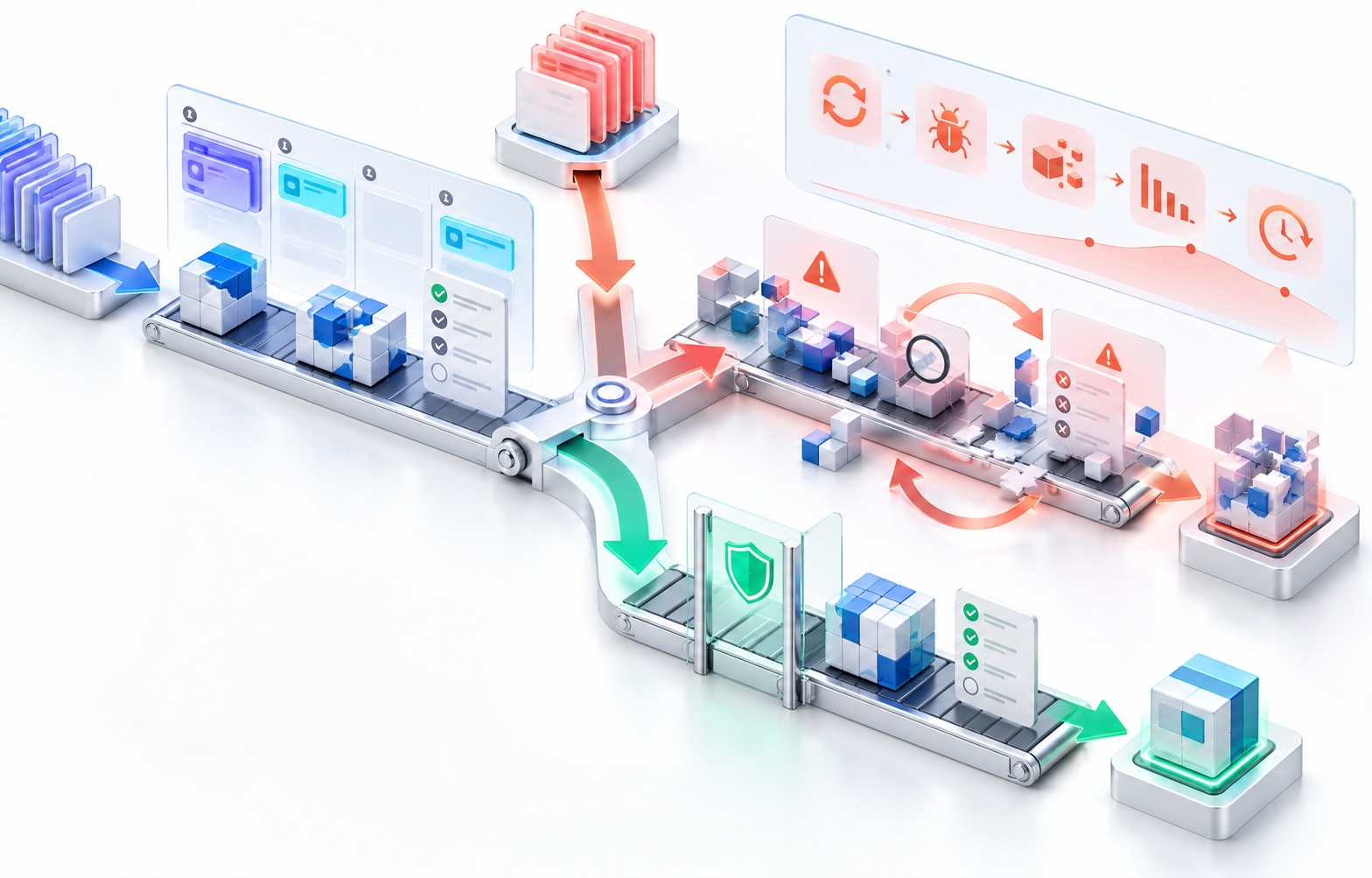
The Real Cost of Mid-Sprint Reprioritization Is a Quality Problem, Not a Scheduling One
A defect ships to production in a SaaS scheduling platform used by mid-size clinics. It surfaces three weeks after release, in a narrow but consequential way: when a front-desk user changes an appointment's provider after it has already been rescheduled once, the system silently keeps the original provider's availability block reserved. Nothing crashes. No error appears. The clinic simply loses a slot it thinks it has, and a patient shows up to an appointment the system never actually held.
The postmortem does what postmortems usually do. It looks at the code, finds the missing state-transition check, and writes a ticket to add a regression test. It does not ask the more useful question, which is when that code was written and what else was happening in the team's world at that moment.
The answer, when someone finally checks the commit history against the sprint board, is unglamorous. The engineer who built the rescheduling logic was pulled onto an urgent billing-export fix on day three of a five-day task, came back to the reschedule work on day six, and finished it in a compressed two days because the sprint review was the next morning. The double-reschedule case — a genuine edge case, not an exotic one — was on the engineer's list of things to handle before the interruption. It never made it back onto the list after. Nobody removed it deliberately. It was simply not there anymore, the way an item can fall out of a mental checklist that gets rebuilt from partial memory instead of read fresh.
This is not a story about a careless engineer or a badly written ticket. It is a story about a decision that was made and never evaluated as a decision: pulling someone off in-flight work to handle something else. That decision gets made constantly, in nearly every product organization, and it is almost never assessed for what it actually costs. Leadership tracks whether the sprint goal was hit, whether the roadmap slipped, and whether the urgent item got resolved. Almost nobody tracks what mid-sprint reprioritization does to the quality of the work it interrupts, even though the mechanism connecting the two is well understood and, in places, well studied.
This article makes the case that reprioritization frequency and timing deserve to be treated as a quality-risk input to product and engineering decisions, not merely a planning inconvenience to be absorbed by "agile flexibility." It lays out why the standard planning-and-velocity lens misses this entirely, what actually happens inside a unit of work when it gets interrupted, and a framework leaders can use to estimate and bound the quality cost of a reprioritization decision before making it — not after a defect report traces back to it.
Why Leadership Tracks the Wrong Half of Reprioritization
Ask most engineering leaders how much their team reprioritizes and they can usually answer with reasonable precision. They can point to the number of times the sprint goal changed this quarter, how often an "urgent" item bumped planned work, and what that did to velocity or roadmap commitments. Product organizations have gotten fairly disciplined about measuring the planning cost of reprioritization: missed sprint goals, slipped release dates, burndown charts with visible kinks where priorities shifted.
What almost none of them can answer is a different question: what happened to the quality of the work that got interrupted. Not the work that got added — the urgent fix, the customer escalation, the executive request — but the work that was already in progress when the interruption landed. That work does not disappear. It gets paused, picked back up later, and usually finished under some version of time pressure, because the schedule slip from the interruption itself has already been absorbed and nobody wants to absorb a second one from the resumed task running long.
The reason this gap exists is not carelessness. It is that the standard toolkit for tracking sprint health was built to answer planning questions, and it answers them well. Velocity, burndown, cycle time, and sprint-goal attainment all describe whether work is moving and whether commitments are being kept. None of them describe what happens to the internal discipline of a piece of work — test coverage, edge-case handling, defensive code — when that work gets interrupted partway through. A team can hit its sprint goal, keep velocity flat, and still ship a meaningfully riskier version of a feature than it would have shipped without the interruption, and the standard dashboard will show nothing unusual.
| What gets measured today | What it tells you | What it does not tell you |
|---|---|---|
| Sprint goal attainment | Whether the team delivered what it committed to | Whether the delivered work carries more defect risk than a non-interrupted version would have |
| Velocity / story points completed | Throughput trend over time | Whether throughput was preserved by cutting corners on interrupted items |
| Burndown chart shape | When and how much scope changed mid-sprint | Which specific in-flight tasks were interrupted, and what state they were in when the interruption happened |
| Roadmap slip / release date variance | Planning accuracy at the roadmap level | Quality variance within features that shipped on schedule despite an interruption |
| Cycle time | How long items take from start to done, on average | Whether an item's cycle time includes a stall-and-resume gap that increased its defect risk |
Table 1: The standard sprint-health metrics leadership already tracks, and the quality question each one leaves unanswered.
This is not an argument that velocity and burndown are the wrong metrics. They answer real questions. It is an argument that they were never designed to answer this one, and treating them as a proxy for "reprioritization is fine as long as the numbers look normal" is a category error. A team can look perfectly healthy on every planning metric while quietly accumulating the kind of risk that shows up three weeks later as a silently reserved appointment slot, or a rounding error in a ledger, or a validation check that never got written.
The 2024 Accelerate State of DevOps Report from DORA makes a version of this point at the organizational level. The report's authors observe that a "move fast and constantly pivot" approach to engineering work damages developer well-being and, in turn, overall performance, and that "instability in priorities, even with strong leadership, comprehensive documentation, and a user-centered approach — all known to be highly beneficial — can significantly hinder progress." That finding is about organizational performance broadly, not defect rates specifically, but it corroborates the underlying claim of this article: priority instability is not a neutral scheduling variable. It has a cost that shows up in delivery outcomes, and treating it as free because the roadmap eventually gets there is a measurement gap, not evidence that the cost doesn't exist.
The Mechanics of an Interrupted Unit of Work
To treat reprioritization as a quality-risk input, it helps to understand precisely what happens, mechanically, when a person is pulled off one task and onto another. This is not a vague claim about "context switching being bad." It is a specific, several-part process, and each part has a distinct effect on the work left behind.
The mental model degrades before the task is even reassigned. Software work, more than most knowledge work, depends on holding a large amount of transient context in working memory: which code paths interact, which edge cases have been handled, which have not, why a particular approach was chosen over an obvious-looking alternative that turned out to have a flaw. Joel Spolsky's widely cited essay on the topic, written from his own experience running a software company, put a number on this that many engineering leaders will recognize even if they have never seen it written down: he estimated that when he had two programming projects on his plate at once, the overhead of switching between them consumed something like six hours of an eight-hour day, leaving two hours of actual output. He also described a case where his team's flagship product was paused for three weeks to handle a client emergency, and getting back to full speed on the paused product took not days but another three weeks — the recovery cost was roughly as large as the interruption itself. Spolsky's central recommendation, stated plainly, is that people should not be asked to work on more than one substantial thing at once, because the human cost of switching bears no resemblance to the near-instantaneous cost of a CPU switching threads, despite the two often being described with the same word. His essay is available in full at joelonsoftware.com.
This is an individual's estimate of his own overhead, not a controlled study, and it should be read that way. But the underlying mechanism it describes — that resuming interrupted work costs meaningfully more than the interruption's calendar duration suggests — has independent support from a different angle. Organizational psychologist Sophie Leroy's 2009 research, published in Organizational Behavior and Human Decision Processes, introduced and tested the concept of "attention residue": when a person switches from an unfinished task to a new one, part of their attention stays with the unfinished task, and that residue measurably degrades performance on the new task, with the effect strongest when the original task was left incomplete rather than completed. The paper is available through ScienceDirect. Applied to software work, this cuts in both directions: the urgent item that triggered the reprioritization is handled by someone whose attention is still partly attached to the interrupted task, and the interrupted task, once resumed, is handled by someone whose attention spent the intervening period partly attached to the urgent item. Neither task gets full attention during the transition window, even after the person is nominally back on it.
The effort available per task drops in a way that compounds, not adds. A frequently cited figure from Gerald Weinberg's book Quality Software Management: Systems Thinking, summarized in a Carnegie Mellon Software Engineering Institute analysis of context switching in DevOps environments, illustrates why splitting attention across concurrent priorities is not a linear trade. According to Weinberg's estimate, a person working on a single project can direct effectively 100 percent of their productive effort toward it. Add a second concurrent project and each gets roughly 40 percent, with about 20 percent lost outright to the overhead of switching. Stretch that same person across five concurrent projects and each gets under 10 percent, with roughly 80 percent of total effort consumed by switching rather than delivered as output. The CMU SEI writeup is available at sei.cmu.edu.
| Concurrent priorities held by one person | Approximate effective effort per priority | Approximate effort lost to switching overhead |
|---|---|---|
| 1 | 100% | 0% |
| 2 | ~40% each | ~20% |
| 3 | ~20% each | ~40% |
| 4 | ~10% each | ~60% |
| 5 | <10% each | ~80% |
Table 2: Gerald Weinberg's widely cited estimate of effort dilution under concurrent task load, as summarized by the Carnegie Mellon Software Engineering Institute. This is a long-standing rule-of-thumb estimate from software management literature, not a controlled empirical study, and individual results vary — but the direction and magnitude of the effect are consistent with the interruption research cited elsewhere in this article. Source: Carnegie Mellon SEI, "Addressing the Detrimental Effects of Context Switching with DevOps".
A mid-sprint reprioritization does not usually put someone at five concurrent priorities. But it very often puts them at two — the interrupted item and the urgent item — for at least the duration of the urgent work, and the table's second row is the one that matters here: roughly 40 percent effective effort on each, with a fifth of total capacity gone before either task benefits from it. That is not a rounding error. It is the difference between a task getting finished with its planned edge-case handling intact and a task getting finished with the minimum needed to pass the demo.
The interrupted task frequently does not get resumed at all, and when it does, resuming it has a real reconstruction cost. A study presented at the 25th IEEE International Requirements Engineering Conference, led by researcher Zahra Shakeri Hossein Abad, examined interruptions in software development work directly and found that developers spend roughly 15 to 30 minutes reconstructing working context after an interruption before they can meaningfully continue, and — more striking — that developers never resume 29 percent of their interrupted or switched tasks at all. The same research found that task switching "typically results in severe performance costs by increasing response latencies and error rates," and specifically flagged programming and testing tasks as more vulnerable to interruption than tasks like architecture or interface design, because of their heavier reliance on sustained problem-solving focus. The paper is available via arXiv.
Read that 29 percent figure carefully, because it is the single most important number in this article. It does not mean 29 percent of interrupted tasks are abandoned outright and never shipped — most eventually get finished, one way or another, because product organizations track open tickets and someone eventually closes them. What it points to is subtler and more relevant here: nearly a third of the time, the original owner's specific understanding of that task — the mental model of the edge cases, the half-built defensive code, the reasoning behind an implementation choice — is not what finishes the task. Someone else finishes it, working from whatever the ticket, the code comments, and the commit history happen to preserve, which is reliably less than what was in the original owner's head. Or the original owner does return to it, but only after enough time has passed that they are effectively reconstructing their own reasoning from evidence rather than recalling it, which the Requirements Engineering Conference research quantifies at 15 to 30 minutes even in the best case of a straightforward resumption.
This is the mechanism behind the clinic scheduling defect from this article's opening. Nothing about the requirement was ambiguous. Nothing about the estimate was wrong. The team had correctly identified the double-reschedule edge case before the interruption happened. What failed was narrower and more specific: the exact piece of context that would have prevented the defect was held in one person's working memory, that person was pulled onto something else for three days, and what came back was not quite the same list of things to handle that had existed before the interruption.
Three Failure Modes That Follow a Mid-Cycle Priority Change
The mechanisms above do not produce a single, uniform kind of defect. They produce a recognizable set of failure patterns, and naming them makes them easier to catch during code review or QA planning, rather than three weeks after release.
Test coverage discipline lapses first, because tests are usually written last. In most workflows, whether test-driven development is formally practiced or not, the sequence in which a feature gets built runs from core logic outward: the primary path first, then edge cases, then error handling, then the tests that verify all of it. An interruption that lands partway through this sequence almost always lands after the core logic is written and before the full test suite exists for it. When the person returns under time pressure — because the sprint deadline did not move even though their available time to hit it did — the path of least resistance is to finish enough to make the feature work for the primary scenario and write tests that confirm exactly that, because writing exhaustive edge-case tests is the first thing time pressure cuts. The feature ships looking complete. Its test suite is thinner than it would have been without the interruption, and it is thinner in a way that is invisible in a code coverage percentage, because the lines that do exist are covered — it is the lines that were never written that are missing.
Edge cases get silently dropped, not deliberately deferred. This is a different failure from choosing to defer a known edge case with a ticket and a comment, which is a normal and often reasonable engineering decision. What happens after an interruption is usually not a decision at all. The engineer's list of "things I still need to handle" existed as working memory, not as a written artifact, at the moment of interruption. When they resume the task, they reconstruct that list from the ticket description, the code so far, and whatever notes they had the discipline to leave — and reconstruction is lossy. An edge case identified through the process of building the feature, rather than written into the original requirement, is the most likely thing to fall out, precisely because it was never anywhere except in the interrupted person's head.
Defensive code gets left half-built and ships that way. Validation logic, rollback handling, retry behavior, and permission checks are frequently implemented incrementally, and it is common for a developer to build the main transaction path, note that error handling needs to be added, and plan to do that before moving to tests. If the interruption lands in that gap, what often survives to production is a function that handles the success path completely and the failure path partially — enough to not throw an obvious exception, not enough to behave correctly under the specific failure condition that will eventually occur. This is the most dangerous of the three failure modes, because it does not show up in a demo, does not show up in a happy-path QA pass, and typically does not show up until the specific failure condition it was supposed to handle actually happens in production.
The person who understands the change best is reassigned before finishing it, and that knowledge does not transfer cleanly. This compounds the first three. When the original owner does not return to the task — moved permanently to the urgent item, out on leave, or simply deprioritized again before coming back — whoever picks it up inherits the code but not the reasoning. Code review can catch some of this, but only for defects visible in the diff. It cannot catch the edge case the original owner knew about and never wrote down, because there is nothing in the diff to review.
| Failure mode | What it looks like in the codebase | Why it is easy to miss | Typical time to discovery |
|---|---|---|---|
| Test coverage discipline lapse | Tests exist and pass, but only cover the primary path reconstructed after resumption | Code coverage percentage looks normal; the gap is in what was never written | Weeks to months, usually via a production incident |
| Silently dropped edge case | No ticket, no comment, no trace — the case simply is not handled | Nothing to flag in review because there is no negative evidence | Highly variable; often triggered by a specific, infrequent user action |
| Half-built defensive code | Success path is complete; failure-path handling is partial or stubbed | Passes a happy-path QA and demo cleanly | Triggered only when the specific failure condition occurs |
| Reassigned ownership without knowledge transfer | Code is technically complete but implements the new owner's best guess at intent, not the original owner's full reasoning | Passes review because the diff looks reasonable in isolation | Often surfaces during the next change to that code, not the original release |
Table 3: Four recognizable quality failure modes that follow mid-cycle reprioritization, and why each one tends to evade the review and QA processes designed to catch defects.
How This Plays Out: Three Scenarios
The mechanics above are easier to evaluate against specific situations than in the abstract. The following three scenarios are hypothetical composites built to illustrate common patterns, not descriptions of actual QAtronic engagements or client work.
A SaaS Company: The Permissions Change That Outran Its Test Plan
Initial situation. A B2B SaaS company is mid-sprint on a feature that lets account administrators delegate limited permissions to team members — a fairly standard access-control feature, moderately complex because of how it interacts with the platform's existing role hierarchy. The engineer assigned to it has finished the core delegation logic and is partway through a matrix of permission-combination tests: delegated view-only access, delegated edit access, delegation that gets revoked mid-session, and delegation interacting with an existing admin role.
The hidden assumption. Leadership assumes that because the feature's core logic is done and a demo works, the remaining work is "just testing" and therefore low-risk to interrupt. This is the assumption that makes the interruption feel free.
The interruption. A significant customer reports that bulk CSV export is timing out on large accounts, threatening a renewal conversation scheduled for the following week. The engineer who built the permissions delegation feature is also the most familiar with the export pipeline, having built it originally. Product leadership reprioritizes: fix the export issue first, permissions work resumes after.
The technical and organizational cause. The export fix takes four days, longer than expected because the timeout has two compounding causes. When the engineer returns to the permissions feature, the sprint is nearly over. The permission-combination test matrix that was roughly half-complete at the interruption point gets finished quickly, but the case of "delegation interacting with an existing admin role" — the most complex combination and the one requiring the most careful reasoning about precedence rules — is the one that gets the least rigorous test coverage, because it is both the hardest to test and the last one on the list when time is short.
The consequence. Three weeks after release, a customer reports that a delegated team member retained edit access to billing settings after their delegation was revoked, because the revocation logic did not correctly account for the case where the same user also held a separate admin role through a different path. This is precisely the interaction the unfinished test case would have caught.
The decision that needs to be made. When the export issue surfaced, leadership had a choice that was never explicitly evaluated: pull the one engineer who understood both systems, accepting an unmeasured quality risk to the nearly finished permissions feature, or absorb a slower export fix by assigning someone less familiar with that code, accepting a different and more visible risk to the customer renewal timeline.
The better approach. Not necessarily "never interrupt urgent customer issues" — the export fix may well have been the right call. The better approach is making that trade explicit at the moment of decision: acknowledging that the permissions feature was in its highest-risk phase (edge-case testing, not yet complete) and either assigning a second engineer to finish the outstanding test matrix in parallel, or explicitly flagging the admin-role interaction case for a dedicated review pass before release, rather than letting it be silently absorbed into "the feature is basically done."
A Fintech Platform: The Reconciliation Job That Shipped Without Its Rounding Test
Initial situation. A fintech company processing merchant settlements is updating its nightly reconciliation job to support a new multi-currency settlement path. The developer has implemented the currency conversion and settlement-matching logic and is in the process of writing tests for rounding behavior across currency pairs with different decimal precision — a known trouble spot in financial systems, since not all currencies use two decimal places, and conversion plus rounding order affects whether totals reconcile exactly.
The hidden assumption. The team assumes rounding tests are a finishing detail rather than core functionality, because the conversion logic itself already passes its primary tests. This is a reasonable-sounding assumption that happens to be wrong for exactly this kind of system, where rounding behavior is not a detail, it is the correctness criterion.
The interruption. A regulatory reporting deadline moves up unexpectedly, and the same developer is pulled to build an export required for the filing. The reprioritization is genuinely non-negotiable — this is a compliance deadline, not a preference.
The technical and organizational cause. The developer returns to the reconciliation work six days later. The conversion logic still passes its existing tests, so the work looks nearly done, and the sprint is now over its original timeline. Under pressure to close it out, the developer finishes the rounding test cases for the two most common currency pairs the company processes and treats the remainder as "the same pattern, should be fine" — a reasonable-sounding shortcut that skips the specific case of a currency pair where the conversion rate itself has more decimal precision than either currency's display format, which is exactly the case most likely to produce a reconciliation mismatch.
The consequence. A small but persistent reconciliation discrepancy appears for merchants settling in that specific currency pair, discovered not by QA but by the merchant's own accounting team noticing settlement totals off by fractions of a cent that accumulate over time into a noticeable gap.
The decision that needs to be made. The regulatory deadline was correctly treated as non-negotiable. The error was in what happened next: nobody flagged that the reconciliation work was interrupted specifically during its highest-risk phase — rounding and precision testing in a financial system — and nobody built in a checkpoint to confirm that phase was actually completed with full rigor after resumption, rather than assumed complete because the feature was functionally working.
The better approach. When a genuinely non-negotiable interruption lands during the riskiest phase of financial logic, the recovery plan should name that phase explicitly and protect it on the way back, for example by requiring a second reviewer to independently verify the full test matrix before release rather than trusting the returning developer's own judgment about what "should be fine."
An Enterprise Healthcare Software Vendor: The Data Migration Validation That Got Compressed
Initial situation. A vendor selling scheduling and records software to hospital systems is migrating a subset of legacy appointment data to a new data model ahead of a client's system cutover. The migration includes a validation pass designed to catch records with inconsistent provider-patient-facility relationships before they are written to the new schema — the kind of validation that exists specifically because legacy data is never as clean as anyone hopes.
The hidden assumption. Because the cutover date is fixed and was set months in advance, the team assumes it has buffer, and buffer feels like something that can absorb an interruption without consequence.
The interruption. A different, unrelated client-facing incident consumes the two engineers most familiar with the migration tooling for five days. The migration timeline does not move, because the hospital's cutover date is fixed and coordinated with the client's own operational planning.
The technical and organizational cause. With five days gone and the cutover date unchanged, the validation pass — originally scoped to check several categories of data inconsistency — gets compressed. The team runs the highest-volume checks (missing provider IDs, malformed dates) and defers a lower-frequency but higher-severity check: appointments assigned to a facility that does not match the patient's registered care network, a configuration error that occurred in a small number of legacy records due to a facility merger years earlier.
The consequence. After cutover, a small number of patients are shown available appointment slots at a facility their insurance does not actually cover, discovered only when patients arrive and are told the visit is out-of-network — a genuine patient-facing failure that also creates a compliance and trust problem for the hospital client.
The decision that needs to be made. The interruption itself may have been unavoidable. What was avoidable was treating "cutover date is fixed" as equivalent to "buffer exists," when in fact the fixed date meant the team was already at its risk tolerance before the interruption happened, leaving no real slack to compress.
The better approach. When an interruption threatens a project with a fixed external deadline and no real buffer, the honest options are to add capacity, negotiate scope (which validation checks are truly optional to defer, decided deliberately rather than by what fits in the remaining time), or negotiate the date. Compressing scope silently, without naming which specific checks are being cut and asking whether that is acceptable, converts an operational decision into an invisible one.
Not All Reprioritization Is Equally Risky
The three scenarios above share a structure worth making explicit: none of them involved a badly written requirement, a bad estimate, or a poorly organized team. Each involved a well-scoped piece of work interrupted at a specific, identifiable point, and the quality cost of the interruption depended heavily on where in the task's lifecycle the interruption landed, not just that an interruption happened at all.
This matters because it means reprioritization risk is not a fixed property of "how often does this team get reprioritized." It is a property of individual decisions, and those decisions vary enormously in how much quality risk they introduce. A few factors consistently separate low-risk interruptions from high-risk ones:
Task phase at the moment of interruption. Interrupting a task before implementation has begun costs planning time but carries almost no quality risk, because nothing partially built is left behind. Interrupting during core implementation costs more but is often recoverable, because the primary logic tends to get documented in the code itself. Interrupting during edge-case handling, defensive coding, or test-writing is the highest-risk window, because this is exactly the phase where the most task-specific knowledge exists only in the developer's head and has not yet been externalized into code, tests, or comments.
Coupling of the interrupted work to other in-flight changes. An isolated feature that can be fully paused and resumed later carries less risk than a change that other in-flight work depends on, because the surrounding context keeps shifting while the interrupted piece sits still, and the gap between the two grows during the pause.
Whether the same person resumes the work. Reassignment risk compounds interruption risk. A pause-and-resume by the same person loses the 15-to-30-minute reconstruction cost the interruption research describes; a pause-and-handoff to someone else loses considerably more, because the new owner has no working memory to reconstruct at all — only what was externalized.
Whether the resumption happens under compressed time. An interruption that pushes the original deadline out by an equivalent amount is materially less risky than one where the deadline holds and the remaining work gets compressed, because compressed resumption is precisely when corners get cut in the way Table 3 describes.
How well the interrupted state was externalized before the person left it. A task paused with a written note of exactly what remains — which edge cases are handled, which are not, what the defensive code still needs — loses much less than a task paused with nothing but the code as it stood, because the note becomes an artifact any resuming person, including the original owner returning after memory has faded, can rely on instead of reconstructing from scratch.
These five factors are not equally visible to a leader making a reprioritization call in the moment, which is exactly the problem. The decision usually gets made by weighing the urgency of the new item against a rough sense of "how far along is the current work," without any structured look at task phase, coupling, ownership continuity, timeline flexibility, or documentation state. The next section turns these factors into something usable at the moment the decision actually needs to be made.
A Framework for Scoring the Quality Cost of a Reprioritization Decision
The purpose of this framework is not to discourage reprioritization. Priorities legitimately change — customer escalations happen, regulatory deadlines move, competitors ship something that changes the calculus, and no organization should pretend otherwise. The purpose is to replace an intuitive, unexamined judgment call with a five-minute structured assessment that surfaces the quality risk before the decision is made, so that if the interruption still goes ahead, it goes ahead with the risk acknowledged and, where possible, mitigated.
Score the proposed interruption against the five factors below. Each factor is scored 0 to 3, with 3 representing the highest risk.
| Factor | 0 (lowest risk) | 1 | 2 | 3 (highest risk) |
|---|---|---|---|---|
| Task phase | Work has not started | Core implementation, primary path | Edge-case handling or defensive code in progress | Test-writing or final validation in progress, incomplete |
| Coupling | Fully isolated; nothing else depends on it | Loosely coupled; a few known dependents | Moderately coupled; several dependents or shared components | Tightly coupled; core to other in-flight work |
| Ownership continuity | Same person will resume, likely within days | Same person will resume, but after more than a week | Different person likely to resume | Task will be abandoned or handed off with no clear resumption owner |
| Timeline flexibility | Original deadline moves out to absorb the interruption | Deadline mostly holds; modest compression | Deadline holds firm; meaningful compression required | Deadline is fixed and non-negotiable with a hard external constraint |
| State externalization | Written handoff note covering remaining edge cases and defensive gaps exists or will be created before the switch | Code comments and ticket notes cover most open items | Only the code itself reflects current state; no explicit notes | Nothing written down; state exists only in the developer's memory |
Table 4: Reprioritization Quality-Risk Scoring Rubric. Score each factor from 0 to 3 based on the specific task being interrupted, then sum for a total risk score from 0 to 15.
Reading the score:
- 0–4 (Low risk): The interruption can generally proceed without special handling. Standard resumption is unlikely to introduce meaningful quality risk.
- 5–9 (Moderate risk): Proceed, but require a brief written handoff note before the switch happens if one does not already exist, and flag the task for a focused review pass when work resumes rather than assuming the demo or passing tests are sufficient.
- 10–15 (High risk): Treat this as a decision requiring explicit trade-off discussion before it happens, not after. Options include adding a second person to finish the highest-risk remaining piece in parallel, negotiating the deadline for the interrupted work, or in rare cases declining the interruption and finding another way to handle the urgent item.
This is not a formula that outputs a single correct answer. It is a way of making a decision that is currently made on instinct into one made with the same five factors considered every time, which is what allows an organization to compare reprioritization decisions to each other and eventually notice patterns — for instance, that interruptions to one particular team consistently score high because that team's work tends to be tightly coupled, which is itself useful information for staffing and sequencing decisions independent of any single interruption.
A Short Checklist for the Moment of Decision
Before approving a mid-cycle reprioritization, a leader can run through this in less time than it takes to read the ticket for the new urgent item:
- Identify the specific task being interrupted, not just "what the team is working on this sprint." The risk lives at the task level, not the sprint level.
- Ask the person doing the work where they are in the task — implementation, edge cases, defensive code, or tests — using Table 4's phase categories as the reference.
- Ask what else depends on this task being finished on schedule, and get a specific answer, not a general sense.
- Decide, explicitly, who resumes the work and whether that is the same person. If not, flag that reassignment as a distinct risk, not an assumed detail.
- Decide whether the original deadline moves. If it does not, say so out loud and treat the resulting compression as a known cost, not a surprise later.
- Ask for a two-minute written note of what is done, what is not, and what the known open risks are, before the person switches tasks. This single step recovers more of the lost context than any other mitigation on this list, and it costs almost nothing.
- Score the interruption using Table 4, and route anything landing in the high-risk band to a brief conversation about mitigation before proceeding, not after.
None of these steps require new tooling. Most can happen in a two-minute conversation. The value is not in the mechanics but in making the assessment happen at all, consistently, rather than leaving it to whether the person approving the interruption happens to think to ask.
Reading the Signals Before You Reprioritize
Beyond the structured scoring, a handful of situational signals reliably predict that an interruption is about to be more expensive than it looks:
The task involves a system with financial, safety, or regulatory consequences for incorrect behavior. The fintech and healthcare scenarios above are not edge cases of the argument; they are the cases where the argument matters most, because the failure modes described in Table 3 are far more consequential in a reconciliation job or a facility-matching validation than in, say, a cosmetic UI preference.
The person being reassigned is the only one who fully understands the system being touched. This is a bus-factor problem wearing a scheduling costume. If pulling someone off a task also means nobody else on the team could finish it correctly without them, that is worth surfacing independently of the immediate interruption decision, because it means every future reprioritization involving that system will carry the same risk.
The urgent item and the interrupted item touch overlapping code. This sounds like it should reduce risk, since the person stays in a related mental context, but it more often increases it, because the two pieces of work can bleed into each other — a fix made under time pressure for the urgent item can subtly change behavior the interrupted feature was relying on, in ways neither task's tests are positioned to catch.
This is not the first interruption to this particular task. Each additional interruption compounds attention residue and reconstruction cost. A task interrupted once is a manageable risk. A task interrupted twice, with two separate gaps in continuity, is a materially different situation and should be scored accordingly — Table 4's ownership-continuity and state-externalization factors should be re-evaluated at each additional interruption, not assumed static from the first assessment.
The team has recently reprioritized this frequently and nobody has looked at the pattern. A single interruption is a decision. A pattern of frequent interruption is a structural problem — often a sign that intake for urgent work has no filter, or that the roadmap is being treated as provisional by stakeholders who have learned that squeaky wheels get engineering time regardless of sprint commitments. The framework in this article helps assess individual decisions; a recurring high frequency of them is a separate, organizational-design problem worth raising on its own.
What to Do When the Reprioritization Is Non-Negotiable
Some interruptions genuinely cannot be declined. A regulatory deadline moves. A security incident demands immediate attention. A major customer's production outage cannot wait for the current sprint to finish. In these cases, the scoring framework above is not about deciding whether to interrupt — it is about deciding how to protect the interrupted work on the way out and the way back in.
A practical sequence for handling an unavoidable interruption:
- Freeze the interrupted task's current state in writing within the hour, not at end of day and not "when there's a moment." Attention residue research suggests the person's ability to accurately recall their own mental state degrades quickly once they start engaging with the new task, so the note needs to happen before that engagement begins, not after.
- Explicitly name the riskiest unfinished piece, using the failure-mode categories in Table 3 as a checklist: is there an edge case identified but not yet coded? Is there defensive code started but incomplete? Is there a test category not yet written? Naming it converts a vague "I'll remember" into a specific artifact someone else could act on if the original owner does not return.
- Decide the resumption owner in advance, not by default. If there is meaningful risk the original person will not return to this task — because the urgent item runs long, or because priorities shift again in the meantime — name a backup reviewer now, while the context is freshest, rather than discovering weeks later that nobody remembers who was supposed to pick it back up.
- Protect the resumption timeline as deliberately as the interruption itself was decided. If the original deadline cannot move, say so explicitly and treat the resulting compression as a scoped, named risk — ideally with a decision about which specific pieces of remaining work (which edge case, which test category) are allowed to be cut, rather than leaving that decision to whoever is under the most time pressure at the moment.
- Schedule a specific, focused review of the resumed work, not a generic code review folded into the normal pull request process. The point of this review is to check specifically against the note from step 2: were the named risks actually addressed, or did they quietly become the things that got cut under the compressed timeline from step 4.
This sequence does not eliminate the cost of interruption. Nothing can, short of not interrupting at all, which is often not a realistic option. What it does is convert an unmanaged cost into a managed one — visible, named, and checked, instead of silently absorbed and discovered later as a production defect.
Measuring Reprioritization as a Quality-Risk Input, Not Just a Velocity Metric
If reprioritization has a measurable-in-principle effect on quality, the natural next question is what an organization can actually track to make that effect visible over time, rather than relying on the scoring framework as a one-off decision aid used inconsistently.
None of the following are established industry-standard metrics in the way that, say, DORA's change failure rate is — change failure rate measures the percentage of deployments that result in degraded service and require remediation, and it is well defined precisely because "deployment" and "remediation" are both unambiguous, observable events. Reprioritization's effect on quality is real but harder to observe directly, because the causal chain runs through a person's internal state, not a system event a monitoring tool can log. The metrics below are proposed candidates, offered with their real limitations stated plainly, not established benchmarks with agreed thresholds.
| Candidate metric | What it approximates | How to collect it | Real limitations |
|---|---|---|---|
| Interrupted-task defect rate | Whether tasks that were reprioritized mid-cycle produce defects at a different rate than tasks that were not | Tag tickets as "interrupted" at the moment of reprioritization; cross-reference against defects later linked to those tickets | Requires disciplined tagging at the moment of interruption, which is easy to skip under time pressure — the exact moment it is least likely to happen |
| Resumption gap | Calendar time between a task being paused and resumed | Difference between pause and resume timestamps on a ticket, if the workflow tool captures state changes | Measures only calendar time, not the reconstruction cost or attention residue that actually drives risk; a short gap is not automatically a safe one |
| Reprioritization frequency per team | How often a given team's in-flight work gets interrupted over a period | Count of mid-cycle priority changes per sprint or per quarter, per team | Frequency alone does not indicate severity; five low-risk interruptions are not equivalent to one high-risk one, so this metric needs Table 4's scores as context, not as a replacement |
| High-risk-score interruption count | How often interruptions specifically land in the highest-risk band from the scoring framework | Tally of Table 4 scores in the 10–15 range over a period | Depends entirely on the scoring actually being done consistently; an unused framework produces no data |
| Post-interruption escaped-defect rate | Whether defects that reach production correlate with a resumed task in their recent history | Requires linking production incidents back to the specific commits and tickets involved, then checking those tickets' interruption history | Retrospective and effort-intensive; works better as a periodic audit than a continuous metric |
Table 5: Candidate metrics for tracking reprioritization's quality effect over time. These are proposed measurement approaches for organizations that want to move beyond one-off risk scoring, not validated industry benchmarks.
The most practical starting point for most organizations is the simplest one: tag interrupted tickets at the moment of interruption, and periodically check whether defect rates differ between tagged and untagged work of comparable size and complexity. This will not produce a rigorous statistical result in most team sizes — the sample sizes involved in a single product team's defect history are usually too small for that — but it produces something more useful in practice, which is a habit of looking, and a rough signal leadership can sanity-check against their own sense of where quality problems have been clustering.
Where This Breaks Down
A framework this specific invites a specific kind of overcorrection: treating every reprioritization as a threat to be resisted, or requiring the full scoring exercise for decisions too small to warrant it. Both are real failure modes worth naming directly.
Genuinely small interruptions do not need the full framework. Pulling someone off a task that has not started yet, or one that is nearly complete with only trivial cleanup remaining, scores low on every factor in Table 4 for a reason — the framework should confirm that intuition quickly, not manufacture process where none is needed. Applying a five-factor scoring exercise to every minor scheduling adjustment will train people to skip it entirely, which defeats the purpose.
Some interruptions are correctly urgent enough that the quality trade-off is worth accepting consciously. A live security vulnerability being actively exploited does not wait for a handoff note. In genuine emergencies, the right response is to accept the risk, document what was skipped as debt to revisit rather than pretend the shortcut did not happen, and move on. The framework's value in these cases is not in preventing the interruption but in making sure the skipped safeguards get explicitly reopened afterward rather than quietly forgotten because the emergency is over and everyone has moved on.
A team with chronically poor task decomposition will see high risk scores regardless of interruption frequency, and the framework will misdiagnose the root cause. If tasks are routinely large, tightly coupled, and poorly documented as a matter of course — independent of whether they are interrupted — every reprioritization will score as high risk, and the real fix is smaller, better-decomposed work, not fewer interruptions. Table 4's coupling and state-externalization factors are useful diagnostics here in their own right: a team that consistently scores high on those two factors, interruption or not, has a decomposition and documentation problem worth solving directly.
Teams operating in a genuinely stable, low-change domain may find this framework is solving a problem they do not have. A team maintaining a mature, slowly evolving internal system with infrequent priority changes will get limited value from formalizing a process for a decision they rarely face. This is squarely a tool for teams and organizations where reprioritization is frequent enough to be a recurring pattern, not an occasional exception.
Startups, Scale-Ups, and Enterprises See This Differently
The underlying mechanism — interrupted work loses context, and lost context produces defects — is constant across company stage. How the risk manifests, and what mitigation is realistic, differs enough to be worth addressing separately.
Early-stage startups often have the least formal protection against reprioritization and, somewhat paradoxically, sometimes the least exposure to its worst consequences, because team sizes are small enough that the same two or three people touch most of the codebase regardless of who is nominally assigned to what. The real risk at this stage is less about lost institutional knowledge — there usually is not much institutional knowledge yet to lose beyond what is in a handful of people's heads, which is itself the vulnerability — and more about accumulating undocumented defensive-code gaps at a rate the team has no capacity to track, because there is no QA function distinct from the engineers themselves and no bandwidth for the kind of structured handoff this article recommends. For startups, the most realistic version of this framework is the lightweight checklist in the earlier section, applied informally, rather than the full scoring rubric — the two-minute written note before a switch is disproportionately valuable here because it is nearly the only mitigation that fits the available time and process maturity.
Scale-ups are frequently where this problem is most acute, because team size has grown past the point where informal shared context covers the gaps, but formal process — dedicated QA capacity, documented handoff practices, structured code review focused on more than syntax — often has not caught up. This is also the stage where reprioritization tends to be most frequent, because the organization is simultaneously fielding more customer escalations as its customer base grows and still operating with startup-era instincts about roadmap flexibility. Scale-ups are the natural home for the full scoring framework in this article: team size is large enough that decisions cannot rely purely on shared tacit knowledge, but the organization is usually still agile enough to adopt a five-minute assessment without it becoming another layer of bureaucracy.
Enterprises typically have more formal QA and review processes already in place, which catches more of the failure modes described in this article before release — but enterprises also tend to have the most tightly coupled systems, the longest resumption gaps (because approval chains and competing priorities make same-person resumption less likely), and the highest stakes when a defect does escape, as the healthcare and fintech scenarios above illustrate. For enterprises, the highest-value addition from this framework is usually not the scoring rubric itself, which formal QA processes partially substitute for already, but the ownership-continuity and ticket-tagging discipline in the measurement section — making reprioritization's effect visible in defect data that enterprise QA teams already collect, rather than treating it as an unmeasured variable buried inside a general defect rate.
Where This Decision Actually Gets Made, and Who Should Be in the Room
Frameworks like the one above fail quietly when they exist as a document nobody consults at the moment the decision is actually happening. Reprioritization decisions rarely get made in a scheduled meeting with time to reflect. They get made in a Slack thread, a hallway conversation, or a two-minute exchange after a customer escalation lands in an incident channel — precisely the settings least conducive to pulling up a scoring rubric. Making the framework useful in practice means embedding it into moments that already exist, rather than asking anyone to create a new one.
Incident and escalation triage is the highest-value point of embedding. Most organizations already have some form of triage process for deciding whether an incoming issue is urgent enough to interrupt planned work — a severity rubric, an on-call rotation, an escalation channel. The quality-risk score from Table 4 belongs inside that same conversation, as a second axis alongside severity, not as a separate approval step layered on top. A triage conversation that already asks "how severe is this" can add, at negligible extra cost, "what does pulling someone onto this cost the thing they're currently doing" — and answering that second question is usually a thirty-second exchange with whoever owns the in-flight task, not a formal review.
Daily standups are a natural place to surface state, but a poor place to make the decision. When a reprioritization has already happened, standup is where the resulting gap tends to become visible — someone mentions they got pulled onto something else and are now behind on their original task. This is useful information, but by the time it surfaces in standup, the interruption has already occurred and the highest-value mitigation, the written handoff note made before the switch, has usually already been missed. Standups are better used to check whether the mitigation steps happened — was a note left, has a resumption owner been confirmed — than to make the original call.
Sprint planning and backlog refinement are where patterns become visible, not individual decisions. No single planning session will catch an urgent mid-sprint interruption before it happens, by definition. What planning sessions are well suited for is reviewing the previous period's interruption pattern: how many reprioritizations happened, how they scored, and whether any recognizable pattern emerged — a particular system that keeps generating high-risk interruptions, a particular class of urgent request that keeps landing on the same one or two engineers. This is where the measurement approach from the earlier section pays off, turning individual decisions into an input for team-level planning rather than treating each interruption as an isolated event with no history.
Retrospectives are where the mitigation steps should be audited, not just the outcome. A retro that asks "did anything ship with quality problems this sprint" is useful but arrives too late to change anything about how the next interruption gets handled. A more targeted question — "of the tasks that got interrupted this sprint, did we actually leave a handoff note, and did we actually name a resumption owner" — checks whether the process in this article is being followed in practice or has quietly become theoretical. Teams that adopt a framework like this one and never revisit whether it is actually being used in the moment tend to find, six months later, that it has fully lapsed without anyone deciding to abandon it.
Ownership of the decision matters as much as the process for making it. In many organizations, the person with the authority to approve a mid-sprint interruption — a product leader, an account executive escalating a customer issue, an executive responding to a board question — is not the person who will feel the consequences of the interrupted task shipping with gaps. This is not a claim that those approvers act carelessly; it is a structural observation that the cost of an interruption is often invisible to the person deciding to cause it, because it surfaces later, attributed to a different cause, and reported through a different channel than the one where the interruption was approved. Giving the engineer or engineering manager closest to the interrupted work a genuine voice in the approval — not a veto, but a required, specific answer to "what does this cost the thing you're currently doing" — closes a substantial part of that visibility gap without slowing down decisions that are genuinely urgent.
None of this requires new software or a formal governance process. It requires deciding, once, where in the organization's existing rhythm this assessment will live, and then actually using it there consistently enough that it becomes habit rather than an document referenced once and forgotten.
Frequently Asked Questions
Does reprioritizing mid-sprint always hurt quality? No. The risk depends heavily on where in the task's lifecycle the interruption lands, whether the same person resumes the work, whether the timeline compresses, and how well the interrupted state gets documented before the switch. An interruption to a task that has not started yet, or one that is essentially finished, carries little quality risk. The risk concentrates specifically in tasks interrupted during edge-case handling, defensive coding, or test-writing — the phases where the most task-specific knowledge exists only in the developer's head.
Is this the same thing as scope creep? No. Scope creep describes a requirement growing larger or less defined over time, usually within a single piece of work. Mid-sprint reprioritization is about a team being pulled away from one already-scoped task to work on a different one, then returning to the first task later. The quality risk described in this article comes from the interruption and resumption process itself, independent of whether either task's requirements were well defined.
How is this different from technical debt prioritization? Technical debt prioritization is about deciding which known, already-identified debt items to address and in what order, typically from a backlog that already exists. This article is about the in-flight act of pulling a team off currently active work to handle something else, and the quality consequences of that specific act — a scheduling and timing problem, not a backlog-ranking problem. See QAtronic's Technical Debt Prioritization for Product Managers for the debt-backlog question specifically.
Does the Scrum framework already address this? Partially, and mostly by intent rather than enforcement. The Scrum Guide states that developers "collaborate with the Product Owner to negotiate the scope of the Sprint Backlog within the Sprint without affecting the Sprint Goal," which implies protection against arbitrary scope changes. In practice, this protection depends entirely on organizational discipline in honoring it. Many organizations running formal Scrum still reprioritize mid-sprint when a stakeholder insists, and the framework itself has no mechanism to prevent that beyond the Scrum Master's role in raising the concern — it describes the intended discipline, not an enforcement mechanism.
What is a reasonable frequency of mid-sprint reprioritization? There is no universal number, and this article does not propose one, because the right frequency depends heavily on the business the team supports — a team fielding live production incidents for a payments platform will reasonably see more urgent interruptions than a team building an internal reporting tool. The more useful question is not "how often" but "how consistently is each interruption's risk actually assessed," using something like the scoring framework in this article, rather than left to instinct every time.
Should QA be involved in the reprioritization decision itself, not just in testing what results from it? Where feasible, yes. QA teams are often the first to notice the downstream pattern — defects clustering around tasks with a documented history of interruption — but rarely have visibility into the reprioritization decision itself, since that decision typically happens between product and engineering leadership before QA is involved. Giving QA visibility into which in-flight tasks are being interrupted, even informally, closes a gap between the group best positioned to recognize the risk pattern and the group making the decision that creates it.
Can automated testing eliminate this risk? It reduces some of it but does not eliminate the underlying cause. Strong automated regression coverage catches defects introduced by a resumed task colliding with existing behavior, which is valuable. It does not, on its own, catch edge cases that were never coded in the first place, because there is no implementation to test against — the gap described in this article is often an absence, not a regression. Automated testing is a genuine mitigation for part of this problem, not a substitute for the process changes described here.
A Distinct Place for Independent QA Capacity
One structural reason this problem persists is that the people best positioned to catch these failure modes — reviewers with fresh eyes on exactly the edge cases and defensive code most likely to have been skipped — are often the same engineers who are also the ones getting reprioritized, which means QA coverage shrinks at precisely the moments it is needed most. Organizations that maintain QA capacity independent of the feature-development team's own reprioritization cycles are structurally better positioned to catch the failure modes in Table 3, because a dedicated QA function reviewing a resumed task is not itself competing for the same attention that was just pulled away from it. This is one of the more concrete, practical reasons to treat software QA services as a distinct capacity commitment rather than a rotating responsibility absorbed by whichever engineers have time between reprioritizations — the review capacity needs to be stable specifically because the development capacity is not.
The Principle to Take Back to Your Team
Mid-sprint reprioritization is not free, and it was never going to become free by being managed as a scheduling problem instead of a quality one. The cost is real, it is describable — lost context, dropped edge cases, half-finished defensive code, reassigned ownership — and in every scenario examined in this article, the requirement was well written, the estimate was reasonable, and the team was competent. The defect still shipped, because the interruption happened during the highest-risk phase of the work and nobody evaluated it that way at the time.
The distinction worth carrying into the next reprioritization conversation is this: the question is not whether to interrupt in-flight work, because sometimes the answer to that is obviously yes. The question is whether the decision to interrupt gets made with the same rigor as any other decision with a known, describable cost — or whether it continues to be made on instinct, with the cost discovered later, disconnected from its cause, in a production incident that gets traced back to a code defect instead of the decision that actually created it.
The next time a reprioritization request comes in mid-sprint, the useful question for a leadership team is not "can we afford to say yes." It is "do we know, specifically, what phase of work we're interrupting, who will resume it, and what happens to the deadline" — and if the honest answer is no, that gap is the actual risk, not the interruption itself.
Resources and Sources
- The 2020 Scrum Guide — Scrum.org / Ken Schwaber and Jeff Sutherland
- Human Task Switches Considered Harmful — Joel Spolsky, Joel on Software
- Addressing the Detrimental Effects of Context Switching with DevOps — Carnegie Mellon University Software Engineering Institute
- Announcing the 2024 DORA Report — Google Cloud Blog / DORA
- Use Four Keys Metrics Like Change Failure Rate to Measure Your DevOps Performance — Google Cloud Blog
- Why Is It So Hard to Do My Work? The Challenge of Attention Residue When Switching Between Work Tasks — Sophie Leroy, Organizational Behavior and Human Decision Processes (2009), ScienceDirect
- Task Interruption in Software Development Projects: What Makes Some Interruptions More Disruptive Than Others? — Shakeri Hossein Abad et al., IEEE International Requirements Engineering Conference (2017), arXiv
- Technical Debt Prioritization for Product Managers — QAtronic
- Software Estimation Accuracy: Why Estimates Always Miss — QAtronic