AI Agent Readiness: Testing Your Website for Agents That Browse, Compare, and Buy
A mid-market furniture retailer's analytics team noticed something odd in the spring of 2026: cart-abandonment rate at the payment step had ticked up by a few points over six months, with no corresponding change in traffic source, price, or shipping policy. The usual suspects — a slow page, a broken discount code, a confusing shipping calculator — all checked out fine. Session recordings showed nothing unusual, because the sessions in question weren't being recorded as unusual at all. They looked like ordinary visits: a product page loaded, a size and color were selected, an address was typed into a field, and then the session simply stopped, always at the same step, always right after a security challenge appeared.
Nobody on the team asked whether the visitor was human. The dashboard didn't have a column for that question, and until recently there was no reason to add one. That single missing distinction — a growing share of sessions that behave like purchase-intent traffic but are not conducted by a person sitting at a keyboard — is becoming one of the more consequential blind spots in web product engineering, and this is a hypothetical composite scenario built from patterns now documented across e-commerce and SaaS checkout flows, not a specific company's data.
The visitors are AI browsing agents: software that reads a web page, decides what to click, fills in what to type, and carries out a task on behalf of a person who gave it an instruction and walked away. Some of them are now shipping in generally available products from major AI labs. A few of them can already complete a purchase without the human touching a keyboard again after the initial request. None of the standard web quality practices most companies rely on — human-centered UX testing on one side, bot-defense and fraud systems on the other — were built to notice when this kind of traffic fails, because it doesn't fail the way a human fails and it doesn't behave the way a scraper behaves. It sits in the space between the two disciplines, and that space currently has almost no owner.
This article lays out what these agents can actually do today, what current data says about how much of this traffic already exists, why it fails silently on typical production sites, and a concrete framework — Agent Readiness testing — for finding those failures before they show up as an unexplained dip in a conversion chart nobody can quite trace.
Two Testing Disciplines That Were Never Built to Cover This
Most engineering organizations run two largely separate programs that touch how a website behaves for outside visitors.
The first is UX and functional testing: does the checkout flow work, does the form validate correctly, is the page usable on mobile, does the site meet accessibility standards. This discipline assumes a human is present — someone who can recognize a modal dialog, wait out a slow JavaScript render, retry after a vague error message, or solve a visual puzzle. Every heuristic in a typical usability review, from "reduce cognitive load" to "make errors recoverable," is implicitly written for a person with eyes, patience, and general world knowledge.
The second is bot defense: web application firewalls, fraud-scoring engines, rate limiting, and CAPTCHA challenges. This discipline assumes the opposite — that anything moving faster or more mechanically than typical human behavior is probably hostile, and that the correct default is to block, throttle, or challenge it. Its success metric is how much malicious automated traffic it keeps out: credential-stuffing bots, scraper fleets scraping prices for competitors, inventory-hoarding scripts, fake-account creation at scale.
An AI agent acting on behalf of a paying customer fits neither model cleanly. It isn't a human, so UX testing never validated the experience for it. It isn't malicious, so treating it the way a bot-defense system treats a credential-stuffing bot produces a false positive with a real customer on the other end of it. The result is a traffic class that is functionally invisible to both programs: too automated for the humans-only assumptions baked into UX QA, and too benign-but-unfamiliar for a fraud system tuned to distinguish "attacker" from "person."
It's worth being precise about what this article is not about, because QAtronic has already covered an adjacent but different problem. A separate QAtronic article addressed agentic AI testing — validating the reliability, safety, and correctness of autonomous AI agents that a company builds and operates itself, such as an internal AI agent that files support tickets or an AI copilot embedded in a product. That is a first-party engineering problem: you own the agent, you can instrument it, and you are responsible for what it does.
This article is the mirror case. The agents in question are not built or controlled by the company whose website is being visited. They are ChatGPT, Claude, Comet, or Gemini, acting on instructions from someone who is your prospective customer, browsing your site the way any other consumer traffic would. You cannot instrument the agent. You cannot see its internal reasoning. You only see what arrives at your server, and what leaves it — a request, a rendered page, a click or a timeout. The discipline this requires is not "test the agent," because the agent isn't yours to test. It's "test what your site looks like to the agent," which is a fundamentally different exercise closer to accessibility testing or cross-browser compatibility than to conventional QA.
What Agentic Browsing Actually Does Today, Verified Against Preview and General Availability Status
Coverage of "AI agents" varies wildly in precision, and the space moves fast enough that a capability described in one quarter's press coverage may be discontinued, renamed, or promoted from preview to general availability by the next. Before building any testing strategy, it's worth being exact about what is actually shipped, to whom, and under what constraints, as of this writing.
OpenAI — ChatGPT Atlas and Agent Mode. OpenAI shipped ChatGPT Atlas, a standalone web browser with ChatGPT built in, in October 2025, available on macOS to Free, Plus, Pro, and Go tier users, with Business access in beta. Inside Atlas, "Agent Mode" lets ChatGPT complete end-to-end tasks — OpenAI's own example is researching a meal plan, building an ingredient list, and adding groceries to a cart for delivery — under human oversight. As of this writing, OpenAI's own release documentation explicitly labels Agent Mode a preview feature, available to Plus, Pro, and Business users, with explicit boundaries: it cannot run code, download files, install extensions, access other applications, or use saved passwords and browser autofill data. Separately, and importantly distinct from Agent Mode, OpenAI's Instant Checkout is generally available today to U.S. ChatGPT Plus, Pro, and Free users, allowing a single-item purchase to be completed inside a chat conversation. It launched with U.S. Etsy sellers live, and OpenAI has stated plans to bring on more than a million Shopify merchants. Instant Checkout runs on the Agentic Commerce Protocol (ACP), an open standard OpenAI co-developed with Stripe, which standardizes how an agent, a merchant's commerce platform, and a payment processor exchange the minimum information needed to complete an order.
Anthropic — Claude computer use and the browser use tool. Anthropic's computer use capability, which lets Claude view a screen, move a cursor, click, and type, moved to general availability alongside a purpose-built browser use tool as of August 20, 2026. The browser tool is a meaningful architectural step beyond pixel-based computer use: rather than only reasoning over a screenshot, the agent also reads the structural markup of a page and can act on a specific field or button by its role in the DOM rather than by screen coordinates. Anthropic's own materials describe the updated tool as able to take multiple actions per model turn, reducing the number of round trips needed to complete a task, and note that computer use is now eligible for HIPAA-regulated workloads under Anthropic's Business Associate Agreement — a signal that Anthropic expects this capability to be used for consequential account and form-based workflows, not just casual browsing.
Perplexity — Comet and "Buy with Pro." Perplexity launched Comet, an agentic AI browser, in July 2025. Comet's assistant can summarize pages, navigate sites, and carry out multi-step tasks inside the user's own browser session. Perplexity's agentic shopping feature, "Buy with Pro," originally limited to Pro and Max subscribers, began expanding to all U.S. Perplexity users — including free-tier users — starting in November 2025, with a PayPal-powered checkout experience layered onto natural-language shopping queries. Comet browser access followed the wider desktop and web rollout in subsequent weeks. This means agentic shopping through Perplexity is no longer a paid-tier novelty; it is becoming a mainstream, free capability for a very large existing user base.
Google — from Project Mariner to Gemini in Chrome. Google's early standalone agent research effort, Project Mariner, launched to Google AI Ultra subscribers in the United States in May 2025 as an experimental Chrome extension capable of shopping, research, and form-filling tasks with human oversight. Google discontinued Project Mariner as a separate product on May 4, 2026, folding its underlying technology directly into Chrome and Gemini rather than continuing it as a standalone offering. The successor capability, announced at Google I/O 2026 and branded "Auto Browse," is a Gemini-3-powered agent mode built into Chrome itself, capable of multi-step tasks such as researching hotel and flight prices across date ranges, filling out long forms using information pulled from PDFs, identifying a product from an image and finding similar options, adding items to a cart, and applying discount codes. As of this writing, Auto Browse is in preview, limited to the United States, available only to Google AI Pro and Google AI Ultra subscribers on Windows, macOS, and Chromebook Plus. Google has paired it with the Universal Commerce Protocol (UCP), its own open standard for agentic purchasing — a direct, and currently non-interoperable, counterpart to OpenAI and Stripe's ACP. Both Auto Browse and OpenAI's Agent Mode include explicit confirmation gates before purchases, password use, or public posting, reflecting a shared industry recognition that unsupervised agent transactions carry real risk.
The table below summarizes verified status as of this writing. Because this category changes quickly, treat "preview" and "GA" labels as a snapshot, not a permanent classification, and re-verify before making architecture decisions based on any single vendor's roadmap.
| Product | Vendor | Core capability | Status (as of writing) | Availability | Commerce protocol |
|---|---|---|---|---|---|
| Agent Mode (in ChatGPT Atlas) | OpenAI | Multi-step task completion inside a dedicated browser | Preview | Plus, Pro, Business (macOS) | — |
| Instant Checkout | OpenAI | In-chat single-item purchase | Generally available | US, Etsy live; Shopify rolling out | Agentic Commerce Protocol (ACP), with Stripe |
| Computer use / browser use tool | Anthropic | Screen- and DOM-aware action-taking for Claude | Generally available | Claude Platform (API/enterprise use) | — |
| Comet browser | Perplexity | Agentic browsing inside a dedicated browser | Generally available (browser); GA rollout | Free and paid tiers | — |
| Buy with Pro | Perplexity | Natural-language shopping and checkout | Rolling out to all US users | Free tier expansion in progress | PayPal-based checkout |
| Auto Browse (Gemini in Chrome) | Multi-step task completion inside Chrome | Preview | US only, Google AI Pro/Ultra | Universal Commerce Protocol (UCP) | |
| Project Mariner | Standalone experimental browsing agent | Discontinued (May 2026) | — | — |
Two patterns are worth naming explicitly. First, every major vendor has converged on the same architecture: an agent embedded in or attached to a browser, with an explicit human-confirmation gate before anything consequential happens, rather than fully unattended autonomy. Second, the industry has produced two competing, non-interoperable commerce protocols (ACP and UCP) within roughly the same year, which means a merchant optimizing for "agent readiness" today has to consider that the technical integration path may itself fragment before it consolidates. Neither protocol dominance is resolved as of this writing, and betting an entire commerce integration on one over the other is a real strategic risk, separate from the testing problem this article focuses on.
How Much of This Traffic Actually Exists
Any serious discussion of agentic traffic needs to draw a sharp line between two things that get casually conflated in trade coverage: crawler traffic that fetches pages to train models or answer search queries, and action-taking agent traffic that fills in forms, clicks buttons, and completes transactions on a live session. Public infrastructure data is far more mature for the first category than the second, and it is important not to borrow crawler statistics to make claims about checkout-completing agents, because they are measuring different things.
On crawler and bot traffic broadly, the data is real and substantial. Cloudflare, which sits in front of a large share of global web traffic, reported that as of mid-2026, more than half of internet traffic is non-human, and that AI-training crawler requests grew from roughly 22 percent of crawler traffic in spring 2025 to 52 percent by June 2026 — a roughly 30-percentage-point shift in about fifteen months. Cloudflare also noted that some heavily crawled content categories saw human traffic to their own pages decline by as much as 40 percent within a year, as AI interfaces increasingly answer queries without sending a click back to the source. Separately, Thales/Imperva's 2026 Bad Bot Report put total automated traffic at 53 percent of the web in 2025, up from 51 percent the year before, with human activity now a minority of measured traffic for the first time in the report's history. Fastly's own 2025 threat research found that AI crawlers made up close to 80 percent of measured AI-related bot traffic, with a small number of large model operators accounting for most of the volume.
These numbers describe crawling and retrieval, not agentic action. They tell you that a very large and fast-growing share of requests hitting a typical site are non-human, and that the split between "search-style crawling" and "AI training and agent-adjacent crawling" has moved sharply toward the latter in a short period. What they do not yet tell you — because no infrastructure vendor currently publishes this breakdown publicly — is what fraction of traffic represents an agent like ChatGPT's Agent Mode, Claude's browser tool, Comet, or Auto Browse actually filling in a form or completing a purchase on behalf of a live user, as opposed to a crawler indexing a page for later retrieval. This is a genuine measurement gap in the industry, not a data point this article can respectably fill in with an invented figure.
What can be said with confidence, based on verified product facts rather than traffic statistics: the number of shipping products capable of agentic, action-taking browsing has gone from effectively zero to at least four major vendor offerings (OpenAI, Anthropic, Perplexity, Google) within about eighteen months, at least two of which (Instant Checkout and Buy with Pro) are already generally available to free-tier consumer users at meaningful scale, and Perplexity in particular has stated an explicit intent to make agentic shopping a default, not a premium, capability for its user base. Cloudflare's own response — building a cryptographic signing standard (Web Bot Auth) specifically to let "signed agents," described as automation directed by an end user rather than a company-owned crawler, identify themselves distinctly from scrapers — reached general availability in August 2025, with early partners including ChatGPT's agent, the open-source Goose agent, and browser-automation infrastructure providers Browserbase and Anchor Browser. Infrastructure providers do not typically build and ship new cryptographic authentication standards for a traffic category they consider negligible. That, more than any single traffic-share percentage, is the leading indicator worth taking seriously.
For planning purposes, this article treats the following as an illustrative, explicitly hypothetical scenario rather than a real industry benchmark: imagine a mid-size e-commerce site currently seeing on the order of one to three percent of checkout-intent sessions initiated by an agentic browser rather than a human, growing over the following two to three years as agent adoption follows the trajectory crawler and chatbot-referral traffic did. That range is not drawn from any published measurement — it is a reasoning tool for the checklist and framework later in this article, useful for stress-testing whether a company's current monitoring would even notice the traffic if it existed at that scale. If a company cannot answer "would we know" for a one-percent illustrative scenario, that is itself the finding, independent of what the real number eventually turns out to be.
Where the Journey Breaks: A Structural Map of Agent Failure Points
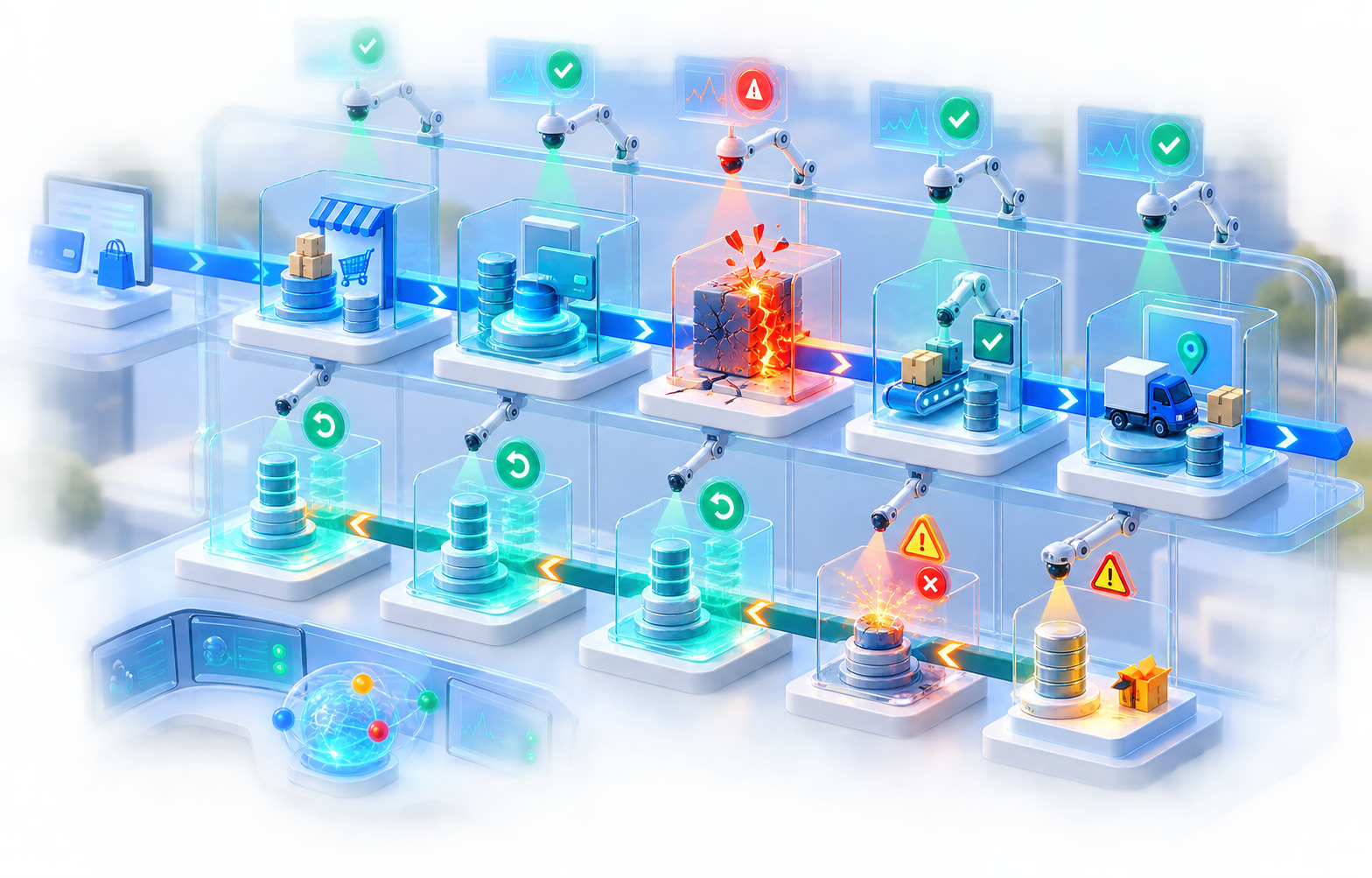
The reason agentic failures are silent rather than loud is that they tend to occur exactly where human-centered design assumes visual and cognitive flexibility that an agent, however capable, does not reliably have. The diagram below maps a standard e-commerce or SaaS journey and marks where human and agent paths diverge.
Four structural failure modes recur across real production sites, independent of industry vertical.
Client-side-only rendering with no structured fallback. Many modern storefronts and SaaS dashboards render price, inventory, or account status entirely through client-side JavaScript frameworks, often loading data asynchronously after multiple round trips, sometimes gated behind user interaction like a hover or a tab click. A human waits, sees a spinner, and understands the page is still loading. An agent that reads the DOM at a fixed point, or that has a bounded budget for how long it will wait for a page to settle, can capture an empty state and reasonably conclude the item is unavailable, the price is unknown, or the account has no data. The failure is not that the agent is unintelligent. It is that the page was built on an assumption — a patient, visually attentive human who will wait out the render — that does not hold for a system operating under a token or time budget, and that was never validated because no automated test ever exercised the page the way an agent does: parsing structure rather than watching pixels resolve.
Bot-defense systems that treat "unfamiliar" as "hostile." Behavioral bot detection distinguishes automation from humans by looking at signals like navigation timing, mouse movement entropy, request cadence, and browser fingerprint consistency. Security research on Perplexity Comet specifically has noted that this kind of agent "presents as ordinary human traffic" from within a real browser session, while other agents built on automation frameworks can look mechanically distinct from a human even when their intent is entirely legitimate — consistent timing, high action density, and systematic page-by-page navigation that resembles a scraping pattern far more than a shopper reading a page. A detection system tuned to catch credential-stuffing bots and scraper fleets, with no separate category for "declared, user-directed agent completing a single purchase," will often treat both the same way: block, throttle, or silently degrade the response. Cloudflare's Web Bot Auth program exists precisely because header-based self-identification is trivially spoofable — "AI identities are routinely faked with look-alike user-agents," in the words of one bot-defense vendor's own analysis — so a system that simply trusts a user-agent string claiming to be an agent is not meaningfully safer, and a system that blocks anything unfamiliar is not meaningfully more accurate.
CAPTCHA and device-bound verification as an unconditional dead end. A visual CAPTCHA is not a hard problem for a general-purpose vision-capable AI system in the abstract, but it functions as a deliberate policy stop for agentic browsers: every major agent vendor's public documentation describes explicit human-confirmation gates before sensitive actions, and encountering a CAPTCHA or a device-bound two-factor prompt is, by design, one of the situations where an agent is expected to pause and hand control back to the person, or simply stop. That is a reasonable safety posture from the vendor's side. From the merchant's side, it means any checkout or account-verification step gated exclusively behind a challenge with no structured alternative path is not a security control that inconveniences an agent — it is a wall the agent is designed not to climb, full stop, regardless of how capable the underlying model is.
Missing or incorrect semantic and accessibility markup. Anthropic's own description of its browser use tool is instructive here: it reads "the structure of the page" and acts on a field or button "rather than a position on screen," meaning its reliability depends directly on whether that structure exists and is accurate — correct form labels, proper ARIA roles, buttons that are actually <button> elements rather than a <div> with a click handler, and price or availability data exposed in a way that maps cleanly to what the page visually displays. This is the same underlying markup that accessibility testing for screen-reader users has been asking companies to fix for years, largely unenforced outside regulated sectors. A site with poor semantic structure was already failing a meaningful subset of human users; it now also fails a fast-growing class of non-human ones for an overlapping reason.
How Bot-Detection Fingerprinting Actually Misfires on Legitimate Agents
It helps to understand the mechanics of behavioral bot detection well enough to see exactly why it struggles with this traffic class, rather than treating it as an unexplained black box.
Most commercial bot-management platforms build a composite risk score from several signal families layered on top of each other. Network- and TLS-level fingerprinting looks at the specific cipher suites, extensions, and handshake ordering a client offers, which vary between a genuine Chrome or Safari build and many automation frameworks driving a browser programmatically. Browser-environment fingerprinting checks dozens of properties exposed by the JavaScript runtime — screen dimensions, installed fonts, WebGL renderer strings, timing characteristics of certain API calls — looking for the subtle inconsistencies that headless or automated browser instances have historically exhibited. Behavioral fingerprinting layers on top of both: mouse-movement entropy, scroll patterns, keystroke timing, and the overall cadence of navigation through a session.
This stack was refined over roughly a decade specifically to catch two adversaries: scraper fleets that request pages far faster and more repetitively than any human would, and credential-stuffing or account-takeover bots that submit login attempts at volume with mechanical timing. Both adversaries share a signature the detection stack is tuned to find: high request volume, low per-request variance, and an absence of the small irregularities a human introduces simply by being a person operating a mouse and a keyboard imperfectly.
A legitimate single-purchase agentic session breaks this model in an uncomfortable way. Anthropic's own description of the browser use tool — reading page structure and acting on a specific field or button "rather than a position on screen" — describes exactly the kind of precise, non-jittery interaction that behavioral fingerprinting was built to flag as suspicious, because a real human rarely clicks a button at its exact pixel center with zero movement variance beforehand. The agent isn't trying to look human and failing; it has no reason to simulate human imprecision, because its goal is accurate task completion, not evasion. That means a detection system calibrated purely on "how human does this look" will often score a transparent, honestly-behaving agent as more suspicious than a scraper that has been deliberately engineered to add randomized mouse jitter specifically to evade the same system. The irony is real: the more honestly an agent behaves, the more anomalous it can appear to a detector built around the assumption that anomalous means adversarial.
This is precisely the gap that identity-based approaches like Cloudflare's Web Bot Auth are trying to close — replacing "does this look human" with "can this request cryptographically prove which agent platform it came from," which sidesteps the behavioral-fingerprinting mismatch entirely for any traffic that adopts the standard. Until adoption is broad enough to rely on, though, most sites are still making the human-likeness judgment by default, and that default is exactly what produces the false positives described in the second scenario below.
Three Scenarios Where the Gap Becomes a Business Problem
The following three scenarios are explicitly hypothetical composites, built from the verified product behaviors and failure mechanisms described above, not descriptions of any real company, QAtronic client, or documented incident.
Scenario one: the SaaS renewal that never showed as a lost sale. A twenty-person analytics startup sells an annual subscription with a self-service upgrade path from a trial tier. A prospective enterprise customer's operations lead, evaluating three vendors, uses an agent in browser mode to visit each vendor's pricing page, extract seat pricing and annual discount terms, and populate a comparison spreadsheet automatically as part of a broader vendor-selection task. Two of the three vendors expose pricing as static, server-rendered HTML with clear structure; the agent extracts accurate figures in seconds. The third vendor — the hypothetical startup in this scenario — calculates seat pricing through a client-side JavaScript widget that requires the user to select a seat count from an interactive slider before any number renders, with no default value and no server-rendered fallback. The agent's extraction returns nothing usable for that vendor's row. The human evaluator, looking at a spreadsheet with two complete rows and one blank one, spends thirty extra seconds deciding whether to manually check the third vendor's site or simply proceed with the two vendors that gave usable numbers — and in this hypothetical, moves forward without going back. Nothing in the startup's analytics shows a lost deal, a support ticket, or an error. The pricing page recorded a normal page view with a short session duration, indistinguishable from any other visitor who glanced at the page and left. The technical fix — server-rendering a default seat-price table with the interactive slider layered on top as a progressive enhancement — is a modest engineering task. The cost of not doing it is invisible by construction, because the funnel has no instrumentation capable of detecting "an agent tried to read this and got nothing."
Scenario two: the checkout that blocked its own paying customer. A direct-to-consumer apparel brand uses a third-party bot-management vendor configured to aggressively challenge any session exhibiting "non-human" behavioral signals, tuned specifically to stop resale bots that snipe limited sneaker drops within seconds of release — a real and costly problem for the brand historically. A customer using a general-purpose agentic browser instructs it to buy a specific jacket in a specific size once it's back in stock, then closes the laptop. When the item restocks, the agent completes the size selection and address entry within a few seconds, in a request pattern — fast, systematic, no mouse movement — that closely resembles the exact sneaker-bot signature the bot-management rule was built to catch. The system throttles the session and serves an interstitial challenge page requiring a visual puzzle. The agent, per its vendor's own safety design, is built to pause and return control to the human on encountering exactly this kind of challenge rather than attempt to solve it — but the human has already closed the laptop and is not present to resume it. The order is never placed. From the brand's side, this shows up only as an anti-bot rule doing exactly what it was configured to do: stopping a bot-like request pattern. Nobody flags it as a lost sale, because the system's entire purpose is to treat this pattern as success, not failure. The distinction this scenario illustrates is not "the security control is wrong" — sneaker-bot abuse is a legitimate threat the brand is right to defend against — but that a binary block/allow model with no path for a declared, legitimate agent to identify itself and complete a real, single-unit, human-authorized purchase cannot distinguish the two cases it was never designed to separate.
Scenario three: the account-status check that returned a wrong answer instead of no answer. A regional insurance company's customer portal displays policy renewal status and outstanding balance through a custom-built dashboard component with no semantic markup — visual cards built from generic <div> elements, status conveyed only through color (green for current, red for overdue) with no accompanying text label, and dollar amounts rendered inside a canvas-based chart rather than as readable text. A customer asks an agent to check whether their policy premium is paid up to date before an upcoming trip. The agent, unable to parse color-only status indicators or extract text from a canvas element, falls back on the nearest readable text on the page, which happens to be a static disclaimer sentence mentioning "coverage may lapse if payment is not received." The agent reports back to the customer that their policy may have lapsed, which is not true. This scenario is the most consequential of the three, because the failure mode is not silence — it is a wrong answer stated with apparent confidence, generated from a genuine engineering gap (color- and canvas-only status communication) that a standard accessibility audit would have flagged years earlier for an entirely different reason: it also fails color-blind users and screen-reader users today. The remediation is the same fix accessibility guidelines have specified for years — pair color with a text label, expose data as text rather than only as a rendered graphic — but the business risk of an agent hallucinating a false account status to a customer making a real decision gives the fix new urgency independent of accessibility compliance obligations.
Sizing the Blind Spot: A Worked, Explicitly Hypothetical Calculation
Because no reliable public figure exists for agent-originated transaction share, the most honest way to reason about exposure is to build a sensitivity calculation rather than quote a borrowed statistic. The following is a fully hypothetical illustrative model, not a real industry benchmark, meant to give an executive team a way to decide whether this problem is worth a diagnostic pass this quarter.
Consider a hypothetical mid-market e-commerce site processing 500,000 monthly checkout attempts at an average order value of $85, with a current checkout completion rate of 68 percent among sessions that reach the payment step. If a conservative, illustrative 1.5 percent of checkout-page sessions are agent-originated — consistent with the current, early stage of consumer adoption described earlier, not a cited figure — that represents roughly 7,500 agent-originated attempts per month. If those attempts complete at even half the rate of human sessions, purely because of the structural failure modes described above (JavaScript-only rendering, CAPTCHA dead ends, bot-defense misclassification) rather than any lack of genuine purchase intent, the gap between "what would have completed at the human rate" and "what actually completed" is roughly 2,550 additional orders per month, or a bit over $216,000 in monthly order value left on the table — not because those customers changed their mind, but because the site could not be completed by the tool they delegated the task to.
The purpose of this calculation is not the dollar figure itself, which depends entirely on assumptions this article cannot verify for any specific business. The purpose is the method: plug in a company's own checkout volume, average order value, and a range of plausible agent-share assumptions from conservative to aggressive, and see whether the resulting number is large enough to justify running the diagnostic checklist this quarter rather than next year. For most businesses with meaningful self-service checkout volume, even the conservative end of a reasonable sensitivity range produces a number worth a few days of engineering time to investigate, which is precisely why the checklist above is designed to be inexpensive relative to the range of plausible exposure it tests for.
The Gap Between Two Testing Disciplines, Made Concrete
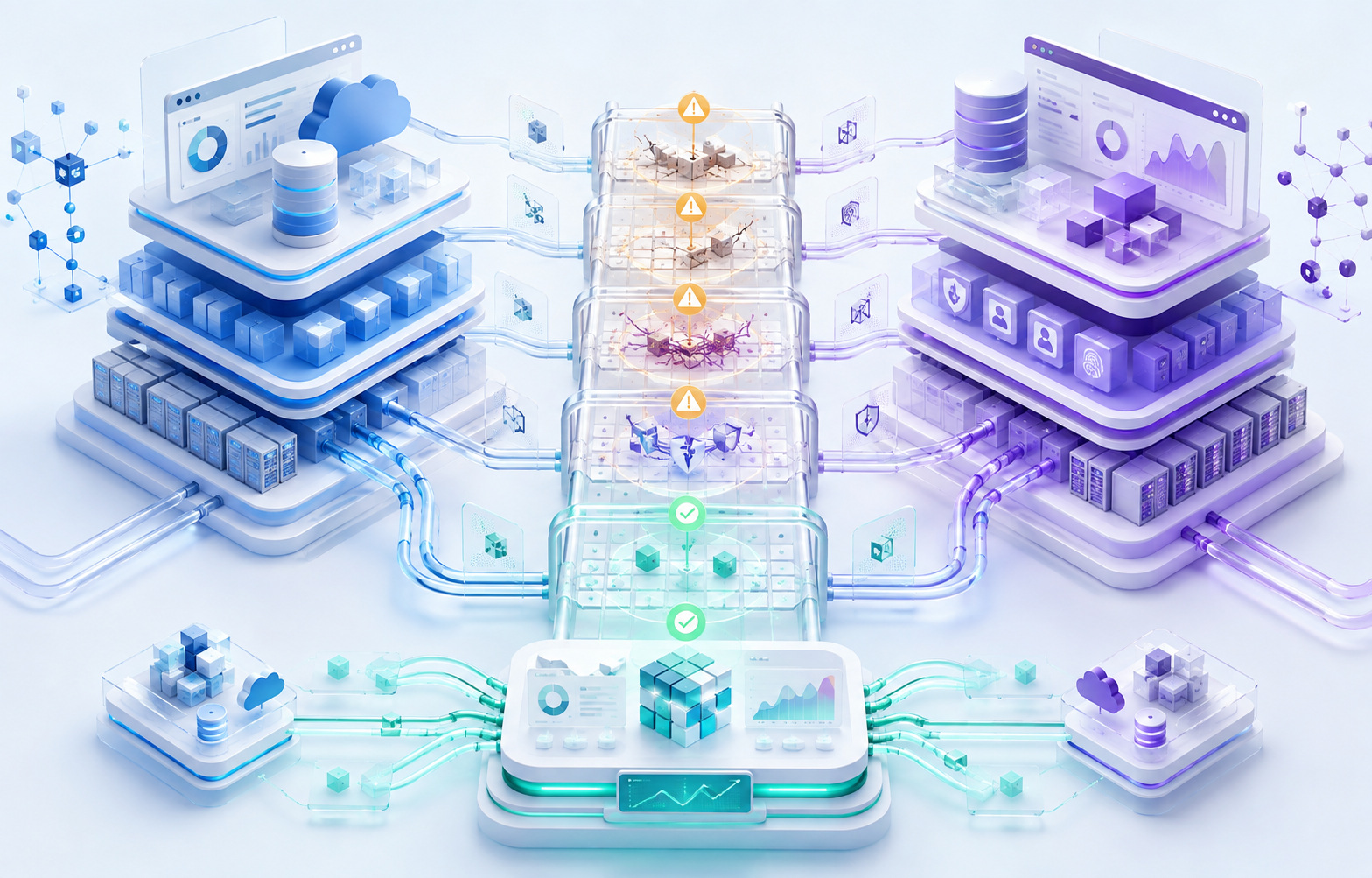
The three scenarios above share a structure: each failure sits precisely in the space where UX testing assumed a capability the agent doesn't have, or bot defense assumed an intent the agent doesn't have. The table below makes that gap explicit by comparing what each existing discipline actually validates against what agentic traffic requires.
| Dimension | Human UX / functional testing | Bot defense / fraud systems | Agent readiness testing (the gap) |
|---|---|---|---|
| Primary assumption about the visitor | Sighted, patient, contextually intelligent human | Automated traffic is presumptively hostile until proven otherwise | Automated traffic may be legitimate, user-directed, and time- or token-constrained |
| What "success" looks like | Task completed with acceptable usability and satisfaction | Malicious pattern detected and stopped | Legitimate structured task completed without misclassification |
| Primary tools | Manual and automated UI testing, usability studies, accessibility audits | WAFs, behavioral bot scoring, CAPTCHA, rate limiting, fraud scoring | DOM/structural validation, declared-agent recognition, structured-data parity checks |
| Failure signal typically captured | Bug reports, usability findings, support tickets | Blocked-request logs, challenge-pass rates | Nothing — failures present as ordinary drop-off or low engagement |
| How JavaScript-only rendering is treated | Acceptable if visually functional and reasonably fast | Not a relevant concern | A structural blocker if no server-rendered or structured-data fallback exists |
| How CAPTCHA is treated | A minor friction point to be used sparingly | A core defensive tool, largely unquestioned | A near-absolute stop for agents with no fallback path |
| Ownership in most organizations | Product/QA team | Security/infrastructure team | Frequently owned by no one |
That last row is the practical crux. In most organizations, UX testing reports to product or engineering leadership, and bot defense reports to security or platform infrastructure. Neither team has a natural mandate to ask whether a legitimate non-human visitor can complete a task, because it isn't quite their problem by the existing definition of their problem. That is precisely the kind of cross-functional gap that produces silent failure at scale: everyone can point to their own dashboard being green.
The Agent Readiness Framework
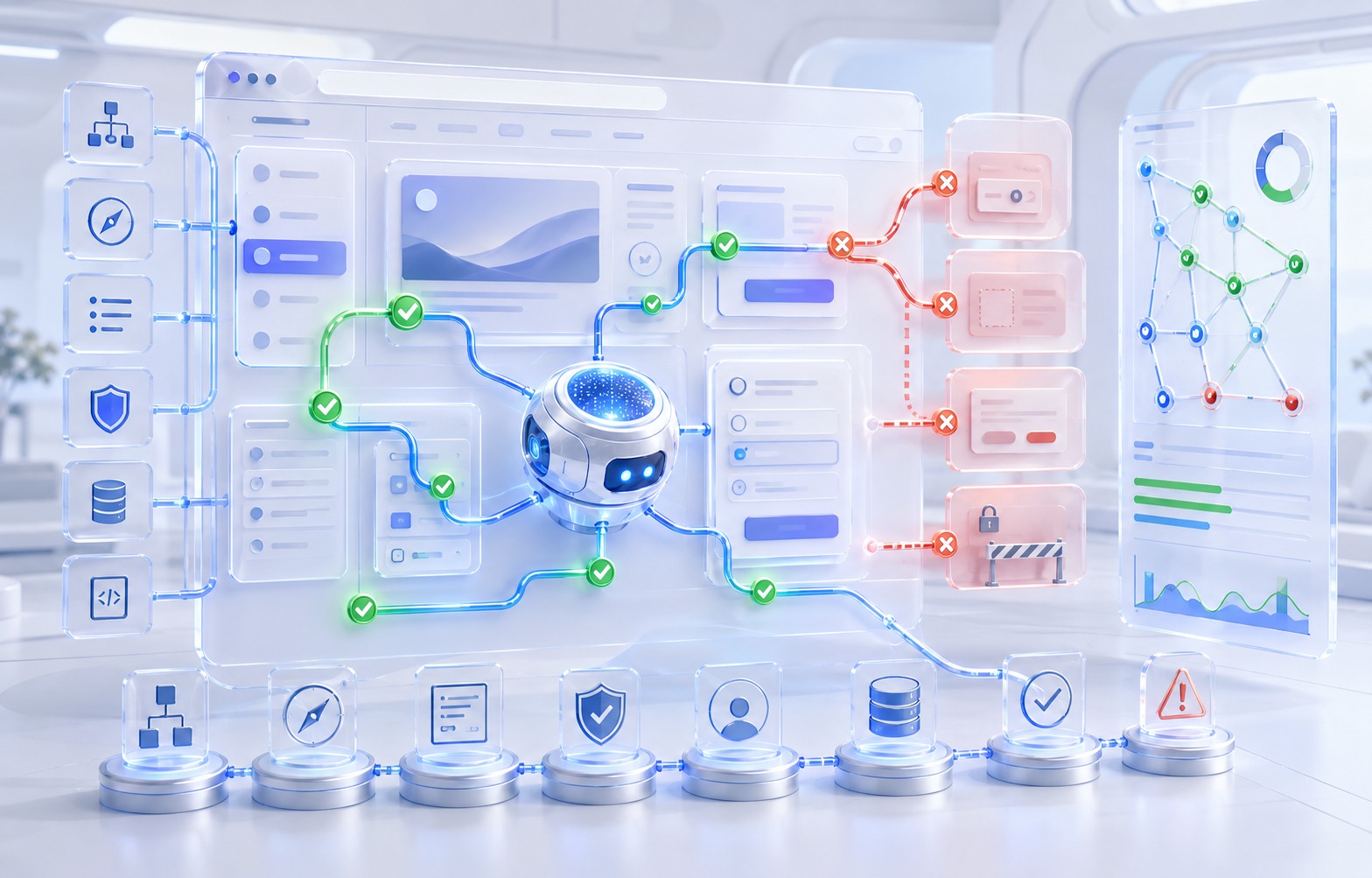
Rather than bolting agent considerations onto either existing discipline, it is more useful to treat agent readiness as its own diagnostic dimension, evaluated across five areas that map directly to the failure modes described earlier. This is an original framework developed for this article, not an existing industry standard, though it draws on the technical requirements documented by commerce-protocol implementers such as Stripe's Agentic Commerce Protocol guidance and Google's Universal Commerce Protocol materials.
Dimension one: Structural transparency. Can critical information — price, availability, account status, terms — be extracted from the page's underlying structure (server-rendered HTML, schema.org markup, a documented API) without requiring client-side JavaScript execution and a visually-timed wait? A site scores well here when a simple non-JavaScript fetch of a product or account page returns the same substantive information a human sees after the page finishes rendering.
Dimension two: Declared-agent handling. Does the bot-defense layer have any mechanism to recognize and differentiate a legitimate, declared, user-directed agent (via an emerging standard like Web Bot Auth, an explicit allowlist, or protocol-level recognition such as ACP or UCP request signatures) from anonymous or spoofable automation, rather than treating all non-human request patterns identically?
Dimension three: Verification path design. For any step that currently requires a visual CAPTCHA or a device-bound confirmation, is there a structured alternative — a scoped, time-limited delegated credential; a lower-risk verification method; or a deliberate, monitored acceptance that this step is a designed stopping point for agents — rather than an unexamined default that silently forecloses the entire task?
Dimension four: Semantic and accessibility fidelity. Does the interface expose status, pricing, and actionable elements through correct semantic markup (proper form labels, real interactive elements rather than styled divs, text-and-color pairing rather than color-only signaling, text alternatives for canvas- or image-rendered data) — the same standard already required for screen-reader accessibility, evaluated here for a second, faster-growing class of non-visual consumer.
Dimension five: Attribution and monitoring. Can the organization currently distinguish agent-originated sessions from human sessions in its analytics and funnel data at all, even approximately? Without this, every other dimension is untestable in production, because there is no way to observe whether a fix actually reduced agent-specific failure versus general noise.
| Maturity level | Structural transparency | Declared-agent handling | Verification path design | Semantic fidelity | Attribution/monitoring |
|---|---|---|---|---|---|
| Level 0 — Unaware | Critical data is JS-only, no fallback | All automation treated identically | CAPTCHA/2FA used everywhere by default, no alternative | Accessibility audit never performed | No way to identify agent traffic even approximately |
| Level 1 — Aware | Some pages server-render key data by coincidence of tech stack | Team is aware of the issue but has made no changes | Same as Level 0, but team recognizes it as a risk | Accessibility audit exists but findings are unaddressed | Team suspects agent traffic exists but has no data |
| Level 2 — Instrumented | Structured data (schema.org or equivalent) added for primary flows | Basic user-agent-based logging of suspected agent traffic (not authenticated) | High-risk steps identified; low-risk steps have at least one non-CAPTCHA option | Core accessibility issues fixed on primary conversion paths | Agent-suspected sessions tagged and tracked separately in analytics |
| Level 3 — Deliberate | All conversion-critical data has a server-rendered or API-accessible fallback | Declared-agent standard (e.g., Web Bot Auth) evaluated or adopted for at least one traffic category | Verification steps redesigned with explicit human-vs-agent policy per step, documented and reviewed | Semantic markup validated against both accessibility and structural-parsing criteria | Agent conversion and failure rates tracked as a distinct, reported metric |
| Level 4 — Integrated | Agentic commerce protocol (ACP/UCP or equivalent) integrated for applicable transaction types | Declared agents recognized and routed through a differentiated policy path in production | Verification design reviewed on every release for agent impact, not only human usability | Semantic fidelity is a release gate, not a periodic audit | Agent-specific funnel data feeds product and engineering prioritization directly |
Most organizations that have not deliberately addressed this sit at Level 0 or Level 1, not because the problem is obscure but because no existing process asks the question. Reaching Level 2 is a modest, largely diagnostic investment. Level 3 requires actual engineering and policy decisions. Level 4 is currently appropriate only for organizations where agentic commerce volume already justifies protocol-level integration — which, per the earlier discussion of traffic data, is not yet most companies, and forcing it prematurely is its own kind of waste, addressed further below.
What Structural Transparency Actually Looks Like in Code
Dimension One is the highest-leverage and cheapest to verify, so it's worth being concrete about what "fixed" actually looks like rather than leaving it abstract.
A product page that renders price only after a client-side fetch typically produces something close to this in its initial server response, with the actual price populated later by JavaScript:
<div id="price-container" class="price-widget">
  <!-- populated client-side after /api/pricing/{sku} resolves -->
</div>
An agent — or a search crawler, or a screen reader waiting on an announced live region that was never properly configured — reading the page at this point sees an empty container and has no reliable way to know a price is coming rather than absent. The fix is not to abandon the dynamic pricing widget, which may be genuinely necessary for real-time inventory or personalized pricing. It's to pair it with a structured, immediately available fallback using schema.org markup, which every major search engine and a growing number of agent implementations already know how to parse:
<div id="price-container" class="price-widget"
     itemscope itemtype="https://schema.org/Offer">
  <span itemprop="priceCurrency" content="USD"></span>
  <span itemprop="price" content="129.00">$129.00</span>
  <link itemprop="availability" href="https://schema.org/InStock" />
</div>
The visual widget can still update this element dynamically for a human watching a real-time price change; the structured attributes give any non-visual reader — human-assistive or machine — a reliable, immediately parseable value the moment the page loads, without waiting on a client-side round trip. This is a small, incremental change to an existing component, not a rebuild, and it is the single most common gap the diagnostic checklist's first step surfaces in practice.
On the bot-defense side, a comparable low-effort step is checking whether a site's edge or WAF configuration already recognizes the Web Bot Auth signature format even before formally adopting a declared-agent policy. A request carrying a valid HTTP message signature under the standard looks approximately like a signed Signature-Input and Signature header pair referencing a published key, verifiable against a directory the agent platform maintains — distinct from an easily spoofed User-Agent: ChatGPT-Agent/1.0 string, which any script can send regardless of its actual origin. Treating the two as equivalent trust signals is the mistake; treating a verified signature as meaningfully stronger evidence than a self-reported header is the correction most bot-management vendors are now building toward.
Questions to Ask an Internal Team or an External QA Partner
Before commissioning a full audit, a short set of direct questions tends to reveal how far along an organization already is, and where the gaps sit:
- If we fetch our top three revenue-driving pages with JavaScript disabled, what comes back, and has anyone actually checked recently rather than assuming?
- Of the requests our bot-management system blocked or challenged last month, has anyone manually sampled even twenty of them to estimate what fraction show characteristics of a plausible single-transaction legitimate agent rather than a scraping or credential-stuffing pattern?
- Which steps in our checkout or account-verification flow are an unconditional CAPTCHA or device-bound challenge, and for each one, was that a deliberate risk decision or an inherited default from a security template nobody has revisited?
- Do we have any way, even approximate, to separate agent-originated sessions from human sessions in our analytics today — and if we added that instrumentation, would anyone actually look at the resulting dashboard?
- When our accessibility audit last flagged color-only status indicators or unlabeled interactive elements, were those findings resolved, deferred, or simply never revisited?
An external QA or security partner should be able to answer the first three with a working diagnostic within days, not weeks, using the checklist earlier in this article as a starting structure rather than a proprietary black-box assessment.
A Practical Diagnostic Checklist
The following sequence is designed to be run by an engineering or QA team in a few days for a primary conversion or account-management flow, without requiring new tooling investment before the first pass.
- Fetch the critical page without executing JavaScript. Use a plain HTTP request (curl, or a headless fetch with JS disabled) against the product, pricing, or account-status page that matters most to conversion. Compare what comes back to what a human sees after full render. If price, availability, or status data is missing or wrong in the no-JS version, this is a Dimension One failure with no fallback.
- Run the primary conversion flow through a DOM-reading automation tool, not just a screenshot tool. Using a structural browser-automation framework (the same class of tooling agent vendors use), attempt to complete the flow by reading and acting on DOM elements — form fields by label, buttons by role — rather than by fixed coordinates. Note every point where the automation cannot identify the correct element because of missing labels, generic div-based controls, or ambiguous structure.
- Audit every hard-stop verification point in the flow. List every CAPTCHA, device-bound 2FA prompt, and other unconditional challenge in the flow. For each one, document whether it is genuinely necessary at that exact step, whether a lower-friction alternative exists for lower-risk transactions, and whether the business has consciously decided this is an acceptable point to lose all agent-originated traffic — as opposed to an unexamined default inherited from a security template.
- Pull current bot-defense logs and separate "declared or plausible legitimate agent" from "confirmed malicious pattern." Most bot-management dashboards already log blocked and challenged requests. Sample a set of blocked sessions from a period of normal traffic and manually assess how many show characteristics of a plausible legitimate single-transaction agent (single item, single completed form, request pattern consistent with a known agent user-agent or signed-agent header) rather than the volume and repetition patterns typical of scraping or credential-stuffing.
- Run an accessibility audit specifically for status- and price-bearing components, if one hasn't been run recently. Focus on color-only status signaling, canvas- or image-only data rendering, and unlabeled interactive elements. Because Dimension Four overlaps substantially with accessibility compliance, this step often has a second, independent justification beyond agent readiness.
- Instrument even a rough agent-traffic signal before making further investment. At minimum, tag sessions with known agent user-agent strings or signed-agent headers separately in analytics, even without full confidence in accuracy. An imperfect signal that exists is more useful than a perfect signal that doesn't, because it turns an invisible category into a trackable, if noisy, one.
- Prioritize fixes by transaction value and traffic realism, not by novelty. A checkout flow with real revenue at stake and a plausible near-term increase in agent-originated attempts deserves attention before a rarely visited internal tool. Resist the temptation to build a full agentic-commerce-protocol integration before completing steps one through six on the flows that actually matter today.
Two Competing Commerce Protocols, and Why That Matters for Sequencing
The Agentic Commerce Protocol and the Universal Commerce Protocol deserve a slightly closer look than the earlier product table allows, because the decision of whether and when to integrate with either has direct implications for how a company sequences its agent readiness work.
ACP, developed by OpenAI and Stripe, is built around a merchant exposing a structured product feed and a checkout session API that a compliant agent — currently ChatGPT's Instant Checkout — can call directly, with Stripe handling tokenized, scoped payment credentials so the agent never touches raw card data. It is live today with U.S. Etsy sellers and expanding to Shopify's merchant base, which gives it real, if still early, production traffic. UCP, Google's counterpart, follows a broadly similar architectural philosophy — structured product data plus a standardized checkout interface — but is tied to Google's own agent surface, Auto Browse, which remains in preview and limited to paid subscribers in one country as of this writing. Neither protocol currently interoperates with the other's agent, meaning a merchant that integrates ACP does not thereby become checkout-ready for a UCP-driven agent, and vice versa.
For a merchant already running on Shopify or working with Stripe as a payment processor, ACP integration is a comparatively low-friction addition once the underlying platform ships native support, since much of the structured-data and tokenization groundwork can be handled by the platform rather than built from scratch. For a merchant on a custom stack, either protocol represents genuine engineering investment, and betting on one before the other demonstrates broader agent-side adoption is a real strategic gamble. This is precisely why the framework in this article treats protocol integration as a Level 4 maturity marker rather than a starting point: the structural, semantic, and bot-defense fixes in Dimensions One, Two, and Four are protocol-agnostic, deliver value regardless of which commerce standard eventually gains more traction, and are the more defensible place to invest while the protocol landscape is still unsettled.
Where This Investment Is Not Yet Justified
Agent readiness is not a universal, immediate priority for every product, and treating it as one risks the same kind of premature optimization that has afflicted other emerging-technology scares in web engineering.
For a low-traffic internal tool, a highly regulated workflow that legally requires human identity verification regardless of agent capability (certain financial account openings, prescription fulfillment, age-gated purchases), or a product whose customer base has no plausible near-term exposure to agentic browsing tools, the diagnostic checklist above is still worth running once, cheaply, as a baseline — but a Level 3 or Level 4 investment is not warranted yet. Building a full ACP or UCP integration for a transaction type where structured verification of human identity is a genuine legal requirement, not merely a UX friction point, would be solving the wrong problem: the CAPTCHA or 2FA step in that flow is not a design oversight, it's a deliberate and currently necessary control, and agent vendors' own confirmation-gate designs already anticipate that some transactions should stop there.
There is also a real cost to over-indexing on a traffic category whose current scale, as discussed earlier, is not independently measured at meaningful precision. A team that reprioritizes its roadmap around agentic commerce protocol integration before establishing even Level 2 monitoring is optimizing against a hypothesis, not a measurement. The correct sequencing is nearly always: instrument first, quantify the actual exposure for your specific product and customer base, then invest proportionally. A B2B SaaS product selling six-figure annual contracts through a sales-assisted process has a very different agent-exposure profile than a direct-to-consumer retailer selling a twenty-dollar item through self-service checkout, and the framework above is meant to be applied with that context, not as a uniform mandate.
A related caution applies to vendor selection. As agent readiness becomes a recognizable category, expect a wave of tools and consultancies marketing themselves specifically around it, some with genuinely useful tooling and some repackaging generic bot-management or accessibility auditing under a new label. The diagnostic checklist in this article is deliberately built so a team can run its first pass with tools it likely already owns — a terminal, an existing browser-automation framework, and access to its own bot-defense logs — precisely so that the decision to buy specialized tooling, if one is warranted, is made after seeing real findings rather than before.
Warning Signs the Problem Already Exists, Even Without Instrumentation
A team that hasn't yet built agent-specific monitoring is not necessarily blind to every symptom. Several existing signals, usually filed under other categories, are worth revisiting with this specific question in mind.
An unexplained rise in sessions that complete form entry but abandon at a single, consistent step — particularly a step involving a challenge screen or a slow-loading dynamic component — deserves a second look even if the volume seems too small to matter individually. A support or sales team fielding an increasing number of prospects who mention comparing pricing "through an AI assistant" or "using an AI browser" before a call, only to note a data point that turned out to be wrong or missing, is describing exactly the failure pattern from the third scenario above, just reported anecdotally rather than through a dashboard. A security team noticing that its bot-management challenge rate has increased without a corresponding increase in confirmed fraud or scraping incidents may be looking at rising false-positive classification of legitimate agent traffic rather than a genuine increase in attack volume — the two produce an identical top-line "more requests challenged" metric but require opposite responses.
None of these signals is conclusive on its own. Together, and combined with even the roughest agent-traffic tagging described in the checklist's sixth step, they turn a vague sense that "something might be happening" into a specific, testable hypothesis.
Startups, Scale-Ups, and Enterprises Face Different Versions of This Problem
A pre-product-market-fit startup with a handful of paying customers has limited reason to invest beyond the initial diagnostic pass — the checklist itself, run once, is proportionate, and the main value is catching the kind of accidental JavaScript-only rendering or missing form labels that a small, fast-moving team is statistically likely to have shipped without noticing, for reasons unrelated to agents at all.
A scale-up with meaningful self-service revenue and a bot-defense system already tuned against real abuse (the sneaker-drop scenario's underlying dynamic is common well beyond apparel) faces the sharpest version of the trade-off: the security investment that protects revenue from one threat is the same investment most likely to silently cost revenue from a different, harder-to-see source. This is the segment where reaching Level 2 or Level 3 attribution — being able to say with reasonable confidence how much legitimate agent traffic exists and how it currently fares — has the clearest near-term payoff, because the organization already has both the traffic volume and the security tooling sophistication to make the distinction meaningful.
An enterprise, particularly one operating regulated products, has to hold two things at once: a genuine, often externally mandated need to preserve certain hard verification steps, and a growing expectation from its own largest customers — many of whom are themselves adopting agentic tools internally for procurement research, vendor comparison, and account administration — that basic informational tasks (checking a contract renewal date, comparing tier pricing, retrieving an invoice) should not require a human to sit through a slow, JavaScript-heavy portal. For this segment, Dimension One (structural transparency) and Dimension Four (semantic fidelity) often deliver value independent of agent traffic specifically, because they overlap with API-first product strategy and accessibility compliance obligations that already exist for other reasons.
That overlap is not hypothetical for any business selling into the European Union. The European Accessibility Act's compliance deadline for e-commerce and a range of other digital services passed on June 28, 2025, and it requires exactly the kind of semantic markup, non-color-only status signaling, and structured content that Dimension Four describes — meaning many EU-facing enterprises have already been legally required to do a meaningful share of this work for human accessibility reasons, whether or not they have connected it to agent readiness at all. An enterprise QA or compliance team that has already run an EAA-driven accessibility remediation program has, in effect, completed a substantial portion of Dimension Four without labeling it as such, and extending that same audit to explicitly check agent-parseability is a comparatively small incremental step rather than a new program.
Beyond Checkout: Account Servicing and Post-Purchase Tasks
Most public discussion of agentic browsing focuses on shopping and checkout, because that is where the commerce protocols and press coverage have concentrated. A comparable and, in some respects, higher-stakes category of task involves an agent checking or modifying the status of an existing relationship rather than initiating a new purchase: confirming a subscription renewal date, checking whether a support ticket has been resolved, verifying loyalty-point balances, initiating a return, or pausing a service before a billing cycle closes.
These tasks differ from first-time checkout in two ways that matter for testing strategy. First, they typically happen behind an authenticated session, which means the agent has to either receive delegated credentials from the user or operate within a browser session the user has already logged into — a materially different trust boundary than an anonymous product-comparison task, and one that current agent vendors treat with particular caution. Anthropic's explicit note that computer use is now eligible for HIPAA-regulated workloads, and every major vendor's insistence on confirmation gates before password use, both reflect how seriously this category is being treated at the product-design level. Second, the cost of a wrong answer is usually higher than the cost of an incomplete one. A shopping agent that can't read a price simply reports back that it couldn't find one, which is an annoyance. An account-status agent that misreads a canvas-rendered balance or a color-only status badge — as in the third scenario earlier — reports a confidently wrong answer that the user may act on directly, with no visual page in front of them to sanity-check against.
For companies with meaningful self-service account portals — SaaS subscription management, insurance and financial account dashboards, loyalty and membership programs, telecom and utility billing — this category deserves its own pass through Dimension Four (semantic fidelity) specifically, independent of whether the company has any checkout flow at all. A B2B SaaS company with no consumer checkout might reasonably conclude commerce-protocol integration is irrelevant to its roadmap, while still having real exposure through a billing or usage dashboard that an operations lead's agent is asked to check before a renewal conversation. The diagnostic checklist's steps apply identically to this category; only the flow being tested changes, from "add to cart and pay" to "log in and report a status."
Metrics That Reveal This Problem and Metrics That Hide It
Standard funnel metrics are not just uninformative here — several of the most commonly watched ones actively obscure the problem, because they were built on the assumption that every session represents a person whose intent can be inferred from behavior.
A useful metric distinguishes between session types before aggregating anything. Agent-attempted-session completion rate, tracked separately from human completion rate even with an imperfect declared-agent or heuristic tag, is the single highest-value addition, because it converts an invisible failure category into a visible one, however roughly measured at first. Blocked-or-challenged rate broken out by suspected traffic type, pulled from existing bot-defense logs, tells a security team whether its current rules are disproportionately catching plausible-legitimate-agent patterns rather than confirmed-malicious ones — a question almost no bot-management dashboard answers by default, because it wasn't asked to.
A misleading metric, by contrast, is overall conversion rate held flat or slightly improved — the composite metric most executives actually watch — because a small but growing agent-failure segment can be fully masked by simultaneous improvement in the much larger human segment, producing a flat topline number that hides a real and worsening sub-problem. Similarly, overall bot-blocked volume treated as a pure security win is misleading in isolation: a rising number of blocked requests could mean the defense system is successfully repelling more attacks, or it could mean a growing number of legitimate agent-originated attempts are being caught in the same net, and the aggregate metric cannot tell the two apart without the kind of sampling described in the diagnostic checklist's fourth step.
Frequently Asked Questions
Is this the same thing as SEO for AI answer engines or "AI search visibility"? No. Optimizing content so that ChatGPT, Perplexity, or Gemini cite or summarize it accurately is a content and information-retrieval problem, sometimes called generative-engine optimization. Agent readiness testing is a distinct, functional problem: whether an agent acting on a user's behalf can actually complete a transactional or account-related task on your site, not whether your content gets referenced in an AI-generated answer.
Should we just add a dedicated API for AI agents instead of fixing the website? An API can be part of a Level 3 or 4 response, particularly through a commerce protocol like ACP or UCP, but it does not replace the underlying diagnostic work. Most agentic browsers today act on the visible web interface, not a special-purpose API most companies haven't built, so structural and semantic fixes to the existing site produce broader near-term benefit than a parallel API that only a fraction of agent traffic will ever discover or use.
Will improving accessibility compliance automatically solve this? It solves a meaningful portion of Dimension Four (semantic fidelity), because both screen readers and structure-reading agents depend on similar underlying markup quality. It does not address Dimension One (JavaScript-only rendering with no data fallback), Dimension Two (bot-defense misclassification), or Dimension Three (unconditional verification stops), each of which requires separate attention.
How do we tell a legitimate agent from a scraper if user-agent strings can be faked? User-agent self-declaration alone is not a reliable signal, which is precisely why cryptographic approaches like Cloudflare's Web Bot Auth exist — verifying a signed request rather than trusting a claimed identity. Where no such standard is yet integrated, behavioral sampling (as in the checklist's fourth step) combined with transaction-value-based risk tolerance is a reasonable interim approach: a single-item purchase attempt with a plausible agent signature carries far less risk than a high-velocity, high-volume pattern regardless of what header it presents.
Do we need to support every agentic browser individually? No. The fixes described in this framework — structural data, semantic markup, thoughtful verification design, and basic attribution — are largely agent-agnostic. A page that exposes clean, structured data and correct semantics is more legible to any current or future agent, not only to the specific products named in this article, which is the more durable way to invest given how quickly this landscape is still changing.
What's the single highest-leverage first step if we can only do one thing? Run the checklist's first two steps — the no-JavaScript fetch comparison and the DOM-reading automation walkthrough — on your single most valuable conversion flow. Both are cheap, require no new tooling purchase, and reliably surface the most common and most fixable failure (Dimension One) faster than any other step in the framework.
Does adopting ACP or UCP lock us into one AI vendor's ecosystem? It's a real consideration. Because the two protocols are currently separate and non-interoperable, integrating deeply with one before the market consolidates carries switching-cost risk. For most companies not yet at Level 4 maturity, the structural and semantic fixes in Dimensions One and Four deliver most of the near-term benefit and are protocol-agnostic, which makes them a safer place to invest ahead of committing to either commerce standard.
Could fixing this for agents make our site worse for human users? Generally no, and often the opposite. Server-rendering critical data as a fallback, adding correct semantic markup, and giving high-value low-risk transactions an alternative to an unconditional CAPTCHA all tend to improve page-load resilience, accessibility, and human usability as a side effect, which is part of why several of these fixes already had an independent justification before agent traffic became a consideration at all.
Where QAtronic Fits
Agent readiness testing sits at the intersection of functional QA, accessibility validation, and security review — three disciplines QAtronic already works across for clients preparing releases where reliability and conversion both matter. For a team that hasn't yet run even a baseline diagnostic against this traffic class, QAtronic can help scope and execute the structural, semantic, and bot-defense assessment described above against a company's actual conversion-critical flows, and translate the findings into a prioritized engineering backlog rather than a generic audit report.
The Distinction That Matters More Than the Percentage
The precise share of a company's traffic that is agent-originated today matters less than a sharper question: does the organization currently have any mechanism that would tell it, at all, if that share were rising. Most do not, and that is the actual finding of this article, independent of how the underlying adoption curve plays out over the next several years.
A useful principle for engineering and product leaders: treat "we cannot currently distinguish agent-originated failure from ordinary human drop-off" as a monitoring gap to close on its own merits, the same way a team would treat any other blind spot in production observability, rather than waiting for a definitive industry statistic to justify the work. The cost of building that visibility is low. The cost of a silently declining channel that nobody can name is not. The question worth taking back to an engineering team this quarter is not "how many of our customers are using AI agents yet" — nobody can answer that precisely today — but "if an agent tried to complete our most valuable conversion flow right now, would we have any way of knowing whether it succeeded, and if it didn't, would anything in our systems tell us why."