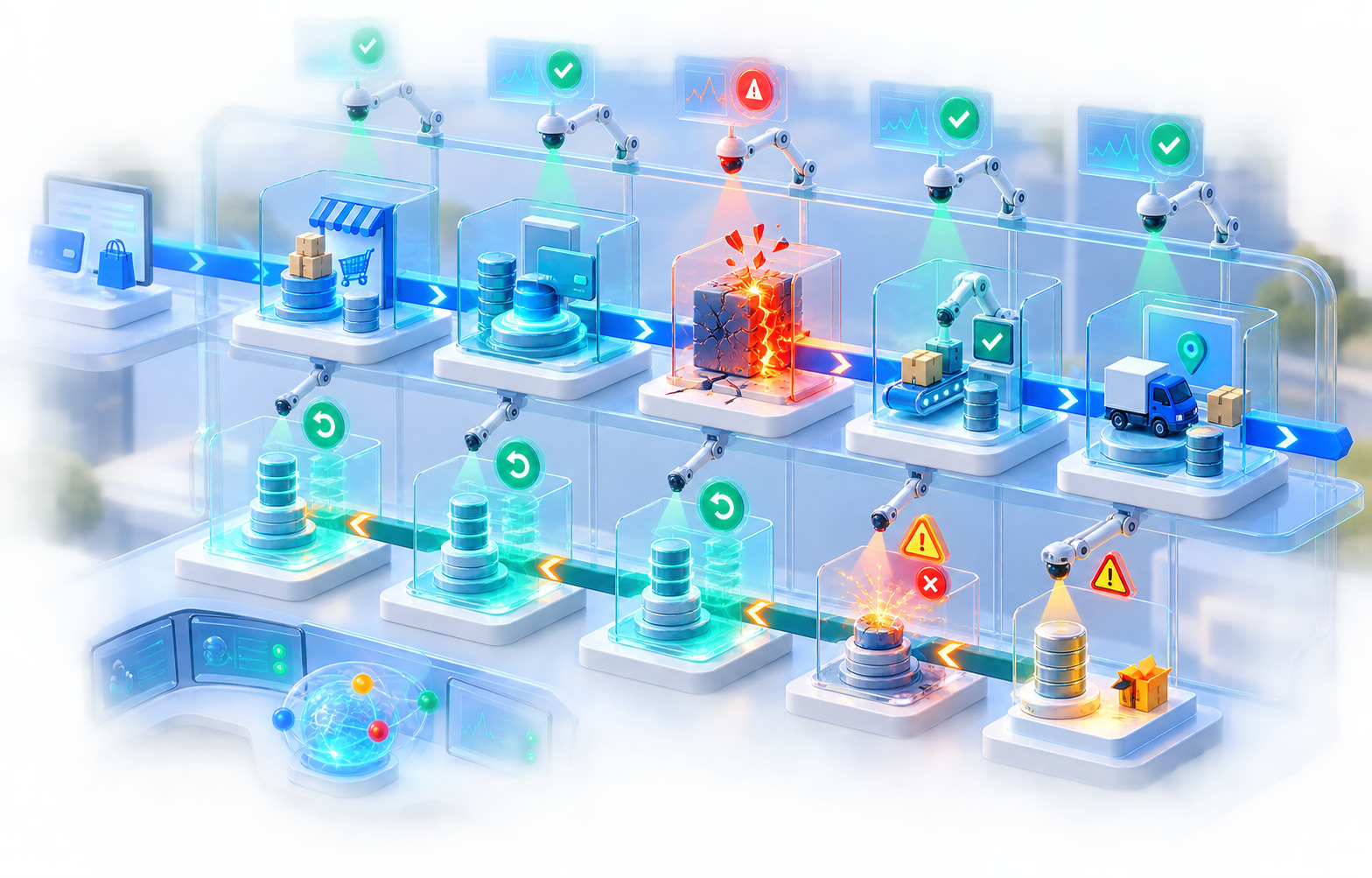
Post-Acquisition Technical Integration Decides Whether the Software Survives the Deal
Fourteen weeks after the acquisition closed, a payments-reconciliation job that had run every night for three years without incident started failing intermittently. Nobody on the newly combined engineering team owned it outright. The acquiring company's on-call engineer, paged at 2:40 a.m., found a runbook that described a system that no longer matched what was running in production, because a migration six weeks earlier had moved the job's database connection to a new instance without updating the document. She escalated to the acquired company's former lead backend engineer, the one person who had built the reconciliation logic. He had left the company nine days earlier, two weeks after his retention bonus vested, taking with him the only complete mental model of how the two companies' transaction IDs were supposed to map to each other.
What actually caused the failure was not the migration, and not the departure. It was a decision made three months earlier, during the final week of deal negotiation, when the two engineering leads agreed — under pressure to avoid delaying the signing date — to run both companies' billing systems "in parallel for now" and reconcile the difference later with a nightly batch job that nobody had fully specified. The decision made sense at the table. It cost almost nothing to say yes to. It appeared nowhere in the diligence report, because diligence had already concluded a week earlier, and it was not the kind of thing a diligence reviewer would have been looking for in the first place. Nine weeks later it was a production incident with financial reporting implications, discovered by an engineer who had never seen the acquired system before and could no longer ask the person who understood it.
This is a hypothetical scenario, constructed to illustrate a pattern rather than to describe any real transaction. But the pattern is familiar to anyone who has sat through an acquisition from the engineering side, on either side of the table. It illustrates something that gets very little attention relative to how often it happens: the technical risk of an acquisition does not peak during diligence. It peaks afterward, during integration, and it peaks precisely during the period when organizational attention has already declared the hard part finished.
Diligence Ends at Closing. Integration Doesn't Get the Same Scrutiny.
Technical due diligence is, by design, a bounded and heavily resourced exercise. A reviewer is engaged, a data room is assembled, interviews are scheduled, artifacts are requested and inspected, and a report is produced that becomes an input to the negotiation. The process is adversarial in a useful sense — the buyer's side is actively trying to find what is wrong, because what it finds changes the price or the terms. That adversarial pressure is exactly what makes diligence rigorous. Someone is paid to be skeptical, on a deadline, with the outcome of their skepticism attached to money.
Integration has almost none of that structure. There is no external reviewer whose job is to be skeptical of the integration plan. There is no report that a deal team reads before deciding whether to proceed, because the decision to proceed was already made. The people doing the integration work are, in the overwhelming majority of cases, the same engineers who were relied upon during diligence to answer the reviewer's questions honestly — and they are now asked to execute a merger of systems, on top of their regular workload, under a compressed timeline, with the added complication that some of them do not yet fully trust each other and some of them are wondering whether they still have a job in six months.
Consulting firms that specialize in post-merger integration describe the period immediately following close as decisive for a reason that has nothing to do with sentiment. Deloitte's description of post-merger integration work characterizes the first hundred days as the most pivotal stretch for demonstrating that the deal's intended value is actually materializing, and notes that even the legal and financial handoff on the day the deal closes typically involves somewhere between two hundred and three hundred fifty separate coordinated tasks across the organization — a volume of coordinated change that has nothing to do with code and everything to do with how much organizational bandwidth gets consumed before the technical work even starts (Deloitte, Post-Merger Integration). Bain's advisory practice, drawing on a portfolio of more than two thousand two hundred completed integrations, has moved away from standardized integration playbooks toward what it calls an integration thesis tailored to the specific deal, explicitly because a generic sequence of steps does not reliably produce the value the deal was priced on (Bain & Company, Post-Merger Integration).
None of that literature is primarily about software. It is about organizational integration broadly — headcount, reporting lines, brand, customer relationships, finance systems. Technology integration is usually treated as one workstream among several, and it is frequently the workstream where the gap between plan and reality is largest, because software systems have dependencies that are invisible until something breaks, and because the people who understand those dependencies are disproportionately likely to be the ones an acquisition makes anxious about their future.
The failure-rate literature on mergers and acquisitions is worth treating carefully rather than quoting as a hard number. The figure most frequently repeated in M&A commentary — that somewhere between seventy and ninety percent of mergers and acquisitions fail to achieve their intended value — traces back to research summarized in Harvard Business Review by Clayton Christensen and colleagues, who describe it as a conclusion reached by "study after study" rather than a single measured statistic with one methodology behind it (Harvard Business Review, "The Big Idea: The New M&A Playbook," 2011). Different studies define "failure" differently — shareholder value destroyed, synergies not realized, strategic objectives unmet — and the range should be read as evidence that integration outcomes are commonly disappointing rather than as a precise probability. What is consistent across the literature, regardless of how failure is defined, is that the reasons cited are almost never about the target's underlying technology being worse than expected. They are about what happens to people, process, and systems during the transition from two organizations to one.
One of the more specific and better-documented findings concerns what happens to the people who understand the acquired systems best. A research analysis using U.S. Census Bureau employer-employee matched data, examining roughly four thousand technology-sector acquisitions between 1990 and 2011 and covering approximately 350,000 acquired employees, found that 33 percent of employees at acquired startups departed within the first year after the deal, compared with 12 percent of similarly qualified employees hired directly by the same acquiring firms over the same period — and that acquired employees remained about 15 percent more likely to leave than comparable new hires even measured over a three-year window (MIT Sloan Management Review summary of Daniel Kim's research, "Your Acquired Hires Are Leaving. Here's Why."). Translate that into engineering terms and the implication is direct: roughly a third of the people who built the system you just acquired are statistically likely to be gone within a year, and the period in which they are most likely to leave overlaps almost exactly with the period in which their knowledge is most urgently needed to complete the technical integration.
The remainder of this article is organized around the specific ways that gap shows up in production systems, followed by a comparison of the two dominant migration strategies and a sequencing framework for the technical integration work itself. None of what follows assumes malice, incompetence, or bad faith on either side of a deal. Almost every failure described here is the predictable consequence of ordinary, individually reasonable decisions made by competent people operating under time pressure and incomplete information — which is exactly what makes the pattern worth understanding in advance, rather than after the first serious incident.
Where the Software Actually Breaks During Integration
Diligence evaluates a system as it exists, operated by the people who currently operate it, under the conditions that currently apply. Integration changes all three of those variables simultaneously — new operators, new conditions, and, given enough time, a partially different system — which is why problems that were invisible during diligence become visible during integration, and why the categories below are structurally different from anything a diligence checklist would surface.
The Knowledge That Leaves With the People Who Vested
Every acquisition creates a predictable financial event for the acquired company's engineers: unvested equity that accelerates or converts, and frequently a retention package with a defined cliff, commonly twelve to twenty-four months. The existence of that cliff is well understood by deal teams and by the engineers themselves. What is less consistently planned for is what happens to institutional knowledge in the specific window before that cliff, when an engineer's incentive to stay has already been paid out in the form of the transaction itself and the remaining retention incentive is a bet on a future that may or may not still contain their role.
The knowledge at risk is rarely written down anywhere, and this is not a documentation failure in the usual sense. It is the ordinary residue of how software gets built inside a small, fast-moving company. A billing reconciliation process, a set of undocumented assumptions about how a legacy customer segment behaves differently from newer ones, the reason a particular retry policy exists on a particular integration, the specific sequence of manual steps required to recover a stuck payment — these things exist in the heads of two or three people because writing them down was never the most urgent thing to do, and for a company operating independently, it usually wasn't. The moment a company is acquired, the cost of that knowledge being undocumented changes completely, because the people who hold it now have both a shorter expected tenure and a much larger population of people around them who might need it.
The pattern is made worse by a structural feature of most acquisitions: the acquiring company typically wants its own engineers, not the target's, running point on the systems being integrated, because those are the engineers who understand the target architecture the new systems need to connect to. That is a reasonable allocation of effort in the abstract. In practice it means the people newly responsible for operating a system are, by construction, not the people who best understand it, at exactly the moment the people who do understand it have the highest probability of leaving of anyone in the combined company.
Systems Nobody Fully Owns Anymore
A closely related but distinct failure mode is ownership ambiguity, which shows up first and most painfully in on-call rotations. Before the acquisition, every production system had someone who was paged when it broke, and that person had enough context to either fix the problem or escalate to someone who could. After the acquisition, for some period that is almost always longer than anyone plans for, this stops being reliably true.
Three patterns account for most of the damage. The first is the system that gets added to a combined on-call rotation before anyone on that rotation has been trained on it, because adding it to the rotation felt like an organizational integration milestone worth hitting quickly. The second is the system that gets left out of any rotation because it is unclear which team owns it, so it pages nobody until a customer notices something is wrong, at which point someone has to reconstruct who is responsible from source control history and old email threads. The third, and the one this article's opening scenario illustrates, is the system that is nominally owned but whose actual behavior has drifted from what the runbook describes, because whoever made the most recent change did not know a runbook existed, or did not know it needed updating, or updated the wrong one.
Google's Site Reliability Engineering practice treats on-call effectiveness as a direct function of two things: engineers having sufficient operational knowledge of the systems they are on call for, and escalation paths that reliably connect an alert to someone who can act on it — and explicitly flags that both of these degrade whenever systems or teams change hands without deliberate onboarding (Google SRE, "Being On-Call"; Google SRE, "Accelerating SRE On-Call"). An acquisition is, from the perspective of on-call effectiveness, a mass simultaneous change of both operators and systems across an entire engineering organization, executed with none of the structured onboarding period that a single new hire would normally receive before being added to a rotation.
The organizational consequence is a period — commonly measured in months, not weeks — during which mean time to resolution for incidents on newly integrated or newly reassigned systems is meaningfully worse than it was before the deal, for reasons that have nothing to do with the underlying code quality and everything to do with who currently understands it and how quickly they can be reached.
Merging the Money: Billing, Customer, and Usage Data Reconciliation
Of every category of post-acquisition technical work, data migration and reconciliation between the two companies' customer, billing, and usage records is the one most likely to surface a discrepancy that someone outside engineering actually notices — a customer billed twice, a usage figure that does not match what finance reported, an account that silently loses its history when merged into the acquiring company's schema.
The underlying difficulty is rarely the mechanics of moving rows from one database to another. It is that two independently built systems almost never model the same business concepts the same way, even when both companies sell what looks, from the outside, like a similar product. One company's notion of an "account" might correspond to a single paying entity; the other's might correspond to a hierarchy of sub-accounts under a parent organization, with entitlements and billing rolling up in ways the first system has no concept for. One system might calculate usage in real time; the other might batch it hourly, with a reconciliation step that silently drops out-of-order events past a certain window. Neither modeling choice is wrong on its own. The problem appears only when someone has to write a mapping between them, under time pressure, usually without the person who built the older or smaller system available to explain every edge case it was designed to handle.
Hypothetical illustrative example: a fintech billing merge that reconciled the numbers but not the customers. Consider a mid-market fintech company acquiring a smaller invoicing and payments platform to add international payment rails to its own product. Both companies' engineering leadership treated the billing merge as primarily a data problem: export the acquired company's customer and transaction records, transform them into the acquiring company's schema, and load them. The acquiring company's data engineers built the transformation pipeline over several weeks, validated it against aggregate totals, and confirmed that total transaction volume and total revenue reconciled to the cent across both systems before and after migration. On that basis, the migration was declared successful and the legacy system was scheduled for decommissioning.
What the aggregate reconciliation did not catch was that the acquired platform had supported a customer configuration — multiple linked sub-merchants operating under one parent billing relationship, common among the acquired company's marketplace customers — that the acquiring platform's data model did not represent at all. The transformation pipeline, built to hit an aggregate-total reconciliation target, had collapsed each parent-and-sub-merchant group into a single flattened account, preserving the correct total dollar amount but destroying the sub-merchant-level detail that several of those customers relied on for their own downstream accounting and tax reporting. The discrepancy was not visible in any dashboard either engineering team was watching, because both teams were watching totals, and the totals were correct. It surfaced roughly five weeks after cutover, when three of the affected customers — who together represented a meaningful share of the acquired platform's marketplace revenue — opened support tickets asking where their sub-merchant breakdowns had gone, at which point the original transaction-level detail on the decommissioned legacy system was already approaching the end of its planned retention window.
The lesson generalizes past this specific scenario. Reconciliation validated only at the aggregate level will reliably catch the failure mode everyone is already worried about — money going missing — while missing the failure mode nobody thought to name in advance, which is structural information that the target schema was never designed to hold. Validating a data migration for financial and customer-facing systems requires reconciliation at the level of individual records and their relationships to each other, not only at the level of sums, and it requires someone who understood the reasons behind the source system's data model, not only its schema, reviewing what the transformation logic assumes.
There is also a regulatory dimension to merging customer data that is easy to treat as a legal-only concern and is actually, in part, an engineering one. Under the General Data Protection Regulation, the European Data Protection Board has stated directly that companies involved in a merger must, in accordance with the GDPR's accountability principle, "conduct in a transparent way a full assessment of the data protection requirements and privacy implications of the merger" and take steps "to mitigate the possible risks of the merger to the rights to privacy and data protection" (EDPB, Statement on the Data Protection Impact of the Mergers Between Telecom Operators, 2020). In practice that assessment depends on engineering being able to answer specific questions the legal team cannot answer alone: what personal data exists in each system, whether the two companies' original bases and stated purposes for collecting it are actually compatible, and whether the merged system continues to honor commitments — retention periods, deletion requests already made, data residency promises — that were made under one company's privacy policy and now have to be honored under a combined one.
United States privacy law takes a narrower but still relevant position. Under California's Consumer Privacy Act, transferring personal information to a third party as part of a merger, acquisition, or similar transaction is explicitly excluded from the statute's definition of a "sale," but that exclusion carries a condition: the information must continue to be "used or shared consistently" with the original business's obligations, and if the acquiring party later "materially alters how it uses or shares the personal information" in a way inconsistent with the promises made when the data was collected, the business is required to provide notice sufficiently prominent for existing consumers to exercise their choices before that new use begins (California Civil Code § 1798.140(ad)(2)(C)). Read literally, that condition means a genuinely reasonable-sounding integration decision — for example, deciding that acquired customers should now be enrolled in the acquiring company's product analytics or marketing systems, which the acquired company's privacy policy never contemplated — can trigger a notice obligation the engineering team has no visibility into unless someone maps what each system's privacy commitments actually were before merging the data that those commitments applied to.
One Login, Two Identity Systems, and a Window Where Both Are Half-True
Authentication and access control integration deserves separate treatment from data migration generally, because the failure modes are different in kind. A billing reconciliation error is embarrassing and potentially expensive. An access-control failure during identity integration can mean a former employee retains production access, a customer from one company can see another company's data, or an internal tool that used to require a specific role now accepts anyone who happens to be in a group that was merged too broadly during a well-intentioned attempt to simplify the combined organization's permission model.
The core difficulty is that two companies' identity systems almost never agree on what a "user" is, what an "organization" is, or how roles map to permissions, and single sign-on integration forces those two models to somehow coexist during a transition period that is longer than anyone initially plans for. NIST's federation guidance describes the technical requirements for reliably asserting a user's identity and attributes across separate systems, and is explicit that federation introduces its own trust and assurance considerations distinct from either system's native authentication — considerations that do not disappear just because both systems being federated are now owned by the same company (NIST Special Publication 800-63C, Digital Identity Guidelines: Federation and Assertions).
Hypothetical illustrative example: a SaaS access-control integration that quietly widened who could see what. Consider a mid-size B2B SaaS company acquiring a smaller competitor with an overlapping but not identical customer base, with a plan to migrate the acquired product's users onto the acquiring company's single sign-on system within the first quarter after close. To ship the migration on the timeline the integration plan had committed to, the identity team mapped the acquired system's three role types — administrator, standard user, and a legacy "viewer" role that predated a permissions redesign the acquired company had never finished — onto the acquiring platform's two closest equivalent roles, administrator and standard user. Viewer accounts, created originally for read-only external stakeholders such as auditors and board observers at customer companies, were mapped to standard user because the identity team judged, reasonably, that the migration needed to ship and a perfect mapping could be handled in a later cleanup pass.
The consequence did not appear immediately. It appeared roughly seven weeks later, when a customer's IT administrator, doing a routine access review of their own account list on the newly merged platform, discovered that an external auditor's account — originally provisioned as a strictly read-only viewer — now had standard-user write access to configuration settings the customer's contract explicitly restricted to internal administrators. Nothing had been exploited. The customer found it themselves, during ordinary vendor oversight, which meant the finding reached the acquiring company's security and customer success teams simultaneously, as a trust question rather than a purely technical one. The remediation itself was straightforward — introduce a proper read-only role and re-map the affected accounts — but the underlying cause, a permission model collapsed under deadline pressure without a security review of what the collapse actually implied for existing customer commitments, is exactly the kind of decision that a diligence process, focused on whether the acquired company's access controls were adequate as they stood, would never have been positioned to catch, because the risk did not exist until the two systems were merged.
The broader point is that identity and access-control integration is not primarily a single sign-on engineering problem. It is a policy-mapping problem wearing engineering clothes, and the engineering work of implementing single sign-on will always be finished well before the policy-mapping work of confirming that every role, group, and permission means the same thing after the merge that it meant before it. Treating the SSO rollout date as the completion date for identity integration, rather than as the point where the harder work of validating the mapping begins, is the specific mistake this failure mode traces back to almost every time.
Two Stacks, Two Vendor Contracts, One Production Environment
The fourth category concerns infrastructure and vendor duplication — the mundane reality that two companies almost always run on different cloud providers, different observability stacks, different CI/CD tooling, and different sets of third-party vendor contracts, and that consolidating any of this carries production risk that is easy to underestimate because none of it looks like a customer-facing feature.
Two forces push companies to consolidate infrastructure faster than the underlying engineering work can safely go. The first is cost: running two full production stacks in parallel is expensive, visibly so, and finance leadership notices it every month the consolidation has not happened. The second is the general organizational pressure toward "one company, one stack" as a symbol that the integration is actually happening, independent of whether consolidating quickly is the technically sound choice for the specific systems involved.
Hypothetical illustrative example: an e-commerce infrastructure consolidation that traded a cost line for an incident. Consider a direct-to-consumer e-commerce company acquiring a smaller, complementary storefront brand that ran its checkout and fulfillment systems on a different cloud provider than the acquiring company's own infrastructure. The integration plan called for migrating the acquired storefront onto the acquiring company's cloud environment within four months, driven substantially by a target to eliminate the smaller company's separate cloud spend and consolidate observability and incident-response tooling under one system, both explicitly framed to the board as synergy targets for the deal. The migration itself — moving the application tier and databases — went reasonably well and was completed close to schedule. What had not been fully migrated by the target date was the acquired company's set of direct integrations with regional payment processors and last-mile delivery carriers used in a handful of countries the acquiring company's own infrastructure did not yet support natively. Those integrations were reconfigured under time pressure to route through the acquiring company's existing, more limited set of payment and logistics partners, on the reasoning that consolidating vendor relationships was itself part of the cost-synergy target the deal had been priced against.
The consequence surfaced during a seasonal sales peak roughly ten weeks after the infrastructure migration completed, when order volume in the affected regions rose sharply and the substitute payment processor integration — configured correctly for typical transaction volume but never load-tested against the acquired brand's actual peak traffic pattern, because nobody on either team had owned that specific test — began failing a meaningful share of transactions during the highest-revenue days of the quarter for that storefront. The underlying cause was not the migration decision itself, which was defensible as a cost-reduction move. It was that the vendor consolidation had been treated as a contract and configuration change rather than as a change to a critical path that needed the same load-testing rigor the original integration had presumably received when it was first built, because nobody had explicitly assigned ownership of validating that the substitute integration actually performed the same way under the same conditions.
Vendor contracts carry a related, less visible risk that is worth naming directly: change-of-control clauses. Many enterprise vendor agreements — for payment processing, for critical infrastructure, for data providers — include terms that are triggered specifically by a change of control at the customer, sometimes requiring renegotiation, sometimes granting the vendor a right to terminate, sometimes changing pricing tiers. These clauses are typically reviewed by legal counsel during diligence, but the operational consequence of them — what actually has to change in the production system if a vendor exercises a right the contract gives them — is an engineering question that frequently does not get asked until the vendor's account team raises it after the deal has already closed.
The Synergy Clock That Outruns the Test Plan
The final category is less a discrete technical failure mode than the organizational force that makes the previous five more likely to occur and less likely to be caught before they reach customers. Acquisitions are frequently justified, in whole or in part, on projected synergies — cost savings from eliminating duplicate systems, revenue from cross-selling into the combined customer base, efficiency from consolidated headcount — and those synergy figures are usually attached to a timeline, because a synergy that takes three years to materialize is worth much less to the deal's economics than the same synergy realized in the first two quarters.
That timeline pressure lands directly on engineering, and it lands in a specific, recognizable way: the request to skip or compress integration testing that would otherwise have been standard practice, framed as a reasonable trade-off given that both systems being merged have presumably already been tested individually and are already running successfully in production. The reasoning sounds sensible in a status meeting. It is also exactly backward, because the risk in an integration is almost never that either system, on its own, is broken. The risk is in the interaction between two systems that were never designed to run together, under load patterns and data shapes that neither system's original testing ever contemplated, executed by teams who are still learning to work with each other's code and each other's assumptions.
The organizational dynamics that produce this pressure are structural, not personal. The executive sponsoring the deal has usually reported a synergy timeline upward — to a board, to investors, or, in a private equity context, to a fund's own limited partners — and that timeline becomes a commitment that is difficult to walk back once it has been stated publicly. Engineering leadership, on both sides of the newly combined organization, is often new to working together and has limited standing yet to push back credibly on a timeline set before they were fully in the room. And the diligence process that would ordinarily have surfaced a realistic estimate of how long safe integration actually takes concluded before the specific technical questions that only surface once two systems are actually being merged were even askable.
The practical result, observed repeatedly across integrations regardless of industry, is a compressed testing window specifically for the highest-risk work — cutover events, data migrations, identity consolidation — precisely because those are the events most visibly tied to the synergy timeline everyone is watching. The chart below illustrates, in constructed rather than measured form, why that compression tends to produce the opposite of its intended effect.
Chart: Illustrative relationship between review rigor and where the deal's actual technical risk sits, before and after close
Chart type: Two-series line chart over the deal timeline.
Axes and categories: X axis — weeks relative to deal close, from twelve weeks before close through sixteen weeks after. Y axis — a relative index from 0 to 100, where 100 represents the highest observed level for each series across the window shown.
These figures are illustrative and hypothetical. They are constructed to demonstrate a pattern commonly described in post-merger integration commentary — a mismatch between when scrutiny is highest and when technical risk is actually highest — and are not measured data from any real transaction, company, or research study. No industry benchmark for either series exists at this level of granularity, and none should be inferred from this chart.
| Weeks relative to close | Organizational scrutiny applied to the target's technology (index) | Actual production risk from unresolved integration work (index) |
|---|---|---|
| -12 | 35 | 5 |
| -8 | 60 | 8 |
| -4 | 85 | 10 |
| -1 | 100 | 12 |
| 0 (close) | 40 | 25 |
| +2 | 25 | 45 |
| +6 | 18 | 70 |
| +10 | 15 | 85 |
| +14 | 12 | 60 |
| +16 | 12 | 40 |
What the chart demonstrates. Scrutiny of the target's technology — reviewer attention, interview hours, artifact requests, executive engagement — climbs steadily through diligence and peaks in the final week before signing, then drops sharply at close, because the formal review process that generated that scrutiny has, by definition, concluded. Actual production risk moves in nearly the opposite direction: it is low before close, because the two systems are not yet interacting, and it climbs through the integration period as migrations execute, identity systems merge, and infrastructure consolidates, peaking somewhere in the middle of the integration window before eventually declining as the combined system stabilizes. The two curves cross close to the signing date, which is exactly the point at which organized scrutiny is at its lowest and rising risk is just beginning — the structural reason this article opened with an incident that traced back to a decision made at the negotiating table and did not surface for months.
How Much Risk Each System Carries, and Why Diligence Never Saw It
Not every system carries the same integration risk, and treating the integration plan as a single undifferentiated project — rather than a portfolio of systems with very different risk profiles — is one of the more consistent planning mistakes in this period. The table below is a general risk framework rather than a measured result; it should be adapted to the specific systems in any real integration, but the relative ordering it describes holds broadly across the scenarios discussed in this article.
| System or domain | Primary failure mode during integration | Typical time for a problem to surface | Blast radius if it goes wrong | Who diligence typically evaluated it against |
|---|---|---|---|---|
| Billing and revenue recognition | Data model mismatch causing silent reconciliation errors | Weeks to a full billing cycle | Financial reporting accuracy, customer trust, potential regulatory exposure | Evaluated as a system in isolation, not as a merge target |
| Customer identity and access control | Over-broad permission mapping or orphaned credentials | Days to a couple of months, often found by a customer's own security review | Data exposure across customer boundaries, contractual breach | Evaluated for its own adequacy, not for how it would map onto another system |
| On-call ownership and operational runbooks | Ownership gaps or stale documentation during incidents | Immediate, at the first incident on the affected system | Extended downtime, slower recovery, erosion of customer trust | Not evaluated at all — diligence assumes the current team keeps operating the system |
| Core infrastructure and vendor integrations | Load or configuration assumptions that do not hold after consolidation | Weeks to months, often at a peak-traffic event | Availability during high-value periods, revenue loss | Evaluated for cost and vendor concentration, not for consolidation risk |
| Data privacy and regulatory commitments | Merged data used or shared in ways inconsistent with original collection promises | Months, often discovered externally by a regulator or customer inquiry | Regulatory exposure, contractual breach, reputational harm | Evaluated as a compliance posture, not as a post-merger data-handling plan |
| Product feature parity and roadmap dependencies | Committed cross-sell or roadmap items assume integration work that has not happened | Months, when the first missed commitment reaches a customer or the board | Revenue miss against the deal thesis, credibility with customers already sold on a combined roadmap | Not evaluated — this risk does not exist until the deal closes |
Two things about this table are worth naming explicitly. First, the rightmost column is the point of the whole exercise: every one of these risks either did not exist during diligence or existed in a form diligence had no reason to examine, because diligence evaluates the target as a standalone system, not as one half of a merger that has not yet happened. Second, the systems with the shortest time-to-surface — on-call ownership and identity — are also the ones most likely to be treated as administrative housekeeping rather than as engineering risk requiring the same rigor as a production migration, which is precisely backward given how quickly they can produce customer-visible harm.
Chart: Illustrative distribution of post-acquisition production incidents by root cause, across a first-100-days integration window
Chart type: Stacked area representation across the integration timeline, shown here as a data table by phase.
Axes and categories: X axis — four sequential phases of a typical integration window (early stabilization, active migration, peak consolidation activity, late-phase stabilization). Y axis — number of production incidents attributable to each root-cause category, out of a hypothetical illustrative total.
These figures are illustrative and hypothetical. They are a constructed composite, built to demonstrate how the root causes described in this article tend to cluster at different points in an integration rather than arriving uniformly, and they are not measured data from any real company, integration, or published industry study. No benchmark for incident volume or distribution during post-acquisition integration is being claimed here.
| Integration phase | On-call / ownership gap incidents | Data reconciliation incidents | Identity / access-control incidents | Infrastructure / vendor incidents |
|---|---|---|---|---|
| Early stabilization | 6 | 1 | 2 | 1 |
| Active migration | 4 | 5 | 4 | 3 |
| Peak consolidation activity | 2 | 6 | 3 | 7 |
| Late-phase stabilization | 1 | 2 | 1 | 2 |
What the chart demonstrates. The four failure categories do not peak at the same time, which is precisely why treating "integration risk" as one undifferentiated concern tends to leave an organization looking in the wrong place at any given moment. On-call and ownership gaps front-load into the earliest weeks, when rotations are first being merged and nobody has built context yet. Data reconciliation and identity incidents build through the active migration phase as records and accounts actually start moving. Infrastructure and vendor incidents cluster later, around the point where consolidation work — the kind driven by cost-synergy targets — is being executed under the most schedule pressure. An integration plan that assembles one generic incident-response posture for the entire hundred-day window, rather than anticipating which category of failure is most likely at each phase, is applying uniform vigilance to a risk profile that is anything but uniform.
Parallel Run or Hard Cutover: The Migration Decision That Gets Made by Default
For nearly every system that has to move from the acquired company's environment to the acquiring company's — billing, customer records, authentication, core application infrastructure — there is a genuine choice between two broad strategies, and that choice is frequently made implicitly, by whichever approach the timeline seems to require, rather than deliberately, based on which approach the specific system's risk profile actually calls for.
A hard cutover moves a system, and the traffic or data that depends on it, from the old environment to the new one at a defined point in time, after which the old environment is retired or kept only as a fallback. A parallel run operates both systems simultaneously for a defined period, typically with some mechanism for keeping them synchronized or for gradually shifting load from one to the other, before finally retiring the old system once the new one has been validated under real conditions. The strangler fig pattern, as described by Martin Fowler, formalizes a version of this second approach for application migrations specifically: new functionality is built alongside the legacy system rather than replacing it outright, with behavior incrementally moved over, which reduces the risk of any single cutover event while extending the total duration and complexity of the migration (Martin Fowler, "StranglerFigApplication").
Neither approach is universally correct, and the opening scenario of this article is a case where an unplanned parallel run — adopted as a negotiating compromise rather than as a deliberate engineering strategy, with no real reconciliation design behind it — produced worse outcomes than either a properly designed parallel run or a hard cutover would have. The comparison below is meant to make the trade-off explicit rather than to argue for one approach in general.
| Dimension | Hard cutover | Parallel run |
|---|---|---|
| Speed to eliminate duplicate systems and vendor cost | Fast — old system retired on a fixed date | Slow — both systems' costs persist until the run concludes |
| Risk if the new system has an undiscovered defect | High — all traffic hits the new system at once, with no live fallback once the old system is decommissioned | Lower — defects can be caught while the old system still handles some or all real traffic |
| Engineering complexity during the transition | Lower — one system to reason about once cutover completes | Higher — requires reconciliation logic, dual-write or sync mechanisms, and monitoring for divergence between the two systems |
| Suitability for financial or highly regulated data | Risky unless preceded by extensive validation, because errors are immediately live in the single system of record | Generally preferred, provided the reconciliation logic itself is rigorously tested — an untested reconciliation process, as this article's opening scenario shows, can be worse than no parallel run at all |
| Organizational and communication overhead | Lower — a single, clearly communicated event | Higher — requires ongoing decisions about which system is authoritative, and clear communication to avoid confusion about where to look for current data |
| Typical failure mode when done poorly | A single large incident at or shortly after the cutover point, highly visible and usually caught quickly | A slow-building discrepancy that goes unnoticed until it has compounded, often discovered by a customer rather than by monitoring |
| Best fit | Systems with well-understood, thoroughly tested behavior and a low tolerance for extended dual-system complexity — internal tooling, well-isolated services with clear boundaries | Systems where the cost of an undetected defect is high and where the two source systems' data models are complex enough that a single irreversible cutover event is genuinely risky — billing, customer identity, core transactional data |
The decision that actually matters is rarely "which strategy in general." It is choosing deliberately, system by system, and then funding the chosen strategy properly — a parallel run without a properly resourced reconciliation and monitoring effort is not actually a risk-reduction strategy, it is a hard cutover with an expensive delay attached and an illusion of safety that makes the eventual discrepancy harder to catch precisely because everyone assumed the parallel period was doing the validation work that nobody actually built.
Metrics That Actually Tell You Whether Integration Is Going Well
Most of what gets reported to executive sponsors during an integration is lagging and binary: a system was migrated or it wasn't, a vendor contract was consolidated or it wasn't, a synergy target was hit or it wasn't. None of those measures say anything about whether the underlying engineering work was done safely, and by the time a lagging measure like customer churn or an SLA breach shows the integration went badly, the specific decision that caused it is usually weeks or months in the past and much harder to trace.
A more useful set of measures separates leading indicators, which say something about risk while there is still time to act on it, from lagging indicators, which confirm afterward whether the risk materialized. Both matter, but leading indicators are the ones executive reporting on an integration almost never includes, because they require someone to have thought about what evidence of trouble would look like before the trouble has actually shown up.
Leading indicators, worth tracking weekly during active integration work:
- Independent operability rate. The share of newly transferred systems where the new owner has demonstrated, without the original owner present, the ability to diagnose and resolve at least one realistic incident scenario. A system counted as "transferred" because a handoff meeting occurred, with no independent demonstration behind it, is not actually transferred — it is scheduled to fail its first real test at the worst possible time.
- Reconciliation discrepancy trend. For any system in a parallel run, the count and dollar or record value of discrepancies found between the two systems, tracked over time rather than checked once. A discrepancy count that is flat or rising as the parallel run continues is a signal that the reconciliation logic itself has a gap, not that the underlying systems are simply different in expected, harmless ways.
- Access-review completion against the merged identity mapping. The share of migrated accounts whose new role and permission set has actually been reviewed against what that account was entitled to before the merge, as opposed to migrated automatically under a best-effort mapping and never checked again. This is the metric that would have caught the SaaS access-control scenario earlier in this article before a customer did.
- Change-failure rate on newly merged systems, compared to each system's own pre-merger baseline. A system whose deployment failure rate rises sharply once it changes hands is showing exactly the kind of operational knowledge gap this article has described throughout — and it is detectable within the first few weeks of new ownership, well before it produces a customer-visible incident.
- Retention status of named critical individuals against the knowledge-transfer plan. Not simply whether a retention package exists, but whether the specific handoff milestones tied to each critical individual are on schedule relative to how close that person is to their retention cliff or vesting date.
Lagging indicators, worth reviewing at each phase gate:
- Customer-reported data discrepancies in the weeks following any customer-facing migration, tracked by root cause rather than only by volume, since a small number of high-severity causes is a different problem than a large number of low-severity ones.
- Mean time to resolution on incidents affecting recently transferred systems, compared against that same system's historical baseline before the transfer, which isolates the effect of the ownership change from the general noise of incident data.
- Actual realized cost savings from infrastructure and vendor consolidation, measured against the load-tested capacity of the consolidated replacement, not only against the invoice reduction — a synergy that was realized by removing capacity the acquired system actually needed during peak periods is not a real synergy, it is a deferred incident.
The organizing principle behind this list is that a metric worth reporting during integration should be capable of changing what the team does next, not simply confirming a decision that was already made. A synergy tracker that only shows systems as "migrated" or "not migrated" cannot distinguish between a migration that was validated and one that was declared complete because the calendar said it should be, and that distinction is exactly the one that determines whether the next quarter includes a production incident or does not.
A Practical Sequence for the First 100 Days
The framework below is organized as a sequence of phases rather than a calendar, because the right pace for any specific integration depends on the size and complexity of the systems involved. The ordering, however, reflects a consistent principle: establish who is responsible for what before attempting to change anything, resolve what is unknown before attempting to migrate what is known, and treat the highest-risk technical events — data migrations, identity cutovers, infrastructure consolidation — as engineering projects that earn their own testing budget, not as line items on a synergy tracker.
Phase 1 — Stabilize ownership before anything else moves.
- Produce a joint inventory of every production system on both sides, each with a named primary and secondary owner drawn from people still employed and expected to remain through at least the next two quarters.
- Merge on-call rotations only for systems where the newly assigned on-call engineers have received structured handoff from someone who actually operated the system, not simply access to its dashboards.
- Freeze non-essential changes to systems that are about to change ownership, so that the people inheriting them are not learning a moving target.
- Identify every engineer whose departure in the next two quarters would eliminate the last remaining deep understanding of a specific system, and treat knowledge transfer from those individuals as the single highest-priority technical work in the organization, ahead of any migration or consolidation project.
- Confirm which vendor contracts on both sides contain change-of-control clauses, and route the operational implications — not just the legal ones — to the engineering owner of the affected system.
Phase 2 — Map before you merge.
- For every system slated for data migration, document the source and target data models at the level of individual entities and their relationships, not only at the level of aggregate totals — the fintech example earlier in this article is the direct argument for why aggregate reconciliation alone is insufficient.
- For identity and access control, produce an explicit mapping from every role and permission in the acquired system to its equivalent in the target system, with any case that does not map cleanly flagged and reviewed by someone with security authority before migration, rather than resolved by rounding to the nearest available role under deadline pressure.
- Map every personal-data flow that will change as a result of merging the two customer bases, and compare it against each company's original privacy commitments to determine whether affected users need to be notified before the change takes effect.
- Build or validate the reconciliation and monitoring mechanism for any system that will run in parallel before the parallel run begins, not while it is already in progress.
Phase 3 — Migrate deliberately, with testing scaled to what is actually at risk.
- For each system, make an explicit, documented choice between hard cutover and parallel run, based on the comparison framework above rather than on whichever approach the timeline assumes by default.
- Load-test any consolidated infrastructure or substituted vendor integration against the acquired system's actual peak traffic patterns, not only the acquiring system's historical patterns — the e-commerce example above is a direct illustration of what happens when this step is skipped.
- Run reconciliation validation at the individual-record level for financial and customer data migrations, with an explicit sign-off from someone who understood the source system's data model, before decommissioning the source system.
- Treat every migration and cutover event as requiring the same testing rigor a comparable change would require in either company's normal release process — an acquisition is not a justification for lowering the bar on changes to production financial or identity systems, even though it frequently feels like one because of timeline pressure.
Phase 4 — Consolidate and confirm, rather than assume, that ownership has actually transferred.
- Decommission legacy systems only after the reconciliation or validation period defined in Phase 3 has actually completed, not on the calendar date originally estimated when the plan was built with incomplete information.
- Re-test the knowledge transfer from Phase 1 by having the new owner of each system independently walk through its most complex operational scenario, without the original owner present, before treating that system as fully transferred.
- Retire duplicate vendor contracts and infrastructure only after confirming, through actual monitoring data rather than an assumption, that the consolidated replacement has handled a full cycle of the acquired system's real usage pattern, including any seasonal or periodic peak.
- Report synergy progress internally using the same evidence standard applied to the technical validation in this framework — a synergy that has been achieved on a dashboard because a system was turned off is not the same as a synergy that has been achieved because the combined system has been shown, under real load, to work.
How the Sequence Changes Depending on Who Is Doing the Integrating
The framework above assumes a single acquiring company integrating a single target, which is the most common case but not the only one. Private equity firms and holding companies that acquire software businesses as a repeated strategy — buy-and-build platforms, portfolio roll-ups — face a variant of the same problem with a different set of constraints, and it is worth naming the difference directly, since operating partners are one of this article's intended readers.
A strategic acquirer integrating a single target usually has an existing engineering organization, existing infrastructure standards, and an existing on-call culture that the acquired system is being absorbed into — the integration direction is largely one-way, and the main risk is that the absorbing organization moves faster than the acquired system's institutional knowledge can transfer. A private equity operating partner overseeing a platform strategy is frequently integrating several acquisitions into each other, sometimes without a single dominant "acquirer" engineering culture to absorb into, which means the ownership and knowledge-transfer work in Phase 1 has to happen multiple times in parallel rather than once, and the temptation to compress it is usually stronger, because the fund's return timeline puts pressure on realizing synergies across the whole platform on a schedule set well before any individual deal's specific technical complexity was understood. The most consistent mistake in this setting is applying one integration playbook uniformly across acquisitions with meaningfully different technical maturity, on the assumption that a sequence that worked for one portfolio company will transfer cleanly to the next — when in practice each acquisition's ownership map, data model, and identity system are specific to that company and have to be rediscovered, not assumed, every time.
Frequently Asked Questions
How is post-acquisition integration risk different from what technical due diligence already covers?
Diligence evaluates a system as it currently exists, operated by the people who currently operate it. Integration changes both of those things at once — new operators taking over systems they did not build, running alongside a second system they were never designed to interact with — which creates an entirely new category of risk that has no equivalent while the target company is still operating independently. A clean diligence report says the target's software was in reasonable shape on its own. It says nothing about whether merging that software with another company's systems, teams, and data will go well.
How long should the "first hundred days" actually take for a software system?
The phrase describes an organizational planning horizon more than a literal technical deadline, and treating it as a hard deadline for every system regardless of complexity is one of the more common sources of the problems described in this article. Some systems — a straightforward internal tool with few dependencies — can be safely consolidated in weeks. Others — core billing, customer identity — often genuinely need longer, and the honest answer to a board or investment committee is a system-by-system estimate grounded in actual complexity, not a single number chosen because it sounds appropriately ambitious.
Should we run the old and new systems in parallel, or cut over immediately?
It depends on the specific system, and the comparison table earlier in this article lays out the trade-off in more detail, but the short version is this: parallel running is usually the safer choice for financial and identity data specifically because those systems are hardest to validate through testing alone and most damaging to get wrong, but only if the reconciliation and monitoring work that makes a parallel run meaningful is actually built and tested before the parallel period begins, not improvised during it.
What happens to on-call responsibility when the acquired team's lead engineer leaves before the transition is finished?
This is one of the highest-risk moments in the entire integration period, and it deserves an explicit response plan rather than being handled reactively. Before any departure is finalized, the organization should confirm that a second person has independently demonstrated the ability to operate the departing engineer's highest-risk systems — not simply attended a handoff meeting — and if that confirmation cannot happen before the departure date, the systems in question should be treated as elevated-risk and monitored accordingly until a real transfer has occurred.
Do we need to notify customers before merging their data into an existing platform?
Under both the GDPR's accountability principle and the CCPA's conditional exemption for merger-related data transfers, the answer depends on whether the combined system's actual use of that data remains consistent with what customers were originally told, not simply on whether the transfer itself was legally permitted. This determination genuinely requires engineering input — someone has to be able to describe, specifically, what changes about how the data is processed, stored, or shared after the merge — and it should be made jointly with legal counsel rather than assumed to be purely a legal question with no technical component.
Who should own integration testing: the acquiring company's QA function or the acquired company's engineers?
Neither exclusively, and treating it as belonging entirely to one side is a common source of the gaps described throughout this article. The acquired company's engineers understand what the source system actually does and where its undocumented edge cases live; the acquiring company's QA and engineering functions understand what the target environment expects and how to validate a migration rigorously under production-like conditions. Integration testing that is owned only by the acquiring side tends to validate against the wrong assumptions about the source system; integration testing left entirely to departing or uncertain acquired-company engineers tends to lose institutional continuity exactly when it matters most. The more reliable pattern is a jointly staffed effort with clear, named ownership, brought in early enough to shape the migration plan rather than only to verify it afterward.
What is the single strongest predictor, before a deal closes, of how difficult the integration will actually be?
The degree to which the two companies' data models, identity systems, and operational conventions genuinely resemble each other, independent of how similar their products look from the outside. Two companies selling what looks like the same kind of software can have wildly different underlying assumptions about what an "account," a "role," or a "transaction" means, and that difference — not the raw size or age of either codebase — is the strongest signal for how much reconciliation, mapping, and validation work the integration will actually require.
Is this different for a private equity roll-up integrating several acquisitions rather than one company absorbing another?
The categories of risk are the same, but the compounding is different. A platform strategy that acquires several companies over a short period faces the ownership, knowledge-transfer, and data-reconciliation work described in this article multiple times in parallel, frequently without one dominant engineering organization for the others to integrate into, and under a fund-level return timeline that can make it tempting to apply one integration template uniformly across acquisitions with genuinely different technical maturity. Each acquisition's specific data model and operational reality still has to be discovered on its own terms.
What QAtronic Does During This Window
Most of the risk described in this article is not a defect in either company's original software. It is risk created by the act of combining two systems that were never designed, tested, or operated together — and validating that combination properly requires the same kind of independent, rigorous testing discipline that a well-run engineering organization applies to any other high-stakes production change, applied specifically to migrations, identity consolidation, and reconciliation logic during the integration window.
QAtronic works with engineering teams during exactly this period: designing and executing the reconciliation testing that catches record-level discrepancies before they reach a customer, load-testing consolidated infrastructure against the acquired system's real traffic patterns rather than assumed ones, and validating identity and access-control mappings before they go live rather than after a customer's own security review finds the gap. If your integration plan has a firm date for a cutover or a parallel-run conclusion but no defined testing budget attached to it, that gap is worth closing before the date arrives rather than after an incident forces the question.
The Distinction That Matters More Than the Synergy Slide
Every acquisition produces a document, somewhere, that describes the integration as a plan: systems consolidated by a date, synergies realized on a schedule, a combined organization operating as one. What this article has tried to show is that the plan and the actual technical work are not the same thing, and the gap between them is largest in exactly the systems — billing, identity, on-call ownership — that are hardest to see from a boardroom and easiest to assume are someone else's problem.
The distinction worth carrying back to your own team is this: due diligence measures whether the software you are acquiring was well built. Integration measures whether your combined organization can operate it — and that is a question about your own people, your own processes, and your own willingness to fund the unglamorous work of reconciliation and validation, not a question about the target company at all. A synergy timeline set before anyone understood how the two systems' data actually mapped to each other is not a plan. It is a guess with a deadline attached, and the deadline does not make the guess more accurate.
The question worth bringing to your own leadership team, before the next acquisition closes rather than after the first serious incident: for every system on the integration plan, who currently understands it well enough to explain its riskiest edge case to a stranger, and what happens to the plan if that person is gone before the work is finished?