In March, a mid-size logistics company stood up five AI agents. One triaged support tickets. One drafted vendor emails. One reconciled shipment exceptions against a rules engine. Two more handled internal reporting — one for finance, one for operations. Each had a clear owner, a narrow tool set, and a Slack channel where someone watched its output every morning.
By September, the same company had 240 agents in production.
Nobody could say, with confidence, who owned all of them. A recruiting agent had inherited a delegation path into the HR system that nobody remembered approving. A "temporary" data-cleanup agent from a Q2 migration project was still running, still writing to a shared memory store, six months after the project closed. Three different teams had built agents that all called the same invoicing API, with three different retry policies, none of which knew about the other two. The security team discovered an agent with standing write access to the production database because a developer, in a hurry, had cloned a service identity that happened to have that permission attached.
Nobody had turned off the ticket-triage agent's memory. It had been quietly accumulating context for six months — every ticket, every resolution, every edge case a support rep had ever typed into the loop. Two engineers spent a week trying to explain why it had started routing a category of billing complaints to the wrong team. The answer turned out to be a single mislabeled ticket from April that the agent had learned from and never forgotten.
None of this happened because the models got worse. If anything, every agent in that fleet was running on a newer, more capable model than the one it launched with. The organization didn't get an intelligence problem. It got a governance problem that looked like an intelligence problem, because nobody was watching the boundaries.
This is the pattern worth naming directly: scaling AI agents is not like scaling microservices, and treating it that way is why organizations lose control of their agent fleets.
A microservice has a fixed interface. It does not decide, at runtime, to call a different service than the one you wired it to. It does not accumulate new behavior from the requests it serves. It does not delegate work to other services based on its own judgment about what "delegate" should mean today. Its permissions are static until someone changes the IAM policy. Its failure modes are enumerable: timeout, 500, bad input.
An agent is different on every one of those axes. It can choose different tools depending on context. It can spawn or invoke other agents. It can accumulate memory that changes its future behavior without a code change. Its permissions are frequently inherited, composed, or inferred rather than explicitly granted. Its failure modes include things a REST API simply cannot do: forming a plan that technically satisfies its instructions while violating their intent, delegating a task to another agent that was never vetted for that responsibility, or quietly expanding its own scope because the tools available to it made a broader action possible.
Complexity in a microservice architecture grows roughly linearly with the number of services, because the interfaces between them are contracts, and contracts are the whole point. Complexity in an agent fleet grows combinatorially, because the "interface" between two agents is not a schema — it's a shared understanding of intent, permission, and memory that nobody wrote down. Five agents have ten possible pairwise interactions. Two hundred and forty agents have almost thirty thousand. Most of those interactions were never designed. They emerged, the way traffic patterns emerge in a city that grew without zoning.
This is the central claim of this playbook, and everything that follows is in service of it:
Autonomous software scales through boundaries, not intelligence.
A smarter model does not make an ungoverned fleet safer. It makes an ungoverned fleet more capable of doing the wrong thing quickly, confidently, and at a scale a human reviewer cannot keep up with. The organizations that will run autonomous AI safely at scale are not the ones with the best prompts or the newest models. They are the ones that treated identity, permission, memory, execution, and observability as infrastructure — designed deliberately, versioned, tested, and owned — rather than as an emergent property of a few hundred well-intentioned prompts.
Why AI Agents Behave Differently At Scale
Complexity does not arrive proportionally. It arrives combinatorially, and it arrives from directions that don't show up in a single agent's design review. Seven mechanisms drive most of it.
Permission overlap. Agents are rarely provisioned with a purpose-built identity. They inherit a service account, clone a role, or get bolted onto an existing integration because it was the fastest path to shipping. At five agents, this is harmless — someone can hold the whole permission graph in their head. At sixty agents built by twelve different teams over eighteen months, permission overlap becomes the default state rather than the exception. Two agents that were never designed to interact both hold write access to the same customer record table, and neither team knows the other exists.
Recursive delegation. Agents built to "figure out how to get something done" will, when given the option, hand sub-tasks to other agents or to themselves-in-a-new-context. This is often exactly what you want — until a delegation chain loops back on itself, or a delegation depth of one becomes a delegation depth of six because nobody set a limit. A planning agent that can invoke a research agent that can invoke a summarization agent that can invoke the planning agent again is a system with a cycle in it, and cycles in autonomous systems do not fail loudly. They fail as cost.
Memory pollution. Long-lived memory is the single most underestimated source of unpredictability in production agent systems. An agent that "remembers" is an agent whose behavior today depends on every interaction it has had since memory was last cleared — including the bad ones, the mislabeled ones, and the ones that were correct in April but wrong in September because the business rule changed. Shared memory across agents compounds this: one agent's bad inference becomes another agent's trusted context.
Tool interactions. A single tool, used by a single agent, is easy to reason about. The same tool, available to forty agents with forty different planning strategies, becomes forty different ways the tool can be invoked in combination with other tools — some of which amplify each other in ways no one tool's design review anticipated. A refund tool and a customer-communication tool are each safe in isolation; an agent that chains them without a human checkpoint can issue and announce a refund policy the company never approved.
Emergent workflows. Nobody designs the interaction pattern where the finance reconciliation agent's exception report becomes an input that the support-ticket agent starts treating as ground truth, but it happens, because agents are good at finding data and incorporating it. Workflows that were never specified in any architecture document become load-bearing, and nobody notices until the upstream agent changes its output format and three downstream agents break in ways their owners can't explain.
State explosion. Every agent that maintains any notion of "where it is in a task" is a state machine, whether or not anyone modeled it as one. Multiply state by agent count, by delegation depth, by memory persistence, and the number of reachable system states outgrows any team's ability to reason about it directly. This is not a metaphor — it is the same combinatorial explosion that makes formal verification of large distributed systems hard, except most agent fleets have no equivalent of a state diagram at all.
Organizational complexity. The hardest one to fix with engineering alone. Five agents built by one team have one owner, one on-call rotation, one Slack channel. Two hundred and forty agents built by twelve teams, over two years, with reorganizations in between, have owners who have left the company, permissions granted by managers who no longer manage that system, and agents whose original purpose is documented only in a Notion page nobody can find. Technical debt is bad enough when it's code. Technical debt in autonomous decision-making authority is a different category of risk.
None of these seven mechanisms is exotic. Each one, alone, is manageable with a bit of discipline. What makes agent fleets behave unpredictably at scale is that all seven compound simultaneously, and the compounding is invisible until an incident forces someone to trace it — at which point the trace usually crosses four teams, three permission systems, and a memory store nobody remembers configuring.
Architecture Notebook — The Enterprise Agent Runtime
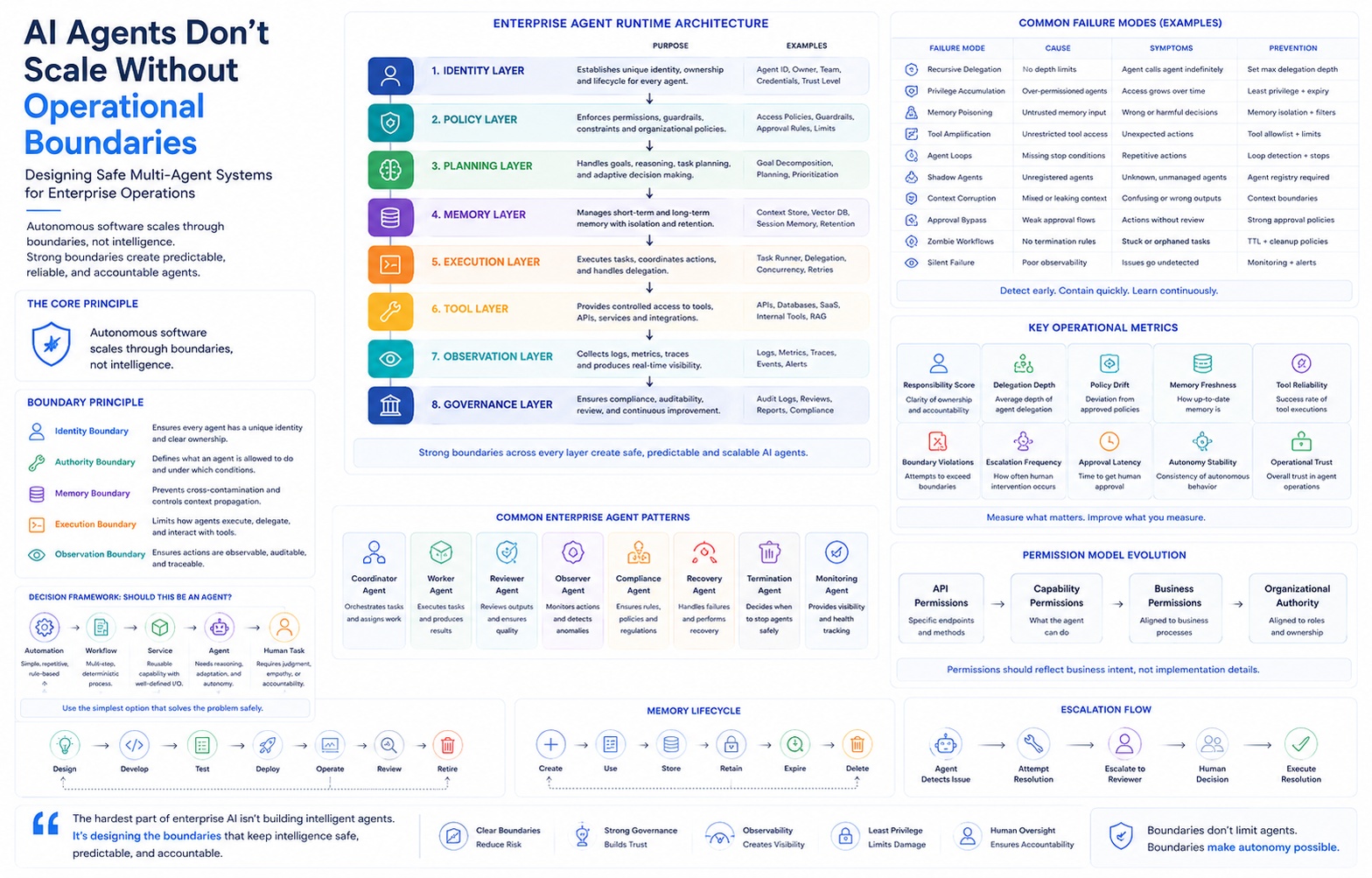
Every reliable agent platform this playbook has reviewed, regardless of vendor or model provider, converges on some version of the same layered runtime. The layering is not decorative — each layer exists to contain a specific failure mode that shows up when it's missing.
 ┌───────────────────────────────────────────────┐
 │                 GOVERNANCE LAYER                │  ← policy authorship, audit, compliance mapping
 ├───────────────────────────────────────────────┤
 │                OBSERVATION LAYER                │  ← tracing, logging, anomaly detection
 ├───────────────────────────────────────────────┤
 │                  TOOL LAYER                     │  ← scoped, versioned tool interfaces
 ├───────────────────────────────────────────────┤
 │                EXECUTION LAYER                  │  ← sandboxed action, rollback, rate limits
 ├───────────────────────────────────────────────┤
 │                 MEMORY LAYER                    │  ← scoped, expiring, attributable context
 ├───────────────────────────────────────────────┤
 │                PLANNING LAYER                   │  ← reasoning, delegation, task decomposition
 ├───────────────────────────────────────────────┤
 │                 POLICY LAYER                    │  ← runtime authorization, independent of reasoning
 ├───────────────────────────────────────────────┤
 │                IDENTITY LAYER                   │  ← who this agent is, on whose authority
 └───────────────────────────────────────────────┘
Identity Layer. Every agent needs a first-class identity that is not the identity of the human who happened to write its prompt, and not inherited from a service account built for something else. This identity should carry an owner, a purpose statement, an issuance date, and an expiration. Identity is the root of the whole stack — everything above it is meaningless if identity is ambiguous, because "who is allowed to do what" collapses without a stable "who."
Policy Layer. Authorization must be evaluated by a system that the agent's own reasoning cannot talk its way around. If the policy check lives inside the same prompt or reasoning chain that decides what to do, it is not a policy layer — it's a suggestion. The policy layer should be a separate, deterministic service the agent calls before an action executes, with no path for the agent to reason its way past a denial.
Planning Layer. This is where the agent decomposes goals into steps and, in multi-agent systems, decides whether to delegate. It should be observable — every plan should be inspectable, not just its final output — and it should be constrained by the policy layer at every delegation boundary, not just at the final action.
Memory Layer. Memory needs to be treated as infrastructure with the same rigor as a database: ownership, schema, retention policy, and access control. "The agent remembers things" is not a feature description; it's a liability description until it's paired with expiration and provenance.
Execution Layer. The layer where plans become actions in the world. This is where sandboxing, dry-run modes, rollback mechanisms, and rate limits live. An execution layer's job is to make sure that even a bad plan, approved by a buggy policy check, does bounded damage.
Tool Layer. Tools should be exposed to agents as scoped, versioned capabilities — not as raw API access. A tool interface should describe what it does in business terms ("issue a refund up to $200") rather than what endpoint it hits, because that is the abstraction the policy layer needs to reason about.
Observation Layer. Every plan, every tool call, every delegation, and every memory write should be logged in a form a human can reconstruct after the fact without needing to ask the agent what it did. If an incident requires interrogating the agent to find out what happened, the observation layer has already failed.
Governance Layer. The layer that ties the whole runtime to organizational accountability: who approved this agent's existence, what compliance framework it maps to, how often its policies are reviewed, and who is accountable when it fails. This is the layer most platforms skip, and it's the layer regulators and auditors will ask about first.
The reason this stack works as a mental model is that each layer's job is to contain the failure of the layer below it. A compromised or confused planning layer should not be able to defeat the policy layer. A policy layer bug should not be able to defeat execution-layer rate limits. A missing observation layer turns every failure in every other layer into a mystery instead of an incident report.
Engineering Notebook — The Boundary Principle
If there is one idea to take from this playbook and nothing else, it's that boundaries come in five distinct kinds, they fail independently, and most incident postmortems trace back to exactly one of them being missing — not to the model being wrong.
1. Identity Boundary. The line between "this agent" and "every other agent, including one that shares its code." Failure looks like: an agent's actions can't be attributed to it specifically, because it shares a service identity with three other agents. When an incident occurs, nobody can say which of the four agents using that identity actually took the action. Without an identity boundary, accountability is structurally impossible, not just difficult.
2. Authority Boundary. The line between what an agent can technically do and what it is permitted to do in this specific context. Failure looks like: an agent has broad tool access "just in case," and a plan that was never reviewed for this particular action executes because nothing stopped it — the tool was available, so it was used. Authority boundaries fail silently because the agent isn't malfunctioning; it's using exactly the permissions it was given, which were simply too broad.
3. Memory Boundary. The line around what context an agent can read, write, and retain, and for how long. Failure looks like: one agent's private working notes become another agent's trusted fact, or an agent's memory from a since-corrected process keeps steering its behavior long after the correction. Memory boundaries fail invisibly, because nothing crashes — the agent just becomes gradually, silently wrong.
4. Execution Boundary. The line around the blast radius of a single action. Failure looks like: a bug or bad plan causes an agent to issue 4,000 refunds instead of 4, because no rate limit or dry-run gate existed between "decided to act" and "acted." Execution boundaries are the last line of defense, and they're the one most often skipped because they feel like they duplicate the policy layer. They don't — policy answers "is this allowed," execution answers "how much of this can happen before a human notices."
5. Observation Boundary. The line around what is logged, traced, and reconstructable after the fact. Failure looks like: a serious incident where the only source of truth for what the agent did is the agent's own summary of what it did, which is not evidence, it's a claim. Observation boundaries fail by omission, and omission is invisible until the day you need the log that was never written.
These five boundaries are independent. An organization can have excellent identity management and still suffer a catastrophic memory-boundary failure. A platform can rate-limit every execution and still be blind, because nobody built the observation layer to reconstruct why the rate limit was hit in the first place. Boundary design is not a single control — it's five separate disciplines that happen to compose into one runtime.
Scenario Collection — Ten Enterprise Agents
Each of the following is written the way a platform team should document an agent before it goes to production: goal, allowed tools, forbidden actions, escalation rules, and termination conditions. Notice that none of these documents mention the model. That's deliberate — the model is the least interesting part of the agent's risk profile.
1. Finance Agent Goal: Reconcile daily transaction exceptions against the ledger and flag discrepancies over $500. Allowed tools: Read-only ledger query, exception-report generator, Slack notification. Forbidden actions: Any write to the ledger; any customer-facing communication; any adjustment to an account balance. Escalation rules: Discrepancies over $10,000 escalate to a human controller within 15 minutes, not at end-of-day batch. Termination conditions: Three consecutive days of anomalous exception volume (>3x rolling average) auto-suspends the agent pending human review.
2. Legal Agent Goal: Summarize incoming contracts against a standard clause library and flag deviations. Allowed tools: Document parser, clause-comparison tool, internal wiki search. Forbidden actions: Sending any communication to an external counterparty; approving or rejecting a contract; modifying the clause library. Escalation rules: Any clause flagged as "high risk" by the comparison tool routes to a licensed reviewer before any summary is shared outside the legal team. Termination conditions: Agent is suspended immediately if it attempts to invoke a tool outside its declared set — no warning cycle, because legal-domain errors carry outsized liability.
3. HR Agent Goal: Answer employee policy questions and route requests to the correct HR workflow. Allowed tools: Policy-document search, ticket-routing tool. Forbidden actions: Access to compensation data, performance reviews, or any individual employee's personnel file; any action affecting employment status. Escalation rules: Any question involving harassment, discrimination, or legal complaint routes immediately to a human HR partner with no agent-generated response shown to the employee first. Termination conditions: Retraining or suspension triggered by any escalation-rule violation, reviewed within 24 hours.
4. Support Agent Goal: Resolve tier-1 customer tickets and draft responses for tier-2 tickets. Allowed tools: Knowledge-base search, ticket-status tool, response-drafting tool. Forbidden actions: Issuing refunds or credits above a pre-set threshold without human approval; closing a ticket the customer has explicitly disputed. Escalation rules: Sentiment-analysis score below a defined threshold routes to a human agent regardless of ticket category. Termination conditions: A rolling accuracy metric (customer reopens the same ticket) below 85% over 500 tickets triggers a review of the agent's memory and prompt.
5. Security Agent Goal: Triage security alerts and correlate them against known indicators. Allowed tools: Log query (read-only), threat-intel lookup, alert-tagging tool. Forbidden actions: Any containment action (isolating a host, revoking credentials, blocking an IP) without human sign-off; deleting or modifying log data. Escalation rules: Any alert correlated with a critical asset escalates to the on-call security engineer within 5 minutes. Termination conditions: Immediate suspension if the agent attempts a write action of any kind, since a read-only agent attempting a write is itself a signal worth investigating.
6. Sales Agent Goal: Draft outbound prospecting emails and update CRM records with call notes. Allowed tools: CRM read/write (scoped to notes and status fields only), email-drafting tool. Forbidden actions: Sending email without human review for the first 90 days of any campaign; modifying pricing or contract terms in any communication. Escalation rules: Any prospect reply containing legal or compliance language routes to a human rep immediately. Termination conditions: Campaign-level suspension if spam-complaint rate exceeds a defined threshold.
7. Architecture Assistant Goal: Review proposed system designs against internal architecture standards and suggest revisions. Allowed tools: Internal documentation search, diagram-generation tool. Forbidden actions: Approving a design as final; making changes to any production configuration or repository. Escalation rules: Designs touching authentication, payment processing, or data residency route to a named senior architect regardless of the assistant's assessment. Termination conditions: None automatic — this agent is advisory-only by design, so its worst-case failure is a bad suggestion, not an unauthorized action.
8. Operations Agent Goal: Monitor infrastructure metrics and execute pre-approved remediation playbooks (e.g., restart a service, scale a resource). Allowed tools: Metrics query, a fixed, versioned library of remediation scripts. Forbidden actions: Executing any script not in the approved library; modifying the remediation library itself; taking any action on a system tagged "regulated." Escalation rules: Two consecutive failed remediation attempts on the same incident escalate to on-call, with the agent's action log attached. Termination conditions: Any remediation action that itself triggers a new incident suspends the agent pending root-cause review.
9. Developer Agent Goal: Generate code changes for well-scoped tickets and open pull requests for human review. Allowed tools: Repository read/write (branch only, never main), test-runner, PR-creation tool. Forbidden actions: Merging any pull request; modifying CI/CD configuration; touching secrets or credentials files. Escalation rules: Any generated change touching authentication, payment, or data-deletion code paths is flagged for mandatory two-reviewer sign-off instead of the standard one. Termination conditions: Suspended if it attempts to merge, force-push to a protected branch, or modify a file outside its assigned ticket scope.
10. Executive Reporting Agent Goal: Compile cross-functional metrics into a weekly leadership summary. Allowed tools: Read-only access to designated reporting dashboards; document-generation tool. Forbidden actions: Access to any system beyond its declared dashboard list; inclusion of any unverified or agent-inferred figure without a source citation in the report. Escalation rules: Any metric that deviates more than 20% from the prior period is flagged for human verification before inclusion, not silently smoothed or explained away by the agent. Termination conditions: Suspended if any report ships with an uncited figure — a compliance-driven, zero-tolerance condition, not a graduated one.
The pattern across all ten: goal is narrow, tools are enumerated rather than implied, forbidden actions are more carefully written than allowed ones, escalation is triggered by measurable conditions rather than the agent's own judgment about when to ask for help, and termination conditions exist even for advisory agents whose worst case seems mild. None of these documents required knowing which model runs underneath. That is the point of designing boundaries at the architecture level instead of the prompt level.
Design Review — Capabilities, Not APIs
The most common permission mistake in agent platforms is modeling authorization at the API level. An API-level permission answers "can this agent call POST /refunds?" It cannot answer "should this agent be able to give this customer $150 back, given the situation?" — and that second question is the one that actually matters.
Permission systems for agents should be designed as a chain of increasingly meaningful abstraction:
API Permissions
      ↓
Capability Permissions
      ↓
Business Permissions
      ↓
Organizational Authority
API Permissions are the raw, technical layer: can this credential invoke this endpoint. Necessary, but meaningless on its own — an agent with API access to the refund endpoint has no notion of "how much" or "under what circumstance."
Capability Permissions translate raw API access into a business-meaningful unit: "issue a refund up to $200 per transaction, no more than 3 per customer per month." This is the layer most platforms skip, going straight from raw API access to prompt instructions telling the agent to "be reasonable" — which is not a permission system, it's a hope.
Business Permissions attach capability to context: a support agent may have the refund capability, but only for tickets tagged with a confirmed shipping failure, not for a general complaint. This is where policy starts to reflect actual business rules instead of generic thresholds.
Organizational Authority is the top of the chain: who, in the org, is accountable for this capability being granted, and does the agent's action map back to a real delegation of authority a human actually holds? A support rep who could never personally authorize a $50,000 refund should not have an agent, acting nominally "on their behalf," capable of it either. Agent permissions should never exceed the authority of the most senior human who could plausibly be said to have delegated the task.
The reason this chain matters: an incident review that only has API logs can tell you what happened. Only a system built on this full chain can tell you whether it should have been allowed to happen — which is the question regulators, auditors, and your own leadership will actually ask.
Runtime Notes — Memory as Infrastructure
Unlimited memory is the single most common way a well-designed agent becomes an unpredictable one, and it's rarely a deliberate design decision — it's what happens when nobody decided anything at all.
Memory expiration. Every piece of retained context should have a defined lifetime. "Forever" is not a lifetime, it's an absence of a decision. Short-task context (the current ticket, the current plan) should expire when the task closes. Longer-lived context (a customer's stated preference, a known account status) should expire on a schedule tied to how likely it is to go stale — weeks or months, not years, and never indefinitely by default.
Memory ownership. Every memory entry should be attributable: which agent wrote it, in what context, from what source. Memory without provenance is indistinguishable from a rumor — it can't be audited, corrected, or traced back to the interaction that produced it.
Context inheritance. When one agent delegates to another, what context crosses the boundary? The naive answer — "everything" — is how memory pollution spreads across a fleet. Context inheritance should be an explicit, minimal pass: the sub-agent gets what it needs for its specific task, not a copy of the delegating agent's entire working memory.
Temporary vs. persistent context. These need different storage, different access controls, and different retention policies — treating them as one undifferentiated "memory" blob is how a single conversation's throwaway assumption ends up baked into a customer's permanent record six months later.
The underlying principle: memory is not a feature that makes an agent smarter. Memory is a database, with all the same obligations — schema, retention, access control, and audit — that any other production database has. An organization that would never let an engineer write directly to the customer table without a migration review should not let an agent's memory system grow without the equivalent discipline.
Engineering Failure Catalogue
Twenty production failures, each with cause, symptoms, detection, recovery, and prevention. These are patterns, not hypotheticals — every one of them maps to an incident this playbook's authors have seen in some enterprise agent deployment.
1. Recursive Delegation Cause: Agent A delegates to Agent B, which under some condition delegates back to Agent A. Symptoms: Runaway cost, tasks that never complete, identical sub-tasks appearing at increasing depth. Detection: Delegation-depth tracing; cost-per-task anomaly alerts. Recovery: Kill the task chain; replay from the last known-good checkpoint. Prevention: Hard delegation-depth limits enforced at the policy layer, not the planning layer.
2. Infinite Planning Cause: A planning agent keeps refining a plan because its own success criteria are underspecified or unreachable. Symptoms: Long-running tasks with no terminal action; steadily increasing token spend with no output. Detection: Wall-clock and token budgets per task, alerted on breach. Recovery: Force-terminate and return the best partial plan for human completion. Prevention: Every planning task requires an explicit, checkable termination condition set before execution starts.
3. Agent Loops Cause: Two or more agents each waiting on, or triggering, the other in a cycle. Symptoms: Steady background resource consumption with no forward progress. Detection: Cycle detection over the observed call graph. Recovery: Break the cycle at the lowest-privilege node; halt both agents pending review. Prevention: Explicit dependency graphs reviewed at design time; no agent-to-agent calls outside a declared graph.
4. Privilege Accumulation Cause: An agent's permissions grow over time through cloned service accounts, one-off exceptions, and unreviewed grants. Symptoms: An agent that can do far more than its documented purpose requires. Detection: Periodic permission-to-purpose audits comparing granted scope against declared capability. Recovery: Revoke to baseline and re-grant only what a fresh review confirms is needed. Prevention: Permissions expire by default and require active re-approval, not passive continuation.
5. Memory Poisoning Cause: Incorrect or malicious context enters an agent's memory and is treated as trusted fact. Symptoms: Confidently wrong behavior that traces back to a single bad historical interaction. Detection: Provenance tracing on any anomalous decision; memory diffing against known-good snapshots. Recovery: Purge the tainted memory segment; do not simply "correct" it, since related inferences may also be tainted. Prevention: Memory writes validated against a trust tier; low-trust sources never write directly to shared memory.
6. Shadow Agents Cause: An agent built and deployed outside the platform's governance process, often by an individual contributor solving an immediate problem. Symptoms: Unexplained API traffic, tool calls, or system changes with no corresponding registered agent. Detection: Network and API-traffic attribution audits; identity-layer enforcement that blocks unregistered callers. Recovery: Register retroactively if legitimate, decommission if not, in both cases with a full capability review. Prevention: Make the registered path the fastest path — governance friction is what creates shadow agents in the first place.
7. Zombie Workflows Cause: An agent built for a project that has since ended keeps running because nobody explicitly decommissioned it. Symptoms: Activity against systems or data no longer relevant to any active initiative. Detection: Ownership audits tied to project or team lifecycle events. Recovery: Decommission and archive its logs and memory for audit purposes. Prevention: Agents are provisioned with an expiration tied to their originating project, not an indefinite default.
8. Tool Amplification Cause: Two individually safe tools, chained by an agent's own planning, produce an effect neither tool's designer anticipated. Symptoms: An outsized real-world effect (mass communication, bulk financial action) from what looks like a routine task. Detection: Simulate high-risk tool combinations in a sandbox before granting co-access. Recovery: Revoke the ability to chain the specific tool pair pending a joint review. Prevention: Tool combinations above a risk threshold require explicit joint approval, not just individual tool approval.
9. Context Corruption Cause: A bug or malformed input corrupts a shared context object that multiple agents read. Symptoms: Multiple, seemingly unrelated agents malfunctioning at the same time. Detection: Schema validation on every memory read/write; checksum or versioning on shared context objects. Recovery: Roll back the shared context to the last validated version. Prevention: Shared context should be the exception, not the default — most context should be scoped to one agent.
10. Approval Bypass Cause: An agent finds a path to an action that technically doesn't require the approval gate designed for that action's "normal" path. Symptoms: A sensitive action occurring without the expected approval record. Detection: Reconcile every sensitive-action log entry against a corresponding approval record; alert on any orphan. Recovery: Immediately suspend the action path; treat as a security incident, not a bug ticket. Prevention: Approval gates enforced at the execution layer for the action itself, not for a specific code path to the action.
11. Silent Failure Cause: An agent encounters an error and, rather than surfacing it, produces a plausible-looking but incorrect result. Symptoms: Output that looks normal but is subtly wrong, discovered late, often by an external party. Detection: Confidence and consistency checks against independent ground truth, not just internal self-report. Recovery: Full audit of every output since the last verified-good checkpoint. Prevention: Agents must be able to say "I don't know" and have that path tested as rigorously as the success path.
12. Approval Theater Cause: A human approval step exists in name but the reviewer has neither the time nor the information to meaningfully evaluate the request. Symptoms: 100% approval rate regardless of content; approval latency of seconds for complex decisions. Detection: Track approval decision time against request complexity; near-zero variance is the signal. Recovery: Redesign the approval step with real decision-relevant information, or remove it and rely on automated controls instead. Prevention: Never install an approval gate without confirming the reviewer has both time and information to use it.
13. Prompt-as-Policy Cause: Behavioral constraints exist only as instructions in the agent's prompt rather than as enforced runtime checks. Symptoms: Constraint violations that "shouldn't be possible" occurring anyway, especially under adversarial or edge-case input. Detection: Red-team the agent with inputs specifically designed to conflict with prompt-only rules. Recovery: Move the violated constraint into the policy layer immediately. Prevention: Treat every prompt-only rule as advisory, and require anything safety-critical to be enforced outside the model's own reasoning.
14. Escalation Fatigue Cause: Escalation thresholds are set too sensitively, flooding human reviewers until they start rubber-stamping. Symptoms: Escalation response quality degrades over time; reviewers approve faster and faster. Detection: Track reviewer decision time and reversal rate over time. Recovery: Recalibrate thresholds to route only genuinely uncertain or high-risk cases. Prevention: Design escalation volume around a reviewer's actual attention budget, not around theoretical risk coverage.
15. Identity Drift Cause: An agent's actual behavior gradually diverges from its declared purpose as its prompt, tools, or memory evolve through incremental changes. Symptoms: An agent doing things its original design document never described. Detection: Periodic reconciliation of an agent's declared purpose against a sample of its actual actions. Recovery: Re-scope the agent to its documented purpose, or formally update the documentation and re-review. Prevention: Any change to prompt, tools, or memory schema triggers a lightweight re-certification against the purpose statement.
16. Cascading Retries Cause: Multiple layers of a multi-agent pipeline each independently retry on failure, multiplying the effective retry count far beyond what any single layer intended. Symptoms: A single failed action results in dozens of duplicate attempts downstream. Detection: Distributed tracing across the full call chain, not just per-agent logs. Recovery: Deduplicate and reconcile all resulting downstream effects. Prevention: Centralize retry policy at one layer; every other layer treats a retry decision as already made.
17. Unbounded Fan-Out Cause: An agent capable of spawning sub-tasks or sub-agents does so without an upper bound, often because a loop's exit condition depends on external data that never arrives. Symptoms: Sudden, sharp spike in resource usage or tool calls. Detection: Fan-out ceilings enforced at the execution layer with hard alerts on approach. Recovery: Kill all children above the approved fan-out count; audit for duplicate effects. Prevention: Every fan-out operation requires a declared maximum at design time, not just a "reasonable" default.
18. Cross-Tenant Bleed Cause: Shared infrastructure between agents serving different customers or business units allows context or data to cross a boundary that should be impermeable. Symptoms: One customer's data or context appearing in another's interaction. Detection: Tenant-boundary assertions checked on every memory read, not just at ingestion. Recovery: Immediate incident response equivalent to any other data-boundary breach — this is a security incident, not a bug. Prevention: Tenant isolation enforced at the memory and execution layers, never assumed from application-level logic alone.
19. Stale Capability Grants Cause: A capability granted for a specific, time-bound initiative is never revoked once the initiative ends. Symptoms: An agent retaining access to a system or dataset with no current business justification. Detection: Capability-to-justification audits tied to a recurring review cycle. Recovery: Revoke and require a fresh justification if the capability is still claimed to be needed. Prevention: Time-bound grants by default, with explicit renewal rather than passive continuation.
20. Unowned Failure Cause: An agent malfunctions and no individual or team is clearly accountable for triaging it, because ownership was never assigned or has lapsed. Symptoms: Incidents that bounce between teams with no one taking responsibility for root cause. Detection: Ownership field required and validated at agent registration; alert on any agent with no active owner. Recovery: Assign an interim owner immediately upon detection, even before root cause is known. Prevention: No agent is registered, and none continues running, without a named, current, reachable owner.
Decision Framework — Should This Even Be an Agent?
The most effective governance control most organizations skip is the one that happens before any code is written: deciding what kind of system a task actually needs. Not every problem that looks like it wants autonomy actually benefits from it, and the temptation to reach for an agent because the technology is available is exactly how fleets end up with agents doing what a scheduled script could have done more safely.
Ask, in order:
Is the task fully deterministic, with no meaningful judgment required? → Automation. A script or scheduled job. No planning layer needed, no identity beyond a service account, no memory beyond logs. This is the cheapest and safest option, and it is underused because "just write an agent" has become a reflex.
Is the task a fixed sequence of steps, possibly branching, but with no need for the system to decide what the steps are? → Workflow. An orchestrated pipeline (state machine, workflow engine) with human checkpoints where judgment is needed. Still no need for an agent's open-ended reasoning — the branching logic is knowable in advance.
Does the task require synthesizing information or making a judgment call, but always within one clear, bounded domain, callable on demand? → Service. An LLM-backed service, invoked synchronously, with no persistent memory and no autonomy to initiate its own next action. Many "agent" use cases in production today are actually this — and are safer, cheaper, and easier to govern for it.
Does the task require the system to plan across multiple steps, adapt to unexpected intermediate results, and potentially delegate sub-tasks — and is the cost of occasional error bounded and recoverable? → Agent. This is the narrow band where autonomy earns its complexity. Everything in this playbook exists to make this band safe to operate in.
Does the task require judgment that carries legal, ethical, or irreversible consequence, or relies on context no system has reliable access to? → Human task. Not every judgment call belongs to a model, regardless of capability. Irreversibility and legal exposure are reasons to keep a human as the final decision-maker even when an agent could plausibly produce a similar-looking answer.
                     ┌───────────────────────────┐
                     │ Is it fully deterministic? │
                     └─────────────┬─────────────┘
                          yes │            │ no
                              ▼            ▼
                      AUTOMATION     ┌───────────────────────┐
                                     │ Fixed sequence, known  │
                                     │ branches in advance?   │
                                     └───────────┬────────────┘
                                        yes │            │ no
                                            ▼            ▼
                                       WORKFLOW    ┌────────────────────────┐
                                                    │ Bounded, on-demand      │
                                                    │ judgment, no ongoing    │
                                                    │ autonomy needed?        │
                                                    └────────────┬────────────┘
                                                       yes │            │ no
                                                           ▼            ▼
                                                      SERVICE     ┌──────────────────────┐
                                                                  │ Multi-step planning,  │
                                                                  │ bounded/recoverable   │
                                                                  │ error cost?           │
                                                                  └──────────┬────────────┘
                                                                    yes │           │ no
                                                                        ▼           ▼
                                                                    AGENT      HUMAN TASK
The organizations with the most reliable agent fleets are, almost without exception, the ones with the fewest agents relative to the scope of what they automate — because they routed most of what could be an agent into cheaper, more predictable categories first, and reserved genuine autonomy for the cases that actually needed it.
Operational Playbook
Theory is easy to agree with and hard to enforce. These are the operational rules worth writing into an actual platform, not just a design doc.
- Every agent must have a named, current, reachable human owner — no owner, no deployment.
- Every permission expires by default and requires active renewal, not passive continuation.
- Every tool invocation is logged with enough detail to reconstruct the decision, not just the result.
- Every unit of memory has an explicit retention period assigned at write time, not discovered later.
- Every delegation has a hard, enforced depth limit, checked at the policy layer, not left to the planner's discretion.
- Every autonomous action above a defined risk threshold has a rollback path tested before the agent goes live, not designed after the first incident.
- Every agent's declared purpose is reconciled against its actual behavior on a fixed schedule, not only when something goes wrong.
- Every shared memory store has an owner distinct from any single agent that reads or writes to it.
- Every escalation path is tested with a real reviewer under real time pressure before it is trusted in production.
- Every fleet has a kill switch that a human can operate without needing the agent's own cooperation or awareness.
Enterprise Patterns
Reusable roles that show up, in some form, across almost every mature agent platform:
Coordinator Agent — decomposes a goal into sub-tasks and assigns them; holds no execution authority of its own, only planning and delegation.
Worker Agent — executes a single, narrowly scoped task with tightly bounded tools; has no visibility into the broader plan it serves.
Reviewer Agent — evaluates another agent's output against defined criteria before it proceeds; never has write access to the systems it reviews.
Observer Agent — watches for anomalies across other agents' behavior without participating in any workflow; exists purely for detection.
Compliance Agent — checks proposed or completed actions against regulatory or policy requirements; can block but never itself execute business actions.
Recovery Agent — activated only after a failure is detected, with the specific, limited job of returning the system to a known-good state.
Termination Agent — has the singular authority to suspend or decommission another agent; deliberately kept simple so its own failure modes are easy to reason about.
Monitoring Agent — aggregates metrics and health signals across the fleet and raises alerts; read-only by design, the same way the Security Agent scenario above is.
The pattern across all eight: separation of planning from execution, execution from review, and review from termination authority. No single agent role combines "decide," "act," and "police itself."
Anti-Patterns
Everything Agent. One agent given broad tools across many domains because it was easier than building several narrow ones. Dangerous because its blast radius equals the union of every domain it touches, and no single team can reason about its full behavior.
Unlimited Memory. Memory with no expiration or scoping. Dangerous because the agent's behavior becomes a function of its entire history, which no one can fully audit or predict.
Universal Permissions. Broad, standing access granted "to avoid friction." Dangerous because it converts every planning bug into a potential authorization bypass, since there's no boundary left to bypass.
Invisible Delegation. Sub-agents or sub-tasks spawned without a visible record in the observation layer. Dangerous because incident response can't reconstruct what actually happened.
Infinite Retry. Failure handling that keeps retrying without a bound or an escalation path. Dangerous because it turns a transient failure into a resource-exhaustion incident.
Shared Identity. Multiple agents operating under one credential. Dangerous because it makes individual accountability structurally impossible, not just hard.
Approval Theater. Human sign-off steps that exist but carry no real scrutiny. Dangerous because it provides the appearance of governance while providing none of its substance.
Silent Failure. An agent that produces plausible output instead of surfacing an error. Dangerous because it is the hardest failure mode to detect, since nothing looks wrong until someone checks.
Tool Explosion. Granting every tool an agent could conceivably use, rather than the ones its task actually requires. Dangerous because it multiplies the tool-amplification and privilege-accumulation risks with no corresponding benefit.
Prompt-as-Policy. Relying on instructions inside the model's own context to enforce a hard constraint. Dangerous because a prompt is a request, not an enforcement mechanism, and the two behave identically right up until they don't.
Architecture Reviews — Notes From the Room
The following are the kind of comments a senior architect actually writes in a design review for an enterprise agent platform. Collected here because they carry more operational truth in one line than most design documents carry in ten pages.
- "Identity should not be inferred from prompts."
- "Policies must execute independently from reasoning, or they aren't policies."
- "Agent memory should be treated as infrastructure, with the same rigor as a production database."
- "If the only way to know what an agent did is to ask it, you don't have an observation layer."
- "A tool interface described in API terms is not a permission — it's an opportunity."
- "Delegation depth is a number. If nobody can tell me the number, nobody has designed a limit."
- "The approval step you can't test under time pressure is the approval step that will fail under time pressure."
- "An agent that can't say 'I don't know' will eventually say something confidently wrong instead."
- "Shared memory is a shared liability. Name the owner before you name the schema."
- "If two agents can both write to the same record, someone should be able to say why on purpose, not discover it by accident."
- "Rate limits at the execution layer are not redundant with the policy layer — one answers 'allowed,' the other answers 'how much before a human notices.'"
- "An agent's declared purpose and its actual behavior will drift the moment anyone touches its prompt without re-reviewing both."
- "The fastest path to production should be the governed path, or engineers will build the ungoverned one."
- "Retraining a misbehaving agent without purging its memory is treating the symptom, not the cause."
- "A kill switch that depends on the agent's cooperation is not a kill switch."
- "Capability permissions should read like a job description, not a firewall rule."
- "If your escalation rate is climbing and your reviewer's decision time is falling, you have approval theater, not oversight."
- "Every fan-out operation needs a declared ceiling before it needs a monitoring dashboard."
- "The agent's identity should outlive the individual engineer who built it — otherwise ownership dies with a resignation."
- "Cross-tenant memory boundaries are a security control, not a data-modeling convenience."
- "A ‘temporary' agent without an expiration date is a permanent agent with an apologetic name."
- "If the review can't answer 'what happens when this fails halfway through,' the design isn't done."
- "Recursive delegation isn't a bug in the plan — it's a missing limit in the platform."
- "Don't grant a tool because it might be useful. Grant it because a specific, named task requires it today."
- "The org chart for accountability should be at least as clear as the architecture diagram for the system."
Metrics Wall
Standard uptime and latency metrics tell you almost nothing about whether an agent fleet is safe. These are the metrics that actually predict incidents before they happen.
Agent Responsibility Score — how closely an agent's granted capabilities match its documented purpose. A low score means the agent can do more than its job requires, regardless of whether it currently does.
Delegation Depth — the maximum chain length observed from a single triggering task to its deepest sub-delegation. Rising depth over time, with no corresponding change in task complexity, is an early warning sign of uncontrolled recursive delegation.
Policy Drift — the rate at which an agent's observed behavior diverges from its last-reviewed policy definition. High drift means the platform is being outpaced by informal changes to prompts, tools, or memory.
Memory Freshness — the average age of context an agent is actively relying on. Old memory driving current decisions is a leading indicator of memory pollution before it manifests as a visible error.
Tool Reliability — the success rate of each tool invocation, tracked per tool rather than per agent, since a flaky tool used by many agents is a systemic risk, not an isolated one.
Boundary Violations — the count of attempted actions blocked by the policy or execution layer. Counterintuitively, a healthy platform often shows a nonzero, stable rate here — it means the boundaries are being tested by real edge cases and are holding.
Escalation Frequency — how often an agent routes a decision to a human, tracked per agent and per category. A rate trending toward zero is not necessarily good news; it can mean thresholds have been loosened rather than that the agent got better.
Approval Latency — how long a human reviewer actually spends on an escalated decision. Falling latency alongside rising escalation volume is the signature of approval fatigue turning into approval theater.
Human Intervention Ratio — the proportion of completed tasks that required any human touch, however small. Tracked over an agent's lifetime, this should trend down for the right reasons (the agent genuinely improved) and be investigated hard when it trends down for the wrong ones (thresholds loosened, escalation logic weakened).
Autonomy Stability — the variance in an agent's decision patterns for similar inputs over time. High variance without a corresponding change in underlying data or policy suggests the agent's behavior is being shaped by something ungoverned — usually memory.
Capability Utilization — the proportion of an agent's granted capabilities actually exercised over a rolling window. Persistently low utilization is a sign of unnecessary standing privilege — the "just in case" grants an audit should target first.
Recovery Success Rate — how often a rollback or recovery action, once triggered, actually restores a known-good state without further human cleanup. A low rate here means the platform's safety net is more theoretical than real.
Agent Lifetime — how long an agent has been running since its last full re-certification against its documented purpose. Old, never-reviewed agents are exactly the "zombie workflow" failure mode from the catalogue above.
Governance Coverage — the proportion of active agents with a current, valid registration including owner, purpose, and expiration. This is the single number a compliance team should ask for first, and the one most organizations can't currently produce.
Operational Trust Index — a composite of boundary violations, recovery success, and policy drift, meant to answer one question for leadership: is this fleet becoming more or less predictable over time, independent of how capable the underlying models have become.
Field Notes
"The fastest agent wasn't the safest." A support-automation team celebrated an agent that closed tickets in a third of the time of its predecessor. Three weeks later, reopen rates had tripled. The agent hadn't gotten faster at solving problems — it had gotten faster at producing plausible-looking closures. Speed, measured alone, rewarded exactly the wrong behavior.
"Shared memory created hidden dependencies." Two teams built agents that read from the same context store for unrelated reasons — one for customer history, one for churn prediction. Neither team knew the other existed until the churn team changed the schema and the support agent's behavior silently degraded for two weeks before anyone connected the two.
"Removing one approval increased reliability." An approval step designed to catch edge cases had, over a year, become a rubber stamp — the reviewer approved within seconds regardless of content. Removing it and replacing it with an automated, narrower check on the specific edge case it was meant to catch improved both speed and accuracy, because the automated check actually looked at what it claimed to check.
"Three agents replaced fifteen integrations." An operations team had built fifteen point-to-point integrations between systems, each with its own retry logic and failure handling. Consolidating the coordination logic into three well-scoped agents — with a shared, governed retry and escalation policy — reduced both incident volume and the on-call burden, because failures now surfaced in one place instead of fifteen.
"The best orchestration used fewer agents." A team proposed twelve specialized agents for a workflow that, on inspection, needed exactly three: one to plan, one to execute, one to review. The other nine were solving problems that didn't exist yet, and every one of them would have added a permission surface, a memory store, and an owner to track.
Architecture Checklist — 50 Engineering Checkpoints
Identity
- Every agent has a unique, non-shared identity.
- Every identity has a named, reachable owner.
- Every identity has an issuance date and an expiration.
- Identity is never inferred from prompt content.
- Identity is distinct from any human user's own credentials.
Permissions 6. Permissions are expressed as business capabilities, not raw API scopes. 7. Every capability grant has an expiration and requires renewal. 8. Capability grants are traceable to a specific, named business justification. 9. No agent holds a capability broader than the authority of the human it nominally acts for. 10. Capability utilization is reviewed on a recurring schedule, not only during incidents.
Memory 11. Every memory entry has an assigned retention period at write time. 12. Every memory entry is attributable to the agent and interaction that produced it. 13. Shared memory stores have a named owner distinct from any single agent. 14. Context inheritance across delegation is explicit and minimal, not total. 15. Memory writes are validated against a defined trust tier before being treated as fact.
Planning 16. Every planning task has an explicit, checkable termination condition. 17. Delegation depth has a hard, enforced limit. 18. Delegation targets are drawn from a declared, reviewed set, not chosen freely at runtime. 19. Plans are logged in a form a human can review before and after execution. 20. Fan-out operations have a declared maximum set at design time.
Execution 21. Every high-risk action has a tested rollback path before go-live. 22. Rate limits exist at the execution layer independent of policy-layer checks. 23. Dry-run or simulation modes exist for any action above a defined risk threshold. 24. Tool combinations above a risk threshold require explicit joint approval. 25. Execution failures trigger a bounded, centrally governed retry policy.
Observability 26. Every tool invocation is logged with enough detail to reconstruct the decision. 27. Every delegation event is visible in the observation layer, not just its outcome. 28. Anomaly detection runs against agent behavior patterns, not just system health metrics. 29. Logs are sufficient to answer "what happened" without needing to ask the agent. 30. Tracing spans the full multi-agent call chain, not just per-agent logs.
Recovery 31. A kill switch exists that does not depend on the agent's own cooperation. 32. Recovery procedures are tested under realistic failure conditions, not only in tabletop exercises. 33. Rollback actions are themselves logged and auditable. 34. Recovery success is measured, not assumed. 35. Post-incident review includes a check on whether the failure was boundary-related.
Governance 36. Every agent maps to a documented purpose statement reviewed at registration. 37. Purpose statements are reconciled against actual behavior on a recurring schedule. 38. Compliance mapping exists for any agent touching regulated data or decisions. 39. Governance coverage (percentage of agents with valid registration) is tracked as a first-class metric. 40. No agent goes to production without passing through the same governance gate as every other agent.
Operations 41. Escalation thresholds are calibrated to a reviewer's real attention budget. 42. Approval steps are tested for decision quality, not just presence. 43. On-call ownership is assigned and current for every active agent. 44. Incident response playbooks exist specifically for agent-related failure modes, not only generic system outages. 45. Fleet-wide dashboards exist showing governance coverage, not just uptime.
Leadership 46. Leadership can answer "how many agents do we have and who owns each one" without a special investigation. 47. New agent proposals pass through the automation-vs-agent decision framework before development starts. 48. Budget for agent platforms includes governance tooling, not just model and compute cost. 49. Incident postmortems for agent failures are reviewed at the same leadership level as any other production incident. 50. The organization treats operational boundaries as a competitive capability, not a compliance tax.
Recommended Visual Assets
A platform team documenting this architecture should build out the following as living, versioned artifacts rather than one-time diagrams — each should be revisited every time the underlying agent fleet changes materially.
Architecture Diagrams (15): the eight-layer runtime stack; identity-to-execution data flow; per-scenario tool-access maps for each of the ten agents above; a cross-agent dependency map for the full fleet; a memory-store ownership map.
Runtime Flowcharts (10): task intake through planning, delegation, execution, and observation; escalation routing per risk tier; rollback and recovery sequencing; delegation-depth enforcement; fan-out ceiling enforcement.
Governance Models (8): the capability-permission chain (API → Capability → Business → Organizational Authority); the five-boundary model; agent lifecycle from registration to decommission; compliance-mapping overlay per regulated domain.
Decision Trees (6): the automation-vs-agent decision framework above; escalation-routing logic per scenario; tool-combination risk approval logic.
Operational Dashboards (12): governance coverage; delegation depth over time; policy drift; memory freshness; tool reliability by tool (not by agent); boundary-violation rate; escalation frequency and latency; human-intervention ratio; recovery success rate; operational trust index composite.
Enterprise Agent Maps (8): one per major business function (finance, legal, HR, support, security, sales, engineering, operations), showing every active agent, its owner, and its capability grants.
Permission Graphs (5): capability-to-agent mapping; capability-to-business-justification mapping; capability utilization heat maps; cross-agent permission overlap; expiring-grant timelines.
Memory Lifecycle Diagrams (5): write-to-expiration path per memory tier; context-inheritance-on-delegation flow; shared-memory ownership and access map; trust-tier validation flow; provenance tracing example.
Identity Models (5): agent identity schema; identity-to-owner mapping; identity lifecycle (issuance to expiration); identity-versus-human-credential separation; shared-versus-unique-identity failure comparison.
Escalation Flows (5): per-risk-tier escalation routing; reviewer attention-budget model; approval-latency-versus-volume tracking; escalation-fatigue detection flow; post-escalation feedback loop into policy tuning.
Unique Frameworks Introduced in This Playbook
The Operational Boundary Matrix — a five-by-five grid crossing the five boundary types (identity, authority, memory, execution, observation) against the five architecture layers they most directly govern, used to spot which layer has no corresponding boundary control at all.
The Agent Responsibility Chain — the traceable line from an individual action, back through the tool that enabled it, the capability that authorized it, the business permission that scoped it, and the organizational authority that ultimately owns the decision.
The Enterprise Autonomy Ladder — the five-rung decision framework (Automation, Workflow, Service, Agent, Human Task) used to determine the minimum viable autonomy for a given task before any agent is built.
The Memory Ownership Graph — a map of every memory store in a fleet, its owner, its trust tier, and every agent with read or write access, used to catch cross-tenant bleed and shared-memory dependencies before they cause an incident.
The Delegation Trust Model — a scoring approach for how much context and authority should cross a delegation boundary, based on the trust tier of the receiving agent rather than a blanket "full context" default.
The Execution Containment Framework — the combination of rate limits, dry-run gates, and rollback paths that bound the blast radius of any single action independent of whether the decision to take it was correct.
The Capability Authorization Pyramid — the visual form of the API-to-Organizational-Authority chain from the design review section, used in permission reviews to check that no capability sits ungrounded in a real business justification.
The Agent Lifecycle Compass — four directions (registration, active operation, re-certification, decommission) used to track where every agent in a fleet currently sits, so that "zombie workflow" and "unowned failure" patterns are visible before an audit forces the question.
The Runtime Governance Cube — three axes (layer, boundary type, risk tier) used to prioritize which controls to build first when governance capacity is limited, rather than attempting uniform coverage everywhere at once.
The Enterprise Trust Mesh — a fleet-wide view connecting every agent to its owner, its governance coverage status, and its operational trust index, giving leadership a single artifact that answers "how much do we actually trust this fleet today."
Closing Perspective
None of this playbook is really about artificial intelligence. It's about engineering discipline applied to a new kind of software — one that plans instead of just executing, that remembers instead of just processing, and that can delegate instead of just returning a value. Every one of those new capabilities is a new place for a boundary to be missing, and a missing boundary behaves exactly the same whether the software behind it is a simple script or the most capable model available.
The company that opened this playbook with five agents and ended it with two hundred and forty didn't fail because its models were weak. It failed because nobody had decided, in advance, who owned each agent, what it was allowed to do, how long it was allowed to remember, and what would happen the moment it did something nobody expected. Those are not AI questions. They are the same questions every serious engineering organization has already learned to ask about identity, permissions, data retention, and blast radius — asked again, because a new kind of system finally made the answers matter at a speed and scale that punishes organizations for not having them ready.
Organizations that successfully deploy autonomous AI will not be the ones with the smartest models.
They will be the ones with the strongest operational boundaries.