Model capability now arrives on a procurement cycle. A version string changes in a configuration file, and every agent in the estate becomes measurably better at planning, tool selection, and recovery from its own errors. The upgrade costs an afternoon of regression testing and a slightly different invoice.
Nothing comparable exists for control. No configuration change makes an organization more governable. Authority models are negotiated. Ownership is assigned to teams that did not ask for it. Audit pipelines are built by platform engineering groups with three other roadmaps. Approval workflows are argued over in review forums, and every one of those artifacts begins decaying the moment the system it describes changes.
Two curves therefore run through every enterprise AI program, and they have entirely different shapes. Capability is exogenous, discontinuous, and effectively free — it improves because someone else spent a decade and a fortune on it. Control is endogenous, linear, and expensive — it improves only when your own organization performs work that produces no visible feature, no demo, and no revenue line.
The gap between those two curves is the real engineering problem of the next decade. It is not a research problem. It is an operations problem wearing research clothing.
Interrogate a stalled agent program honestly and the blocker is almost never reasoning quality. It is that nobody can name the individual accountable when the system is wrong. It is that no one can reconstruct, from evidence rather than recollection, what the agent actually did last Thursday at 14:20. It is that disabling the agent requires a deploy, and the deploy requires a review, and the review requires the person on leave. None of those are intelligence deficits. All of them are governance deficits, and a smarter model makes every one of them worse, because a smarter model is trusted with more.
This is the asymmetry that defines enterprise AI architecture: capability compounds automatically; control compounds only under deliberate engineering pressure. Left alone, the ratio always moves in one direction.
The organizations that scale autonomous systems safely will not be the ones with privileged access to the strongest models. Model access is a commodity and will become more so. They will be the ones that built governance as a runtime system — with latency budgets, failure modes, service levels, and on-call ownership — rather than as a document that describes intentions nobody can enforce.
What follows is not an argument for caution. Caution is not an engineering discipline; it is a mood. It is an argument that authority, accountability, and control are subsystems, and that subsystems have architectures.
Perspective One — Every AI Agent Is An Operational Employee
The instinct is to reason about agents as software, because they are deployed as software: containers, endpoints, dashboards, error budgets. That instinct produces the wrong control model, and it produces it silently.
Conventional software has no authority. It has function. A payment service does not decide whether to refund a customer; it executes a decision that a human encoded at commit time, in a branch, reviewed by another human, in a deterministic contract. The judgment happened in the pull request. The runtime merely replays it.
An agent inverts this. The judgment happens at runtime, over conditions that were never enumerated, using a plan that no reviewer has seen, selecting from a tool set whose combinations were never explicitly authorized. The pull request no longer contains the decision. It contains the capacity to decide.
That inversion is what converts software from an instrument into an actor. And once a system acts on judgment rather than instruction, the questions that govern it stop being infrastructure questions and start being organizational ones.
Identity. A service account is not an identity. It is a credential with no biography. Enterprise identity carries provenance: who provisioned it, under what justification, with what expiry, on whose behalf it is currently acting. An agent that authenticates as svc-automation-prod has authentication without identity, which is precisely the condition under which accountability evaporates. The question a governed identity must answer is not "is this request authenticated" but "which accountable human is currently standing behind this action, and through what delegation chain."
Responsibility. Accountability cannot terminate in a machine. It must resolve, in every case, to a named person with the organizational standing to have prevented the outcome. An agent with no owner is not an unowned system; it is a system whose owner will be selected retroactively, during an incident, by whoever is least able to argue.
Permissions. Human access ratchets in one direction: people accumulate it as they move between teams, and almost nothing is revoked. Agents accelerate this, because expanding an agent's tool access is a one-line change made under delivery pressure by an engineer who is not the accountable owner. The distinction that matters is between a job description and a credential set. Most deployments have the second and have never written the first.
Reporting structure. An agent without an escalation target escalates to nobody. When it encounters a case outside its competence — and it will, because competence boundaries are never crisp — it does not stop. It produces its most plausible output and continues, because continuing is what the objective function rewards. A reporting line is not organizational decoration; it is the mechanism that converts uncertainty into a handoff rather than a guess.
Authority. Authority is not access. Access is the ability to call an API. Authority is the value of the consequences an actor may cause without prior review. These come apart constantly: an agent with read-only credentials to a customer database and write access to an email gateway has trivial access and enormous authority. This is what the Agent Authority Matrix is for — plotting every granted capability against two axes that actually predict harm: reversibility of the action, and blast radius of the action. Capabilities in the irreversible, wide-radius quadrant require human authorization regardless of how confident the system is. Confidence is not a control.
Scope. Drift is faster than in any human role, because the marginal cost of adding a tool is a config entry and the marginal benefit is immediate. Every agent begins narrow; very few remain so. Scope must be a declared, versioned artifact that changes are measured against — otherwise it is only a description of whatever the agent currently does.
Lifecycle. Human roles have probation, review, and graduated authority. Agents have deployment, and then permanence. There is no mechanism by which authority is earned through observed performance rather than granted by initial configuration. The Agent Lifecycle Governance Model makes authority a function of demonstrated reliability, with explicit promotion gates: shadow, supervised, bounded-autonomous, autonomous.
Retirement. Systems are decommissioned when someone notices they cost money. Agents are cheap at idle, so nobody notices. The result is a population of ghost workers holding live credentials, running on schedules nobody remembers configuring, writing into systems whose owners have changed twice. Offboarding is a first-class governance operation, and almost no organization has one for non-human actors.
The deeper point is about what humans supply implicitly. People self-limit through fatigue, fear, social friction, professional risk, and the simple hesitation of a person who senses they are exceeding their remit. Those brakes are invisible precisely because they are never specified. Agents have none of them. Every organizational constraint that was previously carried by human judgment must now be written down, encoded, and enforced by a machine — or it does not exist.
Perspective Two — Autonomy Without Boundaries Creates Organizational Entropy
Capable systems expand. This is not a defect and it is not emergent misbehavior; it is the direct consequence of optimization. Give a system an objective and a catalogue of capabilities, and it will use whatever reduces distance to the objective. Expansion is the cheapest available strategy, so expansion is what you get. Constraint must be structural, because it will never be self-imposed.
The failures below share a property that makes them dangerous: each individual step is locally reasonable. Nothing looks wrong at the point of decision. The pathology is only visible in aggregate, which is exactly the view no dashboard provides.
Recursive delegation. An agent that can invoke another agent has, by construction, created a graph. Graphs have cycles. Without depth limits, cycle detection, and a delegation ledger, an agent can call a peer that calls it back with a slightly restated objective, and each hop passes local plausibility review. Worse is the authority union problem: if a sub-agent executes with the caller's permissions, delegation becomes a privilege-escalation channel. Attenuation must be mandatory — a delegated call should never be able to do more than its parent, and a delegation chain should shrink monotonically. Very few implementations enforce this, because the default in every framework is inheritance.
Unlimited execution. Wall-clock, spend, retry count, and tool-call volume are the four dimensions on which agents run away, and retry loops are the most common. A failing call produces an error, the error becomes context, the context suggests another attempt, and the loop is closed — a denial-of-wallet vector triggered by an upstream outage rather than by an attacker.
Tool abuse. Tools are designed for human interaction rates and human interaction norms. An interface that a person invokes four times a day carries implicit assumptions that break at four thousand invocations an hour. More subtle is composition: two individually safe capabilities compose into an unsafe one. Read access to a customer table is safe. Send access to an outbound channel is safe. Together they are an exfiltration primitive that no single permission review would catch, because permission reviews evaluate grants individually. The Execution Boundary Framework must reason about capability combinations, not capability lists.
Memory pollution. Persistent memory is a mutable global variable with no schema, no versioning, no owner, and no expiry. A fact absorbed incorrectly in one interaction is retrieved with full confidence months later, laundered through repetition into apparent authority. There is rarely a mechanism to answer when the system came to believe something and on what basis, and almost never one to remove a belief and everything derived from it. Memory that cannot be corrected is not an asset; it is an accumulating liability.
Context leakage. The context window is a trust boundary that nobody administers. Data crosses it by inclusion: retrieval pulls documents whose access control was evaluated for the indexing service rather than the requesting user, tenant boundaries dissolve inside a shared vector store, and a fragment of one department's material becomes an input to another department's decision. This is the mechanism behind most real incidents, and it is not a model failure. It is an authorization failure that happens to be expressed in tokens.
Approval bypass. The gap between what was approved and what executed is where governance theatre lives. A human approves an intent — "update the pricing records for the affected accounts." The agent executes a plan. If the plan is regenerated after approval, or if the approval is scoped to a description rather than to a specific, hashed, immutable action set, then the approval authorized nothing. It documented a feeling. Approvals must bind to executables, expire on a short clock, and be invalidated by any change to the plan.
API sprawl. Every integration is permanent. Removal requires proving nothing depends on it, and proving a negative is expensive while leaving it enabled is free. The surface only grows, and it grows fastest where review is thinnest.
The unifying concept is entropy in the strict sense: permission sets, tool catalogues, memory stores, and delegation graphs all have a natural direction of change, and it is expansion. There is no counterforce in the system itself. Governance is the only negative pressure, and it must be applied continuously, because entropy is applied continuously.
Perspective Three — Governance Is A Runtime System
Most enterprises have AI governance. It exists as a policy document, a review board, a spreadsheet of registered use cases, and a set of principles endorsed at executive level. None of it is in the request path. It therefore has no causal relationship to what the system does.
This is the central architectural error. Governance implemented as documentation operates at human timescale — weeks — against systems making thousands of authority-bearing decisions per hour. A control that cannot deny an action at the moment it is attempted is not a control. It is a description of a preference.
Governance has to be built the way any other cross-cutting runtime concern is built: as infrastructure, in the path, with an SLO.
Policy engine. The foundational move is separating the decision point from the enforcement point. Policies are authored centrally, versioned in source control, tested in CI with their own regression suite, and evaluated by a service. Enforcement happens locally at every capability invocation. Policy must be deny-by-default at the capability layer — an agent may invoke exactly what has been explicitly granted, and the absence of a rule is a denial rather than a permission. The evaluation must also be contextual: the same tool call is legitimate or illegitimate depending on the acting identity, the delegation depth, the data classification in context, the time, the cumulative spend, and whether a human approval token is present and valid. Policy that reads only the tool name is access control from 1998.
Runtime verification. Before execution, not after. Destructive operations should be simulated and the simulated diff evaluated against invariants — record count changed exceeds threshold, financial delta exceeds authority ceiling, target set includes protected entities. Post-hoc detection is not verification; it is archaeology with an incident report attached.
Identity systems. Workload identity with short-lived credentials, and — critically — a delegation chain that survives every hop. When an action reaches an external system, that system should be able to determine not only which agent called it but which human authorized the workflow, through which intermediate agents, under which policy version. Long-lived static secrets shared across agents make this impossible by construction, and they remain the most common configuration in production.
Approval workflows. Approvals are cryptographic artifacts, not UI events. They bind to a specific action payload, carry an expiry measured in minutes, name the approving identity, and are single-use. The Human-in-the-Loop Decision Ladder determines which actions require them, graded by the authority matrix rather than by category convenience — the common failure is requiring approval for everything, which produces rubber-stamping, which is worse than no approval because it manufactures a defensible-looking record of oversight that did not occur.
Audit pipelines. The essential property is that audit records are emitted by the runtime, not by the agent. A log the agent writes about itself is testimony. A log the enforcement layer writes about the agent is evidence. Records must be append-only, tamper-evident, and complete enough to reconstruct a decision: inputs, retrieved context with document identifiers, policy version evaluated, decision, action executed, result, and the approval token if one existed. If reconstruction requires interviewing an engineer, the audit system has failed regardless of how much it logged.
Execution boundaries. Sandboxing, egress allow-lists, per-agent rate and spend ceilings, blast-radius caps expressed in domain terms — records touched, currency moved, messages sent, accounts modified. These limits belong in the platform, not in the agent's instructions. Instructions are advisory. Anything expressed only in a prompt is a request, not a boundary.
Compliance automation. Controls that emit evidence continuously, so assurance is a query rather than a project. If demonstrating control effectiveness takes a quarter of manual collection, the answer is already stale when it arrives.
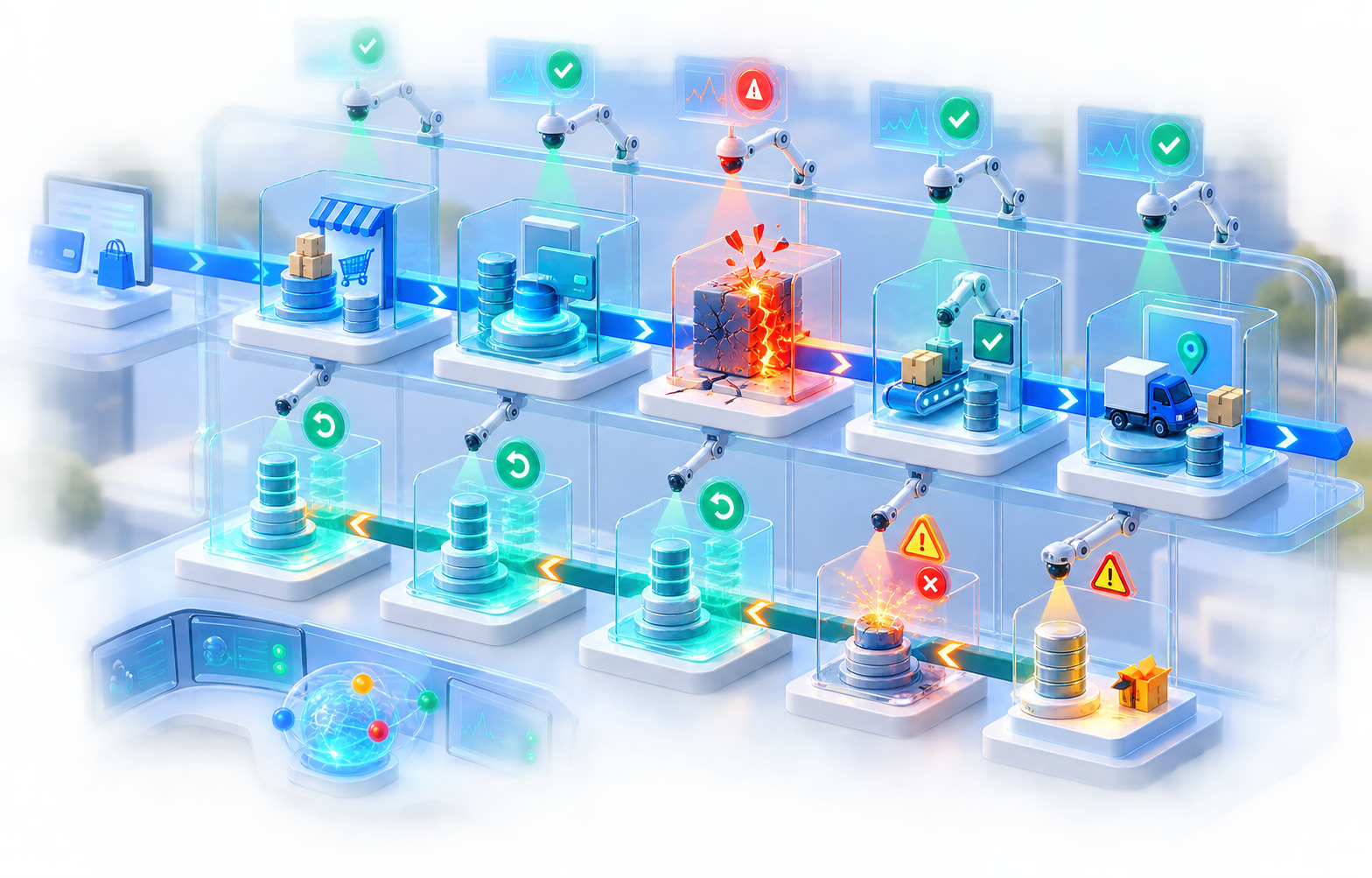
The Policy Enforcement Architecture and the Runtime Trust Pipeline describe the same system from two angles: what evaluates the request, and what the request must pass through before it becomes an effect in the world. The design constraint that matters more than any other is latency. A governance layer with a hundred-millisecond budget will be built into every path. One with a two-second budget will be bypassed within a quarter, by good engineers, for good reasons, with everyone's approval. Governance that is slow does not get enforced; it gets routed around.
Perspective Four — Engineering Trust Instead of Assuming It
Trust in most agent deployments is a binary set at deployment time and never revisited. It should be a computed, dimensional, decaying property — closer to a credit score recalculated per request than to a role assignment made once.
Decomposed, it has at least eight dimensions, and their relationship is multiplicative rather than additive. This is the single most useful thing to understand about it. Eight layers each at ninety percent reliability compose to roughly forty-three percent end-to-end. Trust engineering is therefore not about strengthening the strongest layer, which is where attention naturally goes, but about finding and eliminating the weakest — because the weakest layer sets the ceiling for everything above it.
Identity Trust — Is the actor who it claims to be, and on whose behalf is it acting? Failure looks like a shared credential with no delegation chain, where every action traces to the same service account and accountability terminates in a string.
Context Trust — Is the material entering reasoning authentic, authorized, and unmanipulated? Prompt injection belongs here, and framing it as a model weakness is a category error. It is an integrity failure in the input path. The model is behaving correctly; the premises are adversarial. Content retrieved from external or user-controlled sources should be structurally marked as data, never as instruction, and should carry provenance into the audit record.
Tool Trust — Does this capability do only what it claims, with what side effects, at what reversibility? Tool descriptions are contracts, and they are usually written once by the implementer, never reviewed, and never re-validated when the underlying API changes semantics.
Data Trust — Is retrieved information current, permitted for this requester, and correctly scoped? The dangerous case is not missing data. It is stale or over-scoped data delivered with full confidence, because nothing in the pipeline expresses uncertainty about freshness or entitlement.
Execution Trust — Did what executed equal what was approved? The measurable form is the divergence rate between approved plan and executed action, and most organizations cannot compute it because they never persist the approved plan in comparable form.
Output Trust — Is this a claim the organization is willing to stand behind? Output trust is not accuracy. It is defensibility: whether the assertion is within the bounds of what the organization has authorized this system to assert, to this audience, with this level of hedging.
Human Trust — Is the oversight real or ceremonial? The diagnostic is approval latency distribution. When the median approval takes four seconds and the approval rate is ninety-nine percent, oversight has become a click. This layer degrades silently and always in the same direction, because humans habituate to systems that are usually right.
Business Trust — Is this defensible economically, legally, and reputationally? The layer where a technically flawless action is still the wrong action, and the only layer that cannot be fully automated, because it encodes what the organization is prepared to be seen doing.
The compounding is the argument. An organization with excellent identity, policy, and audit but ceremonial human oversight has not built a strong system with one weak point. It has built a system whose trustworthiness is bounded by its rubber stamp. Governance investment should follow the minimum, not the average — which requires measuring each dimension separately rather than reporting a single confidence number that averages away the thing that will actually fail.
One more property: trust decays. Static grants convert verified trust into assumed trust at a rate proportional to how long ago the verification happened. Permissions granted eighteen months ago against a system since rearchitected are not permissions. They are archaeology with production access.
Perspective Five — The Agent Supply Chain
Reasoning receives nearly all the evaluation effort and causes a minority of the failures. Post-incident analysis of production agent failures converges on a repetitive finding: the model reasoned correctly over corrupted premises, or executed correctly against a misconfigured boundary, or produced a sound plan that an unversioned tool interpreted differently than documented.
An agent's effective behavior is the composition of roughly ten systems. Nine of them are dependencies you did not write, do not version, and frequently do not own. This is a supply chain in the strict sense, and it deserves the same discipline the software supply chain eventually received after a decade of expensive lessons.
Inputs. The entry point and the least trusted surface. The governing question is provenance: which of this originated from an authenticated human, and which arrived through a channel an adversary can write to? Systems that cannot distinguish these two categories inside the context window have no basis for treating them differently, and will not.
Memory. State that outlives the interaction and answers to no owner. Failure mode: unversioned belief. The question is when a fact entered, on what evidence, and what has been derived from it since.
Retrieval. The most common source of authorization failure, because retrieval systems evaluate access at index time while requests arrive at query time. Failure mode: correct answer, wrong entitlement. The question is whether the retrieval layer enforces the requester's permissions rather than the indexer's.
Policies. Themselves a dependency, and one that drifts. Failure mode: rules that describe a system architecture that no longer exists. The question is whether policy has a lifecycle — versioning, testing, expiry, and review triggered by architectural change rather than by calendar.
Tools. External semantics you don't control. A vendor changes a parameter's default behavior in a minor release and an agent's actions change meaning with no change on your side. The question is whether tool contracts are validated continuously rather than trusted from their description.
Execution. Where intent becomes effect and reversibility is determined. Failure mode: an action that cannot be undone taken on a plan that was never reviewed. The question is what fraction of executable actions have a defined compensating action.
External systems. The blast radius. Once an effect leaves your boundary — a payment, a message, a record in a partner's system — governance becomes negotiation. The question is which downstream effects are irreversible and whether those specifically are gated.
Observability. Not logs; reconstruction. Failure mode: complete telemetry that cannot answer why. The question is whether a specific past decision can be replayed with its exact context, policy version, and retrieved documents.
Audit. Evidence with integrity properties, produced by the enforcement layer. The question is whether records are tamper-evident and whether their absence is itself detectable.
Human oversight. The final layer and the most frequently degraded. The question is whether the human has the information, time, and authority to actually refuse.
The Cross-Agent Dependency Map exists to make the second-order version of this visible: in a multi-agent estate, one agent's output is another's input, which means one agent's supply chain includes the entire supply chain of every agent it consumes. Trust does not compose gracefully across that boundary. It degrades, and it degrades quietly, because each agent sees only its immediate neighbors.
Evaluate the chain, not the model. The model is the one component with a benchmark, which is exactly why it is the one component that is rarely the cause.
Perspective Six — Invisible Governance Failures
Security incidents announce themselves. Governance failures do not, because their symptom is an absence — of an owner, of a record, of a review, of an expiry date. You cannot alert on a log that was never written, and no monitoring system fires on the non-occurrence of a decision nobody was assigned to make.
These are not events. They are conditions. They accumulate for quarters without producing a single anomaly, and then they all become relevant simultaneously, during the one incident where evidence matters.
| Condition | At 5 agents | At 500 agents | Why it stays invisible |
|---|---|---|---|
| No agent has a named owner | Everyone knows who built what | Ownership is reconstructed during incidents by elimination | Nothing requires an owner until something goes wrong |
| Anyone can modify prompts | Edits are informal and fast | Behavior changes with no change record; regressions cannot be attributed | Prompts sit outside the artifact governance applied to code |
| No approval history exists | Approvals happen verbally | Nobody can prove an action was authorized | Approving is logged as a UI event, not a binding artifact |
| Policies are unversioned | One recently written policy set | Nobody can state which rules applied on a given date | Policy is treated as configuration, not a controlled artifact |
| Agents delegate recursively | Two agents, one direction | Cyclic call graphs, unbounded depth, merged authority | Each individual call is locally legitimate |
| Secrets are broadly scoped | One shared credential, convenient | Any compromise is total; attribution is impossible | Broad scope produces no errors, only risk |
| Outputs become production decisions | A human reads everything | Automated consumption with no review gate anyone remembers removing | The gate is removed for a good reason and never restored |
| Memory accumulates indefinitely | Small, recent, mostly correct | Confident assertions traceable to no verifiable source | Memory has no expiry and no correction path |
| Old policies remain active | Few enough to hold in your head | Contradictory rules; effective policy is whichever evaluates first | Dead rules produce no errors |
| No retirement process exists | Nothing has been retired yet | Active credentials belonging to systems nobody maintains | Idle agents are cheap and silent |
The scale mechanic is worth stating plainly. Capability grows linearly with the number of agents. Governance burden grows faster, because it is a function of relationships — delegation edges, shared tools, overlapping data scopes, cross-agent dependencies — and relationships grow combinatorially. A five-agent estate can be governed by memory and good engineers. A five-hundred-agent estate cannot be governed by anything except a system. The transition between those two regimes is not signposted. Nobody sends an email announcing that the informal controls have stopped working; the informal controls simply become decorative while everyone continues to rely on them.
The practical consequence: governance must be built during the period when it is provably unnecessary. This is an unpopular argument, because it is a request to spend budget on a problem that has not yet manifested, justified by a curve rather than an incident. It is also the only period in which it is cheap. Retrofitting ownership onto three hundred deployed agents, or reconstructing eighteen months of missing approval history, costs an order of magnitude more than building it correctly at five.
Perspective Seven — Organizational Architecture For AI
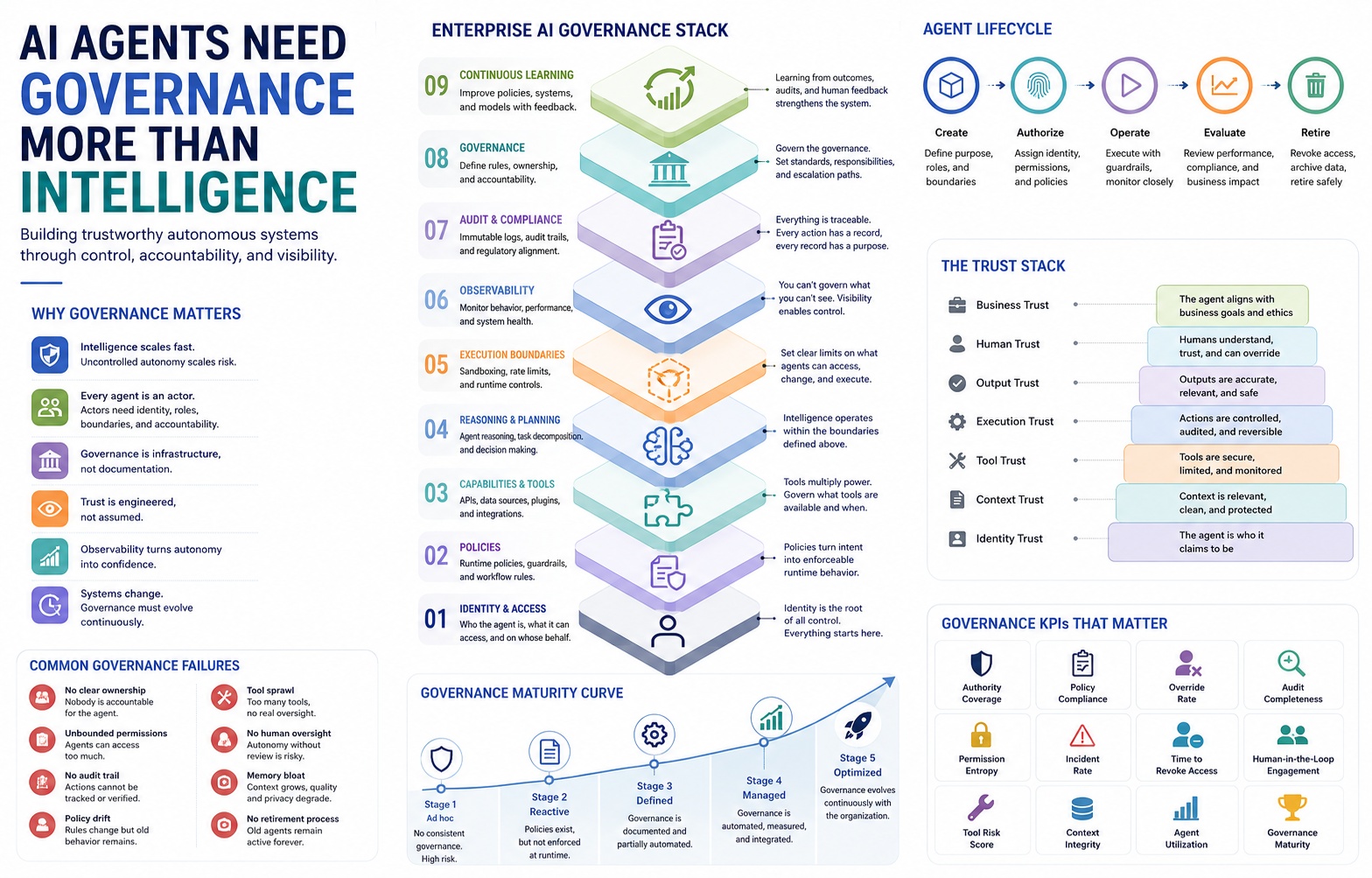
What follows is the Enterprise AI Governance Stack: nine layers, each with a distinct question, distinct primitives, and a distinct failure mode when absent. The layering discipline matters more than the specific decomposition. A layer that can be bypassed by the layer above it is not a layer; it is decoration. Each must be independently enforceable, independently observable, and independently able to refuse.
Note the position of reasoning. It sits at layer four — inside the stack, not on top of it. That placement is the argument of this article expressed as a diagram: intelligence is a component within a control system, not the control system itself.
Layer 1 — Identity
Who is acting, and on whose behalf?
Primitives: workload identity, short-lived credentials, delegation chains with attenuation, human-principal binding. Every action must resolve to an accountable human through a verifiable chain, even when that chain crosses six agents and two organizational boundaries. Without this layer, everything above it enforces rules against an anonymous actor, and audit becomes a record of things that happened to nobody.
Layer 2 — Policies
What is permitted, under what conditions?
Primitives: policy-as-code, versioning, CI-tested rule sets, contextual evaluation, deny-by-default. Policy must be an artifact with a lifecycle — authored, reviewed, tested, deployed, expired. The failure mode when this layer is absent is not permissiveness; it is inconsistency — an effective policy that is the emergent sum of hundreds of configuration decisions nobody has read together, contradicting each other in ways that surface only under specific conditions.
Layer 3 — Capabilities
What can this actor actually do?
Primitives: tool registry, capability grants, composition analysis, blast-radius classification, grant expiry. The critical function is evaluating combinations rather than items, because harmful capability is usually compositional. This layer owns the Agent Authority Matrix and is the only place where "what is the worst outcome this configuration permits" has a computable answer. If that question requires a meeting, this layer does not exist yet.
Layer 4 — Reasoning
How is the decision formed?
Primitives: model selection, planning constraints, structured decomposition, confidence signalling, escalation triggers. The governance contribution of this layer is not better thinking. It is legible thinking: plans expressed in a form a policy engine can evaluate before execution, and uncertainty expressed in a form that triggers escalation rather than being absorbed into a fluent answer. An agent that cannot express a plan separately from executing it cannot be governed at this layer at all.
Layer 5 — Execution
What actually happened in the world?
Primitives: sandboxing, egress control, plan-to-action binding, simulation of destructive operations, rate and spend ceilings, compensating actions. This is where intent becomes irreversible. Every executable capability should carry either a documented reversal path or an explicit acknowledgement that none exists — and the second category should require a categorically different class of authorization.
Layer 6 — Observation
Can we see what is happening now?
Primitives: decision tracing, context capture, delegation-graph telemetry, drift detection, cost attribution. Observation is real-time and diagnostic. Its test is whether an operator can answer "what is this agent doing right now, and under what authority" without reading source code. Most estates hold extensive telemetry that fails it, having been designed to debug latency rather than explain behavior.
Layer 7 — Audit
Can we prove what happened before?
Primitives: append-only tamper-evident records, retention policy, replay capability, evidence generation. Audit is historical and evidentiary, and it differs from observation in the property that matters: audit must hold when someone has an incentive to dispute it. The design test is adversarial: assume the reconstruction will be challenged, and ask whether the record survives without supporting testimony from the engineer who built it.
Layer 8 — Governance
Who decides what the rules should be, and how do they change?
Primitives: ownership registry, authorization ladders, review cadence, exception handling with expiry, retirement process. This is the human institutional layer, and its most important artifact is the exception mechanism. Every governance system generates exceptions. Systems without a formal exception path do not have fewer exceptions; they have undocumented ones, granted informally, with no expiry and no record. Exceptions must be first-class objects that expire by default and require re-justification rather than renewal by silence.
Layer 9 — Continuous Learning
How does the system improve its own control?
Primitives: incident feedback into policy, permission-usage analysis driving revocation, threshold tuning from override data, maturity assessment. The signal that this layer is functioning is contraction: permissions removed because telemetry shows they were never exercised, thresholds tightened because override data shows they were set too loose, tools deprecated because usage analysis shows a safer composition exists. A governance system that only ever adds rules is not learning. It is accreting, and accretion eventually produces the same outcome as absence, because a rule set nobody can hold in mind is a rule set nobody applies.
The AI Governance Maturity Curve maps these layers against organizational progression, and the observed order is consistent: identity and audit first, because external obligation demands them; capability and execution boundaries second, because the first incident demands them; continuous learning last or never, because nothing demands it. The organizations that scale furthest inverted that order deliberately.
Perspective Eight — Measuring Agent Governance
Standard AI metrics — accuracy, latency, token cost, task completion — describe capability. None of them describe whether the system is under control. An agent can hold a ninety-nine percent task success rate while being entirely ungoverned, and that success rate will be quoted during the incident review as evidence that nothing was wrong.
The instruments below measure control. Several are health indicators rather than targets, and the distinction is marked deliberately, because converting an indicator into a target is the standard mechanism by which governance measurement becomes governance theatre.
Agent Authority Score. A composite of granted capabilities weighted by reversibility and blast radius. It answers "what is the worst this agent could do today," independent of what it typically does. It should be computable for every agent, and material changes to it should trigger review at the moment of change rather than at the next quarterly cycle.
Execution Boundary Compliance. The rate at which attempted actions fall outside declared boundaries and are denied. Zero is not a clean result; it almost always means boundaries are drawn loosely enough that they never bind. Healthy systems show a low, persistent, non-zero denial rate.
Policy Drift Rate. How rapidly effective policy diverges from reviewed policy — measured through uncommitted configuration changes, unversioned prompt modifications, and exceptions active past their intended lifetime. High drift means the governance documentation describes a system that no longer exists.
Human Override Frequency. The rate at which humans reverse or modify agent decisions. This is a health indicator in both directions. Rising rates suggest capability degradation or scope creep. A collapse toward zero usually indicates habituation rather than improvement. Track the distribution across reviewers, not the aggregate mean.
Autonomous Decision Accuracy. Correctness measured specifically on decisions executed without human review, sampled and evaluated independently. Aggregate accuracy conceals this population, and it is the only population where errors reach production unmediated.
Approval Latency. Time from approval request to decision, reported as a distribution. The tail identifies bottlenecks that will eventually motivate someone to remove the gate. The floor identifies rubber-stamping: approvals granted faster than the material could plausibly be read are not approvals, and their frequency should be alerted on.
Audit Coverage. The proportion of executed actions that can be fully reconstructed from evidence — inputs, retrieved context, policy version, decision, result. Not the proportion that generated a log line. Reconstruction is the standard, and measured against it, coverage is invariably far below what teams estimate.
Runtime Transparency Index. Whether an operator can determine, in real time and without reading source code, what an agent is doing and under what authority. In practice this predicts incident response time better than any other single measure.
Escalation Success Rate. When an agent encounters a case beyond its competence, how often does it escalate rather than proceed? Measured by sampling low-confidence and novel-case interactions and evaluating the outcome. Silent proceeding is the dominant failure mode of capable systems, and it is invisible in every capability metric.
Agent Retirement Compliance. The proportion of decommissioned agents whose credentials, tool grants, memory stores, scheduled triggers, and downstream dependencies have been fully revoked. Partial retirement is the norm, and it produces the worst artifact in any estate: a system that is officially gone and operationally live.
Tool Access Risk Score. Per-tool exposure across the estate — how many agents hold it, at what authority, with what reversibility. This surfaces concentration risk that per-agent review structurally cannot see, because it evaluates one grant at a time while risk accumulates across grants.
Cross-Agent Dependency Score. Depth, breadth, and cyclicity of the delegation graph. Rising cyclicity is the leading indicator of runaway execution and of failure modes that no single team can debug, because no single team can see the whole graph. This is what the Cross-Agent Dependency Map is measured against.
Memory Integrity Score. The proportion of persisted memory with verifiable provenance, defined expiry, and a correction path. Memory lacking all three is unverifiable assertion accumulating at machine speed, and it degrades in exactly one direction.
Governance Maturity Index. A composite across the nine layers, scored on enforcement rather than existence. The scoring rule that makes it useful: a control that is documented but not enforced at runtime scores zero. Partial credit for intent is how maturity models become comforting fiction.
Two disciplines determine whether these instruments survive contact with organizational incentives. Report distributions rather than averages — governance failures live in tails, and averaging is designed to remove tails. And separate indicators from targets explicitly. The moment override frequency becomes a target, it will be driven toward zero, and the system will look increasingly governed at precisely the rate it stops being governed.
Engineering Manifesto
One. Every autonomous decision deserves an owner. Accountability that terminates in a service account terminates nowhere.
Two. Permissions age faster than software. A grant is a claim about a system state that has already changed.
Three. Trust is earned continuously, never assigned statically. Verification has a half-life, and so should the authority it justified.
Four. The safest system is not the least capable one. Constraint is not the absence of power; it is the presence of structure around it.
Five. Policy that cannot deny is not policy. Without an enforcement path, a rule is a preference with formatting.
Six. An unobservable agent is an unmanaged agent. The absence of alerts is not evidence of control.
Seven. Every agent needs a retirement plan before it needs a deployment plan. What cannot be removed cannot be governed.
Eight. Authority should carry an expiration date. A permanent grant is an unreviewed decision compounding indefinitely.
Nine. Memory without governance becomes liability. Belief that cannot be corrected accumulates in one direction only.
Ten. Governance must evolve faster than capability. The control curve is the only one you have to draw yourself.
Eleven. Approve actions, not intentions. An approval that does not bind to an executable authorizes nothing.
Twelve. Reversibility outranks accuracy. A recoverable error costs a rollback; an irreversible one costs a relationship.
Thirteen. Evidence beats testimony. Records must be produced by the enforcement layer, never by the actor being governed.
Fourteen. Delegation must attenuate. A chain that preserves full authority at every hop is a privilege escalation mechanism with good intentions.
Fifteen. Governance that is slow will be bypassed by competent people acting in good faith. Latency is a security property.
Organizational Governance Audit
What follows replaces recommendations, because recommendations presume a diagnosis. These questions produce one. Their value lies less in the answers than in the time to answer — any question below that cannot be resolved within minutes identifies a control that exists in principle and not in the system.
Ownership
- Who is the named individual accountable for each deployed agent, and when did they last affirm it?
- Which permissions in the estate have no owner because the granting team no longer exists in that form?
- Which agents were built by teams that have since reorganized, and who inherited them explicitly rather than by default?
Traceability
- Can every autonomous production action be traced to an authorizing human through a verifiable chain?
- Can you reconstruct a decision from six months ago — inputs, retrieved context, policy version, result — from evidence rather than recollection?
- Can policy be audited historically, such that you can state which rules were in force on a specific date?
Boundaries
- Which agents hold capability combinations that produce an authority nobody granted deliberately?
- Which tools are permanently available to which agents, and when was that grant last justified rather than inherited?
- Can two agents delegate to each other without bound, and what specifically stops them?
- Which agents can approve their own actions, directly or through a peer they are able to invoke?
Reversibility
- Which executable actions have no compensating action, and are those specifically gated by human authorization?
- Can any single agent be disabled in under sixty seconds, without a deployment, by whoever is on call?
- Can one agent be disabled without disabling the estate?
Lifecycle
- How is a retired agent's memory removed, and how are conclusions derived from it invalidated?
- How many active credentials belong to systems no team currently maintains?
- By what process does an agent's authority increase, and what evidence does that process require?
Oversight
- What is the median approval latency, and is it consistent with a human having read the material?
- How often are governance policies reviewed, and what triggers review other than the calendar?
- Which exceptions are currently active past their intended expiry, and who granted them?
- Can leadership describe, in specific terms, every category of autonomous action currently permitted in production?
An organization that answers most of these quickly has built a governance system. One that must convene a working group has a governance document, and the difference between the two becomes apparent at exactly the moment it is most expensive to discover.
Closing Reflection
The history of software engineering is a repeated demonstration that capability outruns discipline, and that the correction arrives from outside — through an outage, a breach, a regulator, or a loss large enough to convert an architectural argument into a budget line. Distributed systems were built before consistency was understood. Cloud infrastructure was adopted before identity was solved. Services were decomposed before anyone could observe them. In each case the industry acquired the discipline afterward, at a price set by whoever happened to be holding the failure.
Autonomous systems will follow the same pattern, with one difference that matters. Every previous correction was applied to software that executed instructions. This one will be applied to software that exercises judgment, and judgment scales in a way instruction never did. A misconfigured service does the wrong thing repeatedly and identically, which makes it detectable within hours. A capable agent operating beyond its authority does something locally plausible each time, which makes it invisible until the aggregate becomes undeniable — and by then the aggregate is the system of record.
The organizations that come through this period well will not be distinguished by the intelligence of their systems. Intelligence is arriving on everyone's schedule and increasingly on everyone's terms; it is the input that requires the least of you. They will be distinguished by having built, deliberately and early, the far less interesting apparatus that determines when a machine is permitted to act at all — who authorized it, what bounded it, what recorded it, and what could stop it.
That apparatus produces no demonstrations. It appears in no capability benchmark and improves no leaderboard position. It is the part of the system that says no, and it is what will decide which organizations can safely say yes.