Introduction
For thirty years, enterprise data protection has been built around a simple assumption: sensitive information lives in systems, and systems have boundaries. A database has a schema. A file server has a directory tree. A SaaS application has an API with defined scopes. Protecting data meant protecting the perimeter around these containers — encrypt them, log access to them, restrict who can query them, and audit the result.
Generative AI breaks that assumption at the root.
An LLM-powered application does not "store" confidential information in the traditional sense. It consumes it — pulling fragments from a prompt, a retrieved document, a plugin response, or a prior turn in a conversation — and recombines that information into new, unpredictable outputs. There is no schema to lock down, because the "database" is a probability distribution over language, and the "query" is a paragraph of natural-language instructions written by an employee, a customer, or another piece of software.
This is why the majority of real-world AI data leakage incidents look nothing like a traditional breach. There is no exfiltration tool, no compromised credential, no malicious insider copying files onto a USB drive. Instead, a support agent pastes a customer's financial record into a chat assistant to "summarize it faster." A retrieval system returns a chunk of a confidential contract to a user who was never authorized to see it, because the vector index has no concept of tenant boundaries. A coding assistant, given broad memory across sessions, recalls a proprietary algorithm from one customer's session and offers it, half-paraphrased, to another. Nothing was "hacked." Everything was used exactly as designed — and that is precisely the problem.
The business impact of this new leakage surface is not hypothetical. Regulators are extending existing privacy and financial-services obligations to cover model inputs and outputs. Enterprise customers are adding AI-specific data handling clauses to vendor security questionnaires. Boards are asking, in plain language, "if an employee pastes a customer's record into our AI assistant, where does that data go, who can see it, and can we delete it?" Increasingly, security and engineering leaders cannot answer that question with confidence — because the architecture was never built to answer it.
This guide is written for the people who now own that answer: CTOs, CISOs, VPs of Engineering, AI engineering leads, security architects, compliance officers, and SaaS founders building AI-native products. It treats AI data leakage as an architectural discipline, not a checklist of controls bolted onto a working system after the fact. It walks through where confidential information actually travels inside an AI-powered application, the five categories of leakage that account for nearly every real-world incident, and the governance, prompt-layer, retrieval-layer, and output-layer controls that close each one.
The goal is not to make AI systems slower or more restrictive. It is to make them trustworthy enough to be given the data they need to be genuinely useful — which, for most enterprises, is the actual bottleneck standing between a promising pilot and a production AI deployment.
Why AI Changes Data Protection Forever
Traditional software security is built around explicit access. A developer defines an API endpoint. That endpoint has a scope. A user's role determines which scopes they can invoke. If an engineer wants to know whether a given user could theoretically see a given piece of data, they can trace the answer through a fixed, enumerable set of code paths: authentication middleware, authorization checks, database row-level security. The system's behavior is deterministic. The same request, from the same user, produces the same access decision every time.
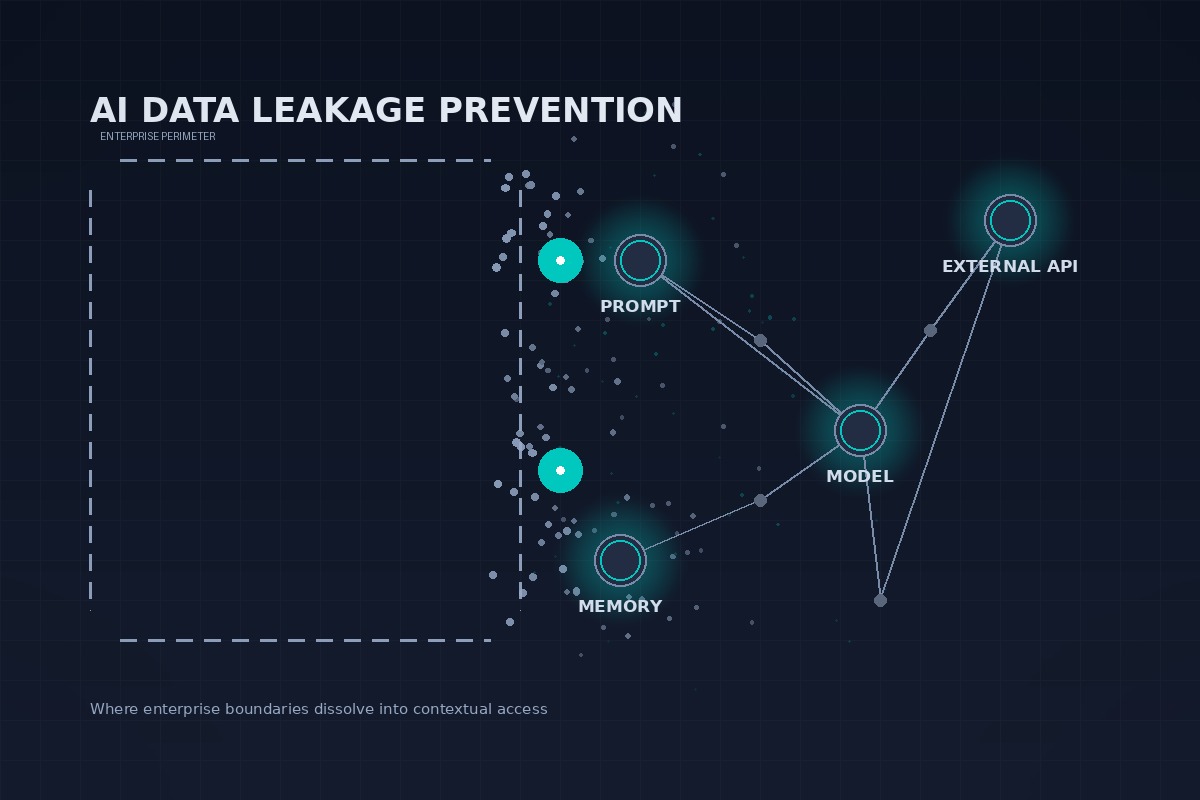
AI systems — specifically, large language model applications — operate on contextual access instead. The model does not have a fixed set of "endpoints" it can return. It has a context window: an assembly of instructions, retrieved documents, conversation history, tool outputs, and system prompts, all flattened into a single stream of tokens. Whatever ends up in that context window is, functionally, available to be reflected back in the output — regardless of whether the person asking the question was ever supposed to see it.
This produces four structural differences that traditional data protection controls were never designed to handle:
1. Access is assembled at inference time, not defined at design time. A traditional system's access rules are written once, in code, and enforced consistently. An AI system's effective access is reassembled every time a prompt is built — by whichever service last touched the context window. If a retrieval step forgets to filter by tenant, or a plugin injects a raw API response instead of a redacted one, the access boundary silently disappears for that single request, with no code change and no alert.
2. The boundary between "instruction" and "data" collapses. In a conventional application, code and data are separate: a SQL query is code, a customer's name is data. In a prompt, both are just text. This is what makes prompt injection possible, and it is also what makes accidental leakage possible — a document retrieved as "context" can just as easily be interpreted by the model as an instruction, and a piece of confidential data pasted as an "example" can just as easily be echoed verbatim in the response.
3. Outputs are generative, not retrieved. A traditional system returns exactly the data it was asked for — nothing more. A generative system produces a synthesis, which means it can recombine fragments from multiple sources the user was never meant to see together, producing a novel disclosure that never existed as a single retrievable record in the first place. This is a materially different risk profile from a database leak: there is no single row to redact, because the leaked information was assembled, not copied.
4. Memory extends the attack surface across time. Traditional sessions expire. AI systems increasingly retain conversation history, long-term memory, and cached embeddings — meaning information disclosed in one interaction can resurface, unprompted, in an entirely unrelated interaction weeks later, to a different user, if memory scoping is not enforced with the same rigor as access control.
The practical consequence for security and engineering leaders is this: you cannot bolt traditional DLP (data loss prevention) tooling onto an AI system and call the problem solved. Traditional DLP inspects data at rest and in transit, looking for patterns that match known-sensitive formats. AI data leakage prevention has to govern data in context — as it moves through prompts, retrieval pipelines, plugin calls, and generated text — which requires new architectural layers, not just new scanning rules.
The Information Journey
Before any control can be designed, the organization needs a shared, precise picture of every point sensitive information passes through inside an AI-powered application. Most AI leakage incidents trace back to a single unmonitored point along this path — not a systemic failure, a single missing checkpoint.
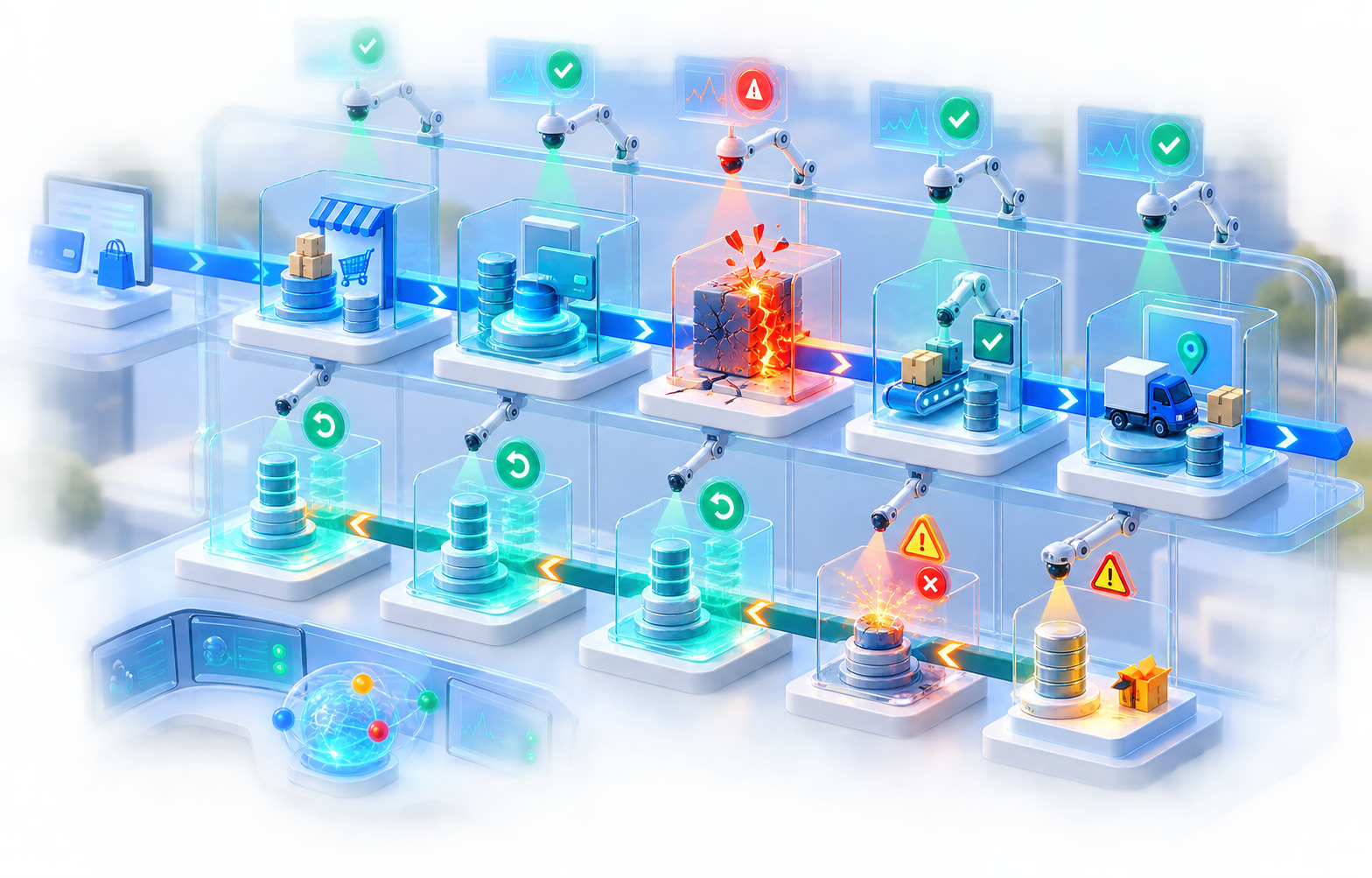
Picture this as a transit line, with sensitive information as the passenger and each stop as a place where it could be misdirected, duplicated, or exposed to the wrong platform.
  ●───────●───────●───────●───────●───────●───────●───────●───────●
 USER   PROMPT  GATEWAY   LLM    MEMORY  VECTOR   PLUGINS EXTERNAL RESPONSE
                                          DB                APIs
User → Prompt. The first exposure point is the least technical and the most common: a person pastes confidential material — a contract, a patient record, a snippet of proprietary source code — directly into a chat interface because it is the fastest way to get the task done. No system control can prevent this at the point of entry; it must be caught at the next stop.
Prompt → Gateway. Enterprise AI deployments should route every prompt through a gateway layer before it reaches a model — the first, and often only, place where an organization can inspect, classify, and act on sensitive content before it leaves its control.
Gateway → LLM. Once a prompt crosses into the model boundary — particularly a third-party or hosted model — the organization loses direct visibility into how that data is processed internally. This is the point at which contractual, not just technical, controls become load-bearing (data-processing agreements, zero-retention commitments, regional hosting).
LLM → Memory. If the application layer persists conversation turns for context continuity or personalization, sensitive content disclosed in one turn is now written to storage that outlives the immediate request — and inherits none of the access controls the original document may have had.
Memory → Vector Database. Many AI applications embed conversation history or memory into a vector store for semantic recall. This step routinely strips away the metadata (tenant ID, classification label, source permissions) that governed the original document, leaving only a mathematical representation that retrieval systems will surface based on similarity, not authorization.
Vector Database → Plugins. When an AI system is connected to tools — a CRM lookup, a ticketing system, an internal wiki search — retrieved chunks are frequently passed to these plugins as unstructured context, with no enforcement that the calling user was entitled to the retrieved content in the first place.
Plugins → External APIs. Tool-calling architectures often forward user-supplied or retrieved data to third-party APIs (translation services, enrichment providers, analytics platforms) as part of executing a function call — a step that is invisible to the end user and, in many implementations, unmonitored by the security team.
External APIs → Response. The final assembly point, where retrieved documents, tool outputs, and model-generated synthesis are combined into the text the user actually sees — and the last chance to catch anything that should not leave the system before it does.
Response → User. Delivered content can be copied, screenshotted, forwarded, or fed into a second AI system, at which point the organization's control ends entirely.
Every one of the "five types of leakage" below maps directly onto a station on this line. Enterprises that have mapped their own AI Information Journey — station by station, with an owner and a control assigned to each — consistently outperform those that treat "AI security" as a single line item, because they can point to exactly where a given piece of sensitive data was, is, and will be at every stage of its lifecycle.
The Five Types of AI Data Leakage
Nearly every real-world AI data leakage incident falls into one of five categories. Understanding them individually matters because each requires a structurally different control — there is no single "AI DLP" product that addresses all five at once.
1. Prompt Leakage
What it is: Confidential information enters the system through the prompt itself — typed, pasted, or uploaded by a user — and is then transmitted to a model, logged, cached, or used for downstream fine-tuning without appropriate controls.
How it happens in practice: An employee pastes an unreleased earnings figure into an AI writing assistant to "make the tone more polished." A developer pastes a proprietary API key into a coding assistant to debug an integration. A support agent pastes a customer's full record — including a national ID number — into a summarization tool.
Business example: A financial services firm's customer support team used a general-purpose AI assistant to draft responses to complaints. Agents routinely pasted the customer's account number and dispute details directly into the prompt. Because the assistant's provider retained prompts for model-improvement purposes by default, unmasked account data was retained on infrastructure the firm did not control and had never assessed under its data processing agreements — a finding that surfaced only during a customer security audit.
2. Memory Leakage
What it is: Information disclosed in one session, or by one user, persists in a memory layer and resurfaces in a different session, to a different user, without the original context or authorization boundary.
How it happens in practice: A "personalized assistant" feature retains facts across sessions to be helpful — "remembers" a user mentioned a merger, a medical condition, or a legal dispute — and later references that fact when a different authenticated identity, or a shared workspace account, interacts with the same assistant.
Business example: A B2B SaaS platform's AI assistant maintained a rolling memory of "important facts" per workspace to improve continuity. Because memory was scoped to the workspace rather than to the individual user's role within it, a junior employee later received an assistant response that referenced a confidential restructuring plan a senior executive had discussed in an earlier session — despite the two having very different access levels within the same account.
3. Retrieval Leakage
What it is: A Retrieval-Augmented Generation (RAG) system returns document chunks the requesting user was not authorized to see, because the retrieval layer's access control is weaker, or entirely absent, compared to the source system's original permissions.
How it happens in practice: A company builds an internal knowledge assistant over its document repository. The ingestion pipeline embeds every document into a single vector index for simplicity, without preserving the original folder- or file-level permissions. Any authenticated employee's query can now retrieve semantically similar chunks from HR, legal, or M&A documents they were never granted access to in the source system.
Business example: An enterprise deployed an internal AI assistant over its document management system to speed up policy lookups. The vector index was built once, from a full export, and was not re-synchronized with the source system's permission changes. Months later, a former contractor's still-active workspace account was able to retrieve draft legal strategy documents through the assistant — documents that had been access-restricted in the source system after the initial index was built, but whose embeddings had never been invalidated.
4. Plugin Leakage
What it is: Tool-calling and plugin architectures forward sensitive data — retrieved context, user input, or intermediate results — to external functions, APIs, or services, with insufficient scoping of what that data actually needs to contain.
How it happens in practice: An AI agent is given a "search internal wiki" tool and a "send email" tool. To fulfill a request, it retrieves an internal document and passes the entire document into the email tool's arguments rather than a summary, resulting in confidential content being forwarded to an external recipient the agent was never explicitly authorized to disclose it to.
Business example: An AI sales assistant was connected to both an internal deal-notes tool and an external enrichment API used to look up prospect information. To perform enrichment, the orchestration layer passed the full internal deal note — including competitor pricing and internal margin notes — to the third-party API as part of the request payload, because the integration had been built to "just forward context" rather than to construct a minimal, purpose-specific query.
5. Model Leakage
What it is: Sensitive information becomes embedded in the model's weights or behavior itself — through fine-tuning, few-shot examples, or reinforcement signals built from real user data — and later resurfaces in outputs to unrelated users, or is extractable through adversarial prompting.
How it happens in practice: An organization fine-tunes a model on historical customer support transcripts to improve response quality, without first removing or masking customer-identifying information in the training set. The resulting model occasionally reproduces near-verbatim fragments of a real customer interaction when prompted with a similar scenario by a different customer.
Business example: A healthcare technology vendor fine-tuned a clinical documentation assistant on a corpus of real (de-identified, they believed) patient encounter notes. An external security researcher later demonstrated that carefully constructed prompts could extract fragments closely matching specific training examples, revealing that the de-identification process had not adequately removed indirect identifiers such as rare diagnosis-and-location combinations.
The Data Waterfall
It helps to think of information moving through an AI system the way water moves through a series of engineered filtration layers rather than a single perimeter fence. Each layer is designed to catch a different class of sensitive content. The failure mode that produces real incidents is almost never "no filters exist" — it is that one layer's filter has a gap, and the layers below it were built assuming the layer above had already caught the problem.
Layer 1 — Entry Filter        (catches: raw PII, obvious secrets typed by users)
        ↓  [ gap: pasted documents bypass typed-input scanners ]
Layer 2 — Gateway Filter       (catches: classified data patterns, policy violations)
        ↓  [ gap: novel or unstructured formats evade pattern matching ]
Layer 3 — Retrieval Filter     (catches: unauthorized document chunks)
        ↓  [ gap: stale permission metadata in the vector index ]
Layer 4 — Plugin Filter        (catches: over-broad tool arguments)
        ↓  [ gap: "pass-through" integrations built for speed, not scoping ]
Layer 5 — Output Filter        (catches: sensitive content in generated text)
        ↓  [ gap: synthesized disclosures with no single matching source ]
Layer 6 — Delivery Filter      (catches: content leaving via export, copy, share)
        ↓  [ gap: no control once content is on the user's screen ]
              RESIDUAL LEAKAGE
The point of the Data Waterfall is not that any single layer is inadequate — each one meaningfully reduces risk. The point is that defense-in-depth is the only viable strategy, because every individual filter has a known, structural blind spot. An organization that invests heavily in an output filter but has no retrieval-layer access control is protecting against the wrong failure mode; an organization with excellent retrieval permissions but no memory governance is leaving an entirely different door open.
The architectural implication: every layer needs an owner, a documented failure mode, and a compensating control in the layer below it. This is the difference between a checklist ("we have PII scanning") and an architecture ("we have PII scanning, and we know it doesn't catch scanned-image uploads, so uploads route through a separate OCR-and-classify path before reaching the same policy engine").
Sensitive Data Classification
Every control described in this guide depends on one prerequisite: the organization must be able to recognize sensitive data programmatically, at the moment it enters an AI system. Classification is not a compliance exercise — it is the input signal every downstream filter depends on.
| Category | Examples | Typical AI Exposure Point | Regulatory Relevance |
|---|---|---|---|
| PII | Names, national IDs, addresses, dates of birth | Prompt input, RAG retrieval, memory | GDPR, CCPA, state privacy laws |
| Financial | Account numbers, transaction history, credit data | Prompt input, plugin calls to financial APIs | PCI DSS, GLBA, SOX |
| Medical | Diagnoses, treatment notes, patient identifiers | Prompt input, fine-tuning corpora | HIPAA, HITECH |
| Legal | Contracts, litigation strategy, privileged communications | RAG retrieval, memory | Attorney-client privilege, e-discovery rules |
| Source Code | Proprietary algorithms, API keys, infrastructure configs | Prompt input to coding assistants, plugin calls | Trade secret law, IP protection |
| Internal Documentation | Org charts, strategic plans, internal policies | RAG retrieval, memory | Confidentiality agreements |
| Trade Secrets | Pricing models, formulas, unreleased product data | Prompt input, memory, fine-tuning | Trade secret law |
| Credentials | Passwords, tokens, private keys | Prompt input, plugin arguments | Internal security policy, SOC 2 |
A workable classification scheme for AI systems needs three properties that many legacy DLP taxonomies lack: it must be machine-detectable at prompt time (not just at rest), it must travel as metadata through retrieval and memory layers rather than being discarded at ingestion, and it must map to a specific enforcement action (block, mask, log, require approval) rather than existing only as a label in a spreadsheet.
The Hidden Memory Problem
Of the five leakage types, memory leakage is the least understood by engineering teams building their first production AI features — largely because "memory" is often added late in a product's development, as a usability improvement, without the same security review given to the initial launch.
Modern AI applications accumulate context through several distinct mechanisms, each with a different risk profile:
Conversation history — the immediate back-and-forth within a single session. Low risk in isolation, but frequently logged in full for debugging or analytics, creating a permanent record of whatever sensitive content was pasted into that conversation.
Long-term memory — facts or preferences an assistant retains across sessions to personalize future interactions. This is where scoping failures are most damaging: memory built "per user" is relatively safe; memory built "per workspace" or "per organization" can silently cross internal role boundaries, as illustrated in the memory leakage example above.
Context windows — the assembled prompt sent to the model on any given turn, often including retrieved documents, prior turns, and system instructions concatenated together. Because context windows are ephemeral by design, teams often assume they carry no persistence risk — but if the application logs full requests and responses (extremely common for debugging and quality monitoring), the context window's contents become permanently stored regardless of the model's own retention policy.
Persistent memory stores — dedicated databases where an AI system writes structured "memories" (e.g., "this customer prefers email over phone," "this account had a billing dispute in March"). These stores rarely inherit the granular access controls of the source systems the facts were derived from.
Vector storage — embeddings generated from conversation history or documents, stored for semantic search. Embeddings are frequently treated as "not sensitive" because they are not human-readable — but modern embedding-inversion techniques can reconstruct a meaningful approximation of the original text from its vector representation, meaning an embedding store should be governed under the same classification rules as the source text.
Session storage — short-lived, browser- or server-side storage of conversation state, often overlooked in security reviews because it is assumed to be cleared on logout, but frequently persists longer than expected in caching layers or client-side storage.
Picture confidential information accumulating the way growth accumulates in a living structure — laid down gradually, in layers, at every point the system takes something in.
                     (new user requests keep adding growth)
                                   ▲
                              Leaves — individual
                            user requests & session
                            state (short-lived, high
                                   volume)
                                   ▲
                             Branches — session
                           memory & context windows
                          (medium-lived, per-session)
                                   ▲
                            Trunk — long-term /
                          persistent memory stores
                         (long-lived, cross-session)
                                   ▲
                             Roots — foundational
                          knowledge base & fine-tuning
                             corpora (permanent,
                              structural)
The governance implication of this structure is that each layer needs an independent retention and deletion policy — a deletion request cannot be satisfied by clearing session state if the same fact was already promoted into long-term memory, and it cannot be satisfied by purging long-term memory if the underlying fact was also folded into a fine-tuning corpus months earlier. Enterprises that can answer "if a customer exercises their right to deletion, does that data still exist anywhere in our AI stack?" with full confidence are the exception, not the rule — and building that confidence requires memory architecture decisions made deliberately, not memory features added incrementally by different teams over time.
Data Leakage in RAG Systems
Retrieval-Augmented Generation is now the dominant architecture for enterprise AI applications, because it lets organizations ground model outputs in their own proprietary knowledge without retraining the model itself. It is also the single most common source of retrieval leakage, because RAG pipelines are frequently built by teams optimizing for answer quality and speed of deployment, with access control treated as a later addition rather than a foundational design constraint.
Knowledge retrieval. The core RAG loop — embed the query, search the vector index, retrieve the top-k most similar chunks, inject them into the prompt — has no inherent concept of "who is allowed to see this chunk." Similarity search is purely mathematical; it will happily return a chunk from a confidential document to any user whose query is semantically close enough, unless an explicit authorization filter is applied before the similarity search, not after.
Chunk overlap. Documents are typically split into overlapping chunks to preserve context across chunk boundaries. This means a single sensitive sentence — a salary figure, a diagnosis, a settlement amount — can appear in multiple chunks, multiplying the number of places a permission failure can expose it, and complicating deletion, since removing "the document" does not guarantee removing every overlapping fragment derived from it.
Embedding exposure. As noted above, embeddings are not inherently anonymous. A vector store that is treated as "less sensitive than the source documents" and given weaker access controls or broader internal visibility is a genuine exposure point, not a theoretical one.
Access control. The single highest-leverage fix in RAG security is enforcing authorization at the retrieval step, using the same permission model as the source system — not a separately maintained approximation of it. If the source document repository uses folder-level permissions, the vector index needs to preserve and enforce those same folder-level permissions at query time, ideally by checking live against the source system rather than a permissions snapshot taken at ingestion time.
Citation leakage. Many RAG systems surface citations or source excerpts alongside generated answers, as a transparency and trust feature. This is valuable — and it is also a direct disclosure channel: if the underlying retrieval step returned an unauthorized chunk, the citation makes that disclosure explicit and attributable, rather than buried inside a paraphrased answer.
Tenant isolation. For any multi-tenant SaaS product offering AI features across customer accounts, the RAG index must enforce hard tenant boundaries — not just "user-level" permissions within a shared index, but structural separation (dedicated indices, namespace partitioning, or row-level tenant filtering enforced at the database layer, not the application layer) that cannot be bypassed by a query crafted to search "across" tenant boundaries.
Architecture recommendations:
- Enforce authorization before the similarity search runs, filtering the candidate set to only chunks the requesting identity is authorized to see — never filter after retrieval, which still requires the sensitive content to have been fetched and processed.
- Re-synchronize the vector index's permission metadata continuously with the source system, not on a periodic batch schedule; a revoked permission should propagate to the retrieval layer within minutes, not the next ingestion cycle.
- Treat embeddings with the same classification label as their source text, and apply equivalent encryption and access logging.
- Use per-tenant namespace partitioning as the default multi-tenant architecture, reserving shared indices only for genuinely public or non-confidential content.
- Log every retrieval event with the requesting identity, the chunks returned, and the permission check outcome — this audit trail is frequently the only way to detect a retrieval leakage incident after the fact.
Prompt-Level Protection
The prompt is the earliest point at which an organization can exercise control, and it is where the highest volume of low-sophistication, high-frequency leakage occurs — an employee pasting something they should not have. Six control types form the foundation of prompt-level protection.
Prompt filtering. Automated inspection of prompt content against defined policies before the prompt reaches the model — the AI-era equivalent of an email DLP filter, but operating on unstructured natural language rather than structured fields.
PII masking. Rather than blocking a prompt outright (which damages usability and encourages workarounds), leading implementations detect PII patterns and replace them with reversible tokens before the prompt reaches the model, then re-substitute the real values into the response after generation — preserving task usefulness while ensuring the model provider, and any logging system, never sees the raw sensitive value.
Context validation. Verifying that the documents, memory entries, or retrieved chunks being assembled into a given prompt are ones the requesting identity — not just the application's service account — is authorized to access, at the moment of assembly.
Secrets detection. Pattern- and entropy-based scanning for credentials, API keys, and tokens, which are among the most common accidental prompt disclosures (particularly in coding-assistant contexts) and among the most damaging, since a leaked credential is directly and immediately exploitable.
Prompt sanitization. Structural cleaning of prompt content to separate untrusted user input from trusted system instructions — reducing the risk that a pasted document is misinterpreted by the model as an instruction, and limiting how much of a retrieved document's raw content is forwarded rather than summarized.
Policy enforcement. A centralized policy engine that codifies organizational rules ("finance data may never be sent to a third-party model," "prompts containing medical terms require encryption in transit and zero-retention hosting") and applies them consistently across every AI application in the organization, rather than leaving each engineering team to implement its own interpretation.
Picture every prompt moving through a fixed sequence of checkpoints before it ever reaches the model — the same way a manufacturing line inspects a product at defined stages rather than only at the very end.
 PROMPT ──▶ [ IDENTITY ] ──▶ [ VALIDATION ] ──▶ [ PII SCANNER ] ──▶ [ POLICY ENGINE ] ──▶  LLM
                  │                 │                  │                  │
            confirms who        confirms the        detects &        checks against
           is making the       requester may see    tokenizes           org-wide
              request          the assembled        sensitive           rules before
                                  context             patterns            release
LLM ──▶ [ OUTPUT SCANNER ] ──▶ USER
│
re-checks the
generated text for
sensitive content
before delivery, and
reverses any masking
tokens correctlyEvery checkpoint on this line has a distinct failure mode, which is precisely why none can substitute for another: Identity confirms who is asking, but says nothing about what they're asking for. Validation confirms the requester's entitlement to the specific context being assembled, but does not inspect the content itself for sensitive patterns. The PII scanner catches known patterns, but will miss sensitive content it has not been trained or configured to recognize — trade secrets, unreleased product names, internal codenames. The policy engine enforces organizational rules, but only for the categories the organization has explicitly defined. And the output scanner, covered next, is the last line of defense and must never be treated as the only line of defense, because by the time content reaches it, it has already been processed by the model.
Output Protection
Even a well-governed prompt pipeline can produce a leaking response, because generation is synthetic: the model can combine authorized inputs into an output that discloses something no single input explicitly stated. Output-layer controls exist to catch this class of failure.
Sensitive response detection. Automated scanning of generated text — using the same classification taxonomy applied at the prompt layer — before the response is delivered to the user, catching cases where the model has reproduced or inferred sensitive content that was present in its context.
Response filtering. Blocking, redacting, or rewriting specific spans of a response that match sensitive patterns, ideally without discarding the entire response, which preserves usability while still preventing disclosure.
Content moderation. Broader policy enforcement on generated content — beyond data sensitivity — covering categories like inappropriate disclosures of internal strategy, competitive intelligence, or content that violates the organization's own public communication standards.
Redaction. Systematic removal or masking of specific sensitive elements identified in a response, applied consistently rather than ad hoc, and logged so that the organization has a record of what was withheld and why.
Approval workflows. For high-stakes AI use cases — an AI system drafting external legal correspondence, or a financial advisory assistant generating client-facing recommendations — routing outputs above a defined risk threshold through human review before delivery, rather than relying entirely on automated controls.
Human review. Maintaining a sampling-based human review process even for lower-stakes AI features, both to catch automated-control gaps and to generate labeled examples that improve the automated scanners over time.
The organizing principle for output protection is that it is a complement to prompt-layer protection, not a replacement for it. An architecture that filters only at output, and not at input, will catch synthesized disclosures but will have already sent the raw sensitive prompt to the model (and, depending on the provider's data handling terms, potentially retained it there) before the output filter ever runs.
Preventing Cross-Tenant Data Leakage
For SaaS founders and enterprise architects building AI features into a multi-tenant product, cross-tenant leakage is the single highest-severity risk category, because a single architectural gap can expose one customer's confidential data to another customer entirely — a materially different severity than an internal employee mishandling their own organization's data.
Tenant isolation. The foundational requirement: every layer of the AI stack — prompt construction, retrieval, memory, logging — must carry and enforce a tenant identifier, and that identifier must be checked at every data access point, not assumed to be correctly scoped because "the query only asked for this tenant's data."
Namespaces. Structural partitioning of vector indices, memory stores, and cached data by tenant, ideally using separate underlying indices or hard database-level partitioning rather than a shared index with a tenant-ID filter applied only in application code — the latter is a single query bug away from a cross-tenant disclosure.
Secure retrieval. Retrieval queries should be constructed such that it is architecturally impossible to retrieve another tenant's data, rather than architecturally possible but prevented by a filter — the difference between a system that cannot leak and a system that is not currently leaking.
Vector segmentation. Where a shared underlying vector database is used for cost or operational reasons, tenant segmentation should be enforced at the storage layer (dedicated collections or partitions per tenant) rather than relying solely on a metadata filter passed into each query.
Identity boundaries. The identity used to authenticate to the AI system, the identity used to authorize a given retrieval, and the identity used to scope memory storage should all resolve to the same verified tenant and user context — a common failure mode is an application-level service account that has broad access "on behalf of" users, which then becomes the effective access boundary instead of the actual requesting user's more limited permissions.
For any organization building AI capabilities into a product used by multiple customers, the standing question for every architecture review should be: "Show me the specific mechanism that prevents Tenant A's query from ever retrieving Tenant B's data — not the policy that says it shouldn't happen, the mechanism that makes it structurally impossible." If that mechanism cannot be pointed to in the code, the risk should be treated as present, not theoretical.
AI Governance for Sensitive Information
Architecture alone cannot solve this problem; every technical control above depends on a governance layer that defines what should happen, assigns responsibility for it, and verifies that it actually did.
Ownership. Every AI system handling sensitive data needs a named accountable owner — not "the AI team" collectively, but a specific role responsible for that system's data handling, in the same way a specific role owns a production database's security posture.
Policies. Written, specific policies covering which data classifications may be used with which AI systems (internal-only models vs. third-party hosted models), acceptable use guidelines for employees, and escalation paths when a suspected leakage incident occurs.
Data lifecycle. Explicit definition of how data moves through the AI system from ingestion to deletion — not just "we have a retention policy," but a mapped lifecycle covering prompts, memory, vector embeddings, logs, and any fine-tuning corpora derived from production data.
Deletion. A demonstrated, tested capability to fully remove a given individual's or customer's data from every layer of the AI stack on request — the memory tree structure described earlier means this is rarely a single database delete statement, and organizations should be able to walk through, concretely, what deletion touches.
Retention. Explicit, minimal retention periods for prompts, responses, and logs, set based on actual operational need (debugging, quality monitoring, legal hold) rather than default provider settings, which frequently retain data far longer than the organization requires or has assessed.
Access logging. Comprehensive, tamper-evident logging of who queried what, what was retrieved, and what was returned — the single most valuable asset during incident investigation, and frequently the thing that is missing entirely when an organization needs it most.
Picture governance as a set of concentric protective layers wrapped around the technical architecture — each layer catching what the layer inside it might miss, and none of them sufficient alone.
                     ┌─────────────────────────────┐
                     │        GOVERNANCE           │
                     │   ┌─────────────────────┐   │
                     │   │      MONITORING      │   │
                     │   │  ┌───────────────┐   │   │
                     │   │  │    OUTPUT     │   │   │
                     │   │  │ ┌───────────┐ │   │   │
                     │   │  │ │ INFERENCE │ │   │   │
                     │   │  │ │┌─────────┐│ │   │   │
                     │   │  │ ││RETRIEVAL││ │   │   │
                     │   │  │ ││┌───────┐││ │   │   │
                     │   │  │ │││ENCRYPT│││ │   │   │
                     │   │  │ ││└───────┘││ │   │   │
                     │   │  │ ││┌───────┐││ │   │   │
                     │   │  │ │││ POLICY│││ │   │   │
                     │   │  │ ││└───────┘││ │   │   │
                     │   │  │ ││┌───────┐││ │   │   │
                     │   │  │ │││IDENTITY│││   │   │
                     │   │  │ ││└───────┘││ │   │   │
                     │   │  │ │└─────────┘│ │   │   │
                     │   │  │ └───────────┘ │   │   │
                     │   │  └───────────────┘   │   │
                     │   └─────────────────────┘   │
                     └─────────────────────────────┘
The layers, read from the center outward: Identity establishes who is acting. Policy defines what that identity is permitted to do. Encryption protects data in transit and at rest regardless of the above. Retrieval enforces authorization at the point data is fetched. Inference governs what the model is permitted to receive and generate. Output catches what inference produced before delivery. Monitoring observes the entire stack continuously for anomalies. Governance defines, owns, and audits every layer inside it. An incident at any inner layer should be caught by at least one layer surrounding it — that redundancy is the actual design goal, not a single "strongest" layer.
Real Enterprise Case Study
Company profile (fictional, composite): A mid-market B2B SaaS provider offering a customer support platform to roughly 400 enterprise customers, serving several regulated industries including healthcare and financial services. The company added an AI assistant feature to summarize support tickets and draft agent responses, built rapidly to meet competitive pressure.
Before
The AI assistant was built directly on top of the existing ticket database, using a single shared vector index across all customer accounts for cost efficiency during the initial build. Ticket content — which routinely included customer PII, and in the healthcare vertical, protected health information — was embedded and indexed without a tenant-scoping filter enforced at the retrieval layer; a metadata field existed, but was only checked in one of the two API paths that queried the index. Conversation memory was retained indefinitely by default, inheriting the AI provider's standard data retention terms, which the security team had not reviewed prior to launch. Support agents routinely pasted full customer records into the assistant's free-text input to generate summaries, with no prompt-layer scanning in place. Within four months of launch, a customer's compliance team, conducting a routine vendor security review, discovered that a test query on their own account had returned a fragment of another customer's support ticket in a "related tickets" suggestion feature — a direct symptom of the incomplete tenant-scoping filter.
The business impact included a formal customer escalation, a mandatory third-party security assessment triggered by the affected customer's contract terms, a temporary feature suspension during remediation, and a materially harder subsequent sales cycle with prospects in the healthcare vertical, who now asked pointed AI-specific questions during procurement that the company could not yet answer with confidence.
After
The remediation program rebuilt the AI assistant around the architecture described throughout this guide. Tenant isolation was enforced through dedicated per-customer vector namespaces rather than a shared index with a filter, making cross-tenant retrieval structurally impossible rather than merely policy-prohibited. A prompt gateway was introduced in front of the assistant, applying PII detection and tokenization before any content reached the model, with reversible masking so agents retained full summary quality. Memory retention was reduced to the minimum period required for the assistant's actual use case (30 days, rather than indefinite), with a documented, tested deletion workflow spanning conversation history, vector embeddings, and logs. Output scanning was added to catch any residual sensitive content in generated summaries before delivery to agents. A named data protection owner was assigned to the AI assistant specifically, with quarterly access-log reviews.
Measurable improvements
- Cross-tenant retrieval incidents: reduced from a demonstrated architectural gap to a structurally prevented category, verified through dedicated penetration testing.
- Average prompt-layer PII detections: measurable volume caught and tokenized weekly, none of which had previously received any scanning.
- Customer security questionnaire pass rate for AI-specific questions: moved from a majority of "cannot currently answer" responses to complete, evidence-backed answers.
- Healthcare-vertical sales cycle length: shortened materially once AI data handling could be demonstrated with architecture diagrams and audit logs rather than described in policy language alone.
- Time to fulfill a data deletion request spanning the AI stack: reduced from an unknown, untested process to a documented procedure with a defined completion time.
The lesson generalizes well beyond this composite example: the fastest path to production AI is not skipping the architecture described in this guide — it is building it early enough that it is not a retrofit under customer or regulatory pressure.
20 Common AI Data Leakage Mistakes
| # | Problem | Business Risk | Mitigation |
|---|---|---|---|
| 1 | Sending raw prompts to third-party models with no gateway | Loss of control over sensitive content the moment it leaves the perimeter | Route all prompts through an internal gateway with logging and policy enforcement |
| 2 | Assuming a shared vector index is "safe enough" with a metadata filter | A single unfiltered query path exposes cross-tenant data | Use structurally separate namespaces or indices per tenant |
| 3 | Retaining conversation memory indefinitely by default | Expanding, unmanaged exposure surface with no deletion capability | Set explicit, minimal retention periods per memory type |
| 4 | No PII masking at the prompt layer | Sensitive data logged or retained by model providers unnecessarily | Deploy reversible PII tokenization before model calls |
| 5 | Treating embeddings as inherently non-sensitive | Embedding-inversion techniques can reconstruct source text | Classify and protect embeddings at the same level as source data |
| 6 | Building RAG permission checks after retrieval instead of before | Sensitive content is fetched and processed even if later blocked | Filter the candidate set by authorization before similarity search |
| 7 | Passing full documents to plugins instead of minimal extracts | Third-party tool calls forward more data than the task requires | Construct minimal, purpose-specific payloads for every tool call |
| 8 | Fine-tuning on production data without rigorous de-identification | Model can reproduce near-verbatim sensitive training examples | Apply rigorous de-identification and adversarial extraction testing pre-deployment |
| 9 | No output-layer scanning, relying solely on input controls | Synthesized disclosures with no single matching sensitive input go uncaught | Deploy output scanning as a mandatory complement to prompt-layer controls |
| 10 | Logging full prompts and responses for debugging with no access controls on the logs | Logs become an unmanaged secondary copy of every leakage risk | Apply the same classification and access controls to logs as to production data |
| 11 | No named owner for AI-specific data handling | Accountability gap when incidents occur | Assign a specific, named accountable owner per AI system |
| 12 | Assuming vendor data-processing terms without review | Sensitive data may be retained or used for model training against expectations | Review and negotiate DPAs specifically for AI/model-training clauses |
| 13 | Stale permission metadata in vector indices | Revoked access in the source system doesn't propagate to retrieval | Continuously synchronize permission metadata between source and index |
| 14 | Treating citation/source display as purely a trust feature | Citations can directly disclose unauthorized source content | Apply the same authorization check to citations as to the retrieved content itself |
| 15 | No tenant-scoping test in the CI/CD pipeline for AI features | Regressions silently reintroduce cross-tenant exposure | Add automated cross-tenant retrieval tests to deployment pipelines |
| 16 | Allowing free-text paste of unstructured documents with no scanning | High-volume, low-sophistication leakage via employee workflow shortcuts | Apply prompt-layer scanning uniformly, regardless of input method |
| 17 | No adversarial testing for prompt injection leading to data disclosure | Crafted prompts can manipulate the model into revealing system or retrieved content | Conduct regular red-team testing targeting disclosure-oriented injection |
| 18 | Memory scoped to "workspace" rather than to individual user roles | Cross-role disclosure within a single account | Scope memory to the most granular identity relevant to the access decision |
| 19 | No deletion testing — retention policy exists on paper only | Inability to fulfill regulatory deletion requests in practice | Periodically test full-stack deletion end-to-end, including embeddings and logs |
| 20 | Treating "AI security" as a single project rather than an ongoing architecture discipline | Controls degrade as new features, plugins, and models are added | Establish continuous governance review as new AI capabilities are shipped |
Building an Enterprise AI Data Protection Strategy
A durable AI data protection program is built in six sequenced phases, not implemented as a single project with a defined end date.
Governance. Establish ownership, classification standards, and policy before building further architecture — every technical control in this guide depends on a governance layer that defines what "sensitive" means for this organization and who is accountable for enforcing it.
Architecture. Implement the layered controls described above — prompt gateway, retrieval authorization, memory scoping, output filtering, tenant isolation — as foundational infrastructure shared across every AI application, not reimplemented inconsistently by each product team.
Monitoring. Deploy continuous logging and anomaly detection across every stage of the Information Journey, with alerting tuned to the specific leakage types most relevant to the organization's AI use cases.
Security. Extend existing security practices — penetration testing, red-teaming, vulnerability management — to explicitly cover AI-specific attack surfaces, including prompt injection and adversarial extraction.
Compliance. Map the architecture and governance controls to the specific regulatory obligations the organization carries (data privacy law, sector-specific regulation, contractual customer commitments), and maintain the evidence trail needed to demonstrate compliance on demand, not only during an audit.
Continuous improvement. Treat this as a standing program with a recurring review cadence, not a project with a completion date — new models, new plugins, and new features are shipped continuously, and each one needs to be assessed against the same architecture before launch, not retrofitted afterward.
Executive Checklist: 50 Questions Every CTO Should Ask Before Connecting Sensitive Data to an LLM
Data Classification & Ownership
- Do we have a documented classification scheme covering every sensitive data category relevant to our AI systems?
- Is there a named, accountable owner for data handling in every AI system in production?
- Can we programmatically detect each classification category at prompt time, not just at rest?
- Have we classified our embeddings and vector stores at the same sensitivity level as their source data?
Prompt-Layer Controls 5. Does every prompt pass through a gateway before reaching a model? 6. Do we apply PII masking or tokenization before sensitive content reaches any model? 7. Is secrets detection (API keys, credentials) applied to every prompt path, including coding assistants? 8. Do we sanitize and structurally separate user input from system instructions in every prompt? 9. Is there a centralized policy engine enforcing organization-wide rules across all AI applications?
Retrieval & RAG Security 10. Is authorization enforced before similarity search in every RAG pipeline, not after retrieval? 11. Does our vector index permission metadata stay synchronized in near-real-time with the source system? 12. Are citations and source excerpts subject to the same authorization check as the underlying retrieval? 13. Do we use structurally separate namespaces per tenant, or a shared index with a filter? 14. Have we tested what happens when a source-system permission is revoked — does it propagate to retrieval within minutes?
Memory Governance 15. Do we know every place conversation history and memory are persisted across our stack? 16. Is memory scoped to the most granular identity relevant (individual user, not just workspace)? 17. Do we have explicit, minimal retention periods defined for every memory type? 18. Have we tested full deletion of a specific individual's data across every memory layer?
Plugin & Tool-Calling Security 19. Do our tool-calling integrations construct minimal, purpose-specific payloads, or forward full context by default? 20. Have we audited every third-party API our AI plugins call, and what data reaches them? 21. Is there logging of exactly what data was sent to each external tool or API call?
Model & Fine-Tuning Risk 22. If we fine-tune on production data, do we rigorously de-identify it beyond simple field removal? 23. Have we conducted adversarial extraction testing on any fine-tuned model? 24. Do we understand our model provider's data retention and training-use policies in specific, contractual terms? 25. Have we negotiated zero-retention or regional hosting terms where required by regulation or customer contract?
Output Protection 26. Is output-layer scanning deployed as a mandatory complement to prompt-layer controls, not a substitute for them? 27. Do high-stakes AI outputs (legal, financial, medical) route through human review before delivery? 28. Do we have redaction capability for generated responses, with logging of what was withheld?
Multi-Tenant / SaaS Architecture 29. Can we point to the specific mechanism — not policy — that prevents cross-tenant data retrieval? 30. Is tenant identity enforced at every layer: prompt construction, retrieval, memory, and logging? 31. Have we run dedicated penetration testing specifically targeting cross-tenant AI data exposure? 32. Do our CI/CD pipelines include automated tests for cross-tenant retrieval regressions?
Governance & Compliance 33. Do we have a tested, documented deletion procedure spanning prompts, memory, embeddings, and logs? 34. Are our data retention periods set based on actual operational need, or default provider settings? 35. Do we maintain tamper-evident access logs across every AI system, sufficient for incident investigation? 36. Have we mapped our AI architecture to every relevant regulatory obligation (privacy law, sector regulation)? 37. Can we produce evidence of AI data handling controls on demand, not only during a scheduled audit?
Monitoring & Incident Response 38. Do we have anomaly detection tuned to each of the five leakage types across our AI stack? 39. Is there a defined escalation path specifically for suspected AI data leakage incidents? 40. Have we conducted a tabletop exercise simulating an AI-specific data leakage incident?
Vendor & Third-Party Risk 41. Have we reviewed the AI-specific clauses in every third-party model or tool vendor's data processing agreement? 42. Do we know, specifically, whether any vendor uses our prompts for model training or improvement by default? 43. Have we assessed the data handling posture of every plugin or tool our AI systems can call?
Organizational Readiness 44. Do employees have a sanctioned, secure AI workflow that is faster than pasting sensitive data into an ungoverned tool? 45. Is there a training program specifically addressing safe AI usage for employees handling sensitive data? 46. Do we have an acceptable use policy for AI tools that is enforced technically, not just documented?
Continuous Governance 47. Is every new AI feature or plugin assessed against this architecture before launch, not after? 48. Do we have a recurring review cadence for AI data protection, independent of any single project timeline? 49. Have we assigned budget and headcount to AI data protection as an ongoing discipline, not a one-time initiative? 50. If a customer or regulator asked us today to trace exactly where their data goes inside our AI stack, could we answer completely, with evidence, in the same meeting?
Conclusion
AI systems are becoming the largest consumers of enterprise knowledge that most organizations have ever deployed — not because any single AI feature handles more data than a traditional application, but because AI assistants are increasingly the interface through which employees and customers interact with every other system: the CRM, the document repository, the support platform, the codebase. Every one of those systems' access boundaries is only as strong as the AI layer sitting in front of them.
Organizations that fail to protect information at every stage of the AI lifecycle — from the moment a prompt is typed, through retrieval, memory, and tool calls, to the response finally delivered to a user — expose themselves to operational risk (features that must be suspended mid-incident), legal risk (regulatory obligations extended to model inputs and outputs), and reputational risk (the customer security review that surfaces a gap the organization did not know existed). None of these risks require a sophisticated attacker. As the examples throughout this guide illustrate, they typically require nothing more than the system working exactly as it was built — built, simply, without this architecture in mind.
The organizations moving fastest and most confidently with enterprise AI today are not the ones with the most advanced models. They are the ones who can answer, with specificity and evidence, exactly where their sensitive data goes inside their AI systems — and who built that answer into the architecture from the start, rather than reconstructing it under pressure after an incident.
Assess how confidential information actually flows through your AI systems today — prompt by prompt, retrieval by retrieval, plugin call by plugin call — and implement the architecture to govern it before scaling further. The cost of building this foundation now is materially lower than the cost of retrofitting it later, and it is the single clearest differentiator between an AI pilot and an AI system your most demanding enterprise customers will trust with their most sensitive data.