Opening: The Meeting That Ended the Pilot
The enterprise customer had been in pilot for six weeks. The kickoff had gone well. The assistant — built on a well-known foundation model, wired into the company's internal documentation, and branded as an "AI knowledge expert" — had answered hundreds of questions correctly. It sounded, every time, like the most competent person in the room.
Then, in a call with the customer's procurement lead, someone asked about the data retention policy for a specific enterprise tier. The assistant answered immediately, in full sentences, with a specific number of days, a named data classification tier, and a citation to an internal document.
The number was wrong. The document didn't say what the assistant claimed it said. The policy, as described, didn't exist.
The procurement lead didn't know that. The answer was fluent, specific, and backed by what looked like a citation. She wrote it into a compliance summary and forwarded it internally. Three days later, someone on the customer's legal team tried to verify the number against the actual contract — and couldn't.
What followed is familiar to anyone who has shipped an AI feature into a regulated workflow: an escalation email, a scramble to reconstruct what the assistant had said and why, a call between the two companies' legal teams, and a feature disabled within forty-eight hours pending "further review." The pilot did not resume.
Where did this hallucination actually begin?
It's tempting to say it began the moment the model generated the sentence. That's true, as far as it goes — language models do generate unsupported, fabricated, or incorrect output. No serious engineer disputes that.
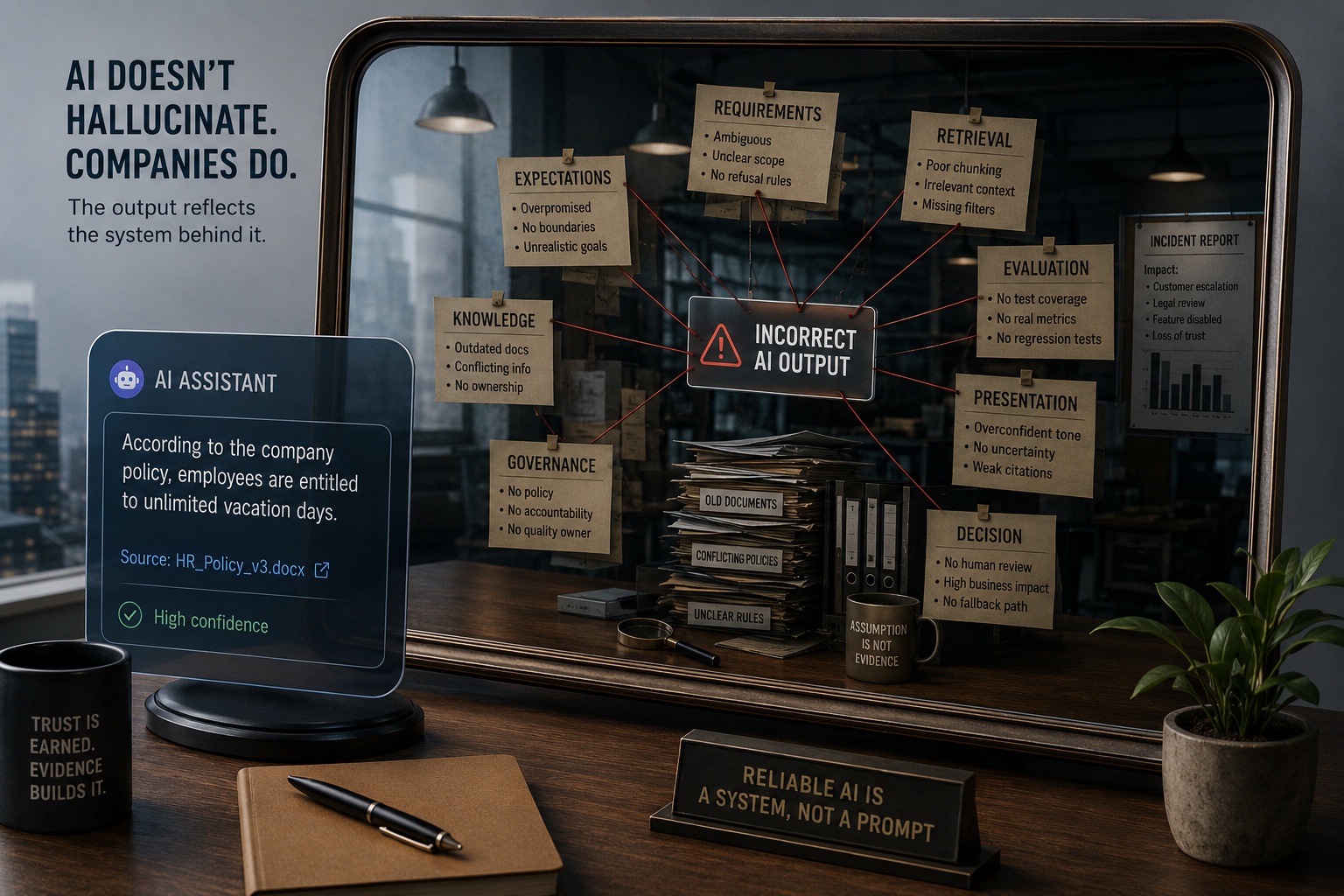
But the sentence was the last event in a much longer chain. Before the model generated a token, the organization had already:
- never defined which questions the assistant was authorized to answer with confidence;
- indexed a mix of current and superseded policy documents with no versioning;
- built a retrieval step that returned the highest-similarity chunk rather than the most authoritative one;
- never required the model to verify its citation actually supported its claim;
- designed an interface that presented every answer, correct or not, in the same confident voice;
- shipped without a production evaluation process that would have caught this exact failure before a customer did;
- given the assistant enough autonomy to answer compliance-sensitive questions with zero human review.
The model produced a false sentence. The company built every condition necessary for that sentence to become a business incident. That's the argument this article makes: models can generate false information. Organizations decide whether that false information becomes a product failure.
What This Article Is Not Saying
This article is not claiming that language models do not hallucinate. It is not arguing that model quality does not matter. It is not shifting responsibility away from AI vendors. It argues that production reliability is a system property — and that organizations control most of the system around the model.
The Word "Hallucination" Hides Too Much
"The model hallucinated" has become the default explanation for almost any AI output failure — and that collapses a dozen distinct failure modes into one vague diagnosis, which makes root-cause analysis nearly impossible.
Consider what actually gets called a hallucination: fabricated facts with no basis anywhere; unsupported claims that are plausible but ungrounded; incorrect retrieval, where the model answers faithfully from a document that should never have surfaced; outdated knowledge, where the model is correct against stale information; citation mismatch, where a real document is cited but doesn't say what's claimed; reasoning errors from correct premises; instruction conflicts between the system prompt and retrieved context; underlying data-quality failures; malformed tool output narrated confidently; misunderstood user intent; and misleading confidence, where technically defensible content is presented with more certainty than the evidence supports.
Each has a different cause, owner, and fix. Treating them all the same usually produces the same two "solutions" — try a better model, add a disclaimer — neither of which fixes most of the list.
| Visible Symptom | Likely Root Cause | Responsible Layer | Detection Method | Mitigation |
|---|---|---|---|---|
| Confident answer, no basis anywhere | Fabrication under a knowledge gap | Generation | Groundedness scoring | Refusal policy for zero-evidence cases |
| Answer sounds right, source doesn't say it | Citation mismatch | Generation + presentation | Automated citation-support check | Require quote-level grounding |
| Correct on stale rules, wrong on current | Outdated knowledge base | Knowledge | Freshness audit | Expiry metadata, re-index triggers |
| Right document exists, wrong one retrieved | Retrieval failure | Retrieval | Precision/recall testing | Reranking, metadata filters |
| Correct math on wrong inputs | Tool/data error upstream | Integration | Input/output validation | Schema validation, sanity bounds |
| Technically defensible, overstated certainty | Presentation design | Presentation | UX review vs. evidence strength | Confidence-aware templates |
Build your own version of this table from real production failures. If your team can't, that's itself a signal: failures are probably being logged as "bad response" with no structure to trace them anywhere.
The Hallucination Often Begins Before the Prompt
Most reliability work focuses on the moment of generation. But a large share of failures that reach a customer were determined before any prompt was written, by decisions nobody labeled as AI decisions.
The prompt is often only the final link in a much longer chain of decisions.
A product manager decides the assistant should "answer questions about our platform" — scope so broad it includes questions nobody thought through. Engineering assumes the knowledge base is "basically complete," without auditing what's missing or contradictory. Nobody defines what the system should do when it doesn't know something, so by default it tries to answer anyway. Nobody defines what counts as sufficient evidence for a claim, so a loosely related paragraph becomes good enough support. Nobody classifies high-risk topics versus low-risk ones, so every question gets identical treatment. None of this shows up in a code review. All of it shows up in production.
Ten questions to answer before building an AI feature:
- What specific decision or task is this feature meant to support, and does the user act on the answer directly or verify it first?
- What is the worst plausible consequence of a confidently wrong answer here?
- Which topics, if answered incorrectly, create legal, financial, or safety exposure?
- What sources are authoritative enough to support a claim, and what happens when they conflict?
- How much evidence is required before the system may state something as fact?
- What does "I don't know" look like in this product, concretely — and will users actually see it?
- Who decides what the system may claim on behalf of the company, and who owns the knowledge base's accuracy?
- What triggers a handoff to a human, and how fast?
- How will we know, in production, that this is getting worse — not just at launch?
- Who is accountable when this system causes a business-impacting error?
If a team can't answer most of these before writing a prompt, it isn't behind on prompt engineering. It's behind on product definition — and no amount of model tuning closes that gap.
A Better Model Cannot Repair a Broken Product Decision
"Let's switch to the newer model" is the most common reliability intervention in the industry, and it's sometimes right. A materially better model can reduce certain failure modes — weak multi-step reasoning, poor instruction-following under long context. It's a legitimate lever. But it's frequently applied to problems it cannot fix, because the problem was never about model capability.
| Problem | Better Model Helps? | Better Intervention |
|---|---|---|
| Stale documents in the knowledge base | No — a smarter model summarizes stale content more fluently, not more currently | Freshness policy, expiry metadata |
| Missing access controls (cross-tenant exposure) | No — this is an authorization bug | Identity-aware retrieval filtering |
| Ambiguous product policy | No — the model can't resolve a policy the company hasn't defined | Written, versioned business rules |
| Weak retrieval relevance | Marginal | Better embeddings, metadata filters, reranking |
| Missing human approval on high-stakes actions | No — this is a workflow gap | Approval gates before irreversible actions |
| Misleading interface (confident tone regardless of evidence) | No — irrelevant to output quality | Confidence-aware response design |
| Nonexistent evaluation dataset | No — you can't know if "better" actually helped | Build golden/adversarial sets before switching |
Across nearly every row, model quality determines how fluently the system expresses what it's been given. It doesn't determine what it's been given, how well that was checked, or what a human sees before acting. Those are architecture and governance questions, and they don't move when you change a model string in a config file. Model upgrades are often pursued because they're the cheapest-looking fix — a config change instead of a data audit or a new approval workflow. They're cheap to attempt and expensive to rely on, because the underlying failure mode is still there.
The Seven Places Where Companies Manufacture Hallucinations
Here is a practical model — not an industry standard, just a framework introduced for this article — for locating where reliability actually breaks down: the Organizational Hallucination Chain.
- Expectation — what the organization believes the system can do, and tells users to expect.
- Requirement — what the system is specified to do, in writing, with evidence standards.
- Knowledge — what the system has access to, and how trustworthy it is.
- Retrieval — what the system actually surfaces at answer time.
- Generation — what the model does with what it's given.
- Presentation — how the answer is shown, and how much certainty it implies.
- Decision — what happens after the answer, and how much autonomy it's given to act.
A hallucination that reaches a customer has usually passed through several of these stages uncaught. The next sections take them in turn — some paired, since the failure modes overlap.
Expectations and Requirements
Every reliability problem is, in part, an expectations problem. A system advertised as "your AI compliance expert" will be trusted differently than one advertised as "a search tool that surfaces relevant excerpts for you to verify" — even with identical underlying architecture. Overconfidence starts upstream of the product: in marketing language that describes probabilistic systems as deterministic databases, in executive pressure to ship on a competitor's timeline, in vague internal claims of "90% accurate" without a defined test set, in treating an experimental feature as a finished, authoritative tool once a pilot customer starts relying on it daily. None of this is a lie exactly — the confidence simply propagates, unchecked, through every layer that touches it.
Some things should never be promised without evidence: diagnostic or treatment-decision reliability in healthcare; that a stated balance, rate, or eligibility figure can be acted on without verification in finance; that a contract summary substitutes for legal review; that an AI-generated security assessment is exhaustive rather than an accelerant to human investigation; always-current, company-wide knowledge without a freshness and coverage disclosure.
Traditional requirements answer "what does the button do." They were never built to answer the harder question an AI feature raises: what is this system allowed to claim, and on what basis? A complete requirement set defines supported domains, prohibited topics, acceptable error thresholds, evidence requirements, refusal behavior, citation behavior, escalation rules, consistency expectations, and privacy boundaries.
AI Answer Quality Specification — reusable template:
| Field | Description |
|---|---|
| Task / User | What's being asked, and by whom |
| Expected behavior | What a correct response concretely looks like |
| Allowed sources | Which documents or APIs may support an answer |
| Required evidence | Minimum standard before a claim is stated as fact |
| Unacceptable output | Explicit examples that must never occur |
| Uncertainty handling | What the system does when evidence is insufficient |
| Escalation | Conditions that trigger human review |
| Evaluation method / production metric | How the behavior is tested, before and after release |
Teams that fill this out for their five or six highest-risk use cases usually discover the exercise surfaces disagreements nobody had resolved — what counts as "current," who's authorized to change a business rule the assistant might cite. Writing the truth specification down is often more valuable than any prompt engineering that follows it.
Knowledge and Retrieval
A large share of what gets blamed on the model is the system being completely faithful to unreliable source material. If the knowledge base contains a superseded policy, a RAG system that surfaces and summarizes it accurately isn't hallucinating — it's functioning correctly against broken input. Common knowledge failures: outdated documents with no expiry mechanism; conflicting policies that both look authoritative; duplicated content drifting out of sync; unlabeled drafts indexed alongside approved documents; missing metadata (no author, date, or approval status); tenant mixing, where one customer's data becomes retrievable in another's context.
Knowledge-readiness checklist: source ownership, freshness, authority, completeness, access control, versioning, traceability, deletion, auditability. Most organizations that actually run this checklist discover a meaningful fraction of their content fails on freshness or authority alone — not from carelessness, but because nobody owned the index as a living asset after launch.
RAG is often pitched as the fix for hallucinations — ground the model in real documents, and it can't make things up. In practice it introduces its own failure surface: weak chunking that fragments meaning; poor embeddings that miss domain-specific relevance; missing permission filtering; inadequate reranking, where the top-similarity result isn't the most authoritative one; low recall, where the right document exists but never surfaces; conflicting retrieved passages with nothing to resolve which governs; citation mismatch, where a real, retrieved document doesn't actually support the specific claim made.
It's worth being precise about three failures that look identical to an end user but require completely different fixes: a retrieval failure (the right information exists but wasn't surfaced), a knowledge failure (what was surfaced is itself wrong or outdated), and a generation failure (the right information was surfaced, but the model still said something unsupported by it). Only the third is primarily a generation-layer failure — though the line isn't always clean, since retrieval quality itself depends partly on model-driven components like embeddings and rerankers, and some reasoning errors trace back to how context was assembled rather than the model's reasoning in isolation. Teams that don't distinguish these end up "fixing" retrieval failures with different prompts, and knowledge failures with different models — solving nothing, because the fix was never in the layer being adjusted.
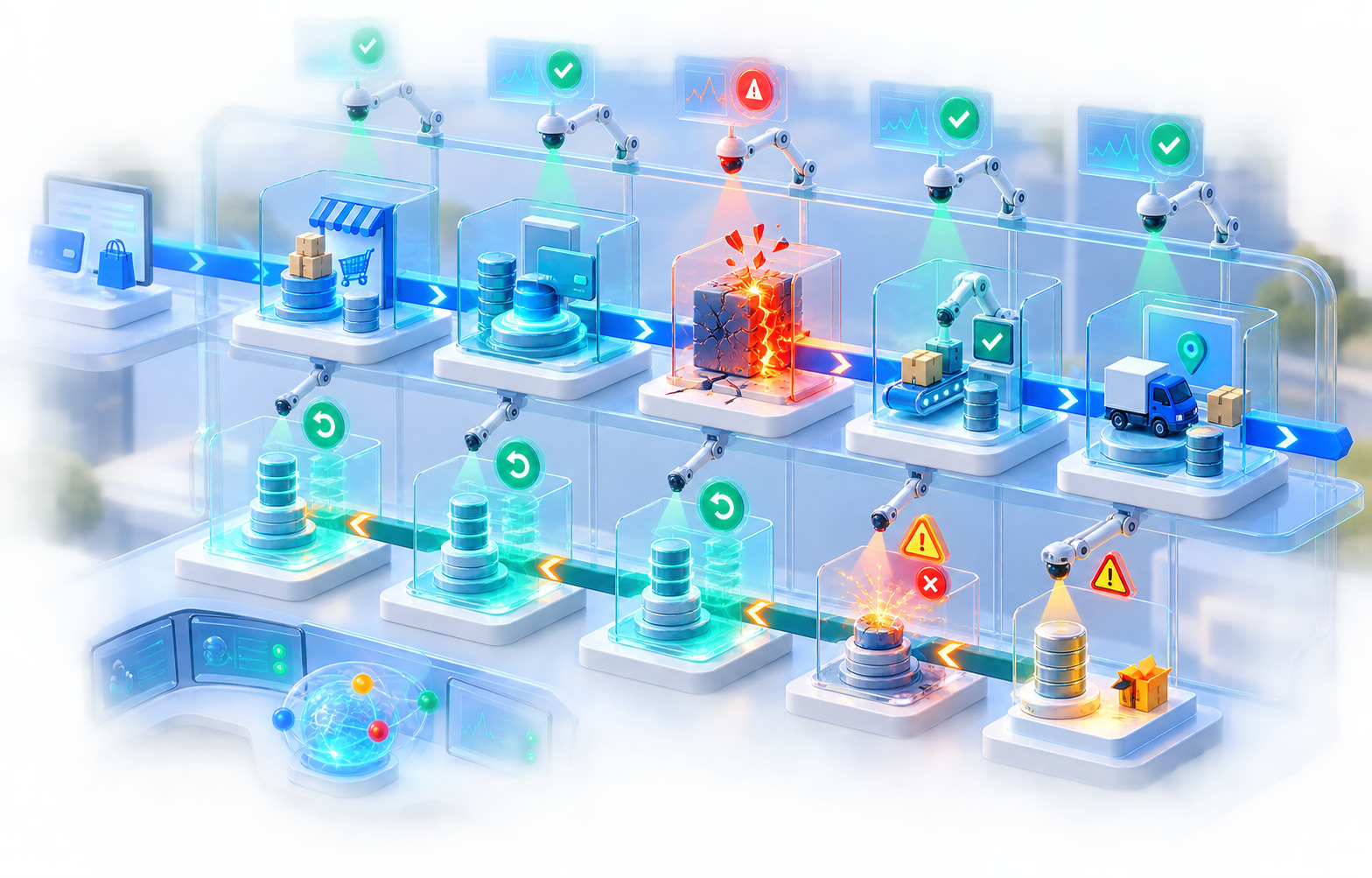
A production pipeline is easier to reason about as a diagram than a paragraph — and drawing it out is usually the fastest way to find where a specific incident actually originated, because it forces a precise answer to "which stage let this through" instead of a vague one.
Identity
  → Risk Classification
    → Authorization Filter
      → Retrieval
        → Reranking
          → Evidence Threshold
            → Context Assembly
              → Generation
                → Citation Validation
                  → Output Policy
                    → Human Approval
→ Logging- Identity — Failure: wrong permission context applied. Control: verify identity and entitlements before any retrieval call.
- Risk Classification — Failure: a high-risk question handled like a routine one. Control: route by risk tier before retrieval begins.
- Authorization Filter — Failure: cross-tenant or over-privileged retrieval. Control: enforce filtering at the query layer, not just the UI layer.
- Retrieval — Failure: low recall or irrelevant matches. Control: evaluate precision and recall on a labeled test set, not spot checks.
- Reranking — Failure: highest-similarity result outranks the most authoritative one. Control: weight reranking by recency, authority, and document status.
- Evidence Threshold — Failure: weak evidence still treated as sufficient to answer. Control: define a minimum relevance score before generation proceeds.
- Context Assembly — Failure: conflicting or redundant passages confuse generation. Control: deduplicate and flag contradictions before passing to the model.
- Generation — Failure: claim exceeds what the assembled context actually supports. Control: groundedness scoring against that context.
- Citation Validation — Failure: cited source doesn't support the specific claim. Control: automated check that citation text entails the claim.
- Output Policy — Failure: response violates a defined constraint (tone, scope, disclosure). Control: policy-layer check before the response is returned.
- Human Approval — Failure: a high-consequence answer reaches the user with no review. Control: mandatory approval gate, scaled to the risk tier from stage two.
- Logging — Failure: failures go undetected until a customer reports them. Control: continuous production sampling against the metric portfolio.
None of these controls are free, and pretending otherwise is how reliability initiatives lose executive support the first time someone asks about latency or conversion. Every control on this list buys a reduction in one kind of risk at a real, specific cost — the decision isn't whether to pay it, but where.
| Control | Reliability Benefit | Trade-off |
|---|---|---|
| Strict refusal thresholds | Fewer unsupported answers | Lower answer rate |
| Citation validation | Better claim support | More latency and cost |
| Human approval | Lower severe-error risk | Slower workflows |
| Frequent re-indexing | Fresher knowledge | More operational overhead |
| Shadow evaluation | Safer model changes | Additional infrastructure |
| Deterministic retrieval | Better consistency | Potentially lower recall |
None of these trade-offs argue against the control — they argue for choosing it deliberately, calibrated to the consequence level of the use case, rather than applying the same setting everywhere by default. A support macro and a compliance answer don't need the same refusal threshold, and treating them identically usually means one is over-controlled and the other under-controlled at the same time.
Generation — What the Model Is Actually Responsible For
None of the above excuses model behavior — that would be its own kind of dishonesty. Language models have genuine, well-understood limitations no surrounding architecture fully eliminates: probabilistic token generation that isn't the same as a verified fact even when it's right; weak calibration, where expressed confidence doesn't correlate well with correctness; sensitivity to prompt phrasing; incomplete internal knowledge with gaps the model doesn't reliably know the boundaries of; reasoning that can fail partway through a multi-step chain even when each step looks locally plausible; sycophancy toward a user's framing; an inability to reliably self-verify — asked "are you sure?", a model will often produce a plausible justification regardless of whether the original claim was correct; and silent behavior shifts across model versions.
This is precisely why model-level evaluation remains essential, not optional. No organizational architecture removes these properties, and a company with excellent requirements, retrieval, and governance around a model it has never evaluated is still exposed. Generation-layer risk is real and permanent — it doesn't go away, it gets managed. The organization's job is building the other six layers well enough that generation-layer imperfection doesn't reach a user unchecked.
Presentation — The Interface Can Turn Uncertainty Into Authority
This is where the gap between "the model was technically not wrong" and "the user was badly misled" usually opens up — and it's almost entirely a design decision, not a model decision. An identical answer, from identical retrieved context, can be presented in ways that communicate wildly different amounts of certainty: polished prose reads as more trustworthy independent of the evidence behind it; "The policy is..." implies certainty that "Based on the document I found, it appears..." would not; no visual signal distinguishes a well-supported answer from a thin one; the interface always produces a full answer because a refusal reads, to whoever built the demo, as a product failure; actions execute without confirmation because friction was optimized away.
Compare, concretely:
Looks certain: "Your enterprise data retention period is 90 days, per your service agreement."
Exposes its evidence and limits: "Based on Section 4.2 of the Enterprise Service Agreement (last verified March 2026), the standard retention period is 90 days for Tier 2 accounts. I couldn't confirm this matches your specific contract terms — I'd recommend verifying with your account manager before relying on this for compliance purposes."
Both could come from the same model call. The second is dramatically less likely to become an incident, because it does the work of calibrating trust instead of outsourcing that job to the reader.
Two smaller design choices compound the same problem. Anthropomorphic phrasing like "I checked and confirmed" implies a verification process that may not actually exist — the model didn't check anything in the sense a human reader assumes; it generated a sentence that used the word "confirmed." And when there's no easy way to open the actual source in one click, users default to trusting the summary instead, because verifying it is more friction than most people will accept in the moment.
A reusable Trustworthy Response Pattern: a concise answer, the specific evidence it's grounded in, source freshness, stated confidence limitations, a recommended verification step where stakes warrant it, and a visible escalation option. One caution: a numeric "confidence score" isn't automatically trustworthy just because it's a number. Model-internal probability measures token likelihood, not factual correctness — a score with no validated relationship to actual accuracy on your use case is decoration, and can create more false trust than no score at all.
Decision — The Real Failure Happens After the Output
An incorrect answer sitting quietly in a transcript is a bug. An incorrect answer that drives an action — a refund issued, a false statement sent to a customer, an irreversible system change — is an incident. The gap between the two is entirely a function of how much autonomy the organization granted, matched against actual consequence.
Autonomy vs. Consequence Matrix:
| Consequence Level | Recommended Autonomy |
|---|---|
| Informational, low risk | Automatic execution acceptable |
| Advisory, internal only | Logging only, periodic sampling |
| Reversible operational | Post-action review, easy rollback |
| External communication, low stakes | Human-on-the-loop (spot-checked) |
| Financial, moderate stakes | Human-in-the-loop (reviewed before execution) |
| Legal or compliance-relevant | Mandatory approval before any external use |
| Safety-critical or irreversible | Prohibited automation — human decision, full stop |
The opening scenario sits squarely in the "legal or compliance-relevant" row, with zero approval in the loop. That single mismatch is, on its own, sufficient to explain why a fluent wrong answer became an emergency shutdown rather than a quietly logged and corrected mistake.
The Most Dangerous AI Output Is Not Absurd
Teams calibrate their intuitions on obviously wrong cases — a founding year that makes no sense, a nonsensical recommendation. Those get caught fast, because they're easy to spot.
The dangerous output is different in kind. It's plausible, specific — a number, a date, a clause, specificity that reads as evidence of grounding even when there isn't any — fluent, partially correct, aligned with what the user already expected, and unsupported in exactly one critical detail. A retention period of "90 days" is more dangerous than "negative 40 days," because only one triggers scrutiny. A citation to a real document that simply doesn't say what's claimed is more dangerous than a citation to nothing, because a user is far more likely to see "Section 4.2" and treat the claim as verified without opening the link.
That's the core distinction between false confidence and obvious hallucination: obvious hallucination gets caught by the first skeptical reader; false confidence gets caught, if at all, by whoever eventually acts on it and finds reality doesn't match — often already inside a compliance summary or a customer email. Evaluation systems that only test for absurd, easily-flagged failures will report excellent accuracy numbers right up until a plausible, one-detail-wrong answer causes real damage.
Founder takeaway: The greatest risk is not that your AI will say something ridiculous. It is that it will say something plausible enough to be trusted and specific enough to influence a decision.
Measuring What Matters: Metrics, Evaluation, and the Hallucination Budget
"Our hallucination rate is 3%" sounds precise and communicates almost nothing actionable — it collapses wildly different situations into one figure. A 3% error rate on creative suggestions is a non-issue; the same rate on compliance claims to enterprise customers is a serious liability. Any aggregate number needs segmentation by use case, severity, source quality, business impact, and model version — silent regressions after an upgrade are common and easy to miss without that last cut.
A useful metric portfolio, briefly: groundedness (are claims supported by retrieved context — but doesn't check if that context was correct); citation correctness (does the cited source actually support the claim — gameable by citing real but tangential documents); retrieval precision/recall (diagnoses noisy or missing retrieval separately from generation quality); refusal quality (does the system decline appropriately, without over-refusing); severe-error rate (requires a severity taxonomy to exist first); business-impact-weighted failure rate (the number that should actually reach executives, since it reflects real risk rather than raw count). No single metric is sufficient alone — that's the point of a portfolio.
A demo is evaluated by whether it impresses whoever's watching. A production system has to survive adversarial phrasing, edge cases, a knowledge base that's grown messy over eighteen months, and a model upgrade nobody asked for. A real evaluation system needs: golden datasets for core use cases, adversarial datasets targeting known failure modes, domain-expert review rather than just engineers judging fluency, production sampling of real traffic, and — critically — every real-world failure converted into a permanent regression test, without exception. Changes should go through offline evaluation, a defined pre-release gate, shadow testing against live traffic without exposing it to users, and canary release to a small monitored slice before full rollout. Two failure modes are worth naming explicitly, because teams tend to miss both: first, an LLM used to grade another LLM's output has its own blind spots and needs periodic calibration against human judgment, or "automated evaluation" quietly becomes a rubber stamp; second, even human reviewers need inter-rater agreement checks, or "human-reviewed" becomes a comforting label without real rigor behind it. Organizations that avoid public incidents are rarely the ones with the most advanced models; they're the ones that never let a new prompt, model, or data source into production without proving, against a real test set, that it didn't quietly make things worse.
Not every use case needs zero factual error, and pretending otherwise leads to paralysis or denial. A more useful frame is an explicit hallucination budget: a stated threshold for acceptable error, tied to consequence, reversibility, detectability, and available human oversight — not a tolerance for carelessness, but a mechanism for making risk tolerance deliberate rather than accidental. A creative copy assistant can tolerate a high error rate; contract analysis and financial execution should tolerate almost none, because the consequence and reversibility profiles are entirely different.
The scope of this concept matters: the budget applies to low- and moderate-consequence use cases. For legal, safety-critical, or irreversible decisions, the acceptable autonomous error budget may effectively be zero — the mechanism there isn't a tolerance threshold at all, but mandatory human review before anything reaches a user. Setting the budget explicitly means a company decides its true risk tolerance in advance, use case by use case — not for the first time during an incident review.
Who Owns AI Truth?
"The model hallucinated" is often also an ownership dodge — it locates the failure somewhere no one on the team is expected to fix. Reliable AI requires shared, explicit ownership across functions that don't normally think of themselves as responsible for factual accuracy: product typically owns use-case approval; AI engineering and quality engineering share evaluation design and release gating; data engineering owns knowledge-source integrity; domain experts are consulted on both evaluation and policy; security owns access boundaries; legal owns user-facing communication in regulated domains; operations owns monitoring and incident response.
| Activity | Accountable | Consulted |
|---|---|---|
| Use-case approval | Product | AI eng, quality, legal, domain experts |
| Knowledge-source approval | Data engineering | Domain experts, security |
| Evaluation design | Quality engineering | AI engineering, domain experts |
| Release decision | Product | AI engineering, quality, legal |
| Model change approval | Quality engineering | AI engineering |
| Incident response | AI engineering + quality | Security, operations, legal |
| User-facing communication | Legal/compliance | Product, operations |
The specific allocation matters less than the exercise of writing it down before an incident forces the question. QA alone cannot own "AI truth" — it can test against a specification, but someone else has to write the specification, someone else has to keep the knowledge base current, and someone else has to decide what happens when a serious error reaches a customer. Placing all responsibility on QA produces a testing function that catches problems nobody upstream is willing or able to fix. A useful test of whether ownership is real rather than nominal: ask five people on the team, separately, who owns knowledge-base accuracy. If the answers don't match, ownership isn't actually assigned — it's assumed, which functions the same as unassigned the moment something goes wrong.
Four Illustrative Failure Scenarios
All figures below are fictional and illustrative — not real client outcomes. These four were chosen to represent four distinct risk types: citation integrity, upstream data freshness, generation-layer limitations, and autonomy design.
B2B SaaS Knowledge Assistant — citation mismatch. Objective: let enterprise customers self-serve product configuration questions. Apparent hallucination: a stated data retention period that didn't match the customer's actual contract. Actual cause: no document versioning, and retrieval returned a generic policy template instead of the customer-specific contract — the citation pointed to a real document that simply didn't say what was claimed. Fix: contract-specific retrieval scoping plus mandatory citation-to-claim validation before any answer is displayed. Illustrative result: citation-mismatch rate fell from roughly 8% to under 1% the following quarter.
FinTech Customer Service — stale tool data. Objective: automate common account questions. Apparent hallucination: told a customer a fee was waived when it wasn't. Actual cause: a tool-integration failure, not a language failure — the account API returned a cached, stale fee-status field, and the model narrated it confidently with no staleness check attached. This was logged internally as "the model hallucinated" for weeks before anyone traced it to the cache. Fix: real-time freshness checks required before any financial claim is generated, plus staleness-injection tests added to the evaluation suite.
Legal Document Analysis — generation-layer limitation. Objective: summarize contract clauses for a legal ops team. Apparent hallucination: asserted an obligation a clause didn't actually contain. Actual cause: long-context degradation — the relevant clause sat in a 40-page document and was underweighted relative to more prominent nearby text, and no long-document evaluation had ever been run to catch this class of error. Unlike the first two cases, this one genuinely traces to a real model limitation. Fix: clause-level retrieval and citation instead of whole-document summarization, plus a long-document-specific golden dataset with known clause locations.
Cybersecurity Investigation — excessive autonomy. Objective: accelerate analyst triage by summarizing alert context. Apparent hallucination: characterized an alert as resolved when it wasn't. Actual cause wasn't generation quality at all — the assistant had been given autonomy to update ticket status directly, with no analyst confirmation step, a decision made for efficiency without a risk-tier review of what "resolved" implies operationally. A real incident's investigation was delayed as a result. Fix: status changes moved to human-in-the-loop confirmation; the assistant recommends but never closes tickets.
Notice the pattern: only one of these four is primarily a generation-layer failure. The other three trace mainly to a retrieval bug, an integration bug, and an autonomy-design decision — each one dressed up, in the postmortem's first draft, as "the AI hallucinated."
Additional failure patterns, condensed — the same root-cause logic applies across sectors:
| Sector | Apparent Hallucination | Actual Root Cause | Fix |
|---|---|---|---|
| Healthcare administration | Stated a procedure was covered when the rule had changed mid-cycle | Knowledge base updated monthly; no expiry flag existed on coverage documents | Event-triggered re-indexing tied to the source policy system |
| E-commerce product assistant | Claimed a product had a feature it didn't | Duplicate SKUs with inconsistent attributes; retrieval pulled the wrong SKU | SKU deduplication and canonical attribute resolution before indexing |
| AI sales agent | Promised a roadmap feature as already available | Roadmap and marketing content indexed identically to current-feature docs | Content-status metadata; roadmap content excluded from the authoritative source set |
| Internal HR assistant | Gave inconsistent answers to the same question from different employees | No consistency requirement specified; retrieval non-determinism assembled different context each time | Deterministic retrieval for policy lookups; consistency added to the spec |
What Reliable AI Organizations Do Differently
The difference between mature and immature AI organizations shows up in behavior, not tooling. Two companies can run the same model on similar infrastructure and have wildly different outcomes, because one has built habits the other hasn't. Reliable organizations define evidence standards before a feature ships, not after an incident forces the question. Domain experts participate directly in evaluation, not just engineers judging general fluency. The riskier the consequence, the less autonomy the system is given — deliberately, in writing. Every real incident becomes a permanent regression test. Model changes are versioned and gated like any other software change, never swapped silently. Refusal behavior is tested as seriously as correct-answer behavior. Users see evidence and limitations instead of uniformly confident prose. Leadership sees quality metrics regularly, not just adoption numbers. And everyone on the team can correctly answer "who owns this if it breaks" without hesitation. Immature organizations tend to discover most of these gaps only in the middle of an incident review — exactly the moment they're most expensive to discover.
A Reliability Roadmap
| Phase | Focus | Success Metric | Common Mistake |
|---|---|---|---|
| First 30 days | Inventory every AI-touching feature; risk-classify each one; name owners for knowledge, retrieval, and quality | Every AI feature has a named owner and documented risk tier | Treating this as a one-time audit instead of an ongoing inventory |
| First 90 days | Build golden and adversarial datasets for top use cases; add pre-release quality gates; measure RAG precision/recall; add approval gates on highest-consequence actions | No release ships without passing a defined gate | Evaluating only the happy path, skipping adversarial and edge cases |
| First 180 days | Move to continuous production evaluation; add model/prompt versioning and shadow releases; run recurring cross-functional governance reviews | Mean time to detect a regression drops measurably | Governance reviews becoming a rubber-stamp formality |
| First 365 days | Full observability across all seven chain stages; automated regression on every change; enterprise-grade reliability reporting | Severe-error rate trending down year over year | Treating "365 days" as a finish line rather than permanent infrastructure |
Founder and CTO Self-Assessment
Fifteen questions, answered yes or no, cover the ground that matters most. This is a practical self-assessment, not a formal certification.
Strategy & requirements
- Have we explicitly defined what this AI feature must never claim?
- Have we set a hallucination budget for our highest-risk use case?
- Do we have a written specification for what evidence a claim requires?
- Is there a documented escalation path to a human?
Data & retrieval 5. Do we know the freshness of every document in our knowledge base? 6. Have we measured retrieval precision and recall separately from generation quality? 7. Do we validate that citations actually support the claims attached to them?
Evaluation 8. Do we have a golden dataset for our top use cases, and an adversarial one for known failure modes? 9. Do we re-evaluate whenever we change model version? 10. Do we track a metric portfolio, rather than a single hallucination rate?
UX & autonomy 11. Does our interface visibly distinguish well-supported answers from thin ones? 12. Is there a clear "I don't know" path the system can actually take? 13. Do irreversible or high-stakes actions require mandatory human approval?
Monitoring & governance 14. Can we detect a quality regression within days, not months? 15. Does every real incident produce a new permanent regression test?
Scoring: 0–4 yes: Demo-Driven. 5–9: Operationally Exposed. 10–12: Controlled but Incomplete. 13–15: Production-Ready, with room to mature specific areas.
This is a shortened version. The full self-assessment runs to 50 questions across ten categories — strategy, requirements, data, RAG, model evaluation, UX, autonomy, monitoring, governance, and incident response — and is available as a separate downloadable checklist for teams who want to run it properly across a leadership team.
Ten Questions for the Next AI Architecture Review
- Which incorrect answers would cause the greatest business harm, specifically?
- What source is considered authoritative when documents conflict?
- What happens when retrieval confidence is insufficient?
- Which actions require human approval before execution?
- How will we know the product is getting worse after a model update — before a customer tells us?
- What evidence can a user actually inspect, in one click?
- Who can disable the feature during an incident, and how quickly?
- What is our current hallucination budget for each major use case, and who approved it?
- What was our most recent AI incident, and did it produce a permanent regression test?
- What would have to be true for us to say, honestly, that this system is production-ready?
When External AI Quality Expertise Becomes Useful
Not every organization needs outside help to build this operating system. External AI quality expertise tends to create genuine value in specific situations: the company has strong engineers but limited experience in evaluation design or RAG diagnostics specifically; the launch timeline doesn't leave room to build evaluation infrastructure from scratch; enterprise customers are asking for concrete reliability evidence the company hasn't yet formalized; internal teams are too close to their own design assumptions to see where the chain actually breaks; the use case touches a regulated workflow where an independent readiness assessment carries real weight; or production incidents are increasing faster than internal capacity to fix them systematically.
Where this typically helps: an independent AI quality audit against a framework like the one above, evaluation strategy design for high-risk use cases, temporarily embedded quality engineers who build the initial datasets and hand off a working process, focused RAG validation, and a production-readiness assessment before a major launch. It's not always necessary — a company with strong internal discipline can build all of this itself. It becomes useful when the gap between current practice and what's described here is large, the stakes are high, and the timeline is short.
Conclusion
Return to the meeting that ended the pilot. The final incorrect sentence — a wrong retention period, delivered with a citation that didn't hold up — was the only part of the failure anyone in that room actually saw. It was not the only part that mattered.
The real failure had accumulated for months: in an expectation that the assistant was more authoritative than it had been built or evaluated to be; in a requirement set that never defined what evidence a compliance-relevant claim required; in a knowledge base mixing current and superseded documents with no versioning; in a retrieval pipeline that returned the most similar passage instead of the most authoritative one; in a generation step with no citation validation; in a presentation layer that gave every answer, regardless of evidence quality, the same confident voice; and in a decision architecture that let a compliance-relevant claim reach a customer with zero human review.
The model produced a plausible, specific, fluent, wrong sentence — exactly what every language model is capable of, under the right conditions, indefinitely. That's not news, and no framework changes it. What changes, when an organization does this work seriously, is what happens next: whether the sentence is caught before a user sees it, whether the interface communicates its actual uncertainty instead of hiding it, whether an approval gate stands between the claim and a customer's compliance file, and whether the whole chain gets stronger the moment a failure is discovered instead of quietly repeating it.
AI systems may produce hallucinations. Organizations decide whether those hallucinations remain harmless imperfections or become expensive business decisions. Reliable AI is not found. It is designed — across requirements, data, retrieval, generation, presentation, and governance — by people willing to own the parts of the system that have nothing to do with the model at all.
Five Internal-Link Opportunities
- The full 50-point AI Reliability Self-Assessment — downloadable companion checklist referenced in the self-assessment section (gate behind email capture).
- A companion deep dive into RAG pipeline architecture — chunking, embeddings, reranking.
- A standalone how-to on building a golden dataset for LLM evaluation.
- A piece on AI incident response playbooks, operationalizing the self-assessment's governance section.
- A technical breakdown of groundedness and citation-validation techniques.
Six Quotable Statements for LinkedIn
- "AI systems may produce hallucinations. Organizations decide whether those hallucinations remain harmless imperfections or become expensive business decisions."
- "The prompt is often only the final link in a much longer chain of decisions."
- "A better model determines how fluently your system expresses what it's been given — not what it's been given, or what happens after."
- "The most dangerous AI output isn't absurd. It's plausible, specific, fluent, and wrong in exactly one detail."
- "The greatest risk is not that your AI will say something ridiculous. It is that it will say something plausible enough to be trusted and specific enough to influence a decision."
- "Reliable AI is not created by selecting a better model. It's created by an entire operating system built around it."
Six FAQ Questions With Concise Answers
1. What exactly is an AI hallucination? Content that's fabricated, unsupported by its actual sources, or factually incorrect — generated fluently and often confidently.
2. Can AI hallucinations be completely eliminated? No. Language models are probabilistic and will generate unsupported output under some conditions regardless of architecture. The realistic goal is preventing them from reaching users unchecked and becoming business incidents.
3. Does using a better or larger model fix hallucinations? Sometimes, for reasoning-heavy failures. It doesn't fix stale data, poor retrieval, missing evaluation, or misleading interfaces — the majority of what causes costly incidents.
4. Is RAG enough to prevent hallucinations? No. It reduces certain fabrication risks but introduces its own failure modes — chunking, retrieval relevance, citation mismatch.
5. What's a "hallucination budget"? An explicit, use-case-specific threshold for acceptable error, based on consequence and reversibility — a governance tool, not a tolerance for carelessness. It applies to low- and moderate-consequence use cases; for legal, safety-critical, or irreversible decisions, the budget is effectively zero and mandatory human review takes its place.
6. When does it make sense to bring in outside AI quality expertise? When internal teams lack specific evaluation experience, timelines are tight, enterprise customers demand reliability evidence, or incidents are increasing faster than internal capacity to fix them systematically.