Why Building a Working Demo Now Takes Days — While Building Dependable Software Still Takes Engineering
Something genuinely changed in software development, and it happened fast enough that most organizations have not finished adjusting to it.
A founder sits down on a Friday afternoon with an idea and, by describing what they want in plain language to a tool like Cursor, Claude Code, Replit, Lovable, or Bolt, watches a working application take shape. Authentication appears. A database gets created and connected. An external API gets wired in. A dashboard renders real data. A payment button processes a test transaction. An admin screen appears, with tables and filters that look like they belong in a Series A pitch deck. By Monday, there is a URL, and the URL leads to something that looks, unmistakably, like a real product.
This is not an exaggeration for effect, and it is not a "vibe coding" cautionary tale in disguise. It is an accurate description of what modern AI-assisted development environments can now do, and it represents a real and durable improvement in how quickly an idea can be tested against reality. Anyone who has actually built software over the past two decades knows how much manual setup used to stand between an idea and a clickable interface: provisioning a database, wiring authentication, hand-writing CRUD endpoints, configuring a deployment pipeline, styling a UI from scratch. Much of that friction has been genuinely, measurably reduced.
That progress deserves to be taken seriously rather than dismissed with a knowing eye-roll about "vibe coding," a term that has already begun to feel dated less than two years after it entered the vocabulary. The tools are real. The productivity gains are, in many documented contexts, real. Multiple controlled studies — not just vendor claims — have found meaningful speedups from AI coding assistance under specific conditions: GitHub's own research recruited 95 professional developers to build an HTTP server in JavaScript with and without Copilot, and the group using the tool finished 55.8 percent faster. A field experiment with roughly two thousand developers across Microsoft and Accenture found measurable increases in completed pull requests among developers given access to Copilot. Google Cloud's 2025 DORA report on AI-assisted software development, drawn from survey responses of nearly five thousand technology professionals, found that AI adoption has reached 90 percent among developers and that individual effectiveness gains are now widespread and measurable.
None of that is the subject of this article, and none of it is in dispute here. The subject of this article is the sentence that tends to follow that demo, spoken in a founder's meeting, a board update, or a hallway conversation with an engineering lead:
If we built a working version in three days, why does the real version need three months?
That question is reasonable to ask. It is also, in most cases, based on a category error — one worth taking seriously precisely because it is so understandable. The honest answer is not "because developers are slow," and it is not "because AI-generated code is bad." Both of those explanations are too convenient, and both let everyone involved avoid the more useful conversation. The real answer is that the three-day prototype and the three-month production system are not the same kind of artifact, built for the same kind of question. They just happen to look similar on a screen.
A prototype exists to answer one question: can this idea work?
A production system has to answer a much longer and less glamorous set of questions: can this keep working, for real users, with real data, under failure, under load, through updates, through incidents, with adequate security, with the ability to support the people using it, and without the kind of failure that damages the business when — not if — something eventually goes wrong?
AI did not eliminate the distance between those two questions. It reduced the cost of answering the first one. That is a genuinely valuable transformation, and it is also a much narrower one than the marketing language around AI development tools tends to suggest. This article is about that distance — what it is made of, why AI has not closed it, and how founders, CTOs, and engineering leaders can reason about it deliberately instead of discovering it the hard way, usually right around the time real customers and real money show up.
The New Software Illusion
There is a specific kind of confusion that modern AI-assisted prototypes create, and it is worth naming precisely because it is not a failure of judgment on anyone's part. It is a natural consequence of how convincing these tools have become.
Call it the gap between visual completeness and operational completeness.
A prototype built with a modern AI coding tool can look, at a glance, indistinguishable from a mature product. It has a login screen. It has a styled dashboard with real charts. It calls a real external API and displays real responses. It processes a test payment. It has an admin panel. Every one of the pieces a person would associate with "a real software company" is visibly present.
Visual completeness is not a trick or an illusion in the pejorative sense — the interface really is there, and it really does work, for the case it was built and tested against. But visual completeness measures something narrower than most people assume it measures. It tells you that the happy path — the expected sequence of events when everything goes right — has been implemented and demonstrated. It does not tell you anything about what happens outside that path: when a payment is declined instead of approved, when two people edit the same record simultaneously, when an uploaded file is malformed, when the third-party API returns an error instead of data, when ten thousand rows exist in a table that was only ever tested with ten, or when a person tries to do something the interface was never designed to prevent.
Operational completeness is a different axis entirely. It describes whether the system can be trusted to behave correctly and safely across the much larger space of situations that real usage inevitably creates. It is, by its nature, mostly invisible in a demo, because a demo is a curated walk down the happy path. Nobody demos the account recovery flow, the database restore procedure, or the on-call runbook, because those things are not what convinces an investor or a first customer that the idea has merit.
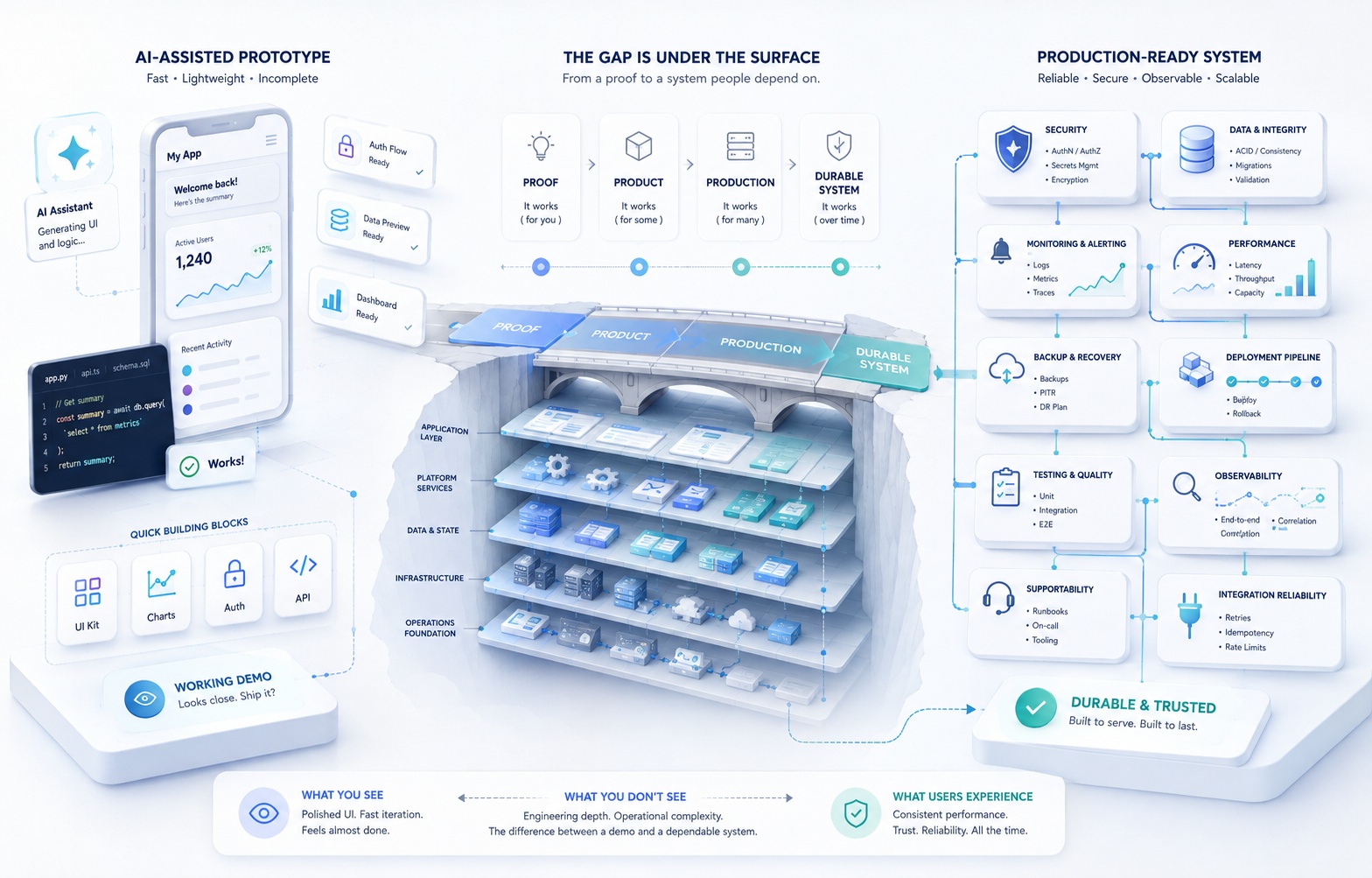
Here is the uncomfortable part: the majority of what makes software dependable exists precisely in the parts a demo does not show. A visually complete prototype can be five percent of the way toward a production-ready system, not eighty percent, even though it looks close to finished. The interface being done says very little about whether the system underneath it is done, because "done" means something different in each of the four stages this article will use as its structural spine.
Those four stages are: Proof, Product, Production, and Durable System. They are not formal industry categories, and no certification body hands out badges for reaching them. They are a conceptual model — a useful way to talk about a distinction that is real even though the boundaries between the stages are fuzzy in practice. Think of them less like a ladder with fixed rungs and more like four different questions a piece of software can be asked, each one harder to answer honestly than the last.
Proof asks: can the idea work at all?
Product asks: can a real user get real value from this, on purpose, more than once?
Production asks: can this operate reliably for real customers, under conditions nobody hand-picked?
Durable System asks: can the organization safely change it, support it, and scale it over time, including after the people who built it have moved on to other things?
AI-assisted development has made astonishing progress on the first stage. It has made real but more modest progress on the second. It has made comparatively little progress on the third and fourth — not because the tools are incapable, but because those stages are not primarily about writing code faster. They are about the slower, less visible work of deciding what the system must guarantee, and then proving that it does.
Section I — Proof: The Part AI Made Cheap
Before examining what AI has not solved, it is worth dwelling honestly on what it has. This is the part of the story that gets underweighted in most "beware of vibe coding" commentary, and underweighting it does a disservice to founders who are making real, defensible use of these tools.
A prototype is extraordinarily good at answering a narrow but important set of questions. Does the workflow, described out loud, actually make sense once someone can click through it? Can the core algorithm or model actually do the thing it is supposed to do, on real inputs, not just in theory? Can the systems the product depends on — a payment processor, a mapping API, a language model, an internal data source — actually be connected together in a way that produces something coherent? Will a person unfamiliar with the idea understand the interface without a guided tour? Can the founder stand in front of an investor, a potential customer, or a hiring candidate and show something that moves, rather than describing something that might exist someday?
AI-assisted development tools are unusually well-suited to this kind of question because so much of what a prototype requires is repetitive, well-documented, and pattern-matchable: boilerplate scaffolding, standard authentication flows, CRUD endpoints, common UI components, routine API integration code, translating a data model from one format to another, generating a first draft of nearly anything. These are exactly the tasks where large language models, trained on enormous amounts of public code and documentation, perform reliably. A tool like Claude Code or Cursor does not need to be creative to save a developer an afternoon of wiring a login form to a database — it needs to recognize a familiar pattern and execute it quickly, which is precisely what these systems are built to do.
The honest caveat belongs here, stated plainly rather than as a disclaimer tacked on for balance: AI tools still require human judgment to be useful, and the productivity gains they produce are neither uniform nor unconditional. The most rigorous field research on this question complicates the simple "AI makes everyone faster" narrative in an important way. METR, an independent research organization, ran a randomized controlled trial in the first half of 2025 with sixteen experienced open-source developers working in codebases they knew well — repositories averaging more than a million lines of code, where the developers had years of prior context. When those developers were allowed to use AI tools (primarily Cursor with Claude 3.5 and 3.7 Sonnet, the frontier models available at the time), they took, on average, 19 percent longer to complete real tasks than when they worked without AI assistance — despite predicting beforehand that AI would make them 24 percent faster, and despite believing afterward, incorrectly, that it had made them 20 percent faster.
That finding is not a reason to dismiss AI-assisted development. It is a reason to be precise about where the speedup actually shows up. METR's own analysis is careful to note what the study does not prove: it does not describe junior developers, greenfield projects, low-stakes prototypes, or the newest generation of tools, and METR itself later flagged that the result should be treated as historical rather than a permanent verdict on current tools. The context that produced the slowdown — experienced developers working inside large, unfamiliar-to-AI, well-understood codebases with high existing quality bars — is close to the opposite of the context where AI-assisted prototyping shines: new, small, unencumbered codebases where there is no legacy logic to reconcile and no existing quality bar the output has to match. In that narrower, greenfield context, the controlled evidence for a real speedup is much stronger. GitHub's own controlled study, an ANZ Bank study reported by researcher Chatterjee and colleagues, and multiple field experiments cited in recent survey literature all converge on double-digit-to-majority speedups for well-scoped, boilerplate-heavy tasks — the exact kind of tasks a prototype is made of.
The productive way to hold both findings at once is this: AI is fastest exactly where a prototype needs it to be fast, and least reliably fast exactly where production work tends to live — inside large, interdependent, already-correct systems where a wrong guess is expensive to notice and expensive to undo. That is not a coincidence. It is close to the central argument of this entire article, stated in miniature.
The economic significance of cheap proof should not be understated. When the cost of testing an idea drops, more ideas can be tested. Founders can validate assumptions with something a user can actually touch, rather than a slide deck, before committing to a hiring plan. Product managers can build a working version of a feature disagreement instead of arguing about it in a meeting. Engineers can explore two or three architectural approaches concretely instead of debating them abstractly. A two-person team can demonstrate a level of technical capability that, five years ago, would have required a much larger initial investment and a much longer runway before the first believable demo existed.
This is a genuinely positive shift, and it is the correct starting point for any serious conversation about AI and software development — not because it needs a disclaimer, but because everything that follows in this article only makes sense in light of it. The gap between prototype and production is not evidence that AI prototyping is a trap. It is evidence that proof and dependability are different problems, solved by different kinds of work, and that solving the first one faster does not solve the second one at all.
Section II — The Prototype Discount
There is a useful way to describe what makes a prototype cheap to build, beyond simply "AI wrote the code faster." Call it the prototype discount — not an established term of art, just a convenient label for a real phenomenon worth naming.
The prototype discount is the large amount of engineering work a prototype can temporarily avoid, because the environment it lives in is controlled, the number of people using it is small, the data inside it is limited and low-stakes, and the consequences of something going wrong are minor and easily contained.
A prototype rarely needs comprehensive permission systems, because there are only a handful of users and the builder personally knows what each of them should be allowed to do. It rarely needs a tested recovery process, because if the database gets corrupted, the founder can simply reset it — the data is test data. It rarely needs monitoring, alerting, or on-call procedures, because the builder is watching the system directly, in real time, because they are the one using it. It rarely needs rate limiting, graceful degradation, or failover, because there is no meaningful load to protect against. It rarely needs deep security hardening, because there is nothing yet worth stealing and no adversary yet paying attention. It rarely needs customer support tooling, audit logs, accessibility work, localization, deployment rollback procedures, incident response plans, comprehensive automated testing, or operational documentation, because none of those things have a customer attached to them yet who would notice their absence.
This list is not a list of mistakes. It is a list of reasonable deferrals. A prototype that tried to build all of this from day one would never get built, and worse, would waste engineering effort hardening assumptions that the market might reject entirely two weeks later. The discount is not a flaw in prototyping — it is the entire point of prototyping. It is what makes the exercise cheap enough to be worth doing before anyone knows whether the idea deserves a larger investment.
The problem is not the discount itself. The problem is what happens in the mind of an organization that has only ever seen the discounted price.
If the only cost anyone has observed is the prototype's cost — three days, one developer, a single AI tool subscription — it becomes easy, almost automatic, to assume that number represents the real, permanent cost of the software. It does not. It represents the cost of software that has been deliberately, and correctly, exempted from most of the obligations that real usage eventually imposes. The discount is temporary by construction. It expires the moment real users, real money, or real consequences enter the picture, whichever comes first — and it expires whether or not anyone has budgeted for that moment.
This is where founder-engineering tension most often originates, and it is worth naming honestly rather than treating as a communication failure on either side. A founder who has personally watched a working prototype get built in three days has excellent, direct evidence that three days is possible. An engineering lead who understands the prototype discount knows that three days bought something real, but not the thing the founder now believes it bought. Neither person is wrong about what they observed. They are describing two different objects that happen to share a URL.
Section III — Product: Does Anyone Actually Want This?
Before the article turns toward production engineering, it is worth pausing on the stage in between — the one where a working prototype is not yet a business, and cheap building can quietly become a new kind of problem.
A prototype proves that something can exist. It does not prove that it deserves to exist. Those are different claims, and conflating them is one of the more expensive mistakes cheap AI-assisted development makes easier to fall into, not harder.
The questions that separate "can be built" from "should be built" are old and familiar to anyone who has done real product work: does a real user, in a real workflow, get enough value from this to come back a second time without being asked? Is the onboarding experience clear enough that a first-time user does not abandon it in the first ninety seconds? Does the pricing make sense against the value delivered? Does the product occupy a defensible position relative to what a user could do instead? Does actual usage — not stated intent in an interview — show retention over weeks, not just a single session?
None of those questions get easier to answer because the software got easier to build. If anything, cheap building introduces a subtler risk: when creating a new feature, screen, or entire product direction costs an afternoon instead of a sprint, a team can generate far more output than it can generate validated learning. It becomes entirely possible to ship ten different feature ideas in a month and still understand the customer barely better than before, because building fast is not the same activity as learning fast. A demo that impresses a room is not the same evidence as a cohort of users who keep coming back on their own.
This is the place where the falling cost of prototyping should be redirected, deliberately, toward increasing the rate of learning rather than simply increasing the rate of output. The founders who get real leverage from AI-assisted development are not the ones who ship the most features — they are the ones who use the lowered cost of building to run more honest experiments per month, retire more bad assumptions per month, and arrive at genuine product-market signal faster than a team without the tools could. Velocity is only valuable in service of learning. Divorced from it, velocity just produces more things to eventually maintain — a problem this article returns to later, because it turns out to be one of the more underappreciated costs of cheap software creation.
Section IV — Production: The Part Users Do Not See
This is where the article turns from the parts of software a founder can watch happen to the parts that are, by design, mostly invisible until they fail.
Nearly everything that makes a piece of software dependable lives outside the interface a user interacts with. Backup systems. Alerting rules that tell an engineer something is wrong before a customer does. Retry logic that quietly recovers from a transient failure. Security controls that prevent one customer from seeing another customer's data. Deployment pipelines that move code from a developer's machine to production without breaking anything along the way. Database migration procedures that change the shape of stored data without losing any of it. Observability systems that let an engineer answer "what just happened, and to whom" during an incident. Rate limits that stop one misbehaving client from degrading service for everyone else. Rollback mechanisms that undo a bad release quickly. Test infrastructure that catches a regression before a customer does. Access controls that determine who inside the company can see and change what. Incident runbooks that turn a 2 a.m. page into a repeatable, calm process instead of an improvised one.
A user experiences almost none of this directly — and that is precisely the design goal. Good production engineering is meant to be invisible during normal operation. Its value only becomes visible in the moment it fails to do its job: the outage, the data loss, the breach, the silent bug nobody noticed for three weeks. This creates a genuine and understandable measurement problem for anyone deciding how to allocate engineering time, because the return on this kind of work does not show up as a new feature a customer can point to. It shows up as an incident that never happened, which is, by its nature, invisible.
Call this the invisible product. The visible product is everything a customer sees, clicks, and evaluates. The invisible product is the infrastructure, the processes, the protections, and the operational muscle that keeps the visible product trustworthy over time. A prototype, almost by definition, builds the visible product and very little of the invisible one — not because the builder was careless, but because the invisible product only becomes necessary once real stakes exist, and a prototype's entire purpose is to exist before real stakes do.
A production organization has to build both, continuously, in parallel with every visible feature it ships. That is a fundamentally different and larger scope of work than what a demo requires, and no amount of AI-generated code changes the fact that most of it is decision-making and verification work, not typing work.
Section V — Identity Is Not Just a Login Screen
Authentication makes a useful concrete example of the gap between visible and invisible product, precisely because it is one of the first things a prototype implements and one of the last things a production system finishes hardening.
A prototype typically needs an email field, a password field, a login button, and a logout button. That is enough to demonstrate the concept of "users have accounts," and building it with a modern AI coding assistant takes minutes.
A production identity system eventually has to account for a much longer list: password reset flows that cannot be abused to enumerate valid accounts, account recovery for users who lose access to their registered email, email verification, multi-factor authentication, single sign-on for enterprise customers who require it as a condition of purchase, roles and permissions that differ across a user base, organization or team membership models, session expiration policies, the ability to revoke a specific session or device, audit trails of who accessed what and when, administrative access that is itself controlled and logged, account deletion that satisfies data-protection obligations, detection of suspicious login patterns, and privacy controls that let users understand and limit what is collected about them.
The point of walking through that list is not to turn this article into an authentication tutorial, and a real product may reasonably never need every item on it. The point is to illustrate a pattern that recurs across nearly every part of a production system: a prototype implements the happy-path capability. Production has to define everything that happens around that capability.
This distinction deserves its own vocabulary, because it recurs constantly through the rest of this article. Call the expected, successful interaction the happy path — the login that succeeds, the payment that clears, the file that uploads cleanly. Call everything outside of it the operating envelope — failure, misuse, malformed input, partial completion, retries, recovery, concurrent access, permission boundaries, and the failure of a dependency the system relies on.
A prototype lives entirely inside the happy path, because that is the only part anyone has tested and the only part a demo needs. Production has to survive the entire operating envelope, because real usage — not malicious usage, just ordinary usage at scale — reliably wanders outside the happy path within the first weeks of real traffic. Two users click submit at the same time. Someone's session expires mid-form. A mobile connection drops during an upload. None of this requires an attacker. It just requires enough real people doing enough real things.
Section VI — Data Becomes Real
Of everything that changes between a prototype and a production system, the transformation in how data behaves is one of the largest and least visible while it is happening.
Prototype data is, almost by definition, small, replaceable, controlled, often synthetic, and temporary. If something goes wrong with it, the fix is usually to clear the table and start again — an entirely reasonable move, because nothing of value was lost.
Production data is none of those things. It becomes valuable to the people who created it. It becomes persistent, in the sense that users expect it to still be there next year. It becomes private, often containing information a company has legal and ethical obligations to protect. It frequently becomes subject to regulation — depending on jurisdiction and industry, obligations around retention, deletion, and disclosure attach to it whether or not the team building the product has thought about them yet. It becomes historical, meaning old records need to remain interpretable even as the system that created them changes. And it becomes interdependent — a customer's account, their billing history, their usage records, and their support tickets all reference each other, so a change to one has ripple effects on the others.
This transition is the reason backups, restore procedures, data integrity checks, migration planning, retention policy, deletion workflows, privacy safeguards, schema evolution, and auditability all become materially more important the moment real customers start creating real data — and materially harder to retrofit than to design for from the start. In a prototype, resetting the database is a normal debugging step. In a production system carrying real customer data, an equivalent mistake is not a debugging step; it is an incident, and depending on what was lost, it can be one with legal, financial, and reputational consequences that outlast the engineering fix by a long time.
There is also a quieter, structural issue underneath all of this: almost no production database schema is the same shape a year after launch as it was on day one. Requirements change, new features need new relationships between data, and mistakes in the original design become clear only once real usage exposes them. A prototype starts from an empty database, which means its schema can change freely — there is nothing yet depending on the old shape. A production system starts carrying history the moment its first real customer signs up, and every schema change from that point forward has to happen without losing or corrupting what is already there. This is worth its own section, because it explains one of the more persistent sources of "why does this simple-sounding change take so long" friction between founders and engineering teams.
Section VII — The Migration Tax
Call it the migration tax — again, a term coined for this article rather than a standard industry phrase, describing a cost that is nonetheless very real.
Every software system that survives long enough eventually needs to change its underlying structure. Database tables get redesigned as the product's understanding of its own domain matures. APIs evolve as new clients and integrations appear. Data formats change as new features require new kinds of information. Workflows change as the business changes. Permission models change as the product grows more complex.
A prototype almost always starts from an empty state, which means every one of those changes is close to free — there is no existing data to preserve, no other systems depending on the current shape, no customers who would notice if a field silently disappeared and reappeared under a different name. A production product does not have that luxury. The longer it has existed, and the more customers depend on it, the more every future engineering decision has to account for the state that already exists.
This explains a pattern that confuses founders more than almost anything else in this discussion: rebuilding something from scratch is dramatically easier before customers arrive than after. It is not that engineers become slower or more conservative over time out of habit — it is that the honest cost of a change genuinely increases once real history has to be preserved through it. A schema change that would take an afternoon on an empty database can require a carefully staged, backward-compatible migration plan, tested against production-scale data, once real customer records depend on the old shape remaining readable throughout the transition.
None of this argues against ever building fast early on — it argues for understanding that the fast, unencumbered version of building has an expiration date, tied not to a calendar but to the arrival of real, persistent customer data. The organizations that navigate this well are not the ones that over-engineer for permanence from day one; they are the ones that recognize, honestly, when that date has passed.
Section VIII — Security Changes When There Is Something to Steal
Security deserves a grounded, non-alarmist treatment here, because the goal of this section is not to frighten founders away from AI-assisted development — it is to explain why the underlying risk calculus genuinely shifts once a private demo becomes a public production system, independent of how the code was written.
A private prototype used by a handful of trusted people operates under a very different threat model than a public product with real customers. Production systems typically involve customer data, sometimes payment information, API credentials for third-party services, commercially sensitive information, employee access to internal tools, and connections to other companies' systems through integrations. As all of that accumulates, three things expand simultaneously: the attack surface — the number of ways in which the system could be probed or abused — the consequences of a successful attack, and the number of people, internal and external, who have some form of access that could be misused, accidentally or otherwise.
Several categories of work grow in importance accordingly: how secrets like API keys and database credentials are stored and rotated, rather than typed directly into code or configuration files; how access control is enforced, so that a user or service can only reach the data and actions it is actually entitled to; how third-party dependencies are tracked and patched as vulnerabilities in them are discovered; how user input is validated and sanitized before it reaches a database or is rendered back to another user; what gets logged, and how those logs are protected; how quickly known vulnerabilities get patched; what kind of security testing — automated scanning, penetration testing, code review focused specifically on security — happens before and after release; whether the system follows a least-privilege model, so that a compromise of one component does not automatically grant access to everything; and how data is protected both in transit and at rest.
The connection to AI-assisted development is direct and well documented, and it deserves to be stated plainly without exaggeration. Application security firm Veracode's 2025 GenAI Code Security Report tested output from more than 100 large language models across 80 coding tasks in Java, JavaScript, Python, and C#, and found that AI-generated code introduced a security vulnerability in 45 percent of cases — a figure that, according to Veracode's own follow-up testing published roughly a year later, has remained essentially unchanged even as the same models' ability to produce syntactically correct, functional code has continued to improve. The same body of research found that when a model faced a choice between a secure and an insecure way of writing the same functionality, it chose the insecure option nearly half the time, and that AI-generated code carried meaningfully more instances of certain vulnerability classes — including cross-site scripting and insecure direct object references — than comparable human-written code.
This pattern is not hypothetical, and one real-world example illustrates it precisely. In mid-2025, security researcher Matt Palmer disclosed a vulnerability, later catalogued as CVE-2025-48757, affecting applications built on the AI app-building platform Lovable. The root cause was not exotic: many Lovable-generated applications shipped without properly configured Row-Level Security policies on their underlying Supabase databases, meaning an unauthenticated attacker could read or write data in tables that were supposed to be private, using nothing more than the public API key embedded in the application itself. Public reporting on the disclosure put the number of affected applications above 170, with data exposed including user records and, in some cases, credentials. Lovable has since added scanning tools intended to flag missing security policies and stated publicly that it has been improving its handling of security since the disclosure.
The lesson here is not "avoid AI app builders." The lesson is that a tool optimized to produce a working happy path, quickly, is not the same as a tool optimized to reason correctly about an authorization boundary that a user will never see in a demo and will only ever notice by exploiting it. Security is precisely the kind of invisible-product work described earlier: nobody can tell, by looking at a working login screen, whether the authorization checks underneath it are correct. That can only be established through deliberate verification — a topic the article returns to directly in the section on testing.
Section IX — "It Works" Is Not a Performance Standard
A prototype can work beautifully with one user, ten rows in a database, one API request at a time, and a fast, stable network connection. None of that resembles the conditions a production system actually has to survive.
Production introduces concurrency — many people using the system at the same moment, sometimes touching the same data. It introduces datasets that grow far beyond what anyone tested against, because real usage accumulates records in a way a demo never does. It introduces peak traffic that looks nothing like average traffic — a marketing email, a press mention, or simply the start of a business day can multiply load in minutes. It introduces users on slow or unreliable mobile networks, large file uploads, background jobs that need to run reliably without a human watching them, and external API rate limits that a prototype, making a handful of test calls, never came close to hitting.
It is worth being precise about what "scalability" actually means here, because the term gets used loosely enough to become almost meaningless. It rarely begins at "millions of users." It often begins much sooner and much more specifically: when a hundred users all perform the same moderately expensive action around the same time; when a single enterprise customer uploads a dataset an order of magnitude larger than anything used in testing; when a background processing queue quietly falls behind and nobody notices until the backlog is enormous; when one integration partner starts sending far more traffic than anticipated, because their own product succeeded.
The engineering concerns that follow from this — latency, throughput, resource consumption under load, the efficiency of database queries as tables grow, the deliberate use of caching, the design of background job queues — do not need to be treated as an intimidating specialty reserved for companies at massive scale. They need to be treated as ordinary, foreseeable consequences of a product actually succeeding, and planned for roughly in proportion to how likely that success is and how soon it might arrive. A product that expects fifty pilot users next quarter does not need the same performance engineering as one about to onboard an enterprise customer with ten thousand employees. The mistake is not under-investing in performance early — it is failing to notice when the assumptions that made under-investment reasonable have quietly stopped being true.
Section X — External APIs Fail Too
One of the clearest advantages of modern AI-assisted development is how quickly it lets a builder connect external services — payment processors, email providers, identity platforms, mapping APIs, AI model providers, and countless other third-party systems can be wired into a prototype in an afternoon, where a decade ago that integration work alone might have consumed a sprint.
That advantage does not extend to what happens once those integrations carry real traffic. Every external dependency a product relies on will, at some point, time out, return an error, change its documented behavior without much warning, enforce a rate limit the prototype never came close to, experience its own outage, or deprecate an API version the product depends on. This is true of payment providers, email providers, identity services, cloud infrastructure APIs, AI model providers, and data providers alike — reliability is not a property any of them can promise perfectly, and the ones that are honest about their own reliability publish status pages precisely because they expect this to happen.
There is a useful distinction to draw here between dependency documentation and dependency behavior. Documentation describes what a service is supposed to do under normal conditions. Behavior is what that service actually does under the conditions production traffic eventually creates — including the conditions no documentation ever fully anticipates. A prototype only ever encounters a dependency's documented behavior, because a prototype's usage pattern is light, predictable, and forgiving. Production is what teaches an organization the difference, usually during an incident.
The engineering response to this reality does not need to be exotic. It generally involves setting sensible timeouts rather than waiting indefinitely for a response, retrying failed requests in a way that will not accidentally duplicate an action (a property called idempotency), having a fallback behavior for when a dependency is unavailable rather than simply failing the entire user action, and — in systems with enough at stake — using the pattern generally known as a circuit breaker, where the system stops calling a failing dependency for a period rather than continuing to hammer it and making the underlying outage worse. None of this needs to be presented as advanced distributed-systems theory to a founder audience; it needs to be understood as the ordinary cost of depending on other companies' infrastructure, a cost a prototype never has to pay because it never depends on that infrastructure long enough or heavily enough to notice.
Section XI — The Billing Edge-Case Explosion
Billing is one of the clearest illustrations of how quickly a simple-looking workflow accumulates real-world complexity, and it is worth walking through concretely rather than abstractly.
A prototype can demonstrate the entire concept in three steps: a customer clicks Upgrade, a test payment succeeds, and the account becomes Pro. That sequence takes minutes to build and instantly makes the product feel monetizable.
Production billing runs into a much longer list of situations that a real customer base generates without trying: a payment that fails partway through, a card that has expired since it was saved, a webhook notification from the payment provider that arrives twice because of a network retry, a customer requesting a full or partial refund, a customer changing plans mid-cycle, a trial period that needs to convert or expire correctly, sales tax that varies by jurisdiction, a customer paying in a currency other than the one the product was originally priced in, proration for a mid-cycle upgrade or downgrade, a cancellation that should or should not take effect immediately, a canceled customer who wants to reactivate, an invoice that needs to be generated and delivered correctly for accounting purposes, and an enterprise customer who needs a negotiated contract instead of the standard self-serve flow.
Not every product needs to handle every item on that list on day one, and building all of it before there is a single paying customer would be a serious misallocation of scarce early-stage engineering time. The point of this section is narrower and more useful than "handle every edge case immediately": real economic workflows generate edge cases at a rate that has very little to do with how complex the happy path looked. A billing flow that took an afternoon to prototype can easily take weeks to make dependable, not because the original code was written badly, but because the space of situations a live financial workflow has to handle is simply much larger than the space a demo needs to cover. This is, in miniature, the entire thesis of this article: real software is, to a significant degree, the disciplined management of exceptions — and exceptions are exactly what a prototype is built to avoid encountering.
Section XII — Error Handling Is Product Design
There is a subtle shift in how errors should be thought about once a product leaves the prototype stage, and it is a shift that engineering teams sometimes make faster than the rest of the organization notices.
In a prototype, an error is usually treated as a development problem — something the builder sees in a terminal, fixes, and moves past. In production, that same error becomes a customer experience. An upload fails partway through. A payment does not go through. An AI generation request times out after the customer has been staring at a spinner for thirty seconds. An integration silently disconnects. An email fails to send. A data import contains malformed rows.
Each of those situations raises questions that have nothing to do with whether the underlying bug gets fixed, and everything to do with what the person on the other end of the failure experiences: What does the user actually see when this happens — a clear explanation, or a blank screen? Can the user retry the action safely, without risking a duplicate charge or a duplicate record? Was anything partially saved, and if so, is the system left in a state anyone can reason about? Does the user understand, in plain language, what happened and what to do next? Can a support person, looking at the same failure from the outside, figure out what went wrong quickly enough to help?
Answering those questions well requires coordination across disciplines that a prototype never has to bring together: interface design, backend engineering, and support all have to agree on what an error state should look like and do, in advance, rather than improvising the answer in the moment a customer is upset. That is a deliberate design exercise, not an incidental byproduct of writing correct code, and it is one of the clearer examples in this article of work that genuinely does not get easier just because the underlying code got faster to write.
Section XIII — Observability: How Do You Know It Is Broken?
A founder personally clicking through a prototype can see, directly, whether it works. That is one of the underrated luxuries of the prototype stage — the person who built it is also, almost always, its only real-time monitor.
That luxury disappears the moment a product has more users than its builder can personally watch. Nobody can manually observe every user session once there are hundreds or thousands of them happening concurrently, which means production systems need a structured way to answer questions a human used to answer just by looking: what failed, where in the system did it fail, for which customers, how often is it happening, and did it start after a specific change was deployed?
This is the province of logging, metrics, distributed tracing, error reporting, and business-level monitoring — a set of disciplines with their own well-developed body of practice that this article will not attempt to re-teach. What matters most for the prototype-to-production conversation is a distinction that is easy to state and easy to get wrong in practice: system health is not the same thing as customer health.
Infrastructure dashboards can report every server as green, every CPU comfortably under load, every service technically "up" — while checkout is quietly broken for one specific payment method, confirmation emails are not being delivered, an AI feature is returning errors for a subset of requests, or a particular workflow step is silently failing for users on one browser. A system can be healthy by every infrastructure metric an engineer would think to check and simultaneously be failing the people using it. Closing that gap requires monitoring that is anchored to what customers are actually trying to accomplish, not just whether the servers running the product are technically alive — a distinction that only becomes necessary, and only becomes obvious, once there are enough real users that nobody can simply watch them directly anymore.
Section XIV — Supportability: Somebody Has to Explain the Failure
There is a production quality that gets far less attention than security or performance, despite quietly determining how expensive every future customer problem will be to resolve. Call it supportability: how easily the organization can understand and resolve a problem a specific customer is experiencing, right now, without an engineer having to personally dig through raw logs and guess.
A supportable system lets someone answer, reasonably quickly: What actually happened to this customer's account? What state is it currently in? Which specific request failed, and can we see exactly why? Is it safe to simply retry the failed action, or could that make things worse? Did a third-party system respond in a way that caused this? Has this exact failure happened to other customers, and if so, is there a pattern? A prototype never needs to answer any of these questions, because the builder already knows the answer from memory — there are only a handful of users, and the person who wrote the system watched it happen.
Production systems that lack supportability force every customer problem to become an engineering investigation, which does not scale in either time or morale. The practical mechanisms that build supportability in are not exotic: internal admin tools that let a non-engineer look up an account's actual state, structured logs that can be searched and filtered rather than read line by line, diagnostic views built specifically for support and operations rather than for developers, clear and specific error codes instead of generic failure messages, a visible history of what happened to a given record over time, and, where appropriate, tools that let a trusted person safely replay or retry a failed action. None of this needs to become a treatise on customer service — the point relevant here is narrower: supportability is production infrastructure, not a support-team problem to solve after launch, and it is invisible in a demo for exactly the same reason security and monitoring are invisible in a demo — nobody demos what happens when something goes wrong for a customer they cannot see in person.
Section XV — Releases Become Events With Consequences
Updating a prototype is close to consequence-free: change the code, refresh the page, see the new version. That simplicity is one of the most seductive parts of the prototype experience, because it makes iteration feel effortless.
A production release is a fundamentally different kind of event, because it touches existing users, real stored data, live transactions in progress, and a web of dependencies that a prototype never had to account for. This is the territory of deployment automation, pre-release checks, database migrations that have to run without corrupting existing data, feature flags that let a new capability be turned on gradually rather than for everyone at once, staged rollouts that expose a change to a small percentage of traffic before the rest, the ability to roll a bad release back quickly, and post-release verification that confirms the new version is actually behaving as intended in the real world, not just in a staging environment.
None of that needs to become a DevOps tutorial here — the specifics are well covered elsewhere, and they change tool by tool. What is worth naming clearly is the underlying purpose all of it serves, because it is easy to lose sight of in the details: the goal of production release engineering is not merely to keep the existing system running. It is to make it possible for the system to keep changing without breaking. Call this property change safety.
Change safety is one of the strongest and most underappreciated ideas in this entire discussion, because it inverts a common intuition. A team without release discipline often feels like it is moving fast, because each individual deploy is quick and informal. But that speed is often an illusion sustained only by luck — the absence of a bad release so far, not the presence of a system that could survive one. A team with real change safety can, somewhat counterintuitively, often move faster over a longer horizon, because a bad release becomes a minor, quickly-corrected event instead of a crisis. Reversibility is not the opposite of speed. In a mature system, it is frequently what speed depends on.
Section XVI — Rollback Is Part of Building the Feature
A closely related and frequently overlooked question deserves its own space: teams routinely design, in detail, how a new feature will launch — and design almost nothing about how it will be undone if it turns out to be wrong.
Production readiness requires thinking about reversibility as a first-class part of building anything, not an afterthought to reach for during an incident. A code deployment, a database migration, a new feature, a configuration change, and a new third-party integration all carry very different degrees of reversibility. Some of these are trivially undoable — flip a flag back, redeploy the previous version. Others are structurally difficult or impossible to reverse cleanly, particularly once a database migration has run and other data now depends on the new shape, or once a third-party integration has begun writing data into an external system that the product does not fully control.
Treating reversibility as an engineering property, evaluated deliberately for every significant change before it ships, rather than discovered under pressure after it has already gone wrong, is one of the more practical habits separating organizations that survive their own mistakes gracefully from organizations that turn every mistake into a crisis. It connects directly back to the idea of change safety in the previous section: a system engineered with reversibility in mind can, in practice, often support faster iteration, precisely because the cost of being wrong is lower. That should not be overstated into a blanket claim that caution always produces speed — some reversibility work is genuinely slow to build and only pays off later. But as a general orientation, designing for "how do we undo this" alongside "how do we ship this" tends to make an organization more willing to ship in the first place.
Section XVII — Testing Changes When Failure Has a Price
This is the section most directly connected to QAtronic's own discipline, and it deserves to be treated carefully rather than turned into a generic "testing matters" argument that could have been written at any point in the last thirty years.
What actually changes between the prototype stage and the production stage is not that testing suddenly becomes important — it is that the economic purpose of testing changes. Prototype testing exists to answer a single question: does the main idea work? That question can usually be answered by clicking through the happy path a handful of times, and a prototype rarely needs more rigor than that, because the cost of a bug at this stage is a wasted afternoon, not a customer incident.
Production testing exists to answer a different and harder question: which important behaviors of this system must remain dependable as it continues to change, week after week, release after release, often touched by more than one person? That is a question about protecting existing guarantees against the risk introduced by every future change, not just about confirming that today's build works. Different layers of testing serve this purpose in different ways — unit tests that verify small pieces of logic in isolation, integration tests that verify pieces work correctly together, end-to-end tests that walk through real user workflows, exploratory testing that a person does deliberately to find what automated tests miss, performance testing under realistic load, security testing aimed specifically at authorization and data protection, and regression testing that catches when a new change has broken something that used to work.
None of these layers deserves equal investment everywhere, and pretending otherwise is its own kind of mistake — a small internal tool does not need the same testing rigor as the payment flow. The organizing idea that should drive the decision is risk coverage: which specific failure, in this specific system, would cause meaningful business harm if it happened silently? Authentication, billing, data integrity, core customer workflows, and critical third-party integrations tend to concentrate risk disproportionately, and they tend to deserve disproportionate testing investment as a result — not because they are technically interesting, but because they are where a silent failure costs the most.
This is the kind of judgment call that a production readiness process exists to make deliberately rather than by accident, and it is a place where an outside quality engineering partner — QAtronic among them — can add real value: not by promising that a system will never fail, but by helping a team decide, honestly and specifically, where a failure would actually hurt, and building the coverage that protects against exactly those failures first.
Section XVIII — AI Can Write Tests Too. That Does Not Remove the Decision.
This point deserves to be made and then left alone, because it is easy to over-explain and it does not need much room.
AI tools can meaningfully help with test-related work: generating candidate test cases, suggesting edge cases a person might not think of, creating realistic test data, helping analyze why a test failed, and drafting test automation faster than writing it by hand. That is a genuine, useful capability, consistent with everything said earlier about AI being strong at pattern-matched, well-scoped work.
What it does not do is answer the harder question underneath all of it: which of the countless things that could be tested actually deserve to be tested, given limited time and a specific business's specific risk profile? Making test execution and test authoring cheaper does not, by itself, determine what deserves verification in the first place. That remains a judgment call about risk, priority, acceptable failure, and business impact — a decision that has to be made by people who understand the product and its consequences, not generated by a tool that has no visibility into which failure would actually damage the company. Cheaper execution is a real gift. It is not a substitute for deciding what is worth executing.
Section XIX — Documentation Appears When the Author Is Not Available
Documentation is easy to dismiss as a chore, and it is worth reframing here as something closer to an ownership mechanism — a way an organization's knowledge about its own system survives the departure of any one person.
In a prototype, almost all relevant knowledge lives inside the head of whoever built it. That is fine, because the builder is present, and the system is small enough that they can hold the whole thing in memory. Production changes that condition, quietly and gradually. Employees leave. On-call rotations mean the person responding to an incident at 3 a.m. is often not the person who built the system that broke. Support staff need to understand enough of how the product works to help a customer without escalating every question. New engineers need to be onboarded without re-deriving every design decision from scratch. Future incidents need to be handled by whoever is on shift, not whoever happens to remember the relevant context.
The useful documentation here is not exhaustive documentation — it is documentation that captures the decisions and procedures nobody else could reasonably reconstruct on their own: why a particular architectural choice was made, how the deployment process actually works step by step, the runbooks for handling known categories of incident, how a given API actually behaves under edge cases that are not obvious from its interface, and the operational procedures a new team member would otherwise have to learn by trial and error, at the expense of an actual customer.
This connects to a concept with real academic and engineering-management grounding, worth naming with proper attribution: bus factor, sometimes called key-person dependency — the number of people who could unexpectedly leave a project before it stalls or becomes unmaintainable, popularized in software engineering discussions as a way of highlighting how dangerously concentrated critical knowledge can become in a small team. A prototype almost always has a bus factor of one, because it was built by one person in a short amount of time, often using an AI tool as a collaborator that retains no memory between sessions once the work is done. A durable production system needs that number to rise, deliberately, faster than the team's natural turnover would otherwise allow it to.
Section XX — AI Lowers Build Cost. It May Increase Ownership Cost.
This section is meant to be the most provocative claim in the article, and it deserves to be stated carefully, with appropriate hedging, because it describes an emerging risk rather than a settled fact.
AI-assisted development makes it dramatically cheaper to create new software. That cuts in a direction that is not automatically positive for an organization's long-term health: cheaper creation tends to produce more of it. More internal tools get built because building one no longer requires pulling an engineer off a roadmap for two weeks. More small services and integrations get created because connecting a new API is now an afternoon's work rather than a project. More one-off scripts and experiments accumulate because trying an idea costs almost nothing.
Here is the part that deserves real attention: every one of those artifacts that turns out to be useful becomes something the organization now has to maintain, indefinitely, whether or not anyone planned for that cost. A useful internal tool built in an afternoon still needs its dependencies updated, its security patched, its behavior understood by whoever eventually has to debug it, and someone accountable for it when it breaks — none of which got cheaper just because building it did.
Call this dynamic software inventory expansion. If an organization's ability to create software grows faster than its ability to responsibly own what it has created, that organization can accumulate more software than it can actually maintain — a form of debt that does not show up on any balance sheet until something breaks and nobody remembers who built it or why. This should be framed as an emerging management risk worth watching deliberately, not as an inevitability already playing out everywhere; the evidence for it is more observational than statistically established at this point, and different organizations will experience it to very different degrees depending on their existing engineering discipline. It connects to familiar, older problems — shadow IT, internal tools nobody officially owns, prototypes that quietly became load-bearing, services with no clear owner left after a reorg — but AI-assisted development gives all of those old problems a much faster on-ramp than they used to have.
The practical response is not to slow down creation. It is to make ownership an explicit, tracked decision at the moment something graduates from experiment to depended-upon tool — a decision organizations increasingly need to make faster than they are used to making it, because the software in question can now exist before anyone has had time to think about who owns it.
Section XXI — The Production Readiness Gap
Everything discussed so far can be organized into a single practical framework, useful for a founder or CTO trying to reason about a specific system rather than software in the abstract. Call it the production readiness gap — again, a conceptual framework proposed for this article, not an industry-standard metric with a formal definition — describing the distance between what a prototype can currently demonstrate and what the business actually needs the system to guarantee or control before real stakes depend on it.
That gap can be usefully broken into categories, each asking a distinct question: Functionality — what does the system do? Reliability — how consistently does it do it? Security — who is able to do what, and is that access actually enforced? Data — how is information protected, migrated, and recovered if something goes wrong? Operations — how is the system deployed, monitored, and supported day to day? Scale — what happens when real load, not test load, hits it? Change safety — can the system evolve without breaking what already works? Business continuity — what happens when a dependency or component fails outright? Supportability — can the organization actually diagnose a specific customer's problem when it happens?
A simple assessment table, applied honestly to a specific product rather than treated as a universal checklist, tends to surface the gap more clearly than any amount of general discussion:
| Area | Prototype Assumption | Production Question | Risk If Ignored | Evidence Required Before Launch |
|---|---|---|---|---|
| Functionality | The happy path works | Does it work across the realistic range of inputs and edge cases? | Silent failures for real users | Test coverage of critical flows, not just the demo path |
| Reliability | The builder is watching it | Will it stay up and correct without anyone watching? | Undetected outages, silent data errors | Monitoring, alerting, defined uptime expectations |
| Security | Nobody adversarial is looking yet | Is access actually restricted to who should have it? | Data breach, unauthorized access | Security review of authorization logic, dependency scanning |
| Data | Data is disposable | Can data be backed up, restored, and migrated safely? | Data loss, corrupted records, compliance exposure | Tested backup/restore process, migration plan |
| Operations | Deploys are manual and informal | Can releases happen safely and be verified? | Bad releases reaching all users at once | Deployment process with rollback capability |
| Scale | Load is trivial | What happens at realistic peak usage? | Slowdowns or outages at the worst possible moment | Load testing against realistic, not synthetic, scenarios |
| Change safety | Every change is low-stakes | Can the system change without breaking existing behavior | Regressions shipped silently to real users | Regression testing tied to critical workflows |
| Business continuity | Dependencies always work | What happens when a critical dependency fails? | Cascading outages, stuck transactions | Defined fallback behavior for key dependencies |
| Supportability | The builder remembers everything | Can support diagnose a specific customer's issue? | Slow, expensive, frustrating support | Diagnostic tooling, structured logs, admin visibility |
This table is not meant to be filled out mechanically and treated as a pass/fail gate — it is meant to make an implicit, usually unstated set of assumptions explicit, so a founder and an engineering lead can have a specific, evidence-based conversation about a specific product instead of a vague, tension-filled one about timelines.
Section XXII — The Production Cost Curve
There is a widely repeated claim in software circles that the last twenty percent of a project takes eighty percent of the effort. It is worth being careful with that phrase — treated as a literal, universal law, it is not something this article can defend, and it should not be presented as one. Treated as a rough metaphor for a real and explainable pattern, it points at something true.
Early functionality tends to be additive: each new feature is built mostly on its own, with a limited number of things it has to interact with correctly. Production hardening tends to be combinatorial: it has to account for the interactions between everything that already exists, not just the thing being added. Consider a system with authentication, billing, organizations, permissions, and a handful of integrations. Each of those, added on its own, is a bounded piece of work. But once several of them exist together, the number of states the system can be in is not the sum of each feature's states — it is closer to the product of them. A user can be mid-way through a billing change while their permission level is also being modified by someone else, while an integration is mid-sync, while their session is expiring. None of those individual features is complicated. Their interaction is where the real complexity — and the real testing burden — lives.
Call this interaction complexity: a system with ten features does not have ten independent things to verify. It has, potentially, a much larger number of combinations of those ten things to consider, and production hardening work grows disproportionately as a result — not because engineers are being slow or cautious for its own sake, but because the honest scope of "make sure this all behaves correctly together" genuinely expands faster than the feature count does. This is a large part of why a system that felt easy to extend at three features can feel dramatically harder to extend safely at fifteen, even when each individual feature, considered alone, still looks simple.
Section XXIII — MVP Does Not Mean Fragile
There is a common and understandable misreading of the term "Minimum Viable Product" worth correcting directly: minimum does not have to mean insecure, unrecoverable, unobservable, or impossible to support. It was never meant to.
The "minimum" in MVP should apply primarily to product scope — which features exist, which user segments are addressed, how polished the experience is — not to the baseline engineering foundations that determine whether the thing can be trusted at all. A minimal product can still have reasonable backups. It can still restrict access appropriately. It can still have basic monitoring that tells the team when something is badly broken. None of that requires the full production readiness apparatus described in the sections above — it requires a level of engineering foundation proportionate to what the MVP is actually being used for.
This is where stage-appropriate engineering becomes the right frame, replacing any instinct toward a universal, one-size-fits-all production-readiness checklist. A twenty-person private pilot running on a founder's own infrastructure, with data everyone involved understands is preliminary, has genuinely different requirements than a public financial platform accepting real customer funds. Applying the second system's requirements to the first would be a waste of scarce early-stage effort. Applying the first system's requirements to the second would be a serious and foreseeable failure. The right question is never "does this meet some universal production standard" — it is "does this meet the standard that this specific level of risk and exposure actually demands," which is precisely the question the next section tries to make answerable.
Section XXIV — The Risk Classification Model
Here is a simple, usable framework for reasoning about how much engineering investment a given system actually needs, organized around the consequences of it failing rather than around an arbitrary notion of what "real production" is supposed to look like.
Low consequence: internal experiments, temporary prototypes, systems working with entirely replaceable data. A failure here is an inconvenience, not an incident.
Medium consequence: a small, limited beta with real but bounded customer exposure, workflows that are inconvenient but recoverable if something goes wrong. A failure here damages trust with a specific, contactable group of people, but rarely causes irreversible harm.
High consequence: anything touching payments, critical or sensitive customer data, regulated workflows, or operations the business genuinely could not function without. A failure here can be expensive, damaging, and in some cases legally consequential.
The right level of engineering investment should track consequence, exposure, recoverability, and scale — not simply whether something is labeled "prototype" or "production" in an internal conversation. This is a genuinely important nuance often missed: an internal prototype that happens to be connected to a live production database, perhaps because it was the fastest way to build an internal tool, can be more dangerous than a fully public but low-stakes beta with disposable data. The label on a system tells you almost nothing about its actual risk. The consequences of its failure tell you everything.
Section XXV — When Is a Prototype Ready for Real Users?
Rather than offering a generic launch checklist — which tends to either miss what matters for a specific product or become so long it is never actually used — it is more useful to organize the decision around a small set of honest questions, each with its own kind of evidence behind it.
Failure: what, specifically, can go wrong in this system? Consequence: who is actually harmed if it does, and how badly? Detection: will the team actually know when it happens, or only find out from an angry customer? Recovery: can service or lost data be restored, and has that recovery process actually been tested, or only assumed to work? Support: can the team understand and resolve a specific customer's problem when it arises? Change: can updates be deployed safely, without a meaningful chance of breaking something that currently works? Security: is access actually controlled, and has that control been verified rather than assumed? Capacity: can the system handle the usage that is realistically expected in the near term, not just the usage it was tested against?
The evidence standard matters more than the confidence level behind it. "We tested it" is a weak, unfalsifiable claim — it says nothing about what was tested, under what conditions, or how thoroughly. "We know which critical flows were tested, under which conditions, with which results" is a claim that can actually be evaluated, challenged, and trusted. The difference between those two sentences is, in a real sense, the difference between a team that has reasoned about production readiness and a team that has simply hoped for it.
Section XXVI — What Should Not Be Built Before Validation
Balance matters here, and it is worth stating directly: this article is not an argument for maximal engineering investment at every stage. Many founders and engineering teams waste months preparing systems for a scale of usage they never actually reach, and that mistake is just as real and just as costly as underengineering — it simply fails more quietly, because nobody notices the months spent building infrastructure for ten thousand users a product never gets.
Reasonable candidates for deferral, in most early-stage contexts, include complex multi-region infrastructure built before there is any geographic distribution of real users to justify it, aggressive performance optimization for load levels that are still purely hypothetical, elaborate internal platforms built to support a team size the company does not yet have, extensive enterprise features requested by no actual enterprise customer, architectural abstractions introduced to anticipate flexibility the product does not yet need, and redundant vendor relationships built to hedge against a level of scale that may never arrive.
The organizing principle worth holding onto through all of this: production engineering is not maximum engineering. It is appropriate engineering, sized to the risk the system actually carries right now. Losing sight of that distinction produces the second of two failure modes worth examining directly.
Section XXVII — The Two Failure Modes
There are two ways to get the prototype-to-production transition wrong, and they sit at opposite ends of the same spectrum.
Failure mode A: the underengineered product. A prototype gets launched as if it were a finished production system, without the controls, recovery mechanisms, or monitoring that real usage requires. The consequences tend to arrive in a predictable order: an incident happens, data is lost or exposed, a support burden appears that nobody staffed for, security weaknesses get discovered by the wrong person first, and the whole system develops a reputation for fragility that is expensive to undo even after the underlying issues are fixed.
Failure mode B: the overengineered prototype. A team spends months building infrastructure, automation, and architecture for a scale and durability the product has not yet earned, before anyone has confirmed that customers actually want what is being built. The consequence here is quieter but no less real: an excellent, robust system that nobody needed, built by a team that could have spent those months learning instead.
Neither extreme is the goal. The goal, stated as plainly as this article can manage, is risk-appropriate engineering — investment that tracks the actual consequences of failure for this specific system, at this specific stage, rather than either a reflexive rush to ship everything or a reflexive instinct to harden everything. Getting this right is less a technical skill than a judgment skill, and it is one of the more valuable things an experienced engineering leader brings to an early-stage company that a fast-moving founder, working alone with an AI coding tool, has no particular reason to have developed yet.
Section XXVIII — The Founder / CTO Conversation
The tension between "why does this take so long" and "why are we moving so slowly" is not, at its root, a personality conflict or a communication failure. It is a structural consequence of two people looking at the same system through two different, equally legitimate lenses.
A founder, looking at a working prototype, sees working software — something that clicks, loads, and produces the right result on the screen in front of them. An engineer or CTO looking at the same system sees a set of uncontrolled assumptions: untested failure paths, unverified authorization boundaries, unmonitored dependencies, a database schema that has never had to survive a migration. Neither view is wrong. They are simply answering different questions about the same object.
The founder reasonably asks: why does this take longer, when I watched something similar get built in three days? The CTO reasonably asks: what happens when this fails, not for the five people who tested it, but for five thousand people who did not? The founder asks: can we launch before everything is perfect, because waiting for perfect means waiting forever? The CTO asks: which specific failures are we willing to accept for now, and which ones would actually hurt the business if they happened?
The most productive version of this conversation stops treating those as opposing positions and starts treating them as a shared set of questions the whole team needs answered together, in the specific context of the specific product: What must be true before this can be exposed to real users? Which risks can reasonably be accepted for now, and revisited later? Which of today's failures would be easy to reverse, and which would not? Which obligations, if deferred now, become significantly more expensive to address later — the migration tax showing up again, in organizational form? And which engineering investments, made now, would actually increase the rate at which the team learns whether this product deserves to exist at all?
Framed that way, the conversation stops being a negotiation between speed and caution and becomes what it actually is: a shared risk assessment, conducted by people who both want the same outcome and are looking at different, equally necessary parts of the picture.
Section XXIX — Investors and Buyers Should Also Ask Different Questions
This distinction matters beyond the walls of a single company, and it is worth noting briefly, without turning this into a separate article about diligence or acquisitions.
A polished, AI-built demo increasingly reveals less than it used to about the underlying engineering maturity of what it demonstrates, precisely because the visual-completeness gap described at the start of this article applies just as much to a fundraising pitch or an acquisition target as it does to a founder's own understanding of their product. Investors, acquirers, and enterprise buyers evaluating a company built substantially with AI-assisted tools increasingly need to distinguish, deliberately, between a feature demonstration and genuine operational capability — because the former has become dramatically easier to produce without the latter necessarily following behind it.
Useful diligence questions in this environment include: how is production actually deployed, and by whom? How are incidents detected — is there real monitoring, or does the team find out from customers? How is data backed up, and has restoring from that backup ever actually been tested? How dependent is the entire system on one specific developer's knowledge, with no documentation or backup behind it? How are user permissions actually enforced, and has that enforcement been verified rather than assumed? How are releases checked before they reach every customer at once? None of these questions require deep technical expertise to ask, and the honesty and specificity of the answers tend to say more about a company's engineering maturity than the polish of its demo does.
Section XXX — Prototype-to-Production as an Investment Decision
Ultimately, the entire question this article has been circling can be reframed in language every founder already speaks fluently: this is a resource allocation decision, not a technical purity contest.
Production engineering consumes real money and real time. But failures also consume real money and real time — often considerably more of both, arriving at a worse moment, in front of the people the business can least afford to disappoint. The decision facing a founder or CTO is never really "how do we make everything perfect," a question with no sensible answer and no natural stopping point. It is a narrower and much more tractable question: where does additional engineering investment reduce expected business risk by more than it costs to make?
A useful, if intentionally informal, way to reason about that is to weigh expected failure cost — the probability that a given failure actually occurs, multiplied by how much it would cost the business if it did — against the cost of preventing or mitigating that failure in advance. This is not a formula that produces a precise number; treating it as one would be a false precision this article explicitly wants to avoid. Its value is as a way of thinking, not a spreadsheet output. Some risks are low-probability but genuinely catastrophic if they occur — a security breach of customer payment data being the clearest example — and deserve investment disproportionate to how often they are likely to happen. Others are comparatively frequent but individually cheap to absorb, and do not deserve the same urgency. Reasoning explicitly through both sides of that comparison, even informally, tends to produce far better prioritization than either ignoring risk entirely or treating every risk as equally urgent.
Section XXXI — The Production Readiness Budget
One practical habit worth adopting, without claiming it as an established industry standard, is treating production readiness as its own explicit line item in engineering planning, rather than as leftover time squeezed in after feature work is done.
Before a meaningful launch, it is worth deliberately allocating engineering capacity not only to finishing features, but to specific production-readiness buckets: testing of the critical flows identified through risk coverage, security review, observability and monitoring setup, backup and recovery — tested, not assumed — deployment process and rollback capability, supportability tooling, and performance validation under realistic conditions.
The right size of that allocation depends entirely on the risk classification of the system in question, and this article deliberately avoids prescribing a universal percentage — a number that would inevitably be wrong for some real product reading it. The point is not the specific figure. The point is visibility: if production hardening has no explicit budget at all, it does not disappear as a cost. It simply becomes surprise work, discovered under pressure, usually during the week before a launch that everyone else already believes is finished.
Section XXXII — What AI Will Probably Make Cheaper Next
It would be a mistake to end this article implying that the gap between prototype and production is permanently fixed at its current width. AI-assisted tooling is continuing to move into parts of the invisible product this article has spent most of its length describing — and it is reasonable to expect that movement to continue, even if the specific tools named in this article change or are replaced within a few years.
Current and emerging capability plausibly extends into generating a wider range of test cases, assisting with infrastructure configuration, drafting documentation and runbooks, helping script data migrations, accelerating incident investigation by summarizing what changed and correlating it with symptoms, assisting with monitoring and alerting setup, and speeding up the creation of internal tools. Google Cloud's 2025 DORA report itself found that AI adoption is now close to universal among developers, and that individual effectiveness gains from that adoption are real and increasingly well-documented — a trend with every reason to continue extending into more of the production lifecycle over time, not just the prototyping phase.
The point this article wants to leave the reader with is not that this progress will stop. It is that lowering the implementation cost of production-readiness work does not eliminate the ownership cost that sits underneath it, and conflating the two is the same category error this entire article has been describing, simply relocated one stage further down the pipeline. AI can produce a deployment configuration; the organization still has to know whether it is correct for its specific system. AI can produce a migration script; the organization still owns the data that script touches, and still bears the consequences if it is wrong. AI can suggest a remediation during an incident; the business still owns the incident, the customers affected by it, and the decision about what happens next. Cheaper implementation is a genuine gift. It has never been, and is unlikely to become, a substitute for ownership.
Section XXXIII — The Real Shift
Pulling the argument of this entire article together requires stepping back from any single section and looking at the larger pattern all of them describe.
Historically, the scarcity of software itself limited how much experimentation any company could afford. Building something, anything, required enough time and enough skilled labor that most ideas simply never got tried. That scarcity is easing — not disappearing, but easing, in a way that is already changing how founders and product teams behave.
As software creation itself becomes less scarce, the genuinely scarce resources in a technology organization shift toward something less easily automated: judgment about what deserves to be built at all, real product insight grounded in how customers actually behave rather than how a demo performs, the trust a system has to earn from the people who depend on it, the operational capability to keep a promise once it has been made to a customer, disciplined quality practice, the organizational capacity to actually maintain what has been created, and the finite, precious attention of the customers a company is trying to serve.
This should be stated as a direction rather than a completed transformation — the shift is real and observable, but it is neither finished nor evenly distributed across the industry, and it would be dishonest to present it as further along than the evidence in this article actually supports. Still, the direction itself is worth naming plainly, because it reframes the entire prototype-versus-production conversation in a more useful way than "AI tools are good" or "AI tools are risky" ever could: when code becomes cheaper to produce, the value of deciding what deserves to become a durable system goes up, not down. Cheap prototyping does not reduce the importance of engineering judgment. It concentrates that importance into an earlier and more consequential decision — the decision about which of the many things that can now be built quickly actually deserve the much larger, much slower investment of making them dependable.
The Demo Was the Beginning
A prototype proves possibility. Production proves dependability. Those are not two points on the same line, measured in the same units, where one is simply an earlier and cheaper version of the other. They are answers to two different questions, and the second one has never been primarily a question about how fast code can be written.
A prototype asks whether software can perform a given action, once, under conditions its builder controlled completely. A production system has to earn something a demo never has to earn: the ability to be trusted to perform that action reliably, for people the builder does not personally know, under conditions the demo was never built to face — bad input, concurrent use, a failing dependency, a determined attacker, a customer who is having the worst day of their week and needs the system to simply work.
The real opportunity created by AI-assisted development is not that it lets a company skip the work of making software dependable. Nothing in the evidence gathered for this article supports that conclusion, and any article claiming otherwise is not being honest with its readers. The real opportunity is narrower, and in some ways more valuable than the inflated version of the story that tends to circulate: companies can now spend dramatically less money and time reaching the point where they actually know which of their ideas deserve the slower, more expensive work of production engineering at all. That is not a smaller transformation than "AI builds software for you." It is a more useful one — because it means the scarce, expensive, hard-won work of engineering discipline can now be spent almost entirely on the ideas that have already proven they are worth it, instead of being spread thin across every idea that merely looked promising in a demo.
The demo was never the finish line. It was always the beginning of the more expensive, more important question that follows it — a question AI has made faster to reach, and has not made any faster to answer.
A prototype proves the idea. A Production Readiness Assessment helps determine what must be true before the business depends on it. If you have a working prototype or an AI-built MVP and are trying to figure out which gaps actually matter before real customers arrive, QAtronic's production readiness assessments look specifically at critical workflows, testing coverage, security, performance, deployment, monitoring, data protection, recovery, integration reliability, and supportability — sized to the risk your product actually carries, not to a generic checklist.