I. EXECUTIVE BRIEF
Prepared for the board. Fifteen minutes of reading. No technical prerequisites.
The situation
Most enterprise AI strategies currently in market are organized around a question that will not matter in three years: which model should we use?
This is not a foolish question. It is simply a question with a short half-life. Model leadership has changed hands repeatedly, often within a single fiscal year. Capability gaps that appeared decisive in one quarter narrowed to noise in the next. Meanwhile the price of a unit of frontier-class inference has fallen by orders of magnitude, and continues to fall. An organization that has built its AI strategy on the specific characteristics of one model is holding an asset that depreciates on the schedule of a smartphone, not a factory.
The systems built around models behave in the opposite way. A retrieval corpus that has been curated, permissioned, and continuously corrected for three years is more valuable in year four than in year one. An evaluation suite that encodes what "correct" means for your business becomes more discriminating each time a failure is added to it. A workflow that has absorbed six revisions of regulatory feedback is difficult to reproduce even by a competitor with a better model. These assets appreciate.
That asymmetry — purchased capability depreciates, built capability compounds — is the entire strategic argument of this paper.
What we are actually observing
Three patterns are visible across enterprise AI programs at scale:
One. Model choice is becoming reversible, and reversibility destroys pricing power. Where an organization can substitute providers in weeks, it pays close to marginal cost. Where it cannot, it pays rent. The strategic move is therefore not to pick the best model; it is to build the architecture that makes the choice cheap to revisit. Vendors understand this, which is why so much commercial energy in the LLM market is directed at the layers above the model — the memory, the tools, the agent frameworks, the connectors. Those are the layers where lock-in actually lives.
Two. The dominant failure mode of enterprise AI is not insufficient intelligence. It is insufficient integration. Pilots do not fail because the model could not draft the summary. They fail because the summary could not be written back into the system of record, or because nobody could explain to an auditor why it said what it said, or because the business could not tell whether it was right often enough to remove the human reviewer. Every one of those is a systems problem.
Three. Value is accruing where organizational specificity is highest. The parts of an AI system that are hardest to copy are the parts that encode something true only about your firm: your taxonomy, your policies, your precedent, your customers' history, your definition of an acceptable answer. No frontier model arrives knowing these. No competitor can buy them.
The claim, stated plainly
The AI model will rarely be the product. The surrounding system will be.
Models improve every few months. Enterprise systems remain in production for years. The organization that designs the strongest AI system architecture — not necessarily the one that selects the smartest model — will hold the more durable advantage.
This does not mean models are unimportant. Electricity is a commodity and also indispensable. It means that model capability is becoming a shared input rather than a proprietary one, and shared inputs do not produce differentiated outcomes. Your competitor will have access to substantially the same intelligence you do, at substantially the same price, within substantially the same quarter.
What we are asking the board to endorse
Not a technology selection. A structural posture, expressed as five commitments:
- Substitutability as a design requirement. Every production AI capability must be able to survive replacement of its model provider. Not theoretically — demonstrably, on a schedule, as a tested drill. We propose measuring this with what this paper calls the Architectural Resilience Index.
- Knowledge as a balance-sheet asset. Fund the curation, permissioning, freshness, and correction of proprietary knowledge as a standing capability, not as a project that ends when a pilot ships.
- Evaluation before scale. No AI capability graduates to production without a business-defined evaluation suite. The suite, not the model, is the quality control system. It is also the mechanism that makes model substitution safe.
- Workflows as capital. Treat encoded business processes as assets with a maintenance cost and a yield, and manage the portfolio accordingly.
- A platform, not a portfolio of pilots. Consolidate the cross-cutting concerns — identity, governance, observability, model access, evaluation — into a shared internal platform so that each new use case starts at the eightieth percentile rather than at zero.
The uncomfortable part
This posture is slower to show results than the alternative. Buying a frontier model and wiring it to a chat interface produces a demo in a fortnight. Building an evaluation harness and a permissioned knowledge layer produces nothing visible for a quarter. Boards should expect the systems-first strategy to look behind for two to three quarters and then to pull decisively ahead, because every subsequent use case rides on infrastructure that already exists.
The failure mode of the model-first strategy is the reverse: fast to first demo, then a plateau, then a long tail of unbudgeted integration, compliance, and reliability work that no one scoped, repeated once per use case because nothing was shared.
The single question to carry into every AI investment review
Not "is this the best model?"
But: "if the model underneath this changed tomorrow, how much of what we built would still be worth something?"
If the answer is "most of it," the investment is in a system. If the answer is "very little," the investment is in a prompt.
II. MARKET PERSPECTIVE
A structural analysis. Not a history.
The recurring pattern
Enterprise technology has repeatedly produced the same economic sequence, in different materials:
Infrastructure → Operating Systems → Cloud → APIs → AI Models
The temptation is to narrate this as a timeline. Timelines are the wrong instrument, because they encourage the belief that the pattern is about time — that things become commoditized because they get old. They do not. They become commoditized because of the interaction of four forces, and those forces can operate in eighteen months or in eighteen years.
Force one: capability converges faster than differentiation can be captured. When a technology layer improves rapidly and improvements are broadly diffusible — through research publication, through talent mobility, through open weights, through architectural imitation — the gap between the leader and the third-place competitor compresses. Compression at the top of a capability distribution means the buyer's decision stops depending on capability and starts depending on price, availability, and terms.
Force two: the interface standardizes, and the standard becomes a solvent. The moment a layer is addressed through a common interface, the thing behind the interface becomes swappable. Standard interfaces are the single most reliable predictor of commoditization, because they convert a relationship into a transaction. Compute became fungible when it became an API call. Storage became fungible when it became an object with a key. The chat-completion request and the tool-call schema are performing exactly this function for language models right now, and the emergence of common tool and context protocols is accelerating it.
Force three: capital intensity concentrates supply but does not confer pricing power over the buyer. This is the counterintuitive one. Layers that require enormous capital tend to consolidate into a few suppliers — which sounds like pricing power. But those suppliers are competing for the same standardized demand with near-identical outputs, which is the classic setup for margin compression, not expansion. High fixed cost plus low differentiation plus low switching cost is the economics of a utility. Foundation models are drifting toward that shape.
Force four: value migrates to the layer where specificity lives. Commoditization is not value destruction; it is value relocation. Value moves upward to the layer that cannot be standardized, because it encodes something particular — a customer relationship, a regulatory posture, a proprietary corpus, a distribution channel, an operational discipline. The higher layer is often technically less impressive and economically more defensible.
Why this rhymes with what came before
Each prior layer followed the same arc, and in each case the winners were not the firms that owned the commoditizing layer, but the firms that built the most valuable thing on top of it.
- When raw compute and storage became metered utilities, the durable advantage went not to the cheapest cycle but to the organizations that built superior operational and data capability on top of cheap cycles.
- When operating systems standardized, the advantage moved to the application and, later, to the ecosystem and distribution around the application.
- When integration standardized into APIs, the advantage moved to the firms with the network, the data, or the regulatory position that the API exposed — not the API itself.
The pattern is consistent enough to state as a rule: the layer that everyone can buy is not the layer where anyone wins.
The specific shape of model commoditization
Two nuances matter for planning, because the naive version of this argument overshoots.
Commoditization is not uniformity. Models will continue to differ — in latency, in cost per token, in context handling, in tool-use reliability, in safety posture, in data-residency options, in the mundane matter of whether the vendor will sign your contract. These differences are real and will persist. But they are procurement differences, not strategy differences. You manage them with a vendor portfolio, not with a bet.
Commoditization is asymmetric across tasks. For the broad middle of enterprise work — summarization, extraction, classification, drafting, routine reasoning over provided context — models are already close to interchangeable, and the choice is dominated by cost and latency. At the difficult frontier — long-horizon agentic work, deep code reasoning, novel scientific or mathematical reasoning — meaningful gaps persist and may persist for some time. The planning implication is not "models don't matter." It is: identify which of your workloads sit in the commoditized middle (most of them) and which sit at the frontier (few), and stop paying frontier prices and accepting frontier lock-in for commodity work.
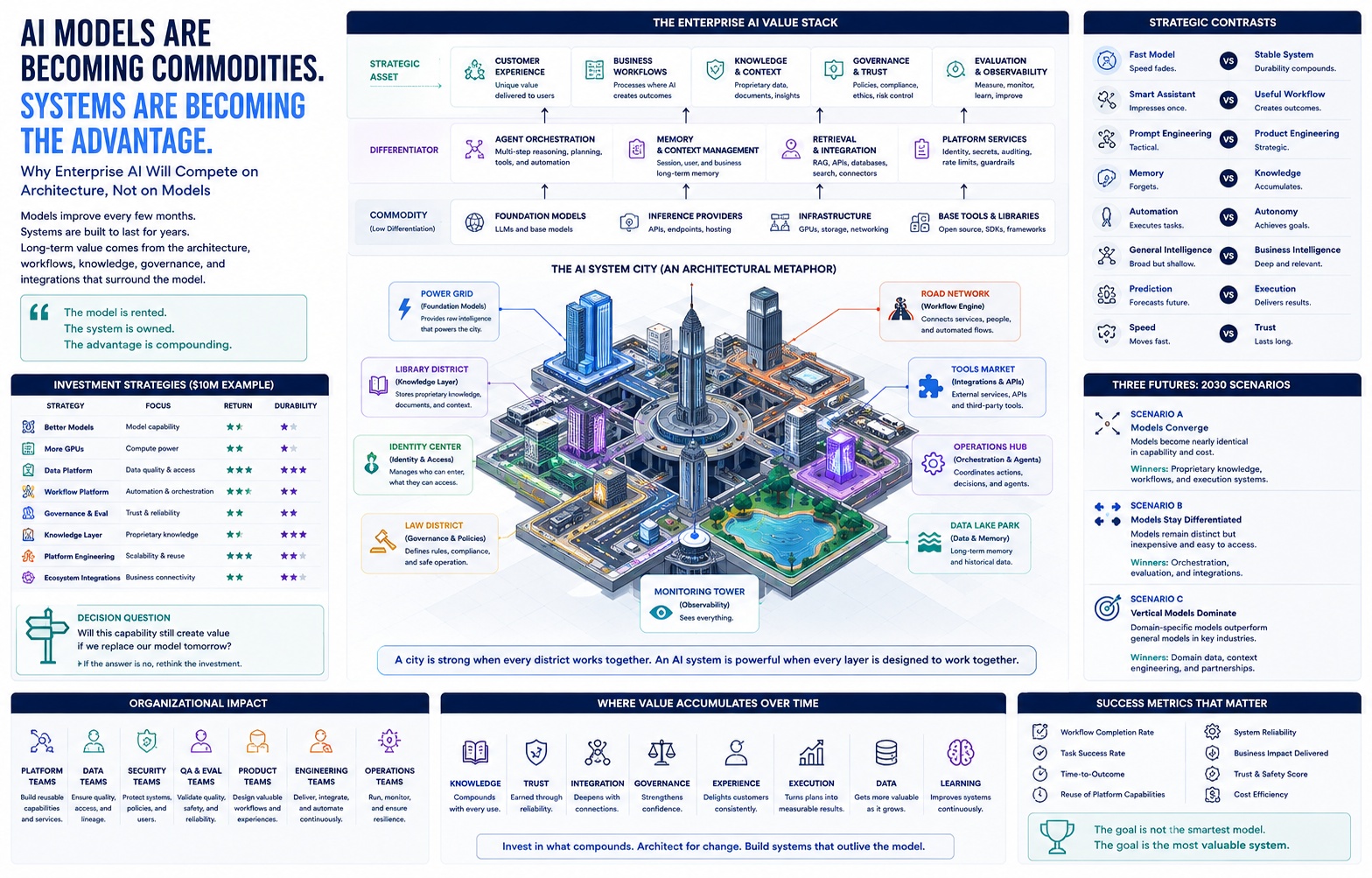
The Enterprise AI Value Stack
The layered pictures normally drawn of AI systems are pictures of data flow. This one is a picture of where value settles. Seven strata, from most substitutable to least:
| Stratum | What it is | Substitutability | Who can copy it |
|---|---|---|---|
| 1. Substrate | Compute, model weights, inference serving | Very high | Anyone with a budget |
| 2. Mediation | Gateway, routing, caching, prompt assembly, tool schemas | High | Anyone with an engineering team |
| 3. Context | Retrieval, knowledge curation, taxonomy, permissioning | Low | Only you, over years |
| 4. Judgment | Business rules, policy, thresholds, escalation logic, evaluation criteria | Very low | Only you |
| 5. Execution | Workflow, orchestration, write-paths into systems of record | Low | Only you, and it costs them years |
| 6. Accountability | Governance, audit, lineage, identity, controls | Low in regulated markets | Only you, and regulators must accept it |
| 7. Experience | The surface the customer or employee touches; earned trust | Lowest | Nobody, quickly |
The stack has a property worth stating explicitly: the strata are not equally expensive to build, and they are not equally expensive to lose. Strata 1 and 2 can be rebuilt in weeks. Strata 3 through 7 represent accumulated organizational time, and organizational time is the one input that cannot be purchased at any price.
Note also the direction of dependency. Everything above stratum 2 is coupled to the substrate only through the mediation layer — if you let that coupling leak, if business rules end up inside prompts and prompts end up bound to one vendor's quirks, you have converted your durable strata into disposable ones. Architectural discipline at stratum 2 is what protects the value of strata 3 through 7. This is the highest-leverage design decision in enterprise AI architecture, and it is almost always made implicitly, by an engineer, in a hurry, in the first month of the first pilot.
The System Advantage Matrix
A decision instrument for the question "should we build this, or rent it?" It has two axes:
- X-axis — External improvement rate. How fast is the market improving this capability on your behalf, for free, whether or not you invest?
- Y-axis — Organizational specificity. How much of this capability's value derives from facts true only of your firm?
| Low external improvement rate | High external improvement rate | |
|---|---|---|
| High specificity | GUARD IT — Proprietary knowledge, business policy, evaluation criteria, customer relationships. Invest heavily. Own it outright. Never outsource the definition, even if you outsource the plumbing. | WRAP IT — Fast-moving capability that must carry your specifics: retrieval, memory policy, agent orchestration. Own the policy; rent the mechanism. Design for replacement of the mechanism. |
| Low specificity | BUILD IT (grudgingly) — Integration into your legacy estate, bespoke connectors, internal platform glue. Nobody will build it for you. Minimize it. Standardize it. | RENT IT — Foundation models, inference, vector storage, base observability tooling. Buy on price and terms. Assume you will change suppliers. Do not fall in love. |
Two failure patterns are visible through this matrix and both are extremely common.
The first is treating a Guard It capability as a Rent It capability — outsourcing the definition of what a correct answer looks like to a vendor's default evaluation harness, or letting a third-party product own your knowledge taxonomy. This is the most expensive mistake in this paper. It converts your only durable asset into someone else's product surface.
The second is treating a Rent It capability as a Guard It capability — building bespoke inference infrastructure, training a general foundation model from scratch, or maintaining an in-house serving stack whose only distinction is that you wrote it. This burns capital on a capability the market is giving away faster than you can build it.
What this implies for the next three years
If the analysis holds, the competitive question for enterprise AI shifts from acquisition to architecture. Everyone will have the intelligence. Not everyone will have:
- knowledge that the intelligence can actually reach, correctly permissioned;
- workflows into which its output can actually flow;
- evaluation that says whether it was right;
- governance that lets it operate unsupervised;
- and users who trust it enough to stop double-checking.
Those five sentences are the enterprise AI strategy. The rest of this document is about how to build them.
III. TECHNOLOGY RADAR
An architecture review of the fourteen layers of an enterprise AI system. Each is classified as Commodity, Differentiator, or Strategic Asset.
The classifications are not judgments of importance. A commodity layer can be mission-critical — losing your inference provider stops the business. The classification answers a narrower question: does investing here create advantage a competitor cannot rapidly neutralize?
Definitions used throughout:
- Commodity — broadly available at similar quality and falling price. Invest to access it efficiently, not to own it. Optimize for substitutability and cost.
- Differentiator — the mechanism is available, but implementation quality varies enough to produce real, measurable performance gaps. Advantage is real but erodes if not maintained.
- Strategic Asset — value derives from accumulated, firm-specific investment. Compounds over time. Cannot be bought, only built. Protect it structurally.
1. Foundation Models — COMMODITY
The capability frontier moves too fast, diffuses too broadly, and prices too aggressively downward for the choice of base model to constitute durable advantage. Capability that was scarce and expensive in one generation becomes the free tier two generations later.
The correct posture is a portfolio, not a partnership: two or three providers qualified for production, routed per workload class, with an internal abstraction that makes the routing a configuration decision rather than a code change.
Where the nuance lives: frontier-class agentic and code-reasoning workloads still show genuine capability separation, and for those specific workloads a single-provider dependency may be temporarily rational. Make that dependency explicit, scoped, and reviewed quarterly rather than accidental and permanent.
The trap: letting "we standardized on one model" quietly become "our business logic is expressed in one vendor's idioms."
2. Inference Providers — COMMODITY
Serving is a utility function: tokens per second, dollars per million tokens, availability, region, and contract terms. It behaves like bandwidth.
Invest in the gateway, not the provider. A well-built internal model gateway — handling authentication, routing, rate limiting, cost attribution, caching, fallback, and request/response logging — is worth more than any provider relationship, because it is the thing that makes provider relationships disposable.
Underrated fact: the gateway is also your single best cost lever. Semantic caching, prompt compression, aggressive routing of commodity work to smaller models, and batch consolidation routinely reduce inference spend by half or more without any change in user-visible quality. That is a platform capability, not a model capability.
3. Prompt Layer — COMMODITY (declining rapidly)
Prompting was a differentiator when models were brittle. As models improve at instruction-following, the marginal return on prompt cleverness collapses. Techniques that produced large gains a generation ago produce noise today.
Prompts remain necessary. They are no longer strategic. What is worth investing in is not prompt craft but prompt infrastructure: versioning, templating, deterministic assembly from structured inputs, environment-specific overrides, and — critically — the discipline that business rules never live in prompt text.
The most common architectural error in enterprise AI: encoding policy in natural language inside a prompt. It is invisible to code review, untestable, unversioned in any meaningful sense, unauditable, and it silently changes behavior when the model changes. Policy belongs in code or in a rules engine, where it can be tested, reviewed, and shown to an auditor.
4. Retrieval — DIFFERENTIATOR
Split this layer in two and the classification becomes obvious.
The mechanism — embedding, indexing, vector search, hybrid lexical-semantic retrieval, reranking, chunking — is commodity and increasingly good out of the box. RAG architecture patterns are published, well understood, and available in every framework.
The retrieval strategy is where quality separates: how documents are decomposed, how permissions are enforced at query time rather than filter time, how freshness is guaranteed, how conflicting sources are resolved, how retrieval quality is measured independently of generation quality. Organizations that measure retrieval separately — recall at k, permission-correctness, staleness distribution — consistently outperform those that only measure end-to-end answer quality, because they can locate the actual defect.
The rule: in a badly performing RAG system, the model is almost never the problem. The retrieval is.
5. Knowledge Layer — STRATEGIC ASSET
The highest-value layer in the stack, and the most consistently underfunded.
This is not "the documents." It is the curated, deduplicated, permissioned, versioned, current, and authoritatively-owned representation of what your organization knows: policies, product truth, precedent decisions, resolved exceptions, customer history, institutional judgment that currently exists only in the heads of your most senior people.
No model arrives with it. No competitor can purchase it. It appreciates.
The Knowledge Compounding Model. The value of a knowledge layer over time behaves as a product of four factors, not a sum — meaning any one of them at zero collapses the whole:
K = Coverage × Fidelity × Freshness × Feedback
- Coverage — proportion of decision-relevant knowledge actually represented in a retrievable form.
- Fidelity — correctness, resolution of contradictions, clarity of authority (which source wins when two disagree).
- Freshness — the decay function. Some knowledge has a half-life of years; some has a half-life of hours. Most enterprises treat all of it as if it had the same half-life, which is why their systems confidently cite superseded policy.
- Feedback — whether usage closes the loop. Every corrected answer, every escalated case, every "this was wrong" is a labeled datum. Systems that capture and reincorporate these compound; systems that discard them plateau.
The multiplicative form is the point. A knowledge layer with excellent coverage, perfect fidelity, and no feedback loop is a static asset that degrades. One with a live feedback loop improves whether or not the model does — which is precisely why it is the layer that survives model change.
Budget signal: if your AI program spends more on inference than on knowledge curation, your strategy is inverted.
6. Business Logic — STRATEGIC ASSET
The encoded rules of how your organization actually decides: eligibility, pricing, risk tolerance, escalation thresholds, exception handling, regulatory constraints, the ten thousand small conditionals that constitute operating knowledge.
This is the purest expression of organizational specificity in the entire stack, and it must be architecturally quarantined from the model. Business logic that lives in code is testable, auditable, deterministic, and portable across every model generation. Business logic that lives inside a prompt or, worse, inside a fine-tune, is none of those things.
Design principle: the model proposes; the system decides. Let the model interpret, extract, draft, and rank. Let deterministic code authorize, apply, commit, and record. The boundary between those two sentences is where enterprise AI architecture succeeds or fails.
7. Workflow Engine — DIFFERENTIATOR
Orchestration mechanics — state machines, durable execution, retries, compensation, human-in-the-loop steps, idempotency, long-running process management — are well-solved and available as products. Buying is usually correct.
The differentiation is in which workflows you have encoded and how deeply they reach into the business. A competitor can license the same engine tomorrow. They cannot license three years of encoded, corrected, exception-handled process knowledge.
The Workflow Capital Framework. Treat encoded workflows as capital assets with the properties capital assets have:
- Acquisition cost — engineering time plus, usually larger, the cost of extracting tacit process knowledge from the people who hold it.
- Yield — hours reclaimed, cycle time reduced, error rate reduced, revenue accelerated. Measured, not asserted.
- Depreciation — process drift. Workflows decay as the business changes around them. An unmaintained workflow silently becomes a source of error.
- Maintenance cost — typically fifteen to twenty-five percent of build cost annually. Almost never budgeted, which is why year-two AI programs feel like they are running to stand still.
- Salvage value — what survives when the underlying model, or the engine, is replaced. High if the process definition is declarative and model-agnostic. Near zero if the process lives inside an agent's prompt.
Portfolio implication: an organization with forty workflows and no maintenance budget is worse off than one with twelve well-maintained ones, because unmaintained automation produces confident wrong answers at scale.
8. Agent Orchestration — DIFFERENTIATOR
Currently the most over-invested and least well-understood layer in enterprise AI.
The frameworks are commodity and multiplying. What is genuinely difficult — and therefore differentiating — is the operational envelope: what an agent is permitted to do, under whose identity, with what budget of time and money and tool calls, with what checkpoints, with what rollback, and with what evidence trail. Agent capability is a model property. Agent containment is an architecture property, and it is the one that determines whether you can ship.
A useful discipline is to specify every autonomous capability in terms of blast radius before behavior: define the maximum damage the agent can do before defining what it should do. Teams that do this ship autonomy into production. Teams that do the reverse ship demos.
Forecast: multi-agent architectures are currently absorbing effort disproportionate to their delivered value in most enterprises. A single well-instrumented agent with excellent tools, tight scope, and clean evaluation outperforms an elaborate agent society in nearly every enterprise setting observed today. Complexity here should be earned, not assumed.
9. Memory — DIFFERENTIATOR (with a strategic core)
Split it, as with retrieval.
The storage and recall mechanism is commodity. The memory policy is not: what is remembered, for how long, under what consent, visible to whom, forgettable on what request, and how memory interacts with permissions when the person who shared something leaves the organization.
The strategic question — and it deserves an explicit architectural decision rather than a default — is where memory lives. If conversational and behavioral memory accumulates inside a model vendor's product, you have handed a compounding asset to a supplier and simultaneously created the strongest form of lock-in available: not technical, but experiential. Users will refuse to migrate away from a system that knows them, regardless of what the architecture allows.
Position: memory is platform state, not model state. Own the store. Own the schema. Own the retention policy. Rent only the recall.
10. Governance — STRATEGIC ASSET in regulated industries; DIFFERENTIATOR elsewhere
Governance is routinely mis-modeled as a cost center that slows delivery. In practice, mature governance is the mechanism that permits delivery — specifically, it is what allows an organization to remove the human reviewer, which is where nearly all of the economic value of enterprise AI is actually located.
Consider the arithmetic. An AI capability with a human checking every output delivers a modest productivity gain. The same capability with a risk-tiered control framework, documented lineage, tested failure modes, and audit evidence sufficient to satisfy a regulator delivers a step change, because it can run unattended. The difference between those two states is governance, not intelligence.
In regulated sectors, an approved control framework for AI decisioning is a genuine moat: expensive, slow, relationship-dependent, and non-transferable.
11. Identity — COMMODITY (protocol) / DIFFERENTIATOR (AI-specific authorization)
Authentication, federation, and directory services are solved commodity infrastructure. Do not build them.
The unsolved and differentiating problem is authorization under delegation: when an autonomous process acts on behalf of a user, whose permissions apply? The user's, at the moment of the request? The service account's? Both, intersected? What happens on a long-running job when the user's entitlements are revoked mid-execution? How is the delegation chain recorded so that an auditor can reconstruct who authorized what?
Most enterprises have no coherent answer, and the gap becomes acute precisely when agentic systems begin taking write actions. Organizations that solve delegated authorization cleanly will deploy autonomy years earlier than those that do not — not because their models are better, but because their security review can conclude.
12. Evaluation — STRATEGIC ASSET
The most undervalued layer in enterprise AI, and the one this paper would fund first.
An evaluation suite is a machine-readable encoding of your organization's definition of correctness. Building one forces the business to answer questions it has often never formalized: what does a good answer look like, what errors are tolerable, what errors are catastrophic, who adjudicates disagreement.
Evaluation delivers four distinct forms of value:
- Quality control — the obvious one.
- Regression protection — behavior does not silently drift when anything changes.
- Substitution enablement — this is the strategic one. Model substitutability is a function of evaluation coverage. Without an evaluation suite, changing providers is an act of faith and therefore never happens. With one, it is an afternoon's benchmark run. Your evaluation suite is what makes the foundation model a commodity to you specifically.
- Compounding institutional memory — every production failure, converted into a test case, becomes permanent organizational knowledge that no personnel change can erase.
That third point deserves emphasis, because it reverses the usual intuition. Commoditization is not something the market does to you; it is something you achieve, by building the harness that lets you treat suppliers as interchangeable. Firms without evaluation are captive to whichever vendor they started with, regardless of what the market offers.
13. Observability — DIFFERENTIATOR
Traditional observability — latency, errors, throughput, cost — is commodity tooling. AI observability is not, because the interesting questions are semantic rather than operational: what did the system actually retrieve, what did it decide, why, and was that decision consistent with the last thousand like it?
The capabilities that separate mature programs: end-to-end trace linking user request → retrieved context → model call → tool invocation → business outcome; cost attribution per feature and per customer; drift detection on output distributions, not just on error rates; and the ability to reconstruct any historical decision exactly, including the corpus state at that moment.
That last capability — temporal reconstruction — is rare and disproportionately valuable. When a decision is challenged eighteen months later, "we can show you exactly what the system knew and did on that date" is the difference between a finding and a footnote.
14. Customer Experience — STRATEGIC ASSET
The surface where AI meets a human, and the place where trust is either earned or destroyed.
The Trust Accumulation Curve describes the governing dynamic, and it is deeply asymmetric:
- Trust accrues slowly and linearly with consistent correct behavior.
- Trust collapses instantly and non-linearly on a confident, visible error — particularly one the user was not equipped to detect.
- Recovery is slower than the original accumulation, because users add verification behavior that never fully goes away.
The strategic consequence is counterintuitive and worth stating for executives: a slightly less capable system that is calibrated about its uncertainty will outperform a more capable system that is confidently wrong occasionally. Adoption — not capability — is the binding constraint on realized AI value, and adoption is gated by trust. This is why interface design decisions such as showing sources, exposing confidence, making the escape hatch to a human obvious, and designing graceful degradation are not cosmetic. They are the highest-leverage reliability engineering available.
Radar summary
| Layer | Classification | Investment posture |
|---|---|---|
| Foundation Models | Commodity | Portfolio. Route by workload. Never single-source by accident. |
| Inference Providers | Commodity | Buy on price and terms. Invest in the gateway. |
| Prompt Layer | Commodity (declining) | Versioning and assembly infrastructure only. No policy in prompts. |
| Retrieval | Differentiator | Buy the mechanism. Own the strategy. Measure it separately. |
| Knowledge Layer | Strategic Asset | Fund permanently. Staff it. Measure decay. |
| Business Logic | Strategic Asset | Keep in code. Quarantine from the model. |
| Workflow Engine | Differentiator | Buy the engine. Own the encoded processes. Budget maintenance. |
| Agent Orchestration | Differentiator | Invest in containment, not capability. Earn complexity. |
| Memory | Differentiator (strategic core) | Own the store and the policy. Rent the recall. |
| Governance | Strategic Asset (regulated) | Fund as an enabler of unattended operation. |
| Identity | Commodity / Differentiator | Buy auth. Build delegated authorization. |
| Evaluation | Strategic Asset | Fund first. It is what makes models commodities. |
| Observability | Differentiator | Invest in semantic tracing and temporal reconstruction. |
| Customer Experience | Strategic Asset | Design for calibration and trust, not for capability display. |
Read the right-hand column as a whole and a pattern emerges: buy the mechanisms, own the meanings. Nearly every "own" in this table refers to something that encodes a judgment only your organization can make.
IV. INVESTMENT WORKSHOP
Scenario: a $10 million AI budget over twenty-four months. Five strategies, argued honestly. Then a recommendation.
Ground rules for this workshop. The budget is fully loaded — people, licenses, infrastructure, and change management, not just software. Returns are assessed on a five-year horizon, because that is the realistic lifespan of an enterprise platform decision. Each strategy is presented as its strongest advocate would present it, then stress-tested.
Strategy 1 — The Frontier Bet
Thesis: capability is the constraint. Buy the best available intelligence, adapt it to our domain, and let raw model quality carry the program.
Where the money goes
- $4.0M — premium inference at frontier tier, at scale
- $2.5M — fine-tuning, domain adaptation, continued pretraining experiments
- $2.0M — ML engineering and research talent
- $1.0M — dedicated or reserved capacity
- $0.5M — light application layer
Expected return. Fastest demonstrable capability. Genuinely superior performance on the hardest tasks — complex reasoning, long-horizon code work, novel synthesis. If your differentiated use case genuinely sits at the frontier, this is not a foolish allocation; it is the only one that works.
Long-term durability. Low. Fine-tunes are perishable: the base model advances, and the adapted variant must be rebuilt, often from scratch, sometimes on a schedule you do not control. A meaningful fraction of this spend has to be repeated every twelve to eighteen months just to stay level.
Competitive advantage. Weak and temporary. Whatever capability you purchase, your competitor can purchase within a quarter. You are renting an advantage that is available to everyone at the same counter.
Hidden risks
- Deep provider dependency, arriving quietly through idiosyncratic prompt formats, vendor-specific tool schemas, and fine-tunes that cannot be ported.
- The integration tax lands later and unbudgeted. Capability without write-paths into systems of record produces impressive demos and no measured value.
- Talent concentration risk in a market where this specific skill set is mobile.
- The commodity trap: paying frontier prices for workloads a mid-tier model handles indistinguishably. In most enterprise portfolios this describes eighty percent of volume.
Verdict: correct for a small number of genuinely frontier workloads. Ruinous as a whole-portfolio strategy.
Strategy 2 — The Data Foundation
Thesis: models are interchangeable; the context you can feed them is not. Fix the data estate and every future AI capability improves at once.
Where the money goes
- $3.0M — data platform modernization, pipelines, quality tooling
- $2.5M — knowledge curation: taxonomy, ontology, deduplication, authority resolution, permissioning
- $2.0M — retrieval infrastructure and the engineering around it
- $1.5M — data governance, lineage, classification
- $1.0M — domain experts embedded to encode institutional knowledge
Expected return. Slow at first, then broad. Nothing ships in the first quarter. By month twelve, every subsequent use case becomes dramatically cheaper because the hard part — reaching correct, current, permissioned information — is already solved.
Long-term durability. Very high. This is the Guard It quadrant. A curated knowledge layer is model-agnostic by construction and appreciates through the Knowledge Compounding Model.
Competitive advantage. Strong and durable. A competitor with a better model and worse context will produce worse answers. This is the most reliable inversion in enterprise AI.
Hidden risks
- The boil-the-ocean failure. Data platform programs have a well-documented tendency to become permanent. Mitigate by scoping curation to the corpora that specific committed use cases actually require.
- Political cost. Resolving authority — deciding which of four conflicting sources is canonical — is an organizational fight, not a technical one, and it is usually the real bottleneck.
- Executive patience risk. Two quarters of invisible progress is where AI programs get cancelled.
- Freshness debt. A curated corpus that is not maintained becomes a high-confidence source of obsolete truth, which is worse than no corpus at all.
Verdict: the highest-durability allocation available. Requires political cover to survive its own timeline.
Strategy 3 — The Workflow Portfolio
Thesis: value is realized only where work actually changes. Pick the ten highest-value processes and automate them end to end, into the systems of record.
Where the money goes
- $3.5M — workflow engineering across ten to fifteen processes
- $2.0M — integration into ERP, CRM, ticketing, core systems (the real cost, and it is always underestimated)
- $1.5M — process discovery and re-design
- $1.5M — change management, training, adoption
- $1.0M — workflow orchestration platform
- $0.5M — measurement and instrumentation
Expected return. The highest measurable near-term ROI of any strategy here, and the most legible to a CFO. Cycle time, error rate, and cost per transaction move on a schedule an executive can see.
Long-term durability. Moderate to high, conditional on maintenance. Encoded workflows are genuine capital, but they depreciate through process drift, and the depreciation is invisible until something breaks publicly.
Competitive advantage. Strong. Deep process encoding is slow to replicate — not because it is technically hard, but because extracting tacit process knowledge takes years of organizational effort.
Hidden risks
- The maintenance cliff. Fifteen workflows built with no maintenance budget become fifteen liabilities in year three.
- Automating a bad process. Encoding dysfunction permanently, at speed, with a technology budget attached.
- Point-solution sprawl. Fifteen workflows with fifteen bespoke integrations, no shared identity model, no shared observability, no shared evaluation. This is the most common shape of enterprise AI failure at the two-year mark: real value delivered, and an unmaintainable estate delivered alongside it.
- Adoption risk. Technically complete workflows that people route around.
Verdict: excellent returns, on the condition that shared platform concerns are extracted rather than duplicated fifteen times.
Strategy 4 — The Trust Infrastructure
Thesis: we cannot scale what we cannot verify or explain. Build evaluation, observability, and governance first, then everything else can move fast safely.
Where the money goes
- $2.5M — evaluation platform, harnesses, business-defined test suites, human review tooling
- $2.5M — AI observability: semantic tracing, cost attribution, drift detection, temporal reconstruction
- $2.0M — governance framework, risk tiering, control design, audit tooling
- $1.5M — security: delegated authorization, data protection, red-teaming
- $1.5M — compliance engineering and regulator engagement
Expected return. Nothing visible in the first two quarters, and then a discontinuity: capabilities that were stuck in review for months begin shipping in weeks, and — decisively — capabilities that required a human reviewer can run unattended. That transition is where the economics of enterprise AI actually change.
Long-term durability. Very high. Evaluation suites, control frameworks, and regulatory relationships are cumulative and non-transferable.
Competitive advantage. Underrated and substantial, particularly in regulated markets. The firm that can put an AI decision into unattended production with regulator acceptance is operating in a different cost structure from the firm that cannot.
Hidden risks
- Governance theatre. Committees, policies, and documentation that impose cost without enabling anything. The test is simple and should be applied ruthlessly: does this control let us ship something we otherwise could not? If no, delete it.
- Building evaluation without business input, producing a suite that measures model fluency rather than business correctness. Evaluation criteria must be authored by the people accountable for the outcome.
- Zero visible output for two quarters, with the same political risk as Strategy 2.
Verdict: the enabling layer. Chronically underfunded because its return appears in other strategies' numbers.
Strategy 5 — The Platform Play
Thesis: the real cost is repetition. Build an internal AI platform so every team starts at the eightieth percentile instead of at zero.
Where the money goes
- $3.0M — platform engineering team (the core investment; this is a standing capability, not a project)
- $2.0M — model gateway, routing, abstraction, caching, cost controls
- $1.5M — shared retrieval, memory, and context services
- $1.5M — golden paths, SDKs, templates, self-service tooling
- $1.0M — shared evaluation and observability integration
- $1.0M — developer experience and internal enablement
Expected return. Low in the first two quarters. Then superlinear: the fifth use case costs a fraction of the first, and the fifteenth costs a fraction of the fifth. Marginal cost per capability falls continuously, which is the only mechanism by which an AI program reaches scale without a proportional headcount increase.
Long-term durability. Very high. The platform is the substitutability mechanism. It is what turns "we should evaluate a different provider" from a six-month program into a configuration change.
Competitive advantage. Indirect but compounding. Platform advantage shows up as velocity — shipping four times as many AI capabilities per engineer-year at lower unit cost and higher reliability.
Hidden risks
- Platform without customers. Building infrastructure ahead of demand, elegantly solving problems no team has. The discipline is to extract the platform from the second and third use case, never to speculate it into existence before the first.
- Abstraction that leaks or over-abstracts. An abstraction that hides genuinely useful model-specific capability gets bypassed, and then you have a platform nobody uses and a shadow estate you cannot see.
- Golden paths that become cages, driving teams underground.
- Cost accounting invisibility — platform teams are expensive and their return appears on other teams' ledgers, making them perennially vulnerable at budget time.
Verdict: the highest-leverage allocation for any organization intending to run more than a handful of AI use cases.
The workshop's recommendation
None of the five in isolation. The pure strategies fail in characteristic ways: Strategy 1 buys a depreciating asset; Strategies 2 and 4 risk cancellation before returning anything; Strategy 3 delivers value and technical debt in equal measure; Strategy 5 risks building for nobody.
A defensible blend across twenty-four months:
| Allocation | Amount | Rationale |
|---|---|---|
| Knowledge & data foundation | $2.5M | The compounding asset. Scoped to committed use cases, not boiled oceans. |
| Workflow portfolio (6–8 processes) | $2.5M | Funds the credibility that protects everything else. Fewer, deeper, maintained. |
| Platform & gateway | $2.0M | Extracted from use cases two and three, not built speculatively. |
| Evaluation, observability, governance | $2.0M | Non-negotiable. Started in month one, not bolted on in year two. |
| Model access & frontier experimentation | $1.0M | Deliberately the smallest line. Portfolio-based. Frontier tier reserved for genuinely frontier workloads. |
Three sequencing rules matter more than the percentages:
- Evaluation starts in month one, even at small scale, because it is the instrument that makes every later decision empirical rather than rhetorical.
- Ship two workflows in the first two quarters — not for their own value, but to buy the political runway that the foundational investments require to survive.
- Extract the platform, never speculate it. The second use case reveals what should be shared. The first only reveals what is possible.
Note what the recommendation implies. Ten percent of the budget goes to models. Ninety percent goes to the system around them. If that ratio feels wrong, the question worth asking is: which part of this budget will still be producing value after the model changes?
V. ENGINEERING ROUNDTABLE
An imagined discussion. Six executives, six positions, no winner. The purpose is to expose trade-offs that org charts usually hide.
Present: CTO · Chief Product Officer · AI Architect · Security Lead · Engineering Manager · CEO
CEO: I want to open with the question I actually get asked by the board. We've spent eighteen months on AI. What do we own now that we didn't own before? Not what we've deployed — what we own.
CTO: Honestly? Mostly a platform. A gateway, a shared retrieval service, an evaluation harness, and three golden paths. If we lost every model provider tomorrow we'd be down for about a week and back with a different one.
CPO: That's a fine answer for you. It's not an answer for a customer. Customers don't experience your gateway. They experience whether the thing helps them, and eighteen months in, our adoption in the field is forty percent. The system is available. It is not used.
CTO: Adoption is downstream of reliability.
CPO: Adoption is downstream of usefulness, and those are different. Our summarization is excellent and nobody wanted summarization. What they wanted was for the case to close. We built an assistant when we should have built a workflow.
AI Architect: I'd push on both of you. The reason adoption is forty percent isn't the interface and it isn't the platform. It's that we can't tell anyone how often it's right. When a regional director asks "should I trust this," we say "generally." That word is why we're at forty percent. Until we have evaluation with business-defined criteria, every deployment decision is a matter of opinion, and opinions lose to caution.
Security Lead: And every deployment decision that goes through my team is also a matter of opinion, which is why I say no. I'm not obstructing. I genuinely cannot answer the question the regulator will ask. When the agent updated that customer record last month, under whose authority did it act? Our audit log says "service account." That's not an answer, it's an absence of one. Solve delegated authorization and I'll approve autonomy in half the time.
CEO: So the architect wants evaluation, security wants identity, product wants workflows, and the CTO wants a platform. Is anyone going to defend the models?
Engineering Manager: Not me. I'll tell you what actually consumes my team. Three weeks ago the provider changed a default and our extraction accuracy dropped four points. Nobody told us. We found out because a customer complained, eleven days later. Eleven days of degraded output going into a system of record. The model wasn't the problem — the blindness was. I don't need a smarter model. I need to know within an hour when behavior changes, and I need to be able to reconstruct exactly what the system saw when it made a decision six months ago.
AI Architect: Which is the same argument I'm making. Evaluation catches it before release, observability catches it in production. Two halves of one instrument.
Engineering Manager: Agreed, except that yours is a pre-deployment instrument and mine is a live one, and every time budget gets cut, mine goes first because it's the one that isn't blocking a launch.
CTO: This is exactly why I fund the platform. Every one of these is a cross-cutting concern. If each product team solves evaluation, identity, and observability on its own, we get eight incompatible half-solutions and eight teams that hate their jobs. Solve it once.
CPO: And meanwhile ship nothing for three quarters.
CTO: I've never proposed shipping nothing.
CPO: You've proposed sequencing that produces nothing customers can feel until Q4. I'm not being unfair — I'm telling you what the funding environment looks like. If we can't show realized value in two quarters, there is no year three to build a platform for. Credibility is a prerequisite for infrastructure, not a reward for it.
CEO: That's the sharpest thing anyone has said. Go on.
CPO: The sequencing is the whole argument. I'd take a slightly worse architecture that produces two visible wins in six months over a beautiful one that produces its first win in fifteen. Not because architecture doesn't matter — because unfunded architecture doesn't exist.
Security Lead: I'll accept that on one condition. Whatever we ship fast, ship it in a category where the blast radius is bounded. Read-only, or human-approved writes. Speed and containment aren't in tension if you choose the right first workflows.
AI Architect: And ship it with evaluation attached, even a thin one. Twenty test cases the business wrote. It costs a week and it means the second version is an engineering exercise instead of an argument.
CEO: Let me ask the question differently. If I could fund exactly one of your positions completely and the others not at all — what breaks?
CTO: Fund only the platform: we build excellent infrastructure for use cases that never materialize, and we get cancelled in year two for having no P&L impact.
CPO: Fund only workflows: we get eight successful automations and an estate nobody can maintain, secure, or evaluate. Year three is spent rebuilding all eight.
AI Architect: Fund only evaluation: we become extremely good at measuring things we haven't built.
Security Lead: Fund only security: nothing ships, but nothing goes wrong. I'd note that's how a lot of enterprises quietly are right now, and it isn't safe — it's just risk deferred into shadow adoption. People are using unapproved tools. That's a worse control posture than a governed system.
Engineering Manager: Fund only observability: perfect visibility into a system that isn't doing anything valuable.
CEO: So each of you is describing a necessary condition and none of you is describing a sufficient one.
AI Architect: That's the structure of the problem. These aren't competing investments. They're a system with multiplicative returns, and the binding constraint moves. Right now the constraint is trust — we can't prove correctness, so we can't remove the reviewer, so the economics don't work. Six months after we fix that, the constraint will be workflow coverage. Six months later it'll be knowledge freshness. Anyone claiming a permanent answer to "which layer matters most" is describing the constraint on the day they last looked.
CTO: Which is an argument for the platform, actually. The platform is how you change what you're investing in without rebuilding.
CPO: It's an argument for the platform emerging from delivery rather than preceding it.
CTO: I can live with that framing.
CEO: Here's my summary, and then we're done. Nobody at this table argued for a model. Six of you, and the thing the market talks about didn't come up except as a source of unannounced regressions. I'll take that as the answer to my opening question.
What we own is: the knowledge, the workflows, the evaluation, the controls, and the ability to change suppliers. What we rent is intelligence.
Security Lead: And what we don't yet own is the answer to "who authorized this."
CEO: Then that's the first line in the next budget.
What the roundtable exposes. Four trade-offs that no framework resolves and every organization must choose deliberately:
- Delivery speed vs. structural integrity. Both positions are correct. The synthesis is bounded-blast-radius delivery with thin evaluation attached — fast and recoverable.
- Centralization vs. autonomy. Platforms create leverage and bottlenecks simultaneously. The resolution is golden paths that are genuinely easier than the alternative, plus a legitimate, visible off-ramp for teams with real reasons to deviate.
- Capability vs. containment. Security's "no" is usually an information problem, not a risk appetite problem. Delegated authorization converts a permanent no into a conditional yes.
- Pre-deployment vs. live assurance. Evaluation and observability are consistently traded against each other under budget pressure and are not substitutes. One prevents shipping defects; the other detects supplier-induced drift you did not cause and were not told about.
VI. ARCHITECTURE BLUEPRINT — THE AI SYSTEM AS A CITY
Diagrams flatten. Cities have the property enterprise architecture actually needs: districts that fail independently, infrastructure that outlives its builders, and citizens who route around bad planning.
An enterprise AI ecosystem is not a pipeline. It is a settlement, and it should be planned like one.
The Power Grid — Foundation Models
Power is what makes the city possible and nobody builds their business around a particular generating station.
Cities buy power from multiple suppliers on standardized voltage, because a single-source grid is a single point of civic failure. They meter it, because unmetered utility consumption is where budgets die quietly. They do not embed the characteristics of one generator into the wiring of every building — a city where appliances only work with one supplier's current is a city that cannot change supplier.
The district's discipline: standardize the interface, meter every draw, contract with more than one supplier, and never let a building's design depend on which station is running today. Some districts — the hospital, the data center — need premium reliability and pay for it. The residential district does not, and paying premium rates for residential load is the single most common waste in this city.
What goes wrong: buildings wired to one supplier's specification. It is invisible for years, and then the supplier raises rates or changes voltage and the cost of migration exceeds the cost of the buildings.
The Library — Knowledge Layer
Every city has information. Few have a library.
The distinction is curation. A library has a catalogue, so material can be found. It has acquisition and deaccession policies, so it stays current — a library that never removes anything becomes a warehouse. It has authority: when two sources conflict, a librarian decides which is canonical, and that decision is recorded. It has restricted sections with enforced access.
Note the roles a library requires that a warehouse does not: librarians. Enterprises consistently fund the building and not the staff, and then wonder why the collection degrades. Knowledge curation is a standing profession inside an AI-enabled organization, not a project phase.
What goes wrong: the library that keeps superseded editions on the open shelves. Citizens cite them with complete confidence. The failure is not visible until someone acts on a repealed regulation.
The Passport Office — Identity
Nothing happens in a functioning city without an answer to who are you, and on whose behalf are you acting?
Ordinary identity is well-solved — everyone has papers. The hard case is delegated authority: an agent acting for a citizen. A city handles this with an instrument that records the grantor, the grantee, the specific powers, the expiry, and the revocation path. An enterprise AI ecosystem needs exactly this, and most have nothing equivalent — their agents carry a generic municipal badge that opens every door, which is why the city's inspectors will not let them into the important buildings.
What goes wrong: an autonomous courier with a master key and no record of who issued it. Everything works until something doesn't, and then no one can reconstruct who was responsible.
The Roads — Workflow Engine
Roads are unglamorous, and they determine the city's economy. A district with brilliant industry and no road to the port is a district with inventory.
Roads must connect to existing infrastructure — the port, the rail yard, the old town. The expensive part of any road program is never the new pavement; it is the junctions with what was already there. In AI terms: integration into the ERP, the CRM, the core ledger, the forty-year-old mainframe that authoritatively knows what a customer owes. This is where workflow budgets are actually consumed, and it is where they are always underestimated.
Roads also require maintenance, and maintenance has no ribbon-cutting. Cities that build roads and do not resurface them end up with an expensive network that everyone avoids.
What goes wrong: the beautiful road that ends at a field. An AI capability that produces excellent output with no committed write-path into a system of record has produced a document, not an outcome.
The Traffic Cameras — Observability
Cameras answer three questions: what is happening now, what happened then, and what is changing.
The third is the one that matters most and is instrumented least. A city that can see current congestion but cannot see that journey times have crept up eleven percent over six weeks is a city that will discover its problem through complaints. Model behavior drifts. Corpora go stale. Costs migrate. None of these announce themselves.
The camera network must also support temporal reconstruction — showing not just that a vehicle passed, but what the junction looked like at that moment. When a decision is challenged eighteen months later, the ability to reproduce the exact context is the difference between an explanation and an apology.
What goes wrong: cameras pointed at the intersections that were problematic when the network was installed, and nowhere near the ones that matter now.
The Laws — Governance
Laws are the district that everyone resents and no city functions without.
Good law is enabling: it defines what may be done without asking permission, which is how a city achieves velocity. Bad law requires a permit for everything, which does not stop activity — it moves activity somewhere unobserved. Every enterprise with a restrictive AI policy and no approved platform has a thriving unofficial district, and it has less control than an enterprise with permissive, well-instrumented rules.
Law is also tiered. A city does not apply nuclear-facility standards to a lemonade stand. Risk-tiered AI governance — light-touch for low-consequence internal drafting, heavy for customer-affecting automated decisions — is the difference between a functioning legal system and a paralyzed one.
What goes wrong: laws written by people who have never walked the district, enforced through documentation nobody reads, producing compliance on paper and improvisation in practice.
The districts the metaphor's usual version omits
The Water Treatment Plant — Data Quality. Upstream of everything, invisible when working, catastrophic when not. Contamination propagates silently through every district. Nobody notices the plant until people get sick, and by then the contaminated water is already in ten thousand homes — or ten thousand cached retrievals.
Zoning — Architectural Standards. Rules about what may be built where, and how it must connect. Zoning is unpopular because it constrains individual builders and valuable because it prevents the city from becoming unnavigable. The AI equivalent: a standard for how business logic is separated from prompts, how services expose themselves, how state is owned. Cities without zoning grow fast and become impossible to change.
The Land Registry — Memory and State. The authoritative record of what belongs to whom, what was agreed, and what has changed. If the registry is held by a single private party, that party owns the city's economy regardless of who owns the buildings. Memory belongs to the municipality, not to the utility.
The Schools — Evaluation. Where standards are defined, taught, and examined. A school defines what competence means, and the definition is the city's own — it cannot be imported from a different city with different needs. Examinations are how the city knows whether a new supplier's product is acceptable before it is installed everywhere.
The Hospitals — Incident Response. For when things go wrong, which they will. Triage, treatment, and the discipline of learning from every case. A city without a hospital is not a safe city; it is a lucky one.
The Postal Service — Integration and Messaging. Reliable delivery, tracked, retried, with dead-letter handling. Unglamorous, and everything depends on it.
The Market Square — Customer Experience. Where citizens actually meet the city's output. All the infrastructure exists to make this square work. A city with immaculate utilities and an unpleasant market square has misallocated everything.
Why the metaphor earns its keep
Three structural insights that pipeline diagrams cannot express:
Districts fail independently, and should. A well-planned city localizes failure: the library going offline degrades answers but does not stop the roads. Pipeline architectures propagate failure end to end. Design each district to fail into a known reduced mode, not into an outage.
Infrastructure outlives its builders and its suppliers. Roads laid a century ago still carry traffic from vehicles nobody imagined. This is exactly the property enterprise AI architecture needs: build the roads so that whatever engine arrives can drive on them. The buildings will be replaced. The street grid will not.
Citizens route around bad planning. If the official road is slow, people take the informal path. Every governance framework, platform, and golden path is subject to this. Adoption is the real test of architecture, and it is a revealed preference, not a stated one. If your teams are bypassing the platform, the platform is wrong — not the teams.
VII. STRATEGIC CONTRASTS
Paired comparisons. Each explores an engineering trade-off rather than declaring a winner.
Fast Model vs. Stable System
A faster model reduces latency in one dimension. A stable system reduces variance across all of them, and enterprise users calibrate their trust on variance, not on averages.
The engineering implication is that a system's perceived quality is set by its worst common case, not its typical one. A capability that responds in one second ninety-five percent of the time and hangs for ninety seconds in the remainder will be described by users as "slow" and, more damagingly, as "unreliable" — a word that transfers to every other AI capability you ship.
The design responses are systems responses, not model responses: timeouts with meaningful partial results, graceful degradation to a smaller model or a cached answer, circuit breakers, and — the most underused technique in enterprise AI — deliberate latency. A system that always takes three seconds and always works feels better than one that usually takes one and occasionally fails.
The tension: stability is bought with redundancy and fallbacks, which add complexity and cost. The resolution is per-workload: interactive drafting can be fast and occasionally imperfect; a nightly reconciliation job must be slow and certain.
Smart Assistant vs. Useful Workflow
An assistant answers. A workflow completes.
The distinction is architectural. An assistant needs a model, context, and an interface. A workflow needs all of that plus state, idempotency, error compensation, permissions, audit, escalation, and a committed write-path into a system of record. The second is roughly five times the engineering effort and roughly twenty times the realized value, because it removes work rather than assisting with it.
Assistants also have a measurement problem: their value is self-reported. "It saves me time" is not a metric that survives a CFO. Workflows produce cycle time, error rate, and cost per transaction — numbers that appear in operational reporting whether or not anyone believes in AI.
The tension: assistants are cheap, fast to build, and genuinely useful for open-ended knowledge work that cannot be proceduralized. The mistake is not building assistants; it is building only assistants and reporting them as transformation.
Prompt Engineering vs. Product Engineering
Prompt engineering optimizes what one model does with one instruction. Product engineering asks what happens on the fourth retry, when the source document is a scanned fax, when two users edit simultaneously, when the vendor deprecates an endpoint, and when a regulator asks for the record.
The economic shape differs sharply. Prompt improvement shows steep early gains and rapid saturation, and much of it is silently obsoleted by the next model release. Product engineering compounds and is model-independent.
The tension: prompt work is fast, visible, and satisfying, which makes it an attractive place for teams to spend time that should be spent on retrieval quality, evaluation, and integration. A useful diagnostic: if a team has iterated a prompt more than five times without measuring a corresponding change in evaluation scores, they are not engineering. They are decorating.
Memory vs. Knowledge
Memory is what happened. Knowledge is what is true. Conflating them is a common and costly architectural error.
Memory is personal, episodic, high-volume, low-authority, and privacy-laden. Knowledge is shared, semantic, curated, authoritative, and governed. They have different retention policies, different permission models, different correctness criteria, and different failure modes. Memory that is wrong is an inconvenience; knowledge that is wrong is a liability.
The error that follows from conflating them: user statements accumulating into the knowledge base. Someone mentions a discount policy in passing; six weeks later the system cites it as policy to a different customer. Memory must never be silently promoted to knowledge — promotion requires an explicit, governed, human-accountable step.
The tension: users experience the boundary as friction ("I already told you that"). The resolution is to make memory work well within its scope while keeping the promotion path explicit.
Automation vs. Autonomy
Automation executes a defined process. Autonomy decides what process to execute.
The engineering distance between these is far larger than the linguistic distance. Automation's failure modes are enumerable, which means they can be tested, monitored, and handled. Autonomy's failure modes are emergent — the interesting ones are combinations of individually reasonable decisions, and they cannot be enumerated in advance.
This changes the entire assurance approach. Automation is verified by testing paths. Autonomy is contained by bounding consequences: budgets on time, cost, and tool calls; irreversibility gates that force human approval before any action that cannot be undone; and complete decision-trail capture so the reasoning can be reconstructed even when it cannot be predicted.
The tension: autonomy's value scales with the breadth of its permissions, and so does its risk, in the same direction, at the same time. Expand the envelope empirically — measure decision quality in a bounded scope, then widen.
General Intelligence vs. Business Intelligence
A frontier model brings enormous general competence and zero knowledge of your business. It does not know that "active customer" means something specific in your data model, that a particular product line has a bespoke approval path, or that a form of language is prohibited in your jurisdiction.
The Business Intelligence Layers — four strata of firm-specific competence that no general model can supply:
- Vocabulary — what your terms actually mean. The most common source of confidently wrong output in enterprise AI, and the cheapest to fix.
- Policy — the rules that constrain decisions. Explicit, documentable, belongs in code.
- Precedent — how similar cases were actually resolved, which frequently diverges from stated policy. Retrievable if captured.
- Judgment — the tacit reasoning of experienced practitioners. Extractable only slowly, through structured elicitation and through capturing expert corrections in production.
General intelligence multiplies these layers. It does not substitute for them. A better model with no business intelligence produces more articulate errors.
The tension: encoding business intelligence is slow, manual, expert-dependent work with no technological shortcut — which is exactly why it is defensible.
Prediction vs. Execution
Models predict. Businesses execute. The gap between them is where enterprise AI value is won or lost.
Execution requires everything prediction does not: transactional integrity, idempotency under retry, permission enforcement at the moment of action, reversibility, audit, and reconciliation with systems of record that were designed decades before any of this. A model that predicts the correct refund amount has done perhaps fifteen percent of the work of issuing a refund.
The tension: prediction is where the impressive capability lives and execution is where the value lives, and they require different engineering cultures. Prediction rewards experimentation; execution rewards paranoia. Organizations that staff execution work with research-minded teams ship systems that are brilliant and unreliable.
Speed vs. Trust
The most consequential pairing, because trust is the actual constraint on realized value.
Recall the Trust Accumulation Curve: linear gain, discontinuous loss, asymmetric recovery. Its implication for delivery is that shipping fast into a high-visibility, low-tolerance surface is a compounding negative bet. One confident public error costs more adoption than six months of correct behavior earns.
But the inverse strategy — waiting for certainty — has its own trust cost. Organizations that promise AI capability and deliver nothing for four quarters lose credibility with their own workforce, and shadow adoption of ungoverned tools fills the gap.
The resolution is not a point on a slider; it is a sequencing rule. Ship fast where errors are cheap, visible to the user, and recoverable — internal drafting, search, summarization with sources shown. Ship slowly where errors are expensive, invisible, or irreversible — customer-facing decisions, financial actions, anything that writes to a system of record without review. Speed and trust conflict only when the same delivery posture is applied to both categories.
VIII. FUTURE SCENARIOS — 2030
Three futures. Not predictions — planning instruments. The useful question is not which occurs, but which capabilities retain value in all three.
Scenario A — Convergence
The world. Model capability converges. The gap between the best available model and the tenth-best becomes imperceptible for the overwhelming majority of enterprise tasks. Open-weight models trail the frontier by months rather than years. Inference is priced like bandwidth: metered, cheap, boring, and procured on contract terms rather than benchmarks. Model selection becomes a supply-chain function reporting to procurement.
What loses value. Model-selection expertise. Prompt optimization as a discipline. Fine-tuning for general capability. Any competitive story that begins "we use the most advanced model." Vendor relationships as strategic assets. Most of the current AI vendor landscape, which is priced on the assumption that intelligence remains scarce.
What retains value.
- Proprietary knowledge, which becomes the only remaining input differentiator. If everyone has the same reasoning capability, the answer quality is entirely a function of what the reasoner can see.
- Integration depth. With capability free, the question is purely what the system can reach and change.
- Evaluation, which becomes the mechanism of price arbitrage — the firm that can safely certify a new supplier in a week captures every price decline immediately; the firm that cannot pays legacy rates for years.
- Trust and brand, since capability parity means customers choose on reliability and experience.
- Governance, which becomes the actual constraint on deployment once capability stops being one.
The strategic posture. Aggressive commoditization: multi-provider by default, ruthless cost routing, and heavy reinvestment of savings into knowledge and workflow. In Scenario A, your evaluation suite is your procurement leverage.
Scenario B — Differentiated but Cheap
The world. Meaningful capability gaps persist — in long-horizon agentic reliability, deep code reasoning, specialized scientific work — but the price of all tiers collapses. Frontier capability costs what mid-tier costs today. The gaps are real and no longer expensive.
This is arguably the most likely of the three, and the most operationally demanding, because it removes the simplifying assumption of both other scenarios.
What loses value. Single-model standardization, which becomes actively costly: you either overpay for commodity work or underperform on hard work. Cost-driven architecture, since compute is no longer the constraint. Static architecture generally.
What retains value.
- Routing intelligence. The ability to decide, per request, which capability tier a task requires — and to be right about it — becomes a genuine differentiator. This is a systems capability with no vendor equivalent, because only you know your task distribution.
- Workload characterization. Knowing which of your tasks are hard and which merely look hard. Most enterprises have never measured this.
- The gateway and abstraction layer, which becomes the most important component in the stack.
- Evaluation per workload class, since "which model is better" becomes a question with a different answer for each of forty task types.
- Composition. Value shifts to combining models of different capability tiers within one workflow: a cheap model for extraction, an expensive one for the difficult judgment, a cheap one to format the result.
The strategic posture. Build the routing layer as a first-class product with its own team, metrics, and roadmap. In Scenario B, architecture is the arbitrage.
Scenario C — Vertical Specialization
The world. Domain-specific models dominate their verticals — legal, clinical, financial, industrial — trained on specialized corpora and licensed on domain terms. General models remain excellent generalists but lose to specialists on domain accuracy, and, critically, on regulatory acceptance: the specialist has certification the generalist lacks.
What loses value. General-purpose model relationships for core domain work. Internal efforts to replicate domain capability that a specialist licenses cheaply. Horizontal AI platforms with no vertical depth.
What retains value.
- Integration architecture, which becomes more valuable, not less. A vertical portfolio means more suppliers, more contracts, more interfaces, more heterogeneity to absorb. The abstraction layer earns its cost several times over.
- The knowledge layer, sharply so. Vertical models know the domain; they still do not know your firm — your customers, your policies, your precedent. Domain knowledge is now purchasable; firm knowledge is not. This makes the distinction between industry knowledge and proprietary knowledge the central strategic question.
- Governance, since multi-vendor specialist portfolios multiply compliance surface.
- Cross-domain orchestration. Real business processes cross domains — a claim is simultaneously clinical, financial, and legal. Nobody sells a model for the seam. Owning the seam is the differentiator.
The strategic posture. Design for supplier heterogeneity from the start. Assume six providers, not one. In Scenario C, the composition layer is the product.
The invariants
Read across all three scenarios and a short list of capabilities retains value regardless of which world arrives:
| Capability | A | B | C | Why it is invariant |
|---|---|---|---|---|
| Proprietary knowledge | ↑↑ | ↑ | ↑↑ | No supplier can provide firm-specific truth in any world. |
| Evaluation | ↑↑ | ↑↑ | ↑↑ | Whatever varies — suppliers, tiers, specialists — you must certify it. |
| Integration depth | ↑ | ↑ | ↑↑ | Value requires execution into systems of record in every world. |
| Abstraction / gateway | ↑ | ↑↑ | ↑↑ | The more heterogeneous the supply, the more it earns. |
| Governance | ↑ | ↑ | ↑↑ | Deployment constraint in all three. |
| Trust & experience | ↑↑ | ↑ | ↑ | Adoption gates realized value regardless of capability. |
| Model selection expertise | ↓↓ | ↑ | → | The only line that is scenario-dependent. |
This table is the strategic argument in its most compact form. Every capability that retains value across all three futures is a system capability. The single line that varies is the one concerning models.
An investment justified only in one scenario is a bet. An investment justified in all three is a strategy. Almost the entire content of enterprise AI system architecture falls into the second category — which is why it should be funded first, even under uncertainty. Especially under uncertainty.
IX. DESIGN NOTEBOOK
Sketches. Each begins with a question an architect should be able to answer before a design review.
Sketch 1 — What happens if the model changes tomorrow?
Not hypothetically. Operationally. Deprecation notices are typically measured in months, and silent behavioral changes in defaults are measured in nothing at all.
Run the exercise concretely. Enumerate every production dependency on model-specific behavior: prompt formats, tool-call schemas, structured-output modes, token limits, safety-filter thresholds, latency assumptions baked into timeouts, output idiosyncrasies your parsers have quietly learned to expect.
Then the diagnostic question: can you swap the model in a configuration change, run your evaluation suite, and make a data-driven go/no-go decision within a week?
If not, locate the coupling. It is almost always in one of four places:
- Business logic embedded in prompt text.
- Parsers tuned to one model's output quirks.
- Fine-tunes with no reproducible rebuild pipeline.
- Absent evaluation, which makes any substitution an act of faith.
Design response. A model abstraction with a stable internal contract: structured input, structured output, versioned. Model-specific adaptation confined to thin adapters. Every capability declares which model tier it requires, not which model. And a quarterly substitution drill — actually route ten percent of production traffic to an alternative provider and compare evaluation scores. Substitutability that has never been exercised is a claim, not a capability.
Sketch 2 — Can the architecture survive replacing every AI provider?
The harder version of Sketch 1, and worth running as a tabletop exercise annually.
Replace the model provider, the vector database, the orchestration framework, the observability vendor, and the evaluation tooling. What survives?
What should survive: the knowledge corpus and its curation process; business logic in code; workflow definitions, if declarative; evaluation criteria, if stored as data rather than embedded in a vendor's product; identity and permission models; integration contracts; and accumulated user trust.
What typically does not survive but should: evaluation criteria trapped inside a vendor's evaluation product. Workflow definitions expressed in a framework's proprietary DSL. Memory living in a vendor's managed store. Knowledge indexed in a form that cannot be re-derived.
Design response. For every component, ask where does the durable value live, and is it stored in a form I own? The mechanism can be rented. The meaning must be owned, in a portable representation, in your own storage. This is the single most reliable heuristic in this paper.
Sketch 3 — Where should business rules live?
Never in the prompt. This is the strongest position in this document and it is worth defending explicitly, because the pull toward prompt-embedded rules is enormous — it is fast, it is easy, and it works in the demo.
Rules in prompts are: untestable in isolation; invisible to code review; unversioned in any meaningful sense; unauditable ("show me where the policy is implemented" → "paragraph four of a template"); probabilistically applied rather than deterministically enforced; and silently altered by model changes.
The allocation:
| Rule type | Where it lives | Why |
|---|---|---|
| Hard constraints (regulatory, financial, safety) | Code, enforced before commit | Must be deterministic and provable |
| Business policy (eligibility, thresholds, routing) | Rules engine or configuration | Changes frequently, needs business ownership and audit |
| Domain guidance (tone, structure, framing) | Prompt / system instructions | Genuinely soft; probabilistic application is acceptable |
| Contextual precedent | Retrieval | Should be evidence, not instruction |
Design principle, restated: the model proposes; the system disposes. Let the model interpret and draft. Let deterministic code authorize and commit. If a rule's violation would produce a headline, a fine, or a loss, it does not belong in a prompt.
Sketch 4 — Should memory belong to the model or the platform?
The platform. Without qualification.
Model-resident memory is convenient and creates the most durable lock-in available: users will not migrate away from a system that knows them, whatever the architecture technically permits. It is also opaque — you cannot audit, export, or selectively delete what you cannot inspect — which is fatal under data-protection regimes with erasure rights.
Design response. Memory as an explicit platform service with its own schema, retention policy, permission model, audit trail, and erasure path. Memory is retrieved and injected as context, not accumulated inside a provider. Separate the tiers deliberately: session state (ephemeral), user preferences (durable, user-visible, user-editable), interaction history (retained per policy, permissioned), and derived insight (governed, with an explicit promotion path to knowledge). Users should be able to see and edit what the system remembers about them — which is both a compliance requirement and, in practice, a significant trust asset.
Sketch 5 — How do we prevent vendor lock-in?
Recognize first that lock-in is not binary and not always bad. Deep integration produces genuine efficiency, and refusing all lock-in means refusing all leverage. The goal is priced, deliberate lock-in rather than accidental lock-in.
The Integration Gravity Map is the instrument. Systems accumulate gravitational mass through their connections, and mass determines migration cost. Map it by counting, per component:
- Write-paths into systems of record (heaviest — these carry transactional and audit commitments)
- Read dependencies (moderate)
- Data at rest in the vendor's custody (heavy, and proportional to volume and history)
- Behavioral dependencies — user habits and trained expectations (heaviest of all, and almost never mapped)
- Contractual and compliance dependencies (certifications you would have to re-earn)
Components with high gravity are effectively permanent. The strategic act is to choose where you allow gravity to accumulate. Let it accumulate in things you own — your knowledge layer, your workflow definitions, your platform. Prevent it from accumulating in things you rent.
Design response: an annual gravity review. For each vendor, state the estimated cost and duration of replacement. If any single vendor's replacement cost exceeds a defined threshold, that is a board-level risk, not an architecture detail.
Sketch 6 — How much autonomy should this capability have?
Autonomy is not a property to be granted globally. It is a per-capability envelope with five independent dimensions:
- Scope — which systems and data it may touch.
- Reversibility — can its actions be undone, and by whom, and how quickly?
- Budget — bounded time, cost, and tool calls, with hard termination.
- Escalation — the conditions under which it must stop and ask.
- Evidence — what trail it leaves, sufficient for reconstruction by someone who was not present.
The sequencing that works: start read-only, add human-approved writes, then add reversible autonomous writes, then irreversible ones only where evaluation demonstrates a measured error rate below a business-defined threshold. Expand one dimension at a time.
Design response. Specify the envelope before the behavior. Blast radius before capability. Teams that reverse this order build impressive prototypes that never pass security review, and the delay is usually measured in quarters.
Sketch 7 — How do we know it is working?
The most-skipped design question in enterprise AI.
Three distinct measurement layers, all required and frequently confused:
- System metrics — latency, cost, availability, throughput. Necessary, uninformative about quality.
- Quality metrics — accuracy against business-defined criteria, retrieval recall, hallucination rate, calibration. This is the evaluation suite.
- Outcome metrics — cycle time, error rate in the downstream process, cost per transaction, revenue effect, adoption. This is what the business actually bought.
The characteristic failure is a program reporting exclusively on the first layer, which produces an executive summary describing an available system delivering unknown value.
Design response. Every AI capability declares its outcome metric before it is built, and instruments it at build time rather than retrofitting it after a value challenge. If nobody can name the outcome metric, the capability does not have a business case — it has a sponsor.
Sketch 8 — What is the failure mode, and who notices?
Traditional systems fail loudly: an error, an exception, a page. AI systems fail quietly and fluently. The output is well-formed, confident, and wrong. Nothing in the operational telemetry indicates a problem.
This inverts the usual detection strategy. You cannot rely on the system to report its own failures.
Design response. Detection through independent instruments: continuous sampled evaluation against golden datasets in production, not just pre-release; output distribution monitoring, where a shift in the shape of outputs signals drift before any user complains; deliberately cheap and visible user feedback paths; and downstream outcome monitoring, since the process metric moves when quality degrades even if nothing else does.
And a design obligation on the interface: make the failure mode legible to the user. Show the sources. Expose uncertainty honestly. Make it easy to disagree. Users who can see the reasoning become an extremely effective distributed error-detection network — and this is, in practice, the most cost-effective quality mechanism available to an enterprise AI program.
Sketch 9 — Should this be one system or many?
The consolidation question, asked once a program reaches a dozen use cases.
Arguments for one: shared knowledge, consistent governance, single identity model, unified observability, lower marginal cost per capability. Arguments for many: independent failure domains, team autonomy, differentiated risk postures, faster iteration.
Design response — the standard split. Consolidate the cross-cutting concerns and distribute the domain-specific ones. One gateway. One identity and delegation model. One observability plane. One evaluation framework. One knowledge platform, with domain-owned corpora inside it. Many workflows, many interfaces, many domain agents, each owned by the team that owns the business process.
The test for whether something belongs in the shared platform: would a second team implement it nearly identically, and would inconsistency between the implementations cause harm? Both yes → platform. Otherwise → domain.
X. COMPETITIVE LANDSCAPE
Three fictional firms, comparable in size, revenue, and market. Same industry, same starting point, three different AI strategies. Five years.
The firms
Company Alpha — the model maximalist. Believes capability is the constraint. Allocates heavily to frontier inference, fine-tuning, and ML research talent. Public commitment to always running the most advanced available model. Thin application layer by design: "the model will handle it."
Company Beta — the process engineer. Believes execution is the constraint. Allocates to workflow automation, integration, governance, and change management. Deliberately conservative on models — mid-tier, multi-provider, chosen on cost and reliability.
Company Gamma — the knowledge compounder. Believes context is the constraint. Allocates to proprietary knowledge curation, evaluation infrastructure, and deep integration with proprietary data sources. Slowest to show visible output. Treats model providers as interchangeable suppliers from day one.
Year One
Alpha is winning, visibly. Impressive demos, favorable press, three capabilities in production within two quarters. The board is pleased. Recruiting improves.
Beta ships two workflows into live operations. Unglamorous — document intake and claims triage — and measurably valuable: intake cycle time down forty percent. Internally credible, externally invisible.
Gamma ships almost nothing. Spends the year on taxonomy, corpus curation, permissioning, and an evaluation framework. Fields uncomfortable questions about whether the program is real. Two senior people leave for Alpha.
Scoreboard: Alpha ahead on perception, Beta ahead on P&L, Gamma behind on both.
Year Two
Alpha hits the integration wall. The capabilities are impressive and thinly used: adoption stalls around thirty percent because output cannot be committed to systems of record without manual re-entry, and users cannot tell when it is wrong. A model generation change forces re-tuning of eleven fine-tunes; four are abandoned. Inference costs are three times budget because everything runs at frontier tier. The first "why is our AI spend so high" board question arrives.
Beta ships six more workflows. Value is compounding through change management: users trust the system because it has been reliable in a bounded scope. Beta's evaluation is thin, which begins to bite — quality issues are discovered by users rather than by tests — and integration debt is accumulating, since each workflow built its own connectors.
Gamma ships its first three capabilities, and they are unusually good. Answer quality noticeably exceeds Alpha's despite running a cheaper model, because retrieval quality and business-vocabulary grounding dominate raw capability. Gamma also runs a provider migration in three weeks — evaluation-driven, low drama — and cuts unit costs by half.
Scoreboard: Beta ahead on value, Gamma ahead on quality per dollar, Alpha ahead on capability and behind on everything else.
Year Three
Alpha restructures. The research team is reduced; a platform team is created. The strategic story shifts from "most advanced model" to "responsible AI at scale," which is what a strategy change sounds like from outside. Roughly two years of accumulated fine-tuning investment is written off. Alpha begins, effectively, to rebuild as Beta — but with three years of undisciplined architecture to unwind first.
Beta hits a different wall: maintenance. Fourteen workflows, no shared platform, fourteen integration patterns, no unified observability. Process drift has silently degraded three workflows and nobody noticed for months. Beta launches a consolidation program — real work, no new value, and a difficult story for the board.
Gamma accelerates sharply. The knowledge layer now covers the majority of decision-relevant domains and the feedback loop is closed: every corrected answer improves retrieval. New capabilities take six weeks instead of six months because context, evaluation, and governance already exist. Gamma ships eleven capabilities this year, having shipped three in the previous two.
Scoreboard: Gamma inflecting, Beta consolidating, Alpha rebuilding.
Year Four
Alpha stabilizes with a competent, unremarkable platform and a capability set roughly at industry median. The expensive lesson is fully absorbed: it purchased three years of capability leadership and converted almost none of it into durable position.
Beta completes consolidation and is now strong — deep process automation on a coherent platform, with genuine operational advantage in its automated domains. Its remaining weakness is knowledge: workflows are excellent at executing decisions and mediocre at informing them, so Beta's advantage is concentrated in structured, high-volume processes and thin everywhere else.
Gamma compounds. Knowledge coverage, evaluation depth, and integration breadth reinforce each other. Gamma routes across four providers on cost and capability, migrating in days. Its unit economics are the best of the three by a wide margin, and its capability velocity is the highest.
Year Five
| Alpha | Beta | Gamma | |
|---|---|---|---|
| Capabilities in production | ~20 | ~35 | ~50 |
| Adoption | Moderate | High in automated domains | High and broad |
| Unit cost per capability | High | Moderate | Low |
| Model dependency | Reduced, painfully | Low by design | Low by design |
| Time to new capability | ~3 months | ~6 weeks | ~4 weeks |
| Durable advantage | Limited | Process depth | Knowledge + velocity |
| Strategic position | Recovered to parity | Strong, domain-bounded | Structurally advantaged |
What the five years actually demonstrate
Alpha's error was not choosing good models. It was believing that model capability was the strategy, and thereby underbuilding every layer that converts capability into outcome. Alpha's spend produced genuine capability and almost no durable asset. This is the most expensive failure mode in enterprise AI precisely because it looks successful for eighteen months.
Beta's error was succeeding without a platform. Every individual decision was defensible; the aggregate produced an unmaintainable estate. Beta's year three was spent rebuilding what could have been built once. The lesson is a sequencing one: extract shared platform capability at use case two or three, not at use case fourteen.
Gamma's advantage was not superior insight. It was correct sequencing under political cover. Gamma's strategy required surviving a year with nothing to show, which most organizations cannot do. The transferable insight is not "do what Gamma did"; it is that the highest-durability investments have the longest lag, and therefore require executive protection that must be arranged in advance.
The synthesis. The best available strategy is Gamma's foundation with Beta's sequencing: begin the knowledge and evaluation work in month one, and ship two bounded, visible workflows in the first two quarters to fund the political runway. Extract the platform at use case three. Treat models as a portfolio throughout. This is harder than any of the three pure strategies, and it is the only one without a predictable failure mode.
XI. EXECUTIVE DECISION CARDS
Not a checklist. Each card poses a question with a real answer on both sides, and states the conditions that decide it.
CARD 01 — Should this capability depend on a single model?
Yes, when:
- The workload sits at a genuine capability frontier where a measured, material gap exists — verified by your own evaluation, not a public benchmark.
- The dependency is scoped to one capability rather than the whole platform.
- You have quantified the switching cost and accepted it explicitly, with a review date.
- The capability is experimental and cheap to rebuild.
No, when:
- The workload is commodity — extraction, classification, summarization, routine drafting. Most enterprise volume is here.
- The capability is customer-facing or revenue-critical, where provider outage becomes business outage.
- The dependency would propagate into shared platform components.
- You cannot state what would happen if the provider deprecated the endpoint in ninety days.
Decision rule: single-model dependency is a scoped, priced, reviewed exception. If it is the default, it is not a decision — it is an accident with a rationalization attached.
CARD 02 — Should this workflow survive provider replacement?
Yes, when:
- It touches a system of record or produces auditable outcomes.
- It has more than a handful of regular users, or any external ones.
- It is expected to run for more than a year.
- It encodes business process knowledge that took real effort to extract.
No, when:
- It is a genuine experiment with a defined kill date.
- It is a prototype whose purpose is to answer a question, not to run.
- Rebuild cost is genuinely lower than abstraction cost — which is rarer than teams claim.
Decision rule: survivability is cheap when designed in and expensive when retrofitted. The cost is roughly ten to fifteen percent at build time and several times the original build cost afterward. Default to yes; require justification for no.
CARD 03 — Should this knowledge remain external?
Meaning: retrieved at inference time versus baked into a fine-tune or a prompt.
Keep it external (retrieved), when:
- It changes — and nearly all business knowledge changes.
- It requires access control, since a fine-tune cannot enforce permissions.
- It must be auditable and citable, so users can verify.
- It must be correctable quickly. Retrieval fixes propagate in minutes; fine-tune fixes take weeks.
- Volume exceeds what fits in context, requiring selection.
Internalize it (fine-tune), when:
- You are teaching form rather than fact — style, structure, output format, domain register.
- The behavior is stable across years.
- Latency or cost pressure genuinely justifies it, measured rather than assumed.
- You have a reproducible rebuild pipeline for the next model generation. Without this, do not fine-tune.
Decision rule: facts are retrieved; behaviors are trained. Nearly every enterprise fine-tuning failure is a violation of this line — an attempt to teach a model facts that then become permanently, confidently, unupdateably wrong.
CARD 04 — Should this evaluation be automated?
Yes, when:
- Correctness is objectively checkable — extraction against ground truth, classification against labels, code against tests, calculation against expected values.
- The volume of cases makes human review impractical.
- It runs as a regression gate on every change.
- The criteria are stable enough to encode.
No — keep humans in it, when:
- Quality is contextual, subjective, or involves judgment about tone, appropriateness, or risk.
- The stakes are high enough that a systematic evaluator error would be costly.
- The domain is new and the criteria themselves are still being discovered.
- You are calibrating an automated evaluator, which requires human agreement measurement.
Decision rule: automate the check, never the criteria. Criteria must be authored and owned by the business function accountable for the outcome. And treat any model-based evaluator as a system requiring its own validation — an unvalidated automatic evaluator is a confident, scalable source of false assurance.
CARD 05 — Should orchestration become its own platform?
Yes, when:
- More than roughly five AI capabilities are in production, and the sixth is starting from scratch.
- Multiple teams are solving the same problems — retries, state, human-in-the-loop, tool access — differently.
- Cross-capability concerns (identity, observability, cost attribution) are inconsistent and causing incidents.
- You can identify a team that will own it with a roadmap, not maintain it as a side duty.
No, when:
- Fewer than three capabilities exist. You do not yet know what should be shared.
- The capabilities are genuinely heterogeneous, and abstraction would fit none of them.
- You cannot staff a platform team properly. An under-resourced platform is worse than none — it becomes a bottleneck without becoming a service.
Decision rule: platforms should be extracted, not anticipated. The second and third use case reveal what is common. The first reveals only what is possible.
CARD 06 — Should this decision be made autonomously?
Yes, when:
- Evaluation demonstrates an error rate below a business-defined, explicitly agreed threshold.
- Errors are detectable through downstream monitoring rather than only through complaints.
- Actions are reversible, or a bounded compensation path exists.
- Volume makes human review economically or operationally infeasible.
- Delegated authorization is solved, so the decision has an accountable identity attached.
No, when:
- Errors are irreversible, or the harm is concentrated on individuals.
- Regulation requires human judgment in the loop.
- The error rate is unknown, which is a different and worse condition than "known and acceptable."
- The decision involves adverse consequences for a person — denial, termination, penalty — where reviewability is a legitimate expectation regardless of measured accuracy.
Decision rule: autonomy is earned through demonstrated measurement, granted incrementally, and revocable. It is not a launch feature.
CARD 07 — Should we build this or buy it?
Build, when:
- It encodes firm-specific meaning — knowledge structure, business policy, evaluation criteria.
- It is the Guard It quadrant of the System Advantage Matrix.
- Available products would own data or definitions you must own.
- It is integration into your own estate, which nobody else will build.
Buy, when:
- It is a mechanism rather than a meaning: vector storage, workflow engines, observability plumbing, identity providers, inference.
- The market is improving it faster than you could.
- Your version's only distinction would be that you wrote it.
Decision rule, restated because it is the operative one: buy the mechanisms, own the meanings. When a product bundles both — and most AI products deliberately do — check whether you can export the meanings in a portable form. If not, you are not buying a tool; you are renting your own strategy back from a supplier.
XII. ARCHITECTURE GALLERY
Five enterprise AI architectures, described honestly, including what each is bad at.
Gallery 1 — The Minimal AI Layer
Shape. Application code calls a model API directly. Prompts in the codebase. Little or no retrieval. No orchestration, no evaluation infrastructure, no shared services.
Strengths. Fastest possible time to value — days. Almost no operational overhead. Genuinely correct for early experimentation, for narrowly-scoped internal tools, and for organizations validating whether AI has any application in their context.
Limitations. Every capability re-solves everything. Model dependency is total and invisible. No quality measurement, so no ability to reason about improvement or regression. Costs cannot be attributed. Scales to roughly three capabilities before the marginal cost of the fourth begins rising instead of falling.
When correct. Fewer than three capabilities; internal; low-stakes; explicit intent to rebuild. When dangerous. When it becomes the accidental default because three capabilities quietly became fifteen. This is the most common origin of unmanageable AI estates.
Gallery 2 — The Knowledge-Centric Platform
Shape. A curated knowledge layer is the architectural center. Retrieval is a first-class service with its own quality metrics. Models are relatively thin consumers of well-prepared context. Heavy investment in taxonomy, permissioning, freshness, and feedback capture.
Strengths. Highest answer quality per unit of model capability — routinely outperforms architectures using stronger models. Naturally model-agnostic, since the value sits in context. Compounds via the Knowledge Compounding Model. Strong audit story: answers cite sources.
Limitations. Slow to establish. Requires standing librarian-equivalent staffing that most organizations neither budget nor recognize as a role. Weaker at doing than at knowing — excellent answers, limited execution. Knowledge freshness is a permanent operational burden.
When correct. Knowledge-intensive domains — professional services, healthcare, legal, insurance, complex technical support — where the dominant failure is people not finding or trusting the right information. When insufficient. When the business need is throughput on structured processes, where knowing is not the bottleneck.
Gallery 3 — The Workflow-Centric Platform
Shape. A durable orchestration engine is the center. AI is one step type among many. Deep integration into systems of record. State, retries, compensation, and human-in-the-loop are first-class.
Strengths. Highest measurable ROI and the most legible to finance. Naturally auditable, since the engine records every step. AI failure degrades to a human step rather than to an outage. Value survives model change almost entirely, because the process definition is the asset.
Limitations. Only fits proceduralizable work, which excludes much high-value knowledge work. Substantial upfront process discovery. Depreciates through process drift and requires real maintenance budget. Weaker at open-ended reasoning, since the architecture presumes the shape of the work is known.
When correct. High-volume, structured, cross-system operational processes — claims, onboarding, procurement, reconciliation, order management. When insufficient. Exploratory, research, or advisory work where the path is not known in advance.
Gallery 4 — The Agent Ecosystem
Shape. Multiple semi-autonomous agents with tool access, coordinated through delegation or a shared blackboard. Dynamic task decomposition. Heavy tool infrastructure and memory.
Strengths. Handles genuinely open-ended tasks where the process cannot be specified in advance. Highest ceiling on task complexity. Naturally extensible — new tools expand capability without redesign. Adapts to novel situations.
Limitations. Hardest to evaluate, because there is no single correct path against which to compare. Hardest to debug: failures are emergent combinations of individually sensible decisions. Cost is unpredictable and can be unbounded without hard budgets. Security surface is large — every tool is an attack path, and prompt injection through retrieved content is a live and unsolved concern. Non-deterministic behavior is difficult to reconcile with audit expectations.
When correct. Research, investigation, complex diagnosis, software engineering — bounded scope, tolerant of variance, with a human reviewing outcomes. When dangerous. Anywhere consequences are irreversible or the error rate is unmeasured. Most enterprises attempting this architecture today are attempting it a stage too early, and the evidence is that they cannot state their agents' measured task-completion rate.
Gallery 5 — The Enterprise AI Operating System
Shape. The full stack as a coherent internal platform. Model gateway with routing and cost control. Shared knowledge and retrieval services. Unified memory service. Orchestration engine. Centralized identity with delegated authorization. Platform-wide evaluation and observability. Governance embedded in the golden path rather than bolted on. Self-service capability creation for product teams.
Strengths. Lowest marginal cost per new capability — the fifteenth capability costs a small fraction of the first. Consistent governance and security by construction. Genuine model substitutability, exercised rather than claimed. Central cost visibility. Highest capability velocity at scale, which becomes the dominant competitive variable past roughly twenty capabilities.
Limitations. Substantial standing investment — a real platform team, permanently. Long lead time before value. Risk of over-abstraction and of golden paths that become cages. Requires organizational maturity around platform-as-product, which is a discipline many enterprises have not yet developed even for non-AI infrastructure. Justifiable only at genuine scale.
When correct. Twenty-plus AI capabilities across multiple business units, with a multi-year commitment. When premature. Below roughly ten capabilities. Building this before demand exists produces elegant infrastructure with no customers — the characteristic failure of Strategy 5 in the investment workshop.
The gallery's argument
These are not five options to choose between. They are a progression, and the strategic error is either skipping stages or refusing to leave one.
Minimal → Knowledge or Workflow (depending on whether your constraint is knowing or doing) → Agents where the work is genuinely open-ended → Operating System when scale makes marginal cost the dominant concern.
The two failure patterns are symmetric. Skipping stages produces the enterprise AI operating system with three users. Refusing to progress produces fifteen minimal-layer capabilities that nobody can secure, evaluate, or maintain. Of the two, the second is far more common and far more expensive, because its cost is deferred and invisible until it isn't.
XIII. ORGANIZATIONAL PERSPECTIVE
How the work changes. This section describes new responsibilities, not replaced people — the observable pattern in mature programs is redistribution of accountability, and the organizations that plan for it outperform those that discover it.
Platform Teams acquire a new class of customer-facing product: the internal AI platform. The shift is from providing infrastructure to providing golden paths — opinionated, well-documented, genuinely-easier-than-the-alternative routes to production. The new responsibilities: owning the model gateway and provider portfolio as a supply-chain function; running substitution drills; managing shared context and memory services; and maintaining the abstraction boundary that keeps business logic portable. The cultural change is the hard part: platform teams must treat adoption as their primary metric, because a bypassed platform is a failed platform regardless of its technical quality.
Data Teams move from pipeline operation to knowledge stewardship. This is a genuine expansion of scope. New responsibilities: curating corpora for retrieval rather than only for analytics; resolving authority between conflicting sources; managing freshness with explicit decay policies per knowledge class; enforcing permissions at retrieval time; and closing the feedback loop so that corrections improve the corpus. This work has more in common with library science than with data engineering, and organizations that staff it with only data engineers tend to build excellent pipelines feeding uncurated content.
Security faces its most substantial change. Traditional application security assumes deterministic behavior and enumerable inputs; neither holds. New responsibilities: delegated authorization for autonomous processes, which is the current blocking constraint on enterprise autonomy; prompt-injection defense, particularly through retrieved and tool-returned content; tool-permission modeling; data-exfiltration monitoring through model interactions; and adversarial evaluation as a standing practice rather than a pre-launch event. The posture shift that matters: from gatekeeper to envelope designer. Security's leverage is in defining the bounded space within which teams may move quickly, not in approving each movement.
QA undergoes the largest methodological change of any function. Deterministic assertion gives way to statistical acceptance. New responsibilities: designing evaluation datasets that represent real distributions including the difficult tail; defining acceptance thresholds with the business rather than for it; measuring regression across model changes you did not initiate; validating automated evaluators against human judgment; and — the genuinely new capability — production quality monitoring, since AI quality degrades without any code change. QA moves from a release gate to a continuous instrument, and from a cost center to the function that owns the organization's definition of correctness. That is a promotion, and it should be resourced as one.
Legal shifts from reviewing documents to encoding constraints. New responsibilities: translating regulatory requirements into testable technical controls; establishing liability positions for automated decisions; managing IP and data-usage terms across a provider portfolio; defining audit and record-retention requirements for AI decisions; and participating in risk tiering. The high-leverage change is earlier engagement: legal involved at architecture time can specify constraints that are cheap to build in and ruinous to retrofit.
Product acquires the responsibility for probabilistic experience design. New responsibilities: designing for uncertainty — showing sources, exposing confidence, making disagreement easy; defining acceptable error rates as a product decision rather than deferring it to engineering; designing graceful degradation; and owning adoption, which in AI products is a function of trust rather than of feature completeness. Product also owns the workflow portfolio: which processes to encode, in what order, with what maintenance commitment.
Engineering absorbs a fundamental change in the nature of correctness. Systems no longer behave identically given identical inputs. New responsibilities: designing for non-determinism with idempotency, compensation, and reconciliation; building the abstraction boundaries that preserve substitutability; treating cost as a first-class engineering constraint, since inference cost scales with usage in a way most engineers have never had to design against; and instrumenting for semantic observability. The discipline required is closer to distributed systems engineering than to application development — assume failure, design for partial correctness, reconcile continuously.
Operations takes on a genuinely new function: the AI incident. New responsibilities: detecting quality degradation that produces no errors and no alerts; running the playbooks for provider outages, silent behavior changes, and corpus contamination; managing cost anomalies, which can escalate faster than most operational failures; and owning the human fallback paths that every automated capability must have. Operations also becomes the natural owner of the substitution drill, because it is fundamentally a continuity exercise.
The cross-cutting change
Four organizational shifts appear consistently in mature programs, independent of industry:
- Correctness becomes a shared, explicit, negotiated definition. In traditional software, the specification defines correctness. In AI systems, correctness must be defined collaboratively by business, legal, and engineering, encoded in evaluation, and revised as understanding improves. Organizations without a forum for this argument have the argument anyway — in production, in front of customers.
- Quality becomes continuous rather than gated. Because behavior drifts without deployment, quality assurance cannot be an event.
- Cost becomes an engineering concern rather than a procurement one. Architecture decisions determine spend directly and dramatically.
- Knowledge curation becomes a permanent staffed function. This is the most consistently missing role in enterprise AI organizations, and its absence is the most reliable predictor of a program that plateaus in year two.
XIV. ECONOMIC LENS
Where enterprise value is likely to accumulate, and why each of these outlasts the adoption of any particular model.
Proprietary Knowledge. The clearest case. Every competitor will have access to comparable reasoning capability; none will have your customer history, your resolved exceptions, your institutional precedent. Knowledge is the input that determines output quality once capability is common, and its value increases with time and use through the Knowledge Compounding Model. It is also non-purchasable at any price, because it is a record of decisions that have to have actually happened.
Trust. Undervalued because it does not appear on a balance sheet, and decisive because it gates adoption, and adoption gates all realized value. An AI capability used by ninety percent of its intended users at moderate quality delivers more value than one used by thirty percent at high quality. Trust accumulates slowly and non-transferably; a competitor cannot buy your users' willingness to act on an answer without checking it.
Integration. Deep, tested connections into systems of record convert output into outcome. Integration is expensive, slow, unglamorous, and specific to your estate — which is precisely why it is defensible. It also exhibits the Integration Gravity property: connections accumulate mass, and mass resists displacement. The strategic act is to ensure the gravity accumulates around assets you own.
Governance. In regulated markets, an approved control framework is a licence to operate at a cost structure competitors cannot match. The economics are stark: governance is what permits removing the human reviewer, and the human reviewer is where the majority of AI value is currently trapped. Regulatory relationships and accepted control designs are slow to build and non-transferable.
Customer Experience. The surface where all underlying capability is either realized or wasted. It is also where switching costs concentrate — behavioral dependency is the heaviest form of gravity on the Integration Gravity Map. An experience that users have adapted their working habits around is remarkably durable, and remarkably difficult to replicate even with superior underlying technology.
Operational Excellence. The discipline of running AI systems reliably: substitution drills, incident playbooks, cost controls, drift detection, corpus maintenance. Invisible when present, catastrophic when absent, and impossible to acquire quickly because it is composed of accumulated organizational habit rather than of any purchasable artifact.
Execution Systems. Encoded workflows are capital assets with measurable yield, as set out in the Workflow Capital Framework. Their value survives model change almost entirely, because the process definition — not the intelligence applied to it — is the asset. A competitor with a better model and no encoded processes produces better suggestions and the same outcomes.
Continuous Learning. The mechanism by which every other asset compounds. An organization that captures corrections, converts failures into test cases, and feeds production signal back into knowledge and evaluation improves whether or not the models do. An organization without these loops is entirely dependent on supplier improvement — which is to say, on improvement its competitors receive simultaneously.
Evaluation Capability. Listed last because its economic role is the least intuitive and arguably the most important. Evaluation is what converts a rapidly-improving supplier market into your cost advantage. Without it, price declines and capability improvements in the model market pass you by, because you cannot safely act on them. With it, every market improvement becomes immediately capturable. Evaluation is the mechanism by which model commoditization becomes a benefit you receive rather than a fact you observe.
The pattern
Each of these shares three properties, and the properties are the argument:
- They are accumulated rather than purchased. The input is organizational time, which has no market.
- They are model-independent. None loses value when the underlying model changes; several gain value, because they are the instruments through which change is exploited.
- They compound. Each is more valuable in year five than in year one, given maintenance.
Compare the alternative: model access is purchased rather than accumulated, model-dependent by definition, and depreciating. It is a necessary input and an impossible foundation for a strategy.
The economic argument reduces to a single observation. In a market where the most impressive input is available to everyone at a falling price, the competitive question is not who has the best input — it is who has built the best machine for turning that input into outcomes. Every item in this section describes a component of that machine.
XV. INSTRUMENTATION — MEASURING ARCHITECTURAL DURABILITY
A strategy that cannot be measured becomes a preference. Three instruments, offered as starting points to be adapted rather than adopted.
The Architectural Resilience Index
The question it answers: if we were forced to replace our model provider, what proportion of what we have built would retain its value?
Five components, each scored 0–20, summing to 100. Score per capability, then weight by business criticality for a portfolio view.
| Component | What is measured | Score 0 | Score 20 |
|---|---|---|---|
| Substitution surface | How much code changes to swap providers | Direct provider SDK calls throughout the application | Single abstraction; provider is configuration |
| Contract stability | Whether inputs and outputs are structured and versioned | Free-text prompts and ad-hoc output parsing | Typed, versioned request/response contracts with adapters |
| Evaluation coverage | Whether substitution can be decided empirically | No evaluation; substitution is opinion | Business-authored suite covering the real distribution, run as a gate |
| State ownership | Where knowledge, memory, and workflow definitions live | In the vendor's custody, non-portable | In your storage, portable, re-derivable |
| Behavioral decoupling | Whether business logic is separated from model behavior | Policy encoded in prompt text | Policy in code; the model interprets and drafts only |
Interpretation. Below 40: the model provider is effectively a permanent architectural dependency, and the portfolio is a strategic risk. 40–70: substitution is possible but costly, measured in quarters. Above 70: substitution is an engineering task measurable in weeks, and the organization can capture market price and capability improvements as they occur.
The index is deliberately unforgiving on evaluation coverage and behavioral decoupling, because those two components dominate in practice. An organization with a beautiful abstraction layer and no evaluation suite has built a mechanism it will never dare to use.
AI Replacement Readiness — the drill
The index is a claim. The drill is the evidence.
Once per quarter, for one production capability: route a meaningful share of traffic to an alternative provider, run the evaluation suite, compare results, and record the elapsed time from decision to confident go/no-go. That elapsed time is your replacement readiness, and it is the only measure that cannot be argued with.
Organizations that run this drill discover the coupling they did not know they had, in a controlled setting, at low cost. Organizations that do not run it discover the same coupling during a deprecation window, at high cost, on someone else's schedule.
The Platform Differentiation Spectrum
A framing device for portfolio review. Every capability sits somewhere on a spectrum from wholly purchased to wholly owned:
Bought → Configured → Composed → Authored → Owned
- Bought: a vendor product used as delivered. Zero differentiation, minimum cost, appropriate for undifferentiated work.
- Configured: a vendor product tuned to your context. Slight differentiation, easily replicated by a competitor buying the same product.
- Composed: multiple purchased components assembled in an arrangement particular to you. Moderate differentiation; the arrangement is the asset.
- Authored: built by you on purchased primitives, encoding firm-specific meaning. Substantial differentiation.
- Owned: built and continuously improved through proprietary feedback loops. Compounding differentiation.
The portfolio review question is not "how far right can we get?" — pushing undifferentiated capabilities rightward is exactly the waste described in Strategy 1 of the investment workshop. The question is: are our differentiating capabilities on the right, and our undifferentiated ones on the left? A portfolio with commodity workloads at Authored and knowledge curation at Bought has its investment precisely inverted, and this is a more common diagnosis than it should be.
XVI. CLOSING LETTER — TO THE CTOs WHO COME AFTER US
You will inherit systems you did not design, built against constraints you will find difficult to imagine. Some of what we built will look naive to you. Some of it will still be running, which is a different kind of judgment.
We want to tell you what we got wrong, and what we think we got right, in the hope that it is useful.
What we got wrong. We spent an enormous amount of our attention on a question that turned out not to matter very much. Which model. Which benchmark. Which provider had pulled ahead this month. It felt like the important question because it was the one that changed most visibly, and we mistook motion for consequence. Meanwhile the questions that actually determined whether our systems were worth anything — where does business logic live, who owns memory, how do we know the answer was right, what happens when the provider changes a default without telling us — those we often answered by accident, in the first month of a pilot, and then lived with for years.
We also mistook capability for value more often than we would like to admit. We built things that were genuinely impressive and genuinely unused, because we had solved the interesting part and left the tedious part — the write-path into the system of record, the permission model, the escalation to a human, the evidence for the auditor — for later. Later turned out to be where all the work was.
What we think we got right. When we treated the model as a supplier rather than a partner, we were rewarded. When we insisted that policy live in code and not in prose, we were rewarded years later, in rooms we had not anticipated, in front of people asking questions we had not been asked before. When we funded the librarians and not just the library, the systems got better on their own. And when we built the evaluation suite before we needed it, we found that we had accidentally built the thing that let us take advantage of every improvement the market produced, while our competitors watched those improvements go past.
If there is one structural insight we would hand forward, it is this: the parts of a system that are hardest to build are usually the parts that are hardest to copy, and they are almost never the parts that are most impressive.
You will face your own version of our mistake. Something will be improving so quickly and so visibly that it will feel like the only thing worth attending to, and the people around you will organize their strategies around it. It may not be models by then. The specific technology is not the point. The pattern is: whenever a capability is improving rapidly and diffusing broadly, it is becoming a shared input, and shared inputs do not produce differentiated outcomes. The advantage is elsewhere — in the accumulated, unglamorous, firm-specific machinery that converts that input into something a customer receives.
We would also say, gently, that the discipline this requires is not primarily technical. The architecture that survives is rarely the most sophisticated one. It is the one whose boundaries were drawn carefully, and then defended — against schedule pressure, against the elegant shortcut, against the vendor whose product would be so much easier if you let it hold your knowledge, against your own engineers' entirely reasonable desire to do the interesting thing. Every one of those pressures is legitimate. The boundaries still have to hold.
There is a particular satisfaction in this work that we did not expect and want to name. When a provider we had depended on for two years announced a deprecation, our team's reaction was not alarm. It was a scheduled task. Nobody wrote about it, no one outside the team noticed, and it was the clearest evidence we ever had that the architecture had been right. That is what good architecture feels like from the inside: not the presence of a dramatic capability, but the absence of a dramatic problem.
You will build systems that outlive the technologies they were designed around. That has happened in every previous cycle and there is no reason to think this one is different. The models will change. They will change again. The question you should be able to answer at any moment — and the question we think is the whole of the discipline — is not whether you are running the best available intelligence.
It is whether, when the intelligence underneath your system is replaced, anyone outside your engineering team would be able to tell.