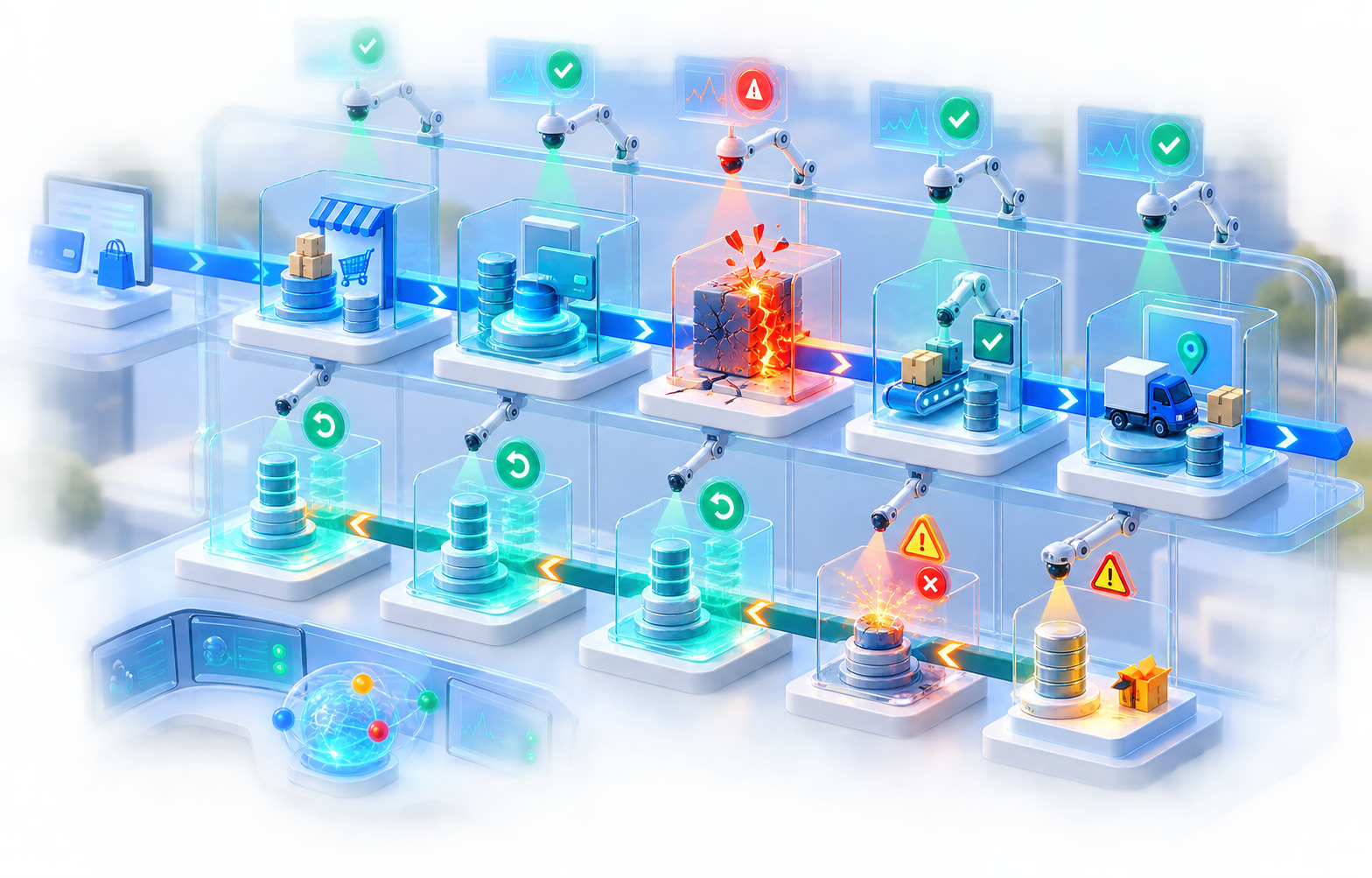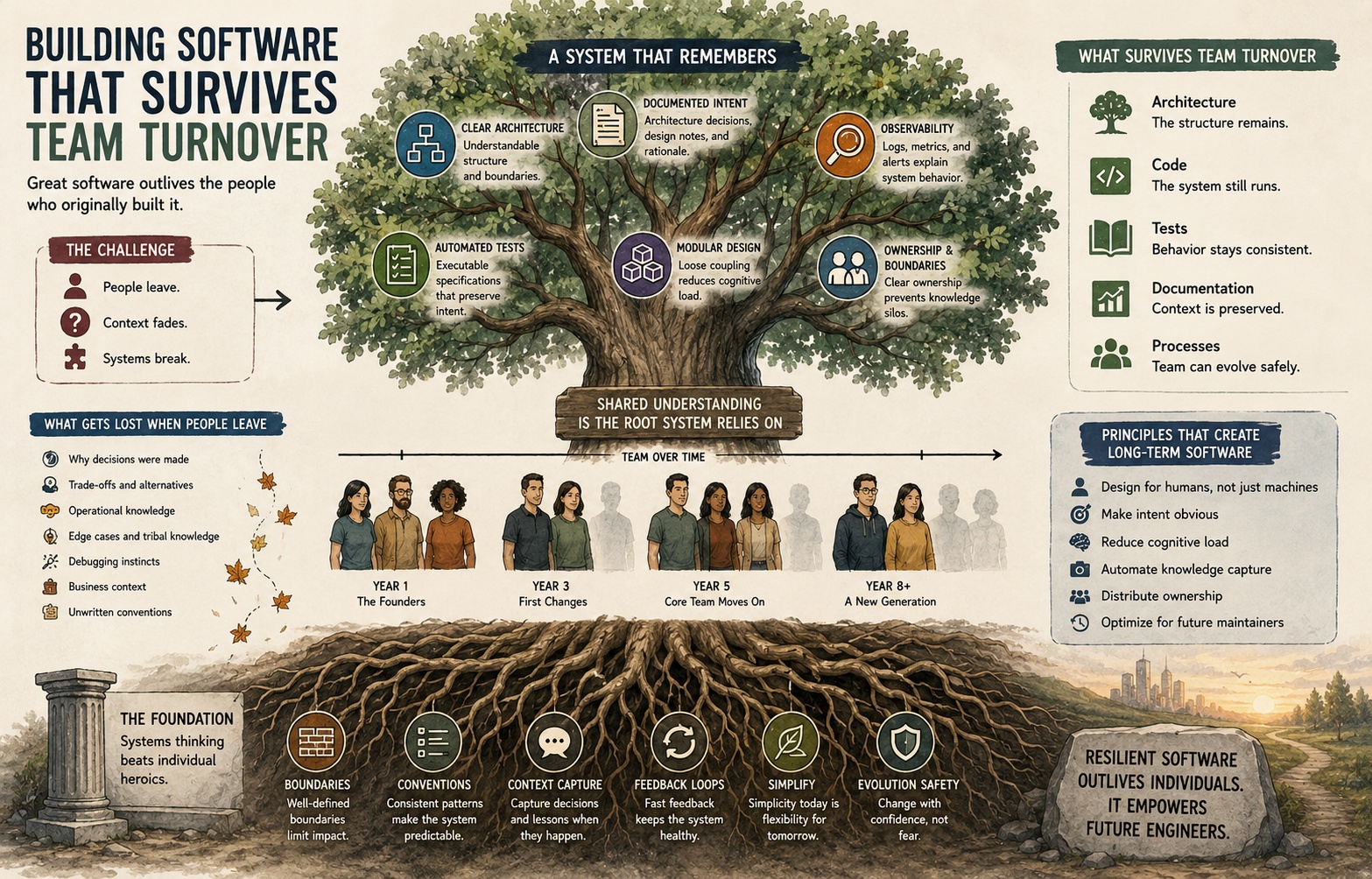
Opening — The First Day
The badge works on the first try. That's a good sign, someone says, only half joking.
The new Staff Engineer — we'll call her the way every company eventually calls this person, "the one who finally gets it running again" — sits down at a desk that used to belong to somebody else. The nameplate is gone, but the outline where tape once held a sticky note is still faintly visible on the monitor stand, a small ghost of a habit nobody kept.
The platform she's been hired to lead is eleven years old. It processes several hundred thousand transactions a day. It generates, by the finance team's own account, tens of millions of dollars a year. The original engineering team — the five people who wrote the first commit, argued over the first schema, and shipped the first production deploy at 2 a.m. on a Tuesday — left the company more than three years ago. Not in a scandal. Not in a mass exodus. Just, one by one, the way people leave: a better offer, a burnout, a move across the country, a founder who started a different company and took two engineers with him.
Nobody who currently works on the system wrote a single line of its foundation.
And yet it runs. Every day. Reliably enough that nobody in the leadership chain thinks about it very often, which is its own kind of compliment.
Her first week is a tour of a haunted house that nobody is afraid of because nobody remembers there's anything to be afraid of. She asks why the billing service retries exactly four times before failing over. I think that was a rate-limit thing with the old payment processor, someone says. She asks why there's a service called otter that seems to do nothing except relay messages between two other services that could, in principle, talk to each other directly. It was probably there for a migration that never finished. She asks why the on-call runbook says, in bold, all caps, DO NOT RESTART THE INGEST WORKER BEFORE 3 A.M. Honestly, no idea. But nobody's tested violating it, so nobody's going to.
Every answer starts with I think or it was probably. Nobody says because. Nobody can, because the people who knew because are gone, and what's left is folklore — plausible, functional, unverifiable folklore, passed from engineer to engineer the way sailors used to pass down which way to point the ship when the water changed color, long after anyone remembered the reef underneath.
This is not a story about bad documentation. The wiki, in this company, is actually decent. There are architecture diagrams, a handful of design docs, a Confluence space with real content in it. This is a story about something documentation was never designed to solve: the gap between what a system does and what a system's builders understood — a gap that widens every time someone who understood leaves, and that no amount of retroactive writing fully closes, because understanding was never only stored in words. It was stored in judgment. In instinct. In the thousand small decisions nobody thought were worth writing down because, at the time, they were obvious.
By the end of her first month, she has stopped being surprised by the shrugs. She has started, instead, to notice something else: the system, despite the amnesia surrounding it, keeps working. It absorbs new features. It survives incidents. Engineers who never met its authors somehow ship changes into it without destroying it. Something is holding the place together that has nothing to do with anyone remembering anything.
The software was alive.
Its creators were gone.
The Ghost Company
Field notes from a walkthrough of an engineering organization, three years after its founding team departed. Written as a site visit, not a retrospective.
The desks are still arranged the way they were arranged for the team that used to sit here, even though almost nobody who sits there now was part of that team. Open-plan pods, four to a cluster, angled toward a wall that used to be reserved for the "big whiteboard" — the one where, according to a photo still pinned near the coffee station, someone once drew the entire system architecture in six colors of dry-erase marker, freehand, from memory, in under twenty minutes.
The whiteboard itself has been erased and redrawn dozens of times since. But if you look closely, in the corner, there's a faint ghost of blue ink that never fully came off — a rectangle labeled AUTH with an arrow pointing to a box that no longer exists in the current architecture. Nobody has erased it because nobody is sure it's safe to erase. It might mean something. It might not. It has become, without anyone deciding this on purpose, a kind of relic.
The artifacts of a departed team accumulate like sediment:
- Old Jira tickets, some still open, assigned to accounts that were deactivated years ago, describing bugs that may or may not still exist, in language that assumes context nobody currently on the team has.
- Slack messages, screenshotted into design docs because someone thought a particular explanation was too good to lose, quoting engineers who no longer work there, explaining reasoning that made sense inside a conversation nobody can now have.
- Infrastructure diagrams, exported as images, embedded in wikis, subtly out of date the week after they were made, and never updated again because updating them requires understanding they were trying to preserve in the first place.
- Architecture Decision Records (ADRs), some rigorous, some three sentences long, written in a hurry by someone who assumed — reasonably, at the time — that they'd still be around to answer follow-up questions.
- Git commit messages, the strange diary nobody meant to keep, ranging from
fix bugto paragraphs of genuine reasoning, an inconsistent archaeological record depending entirely on which engineer happened to be tired that day.
None of these artifacts, alone, tell you how the system actually works. Together, they form something closer to a fossil record: not a live account of the organism, but an imprint of where it once stood, which bones survived, and which soft tissue is gone forever.
This is the central discovery of the Ghost Company walkthrough: software doesn't just store logic. It stores residue — compressed, partial, occasionally corrupted fragments of the people who shaped it. A well-named function is a fragment of someone's clarity. A poorly named one is a fragment of someone's exhaustion. A defensive try/catch wrapped around code that "should never fail" is a fragment of someone's scar tissue from an incident nobody currently employed was present for.
Walking through it, you start to read the codebase less like an engineer and more like an archaeologist reads a dig site: not "what does this do" but "who was under enough pressure to write it this way, and what were they trying to protect against."
The people are gone. The imprint of their judgment is still load-bearing.
A museum catalog entry, filed alongside the walkthrough notes, for one artifact recovered during the visit:
Exhibit 14 — The Retry Constant. Location:
payments/config/retry.yml, line 3. Description: A single integer,4, governing the maximum number of retry attempts for failed payment submissions. Undocumented in any surviving design record. Provenance: Believed to originate from a rate-limiting policy enforced by a payment processor the company stopped using approximately six years ago. No engineer currently employed can confirm this with certainty. Condition: Load-bearing. Three separate attempts to "clean up" this value in the intervening years were reverted within days, each time following a spike in failed transactions whose root cause was only identified after the fact. Curatorial note: This is, functionally, a fossil — a number whose original environment no longer exists, preserved because removing it once caused visible harm, even though nobody currently present can articulate exactly why.
Every long-lived codebase has several exhibits like this one: numbers, flags, and conditionals that have outlived their explanation but not their consequences. They are rarely the most complex parts of the system. They are, disproportionately, the parts most worth documenting properly the first time anyone rediscovers what they're for — because the next person to encounter Exhibit 14 will have exactly the same two options every predecessor has had: trust the fossil, or repeat the experiment that proved it necessary.
The Ship of Engineers
Consider the old paradox, retold with a different set of planks.
A ship sets out to sea with a crew of thirty. Over the course of a decade-long voyage, every original sailor eventually leaves the ship — some at the next port, some transferred to other vessels, some simply retiring from the sea. New sailors join to replace them, learn the ropes from whoever is senior at the time, and in turn eventually leave themselves. By the tenth year, not a single sailor from the original crew remains aboard.
Is it still the same ship?
Philosophers have argued this for millennia about wooden planks. Engineering leaders now live this argument every day about engineering teams, except the stakes are not academic — they're operational, financial, and, more than either of those, deeply human.
Here is the uncomfortable version of the question for a CTO: if every engineer who wrote your platform's foundational architecture has left, and every engineer who wrote the second generation of features has also left, and the only people who remain learned everything third-hand from people who themselves learned it second-hand — is this still the same engineering organization that built the product?
The instinctive answer is "no, obviously not — it's an entirely different group of people." But that answer proves too much. It would mean no organization that has ever operated for more than a few years is "the same" organization, which makes the concept useless. The more useful question isn't about identity. It's about continuity of reasoning.
A ship is the same ship, most sailors would say, not because of its planks but because of its keel logic — the deep structural decisions that don't change even as surface materials are replaced: its intended course, its hard-won lessons about which waters to avoid, its accumulated instincts about weather it has already survived. A ship becomes a different ship not when its crew changes, but when nobody left aboard remembers why it avoids the reef three degrees north of the charted route — and it sails straight into it.
This reframes the entire problem of engineering turnover. The goal was never to prevent people from leaving. People will always leave; treating retention as the solution to continuity is a category error, optimizing for the wrong variable. The actual goal is to ensure that the keel logic survives the crew — that the hard-won reasoning about why the system avoids certain reefs is transferred into something more durable than any individual sailor's memory: into the architecture itself, into the tests that fail loudly when someone forgets, into naming and boundaries and automated guardrails that encode judgment nobody currently employed needs to re-derive from scratch.
An organization becomes a "different" organization — dangerously, expensively different — not on the day the last original engineer leaves, but on the day the reasoning they carried leaves with them, silently, because nobody built anything to catch it on the way out.
Engineering DNA
Notes toward a biological model of software systems.
Software is not a machine. Machines don't evolve; they degrade. Software, when it's healthy, does something stranger — it survives radical replacement of its constituent parts while retaining a recognizable identity, adapts to environments its original designers never anticipated, and occasionally develops immune responses to categories of failure it has already suffered once. That behavior has a name in every other domain where it occurs naturally: biology.
Treat a long-lived system as a living organism, and useful new questions emerge.
Genes. Every system has a small number of foundational decisions that everything else is built on top of — the data model's core entities, the primary consistency guarantees, the fundamental trust boundaries. These are the genes: expensive to change, quietly present in almost every downstream feature, and usually invisible to newer engineers because nobody thinks to point at the thing that's simply always been true.
Mutation. Every codebase accumulates small, unplanned deviations — a shortcut taken under deadline pressure, a workaround nobody circled back to formalize, an inconsistency between two services that were supposed to match. Most mutations are neutral or mildly harmful. Occasionally, a mutation turns out to be an accidental improvement that later becomes standard practice, adopted the way a beneficial trait spreads through a population — not because anyone designed it, but because it worked and people copied it.
Inheritance. New services are rarely built from nothing. They inherit patterns, libraries, naming conventions, and unstated assumptions from whatever the engineer building them copied as a starting template. This is how organizational habits propagate long after the engineer who first established them has left — the same way a grandparent's turn of phrase survives in a grandchild who never met them, carried by a parent who didn't even notice they were passing it on.
Evolution and selection. Under real pressure — incidents, scaling limits, competitive deadlines — some architectural patterns thrive and spread, while others quietly go extinct, replaced service by service until nobody remembers they were once the default. Nobody centrally designs this. It happens the way evolution happens: through selection pressure acting on variation, not through a plan.
Immune system. Mature systems develop defenses against categories of failure they've already survived: circuit breakers born from a specific outage, validation logic born from a specific data corruption incident, alerting thresholds tuned by a specific 3 a.m. page. These defenses often look like paranoia to an engineer who wasn't there for the original wound. They are, in fact, encoded memory of a survived threat — the software's own scar tissue, doing on autopilot what the original engineer used to do by instinct.
Adaptation and memory. The practices that persist longest in an engineering culture aren't the ones written down most thoroughly — they're the ones structurally reinforced by the system itself: a linter that blocks a known-bad pattern, a CI check that fails loudly on a mistake the team has made before, a naming convention enforced by tooling rather than by a wiki page nobody rereads. This is what might be called Institutional Engineering DNA — the subset of organizational knowledge that has been encoded so deeply into the system's structure that new engineers absorb it without ever being taught it directly, the way a child absorbs grammar before anyone explains a rule.
The practical implication for leaders: don't ask only "is this documented?" Ask "is this expressed in the organism, or only in the paperwork about the organism?" Documentation can be lost, ignored, or go stale. DNA, once truly encoded into the structure of the system, gets inherited by default.
Genetic disorders. Biological systems also inherit dysfunction, not just health, and so do engineering organizations. A founding team's discomfort with writing tests, if never corrected, doesn't disappear when that team leaves — it gets inherited by every subsequent hire who learns "how we do things here" by imitating whoever trained them, long after the original source of the habit is gone. This is why culture change initiatives that target individuals so often fail to outlast the individuals they targeted: if the underlying "genome" — the templates, the defaults, the tooling that makes one path easier than another — isn't changed, the old trait simply resurfaces in the next generation, expressed through different people, exactly as unexamined as before.
Lost Conversations
Fictional fragments, reconstructed from the kind of meeting that happens at every company, at every stage of a system's life, whether anyone writes it down or not.
Year 1.
"Should we write this down somewhere? The reason we chose eventual consistency here instead of strong consistency — it's not obvious from the code."
"Yeah, definitely. Let's put it in the design doc. We'll remember why anyway — we were all in the room."
Year 4.
"Wait, why doesn't this service just call the other one directly? Why does it go through this queue?"
"Honestly, I think there was a reason. Something about the old payment provider's rate limits, maybe? I wasn't here for that decision, but I've heard it mentioned."
Year 7.
"This whole module is a mess. Nobody's touched the core logic in three years and everyone's scared of it. I say we rewrite it clean, now that we actually understand the domain properly."
"Do we understand it properly, though? Or do we just understand what it currently does?"
"...Let's rewrite it. We'll be more careful this time."
Year 11.
"Does anyone know why we have two different services that both seem to own customer identity? This is causing real bugs."
"Nobody knows anymore. It predates everyone in this room. I think it might've been a merger of two teams, once, but I'm honestly guessing."
Read in sequence, these four fragments are not a story about incompetence. They're a story about entropy — the default, predictable decay of shared understanding across time, absent any deliberate mechanism to resist it. Nobody in any of these rooms was careless. Each decision, in its moment, felt reasonable: we'll remember, because we were there. The failure isn't a failure of any individual meeting. It's a failure to recognize that "we were there" is not a durable storage mechanism — it is a temporary cache with an expiration date set by whichever person in the room leaves soonest.
By Year 11, the organization isn't short on intelligence. It's short on provenance — the traceable lineage between a decision and its reasoning. The decision survived. The reasoning for the decision did not. And a decision without its reasoning is not knowledge; it's superstition wearing knowledge's clothes.
The House Nobody Built Alone
Consider a European cathedral that took over a hundred years to complete — long enough that not one master builder who laid its foundation stone lived to see its towers finished. Successive generations of stonemasons, architects, and craftsmen each contributed a portion, working from plans that were themselves revised by hands that would never meet the hands that drew the originals.
Almost nobody visiting that cathedral today can name a single person who built it. And yet the structure stands: coherent, load-bearing, still doing exactly what it was designed to do, centuries after every relevant intention was supposedly lost with its authors.
How does a structure survive the complete turnover of everyone who understood it?
Not because the knowledge was written down somewhere and dutifully read by every subsequent generation — most of it wasn't, and most of what was has been lost to time, fire, and language change. It survives because the structure itself encodes the constraints that future builders had to respect. A flying buttress doesn't need a memo explaining why it's there; its presence is the explanation. Remove it, and the wall it supports will tell you why it existed, immediately and unambiguously, by falling down. The building teaches its own maintainers through the physical consequences of ignoring what it's quietly telling them.
This is the property long-lived software should aspire to and rarely achieves: structural self-explanation. A well-designed boundary between two services should make the wrong kind of coupling difficult, not merely discouraged in a wiki page. A well-chosen name should communicate intent to someone who has never met the original author. A test suite that fails loudly the moment an implicit constraint is violated is doing, in miniature, exactly what a flying buttress does: it converts institutional memory that would otherwise require a person into a structural property that requires nobody.
Cathedrals were never maintained by a permanent, unbroken lineage of experts. They were maintained by structure that taught new builders what the old builders knew, forcibly, through the consequences of getting it wrong. This is the model. Not "how do we make sure someone remembers." Rather: how do we build so the system itself does the remembering, and the reminding, whether or not the right person is in the room.
Interview With Legacy Code
A transcript, reconstructed in the spirit of an interview, in which the system is asked to speak for itself. The "answers" are composites, drawn from what the code, its structure, its tests, and its scars actually reveal to anyone willing to read closely enough.
Q: Who built you?
I don't remember names. I remember decisions. There was someone who cared deeply about consistency — you can tell, because every write path in me checks the same three invariants, even in places where it would have been faster not to. There was someone else, later, who was in a hurry — you can tell, because there's a module with no tests and a comment that just says "TODO: handle edge cases," and nobody ever came back to it. I am the sum of people who no longer work here, expressed as behavior.
Q: Why are you structured this way?
Some of it is deliberate. Some of it is scar tissue. The retry logic in my billing path exists because something failed catastrophically once, and whoever fixed it built a wall thick enough that it's never failed that way again — thick enough, in fact, that most people now assume the wall was always the plan, rather than the aftermath of an emergency.
Q: What are you afraid of?
I don't have fear, but I have failure modes nobody has re-tested in years. There is a corner of me — a legacy authentication path — that everyone avoids touching, not because anyone can articulate what would go wrong, but because the last two people who tried broke something in a way that took days to fully understand. That avoidance has calcified into policy. Nobody remembers the original incident. Everyone still respects it.
Q: Which parts should nobody change?
The parts with the fewest tests and the most tribal caution around them are usually the parts that most urgently need better tests, not more caution. Caution without understanding is not safety. It's just fear wearing safety's clothes. Ask me the question underneath your question: which parts should nobody change without first understanding why they're the way they are — that list is much longer, and much more honest.
Q: Which assumptions no longer exist?
I still behave as though a single data center will always be enough. I still assume, in places, that a customer has exactly one billing account. Both of those assumptions stopped being true years ago, in the business the humans around me actually run today. I haven't been told. Nobody has fully told me. I am, in places, running on a model of the world that no longer describes the world.
This exercise — genuinely interrogating a system as though it could answer, then verifying the "answers" against tests, incident history, and git blame — surfaces something documentation reviews rarely do: the difference between what the system was designed to assume and what the system is currently forced to assume. That gap is where outages live. It is also, not coincidentally, exactly the gap that widens fastest once the people who understood the original assumptions are gone.
Engineering Family Tree
Not documentation. Genealogy.
Most organizations document their systems as though they were static objects: here is the architecture, here is the data flow, here is the deployment pipeline. This is accurate and almost useless for the actual problem of continuity, because it describes the system as a photograph rather than as a lineage.
Try, instead, drawing it as a family tree.
Ancestors. The two or three original services that predate everything else — the "grandparents" whose early decisions (a chosen database, a chosen protocol, a chosen team topology) are still, quietly, shaping constraints on services that didn't exist when those decisions were made and whose current owners have never read the original reasoning.
Parents and children. Services that were deliberately split off from a larger monolith carry unmistakable resemblance to their origin — similar naming conventions, similar error-handling philosophy, similar blind spots. You can often tell which "parent" a service came from just by reading its code style, the way you can sometimes tell which side of a family someone resembles.
Branches that diverged. Two services that started as one, split by a team reorganization, that have since evolved incompatible assumptions about the same underlying entity — each one now the equivalent of estranged siblings who used to agree on what "family" meant and no longer do.
Orphans. Services whose original owning team was dissolved in a reorg, currently maintained by whichever team drew the short straw, running critical logic that nobody currently responsible for it chose to build and nobody fully understands.
Extinct services. Systems that were decommissioned, but whose data models, naming conventions, or API shapes persist as fossils inside services that replaced them — the equivalent of vestigial anatomy, present because ancestry required it, serving no current function, too risky to remove because nobody's certain it's truly vestigial.
Inherited interfaces. Contracts between services, originally negotiated by two specific engineers who trusted each other's judgment, now enforced by two teams who have never met, treating the interface as immutable law rather than as a negotiated agreement between two people who happened to be reasonable at the time.
Mapped this way — as a genealogy, not a snapshot — an engineering organization can ask questions no architecture diagram would prompt: Which of our services are direct descendants of a single person's judgment, and does anyone currently here share that judgment? Which "estranged siblings" need a reconciliation conversation before their divergence becomes a production incident? Which orphans need a deliberate adoption, rather than accidental custody?
This is the beginning of an Engineering Inheritance Graph — a living map not of what talks to what, but of whose reasoning still governs each part of the system, and whether that reasoning is still present, in a person or in the structure, anywhere the organization can reach it.
What Leaves With People?
An inventory, taken honestly.
Code captures behavior. It captures, at best, a compressed and partial trace of the reasoning that produced that behavior. Everything else — the surrounding context that made the decision make sense — tends to leave the building at exactly 5 p.m. on someone's last day, walking out in a brain rather than a repository. An honest inventory of what typically walks out the door:
- Trade-offs considered and rejected. The code shows what was chosen. It almost never shows the three alternatives that were seriously considered and discarded, along with the reasons — reasons that would instantly resolve the next "why don't we just—" conversation, if only someone remembered them.
- Customer stories. The specific, painful support ticket that justified a defensive check nobody else has ever seen trigger. Without the story, the check looks like paranoia. With it, the check looks like scar tissue earned the hard way.
- Failed experiments. The approach that was tried, quietly reverted, and never spoken of again — meaning some future engineer, with perfect confidence and zero malice, proposes the exact same failed approach as a brilliant new idea.
- Architectural intent. Not what a boundary does, but what it was meant to protect against — a distinction that determines whether a future refactor honors the boundary's purpose or accidentally guts it while technically preserving its shape.
- Operational intuition. The senior engineer's gut feeling that "if this metric drifts above a certain line during a deploy, something's about to go wrong" — accurate, valuable, and entirely un-transferable unless someone deliberately converts it into an alert before that engineer leaves.
- Debugging instincts. The unwritten mental checklist an experienced on-call engineer runs through in the first ninety seconds of an incident, built from a decade of pattern-matching against failures nobody else witnessed.
- Deployment rituals. The small, informal steps a team does before a risky release that were never codified because they felt too obvious to write down — until the person who always remembered to do them is no longer in the room.
- Business context. Why a feature exists — which customer demanded it, which deal it saved, which regulation it satisfies — context that determines whether it's safe to simplify, deprecate, or leave alone.
- Trust. The informal understanding that "if that service's team says it's fine, it's fine" — an efficiency multiplier built over years of relationship, gone the instant both people who built that trust have moved on.
- Relationships. The cross-team shortcuts that exist only because two engineers on different teams happen to get lunch together and can resolve in five minutes what would otherwise take three meetings and a ticket.
None of this shows up in a code review. Almost none of it shows up in a design doc, because most of it doesn't feel worth writing down at the time it's known — it only becomes obviously valuable in retrospect, after it's gone, when someone is trying to reconstruct it from fragments and folklore. This is the real argument for treating continuity as an architectural property rather than a documentation task: documentation, however diligent, only ever captures a small, biased sample of what actually leaves. The deeper solution has to be structural — building systems and practices that don't depend on this inventory being remembered by any specific person in the first place.
A useful, uncomfortable exercise for any engineering leadership team: pick a departure from the last two years — someone senior enough that people still occasionally say "you'd have to ask so-and-so" about a decision, except so-and-so is gone. Try to actually answer the question the old way — reconstruct the trade-off, the customer story, the operational intuition — from what remains. Time it. Most teams that try this for the first time are surprised by how long it takes, and more surprised by how much of the reconstruction turns out to be confident guessing rather than genuine recovery. That gap, made visible, is usually the single most persuasive argument a technical leader can bring into a budget conversation about investing in continuity practices before the next departure, rather than after.
The Library That Writes Itself
Imagine an engineering library that nobody has to remember to update, because it isn't a library in the traditional sense at all — it's a byproduct of the system simply operating.
Every deployment automatically records not just what changed, but a structured note on why, pulled from the pull request that triggered it and linked permanently to the metrics that moved afterward. Every incident automatically generates a timeline — not a manually reconstructed one, written under duress three days later by whoever drew the short straw, but a live one, assembled as the incident unfolds, from alerts, deploys, and chat messages, then lightly annotated by humans afterward rather than written from scratch. Every architecture review is captured not as a slide deck destined for a folder nobody reopens, but as a structured decision record, linked to the specific commits it authorized, searchable by the exact question a future engineer will actually ask: not "what did we decide," but "what problem were we trying to solve when we decided this."
Every rollback records what broke and what the earliest reliable signal of the break was, building — deploy after deploy, quietly, without anyone having to remember to do it — a genuinely useful catalog of "here is what our failures tend to look like in the ninety seconds before they become obvious." Every migration is captured with its rationale, its risks, and its planned rollback path, so that the next migration doesn't have to rediscover, the hard way, constraints the last migration already learned. Every significant customer complaint is linked, automatically, to the code path it touched, so that six years later, an engineer staring at a strange defensive check can find not just that it exists, but the exact, specific pain it was built to prevent.
This is the difference between documentation and what might be called a Knowledge Resilience Engine: documentation is something a person has to choose to write, maintain, and hope someone reads later. A Knowledge Resilience Engine is knowledge capture built into the operational fabric of the system itself — generated as an unavoidable side effect of doing the work, rather than as an additional, optional, frequently-skipped task layered on top of it. It doesn't rely on anyone's diligence, because it isn't asking anyone to be diligent. It's asking the system to notice things about itself and keep the receipts.
No organization does this perfectly. Most do fragments of it — a good incident-review culture here, decent ADRs there, a changelog that's actually maintained somewhere else. The point isn't a specific tool. It's a design philosophy: stop treating knowledge capture as an act of memory, and start treating it as an act of instrumentation. You don't ask engineers to remember why the system behaves a certain way. You build the system so that the "why" is emitted, logged, and linked automatically, the same way you'd instrument latency or error rates — because in the long run, lost institutional reasoning causes exactly as much damage as lost uptime, just on a longer fuse.
Engineering Time Machine
A dispatch from twenty years in the future, examining software written today.
An engineer, not yet born at the time of this writing, is assigned to maintain a platform originally built in the mid-2020s. She opens the repository the way archaeologists open a tomb: carefully, expecting mystery, prepared to be patient with whatever she doesn't understand.
Some of what she finds makes immediate, obvious sense, because the original team encoded their intent directly into structure rather than relying on anyone remembering it. The service boundaries map cleanly onto business domains that, remarkably, still exist twenty years later, largely unchanged — a sign that the original team understood the actual shape of the business, not just its current implementation. The naming is consistent enough that she can navigate the system's logic without a guide, inferring correctly, again and again, what a function does purely from what it's called. The tests fail in ways that clearly communicate which assumption was violated, not just that something broke — sparing her days of the guessing game her predecessors, elsewhere in the industry, are still forced to play with worse-built systems.
Some of what she finds is, and always will be, a mystery — not because the original team was careless, but because certain decisions were genuinely, unavoidably contextual: a specific regulatory requirement that existed in 2026 and was quietly repealed in 2031, leaving behind a validation rule with no discoverable justification; a specific competitor's pricing model that shaped an early design choice, referenced in nobody's code and nobody's memory, because it simply wasn't the kind of thing anyone thought to record permanently.
And some of what she finds makes her wish, genuinely, that the original team could answer one question: not "what does this do" — she can usually determine that herself — but "did you know this would still be running in twenty years, and if you did, what would you have explained differently?"
This is the honest, humbling exercise every engineering team should run periodically, not as a mystical ritual but as a practical design review: imagine the engineer twenty years from now, reading this code with no access to you, and ask which of today's decisions will still make obvious sense to her, and which will look like unexplainable folklore. Anything in the second category is not a documentation gap. It's a Continuity Architecture gap — a place where the system currently depends on a person's presence to remain comprehensible, and where the person is not guaranteed to still be there.
The exercise doesn't produce perfect foresight. Some mysteries are genuinely unavoidable — context that simply won't survive any reasonable amount of documentation, because the world itself changed underneath the decision. But most of what confuses a future maintainer isn't unavoidable mystery. It's avoidable amnesia: reasoning that could have been captured, cheaply, at the moment it existed, and simply wasn't, because nobody imagined — the way nobody ever quite imagines it — that they wouldn't be the one answering the question when it finally got asked.
A Company Without Heroes
Every engineering organization has, at some point, a hero — the one engineer who can debug anything, who knows the system so deeply that incidents get resolved in minutes rather than hours the moment they're paged, whose Slack status going to "away" quietly raises everyone else's blood pressure. Leadership tends to treat this person as an asset. They are, in the short term. In the long term, they are a single point of failure wearing a name badge, and the organization's dependence on them is not a compliment to their skill — it's a diagnosis of the system's fragility.
The healthiest engineering organizations don't have fewer talented people. They have systems designed so that talent isn't a bottleneck — so that no individual's departure creates a comprehension cliff the rest of the team falls off. This isn't achieved by making people less valuable. It's achieved by making understanding less concentrated: spreading not just ownership but the actual reasoning behind ownership, across enough people and enough structure that no single departure — however senior, however irreplaceable-feeling in the moment — removes the organization's ability to reason about its own system.
Picture two companies with an identical incident: a critical service starts silently corrupting a small percentage of records under a specific, rare load pattern.
In the first company, one senior engineer recognizes the pattern within minutes, because she's seen something like it before, three years ago, and remembers the fix. She's paged, she fixes it, everyone is grateful, and the organization's unspoken lesson is: we got lucky she was available.
In the second company, no single engineer recognizes the pattern immediately — but the incident response process surfaces the right historical precedent within minutes anyway, because a previous, similar incident was captured with enough structural detail that it's discoverable by anyone on call, not just by whoever happened to live through it. The fix takes slightly longer than it would have taken the hero. But the organization's unspoken lesson is entirely different: we didn't need to get lucky.
This is the difference between an organization that depends on heroes and an organization with what might be called genuine System Independence — a property measurable, in practice, by a blunt but revealing question: if our three most senior engineers all left simultaneously, next month, what would we lose that we couldn't recover within a reasonable window? An honest answer to that question, taken seriously by leadership rather than dismissed as unlikely, is the beginning of designing it away.
None of this argues against valuing exceptional engineers — quite the opposite. It argues for valuing them enough to actively extract and structurally distribute what makes them exceptional, rather than quietly enjoying the convenience of their irreplaceability until the day they leave and the convenience leaves with them.
There's a simple diagnostic leaders can run without waiting for a crisis: during the next major incident, notice not just who fixes it, but how the fix was found. Was it recognized from a documented, discoverable precedent — a runbook, a decision record, a monitoring dashboard someone could have found without prior history with the system? Or was it recognized because one specific person's memory happened to contain a matching pattern from years ago? The first outcome is a sign of genuine System Independence. The second outcome, however impressive it feels in the moment, is a warning sign wearing the costume of a success story — and it's worth treating it as exactly that the next morning, in the retro, rather than simply thanking the hero and moving on.
The Last Engineer
A short story.
She had been there longer than anyone — eighteen years, joining back when the platform was three services and a shared database, staying through two acquisitions, four reorgs, and the slow, patient replacement of every original teammate, one departure at a time, until she was the only person left who had written a single line of the original system.
Her retirement party was small. People were kind about it in the specific way people are kind about someone who has quietly been the answer to more questions than anyone realized, for longer than anyone tracked. Someone joked that the system might just stop working the day she left, the way old superstitions claim a house falls apart the moment the last person who truly understood it walks out the door.
It didn't stop working. It didn't even slow down.
If anything, in the eighteen months after she left, the team shipped faster than it had in years. Not because she hadn't mattered — she had mattered enormously, for nearly two decades. But because, in her last three years, without ever framing it as a special project, she had quietly done something more valuable than staying forever: she had made herself structurally unnecessary. She'd spent those years converting her instincts into linter rules. Converting her debugging intuition into automated alerts tuned to the exact signals she used to notice by feel. Converting the reasons behind the system's stranger decisions into ADRs specific enough that a new engineer, reading them cold, could reconstruct her thinking without needing to reconstruct her.
The team that remained hadn't inherited her presence. They'd inherited her judgment, encoded into a form that didn't require her to still be in the room to exercise it. The system remembered what she used to remember. The tests caught what she used to catch by instinct. The runbooks explained what she used to explain from memory, unprompted, the moment someone asked the right question.
Development accelerated after she left not despite her absence, but because of what she'd done in anticipation of it: she had spent her last years transferring her value out of her own head and into the structure of the system itself, where it could keep working long after she stopped showing up to work.
This is the quiet, unglamorous ambition every senior engineer should hold for their final years on a system they've shaped for a decade or more: not to be irreplaceable, but to leave behind something so well-instrumented with their own hard-won judgment that their eventual absence is barely noticed by the system, however deeply it's felt by the people who miss working with them.
Systems That Remember
A working philosophy, laid out plainly.
Memory, in an engineering organization, is usually treated as a documentation problem: write the wiki page, keep it updated, hope people read it. This framing is incomplete in a specific and costly way — it assumes memory lives in one place, the place explicitly labeled "memory," when in fact a mature system carries memory in dozens of places most teams never audit as memory at all.
Architecture remembers. A boundary drawn between two services encodes a decision about what should be allowed to change independently — a decision someone made, once, for reasons that may no longer be written anywhere, but that the boundary itself continues to enforce, correctly, indefinitely, regardless of who's currently on the team.
Naming remembers. A function called reconcileLedgerAfterPartialRefund is quietly teaching every future reader something about a business scenario the original author had to think hard about. A function called helper2 is teaching nothing, and worse, it's actively erasing what its author once knew, replacing it with nothing.
Boundaries remember. The specific data a service refuses to accept, the specific operations it refuses to perform without explicit authorization — these refusals are frozen judgment, the accumulated caution of people who learned, sometimes expensively, what happens when the boundary isn't there.
Automation remembers. A CI check that blocks a specific class of mistake is the organization's memory of that mistake, made durable and impersonal — available to an engineer who joined last week exactly as reliably as it's available to the person who originally got burned.
Tests remember. A test that encodes a strange, specific edge case is a monument to an incident, a support ticket, or a moment of paranoia that turned out to be justified — preserved not as a story someone has to retell, but as a check someone has to pass.
Interfaces remember. A contract between two services, once negotiated carefully between two trusting engineers, continues to enforce that negotiation's terms long after neither engineer is present to explain why the terms are what they are.
Operational practices remember. A deploy checklist, a rollback procedure, an escalation path — each one a compressed record of a specific way things once went wrong, converted into a repeatable practice that doesn't require anyone to recall the original incident to benefit from the lesson it taught.
Decision records remember, when they're written with enough honesty to capture not just the decision but the doubt — the alternatives seriously weighed and the reasons they were set aside, which is almost always more valuable to a future reader than the decision itself.
Monitoring remembers. A dashboard tuned to watch a specific signal is a record of someone, once, learning the hard way that this signal mattered, converted into vigilance that doesn't sleep, doesn't forget, and doesn't leave the company.
Ownership remembers, or fails to, depending on whether it's structured as genuine accountability — a team that actually understands what it owns — or as a label in a directory that nobody has updated since the last reorg, in which case "ownership" isn't memory at all; it's the appearance of memory, which is worse than no memory, because it creates false confidence exactly where caution is most needed.
Design systems remember. A shared component library, consistently used, is an organization's memory of what "correct" looks like, propagated automatically to every new interface built from it, without requiring a design review to re-explain the reasoning every time.
None of these, individually, is a complete solution. Together, they constitute what might be called an Architectural Memory Layer: a distributed, redundant, structurally-reinforced form of institutional memory that doesn't route through any single person's recollection, and therefore doesn't expire on that person's last day. The goal of a continuity-minded engineering leader isn't to build a better wiki. It's to audit, deliberately, how much of the organization's actual understanding is expressed in this layer — the layer that survives turnover by default — versus how much is still, quietly, living only in someone's head, one resignation letter away from becoming folklore.
Letter to Future Maintainers
To whoever is reading this fifteen years from now, long after every name in this codebase's early history has become unfamiliar to you —
We don't know your name. We don't know what the business looks like when you read this, what's grown, what's been sunset, what problem you're actually trying to solve today that has nothing to do with any of the problems we were solving when we wrote this. We are, to you, exactly what our predecessors are to us: a set of decisions with the reasoning slowly fading out of them, unless we do something now to slow that fade.
So here is what we owe you, and what we've tried, imperfectly, to leave behind.
We owe you honesty about what we didn't know. Several of the decisions in this system were made under real uncertainty, with incomplete information, on a deadline. Where we knew we were guessing, we've tried to say so directly in the decision records, rather than presenting a guess with the false confidence of a conclusion. If something here looks arbitrary, it may genuinely have been arbitrary — please don't assume there's a reason you're simply failing to find. Sometimes there isn't one. Verify before you defer to it.
We owe you the difference between load-bearing and incidental. Some of what we built is structurally important — remove it and something breaks in ways that are expensive to diagnose. Some of it is simply how we happened to do things, changeable without consequence. We have tried, wherever we remembered to, to mark the difference explicitly, because we know from our own experience inheriting other people's systems how much time is wasted treating incidental choices as sacred and sacred constraints as incidental.
We owe you our failures, not just our successes. There are three approaches described in our decision records that we tried and abandoned, along with why. If you find yourself independently arriving at one of these approaches, we hope that record saves you the months it cost us to discover it doesn't work — or, just as usefully, tells you enough about why it failed for you to recognize that your version might actually be different enough to succeed.
We owe you the business context, not just the technical context. Several parts of this system exist because of a specific customer commitment, a specific regulatory requirement, or a specific competitive pressure that may or may not still be true when you read this. Where we could, we've linked the code to the reason. Where the reason has expired, we hope you feel entirely free to remove what it justified — that removal is not disrespect for our work. It's exactly what we would have wanted.
We owe you an honest account of our fear. There are parts of this system we were afraid to touch, and we want to tell you clearly whether that fear was justified by a real, specific, verifiable failure mode, or whether it was just inherited caution from someone before us that we never got around to testing. Unexamined fear is not the same thing as wisdom, and we don't want to pass off the former as the latter.
Most of all, we owe you the acknowledgment that you will, eventually, be exactly what we are to you now: a set of names fading out of a system that continues running without you. We hope what we've built makes that fading a little less costly for whoever comes after you than we've tried to make it for you.
Take care of it. Change what needs changing. You don't need our permission, and you won't have our presence — only, we hope, enough of our reasoning to make good decisions without us.
Closing Reflection
There is a version of engineering leadership that measures success by retention — by how long the original team stays, by how few resignations disrupt the roadmap, by how rarely anyone irreplaceable actually has to be replaced. It is an understandable instinct. It is also, quietly, a strategy built on borrowed time, because every engineer eventually leaves, whether through resignation, retirement, reorg, or simply the ordinary passage of a career through more companies than any one of them will hold forever.
The organizations that build software capable of genuinely lasting — not merely surviving in production, but continuing to evolve intelligently, decade after decade, through complete turnover of everyone who built it — are not the ones that manage to keep people the longest. They are the ones that build the least dependence on any specific person's memory in the first place: systems where architecture, naming, tests, automation, and decision records carry forward the reasoning that would otherwise walk out the door with whoever happens to be holding it that year.
Software doesn't become resilient when people stay forever.
It becomes resilient when people can leave without taking the system's intelligence with them.