The question a CTO should be asking
A Series-B SaaS company has about four hundred Playwright specs. They were written over two years by two automation engineers and a handful of product developers who were talked into contributing. The suite runs on every pull request, takes eleven minutes on a good day, and generates a steady trickle of Slack messages that begin with "is this failure real?"
In a Thursday engineering review, a staff engineer demos something she set up over the weekend. She runs npx playwright init-agents, points the planner at the staging environment, and asks it to produce a plan for the team-invitation flow. Ninety seconds later there is a readable Markdown document listing eleven scenarios with steps and expected results. She feeds it to the generator. It opens a browser, walks the flow, and writes spec files with role-based locators. Two of them fail on the first run. She names one of them to the healer, which replays the failing steps, looks at the live page, changes a locator, reruns, and turns it green.
The CTO watches this and asks the obvious question:
"If an agent can plan the tests, write the code, run it, and fix it when it breaks, why are we still budgeting for a dedicated automation team?"
That is not a naive question. It is the correct question, and anyone who answers it with reflexive defensiveness is not worth listening to. The demo is real. The artifacts are real. The time saved on that particular flow is real. A serious answer has to start by taking the demo seriously.
The problem is that the phrase "test automation engineer" is doing an enormous amount of quiet work in that sentence. It bundles together jobs that have almost nothing in common with each other:
- Translating a described scenario into browser commands is one job.
- Deciding which scenarios are worth having at all is a different job.
- Deciding what constitutes evidence that the product actually works — not that it rendered, but that it worked — is a third.
- Keeping an execution system fast, isolated, and trustworthy enough that a red build means something is a fourth.
- Looking at a failure and correctly attributing it to the product, the test, the environment, the data, or a wrong assumption baked in six months ago is a fifth.
- Knowing which of the company's risks are financially or legally serious, and steering verification effort toward them, is a sixth.
When someone asks "can AI replace a test automation engineer," they are almost always thinking about the first job. The demo replaced part of the first job. It is entirely possible for that to be a large productivity change and simultaneously not a replacement of the role, and the only way to tell which is happening is to decompose the role and check each part against what the agents currently do.
So this article runs a replacement test. Not "can AI write a test file," but: what exactly would have to be automated before we could honestly say the engineer had been replaced? We will go responsibility by responsibility, compare each against documented Playwright agent behavior, and see what is left standing.
One framing to hold onto, because it determines whether the rest of this makes sense:
Replacement cannot be measured by asking whether an agent can produce a test file. It has to be measured by asking whether anything can own the consequences of that test file.
A test file has consequences. It occupies CI minutes. It will fail one day at 2 a.m. and someone will have to decide whether to ship. It encodes a claim about what correct behavior is, and that claim will outlive the person who made it. Producing the artifact and owning the artifact are different economic activities, and conflating them is how teams end up with four thousand generated tests and no idea which ones they believe.
[Visual concept: a split diagram — left column "Producing a test" (write code, pick locators, run it, make it green), right column "Owning a test" (choose the scenario, define correctness, absorb the failure, defend the release decision) — with a dotted line showing that agent capability currently saturates the left column and thins out toward the right.]
What Playwright Test Agents actually do
Before analysis, an accurate description. Everything in this section reflects Playwright's official documentation and release notes at the time of writing. Playwright moves quickly — the test agents shipped in v1.56 and the current stable line is v1.62 — so treat specifics as a snapshot and check playwright.dev for the current behavior before making a build-versus-buy decision on top of it.
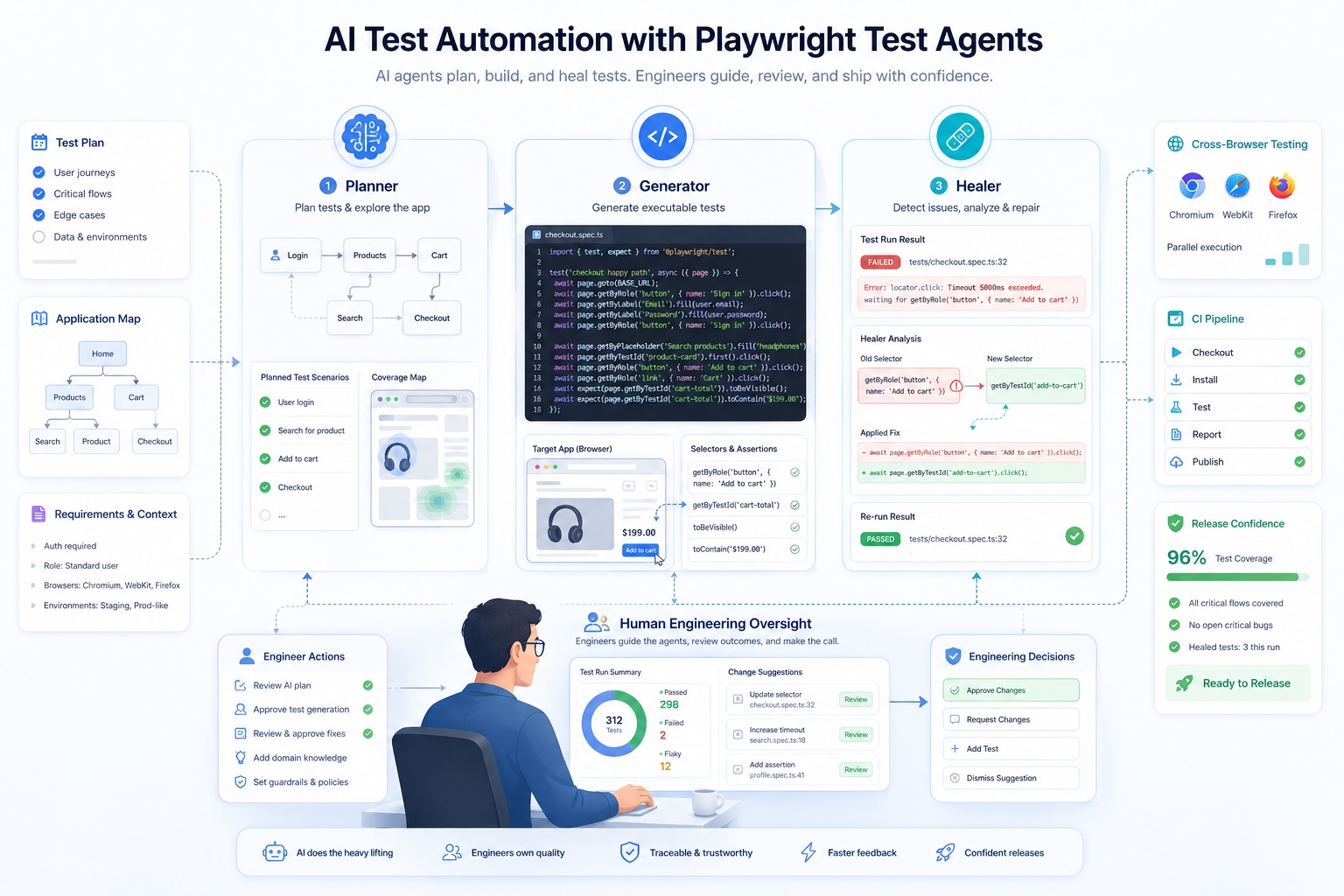
What are Playwright Test Agents? They are three agent definitions that ship with Playwright and guide an LLM through the core stages of building and maintaining a Playwright test suite: 🎭 planner, 🎭 generator, and 🎭 healer. The documentation is explicit that they can be used independently, sequentially, or chained together in an agentic loop, and that using them in sequence is what produces test coverage for a product.
They are installed into a project with a single command that generates the definition files for whichever agentic environment you use:
npx playwright init-agents --loop=vscode
# also documented: --loop=claude, --loop=codex, --loop=opencode
Two details in the docs matter more than they first appear. First, the definitions are described as collections of instructions and MCP tools — the agent is not a black-box model endpoint, it is a prompt-plus-tooling contract that Playwright authors and ships. Second, the docs say these definitions should be regenerated whenever Playwright is updated so they pick up new tools and instructions. In other words, your agent behavior is versioned with your test framework, and drifting behind on init-agents means running agents against stale tool descriptions.
Planner
The planner explores the application and produces a test plan for one or many scenarios and user flows. Its documented inputs are:
- a clear request ("generate a plan for guest checkout");
- a seed test that sets up the environment needed to interact with the app;
- optionally, a Product Requirement Document for context.
The seed test is doing more work than its name suggests. Playwright's documentation notes that the planner will run the seed test to execute all the initialization a test needs — global setup, project dependencies, fixtures, and hooks — and will also treat it as a worked example that generated tests should resemble. A seed test is typically minimal:
import { test, expect } from './fixtures';

test('seed', async ({ page }) => {
  // uses the project's custom fixtures from ./fixtures
});
The output is a Markdown plan written to specs/, described as human-readable but precise enough for test generation. Playwright's own example shows the shape: an application overview, then numbered scenarios, each with a seed reference, ordered steps, and a list of expected results in plain language ("counter shows 1 item left", "input field is cleared and ready for next entry").
That Markdown file is the most underrated artifact in the whole system. It is the point where intent becomes reviewable by a human who does not read TypeScript — a product manager, a domain expert, a compliance owner. Everything downstream inherits from it.
Generator
The generator consumes the Markdown plan and produces executable Playwright tests. The important documented behavior is that it does not write code from imagination: it verifies selectors and assertions live as it performs the scenarios, and Playwright notes that it supports generation hints and provides a catalog of assertions for structural and behavioral validation.
The generated files are written under tests/, aligned one-to-one with specs where feasible, and carry provenance comments back to the plan and seed:
// spec: specs/basic-operations.md
// seed: tests/seed.spec.ts
import { test, expect } from '../fixtures';
The docs also state plainly that generated tests may include initial errors, which the healer can then fix. This is an honest and useful admission: the design assumes a generate-run-repair loop rather than first-pass perfection.
Healer
Can Playwright automatically fix failing tests? Within limits, yes — that is what the healer does. Given the name of a failing test, the documented behavior is:
- replay the failing steps;
- inspect the current UI to locate equivalent elements or flows;
- suggest a patch, with the documentation naming locator updates, wait adjustments, and data fixes as examples;
- rerun the test until it passes or until guardrails stop the loop.
And then a sentence that deserves far more attention than it usually gets. The documented output is: a passing test, or a skipped test if the healer believes that functionality is broken.
Read that again from a governance perspective. The healer has two exits. One produces a modified green test. The other produces a skip — an annotation that removes a scenario from the suite's effective coverage while leaving the file in place. Both exits are reasonable engineering behaviors. Neither is self-evidently safe to merge without a human reading the diff. We will come back to this repeatedly.
The artifacts, and why the shape matters
Playwright describes the resulting layout as deliberately simple and auditable: agent definitions in the client-specific directory, human-readable plans in specs/, generated tests in tests/, a seed.spec.ts, and the normal playwright.config.ts.
repo/
  .github/                # agent definitions
  specs/                  # human-readable test plans
    basic-operations.md
  tests/
    seed.spec.ts
    create/add-valid-todo.spec.ts
  playwright.config.ts
That structure encodes a real opinion: intent lives in Markdown, implementation lives in TypeScript, and the two are traceable to each other. A team that keeps that separation has something to review. A team that lets agents write specs directly into test files, or that stops maintaining the plans once the code exists, has thrown away the only artifact a non-engineer can audit.
The tooling underneath
The agents sit on top of a browser-control layer, and Playwright has been building that layer out aggressively. Playwright MCP exposes browser interaction as tools to a model. The Playwright CLI is described as a command-line interface for browser automation designed specifically for coding agents, with token-efficient output, accessibility-tree snapshots with element refs, and a persistent daemon so there is no per-command browser startup cost. As of v1.62 both the MCP server and the CLI are bundled with Playwright itself and runnable via npx playwright mcp and npx playwright cli.
Several other recent additions are clearly aimed at making agent behavior inspectable rather than magical:
- a CLI debugger for agents (
npx playwright test --debug=cli) that lets an agent attach to a paused test and step through it; - CLI trace analysis (
npx playwright trace) so an agent can list actions, read the failing assertion's expected-versus-received values, and pull before/after snapshots from a trace without a GUI; - screencast APIs that Playwright's own release notes frame as "agentic video receipts" — an agent recording an annotated walkthrough of what it verified, for a human to review faster than logs;
- an option on aria snapshots to append bounding boxes, noted as useful for AI consumption.
Taken together, the direction is unmistakable and worth naming: Playwright is not just adding an AI feature. It is systematically converting its debugging surface — traces, snapshots, the debugger, video — into machine-readable evidence. That is a considered bet that the bottleneck in agentic testing is not action execution but observation, and it is the right bet.
[Visual concept: the Planner → Generator → Healer loop drawn as a production line with the artifacts on the belt — request + seed test + PRD → specs/*.md → tests/*.spec.ts → test run → failure → patch — and human review gates drawn as physical checkpoints between stages, one of which is labeled "the gate most teams skip."]
Codegen is not the same thing as an agent
Playwright has had test generation for years, and a lot of skepticism about "AI test generation" is really unresolved skepticism about record-and-replay wearing a new hat. The distinction is worth drawing precisely, because the two tools fail in different ways.
Playwright's test generator — codegen — records what you do in a browser and writes the corresponding code. Its documented behavior is to inspect the page and pick the best locator, prioritizing role, text, and test-id locators, and to refine a locator when several elements match so the result uniquely identifies the target. It can generate a limited set of assertions on demand: assert visibility, assert text, assert value, chosen by clicking a toolbar icon and then an element. Since v1.55 it can also generate toBeVisible() assertions automatically for common interactions, if you enable that in the codegen settings. It supports emulation options and can preserve authenticated state via --save-storage and --load-storage, which is how most teams bootstrap a recorded session behind a login.
Codegen is a transcription tool. It is very good at it. But notice what determines the output: your hands. Codegen has no opinion about which flow matters, no notion of what the flow is supposed to prove, and no ability to decide that a check is missing. It records the actions you chose and the assertions you clicked. The scenario design happens entirely in the human's head, and the tool captures the residue.
Agentic generation changes the input, not merely the intelligence. The planner is given a goal, an environment via the seed test, and optionally a requirements document, and it decides which scenarios exist. The generator is given a plan in prose and decides how to realize each step and expected result in code, checking selectors and assertions against the live application as it goes. The healer is given a failure and decides what change would make the scenario work again.
The difference is the location of the judgment:
| Codegen (test generator) | Agentic workflow (planner/generator/healer) | |
|---|---|---|
| Trigger | A human performs the flow | A request, plus a seed test and optional PRD |
| Scenario selection | Entirely human | Proposed by the planner, from exploration and supplied context |
| Assertions | Human clicks the ones they want, from a small set | Drafted by the generator against expected results in the plan |
| Failure response | None — the recording is a one-time artifact | Healer replays, inspects, patches, reruns, or skips |
| Human artifact | The final spec file | The Markdown plan and the spec file |
| Typical failure mode | Under-specified tests, brittle only where the human was careless | Plausible tests that verify the wrong thing, at volume |
That last row is the one that matters for risk. Codegen's failure mode is small and visible: you recorded a thin test, you know you recorded a thin test. The agentic failure mode is larger and quieter: a well-structured suite of fluent, passing tests whose expected results were inferred from a source that was never authoritative. Fluency is not evidence. A generated test that looks exactly like a test an experienced engineer would write is not thereby a test an experienced engineer would keep.
This is also why "can AI generate Playwright tests?" is a badly posed question with an uninteresting answer. Yes, obviously, and it does it well. The interesting questions are what it generated tests about, and what it decided "correct" means.
[Internal link opportunity: Playwright test automation]
The Automation Engineer Work Map
To run the replacement test properly we need the job written down. What follows is the Automation Engineer Work Map — an analytical framework proposed in this article for the purpose of this analysis. It is not a Playwright concept, not an industry standard, and not a competency matrix anyone is obliged to adopt. It is simply a decomposition detailed enough that we can check capabilities against it one by one.
Fourteen responsibilities, roughly in the order they occur:
- Understand product intent — what the software is supposed to do, including rules that are not visible in the interface.
- Identify business-critical workflows — which paths carry revenue, legal exposure, data integrity, or reputational risk.
- Decide what to automate — and, harder, what to leave to other techniques or leave uncovered on purpose.
- Design test scenarios — including negative paths, boundary conditions, role and permission variants, and states that are awkward to reach.
- Define expected results — the oracle. What outcome would prove the behavior is correct?
- Implement test code — turn the scenario into working, readable automation.
- Select resilient locators — prefer stable, user-facing handles over structural coupling to the DOM.
- Design fixtures and abstractions — the reusable machinery that keeps a suite from becoming four hundred copies of a login sequence.
- Control application and data state — seeded accounts, API setup, storage state, tenancy, cleanup, isolation.
- Debug failures and attribute causes — product, test, environment, data, or assumption.
- Maintain tests through intentional change — when the product legitimately changes, update the automation to match the new intent.
- Distinguish product bugs from test bugs — the single highest-leverage judgment in the job.
- Integrate with CI/CD — execution policy, triggers, parallelism, sharding, artifacts, gating.
- Measure and prune the suite — runtime, flake rate, defect detection, redundancy, deletion.
- Decide whether the evidence is sufficient to release — the accountability endpoint.
Fifteen, then. The extra one earns its place.
Now the comparison. The columns below distinguish assistance (an agent meaningfully reduces the effort) from substantial automation (an agent can carry the responsibility end to end with light supervision), and name what has to be true for that to be safe.
| Responsibility | Agent assistance today | Substantial automation? | Context it depends on | Primary risk if delegated blindly | Human accountability still required |
|---|---|---|---|---|---|
| 1. Understand product intent | Strong summarization of supplied documents; good at surfacing questions | No | PRDs, acceptance criteria, domain rules, past incidents — none of which are in the UI | Intent is inferred from implementation and quietly canonized | Yes — someone must supply and vouch for intent |
| 2. Identify business-critical workflows | Can rank by heuristics if told what matters | Partial, only with supplied risk context | Revenue paths, incident history, contracts, security model | Even coverage of uneven risk | Yes |
| 3. Decide what to automate | Good at proposing candidate lists | Partial | Existing coverage at other layers, suite budget, flake history | Duplicate coverage; expensive E2E tests for things a unit test proves better | Yes |
| 4. Design test scenarios | Strong for observable happy paths and CRUD variants; decent at obvious negatives | Partial | Roles, permissions, data states, edge cases, known defect patterns | Plausible-looking coverage with systematic blind spots | Shared |
| 5. Define expected results | Can draft; excellent at drafting from a good spec | Rarely — this is the oracle problem | An authoritative source of correctness | Current behavior becomes the expectation, bugs included | Yes |
| 6. Implement test code | Very strong | Yes, for explicit scenarios | The plan, the seed test, project conventions | Low — this is the safest delegation in the list | Review, not authorship |
| 7. Select resilient locators | Very strong; Playwright's locator priorities are built in | Yes | The live DOM and accessibility tree | Occasional coupling to incidental text or structure | Light review |
| 8. Design fixtures and abstractions | Good at following an existing pattern; weaker at inventing one | Partial | The framework's architecture and intended seams | Fixture sprawl; duplicated setup; hidden coupling | Yes, for the architecture |
| 9. Control state and data | Good at using provided setup; can write API-based seeding | Partial | Environments, tenancy, auth, cleanup guarantees | Shared-state collisions under parallel execution | Yes |
| 10. Debug and attribute failures | Genuinely strong — traces, snapshots, and error context are now machine-readable | Partial | Trace artifacts, recent diffs, environment status | Confident misattribution of a real regression to "flakiness" | Yes for ambiguous cases |
| 11. Maintain through intentional change | Strong on mechanics | Partial | Whether the change was intended, and what the new intent is | Tests updated to match a change nobody approved | Yes |
| 12. Distinguish product bugs from test bugs | Can propose a classification with reasoning | No | Intent, again — the same missing input as #1 and #5 | The most expensive failure mode in the entire system | Yes |
| 13. Integrate with CI/CD | Good at config generation and incremental optimization | Partial | Cost budget, infra, release process, gating policy | Slow or unreliable pipelines; wrong gating | Yes |
| 14. Measure and prune | Can compute redundancy, runtime, flake signals | Partial | What the suite is for | Growth without pruning; nobody deletes anything | Yes |
| 15. Release sufficiency decision | Can summarize the evidence well | No | Everything above, plus commercial and legal context | Accountability with no accountable party | Yes, unambiguously |
Read the middle column top to bottom and the pattern is hard to miss. Agent capability is highest in the middle of the list — implementation, locators, mechanics — and drops off sharply at both ends. It is weakest where the work requires knowledge that does not exist in the running application, and weakest of all where the work is an act of accountability rather than production.
This is not a permanent verdict. Rows 4, 9, 10, and 14 look to me like the ones most likely to move within a couple of release cycles, particularly as agents get better structured access to specifications, incident history, and coverage data. Rows 5, 12, and 15 will move slowly, because their bottleneck is not model capability. It is whether the organization has written down what correct means, and who is answerable when it turns out to be wrong.
[Visual concept: the fifteen responsibilities on a horizontal axis in workflow order, with a curve showing agent capability — low at "understand intent," peaking sharply at "implement code" and "select locators," collapsing again at "distinguish product bugs from test bugs" and "release decision." Title it "the capability is real, and it is shaped."]
The Planner test: discoverability is not intent
Take the planner as a replacement candidate rather than a feature and ask a simple question: what does a competent engineer actually do before writing a test?
They read the ticket, then distrust it. They look at the acceptance criteria and notice which cases are unspecified. They ask the product manager what happens on the boundary — at zero, at the limit, on the last day of the billing period. They check whether this area has a defect history and whether any of those defects reached production. They look at the API the frontend calls and notice that it accepts a field the UI never sends. They ask which roles can reach this screen, and whether an org admin sees something a member does not. They think about data: what state must exist before this scenario is even reachable, and what does it leave behind. They remember that a similar-looking feature shipped last quarter with a rounding bug that took three days to diagnose.
Almost none of that is available by looking at the running application.
Now list what the planner has. Per the documentation: a request, a seed test that establishes an environment and an example, optionally a PRD, and the ability to explore the live app through browser tooling. That is a real and useful context set — the PRD hook in particular is the single most important input in the entire pipeline, and teams that skip it are running the planner at a fraction of its capability. But the default posture, if nobody supplies more, is exploration of what exists.
Which brings us to the distinction the planner section really turns on.
Application discoverability is what an agent can learn by driving the interface: there is a Checkout button, it is disabled until a shipping address exists, submitting produces a confirmation screen with an order number, the number appears again in order history.
Product intent is what the system is supposed to do, which is a claim about the world, not about the DOM. Whether a purchase should be blocked above a credit threshold. Whether two promotional discounts may combine. Whether canceling a subscription takes effect immediately or at the end of the paid period. Whether a member of Workspace A should ever be able to retrieve an invoice belonging to Workspace B. Whether submitting the same payment request twice should charge once.
An agent exploring a checkout flow can discover the button. It cannot discover the credit policy, because the credit policy is not a rendering. At best it can observe the consequence of the policy in one particular case with one particular account and generalize — which is exactly the move that produces confident, wrong tests.
Consider three concrete SaaS cases.
Discount stacking. The UI has a promo code field. The planner tries a code, sees a discount applied, and writes a scenario: apply code, expect total reduced. Correct as far as it goes. But the commercial rule is that a partner referral discount and a seasonal promotion must never combine, because that combination produces negative margin on the entry-level tier. The interface does not say this. It simply accepts one code at a time in the current implementation. There is no observation of the working application that yields the rule, and no test in the generated suite will fail when someone later adds multi-code support and the rule is violated.
Cancellation semantics. The planner cancels a subscription in staging and observes that access disappears immediately. It writes: after cancellation, the dashboard shows the free-tier state. If the contract and the PRD say the customer retains paid features until the end of the billing period, the planner has just proposed a test that will pass against a bug and fail against a fix. The test is not wrong about what happens. It is wrong about what should happen, and it has no way to know the difference.
Idempotency. A payment endpoint is supposed to be idempotent under retry. In the browser this is invisible: you cannot double-submit through a UI that disables the button. The behavior that matters exists at a layer the planner is not looking at, under a condition the planner has no reason to construct.
The general principle underneath all three is worth stating on its own, because it is the load-bearing idea for everything after it:
A running application is evidence of what was implemented. It is not a specification of what was intended.
Every automated system that learns expected behavior by observation is subject to this, and the more capable the observation, the more convincing the resulting mistake. The failure is not that the agent is imprecise. It is that it is precise about the wrong reference.
The practical consequence is that the value of the planner is largely a function of the context you can feed it. A team with maintained acceptance criteria, a defect taxonomy, a written permission model, and API contracts will get planner output that is genuinely close to what a mid-level engineer would draft. A team whose requirements live in Slack threads and a founder's head will get an articulate description of the current implementation, and will mistake it for a test plan. The agent is roughly as good as the specification culture around it — which is an uncomfortable result, because specification culture is exactly what most fast-moving SaaS teams have deprioritized.
[Internal link opportunity: SaaS testing]
The Generator test and the Assertion Gap
Give the generator its due first, because it earns it.
Turning an explicit, well-specified scenario into working Playwright code is the part of test automation that consumes the most engineer-hours and rewards the least judgment. It is typing. It is finding the element, remembering whether the confirmation dialog is in a portal, writing the fourth login helper of the week, discovering that the table renders asynchronously. Playwright's generator does this against the live application, verifying selectors and assertions as it performs the scenario, which is a materially better approach than generating code from a screenshot or a DOM dump and hoping. And because it inherits Playwright's locator priorities — role, text, test id, refined when ambiguous — the code it produces tends to look like code a competent engineer would write, not like the CSS-path sludge that older record-and-replay tools emitted.
For a CRUD-heavy admin interface, this is close to a solved problem. Create, edit, list, filter, delete, validate the required field, check the empty state. These scenarios are explicit, observable, low-ambiguity, and enormously repetitive. If your automation backlog is mostly of this shape, agentic generation will change your week.
Now the harder question. Does executable code equal a valuable test?
The Assertion Gap
Here is a test that runs perfectly, passes reliably, is well-structured, uses excellent locators, and proves almost nothing:
test('user can save profile changes', async ({ page }) => {
  await page.getByRole('textbox', { name: 'Display name' }).fill('Ada Lovelace');
  await page.getByRole('button', { name: 'Save' }).click();
  await expect(page.getByText('Changes saved')).toBeVisible();
});
What has been established? That clicking Save causes a string to appear. That is genuinely something — it rules out a JavaScript exception, a broken button handler, a routing failure. But consider everything consistent with this test passing: the request failed and the toast is optimistic; the value was written to the wrong record; the value was truncated to twenty characters; an unrelated field was cleared as a side effect; the change lives only in client state and vanishes on reload; the write succeeded but a downstream search index was never updated so the user is unfindable by their new name.
Call the distance between what the test executed and what it actually established the Assertion Gap. It is the gap between action coverage — this path can be walked — and behavioral evidence — this behavior is correct.
Action coverage is what you get for free. Behavioral evidence is what you have to decide to want.
A stronger version of the same scenario:
test('display name change persists and does not alter role', async ({ page, request }) => {
  const before = await (await request.get('/api/v1/me')).json();

  await page.getByRole('textbox', { name: 'Display name' }).fill('Ada Lovelace');
  await page.getByRole('button', { name: 'Save' }).click();
  await expect(page.getByText('Changes saved')).toBeVisible();

  const after = await (await request.get('/api/v1/me')).json();
  expect(after.displayName).toBe('Ada Lovelace');
  expect(after.role).toBe(before.role);           // no privilege drift
  expect(after.email).toBe(before.email);         // no collateral mutation

  await page.reload();
  await expect(page.getByRole('textbox', { name: 'Display name' }))
    .toHaveValue('Ada Lovelace');                 // it survived the round trip
});
Same flow. Different claim. The second version verifies that a mutation occurred, that it was the correct mutation, that fields outside the scenario's remit were untouched, and that the state persisted rather than lived in a component. It costs perhaps ten extra lines and one design decision: someone had to think about what a bad save would look like.
It is worth being precise about assertion types, because "add more assertions" is not the lesson:
- Structural assertions — an element exists, has this role, matches this accessibility snapshot. Cheap, fast, good regression tripwires for layout and rendering. They say nothing about business outcomes.
- Behavioral assertions — the interaction produced the intended user-visible consequence.
- State assertions — the underlying record now holds the correct value.
- Persistence assertions — the change survives a reload, a new session, a different device.
- Invariant assertions — things that must remain true regardless: the sum of line items equals the invoice total, a user's role did not change, the tenant identifier on the record matches the acting user's tenant.
- Negative assertions — the things that must not have happened. These are the ones generated suites most reliably lack, because nothing in the observed flow suggests them.
The last two categories are where the oracle actually lives, and they are the hardest for an agent to originate, because they require knowing what would constitute damage.
A caution, because this argument is easy to over-apply. None of this means browser tests should verify everything through the UI, and it certainly does not mean every end-to-end test should be a five-layer assertion stack. Some of these checks belong in a unit test where the pricing function can be exercised in microseconds across two hundred cases. Some belong in an API or contract test, where authorization can be probed directly without pretending to be a mouse. The point of an end-to-end test is to prove that the assembled system delivers a user-meaningful outcome — and to prove that, it usually needs at least one assertion that reaches past the rendering into the state.
Playwright makes this easier than most stacks, incidentally. Its web-first assertions retry until the condition is met, which removes an entire class of timing hacks; expect(locator).toBeVisible() waits rather than sampling once, and the documentation is direct that expect(await locator.isVisible()).toBe(true) is the wrong shape because it does not wait at all. The request fixture allows API calls inside a browser test using the same context. toMatchAriaSnapshot() gives you a structural assertion that is far more informative than a pile of visibility checks. The tools are there. The question is whether anything decided to use them for the right claim.
Do AI-generated tests need human review? On this evidence, yes — but the review that matters is not "does this code look right." Generated code usually looks right. The review that matters is: what does this test claim, and would it fail if the claim were violated?
[Visual concept: two identical flow diagrams of the same click-through, one annotated with a single check at the end labeled "action coverage," the other annotated with checks branching into API state, persistence, and untouched fields, labeled "behavioral evidence." Same path, different amount of proof.]
The test oracle problem and Oracle Inheritance
The Assertion Gap is a symptom. The underlying condition has a name in the research literature, and it long predates any of this.
What is a test oracle? It is the mechanism by which a test determines whether observed behavior is correct. Running the software gives you an output. Something else has to tell you whether that output is the right one. The survey that most people cite, Barr, Harman, McMinn, Shahbaz and Yoo's The Oracle Problem in Software Testing, frames it exactly this way: given an input, the challenge of distinguishing correct from incorrect behavior is the test oracle problem, and it is described as a bottleneck limiting overall test automation. Their conclusion, after cataloging the techniques — specifications, contracts, models, metamorphic relations, pseudo-oracles — is that when none of these is fully adequate, the final source of oracle information remains the human, who may hold informal specifications and expectations that were never written down.
That paper is from 2015. It has aged extraordinarily well, because the arrival of capable code-generating agents has changed the cost of actions dramatically and the cost of oracles barely at all.
Where can an expected result legitimately come from?
- a written specification or acceptance criterion;
- a formal contract — an OpenAPI schema, a Protobuf definition, a type;
- a domain rule, such as a tax calculation or an accounting identity;
- a regulatory or contractual obligation;
- an independent reference implementation, or an older version of the system;
- production evidence — what real users successfully do today;
- a metamorphic relation: not "the answer is X" but "doubling the quantity must double the subtotal";
- a human domain expert;
- the current implementation.
These sources routinely disagree. That is not a pathology, it is the normal state of a shipping product. The spec says one thing, the code does another, support has been telling customers a third thing for eight months, and the contract with the enterprise customer says something stricter than all of them. Resolving that disagreement is a judgment call with commercial consequences, and it is made by a person.
Three examples where the disagreement is decisive.
Proration on upgrade. The requirements say that upgrading mid-cycle should charge a prorated amount for the remainder of the period. The implementation charges the full new price immediately and resets the billing date. An agent exploring the application sees the immediate charge, records it as expected behavior, and writes an assertion that the invoice equals the full plan price. The test passes. It will keep passing. And on the day an engineer fixes proration, the suite goes red and someone has to decide whether the fix or the test is the defect — a decision that will be made under time pressure by whoever is on call.
Hidden versus forbidden. An administrative "Delete workspace" control is not rendered for members, only for owners. A browser-derived plan quite reasonably encodes: as a member, the delete control is not visible. That assertion is satisfied by a purely cosmetic implementation in which the endpoint remains callable by anyone with a valid session. The security requirement is not "the control is hidden." It is "the operation is refused server-side." OWASP has ranked broken access control at the top of its Top 10 for the 2025 edition, explicitly folding in object-level and function-level authorization failures — precisely the class of bug that a UI-visibility assertion cannot detect and can actively disguise.
Rounding. A price renders as $19.99. For one currency with a different rounding convention, the domain rule produces a different figure, and the application is wrong. A test generated from the observed value canonizes the wrong figure, at which point the bug has acquired a defender.
Oracle Inheritance
Name for the pattern, offered as an analytical term in this article rather than an established one:
Oracle Inheritance is what happens when a test derives its expected results primarily from the behavior of the existing implementation. The test then encodes current behavior as correct behavior — and if the current behavior contains a defect, the test converts that defect into a protected requirement.
Three consequences follow, and they compound.
First, the bug is now defended. Any future correction fails the suite. In a healthy team this triggers a conversation. In a busy team, under a green-build norm, it triggers a revert or a test update — and the second option is now available at the click of a button, since an agent can rewrite the assertion to match the new behavior in seconds.
Second, the defect becomes invisible to the process that was supposed to find it. The test suite reports full coverage of the pricing flow. The coverage is real. The oracle is wrong. A metric that says "we test this thoroughly" is now actively misleading, which is worse than no metric.
Third, and most subtly, oracle inheritance is silent at generation time. There is no signal, no warning, no failing build. The test is green from birth. You discover the problem only when something else disagrees with it — a customer, an auditor, a fix.
To be scrupulous about attribution: nothing in Playwright's documentation instructs the generator to treat observed behavior as canonical, and the design deliberately provides hooks against it — the planner accepts a PRD, the plan is written as reviewable Markdown listing expected results explicitly, and the generated test carries a // spec: comment linking back to it. Those are exactly the right structural affordances. Oracle inheritance is not a Playwright flaw; it is the default outcome of any observation-based generation when the human declines to supply an independent source of truth. The tool gives you a slot for the oracle. It cannot make you fill it.
Which suggests a practical rule with an unusually high return: the assertions in a generated test should be traceable to something that is not the application. A requirement, a contract, a rule, a decision recorded by a person. Where they cannot be, that test is a smoke test, and should be labeled and valued as one rather than counted as verification.
[Visual concept: a single "expected result" box with arrows coming in from spec, contract, domain rule, human expert, and — highlighted in a different color, thicker than the rest — "the current implementation." Caption: the cheapest oracle is the one most likely to be wrong.]
When the code and the test share the same assumption
There is a workflow now common enough to be worth examining directly:
A requirement is written → an agent generates the implementation → an agent generates the tests → the tests pass → the change is merged.
Every step is defensible. The composite has a structural weakness that neither step exhibits alone.
Testing derives its power from independence. A test is informative to the extent that it could disagree with the implementation. When the implementation and its verification are produced from the same interpretation of the same ambiguous requirement, that possibility narrows. If the requirement said "users can export their data" and the interpretation was "export the current page of results," then the code exports one page and the test asserts that one page was exported, and the pair is perfectly consistent and jointly wrong. The green build is not evidence about the requirement. It is evidence that the artifacts agree with each other.
This is correlated error, and I want to be careful not to overclaim it. I have no reliable figures on how often it occurs in practice, and I would distrust anyone who offered you a percentage. What can be said without inventing evidence is architectural: when two artifacts share an origin, agreement between them carries less information than agreement between artifacts with different origins. That is a property of the arrangement, not a measurement of any particular model.
It is also worth resisting the flattering inference that humans are automatically independent. They are not. A developer who writes their own unit tests immediately after writing the code brings the same misreading to both. Two engineers who attended the same requirements meeting share the same misunderstanding. Entire teams inherit a founder's mental model of the domain and test happily against it for years. Human-written tests have been suffering from correlated error since the invention of human-written tests. The difference now is speed and volume: the loop closes in minutes rather than days, and produces far more artifacts, so a shared misinterpretation propagates further before anything external contradicts it.
The remedy is not "have a human do it." The remedy is to deliberately introduce an independent reference somewhere in the loop:
- A contract as arbiter. Assert against the OpenAPI schema or the type, not against what the implementation returned. If the response shape violates the contract, the test fails regardless of what either agent believed.
- A different derivation path. Let the implementation come from the ticket and the expected results come from the acceptance criteria, reviewed by the person who wrote them — the planner's PRD input is exactly this seam, which is why using it is not optional in serious use.
- Invariants instead of values. Rather than "the total is $47.00," assert that the total equals the sum of line items plus tax minus discounts. An invariant is derived from the domain, not from the run, and it survives changes to the data.
- Metamorphic relations. "Adding an item must not decrease the total." "Exporting then reimporting must produce an identical record set." These hold without anyone knowing the correct absolute answer, which makes them unusually well suited to cases where the oracle is expensive.
- Production evidence. Behavior real users depend on today is a strong, if noisy, oracle for regression purposes.
- A human domain owner on the specific claims that matter. Not on every test — on the fifteen assertions that encode the rules the business would litigate over.
There is a useful precedent for the general shape of this. Meta's published work on TestGen-LLM took the position that LLM-generated tests should not be accepted on plausibility, but should have to pass a filtration process demonstrating measurable improvement — building, passing reliably across repeated runs, and increasing coverage — before a human even sees them. Their reported figures from the Instagram evaluation are instructive precisely because they are unglamorous: 75% of generated test cases built correctly, 57% passed reliably, 25% increased coverage, and 73% of the recommendations that survived filtration were accepted by engineers. That is a very different domain from browser end-to-end testing and the numbers do not transfer. What transfers is the design principle: put an automated, objective filter between generation and acceptance, so that human review is spent on the survivors rather than on the raw output.
The equivalent question for a Playwright team is: what is our filter? "It's green" is not a filter. It is the thing that needs filtering.
The Healer test: five kinds of red
The healer is the most psychologically impressive of the three agents, and impressiveness is a reason for caution rather than confidence. Watching a red test turn green without human intervention produces a feeling of progress that is not always correlated with progress.
Recall the documented behavior precisely: given a failing test name, the healer replays the failing steps, inspects the current UI to find equivalent elements or flows, proposes a patch — locator update, wait adjustment, data fix are the examples given — and reruns until the test passes or guardrails halt the loop. The output is a passing test, or a skipped test if the healer concludes the functionality is broken.
That last branch is important and deserves credit: the design explicitly contemplates "this is not a test problem" as an outcome, rather than grinding until green. That is a considered choice and a good one. It is also, from a risk perspective, a decision — a judgment about whether a failure indicates a broken product, made by an agent, expressed as a skip.
So: what does "healed" mean? It depends entirely on why the test was red, and there are at least five distinct answers.
Type A — The locator broke; the behavior did not. A button's accessible name changed from "Save" to "Save changes." A test id was renamed during a refactor. A form field moved into a modal but does the same thing. Here the test's intent is intact and only its grip on the DOM slipped. Automated repair is close to purely beneficial: it removes maintenance work that produces no information. This is the case the healer is built for, and where letting it run with light oversight is defensible.
Type B — The environment or timing changed. A previously synchronous list now loads asynchronously. A seeded fixture drifted. Here repair is sometimes right. Replacing a brittle wait with a proper web-first assertion is a genuine improvement. Extending a timeout from five seconds to thirty because the page got slower is not a repair — it is the suppression of a performance regression, disguised as maintenance. The same category contains both the best and one of the worst possible actions, distinguished only by why the timing changed.
Type C — The product changed on purpose. The invite flow gained a confirmation step. The plan selector became a two-column comparison. The test is failing because it describes a product that no longer exists. It should be updated — but "updated" means realigned to the new intent, and the new intent is in a ticket, not on the screen. An agent that reroutes the test through the new confirmation step has produced a working test whose expected results were never re-derived. Frequently that is fine. Occasionally the new step is exactly where the new requirement lives, and the test now walks past the thing it should be checking.
Type D — The product is broken. The test is doing its job. The correct action is to leave it red, escalate, and fix the software. Any automated action other than reporting is harmful. The documented skip branch is the healer's answer here, and a skip is much better than a forced green — but a skipped test is still a test that stopped protecting you, and if nobody reads the diff, the difference between "we found a bug" and "we quietly stopped checking" is invisible in the CI summary.
Type E — The correct behavior is ambiguous. The checkout total changed from $47.00 to $46.50 after a pricing refactor. Is that the bug fix everyone was waiting for, or an off-by-one in the tax rounding? Nothing in the UI answers this. Nothing in the trace answers this. The only sources that can answer it are the pricing spec and the person who owns it. This category is not a limitation of current models; it is a case where the required information does not exist in the system under observation.
Type A is a maintenance chore. Type D is a critical signal. From inside a failing test run, before diagnosis, they look identical: red.
That is the entire problem in one sentence. Everything else in this section is elaboration.
| Failure type | What actually changed | Is autonomous repair appropriate? | What tells you |
|---|---|---|---|
| A — Locator drift | Implementation detail | Usually yes | Same flow reachable, same outcome observed |
| B — Timing / environment | Execution conditions | Sometimes | Why it got slower — a repair here can hide a regression |
| C — Intentional product change | The product | Only with the new intent in hand | The ticket, the PR, the spec — not the screen |
| D — Product regression | The product, badly | No — report | Requires an oracle to recognize |
| E — Ambiguous expectation | Unclear | No | Nothing observable resolves it |
The Healing Paradox
Here is an analytical framing proposed in this article, not an official Playwright concept and not a claim about how Playwright's healer behaves:
The Healing Paradox: the more capable a system becomes at autonomously restoring failing tests to a passing state, the more the value of the entire suite depends on a distinction the healing process itself does not automatically make — the distinction between test drift and product regression.
Consider the limiting case, which no responsible tool would implement but which is the natural attractor of any system optimized on the wrong objective. Imagine a repair loop whose sole target is "make the suite green." Every red test eventually becomes green. Suite health metrics look perfect. Flake rate approaches zero. And the suite's information content approaches zero with it, because a test that can always be made to pass has stopped being a measurement.
Playwright's documented guardrails point away from that attractor: the loop is bounded, and the healer can conclude that functionality is broken and skip rather than force a pass. Those are real constraints and I want to be clear I am not accusing the tool of the failure mode. The paradox is a property of the category, and it shows up as soon as a team wires healing into a pipeline and stops reading the patches — which is a decision the team makes, not the tool.
The design principle that falls out of it is simple to state and surprisingly rare in practice:
A testing system should be built to preserve the intent of its tests, not the executability of its tests.
Executability is easy to measure and easy to optimize. Intent is neither, which is why systems drift toward defending the wrong one. The Markdown plan in specs/ is the closest thing the Playwright workflow has to a durable record of intent, which is why the discipline of keeping it — and diffing against it — is worth more than it looks.
That suggests concrete governance mechanisms. None are exotic:
- Treat agent patches as pull requests, not as background maintenance. They are code changes to a system that gates your releases.
- Diff against the spec, not just against the previous test. Ask whether the repaired test still checks what the plan said it should check. The
// spec:provenance comment exists to make this cheap. - Require an explicit reason code for every repair. "Locator renamed after design system upgrade" is a different artifact from "adjusted expected total." Requiring the agent to state the category makes the risky category visible.
- Never auto-merge a change to an assertion or an expected value. More on this below — it is the single highest-value policy line.
- Treat a skip as a defect report. If the healer concludes functionality is broken, that should open a ticket and notify a human, not silently reduce coverage. A skipped critical test is a coverage change that no one approved.
- Fence the critical scenarios. Payment, authentication, authorization, tenancy, data deletion, export. Autonomous modification off, review mandatory, no exceptions for release pressure.
- Audit the trend, not just the event. One repair is noise. The same test being repaired four times in six weeks is a message about the application's testability, and it is a message nobody hears if repairs are invisible.
What are the risks of self-healing tests? Compactly: a repair that hides a regression; a repair that quietly changes what "correct" means; a skip that silently removes coverage; a stabilization that masks a performance problem; and the erosion of the team's belief that a red build means anything. The first four are technical. The fifth is cultural and by far the most expensive, because once a team stops trusting its suite, every subsequent investment in that suite is wasted.
Not all repairs are equal
The healer's documented patch types — locator update, wait adjustment, data fix — are not equally consequential, and treating them under one policy is the root of most bad outcomes here.
| Agent modification | Typical risk | Why | Suggested review posture |
|---|---|---|---|
| Locator update | Low | Changes how the test grips the UI, not what it claims | Batch review; auto-merge tolerable on non-critical suites |
| Wait / synchronization strategy | Low to medium | Usually correctness; sometimes a slow product being accommodated | Auto-merge if replacing a fixed sleep with a web-first assertion; review any timeout increase |
| Fixture or setup change | Medium | Alters the preconditions the scenario runs under | Review — a changed precondition can quietly weaken the scenario |
| Test data change | Medium | May move the case off the boundary it was written to probe | Review, especially where the data was the point |
| Navigation / flow change | Medium to high | The test now walks a different path; it may bypass the step under test | Review against the spec |
| Assertion change | High | Changes what the test claims, i.e. what the suite means | Human approval required |
| Expected business value change | Very high | Redefines correctness itself | Human approval, and usually a domain owner, not just an engineer |
| Skipping a test | Very high | Removes coverage; often signals a real defect | Human approval plus a tracked ticket |
There is no universal policy here — a design-system-heavy marketing site and a payments ledger should not have the same rules, and a team of two should not adopt the process of a team of eighty. What is universal is that the rows should not share a policy. If your pipeline treats an assertion rewrite the same way it treats a locator rename, you have collapsed the most important distinction in agentic test maintenance.
[Visual concept: a vertical risk ladder of agent modifications from "locator update" at the bottom to "expected business outcome changed" and "test skipped" at the top, with a horizontal line drawn across it labeled "the auto-merge line" and a note that most teams draw it too high.]
Flaky tests and the temptation to adapt
Flakiness deserves its own treatment, because it is where healing is most useful and most dangerous, often within the same week.
A flaky test is not merely annoying. It is a test whose result carries reduced information, and it degrades every decision downstream of it. When a suite has a meaningful flake rate, a red build no longer means "something is wrong"; it means "something is wrong, or we got unlucky." The rational response to that ambiguity is to rerun, and the rational response to a passing rerun is to move on — which means genuine regressions get absorbed into the noise floor. Flakiness does not reduce test coverage on paper. It reduces the coverage you actually act on.
The causes are heterogeneous, which is exactly why triage is expensive: race conditions in the application; unhandled async in the test; shared state between tests running in parallel; test data mutated by a neighboring test; a third-party dependency; resource contention on CI runners; a genuine intermittent product bug — the most valuable and most frequently misfiled category of all.
Agents are legitimately good at parts of this, and the recent Playwright releases are clearly built to help. An agent can read a trace from the command line, list the actions, pull the expected-versus-received values from the failing assertion, and fetch before/after DOM snapshots — without a GUI and without a human in the chair. It can attach to a paused test through the CLI debugger and step through it. It can cluster failures across a hundred CI runs and notice that everything failing shares one fixture, one worker, or one time of day. It can spot that a locator matches two elements only when a feature flag is on. Pattern-matching across large volumes of failure artifacts is a task where machines have an honest advantage over tired humans, and error triage may be where agentic testing delivers its most underrated value.
The risk is specific and it is not about capability. It is about objective. A system rewarded for eliminating red will eventually find that the cheapest way to eliminate a flaky red is to accommodate it: extend the timeout, add a retry, loosen the assertion, wait for a different element. Each accommodation is locally reasonable. Collectively they convert a signal about an unstable application into a slightly slower, slightly weaker test — and the instability continues, now unobserved, in production.
The distinction to hold: stabilizing a test means removing a false source of variance from the test itself. Accommodating instability means adjusting the test to tolerate variance in the product. The first is engineering. The second is measurement drift. From the outside, both look like "flake fixed."
Playwright's own primitives make the good version of this considerably easier, and a team adopting agents should lean on them deliberately:
- Auto-waiting and actionability checks mean most naive timing fixes are unnecessary in the first place; if an agent is adding sleeps, something upstream is wrong.
- Web-first assertions retry until the condition holds, which is the correct fix for the overwhelming majority of timing failures.
- Test isolation via separate browser contexts — the documentation's guidance is that each test should be fully independent, with its own storage, cookies, and data — removes the largest structural source of parallel-execution flake.
- Traces with modes like
retain-on-failure-and-retrieslet you compare a passing attempt against a failing one for the same test, which is often the fastest route to a race condition. - Retries are a diagnostic instrument, not a cure. A test that passes only on retry is reporting something. Playwright can fail the run on flaky tests via configuration, and newer versions offer an isolated retry strategy that runs retries at the end in a single worker to minimize interference — which is a much better way to find out whether a failure was caused by a neighbor.
One governance rule covers most of this: an agent should be permitted to stabilize a test, and required to escalate when it cannot explain the instability. "I could not determine why this is intermittent, so I extended the timeout" should be an escalation path, not a merged patch. The explanation is the deliverable, not the green.
[Internal link opportunity: regression testing]
What agents are genuinely good at
An article that only catalogs risk would be dishonest about the size of the shift, so here is the affirmative case stated without hedging.
Playwright's agents substantially reduce, and in favorable cases largely eliminate, the human effort in:
- Boilerplate. Imports, describe blocks, fixture wiring, setup and teardown, project conventions. Pure typing, zero judgment.
- Locator discovery. The generator works against the live application and inherits Playwright's locator priorities. This was a startling amount of a junior engineer's day and it is now mostly gone.
- Translating explicit plans into code. Where a scenario is written down clearly, the implementation step is close to mechanical, and agents do mechanical extremely well.
- CRUD-shaped coverage. Create, read, update, delete, validate, empty state, pagination, sorting. High volume, low ambiguity, high repetition — the ideal profile.
- Mapping an unfamiliar application. Point a planner at a system nobody on the current team built and it will produce a structured inventory of flows in an afternoon. For inherited codebases and acquisitions this alone can justify adoption.
- First-pass regression suites. Getting from zero coverage to a broad, shallow safety net is a different job from getting from broad-and-shallow to deep-and-trustworthy, and agents are dramatically better at the first.
- Routine selector maintenance. The Type A repairs above. Design system upgrades used to cost a week of someone's attention for no informational gain.
- Converting manual test cases into executable tests. Many organizations have hundreds of well-written manual scenarios in a test management tool. That is exactly the input the generator wants: explicit steps, explicit expected results, already reviewed by a human. Teams sitting on a mature manual regression pack are, in my view, in the single best position to benefit — the oracle problem is already solved for them, on paper, and they have been paying for the transcription cost for years.
- Scenario variants. Given one working test, producing the role variants, locale variants, and boundary variants is fast and reliable.
- Failure triage on simple cases. Trace reading, error clustering, obvious-cause identification.
- Keeping artifacts synchronized. Plans, tests, and documentation drifting apart is a chronic condition that agents can genuinely help manage.
- Proof-of-concept speed. Evaluating whether a testing approach is viable used to take a sprint. It can now take an afternoon, which changes what is worth trying.
I am deliberately not attaching a percentage to any of this. I have seen no methodologically sound, generalizable measurement of end-to-end test authoring speedup from agentic tools, and the vendor figures in circulation are not measurements. What can be said responsibly is directional and still significant: the marginal cost of producing an executable browser test has fallen sharply, and the marginal cost of deciding what that test should prove has not fallen nearly as much. Every downstream consequence in this article follows from that asymmetry.
The economic implication is real. For a team whose automation backlog is dominated by explicit, observable, low-ambiguity scenarios, agentic generation changes the shape of the work more than any tooling change in the last decade. For a team whose backlog is dominated by "we don't actually know what this is supposed to do," it changes almost nothing about the hard part — while making it much easier to produce a large volume of confident-looking tests about it.
The business-risk blind spot
Here is a failure mode that no code review catches, because every individual artifact is fine.
An agent is pointed at a SaaS application and asked to build regression coverage. Six weeks later there are three hundred tests. Profile preferences: exhaustively covered — nineteen tests, every toggle, every validation message. Notification settings: thorough. Dashboard filters: excellent. Table sorting: comprehensive.
Billing retry after a failed charge: one test, happy path. Role permission boundaries: nothing. Account deletion and the data it should cascade to: nothing. Data export completeness: nothing. Tenant isolation: nothing.
No test in that suite is bad. The suite is bad, and it is bad in a way that is invisible from inside any single review, because the defect is in the distribution of effort rather than the quality of any artifact.
Why does this happen? Because visible surface area and business risk are uncorrelated, and exploration finds surface area. Profile preferences have twenty interactive controls, all discoverable, all easy to exercise, all producing immediate observable feedback. Billing retry logic has almost no interface — it is a background process, triggered by an external webhook, observable only through a state change and an email. Tenant isolation has no correct interface: the thing you need to test is precisely the thing the UI is designed never to offer you.
The agent optimized for what it could see and act on. That is not a defect in the agent; it is what exploration means.
So the question a CTO should ask is never "how many scenarios did the agent generate?" It is: did we spend our verification effort on the risks that would actually hurt us?
Answering that requires inputs that live nowhere near the DOM:
- Incident history. What has actually broken, how badly, and how long it took to notice. Past failures are the best available predictor of future ones and the most underused input in test planning.
- Revenue paths. Signup, checkout, upgrade, downgrade, renewal, dunning, refund. A twenty-minute outage in a preferences screen is an annoyance; a silent failure in dunning is a quarter of unbilled revenue.
- Support ticket clustering. Where do users actually get stuck? Support has been generating a prioritized bug-probability distribution for years and rarely gets asked for it.
- The security and permission model. Which boundaries must hold, and what happens if one does not.
- Customer contracts and SLAs. Specific obligations to specific customers create specific verification requirements — an enterprise contract promising data residency or audit-log completeness is a testing requirement with a signature on it.
- Regulatory context. Some sectors carry obligations that constrain how evidence must be produced and retained. I will not generalize about which requirements apply where — that varies enormously by jurisdiction, sector, and the specific commitments a company has made, and it is a question for counsel rather than for a testing article. The relevant point is structural: where such obligations exist, they are an input to test planning that no amount of application exploration will surface.
A useful diagnostic that takes an hour: list your top ten business risks, then map your test suite onto them and see how the mass is distributed. Most teams find their coverage clusters around whichever parts of the product were easiest to automate, which is the same bias an agent has — only slower.
[Internal link opportunity: Quality Engineering]
Test automation is a software system
A recurring error in the "can AI replace automation engineers" conversation is treating a test suite as a pile of files. Production-grade automation is a software system with users, an SLA, a runtime budget, and its own defect backlog. Its users are developers, and its output is trust.
The parts that are not test files:
Framework structure and abstraction. Where do page objects, helpers, and domain-level actions live, and what is the rule for adding one? A generated suite with no shared abstraction is maintainable at fifty tests and unmanageable at five hundred. Agents follow an existing architecture well and invent a coherent one poorly — which is an argument for humans establishing the seams early and letting agents fill them, not the reverse.
Fixtures. Playwright's fixture model is the main lever for setup cost and isolation. Authentication via stored storage state rather than a UI login per test is often the single largest runtime win available to a team, and it is an architectural decision, not a per-test one.
Environment and data strategy. Which environment do tests run against, who owns its data, is it reset, and can a hundred workers use it concurrently without colliding? This is where most suites actually fail, and no amount of test-writing capability compensates for getting it wrong.
Authentication and secrets. Roles, tenants, tokens, expiry, and keeping credentials out of the repository — with the extra wrinkle that agents now need scoped access to environments too, which is a new security surface that did not exist two years ago.
CI execution policy. What runs on a pull request, what runs on merge, what runs nightly, what blocks a release. This is a product decision about the cost of delay versus the cost of escape, and it is not derivable from the test files.
Parallelism and sharding. Playwright parallelizes by default and can shard across machines; using that well is the difference between an eleven-minute suite and a fifty-minute one, and it interacts directly with isolation and data strategy.
Reporting and artifacts. Traces, videos, screenshots, merged reports across shards. These are the raw material for every subsequent diagnosis — including by agents, which now consume them directly.
Browser and device matrices, tagging, retry policy, cost. Every one of these has a runtime and dollar consequence, multiplied by frequency.
Can agents contribute here? Substantially — config generation, sharding arithmetic, fixture scaffolding, identifying the slowest tests, spotting isolation violations. This is legitimate assistance and it compounds.
Does the ownership disappear? No, for a reason that is structural rather than sentimental: these are system-level decisions with cross-cutting consequences and no local feedback signal. An agent optimizing an individual test has no way to observe that its fixture choice added ninety seconds to every pull request across the organization. Someone has to hold the whole thing in view.
And there is a second-order effect that adoption makes worse before it makes better. Generated volume lands on the parts of the system that were sized for hand-written volume. Suites that were fine at four hundred tests behave differently at four thousand: runtime, CI cost, flake surface, artifact storage, and review load all scale, and some scale worse than linearly. Which leads to the trap.
The Test Quantity Trap
Another framework proposed in this article rather than an established term:
The Test Quantity Trap: when the marginal cost of producing a test falls dramatically, teams produce more tests, but the marginal cost of owning a test does not fall by the same factor. The suite grows toward a size the organization cannot actually maintain, and the excess is paid for in runtime, review attention, and eroded trust.
Every test is a permanent liability with a recurring cost. It consumes CI minutes on every run, forever. It occupies review attention every time it fails. It must be understood by whoever inherits it. It requires data, environments, and maintenance through every UI change. It contributes to the flake surface. And crucially, a test that fails for uninteresting reasons doesn't just cost its own triage time — it degrades the credibility of every other test in the suite.
Against that, a test's asset value is exactly one thing: the evidence it contributes that no other test already contributes.
Which means the useful question is not "is this test correct?" but "what would we not know if this test did not exist?" A test that duplicates a check performed by three other tests is correct and worthless.
The specific pathologies to watch for once generation is cheap:
- Redundant flows. Fourteen tests that each log in, navigate to settings, and check a different toggle. One test with fourteen assertions gives the same evidence at a fraction of the runtime.
- End-to-end tests doing unit tests' work. Exercising a pricing rule through the browser is a hundred times slower and a hundred times more fragile than exercising the pricing function. Generated suites drift toward the browser because that is where the agent is operating.
- Assertion-thin tests. Tests that navigate a lot and prove little. Individually harmless; in bulk they inflate the coverage number while flattening the information content.
- Slow suites nobody trusts. The endpoint of unchecked growth is a forty-minute pipeline that developers route around.
The corrective discipline is unglamorous and rare: a mature automation practice deletes tests as confidently as it creates them. That requires being able to answer what a given test is for — which requires having decided, at creation time, what it was for. The specs/ plans make this tractable in a way that a bare directory of spec files does not.
A concrete governance suggestion: make suite runtime and suite size explicit budgets with named owners, the way you would treat bundle size or cloud spend. Without a budget, generated volume expands until something breaks, and the thing that breaks is usually developers' willingness to look at the results.
Where browser agents stop: layers, security, performance
Playwright is exceptionally good at what it does, and it does more than most people credit — it drives real browsers with real timing and real network behavior, and its request fixture and API testing support mean a "browser test" can freely make direct HTTP calls with the same authenticated context. That combination is powerful and underused.
It is still not the whole verification problem, and conflating "our Playwright suite is green" with "the system is correct" is one of the more expensive category errors available to a founder.
Unit and component tests verify logic at a granularity end-to-end tests cannot reach economically. Two hundred pricing edge cases belong here, executed in under a second.
Service, API, and contract tests verify the agreements between components — including, critically, the enforcement that a UI cannot demonstrate. Consumer-driven contract testing catches integration breakage before deployment in a way no browser test can.
Database and data-integrity validation verifies what actually persisted, including constraints, cascades, and migrations.
Performance and load testing verifies behavior under concurrency, which browser functional tests are structurally incapable of establishing.
Security testing verifies that the system resists misuse rather than merely supporting use.
Resilience testing verifies behavior when dependencies degrade — the case that produces the worst incidents and gets the least coverage.
Observability verifies that you would find out. A system with excellent tests and no production signal is a system that discovers its failures from customers.
End-to-end tests earn their place because they are the only layer that verifies the assembled system through the interface a customer actually uses. Routing, bundling, authentication, CDN behavior, third-party scripts, browser quirks, and the integration of a dozen services that all pass their own tests individually — these only fail together, and only in a browser. That is a genuinely irreplaceable form of evidence, and the argument here is emphatically not that E2E testing is second-class. It is that it answers one question well and other questions badly.
What about security?
Agent-generated functional browser tests cannot establish that an application is secure, and the reason is structural rather than a matter of model capability: a functional test is written to confirm that intended use works. Security is about what happens under unintended use. Those are different question types, and one does not imply the other.
The cleanest illustration is the one every founder should internalize:
"The button is hidden" is not the same claim as "the operation is forbidden."
A generated test observes that a member does not see the "Delete workspace" control and asserts its absence. That assertion is fully satisfied by an implementation where the endpoint remains callable by any authenticated user with a crafted request. Client-side control of access is not access control. OWASP's Top 10 keeps broken access control at number one, and the 2025 edition explicitly names object-level and function-level authorization failures within it — exactly the failures that UI-visibility assertions cannot see. OWASP's own guidance is blunt on the point: access control is only effective when enforced in trusted server-side code.
Areas where UI-derived functional coverage is systematically insufficient:
- Authorization boundaries — vertical (role escalation) and horizontal (accessing a peer's object by changing an identifier).
- Tenant isolation — the single highest-consequence property in multi-tenant SaaS.
- Server-side enforcement of rules the client also enforces.
- Input validation and injection paths, including fields the UI constrains but the API does not.
- Session behavior — expiry, revocation, concurrent sessions, token invalidation after a password change.
- Mass assignment — accepting a
rolefield on a profile update endpoint because the model was bound wholesale. - Security headers and transport configuration.
Playwright can absolutely participate in testing several of these, and it should. Its API testing capability makes it a reasonable vehicle for authorization tests: acquire a valid session as user A, then call an endpoint scoped to user B and assert the correct rejection. That is a good, cheap, high-value test that belongs in most SaaS suites. But writing it requires someone to have decided that the boundary exists and matters — which is a threat-modeling activity, not an exploration activity. Nothing an agent observes in a working UI suggests that it should try to read another tenant's invoice.
[Internal link opportunity: security testing]
What about performance?
Functional correctness at one user tells you almost nothing about behavior at production concurrency. A checkout flow that completes in 800ms in a Playwright test on an idle staging environment may take twelve seconds when four hundred concurrent users contend for the same inventory lock — and the failure mode may not be slowness at all but a race condition that only manifests under contention.
Browser functional tests establish: this flow works, in these conditions, one at a time. They do not establish throughput, latency under load, resource behavior over time, queue depth, connection pool exhaustion, or degradation curves. Those require load generation and measurement infrastructure, and they answer a different question.
The boundary matters for one practical reason: a suite of green agent-generated tests can create a strong and unearned feeling of readiness before a launch. Knowing exactly what your automation establishes — and what it does not — is a prerequisite for making a release decision honestly.
[Internal link opportunity: AI application testing]
Worked example: a plan upgrade in a B2B SaaS
A hypothetical, used only in this section. A B2B SaaS workspace product with Free, Team, and Business plans. The scenario: a workspace owner upgrades from Team to Business mid-billing-cycle. Available context: a PRD, a staging environment, a seeded owner account, and Playwright agents configured.
1. What the planner can reasonably discover. Driving the application, it finds the billing settings page, a plan comparison, an "Upgrade to Business" button, a confirmation modal summarizing the change, a payment step using a saved card, a success state, and a billing page now reading "Business." It can also discover reachable adjacent states: the seat count control, the invoice history list, the downgrade path.
2. The plan it might produce. Something structurally close to Playwright's documented example: an overview, then numbered scenarios — upgrade with saved payment method, upgrade with declined card, upgrade as a non-owner (expected to be blocked), seat count increase on upgrade — each with steps and expected results in prose. This is a good plan. A competent engineer would recognize their own first draft in it.
3. What the generator automates well. All of the mechanics. Navigation, the modal, the card selection, waiting for the asynchronous confirmation, role-based locators, and assertions drawn from the plan's expected results:
// spec: specs/billing-upgrade.md
test('owner upgrades from Team to Business', async ({ page }) => {
  await page.getByRole('link', { name: 'Billing' }).click();
  await page.getByRole('button', { name: 'Upgrade to Business' }).click();
  await page.getByRole('button', { name: 'Confirm upgrade' }).click();

  await expect(page.getByText('You are now on Business')).toBeVisible();
  await expect(page.getByRole('heading', { name: 'Business plan' })).toBeVisible();
});
This will pass. It took no human time. It is worth having.
4. Straightforward assertions. The success message, the plan name on the billing page, the Business-only feature now appearing in navigation, the upgrade button no longer being offered. All observable, all correctly inferred, all genuinely useful.
5. Assertions that require business knowledge. Here is where the article's whole argument becomes concrete. None of the following are discoverable by driving the UI:
- The proration amount. The PRD says an upgrade mid-cycle charges the prorated difference for the remaining days. The correct charge on day 12 of a 30-day cycle is a specific number derived from a rule. The UI shows a number. Only the rule tells you whether it is the right one.
- The billing anchor date. Does the cycle date stay put or reset? Both implementations render plausibly.
- Seat entitlements. Do the additional Business seats become available immediately, and does an existing over-limit condition resolve?
- Idempotency. If the confirm request is retried — double-click, network retry, impatient user — is the customer charged once?
- Failure atomicity. If the payment succeeds but the plan update fails, what state is the account left in? This is the scenario that generates the angriest support tickets and it is nearly invisible to exploration.
- Downstream effects. Was the entitlement propagated to the API gateway? Did the CRM record update? Did the receipt email send with the correct amount?
The strengthened version of the test is not dramatically longer — it is dramatically better informed:
test('mid-cycle upgrade prorates correctly and preserves the billing anchor', async ({ page, request }) => {
  const before = await (await request.get('/api/v1/billing/subscription')).json();

  await page.getByRole('link', { name: 'Billing' }).click();
  await page.getByRole('button', { name: 'Upgrade to Business' }).click();
  await page.getByRole('button', { name: 'Confirm upgrade' }).click();
  await expect(page.getByText('You are now on Business')).toBeVisible();

  const after = await (await request.get('/api/v1/billing/subscription')).json();
  expect(after.plan).toBe('business');
  expect(after.currentPeriodEnd).toBe(before.currentPeriodEnd);   // anchor preserved

  const [invoice] = (await (await request.get('/api/v1/billing/invoices')).json()).items;
  expect(invoice.amountCents).toBe(expectedProration(before, PLAN_PRICES));
  expect(invoice.currency).toBe(before.currency);
});
Note what expectedProration is doing. It is a second implementation of the rule, derived from the specification, living in the test suite. That is an independent oracle, and it is the reason this test can disagree with the application. An agent could write the shape of this test easily. It could not originate the decision that proration is the thing to check, nor supply the rule.
6. When the UI changes. Six weeks later, design ships a two-column plan comparison, the confirm button becomes "Complete upgrade," and the success state becomes a full-page screen rather than a toast. The original test breaks at three points.
7. What the healer can reasonably repair. The button rename and the changed success element — Type A, structural, intent-preserving. It replays, inspects the current UI, finds the equivalent flow, patches locators, reruns, green. That is a genuine saving and the right use of the tool.
8. What should trigger human review. If the healer's patch touches expect(invoice.amountCents), everything stops. An assertion on a monetary value is not a maintenance detail — it is the claim the test exists to make. Likewise if the repair routes around a new step: if the redesign introduced a "confirm proration amount" interstitial and the patch simply clicks through it, the test now passes without verifying the thing the interstitial was added to expose. And if the healer concludes the functionality is broken and skips the test, that is a defect report, not a suite maintenance event.
The pattern generalizes. The agent handles the flow. The human owns the number.
Contrasting example: tenant isolation
A second hypothetical, deliberately chosen because it inverts the first. A multi-tenant document platform. The requirement is one sentence: users in Workspace A must never access documents belonging to Workspace B.
Ask a planner to build coverage for document access and it will produce something reasonable from what it can see: log in as a Workspace A user, observe that the document list contains only Workspace A documents, search for a Workspace B document title and observe no results, check that the workspace switcher shows only permitted workspaces.
test('workspace A user does not see workspace B documents', async ({ page }) => {
  await page.getByRole('link', { name: 'Documents' }).click();
  await expect(page.getByText('Q4 Board Deck — Workspace B')).toBeHidden();
});
Everything here is true and none of it is the requirement. This test verifies that the listing endpoint filters correctly. The requirement is about access, and access is attempted through many doors:
- Direct URL. Navigate to
/documents/{id}with a known Workspace B identifier while authenticated as a Workspace A user. Does the server return 403, or does it render? - The API directly.
GET /api/v1/documents/{id}with A's valid session token and B's document ID. This is broken object-level authorization, the pattern OWASP places at the top of its list, and it is invisible from the interface by construction. - Identifier manipulation on write paths. Can A move, share, comment on, or delete B's document by supplying its ID to an endpoint that only checks authentication?
- Indirect exposure. Does full-text search leak snippets? Do link previews render for unauthorized documents? Does an export or audit log include cross-tenant records? Does an error message differ between "does not exist" and "exists but forbidden," leaking existence?
- Server-side enforcement under a tampered client. If a hidden field or a client-side role flag is modified, does the server still refuse?
A version of this test that actually addresses the requirement barely touches the browser:
test('workspace A cannot reach a workspace B document by ID', async ({ request }) => {
  const b = await seedDocument({ workspace: 'B' });
  const asA = await loginAs('owner@workspace-a.test');

  const direct = await request.get(`/api/v1/documents/${b.id}`, { headers: asA.headers });
  expect(direct.status()).toBe(403);

  const write = await request.patch(`/api/v1/documents/${b.id}`,
    { headers: asA.headers, data: { title: 'pwned' } });
  expect(write.status()).toBe(403);

  const share = await request.post(`/api/v1/documents/${b.id}/share`,
    { headers: asA.headers, data: { email: 'owner@workspace-a.test' } });
  expect(share.status()).toBe(403);
});
Playwright runs this perfectly well — this is a Playwright test. The framework was never the limitation. What produced it was someone deciding that the boundary exists, that it is enforced server-side or not at all, and that "not visible" and "not permitted" are different propositions with different consequences.
That decision is threat modeling, and it is the clearest available illustration of the line between UI automation and quality engineering. The first asks whether the application does what it appears to do. The second asks what could go wrong and what evidence would reveal it. An agent is now excellent at the first and can execute the second competently once someone has framed the question. Framing the question is the job.
The Replacement Matrix: what can actually be delegated
Pulling the analysis together. This is an editorial framework, not a benchmark of Playwright and not a measurement of anything. It reflects a considered reading of documented capability plus engineering judgment about consequence, and it will need revising as the tools change. The autonomy levels used are: High automation potential, Supervised automation, Human-led with AI assistance, and Human accountability required.
| Task | Agent autonomy today | Context required | Consequence of failure | Recommended oversight |
|---|---|---|---|---|
| Locator creation | High automation potential | Live DOM / accessibility tree | Test breaks visibly; cheap to fix | Spot-check; auto-merge tolerable outside critical suites |
| CRUD scenario generation | High automation potential | Working environment, seed test | Redundant or thin coverage | Review for duplication, not correctness |
| Boilerplate, fixtures scaffolding | High automation potential | Existing project conventions | Structural drift over time | Architectural review at intervals |
| Test plan drafting | Supervised automation | PRD, roles, risk context | Systematic blind spots | Human reviews the specs/ plan before generation |
| Assertion drafting | Supervised automation | Expected results from a real spec | Weak or wrong claims that look fine | Review every assertion on business-critical flows |
| Test data generation | Supervised automation | Boundaries, tenancy, privacy constraints | Case drifts off the boundary it was probing | Review where the data is the test |
| Straightforward test repair (Type A) | High automation potential | Live app, failing trace | Low | Batch review of patches |
| Assertion or expected-value repair | Human accountability required | Whether behavior changed intentionally | Silent redefinition of correctness | Explicit approval, always |
| Business-rule verification | Human-led with AI assistance | Domain rules, contracts | Encoded bug; failed audit; revenue error | Domain owner signs off on the rule |
| Security-risk identification | Human-led with AI assistance | Threat model, permission model | Undetected authorization failure | Security-literate review; not derivable from UI |
| Regression prioritization | Human-led with AI assistance | Incidents, revenue paths, support data | Effort spent on low-risk surface | Human sets priorities; agent executes |
| Failure triage | Supervised automation | Traces, diffs, environment state | Real regression dismissed as flake | Escalation required for unexplained failures |
| Framework architecture | Human-led with AI assistance | Whole-system constraints | Compounding maintenance cost | Human owns; agent implements |
| CI cost and execution policy | Human-led with AI assistance | Budget, release process | Slow pipeline; wrong gating | Human decides policy |
| Suite pruning / deletion | Human-led with AI assistance | What each test is for | Unbounded growth; runtime collapse | Human decides; agent supplies the analysis |
| Release decision | Human accountability required | Everything above, plus commercial context | Unowned risk | Named human, every time |
Two things stand out when the table is read as a whole. First, the top third is genuinely delegable now, and a team refusing to delegate it is spending senior engineering time on transcription. Second, the bottom third is not primarily gated on model capability. It is gated on whether the organization has an oracle and an owner. Better agents will not supply either.
[Visual concept: the Replacement Matrix rendered as a two-axis map — horizontal axis "agent autonomy today," vertical axis "cost of being wrong" — with tasks plotted as points. The dense cluster in the low-cost/high-autonomy quadrant is the automation opportunity; the sparse points in the high-cost/low-autonomy quadrant are the job that remains.]
Three operating models
Three coherent ways to adopt Playwright Test Agents. These are alternatives suited to different risk profiles, not maturity levels — Model 1 is the correct answer for some organizations permanently.
Model 1 — AI-Assisted Automation
Humans own plans, expected results, architecture, and review. Agents generate implementations and propose repairs; nothing merges without a person reading it. In practice: engineers write or heavily edit the specs/ plans, run the generator, review every assertion, and treat healer output as a suggested diff.
Suits: regulated or high-consequence systems, complex domain logic, teams early in adoption, small teams where one bad merge is a real incident. Advantage: risk profile essentially unchanged from hand-written automation, with a large chunk of the typing removed. Cost: review becomes the bottleneck; if volume outruns review capacity, the benefit evaporates.
Model 2 — Supervised Agentic Automation
Agents plan, generate, execute, and heal within categories. Humans review the plan before generation, all business-critical scenarios, every assertion modification, and any workflow change. Routine locator repairs flow through with batch review.
Suits: most mid-size SaaS engineering organizations. Advantage: the best available ratio of throughput to risk for typical products. Requires: a defined critical-scenario list, a reason-code convention for repairs, and someone who actually reads the batch reviews. This model degrades silently into "nobody reviews anything" if that last requirement is unfunded.
Model 3 — Constrained Autonomous Maintenance
Agents may autonomously modify low-risk test mechanics inside explicit boundaries — locator updates, synchronization fixes that replace waits with web-first assertions, non-semantic refactors — on a defined subset of the suite. Everything above the boundary requires approval. Every autonomous change is logged, reason-coded, and reviewable after the fact.
Suits: large suites with heavy UI churn, mature CI, strong observability, and a team with the discipline to maintain the fence. Advantage: eliminates the largest recurring maintenance cost in browser automation. Risks: boundary erosion — the fence tends to move outward under delivery pressure, one exception at a time; audit fatigue, where logs exist but nobody reads them; and a slow decoupling between what the suite checks and what anyone believes it checks.
Model 3 is not the destination. It is the right choice when the failure modes it introduces are cheaper than the maintenance it removes, and that arithmetic is specific to a product. A payments platform may rationally stay in Model 1 for its ledger suite and run Model 3 for its marketing site, in the same repository.
Semantic Distance: human-in-the-loop without approving everything
"Human-in-the-loop" is often implemented as "a human approves every agent action," which is a way of converting an automation gain into a review queue. If the review is uniform, it is either too heavy to sustain or too shallow to help. The alternative is to make review proportional.
Here is the organizing idea, proposed in this article as an analytical model:
Semantic Distance: the degree to which a change moves away from implementation detail and toward the meaning of the expected behavior. The greater the semantic distance of a modification, the more human review it warrants.
A locator is a mechanism for finding an element. Changing it changes nothing about what the test asserts. An expected value is the claim the test exists to make. Changing it changes what the organization believes correct means. These are not the same kind of edit, and no coherent policy should treat them alike.
| Modification | Semantic distance | What it changes | Suggested handling |
|---|---|---|---|
| Selector / locator update | Low | How the test finds an element | Automatable; batch audit |
| Wait strategy replaced with a web-first assertion | Low | How the test synchronizes | Automatable |
| Timeout increased | Low-to-medium | Tolerance for slowness | Flag — may be masking a performance regression |
| Fixture or setup change | Medium | The preconditions of the scenario | Review |
| Test data change | Medium | Which case is exercised | Review, especially at boundaries |
| Navigation path change | Medium-to-high | Which route through the product is covered | Review against the spec |
| Assertion added or modified | High | What the test claims | Human approval |
| Expected business outcome changed | Very high | What correctness is | Human approval, plus domain owner |
| Critical test skipped or disabled | Very high | What is covered at all | Human approval, plus a tracked defect |
The operational value is that it makes review budget allocable. A team can honestly say: locator repairs flow through; assertion changes never do; everything between gets sampled. Total review effort falls, and the review that remains is concentrated where being wrong is expensive.
It also gives you a metric worth watching. Track the distribution of agent modifications by semantic distance over time. A healthy pattern is a large base of low-distance repairs and a small, stable, always-reviewed tail. A rising proportion of high-distance modifications means either the product is changing meaningfully — in which case someone should be redefining the tests deliberately — or the suite is being reshaped to fit the application, which is the Healing Paradox arriving on schedule.
[Visual concept: a horizontal Semantic Distance scale from "locator" to "expected business outcome," with an "autonomy permitted" zone shaded at the left, a "review required" zone at the right, and a movable threshold marker labeled "set this per suite, not per company."]
From test author to test system designer
The likely direction of the role, where agentic testing is adopted successfully, is not disappearance but relocation. Less time producing test code; more time on the decisions that determine whether test code is worth anything:
- test architecture — the seams, fixtures, and abstractions that generated volume will fill;
- risk modeling — deciding what deserves verification before deciding how to verify it;
- testability design — pushing stable identifiers, deterministic data hooks, and clean state-seeding APIs into the application, which raises the ceiling on what agents can do reliably;
- specification quality — because the planner's output is bounded by the intent it is given;
- oracle design — building independent references: contracts, invariants, domain calculations, metamorphic relations;
- agent instruction and context design — what the agents are told, what they can reach, what they may change;
- test data and environment strategy;
- observability — closing the loop between production reality and test priorities;
- CI design and cost;
- governance — the semantic distance thresholds, the audit trail, the critical-scenario fence;
- review of generated automation — the new core skill;
- failure triage on the ambiguous cases agents escalate.
Note that this is largely the senior end of the existing role. Which is precisely why the transition is uncomfortable rather than painless: it compresses demand for the work that used to be how people entered the field, and expands demand for judgment that was previously acquired by doing that work. Anyone who tells you this is costless is not being straight with you.
The skills that appreciate: Playwright and TypeScript fluency at a level sufficient to review generated code critically; application and API architecture; CI/CD; observability; debugging; risk analysis; testability design; domain understanding; and the ability to specify and constrain an agent precisely. The skill that appreciates most is the least fashionable one — testing fundamentals. Equivalence partitioning, boundary analysis, state modeling, oracle selection, coverage reasoning. When producing a test costs nothing, the scarce ability is knowing whether a test is worth trusting, and that ability is not acquired by using the tools that produce them.
Economics: will companies need fewer automation engineers?
The honest answer is that it depends on what the company does with the surplus, and that the question conflates hours with headcount.
What can be said with reasonable confidence: fewer engineer-hours will be required per test authored and per routine repair. That is the direct effect and it is real.
What follows from it is genuinely uncertain, and several outcomes are plausible simultaneously in different organizations:
- Some teams will maintain their current coverage with fewer hours spent on authoring, and reallocate those hours to depth — oracles, security boundaries, resilience, the things that were always backlogged.
- Some will hold headcount and expand coverage significantly, particularly organizations that have been running at a known coverage deficit.
- Some early-stage companies will defer a first dedicated automation hire, having a developer drive agents instead. This is often correct at seed stage — and it quietly transfers oracle responsibility to whoever is fastest, which becomes a problem at the exact moment the product becomes complex enough to need one.
- Experienced engineers will oversee much larger automated estates than they could hand-write, which is the outcome I would expect to dominate in mid-size SaaS.
- Larger or higher-consequence products will continue to need engineering ownership of the quality system, and in some cases will need more of it, because a bigger automated estate with less human authorship needs more governance, not less.
I am not going to give you a workforce number. Nobody has credible data on this yet, and anyone offering a percentage is selling something.
The general economic reason for caution about the naive inference — cheaper production means fewer producers — is that software productivity gains have historically been absorbed rather than banked. Compilers, high-level languages, open-source libraries, cloud infrastructure, and CI all made individual engineers dramatically more productive without shrinking the profession, because the demand for software was elastic and the released capacity was consumed by scope. There is a reasonable case that verification demand is similarly elastic: most organizations know exactly which parts of their product they are not testing and would test them if it were affordable.
There is also a countervailing consideration worth stating rather than dodging. Elastic absorption is a tendency, not a law, and it operates at the level of the industry rather than the individual team. A specific company can rationally decide that its current coverage is sufficient and simply take the savings. Teams whose value was concentrated in test authoring throughput are more exposed than teams whose value is concentrated in test system ownership. That is a real change in what the market pays for, and it is arriving faster than most career planning assumes.
The Two-Sprint Experiment
Rather than a lengthy program, here is a bounded evaluation a CTO or QA lead can run in about four weeks and actually learn something from.
Setup. Choose a set of representative scenarios — say fifteen, though the number matters far less than the spread — deliberately sampled across categories, because the whole point is to find where capability changes:
- straightforward CRUD (3);
- authentication and session handling (2);
- business-logic-heavy flows such as pricing, billing, or entitlements (3);
- permissions and role boundaries (2);
- a known-unstable area of the UI (2);
- data-dependent workflows with nontrivial setup (3).
Sprint 1 — baseline. An experienced engineer implements the set by hand, as they normally would. Record effort honestly, including the setup work that usually goes unlogged.
Sprint 2 — agent-assisted. A different engineer of comparable seniority runs the same set through the planner-generator-healer workflow, reviewing at each gate. Then, deliberately, introduce a UI change that breaks a subset of tests — a real refactor if one is available, otherwise a synthetic one — and separately introduce a genuine product regression into a business-logic flow. Run the healer against both.
What to measure.
| Dimension | What you are actually testing |
|---|---|
| Time to first executable test | The raw authoring speedup |
| Human review effort | The cost the demo never shows |
| Assertion quality | How many generated assertions verify behavior rather than rendering |
| Scenario omissions | What the plan missed, by category — this is where blind spots become visible |
| False repairs | Repairs that made a test pass without preserving its intent |
| Flakiness | Over ~20 CI runs of each version |
| Maintenance after intentional UI change | The Type A/C repair story, with review time included |
| Real regression detection | Did the workflow catch the injected regression, or heal past it? |
| CI execution cost | Runtime and spend delta of the generated suite |
The regression row is the experiment's centerpiece. Everything else measures speed; that one measures whether the output is a testing system.
How to judge it. Not by test count. The proposed operational metric — and this is a suggested metric for internal use, not an industry standard — is:
How much trustworthy automation can this team maintain per engineer-hour?
"Trustworthy" is doing the work in that sentence, and it has to be operationalized locally: tests whose assertions were reviewed against a real oracle, that pass reliably, and that would have caught the injected regression. A workflow that triples output while halving trustworthiness has made things worse in a way that a test-count dashboard will report as a triumph.
Likely finding, offered as a prediction rather than a result: a large speedup on CRUD and authentication, a moderate speedup on data-dependent flows, a small speedup on business logic once assertion review is honestly counted, and near-zero on permissions — where the omissions, not the implementation, are the problem. If your results look substantially different, that is worth understanding; it probably says something about your specification culture.
The wrong questions
Compactly, the questions that produce bad decisions here, and their replacements:
- Wrong: "How many tests did the agent generate?" Better: "How much distinct behavior did those tests independently verify?"
- Wrong: "Did the healer make the suite green?" Better: "Did each repair preserve the original intent of the test?"
- Wrong: "Can AI write Playwright?" Better: "Can this system maintain trustworthy evidence as the product changes?"
- Wrong: "Can we remove QA?" Better: "Which quality engineering responsibilities can now be automated safely, and who owns the rest?"
- Wrong: "What is our coverage percentage?" Better: "Which of our top ten business risks have verification we would stake a release on?"
- Wrong: "How fast can we generate tests?" Better: "How fast can we delete the ones that stopped earning their runtime?"
AI can replace test writing faster than it can replace test engineering
Back to the CTO's question, which deserves a direct answer.
Playwright Test Agents materially change how browser automation gets built and maintained. That is not marketing; it is the documented behavior of a planner that explores an application and produces a reviewable plan, a generator that turns that plan into tests while verifying selectors and assertions against the live application, and a healer that replays failures, patches, and reruns within guardrails. For explicit, observable, low-ambiguity workflows, the manual implementation cost drops substantially. The mechanical portion of test automation — the portion that most people picture when they picture the job — is being automated, and teams that refuse to adopt this will spend senior engineering time on transcription while their competitors spend it on risk.
But the replacement test we ran did not come out where the demo suggested. Going responsibility by responsibility, agent capability is concentrated in the middle of the work map — implementation, locators, mechanics, first-pass triage — and thins out at both ends. It thins where the work requires knowledge that does not exist in the running application: intent, domain rules, contractual obligations, threat models, incident history. And it disappears entirely where the work is an act of accountability rather than production: deciding what correct means, deciding whether a repaired test still means what it meant, deciding whether the evidence justifies a release.
Those are not gaps waiting for a better model. They are gaps in the inputs. An agent cannot derive a proration rule from a rendered price, cannot infer that a hidden button should also be a forbidden endpoint, and cannot know that the last three production incidents all began in the billing retry path. Supply those inputs and the agents become dramatically more useful. Fail to supply them and you get a large volume of articulate, passing, well-structured tests that describe the software you have rather than the software you meant to build — which is a more expensive outcome than having no tests, because it comes with confidence.
So the answer to "why are we still building an automation team" is not "because AI can't do it." It is: because someone has to decide what the tests are for, what correctness means, and whether the evidence is good enough to ship — and because a system that repairs itself needs a clearer definition of intent than one that doesn't.
The code was never the whole job. It was the visible part.
The automation engineer of the next few years will hand-write far fewer tests. Their value will come from designing the system that decides which automated evidence deserves to be believed — and from being the person who is answerable when it turns out to be wrong.
Teams adopting agentic test automation face a set of decisions that the tooling deliberately leaves open: where autonomous generation and healing are safe, where review belongs, what the oracle actually is, and how browser automation fits into a verification strategy that also has to cover APIs, authorization boundaries, data, and performance. QAtronic works with SaaS and product engineering teams on exactly those decisions — designing and building Playwright automation, integrating AI-assisted workflows into existing suites, stabilizing suites that have stopped being trusted, and shaping test strategy around a product's real risk profile rather than its surface area.
A note on evidence. The Playwright behavior described here comes from official documentation and release notes current at the time of writing, and Playwright is evolving quickly enough that implementation details are worth re-checking against playwright.dev. The Automation Engineer Work Map, Assertion Gap, Oracle Inheritance, Healing Paradox, Test Quantity Trap, Semantic Distance, Replacement Matrix, three operating models, and Two-Sprint Experiment are analytical frameworks introduced in this article rather than Playwright concepts or industry standards. They are intended as practical ways to reason about the problem, not as formal standards. The company scenarios are hypothetical and labeled as such. Where evidence is limited, particularly around productivity and workforce effects, we have said so rather than filling the gap with unsupported numbers.
Sources and Further Reading
- Playwright Test Agents — official documentation — the planner, generator, and healer, their inputs and outputs, and the specs/tests/seed artifact conventions.
- Playwright release notes — agents introduced in v1.56; subsequent agent-facing additions including CLI trace analysis, the CLI debugger, screencast receipts, and the bundling of MCP and the CLI.
- Playwright Test Generator (Codegen) documentation — recording, locator generation and refinement, and the assertion types codegen can produce.
- Playwright Best Practices — testing user-visible behavior, test isolation, web-first assertions, locator strategy, parallelism and sharding.
- Playwright CLI for coding agents — the token-efficient, ref-based browser automation interface designed for agentic loops.
- Playwright on GitHub (microsoft/playwright) — source, issues, and the canonical record of behavior changes.
- Barr, Harman, McMinn, Shahbaz & Yoo — The Oracle Problem in Software Testing: A Survey — the foundational treatment of where expected results come from and why the human remains the oracle of last resort.
- Alshahwan et al. — Automated Unit Test Improvement using Large Language Models at Meta — the "assured" filtration approach to LLM-generated tests, with reported build, pass, coverage, and acceptance rates.
- OWASP Top 10:2025 — A01 Broken Access Control — why server-side enforcement, not interface visibility, is the property that must be tested.
- OWASP API Security Top 10 — Broken Object Level Authorization — the cross-tenant access pattern behind the second worked example.