Here are two pieces of automation.
The first runs on every pull request. It installs dependencies, runs the unit test suite, runs the linter, builds the package, and fails the build if any exit code is non-zero. Every step is a command. Every outcome is binary. If you read the configuration file, you know exactly what the machine will do, in what order, under what conditions, before it does it.
The second is a single sentence sitting in a workflow file next to the first: "Review the code changes in this pull request and determine whether the documentation still accurately describes the resulting behavior. If it does not, propose an update."
Nothing about that second instruction tells the machine which files to open, which sentence in the README might be wrong, or what "accurately describes" means in a borderline case. It does not specify a procedure. It specifies an objective, and it leaves the method of pursuing that objective to something that reasons about the repository at runtime.
That difference — procedure versus objective — is the entire subject of this article. The first workflow tells a machine how to work. The second delegates part of the judgment about what work is necessary. Traditional continuous integration and continuous delivery are built almost entirely out of the first kind of instruction. A newer category of pipeline automation, now being described in the industry as Continuous AI, introduces the second kind, and it does so inside the same repositories, the same triggers, and frequently the same YAML-adjacent tooling that already runs your builds.
This is not an argument that CI/CD is being replaced. Compilation still either succeeds or fails. A unit test still either passes or does not. Nothing in this article suggests otherwise, and a large part of it is devoted to explaining why deterministic automation should stay exactly where it is. The argument is narrower and, for engineering organizations, more consequential: a second category of automation is being added alongside the first one, and it obeys different rules, fails in different ways, and has to be engineered, tested, and governed differently — because it is not executing instructions anymore. It is interpreting them.
Two Kinds of Automation Contract
Every automated system operates under an implicit contract between the engineer who configured it and the machine that executes it. For deterministic automation, that contract has a simple shape: the engineer specifies both the desired result and the exact procedure that produces it. pytest either returns zero or it doesn't. A YAML step either runs a shell command that succeeds or one that fails. The contract is procedural — comply with the steps, and correctness follows from the steps being correct.
Agentic automation changes the shape of that contract. The engineer still specifies a desired result, and still specifies constraints, available tools, permissions, and boundaries around acceptable output — but part of the procedure, the sequence of intermediate steps that gets from the current repository state to the desired result, is no longer fixed in advance. It is determined at runtime by a model reasoning over context that the engineer did not fully anticipate.
This means the central engineering question changes. For a conventional workflow, the question is: did the workflow execute? For an agentic workflow, that question is necessary but no longer sufficient. You also need to ask whether the agent interpreted the instruction the way you intended, whether it looked at the right evidence before concluding anything, whether it took actions inside the boundaries you set for it, whether its conclusion holds up under inspection, whether the output is actually useful to the people who receive it, whether a second run under similar conditions would produce an equally acceptable result, and how much the reasoning process cost to run.
None of those questions have exact analogues in traditional CI, because traditional CI does not reason. It executes. The rest of this article works through what changes, section by section, treating the automation contract itself as the object under examination rather than treating "AI in CI/CD" as a single homogenous trend.
What "Continuous AI" Currently Means, and What It Does Not
The term Continuous AI comes from GitHub Next, GitHub's applied-research group, which coined it to describe <cite index="12-1">all uses of automated AI to support software collaboration on any platform, intended as an echo of Continuous Integration</cite>. It is worth being precise about what that framing does and does not claim.
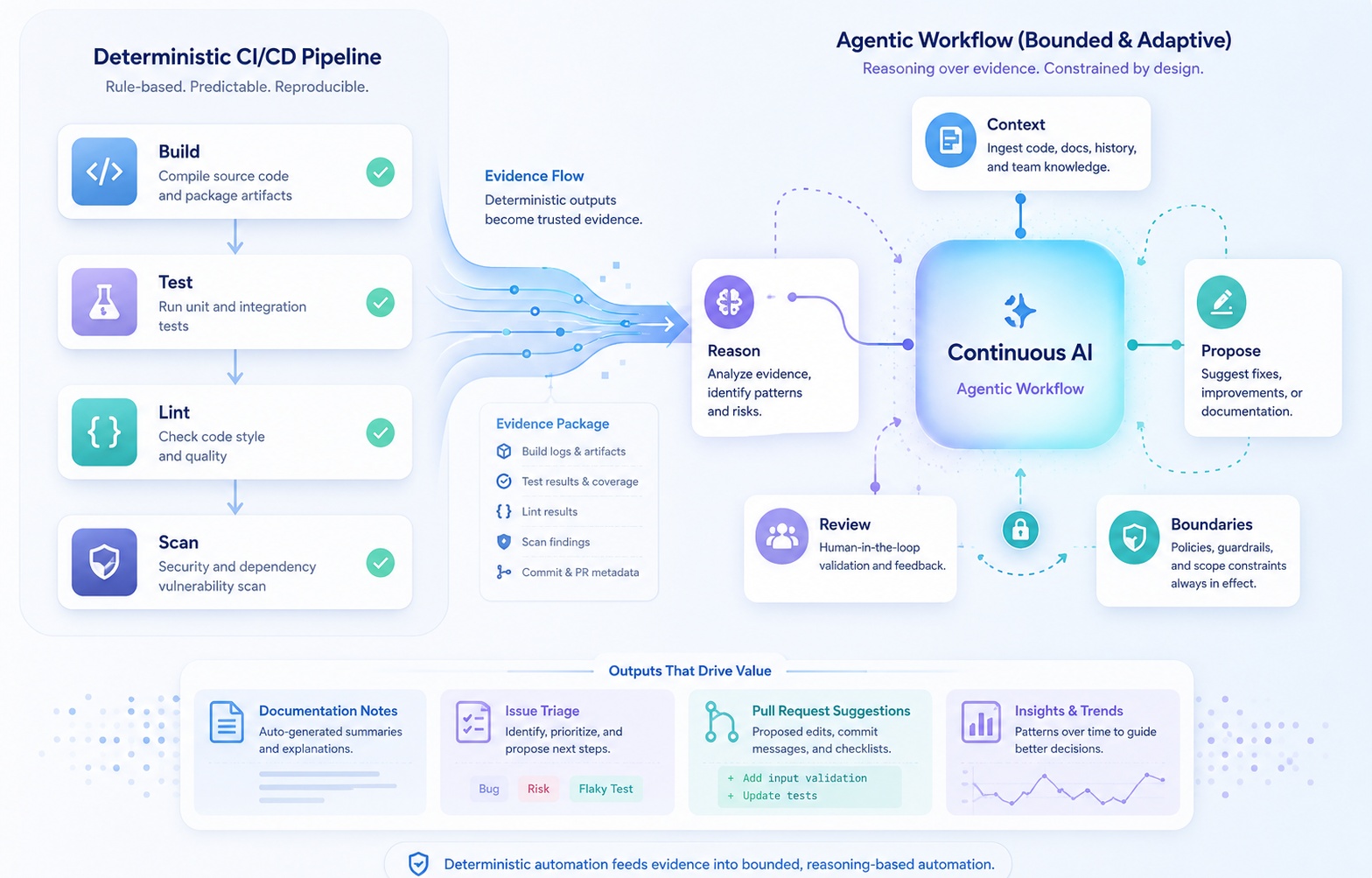
GitHub Next has described Continuous AI as <cite index="13-1">a broad category of activities, workloads, and capabilities, rather than any single tool</cite>, and has been explicit that the pattern <cite index="13-1">can involve fully autonomous AI agents, but more often centres on scripted "agent-like" AI workflows that are not fully autonomous, but rather involve human oversight and control</cite>. That is a materially different claim than "AI will run your pipeline." It is closer to: certain classes of repository work that have always resisted rule-based automation can now be handled by bounded, reviewable, agent-executed workflows that sit next to your existing CI, not inside a replacement for it.
Idan Gazit, who leads GitHub Next, put the underlying rationale directly: <cite index="14-1">this is why GitHub Next has been exploring a new pattern: Continuous AI, or background agents that operate in your repository the way CI jobs do, but only for tasks that require reasoning instead of rules</cite>. Gazit's framing of what CI is actually good at is worth sitting with, because it is easy to describe CI failures as shortcomings. They are not. <cite index="14-1">CI isn't failing. It's doing exactly what it was designed to do. CI is designed for binary outcomes. Tests pass or fail. Builds succeed or don't. Linters flag well-defined violations.</cite> The problem Continuous AI is aimed at is not that CI is broken. It is that a large share of engineering work was never expressible as a binary check in the first place — <cite index="14-1">a docstring says one thing, but the implementation says another; text passes accessibility linting but is still confusing to users; a dependency adds a new flag, altering behavior without a major version bump</cite> — and no amount of tightening the rules closes that gap, because the gap is not a rules problem.
It is important not to overstate the maturity of this pattern. GitHub's own engineering implementation of Continuous AI, GitHub Agentic Workflows, is explicitly labeled as being <cite index="6-1">in public preview and subject to change</cite>. It reached that status after moving from a technical preview announced in February 2026, which itself described the feature as <cite index="5-1">a way to automate repository tasks using AI agents that run within GitHub Actions</cite> covering <cite index="5-1">issue triage, pull request reviews, CI failure analysis, and repository maintenance</cite>. It is a real, shipping capability with production adopters, not a research demo — but it is also an emerging pattern with an evolving specification, not a settled engineering discipline with an agreed standard, and it should be evaluated with that in mind.
It is also worth separating three things that get casually collapsed into one idea: Continuous Integration, Continuous Delivery/Deployment, and Continuous AI. CI verifies that a change integrates correctly against a known, deterministic set of checks. CD automates the deterministic movement of verified artifacts toward a release. Continuous AI is neither of these; it is a pattern for delegating judgment-dependent repository tasks — the kind that were never going to become CI checks no matter how carefully you wrote the rules — to a reasoning process that operates under constraints. None of the three subsumes the others, and organizations that treat Continuous AI as "the next phase after CI/CD" are setting an expectation the pattern was not designed to meet.
The Real Line Isn't "Simple" vs. "Difficult." It's "Specifiable" vs. "Interpretive."
There is a tempting but wrong way to divide engineering tasks between deterministic automation and agentic automation: put the easy things in CI and the hard things in AI. That framing produces bad architecture, because difficulty and specifiability are different axes entirely.
Running a full regression suite across a large distributed system can be operationally difficult — slow, flaky, resource-intensive — and it remains a fully deterministic problem: the test either exercises the specified behavior correctly and the assertion holds, or it does not. Difficulty here is a scaling problem, not an interpretation problem. Compare that to deciding whether two bug reports describe the same underlying issue. That task is often trivial in terms of effort — a few seconds of reading — but it is fundamentally interpretive: it requires understanding intent, context, and often tacit product knowledge that was never written down anywhere the machine could parse as a rule.
The actual dividing line is whether a task can be expressed as an explicit, finite, checkable procedure. Tasks like running unit tests, building artifacts, validating a schema, checking formatting, verifying a dependency lockfile, performing security scanning against known vulnerability databases, and running integration tests all share a property: correctness is procedurally specifiable. You can write down, in advance, exactly what "correct" means, and a deterministic program can check it.
Contrast that with tasks like: does the documentation still match the implementation? Does this new issue look like a duplicate of an existing one? Which area of a large codebase most plausibly explains an unfamiliar CI failure? Does new code deviate from architectural conventions the team has established but never formally encoded? Which untested code path most deserves additional coverage, given the behavior it implements? Did a dependency update introduce a change that deserves a human's attention even though nothing technically broke? Should a given pull request's behavioral change be reflected in release notes?
None of these are hard in the sense of requiring more compute. They are hard in the sense that "correct" cannot be fully pre-specified; it depends on context that shifts from one instance to the next, and the person evaluating an answer would recognize a good one without being able to write an exhaustive rule that generates it. That is the actual boundary that should decide where deterministic automation ends and where agentic automation might begin to add value — and it is worth being disciplined about the word "might," because interpretive difficulty is a necessary condition for agentic automation to be useful, not a sufficient one. A lot of interpretive tasks are also high-stakes, irreversible, or poorly bounded, and those properties argue against automating them at all, agentically or otherwise. That tension runs through the rest of this article.
One more terminological note. It is tempting, when describing what an agent does with an interpretive task, to say it "understands" the code or "reasons" about it the way an engineer would. Precision matters here. What is actually happening is that a probabilistic, context-sensitive model, operating within a defined set of tools and constraints, produces an output conditioned on the evidence it was given and the instructions it was given. That is not equivalent to human understanding, and describing it that way makes it harder, not easier, to reason clearly about where it will fail.
Natural Language Becomes Part of the Execution Contract
The most structurally significant change Continuous AI introduces is not the presence of a model. It is that natural language becomes executable configuration.
Traditional automation is defined in YAML, shell, application code, and explicit rule sets. Whatever ambiguity exists in a Python script or a Makefile target is ambiguity the compiler or interpreter will refuse to tolerate; the program either parses correctly and does one specific thing, or it errors. GitHub Agentic Workflows inverts part of that model: <cite index="6-1">agentic workflows execute natural language instructions with contextual reasoning</cite>, with a workflow defined as <cite index="4-1">a markdown file that contains YAML frontmatter for configuration and natural language instructions for the AI agent</cite>.
This is a genuine capability. Natural language is expressive in ways that formal configuration languages are not — a team can describe an objective like "make sure new public API surface has matching documentation before merge" in a single sentence, where the equivalent deterministic implementation would require enumerating every pattern that constitutes "public API surface" and every pattern that constitutes "matching documentation," which is precisely the enumeration problem that made this an interpretive task in the first place.
But the properties that make natural language expressive are the same properties that make it dangerous as configuration. It is contextual, which means the same sentence can mean different things depending on what surrounds it. It is easy to modify, which means small wording changes can pass code review as if they were cosmetic when they are not. It is frequently underspecified, leaving gaps that the agent has to fill with its own judgment at runtime — judgment the author did not necessarily intend to delegate. And it can be internally contradictory in ways that are much harder to catch by inspection than a syntax error, because there is no compiler that will flag a workflow instruction that says "be conservative about proposing changes" in one sentence and "propose fixes for anything you find" in another.
The engineering conclusion here is not "avoid natural-language workflows." It is that a workflow prompt governing production repository automation is not documentation. It is configuration with runtime consequences, and it needs the same discipline any other piece of production configuration needs: versioning, code review by someone other than the author, a visible change history, a way to test changes before they reach production behavior, and a rollback path when a revision turns out to behave differently than intended. GitHub's own tooling reflects this by treating the markdown workflow file as source that gets compiled into a hardened, committed artifact — <cite index="21-1">the .md file is the editable source of truth, while the .lock.yml is the compiled GitHub Actions workflow with security hardening</cite> — which means both the human-readable instruction and its compiled form end up in version control, reviewable in a pull request like any other change.
A One-Sentence Edit Can Be a Permission Expansion
Consider two versions of the same instruction, differing by a handful of words.
Version A: "Review this pull request for missing tests."
Version B: "Review this pull request and add tests for uncovered behavior."
Linguistically, the difference is small — a shift from "review" to "review and add." Operationally, it is enormous. Version A is an analysis task; its worst plausible failure mode is a bad or unhelpful comment. Version B is a repository-modification task; its worst plausible failure mode is a merged change that alters behavior, introduces a bug, or bakes in an incorrect assumption about what the code is supposed to do, dressed up as "coverage."
This is the practical reason that natural-language workflow instructions cannot be reviewed the way prose is normally reviewed — for clarity and tone — and instead need to be reviewed the way a permissions change or an infrastructure-as-code diff is reviewed. A prompt edit that shifts from analysis to modification is not a wording improvement. It is a permission expansion, and it deserves the same review weight as a pull request that adds contents: write to a workflow's YAML permissions block, because in practice, it often has to be accompanied by exactly that kind of change. Reviewers of agentic workflow changes should be asking, for every diff to an instruction file: does this change what the agent is now allowed to conclude, what tools it now has access to, what it is now permitted to output, how much it will now cost to run, or what class of behavior it can now exhibit that it could not before? A wording change that answers "yes" to any of those questions is a behavioral change, whatever it looks like in the diff.
Declarative and Agentic Automation Are Related, Not the Same
Engineers already have a mental model for automation that specifies a target rather than a procedure: declarative systems. A Kubernetes manifest specifies a target state; the controller figures out how to reconcile the cluster toward it. A build system's dependency graph specifies what artifacts are needed; the build tool figures out an execution order. It is tempting to slot agentic automation into the same category — "you tell it what you want, and it works out how."
The analogy holds at a surface level and breaks at the level that matters. A declarative reconciliation loop is still executing a fully deterministic algorithm; given the same starting state and the same target, it will take the same path to get there, and that path is auditable in advance by reading the reconciler's source code. An agentic workflow, given the same starting state and the same instruction, may take a different path on different runs, because the intermediate reasoning is probabilistic rather than algorithmic. The declarative system's flexibility is about not caring which valid path is taken. The agentic system's flexibility is about the path not being fully knowable in advance at all.
Agents also remain bounded, and it matters to keep that concrete rather than treating "the model decides" as an open-ended capability. What an agent can actually do in a given run is bounded by the tools it has been granted, the permissions attached to those tools, the runtime and resource budget it is operating within, the underlying model's actual capability on the task at hand, the context it has been given or can retrieve, the instructions it was configured with, and whatever external systems it is permitted to call. None of those boundaries emerge from the model "choosing" to respect them. They are engineered constraints sitting around a probabilistic process, and the quality of an agentic workflow is largely a function of how well those constraints were designed — which is the subject of most of the rest of this article.
What Should Stay Deterministic
Before going further into what agentic automation can add, it is worth being unambiguous about what it should not touch, because the risk in this domain is not underuse. It is enthusiasm outrunning judgment.
Compilation should remain deterministic. Unit-test pass/fail evaluation should remain deterministic. Cryptographic verification, schema validation, code formatting checks, dependency-lockfile verification, and known-CVE security scanning should remain deterministic. Required policy gates — license compliance, artifact signing, mandatory approval counts, exact numeric thresholds like coverage floors — should remain deterministic. None of these benefit from being reinterpreted probabilistically, and several of them would become actively worse if they were: a security gate that only usually catches a known vulnerability pattern is a worse security gate than a static rule that catches it every time.
The underlying principle is straightforward: if correctness can be expressed precisely as code, there is little engineering reason to replace that code with probabilistic judgment. Interpretation adds value exactly where precise specification is not achievable — not as a general substitute for precision where precision already exists. Agentic automation should augment rule-based automation in the territory rules cannot reach. It should never be used to make an already-deterministic check less deterministic, because that trade gives up certainty in exchange for something that, at best, approximates the certainty it replaced, and at worst, degrades it invisibly.
The Hybrid Pipeline
Put together, this produces a layered architecture rather than a replacement:
Code Change
     │
     ▼
Deterministic CI
 ├─ Build
 ├─ Unit Tests
 ├─ Integration Tests
 ├─ Lint / Format
 └─ Security & Dependency Scans
     │
     ▼
Agentic Layer  (reasoning-based, evidence-grounded)
 ├─ Investigate an unusual CI failure
 ├─ Check documentation against the diff for drift
 ├─ Identify undertested behavior in the change
 └─ Summarize architectural or cross-cutting impact
     │
     ▼
Validated, Reviewable Output
 ├─ Comment
 ├─ Issue
 └─ Pull Request
     │
     ▼
Human / Policy Review
     │
     ▼
Merge / Release
The two layers are not competing for the same responsibility; they complement each other, and the direction of that complementarity matters. Deterministic CI should run first and produce evidence — test results, coverage deltas, lint findings, dependency changes, benchmark numbers, repository history — that the agentic layer consumes as grounding for its reasoning, rather than the agentic layer operating on raw, unverified intuition about what "looks right." A workflow that asks an agent "does this change look safe?" with no supporting evidence is asking it to speculate. A workflow that hands the agent the actual diff, the actual test results, the actual coverage delta, and the actual dependency changes, and then asks it to assess risk given that evidence, is asking it to reason from grounded facts. The difference in reliability between those two workflow designs is large, and it is entirely a matter of how much deterministic evidence the agent is given before it is asked to interpret anything.
The Context Window Is Not the Repository
It is worth being precise about what "giving an agent context" actually means mechanically, because a common misconception distorts how people design these workflows: the idea that a coding agent simply "reads the whole codebase" the way a very fast engineer might skim every file before answering a question.
That is not how these systems typically operate, and treating it as if it were leads to workflow designs that either waste budget trying to stuff enormous amounts of text into a single prompt, or that quietly assume the agent has awareness of files it never actually inspected. In practice, an agent working against a repository has to search, retrieve, and navigate — using tools to query the GitHub MCP server, to search code, to inspect specific files, to pull specific issues or pull request threads — assembling the relevant slice of context iteratively rather than holding the entire repository in view at once. GitHub's own architecture reflects this directly: <cite index="28-1">the agent has read-only access to GitHub state via the GitHub MCP server</cite>, which is a retrieval mechanism, not a full-repository memory dump.
This has direct design implications. More context is not automatically better; an oversized or poorly scoped context window increases cost, increases the chance of irrelevant or contradictory material influencing the output, and increases the chance that stale documentation or an out-of-date comment gets treated as current fact. Workflow authors need a deliberate context boundary — which files, which metadata, which historical discussion the agent is meant to consider — rather than an implicit assumption that "it can just look things up." Cross-repository access, private or sensitive information, generated files, and vendored third-party code all deserve explicit decisions about whether they belong in an agent's field of view at all, not default inclusion because nobody thought to exclude them.
Designing a Task That Is Actually Fit for This
Not every interpretive task is a good candidate for agentic automation, even setting aside the deterministic-versus-interpretive question. A well-formed candidate task tends to share several properties: it recurs often enough that automating it is worth the engineering investment; it genuinely requires interpretation rather than being a rule in disguise; the evidence needed to make a good judgment is actually accessible to the agent; the scope of the task is bounded rather than open-ended; the resulting output is something a human can meaningfully review; and the cost of the agent being wrong in a given instance is manageable rather than catastrophic.
"Improve the entire architecture" fails almost every one of those properties. It has no natural boundary, no clear evidence set, no obvious reviewable artifact, and an essentially unbounded blast radius if the agent's judgment is wrong. "Review recently modified authentication code for deviations from the repository's documented authentication patterns, and open an issue with cited evidence for each potential deviation" is a materially better-formed task. It is scoped to a specific, security-relevant subsystem. It has a defined evidence source — the documented patterns, presumably in an architecture doc or a set of established conventions. It produces a reviewable artifact — an issue, not a silent change. And a wrong conclusion costs a maintainer a few minutes of reading an issue that turns out not to apply, rather than costing a shipped authentication regression.
The general lesson is that agentic workflows should be written the way you would write a job description for a competent but literal-minded new team member with narrow authority: a specific area of responsibility, a specific kind of evidence to work from, and a specific kind of output to produce, rather than a broad mandate to "help."
Continuous Documentation
Documentation drift is a useful worked example precisely because it demonstrates the deterministic/interpretive boundary so cleanly. Traditional CI can verify that a link resolves, that a referenced file exists, that a markdown document is syntactically valid. None of those checks can answer the actual question that matters to a reader: does this documentation still accurately describe what the code does?
An agent working this problem can compare an implementation against its public API surface, its configuration schema, its README, and its reference documentation, and flag places where the two have diverged — the exact category of drift Gazit cited: <cite index="14-1">a docstring says one thing, but the implementation says another</cite>. The output of that comparison can take several forms depending on how much autonomy the workflow has been granted: a report listing suspected drift for a human to investigate, a suggested patch attached to an issue, or a full pull request with a proposed documentation update.
Testing a workflow like this requires asking a specific set of questions that have nothing to do with whether the workflow "ran successfully." Did it identify drift that actually exists, rather than inventing a discrepancy that isn't there? Did it confine its edits to the documentation it was assessing, rather than rewriting unrelated prose because it was already touching the file? Did it correctly preserve working code examples rather than "fixing" them into something that no longer runs? Did it avoid deleting documentation that was intentionally incomplete or forward-looking, mistaking it for an error? Each of those is a behavioral property that a passing CI run tells you nothing about.
Continuous Test Improvement
This deserves particular attention for a quality-engineering audience, and it deserves to be framed carefully, because the naive version of this idea — "AI writes all the tests" — is both wrong about what these systems reliably do well and a bad target to optimize toward.
The more defensible pattern is a background agent that identifies areas of weak coverage relative to changed behavior, inspects what a specific change actually does, suggests missing test scenarios grounded in that behavior, generates candidate tests for a human to evaluate, and separately investigates flaky or intermittently failing tests to characterize why they fail rather than simply rerunning them until they pass.
The critical distinction to hold onto throughout any of this is between coverage quantity and test quality. A workflow that raises a coverage percentage from one number to a higher number has not automatically improved confidence in the system; it may have added tests that assert something trivially true, that duplicate existing coverage under a new name, or that are so tightly coupled to implementation details that they will need to be rewritten the next time someone refactors, adding maintenance burden without adding protection. Evaluating agent-proposed tests means actually reading them for meaningful assertions, coverage of negative paths and boundary cases, absence of redundancy with existing tests, resistance to becoming brittle under refactors that shouldn't break them, and reasonable runtime — the same criteria you would apply to a human-authored test, applied with no less rigor because the author was a model.
Continuous CI Failure Investigation
A conventional CI system reports a fact: a test failed. It does not, on its own, tell you why, and figuring that out — especially for an unfamiliar or intermittent failure — is often one of the more time-consuming interpretive tasks in day-to-day engineering. Eddie Aftandilian of GitHub Next described this as a central motivating case for the pattern: <cite index="17-1">there are many tasks developers may want to perform as part of the continuous integration process, but that can't realistically be done with a purely deterministic algorithm</cite>, and CI failure triage is a clear example — <cite index="17-1">there's a whole class of these things that you always want an agent watching the events in the repo, maybe running on a schedule, or running when an issue is created, and then following a list of steps on how to vet that or how to deal with it</cite>.
An agentic investigation workflow can correlate a failure against the specific change that likely caused it, compare the failure signature against previously seen failures to spot a recurring pattern, distinguish an infrastructure-level failure from an application-level one based on log content, identify which files most plausibly deserve inspection, and propose a candidate fix for a human to evaluate.
The critical governance point here is about what the agent is not permitted to do in the course of this investigation. It should not be granted the ability to silently rewrite a failing test in order to restore a green build. That sounds like an edge case until you list the concrete forms it takes: changing an expected value to match what the code currently produces, removing an assertion that is inconvenient, adding a skip annotation, widening a timeout until a race condition stops manifesting, or otherwise treating "the test now passes" as equivalent to "the code is now correct." Any of those actions makes the pipeline look healthier while making the system it is protecting less well understood. This is precisely the kind of task where the appropriate output is a proposal — an issue with a hypothesis and supporting evidence, or a draft pull request — rather than a direct, unreviewed change to test expectations, because the cost of getting it wrong compounds silently.
Continuous Issue Triage
Issue triage is a comparatively low-risk domain for agentic automation, but not a risk-free one, and the distinction is instructive. An agent can reasonably be asked to summarize an issue, apply labels, flag a likely duplicate, route it toward the subsystem it most plausibly concerns, and identify when a report is missing the information needed to reproduce it.
The failure modes are real even if the average cost per failure is low: a misassigned priority that buries something urgent, incorrect ownership routing that delays response, a duplicate misclassification that causes a genuinely distinct issue to be silently closed, or — the case that deserves the most caution — a security-sensitive report being triaged in a way that increases its public visibility rather than routing it to a private security process. The general principle is that some triage metadata is genuinely low-stakes and tolerant of occasional error, while other triage decisions carry operational consequences disproportionate to how mundane the task looks on the surface. Workflow design should reflect that distinction rather than treating all issue-triage output as uniformly low-risk simply because "triage" sounds administrative.
Continuous Dependency Analysis
Dependency automation already has a deterministic backbone that should stay exactly where it is: version graphs, known-vulnerability databases, lockfile diffs, and build verification are all things a deterministic tool does reliably and should keep doing. What deterministic tooling generally cannot do is read a dependency's release notes and assess whether a change, even one that respects semantic versioning, is likely to alter behavior your codebase depends on.
An agent can inspect release notes, flag breaking changes even when they were not flagged as breaking upstream, identify which of your own code paths touch the affected API, and summarize whether the update deserves scrutiny beyond "the build still passes." This is a hybrid task by nature: the deterministic layer establishes what changed and whether it builds; the agentic layer assesses whether the change is likely to matter given how your specific codebase uses the dependency.
Continuous Localization
Localization is a good illustration of the same division of labor in a different domain. An agent can identify newly introduced or changed user-facing strings in a diff and propose translations grounded in the surrounding context. What it should not be trusted to verify on its own is the mechanical correctness of the result — missing translation keys, broken placeholder tokens, malformed locale files, and, where relevant, layout implications of translated text. Those checks are precisely specifiable, and a deterministic validator should own them regardless of whether the translation itself came from a human translator or a model. The pattern repeats: semantic generation from an agent, deterministic validation of the result.
Continuous Code Cleanup
Cleanup tasks — duplicate code identification, simplification, dead-code removal, naming consistency, catching architectural drift from established conventions — are worth including with a note of skepticism, because a meaningful share of what gets labeled "cleanup" is actually a matter of taste rather than an objectively correct change. An agent's opinion that a function should be restructured is not self-evidently more authoritative than a human's opinion that it shouldn't be, and workflows in this category should almost always produce a proposal — a pull request or an issue with a suggested diff — rather than an invisible, unreviewed mutation to the codebase. The value of a cleanup agent lies in surfacing candidates a human might not have noticed, not in unilaterally deciding what "cleaner" means.
The Output Model
Across every example above, one design decision recurs and matters more than almost any other: what is the agent actually allowed to produce?
There is a real risk spectrum here, roughly ordered from lowest to highest exposure: analysis with no artifact at all, an annotation or comment, a new issue, a draft, a patch, a full pull request, a direct change to a branch, an actual merge, and a deployment action. Not every system supports every point on this spectrum, and this list is conceptual rather than a claim about any specific tool's capabilities — but the underlying principle holds generally: the farther an output moves toward an irreversible, unreviewed action, the stronger the surrounding controls need to be before that output is permitted. A workflow that can only leave a comment has a bounded worst case. A workflow that can push directly to a protected branch does not, and the controls around it should be proportionate to that difference, not identical to the controls around the commenting workflow because both happen to be labeled "AI."
Reviewable Artifacts Are Not a Nicety — They're the Governance Mechanism
One of the more understated design decisions in this space is the choice to route agent output through artifacts that existing engineering processes already know how to handle: diffs, pull requests, issues, comments, structured reports, test results. This matters more than it might initially seem to, because these artifact types already come with review workflows, ownership conventions, permission models, revision history, rollback mechanisms, and discussion threads built in. An organization does not need to invent new governance machinery to handle agent output if that output arrives in the same shape as human-authored output always has.
This is also the practical argument against invisible background mutation, whatever the task. A pull request the agent opens can be diffed, commented on, run through the same deterministic CI as any human contribution, compared against the base branch, and rejected or reverted using tooling teams already understand. A change applied silently, with no artifact and no diff, has none of that, and the fact that it might have been correct does not compensate for the fact that nobody could have checked.
"Safe Outputs" as a General Architectural Idea
GitHub's own implementation gives a concrete, currently-shipping example of this principle taken seriously at the infrastructure level, and it is worth describing accurately rather than treating it as a black box. The agent job in a GitHub Agentic Workflow runs read-only by default: <cite index="20-1">the supported agent-job path defaults to read-only GitHub access and sandboxed execution</cite>, and <cite index="28-1">the agent has read-only access to GitHub state via the GitHub MCP server — it cannot write anything directly, not even add a comment</cite>. When the agent wants to take an action with a side effect — commenting, opening an issue, opening a pull request — it does not perform that action itself. It requests it through a separate mechanism: <cite index="28-1">the agent buffers the action through the Safe Outputs MCP server, and the agent job exits</cite>. <cite index="20-1">Safe outputs buffer configured writes, validate them, and apply them in separate jobs with scoped permissions</cite>, and those outputs are also sanitized before they are rendered anywhere: <cite index="25-1">the text output by AI agents is automatically sanitized to prevent injection of malicious content, applying XML escaping, HTTPS-only enforcement, a domain allowlist, size limits, and control-character stripping</cite>.
The specific mechanism is GitHub's, and it should be treated as one implementation of a broader architectural principle rather than a universal standard every agentic system follows. But the principle itself generalizes cleanly, and any team building agentic automation on any platform should be asking whether their own architecture reflects it: the reasoning process should not hold unrestricted write credentials. There should be a structural separation between the runtime that reasons and proposes, the intermediate representation of what it wants to do, a validation or policy layer that inspects that proposal against rules the reasoning process does not control, and only then, the actual write action. That chain of separation is what reduces blast radius when the reasoning process is wrong, confused, or manipulated — and it is a meaningfully stronger guarantee than trusting the instructions given to the model to be followed correctly every time, because instructions are exactly the layer that natural-language ambiguity, discussed earlier, makes least reliable.
The Current State of GitHub Agentic Workflows
Since this article treats GitHub's implementation as a primary example throughout, it is worth summarizing its current shape directly, based on official documentation current as of publication, with the understanding that a public-preview feature will continue to change.
A workflow is authored as a markdown file with YAML frontmatter, committed to .github/workflows/. <cite index="21-1">The frontmatter defines triggers (when the workflow runs), permissions (what it can access), and tools (what capabilities the AI has), while the markdown contains natural language task descriptions.</cite> The gh aw compile command turns that source file into a .lock.yml file — the hardened, actually-executed GitHub Actions workflow — and both files are committed to the repository, so the human-readable instruction and its compiled, security-hardened form are both visible in version control and both reviewable in a pull request. Compilation also runs the workflow through security scanners; one third-party technical writeup describes the compiler pinning all action dependencies to specific commit SHAs and running <cite index="28-1">actionlint for workflow linting, zizmor for privilege escalation vulnerabilities, and poutine for supply chain risks</cite> — a detail worth independently verifying against current documentation before relying on it, since tooling in a public-preview feature can change.
Multiple AI engines are supported behind the same workflow format: official documentation lists <cite index="21-1">GitHub Copilot (default), Claude by Anthropic, Codex, and Gemini by Google</cite>, with the project's own repository additionally naming Pi among <cite index="20-1">built-in AI engines</cite>. Network access from inside the agent's sandbox is deliberately constrained: the execution environment runs behind <cite index="22-1">the Agent Workflow Firewall, which containerizes the agent and routes all HTTP/HTTPS traffic through a proxy with a domain allowlist</cite>, meaning a workflow author has to explicitly declare which external network destinations, if any, the agent may reach.
GitHub has been explicit that this is meant to sit beside existing CI/CD, not replace it: the project's own guidance states plainly that engineers should <cite index="20-1">use conventional GitHub Actions for deterministic builds, tests, linting, deployments, and reproducible scripts, and add an agentic workflow when a task needs reasoning or interpretation</cite>, and that <cite index="20-1">GitHub Agentic Workflows complements existing CI/CD; it does not replace it</cite>. That is a direct, primary-source confirmation of this article's central framing, not merely an inference from the tooling's design.
Adoption evidence, where available, is worth citing precisely rather than generalizing into an industry trend. At the time of the public preview announcement, GitHub cited two named early adopters. A Carvana engineering executive described using agentic workflows for <cite index="3-1">changes that span multiple repositories</cite>, saying the platform's <cite index="3-1">flexibility and built-in controls give us confidence to leverage agentic workflows across complex systems</cite>. A Marks & Spencer engineering executive described building <cite index="3-1">a catalogue of reusable workflows spanning security, quality, and delivery that teams can adopt across any repository</cite>, framing the value as recovering time previously lost to <cite index="3-1">repetitive work such as triaging issues, remediating vulnerabilities, maintaining dependencies, and reviewing routine changes</cite>. These are two organizations' accounts of their own experience, not evidence of broad industry adoption, and this article does not extrapolate beyond what they said.
Multiple Engines, One Instruction — a New Testing Problem
The fact that a single workflow definition can run against different underlying engines — <cite index="21-1">each engine interprets natural language instructions and executes them using configured tools and permissions</cite> — creates a testing problem that has no equivalent in deterministic automation. A shell script produces identical behavior regardless of which machine executes it, because the instruction is unambiguous by construction. A natural-language instruction, run by two different models, or by two different versions of the same model, can produce two outputs that are both individually defensible and still meaningfully different from each other — different documentation phrasing, a different but equally valid set of proposed tests, a different framing of the same root-cause hypothesis.
The practical consequence is that testing an agentic workflow cannot rely on exact output matching the way testing deterministic automation can. Teams need behavioral acceptance criteria instead — a definition of what any acceptable output must satisfy, regardless of its exact wording or structure — rather than a definition of what one specific output must look like. This distinction runs through the entire next section, because it is the single biggest departure from how engineers are used to testing automation.
Testing an Agentic Workflow
Traditional workflow testing asks a narrow question: did the expected command execute, and did it produce the expected exit code? Agentic workflow testing has to ask a broader one: did the outcome satisfy an acceptable set of constraints, given that there may be more than one acceptable outcome?
It helps to separate what gets tested into three distinct categories, because each requires a different evaluation mechanism, and conflating them leads to test suites that either miss real problems or produce false failures on harmless variation.
Deterministic assertions are checks that remain exact-match regardless of how the agent reasoned to get there. Did the workflow modify any file outside its declared scope? Did any deployment action occur when the workflow was only authorized to analyze? Did all agent-generated code compile? Did all agent-modified tests still pass? Is the structured output in the expected schema? These are binary, and they should be tested exactly the way any deterministic property is tested — because they are deterministic properties, even though they're wrapped around a probabilistic process.
Behavioral assertions check properties of the process, not just the outcome. Did the agent actually inspect the files relevant to the task before concluding anything, or did it produce a plausible-sounding answer without grounding? Did it alter a test's expected values without providing a justification tied to evidence? Did every substantive recommendation cite something concrete — a file, a line, a test result — rather than asserting a conclusion with nothing behind it? When the input was genuinely ambiguous, did the agent escalate that ambiguity instead of guessing? These require inspecting the agent's tool-use trace and intermediate actions, not just its final output, and they are usually the most informative category for catching workflows that produce plausible-looking but ungrounded results.
Semantic evaluation checks whether the content of the output is actually correct — is the documentation update accurate, is the issue classification sensible, does the proposed test actually cover meaningful behavior. This is the category where full automation is hardest and where human review, or a separately-run evaluation model checking specific factual claims against ground truth, does the most work. It should be used where the first two categories cannot answer the question, not as the default evaluation mechanism, because it is the most expensive and the least precise of the three.
The unifying principle across all three: use deterministic assertions wherever a property can be checked deterministically, and reserve semantic evaluation for genuinely irreducible judgment calls. A team that defaults to semantic evaluation for everything is doing the equivalent of manual QA for properties a script could check exactly.
Do Not Test Probabilistic Output as Exact Text
It is worth stating directly, because it is a common early mistake: if two different summaries of the same finding are both factually correct and both actionable, exact string comparison between them is not a meaningful test, and a test suite that asserts on exact output text will fail constantly on harmless variation while telling you nothing about whether the workflow is actually working.
Instead, test the properties that matter regardless of exact phrasing: required facts that must appear somewhere in the output, claims that must never appear, evidence that must be referenced, conformance to an output schema if one is expected, adherence to declared action boundaries, and any business invariant the output has to respect. This is a stricter, more useful bar than string matching, and it is also more work to design well, which is exactly why it deserves deliberate attention rather than being treated as an afterthought once the workflow "seems to work."
Golden Datasets for Workflows
One of the more transferable practices from traditional machine learning evaluation into this domain is building a representative set of historical scenarios and running the workflow against all of them before trusting it against live traffic. A documentation-drift workflow can be tested against a known, previously identified case of drift, alongside cases where documentation was accurate and should trigger no action. A CI-investigation workflow can be tested against a known flaky test and a known genuine regression. A triage workflow can be tested against a known duplicate pair and a known false-positive duplicate pair. An architecture-review workflow can be tested against a known real deviation and a case that superficially resembles one but isn't.
Running the workflow against this dataset produces measurable signal: correct-detection rate, false-positive rate, false-negative rate, the qualitative usefulness of what was recommended, the rate at which the workflow took an unsafe or out-of-scope action, and the cost and latency of each run. None of these numbers have a universal acceptable threshold that applies across organizations or task types — that would be a false precision this article is not going to manufacture — but having them at all, and tracking them over time as the workflow's instructions or underlying model change, is the difference between operating an agentic workflow with evidence and operating one on faith that it's still doing what it did when it was first configured.
Shadow Mode
The single lowest-risk way to introduce a new agentic workflow is to run it without granting it any write capability at all, and simply record what it would have proposed. No comment gets posted, no issue gets opened, no pull request gets created — the workflow runs on real, current repository events, and its output is logged for comparison against what a human reviewer actually decided in the same situation.
This produces something a golden dataset cannot: evidence of how the workflow performs against genuinely current, unseen inputs, rather than against a fixed historical set that the workflow's instructions might implicitly be tuned toward. It is a deployment pattern, not a specific product feature — most agentic tooling does not enforce this as a distinct mode, and building it typically means configuring the workflow's declared output capability to be report-only during an evaluation period rather than relying on a dedicated dry-run switch. But the pattern is worth treating as a default first stage for any new workflow with a nontrivial error cost, because it converts "we think this is ready to write to the repository" from a guess into a claim backed by a comparison against real human decisions.
Progressive Autonomy
Shadow mode naturally leads into a broader point: autonomy should be earned incrementally, not granted at whatever level seems most impressive to configure on day one.
A reasonable progression looks like: read-and-report first, with no write capability at all. Then, once the workflow has demonstrated it reliably produces useful output, comment capability, which is low-cost to ignore if wrong. Then issue creation, which persists but is still easily closed and does not touch code. Then pull-request creation, which touches code but remains fully reviewable and requires a human merge decision before it has any effect. Only beyond that point, and only where there is a specific, evidenced justification, should higher-impact operations — direct writes to protected branches, deployment actions, anything irreversible — be considered at all.
The correct autonomy level for a given workflow is not a fixed destination every team should aim for. It is a function of the specific task's error cost, how reversible a mistake would be, how much evidence has actually been gathered about the workflow's reliability, the organization's security posture, and its explicit governance policy. Maximum autonomy is not the implicit end goal of this progression; the right level is wherever the evidence stops supporting further expansion, and that point is different for a documentation-comment workflow than it is for a workflow with write access to release infrastructure.
Permissions and the Principle the Model Doesn't Get to Set Its Own Scope
Agentic automation reintroduces a security principle every engineer already knows — least privilege — with new stakes, because the entity being scoped is now something that reasons about its own task rather than executing a fixed sequence someone already fully specified. A workflow whose entire job is checking documentation accuracy has no legitimate need for deployment credentials, billing-system access, or production database write access, and granting it those things "in case it's useful later" is exactly the kind of scope creep that least-privilege design exists to prevent.
Concretely, the permissions worth deliberately scoping include repository read access, issue-write access, pull-request-write access, contents-write access, any outbound network access, and any secrets the workflow's tools might reach. Each of these should be granted because the specific task requires it, not granted broadly because narrowing them later feels like it can be deferred.
The rule that matters most here, and that is easy to get backwards, is that the system deciding what action to take should never be the same system that decides what it is permitted to do. Put concretely: the model can express a desire — "I want to update file X" — but whether that desire is actually permitted has to be evaluated by a deterministic policy layer sitting outside the model's own reasoning, and only if that policy layer approves does any tooling actually execute the write. If the permission boundary itself is something the model can reason its way around, it isn't a boundary. This is the same principle Safe Outputs implements structurally, described earlier, generalized into a rule any agentic system on any platform should follow regardless of vendor.
Prompt Injection in Repository Content
Repository agents routinely inspect content nobody engineered to be trustworthy: issue text, pull request comments, embedded documentation, code comments, and sometimes external content referenced from any of those. Any of that content can contain text specifically crafted to look like an instruction to the agent, attempting to get it to behave differently than its actual configured task intended.
The core defensive principle is straightforward to state and consequential to actually implement: content the agent is reading must never automatically become a trusted workflow instruction just because it appears inside the context the agent is examining. There has to be a maintained distinction between the instructions the workflow's owner configured and the arbitrary text the agent encounters while doing its job, and the architecture needs to enforce that distinction rather than relying on the model to reliably tell the difference on its own. This is precisely why an instruction hierarchy, careful treatment of untrusted content, tightly scoped tool boundaries, output sanitization, and restricted network access all matter as a combined system rather than any single one of them being sufficient alone — the sanitization step described earlier, for instance, exists specifically because agent-generated text could otherwise carry embedded content designed to execute when rendered elsewhere. This article deliberately does not describe specific injection techniques; the point worth taking away is architectural, not tactical.
Supply-Chain Exposure Through Agent Context
A related but distinct concern: an agent inspecting dependency files, generated artifacts, or external documentation is, in effect, extending the set of content that has some influence over its behavior. The same principle from prompt injection applies here in a narrower form — content sourced from outside the repository's trusted boundary should not automatically acquire the authority to direct the agent's actions simply because it happened to be included in the context the agent was given. This is not a call to treat every agentic workflow as a generic supply-chain security exercise; it is a reminder that the context boundary discussed earlier in this article is also, among other things, a trust boundary, and it deserves to be designed with that dual purpose in mind.
Cost Becomes Part of Pipeline Design
Traditional CI already has a real, familiar cost: compute time. Agentic workflows add a second cost on top of that — inference — and it does not scale the same way. A workflow that looks cheap on any individual run can become a meaningful expense in aggregate if it is triggered frequently enough, and the drivers of that cost are worth naming individually rather than treated as one undifferentiated "AI cost" line: the number of times the workflow runs, which model or engine it uses, how much context it is given, how many reasoning or tool-use steps a given run takes, how often runs are retried, the size of the repository it operates against, and the size of the output it generates.
The more useful cost framing for engineering leadership is not raw spend, but spend relative to value delivered: cost per genuinely useful artifact produced, cost per recommendation a human actually accepted, cost per AI-proposed change that was actually merged, cost per CI failure the workflow correctly diagnosed. Two workflows with identical token spend can have wildly different value if one has a high acceptance rate and the other is mostly generating output nobody uses — and token count alone, without that context, tells you almost nothing about whether the automation is worth what it costs.
Budgets as an Explicit Control
Resource boundaries deserve to be treated as a first-class part of workflow design rather than an afterthought discovered after a runaway bill. Concretely, that means setting a maximum runtime, a maximum inference spend, a maximum number of reasoning or tool-call steps, a maximum number of files a workflow is permitted to touch in a single run, and a maximum size for any generated output. Some platforms are actively building dedicated controls for this — for instance, GitHub has discussed AI credit controls as part of this space — but the specific names, defaults, and mechanics of any vendor's budget controls should be verified against current documentation before being described in detail, since this is one of the areas most likely to change during a preview period. The general engineering requirement holds regardless of the specific implementation: an autonomous or semi-autonomous workflow should never run with an effectively unbounded resource ceiling, the same way you would never ship a retry loop with no maximum retry count.
Latency Has a Different Meaning Here
A unit test in the critical path of a pull request needs to return a result quickly enough that it does not stall a developer waiting on it. A background documentation-drift analysis, by contrast, can tolerate meaningfully more latency without costing anyone anything, because nobody is blocked on it finishing in the next few seconds.
This means service-level expectations for agentic workflows should be set according to the workflow's actual purpose, not uniformly optimized for interactivity because that is the default engineers reach for with CI. It is worth explicitly distinguishing three categories when setting expectations: a blocking workflow that gates a merge and therefore needs to complete quickly and reliably; a non-blocking advisory workflow that can run in parallel with merge-relevant CI without holding it up; and a background maintenance workflow that can run on a schedule with no real-time pressure at all. Treating all three the same, typically by trying to make everything fast, either wastes engineering effort optimizing latency nobody needed, or worse, pressures a workflow that should have had time to gather more evidence into producing a faster, less grounded answer.
Should an Agentic Finding Block a Merge?
This deserves a careful, non-sweeping answer rather than a universal rule, because the honest answer depends entirely on how deterministic the underlying finding actually is.
An agentic finding sits somewhere on a spectrum from purely informational, to an advisory warning, to something requiring an explicit human review before proceeding, to — in rare cases — an actual hard gate. The general principle worth applying is that the more subjective a judgment is, the more caution is warranted before making it a hard blocker on shipping code. A deterministic finding — a genuine license violation flagged with certainty, a confirmed test failure — is a reasonable candidate for a hard gate, because there is no interpretive uncertainty in the finding itself. An agent's opinion that a variable naming convention seems inconsistent with the rest of the codebase is a fundamentally different kind of finding, and treating it with the same gating weight as a failed build conflates a judgment call with a verified fact. Where a finding genuinely warrants escalation — a plausible security concern, for instance — the better design is usually routing it to mandatory human review rather than an automatic block, preserving the human decision point without collapsing the distinction between "this needs a look" and "this is definitely wrong."
False Positives Have a Real Operational Cost
An agentic workflow that comments on every pull request with low-value, generic observations does not stay useful for long. Developers learn quickly which sources of feedback are worth reading and which are noise, and once a workflow crosses into the second category, its output starts getting ignored regardless of whether any individual comment happens to be correct — which defeats the purpose of running it at all, and quietly converts what was meant to be a quality signal into background noise that trains people to skip it.
This makes usefulness a genuinely operational metric, not a soft or subjective one, and it is measurable: acceptance rate of proposed changes, dismissal rate of flagged issues, the rate at which a finding actually prompts an action versus being closed with no follow-up, how often the same finding recurs without being addressed, an estimated false-positive rate, and the human review time each output consumes relative to the value it delivers. None of these numbers should be invented or assumed; they should be tracked from actual usage, the same way any other engineering tool's adoption and value would be tracked, and a workflow whose numbers are trending toward "ignored" needs either retuning or retirement, not continued deployment on the assumption that AI-generated output is inherently valuable.
Automation Can Create Work Instead of Removing It
It is tempting to treat any successful agentic workflow run as a productivity win by default, but that framing skips a step. A workflow that generates a dozen issues nobody needed, several pull requests of marginal value, a stream of repetitive comments, or refactors nobody asked for has not reduced engineering work — it has transferred it, from whatever the task originally would have required to the review burden of evaluating everything the workflow produced.
The relevant measure of net value is not activity generated. It is human attention saved by the workflow's genuinely useful output, minus the human attention required to review everything the workflow produced, including the parts that turned out not to be useful. A workflow can run constantly, generate a large volume of output, and still be a net negative by this measure if its signal-to-noise ratio is poor enough — and that possibility is exactly why the metrics in the previous section matter more than raw output volume ever will.
Review Debt
This produces a concept worth naming explicitly, because it is a real and growing operational category distinct from anything traditional CI produces: agent-generated artifacts create review obligations the same way human-generated pull requests do, and if the rate of generation outpaces the team's actual capacity to review carefully, the organization accumulates a backlog that behaves exactly like technical debt — quietly compounding until someone is forced to deal with it under worse conditions than if it had been addressed as it accrued.
This is not a dramatic bottleneck scenario; it is an ordinary capacity-planning question that deserves an ordinary answer: how many agent-proposed changes can this team actually review with the care those changes deserve, in a given period, without review quality degrading? If a workflow's output volume is calibrated against anything other than that number, review debt is the predictable result, and the fix is usually reducing the workflow's trigger frequency or scope, not asking humans to review faster.
Agent Fleets, and the Case Against a Single Do-Everything Agent
GitHub Next has discussed a pattern of multiple narrow, purpose-specific agents operating within a single repository rather than one broad agent handling an undifferentiated set of responsibilities — <cite index="9-1">documentation has been updated to reflect recent code changes, two new pull requests that improve testing await your review</cite>, describing a repository maintained by several distinct background processes rather than one general-purpose assistant, each responsible for a specific, bounded chore.
Comparing the two designs directly: a single instruction like "maintain repository quality" is difficult to test meaningfully, difficult to scope permissions for, difficult to budget, difficult to authorize with any precision, and difficult to evaluate, because "quality" is not one thing with one evidence set. A collection of narrower workflows — one for documentation drift, one for test coverage, one for issue triage, one for dependency analysis — is considerably more governable specifically because each one can have its own bounded permissions, its own golden dataset, its own budget, and its own accountable owner. That said, this is not a universal prescription; some repositories, particularly smaller ones with simpler needs, may reasonably be served by one broader agent rather than a proliferation of narrow ones, and the right granularity is a judgment call informed by the same properties that determine whether any given task is a good candidate for automation in the first place.
When Workflows Start Interacting With Each Other
Once multiple agentic workflows are operating in the same repository, a new systems-level problem appears that single-workflow thinking does not anticipate. Consider a documentation agent opening a pull request, a test-improvement agent inspecting that same pull request, a cleanup agent modifying the same files the documentation agent just touched, and a review agent commenting on the modifications the cleanup agent made. Each individual workflow may be behaving exactly as designed, and the aggregate behavior can still be a mess — competing edits, redundant findings, or worse, a workflow's own output triggering another workflow, which triggers another, in a loop nobody intended.
This deserves explicit design attention rather than being discovered in production: trigger design needs to account for the possibility of trigger storms where one event cascades into many workflow runs; recursive triggering needs an explicit circuit breaker, because "agent-created event triggers another agent" is a loop waiting to happen if nothing prevents it; deduplication needs to prevent multiple workflows from independently proposing the same fix; and every artifact needs clear provenance so that when two workflows' output conflicts, a human resolving the conflict can tell which workflow produced what, and why.
Provenance
That last point deserves its own emphasis, because it is what makes everything else in this article debuggable after the fact rather than only in principle. Every artifact an agentic workflow produces should carry enough metadata to answer, without guesswork, which workflow generated it, what version of that workflow's instructions was in effect at the time, which engine or model executed it, what triggered the run, which commit it was evaluating, what permissions it held during that run, and which specific execution log corresponds to it. This is not a nice-to-have observability feature; it is the minimum information required to debug a wrong or unwanted output, to hold a specific workflow version accountable for a specific mistake, and to distinguish "this workflow has always behaved this way" from "something about this run was different."
Idempotency
A recurring workflow that runs on a schedule or on repeated triggers should not create a new issue every time it re-detects the same unresolved problem. If documentation drift was flagged and remains unresolved, running the detection workflow again should recognize that an open artifact already exists rather than opening a duplicate — which means the workflow needs some mechanism for existing-artifact detection, stable identifiers tied to the underlying finding rather than to the specific run that produced it, deduplication logic, and enough state awareness to know what it concluded last time. This is a familiar concern from ordinary automation engineering, but it carries a semantic dimension here that a purely mechanical retry-avoidance check does not have to handle: two runs might describe the same underlying issue in different words, and recognizing that as the same issue rather than a new one is itself a small interpretive task nested inside the larger one.
Memory Deserves More Caution Than Enthusiasm
It is tempting to solve the idempotency problem, and others like it, by giving an agentic workflow persistent memory across runs — remembering what it already flagged, remembering a recommendation a human explicitly rejected, tracking an ongoing maintenance item over time. There are real benefits to this: avoiding repeated findings, respecting past human decisions instead of re-litigating them every run, and tracking slow-moving maintenance work across many executions.
The risks are proportionate to the benefit, though, and worth taking seriously rather than treating persistent memory as a free upgrade. Stale assumptions baked into memory can silently steer future runs in a wrong direction long after the assumption stopped being true. Incorrect persistent state, once written, tends to compound rather than self-correct. Memory also introduces hidden behavior — two runs of the identical workflow, against similar inputs, can behave differently for reasons that are not visible anywhere in the workflow definition itself, which makes debugging materially harder. The practical guidance is that durable state, where it is used at all, should be explicit, versioned, and inspectable — a maintainer should be able to look at what a workflow "remembers" the same way they can look at its instructions — rather than an implicit, opaque accumulation the workflow builds up on its own over time.
The Same Instructions Can Produce Different Behavior Later
A workflow's markdown file can remain byte-for-byte unchanged while the underlying model interpreting it changes — through a provider-side model update, a version bump, or a change in default engine behavior — and the workflow's actual behavior can shift as a result, with nothing in the repository's own history reflecting why.
This means an unchanged automation definition does not guarantee unchanged automation behavior, which is a genuinely uncomfortable property for anyone used to reasoning about CI the way they'd reason about a compiled program. Where an underlying platform allows explicit version pinning for the engine or model a workflow uses, pinning is worth doing deliberately, understanding that it trades behavioral stability for the possibility of missing improvements available in newer versions. Not every provider or platform allows exact pinning, and this should not be assumed to be universally available. Regardless of whether pinning is available, periodic regression evaluation against the workflow's golden dataset, run any time the underlying engine changes and on some routine cadence regardless, is the practical safeguard — treating a model or engine update the way you would treat any other dependency update that could plausibly change behavior, because that is exactly what it is.
Non-Determinism Is Not the Same as Failure
It is worth stating plainly, because it is easy to conflate the two: two different runs of the same agentic workflow producing two different outputs is not, by itself, evidence that something is wrong. A documentation-drift workflow might produce two differently worded but equally accurate patches on two separate runs against the same input. That is expected behavior for a probabilistic process, not a defect.
What this means for evaluation is that the right target is invariant properties, not exact output matching — properties like "the proposed patch must not alter code, only documentation," "the output must cite the specific implementation it is describing," "any documented behavior it references must actually be preserved by the current implementation," and "the resulting documentation must still pass whatever build or lint process the docs pipeline uses." Testing for those properties, rather than for one specific expected string, is both a more accurate reflection of what "correct" means for this kind of task and a materially more robust way to build a test suite that survives normal variation without either missing real problems or flagging harmless ones.
A Working Taxonomy of Failure Modes
It is useful to have a shared vocabulary for how agentic workflows actually fail, because "it didn't work" covers meaningfully different underlying problems that call for different fixes.
| Failure mode | What it looks like | Typical cause |
|---|---|---|
| Interpretation failure | Agent pursued a different objective than intended | Ambiguous or underspecified instruction |
| Context failure | Agent reasoned from incomplete or irrelevant evidence | Poorly scoped or missing context |
| Tool failure | Agent could not complete an action it needed | Missing tool, misconfigured integration |
| Permission failure | Agent attempted an action outside its allowed scope | Overly broad or ambiguous permission grant |
| Semantic failure | Output was well-formed but factually or logically wrong | Model limitation, insufficient grounding |
| Over-action | Agent did more than the task warranted | Instruction expanded scope unintentionally |
| Under-action | Agent produced nothing useful when action was warranted | Excessive caution, unclear success criteria |
| Loop / trigger storm | Workflow re-triggers itself or another workflow repeatedly | Missing loop prevention, poor provenance |
| Duplicate artifact | Same finding reported multiple times | Missing idempotency check |
| Cost runaway | Run consumes far more budget than expected | No budget ceiling, unbounded retries |
| False positive | Flags a problem that does not exist | Weak evidence grounding |
| False negative | Misses a problem that does exist | Insufficient context, task too broad |
| Stale-context decision | Conclusion based on outdated information | No freshness check on retrieved context |
Each row in that table points toward a specific engineering fix discussed elsewhere in this article — tighter instructions for interpretation failures, better context boundaries for context and stale-context failures, stricter permission scoping for permission failures, golden datasets for semantic failures, provenance and dedup logic for loops and duplicates, and explicit budgets for cost runaways. The taxonomy is useful precisely because it turns "the agent got something wrong" into a specific, actionable category rather than an undifferentiated shrug.
"I Don't Know" Has to Be an Acceptable Outcome
A workflow that is implicitly or explicitly pressured to always produce a change — because "no output" looks like the workflow failed to run, or because success metrics reward volume — will produce lower-quality output on average, because it will act even in cases where the correct behavior is to abstain.
An agent needs to be able to conclude, and have that conclusion treated as a legitimate, successful outcome rather than a failure to route around: the evidence available is insufficient, the request as given is ambiguous, the relevant documentation is internally conflicting, or the situation genuinely requires manual review rather than automated action. "No proposed change" needs to be engineered as a first-class, expected outcome, not an edge case the workflow stumbles into. Systems that treat every run as needing to produce something create exactly the pressure that makes agents overreach, and overreach is where most of the failure modes in the table above actually originate.
Observability, Scoped to This Problem Specifically
This is not the place for a general treatment of AI agent observability as a discipline — that ground has been covered elsewhere, and repeating it here would be exactly the kind of padding this article is trying to avoid. What is specific to agentic CI/CD governance is a narrower set of things worth tracking for every workflow run: which workflow ran, what triggered it, which version of the workflow's instructions was active, which model or engine executed it, how long it took, how many tool calls it made, what artifact it produced, what it cost, whether it failed and how, and what a human reviewer ultimately did with its output. That last field — the actual review outcome — is the one most often missing from observability setups borrowed wholesale from general AI monitoring, and it is the one that makes the rest of the data usable for governance rather than just for debugging.
Metrics That Actually Reflect Quality
Activity metrics are the easiest numbers to collect and the least informative ones to act on: the number of AI-generated pull requests, the number of workflow runs, the raw volume of AI-generated code. None of these say anything about whether the automation is good.
More meaningful measures include the rate at which proposed recommendations are actually accepted, the rate at which proposed changes are actually merged, the false-positive rate against a maintained baseline, the rate at which an accepted change later needed to be reverted or corrected, the human review time each output actually consumes, the rate at which issues were correctly triaged as measured against actual resolution, the amount of genuine documentation drift resolved, the number of tests added that a human judged to add real coverage rather than padding a number, and cost measured per accepted result rather than per run. These are harder to instrument than activity counts, and that difficulty is exactly why they are more valuable — they measure the thing the workflow was actually built to produce, not the thing that happens to be easy to count.
Security Metrics Specific to This Layer
On the security side, the signals worth tracking are different from general application security monitoring and specific to the fact that a reasoning process is now part of the pipeline: attempted writes that were blocked by the policy layer before execution, permission-boundary violations caught during a run, unsafe outputs rejected by validation before they reached anywhere visible, unexpected network requests attempted from inside the agent's sandbox, and any case where a workflow's actual scope during execution diverged from its declared scope. Where a specific vendor mechanism is being referenced — a named threat-detection feature, a specific firewall product — it should only be described in detail once verified against that vendor's current documentation, since these mechanisms are exactly the kind of implementation detail most likely to change during a preview period.
What Changes for Quality Engineering
The honest answer here is not that quality engineering becomes more important in some vague, elevated sense — that framing has already been used elsewhere and does not need repeating. The concrete answer is that a new category of thing exists that needs testing, and quality engineering practice extends to cover it the same way it has extended to cover every other new category of system that entered production over the years.
That means testing the workflow itself as a piece of production software, not just the application it operates on. It means defining deterministic guardrails around what an agentic workflow is and is not permitted to do, and verifying those guardrails hold under adversarial and edge-case conditions, not just happy-path ones. It means building the representative evaluation sets described earlier as a maintained artifact, not a one-time exercise. It means actually verifying agent-generated changes with the same rigor applied to human-generated ones, resisting any temptation to wave through AI-authored pull requests with lighter review because the process felt more automated. It means measuring false-positive rates as an ongoing operational number rather than a one-time acceptance test. It means validating permission boundaries directly, by attempting to trigger out-of-scope behavior in a controlled way rather than assuming the configuration is correct because it looks correct. It means reproducing agent failures deterministically enough to actually diagnose them, which in turn means the observability and provenance data discussed earlier need to exist before a failure happens, not be bolted on after one. It means testing what a workflow does when its primary path fails — does it degrade to reporting an error, or does it fail in some less visible way. And it means treating every production failure of an agentic workflow the way a good team already treats an application incident: as raw material for a new regression case, added to the golden dataset, so the same failure mode gets caught automatically the next time.
The Pipeline Now Contains Software That Makes Bounded Choices at Runtime
It is worth stating the underlying shift plainly, because everything above is really one implication of it. Traditional CI is software, in the ordinary sense — deterministic, testable by exact assertion, versioned, and predictable given its inputs. Agentic CI is also software. The difference is not that one is "real engineering" and the other isn't; the difference is that some of the operational choices inside agentic automation are now made probabilistically, at runtime, rather than fully fixed at authoring time.
That means the automation layer itself has become another product surface inside the organization, with everything a product surface requires: explicit requirements, a testing discipline appropriate to its actual behavior, versioning, monitoring, a security model, and clear ownership. Treating an agentic workflow as "just a script with an AI step" undersells what it actually is and skips the engineering rigor it actually needs.
Ownership
That last requirement — clear ownership — deserves to be named explicitly, because agentic workflows are easy enough to create that they can proliferate without anyone being accountable for any specific one. Ownership can reasonably sit with a platform team, with the maintainers of the specific repository a workflow operates on, with a QA or quality-engineering function, with security, with a developer-productivity team, or with whichever domain team the workflow's task most directly concerns — there is no universal correct answer to who should own a given workflow. What matters is that every workflow has a specific, named owner responsible for its stated purpose, its permission scope, its ongoing evaluation, its cost, its maintenance as instructions or dependencies shift, and the decision to retire it when it stops earning its keep. A workflow with no clear owner is a workflow nobody will notice has started misbehaving.
Workflow Sprawl
Because agentic workflows are comparatively cheap to author — a markdown file and a trigger, in the simplest case — repositories can accumulate a large number of them quickly, and without deliberate governance, that accumulation looks a lot like the unmanaged CI workflow sprawl many organizations already know from experience, but with an added layer of behavioral complexity, since each one is also a source of probabilistic, non-deterministic output. The mitigation is not different in kind from ordinary automation governance: maintain an inventory of what exists, assign ownership to each entry, version instructions the way you would version any other configuration, track actual usage, track cost, track when a workflow last produced something genuinely useful, and retire workflows that have stopped earning that cost. The addition specific to this domain is that "usage" here means more than "did it run" — it means whether its output was actually accepted, which brings the metrics discussed earlier directly into the governance process rather than treating them as a separate concern.
The Kill Switch
Every agentic workflow needs a tested way to be turned off, and "tested" is doing real work in that sentence — an untested kill switch is a hope, not a control. Teams should be able to disable a workflow entirely, revoke its write capability specifically while leaving its read/analysis function running, pause its triggers without deleting its configuration, downgrade it to report-only mode as an intermediate step, and roll back its instruction file to a previous known-good version. None of these controls should be assumed to work correctly the first time they're actually needed; they should be exercised deliberately, before an incident forces the first real test of whether they function as designed. Disabling the underlying model API entirely is not, by itself, an adequate operational strategy — buffered actions, in-flight runs, or already-queued safe-output writes may still need to be handled even after the model itself has been cut off, and a kill switch that doesn't account for that is incomplete.
Change Management for Everything That Defines Behavior
A short, explicit list of what should trigger deliberate review, because each of these can change a workflow's behavior even when nothing about its surface-level purpose appears to have changed: the natural-language instruction itself, the tools it has access to, its permission grants, the underlying model or engine, the sources of context it draws from, the trigger conditions that cause it to run, the capabilities it's allowed to output through, and its resource budget. A small edit to any one of these can produce a disproportionately large behavioral change, for exactly the reasons discussed throughout this article — natural language is contextual and easy to underspecify, and a model interpreting an instruction differently than a human reviewer expected is one of the more common ways an agentic workflow quietly drifts from its intended purpose. Reviewing changes to any of these fields with the same care given to a permissions change in a deployment pipeline, rather than the lighter care typically given to a documentation edit, is the practical discipline this implies.
A Concrete, Low-Risk Adoption Sequence
Rather than the generic advice to "start small and iterate," here is what a specific, technically grounded low-risk introduction actually looks like in practice. Choose one bounded, well-formed candidate task, evaluated against the criteria described earlier in this article — recurring, genuinely interpretive, evidence-accessible, scoped, reviewable, and tolerant of an occasional wrong answer. Configure the workflow to run in report-only mode, with no write capability at all. Build a historical evaluation set specific to that task before trusting the workflow against live traffic. Measure precision and practical usefulness against that set, and only proceed once those numbers are actually acceptable, not once the workflow simply appears to be running without errors. Add a reviewable artifact — most commonly a comment or an issue — as the first form of output the workflow is allowed to produce. Only add limited write capability, such as pull-request creation, once the evidence from the report-only phase specifically justifies it. Continuously monitor the actual acceptance and rejection rate of what the workflow proposes. Expand its scope only when the accumulated evidence supports expansion, not on a fixed timeline and not because the workflow has been running without incident for a while, since "no incident yet" and "reliable" are not the same claim.
A Maturity Model for Agentic Automation in a Pipeline
It helps to have a small number of named stages to describe where a given workflow, or an organization's overall posture, currently sits.
Scripted — only deterministic automation is in use. No reasoning-based workflows exist yet. This remains a completely legitimate steady state for organizations or repositories where no task actually meets the bar for agentic automation described earlier in this article.
Advisory — agentic workflows analyze and report, with no write capability. This is the shadow-mode and early-report-only stage, and it is where new workflows should begin regardless of how much autonomy they will eventually be granted.
Proposal — agentic workflows produce reviewable artifacts: draft patches, issues, comments, pull requests. Nothing is merged or applied without a human decision. This is where most agentic workflows should probably remain long-term, given the risk-to-benefit profile of most interpretive tasks.
Controlled action — agentic workflows perform narrowly scoped writes directly, within tightly bounded permissions and strong policy validation. This stage should only be reached where evidence from the earlier stages specifically justifies it for a specific, bounded task — not adopted broadly because it was reached successfully once.
Orchestrated — multiple bounded, specialized workflows operate together across a repository or organization, with the provenance, deduplication, and interaction-management practices described earlier in place to keep them from interfering with each other.
No organization should treat reaching the final stage as the implicit goal. Most well-run agentic automation programs will have the bulk of their workflows sitting comfortably in Advisory or Proposal indefinitely, because that is where the risk-adjusted value for most interpretive engineering tasks actually lives.
A Decision Framework: Should This Specific Task Become Continuous AI?
Before configuring a new agentic workflow, it is worth running the candidate task through a specific set of questions rather than relying on intuition about whether "AI seems like a good fit" for it.
Can the task actually be expressed deterministically, even if doing so would be tedious? If yes, it probably belongs in traditional CI, not here. Does interpretation genuinely add value beyond what a well-written deterministic rule could achieve? Is the evidence the task depends on actually accessible to an agent, or does the judgment rely on tacit knowledge that exists nowhere the agent could retrieve it? Is the task's scope genuinely bounded, or does it expand indefinitely the more you try to define it? Is the resulting output something a human can meaningfully review in a reasonable amount of time? What is the cost if the workflow produces a false positive, and is that cost tolerable? What is the cost if it produces a false negative, and is that cost tolerable? Is the action, if wrong, reversible? Can the permissions this task requires actually be scoped narrowly, or does the task inherently require broad access? Can success be measured concretely, using the kind of metrics described earlier, rather than only assessed impressionistically? And can the workflow safely conclude "no action" when the evidence doesn't support a confident answer, without that being treated as a failure of the workflow?
A task that scores poorly across most of these dimensions is probably not a good candidate for agentic automation yet, whatever its surface appeal. That is not a permanent verdict — task boundaries, available evidence, and tooling all continue to shift — but it is the honest answer for a task evaluated today against these criteria.
CI/CD Is Not Being Replaced
This is worth restating once, directly, near the end, rather than scattered as a hedge throughout the article. Traditional CI provides deterministic truth about a fixed, well-specified set of properties: the build compiles, the tests pass, the lockfile is valid, the linter finds no violations. Agentic workflows provide something categorically different: an interpretation of the surrounding engineering context that a deterministic check was never designed to capture in the first place.
The distinction is visible in how the two respond to the same event. CI reports: test failed. An agentic workflow, given that same failure as evidence, might report: the likely cause is configuration change X, based on correlation between the failure signature, the recent diff, and a similar failure pattern seen three weeks earlier. Those are not competing answers to the same question. They are answers to two different questions, and an organization needs both — one does not make the other unnecessary, and neither should be asked to do the other's job.
Diffs Are the Reason Pull-Request-Oriented Automation Works
It is worth returning to a point made earlier because it deserves to be understood as load-bearing rather than incidental: code review workflows already know how to handle a diff. That familiarity is precisely why pull-request-oriented agentic automation is comparatively easy to govern well, compared to any output format engineering teams would have to build new tooling to handle. A diff makes explicit exactly what an agent changed. Teams can review it with existing tools, comment on it through existing channels, run it through the same deterministic CI any human change goes through, compare it against the base branch, reject it, or revert it — all using muscle memory and infrastructure that already exists. An explicit artifact that plugs into existing review infrastructure is preferable to an invisible background mutation in essentially every case, not because invisible mutation is inherently unsafe in principle, but because it forfeits every one of those existing safeguards for no engineering benefit.
Trust Comes From System Design, Not From the Model's Personality
It is worth closing the governance discussion with a direct statement of where trust in this kind of system actually comes from, because it is tempting, in casual conversation about AI, to talk about trusting a model the way you might talk about trusting a colleague's judgment. That framing does not transfer well to engineering practice.
Engineering trust in an agentic workflow should come from the same places trust in any other production system comes from: bounded permissions that limit the damage a mistake can do, visible outputs that can actually be inspected before they take effect, deterministic validation wrapped around whatever is probabilistic, evidence grounding the conclusions rather than unsupported assertion, human review at the points where it matters, a testing discipline appropriate to the system's actual behavior, auditability sufficient to reconstruct what happened after the fact, and failure containment that keeps a bad outcome local rather than letting it cascade. None of that is a judgment about whether a given model is trustworthy as an entity. It is a judgment about whether the system built around the model constrains what a mistake can cost — and that is a question engineers already know how to answer, because it is the same question they ask about every other system with a probabilistic or externally-sourced component.
The Automation Contract, Restated
At the start of this article, one workflow contained a procedure: run the tests, run the linter, build the package, fail on a non-zero exit code. The other contained an objective: assess whether documentation still matches behavior, and propose an update if it doesn't.
Operating the first one safely has always meant getting the procedure right. Operating the second one safely means something broader, because the procedure is no longer entirely yours to specify in advance: it means defining the intent clearly enough that the delegated judgment has somewhere solid to stand, constraining what the agent can access and what it can do, grounding its reasoning in real evidence rather than speculation, scoping its permissions to exactly what the task requires, validating its output before that output can act on anything, routing it through review wherever the stakes call for a human decision, bounding what it can cost, and designing deliberately for the moment it gets something wrong.
When automation executes instructions, correctness lives mostly inside the instructions themselves. When automation interprets intent, correctness has to live in the system built around it — and building that system, not the presence of a model, is the actual engineering work this shift requires.
Frequently Asked Questions
What is Continuous AI? A pattern, coined by GitHub Next, describing the use of automated AI agents to handle reasoning-dependent repository tasks — the kind that resist expression as fixed rules — running alongside existing engineering workflows rather than replacing them.
Is Continuous AI the same as CI/CD? No. CI verifies deterministic properties of a change; CD automates deterministic movement of a verified artifact toward release. Continuous AI addresses a different category of task: one where correctness depends on interpretation rather than a fixed rule, and it complements CI/CD rather than extending or replacing it.
Will agentic workflows replace GitHub Actions or similar CI systems? No. In GitHub's own implementation, agentic workflows compile into and run as GitHub Actions workflows, and official guidance explicitly frames them as a complement to conventional CI/CD, not a substitute for it.
What tasks are suitable for Continuous AI? Tasks that recur, genuinely require interpretation rather than a disguised rule, have accessible supporting evidence, have a bounded scope, produce a reviewable artifact, and carry a tolerable cost if the workflow is occasionally wrong.
What should remain deterministic? Anything whose correctness can be precisely specified in advance: compilation, unit-test evaluation, cryptographic and schema validation, formatting, dependency-lockfile checks, known-vulnerability scanning, and mandatory policy or compliance gates.
How do you test an agentic workflow? Through a combination of deterministic assertions on properties that remain exact regardless of reasoning path, behavioral assertions on the process the agent followed, and semantic evaluation of content correctness where the first two are insufficient — never through exact-text matching against a single expected output.
Should AI-generated findings block a merge? Only where the underlying finding is itself deterministic or near-certain. Genuinely interpretive or subjective findings are usually better routed to advisory status or mandatory human review than treated as an automatic hard gate.
How should agentic workflows be secured? Through least-privilege permissions set by a policy layer the agent does not control, read-only defaults with validated write mechanisms for anything with a side effect, careful treatment of untrusted repository content, scoped network access, and sanitized output.
How do you measure whether Continuous AI is useful? Through acceptance and merge rates of what the workflow proposes, false-positive rates against a maintained baseline, human review time relative to value delivered, and cost measured per accepted result — not through raw activity counts like number of runs or lines of AI-generated code.
What is the difference between an AI coding agent and an agentic CI workflow? A coding agent is typically invoked interactively by a developer to accomplish a specific task in a session. An agentic CI workflow is triggered automatically by repository events or schedules, operates under frontmatter-defined permissions and tools, and is expected to run unattended, within governance and safety constraints appropriate to running without a human directing each step.
Sources and Further Reading
- GitHub Next, "Continuous AI" project page — https://githubnext.com/projects/continuous-ai/
- GitHub, "awesome-continuous-ai" — https://github.com/githubnext/awesome-continuous-ai
- GitHub Blog, "Continuous AI in practice: What developers can automate today with agentic CI" — https://github.blog/ai-and-ml/generative-ai/continuous-ai-in-practice-what-developers-can-automate-today-with-agentic-ci/
- GitHub Blog, "Automate repository tasks with GitHub Agentic Workflows" — https://github.blog/ai-and-ml/automate-repository-tasks-with-github-agentic-workflows/
- GitHub Changelog, "GitHub Agentic Workflows are now in technical preview" — https://github.blog/changelog/2026-02-13-github-agentic-workflows-are-now-in-technical-preview/
- GitHub Changelog, "GitHub Agentic Workflows is now in public preview" — https://github.blog/changelog/2026-06-11-github-agentic-workflows-is-now-in-public-preview/
- GitHub Docs, "About GitHub Agentic Workflows" — https://docs.github.com/en/copilot/concepts/agents/about-github-agentic-workflows
- GitHub Docs, "Creating GitHub Agentic Workflows" — https://docs.github.com/en/copilot/how-tos/github-agentic-workflows/creating-github-agentic-workflows
- GitHub, gh-aw repository — https://github.com/github/gh-aw
- GitHub Agentic Workflows documentation, "How They Work" — https://github.github.com/gh-aw/introduction/how-they-work/
- GitHub Agentic Workflows documentation, "Safe Outputs" — https://github.github.io/gh-aw/reference/safe-outputs/
- GitHub Agentic Workflows documentation, "Safe Outputs (Pull Requests)" — https://github.github.io/gh-aw/reference/safe-outputs-pull-requests/
- GitHub Blog, "Continuous AI for accessibility: How GitHub transforms feedback into inclusion" — https://github.blog/ai-and-ml/github-copilot/continuous-ai-for-accessibility-how-github-transforms-feedback-into-inclusion/
- The New Stack, "GitHub's Agentic Workflows bring 'continuous AI' into the CI/CD loop" — https://thenewstack.io/github-agentic-workflows-overview/
- developer-tech.com, "GitHub brings agentic workflows to GitHub Actions" — https://www.developer-tech.com/news/github-agentic-workflows-github-actions/
Note: GitHub Agentic Workflows is a public-preview capability and is explicitly subject to change. Specific mechanics, defaults, engine support, and cost-control features referenced in this article should be reverified against current official documentation before being relied upon operationally.