Almost no software system fails because engineers wrote bad code.
Systems fail — commercially, not technically — because the cost of change rises faster than the value of change. The code still runs. The uptime is fine. The tests pass. But a feature that took four days in year one takes eleven weeks in year four, and nobody can explain exactly why. There is no single culprit. There is no bad commit to revert. The system simply stopped being able to absorb new intentions.
This paper argues a single thesis:
Flexibility, not speed, is the durable competitive advantage in software. Speed is an output. Flexibility is the capital that produces it.
Speed is what you measure. Flexibility is what you spend. Every organization begins with a large reserve of flexibility — few users, few engineers, few commitments, no legacy contracts, no compliance boundaries, no on-call rotation to protect. Growth converts that reserve into product. That conversion is correct and necessary. The failure mode is not spending flexibility; it is spending it without accounting for it, and discovering the balance is zero only when the market demands a pivot you can no longer make.
The core mechanism is deceptively simple. Every technical decision has two costs: the cost to implement, and the cost to reverse. Teams estimate the first well and the second almost never. Reversal cost compounds with the number of call sites, teams, data stores, external contracts, and mental models that come to depend on the decision. A choice that was free to reverse in week two costs eight engineer-months in year three — not because the decision got worse, but because it diffused.
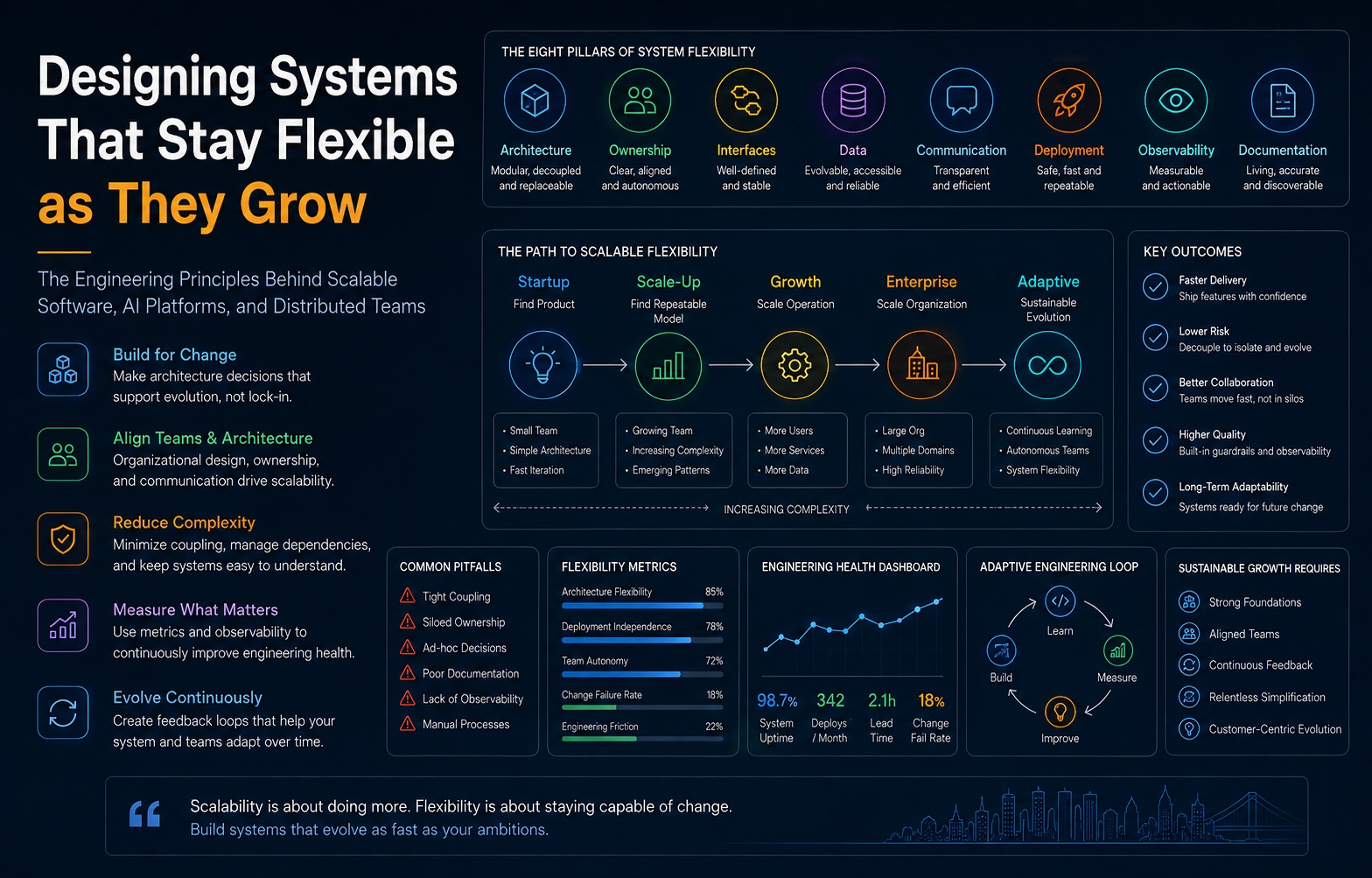
This paper introduces a set of original models to make that process visible and manageable:
| Model | Purpose |
|---|---|
| System Flexibility Model (SFM) | Eight dimensions of flexibility; flexibility is bounded by the weakest one, not the average |
| Decision Lifecycle | Five stages from decision to constraint, with intervention points at each |
| Change Amplification Factor (CAF) | How many artifacts, services, and teams one unit of business change touches |
| Coupling Ledger | Classifies the five coupling types by what each one actually costs you |
| Engineering Health Dashboard | Four quadrants — Flow, Stability, Cognition, Evolvability |
| Engineering Friction Index (EFI) | Ratio of elapsed lead time to active work time; measures waiting, not working |
| Architecture Evolution Cycle | Sense → Model → Seam → Shift → Settle: how to evolve without rewrites |
| Ownership Matrix | Maps components against ownership states; exposes orphaned and contested assets |
| Adaptive Engineering Loop | Ties production signal back into architectural decisions |
| Five-tier Maturity Models | For architecture, documentation, deployment, observability, and organization |
The paper is written for people who make decisions that outlive them: CTOs, VPs of Engineering, founders, software architects, staff engineers, and engineering managers. It assumes you already know what a microservice is. It does not assume you know when one is a liability.
Three claims underpin everything that follows.
First, growth is not a scaling problem; it is a coordination problem. Systems that break at 50 engineers rarely break on throughput. They break because the number of humans who must agree before a change ships grew faster than the number of humans who write the change. Distributed systems engineering solved machine coordination decades ago. Most organizations have not solved human coordination at all.
Second, architecture is a social artifact before it is a technical one. Conway's Law is not a caution — it is a design tool. If you cannot draw your team boundaries, you cannot predict your service boundaries, and you certainly cannot enforce them.
Third, evolvability must be measured or it will be sacrificed. Every quarter, evolvability loses budget arguments to features, because features have metrics and evolvability does not. Chapter 14 fixes that with six metrics you can instrument this month.
The goal is not architectural purity. Purity is a cost with no revenue line. The goal is a system where the cost of the next change stays roughly flat as the organization triples — where a company can change its mind, cheaply, for a very long time.
Chapter 1 — Growth Changes Everything
1.1 The three regimes
Software organizations do not scale continuously. They pass through discontinuities where the dominant constraint changes entirely, and where practices that were virtues become pathologies.
   REGIME 1               REGIME 2                  REGIME 3
   STARTUP                SCALE-UP                  ENTERPRISE
   1–10 eng               10–80 eng                 80–500+ eng
   1–2 teams              5–12 teams                20–60 teams
        |                      |                         |
        v                      v                         v
 Constraint:            Constraint:               Constraint:
 PRODUCT TRUTH          COORDINATION              GOVERNANCE
 (what to build)        (who decides what)        (how to change safely)
        |                      |                         |
        v                      v                         v
 Everyone knows         Nobody knows              Nobody can know
 everything             everything                everything, and
                                                  that must be OK
        |                      |                         |
        v                      v                         v
 Optimize for:          Optimize for:             Optimize for:
 Reversibility          Boundaries                Independence
 Deletion               Contracts                 Paved roads
 Learning rate          Ownership                 Blast radius
The transitions are where organizations get hurt, and the reason is that the failure signal arrives late. A team of 8 that adopts a shared database sees no pain for eighteen months. The pain arrives at 40 engineers, at which point the cause is invisible and the remedy is expensive.
1.2 Why 5 engineers can do anything
At five engineers, coordination is free. The entire system fits in one person's head. Any engineer can safely change any file, because the blast radius of a mistake is one Slack message away from correction. Architecture is close to irrelevant; what matters is learning rate.
This is the regime where a modular monolith, a single Postgres instance, one deploy pipeline, and near-zero abstraction is not a compromise — it is optimal. Premature service decomposition at this stage is one of the most reliably destructive decisions in the industry, because it purchases independence that nobody needs with coordination costs that everybody pays.
The single most valuable practice at this stage is not architecture. It is decision hygiene: writing down, in three sentences, what you chose and what you assumed. Chapter 3 and Chapter 7 explain why those three sentences are worth more than any diagram you will draw this year.
1.3 Why 50 engineers is the fracture point
Between roughly 30 and 80 engineers, three things break simultaneously.
Knowledge stops being shared by osmosis. At 8 people, everyone hears every decision. At 50, in 8 teams, information transfer becomes an explicit engineering problem. Undocumented decisions become tribal, then mythological, then wrong.
The deployment pipeline becomes a queue. One shared artifact plus twelve teams equals a merge queue, a release train, and a "release captain" role that nobody wanted. Deployment frequency per team collapses even as total deployment frequency rises.
Ownership becomes ambiguous exactly where it matters most. The shared modules — auth, billing, the notification service, the user object — belong to everyone, which means they belong to nobody. These become the highest-churn, lowest-quality, most-feared parts of the system. We call this the Commons Failure, and it is the single most common structural pathology in scale-up engineering.
The organizational tell is diagnostic and reliable: the ratio of time spent negotiating a change to time spent making it exceeds 1.0. When engineers spend more of a workday in alignment than in implementation, the architecture is no longer serving the organization.
1.4 Why 300 engineers breaks systems entirely
At enterprise scale the binding constraint is neither knowledge nor queueing. It is the impossibility of global consistency.
No individual can hold the system. No review board can evaluate every change. No standard can be enforced by persuasion. Any mechanism that requires a human to be in the loop for correctness will either be bypassed or become the bottleneck — usually both, in that order.
What works at this scale is a change of kind, not of degree:
- Correctness properties are moved from human review into automated guardrails — CI checks, contract tests, policy-as-code, schema registries, service templates.
- Consistency is achieved not by mandate but by paved roads: the compliant path is the fastest path, so teams take it for selfish reasons.
- Autonomy is granted proportionally to blast radius containment, not to seniority or trust.
The counterintuitive result: enterprises that scale well are more permissive than scale-ups, not less. They permit local variation because they have invested in structural containment. Organizations that respond to scale with additional approval gates are treating a structural problem with a procedural drug, and the side effect is that the best engineers route around the process or leave.
1.5 The regime-mismatch table
Most architecture arguments inside a company are actually arguments about which regime you are in. Two engineers, both correct, disagreeing about which world they live in.
| Practice | Startup (1–10) | Scale-up (10–80) | Enterprise (80+) |
|---|---|---|---|
| Shared database | Correct | Dangerous | Disqualifying |
| Modular monolith | Optimal | Viable with enforced modules | Viable per-domain |
| Microservices | Almost always wrong | Correct at team boundaries only | Default, with platform support |
| Architecture review board | Overhead | Lightweight, advisory | Automated + advisory |
| Written ADRs | High value, low cost | Mandatory | Mandatory + indexed |
| Shared deployment pipeline | Correct | Bottleneck | Disqualifying |
| Central platform team | Premature | Essential (2–6 people) | Multiple platform products |
| Ad-hoc on-call | Acceptable | Team-owned | Follow-the-sun / tiered |
| Framework standardization | Irrelevant | Emerging | Enforced via templates |
Practical recommendation. Once per year, in writing, state which regime you are in and which regime you will be in twelve months from now. Then audit your top ten engineering practices against the table above. The practices that are correct for your current regime but disqualifying for the next one are your architecture roadmap. Everything else is opinion.
Chapter 2 — Flexibility Is an Engineering Property
Flexibility is usually treated as a vibe — a subjective sense that a codebase "feels good to work in." That is useless for decision-making. Flexibility is a measurable property of a system, decomposable into eight dimensions, each independently observable and independently improvable.
2.1 The System Flexibility Model (SFM)
                    SYSTEM FLEXIBILITY MODEL
   ┌───────────────────────────────────────────────────────────┐
   │                                                           │
   │   STRUCTURAL              HUMAN               OPERATIONAL │
   │   ───────────             ─────               ─────────── │
   │                                                           │
   │   1. Architecture         3. Ownership        6. Deployment│
   │   2. Interfaces           4. Communication    7. Observability
   │   5. Data                 8. Documentation                │
   │                                                           │
   └───────────────────────────────────────────────────────────┘

   Effective Flexibility = MIN(d1 ... d8)      not AVG(d1 ... d8)
The central and most important claim of the model:
Effective system flexibility equals the score of the weakest dimension, not the average of all dimensions.
This is Liebig's law of the minimum applied to software. A system with immaculate service boundaries, elite observability, and a world-class CI pipeline — sitting on a shared database that six teams write to — has the flexibility of that shared database. The excellent dimensions do not compensate. They merely make the constraint harder to see, because every local investigation finds a healthy component.
The practical consequence is that flexibility investment must be targeted at the minimum, and everything else is over-investment. Most organizations do the opposite: they invest where their strongest engineers already have expertise, which is where the system is already strongest.
Score each dimension 0–4. Definitions of the levels appear in Chapter 17.
2.2 Dimension 1 — Architecture
Question it answers: can a component be replaced without a coordinated rewrite?
Architectural flexibility is not about style — monolith, modular monolith, services, actors. It is about replaceability: the cost of deleting a component and substituting a different implementation behind the same boundary.
Test it directly. Pick your third-most-important component. Ask: what is the cost, in engineer-weeks, of replacing its implementation entirely? If nobody can estimate within an order of magnitude, the boundary does not exist — you have a named region of code, not a component.
Signals of low architectural flexibility: cyclic dependencies between modules; components that cannot be tested without booting the whole system; "shared" utility packages that import from domain code; a dependency graph that nobody has ever rendered.
Recommendation. Render the dependency graph monthly and diff it. Cycles are the leading indicator of architectural rigidity, and they are cheap to detect and expensive to remove later.
2.3 Dimension 2 — Interfaces
Question it answers: can I change my side without breaking yours?
An interface is flexible when the producer can evolve independently of every consumer. That requires explicit contracts, additive-only change discipline, and consumer-driven verification. Without them, every interface is a distributed monolith joint.
The tell: when a team must ask who is calling an endpoint before changing it, the interface is not a contract; it is a rumor. Chapter 8 covers this in depth.
2.4 Dimension 3 — Ownership
Question it answers: for any file, service, or dataset, who decides?
Ownership flexibility means every asset has exactly one accountable team, and that team has authority proportional to accountability. Both halves matter. A team that is on-call for a service it cannot refactor has responsibility without authority — the fastest known route to attrition among senior engineers.
The pathologies are symmetrical:
- Orphaned assets: nobody owns it, so it decays and everyone fears it.
- Contested assets: several teams own it, so every change requires negotiation.
Both produce the same measurable symptom: high change latency in the components with the highest change demand. Chapter 6 provides the Ownership Matrix that maps these.
2.5 Dimension 4 — Communication
Question it answers: how many people must agree before a change ships?
Call this the Decision Fan-Out: the number of humans outside the implementing team whose consent is required. Fan-out of 0 is autonomy; fan-out of 2 is coordination; fan-out of 6 is paralysis.
Fan-out is not a cultural property. It is a structural one, produced by architecture and ownership. You cannot train it away with better meetings. You reduce it by removing the dependencies that create it.
2.6 Dimension 5 — Data
Question it answers: can the schema change without a cross-team project?
Data is the least flexible dimension in almost every organization, and it is almost always the system's binding constraint. Code can be rewritten in a sprint; a schema with fourteen unknown readers cannot be changed at all.
Data flexibility requires three properties: a single writer per dataset, explicit read contracts (views, APIs, or published events rather than direct table access), and versioned, backward-compatible evolution. Chapter 9 covers the mechanics.
2.7 Dimension 6 — Deployment
Question it answers: can one team ship without another team's calendar?
Deployment flexibility is measured by the Deployment Independence Index (Chapter 14): the fraction of production changes that require no coordinated release with another team. Below 0.7, your architecture is functionally a monolith regardless of how many containers you run.
Two failure patterns dominate: the shared release train (organizational coupling wearing a scheduling costume) and the lockstep deploy (service A and B must ship together because their contract is implicit).
2.8 Dimension 7 — Observability
Question it answers: can I change something and know within minutes whether I was right?
Observability is not a monitoring concern. It is the feedback bandwidth of the entire engineering system, and it directly gates how much risk a team can take. A team that can detect a bad change in 90 seconds can ship aggressively. A team that discovers problems from customer emails must ship defensively — which means slowly, in large batches, with heavy review, which makes each change riskier still.
This is the observability–velocity flywheel, and it turns in both directions.
2.9 Dimension 8 — Documentation
Question it answers: can a competent stranger make a correct decision without a meeting?
Documentation flexibility is not about volume. It is about whether decisions and their rationale survive the departure of the people who made them. A system whose constraints exist only in the memory of three long-tenured engineers has a flexibility ceiling set by their calendars and their retention.
The specific artifact that matters is the decision record — not the wiki page, not the onboarding doc. Chapter 7 explains why.
2.10 Using the model
Score all eight dimensions, quarterly, with evidence rather than opinion. Then:
- Identify the minimum. That is your architecture strategy for the next two quarters.
- Refuse to invest in any dimension scoring two or more points above the minimum.
- Re-score after the intervention. The minimum will have moved to a new dimension. That is success, not failure — it means you raised the floor.
| Dimension | Primary metric | Fast diagnostic |
|---|---|---|
| Architecture | Replacement cost of a core component | Are there dependency cycles? |
| Interfaces | Consumer-breaking changes per quarter | Can you list every consumer? |
| Ownership | % assets with exactly one owner | Who is paged for the auth module? |
| Communication | Decision fan-out per change | How many approvals per PR? |
| Data | Schema changes requiring cross-team work | Who writes to this table? |
| Deployment | Deployment Independence Index | Can you ship on a Friday alone? |
| Observability | Mean time to detect | Would you know in 5 minutes? |
| Documentation | % decisions with a written record | Why is it built this way? |
Chapter 3 — Decisions Become Technical Debt
3.1 Debt is not the right metaphor, but it is the one we have
The debt metaphor implies deliberate borrowing at a known rate. Most technical debt is neither deliberate nor known. It is the accumulated residue of decisions that were correct when made and were never revisited when their premises expired.
That distinction matters, because it changes the remedy. You cannot prevent debt by making better decisions — the decisions were already good. You prevent it by tracking the expiry of the assumptions underneath them.
3.2 The Decision Lifecycle
   ┌──────────┐    ┌────────────┐    ┌───────────┐    ┌─────────────┐    ┌────────────┐
   │ DECISION │ →  │ COMMITMENT │ →  │ DIFFUSION │ →  │ OSSIFICATION│ →  │ CONSTRAINT │
   └──────────┘    └────────────┘    └───────────┘    └─────────────┘    └────────────┘
   Reversal cost:
      ~0              1x                 10x              100x            Not reversible
                                                                         (only routable
   Intervention:                                                          around)
   Write it       Isolate it        Detect it        Contain it        Fund an exit
   down           behind a          via CAF          via anti-
                  boundary                           corruption layer
Stage 1 — Decision. A choice is made, usually verbally, usually with good local reasoning. Reversal cost is near zero. The only thing that matters here is capturing the assumption, not the choice: "we chose X because we expect fewer than 100k events/day and a single team."
Stage 2 — Commitment. Code exists. Reversal costs one unit of work. Still cheap. This is the last stage where an individual can reverse the decision without a meeting.
Stage 3 — Diffusion. The decision's shape spreads. Other code assumes the data model, the error semantics, the latency profile, the deployment topology. Crucially, the diffusion is invisible in the diff — no commit says "I am now depending on the assumption that user IDs are integers." This is where debt is actually created, and it is the stage almost no organization instruments.
Stage 4 — Ossification. The decision becomes an unstated invariant. New engineers reproduce it because the surrounding code does. It appears in interview questions and onboarding docs. Reversal now requires a project, a sponsor, and a quarter.
Stage 5 — Constraint. The decision is now a property of the business. Product roadmaps are silently trimmed to avoid it. Nobody proposes the features it forbids, so the constraint never appears in any document — it appears as absence. This is the most expensive form of technical debt precisely because it is invisible: you cannot see the features you stopped imagining.
3.3 Decision half-life
Every architectural decision rests on assumptions with finite lifespans:
| Assumption class | Typical half-life | Example |
|---|---|---|
| Traffic/volume | 6–12 months | "Single Postgres will be fine" |
| Team topology | 12–18 months | "One team owns checkout" |
| Regulatory scope | 18–36 months | "We only operate in one jurisdiction" |
| Vendor viability | 24–48 months | "This managed service will exist" |
| Domain model | 24–60 months | "An order has exactly one customer" |
| Language/runtime | 5–10 years | "The JVM is our platform" |
Recommendation. Every ADR carries an explicit review trigger — not a review date. Dates get ignored; triggers fire. Good triggers are quantitative and observable: "revisit when daily write volume exceeds 5M," "revisit when more than one team writes to this table," "revisit when p99 exceeds 400ms for two consecutive weeks." Wire the trigger into your monitoring where possible. An ADR whose trigger is a Grafana alert is a living document; one with a calendar reminder is a dead one.
3.4 The Reversal Cost Curve
Reversal cost is not linear in time. It is approximately:
Reversal Cost ≈ C_base × (call sites)^0.7 × (teams touched)^1.3 × (external contracts + 1)^2The exponents are illustrative, not measured — but their relative order is the point, and it is consistently observed:
- Call sites contribute sub-linearly. Mechanical refactoring scales well; tooling helps.
- Teams touched contribute super-linearly. Every additional team adds negotiation, calendar alignment, and divergent priorities.
- External contracts contribute quadratically. You cannot refactor someone else's client. You must support both versions, run a migration campaign, and wait on the slowest partner.
The strategic implication is sharp: delay the moment a decision crosses a team boundary or an external boundary for as long as possible. Internal ugliness is cheap. Published ugliness is permanent.
3.5 The four debt origins
Not all debt behaves the same way, and treating it uniformly wastes remediation budget.
| Origin | Mechanism | Interest rate | Correct response |
|---|---|---|---|
| Deliberate | Known shortcut, taken consciously | Predictable | Track it; schedule repayment; usually fine |
| Environmental | The world changed; decision didn't | Rises silently | Assumption review triggers |
| Diffusion | Correct decision, spread too far | Compounds fastest | Boundaries + anti-corruption layers |
| Entropic | Many small inconsistent choices | Slow, broad | Automated standards; paved roads; linters |
Environmental and diffusion debt account for the majority of real cost in growing companies, and neither is addressed by the standard remedy of "20% time for tech debt." You cannot fix a diffused assumption with a Friday afternoon.
3.6 Making decisions cheaper to reverse
Three practices, in descending order of leverage:
- Isolate before you commit. Put every third-party dependency, every external contract, and every uncertain choice behind an interface you own. This converts an external contract (quadratic reversal cost) into an internal call site (sub-linear). It costs roughly a day. It is the highest-ROI hour in architecture.
- Prefer decisions with a known exit. When comparing two options, ask explicitly: what is the exit plan for each? An option that is 15% worse today but has a clean, tested exit is usually the correct choice at scale-up stage.
- Instrument diffusion. Track how many modules depend on each core abstraction, and alert on growth. When a type, table, or client library crosses from three consumers to twelve, its reversal cost has grown by roughly an order of magnitude and nobody has noticed. A weekly report of "abstractions whose consumer count grew fastest" is a debt early-warning system, and it costs a few hours to build.
Chapter 4 — Coupling vs Independence
4.1 Coupling is not bad; unmanaged coupling is
Zero coupling is zero system. Every useful architecture is a deliberate arrangement of couplings. The engineering question is never "how do we remove coupling" but "which couplings do we accept, where do we put them, and what do they cost when we want to change?"
Coupling costs three distinct currencies, and conflating them causes most bad architecture arguments:
- Change cost — how many artifacts must change together.
- Coordination cost — how many humans must agree.
- Runtime cost — how failures and latency propagate.
A shared library has high change cost, low coordination cost (if one team owns it), and zero runtime cost. A synchronous RPC has low change cost, low coordination cost, and high runtime cost. These are not comparable on a single "coupling" axis, and treating them as such is why teams replace a shared library with an RPC and are surprised when reliability degrades.
4.2 The five coupling types
| Type | What is shared | Primary cost | Detection | Typical remedy |
|---|---|---|---|---|
| Code coupling | Classes, functions, packages | Change cost | Dependency graph; cycle detection | Module boundaries; dependency inversion |
| Service coupling | Runtime calls, availability | Runtime cost | Trace fan-out; correlated error rates | Async messaging; caching; graceful degradation |
| Data coupling | Schemas, tables, semantics | Change + coordination | Query log by service; grep for table names | Single writer; read APIs; published events |
| Deployment coupling | Release timing, artifacts | Coordination cost | Correlated deploy timestamps | Independent pipelines; contract tests |
| Organizational coupling | Decisions, roadmaps, priorities | Coordination cost | Approvals per PR; cross-team tickets per epic | Ownership realignment; platform abstraction |
4.3 The Coupling Ledger
Treat coupling as a balance sheet, not a moral failing. For each significant coupling, record: the two parties, the type, the reason it exists, the cost of removal, and the trigger that would justify removal.
   COUPLING LEDGER (excerpt)

   A ←→ B      Type: DATA (shared `orders` table)
               Reason: historical; both teams evolved from one
               Change cost: HIGH — every schema change needs both teams
               Removal cost: ~6 engineer-weeks (introduce read API + backfill)
               Removal trigger: >2 schema conflicts per quarter  [FIRED Q3]

   B ←→ C      Type: SERVICE (sync RPC, p99 220ms)
               Reason: correctness — C needs live inventory
               Change cost: LOW (versioned contract)
               Runtime cost: HIGH — C's availability ≤ B's availability
               Removal trigger: B availability < 99.9% for 2 months  [not fired]
The ledger converts coupling from an aesthetic complaint into a managed portfolio. Most importantly, it makes the correct couplings explicit, so engineers stop trying to remove them and stop feeling guilty about them.
4.4 Change Amplification Factor (CAF)
The single most useful coupling metric, and one almost nobody measures:
CAF = the number of distinct deployable artifacts that must change to deliver one unit of business capability, averaged over the last N features.
Compute it from your last 20 shipped features. Count deployables touched, not files. Then compute the team-weighted variant:
CAF-T = the number of distinct teams that must change something for one unit of business capability.
| CAF-T | Interpretation | Action |
|---|---|---|
| 1.0–1.3 | Healthy alignment between architecture and domain | Maintain |
| 1.3–2.0 | Normal for cross-cutting features; watch the outliers | Investigate top 3 recurring pairs |
| 2.0–3.0 | Boundaries misaligned with the domain | Re-cut boundaries or merge teams |
| > 3.0 | Distributed monolith | Structural intervention required |
The power of CAF-T is that it is domain-relative. A CAF-T of 2.5 is not intrinsically bad — but if the same two teams appear in every high-CAF feature, your boundary is in the wrong place. The pair that co-changes most often should either be one team, or should have a contract between them that stops the co-change.
4.5 Tight vs loose coupling — the honest comparison
| Property | Tight coupling | Loose coupling |
|---|---|---|
| Initial development speed | Faster | Slower (contracts, plumbing) |
| Refactoring within a boundary | Easy, compiler-assisted | Easy |
| Refactoring across boundaries | Cheap early, brutal late | Expensive but bounded and predictable |
| Correctness guarantees | Strong (transactions, types) | Weaker (eventual consistency, retries) |
| Debugging | Single stack trace | Requires distributed tracing |
| Failure isolation | None | Good |
| Independent deployment | No | Yes |
| Cognitive load per engineer | Low at small scale, unbounded at large | Moderate and bounded |
| Cost profile | Low fixed, rising marginal | High fixed, flat marginal |
The last row is the whole argument. Tight coupling has a low fixed cost and a rising marginal cost per change. Loose coupling has a high fixed cost and a roughly flat marginal cost. The crossover point is a function of team count and change volume — typically somewhere between 15 and 40 engineers for a given domain.
Deciding correctly means estimating where you will be when the crossover arrives, not where you are. Organizations that decompose too early pay the fixed cost with none of the benefit. Organizations that decompose too late pay the marginal cost forever, and then pay the fixed cost anyway under duress.
4.6 Organizational coupling is the one that actually hurts
Code coupling is visible, tooled, and fixable by engineers on a Thursday. Organizational coupling is invisible, untooled, and fixable only by leadership.
Symptoms: an epic that requires four teams' quarterly planning to align; a "dependency" column in a project tracker; a weekly sync whose only purpose is to unblock other teams; senior engineers whose main function is inter-team translation.
Recommendation. Once a quarter, take your ten largest delivered items and count the teams involved. Then ask a harder question: for each pair of teams that appears repeatedly, is the coupling in the code, in the data, or in the org chart? The answer determines who fixes it. Architects fix code coupling. Only executives fix org coupling — and pretending otherwise is why many architecture initiatives fail with a technically excellent design that nobody could adopt.
Chapter 5 — Systems That Grow Without Rewrites
5.1 The rewrite is an admission of a missing seam
Large rewrites are almost never justified by code quality. They are justified by the absence of seams — places where the system can be cut without severing everything. When a system has seams, evolution proceeds by replacement of parts. When it has none, the only available operation is replacement of the whole.
The strategic goal is therefore not "good code." It is the continuous maintenance of seams in the places where change is most likely.
5.2 The Architecture Evolution Cycle
        ┌─────────┐
        │  SENSE  │  Where is change demand concentrating?
        └────┬────┘  (commit heat map, CAF outliers, incident clustering)
             ↓
        ┌─────────┐
        │  MODEL  │  What is the domain boundary that *should* exist?
        └────┬────┘  (event storming, capability mapping)
             ↓
        ┌─────────┐
        │  SEAM   │  Introduce the interface *inside* the existing system.
        └────┬────┘  (facade, port, anti-corruption layer — no extraction yet)
             ↓
        ┌─────────┐
        │  SHIFT  │  Move traffic/data behind the seam. Strangler, dual-write,
        └────┬────┘  shadow read, expand/contract.
             ↓
        ┌─────────┐
        │ SETTLE  │  Delete the old path. Update ADRs, ownership, dashboards.
        └────┬────┘  ← the step that is skipped, and why systems accumulate ghosts
             │
             └──────→ back to SENSE
The two steps that organizations habitually skip are SEAM and SETTLE.
Skipping SEAM produces the big-bang extraction: a team pulls a service out, discovers 40 hidden dependencies mid-flight, and ships a distributed version of the original mess. Introducing the seam first, inside the monolith, surfaces every dependency at compile time, in a branch that costs nothing to abandon. If you cannot make the seam hold inside the monolith, extraction will not save you — it will only make the failure remote and asynchronous.
Skipping SETTLE produces the dual-system tax: both the old and new paths live forever, doubling maintenance and guaranteeing that the next engineer will pick the wrong one. A migration that is 95% complete has delivered negative value. Fund migrations to 100% or do not start them.
5.3 Modularity: the four properties
A module is not a folder. A module has four properties, and missing any one makes it decorative:
- A boundary — an explicit, enforced list of what may be imported from outside. Enforce mechanically (build-level module systems, import linters, package visibility, separate compilation units). Boundaries maintained by convention decay at approximately the rate of engineer turnover.
- A contract — a stated interface plus stated semantics: error behavior, idempotency, latency expectations, consistency guarantees.
- An owner — one team, named, on-call.
- A test surface — testable in isolation, without the rest of the system. If it needs the full system to test, it is not a module; it is a region.
5.4 Dependency inversion as a flexibility instrument
Dependency inversion is usually taught as an OO principle. Treat it instead as an economic one: it moves the location of a decision from the caller to the boundary, which collapses reversal cost.
The rule of thumb that survives contact with real systems:
Depend on things that change more slowly than you do.
Domain logic should not depend on infrastructure, because infrastructure changes faster (vendors, versions, deployment models). Infrastructure should depend on domain-defined ports. This is not architecture astronautics; it is the difference between "we replaced our queue provider in a sprint" and "we cannot replace our queue provider."
Apply it selectively. Inverting every dependency produces indirection without benefit. Invert at exactly three places: external vendors, cross-team contracts, and anything whose assumption half-life is under two years (see 3.3).
5.5 Replaceability as the design target
For every significant component, ask three questions at design time:
- What would replace this, if the assumption underneath it expired?
- What would that replacement cost today?
- What single change would cut that cost in half?
The third question is the whole discipline. It usually has a cheap answer — an interface, a feature flag, a translation layer, a stopped direct-database read. Doing it costs a day now and saves a quarter later.
5.6 Boundaries follow the domain, not the technology
The most durable boundaries are drawn along business capability lines, because those change least. Boundaries drawn along technical layers (a "UI team," a "database team," an "API team") guarantee that every business change crosses every boundary — the worst possible CAF-T. Boundaries drawn along technology choices ("the Kafka team") guarantee that the boundary dies with the technology.
| Boundary basis | Stability | Typical CAF-T | Verdict |
|---|---|---|---|
| Business capability | High (years) | 1.0–1.5 | Preferred |
| Data lifecycle / aggregate | High | 1.2–1.8 | Strong, especially for data-heavy systems |
| Customer segment | Medium | 1.3–2.0 | Viable for genuinely divergent segments |
| Technical layer | Low | 3.0+ | Avoid |
| Technology / framework | Low | 2.5+ | Avoid, except for genuine platform components |
| Team convenience / history | Very low | Unpredictable | The most common and least defensible |
Recommendation. When someone proposes a new service, require a one-paragraph answer to: which business capability does this own, which data does it exclusively write, and which team is accountable? If any answer is missing, the service will become a coordination point rather than a boundary.
Chapter 6 — Organizational Architecture
6.1 Conway's Law as a design instrument
Conway's observation — that systems mirror the communication structures of the organizations that build them — is usually quoted as a warning. Treat it as a lever. It runs in both directions and it never stops running.
        BUSINESS STRATEGY
              ↓  (defines what capabilities must exist)
        TEAM STRUCTURE
              ↓  (defines who can decide without asking)
        ARCHITECTURE
              ↓  (defines what can change independently)
        SOFTWARE
              ↓  (defines what the business can actually do)
              └──────────────→ feeds back into strategy
The loop closes. A business constrained by its software is constrained by an architecture that was determined by a team structure chosen — often casually, often by hiring accident — years earlier.
The actionable form, sometimes called the inverse maneuver: when you want a particular architecture, first build the team structure that would naturally produce it. Reorganizing to match a target architecture is more reliable than mandating an architecture that cuts across your org chart. An architecture that opposes the org chart loses, every time, on a timescale of about two quarters.
6.2 The four team types and what each is for
| Team type | Owns | Optimizes for | Failure mode | Healthy ratio at ~100 eng |
|---|---|---|---|---|
| Product / stream-aligned | A business capability, end to end | Flow of business value | Reinventing infrastructure | 60–70% |
| Platform | Internal products consumed by other teams | Reducing cognitive load | Becoming a ticket queue | 15–20% |
| Enabling | Capability uplift, temporarily embedded | Raising others' ceiling | Becoming permanent consultants | 5–10% |
| Complicated-subsystem | A genuinely specialist component | Deep correctness | Becoming a bottleneck / silo | 0–10% |
Two rules keep this from degenerating:
Platform teams must ship products, not tickets. The test is self-service: can a product team adopt the platform capability without talking to the platform team? If not, you have not built a platform; you have built a shared services department, and it will become the organization's central bottleneck as surely as a shared database.
Enabling teams must have exit criteria. An enabling engagement without a stated end date and a stated capability outcome becomes a permanent dependency, which is the opposite of enablement.
6.3 Ownership: the Ownership Matrix
Map every significant asset (service, dataset, library, pipeline) against ownership state:
                     HIGH CHANGE DEMAND
                            │
      CONTESTED             │            HEALTHY CORE
   (many teams change it,   │      (one owner, high change,
    no single owner)        │       clear contract)
    → highest friction      │      → protect and invest
                            │
   ─────────────────────────┼──────────────────────────  CLEAR OWNERSHIP →
                            │
      ORPHANED              │            STABLE ASSET
   (nobody owns, nobody     │      (one owner, low change)
    understands, everyone   │      → maintain, document,
    is afraid)              │         consider archiving
    → highest risk          │
                            │
                     LOW CHANGE DEMAND
The two left quadrants are where scale-ups lose their velocity. Contested assets consume coordination; orphaned assets consume courage. Both are fixable in a week of leadership attention, and both are routinely tolerated for years.
Recommendation. Maintain a machine-readable ownership registry (a file in the repo, or a service catalog) that is enforced in CI: every service, dataset, and pipeline must resolve to exactly one owning team, or the build fails. This is one of the highest-leverage governance mechanisms available, and it costs a week to implement.
6.4 Communication structures and the cost of shared context
The number of potential communication paths in a group of n people is n(n−1)/2. At 8 people, 28 paths — manageable by osmosis. At 50, 1,225 — impossible. The organization does not choose to stop communicating; it simply cannot.
The engineering response is not more meetings. It is reducing the number of paths that need to exist, which is precisely what good boundaries and contracts do. Architecture is, functionally, a communication compression scheme: a well-designed interface replaces a hundred conversations with one document.
This produces a useful heuristic for evaluating any proposed design:
A good architecture reduces the number of people who need to be in the room. Evaluate designs by the meetings they eliminate.
6.5 Team size, tenure, and the cognitive budget
Each team has a finite cognitive budget. Exceeding it produces the same symptoms as understaffing — slow delivery, defects, burnout — and is routinely misdiagnosed as such, leading to hiring that makes it worse.
Practical constraints observed consistently across organizations:
- A team of 5–9 can own roughly one bounded context of moderate complexity, or 2–4 small services.
- A team owning more than ~6 deployable services with meaningful traffic will begin to under-maintain them.
- On-call for more than ~3 distinct failure domains degrades response quality measurably.
When a team is over budget, the options are: reduce scope (transfer ownership), reduce complexity (consolidate services), or raise capability (platform abstraction, enabling team). Adding people to an over-budget team without changing its scope adds coordination cost to an already saturated system.
Chapter 7 — Documentation Is Architecture
7.1 The asymmetry
Code answers what. Tests answer what should be true. Nothing in the repository answers why, and why is the only thing that lets a future engineer safely change the system.
An engineer who does not know why a constraint exists has exactly two options: preserve it superstitiously (rigidity) or remove it recklessly (incidents). Both are failures caused by missing documentation, and both are usually attributed to something else.
7.2 The document taxonomy
| Type | Answers | Written when | Read when | Half-life | Owner |
|---|---|---|---|---|---|
| ADR | Why did we choose this? | At decision time | Before changing it | Years (immutable) | Deciding team |
| Architecture map | What exists and how it connects? | Continuously, generated | Onboarding, incidents, planning | Weeks | Platform / architects |
| Interface contract | How do I integrate? | With the interface | On every integration | Version-scoped | Producing team |
| Runbook | What do I do when this breaks? | After the first incident | At 03:00, under stress | Months | On-call team |
| Playbook | How do we do this recurring process? | After doing it twice | Before doing it again | Months | Process owner |
| Onboarding path | How do I become productive here? | Continuously | First 30 days | Months | Team lead |
| Postmortem | What did we learn? | After incidents | During similar incidents | Permanent | Incident commander |
Each type has a different half-life, and mixing them in one wiki guarantees that the long-lived documents rot alongside the short-lived ones. Separate them physically.
7.3 Architecture Decision Records, done properly
An ADR is not a design document. It is a short, immutable record of a choice and its context. Immutability is the point: superseded ADRs are not edited, they are superseded by a new ADR that references them. The chain of decisions is the intellectual history of the system.
A high-value ADR contains six fields and fits on one page:
- Context — what was true when we decided (traffic, team count, constraints, deadlines).
- Decision — what we chose, in one sentence.
- Alternatives — what else was considered and the specific reason each was rejected.
- Consequences — what becomes easier, what becomes harder.
- Assumptions — the beliefs this rests on. This is the field that matters most and the one usually omitted.
- Review trigger — the observable condition that should cause reconsideration (see 3.3).
The alternatives section is what distinguishes an ADR from a justification. A record listing only the chosen option teaches nothing and permits no re-evaluation; it is a press release. The value is in the road not taken, because in three years the conditions that eliminated an alternative may have reversed.
7.4 Living documentation
Anything a human must remember to update will eventually be wrong, and wrong documentation is worse than none, because it is trusted. The discipline is therefore generation over curation wherever possible:
- Service catalog generated from deployment metadata and ownership files.
- Dependency graphs generated from build metadata and runtime traces.
- API documentation generated from schemas (OpenAPI, protobuf, GraphQL SDL) and verified against production traffic.
- Data lineage generated from query logs and pipeline definitions.
- Runbook links attached to alerts, so the alert is the entry point to the runbook.
Hand-written documentation should be reserved for the three things that cannot be generated: rationale, semantics, and process.
7.5 Documentation Health Index
A measurable proxy, computable monthly:
   DHI = 0.35 × (decisions with ADRs / significant decisions)
       + 0.25 × (services with current runbooks / services on-call)
       + 0.20 × (generated artifacts / total architecture artifacts)
       + 0.20 × (docs updated in last 90 days / docs referenced in last 90 days)
The last term is the sharpest signal. A document that is read frequently and updated rarely is actively misleading people, and it is far more dangerous than a document nobody opens. Instrument reads if your wiki allows it; the highest-read, lowest-freshness pages are your remediation queue, in order.
7.6 The documentation lifecycle workflow
   TRIGGER          →  DRAFT       →  REVIEW      →  PUBLISH    →  DECAY WATCH   →  RETIRE
   (decision,          (author,       (one peer,     (indexed,     (freshness       (archive,
    incident,           15 min)        24h SLA)      linked from   check +          never delete;
    new service)                                     code)         read/update      supersede)
                                                                   ratio)
Recommendation. Tie documentation to events, not to calendars. "Write an ADR when you make a decision" works. "Documentation week" does not, because it produces documents nobody needed at the moment nobody remembers the context.
Chapter 8 — Designing Stable Interfaces
8.1 An interface is a promise with an unknown expiry
The moment an interface has a consumer you do not control, you have made a promise whose cost you cannot estimate. Interface design is therefore mostly about limiting the surface of what you promise, not about maximizing what you expose.
The single most useful discipline: publish the minimum that satisfies the use case, and nothing that reflects your internal model. Every internal detail that leaks into a contract becomes an external constraint on your future refactoring. Exposing your database column names in an API is not convenience; it is a permanent tax on schema evolution.
8.2 Choosing an interface style
| Style | Coupling | Best for | Evolution mechanism | Watch out for |
|---|---|---|---|---|
| REST/JSON | Low structural, high semantic | Public APIs, broad ecosystems, human debuggability | Additive fields; URL or header versioning | Schema drift; undocumented semantics |
| gRPC / protobuf | Low, schema-enforced | Internal high-volume service-to-service | Field numbering; reserved fields; additive-only | Generated-client version sprawl |
| GraphQL | Client-driven | Aggregating many backends for varied clients | Deprecation directives; field-level metrics | Unbounded query cost; N+1; hidden coupling to resolvers |
| Events (pub/sub) | Lowest runtime, highest semantic | Decoupling producers from unknown consumers | Schema registry + compatibility rules | Semantic drift; no consumer visibility; ordering |
| Shared library | Highest change coupling | Pure logic, no I/O, one owner | Semantic versioning; support window | Becoming a distributed monolith's spine |
| Shared database | Total | Nothing, past a single team | None. There is no evolution mechanism | This is not an interface |
The final row is stated deliberately. A shared database is not a slow interface or a cheap interface; it is an interface with no evolution mechanism at all, because the producer cannot enumerate consumers, cannot version, and cannot deprecate. Every other choice on this list is recoverable.
8.3 Compatibility rules that actually hold
Backward compatible (existing consumers keep working with new producer): add optional fields, add endpoints, add enum values only if consumers are specified to ignore unknowns, widen accepted input.
Forward compatible (old producer, new consumer): requires consumers to tolerate missing fields and unknown values. This must be designed in from the start; it cannot be retrofitted.
Breaking: removing or renaming a field, narrowing a type, changing semantics of an existing field, tightening validation, changing default behavior, changing error codes.
The dangerous category is the fourth item: semantic changes are invisible to every automated compatibility check you own. Changing status: "pending" to mean something slightly different passes every schema validator and breaks every consumer. Guard semantics with documentation, contract tests that assert behavior rather than shape, and — most effectively — by never reusing a field for a new meaning. Add a new field and deprecate the old one. Storage is cheaper than an outage.
8.4 Expand / Contract: the only safe change protocol
   PHASE 1  EXPAND     Add the new field/endpoint/event alongside the old.
                       Producer writes both. Nothing breaks.
                          ↓
   PHASE 2  MIGRATE    Consumers move at their own pace.
                       Instrument usage of the old path per consumer.
                          ↓
   PHASE 3  VERIFY     Old-path usage = 0 for N days, across all known
                       consumers, including batch jobs and analytics.
                          ↓
   PHASE 4  CONTRACT   Remove the old path. Record in ADR.
Phase 3 is where discipline is won or lost. You cannot deprecate what you cannot measure. Every deprecatable element needs per-consumer usage telemetry, or the deprecation will stall permanently and you will carry both paths for years. The organizations that evolve fastest are the ones that can prove nobody is calling something.
8.5 Versioning strategy
| Strategy | Cost to producer | Cost to consumer | When appropriate |
|---|---|---|---|
| No versioning, additive-only | Low ongoing | Very low | Internal services with strong schema discipline — the default and the target |
| Header/media-type versioning | Medium | Low | Public APIs needing occasional breaks |
| URL versioning (/v2/) | High (parallel stacks) | Low | Major redesigns, long support windows |
| Consumer-pinned schema registry | Medium | Medium | Event-driven systems |
| No versioning, breaking changes | Zero | Catastrophic | Only inside a single team's boundary |
The strategic advice: make additive-only the norm and treat every version bump as an architectural failure worth a postmortem. Version numbers are not a feature; they are a record of times you could not evolve compatibly, and each one multiplies your maintenance surface for as long as the old version lives.
8.6 Consumer-driven contract testing
The producer cannot test against unknown consumers. The consumer cannot test against a future producer. Consumer-driven contracts resolve this: each consumer publishes the subset of the contract it actually relies on; the producer's CI verifies that all published expectations still hold.
This converts a coordination problem into an automated check, which is the general shape of every good enterprise-scale solution. It also produces, as a side effect, the exact artifact you need for deprecation: a machine-readable list of who depends on what.
Recommendation. Before extracting your third service, stand up contract testing. Before your tenth, make it mandatory in CI. Retrofitting contract tests across 40 services is a multi-quarter project; adding them at service three is a two-day one.
Chapter 9 — Data Evolution
9.1 Data outlives everything
Code has a half-life of a few years. Frameworks, less. Teams, less still. Data outlives all of them, and it carries the semantics of decisions made by people who left before the current CTO was hired.
This asymmetry has a direct architectural consequence: the data model is the most expensive thing you will design and the hardest thing you will change. Yet it is routinely designed with less rigor than the API in front of it, by whoever happened to write the first migration.
9.2 The three data ownership rules
Rule 1 — One writer. Every dataset has exactly one service authorized to write to it. Multiple writers means no service can reason about invariants, no service can safely change the schema, and no service can be held accountable for correctness. This rule is worth more than every other data practice combined.
Rule 2 — No shared reads through the storage layer. Reads go through an API, a published event stream, or a deliberately maintained read model — never through direct table access by another service. Direct reads make your physical schema a public contract, which means every index change, denormalization, or column rename becomes a cross-team negotiation.
Rule 3 — Analytics is a consumer, not an exception. The most common violation of Rules 1 and 2 is the analytics pipeline reading production tables directly. It is a coupling exactly as binding as any other, with the added property that its breakage is discovered by executives looking at a dashboard rather than by engineers looking at alerts. Publish to the warehouse deliberately, with an owned contract.
9.3 The expand/contract migration pattern for schemas
Schema changes follow the same protocol as interface changes, with the added complication that data must be transformed, not just accepted.
   1. ADD          New column/table, nullable, no reads.        [reversible]
   2. DUAL-WRITE   Write both old and new. Old is still truth.  [reversible]
   3. BACKFILL     Batch-migrate historical rows. Idempotent,
                   resumable, rate-limited.                     [reversible]
   4. VERIFY       Reconcile old vs new continuously. Alert on
                   divergence. Run for at least one full
                   business cycle (month-end, billing run).     [reversible]
   5. SHADOW READ  Read new, compare to old, serve old.         [reversible]
   6. SWITCH       Read new. Old still written.                 [reversible in minutes]
   7. STOP WRITE   Stop writing old.                            [reversible in hours]
   8. DROP         Remove old column/table. Update ADR.         [irreversible]
Every step before 8 is reversible, and each is deployable independently. The pattern is slow by design: it trades elapsed time for the elimination of unrecoverable states. For any dataset that matters, this trade is always correct.
Step 4 deserves emphasis. Reconcile for at least one full business cycle. Month-end batch jobs, quarterly billing runs, annual renewals, and reporting periods surface the edge cases that daily traffic never touches. Migrations that skip a business cycle discover their defects in the finance team's spreadsheet.
9.4 Event schema evolution
Events are harder than APIs, because consumers are unknown, replay means old events must remain readable indefinitely, and there is no request/response cycle in which to negotiate.
| Compatibility mode | Producer may | Consumer requirement | Use for |
|---|---|---|---|
| Backward | Add optional fields, remove optional fields | New consumer reads old events | Most event streams |
| Forward | Add fields | Old consumer reads new events | Slow-upgrading consumers |
| Full | Only additive optional changes | Both directions | Long-retention, replayable streams |
| None | Anything | — | Never, in shared streams |
Practical rules that prevent most event-driven disasters:
- Register schemas centrally and enforce compatibility in CI, not at runtime. A producer that can deploy an incompatible schema will eventually do so at 17:00 on a Friday.
- Never reuse a field name with new semantics. Field 7 of a protobuf message is reserved forever once retired.
- Version the event type, not the payload, when semantics genuinely change:
OrderPlaced.v2as a new topic or type, with parallel publishing during migration. - Distinguish fact events from command events. Facts (
OrderPlaced) are immutable history and must remain readable forever. Commands (ShipOrder) are transient and may evolve faster. Conflating them means you inherit the strictest constraints on everything.
9.5 Semantic drift: the silent failure
The hardest data problem is not structural — it is semantic. active_user means one thing to growth, another to billing, another to the ML team. Nobody is wrong. All three definitions are in production. Reports disagree. Trust erodes. Someone proposes a data governance initiative.
The remedy is not a committee. It is naming discipline plus a single owning team per business concept, with the definition versioned alongside the code that computes it. If two definitions are genuinely needed, name them differently — billing_active_user and engagement_active_user — and let both exist openly. Ambiguity is more expensive than duplication.
9.6 Data flexibility checklist
- Does every dataset have exactly one writing service? (If not, this is your minimum SFM dimension.)
- Can you enumerate every reader of your top five tables, mechanically?
- Can you add a column without cross-team coordination? Remove one?
- Is there a schema registry with compatibility enforced in CI?
- Is there a documented retention and deletion policy per dataset, and is it enforced?
- Can you replay your event history against a new consumer, today?
- Is PII classification attached to columns as metadata, not to a wiki page?
Chapter 10 — Building Resilient Deployments
10.1 Deployment is where architecture becomes real
An architecture is not what the diagram says; it is what can be deployed independently. Two services in separate repositories, with separate teams, that must be released in lockstep are one component with extra latency. The deployment topology is the authoritative architecture diagram.
The corollary is that deployment engineering is architecture work, not operations work, and treating it as someone else's problem is how organizations end up with a beautiful design and a nightly release train.
10.2 The independence hierarchy
   LEVEL 0   Manual, coordinated release           Weeks       DII ≈ 0.0
   LEVEL 1   Scheduled release train, all services Bi-weekly   DII ≈ 0.1
   LEVEL 2   Independent pipelines, manual gates   Weekly      DII ≈ 0.5
   LEVEL 3   Automated CD, deploy ≠ release        Daily       DII ≈ 0.8
   LEVEL 4   Progressive delivery, automated       On merge    DII ≈ 0.95
             rollback on SLO breach
The critical jump is Level 2 → Level 3, and it hinges on one conceptual separation: deploy is not release. Once code shipping to production is decoupled from behavior becoming visible to users, deployment stops being a risk event. Batch sizes fall, review pressure falls, rollback becomes trivial, and the whole risk profile of the engineering organization changes.
10.3 Strategy comparison
| Strategy | Blast radius | Rollback speed | Infra cost | Complexity | Best for |
|---|---|---|---|---|---|
| Recreate | 100%, with downtime | Redeploy (minutes) | Lowest | Trivial | Internal tools, batch systems |
| Rolling | Gradual, uncontrolled | Slow (roll forward) | Low | Low | Stateless services, default baseline |
| Blue/Green | 100% at switch, instant revert | Seconds | 2× during deploy | Medium | Databases-adjacent, regulated releases |
| Canary | 1–5% of traffic | Fast, automated | Low–medium | Medium–high | High-traffic user-facing services |
| Feature flags | Per-user, per-segment | Instant, no deploy | Negligible | High (flag debt) | Product experimentation, risky logic |
| Shadow traffic | Zero (no user impact) | N/A | Medium (2× compute) | High | Rewrites, engine replacements, migrations |
These are complementary, not competing. A mature setup uses canary for infrastructure-level change, flags for behavior-level change, and shadow traffic for correctness-critical replacements.
10.4 Feature flags: power and debt
Feature flags are the highest-leverage flexibility instrument in delivery and the most reliable source of long-term complexity. Both statements are true, and managing the tension requires explicit lifecycle policy.
Classify every flag at creation:
| Flag class | Purpose | Expected lifetime | Removal policy |
|---|---|---|---|
| Release flag | Decouple deploy from release | Days to weeks | Auto-ticketed at 30 days; blocked build at 90 |
| Experiment flag | A/B measurement | One experiment cycle | Removed with the experiment |
| Ops flag / kill switch | Degrade under load | Permanent | Tested quarterly in game days |
| Permission flag | Entitlement | Permanent | Belongs in the authorization system, not the flag system |
Unclassified flags become permanent. A codebase with 400 live flags has 2^400 nominal configurations and no test coverage of any of them — the flags have become the architecture, and an unmanaged one. Enforce expiry mechanically: flags carry an owner and an expiry date in code, and CI fails on expired release flags. This single control prevents the most common form of delivery-layer entropy.
10.5 Rollback as a first-class design constraint
The question "how do we roll this back?" must be answered before merge, not during the incident. Three categories, in ascending difficulty:
- Stateless code change — trivial. Redeploy previous artifact.
- Config/flag change — trivial. Flip the flag.
- Data-affecting change — non-trivial and often impossible. Once you have written data in a new shape, the old code may not read it.
For category 3, the correct design constraint is: never ship a code change and a non-backward-compatible data change in the same deployable unit. Follow the expand/contract sequence in 9.3, where every step is independently reversible. This single rule prevents the majority of severe, hard-to-recover production incidents in data-intensive systems.
10.6 Progressive delivery and automated verification
The end state is a pipeline where a merge triggers deployment to a small traffic slice, SLO-based analysis runs automatically, and rollback occurs without a human if error budgets are threatened.
The prerequisite is service-level objectives that are specific enough to automate against. "The service is healthy" cannot be evaluated by a machine. "p99 latency < 300ms, error rate < 0.5%, checkout completion rate within 2% of baseline" can.
The third of those is the one most organizations omit and the one that matters most: business metrics in the deploy gate. Technical metrics detect crashes. Business metrics detect the far more common failure where the system is perfectly healthy and quietly no longer working — the button renders, returns 200, and does nothing.
10.7 Release workflow
   MERGE → BUILD → AUTOMATED TESTS → CONTRACT VERIFY → DEPLOY (0% traffic)
      → SMOKE → CANARY 1% → [auto-analysis 10 min] → CANARY 10%
      → [auto-analysis 30 min] → 50% → 100% → FLAG ENABLED (product decision)
      → POST-RELEASE WATCH (24h) → FLAG REMOVED (within 30 days)

   Any analysis failure → automatic rollback → alert owning team → no incident
   declared unless customer impact occurred.
The last clause matters culturally. An automated rollback is a success of the system, not a failure of the engineer. Organizations that treat rollbacks as incidents teach their engineers to ship less often and in larger batches, which raises risk. The metric to optimize is not "deployments without rollback"; it is time-to-recovery and change failure rate.
Chapter 11 — Observability
11.1 Observability is a flexibility instrument
Observability is usually justified by reliability. That undersells it. Its deeper function is shortening the feedback loop between a decision and evidence about that decision, which is what determines how much architectural risk an organization can afford to take.
An organization that can detect a regression in 60 seconds can attempt a bold refactor on a Tuesday. An organization that discovers problems weekly can only attempt safe changes, which means it accumulates the unsafe ones until they become a rewrite. Observability maturity therefore sets a ceiling on architecture maturity.
11.2 The four signal classes
| Signal | Answers | Cardinality | Cost profile | Common failure |
|---|---|---|---|---|
| Metrics | Is something wrong? How much? | Low | Cheap, scales well | Insufficient dimensions to localize |
| Logs | What exactly happened here? | Very high | Expensive at scale | Unstructured; unsearchable; 90% noise |
| Traces | Where did the time go, across services? | High | Medium, sampling-dependent | Incomplete propagation; sampled away when needed |
| Profiles | Why is this code slow/expensive? | Medium | Medium, continuous profiling | Rarely wired into production |
The practical stack: metrics for detection and alerting, traces for localization, logs for explanation, profiles for optimization. Organizations that try to do all four with logs pay ten times more for a tenth of the capability — a pattern that persists because logs are the easiest thing to add on day one.
11.3 The three telemetry layers
Most organizations instrument only the middle layer.
   ┌──────────────────────────────────────────────────────────────┐
   │  BUSINESS TELEMETRY                                          │
   │  signups, checkouts completed, revenue/min, activation rate  │
   │  → detects "healthy system, broken product"                  │
   ├──────────────────────────────────────────────────────────────┤
   │  OPERATIONAL TELEMETRY                                       │
   │  latency, errors, saturation, traffic, queue depth           │
   │  → detects "system is broken"                                │
   ├──────────────────────────────────────────────────────────────┤
   │  ENGINEERING TELEMETRY                                       │
   │  lead time, deploy frequency, CFR, MTTR, build time,         │
   │  PR wait time, flaky test rate, CAF                          │
   │  → detects "our ability to change is degrading"              │
   └──────────────────────────────────────────────────────────────┘
The bottom layer is the one this paper cares about most, and the one that is almost universally missing. A system that is losing flexibility emits no operational signal at all. Latency is fine. Errors are flat. Uptime is excellent. The only observable is that everything takes longer, and that is only observable if you instrument the engineering process itself.
11.4 The Engineering Health Dashboard
An original framework, structured as four quadrants. Each quadrant has 2–3 metrics, a review cadence, and an owner. The point of the structure is that the quadrants trade off against each other, and a dashboard that shows only two of them will drive the organization into the other two.
   ┌───────────────────────────┬───────────────────────────┐
   │  FLOW                     │  STABILITY                │
   │  ────                     │  ─────────                │
   │  • Lead time (commit→prod)│  • Change failure rate    │
   │  • Deploy frequency/team  │  • MTTR                   │
   │  • PR wait time           │  • SLO error budget burn  │
   │  Owner: Eng leadership    │  Owner: Service owners    │
   │  Cadence: weekly          │  Cadence: weekly          │
   ├───────────────────────────┼───────────────────────────┤
   │  COGNITION                │  EVOLVABILITY             │
   │  ──────────               │  ────────────             │
   │  • Time to first PR (new  │  • Change Amplification   │
   │    hire)                  │    Factor (CAF / CAF-T)   │
   │  • Services per team      │  • Deployment Independence│
   │  • On-call load & pages/wk│    Index                  │
   │  • Documentation Health   │  • Architecture Flexibility
   │    Index                  │    Score (SFM minimum)    │
   │  Owner: Eng managers      │  Owner: Architects        │
   │  Cadence: monthly         │  Cadence: quarterly       │
   └───────────────────────────┴───────────────────────────┘
Flow without Stability produces a fast pipeline delivering outages. Stability without Flow produces a change-approval bureaucracy. Flow and Stability without Cognition produces burnout and attrition, usually 12–18 months after the metrics start looking excellent. All three without Evolvability produces the exact failure this paper describes: a high-performing organization whose cost of change is quietly compounding, invisible on every dashboard, until a strategic pivot arrives and cannot be executed.
11.5 Alerting discipline
Two rules eliminate most alert fatigue:
Alert on symptoms, not causes. Page on "checkout success rate dropped below 98%," not on "CPU > 80%." Cause-based alerts fire constantly during normal operation and miss novel failures entirely.
Every page must be actionable and documented. If a human is woken up, there must be something for that human to do, and a runbook linked from the alert payload telling them what. Any alert that fires and is routinely acknowledged without action must be deleted or downgraded within one week. An organization that tolerates non-actionable pages is training its engineers to ignore alerts, and it will discover this during a real outage.
Track pages per on-call shift as a first-class metric with a hard threshold (a common target: fewer than two pages per shift, no more than one outside business hours per week). Above that, reliability work preempts feature work — automatically, by policy, without a negotiation.
Chapter 12 — AI Changes Architecture
12.1 What is actually new
Adding an LLM to a system is not adding a dependency. It is adding a component with properties no other part of your architecture has:
- Non-deterministic output for identical input.
- No structural contract — the interface is a string, and the behavior is statistical.
- Quality that degrades silently with no error signal, and no exception to catch.
- Externally versioned behavior — the vendor can change your system's semantics without your deployment.
- Cost proportional to usage at a scale where a bug is a budget event, not a latency event.
- Latency an order of magnitude above typical service calls, with heavy tail variance.
Every architectural practice in this paper — contracts, versioning, observability, rollback — needs adaptation for a component whose contract is distributional.
12.2 The AI system layer model
   ┌────────────────────────────────────────────────────────────┐
   │ 8. HUMAN OVERSIGHT   approval gates, escalation, override  │
   ├────────────────────────────────────────────────────────────┤
   │ 7. EVALUATION        offline evals, online metrics, regression
   ├────────────────────────────────────────────────────────────┤
   │ 6. OBSERVABILITY     traces w/ prompts, cost, quality scores│
   ├────────────────────────────────────────────────────────────┤
   │ 5. POLICY & SAFETY   authz, PII, content rules, rate limits │
   ├────────────────────────────────────────────────────────────┤
   │ 4. ORCHESTRATION     agents, tools, planning, retries       │
   ├────────────────────────────────────────────────────────────┤
   │ 3. MEMORY            session, long-term, user profile       │
   ├────────────────────────────────────────────────────────────┤
   │ 2. RETRIEVAL (RAG)   chunking, indexing, ranking, freshness │
   ├────────────────────────────────────────────────────────────┤
   │ 1. PROMPT / MODEL    templates, versions, params, routing   │
   └────────────────────────────────────────────────────────────┘

   Layers 5–8 are what separate a demo from a production system.
   Most teams build 1–4 and ship. The failures all live in 5–8.
12.3 The prompt layer is code
Prompts determine behavior. Therefore they are code, and every practice that applies to code applies to them: version control, code review, testing, staged rollout, and rollback. A prompt edited in a vendor console and applied to production is an unreviewed, untested, unlogged production change — the exact practice the industry spent twenty years eliminating.
Recommendation. Prompts live in the repository, are versioned with the application, are rendered from templates with explicit typed inputs, and every production inference logs the prompt version identifier. Without that identifier, you cannot correlate a quality regression with its cause, and quality regressions are your dominant failure mode.
12.4 Retrieval is a data architecture problem
RAG systems fail far more often at the retrieval layer than at the model layer, and the failures are ordinary data engineering failures wearing new clothing: stale indexes, incorrect chunk boundaries, missing access-control filtering, unmeasured recall.
Design constraints that matter:
- Index freshness is a stated SLO, monitored like any other pipeline lag. "How stale can an answer be?" is a product decision, not an accident of cron scheduling.
- Authorization is applied at retrieval time, per user, inside the query — never as a post-filter on results and never by trusting the model to withhold. A retrieval layer that returns documents the user cannot read has already leaked them.
- Retrieval quality is measured independently of generation quality. Track recall@k against a labeled set. If you cannot say whether a bad answer was caused by bad retrieval or bad generation, you cannot improve either.
12.5 Evaluation is the contract test of AI systems
This is the central architectural insight of the chapter.
In a conventional system, the contract is structural and verified by a type checker or a contract test. In an AI system, the contract is behavioral and distributional, and the only thing that can verify it is an evaluation suite. Evals occupy exactly the position in the architecture that contract tests occupy for APIs: they are the mechanism that permits independent change.
This has a hard consequence: without evals, you cannot safely change a prompt, a model, a retrieval strategy, or a chunking parameter. An AI system without an eval suite is not merely under-tested; it is architecturally frozen, because every change is unverifiable. Teams in this state typically stop touching a working prompt out of fear — the AI-era version of the untouchable legacy module.
A minimum viable eval architecture:
| Layer | What it checks | Runs when | Gate |
|---|---|---|---|
| Unit evals | Deterministic assertions (format, schema, refusals, PII absence) | Every PR | Hard block |
| Golden set | 50–500 curated cases scored by rubric or model-as-judge | Every prompt/model change | Block on regression > threshold |
| Adversarial set | Injection, jailbreak, edge cases, known past failures | Nightly + pre-release | Block on any new failure |
| Online metrics | Task completion, thumbs, escalation rate, cost/task | Continuous | Alert + auto-rollback |
| Shadow eval | New model/prompt scored against live traffic offline | Before rollout | Promotion decision |
Every production incident adds a case to the golden or adversarial set, permanently. This is the AI equivalent of a regression test, and it is what turns an unmanageable system into a managed one.
12.6 Agents multiply architectural risk
An agent is a loop that takes actions with side effects, driven by non-deterministic output. Architecturally, this is an unbounded, unreviewed caller of your internal APIs.
Required containment:
- Tools are the authorization boundary. Every tool call runs under the user's permissions, not the agent's service account. This is the single most important design rule in agentic systems, and violating it converts a prompt injection into a privilege escalation.
- Side effects are staged and reversible. Prefer proposing an action for approval over performing it. Where actions execute directly, they must be idempotent, logged with full arguments, and revocable.
- Loops are bounded by steps, wall-clock time, and cost — enforced by the orchestrator, never by an instruction in the prompt.
- Untrusted content is untrusted input. A retrieved document or a web page is data, never instruction. Architecturally: separate channels, explicit provenance labels, and no privilege derived from content.
12.7 Human oversight as an architectural component
Human review is not a policy footnote; it is a component with capacity, latency, and failure modes. Design it accordingly: route by confidence and by impact, measure reviewer throughput, and monitor for automation bias — the well-documented tendency of reviewers to approve almost everything once the system is usually right. A review step with a 99% approval rate is not oversight; it is a delay with a compliance narrative attached.
Design the escalation path as you would a queue: what is its throughput, what is its backlog, what happens when it saturates, and what is the degradation behavior when it does?
Chapter 13 — Scaling Engineering Teams
13.1 Hiring changes the system
Every hire changes the architecture, because every hire changes the communication structure. An organization that doubles headcount in a year has doubled its coordination surface and halved its average tenure — which means it has halved the amount of undocumented context the system can rely on.
The practical rule: the faster you hire, the more you must externalize context. Rapid growth and tribal knowledge are mutually exclusive. Organizations that grow fast without investing in written decisions, paved roads, and self-service platforms do not merely slow down; they actively lose knowledge, because the ratio of people-who-know to people-who-ask crosses a threshold and the knowers become full-time answerers.
13.2 Structuring for absorption
The absorption capacity of a team — how many new engineers it can integrate per quarter without losing throughput — is roughly 20–30% of team size per quarter, and less when the domain is complex or the codebase is poorly documented. Exceeding it produces a quarter or two of negative marginal output per hire.
Levers that raise absorption capacity:
- A working local environment reachable in under an hour (measure this; it is usually far worse than leadership believes).
- A curated set of genuinely shippable starter tasks, maintained continuously rather than assembled in a panic on someone's first day.
- Documented architecture rationale, not just structure.
- An explicit buddy with allocated time, not an implicit expectation.
Time to first meaningful PR is the single best proxy for onboarding health, and it is a proxy for far more than onboarding: it measures the total friction of your development environment, which every engineer pays every day.
13.3 Ownership and the accountability contract
Ownership must be explicit, published, and paired with authority. The contract for an owning team:
| Owner has the right to | Owner has the obligation to |
|---|---|
| Refuse changes that violate the contract | Publish and maintain that contract |
| Choose internal implementation freely | Maintain backward compatibility |
| Set the roadmap for the component | Meet published SLOs |
| Say no to feature requests | Provide a self-service path where possible |
| Deprecate on a published schedule | Support consumers through migration |
Ownership without the right to say no is not ownership; it is a queue with an on-call rotation attached. This is the most common reason strong senior engineers leave platform teams.
13.4 Code review as an architectural control
Review has three distinct purposes, and conflating them makes it slow and low-value: correctness (better served by tests and types), knowledge transfer (real, and the main long-term value), and architectural conformance (the one that requires human judgment).
Scale review by moving correctness into automation and reserving human attention for the third purpose. A useful policy shape:
| Change type | Review requirement | Target latency |
|---|---|---|
| Within a module, no interface change | One peer, async | < 4 hours |
| Interface change | Owner + one consumer representative | < 24 hours |
| New service or dependency | Lightweight architecture review + ADR | < 1 week |
| Cross-cutting (auth, data model, platform) | Architects + affected owners + ADR | < 1 week |
| Security/compliance-relevant | Automated policy check + specialist | Varies |
PR wait time is a first-class metric. A 20-minute review that waits 26 hours is a 26-hour cost, and it multiplies: it forces context switching, encourages larger batches, and lengthens lead time far more than the review itself ever does.
13.5 Knowledge distribution
Three mechanisms, in order of leverage:
- Written decisions (ADRs, postmortems) — asynchronous, permanent, scale-free.
- Structured rotation — engineers spending a fixed period on another team's domain. Expensive, slow, and the only reliable way to transfer deep tacit knowledge.
- Teaching artifacts — internal design reviews, recorded architecture walkthroughs, incident review sessions open to all.
A useful and uncomfortable diagnostic: the bus factor per critical component. Compute it from commit history and on-call records, publish it, and treat any critical component with a bus factor of one as a live risk with an owner and a deadline — not as a compliment to the engineer involved.
13.6 Career structure and architectural quality
Organizations get the architecture their promotion criteria reward. If the only path to staff-plus is launching new systems, engineers will launch new systems, and nobody will delete anything. The result is a growing surface area with a shrinking maintenance capacity — an outcome no architecture review can prevent, because the incentive is upstream of the decision.
Recommendation. Make simplification, deprecation, and migration completion explicitly promotable, with named examples in your levelling guide. "Removed a system" should appear in promotion packets as often as "built a system." This is an architecture intervention that only leadership can make, and it has a longer half-life than any design document.
Chapter 14 — Measuring Flexibility
14.1 Why unmeasured properties lose
Every quarter, evolvability competes with features for budget. Features arrive with revenue projections and user counts. Evolvability arrives with a senior engineer saying it will get worse. That argument loses, correctly, because it is not an argument — it is an assertion.
The six metrics below are chosen because each is (a) computable from data you already have, (b) hard to game without actually improving the system, and (c) interpretable by a non-engineer executive.
14.2 Architecture Flexibility Score (AFS)
The SFM minimum, expressed as a single number.
   AFS = MIN(d_architecture, d_interfaces, d_ownership, d_communication,
             d_data, d_deployment, d_observability, d_documentation)

   where each d ∈ {0,1,2,3,4}   (levels defined in Chapter 17)

   Report as:  AFS = 1  (constrained by: DATA)
Report the constraining dimension alongside the score, always. The number alone is a vanity metric; the constraint name is a strategy. An organization that can state "our AFS is 2, constrained by ownership" has an architecture roadmap in six words.
Cadence: quarterly, scored by architects with evidence, reviewed with engineering leadership.
14.3 Deployment Independence Index (DII)
   DII = (production deployments requiring no coordinated release with
          another team's component)
         ─────────────────────────────────────────────────────────────
         (total production deployments)
Compute from deploy logs over 90 days. A deploy is "coordinated" if another team deployed a dependent component within the same release window by necessity — determine this by asking teams to tag deploys, or approximate it by correlating deploy timestamps across services with known contracts.
| DII | Interpretation |
|---|---|
| > 0.90 | True independence; architecture supports autonomy |
| 0.70–0.90 | Healthy, with identifiable coupled pairs to address |
| 0.40–0.70 | Partial decomposition; distributed monolith risk |
| < 0.40 | Monolith with network latency; decomposition has not delivered value |
DII is the most useful single number for evaluating whether a services migration is succeeding. Many organizations complete a two-year microservices program and never compute it; a substantial fraction would discover a DII below 0.5, meaning they purchased operational complexity without purchasing independence.
14.4 Team Ownership Score (TOS)
   TOS = 0.5 × (assets with exactly one owning team / total assets)
       + 0.3 × (assets whose owner made >50% of last-90-day changes / total)
       + 0.2 × (assets with a current on-call rotation / total in production)
The second term detects nominal ownership — a team is listed as owner but other teams do most of the changing. This is the precursor to contested assets, and it is invisible in an ownership registry alone.
14.5 Documentation Health Index (DHI)
Defined in 7.5. The critical sub-metric to track separately is the stale-and-read set: documents in the top decile of reads and the bottom decile of freshness. That list, sorted, is a prioritized remediation queue that requires no judgment to produce.
14.6 Change Failure Rate (CFR) and its companions
CFR — the proportion of production changes requiring remediation (rollback, hotfix, forward fix) — is well established. Two refinements make it far more useful for architecture work:
Segment CFR by component. An aggregate CFR of 8% might be 2% across thirty services and 45% in one. The aggregate hides the actionable fact. Components with anomalously high CFR are almost always high-coupling, low-observability, or contested-ownership components — CFR is a symptom metric that points at structural causes.
Track CFR against deployment size. If CFR rises with batch size (it almost always does), you have quantified the cost of your deployment friction, and you have converted "we should deploy more often" from an opinion into an expected-value calculation.
14.7 Engineering Friction Index (EFI)
The most direct measure of organizational drag:
   EFI = (elapsed lead time, idea → production)
         ──────────────────────────────────────
         (active engineering time on that work)
An EFI of 1.0 means work never waits. An EFI of 8 means that for every hour of engineering, seven hours are spent in a queue: awaiting review, awaiting a dependency, awaiting a release window, awaiting an approval, awaiting an environment, awaiting a decision.
Typical observed ranges: elite delivery organizations sit near 2–3. Most scale-ups sit between 6 and 12. Anything above 15 indicates the organization's dominant cost is coordination, and hiring more engineers will increase lead time.
The value of EFI is diagnostic: decompose the waiting.
| Wait state | Typical share | Structural cause | Fix |
|---|---|---|---|
| Awaiting review | 15–30% | Reviewer load; unclear ownership | Review SLAs; automate correctness checks |
| Awaiting dependency | 20–40% | Coupling; misaligned boundaries | Address via CAF-T analysis |
| Awaiting release window | 5–25% | Deployment coupling | Progressive delivery |
| Awaiting decision/approval | 10–30% | Decision fan-out; unclear authority | Explicit decision rights |
| Awaiting environment/CI | 5–20% | Platform gaps; flaky tests | Platform investment |
Publishing this decomposition once, honestly, changes more executive minds than any architecture presentation, because it expresses architectural debt in the only currency leadership universally understands: elapsed time.
14.8 Putting the metrics together
| Metric | Cadence | Owner | Target direction | Gaming risk |
|---|---|---|---|---|
| AFS + constraint | Quarterly | Architects | ↑ with named constraint | Medium — mitigate with evidence requirements |
| DII | Monthly | Platform | ↑ toward 0.9 | Low |
| TOS | Quarterly | Eng managers | ↑ toward 0.9 | Low |
| DHI | Monthly | Per-team | ↑ toward 0.8 | High — never target volume |
| CFR (segmented) | Weekly | Service owners | ↓ | Medium — pair with deploy frequency |
| EFI (decomposed) | Monthly | Eng leadership | ↓ toward 3 | Low — decomposition resists gaming |
Recommendation. Never report a flow metric without a stability metric, and never report either without a cognition metric. Metrics presented alone become targets, and targets pursued in isolation reliably damage the dimension you did not show.
Chapter 15 — Enterprise Case Study
A composite scenario assembled from patterns common to B2B SaaS companies scaling from seed stage to enterprise. Figures are illustrative placeholders for a representative trajectory, not measurements of a specific company.
15.1 Phase 1 — Origin (Year 0–2, 6 engineers)
A workflow-automation SaaS built on a Rails monolith and a single Postgres instance. One repository, one pipeline, one deploy per day. Everyone reviewed everything. Lead time from idea to production: under two days.
Two decisions were made in the first six months, both correct, both recorded nowhere:
- A single
accountstable serving authentication, billing, and workspace membership — because those were the same concept when there were forty customers. - Direct database access from the reporting service — because there was one reporting query and it was faster to write than an API.
15.2 Phase 2 — Growth (Year 2–4, 6 → 55 engineers)
Revenue grew 6× and headcount grew 9×. The organization split into eight product teams, aligned to features rather than capabilities: Onboarding, Reporting, Integrations, Billing, Admin, Mobile, Growth, and Core.
The symptoms arrived in a familiar sequence:
- Month 8: merge queue introduced; deploys drop from daily to twice weekly.
- Month 14: "release captain" rotation created. A full-time role emerges from nowhere.
- Month 19: the
accountstable has fourteen writers across six teams. Any schema change requires a coordination meeting. - Month 22: a routine index change on
accountsdegrades the reporting service, which nobody knew was reading it. Four-hour partial outage. - Month 26: three separate definitions of "active customer" appear in board reporting.
Measured state at the end of Phase 2:
| Metric | Value |
|---|---|
| Lead time (idea → prod) | 34 days |
| Deploy frequency | 2 / week (org-wide) |
| Deployment Independence Index | 0.15 |
| Change Failure Rate | 21% |
| CAF-T (teams per feature) | 3.4 |
| EFI | 14 |
| AFS | 1 — constrained by DATA |
| Time to first PR (new hire) | 19 days |
Note the shape of the failure: nothing was technically broken. Uptime was 99.95%. The engineering organization was nine times larger and shipping less.
15.3 Phase 3 — Diagnosis
The instinctive proposal was a microservices migration. It was rejected in favor of a diagnosis-first approach, which produced three findings:
- The constraint was data, not architecture. Extracting services while the
accountstable remained shared would have produced a distributed monolith with worse failure modes and no gain in DII. - Team boundaries were misaligned with the domain. CAF-T of 3.4 was driven by feature-based teams. Every business change crossed Onboarding, Core, and Billing.
- There was no platform capability. Each team built its own pipeline, its own observability, its own migration tooling. Roughly a quarter of engineering capacity was being spent rebuilding the same infrastructure eight times.
15.4 Phase 4 — Intervention (Year 4–5)
Sequenced deliberately, weakest SFM dimension first.
Quarter 1 — Ownership and visibility. Ownership registry enforced in CI; every asset resolves to one team or the build fails. Instrumented EFI decomposition and published it. No architecture changed. Discovered eleven orphaned services, three of which were deleted outright.
Quarter 2 — Team re-cut. Reorganized eight feature teams into five capability teams (Identity & Access, Workspace, Billing & Revenue, Integrations, Insights) plus a 5-person platform team. This was the highest-risk and highest-return step, and it preceded all architectural work — the inverse Conway maneuver.
Quarter 3–4 — Data decomposition. Applied expand/contract to accounts. Introduced an Identity service as the single writer for authentication data; billing and workspace membership moved to owning services via dual-write, backfill, verify, switch. Reporting moved off direct database reads to a published event stream. Eleven months elapsed; zero customer-visible incidents attributable to the migration.
Quarter 4–5 — Delivery independence. Per-team pipelines, contract testing mandatory in CI, feature flags with enforced expiry, canary deployment with automated SLO analysis in the platform template.
Quarter 5–6 — Documentation and evolvability. ADRs made mandatory for interface and data decisions, with review triggers. Generated service catalog and dependency graph. Golden-path service template that ships with observability, contract tests, and a runbook stub.
15.5 Phase 5 — Outcome
| Metric | Before | After (18 months) |
|---|---|---|
| Lead time (idea → prod) | 34 days | 6 days |
| Deploy frequency | 2 / week org-wide | 14 / day org-wide |
| Deployment Independence Index | 0.15 | 0.87 |
| Change Failure Rate | 21% | 6% |
| MTTR | 4.5 hours | 38 minutes |
| CAF-T | 3.4 | 1.4 |
| EFI | 14 | 4 |
| AFS | 1 (data) | 3 (documentation) |
| Time to first PR | 19 days | 4 days |
| Headcount | 55 | 71 |
Three observations matter more than the numbers.
The AFS constraint moved rather than disappeared. After the intervention, documentation became the binding dimension. That is the expected and desirable outcome — the floor rose and a new constraint became visible. An organization whose constraint never moves is not improving.
The highest-leverage change was organizational. The team re-cut in Quarter 2 was what made the data decomposition tractable. Attempted in the reverse order — as it usually is — the migration would have fought the org chart and stalled.
Headcount grew 29% while output grew several-fold. The gain came from removing waiting, not from adding engineers. This is the practical meaning of flexibility as capital: the same people, with the constraint removed, are a different organization.
Chapter 16 — Common Mistakes
Twenty failure patterns, ordered roughly by frequency-weighted damage. Each includes the underlying mechanism, because the pattern alone is not actionable.
1. Decomposing before the boundary is known. Extracting services from a domain you do not yet understand freezes the wrong boundaries in the most expensive medium available — the network. Mechanism: reversal cost crosses a team boundary prematurely (Ch. 3.4).
2. Keeping the shared database after splitting the services. Produces every cost of distribution with none of the independence. Mechanism: the data dimension remains the SFM minimum, so nothing improves.
3. Reorganizing teams without changing architecture, or vice versa. Either alone reverts within two quarters. Mechanism: Conway's Law operates continuously, not once.
4. Treating platform teams as ticket queues. Converts the intended bottleneck-reducer into the organization's central bottleneck. Mechanism: no self-service means every consumer interaction requires a human.
5. Measuring velocity without measuring stability or cognition. Produces a fast, brittle, burning-out organization with excellent dashboards. Mechanism: unmeasured quadrants absorb all the cost (Ch. 11.4).
6. Big-bang rewrites. Historically among the highest-mortality projects in software. Mechanism: no incremental value delivery, so the project must survive an entire strategy cycle before returning anything.
7. Abandoning migrations at 90%. Both systems live forever; maintenance doubles permanently. Mechanism: SETTLE is skipped (Ch. 5.2).
8. Unmanaged feature flags. Flag count grows unbounded; the configuration space becomes untestable. Mechanism: no expiry policy, no owner, no enforcement.
9. Semantic changes disguised as compatible changes. Passes every automated check, breaks every consumer. Mechanism: schema validation cannot see meaning (Ch. 8.3).
10. Direct database access from analytics. Makes the physical schema a public contract with an executive audience. Mechanism: Rule 3 violation (Ch. 9.2).
11. Ownership without authority. Teams on-call for systems they cannot refactor. Mechanism: accountability without decision rights; drives senior attrition.
12. Architecture review boards as approval gates. Becomes a queue, then a formality, then a bypass. Mechanism: human-in-the-loop correctness does not scale (Ch. 1.4).
13. Standards without paved roads. A standard that is slower than the non-compliant path will not be followed, regardless of mandate. Mechanism: compliance must be the path of least resistance.
14. Documentation projects instead of documentation events. Produces documents written without context, read by nobody. Mechanism: documentation must be triggered by decisions (Ch. 7.6).
15. Optimizing review thoroughness over review latency. A 26-hour wait for a 20-minute review dominates lead time and forces large batches. Mechanism: queueing, not throughput.
16. Hiring past absorption capacity. Marginal output per hire goes negative for one to two quarters. Mechanism: onboarding load falls on the same senior engineers who were already the constraint.
17. Adopting a technology without an exit plan. Every vendor and framework choice has a half-life; unwrapped dependencies become permanent. Mechanism: external contract, quadratic reversal cost.
18. Shipping AI features without an evaluation suite. Renders the prompt layer frozen — unverifiable changes are unmakeable changes. Mechanism: evals are the contract test of AI systems (Ch. 12.5).
19. Granting agents service-account permissions. Converts prompt injection into privilege escalation. Mechanism: authorization must be bound to the user at the tool boundary (Ch. 12.6).
20. Rewarding only construction in promotion criteria. Surface area grows, maintenance capacity does not, and nothing is ever deleted. Mechanism: incentives are upstream of architecture (Ch. 13.6).
A pattern worth noting: only about half of these are technical. The other half are decisions that no architect can make and no design document can fix. That distribution is not accidental — it is the central argument of this paper restated as a failure taxonomy.
Chapter 17 — Maturity Models
Five parallel models, each with five levels. They are deliberately aligned: an organization is rarely uniform, and the spread across models is more informative than any single score. A Level 4 deployment capability sitting on Level 1 data architecture is a well-known and unstable configuration — it delivers change quickly right up to the point where the data constraint binds, and then delivers nothing.
17.1 Architecture maturity
| Level | Name | Characteristics | Typical AFS contribution |
|---|---|---|---|
| 0 | Ad hoc | No stated boundaries; cycles throughout; change cost unpredictable | 0 |
| 1 | Growing | Modules exist by convention; boundaries erode with turnover | 1 |
| 2 | Structured | Boundaries enforced mechanically; dependency graph rendered and acyclic | 2 |
| 3 | Scalable | Components replaceable with estimable cost; seams exist where change concentrates | 3 |
| 4 | Adaptive | Boundaries are actively re-cut in response to measured change patterns (CAF-driven) | 4 |
17.2 Documentation maturity
| Level | Name | Characteristics |
|---|---|---|
| 0 | Ad hoc | Knowledge is tribal; rationale exists only in memory |
| 1 | Growing | READMEs and onboarding docs; no decision records |
| 2 | Structured | ADRs for significant decisions; runbooks for on-call services |
| 3 | Scalable | Generated catalogs and dependency maps; ADRs include assumptions |
| 4 | Adaptive | Review triggers wired to monitoring; DHI tracked; stale-and-read remediation queue |
17.3 Deployment maturity
| Level | Name | Characteristics | DII |
|---|---|---|---|
| 0 | Ad hoc | Manual, coordinated, feared | ~0 |
| 1 | Growing | Automated build, scheduled release train | 0.1 |
| 2 | Structured | Independent pipelines; manual approval gates | 0.5 |
| 3 | Scalable | Continuous delivery; deploy decoupled from release | 0.8 |
| 4 | Adaptive | Progressive delivery with automated SLO-based rollback, including business metrics | 0.95 |
17.4 Observability maturity
| Level | Name | Characteristics |
|---|---|---|
| 0 | Ad hoc | Logs on a box; customers report outages |
| 1 | Growing | Centralized logs; host metrics; cause-based alerts |
| 2 | Structured | Structured logs, service metrics, symptom-based alerting, runbook-linked pages |
| 3 | Scalable | Distributed tracing across all services; SLOs with error budgets; business telemetry |
| 4 | Adaptive | Engineering telemetry instrumented (EFI, CAF, CFR by component); telemetry gates deployments |
17.5 Engineering organization maturity
| Level | Name | Characteristics |
|---|---|---|
| 0 | Ad hoc | Everyone does everything; ownership implicit |
| 1 | Growing | Teams exist; ownership contested; heroes carry systems |
| 2 | Structured | One owner per asset; explicit on-call; decision rights stated |
| 3 | Scalable | Stream-aligned teams on capability boundaries; platform team shipping self-service products |
| 4 | Adaptive | Team topology reviewed against CAF-T; simplification and deprecation are promotable |
17.6 Using the maturity models
Three rules:
- Do not target Level 4 everywhere. Level 4 has real ongoing cost. A 30-engineer company at Level 2 across the board is healthier than one at Level 4 in deployment and Level 0 in data.
- Advance the minimum. Same logic as the SFM: the lowest model is the constraint, and investment elsewhere is over-investment.
- Expect regression. Maturity decays with growth. A Level 3 organization that doubles headcount will measure Level 2 six months later without any decision having been made. Re-score after every significant growth event, and treat the decay as normal rather than as failure.
Chapter 18 — The CTO Checklist
Forty questions. The value is not in answering them well; it is in noticing which ones you cannot answer at all. An unanswerable question is a missing instrument, and a missing instrument is where risk accumulates undetected.
Run this annually with your architects and engineering managers. Score each: Yes with evidence / Yes, believed / No / Cannot determine. The fourth category is the important one.
Architecture (1–8)
- Can you render your service dependency graph today, automatically, from live data?
- Are there dependency cycles between your top-level modules or services?
- What is the estimated cost, in engineer-weeks, of replacing your third-most-important component?
- Which SFM dimension is currently your minimum, and what evidence supports that?
- Which boundaries were drawn along business capabilities, and which along technical layers or team history?
- What is your CAF-T over the last twenty features, and which team pair recurs most?
- Which components could not be tested without booting the whole system?
- Which architectural decisions currently rest on assumptions you know to be expired?
Interfaces and contracts (9–14)
- For your five busiest internal APIs, can you enumerate every consumer mechanically?
- Do you have consumer-driven contract tests enforced in CI?
- How many breaking API changes did you ship last year, and what did each cost?
- Can you measure per-consumer usage of a deprecated endpoint or field?
- What is your longest-running incomplete deprecation, and who owns finishing it?
- Do any external contracts expose your internal data model directly?
Data (15–20)
- Does every dataset have exactly one writing service?
- Which services read another service's tables directly?
- Is analytics reading production tables, and if so, who owns that contract?
- Is schema compatibility enforced in CI via a registry?
- Can you run a full expand/contract migration on your largest table without downtime, and has anyone done so?
- Do you have more than one production definition of a core business term?
Deployment (21–25)
- What is your Deployment Independence Index?
- Can a single team ship to production today without any other team's involvement?
- Is deploy decoupled from release for user-facing behavior?
- How many live feature flags exist, how many are past their expiry, and who owns removal?
- For your last five severe incidents, what was the rollback path, and did it work as designed?
Observability (26–30)
- Would you detect a 20% drop in checkout conversion within five minutes?
- Does every page carry a linked runbook, and was each runbook used in the last quarter?
- What is your median pages per on-call shift, and what happens automatically when it exceeds threshold?
- Do you instrument engineering telemetry — lead time, CFR by component, PR wait time?
- Can you trace a single user request across every service it touches?
Organization (31–36)
- Does every service, dataset, and pipeline resolve to exactly one owning team, enforced in CI?
- Which critical components have a bus factor of one?
- Do your owning teams have the right to refuse changes, or only the obligation to accept them?
- What is your EFI, and what is the largest wait state in its decomposition?
- What is your time to first meaningful PR for new hires?
- Is simplification or deprecation named as promotable in your levelling guide?
AI systems (37–40)
- Are your prompts version-controlled, reviewed, and logged with a version identifier on every inference?
- Do you have an evaluation suite that gates prompt and model changes in CI?
- Do agent tool calls execute under the end user's permissions rather than a service account?
- Do you know the per-task cost of your AI features, and does it alert on anomalies?
Chapter 19 — The Engineering Playbook
A sequenced roadmap. The ordering is deliberate and is the most important part: measure before you diagnose, diagnose before you reorganize, reorganize before you re-architect, re-architect before you optimize. Organizations that invert this sequence do expensive work in the wrong place, which is the dominant failure mode of architecture initiatives.
Days 0–30 — Instrument
Change nothing structural. Build the ability to see.
- Stand up an ownership registry; enforce single ownership in CI. Accept the pain of the assets that fail — that list is your first finding.
- Compute EFI and decompose it by wait state. Publish it.
- Compute CAF and CAF-T from the last twenty delivered features.
- Score the SFM across all eight dimensions with evidence, and name the minimum.
- Compute DII from ninety days of deploy logs.
- Render the dependency graph; identify cycles.
Output: a one-page state-of-the-system with six numbers and one named constraint.
Days 30–90 — Diagnose and decide
- Determine whether the constraint is structural (code, data, interfaces) or organizational (ownership, communication, deployment coordination).
- For the top three recurring high-CAF team pairs, classify the coupling type using the Coupling Ledger.
- Establish the ADR practice, retroactively recording the five decisions that most constrain you today — including assumptions and review triggers.
- Publish decision rights: who can approve a new service, a new datastore, a breaking change, a new vendor.
- Agree the Engineering Health Dashboard: four quadrants, nine metrics, named owners, stated cadence.
Output: a written diagnosis with a named constraint, a proposed intervention, and a stated expected effect on two metrics.
Days 90–180 — Align the organization
Only if the diagnosis points here — but it usually does.
- Re-cut teams toward business capabilities, using CAF-T as evidence for where boundaries belong.
- Establish or right-size the platform team, with a mandate to ship self-service products rather than fulfil tickets.
- Resolve orphaned assets: transfer, consolidate, or delete. Deleting is frequently correct and almost never considered.
- Resolve contested assets: assign single ownership and publish contracts.
- Introduce review SLAs and move correctness checks from humans into automation.
Output: an org chart that a reasonable person could use to predict the target architecture.
Days 180–365 — Re-architect at the constraint
- Apply the Architecture Evolution Cycle to the constrained area: Sense → Model → Seam → Shift → Settle.
- Introduce seams inside the existing system before extracting anything.
- For data constraints, run full expand/contract with reconciliation across at least one complete business cycle.
- Introduce contract testing before the extraction, not after.
- Fund each migration to 100%, including deletion of the old path. Track "migrations at 90%" as a standing risk item with named owners.
Output: the SFM minimum has moved to a different dimension. That is the success criterion.
Year 2 — Institutionalize
- Golden-path service template shipping with observability, contract tests, ownership metadata, runbook stub, and deployment pipeline pre-wired.
- Progressive delivery with automated SLO analysis, including at least one business metric per critical path.
- Feature flag lifecycle enforced mechanically.
- Quarterly SFM re-scoring; architecture strategy derived from the constraint, not from preference.
- Promotion criteria amended to reward simplification, deprecation, and migration completion.
- For AI systems: prompt versioning, eval suites in CI, user-scoped tool authorization, per-task cost telemetry.
Standing workflows to operate indefinitely
Architecture review (advisory, not gating). Triggered by: new service, new datastore, new external dependency, breaking interface change, cross-team data model change. Output is an ADR, not an approval. Target latency under one week. If it becomes a queue, it has failed — automate what can be automated and reduce the trigger list.
Technical decision process. Proposer writes a one-page ADR draft including alternatives and assumptions → named decider (not a committee) → asynchronous comment window → decision recorded → review trigger instrumented. Decision rights are published in advance. The absence of a named decider is the most common cause of a stalled decision.
Incident learning. Blameless review within five business days → contributing factors, not root cause → actions with owners and dates → and one structural question: which SFM dimension made this incident possible or made recovery slow? Feed the answer into the quarterly scoring. Incidents are the cheapest architectural information you will ever receive.
System evolution review. Quarterly. Re-score the SFM. Re-compute CAF-T. Review the Coupling Ledger for fired removal triggers. Review ADRs whose review triggers have fired. Decide the next constraint to attack. Ninety minutes, four architects, one page of output.
Chapter 20 — Final Thoughts
20.1 The compounding asset
Every engineering organization is accumulating two things simultaneously: features, and constraints. Features are visible, celebrated, and measured. Constraints are invisible, unmeasured, and compound faster.
The organizations that remain effective at 300 engineers are not the ones with the best technology choices. Technology choices age out; every stack in production today will look dated in a decade. What persists is the capacity to change the choice — and that capacity is built from mundane things: single writers, enforced boundaries, written assumptions, one owner per asset, measured wait states, deletable code.
None of these are exciting. All of them are cheap when done early and expensive when done late. That asymmetry is the entire discipline.
20.2 Nine lessons
- Flexibility is capital, not virtue. You spend it deliberately, and you must know the balance.
- The weakest dimension sets the ceiling. Investing anywhere else is comfortable and useless.
- Reversal cost, not implementation cost, is the number that matters. Estimate it out loud before every significant decision.
- Delay the crossing of team and external boundaries. Internal ugliness is cheap; published ugliness is permanent.
- The org chart is an architecture document. Change it first when the architecture must change.
- Data is the constraint far more often than code. It is also the dimension teams instinctively avoid.
- A migration at 90% has delivered negative value. Fund deletion as seriously as construction.
- What is unmeasured loses budget every quarter, forever. Instrument evolvability or watch it be traded away by rational people making locally correct decisions.
- In AI systems, evals are the contract. Without them the system is not under-tested; it is frozen.
20.3 A closing observation
There is a moment in the life of most successful software companies when the strategy requires something the architecture cannot do. A new market, a new pricing model, a new customer segment, a regulation, an acquisition, a platform shift.
At that moment, the entire preceding decade of engineering decisions is graded at once — not on elegance, not on uptime, not on the technology chosen, but on a single question: can we still change our mind?
Everything in this paper exists to make the answer to that question yes, for as long as possible, at a price the business can afford.
The work is unglamorous. It is written assumptions, single writers, expiring flags, deleted services, named owners, and measured waiting. It will never be the part of the system anyone demos.
It is, reliably, the part that decides what the company gets to become.