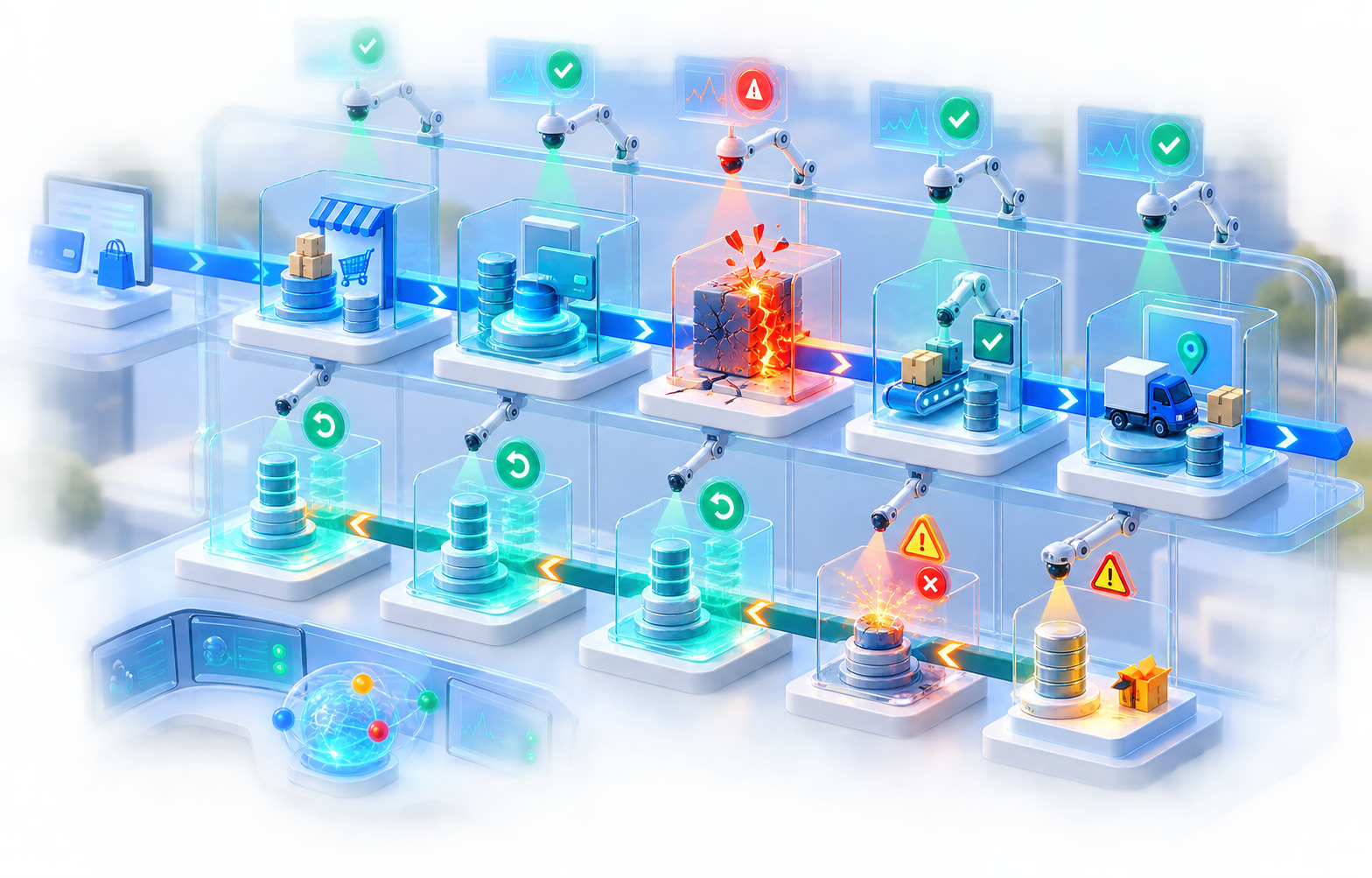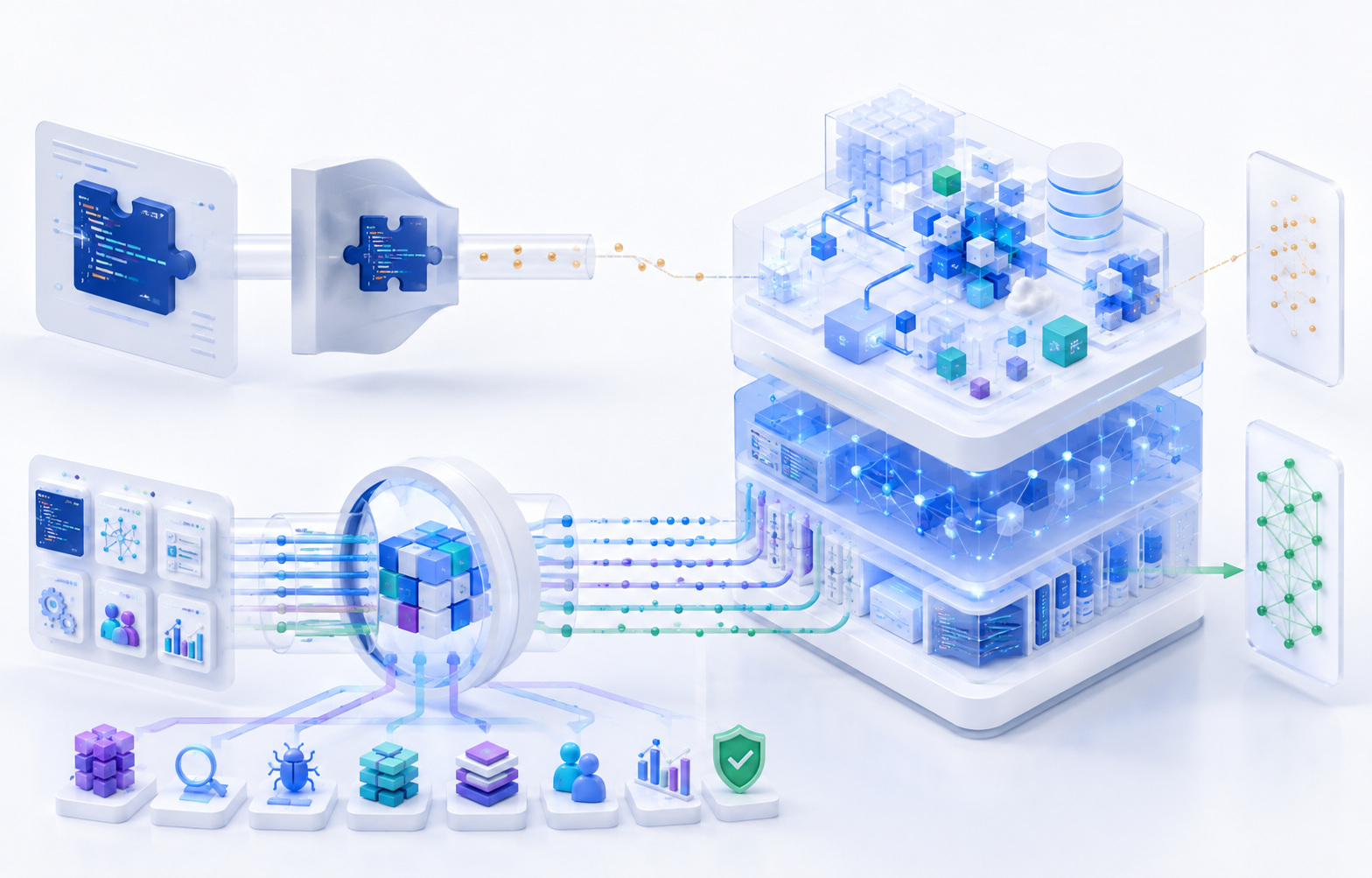
Embedding Drift: Why Your RAG System Gets Worse After a Change Nobody Tested
A mid-sized fintech company runs an internal support copilot for its customer operations team — a retrieval-augmented generation system built over roughly four thousand internal documents: policy pages, dispute-resolution procedures, product FAQs, and compliance notes. The system has been in production for a year and performs well enough that the operations team has stopped thinking about it as a project and started treating it as infrastructure, the same way they think about the ticketing system or the internal wiki search.
Two months before anyone notices a problem, a platform engineer runs a routine dependency upgrade across the company's Python services. Among dozens of package bumps in that pull request is a minor-version update to the OpenAI client SDK. The upgrade passes CI. Nothing in the diff touches the RAG service's code, its prompts, or its retrieval logic. The PR is reviewed for breaking API changes, none are found, and it ships.
What nobody catches in review is that the embeddings call in the ingestion pipeline used a bare model alias rather than a pinned, dated model identifier, and that the client library's default resolution for that alias had quietly shifted between SDK versions — a change buried in a changelog nobody on the platform team reads, because the platform team does not own the RAG system and has no reason to think a client library bump is an AI-model change. From that point forward, every newly ingested or re-processed document gets embedded with a different model than the four thousand documents already sitting in the vector index.
Nothing breaks. The ingestion pipeline runs green. The application logs show two hundred milliseconds of retrieval latency, same as always. The chat completions call still returns fluent, well-formatted answers. For about three weeks, almost nobody notices anything, because the bulk of the knowledge base was untouched and the shift only affects documents updated after the SDK bump — a slowly growing minority of the index.
What does show up, gradually, is a change in the texture of support agent complaints about the copilot. Agents start describing answers as "close but not quite right" — citing a policy section that sounds plausible but is actually one version out of date, or pulling a dispute-resolution step from a different product line than the one in the ticket. Nobody connects this to an infrastructure change from six weeks earlier, because nothing about the symptom looks infrastructural. It looks like the kind of thing you'd blame on prompt quality, or on the underlying chat model, or — as one engineer initially assumed, having read about exactly this problem in a different context — on the LLM provider silently swapping which model answers a request. That turns out to be a dead end: the chat model is pinned to a dated snapshot and hasn't changed. The actual cause is two layers upstream of the model doing the talking, in the layer that decides what the model gets to read before it answers.
This is a hypothetical scenario, built to illustrate a mechanism rather than to describe a specific real incident. But the mechanism itself is not speculative. It follows directly from how nearest-neighbor vector search works, and from what embedding-model providers do and do not guarantee about compatibility across model versions — guarantees that, as the research below documents, mostly do not exist. This article is about that mechanism: why it causes embedding drift, why it is structurally invisible to conventional monitoring, and how to build retrieval quality testing, embedding version pinning, and re-indexing discipline into a RAG system's release process before drift becomes the operations team's problem to diagnose after the fact.
The Assumption RAG Quietly Depends On
Every RAG system rests on a mechanical premise that is almost never written down anywhere in its architecture documentation, because it seems too obvious to need stating: the vectors representing the knowledge base and the vector representing an incoming query have to live in the same geometric space for a nearest-neighbor comparison between them to mean anything.
In practice, this means two embedding calls — one made at indexing time, against a document chunk, and one made at query time, against a user's question — must come from the same embedding model, in the same configuration, for the distance or similarity score between the resulting vectors to reflect actual semantic relatedness. If they don't, the numbers you get back from a similarity search are not wrong in an obvious way. They are numbers. Cosine similarity between any two vectors of matching dimensionality always produces a value between -1 and 1. Nearest-neighbor search always returns the k nearest points by whatever distance metric the index uses. The system will confidently report that document B is the third-closest match to your query, and that number will be exactly as real and exactly as computable whether or not the two vectors were ever intended to be compared to each other.
This is worth sitting with, because it is the structural reason embedding drift is so much harder to detect than most other classes of production failure. A failed API call throws. A schema mismatch throws. A null pointer throws. A vector space mismatch does not throw, because there is no such thing, at the mathematical level, as an invalid comparison between two same-dimensioned vectors — only a comparison that happens not to correspond to what a human would consider "similar."
OpenAI's own embeddings documentation is a useful, concrete illustration of how little compatibility is guaranteed across model versions even within a single vendor's own model family. The current generation of models — text-embedding-3-small (1536 dimensions by default) and text-embedding-3-large (3072 dimensions by default) — succeeded the earlier text-embedding-ada-002 (1536 dimensions). Note that text-embedding-3-small and ada-002 share the same default dimensionality. Nothing in OpenAI's public documentation states that vectors produced by these two models can be meaningfully compared to each other, and nothing states that they cannot — the compatibility question is simply not addressed, because within-model consistency is the only property the provider is committing to. Two models that happen to output vectors of the same length are not thereby interchangeable; dimensionality is a shape constraint, not a semantic one. A 1536-length vector from ada-002 and a 1536-length vector from text-embedding-3-small were produced by different neural networks trained on different objectives and are not guaranteed to encode "similar meaning" using the same geometric relationships. Treating them as comparable because the array lengths match is the exact mistake that produces silent drift.
Qdrant's own operational documentation, aimed at engineers who run vector databases in production, states the underlying migration problem plainly: moving to a new embedding model is not a configuration change, it is a re-indexing project, precisely because the new model's output cannot be safely mixed with the old model's output in the same collection. Qdrant's guidance recommends either a blue-green migration (a parallel collection built entirely from the new model, cut over only once verified) or, for newer versions of the database, a named-vector approach that stores both the old and new embeddings side by side on the same points until the cutover is complete. Both approaches exist specifically because there is no safe partial or incremental way to swap an embedding model under a live index — the two vector families cannot coexist within a single comparison space without one silently contaminating retrieval quality for the other.
That is the assumption. It is fragile, it is rarely written into an architecture diagram, and in most RAG systems currently in production, nothing actively verifies that it continues to hold from one week to the next.
Why the Failure Never Throws an Exception
It helps to separate two categories of embedding mismatch, because they behave very differently in production, and only one of them is easy to catch.
Hard mismatch — dimension mismatch. If your query embedding has 1536 dimensions and your index was built on 3072-dimensional vectors, most vector databases will reject the comparison outright with a clear error. This is the easy case. It happens, for example, if a team switches from text-embedding-3-small (1536) to text-embedding-3-large (3072) without updating the index schema, and it gets caught immediately, usually in a staging environment, because the system cannot even execute the query.
Soft mismatch — same shape, different space. This is the dangerous case, and it is the one this article is about. Two embedding models can produce vectors of identical dimensionality that are not comparable, and the system will run without error, because nothing about a soft mismatch violates a schema constraint. There are several concrete ways a soft mismatch enters a production RAG system:
- A provider changes what a default model alias resolves to. This is structurally identical to the chat-model alias risk QAtronic has documented elsewhere for generation models, but applied to the embeddings endpoint instead. If an ingestion pipeline calls an embeddings endpoint using an unpinned or loosely pinned model reference, a provider-side default change can silently start producing vectors from a different model without a single line of application code changing.
- A team upgrades a self-hosted embedding model. Organizations running open-source embedding models (sentence-transformer variants, domain-tuned bi-encoders, or similar) often treat a model upgrade the same way they'd treat any other dependency bump — pull the new checkpoint, redeploy, done. If the new checkpoint is not the same model at a later training step but a materially different architecture or training run, the resulting vector space is different even if the output dimensionality is unchanged.
- The
dimensionstruncation parameter is applied inconsistently. OpenAI's third-generation embedding models support adimensionsAPI parameter that lets a caller request a shortened embedding — for example, truncating a 3072-dimensionaltext-embedding-3-largevector down to 1024 dimensions to save storage and compute, a technique the documentation describes as preserving most of the model's concept-representing properties. This is a genuinely useful cost/performance lever, but only if it is applied identically at index time and query time. If a re-indexing job passesdimensions=1024while an older query path still calls the API without the parameter (returning the full 3072-dimensional vector), a dimension mismatch will at least throw an error — but if a second code path applies a different non-default truncation value, or if the truncation is applied inconsistently within a mixed index, the result is a soft mismatch layered on top of already-fragile geometry. - A distance metric or normalization setting changes at the vector database layer. Cosine similarity, dot product, and Euclidean (L2) distance are not interchangeable, and they are not automatically consistent with how a given embedding model expects to be compared. OpenAI states explicitly that its embeddings are pre-normalized to unit length and that cosine similarity is the recommended metric — under that normalization, cosine similarity and dot product produce identical rankings, but only because of that specific normalization property. If an index is reconfigured to use a different distance metric, or if vectors are normalized inconsistently across index-time and query-time paths, ranking quality degrades even though every vector still has the "correct" model and dimensionality.
- A re-indexing or migration job fails partway through. This produces the most operationally dangerous version of the problem: a single index containing a mix of old-model and new-model vectors, with no field distinguishing which is which. Every query against that index is now comparing the query vector against some genuinely comparable neighbors and some incomparable ones, and the ranking algorithm has no way to know the difference. It will return its top-k results as if they were all equally valid, silently favoring whichever population — old or new — happens to be geometrically closer to the query model's output, regardless of actual content relevance.
The common thread across all five is that the system keeps functioning. Ingestion pipelines report success. Query latency stays flat. The vector database's own health checks — which typically monitor availability, query latency, and index build status, not semantic ranking quality — show green across the board. The chat model on the far end of the pipeline receives whatever context retrieval handed it and, because large language models are specifically good at producing fluent, confident text from whatever input they're given, it produces an answer that reads exactly like every other answer the system has ever given. The generation layer has no mechanism for knowing that the context it was handed is weakly related to the question, so it does what it is designed to do: it writes the most plausible answer it can construct from the material in front of it. That is the mechanism behind the "confidently wrong, and confidently wrong in a way that sounds identical to confidently right" symptom that shows up in end-user complaints weeks after the actual cause.
An Illustrative Timeline of Silent Degradation
The chart below is explicitly hypothetical. It is not drawn from any real deployment, benchmark, or QAtronic client engagement — it illustrates the shape of the problem described above: a gradual quality decline that tracks the growing share of an index affected by a model mismatch, rather than a sudden failure that would trip a conventional alert.
Illustrative Chart 1 — Retrieval quality against a fixed evaluation set, before and after an unpinned embedding-model change (hypothetical scenario, not real production or benchmark data)
Categories: weeks since the embedding-model change occurred (the change itself produces no alert and is not visible on this axis by design). Metrics: Recall@10 and Mean Reciprocal Rank (MRR), both measured against the same fixed set of 150 evaluation queries with known-correct documents, re-run weekly against the live index.
| Week | Share of index affected by mismatch | Recall@10 | MRR |
|---|---|---|---|
| 0 (change occurs, unnoticed) | 0% | 0.91 | 0.78 |
| 1 | 4% | 0.90 | 0.77 |
| 2 | 9% | 0.88 | 0.74 |
| 3 | 15% | 0.85 | 0.70 |
| 4 | 21% | 0.82 | 0.66 |
| 6 | 33% | 0.76 | 0.58 |
| 8 | 44% | 0.71 | 0.52 |
| 10 (agents start filing complaints) | 55% | 0.65 | 0.46 |
| 12 (root cause identified) | 64% | 0.60 | 0.41 |
What this illustrates: recall and MRR decline roughly in proportion to how much of the index has been re-embedded with the mismatched model — a slow, monotonic slope with no single point that looks like an incident. A monitoring system watching only availability, latency, or error rate would show a flat, healthy line across the entire period. A monitoring system watching retrieval quality against a fixed evaluation set — the practice this article recommends building — would show a visible, actionable decline starting in week one, roughly ten weeks before the illustrative scenario has agents filing complaints. The gap between "detectable in metrics" and "detectable by users noticing" is the entire argument for treating retrieval evaluation as a standing practice rather than a one-time launch activity.
Where Embedding Drift Actually Originates
It is worth cataloguing the realistic entry points for this failure class, because "keep the embedding model consistent" is easy advice to agree with and surprisingly easy to violate without anyone deciding to.
| Trigger | Who typically causes it | Why it goes unnoticed |
|---|---|---|
| Provider changes a default model alias behind an unpinned embeddings call | Platform/infra team, via a routine SDK or dependency upgrade | The team making the change doesn't know it touches an AI system; no AI-specific review gate exists for infra PRs |
| Team manually upgrades a self-hosted embedding model | ML/data engineering team, treating it as a routine model refresh | The upgrade is evaluated on the model's own benchmark improvement, not on compatibility with the existing index |
| Inconsistent use of a dimension-truncation parameter across code paths | Application engineers, often at different times, in different services | No single owner reviews all embeddings call sites together; the two paths are in different repos or services |
| Vector database distance metric or normalization setting changed during a database migration or upgrade | Infrastructure/DevOps team performing a database migration unrelated to AI features | The migration's test suite covers availability and query correctness, not semantic ranking quality |
| Partial or interrupted re-indexing job leaves a mixed-model index | Whoever ran the re-index, often without a resumable or atomic migration design | No verification step confirms index homogeneity before or after the job; the job "succeeded" by its own logging |
| A/B test or canary embedding model left partially rolled out | Product/ML team running a legitimate experiment that isn't fully reverted or fully promoted | The experiment's own metrics (click-through, engagement) don't isolate retrieval quality from generation quality |
None of these require carelessness. Every one of them is a reasonable, defensible action taken by a competent engineer who did not have visibility into a downstream system they don't own. That is precisely the organizational pattern that makes embedding drift a testing and process problem rather than a training problem — the fix is not "tell engineers to be more careful," it is building a verification step that catches the condition regardless of which team or which change introduced it.
Chunking Changes: The Adjacent Risk That Compounds Embedding Drift
Embedding model changes rarely travel alone. In most real re-indexing projects, a team revisiting the embedding model also takes the opportunity to adjust how documents are split into chunks before embedding — moving from fixed-length chunking to a semantic or heading-aware splitter, changing chunk overlap, or adjusting maximum chunk size to better fit a new model's context limits. Each of these is a reasonable, independently justifiable change. Bundled together with an embedding model swap, they make the resulting quality shift far harder to diagnose, because a drop in recall or nDCG after the change could now be caused by the new model, the new chunk boundaries, or an interaction between the two, and a single before/after metric comparison can't distinguish which.
This matters for testing discipline specifically because it argues against combining changes inside a single re-index event, even when doing so feels efficient. If a team is going to change both the embedding model and the chunking strategy, the evaluation harness should be run in at least three configurations before committing to a full re-index: old model with old chunking (the existing baseline), old model with new chunking (isolating the chunking effect), and new model with new chunking (the actual target state). Skipping the middle configuration means that if the combined result comes back worse than baseline, there is no way to tell from the metrics alone whether the fix is to reconsider the model choice, the chunking choice, or both. A team that already has an evaluation harness in place, as described later in this article, can run this three-way comparison for a marginal cost — a few additional harness runs against sampled subsets of the corpus — that is trivial compared to the cost of debugging a conflated regression after the fact.
There is a second, more subtle chunking interaction worth naming: chunk boundaries affect what a document "means" to an embedding model independent of which model is used, because a chunk that splits a sentence or a table mid-way produces a fundamentally different input than the same content chunked cleanly. If a re-indexing project changes chunking and a team's evaluation set was built against the old chunk boundaries — for example, with ground-truth answers mapped to specific chunk IDs — that evaluation set itself needs to be re-validated against the new chunk boundaries before it can be trusted to measure the new configuration fairly. An evaluation harness that silently compares apples-shaped ground truth against oranges-shaped new chunks will produce numbers that look like a regression even when the new configuration is genuinely better, simply because the ground-truth chunk IDs no longer exist in the new index.
What Recall@k, MRR, and nDCG Actually Measure
Before building a testing framework, it is worth being precise about the metrics involved, because they get invoked casually in RAG discussions without much explanation of what each one actually captures — and using the wrong one for a given system's shape produces a false sense of confidence.
These three metrics come from established information retrieval literature, not from the RAG or LLM ecosystem specifically; RAG evaluation borrowed them from decades of prior search-engine and recommender-system research, and they retain their original definitions.
Recall@k measures what fraction of all genuinely relevant documents for a query were retrieved somewhere in the top k results. It does not care about order — a relevant document ranked first and a relevant document ranked tenth (out of ten) count identically toward recall. This makes it a coverage metric: did the system surface the right material at all, regardless of how well it was ranked. Recall@k is intuitive to explain to a non-technical stakeholder and is a reasonable default for RAG, because a generation model given ten context chunks can often extract the right answer from chunk seven just as well as from chunk one — coverage frequently matters more than perfect ordering.
Mean Reciprocal Rank (MRR) is order-aware. For each query, it looks at the rank position of the first relevant result and scores that query as 1 divided by that rank — a relevant document in position 1 scores 1.0, in position 2 scores 0.5, in position 10 scores 0.1. MRR is then averaged across all evaluation queries. This metric is well suited to systems where a single best answer matters most — a support chatbot retrieving one authoritative policy passage, for instance — and it is less informative for systems where several different relevant passages might all need to be surfaced together.
Normalized Discounted Cumulative Gain (nDCG@k) is the most complete of the three, because it accounts for both rank position and graded relevance — not just "relevant or not" but "how relevant, on some scale" (for example 0–3, with 3 being a perfect match and 0 being irrelevant). Discounted Cumulative Gain sums each result's relevance grade divided by a logarithmic discount based on its rank position, rewarding highly relevant results that appear early more than the same results appearing late. Normalizing that score against the best possible ordering for the same query produces a value between 0 and 1, making it comparable across queries with different numbers of relevant documents. nDCG is the standard metric on the MTEB (Massive Text Embedding Benchmark) leaderboard's retrieval category, and it is the right choice when relevance in your domain genuinely comes in degrees rather than a binary yes/no — which is common in RAG, where a document can be "exactly on point," "partially relevant," or "topically adjacent but not useful."
A comparison worth internalizing:
| Metric | Order-aware? | Handles graded relevance? | Best fit for | Weak point |
|---|---|---|---|---|
| Recall@k | No | No (binary relevant/not) | Coverage checks; "did we retrieve the right material at all" | Rewards a system that buries a relevant result at rank 9 exactly as much as one that surfaces it at rank 1 |
| MRR | Yes | No (binary) | Single-best-answer retrieval (support bots, FAQ lookup) | Ignores everything after the first relevant hit; blind to whether the rest of top-k is good or garbage |
| nDCG@k | Yes | Yes | General-purpose RAG evaluation where relevance is graded and ranking quality matters throughout top-k | Requires graded relevance labels, which are more expensive to produce than binary labels |
For most production RAG systems, the practical recommendation is to track recall@k as a coverage floor (did retrieval even surface the right material) and nDCG@k as the quality signal on top of it (was it ranked well), while reserving MRR for the specific subset of use cases — narrow Q&A, single-document lookup — where one best answer is genuinely the product requirement.
The Metrics That Mislead You
Most RAG systems already collect some signal about answer quality, and it's worth being explicit about which of those signals can and can't detect embedding drift, because the wrong metric creating false confidence is arguably worse than having no metric at all — a team watching the wrong dashboard stops looking for the actual problem.
Thumbs-up / thumbs-down feedback rate is the most common signal teams already have, and it is a weak proxy for retrieval quality specifically. Users rate an interaction based on the final answer's tone, formatting, and apparent helpfulness, not on whether the underlying context was actually the most relevant material available. A fluent, well-organized answer built on subtly wrong context routinely earns a thumbs-up from a user who has no way to independently verify the source material — this is precisely the failure mode described earlier, where the generation layer's fluency masks a retrieval problem. Feedback rate also suffers from response bias: dissatisfied users often abandon the interaction rather than clicking a negative rating, while satisfied users rate inconsistently, so the aggregate number moves slowly and lags real quality changes by weeks.
Session length or follow-up-question rate is sometimes read as a quality signal — the assumption being that a user asking a follow-up question means the first answer was useful enough to build on. This cuts both ways just as easily: a user asking three follow-up questions in a row can mean the first answer was excellent and prompted deeper exploration, or that the first answer missed the point entirely and the user is rephrasing in search of something usable. Without a way to distinguish these two cases, this metric is closer to noise than signal for retrieval quality specifically.
The LLM's own confidence language — phrases like "I'm not entirely sure, but" versus a flatly stated answer — is not a reliable indicator of whether the underlying retrieval was good, because a language model's hedging behavior is a property of its own training and prompting, not a measurement of the actual relevance of the context it was given. A model can hedge convincingly on a well-retrieved answer and state a poorly-grounded answer with full confidence, because nothing in its generation process has direct visibility into a retrieval quality score.
Application-level error rate and latency, the metrics most existing observability dashboards already track well, measure whether the system is running, not whether it's retrieving correctly — this is the same point made earlier about health checks, worth restating here because it's the single most common gap QAtronic sees in teams who believe their RAG system is being monitored. A system can post a perfect uptime record for months while its retrieval quality quietly declines the entire time.
What actually works as a leading indicator is a fixed evaluation set measured directly against ground truth, exactly because it removes the confounding factors above — a labeled query with a known-correct answer either gets retrieved or it doesn't, independent of how the user felt about the resulting conversation, how many follow-up questions they asked, or how confidently the model phrased its response. This is not an argument to discard user feedback signals entirely; they remain useful for catching generation-layer problems (tone, format, unhelpfulness) that a retrieval-focused evaluation harness won't see. It is an argument for not mistaking them for a retrieval quality signal, and for not concluding a RAG system is "healthy" from feedback and uptime data alone.
Building a Retrieval Evaluation Harness
None of the metrics above are useful without a fixed, reusable evaluation set to run them against — the equivalent of a golden dataset in traditional regression testing, adapted to retrieval. This is the practical center of testing for embedding drift: a small, curated set of representative queries, each mapped to the document or documents that should be retrieved for it, re-run on a schedule and after every change to the embedding pipeline or vector database configuration.
Constructing the evaluation set. The most reliable source is real query logs, sampled and manually verified rather than synthetically generated end to end — a subject-matter expert reviews a sample of actual user or agent queries, identifies which documents genuinely answer each one, and records that mapping. A smaller synthetic supplement can help cover known-important documents that don't yet have organic query volume (for example, a newly published compliance policy), but synthetic-only evaluation sets tend to be too easy, because a language model generating a test query from a document tends to reuse the document's own vocabulary, which is not how real users phrase questions. A working target for most mid-sized knowledge bases is 100–300 labeled queries — large enough to produce a stable average metric, small enough to review and maintain by hand.
A minimal evaluation harness, illustrative and adaptable rather than a specific vendor's exact API:
# retrieval_eval.py
# Illustrative retrieval evaluation harness — adapt client calls to your
# actual embedding provider and vector database SDK.

from dataclasses import dataclass
from typing import List

@dataclass
class EvalQuery:
    query_text: str
    relevant_doc_ids: List[str]      # ground truth, human-verified
    relevance_grades: dict = None     # optional: {doc_id: grade} for nDCG

def recall_at_k(retrieved_ids: List[str], relevant_ids: List[str], k: int) -> float:
    top_k = set(retrieved_ids[:k])
    relevant = set(relevant_ids)
    if not relevant:
        return None
    return len(top_k & relevant) / len(relevant)

def reciprocal_rank(retrieved_ids: List[str], relevant_ids: List[str]) -> float:
    relevant = set(relevant_ids)
    for i, doc_id in enumerate(retrieved_ids, start=1):
        if doc_id in relevant:
            return 1.0 / i
    return 0.0

def run_eval(eval_set: List[EvalQuery], retriever, k: int = 10) -> dict:
    """
    `retriever` is a callable: query_text -> ordered list of doc_ids.
    Run this against the SAME embedding model and index configuration
    that production actually uses — never against a separate "test"
    embedding call that could itself drift out of sync with production.
    """
    recalls, rrs = [], []
    for eq in eval_set:
        retrieved = retriever(eq.query_text, k=k)
        r = recall_at_k(retrieved, eq.relevant_doc_ids, k)
        if r is not None:
            recalls.append(r)
        rrs.append(reciprocal_rank(retrieved, eq.relevant_doc_ids))

    return {
        "recall_at_k": sum(recalls) / len(recalls),
        "mrr": sum(rrs) / len(rrs),
        "n_queries": len(eval_set),
    }

# Compare against a stored baseline; fail the pipeline if the drop
# exceeds a defined tolerance.
BASELINE = {"recall_at_k": 0.91, "mrr": 0.78}
TOLERANCE = 0.05  # absolute drop allowed before this is a release blocker

def check_regression(current: dict, baseline: dict = BASELINE, tolerance: float = TOLERANCE):
    failures = []
    for metric, baseline_value in baseline.items():
        drop = baseline_value - current[metric]
        if drop > tolerance:
            failures.append(f"{metric} dropped {drop:.3f} (baseline {baseline_value}, now {current[metric]:.3f})")
    return failures
The critical design decision embedded in that harness is the comment inside run_eval: the evaluation must exercise the actual production retrieval path — the same embedding model call, the same vector database client, the same index — rather than a parallel test-only code path that could quietly diverge from what production is really doing. An evaluation harness that calls a different, "known good" embedding configuration to sanity-check itself will pass cleanly even while the real production path has drifted, because it never actually tests the thing that's serving users.
Where RAGAS and similar frameworks fit. RAGAS is an open-source evaluation library purpose-built for RAG systems that extends beyond classic information-retrieval metrics into LLM-assisted evaluation — metrics like context precision, context recall, and faithfulness that use a language model to judge whether retrieved context actually supports the generated answer, rather than relying solely on a fixed human-labeled ground truth. This is a genuinely useful complement to recall@k/MRR/nDCG, particularly for catching cases where retrieval technically surfaced a relevant document but the generation layer still produced an unfaithful answer from it. It is not a replacement for the fixed-ground-truth evaluation harness above: LLM-graded metrics are more flexible and require less manual labeling, but they introduce their own variance (the grading model has its own behavior that can shift) and are better suited to catching generation-layer faithfulness problems than to detecting the specific, mechanical embedding-space mismatch this article is about. A mature testing setup uses both: fixed-ground-truth recall/MRR/nDCG as the deterministic, cheap-to-run regression gate on every embedding or index change, and RAGAS-style LLM-graded metrics as a periodic, deeper quality audit.
Embedding Version Pinning as a Release Discipline
QAtronic's earlier analysis of chat-model version drift argued that a hosted LLM should be treated as a versioned dependency, pinned the same way a team pins a database driver or a critical library — because the alternative is a dependency that can change behavior on a schedule the team doesn't control and doesn't get notified about. The identical argument applies to the embeddings endpoint, with one addition that makes it more consequential for embeddings than for chat completions: a chat model's output is consumed once, per request, and then discarded. An embedding model's output is stored, indexed, and compared against for the entire lifetime of that data in the vector database — sometimes years. A silent embedding-model default change doesn't just affect the next API call. It affects the geometric meaning of every vector written from that point forward, indefinitely, until someone notices and re-indexes.
This has a specific practical implication: version pinning for embeddings needs to happen at two points, not one.
Pin the model call itself. Use a specific, dated model identifier rather than a bare alias wherever your embeddings provider supports one, exactly as recommended for chat models. This prevents a provider-side default change from silently altering what your ingestion pipeline produces.
Record the model version as metadata on the data, not just in a config file. A config file states what model should be in use going forward; it says nothing about what model actually produced the vectors already sitting in the index. Every stored vector should carry a payload field recording which embedding model and configuration produced it — model identifier, dimension setting if truncation is used, and ideally a timestamp. This turns "is my index internally consistent" from an open question into a query you can actually run.
// Example vector database payload, illustrative schema
{
  "id": "doc_4471_chunk_3",
  "vector": [0.0123, -0.0871, ...],
  "payload": {
    "source_doc_id": "policy-refund-v4",
    "chunk_text": "...",
    "embedding_model": "text-embedding-3-large",
    "embedding_dimensions": 3072,
    "embedded_at": "2026-06-14T00:00:00Z",
    "embedding_pipeline_version": "ingest-v7"
  }
}
With that field in place, a scheduled query — "count distinct values of embedding_model across the collection" — becomes a five-minute health check that catches the mixed-index failure mode directly, rather than waiting for retrieval quality metrics to degrade enough to notice. This single check is disproportionately cheap relative to the failure it catches, and it belongs in the same category as a schema-validation check: run continuously, alert immediately on any unexpected value, treat any drift toward multiple concurrent model versions as an active incident rather than a background cleanup task.
Gate embedding model upgrades the way you'd gate a chat model upgrade. Before adopting a new embedding model — whether because a provider released a better one or because a self-hosted model is due for a refresh — run the retrieval evaluation harness described above against the new model on a representative sample of the corpus, compare recall@k, MRR, and nDCG against the current baseline, and require the new model to meet or exceed the existing baseline before approving a full re-index. This is where the OpenAI benchmark data cited earlier becomes practically useful, not just as a curiosity: OpenAI's own published comparison shows text-embedding-3-large scoring 64.6 average on MTEB versus 61.0 for ada-002, and 54.9 versus 31.4 average on the multilingual MIRACL benchmark — a real, vendor-reported improvement (source: OpenAI, "New embedding models and API updates"). That improvement is a legitimate reason to consider upgrading. It is not, by itself, evidence that the upgrade will be safe to roll out incrementally, or that it won't require a full re-index — it says nothing at all about compatibility with the existing index, only about the new model's standalone quality on a general benchmark. A team that reads "3-large outperforms ada-002" and swaps the model in place, without re-indexing the existing corpus, gets a worse system despite adopting an objectively better model, because the improvement in the new model tells you nothing about the (non-existent) compatibility between the new model's vector space and the old one already sitting in your index.
Re-Indexing as a Tested, Release-Gated Operation
The organizational habit this article is arguing against is treating re-indexing as a background maintenance chore — something a script runs overnight, unattended, with success measured by "did the job finish without throwing an error." Re-indexing an entire knowledge base onto a new embedding model is a release. It changes what every single query in the system will retrieve, for every user, simultaneously, the moment it completes. It deserves the same rigor a team would apply to a database schema migration or a payment-processing change, not the rigor typically applied to a cron job.
A note on cost and scale. Re-embedding an entire corpus is not free, and the cost scales with corpus size and chunk count in a way that's easy to underestimate for organizations that have grown their knowledge base gradually over years without ever re-processing it in bulk. The following is an illustrative, hypothetical scenario — not real pricing or a real client engagement — meant only to demonstrate why re-indexing needs to be planned as a discrete project rather than assumed to be a quick background task:
Illustrative Chart 2 — Estimated re-indexing time by corpus size, blue-green approach with verification steps (hypothetical scenario for planning purposes only, not real benchmark data)
Categories: approximate corpus size (number of chunks). Metric: estimated end-to-end time to complete a verified, release-gated re-index (embedding generation, shadow index build, evaluation harness run, canary period) at a conservative, illustrative throughput assumption.
| Corpus size (chunks) | Estimated embedding generation time | Estimated shadow build + verification | Estimated canary period | Total estimated timeline |
|---|---|---|---|---|
| 10,000 | Under 1 hour | Same day | 1–2 days | 2–3 days |
| 100,000 | A few hours | 1 day | 3–5 days | 1 week |
| 1,000,000 | 1–2 days (rate-limit dependent) | 2–3 days | 1–2 weeks | 3–4 weeks |
| 10,000,000+ | Multiple days, likely batched | 1+ week | 2–4 weeks | 1–2 months |
What this illustrates: the mechanical cost of generating new embeddings is usually the smallest part of the timeline once a corpus grows past the smallest tier — verification and a genuine canary period, run properly, dominate the schedule for any organization with a large knowledge base. Teams that skip the canary period to save time are the ones most likely to discover a soft mismatch or an ingestion bug only after full cutover, when rollback is more disruptive.
Ownership: Who Actually Catches This
A recurring pattern across the trigger list earlier in this article is that the person making the change and the person who would notice its consequences are usually on different teams, sometimes in different reporting lines entirely. A platform engineer bumping a client SDK version has no reason to think about retrieval quality. An ML engineer evaluating a new embedding model on a public benchmark has no reason to think about a specific customer support team's complaint pattern. A DBA running a routine index rebuild has no reason to think about embedding-space geometry at all. Embedding drift is, organizationally, an ownership gap problem as much as it is a technical one, and naming a clear owner for each part of the chain is a cheap, high-leverage fix.
| Responsibility | Typical owner | What they need to own specifically |
|---|---|---|
| Pinning the embedding model version in code | Application/backend engineering | Ensuring no code path calls an unpinned or default model alias |
| Maintaining the evaluation golden dataset | QA or a designated ML-adjacent owner, with subject-matter review | Keeping the query set representative of real usage; re-validating it after chunking changes |
| Running the evaluation harness on schedule and on every change | Platform/DevOps, wired into CI/CD | Treating a metric regression as a release blocker, not an FYI |
| Reviewing and approving embedding model upgrades | A named technical owner (often the same person who owns the chat-model pinning decision) | Requiring a harness run against the new model before approval, independent of the vendor's own benchmark claims |
| Executing and verifying re-indexing projects | Whoever owns the vector database infrastructure, with sign-off from the evaluation harness owner | Treating re-indexing as a release with a rollback plan, not a background job |
| Monitoring the embedding-model metadata field for index consistency | Platform/DevOps, as an automated check | Alerting immediately on more than one embedding-model value present outside a defined migration window |
The value of writing this table out explicitly — even in a lightweight form, adapted to a specific team's structure — is that it forces an answer to a question most organizations currently don't have an answer to: if the embedding model changed under this system today, whose job would it be to notice? In the fintech scenario that opened this article, the honest answer for most of the two-month gap was nobody's, not because anyone was negligent, but because no one had been assigned the job.
Three Situations Where This Plays Out Differently
Scenario: the e-commerce product-search team upgrades a self-hosted model. Hypothetical, illustrative scenario. An online marketplace runs product search as a RAG-adjacent semantic retrieval system: product descriptions and reviews are embedded with a self-hosted sentence-transformer model, and a shopper's search query is embedded the same way to find semantically similar products, with an LLM layer summarizing and re-ranking the top results. The ML team, evaluating a newer open-source embedding model that scores noticeably better on a public benchmark, swaps the model in the query-embedding service during a routine deploy, reasoning that "it's a drop-in replacement, same interface, same output shape." The hidden assumption is that a better-benchmarked model in the same family is safe to swap incrementally rather than requiring a full corpus re-index. The technical cause: the new model was trained with a different objective and produces a genuinely different vector geometry, even at the same output dimensionality, from the model used to index the existing product catalog months earlier. The consequence: search relevance for the marketplace's oldest and highest-volume product categories degrades first and worst, because those listings were embedded longest ago and have the least recent re-processing, while newer or recently-updated listings (embedded closer to the swap) show less degradation — producing a confusing pattern where newer, lower-traffic products seem to rank better than established bestsellers for the same query, which the team initially investigates as a ranking-algorithm bug rather than an embedding-consistency problem. The decision facing the team: roll back the query-side model change immediately, or push forward with an emergency full catalog re-index. The better approach, and the one consistent with the framework above: any embedding model change — self-hosted or hosted, "drop-in" or not — should never ship to the query side of a live system without either a completed corresponding re-index of the indexed side, or a verified evaluation harness run confirming the two sides remain compatible, which in practice they almost never do.
Scenario: a healthcare software vendor's internal knowledge base survives a database migration, but its retrieval quality doesn't. Hypothetical, illustrative scenario. A healthcare SaaS company migrates its internal clinical-documentation-search RAG system from one vector database vendor to another as part of a broader infrastructure consolidation. The migration is treated primarily as a data-transfer and cost project: export vectors, import them into the new system, verify record counts match, cut over. The hidden assumption is that a vector is a vector — that moving the same numbers from one database to another preserves their meaning. The technical cause: the new vector database's default distance metric differs from the old one (for example, moving from a system defaulting to cosine similarity to one defaulting to dot product on non-normalized vectors, without an explicit normalization step during the data transfer), which silently changes the ranking behavior for every single query, independent of any embedding model change at all. The consequence: retrieval quality drops immediately after cutover, but because the migration's own test plan verified record counts and query latency — both of which look identical — nobody flags the release as risky until clinical documentation specialists notice search results feel "off" in a way they can't immediately articulate, days into using the new system for real work. The decision facing the team: audit the new system's distance-metric and normalization configuration against what the embedding model actually expects, or assume the problem lies elsewhere (a common first guess is "the migration corrupted some vectors," which sends the investigation down an unproductive data-integrity path). The better approach: any vector database migration, even one that changes nothing about the embedding model or the data itself, should be verified with the same retrieval evaluation harness used for embedding-model changes — a distance-metric or normalization mismatch is functionally identical to embedding drift from the query's perspective, even though its root cause is entirely different.
Scenario: an interrupted background re-index leaves a SaaS marketplace platform with a permanently mixed index. Hypothetical, illustrative scenario. A B2B SaaS marketplace runs a RAG-based documentation assistant for its API. An engineer kicks off a background job to re-embed the documentation corpus onto a newer model, intending to improve retrieval for a set of recently added integration guides that were performing poorly under the old model. The job runs against a large corpus, hits an unrelated rate-limit error roughly sixty percent of the way through, and fails silently — the job's own error handling logs the failure but does not roll back or flag the partially-completed state, and no alert reaches the engineer, who assumes the job succeeded based on an earlier, unrelated dashboard check. The hidden assumption is that a re-indexing job either fully succeeds or fully fails, and that a failure would be obviously visible. The technical cause: the index now permanently contains a mix of old-model and new-model vectors with no field distinguishing which is which, and no automated process is watching for that condition. The consequence: retrieval quality becomes internally inconsistent in a way that resists diagnosis for months — some queries retrieve well (when the nearest genuinely relevant document happens to share the query's embedding-model "side" of the mixed index), others retrieve poorly, and the inconsistency itself, rather than a uniform decline, is what makes the problem hard to characterize; a developer support team spends real time trying to identify a pattern in "which kinds of questions the bot gets wrong" before anyone thinks to check whether the index is homogeneous. The decision facing the team: attempt to selectively identify and fix the affected subset, or treat the entire index as suspect and rebuild from scratch. The better approach: this is exactly the failure the embedding-model metadata field described earlier is designed to catch immediately — a scheduled query counting distinct embedding_model values in the collection would have surfaced this within hours of the failed job, rather than months into an open-ended, expensive investigation.
When the Full Framework Isn't Worth the Overhead
None of this is free, and applying the complete framework — pinned versions, a maintained evaluation harness, release-gated re-indexing with shadow indexes and canary periods — to every RAG system regardless of scale is its own kind of process mistake. The overhead is worth it in proportion to how much the system's failure mode actually costs.
A small, largely static knowledge base — a few dozen internal documents that change rarely, serving a handful of internal users, with no compliance or customer-facing consequence if an answer is subtly wrong — does not need a formal retrieval evaluation harness with a maintained golden dataset. The pragmatic version of this framework for that context is much lighter: pin the embedding model version explicitly, record it as metadata, and re-index manually (with a quick spot-check of ten or fifteen representative queries) on the rare occasion the model changes. Building a full CI-gated evaluation pipeline for a system with negligible query volume and low consequence-of-error is effort better spent elsewhere.
The framework earns its cost as three factors grow together: query volume (more opportunities for a bad answer to reach someone), knowledge base size and update frequency (more surface area for a partial or inconsistent re-index), and the real-world cost of a wrong answer (a customer-facing support bot or a compliance-adjacent internal tool carries more downside than an internal engineering wiki search).
| Factor | Startup (early product, low volume) | Scale-up (growing product, meaningful volume) | Enterprise (high volume, compliance exposure) |
|---|---|---|---|
| Embedding version pinning | Do it — costs almost nothing, prevents the easiest-to-avoid failure | Mandatory, enforced in code review | Mandatory, enforced by automated policy/lint check |
| Metadata field per vector recording model version | Recommended, low effort to add early | Required — this is the cheapest possible drift detector | Required, plus automated alerting on any multi-version state |
| Formal evaluation harness (recall@k / MRR / nDCG) | Optional; a manual spot-check of 10–20 queries may suffice | Recommended, run on every embedding or index change | Required, run on a schedule in addition to every change, with a maintained and periodically re-validated golden set |
| Shadow-index / canary re-indexing process | Usually unnecessary at this scale; a maintenance window is fine | Recommended once outage or quality-regression cost exceeds a rushed re-index's convenience | Required — a live cutover without a canary period is a release risk at this scale |
| LLM-graded evaluation (RAGAS-style) | Skip | Useful periodic supplement, not a release gate | Valuable as a periodic quality audit alongside the deterministic gate |
An Embedding Drift Readiness Checklist
A practical, review-oriented checklist for a team assessing its own exposure, or evaluating a vendor's RAG implementation:
- Is every embedding API call pinned to a specific, dated model identifier rather than a bare or default alias, on both the ingestion (indexing) and query paths?
- Does every vector stored in the index carry metadata identifying which model, configuration, and truncation setting produced it, queryable independently of the application code?
- Is there a scheduled check that counts distinct embedding-model values across the live index and alerts if more than one value is present outside a defined, time-boxed migration window?
- Does a maintained, human-verified evaluation set exist, mapping realistic queries to known-correct documents, large enough to produce a stable metric (typically 100+ queries)?
- Is that evaluation harness run against the actual production retrieval path — not a parallel test-only embedding call — on a defined schedule and after any change to the embedding model, vector database configuration, or chunking strategy?
- Is there a defined regression threshold (a specific, agreed drop in recall@k, MRR, or nDCG) that blocks a release rather than relying on someone's subjective read of the numbers?
- Does any embedding model or vector database change go through a shadow/parallel verification step before live traffic depends on it, rather than an in-place, unverified swap?
- Is there a canary or phased rollout period for a completed re-index before full cutover, with a defined rollback path?
- Does the vector database's distance metric and normalization setting get explicitly reviewed — not assumed unchanged — during any database migration or major version upgrade, independent of whether the embedding model itself changed?
- If a re-indexing job can fail partway through, does the pipeline detect and flag a partial completion state, rather than treating "job exited" as equivalent to "job succeeded"?
A team that can answer yes to all ten has effectively eliminated embedding drift as an unmonitored risk. Most production RAG systems, based on the mechanisms described in this article, can currently answer yes to perhaps two or three.
Questions to Bring to Your Own Team or an External Vendor
For an internal team: Who owns the embedding model version as a piece of infrastructure — is there a single name attached to it, the way there is for the production database or the payment integration? When was the last time anyone ran a retrieval-quality check against a fixed evaluation set, and can you produce the number? If someone upgraded a client SDK or ran a routine dependency bump tomorrow, is there any code review checkpoint that would flag a change to what embeddings endpoint gets called?
For an external vendor or contractor building a RAG system: How is the embedding model version pinned, and what happens automatically if the provider changes a default? What does the re-indexing process look like when the embedding model changes, and is it something the vendor treats as a tested release or as background maintenance? Can they show a retrieval evaluation metric — recall@k, MRR, or nDCG — from a real evaluation run, rather than only end-to-end answer quality judged subjectively? What is the rollback plan if a re-index degrades quality after cutover, and has that rollback ever actually been exercised rather than only planned?
Frequently Asked Questions
What is embedding drift? Embedding drift is the gradual or sudden degradation of retrieval quality in a vector-search or RAG system that occurs when the embedding model, configuration, or vector database settings used at index time diverge from those used at query time, causing similarity comparisons to no longer reflect genuine semantic relatedness — without producing any error, exception, or failed health check.
Can two embedding models with the same output dimensionality be used interchangeably? No. Matching dimensionality is a shape requirement, not a semantic guarantee. Two models producing 1536-dimensional vectors can place semantically similar text in entirely different regions of that 1536-dimensional space, because each model was trained independently. Vector database vendors, including Qdrant in its own migration documentation, treat any embedding model change as requiring a full re-index rather than an in-place swap, specifically because of this.
Will my vector database throw an error if embeddings are mismatched? Only if the dimensionality itself doesn't match, which most databases reject outright. A same-dimension mismatch between two different models or configurations will not throw an error; the database will return a similarity ranking as normal, and that ranking will simply be less meaningful.
How often should a RAG system's retrieval quality be re-evaluated? At minimum, after any change to the embedding model, vector database configuration, distance metric, or chunking strategy. For production systems with meaningful query volume, running the evaluation harness on a regular schedule — independent of known changes — is worthwhile, since it also catches upstream changes a team didn't know occurred, such as a provider-side default model alias update.
What's the difference between embedding drift and the LLM chat model changing? Chat-model drift affects the generation layer — the model that writes the final answer might start phrasing things differently, refusing different content, or reasoning differently, even given identical input. Embedding drift affects an earlier layer — what context the generation model is even given to work with. The two can be mistaken for each other because both produce "the answers got worse," but the root cause, the detection method, and the fix are entirely different.
Is RAGAS a replacement for recall@k and MRR? No, it's a complement. RAGAS and similar LLM-graded frameworks are well suited to evaluating whether a generated answer is faithful to its retrieved context, which classic information-retrieval metrics don't directly measure. Classic recall@k, MRR, and nDCG against a fixed, human-labeled ground truth remain the more deterministic, reproducible way to catch a specific embedding-space mismatch, and they're cheaper to run as an automated release gate.
Do small, static knowledge bases need this level of testing rigor? Not the full framework. A small, infrequently updated knowledge base with low query volume and low consequence-of-error can reasonably rely on version pinning, metadata tagging, and a manual spot-check on the rare occasion the embedding model changes, without a maintained automated evaluation harness or a formal canary rollout process.
The QAtronic Perspective
Testing a RAG system's retrieval layer is not fundamentally different in spirit from testing any other data-dependent production system — it requires a fixed reference point, a repeatable measurement, and a threshold that blocks a release rather than a subjective sense that things still seem fine. What makes embedding drift specifically dangerous is that it sits in a part of the stack most teams have not yet built that discipline around, because vector search still feels new enough that "does this still retrieve the right documents" hasn't yet become a standard release check the way "does this API still return the right schema" has. QAtronic works with engineering teams to build exactly that missing layer — retrieval evaluation harnesses, embedding-version pinning conventions, and release-gated re-indexing processes — as a practical extension of the same release-quality discipline QAtronic applies across the rest of a software delivery pipeline, rather than as a separate, bespoke AI-testing specialty.
A Distinction Worth Keeping
The uncomfortable part of embedding drift is not that it's hard to fix. Pinning a model version, tagging vectors with metadata, and running a retrieval evaluation harness on a schedule are all mechanically straightforward — none of it requires research-level expertise. The uncomfortable part is that fixing it requires believing, in advance, that a system which currently shows no errors, no failed checks, and no red dashboards might already be quietly wrong. That is a harder thing to act on than a paged incident, because nothing is asking you to.
The distinction worth carrying back to your own team is this: a RAG system's health checks were almost certainly designed to verify that it runs, not that it retrieves correctly. Those are different properties, and only one of them is currently being tested in most production deployments. The question worth putting to an engineering team building or operating a retrieval system is not "has anything broken recently" — embedding drift, by construction, will never produce a yes to that question until long after the damage is done. The better question is: if the embedding model quietly