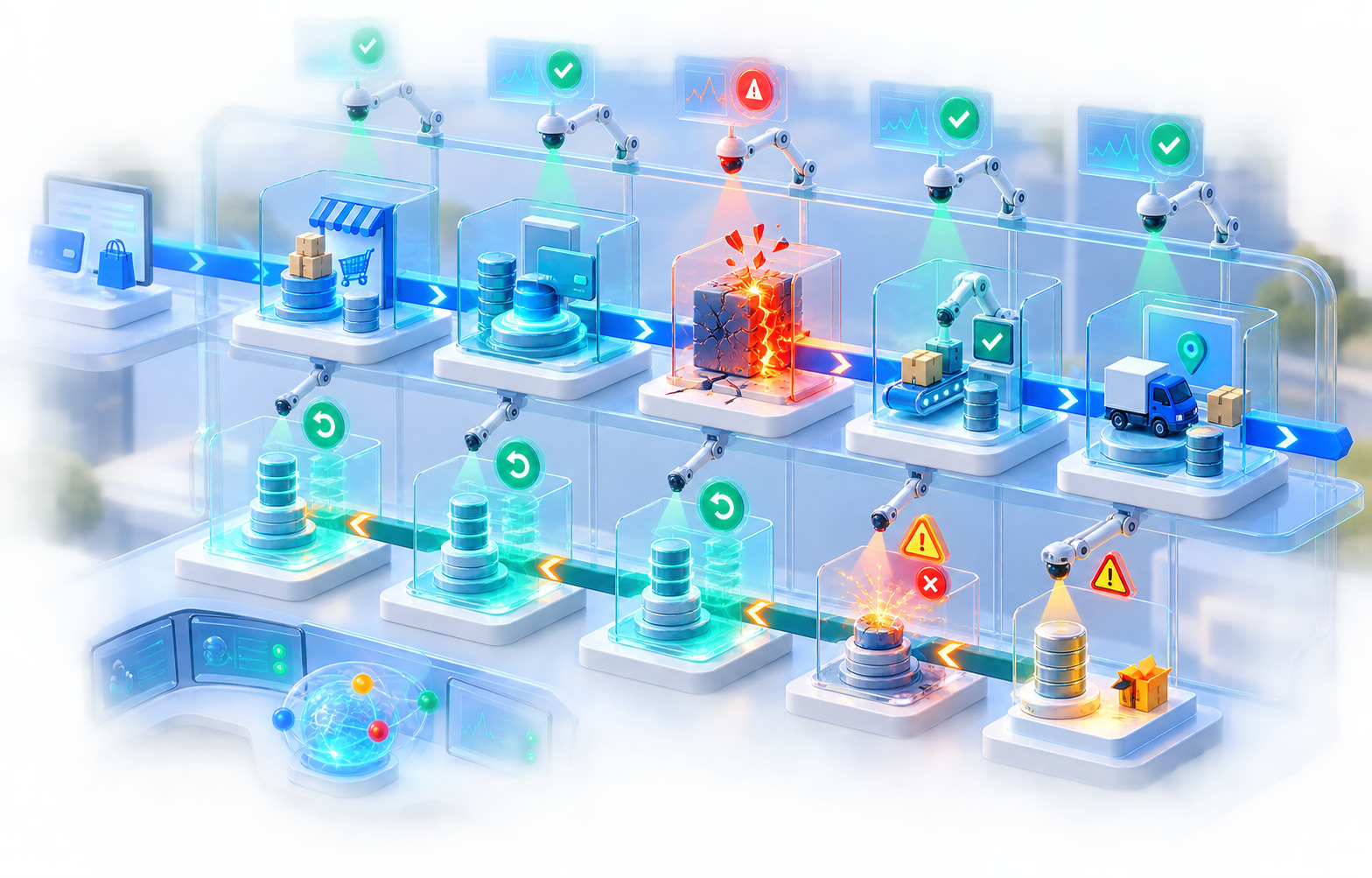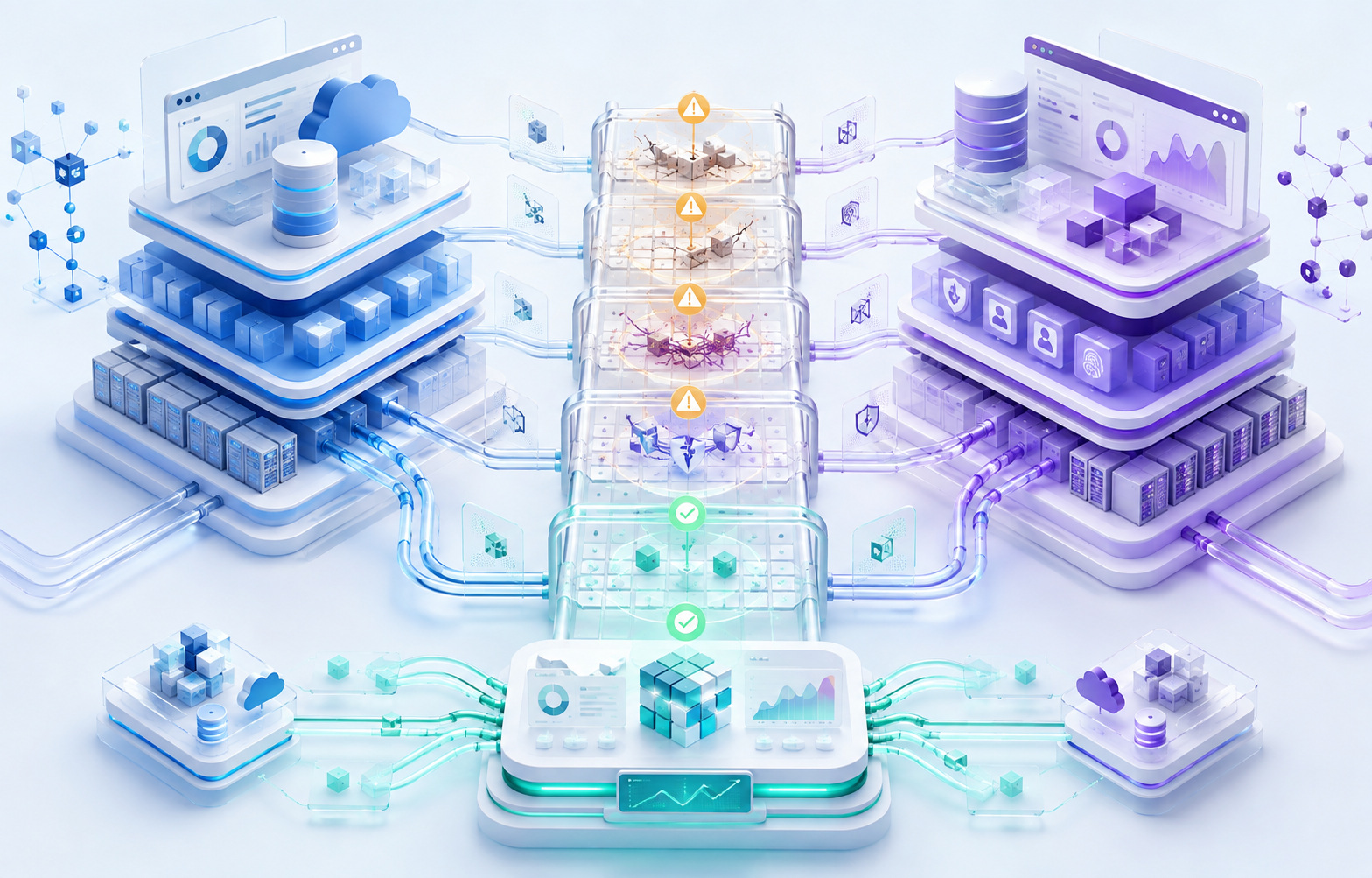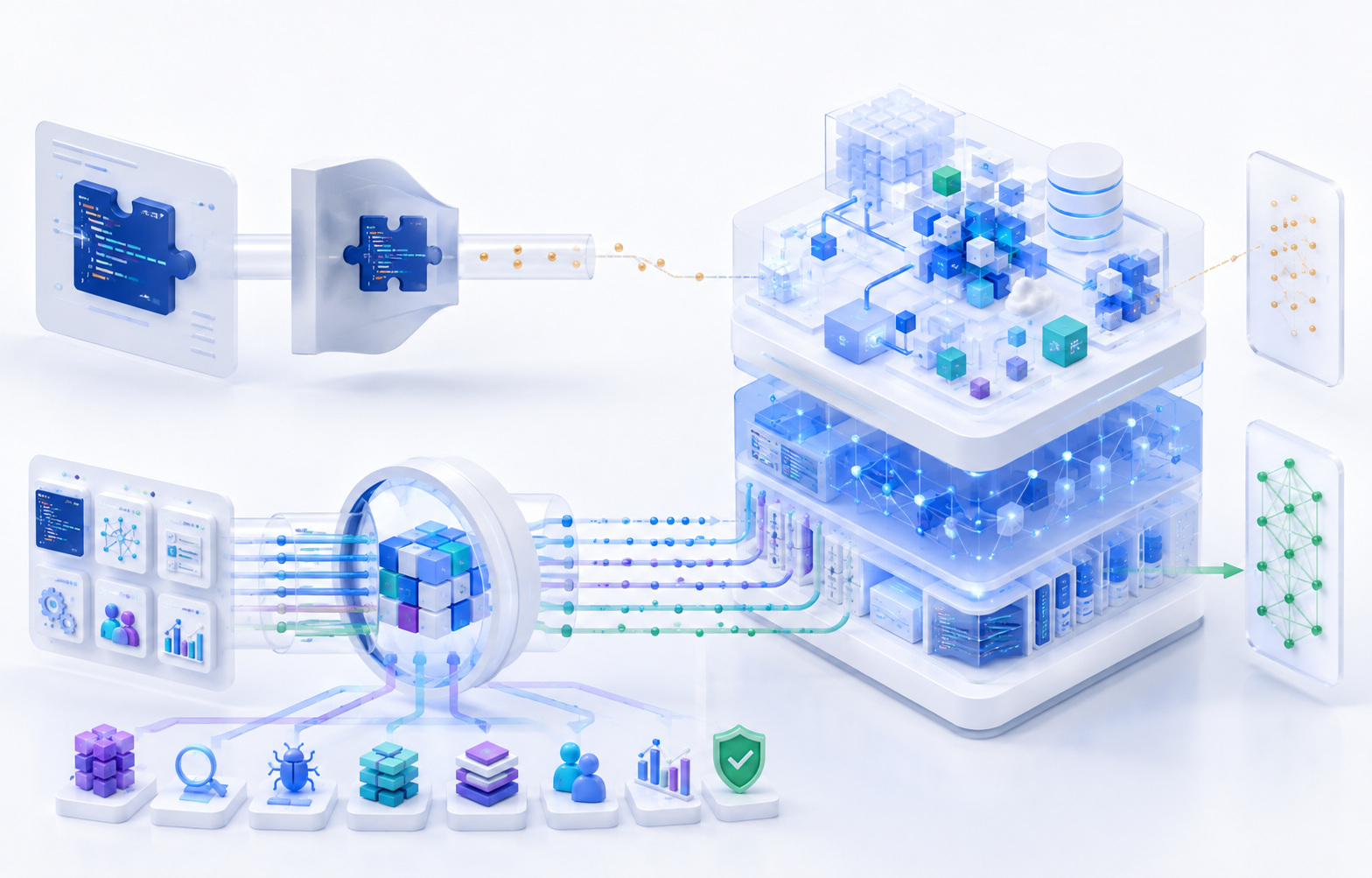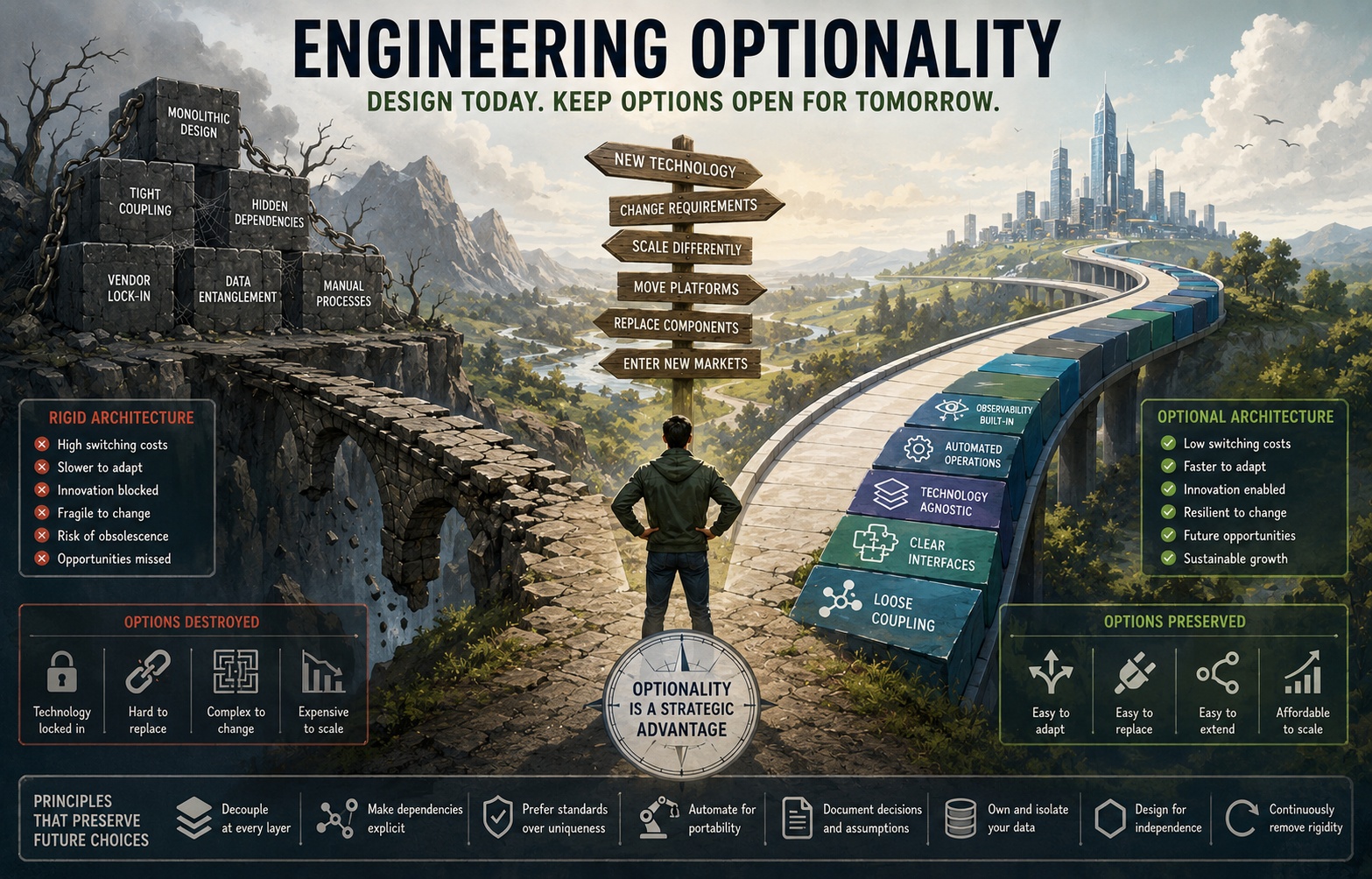
There is a quiet asymmetry at the center of software engineering: the decisions that are easiest to make are usually the hardest to unmake. A dependency is added in an afternoon and removed over three quarters. A schema column is created in a migration file and retired only after four teams agree, six services are patched, and one reporting pipeline is rebuilt.
Most engineering discourse concerns the first half of that asymmetry — how to choose well. This essay concerns the second half: how to choose in a way that leaves you able to choose again.
Engineering optionality is the accumulated capacity of a system and its organization to change direction at acceptable cost. It is not a technology, a pattern, or a maturity level. It is a property that every architectural decision either creates, preserves, or destroys — usually without anyone recording which. The organizations that survive technological disruption are rarely the ones holding the newest technology when the disruption arrives. They are the ones whose systems could still move.
Part I — The Architecture of Future Decisions
Architecture is not a picture of the system. It is the set of decisions you cannot cheaply revisit.
The most useful working definition of software architecture is a negative one: architecture is whatever remains expensive to change after the code is written. Everything else is implementation. A function body is not architecture, because rewriting it costs an hour. The choice to make every service call synchronous is architecture, because unwinding it costs a year.
The consequence is that an architect's primary job is not making good decisions. It is controlling how many decisions become expensive, and which ones. A system with two hundred irreversible decisions and excellent judgment behind each is more fragile than one with twenty and merely adequate judgment, because judgment applies to a known present and irreversibility to an unknown future.
The reversibility gradient
Decisions do not divide cleanly into reversible and irreversible. They sit on a gradient, and the gradient is what belongs on the whiteboard.
Diagram — The Reversibility Gradient
A horizontal axis runs from Free to Terminal; vertical position shows how many components depend on each decision.
- Free (hours): log format, retry counts, internal function structure, flag defaults.
- Cheap (days): library choice inside one module, CI runner, caching strategy.
- Structural (weeks to months): service boundaries, message contracts, authentication model, deployment topology.
- Foundational (quarters): data model ownership, consistency guarantees, tenancy model, identity semantics.
- Terminal (years, or never): the meaning of a primary business entity, the granularity of the transaction boundary, whether the domain model is expressible outside its runtime.
Points drift rightward over time. A "cheap" decision with three dependents is structural once it has forty. Nothing drifts left on its own.
That drift is the mechanism behind most architectural decay. Reversibility is not a fixed attribute of a decision; it is a function of how much has since been built on top of it. Every decision is cheap on the day it is made and expensive on the day you want it back. Architecture is the discipline of noticing which of today's cheap decisions are on a trajectory to become tomorrow's terminal ones.
The cost of commitment
Commitment is not inherently bad. A system that commits to nothing accomplishes nothing; infinite flexibility is indistinguishable from having no design. The question is never whether to commit but what you receive in exchange. Every commitment has a price — what you pay now, in effort or constraint — and a strike, what exit would cost later.
| Commitment style | Price now | Exit cost later | Typical example |
|---|---|---|---|
| Deferred | Low | Low | Wrapping a third-party client behind a narrow internal interface |
| Deliberate | Moderate | Moderate | Adopting a standard protocol with a documented contract |
| Absorbed | Zero | High | Letting a vendor SDK's types propagate through the domain layer |
| Structural | High | Very low | Modeling the domain independently of any framework or storage engine |
| Terminal | Zero | Effectively infinite | Encoding business rules directly into a proprietary platform's configuration |
The two rows worth memorizing are Absorbed and Structural. Absorbed commitments feel free, which is why they accumulate. Structural commitments feel wasteful, which is why they get cut in planning.
Architecture as option management
The financial analogue is worth using carefully rather than decoratively. An option is the right, but not the obligation, to act at a known cost; its value rises with uncertainty and with time to expiry. In system design, the underlying is the technology or structural approach; the strike price is the migration cost; volatility is the rate at which the surrounding landscape changes; expiry is the point at which the decision stops mattering, either because the system is retired or because accumulated coupling has already destroyed the option.
This yields a heuristic most architectural debates lack: buy optionality where volatility is high and the premium is low; sell it where volatility is low and the premium is high. The common failure is not a wrong answer to this calculation but never performing it — treating every decision as equally reversible, which flattens a gradient that should govern the entire design.
The commitment ledger
Alongside architectural decision records, which capture why something was chosen, keep a short ledger of what it would take to undo: what we committed to, what we would have to rebuild or re-learn to leave, and whether that exit cost is rising, flat, or falling.
The third column is the one nobody keeps and everybody needs. A dependency whose exit cost has risen every quarter for two years is not a decision anymore — it is a structural feature of the organization, and it deserves to be named as such before it is discovered as such.
Part II — The Economics of Engineering Optionality
Flexibility is usually argued for aesthetically: cleaner, more elegant, more decoupled. Aesthetic arguments lose to delivery pressure, and deserve to. Optionality survives contact with a roadmap only when argued economically.
Switching cost is not one number
The largest analytical failure in technology strategy is treating migration cost as a monolith — "moving off this would be six months." Six months of what? It decomposes into five components that respond to entirely different design choices.
| Component | What it measures | What reduces it |
|---|---|---|
| Extraction | Untangling the dependency from surrounding code | Narrow interfaces, adapter boundaries, no leaked types |
| Translation | Rewriting behavior against a different substrate | Standard protocols, portable formats, logic outside the substrate |
| Verification | Proving the replacement behaves identically | Behavioral tests, contract tests, recorded production traffic |
| Cutover | Running both systems and moving live traffic | Dual-write capability, idempotent operations, reversible deploys |
| Relearning | Rebuilding human operational competence | Documentation, runbooks, distributed ownership, low tacit knowledge |
Only two of the five are about code. Verification, cutover, and relearning are properties of testing discipline, deployment machinery, and organizational memory — which is why migrations undertaken by structurally similar organizations diverge so widely in duration. An organization with excellent boundaries but no behavioral test suite cannot migrate, because it cannot prove equivalence. Optionality is a chain, and it breaks at whichever link was never invested in.
Dependency value versus dependency liability
Every dependency provides value and incurs liability on different curves. Value is front-loaded: the greatest benefit arrives in the first months, when the dependency saves you from building something. Liability is back-loaded, growing with each integration point and each engineer who learns to think in its idioms.
Diagram — The Dependency Value Curve
Two lines over time. Value delivered rises steeply, then flattens into a plateau. Accumulated liability starts near zero and rises with increasing slope as integration surface grows. They cross at a point invisible from inside the system and obvious from outside it. The area before the crossover is the case for adopting the dependency; the area after is the cost of never having designed an exit.
The implication is not "avoid dependencies," but that the time to design an exit is at adoption, when the integration surface is one point wide and a boundary costs a few hours. Afterwards it must be retrofitted through every call site, and by then the work is indistinguishable from the migration itself.
The four kinds of lock-in
Vendor lock-in is discussed as one phenomenon. It is at least four, ordered by difficulty of escape.
- Contractual — terms, commitments, exit fees. Painful but bounded, and visible where executives can see it.
- Technical — proprietary APIs, non-portable formats, platform-specific primitives. Expensive but tractable; responds to engineering effort.
- Data — large, continuously written, no clean export, or semantics that exist only inside the platform. Slow and expensive, because it cannot be paused.
- Cognitive — the organization has learned to reason in the vendor's model. Requirements are written in its vocabulary; alternatives are judged by how closely they resemble it. The most expensive and least visible, because it produces no artifact you can point at.
Most exit planning addresses the first two and is surprised by the last two.
The rigidity tax
Rigidity does not present as an inability to change. It presents as a worsening exchange rate between effort and outcome: estimates for structurally similar features grow without a corresponding growth in scope; changes require coordination across teams with no shared domain concern; the number of people who must approve a change exceeds the number who must write it. Eventually the organization begins declining opportunities on architectural rather than strategic grounds.
That last symptom is the one that matters commercially. When a business cannot enter a market, serve a regulated geography, or support a pricing model because the system does not permit it, architecture has silently become strategy — making decisions no one intended to delegate to it.
Optionality is an investment, and investments have carrying costs
The honest counterargument is that flexibility is not free. Abstractions cost comprehension, indirection costs debugging time, and portability layers often prevent using the best features of the thing you are portable across. An organization that buys every available option pays premiums on positions it will never exercise, and ships slowly enough that the future it was preserving arrives without it. Hence the governing trade-off:
| Low uncertainty | High uncertainty | |
|---|---|---|
| Low cost of flexibility | Take the option; it's nearly free | Take the option; the clearest win available |
| High cost of flexibility | Commit deliberately; document the exit cost and move on | The only case requiring real judgment — decide explicitly, revisit on a schedule |
Three of four cells resolve mechanically. Almost all real architectural argument belongs in the fourth, and it becomes far more productive once the other three are off the table.
Heuristic: Pay for optionality in proportion to your uncertainty, not in proportion to your anxiety. The two feel identical in the moment and diverge completely in the retrospective.
Part III — Decisions That Quietly Destroy Future Options
Options are rarely destroyed by decisions anyone would defend. They are destroyed by decisions that were locally correct, cheap, and invisible — each shipping a small, permanent reduction in what the system can become.
1. Synchronous coupling between services
Attractive today. The call is simple, the response immediate, debugging linear. Asynchronous alternatives demand queues, idempotency, ordering decisions, and a mental model the team must build first.
Expensive later. Synchronous calls transmit more than data; they transmit availability, latency, and release timing. A chain of five has the availability of the product of its parts and the deployment freedom of its slowest team. The option destroyed is independent evolution, one call at a time.
Early signal: you cannot deploy service A without checking whether team B has released.
2. Business logic living inside infrastructure
Attractive today. The routing layer already inspects headers, so tenant selection goes there; the pipeline already branches, so the approval rule goes there. Each placement avoids writing and deploying code — exactly the appeal.
Expensive later. Logic in infrastructure is logic without tests, without local reproducibility, without a home in the domain model. It welds the rule to the plumbing that expresses it: changing platforms means re-deriving rules never written down anywhere else. The option destroyed is substrate independence.
Early signal: answering "what are the rules for X?" requires reading a configuration file.
3. Database ownership violations
Attractive today. The data is right there. A join is faster than an API call, simpler than a contract, available immediately. The alternative costs a sprint and a negotiation.
Expensive later. A second reader converts a private schema into a public interface without anyone declaring it one. The owning team loses the ability to refactor, rename, denormalize, or migrate, because it no longer knows who depends on what. Ownership becomes fictional: accountable for the data, not in control of it. The option destroyed is internal evolution — destroyed by someone else's actions.
Early signal: a schema change triggers a conversation with a team absent from your dependency list.
4. Shared schemas as integration contracts
Attractive today. One canonical model, no duplication, universal agreement on what a customer is. It has the appearance of rigor.
Expensive later. A shared schema forces every consumer to accept every producer's change and every producer to accommodate every consumer's constraint — a coordination bottleneck with a version number. Its growth is monotonic, because removal requires consent that never arrives. And the premise is usually false: billing, support, and fulfillment do not mean the same thing by "customer." The option destroyed is independent change of meaning.
Early signal: the canonical entity has fields whose applicability depends on who is reading.
5. Undocumented APIs
Attractive today. The code is the documentation. The team is small and knows the behavior. Writing it down costs time and goes stale.
Expensive later. An interface without a specification has its actual behavior — bugs, timing quirks, undefined edge cases — promoted to contract by observation, and consumers come to depend on accidents. Replacing it then means reproducing behavior nobody designed and nobody can enumerate. The option destroyed is reimplementation: you cannot rewrite what you cannot specify.
Early signal: a rewrite proposal stalls on "what does it currently do in this case?"
6. Framework dependence beyond the edge
Attractive today. The framework offers the whole stack. Using all of it is faster than using part and fighting the rest, and its conventions are a free design.
Expensive later. A framework is a set of assumptions about control flow. When domain objects inherit from framework base classes, when business rules run inside lifecycle hooks, when entities are defined by ORM annotations, the framework stops being a tool the system uses and becomes the environment the system requires. Upgrades become migrations. The option destroyed is runtime portability, and its loss surfaces only when the framework's version, licensing, or maintenance status changes.
Early signal: unit tests cannot run without framework initialization.
7. Vendor-specific implementation reaching past the boundary
Attractive today. The differentiated features are the reason for choosing the vendor at all; a lowest-common-denominator subset forfeits the value you are paying for. That is a valid argument, and why this case is subtle rather than obvious.
Expensive later. The problem is rarely the feature; it is the propagation of the vendor's types, identifiers, and semantics into layers with no business knowing about them. Once a vendor identifier is a foreign key in your primary store, once its error taxonomy shapes your retry logic, once its consistency model is assumed by your domain invariants, you have not adopted a service — you have adopted a data model. The option destroyed is substitutability.
Early signal: a vendor-shaped identifier appears in a table that predates the vendor.
8. Manual operational processes
Attractive today. It happens rarely. Automating costs more than doing. Someone reliable knows how.
Expensive later. A manual process is a dependency on a person, and people are the least portable component in any system. Manual steps cannot be tested, parallelized, or handed over without transferring tacit knowledge nobody externalized. Above all they make rehearsal impossible — and a migration you cannot rehearse is one you will attempt exactly once, under pressure, without a rollback. The option destroyed is safe reversibility of change itself.
Early signal: a routine procedure is scheduled around one person's availability.
The common structure
Every entry trades a small, immediate, certain saving for a large, deferred, uncertain cost. This is not a failure of engineering skill but a rational response to incentives that measure the near term precisely and the long term not at all. The countermeasure is not better judgment in the moment but making the deferred cost visible in the moment — through the commitment ledger, through explicit exit-cost estimates, through review questions that ask not "is this good?" but "what does this prevent us from doing later?"
Heuristic: Anything that flows across a boundary in more than one direction is not a boundary. Data, types, identifiers, exceptions, timing assumptions, and deployment schedules all count as flows.
Part IV — Optionality Across Every Layer
Optionality is usually discussed as an architectural property, which understates it by an order of magnitude. An organization with beautifully bounded services and no independent deployment pipeline has optionality it cannot exercise. One with portable infrastructure and a single engineer who understands the data model holds an option with a hidden expiry date.
| Layer | The option | Most common destroyer | Cheapest preservation move |
|---|---|---|---|
| Business | Change pricing, packaging, or market | Rules encoded structurally rather than as data | Model policies as data with an evaluation point |
| Architecture | Split, merge, replace, relocate a component | Bidirectional coupling; shared mutable state | One-directional dependencies; explicit contracts |
| Infrastructure | Move workloads between substrates | Provider primitives used directly by application code | Provider specifics confined to one adapter |
| Platform | Change internal tooling invisibly | Platform APIs exposing implementation, not capability | Interfaces named as verbs, never as products |
| Data | Relocate, reshape, reinterpret data | Semantics living only in query logic; irreversible ingest | Retain raw data; make derived state rebuildable |
| Security | Change identity providers or authorization model | Authorization decisions scattered across call sites | Centralized policy; abstract principal, never a raw token |
| Testing | Prove a replacement behaves identically | Tests coupled to implementation structure | Behavioral and contract tests at boundaries |
| Observability | Understand a system while changing it | Telemetry semantics defined by a vendor's agent | Open instrumentation standards; tool-independent objectives |
| Deployment | Ship or roll back any component alone | Coordinated releases; environment-specific artifacts | One artifact promoted across environments |
| Documentation | Hand over or reimplement without the authors | Documenting how code works, not what was decided | Record decisions and contracts; let code show mechanism |
| Knowledge | Continue after any individual departs | Expertise concentrated in one person | Rotate ownership; write the runbook before you need it |
| Ownership | Reassign a component to another team | Unowned components; owners without authority | Named owner, documented interface, transferable by design |
| Team organization | Reshape teams around a new strategy | Team structure hard-wired into system structure | Align teams to bounded contexts |
| Culture | Adopt a new approach without resistance | Identity attached to technologies rather than outcomes | Reward removals as visibly as launches |
Three observations
The destroyers rhyme. In nearly every row the option is lost the same way: an implementation detail escapes its layer and becomes an assumption in the layer above. Optionality is preserved almost entirely by preventing leakage across boundaries — the same discipline, repeated at fourteen altitudes.
The preservation moves are cheap. Not one entry in the fourth column describes a large investment; they describe habits. Optionality at adoption time is nearly always small, and retrofitting it is nearly always large. That gap is the entire practical argument.
The layers are multiplicative. Migration capability is bounded by the weakest layer, not averaged across them — which is why some organizations with excellent architecture migrate slowly and some with mediocre architecture migrate fast. The differentiator is usually deployment and testing, the layers that determine whether change can be rehearsed.
Heuristic: Optionality is the minimum across layers, not the mean. Improving your strongest layer changes nothing.
Part V — Why Simplicity Often Creates More Optionality Than Flexibility
Here is the paradox at the center of this subject: most systems that cannot change were built to be changeable.
Configuration engines, plugin frameworks, generic workflow layers, entity-attribute-value schemas, abstraction hierarchies anticipating implementations that never arrived — all built by careful engineers reasoning correctly from the premise that requirements would change. They were right about the premise and wrong about the mechanism. The systems that proved easiest to change were usually the smallest and most direct.
Why generalization reduces optionality
An abstraction is a bet on the shape of future variation: things will change, and along this axis. When the bet is right, the abstraction is enormously valuable. When it is wrong — and the base rate for predicting the axis of change is poor — it is worse than nothing, because the system must now be changed and the abstraction dismantled.
Three effects compound the damage. Generalized code has more states, so every configuration point multiplies the behaviors that must be understood and preserved during any modification. It attracts consumers with divergent needs, so a flexible component becomes a shared one, then a coordination point that cannot be changed unilaterally. And it encodes wrong assumptions more durably: a specific implementation says "this is how billing works," while a generic engine says "this is how all processes work" — and it is far harder to contradict a claim that broad.
The distinction that resolves the paradox
Not all flexibility is speculative. The useful distinction is between observed variation and anticipated variation.
| Observed variation (≥2 real instances) | Anticipated variation (0–1) | |
|---|---|---|
| Build the abstraction | Correct — the axis is empirical, and the abstraction compresses known facts | The default error: certain cost, speculative benefit, expensive to reverse |
| Keep it concrete | Duplication that will eventually be paid for in inconsistency — usually the smaller error | Correct — preserve the option to abstract later, when the axis is known |
The right-hand column is where "future-proofing" lives and where it fails. Duplication is cheap to remove once you can see the pattern. A wrong abstraction is expensive to remove and obscures the pattern, because everyone reads the system through it.
What actually produces changeability
The properties that reliably correlate with cheap change are structural rather than anticipatory. They do not predict the future; they limit the blast radius of being wrong about it.
- High cohesion. Everything that changes together lives together — the strongest single predictor of change cost, because it determines how many places a modification must touch.
- Small interfaces. Replacement cost scales with exposed surface, not volume of code. A ten-thousand-line component with four methods is more replaceable than a five-hundred-line one with forty entry points.
- Explicit contracts. A boundary with a specification can be reimplemented; a boundary without one can only be preserved by copying its accidents.
- Bounded contexts. Models are correct only within a scope. Making that scope explicit lets the same concept mean different things in different places — an accurate reflection of how organizations work.
- Minimal abstraction depth. Each layer between intent and effect raises the cost of understanding, and understanding is the first phase of every change.
- Removability. Systems accumulate because nothing is designed to be taken out, and every undeleted component constrains everything around it.
The composition test
A way to evaluate a design decision without invoking taste: ask whether it makes the system more composable or more configurable. Composable systems change by rearranging small pieces with clear boundaries; configurable systems change by adjusting parameters inside a fixed structure. Composability preserves optionality because pieces recombine in ways the designer never considered. Configurability consumes it, because the parameter space was defined in advance and anything outside it means modifying the engine everyone now depends on.
Diagram — Complexity and Changeability
Plot cost-of-change against system complexity: a shallow U with a very long right tail. At the far left, cost is slightly elevated — a system too primitive to express its domain rewrites the same logic repeatedly. The curve descends to a broad minimum, then rises steeply and does not stop, because complexity added for flexibility must itself be maintained and eventually removed. Most "future-proof" architectures sit on the right tail, having aimed at the minimum and overshot by an amount proportional to their designers' confidence about the future.
Heuristic: If you cannot delete it, you did not decouple it — you only decorated the coupling.
Part VI — Technology Trends Change Faster Than Architecture
Every layer of a technology stack has a different half-life, and the mismatch between them is the underlying reason optionality matters at all.
| Layer | Approximate half-life | Rate of forced change |
|---|---|---|
| Deployment substrate (VMs, containers, functions, runtimes) | 3–6 years | High — external, often non-negotiable |
| Frameworks and language ecosystems | 5–8 years | High — maintenance and security |
| Data storage engines | 8–12 years | Moderate — scale and cost |
| Integration protocols | 10–15 years | Low — standards are sticky by design |
| Domain model and business semantics | 15–25 years | Low — driven only by the business |
| Organizational knowledge structures | Longest of all | Slowest, and hardest to redesign |
Read downward and a design principle falls out with no further argument: the fastest-changing layers should depend on the slowest-changing layers, never the reverse. A domain model that imports a deployment substrate's assumptions has inverted the gradient and will be rewritten on the substrate's schedule rather than the business's.
What the major transitions actually rewarded
The last two decades supplied a natural experiment, run repeatedly on organizations of every size. The transitions differ in technical content and are strikingly similar in what they rewarded.
Monolith to services. The stated migration was about deployment independence and team autonomy. What determined difficulty was whether the monolith had internal boundaries. Codebases with cohesive modules and narrow interfaces were extracting components; internally undifferentiated codebases were performing archaeology. The same target architecture cost some teams a quarter and others three years.
Virtual machines to containers. The technical change was substantial; the migration often was not, because containerization mostly demanded that applications stop assuming a persistent, mutable, hand-configured host. Organizations already treating environments as reproducible found the transition to be repackaging. Those depending on machine-level state discovered that the container was not the hard part — the hosts were.
Containers to serverless and managed runtimes. This rewarded a narrower property: whether business logic was expressible independently of its invocation mechanism. Code structured as functions from input to output moved easily. Code assuming long-lived processes, in-memory session state, or background threads did not — not because serverless is restrictive, but because those assumptions were never about the business and had been treated as though they were.
Classical machine learning to foundation models. The shift invalidated an enormous amount of specific work — feature engineering, model architectures, training pipelines — but not data infrastructure, evaluation discipline, labeling processes, or the ability to define what "good" meant for a task. Teams whose value sat in model-specific artifacts rebuilt; teams whose value sat in data quality and evaluation swapped the model and kept the rest.
Foundation models to agentic systems. The current transition rewards something most systems were not designed for: letting an external, non-deterministic actor invoke capabilities safely. That requires documented interfaces, granular authorization, idempotent operations, audit trails, and clear separation between reading and acting — every one a general practice predating the transition by decades. Organizations that had them are integrating; those that did not are discovering their systems were only ever safe because the callers were humans who knew what not to do.
The pattern across all five
| Transition | Ostensible requirement | Property that actually decided the outcome |
|---|---|---|
| Monolith → services | Distributed systems capability | Pre-existing internal modularity |
| VMs → containers | Container tooling | Reproducible, stateless environments |
| Containers → serverless | Function-oriented design | Logic independent of invocation model |
| Classical ML → foundation models | Model expertise | Data infrastructure and evaluation rigor |
| Foundation models → agents | Agent frameworks | Documented interfaces and granular authorization |
Not one deciding property was specific to the transition it decided. Each was a general structural property, acquired years earlier for unrelated reasons, that turned out to be the thing that mattered.
This is the strongest available argument for engineering optionality, and it is empirical rather than theoretical. The organizations that adapted fastest were not the ones that anticipated the change. They were the ones that had preserved the ability to move at all. Their advantage was structural readiness, not foresight — applicable precisely because good boundaries are not predictions about the future; they are a refusal to bet on it.
The mirror image is equally consistent: organizations that optimized most aggressively for one technology paid the most in its succession. The optimization was rational and usually delivered real returns; the cost was that they were collected in a currency that stopped being accepted. Hence a discipline for adopting any technology at the peak of its usefulness:
- Adopt fully at the edges, where its distinctive value lives and where replacement is contained.
- Refuse it entirely at the core, where the domain model and business semantics live.
- Write down the boundary, so the next generation of engineers knows which parts are load-bearing and which are rented.
Heuristic: Bet aggressively at the edges and conservatively at the core. The edges are where value is realized; the core is where it is retained.
Part VII — The Optionality Scorecard
What follows is an instrument, designed for a single component or subsystem — not an entire estate, because estate-level averages hide exactly the concentrations of rigidity that matter. Each question is answered on a deliberately behavioral scale: it asks what has been demonstrated, not what is believed.
- 0 — Impossible. No path exists without redesigning surrounding systems.
- 1 — Theoretically possible. A path exists on paper; nobody has attempted or estimated it.
- 2 — Feasible with effort. The path is understood, the cost estimable, the work bounded.
- 3 — Demonstrated. It has been done, rehearsed, or is routine.
The ten questions
| # | Question | What it actually measures |
|---|---|---|
| 1 | Can we replace this vendor or dependency? | Boundary integrity; whether foreign types have leaked inward |
| 2 | Can we split this component in two? | Internal cohesion; whether seams exist below the top-level interface |
| 3 | Can we move our data elsewhere? | Portability of format and semantics; whether meaning survives export |
| 4 | Can another team take ownership? | Externalized knowledge; documentation and operational transferability |
| 5 | Can we rewrite one module without touching others? | Contract quality; whether behavior is specified or merely exhibited |
| 6 | Can we deploy this independently? | Release coupling; whether autonomy is architectural or aspirational |
| 7 | Can we observe this independently? | Diagnostic self-sufficiency; whether failure can be localized |
| 8 | Can we secure this independently? | Authorization granularity; whether trust is per-component or ambient |
| 9 | Can we scale this independently? | Resource coupling; whether load in one dimension forces provisioning in another |
| 10 | Can we remove this entirely? | Removability — the strongest single indicator, and the least often asked |
Interpretation
| Range | State | What it means in practice |
|---|---|---|
| 24–30 | Optionality-rich | Change is a planning question. Migrations are projects, not programs. |
| 17–23 | Workable | Change requires deliberate investment. Most healthy systems live here. |
| 10–16 | Constrained | Change is a negotiation across teams. Strategy is beginning to be shaped by structure. |
| 0–9 | Committed | The system is no longer a decision. Treat it as a fixed constraint or fund its replacement. |
The band matters less than two derived readings. The distribution: a component scoring 3 on nine questions and 0 on one has a single nameable problem — far better news than uniform mediocrity. The trend: a component moving from 22 to 18 over eighteen months is more concerning than one that has sat at 15 for five years. Optionality has a first derivative, and it is the more informative number.
The adoption decision tree
Does this decision touch the domain model or core business semantics?
├─ YES → Can the dependency be confined behind an interface we define ourselves?
│         ├─ YES → Adopt behind the boundary. Write down what the boundary protects.
│         └─ NO  → Do not adopt at the core. Reconsider scope or find an edge-only use.
│
└─ NO (it lives at an edge) → Would exiting require rebuilding data or semantics?
          ├─ YES → Treat as a data commitment, not a tooling choice.
          │         Require: export path, semantic documentation, rebuild procedure.
          └─ NO  → Adopt fully. Record the exit cost. Review it annually.
The tree's purpose is not to produce a decision — most are obvious once framed — but to force a distinction ordinary evaluation collapses: the difference between adopting a tool and adopting a model. Tools are replaceable by definition. Models are not, because they propagate into everything that touches them.
The pre-commitment checklist
- Exit path. Can we describe in a paragraph how we would leave? The absence of one is diagnostic.
- Blast radius. Which components change if this is removed? If the answer is "unknown," it is "most."
- Data custody. Is irreplaceable data held in a form only this dependency can interpret?
- Behavioral specification. Do tests describe required behavior independently of this implementation?
- Operational transferability. Could another team operate this from written material alone?
- Rehearsal. Have we ever practiced changing anything at this layer?
The last item separates organizations that believe they can migrate from organizations that can. Capability that has never been exercised is a hypothesis.
Part VIII — Building Organizations That Expect Change
Every technical property discussed so far has an organizational precondition. Boundaries are maintained by teams that agree they are boundaries. Documentation exists because someone is accountable for it. Contracts hold because breaching them has a cost. Systems drift toward coupling by default, and only deliberate organizational structure resists that drift. Optionality decays organizationally first — well before the decay appears in the architecture.
Ownership as the load-bearing element
Ownership is how architectural intent survives the departure of the people who formed it. Unowned components accumulate coupling because nobody has standing to refuse a request. Diffusely owned ones accumulate it because refusing costs more coordination than accepting. Owners without authority over their dependencies cannot maintain boundaries at all; they can only document the violation.
Functional ownership requires three things at once: a named team, a documented interface that team may defend, and the authority to refuse changes that would breach it. Any one missing renders the other two decorative. The strongest test is transferability — if a component cannot be handed to a different team within a quarter, it is not owned but inhabited, and the distinction becomes stark the moment anyone resigns.
Decision records as an option-preservation mechanism
Architectural decision records are usually justified as documentation. Their real function is more valuable: they preserve the conditions under which a decision was made, the only information that lets a future team know whether it still holds. A decision without recorded rationale becomes load-bearing by default — nobody can safely change it, because nobody knows what would break. It calcifies not because it is correct but because it is unexamined, and unexamined decisions are the primary raw material of architectural rigidity.
The fields that matter most are the ones most often omitted: what we assumed about the future — the assumption is the expiry date, and when falsified the decision should be revisited automatically rather than defended reflexively; what we rejected, and why, so a revisit starts from analysis rather than scratch; and what reversal would cost, captured while the honest answer is still knowable.
Governance that regulates commitment rather than conformity
Most governance optimizes for consistency: same languages, same patterns, same platforms. Consistency has real value in operational cost and in mobility between teams, but it is not adaptability, and the two are routinely confused. A perfectly consistent estate can be perfectly rigid.
| Conformity-oriented governance asks | Optionality-oriented governance asks |
|---|---|
| Does this follow our standards? | What does this prevent us from doing later? |
| Is this the approved technology? | Is this confined to a layer where it can be replaced? |
| Does this match our reference architecture? | What is the exit cost, and is it rising? |
| Have all stakeholders approved? | Who can change this later without approval? |
| Is this the best available option? | If this is wrong, when will we find out, and what will it cost then? |
The right-hand column is harder to administer because it produces judgments rather than checklists. It is also the only column addressing the failure mode that ends companies.
Architecture review as reversibility review
Reframing the standard review around one question changes what it produces. Instead of "is this design good?" — which invites taste, seniority, and preference — ask "which decisions here are irreversible, and are we comfortable with that list?" This converts disagreement into enumeration, surfaces the decisions nobody recognized as decisions, and leaves a durable artifact rather than an approval that evaporates when the meeting ends.
Platform engineering as institutionalized optionality
The strategic case for an internal platform is not developer productivity, legitimate as that is. It is that a platform relocates commitments from many places into one. When fifty services integrate directly with an infrastructure provider, changing that provider is fifty migrations; when they integrate with an internal capability interface, it is one migration and fifty verifications — and verification is an order of magnitude cheaper than reimplementation.
This holds only if platform interfaces are expressed in capabilities rather than products. An interface named for what it does survives replacement of what implements it. An interface named for the vendor beneath it has merely relocated the coupling, adding indirection that gives comfort without portability.
Continuous simplification as a funded activity
Systems gain complexity through normal operation; nothing removes it by accident. Rigidity is the integral of complexity over time, and every increment is defensible on its own — which is why an organization without a deliberate simplification practice grows monotonically more rigid regardless of the quality of its individual decisions.
- Deletion as a tracked outcome. Components removed, dependencies dropped, endpoints retired, flags collapsed. If launches are counted and removals are not, the incentive structure is already decided.
- Scheduled dependency review. Annually, per dependency: is the exit cost rising? Is the original assumption still true? Fifteen minutes, catching drift no single decision would have caught.
- Boundary audits. Verify boundaries by attempting to violate them — foreign types past the adapter, direct database access across ownership lines, vendor identifiers in core tables. Boundaries erode invisibly and must be checked, not assumed.
- What does not work: a standing "tech debt" allocation with no target. Undirected capacity flows toward whatever is most annoying, rarely whatever is most constraining.
Knowledge as the layer with the longest half-life
Knowledge structures outlive every technology they describe. An organization that understands its domain deeply, and has externalized that understanding into written models and shared vocabulary, can rebuild its systems on any substrate. One whose understanding lives only in running code and long-tenured individuals cannot rebuild at all — it can only maintain, and maintenance is a strategy with a terminal date.
Heuristic: A system can be rebuilt from a model. A model cannot be recovered from a system.
Closing Reflection
Technology changes. Markets change. Languages, runtimes, providers, and models change, on schedules no engineering organization sets and few can influence.
Against this the instinct is to predict — to identify the durable choice, the technology that will still be standing, the architecture that will not need revisiting. The instinct is understandable and almost always wrong, not because the analysis is poor but because the question is unanswerable. The record is unambiguous: the organizations that adapted fastest to each successive shift were not the ones that saw it coming.
They were the ones that had spent years, usually for unglamorous local reasons, keeping their domain model separable from its runtime, their data readable outside its store, their behavior specified rather than merely exhibited, their components deployable one at a time, and their knowledge written where someone other than its author could find it. None of that was foresight. It was the ordinary discipline of not making things harder to change than they needed to be — which looks like overhead in every quarter it is practiced and like foresight in the one quarter it pays.
There is a version of engineering maturity that consists of knowing more answers. There is a better version that consists of arranging matters so that fewer answers have to be final.
Great engineering organizations are not built by predicting change. They are built by expecting it. Every boundary drawn, every contract written, every dependency confined is a small refusal to bet the whole system on a single view of what comes next.
The ultimate competitive advantage is not choosing correctly today. It is preserving the freedom to choose again tomorrow.