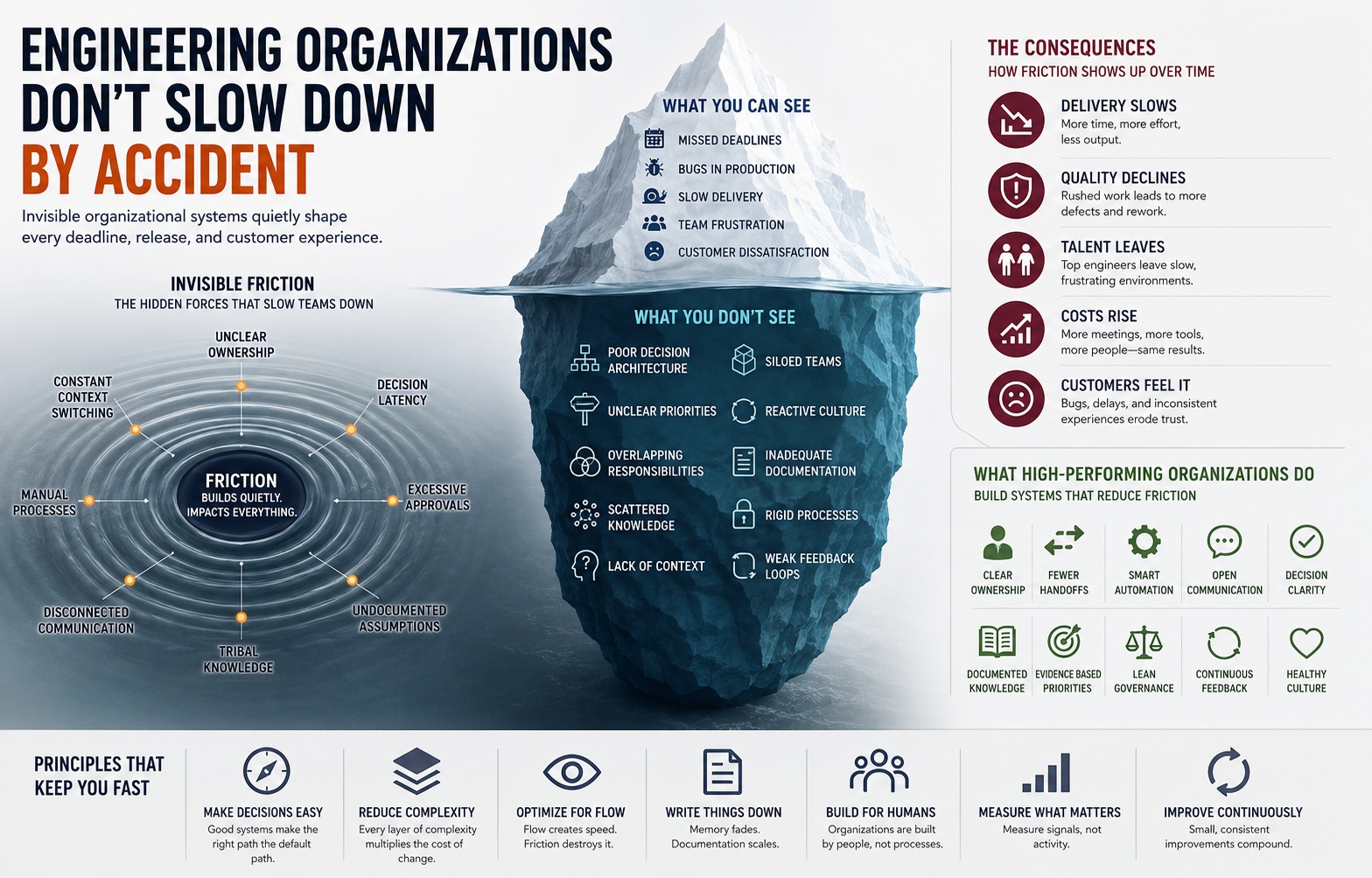
Organizations rarely become slow because engineers suddenly became worse. They become slow because invisible organizational systems gradually begin making every decision more expensive.
No one signs off on this decline. There is no meeting where a VP Engineering announces that shipping will now take three times longer, or that a two-line configuration change will require four approvals instead of one. The slowdown arrives the way sediment arrives at the bottom of a river — one small deposit at a time, invisible in any single moment, unmistakable after enough of them accumulate.
Ask a room full of engineering leaders why their organization moves slower than it did two years ago, and the answers cluster around people: headcount growth diluted the talent pool, senior engineers left, the remaining team is less experienced. These explanations are comfortable because they are personal and reversible — hire better, retain longer, train harder. They are also, in most cases, wrong. The real answer is usually structural. Something about how the organization routes decisions, assigns ownership, and absorbs new complexity has changed, and the code is simply the place where the consequences become visible.
This article is not about processes to adopt or frameworks to install. It is an attempt to look directly at the systems that determine how fast an engineering organization can move — systems that are almost never named in a sprint retrospective, and almost always the actual bottleneck.
What follows is not a single narrative but a series of independent lenses, each one revealing a different piece of a structure that most organizations have never looked at directly, because no single team is positioned to see the whole of it. A platform engineer sees the approval queue from one angle. A QA lead sees it from another. A CTO sees only the aggregate delay, without visibility into where along the chain it actually accumulated. Putting these lenses side by side is the point.
Speed Is an Organizational Property
Delivery speed is treated, in most companies, as an attribute of individuals. A fast engineer ships fast. A slow team is full of slow engineers. This framing survives because it is intuitive and because it protects the organization from examining itself. But speed, at the level that matters to a business, is not produced by individual output. It is produced by how many decisions a piece of work must pass through before it becomes real.
Consider two engineers of identical skill, placed in two different organizations. In the first, they own a service end to end: they can change an API contract, deploy it, and observe the result without asking permission from anyone outside their team. In the second, the same change requires sign-off from a platform team, a security review, a change advisory board, and a release manager who batches deployments weekly. The engineer has not changed. The distance between intention and production has.
This distance is decision latency, and it compounds in ways that are easy to underestimate. A single approval step that adds two days of waiting does not cost the organization two days per change — it costs two days multiplied by every change that depends on the outcome of the first one. Dependencies turn a linear delay into a branching one. A platform team that takes a week to review a schema change is not slowing down one team; it is slowing down every team whose roadmap assumes that schema exists.
Ownership shapes this even more directly than approval chains do. When ownership is shared across teams — a common outcome of matrix structures and "everyone is responsible for quality" mandates — decisions default to committee, because no individual has the standing to make the call alone. Committees are not inherently slow, but they are structurally incapable of moving at the speed of a single accountable owner, because they require synchronization: multiple calendars, multiple opinions, multiple rounds of consensus-seeking before action.
Coordination cost is the tax an organization pays for every boundary it draws. Draw team boundaries around technical layers — a frontend team, a backend team, a data team — and every feature that touches more than one layer becomes a coordination problem. Draw them around business capabilities instead, and coordination collapses inward, because most decisions can be made by the people who own the outcome. Neither structure is universally correct. What matters is that the structure itself, not the individuals inside it, determines how much friction a typical unit of work will encounter.
The uncomfortable implication is that hiring stronger engineers into a poorly structured organization does not produce a faster organization. It produces stronger engineers, individually capable, collectively throttled by the same decision latency, the same ownership ambiguity, the same coordination tax that slowed down their predecessors.
Complexity Hides Outside the Codebase
Software architecture diagrams are honest about technical structure and almost entirely silent about the structure that actually governs how the system evolves. The real architecture of most systems is not the one drawn in the design document. It is the one implied by who is allowed to change what, who must be consulted first, and which changes trigger which approval chains.
This second architecture is rarely documented, because it accumulates through precedent rather than design. A security incident two years ago leads to a new review gate. A production outage caused by an untested migration leads to a mandatory staging sign-off. Each addition, in isolation, is a reasonable response to a real event. None of them were designed together, and none of them were ever removed once the risk that motivated them faded. The result is an approval chain that reflects the organization's history of fear rather than its current risk profile.
Duplicated responsibility is a quieter form of the same problem. Two teams both believe they own data validation for a given entity, because ownership was never explicitly assigned and both teams built defensive checks independently. This looks, from the outside, like redundancy — a form of resilience. In practice it produces divergence: the two validation paths drift apart over time, disagree on edge cases, and eventually someone has to reconcile them under pressure, usually during an incident.
Undocumented assumptions behave like landmines buried in working systems. An engineer builds a caching layer assuming that a particular downstream service is idempotent. Nobody writes this assumption down because it was true at the time and seemed obvious. Three years and two team rotations later, the downstream service changes, the assumption silently breaks, and nobody currently on the team knows the assumption existed, let alone that it needs revisiting.
Conflicting incentives are perhaps the most corrosive of these invisible structures, because they actively reward behavior that damages the system while appearing to reward the opposite. A platform team measured on uptime and a product team measured on release velocity are not adversaries by choice — they are adversaries by design, because the incentive structure has made stability and speed into a zero-sum negotiation instead of a shared objective. Every friction point between those two teams that looks like a personality conflict is often just an incentive conflict wearing a human face.
Communication paths complete the picture. In any organization, information about a decision has to travel from the people who understand the problem to the people who can act on it. When that path is short — a team with direct access to its own users, its own metrics, its own deployment pipeline — decisions are informed quickly. When it is long — filtered through account managers, product marketing, a steering committee, a quarterly planning cycle — the information arrives stale, if it arrives at all. Architecture, in the sense that actually governs system evolution, is the shape of these paths. The technical diagram is downstream of it.
There is also an informal power structure layered underneath the formal one, and it has more influence over technical decisions than most org charts admit. Certain engineers, by virtue of tenure or reputation rather than title, become de facto approvers whose implicit sign-off is required before a change feels safe to ship, regardless of what the documented process says. This can be a genuine asset — concentrated, hard-won context, applied where it matters — or it can quietly become a single point of failure that the organization has never acknowledged, let alone planned around. Either way, it is a real structural force, and it rarely appears in any diagram of how the system is supposed to work.
Organizations Accumulate Friction Like Software Accumulates Technical Debt
Technical debt has a well-understood vocabulary: shortcuts taken under deadline pressure, code written to satisfy today's requirement without anticipating tomorrow's, interest that compounds until a rewrite becomes unavoidable. Organizations accumulate an equivalent form of debt, and it behaves the same way — quietly serviceable at first, increasingly expensive to carry, and eventually forcing a reckoning that looks, from the outside, sudden.
Process debt accrues every time a rule is added to prevent a past failure without being revisited once the conditions that caused the failure change. A mandatory design-review meeting introduced after a single bad architectural decision becomes, five years later, a standing weekly ritual that most attendees privately consider a waste of time — but nobody has the authority, or the appetite, to be the one who removes a safety measure and takes the blame if something eventually goes wrong.
Communication debt builds when the organization scales past the point where informal channels can carry the necessary information. In a twelve-person engineering team, everyone roughly knows what everyone else is doing. At a hundred and twenty, that knowledge has to travel through structured channels — documentation, status updates, cross-team syncs — or it simply stops propagating. Teams that never invested in these structures while they were small find, once they are large, that entire categories of knowledge exist only in the heads of a shrinking number of tenured employees.
Ownership debt is what remains when reorganizations happen faster than ownership records are updated. A service built by a team that was dissolved eighteen months ago is now "owned," on paper, by a team that inherited it along with forty other systems and has never opened its repository. Every incident involving that service starts with a search for who is actually responsible, because the org chart and the operational reality diverged long ago.
Documentation debt is the most visible and least understood of these categories. Most organizations treat missing documentation as a hygiene issue — something to be improved when time allows. It is more accurately understood as a tax on every future decision that touches the undocumented system, paid in the currency of investigation time, tribal-knowledge dependency, and onboarding friction. The cost does not appear on any dashboard, which is precisely why it is so persistently underfunded.
Decision debt accumulates when decisions are deferred rather than made — not resolved, simply postponed, often through the invention of a committee, a working group, or a task force whose implicit purpose is to delay accountability rather than accelerate resolution. Deferred decisions do not disappear. They wait, usually at the worst possible moment, to become urgent.
Governance debt is the compounding interest on all of the above: rules and checkpoints originally introduced with good reason, layered on top of one another until removing any single one feels risky, even though the combined weight of all of them is what is actually slowing the organization down. No individual governance rule looks unreasonable in isolation. Their sum is what makes shipping anything feel like navigating a maze that nobody designed on purpose.
What makes organizational debt more dangerous than technical debt is that it is largely invisible on any engineering dashboard. A team can watch its test coverage decline or its build times climb. Almost no organization tracks its own decision latency, its own approval-chain depth, or the age of its unresolved ownership ambiguities — which means the debt compounds in the dark, unmeasured until the day it becomes unmanageable.
Why Teams Rarely Notice the Decline
Ask engineers inside a slowing organization whether anything has gotten meaningfully worse, and most will say no. This is not denial. It is a structural property of how gradual decline is perceived.
Every individual change that adds friction is, on its own, reasonable. A new mandatory checklist item after a near-miss incident. One additional reviewer added to a pull request because the previous reviewer was overloaded. A short weekly sync introduced to keep two teams aligned during a migration. Nobody experiences any of these as a slowdown, because each one is small enough to be absorbed without complaint, and each one arrives with a plausible justification attached.
The comparison that would reveal the decline — this quarter versus the quarter before the first of these changes was introduced — almost never happens, because nobody is incentivized to make it. Engineering leaders are evaluated on forward progress, not on auditing the accumulated weight of past decisions. Retrospectives look backward one sprint at a time, which is exactly the wrong time horizon to notice a trend that unfolds over eighteen months.
Meeting load increases the same way. A recurring sync that made sense during a specific cross-team dependency outlives the dependency, because cancelling a meeting requires someone to actively decide it is no longer necessary, while continuing it requires nobody to decide anything at all. Inertia favors accumulation.
Review requirements follow an identical pattern. Each additional required reviewer, each additional required check, is proposed in response to a specific failure and evaluated only against the benefit of preventing that specific failure again — never against the cumulative cost of every review gate that came before it. The organization optimizes each safeguard locally and never audits the safeguards as a system.
Exceptions compound the effect further. Every process eventually accumulates carve-outs for situations the original designers did not anticipate: a fast-track for critical hotfixes, a special approval path for a particular high-risk service, an informal understanding that a certain team can skip a certain step because their lead has enough tenure to be trusted. These exceptions are locally sensible and globally corrosive, because they turn a supposedly uniform process into a maze of case-by-case judgment calls that new employees cannot navigate without asking someone who remembers why each exception exists.
The result is an organization whose members genuinely, honestly believe that nothing significant has changed — because nothing changed significantly on any single day. The decline is real, cumulative, and almost entirely undetectable from inside the day-to-day experience of doing the work.
Measuring the Wrong Things
Most engineering organizations measure activity because activity is easy to count, and they infer effectiveness from it because the inference is convenient rather than because it is sound.
Velocity, as tracked through story points, was designed as a team-local planning tool and has been repurposed, almost everywhere, as a cross-team performance signal — a use it was never built to support. Story points are not comparable across teams, are trivially inflatable once they become a target, and measure the volume of estimated effort rather than the value delivered. A team can increase its velocity by inflating estimates without shipping anything of greater worth, and a team under pressure eventually learns to do exactly that.
Deployment count suffers from a related distortion. A high deployment frequency is often celebrated as evidence of a mature delivery pipeline, and sometimes it is — but it can just as easily reflect a system so brittle that every change requires multiple follow-up deployments to fix what the previous one broke. Frequency without a corresponding measure of change failure rate tells you almost nothing about organizational health.
Utilization — the percentage of an engineer's time that is allocated to planned work — is perhaps the most actively harmful metric in common use, because it optimizes directly against the slack an organization needs to absorb unplanned work, respond to incidents, and think. A team running at ninety-five percent utilization is a team with no capacity to investigate a strange production anomaly before it becomes an outage, no room to mentor a struggling teammate, no space to question whether the current approach is even correct. High utilization looks efficient on a spreadsheet and behaves, operationally, like a system running without margin.
Pull request count rewards the wrong unit of work entirely. It favors many small, low-risk changes over the occasional large change that actually required deep thought, and it can be gamed by fragmenting work into commits that individually look productive while collectively achieving little. Reviewers, under pressure to keep pace with volume, rubber-stamp more and scrutinize less — which quietly degrades the very review process the metric was meant to make visible.
What these metrics share is a focus on output volume rather than decision quality or organizational friction. A more honest set of indicators would look at how long a decision typically waits before someone with the authority to make it actually engages with it; how often engineers report needing to ask the same clarifying question because the answer lives nowhere durable; how many approval steps a typical change passes through, and how many of those steps are backed by clear accountability versus inherited ritual; how long a new engineer takes to ship their first meaningful change unassisted, which is a remarkably sensitive proxy for how much invisible complexity the organization has accumulated; and how often incidents trace back to ownership ambiguity rather than a technical root cause.
Even cycle time, one of the more defensible metrics in common circulation, is frequently misread. Measured from first commit to production, it captures the mechanical portion of delivery — build, test, deploy — while missing the far larger stretch of time a piece of work often spends waiting to be prioritized, clarified, or assigned an owner in the first place. An organization can post an excellent cycle time on the metric it tracks while the actual lead time experienced by the business, from problem identification to solution in production, remains stubbornly long, because the delay lives almost entirely outside the window the metric was built to measure.
None of these appear on a standard engineering dashboard, largely because none of them can be pulled automatically from a version control system. They require someone to actually ask the organization about itself.
The Organizational Architecture Behind High-Performing Teams
Discussions of software architecture rarely extend the same rigor to the architecture of the organization producing the software, even though the two are inseparable — a relationship well known since Conway's observation that systems mirror the communication structures of the teams that build them. The organizations that sustain speed over years, not just quarters, tend to have deliberately designed six interlocking structures.
Decision architecture determines who is authorized to make which calls, and at what altitude those calls are made. In well-designed organizations, most decisions are resolved at the level closest to the information required to make them well — a principle borrowed more from military doctrine than from management theory, where the cost of centralizing every decision at the top is measured in lives rather than sprint cycles, but the underlying logic transfers directly.
Communication architecture is the deliberate design of how information moves, as opposed to the accidental structure that emerges from whichever tools and habits a company happened to adopt early. This includes decisions about what must be written down versus what can remain verbal, how asynchronous communication is structured so that time zones and calendars stop being a bottleneck, and how information reaches the people who need it without requiring them to already know to ask for it.
Ownership architecture assigns clear, durable accountability for systems, decisions, and outcomes — not as a punitive mechanism, but as a way of ensuring that ambiguity does not silently accumulate into the ownership debt described earlier. The strongest version of this treats ownership as something actively maintained, reviewed on a cadence, rather than something assigned once during a reorganization and never revisited.
Knowledge architecture is the system by which the organization retains what it has learned, independent of any single employee's memory. This is not the same as documentation volume; a wiki with ten thousand stale pages is not knowledge architecture, it is knowledge debt with a search bar attached. Real knowledge architecture is curated, current, and structured around the questions people actually ask, rather than the questions someone thought to answer once.
Operational architecture governs how the organization detects and responds to problems — incident response, on-call structure, postmortem practices — and whether the lessons from each incident actually change the system, or simply produce another item on an ever-growing checklist. The difference between an organization that learns from incidents and one that merely documents them is the difference between an operational architecture that adapts and one that only accumulates.
Learning architecture is the least discussed of the six, and arguably the most predictive of long-term organizational speed. It concerns how quickly the organization updates its own beliefs — about which processes work, which don't, which risks are still real and which have quietly become obsolete. Organizations with strong learning architecture treat every process as a hypothesis subject to revision. Organizations without it treat every process as a fixed cost of doing business, immune to the same scrutiny they would apply to a piece of legacy code.
These six systems reinforce one another in ways that make them difficult to improve in isolation. Strong ownership architecture without strong communication architecture produces owners who cannot get the information they need to own well. Strong learning architecture without strong operational architecture produces organizations that understand their own failures perfectly and still cannot act on that understanding fast enough to matter. The organizations that sustain speed treat these six systems as a single interconnected structure, not six independent initiatives to be delegated to six different committees.
Counterintuitive Insights
A number of patterns emerge repeatedly across organizations that have either sustained speed for years or lost it gradually — patterns that run against the intuitions most engineering leaders start with.
The fastest teams often hold fewer meetings, not because they communicate less, but because they communicate earlier — resolving ambiguity before it becomes a scheduling problem instead of after.
More documentation frequently produces fewer meetings, because a well-maintained written answer eliminates the need for a live conversation to reproduce it every time a new person asks the same question.
The strongest engineering cultures optimize for decision quality rather than decision consensus, which means they are comfortable with a single accountable owner making a call that not everyone agrees with, rather than delaying every decision until agreement is manufactured.
Every additional approval step introduces its own uncertainty, because each new approver becomes a potential point of disagreement, delay, or misunderstanding — the assumption that more review strictly reduces risk ignores the risk the review process itself introduces.
An unclear owner does not distribute responsibility evenly across a team; it creates a hidden queue, where the work waits for someone to feel enough ownership to act, which is slower and less predictable than a queue with an explicit, visible backlog.
Organizations that reward visible busyness inadvertently punish the engineers who solve problems quietly and efficiently, because quiet, efficient work generates less visible activity to reward.
A team's actual bottleneck is rarely the step that takes the longest; it is usually the step that people are most afraid to question, because questioning it requires confronting whoever originally introduced it.
Standardization reduces friction only when the standard fits the actual variation in the work; forcing genuinely different problems through an identical process produces the appearance of consistency while quietly degrading outcomes in every case that doesn't fit the mold.
The organizations most confident that they don't have a communication problem are frequently the ones with the least visibility into how much information is being lost, because confidence in this area tends to be inversely correlated with the humility required to go looking for the gaps.
Removing a process is almost always harder than adding one, because adding a process distributes a small, invisible cost across everyone, while removing one requires someone to visibly accept the risk the process was created to mitigate — which is why organizational debt accumulates so much more easily than it gets paid down.
A Practical Organizational Audit
Rather than a set of recommendations, the more useful exercise is a set of questions — ones that rarely get asked in a normal planning cycle, because none of them fit neatly into a sprint, a roadmap, or a quarterly OKR.
Where do decisions actually wait, and who is the person — not the role, the specific person — whose desk they sit on before they can move forward?
Where does ownership genuinely overlap, such that two different teams could reasonably claim, or reasonably deny, responsibility for the same system?
Which questions do engineers ask repeatedly, across different teams and different weeks, because the answer exists only in someone's memory rather than somewhere durable and discoverable?
Which current process exists purely because another process once failed, without anyone having since asked whether the conditions that caused that failure are still present?
If a specific engineering manager left tomorrow, what operational knowledge would leave with them — and has anyone actually tried to answer this before it becomes urgent?
Which metrics currently in use are shaping behavior rather than describing outcomes, and would the organization's actual priorities survive if people stopped optimizing for those metrics directly?
How many approval steps does a typical change pass through from idea to production, and for each one, is there a specific, current risk it mitigates, or only a historical one?
Which teams have the shortest distance between deciding something and acting on it, and what structural conditions make that possible — could those conditions be deliberately reproduced elsewhere?
This is not a checklist to complete once. It is a set of questions worth returning to on a recurring basis, precisely because the answers change as the organization does, and because the decline these questions are designed to detect is, by its nature, gradual enough to escape notice between any two consecutive check-ins.
Final Reflection
Software systems mirror the organizations that create them. This is not a metaphor; it is closer to a physical law of how complex systems get built by groups of people who must communicate to coordinate their work.
Improving technical architecture without improving organizational architecture does not remove complexity — it relocates it. A cleaner codebase built inside a decision-making structure that still routes every meaningful change through four committees will, in time, accumulate a new layer of workarounds, exceptions, and informal shortcuts that route around the official process, because the people doing the work will always find a way to move at the speed the business actually requires, whether or not the organization has designed for it.
The best engineering organizations do not eliminate complexity. Complexity does not disappear; it moves. What distinguishes organizations that sustain speed over years is not the absence of friction but the deliberateness of where that friction is allowed to live — placed at the boundaries where real risk exists, and removed from everywhere else it has simply been permitted to accumulate.
The question worth sitting with is not how to move faster. It is where, specifically, the organization has decided — often without ever deciding anything at all — that complexity is allowed to exist.