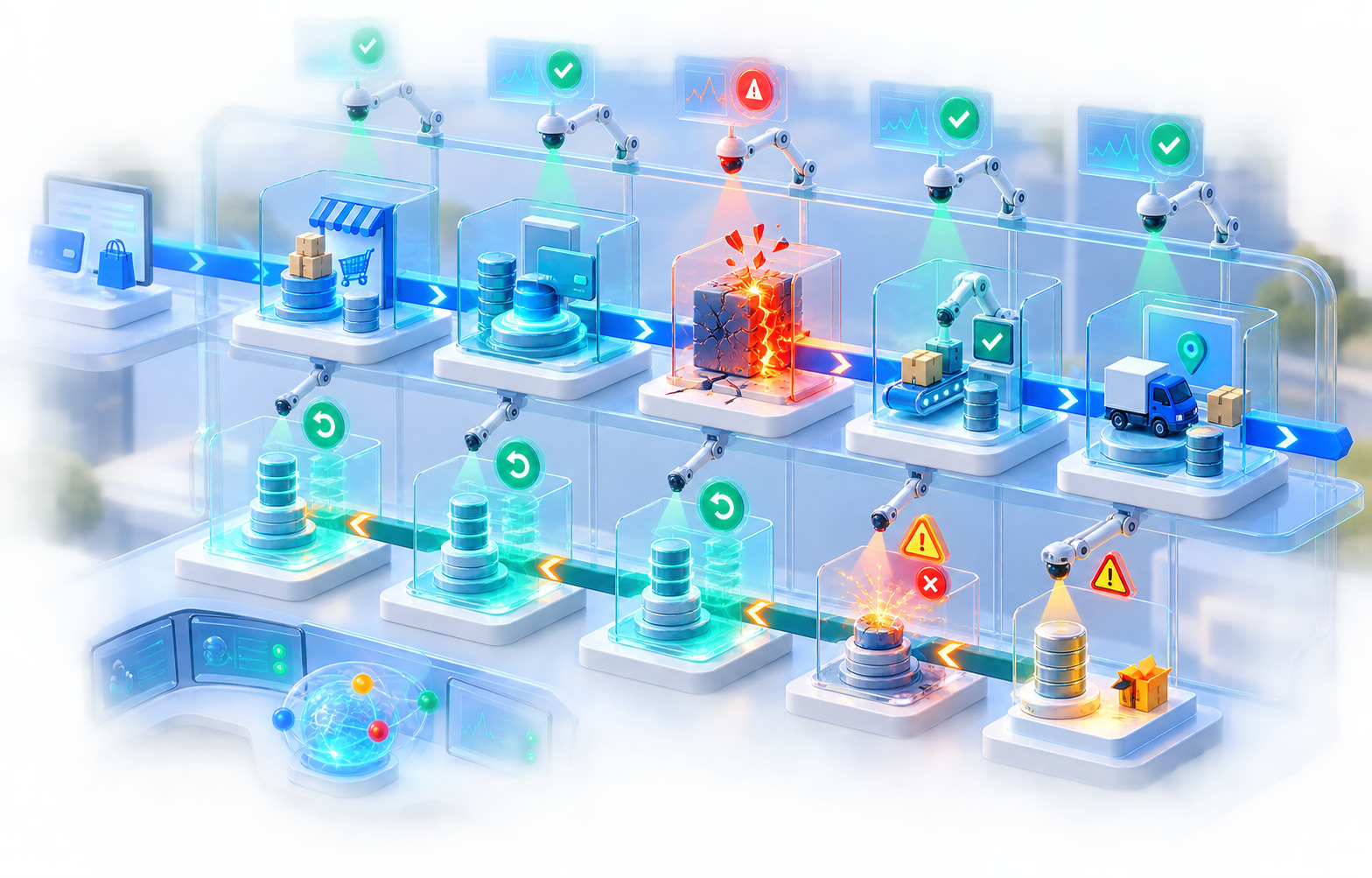
Entitlement Drift: Why Feature Entitlement Testing Is the Discipline Your Pricing Page Assumes You Already Have
Somewhere in the history of most SaaS products there is a moment that never shows up in a postmortem, because nothing broke visibly enough to warrant one. A team is shipping a new paid tier. The pricing page needs three columns and a row of checkmarks by Friday. The fastest way to make the checkmarks real is a single boolean — is_pro, plan_tier, feature_x_enabled — stored on the customer record and flipped by whichever part of the system hears about a purchase first, usually a webhook handler written in an afternoon. The frontend reads the boolean to decide what to render. The backend, if anyone remembers, reads the same boolean to decide what to allow. It works. The tier ships on time.
That decision is rarely wrong in isolation. It is wrong in aggregate, eighteen months and eleven feature launches later, when the boolean has become four booleans, then a JSON blob of feature flags, then a permissions table that three different services read with three different levels of freshness, updated by six different code paths that each assume they are the authoritative one. Nobody chose this outcome. Every individual step was reasonable given the deadline in front of it. The compounding cost of treating entitlement as a side effect of feature work, rather than a system with its own correctness requirements, is what this article is about.
The pricing page is the easy part. Three columns and a grid of checkmarks describe an intent, not an implementation. Enforcing that intent means every place in the product that gates a feature — a frontend conditional, a backend authorization check, a rate limiter, a background job, an export function, an API scope — has to agree, in real time, with whatever the billing system currently believes about the account, and both of those have to agree with what was actually sold. When they do not agree, the failure is not cosmetic. It runs in two directions simultaneously, and both are expensive in ways that rarely reach the same dashboard.
This article treats feature entitlement testing as a discipline with its own shape: its own failure taxonomy, its own place in the technical stack, its own test matrix, and its own ownership question. It is written for engineering and product leaders who have a pricing page with more than one tier and have never asked, in a structured way, whether the product actually enforces what that page promises.
The Two-Directional Economic Exposure
Most access-control failures have a single obvious direction: someone who should not have access gets it. Entitlement failures are unusual because the same root cause — disagreement between what the product enforces and what the billing system believes — produces two opposite financial outcomes, often in the same codebase, sometimes in the same feature, sometimes in the same week.
Leakage: the failure that costs money quietly
Revenue leakage from entitlement drift is a Free or lower-tier account retaining access to a feature it should have lost, or never having lost access after a downgrade, cancellation, or failed payment. It is the least visible failure mode in software delivery because nothing crashes, nothing errors, and no customer files a ticket. The account is happy. The account is also not paying for what it is using.
Leakage accumulates through a small number of recurring mechanisms:
- Downgrade that updates billing but not enforcement. A customer moves from Pro to Free. The billing record updates correctly — Stripe (or whichever billing platform is in use) reflects the new plan, the next invoice reflects the new price. But the entitlement check that gates the Pro-only feature reads from a different table, a cache, or a JWT claim that was not invalidated, and the feature keeps working until something else forces a refresh — a session expiry, a manual QA pass, a customer mentioning it in passing.
- Trial expiration without a corresponding revocation event. Trials frequently expire by the mere passage of time rather than by an explicit action. If the system's authorization model was built around discrete events (a webhook fires, a flag flips) rather than a continuously evaluated state (is
nowpasttrial_end), a trial can expire in the billing system's records while the product keeps behaving as though it is still active, because no event ever arrived to tell it otherwise. - Failed payment that never reaches a hard block. A payment fails, retries begin, and many teams — reasonably, to avoid punishing a customer for a transient card issue — give a grace period before restricting access. The problem is not the grace period itself; it is that grace periods are often implemented as a one-time flag set on failure and never re-evaluated, so an account that should have been suspended after the grace period elapses simply stays in its pre-failure state indefinitely, because nothing re-checks it.
- Seat and usage limits that gate at signup but not continuously. A plan is capped at ten seats or a metered quota. The check that enforces the cap runs when a new seat is added, but not on every request from the eleventh, twelfth, and thirteenth seat if they were added through a path that bypassed the check — a bulk import, an SSO-provisioned user, an admin console action taken by an internal support engineer trying to help the customer.
- Enterprise overrides that outlive their negotiated term. A sales team negotiates a temporary feature unlock for a proof of concept or a pilot. It is implemented as a manual flag because the standard tier model has no field for it. The pilot ends, the deal does not close, and the flag is never removed because no system tracked that it had an expiration in the first place.
None of these require an attacker. They require ordinary product operation and an entitlement model that does not re-verify itself continuously. Leakage is also disproportionately hard to detect through normal QA, because QA test plans are almost always written to confirm that paying customers get what they paid for — that the checkmark on the pricing page is real for people who are supposed to have it. Far fewer test plans are written to confirm the negative: that a Free account genuinely cannot do the thing, not just at the moment the account became Free, but every day after.
The financial impact compounds with time, which is precisely what makes it hard to notice. A single leaked account might represent a modest amount of unbilled usage. A leakage pattern tied to a common transition — say, every downgrade from a specific tier fails to revoke a specific feature — multiplies across every account that makes that transition, for as long as the bug exists, which in the absence of dedicated entitlement testing is often measured in months rather than days. Finance teams sometimes catch aggregate revenue-per-account trending down relative to logo count, but attributing that trend to a specific entitlement bug, rather than to pricing pressure or product-market factors, usually requires an engineer to go looking — and nobody goes looking until leakage is suspected for other reasons.
Lockout: the failure that costs trust
The opposite failure is more visible and, per incident, more reputationally expensive: a paying customer, in good standing, is denied a feature their plan and their invoice both say they should have. This is the failure that generates a support ticket, and support tickets are where the systemic nature of entitlement bugs tends to get lost.
A support engineer who receives "I upgraded to Pro yesterday and I still can't export data" has every incentive to treat it as a one-off — reset a cache, manually flip a flag, apologize, close the ticket. That response resolves the individual customer's frustration. It does nothing to prevent the same failure from recurring for the next account that upgrades through the same code path, because the underlying disagreement between the billing system and the entitlement store was never fixed, only patched around for one account.
Lockout failures share structural causes with leakage failures — they are two expressions of the same underlying disagreement — but they map to different triggering moments:
- Upgrade that updates billing before enforcement catches up. The mirror image of the downgrade-leakage case. A customer pays, the invoice is generated immediately, and the product's entitlement check is still reading stale cached state for anywhere from seconds to hours, depending on cache TTL design.
- Webhook delivery failure or ordering inversion. If the entitlement store is driven by billing webhooks and a webhook is delayed, dropped, or arrives out of the order it was generated, the product can be left believing an account is still on its old plan even though the billing provider has already processed the change. Stripe's own documentation is explicit that webhook event delivery order is not guaranteed and that receiving systems must not depend on receiving events in the sequence they were generated — a constraint that is easy to overlook when a webhook handler is first written against the happy path and easy to violate when entitlement logic implicitly assumes each event supersedes the last one received, rather than checking the actual current state of the object.
- Seat reassignment or account merge that drops entitlement context. When two accounts merge, when an admin transfers ownership, or when a user is moved between workspaces, entitlement is frequently tied to an ID that does not survive the operation cleanly, leaving a user correctly billed but incorrectly evaluated.
- Enterprise custom entitlement not reflected in the code path a new feature uses. A customer negotiated unlimited API calls, but a new feature ships with a generic rate limiter that checks the standard tier table and has no awareness of the negotiated override, because the override lives in a spreadsheet, a CRM field, or a one-off database row that the new engineer building the rate limiter never knew to consult.
Lockout is expensive in ways that do not show up cleanly in a revenue report. It erodes the trust that a demo or a sales conversation built, particularly when the blocked feature is one the customer was specifically sold on. It generates support load that is disproportionate to the number of affected accounts, because a blocked paying customer escalates faster and further than a leaking free account ever will. And it carries a specific reputational risk in sales-led and enterprise motions: when a feature the sales team demonstrated does not match what the contract and the product actually deliver, the resulting trust damage is not with one account, it is with whichever expansion or referral conversation depended on that account's confidence.
The quadrant: why both failures come from the same root cause
It is tempting to treat leakage and lockout as opposite problems requiring opposite fixes — tighten the checks to stop leakage, loosen them to stop lockout. That framing is wrong, and acting on it makes both problems worse. Both failures come from the same underlying condition: the product's enforcement layer and the billing system's record of truth are allowed to disagree, and nothing in the architecture forces them back into agreement on a bounded timeline.
| Enforcement lags billing (stale-permissive) | Enforcement leads billing (stale-restrictive) | |
|---|---|---|
| Account should have MORE access | Lockout: customer upgraded or trial converted, product still shows old restrictions | Rare, but occurs when a manual override was applied and then silently expired before billing caught up |
| Account should have LESS access | Leakage: customer downgraded, canceled, or failed payment, product still grants old access | Correct outcome — but only if this is the intended design (e.g., deliberate grace period), not an accident |
The useful insight in this table is the diagonal that matters: both leakage and lockout live in the "enforcement lags billing" column, which is by far the more common failure mode in real systems, because most entitlement architectures are built to react to billing events rather than to continuously verify state against them. The direction of the error — whether the stale state happens to be more generous or less generous than the truth — is essentially a coin flip determined by which specific value was cached, not by anything the engineering team designed on purpose. That is the core diagnostic fact leaders should take from this section: if your entitlement architecture is reactive rather than continuously verified, you do not have a leakage problem or a lockout problem. You have both, and you will keep having both until the architecture changes, regardless of how many individual tickets get patched.
Why Entitlement Drifts: The Structural Causes
Understanding why entitlement logic drifts out of sync is a prerequisite for testing it well, because the test strategy has to target the actual mechanisms of failure rather than a generic notion of "access control bugs." Four structural causes recur across most SaaS codebases.
No single source of truth, because none was ever designed
Entitlement logic is almost never built as a system. It is built as a sequence of individual feature decisions: "this feature should be Pro-only," decided and implemented at the moment that feature ships, by whichever engineer is building it, using whatever check felt fastest at the time — a database column, an environment-style feature flag, a hardcoded list of customer IDs for an early pilot that never got generalized. Each individual decision is locally reasonable. The aggregate is a system with several parallel and only loosely synchronized definitions of what a given account is allowed to do, and no component whose job is to reconcile them.
This absence is easy to miss because it does not look like a missing system — it looks like several small, working systems. The frontend correctly hides a button for Free accounts. The backend correctly rejects the API call. The billing platform correctly reflects the plan. Each piece, examined alone, passes its own test. The drift appears only when two of those pieces are compared against each other at a moment of transition, which is exactly the moment most manual QA and most automated test suites do not examine, because writing a steady-state test ("does a Pro account see the Pro feature") is far easier than writing a transition test ("does an account that was Pro three minutes ago and is now Free correctly lose the feature within an acceptable window, and does every code path that checks entitlement agree on that").
Billing events are asynchronous, and asynchronous means "can arrive out of order or not at all"
Modern billing platforms are event-driven by design, and that design choice has direct consequences for entitlement correctness. Stripe's webhook documentation states plainly that event delivery order is not guaranteed, gives a concrete example — a single subscription creation can generate customer.subscription.created, invoice.created, invoice.paid, and charge.created events that may not arrive in that sequence — and instructs integrators to design handlers that do not depend on receiving events in the order they were generated. The same documentation describes automatic retries over as long as three days with exponential backoff for failed deliveries, and explicitly warns that endpoints may receive the same event more than once, requiring idempotent handling keyed off the event ID.
Each of those verified facts translates directly into an entitlement failure mode if the integrating team does not design for it:
- Out-of-order delivery means a handler that naively applies "the most recently received event wins" can apply an older state after a newer one, because "most recently received" and "most recently generated" are not the same thing.
- Multi-day retry windows mean a webhook endpoint that was briefly down, misconfigured, or returned a non-2xx response during a deploy can have events arrive hours or days after the billing change actually happened — during which time the product's entitlement state is wrong, silently.
- Duplicate delivery means a handler that is not idempotent can apply the same downgrade or upgrade twice, which is usually harmless for a plan flag but can be actively damaging for anything that increments or decrements a counter, such as seat counts or credit balances tied to entitlement.
None of this is a flaw in Stripe or any other billing platform; it is an inherent property of asynchronous, at-least-once delivery systems, and it is documented as such. The failure is not that billing platforms behave this way. The failure is when entitlement logic is written as though they do not.
Caching entitlement state introduces a staleness window by design
Checking entitlement on every request against a live billing-system call is usually too slow and too fragile — it adds latency to every request and creates a hard dependency on an external system's uptime for basic product functionality. The standard mitigation is to cache entitlement state locally: in a database column updated by webhooks, in an in-memory cache, in a signed token like a JWT claim that is only refreshed on login or token renewal.
Every one of those mitigations is correct engineering practice. Every one of them also introduces a staleness window whose length is a design decision that is frequently made once, informally, and never revisited. A JWT with a twenty-four-hour expiry means an entitlement downgrade can take up to twenty-four hours to take effect for a user who does not log out and back in. An in-memory cache with no explicit invalidation hook, refreshed only on a fixed interval, means the same thing on a shorter but still nonzero timescale. The staleness window is not itself the bug — a bounded, understood, intentionally chosen staleness window is a legitimate trade-off. The bug is when the staleness window is unbounded because nothing invalidates the cache on the specific events that should invalidate it, so what was designed as "stale for up to five minutes" becomes "stale until something unrelated happens to refresh it," which can be hours, days, or indefinitely.
Entitlement is ambiguous about what it actually entitles
A subtler cause, easy to overlook because it sounds like a modeling detail rather than a root cause: most products never explicitly decide what level an entitlement check applies to. A plan is purchased by an account, but a feature is used by a user, and the two are not the same thing the moment a product supports more than one seat per account. A check written as "does this user have access to feature X" and a check written as "does this account have access to feature X" look interchangeable in a single-seat product and diverge the instant a second seat is added — an invited teammate on a Business-tier workspace should typically inherit the workspace's entitlement, but a bug that checks entitlement against the inviting user's individual record rather than the workspace's record can leave every invited seat either fully unentitled or, more dangerously from a leakage standpoint, entitled by default because the check silently fails open when it cannot find a per-user record at all.
The same ambiguity resurfaces one level up for products with an organization layer above the workspace — a holding structure with several workspaces underneath a single billing relationship. Whether entitlement is meant to apply at the organization level, cascade down to every workspace, or has to be purchased per workspace independently is a business decision, and if it is never written down explicitly, different engineers building different features tend to guess differently, producing a product where some gated features respect organization-wide billing and others do not, with no single person aware that the two behave differently until a customer notices the inconsistency first.
Sales-negotiated custom entitlements do not fit the tier model, by construction
Enterprise sales conversations routinely produce entitlements that do not exist anywhere on the pricing page: a specific account gets a higher API rate limit than any published tier offers, a feature still in limited release, a temporary unlock during a proof of concept, a legacy grandfather clause from a pricing change two years ago that the account was never migrated off of. These are not edge cases from the business's perspective — they are often some of the most valuable accounts in the portfolio, negotiated individually because the deal was worth negotiating individually.
From the entitlement system's perspective, they are precisely the input the standard tier model was not built to represent. A model built around "plan equals Free, Pro, or Enterprise, and each plan maps to a fixed feature set" has no natural place for "this specific account, on the Enterprise plan, additionally gets feature X which is not part of standard Enterprise." The common workaround — a metadata field, a manual database override, a note in the CRM that never made it into the product — is exactly the kind of parallel, unsynchronized source of truth described above, except this one was created by a human decision outside engineering entirely, which makes it even less likely to be discovered by a code review or an automated test written against the standard tier definitions.
A Risk Map: Where Entitlement Actually Breaks in the Stack
The structural causes above explain why drift happens. This section maps where in a typical technical stack that drift actually surfaces, because a test strategy has to target specific layers, not an abstract concept of "entitlement."
Frontend conditionals
The most visible and least dangerous layer, precisely because it is the most visible. A frontend check that hides a button, disables a menu item, or redirects away from a page is a user-experience control, not a security control — anyone who inspects network requests or calls the API directly can bypass it. The risk at this layer is almost never that someone gains unauthorized access purely through the frontend (that requires a backend failure too); it is that the frontend and backend disagree about entitlement state, producing a confusing user experience: a button that is visible but returns a 403 when clicked, or a button that is hidden even though the backend would have allowed the action, silently suppressing a feature the account has actually paid for. The second case is a leakage-adjacent lockout: the account is correctly entitled, correctly billed, and incorrectly denied the ability to even attempt the action, because the frontend's copy of entitlement state is stale or was implemented against an outdated tier definition.
Backend authorization middleware
This is the layer that actually matters for security and for correctness, because it is the layer an attacker or a misbehaving client cannot bypass by manipulating the UI. The recurring failure pattern here is inconsistency across endpoints rather than absence of checks: one API route correctly checks entitlement before executing a paid action, a newer route added by a different engineer or team does not, because the check was never centralized into something like middleware, a decorator, or a shared authorization service that every route is required to pass through. Entitlement checks implemented ad hoc, endpoint by endpoint, have the same failure signature as any access-control system without a default-deny posture: coverage depends entirely on every individual engineer remembering to add the check, on every occasion, forever, which is not a property that scales past a handful of endpoints.
A second backend-layer failure is granularity mismatch: a check that gates an entire feature at the top level (can this account use the export feature at all) but fails to re-check entitlement on sub-operations that should carry their own limits (can this account export more than the row limit its plan allows, can this account schedule this export to run more than once per day). The top-level gate passes, and the sub-operation, having no gate of its own, executes without limit.
Billing-webhook-driven state
Covered in mechanism above; the risk-map framing is simpler: this is the layer where the product's belief about entitlement is synchronized with the billing platform's belief, and it is the layer most exposed to the asynchronous-delivery properties described earlier — out-of-order arrival, retries spanning days, duplicate delivery. Concretely, teams should inventory which webhook events their entitlement logic actually listens for and cross-check that list against the billing platform's full event catalog. It is common to find that a team built handlers for the "obvious" events — subscription created, subscription canceled — and missed less obvious but entitlement-relevant events such as a subscription entering past_due status, a trial's trial_will_end notice (which Stripe fires three days before trial expiration, or immediately if a trial is shortened), a subscription moving to paused, or a subscription schedule expiring. Each unhandled event type is a silent gap: the billing platform's state changes, nothing in the product reacts, and entitlement freezes at whatever it was before the unhandled event fired.
Feature flags as a parallel, competing source of truth
Feature-flagging systems are frequently introduced for reasons that have nothing to do with billing — staged rollouts, A/B tests, kill switches for risky features — and then get reused, informally, to also express plan-based access, because the flagging system already exists and adding a plan-based flag is easier than building a proper entitlement service. The risk is that the flagging system and the billing-derived entitlement store now both claim authority over the same question, evaluated by different code, refreshed on different schedules, sometimes owned by different teams. A flag left on for internal testing, a rollout percentage that was never taken to 100% or rolled back to 0%, or a flag targeting rule written against an outdated segment definition can each independently override what the billing-driven entitlement check would have said, in either direction.
Caches at every layer
CDN caches, application-level caches, database read replicas with lag, and client-side storage (local storage, cached API responses) can each hold a stale copy of entitlement-relevant data. The risk compounds because these caches are usually owned by infrastructure or platform teams optimizing for performance and availability, who have no visibility into which specific fields represent entitlement state and therefore need explicit invalidation hooks distinct from the cache's general expiration policy.
Account merges, splits, and seat reassignment
Multi-tenant and multi-seat products accumulate entitlement edge cases at the boundaries of the account model itself: two workspaces merging after an acquisition, a single workspace splitting into two after an internal reorg, a user moving from one workspace to another, an admin transferring billing ownership to a different login. Entitlement is almost always modeled as belonging to an account or workspace ID, and these operations are precisely the ones most likely to create, orphan, or duplicate that ID in ways the entitlement layer was never tested against, because they are infrequent enough that they rarely appear in a standard regression suite.
Mobile and offline clients
Native mobile applications and any client designed to function offline add a layer the risk map above only implies: entitlement state that is deliberately persisted on a device so the app remains usable without a network connection. That persistence is a legitimate product requirement, but it means a downgrade, cancellation, or failed payment cannot reach that copy of entitlement state until the device next syncs, which for an infrequently opened app can be days or weeks rather than minutes. Unlike a server-side cache, this layer is entirely outside the product team's direct control once the app is on the device, which makes an explicit, deliberately chosen maximum offline-access window — enforced by the client refusing to honor cached entitlement past a defined age, rather than trusting it indefinitely — a design decision that has to be made on purpose rather than inherited by default from whatever the original offline-mode implementation happened to do.
Enterprise overrides living outside the codebase
As discussed above, this is less a stack layer than a governance gap, but it belongs on the risk map because it is where technically correct entitlement logic still produces the wrong outcome: every layer above can be functioning exactly as designed against the standard tier model and still deny (or grant) access incorrectly to an account whose actual contractual entitlement was negotiated outside that model.
Entitlement risk-map summary
| Layer | Typical failure | Direction it usually favors |
|---|---|---|
| Frontend conditionals | Stale or missing check, disagrees with backend | Either — mostly a UX/trust issue, not security |
| Backend authorization | Inconsistent coverage across endpoints; missing sub-operation limits | Leakage |
| Billing-webhook sync | Missed event types, out-of-order or duplicate delivery | Both, unpredictably |
| Feature flags as parallel entitlement | Competing source of truth, stale rollout state | Both |
| Caches (CDN, app, client) | No explicit invalidation on entitlement change | Both, biased toward leakage (permissive defaults age worse) |
| Mobile/offline clients | Persisted entitlement outlives any server-side change until next sync | Leakage |
| Account merge/split/reassignment | Entitlement tied to an ID that doesn't survive the operation | Lockout |
| Sales-negotiated overrides | Not represented in the standard tier model at all | Both, and invisible to standard tests either way |
A Hypothetical Walkthrough: The Downgrade That Wasn't
The following scenario is a hypothetical composite, constructed to illustrate a realistic failure pattern. It does not describe any specific QAtronic client, and no figures in it are drawn from a real engagement or published case study.
Initial situation. A mid-sized project-management SaaS product offers three tiers: Free, Team, and Business. The Business tier includes an advanced reporting module — custom dashboards, scheduled exports, and access to a longer data-retention window. Entitlement is enforced by a plan field on the account record, updated by a webhook handler that listens for customer.subscription.updated and writes the new plan name derived from the subscription's price ID. The reporting module is served by a separate microservice, added eight months after the original monolith, which caches the account's plan in Redis for performance, refreshed every fifteen minutes or on an explicit cache-bust call made by the webhook handler — for the monolith's own tables, not for the reporting service's cache, because the two were built by different teams roughly a year apart and the reporting team was never looped in on what events existed to bust their cache.
The hidden assumption. The engineer who built the reporting service assumed that a fifteen-minute cache refresh was a safe enough staleness window for a feature that customers do not check every minute, and that the monolith's webhook handler already invalidated whatever needed invalidating. The engineer who built the webhook handler, working a year earlier, had no reason to know the reporting service would later exist, let alone that it would need its own cache-bust call. Neither assumption was unreasonable at the time it was made. Together, they left a specific, undocumented gap: nothing tells the reporting service's cache to invalidate immediately when a subscription downgrades.
The technical and organizational cause. A Business account cancels its subscription, moving to Free at the end of the current billing period. Stripe correctly fires customer.subscription.updated with the new status, and later customer.subscription.deleted when the period ends. The monolith's webhook handler correctly updates the plan field to free. The reporting microservice's Redis cache, however, is not touched by that handler at all — it was built to be refreshed independently, on its own fifteen-minute schedule, and nothing in its design was ever revisited when the downgrade flow was built. For up to fifteen minutes after each refresh cycle, and in practice often longer because the refresh job itself runs on a schedule rather than being triggered by the downgrade event, the reporting service continues to serve plan: business from its stale cache.
The consequence. In isolation, fifteen minutes of leakage on a single downgrade is immaterial. The organizational cause is what turns it into something worth solving: this is not a one-time incident, it is the standing behavior of every downgrade from Business to any lower tier, for as long as the reporting service exists in its current form. Over a year, across however many accounts churn down from Business, the aggregate unbilled usage of the reporting module is not the interesting number — the interesting number is that nobody in either team owns a test that would ever have caught this, because the monolith team's tests confirm the plan field updates correctly (which it does), and the reporting team's tests confirm the cache serves the correct value for whatever plan it currently holds (which it also does, technically). Each component passes its own test. The gap exists entirely at the boundary between them, which is precisely the kind of gap steady-state, single-service test suites are structurally unable to see.
The decision that needs to be made. When this kind of gap is eventually discovered — typically by an engineer investigating an unrelated bug, or during a security review, rather than by a dedicated entitlement test — the team faces a choice that is easy to make badly under time pressure: patch the specific fifteen-minute cache with a manual bust call added to the existing webhook handler, and move on, or treat the discovery as a signal that entitlement-relevant caches exist elsewhere in the stack without any inventory of where they are or how they get invalidated.
The better approach. The durable fix is not the cache-bust call itself, though that is necessary. It is building an inventory — even a simple one, a spreadsheet or a short internal document — of every place entitlement state is cached, stored, or independently derived across the stack, and for each one, an explicit answer to "what invalidates this, and within what maximum bound." That inventory becomes the seed of the plan × billing-state × feature test matrix described in the next section, and it converts entitlement correctness from a property that depends on every engineer independently remembering every downstream consumer of a billing event, into a property that a test suite can actually verify.
Feature Entitlement Testing as Its Own Discipline
Most QA effort applied to entitlement, where it exists at all, tests the steady state: does a Pro account see the Pro features, does a Free account not see them. That coverage is necessary and almost always already exists in some form. It is also close to useless for catching the failures described above, because every one of those failures lives at a transition, a caching boundary, or a disagreement between systems — none of which a steady-state test is designed to exercise.
The core framework: plan × billing-state × feature matrix
The single most useful structural change a team can make is to stop testing "does this plan have this feature" as a flat list and start testing it as a three-dimensional matrix: plan, crossed against billing state, crossed against feature. The billing-state dimension is what steady-state testing omits, and it is where entitlement bugs concentrate.
Using Stripe's actual documented subscription status values as a concrete, verifiable example of what the billing-state axis should contain — trialing, active, past_due, canceled, unpaid, paused, incomplete, and incomplete_expired — a minimal version of the matrix for a single feature looks like this:
| Billing state | Expected entitlement | What to verify |
|---|---|---|
trialing (within trial window) |
Full tier access | Feature accessible; trial banner/limits, if any, are correct |
trialing, 3 days before trial_end |
Full access, trial_will_end notice fired |
Access unchanged; downstream systems that react to the notice (billing reminder emails, in-app prompts) behave correctly without altering entitlement itself |
active |
Full tier access per paid plan | Feature accessible; correct limits for the specific tier |
past_due (payment failed, retries in progress) |
Per defined grace-period policy | Access matches the documented policy exactly — not whatever the cache happens to still hold |
unpaid (retries exhausted, per account settings) |
Access revoked or downgraded per policy | Feature is blocked within the maximum allowed staleness window, not "eventually" |
canceled, access-until-period-end |
Full access until current_period_end, then revoked |
Access does not lapse early; access does not persist past the boundary |
canceled, immediate |
Access revoked immediately | No staleness window exceeds the defined bound |
paused |
No invoices generated; access per pause policy | Distinct from "canceled" — verify the product does not conflate the two |
incomplete → incomplete_expired |
No access ever granted; invoice voided | Confirms a failed initial payment never silently grants trial-like access |
| Seat/usage limit reached mid-cycle | New usage blocked, existing usage unaffected (or per policy) | Limit enforcement happens on the specific request that crosses the threshold, not only at signup |
| Enterprise custom override active | Override honored regardless of standard tier logic | Every code path that checks entitlement — not just the original one the override was designed for — respects the override |
This table is a template, not a finished test plan — the specific policies (what happens during past_due, how long a grace period lasts, whether paused and canceled are treated identically) are business decisions each team has to make and document explicitly before they can be tested, and making that documentation exist is itself a valuable output of building the matrix, independent of the tests it produces. Many teams discover, in the process of trying to fill in the "expected entitlement" column, that no one had actually decided what should happen in several of these states — the behavior in production is whatever the code happens to do by accident, not a chosen policy.
The matrix should then be crossed against every plan tier and every gated feature, which for most products yields a large but finite and enumerable set of cases — considerably larger than a steady-state test suite, but far smaller than the space of general functional testing, and highly automatable once the underlying billing-state transitions can be simulated or triggered in a test environment. Stripe and comparable billing platforms provide test-clock or sandbox tooling specifically to let integrators advance simulated time and trigger these state transitions deterministically, which is the practical mechanism that makes automating this matrix feasible rather than purely theoretical.
Testing the transition, not just the destination state
A second, related discipline is testing the moment of transition itself, not only the before-state and after-state. Several of the failure modes described earlier — stale caches, out-of-order webhooks, duplicate event handling — only manifest during the transition window, and are invisible if a test only checks "is entitlement correct while active" and "is entitlement correct while canceled" without ever checking "is entitlement correct in the sixty seconds immediately following cancellation."
Concretely, transition testing should cover:
- Upgrade: does access to the new tier's features become available within the defined maximum latency, across every layer that gates those features (frontend, backend, any specialized service), not just the layer the original webhook handler was written to update.
- Downgrade: does access to the lost tier's features become unavailable within the defined maximum latency, with the same cross-layer scope.
- Trial expiration: does the product correctly revoke trial-only access purely from the passage of time, without requiring a webhook to arrive, since trial expiration is a state that is true simply because
now > trial_end, and any entitlement check that only reacts to events rather than also evaluating this condition directly is vulnerable to silently extending trials indefinitely if the expected event is ever missed. - Failed payment entering and then exiting a grace period: does the product correctly apply the documented grace-period policy on entry, and correctly restore or correctly continue to restrict access depending on whether the payment issue resolves or the retries are exhausted.
- Seat-limit changes: does adding a seat beyond the plan's limit correctly block or correctly trigger the expected upgrade prompt, through every path a seat can be added (invite flow, SSO auto-provisioning, bulk CSV import, admin console).
- Account merges and splits: does entitlement survive the operation intact, with neither account inheriting more access than it is entitled to nor losing access it should retain.
- Manual admin or support overrides: when a support engineer manually flips an entitlement flag to resolve a ticket, does the fix survive the next legitimate billing event, or does it get silently overwritten (or does it persist incorrectly after the underlying issue that caused the ticket is separately fixed).
Testing cache invalidation explicitly
Given how much of the drift problem traces back to caching, cache invalidation deserves to be tested as a first-class case rather than assumed to work because the cache's general expiration policy exists. A useful practical test pattern: change an account's billing state through the actual billing platform (or its test-clock equivalent), then measure, layer by layer, how long each entitlement-consuming system takes to reflect the change — frontend, backend API, any specialized services, exported reports, mobile clients with their own local caches. Any layer whose observed latency exceeds its documented maximum staleness bound is a finding, independent of whether it happens to be "just" fifteen minutes in the specific test run; the point of the test is verifying the bound is actually enforced, not just usually short.
Testing what happens when the billing provider and the entitlement store disagree
The most structurally important test category, and the one least likely to already exist, is reconciliation testing: deliberately putting the billing platform's record and the entitlement store's record into disagreement, and verifying the product's behavior in that state. This matters because disagreement is not a hypothetical edge case — given documented, verified facts about at-least-once delivery, multi-day retries, and unguaranteed ordering, disagreement is a routine and expected transient condition of any webhook-driven entitlement system, not a rare failure.
Useful reconciliation tests include:
- Deliberately delaying or dropping a webhook delivery in a test environment and confirming the product has a reconciliation mechanism — a periodic job that re-fetches billing state directly from the provider's API for accounts whose last webhook is older than an expected threshold — rather than depending entirely on webhook delivery for correctness.
- Delivering webhook events out of the documented generation order and confirming the handler is idempotent to sequence, not just to duplication — that is, confirming the handler checks the actual current state of the billing object (which most billing APIs allow retrieving directly) rather than blindly trusting whichever event happened to arrive last.
- Delivering the same event twice and confirming no double-application of stateful changes such as seat or credit adjustments.
- Simulating a billing-platform outage during which no events can be delivered at all, and confirming the product has an explicit, intentional policy for that condition (continue serving last-known entitlement for a bounded period, versus fail closed, versus fail open) rather than an accidental one determined by whatever the cache happened to be doing.
A practical entitlement test checklist
For teams building this discipline for the first time, the following checklist condenses the above into a starting inventory rather than a finished program:
- Every gated feature is listed against every plan tier, with the intended access level documented explicitly (not inferred from current code behavior).
- Every billing state the platform can produce — not just "active" and "canceled" — has a documented, agreed access policy for every gated feature.
- Every place entitlement state is stored or cached (database columns, in-memory caches, CDN caches, client-side storage, JWT claims, feature-flag systems) is inventoried, with an owner and a maximum staleness bound for each.
- Every transition moment (upgrade, downgrade, trial expiry, payment failure entering and exiting grace period, seat-limit crossing, account merge/split, manual override) has at least one automated test that exercises it end to end, across every consuming layer, not just the layer nearest the billing event.
- A reconciliation mechanism exists that does not depend solely on webhook delivery, and it is tested under simulated delay, drop, duplication, and reordering.
- Enterprise custom overrides are represented in a system a test can query, not solely in a CRM field or a spreadsheet, and at least one test confirms a newly built feature respects an existing override without requiring the engineer building it to know the override exists.
- A recurring (not one-time) leakage audit exists — a scheduled job or report comparing entitled access against billed plan across the full account base, flagging mismatches for review rather than waiting for one to be noticed by accident.
Warning signs an organization already has entitlement debt
Several observable patterns tend to precede an organization discovering it has a systemic entitlement problem, and any one of them is worth treating as a prompt to build the matrix described above before an incident forces the issue:
- Support engineers have standing, informal knowledge of "the fix" for a recurring access complaint — a specific flag to flip, a specific cache to clear — that has never been escalated as an engineering ticket because it "works" as a manual workaround.
- No one can answer, without checking code, how long a downgrade takes to fully propagate across every system that gates a feature.
- Enterprise account entitlements live primarily in the CRM, a spreadsheet, or a Slack thread rather than in a system the product itself queries.
- The engineering team can name the last time a new feature accidentally shipped without an entitlement check at all, because the check was assumed to be "handled elsewhere" by whichever shared component the engineer expected to enforce it.
- Finance or revenue operations has, at some point, manually reconciled billed accounts against product usage and found unexplained gaps in either direction, without a standing process to repeat that reconciliation regularly.
None of these signs, individually, indicates a crisis. Together, they describe an organization where entitlement correctness depends on institutional memory rather than on a system, which is precisely the condition that produces both leakage and lockout over time without anyone deciding it should.
Entitlement Bugs Are a Form of Broken Access Control
It is worth being precise about the security classification of entitlement bugs, because the framing changes who should be involved in fixing them and how urgently. Broken Access Control has been the top-ranked category in OWASP's Top 10 web application security risks since the 2021 edition, with OWASP reporting that access-control weaknesses map to 34 underlying CWEs and appear across the contributing application dataset with an average incidence rate the organization cites as 3.81%, moving up from fifth position in the prior list. Among the CWEs OWASP maps into this category are CWE-284 (Improper Access Control), CWE-285 (Improper Authorization), and CWE-639 (Authorization Bypass Through User-Controlled Key) — all of which describe, in general security terms, exactly the entitlement failures this article has been describing in billing-specific terms.
An entitlement bug that lets a Free account use a Pro feature is, functionally, an authorization bypass. It is usually less alarming than a bug that exposes another customer's private data, because the "unauthorized" party in a leakage scenario is simply getting a feature for free rather than reading something they should never see. But the underlying defect — a system failing to correctly enforce who is allowed to do what — is the same category of defect OWASP has ranked as the most prevalent access-control risk category in modern web applications, and the same architectural principle OWASP recommends applies directly: access control is only effective when enforced in trusted server-side code, where the party being checked cannot modify the check itself. A frontend conditional that hides a Pro feature from a Free account is not an access control; it is a UX affordance. If the backend does not independently and redundantly verify entitlement on every request that touches a gated capability, the "control" is advisory, not enforced, and any client capable of calling the API directly — including, notably, an increasingly common category of automated or AI-driven client that does not experience a UI at all — bypasses it trivially.
There is a second, less obvious security dimension worth naming: sales-negotiated overrides and manually applied support fixes, if implemented as ad hoc database writes rather than through an auditable entitlement system, are themselves a category of privileged, undocumented access grant. An organization that would never accept an engineer manually editing a production authentication table to grant someone admin access should apply the same scrutiny to an engineer manually editing an entitlement table to grant a customer a feature — the mechanism and the risk profile are structurally the same, even though the intent (helping a customer) feels benign. Treating entitlement changes with the same change-control discipline applied to other privileged data mutations — logged, attributable, and ideally reversible through the same system that applies standard billing-driven changes — closes a gap that is otherwise invisible to both security review and QA, because neither team typically thinks of a "give the customer the feature" support action as a security-relevant event.
Ownership, Governance, and Company Stage
Entitlement testing fails to happen as a discipline for an organizational reason as much as a technical one: it does not naturally belong to any single existing team. Billing ownership typically sits with a finance-adjacent or platform engineering function focused on invoicing correctness. Feature ownership sits with whichever product team built the specific gated capability. Frontend and backend authorization are frequently owned by different engineers entirely, sometimes different teams. QA, where it exists as a distinct function, is usually organized around feature correctness rather than cross-cutting concerns like entitlement. The result is that entitlement correctness is everyone's adjacent responsibility and no one's primary one — precisely the organizational pattern that lets structural risks persist even when individual engineers are diligent.
Startups
At the earliest stage, entitlement logic is usually simple by necessity — few tiers, few gated features — and the pragmatic answer is not to build the full matrix described above prematurely. The higher-value action is documentation: writing down, in one place, what each tier is supposed to include and what billing states exist, before the number of gated features grows past the point where one engineer can hold the whole picture in their head. The cost of skipping this is not felt immediately; it is felt eighteen months later, which is exactly the pattern the opening of this article described.
Scale-ups
This is the stage where entitlement drift becomes expensive and where the matrix-based approach earns its cost. Feature count and tier count have both grown, multiple engineers or teams now touch entitlement-adjacent code without full visibility into each other's assumptions, and the first sales-negotiated enterprise overrides start appearing. This is the point at which a scale-up should assign explicit ownership — not necessarily a dedicated team, but a named accountable owner, frequently a QA or platform engineering lead, whose job includes maintaining the plan × billing-state × feature matrix as a living artifact and running the reconciliation tests described above on a recurring basis rather than only after an incident.
It is also, not coincidentally, the stage at which entitlement problems are most likely to be misdiagnosed as something else. A scale-up noticing gross margin erosion per account, or a plateau in expansion revenue despite healthy feature adoption, has every reason to first suspect pricing strategy, packaging, or sales execution — all legitimate hypotheses, and none of them mutually exclusive with an entitlement bug quietly giving away the exact feature the pricing team is trying to monetize. Ruling entitlement correctness in or out early, with the kind of reconciliation report described earlier in this article, is cheap relative to the alternative of a pricing team redesigning packaging around a margin problem that a code fix would have resolved directly.
Enterprises
At enterprise scale, the volume of negotiated custom entitlements, the number of billing states in play (multi-year contracts, custom invoicing terms, regional pricing, usage-based components layered on top of tier-based ones), and the number of engineering teams touching entitlement-adjacent systems all make the ad hoc approach fail decisively rather than gradually. Enterprises are also the segment most exposed to the trust cost of lockout failures, because enterprise deals are relationship-dependent and a demoed feature that does not match delivered access damages an account relationship with a dollar value large enough to be individually noticed by leadership. At this stage, a dedicated entitlement service — a system whose sole responsibility is answering "is this account entitled to this feature, right now" authoritatively, queried by every other system rather than each system maintaining its own derived copy — stops being over-engineering and starts being the only architecture that scales, because it collapses the "no single source of truth" root cause described earlier into an actual single source of truth by design.
Metrics worth building
Two measurement efforts are worth establishing regardless of company stage, because both are currently invisible in most organizations:
- A leakage estimate, built from a recurring reconciliation report comparing billed plan against enforced entitlement across the account base, flagging any mismatch for engineering review. The value of this metric is less its precise dollar figure — which depends heavily on product specifics no external source can generalize — and more the fact that it exists at all and is reviewed on a cadence, converting entitlement drift from something discovered by accident into something actively monitored.
- A lockout signal, built from tagging support tickets that involve "I paid for X and can't access it" as a distinct category, tracked separately from general bug reports, so that a pattern across multiple tickets pointing to the same transition or code path is visible to engineering leadership rather than dissolving into a general support-ticket backlog where each instance looks like an isolated case.
Neither metric requires sophisticated tooling to start. Both require someone to decide they matter enough to track, which is itself the central organizational obstacle this article has been describing.
Practical Next Steps for Leaders
For a leader deciding where to start, the highest-leverage sequence is usually:
- Ask directly, in a meeting with engineering and support leadership present: "If a customer downgrades today, how long until every system that gates a paid feature reflects that, and how do we know?" The quality and confidence of the answer is itself a diagnostic.
- Build the plan × billing-state × feature matrix as a documentation exercise before it is a testing exercise. Filling in the "expected access" column across every billing state, for every gated feature, routinely surfaces undocumented or accidental policies on its own.
- Inventory every place entitlement state is cached or independently derived, with an explicit owner and staleness bound for each, using the risk map in this article as a starting checklist rather than assuming the inventory is already complete.
- Instrument a recurring reconciliation job comparing billing-platform state against enforced entitlement, and treat any mismatch it finds as a bug report, not a routine correction.
- Re-tag support tickets that involve access mismatches as a distinct category, and review that category on a cadence separate from general bug triage.
None of these require a large upfront engineering investment. They require treating entitlement as a system with its own correctness properties, which is the underlying shift in perspective this article has been arguing for.
Frequently Asked Questions
Is entitlement testing the same thing as billing testing? No. Billing testing verifies that invoices, proration, taxes, and payment collection are calculated and processed correctly. Entitlement testing verifies that whatever the billing system decides gets correctly enforced as feature access in the product. A billing system can be perfectly correct — every invoice accurate, every charge processed on time — while the product still has entitlement bugs, because enforcement is a separate, downstream layer that has to independently stay synchronized with billing state.
We use a third-party feature-flagging or entitlement platform. Does that eliminate the risk described here? It reduces some categories of risk — a dedicated entitlement platform typically centralizes the source-of-truth problem described in this article by design — but it does not eliminate the transition-testing, cache-invalidation, and reconciliation concerns. A third-party platform still has to be kept synchronized with the billing platform, still has propagation latency to every consuming system, and still needs its own transition-moment and disagreement-handling tests. It changes where the complexity lives; it does not remove the need to test it.
How often should the entitlement test matrix be re-run? As part of the regular automated test suite for any change that touches billing integration, entitlement checks, caching layers, or account-management flows (merges, splits, seat management) — not only after a dedicated "entitlement" ticket. Because entitlement bugs are cross-cutting, the changes that introduce them are frequently changes that were not labeled as entitlement work at all, which is part of why they are hard to catch through targeted testing alone; broad regression coverage over the matrix is what catches those.
Our billing volume is small. Is this worth building before it becomes a bigger problem? The investment that scales down cleanly is documentation — an explicit, written policy for what each tier and billing state should grant — because that artifact prevents the "no single source of truth" root cause from ever taking hold, and it costs relatively little to produce early. The investment that does not scale down as cleanly is a dedicated reconciliation and automated-matrix testing program, which is reasonable to defer until tier count, feature count, or enterprise-override volume make manual verification impractical — a threshold that varies by product but is worth revisiting deliberately rather than by default inertia.
Who should own entitlement correctness — engineering, QA, product, or finance? No single function owns every piece, which is exactly the problem. The workable pattern is a named accountable owner — commonly a QA or platform engineering lead — responsible for maintaining the test matrix and the reconciliation process as living artifacts, with clear escalation paths into billing/finance for leakage findings and into support/success for lockout patterns. The owner does not need to personally fix every gap; they need to ensure gaps are visible and tracked rather than rediscovered independently by each team that happens to trip over one.
Does this apply to usage-based or metered pricing, not just tiered plans? Yes, and arguably more acutely. Usage-based entitlement adds a continuously changing dimension — current consumption against a quota — on top of the plan-and-billing-state dimensions already discussed, which multiplies the transition moments worth testing (crossing a usage threshold mid-cycle, quota resets at renewal, overage handling, metered add-ons layered on a base tier) and increases the cost of any staleness window, because usage-based leakage compounds continuously rather than only at plan-change events.
What's the difference between an entitlement check and a feature flag? A feature flag typically answers "is this code path active" for operational reasons — a staged rollout, a kill switch, an experiment — and is usually evaluated independently of who is asking. An entitlement check answers "is this specific account or user allowed to use this," derived from a commercial relationship. The distinction matters because the two are frequently implemented using the same underlying flagging infrastructure, which is efficient but risks treating a billing-driven access decision with the same operational looseness (manual overrides, rollout percentages, stale targeting rules) that is appropriate for a rollout flag but not for a decision tied directly to what a customer is paying for.
Should entitlement checks fail open or fail closed when the billing platform is unreachable? This has to be a deliberate policy decision rather than an accidental default, and reasonable products choose differently depending on the feature. A conservative default is to continue honoring the last known good entitlement state for a short, explicitly bounded window during an outage (avoiding punishing a customer for an infrastructure problem that is not their fault), then fail closed if the outage extends past that window — rather than either failing open indefinitely, which reintroduces the leakage risk described throughout this article, or failing closed immediately, which turns every billing-platform hiccup into a customer-facing lockout incident.
The QAtronic Perspective
Entitlement correctness sits exactly at the boundary QAtronic works in: the place where a business decision — what a customer is allowed to have for what they pay — depends on several engineering systems agreeing with each other under real-world conditions like asynchronous delivery, caching, and negotiated exceptions. If your team has never mapped its own plan × billing-state × feature matrix, or has never deliberately tested what happens when your billing platform and your entitlement store disagree, that is a specific, bounded gap QAtronic can help design test coverage for — building the matrix, instrumenting reconciliation checks, and identifying which layers of your stack are currently trusting assumptions rather than verifying them.
Conclusion
The pricing page is a promise made in three columns. Enforcing that promise correctly, continuously, across every system that touches a gated feature, is an engineering property that has to be built and tested on purpose — it does not follow automatically from the billing system being correct, and it does not follow from any individual feature check being correct in isolation. Entitlement drift is not a bug category most teams are missing tickets for. It is a bug category most teams have no test suite capable of finding, because the failures live specifically in the transitions, the caches, and the disagreements that steady-state testing is structurally blind to.
The principle worth taking back to an engineering organization is this: if entitlement is enforced reactively — updated only when an event happens to arrive, cached until something happens to refresh it, checked only in the code path someone happened to remember to check — then leakage and lockout are not two separate risks to weigh against each other. They are the same underlying defect, expressing itself in whichever direction the stale value happens to point on a given day. The fix is not to tune the system toward one failure mode or the other. It is to make entitlement state something the product continuously verifies against the billing system's actual truth, within a bound the business has deliberately chosen, rather than something it merely remembers from the last event that happened to arrive.
The question worth putting to an engineering team is not "have we ever had an entitlement bug." Every team with more than one pricing tier has. The question is: when your billing platform and your entitlement store disagree — and given how these systems are built, they eventually will — does anything in your stack notice before a customer, a support ticket, or a finance review does?