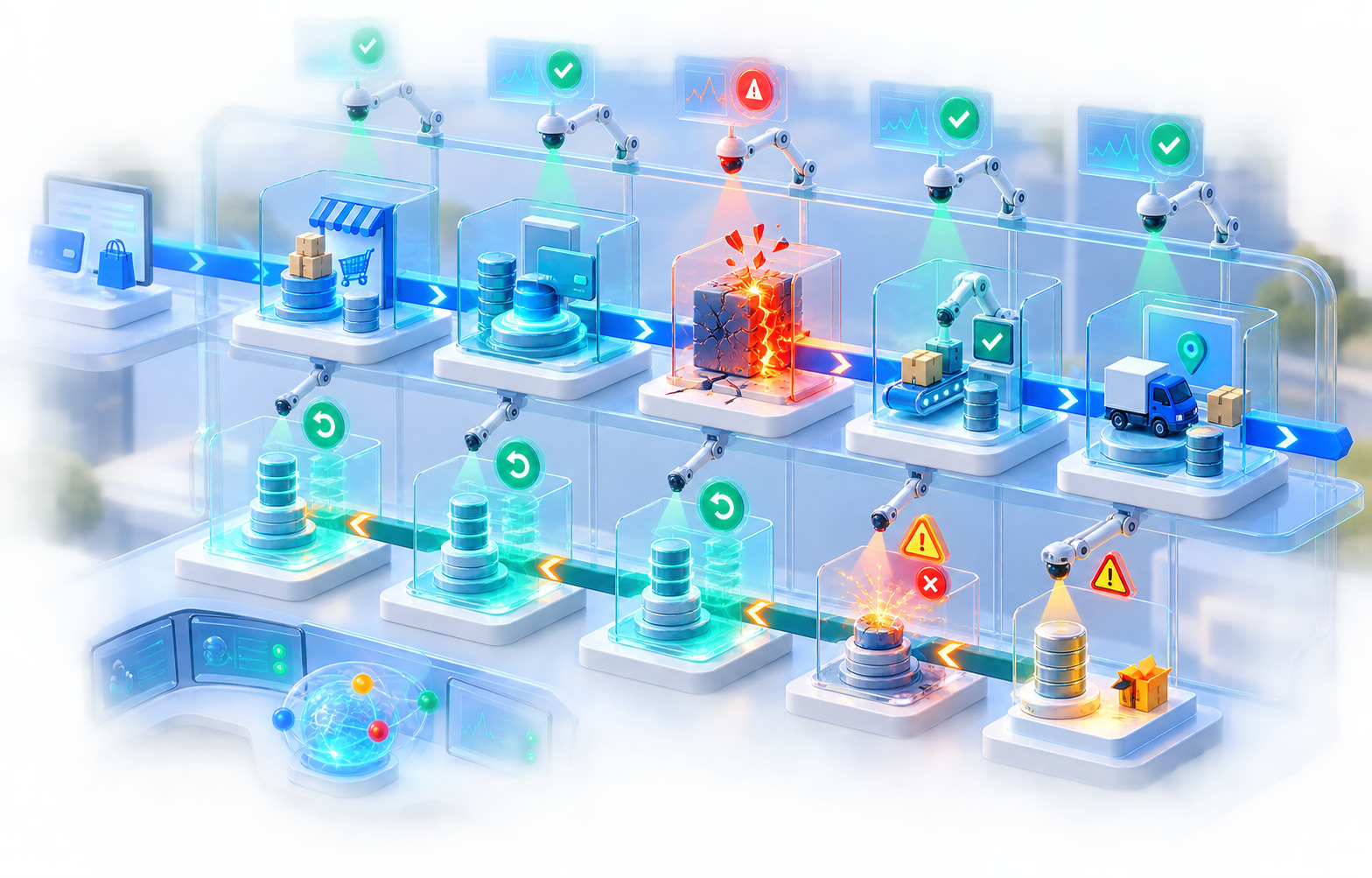
Ask a QA lead how their team validates a feature-flagged release, and you will usually get a confident answer: full regression with the flag off, full regression with the flag on, sign-off, ship. Ask that same team to reproduce a bug reported by one customer during a 10% rollout, and the confidence disappears. Nobody can say, without opening a dashboard, what flag state that customer was actually in. The regression suite that just passed never ran in that state, because it was never designed to.
This is not a hypothetical failure of process. It is the default outcome of how feature flag testing gets scoped at most companies that use flags seriously, and it holds even at organizations with strong test automation and disciplined release practices. The gap is not sloppiness. It is arithmetic. Two independent boolean flags produce four possible states. Ten flags produce 1,024. Twenty produce over a million. No test plan grows at that rate, and none needs to — but almost none is deliberately designed to cover the states that matter, which is a different and much more solvable problem than covering all of them.
Feature flags were adopted, correctly, as a risk-reduction tool: ship code dark, expose it gradually, kill it instantly if something breaks. That framing is sound for deployment risk. It says nothing about verification risk — the question of which combinations of active flags a real user might encounter, and whether anyone checked what the application does in that combination before a paying customer found out first. QA processes built around "flags off, flags on" answer a question nobody in production is actually asking. Production is not binary. It is a distribution, and most of that distribution is mixed state that never appeared in a test run.
This article maps where that risk accumulates — in the code, in the data layer, in third-party integrations, in traffic routing, and in the organization itself — and then lays out a governance and testing model that treats flag state as a dimension of quality risk with the same seriousness applied to browsers, devices, or user roles. The goal is not exhaustive coverage of every flag combination; that goal is mathematically unreachable past a handful of flags and would be a poor use of engineering time even if it were reachable. The goal is deliberate, risk-ranked coverage of the combinations that can actually hurt the business, replacing the accidental default of testing almost nothing beyond the two extremes.
The Math Nobody Puts in the Sprint Planning Doc
The combinatorics behind feature flags are simple enough that most engineers can derive them without a calculator, which is precisely why they get skipped over rather than confronted. Each independent boolean flag doubles the number of distinct states the system can be in. With one flag, there are two states. With two, four. With three, eight. The formula is 2^n for n independent binary flags, and it climbs faster than intuition expects:
| Number of active flags | Possible states (2^n) |
|---|---|
| 2 | 4 |
| 5 | 32 |
| 8 | 256 |
| 10 | 1,024 |
| 15 | 32,768 |
| 20 | 1,048,576 |
Most flag platforms do not stop at booleans. LaunchDarkly, Split, and Unleash all support multivariate flags — string or JSON variations, not just true/false — and percentage rollouts that split a single flag into multiple weighted cohorts. A flag with four variants behaves, combinatorially, like two independent booleans stacked together. A percentage rollout does not add a new discrete state so much as it adds a probability distribution across the states that already exist: with a flag at a 10% rollout, roughly one in ten sessions lands in the "on" branch of that flag while the rest sit in "off," and that split recombines with every other active flag's split to produce a joint distribution that is almost never mapped anywhere.
It is worth being precise about what this number represents and what it does not. Not every one of those 2^n states is reachable in practice — some flags are mutually exclusive by design, some only apply to a subset of user types, and some code paths short-circuit before a downstream flag is ever evaluated. Nobody is arguing that a team with twelve flags owes the business 4,096 test cases. The point of the math is narrower and more uncomfortable: the number of states that are never checked grows just as fast as the number that are theoretically possible, and the two states almost every team does check — everything off, everything on — represent a vanishingly small fraction of that space once a product has been running flags for more than a few months.
A useful mental model, borrowed loosely from the discipline of combinatorial testing that hardware and safety-critical software testers have used for decades, is that most real defects are not caused by all ten flags interacting simultaneously. Research from the National Institute of Standards and Technology on software failures found that the overwhelming majority of reported faults were triggered by interactions between a small number of factors — typically two to six — rather than by the full combinatorial space, and that testing all interactions up to a bounded strength, such as pairwise (2-way) or higher, catches a large share of interaction-driven defects without exhaustive testing (NIST, Combinatorial Methods in Testing; NIST Special Publication 800-142, Practical Combinatorial Testing). That finding was developed studying configuration-driven software broadly, not feature flags specifically, but the underlying logic transfers cleanly: flags are configuration, and configuration-driven interaction bugs follow the same shape whether the configuration lives in a settings file, a hardware driver, or a flag management dashboard. Section 6 of this article applies that logic directly to flag combination selection.
The immediate implication for QA planning is that the goal is never "test every combination." The goal is to stop pretending that testing two combinations out of a much larger reachable space constitutes coverage of "the feature," when what it actually constitutes is coverage of the two combinations that are, in most mature products, the least representative of what a real user experiences.
Why "Flags Off, Flags On" Became the Default Test Plan
No QA team decided, in a planning meeting, that testing only two states out of a much larger space was an acceptable risk posture. The pattern emerges from several separate, individually reasonable decisions that compound into a blind spot nobody chose deliberately.
Flags proliferate faster than test plans get revisited
A test plan for a feature is usually written once, close to that feature's launch, against the flags that exist at that moment. Flags accumulate continuously afterward. A pricing team adds a discount-stacking flag six months later. A platform team adds a regional data-residency flag the quarter after that. Neither team goes back and asks whether the original feature's test plan needs to account for the new flag, because from their vantage point, the original feature is old, stable, shipped code — not something actively under test. The interaction between the old feature and the new flag exists in production regardless of whether anyone thought to test it, because the two code paths run in the same request whether or not a document says they should be tested together.
The flag dashboard and the test matrix live in different systems, maintained by different people
Flag state is configured in a dashboard — LaunchDarkly's targeting rules, Split's treatments, Unleash's strategies, or an internal admin panel — and that configuration can change without a code deploy, a pull request, or a ticket that QA would naturally see. A product manager adjusting a rollout percentage from 5% to 25%, or a support engineer flipping a permissioning flag for one enterprise account, is making a change to the effective behavior of the system that never touches the codebase and therefore never triggers whatever process usually prompts test planning. QA's test matrix, by contrast, typically lives in a test management tool or a spreadsheet that was populated when the feature was built and is rarely reconciled against the live flag configuration. The two systems of record for "what state is the application actually in" — the dashboard and the test plan — are disconnected by default, and closing that gap requires an explicit process decision that most organizations never make.
"Temporary" flags become permanent, and they stack
Release toggles, in Martin Fowler's widely cited taxonomy of feature flag types, are meant to be short-lived — a mechanism to let trunk-based development ship incomplete code safely, removed within days or weeks once the feature is fully rolled out (Martin Fowler, "Feature Toggles (aka Feature Flags)"). In practice, removing a flag requires someone to prioritize a cleanup task that delivers no visible feature value, competing against a backlog of work that does. Fowler's own framing is direct about the consequence: teams that do not treat flags as inventory with a carrying cost accumulate them, and each flag that outlives its intended purpose is one more axis the state space grows along, indefinitely, with no corresponding growth in test coverage. A codebase with forty live flags, most of which were expected to be removed within a month of creation and instead have been live for a year or more, has a state space that dwarfs what any test plan written for individual features ever anticipated.
Flag-dependent code paths interact in ways nobody designed for
This is the least visible driver and the most damaging one. A flag is typically introduced by a single team to control a single feature, evaluated with a narrow, local view of what it affects. The team shipping a new checkout UI flag is thinking about checkout. The team that shipped a loyalty-points calculation flag eight months earlier was thinking about loyalty points. Neither team is thinking about the other's flag, because from an ownership standpoint, neither team has a reason to. But if both flags touch order total computation — one determining which UI renders the discount, the other determining how loyalty points are converted to a monetary discount — the two code paths interact in the shared order-total logic whether or not either team intended that interaction, and whether or not either team is even aware the other flag exists. Unleash's own guidance on flag management specifically warns about this class of problem in the context of parent-child flag dependencies, where two flags with independent rollout percentages create combined exposure that is not obvious from either flag's configuration in isolation (Unleash, "Feature flag best practices at scale"). Nobody designed the interaction. Nobody tested it. It exists anyway, for every user who happens to land in both flags' "on" cohort simultaneously.
Put together, these four dynamics describe an organization doing nothing wrong in any single decision and ending up, cumulatively, with a test process that verifies a shrinking fraction of what production actually runs. The fix is not to blame the individual decisions — none of them was unreasonable in isolation — but to build a process layer that catches what individually reasonable, locally scoped decisions miss in aggregate. That is what the rest of this article addresses.
A Risk Map: Where Flag-State Risk Actually Accumulates
Flag-state risk is not evenly distributed. It concentrates at specific points in the stack and the organization, and understanding where lets a team focus test design and governance effort where it actually pays off, instead of spreading effort thin across every flag equally. The following map catalogues six layers where this risk accumulates, from the code itself outward to the people managing it.
Application layer: branching logic and shared state
The most direct risk sits in application code where multiple flags influence a shared execution path — pricing calculations, permission checks, rendering logic, or any function that more than one flag's conditional touches. A single flag check (if (flags.newCheckout) { ... }) is trivial to reason about in isolation. The risk appears when a second, unrelated flag check sits inside the same function, the same request lifecycle, or the same shared object, and the two conditions were never evaluated together by either engineer who wrote them. Shared session state is a particularly common vector: if a flag value is read once at session start and cached, but a related flag is evaluated per-request, the two can silently drift out of sync within a single user's session, producing a state that isn't even a stable member of the 2^n space — it's a transitional state that exists only because of an implementation detail in how flags are read.
Data layer: schema flags, dual writes, and migration flags
Flags used to gate database schema changes or dual-write migrations carry risk that outlives the flag itself. A flag that toggles between writing to an old column and a new column, or between a legacy table and its replacement, creates a period — sometimes weeks, sometimes much longer if the flag becomes semi-permanent — during which data written under one flag state must remain readable and correct under the other. A user whose record was created while a migration flag was in one state, then read after the flag flipped for them individually (common with percentage rollouts that reassign users over time or gradual backfills), can end up in a data state that no single flag configuration was ever designed to produce. This is one of the few flag-risk categories where the defect does not disappear when the flag is eventually removed — bad data written during a flawed dual-write period persists in the database indefinitely.
Integration layer: third-party APIs conditioned on flag state
When a flag controls which code path calls a third-party API — a new payment processor integration behind a rollout flag, for instance, or a flag that changes which fields get sent to an analytics or CRM platform — the interaction risk extends outside the codebase entirely. A combination of two flags might cause a payload to be sent to a third-party API in a shape that party has never seen and does not validate gracefully against, producing a failure that shows up in that vendor's error logs before it shows up in the flag-owning team's own monitoring, if it shows up there at all. Teams that test flag combinations only against internal assertions, without exercising the actual outbound integration call in that specific combined state, routinely miss this category.
Infrastructure and traffic layer: canary routing and regional flags
Percentage rollouts and canary deployments are themselves a form of flag, whether implemented through a dedicated feature-flag platform or through infrastructure-level traffic splitting. When these routing-layer flags combine with application-layer flags — for example, a canary deployment running a newer application build, where that build itself has three additional feature flags active for a subset of its traffic — the state a given request experiences is a product of both the deployment version and the flag configuration, and the two are frequently managed by different teams (platform/SRE for the canary, product engineering for the feature flags) using different tools, with no shared view of the combined state space either team is responsible for.
Organizational layer: ownership diffusion across teams
As flag count grows, the number of teams with flags active in any given user-facing flow grows with it. A single checkout page can easily have flags owned by the payments team, the pricing team, the growth/experimentation team, and the platform team, all active simultaneously for a given session. No single owner has visibility into, let alone responsibility for, the combined behavior of all four teams' flags together. This is an organizational risk, not a technical one, but it manifests as the same class of untested interaction bug — the difference is that fixing it requires a governance decision (who owns cross-flag interaction risk on a shared surface) rather than a code change.
Temporal layer: flags stacking and interacting across release cycles
The state space at any given moment is not static — it is the accumulated residue of every flag any team has shipped and not yet cleaned up, going back months or years. A flag shipped eighteen months ago that was supposed to be temporary, combined with a flag shipped last week, produces an interaction that neither the original nor the current engineer has full context on, because the original engineer may have left the team, moved to a different project, or simply forgotten the flag's exact behavior. This is the layer where "temporary flags become permanent and stack with newer ones" does its quiet damage: each individual flag's risk might be well understood in isolation and poorly understood in combination with flags that postdate it by a year or more, and nothing in a typical release process forces that reconciliation to happen.
Risk map summary
| Layer | Where risk concentrates | Typical detection point (if any) |
|---|---|---|
| Application | Shared functions with multiple flag checks; stale cached flag reads | Production error monitoring, if the failure throws an exception rather than silently returning wrong output |
| Data | Dual-write and migration flags; per-user flag reassignment over time | Data quality audits, often weeks or months after the fact |
| Integration | Outbound API calls whose payload shape depends on combined flag state | Third-party vendor error logs, or not at all if the vendor accepts malformed data silently |
| Infrastructure/Traffic | Canary or regional routing combined with application-level flags | SRE dashboards, usually scoped to infrastructure health rather than feature correctness |
| Organizational | Multiple teams' flags active on one shared user flow | Support tickets, usually attributed to the wrong team first |
| Temporal | Old "temporary" flags combined with newly shipped flags | Rarely detected proactively; usually surfaces during an unrelated incident investigation |
The through-line across all six layers is the same: the code or configuration that creates the risk is often individually correct. The risk lives entirely in the combination, and combinations are exactly what "flags off, flags on" testing is structurally unable to see.
Why the metrics that already exist rarely surface this on their own
It is worth naming directly why this risk tends to stay invisible even at companies with reasonably mature monitoring. Uptime, error rate, and latency percentiles are almost universally tracked in aggregate across the whole user base or, at best, sliced by broad, pre-existing segments such as plan tier, region, or platform. Flag state is rarely one of those pre-existing segments, because the dashboards were built before the current flag population existed and nobody went back to add flag cohort as a dimension once the flag count grew. A defect that degrades outcomes for a narrow intersection of cohorts — the 2% overlap in the hypothetical example below is a realistic order of magnitude for a mid-traffic flag combination — gets diluted into statistical noise against the other 98% of unaffected traffic long before it moves an aggregate number enough to trigger an alert threshold. This is a distinct failure from "nobody looked." Somebody may well be looking at the dashboard every day; the dashboard itself is simply not built to make this class of problem visible, no matter how attentively it is watched. Section 8 addresses the observability change that closes this specific gap.
Hypothetical Example: How a 5% Rollout Cohort Quietly Lost Margin While Every Dashboard Stayed Green
The following scenario is hypothetical. It is not drawn from a QAtronic client or a published case study, and no figures in it are real data — it is constructed to illustrate how the mechanisms described above combine in a realistic setting.
Initial situation. A mid-size e-commerce SaaS platform runs three flags simultaneously on its checkout flow. A loyalty-points redemption flag, owned by the retention team, has been live at a 40% rollout for eight months and is considered stable, mature functionality — nobody thinks of it as "a flag under test" anymore. A new promotional-discount flag, owned by the pricing team, is being rolled out at 5% as part of a seasonal campaign. A third, unrelated checkout-UI redesign flag is fully live (100%) in two of the company's five markets. The pricing team's QA process, ahead of the promotional-discount launch, runs the standard regression suite twice: once with the promotional-discount flag off, once with it on, using a test account that has loyalty points disabled by default because loyalty points are "someone else's feature."
Hidden assumption. The pricing team assumes that because the loyalty-points feature is old and stable, it is safe to treat as environmental background rather than as an active variable in their own test matrix. The retention team, for its part, has no reason to know a new discount flag is launching, because flag creation and rollout scheduling are managed independently by each team through the flag platform's dashboard, with no shared release calendar that surfaces cross-team flag activity. Both assumptions are individually reasonable. Together, they mean nobody tests the state where both flags are active for the same user.
Technical and organizational cause. The order-total calculation applies discounts sequentially: loyalty points are converted to a monetary discount first, then the promotional discount is applied as a percentage of the resulting subtotal. This ordering was correct for every combination the pricing team actually tested, because their test account never had loyalty points active. For the roughly 2% of checkout sessions where a user is simultaneously in the loyalty-points 40% cohort and the promotional-discount 5% cohort, the sequencing produces a materially larger total discount than either team's finance modeling assumed — the promotional percentage is calculated against an already-reduced subtotal in a way that neither team's pricing model accounted for, effectively stacking the two discounts more generously than intended.
Consequence. For several weeks, checkout completes successfully, no errors are thrown, and conversion-rate dashboards — which track completed purchases, not margin per purchase — show a healthy or even improved conversion rate in the affected cohort, because a larger effective discount is, unsurprisingly, good for conversion. Nobody is alerted, because nothing is broken in the sense that error monitoring or uptime dashboards would catch. The first signal arrives a month later, in a routine margin review, when finance flags a gross-margin discrepancy for the promotional campaign that is larger than the campaign's approved budget. Tracing the discrepancy back to its cause takes several days, because the affected transactions are scattered across a 2% intersection of two independently managed rollout percentages, and no existing dashboard segments checkout data by combined flag state.
The decision that needs to be made. Once the cause is identified, the immediate fix — reordering the discount calculation, or excluding the promotional flag from stacking with active loyalty redemptions — is straightforward. The harder decision is organizational: does this get treated as an isolated bug to patch, or as evidence that the company's flag governance has a structural gap that will produce the same failure mode again with the next pair of flags that happen to share a code path? Treating it as an isolated bug fixes this instance. It does nothing about the next one, because the underlying cause was never really the discount math — it was the absence of any process that would have surfaced "these two flags both touch order total" before either team started coding.
The better approach. A risk-tiering process (detailed in the next section) would have flagged the promotional-discount rollout as touching a revenue-critical code path — order total calculation — and required, as a condition of launch, a check for other active flags known to touch the same path. That check would have surfaced the loyalty-points flag in minutes, prompting a combined-state test that the standard "off/on" regression suite was never designed to catch. The fix is not "test everything." It is "identify which flags share a blast radius on revenue-critical logic, and treat that specific intersection as a required test case," which is a bounded, achievable amount of additional testing rather than an open-ended combinatorial burden.
A Practical Framework: Risk-Tiering Flag Combinations for Test Coverage
Exhaustive combination testing is not the answer to combinatorial explosion — it is not achievable past a small number of flags, and treating it as the goal encourages teams to give up on flag testing discipline entirely rather than do the achievable version well. What is achievable is deliberately identifying which flag combinations carry enough risk to deserve dedicated test design, and being explicit about which combinations are being consciously accepted as untested. The following model, built specifically for this purpose, scores flag combinations across four dimensions and maps the resulting score to a required coverage tier.
The four risk dimensions
Blast radius. What share of traffic or revenue could a given combination affect if it behaves incorrectly? A combination reachable by 40% of users scores higher than one reachable by 0.5%, but blast radius should be evaluated on the combination's reachable population (the intersection of the relevant flags' rollout percentages), not on either flag's rollout percentage alone — the checkout example above was a 2% intersection despite one flag being at 40%.
Code-path criticality. Does the combination touch logic connected to revenue, authentication, data integrity, or regulatory/compliance obligations, or is it isolated to a cosmetic or clearly non-critical path? A combination that shares a function with payment calculation carries different consequences than one that shares a function with a dismissible UI banner.
Interaction density. How many other currently active flags does this combination's code path already share with? A flag introduced into a function that already has three other active flags checked inside it carries more latent risk than a flag introduced into a clean, single-condition function, independent of what the new flag does on its own.
Reversibility. How quickly can the combination's effect be killed if it turns out to be wrong, and how much of its damage is reversible once killed? A pricing bug that can be caught and the flag killed within an hour, with no persisted incorrect data, is lower risk than a data-migration flag combination whose incorrect writes persist in the database after the flag is turned back off.
Scoring and tiers
Score each dimension 0–3 (0 = negligible, 1 = low, 2 = moderate, 3 = high) and sum the total, producing a range of 0–12. The table below maps score ranges to required coverage. These thresholds are a starting model, not a fixed standard — teams should calibrate them against their own risk tolerance and revisit them after each incident that the model failed to catch, tightening the thresholds where a miss occurred.
| Tier | Score | Required coverage | Example |
|---|---|---|---|
| Tier 1 — Critical intersection | 9–12 | Dedicated test cases for this specific combination before rollout; combination re-verified at each rollout percentage change; combination added to permanent regression suite, not just pre-launch checks | Two flags both touching payment or order-total calculation, each individually reversible but combined effect persists in billing records |
| Tier 2 — Managed risk | 6–8 | Combination included in pairwise test design (Section 6) rather than left to chance; monitored by cohort in production (Section 8) for the first two weeks of overlap | A new checkout-UI flag combined with an existing, moderately trafficked loyalty or discount flag |
| Tier 3 — Watched, not dedicated | 3–5 | No dedicated pre-launch test case required, but the combination is logged in the flag inventory as a known co-active pair and included in cohort-level production monitoring | Two flags on different, loosely related surfaces (e.g., a notification-preferences flag and a dashboard-layout flag) with low individual traffic |
| Tier 4 — Accepted, undocumented risk | 0–2 | Explicitly and consciously left untested; no action required beyond noting the flag exists | Two cosmetic, low-traffic, easily reversible flags with no shared code path |
The critical shift this framework produces is not that more gets tested — for most organizations, Tier 1 and Tier 2 combinations together represent a small fraction of the total combinatorial space. The shift is that Tier 4 becomes a conscious, documented decision rather than the accidental default state of every combination nobody thought to check. When an incident does occur in a Tier 4 combination, the organization has a record showing that the risk was evaluated and knowingly accepted, rather than an admission that nobody ever looked.
This scoring exercise takes a QA lead or engineering lead perhaps fifteen to thirty minutes per new flag once the practice is established — evaluated at the point a flag is created, and re-evaluated whenever its rollout percentage or targeting rules change materially. That is a small, bounded cost compared to either exhaustive testing (unbounded and unachievable) or no structured evaluation at all (which is what "flags off, flags on" amounts to in practice).
Designing the Test Matrix: Pairwise and Risk-Based Combination Selection
Once Tier 1 and Tier 2 combinations are identified, the next question is how to design test cases that cover them without still trying to enumerate every possible state within that reduced set. This is where combinatorial test design techniques, developed originally for hardware and configuration testing, apply directly.
Why pairwise coverage works as a default strategy
Pairwise (also called 2-way) combinatorial testing selects a set of test cases such that every possible pair of parameter values appears together in at least one test case, without requiring every combination of all parameters simultaneously. NIST's combinatorial testing research — developed studying software failures across multiple domains, including an analysis of medical device software recalls — found that a large share of reported software failures were triggered by interactions of a small number of factors, and that pairwise or slightly higher-strength (3-way to 6-way) combinatorial coverage was sufficient to detect the large majority of interaction-driven faults found through exhaustive testing in the systems studied (NIST SP 800-142; NIST, Combinatorial Methods in Testing). This is a general finding about interaction-driven software defects, not a claim specific to feature flags, and it should be applied with that caveat: flags that are known to be tightly coupled by design (the parent-child dependency pattern Unleash warns about) may need higher-strength coverage — 3-way or beyond — specifically for that coupled subset, even while pairwise remains the default for the broader flag set.
Applied to feature flags, pairwise design means: for the set of flags identified as Tier 1 or Tier 2 in the risk-tiering pass, generate a test suite where every pair of flag states (on/off, or variant A/B/C for multivariate flags) appears together in at least one test case, rather than testing every flag against every other flag in every combination. For five binary flags, exhaustive testing requires 32 test cases; pairwise coverage typically requires somewhere in the range of 6–10, depending on the specific tool and constraints used to generate the set. Multiple open-source and commercial tools (from academic combinatorial test generators to spreadsheet-based manual construction for smaller flag sets) can generate a pairwise-covering set automatically once the flags and their possible values are enumerated — the technique does not require custom tooling to implement at small to moderate scale.
Where pairwise coverage is not enough
Pairwise testing is a strong default, not a universal guarantee. It explicitly does not catch defects that only manifest when three or more specific flags interact in a way that a 2-way covering set does not happen to include together. For combinations identified as Tier 1 under the risk-tiering model — the ones with the highest blast radius and code-path criticality — it is worth explicitly constructing the specific higher-order combination (3-way or the full combination, if the flag count is small enough) rather than relying on pairwise coverage to have caught it by chance. The risk-tiering pass and the combinatorial design technique work together: tiering tells you where to spend extra rigor, and combinatorial design tells you how to spend a bounded test budget efficiently across everything below that threshold.
Practical construction for a flag test matrix
A workable process looks like this:
- Enumerate the flags active on the surface under test (a checkout flow, an onboarding sequence, a specific API endpoint) and their possible states — binary flags have two, multivariate flags have as many as they define, and percentage-rollout flags should be treated as binary (on/off) for test-design purposes even though production traffic sees a probabilistic split.
- Apply the risk-tiering model from Section 5 to identify which flags and which specific pairs are Tier 1 or Tier 2.
- For Tier 1 pairs, write dedicated test cases covering that specific combination explicitly — do not rely on a generated covering set to include it by chance.
- For the remaining flag set, generate a pairwise-covering test suite so that every other pair is represented at least once.
- For Tier 3 combinations, skip dedicated pre-launch test cases but ensure the combination is captured in cohort-level production monitoring (Section 8), so a real-world defect surfaces quickly even without pre-launch coverage.
- Re-run this process, or at minimum re-check Tier 1 assignments, whenever a flag's rollout percentage changes materially or a new flag is introduced onto the same surface — the covering set generated at launch is not permanent once the flag population on that surface changes.
This is meaningfully more test design work than running a suite twice (off, on), but it is bounded, explainable, and scales sub-linearly with flag count rather than exponentially — which is the entire point of applying combinatorial design instead of either exhaustive testing or no structured design at all.
A worked illustration of the reduction
The scale of the reduction is easiest to see with a small, concrete set. Consider six binary flags active on a single checkout surface — a discount flag, a loyalty flag, a shipping-options flag, a checkout-UI flag, a payment-method flag, and a tax-calculation flag. Exhaustive coverage of six independent binary flags requires 64 test cases (2^6). A pairwise-covering set for the same six flags — one where every possible pair of flag states appears together in at least one test case — typically requires somewhere around 10 to 12 test cases, depending on the specific generation algorithm and any constraints applied (such as excluding combinations that are logically impossible, for instance a payment-method variant that only exists in markets where the checkout-UI flag is also active). That is roughly an 80 percent reduction in test case count while still exercising every pairwise interaction at least once — the interaction strength that NIST's research found accounts for the large majority of real interaction-driven defects. If risk-tiering has identified that the discount flag and the loyalty flag specifically warrant full-combination coverage because of their shared order-total logic, that adds a small, fixed number of additional targeted cases on top of the pairwise set, rather than requiring the full 64-case exhaustive suite to guarantee that one specific interaction is covered.
Flag Inventory and Expiry: Treating Flags as a Managed Asset
None of the testing discipline above is sustainable if the underlying flag population grows without bound and without visibility. Test design has to operate against a known, current inventory of active flags — and for most organizations using flags at any scale, that inventory does not exist in usable form until someone deliberately builds it.
Flags as inventory with a carrying cost
Fowler's framing is useful to adopt directly: flags are inventory, and inventory has a carrying cost, whether or not anyone is accounting for it (Martin Fowler, "Feature Toggles"). The carrying cost of a flag is not just the small runtime overhead of an evaluation call — it is the permanent addition of a dimension to the state space that every subsequent flag interacts with, for as long as the flag remains live. A flag that was meant to exist for two weeks and has existed for two years has been accumulating that carrying cost, invisibly, the entire time, and every new flag introduced during those two years inherited an interaction risk with it that nobody accounted for.
A lifecycle, not a launch event
Flag platforms increasingly build lifecycle tracking directly into their tooling. Unleash's documented model tracks flags through stages — definition, development, production use, cleanup, and archival — specifically to make it visible when a flag has drifted past the stage it should be in, rather than treating flag creation as a one-time event with no expected end state (Unleash, "Feature flag best practices at scale"). LaunchDarkly's own guidance on reducing flag-related technical debt similarly frames flag cleanup as a recurring discipline rather than an occasional cleanup sprint (LaunchDarkly, "Reducing technical debt from feature flags"). The specific tooling matters less than the underlying practice: every flag should have an intended lifetime attached at creation, and a mechanism — a recurring report, a failing test that checks flag age against a threshold, a backlog ticket generated automatically — that surfaces when a flag has outlived that intended lifetime, rather than relying on someone to remember.
Why naming and ownership are testing concerns, not just hygiene
Unleash's guidance also warns specifically against reusing flag names or allowing new features to reference old, archived flag identifiers, since doing so risks silently reactivating retired functionality when a new flag accidentally shares a namespace with an old one (Unleash, "Feature flag best practices at scale"). This is a testing concern, not just a naming-convention preference, because a reactivated legacy code path is exactly the kind of state that never appears in current test plans — it was tested when it was active, removed from active testing when it was archived, and then silently reintroduced with none of the surrounding assumptions from either its original testing or the current codebase still valid.
Clear ownership matters for the same underlying reason. When a flag's owner changes over its lifetime — commonly starting with an individual engineer during development and shifting to a product manager or growth team once it reaches partial rollout — the person best positioned to know what the flag currently does, and what it currently interacts with, changes too. Without an explicit ownership record attached to the flag itself, the person a QA engineer needs to talk to when scoping a combination test for that flag is often not obvious, and tracking them down consumes time that a five-second lookup in a flag registry would have saved.
A minimum viable flag inventory
For teams with no formal flag governance today, a minimum viable inventory that supports the testing model in this article needs, per flag: a unique, non-reused name; the intended purpose and intended lifetime; the current owner; the surfaces or code paths it touches; its current rollout state; and its risk-tier classification from Section 5, re-evaluated whenever the rollout state changes. This does not require a dedicated governance platform — a well-maintained spreadsheet or a lightweight internal tool is sufficient at small to moderate flag counts, and most commercial flag platforms expose enough of this metadata through their own dashboards and APIs to populate most of these fields automatically once someone commits to keeping the remaining fields current.
Observability by Cohort: Debugging When "It Works for Me" Is Meaningless
A support ticket describes a bug. An engineer opens the affected page, using their own account, and cannot reproduce it. This exchange happens constantly in flag-heavy systems, and it happens not because the bug is intermittent or the customer is mistaken, but because the engineer's account and the customer's account are, in a very literal sense, running different software — different combinations of active flags — and nobody's tooling makes that difference visible by default.
Flag state as debugging context, not just a targeting mechanism
Flag platforms are built primarily as targeting and rollout tools: they answer "who should see this variant." They are not, out of the box, debugging tools that answer "what flag state was this specific failed request running under." Closing that gap requires deliberately attaching flag state to observability data — traces, logs, and error reports — as first-class context, the same way request ID, user ID, or region are typically attached.
The practical pattern, documented by both observability vendors and flag platforms working together, is to evaluate the relevant flags once at the start of request handling, cache the resulting treatment values, and attach each one as an attribute on the request's trace span, so that a distributed trace for any given request carries a complete record of exactly which flag variants that request experienced (Harness, "Applying Feature Flag Context to Your OpenTelemetry Spans"). Honeycomb's own guidance on feature flags frames the combination directly: flags without observability tell you what is live, but not what is actually happening to users experiencing each combination, and observability without flag context leaves you unable to distinguish "everyone is seeing this problem" from "the 5% cohort in this specific flag combination is seeing this problem" (Honeycomb, "What Is a Feature Flag? Best Practices and Use Cases").
What cohort-level observability enables that dashboards do not
Standard product dashboards aggregate. Conversion rate, error rate, and latency percentiles are typically reported for the whole product or, at best, segmented by broad categories like plan tier or region. A defect confined to the 2% intersection of two flag cohorts, as in the hypothetical checkout example earlier, does not move an aggregate metric enough to trip an alert — the effect is diluted across the other 98% of unaffected traffic. Cohort-level observability, where flag state is a first-class dimension that can be filtered and segmented on, is what allows a team to ask directly: "for users in states A-on/B-on, what does conversion, error rate, and latency look like, compared to A-on/B-off?" That question is unanswerable from an aggregate dashboard and directly answerable from a trace store or logging platform that carries flag state as structured attributes.
This capability pays for itself twice. During incident response, it collapses the "it works for me" debugging cycle from hours of manual state reconstruction to a direct query. During normal operation, it allows a team to proactively check newly launched flag combinations for the first days or weeks of overlap — the monitoring requirement assigned to Tier 2 and Tier 3 combinations in the risk-tiering framework — without needing a dedicated test case for every combination, because production itself becomes the source of the signal, observed deliberately rather than accidentally.
Getting flag context into incident response, not just dashboards
The same context needs to reach the humans responding to an incident, not just the metrics platform. A support or incident-response workflow that captures a user's current flag state alongside their bug report — even as a simple, automatically generated snapshot attached to the ticket — removes the single most common cause of "cannot reproduce" closures on flag-related bugs. Without it, the responder's own flag state, which may differ from the reporting user's on every dimension that matters, becomes the default (and wrong) baseline for reproduction attempts.
Kill-Switch Testing: Verifying the Exit, Not Just the Entrance
Most flag testing effort, understandably, focuses on what happens when a flag turns on: does the new code path work correctly. Far less attention typically goes to what happens when a flag that has been on — sometimes for months, sometimes at a high rollout percentage — gets turned back off in an emergency. This is a gap with outsized consequences, because the kill switch is specifically the mechanism a team reaches for during an active incident, which is the worst possible moment to discover it does not work cleanly.
Why "off" is not automatically safe just because it used to be the default
Early in a flag's life, "off" is the well-understood, previously shipped, battle-tested state, and "on" is the new, risky state under test. That framing quietly stops being accurate the longer a flag stays on at high rollout. Downstream systems, database schemas, cached data, and even other flags' logic may have been built or modified with an implicit assumption that this flag is on — because for months, for the overwhelming majority of users, it has been. Turning it back off during an incident does not restore the original "off" state that was tested at launch; it produces a new, different state that may never have been tested at all, because nobody anticipated needing to test "on for months, then abruptly off" as its own distinct scenario.
What kill-switch testing actually needs to verify
Kill-switch testing means periodically and deliberately verifying, for flags at meaningful rollout percentages, that toggling the flag back to off produces correct behavior — not just an absence of errors, but correct data handling for any records created or modified while the flag was on. This matters most acutely for flags in the data layer described in Section 3: a dual-write migration flag turned off mid-migration needs a verified, tested answer for what happens to records already written in the new format, not an assumption that reverting the flag reverts the data. For purely presentational or logic flags with no persisted side effects, kill-switch verification is lighter — largely confirming that toggling off does not throw errors and correctly falls back to the prior code path — but it should still be an explicit, periodic check rather than an assumption.
A concrete illustration of why this matters, grounded in a real incident
The most consequential documented example of state divergence caused by inconsistent flag or configuration deployment is the Knight Capital Group trading incident of August 1, 2012, detailed in the SEC's subsequent administrative order. Knight repurposed a flag that had previously activated a legacy function called "Power Peg," which had been dormant for roughly eight years, intending it to trigger new functionality instead. During deployment, a technician copied the new code to seven of Knight's eight production servers but missed the eighth, leaving that one server running the old Power Peg logic under the repurposed flag. When the flag was activated across all eight servers, seven ran the intended new behavior and one executed the old, dormant Power Peg logic — a combination of states that existed nowhere in Knight's testing because no single server was ever verified against what the fleet as a whole would do once inconsistently deployed. The result was a firm generating unintended orders across 154 stocks within 45 minutes of market open, a loss of approximately $460 million, and a firm with only about $365 million in available capital to absorb it (SEC, In the Matter of Knight Capital Americas LLC, Release No. 34-70694, October 16, 2013).
Knight's incident predates the modern feature-flag platform category and was a configuration deployment failure rather than a managed rollout through a tool like LaunchDarkly or Unleash. It is cited here specifically because it is one of the most thoroughly, publicly documented illustrations of the exact mechanism this article describes: a flag whose meaning changed, deployed inconsistently across a fleet, producing a state — seven servers in the new behavior, one in old behavior, activated simultaneously — that nobody explicitly tested because nobody conceived of it as a state requiring verification. The scale of the consequence is specific to a low-latency trading firm and should not be read as a claim that every flag-state gap carries nine-figure risk. The mechanism, however, generalizes directly to any system managing flag consistency across multiple servers, regions, or deployment targets, and the underlying lesson — that "the flag is on" is not a single verified fact if it can be true on some parts of the fleet and false on others simultaneously — applies to any organization running flags at scale, including through modern SDK-based platforms if their caching, propagation delay, or offline-fallback behavior is not itself tested for consistency.
Building the practice
Kill-switch testing does not need to be a separate, elaborate test suite. For Tier 1 and Tier 2 combinations under the risk-tiering model, the "off" transition after extended "on" time should simply be one of the explicit scenarios covered — either as an automated test that exercises the toggle-back-off path against realistic pre-existing data, or as a periodic manual game-day exercise for flags controlling especially critical paths. The specific discipline worth adopting is asking, for every flag with meaningful rollout percentage and runtime, "if we had to kill this in the next five minutes, do we know — not assume — what happens," and treating "we have not verified that" as an open risk item rather than a closed one by default.
Ownership: Who Actually Owns Flag-State Risk?
Flag-combination risk falls into an ownership gap more often than any other category described in this article, because it is, by definition, not fully owned by any single flag's creator. A responsibility map, made explicit rather than assumed, closes that gap.
| Responsibility | Typical owner | What often goes wrong without explicit assignment |
|---|---|---|
| Creating and maintaining the flag inventory | QA lead or a designated platform/DevEx owner | Inventory exists nowhere, or exists in a form (a stale wiki page) nobody trusts or updates |
| Risk-tiering a new flag before launch | The engineer or team introducing the flag, reviewed by QA | Skipped under launch time pressure; treated as optional overhead rather than a launch gate |
| Identifying cross-team flag interactions on shared surfaces | QA, with input from any team whose flags touch the same surface | Nobody has visibility into other teams' flags on the same page or endpoint; discovered only after an incident |
| Designing and executing combination test cases | QA, in collaboration with the owning engineering team | Left entirely to developers under deadline pressure, who reasonably scope testing to their own flag in isolation |
| Cohort-level production monitoring | Engineering, with dashboards reviewed by QA and the flag's business owner | Built once at launch, never revisited as new flags begin sharing the same surface |
| Flag expiry and cleanup | Individually assigned per flag at creation, tracked centrally | Assumed to be "everyone's job," which functions as nobody's job |
| Kill-switch verification for high-risk flags | Engineering, with QA sign-off for Tier 1 combinations | Assumed to work because the flag worked correctly when first turned on |
The recurring failure pattern across every row is the same: responsibility that is implicit rather than explicit defaults to nobody, because everyone reasonably assumes it belongs to whoever created the specific flag closest to their own area, and the specific risk this article describes lives precisely in the space between flags that different people created. Assigning an explicit, named owner to each row — even a role rather than an individual, such as "the QA lead reviews risk-tier scores before any Tier 1 or Tier 2 launch" — is a low-cost governance change that closes most of the gap described in Section 2 without requiring new tooling.
Startups, Scale-Ups, and Enterprises: Different Failure Modes
The right amount of process here is not constant across company stage, and applying enterprise-grade flag governance to a five-person engineering team, or startup-grade informality to a system processing regulated financial transactions, both produce predictable failure.
Startups, typically running a small number of flags with a small engineering team where most people have context on most of the codebase, face lower interaction risk in absolute terms but weaker recovery capacity if something does go wrong — less monitoring infrastructure, fewer engineers available to investigate an obscure combination bug, and less margin to absorb a revenue-impacting incident. The right-sized practice at this stage is usually lightweight: a shared, honestly maintained flag list (even a simple spreadsheet), a habit of asking "what else is active on this page" before shipping a new flag, and cohort-level monitoring reserved for the handful of flags that touch payment or authentication, rather than a formal scoring framework applied to every flag.
Scale-ups, the stage where flag count typically grows fastest — because the team is large enough that multiple squads ship flags independently, but not yet large enough to have built dedicated platform tooling or governance roles — face the sharpest version of the problem this article describes. This is the stage at which flag sprawl most often outpaces process, precisely because the organization has passed the point where informal, tribal-knowledge coordination works but has not yet invested in the formal governance that would replace it. The risk-tiering framework and a real flag inventory tend to deliver the highest return on investment at this stage specifically, because the alternative — continuing informal coordination as team count grows — is the mechanism most directly responsible for the organizational-layer risk described in Section 3.
Enterprises, typically running the largest flag counts across the most teams, usually already have dedicated platform tooling and some governance in place, but face a different failure mode: governance that exists on paper (a documented flag policy, a required review step) but is not actually enforced or verified in practice, especially across business units or acquired teams operating with different tooling or different levels of process discipline. At this stage, the practical priority shifts from building the framework to auditing whether it is actually followed — checking whether risk-tier scores exist for recent Tier 1 launches, whether the flag inventory matches what the platform's own API reports as currently active, and whether kill-switch verification has actually been exercised on critical flags recently rather than assumed to still work from when it was last tested.
What to Change This Quarter: A Practical Checklist
For a team recognizing this gap in its own process, a reasonable adoption sequence, roughly in order of effort versus immediate risk reduction:
- Pull a current export of every active flag from the flag platform's dashboard or API and compare it against whatever test plan or inventory currently exists. The size of the gap between the two lists is usually the fastest way to make the problem concrete to stakeholders who have not internalized it yet.
- Apply the risk-tiering model (Section 5) retroactively to the current set of active flags, focused specifically on flags touching payment, authentication, or data integrity paths first.
- For any Tier 1 combinations identified, verify — do not assume — what happens today if each flag involved is turned back off. This closes the most dangerous gap first, independent of any new testing process going forward.
- Add flag state as a captured attribute on request traces or logs for at least the highest-traffic, highest-criticality surfaces, even before building out a full cohort-monitoring dashboard.
- Assign explicit ownership for each row in the responsibility map from Section 10, even informally, and confirm the assignment with the people involved rather than documenting it silently.
- For the next new flag any team plans to launch, require a risk-tier score and an explicit answer to "what else is active on this surface" as part of the existing launch checklist, rather than treating it as a separate new process.
- Set an expiry review date for every flag currently past 90 days of age with no documented reason for continued life, and route that list to the relevant owners rather than letting it accumulate silently.
None of these steps individually requires new tooling or a significant budget request. Together, they convert flag-state risk from an invisible, accumulating liability into a bounded, deliberately managed one.
Conclusion: Flag State Is Production State
The uncomfortable premise underneath everything in this article is simple: a feature flag is not a deployment detail that QA can treat as outside its scope. It is a runtime parameter that changes what the application does, exactly like an input value, a user role, or a device type — categories no QA process would dream of testing at only two extremes. The habit of testing flags off and flags on and calling it done persists not because anyone believes it is sufficient, but because nobody has framed flag state as a first-class test dimension deserving the same deliberate design applied to any other input that changes system behavior.
The principle to take back to an engineering organization is not "test every combination" — that goal is both unreachable and, past a small number of flags, a poor use of any team's time. The principle is narrower and more actionable: know which flag combinations touch your business's most consequential logic, deliberately decide how much verification each one deserves, and be honest — in writing, in an inventory, in a risk score — about which combinations you are choosing to leave untested rather than discovering that choice was made by default. Feature flag testing, done well, is not about eliminating the combinatorial explosion. It is about refusing to let that explosion make the decision about what gets verified on your behalf.
The question worth putting to an engineering and QA team directly, the next time a flag-driven incident happens or nearly happens: if a customer reports a bug tomorrow and nobody on the team can reproduce it, is that because the bug does not exist, or because nobody on the team is currently in the same flag state the customer is in? Most organizations, honestly answering that question today, will not like what it reveals about how much of production they are actually testing.
Where an External QA Partner Fits
Building flag-aware test coverage from scratch — a workable risk-tiering process, a pairwise test design practice, cohort-level observability, and the governance to keep a flag inventory current — is a real investment of time that most engineering teams are simultaneously trying to spend on shipping product. QAtronic works with engineering and QA teams to design test strategies that treat flag state as a deliberate risk dimension rather than an afterthought: building the risk-tiering criteria specific to a given product's revenue and compliance surfaces, constructing combinatorial test suites around the combinations that actually matter, and helping instrument the observability needed to catch what pre-launch testing cannot. The goal is not to promise zero flag-combination incidents — nobody can responsibly promise that — but to replace an accidental testing gap with a deliberately managed one.
Frequently Asked Questions
Is it realistic to test every possible feature flag combination before release? No, and it should not be the goal. Past roughly ten to fifteen independent flags, the combinatorial space exceeds what any team can test exhaustively, and most of that space carries negligible risk. The realistic goal is risk-based selection: identify the combinations that touch consequential logic, apply combinatorial test design techniques like pairwise coverage to the rest, and consciously document which low-risk combinations are being left untested.
How is feature flag testing different from A/B testing? A/B testing measures which variant performs better against a business metric, typically assuming each variant individually works correctly. Feature flag testing, as described in this article, is about verifying that the application behaves correctly across the states flags create — including states created by multiple flags interacting — independent of which variant a business ultimately decides to keep. A flag combination can be functioning correctly from an A/B testing statistical standpoint while still containing an unrelated combination bug that never surfaces in the metric being measured.
Should QA have direct access to the flag management dashboard, not just the codebase? In most organizations, yes. If QA's view of "what flags exist and what state they're in" comes only from reading code or from a test plan written at feature launch, it will systematically lag behind the live configuration, which can change through the dashboard without any corresponding code change or notification to QA. Direct, at least read-level, access to the flag platform closes that gap.
How long should a "temporary" flag be allowed to exist before it becomes a governance concern? There is no universal number, but the specific duration matters less than having any explicit expected lifetime attached to a flag at creation, and a mechanism that surfaces flags that have exceeded it. A common practical pattern is treating release toggles (meant to support incremental rollout of a single feature) as concerning past roughly 30-60 days, while permissioning or long-lived operational toggles are expected to persist much longer by design — the governance question is whether the flag's actual lifetime matches its intended type, not whether it has crossed an arbitrary universal deadline.
Does pairwise testing guarantee that no combination-related defect will reach production? No. Pairwise (2-way) coverage is a strong, evidence-supported default for catching interaction-driven defects efficiently, but it does not guarantee coverage of defects that require three or more specific flags interacting simultaneously in a way a 2-way covering set does not happen to include. For the highest-risk combinations identified through risk-tiering, constructing the specific higher-order combination explicitly, rather than relying on pairwise coverage alone, closes that gap for the cases where it matters most.
Who should decide whether a given flag combination is high enough risk to deserve dedicated testing? The risk-tiering model in this article is designed to make that decision structured rather than a judgment call under launch-time pressure, but the decision itself should not sit solely with the engineer creating the flag, since that person's view of risk is naturally scoped to their own feature. A QA lead or a designated reviewer with visibility across teams is better positioned to catch cross-team interaction risk that the flag's creator has no way to see from their own vantage point.
If a flag is only active for 5% of traffic, is it really worth the effort of dedicated testing? Rollout percentage alone is a misleading signal of risk, and this is one of the more common reasoning errors this article addresses. A 5% flag combined with an unrelated 40% flag produces a 2% intersection, which sounds negligible until it is expressed as a share of revenue or as an absolute number of affected customers at scale — 2% of a meaningful transaction volume is rarely trivial in dollar terms, and it is precisely the kind of narrow, easily overlooked cohort that aggregate dashboards are worst at surfacing. The risk-tiering model deliberately weighs code-path criticality and reversibility alongside blast radius so that a low-percentage flag touching payment or compliance logic is not waved through purely because its rollout number looks small.