1. Incident Report — INC-4471
Severity: SEV-1 System: Enterprise AI Assistant ("Concierge") Detected by: Customer Success, escalated by VP of Retail Operations Status: Resolved, postmortem attached
Summary
At 08:12 on a Tuesday morning, customer support began receiving complaints that Concierge — the company's AI-powered shopping and account assistant — was telling customers that out-of-stock items were available, quoting prices that hadn't been valid in six weeks, and recommending products that had been discontinued. By 09:00, the volume of complaints had tripled. By 10:30, a regional VP had escalated directly to the CTO with a one-line message: "Is the model broken?"
It was not the model.
Initial Assumptions
The first hour of triage followed a predictable pattern, one that will be familiar to anyone who has been on call for a production AI system:
- Someone asked whether the model had been updated recently. It had not.
- Someone asked whether a prompt template had changed. It had not.
- Someone asked whether the vector database had been reindexed with a bad embedding model. It had not.
- Someone asked, only after the first three questions had been exhausted, "What does the data actually look like right now?"
This ordering is not an accident. It reflects an organizational reflex: when an AI system misbehaves, the first suspect is the AI. The model is the newest, most visible, most discussed component in the stack, so it absorbs blame by default. Data pipelines are old, boring, and invisible — which is exactly why they are rarely the first hypothesis, and almost always the actual cause.
Evidence Collection
Once the team turned its attention to the data layer, the picture assembled quickly:
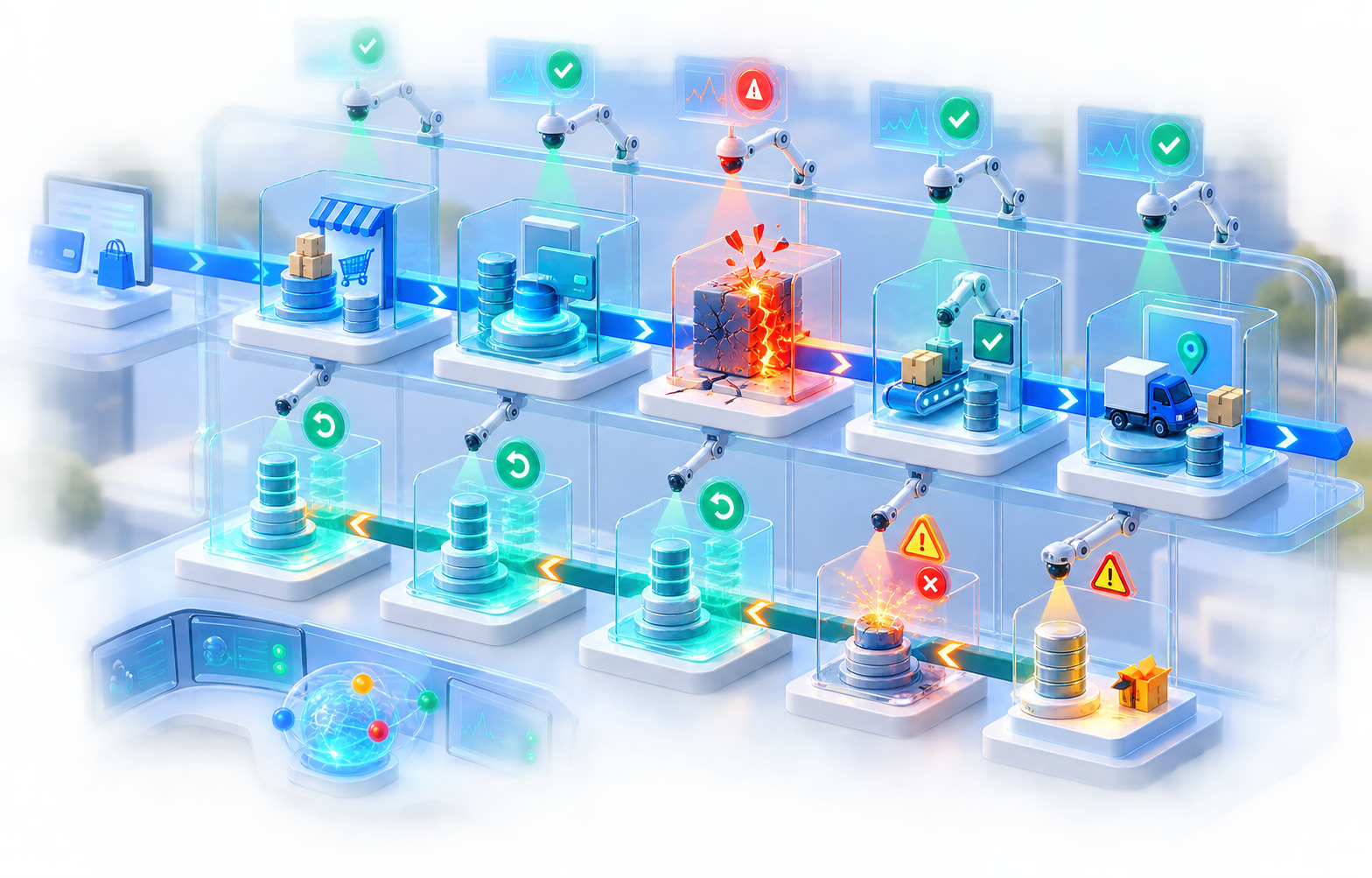
- Stale inventory feed. A nightly batch job responsible for syncing warehouse inventory into the product catalog had been silently failing for eleven days. It was not erroring loudly; it was succeeding with zero rows processed, because an upstream API had changed its pagination behavior and the job was reading an empty first page and calling it done.
- Duplicate customer records. A merger of two regional customer databases eighteen months earlier had left roughly 6% of customers with two or three overlapping profiles, each with different loyalty tiers, different saved preferences, and in some cases different email addresses. Concierge was retrieving whichever profile happened to be returned first by a non-deterministic query, meaning the same customer could get different answers minute to minute.
- Broken ETL job. A currency-normalization step in the pricing pipeline had been quietly deprecated during a platform migration eight months prior, but nothing had been pointed at its replacement. Prices for three international markets were being displayed in the wrong currency, then further transformed by a downstream rounding rule designed for a different currency entirely.
- Missing ownership. No single team could say, with confidence, who owned the "canonical" product availability table. Three teams had write access. Two of them didn't know the other existed.
- Silent schema change. A column rename in the source inventory system (
qty_available→available_qty) had gone out with a routine service deploy. The transformation layer downstream had a fallback that defaulted missing columns tonull, and a further downstream rule that treatednullavailability as "in stock" rather than "unknown." This single design decision, made years earlier for a completely different reason, was directly responsible for a large share of the false-availability complaints.
None of these five things were new. Every one of them had existed, quietly, for weeks or months. Concierge did not create these problems. It surfaced them, instantly and at scale, to every customer who asked a question.
Root Cause
The proximate cause was the empty inventory sync. The actual cause was structural: the organization had built a highly capable AI system on top of a data platform that had never been required to be trustworthy, because until Concierge existed, no single system consumed enough of the data, fast enough, for its inconsistencies to become visible in real time. Dashboards refreshed weekly and were reviewed by humans who mentally corrected for known quirks. Reports were reconciled by hand. The AI assistant had no such tolerance, and no such institutional memory. It answered exactly what the data said, instantly, to thousands of customers simultaneously.
Business Impact
- 14,000+ customer interactions affected over an 11-day window before detection
- Estimated $340K in mis-priced transactions requiring manual reconciliation
- A measurable dip in trust scores for the assistant channel, which persisted for six weeks after the fix shipped
- Three weeks of engineering time spent on remediation versus roughly four hours spent building the original inventory sync job years earlier
Long-Term Engineering Improvements
The fixes that mattered were not model fixes. They were:
- A single canonical, owned source of truth for product availability, with automated reconciliation against the warehouse system
- Schema change alerts wired into CI/CD for every producing system, not just the consuming ones
- A "zero rows processed" alert on every batch job, distinct from a job failure alert
- Deduplication and identity resolution for the merged customer base
- An explicit data freshness contract for every dataset Concierge depended on, with the assistant instructed to say "I'm not confident about this" rather than guess when a freshness contract was violated
2. Executive Memo — To the Leadership Team
From: Office of the CTO Re: What INC-4471 actually tells us about our AI investment
We have spent the better part of two years and eight figures building AI capability: a recommendation engine, a support assistant, an internal copilot for operations, and now Concierge. Each of these initiatives was justified, correctly, by the belief that better predictions and better assistance would improve the business. What INC-4471 tells us is not that this belief was wrong. It's that we have been quietly assuming a precondition that was never actually true: that the data underneath these systems was good enough to support them.
It wasn't, and in places it still isn't.
Here is the sentence I want to become part of how we plan, staff, and fund AI work going forward:
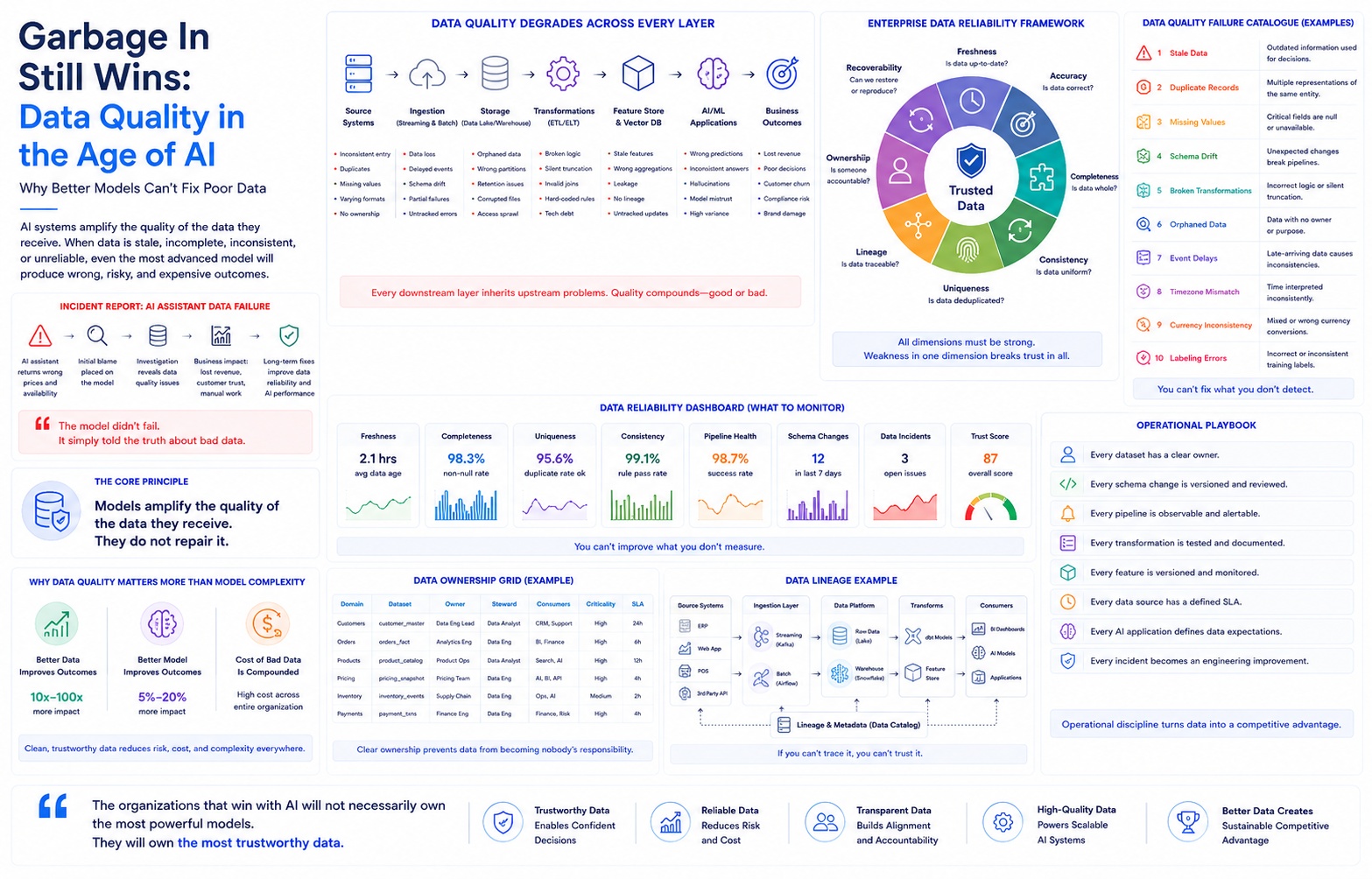
Models amplify the quality of the data they receive. They do not repair it.
A more capable model does not know that two customer records refer to the same person. It does not know that a null value means "unknown" rather than "zero." It does not know that a price is six weeks stale. It will use exactly what it is given, with full confidence, at whatever scale we deploy it. This is precisely what makes AI valuable — and precisely what makes it dangerous on top of an unreliable foundation. A human analyst working from the same broken data would have been slow, inconsistent, and probably would have caught some of the errors through informal pattern-matching ("that price doesn't look right, let me check"). Concierge had no such hesitation. It was fast, consistent, and wrong at scale.
The central question I'd like every architecture review to ask from now on is this:
If we replaced today's AI model with a perfect one, how many of our business problems would actually disappear?
Based on the INC-4471 postmortem, the honest answer for that incident is: almost none of them. A perfect model, given the same duplicate customer records, the same stale inventory feed, and the same currency bug, would have produced the same wrong answers, possibly with more eloquent phrasing.
This reframes where we should be spending our next round of investment. We have been funding model work as though it were the bottleneck. In most of the incidents we've had this year, it was not. I am not proposing we stop investing in AI capability. I am proposing that we stop treating data engineering as background infrastructure and start treating it as a first-class product with its own roadmap, its own on-call rotation, and its own budget line that isn't the first thing cut when a quarter gets tight.
3. Investigation Timeline
Discovery
   │  Customer complaints spike; support escalates as "AI is hallucinating"
   ▼
Initial Assumptions
   │  Model regression suspected → prompt regression suspected → embedding
   │  drift suspected — each ruled out in turn
   ▼
Evidence Collection
   │  Logs pulled from Concierge's retrieval layer; responses traced back
   │  to specific source records rather than model behavior
   ▼
Data Pipeline Inspection
   │  Batch job history reviewed; "success" status found to be misleading
   │  (zero rows is not a failure state in the current alerting config)
   ▼
Root Cause Analysis
   │  Five independent data issues identified, compounding across layers:
   │  stale sync, duplicate identity, currency bug, ownership gap, schema drift
   ▼
Business Impact
   │  Financial exposure quantified; trust erosion measured via CSAT
   ▼
Long-Term Engineering Improvements
   │  Ownership assigned, freshness contracts defined, alerting redesigned,
   │  identity resolution project greenlit
The most expensive part of this timeline, in hindsight, was not the root cause analysis. It was the initial assumptions phase. Two hours were spent investigating the model before anyone looked at the data. That two hours, multiplied across every future incident of this kind, is a recurring tax the organization will keep paying until "check the data first" becomes the default reflex rather than the last resort.
4. Architecture Review — Enterprise Data Platform
This review walks the platform end-to-end, layer by layer, and asks a single question at each stage: how does quality degrade here, and would we know if it did?
Source Systems
This is where truth is supposed to originate — the warehouse management system, the CRM, the point-of-sale system, the marketing platform. In practice, source systems degrade quality in three ways: they change schemas without warning (because the team that owns the source system doesn't know who consumes it downstream), they contain data entered by humans under time pressure (leading to typos, defaults left unchanged, and copy-paste duplication), and they represent the same real-world concept differently across systems (a "customer" in the CRM is not the same entity as a "customer" in the billing system, and reconciling the two is treated as someone else's problem).
Streaming Pipelines
Streaming introduces a class of failure that batch systems don't have: partial, out-of-order, or duplicated events that look individually valid but are collectively wrong. A payment-retry event stream that fires three times for one logical transaction, due to an upstream retry policy, will silently triple revenue in any downstream aggregation that isn't explicitly deduplicated on an idempotency key. Streaming failures are also the hardest to notice, because the pipeline itself rarely goes down — it just quietly processes bad events at full throughput.
Batch Jobs
Batch jobs fail in two ways: loudly (an exception, a retry, a page) and quietly (a job that completes "successfully" while processing zero, partial, or corrupted input). The quiet failure is the dangerous one — precisely the failure mode behind INC-4471 — because every downstream system assumes success means correctness.
Transformation Layers
This is where meaning gets silently rewritten. A null becomes a zero. A missing field gets defaulted to a value that made sense for one use case and is wrong for every other. A timezone conversion is applied once, then applied again downstream by a different team who didn't know the first conversion had already happened. Transformation logic tends to accumulate in layers, and each layer is usually built by someone unaware of every other layer's assumptions.
Feature Stores
Feature stores are supposed to be the antidote to inconsistent features between training and serving. In practice, they introduce their own failure mode: features computed correctly at training time but computed differently — or staler — at serving time, because the serving path pulls from a cache with a longer refresh interval than anyone documented. A model trained on features that are, on average, four hours fresher than what it sees in production will quietly underperform in ways that look like model drift but are actually a freshness mismatch.
Vector Databases
Embeddings inherit every flaw in the text they were generated from. A product description that's stale, duplicated, or wrong will be embedded faithfully and retrieved faithfully. Reindexing on a slower cadence than the underlying catalog changes means the retrieval layer is, by construction, always somewhat behind reality — and unlike a SQL query, a vector similarity search doesn't fail loudly when the underlying fact has changed; it just returns a confident, wrong, semantically-plausible answer.
Analytics
Dashboards built on top of all of the above inherit every upstream defect, but with one additional risk: humans trust dashboards more than they trust raw data, because dashboards look authoritative. A chart with a clean line and a title is more persuasive than the messy table it was built from, even when the table was wrong.
AI Applications
This is the layer where every upstream defect becomes visible, instantly, and at a scale no human reviewer can keep up with. AI applications don't introduce new data quality problems nearly as often as they get blamed for; they expose existing ones to an audience — customers — who have no context for the organization's known data quirks and no patience for wrong answers delivered confidently.
Customer Interfaces
By the time a data defect reaches a customer interface, it has been laundered through so many layers that it is nearly impossible to trace back to its origin without deliberate instrumentation. This is why INC-4471 took hours to diagnose rather than minutes: the actual root cause was six layers removed from where the symptom appeared.
5. Engineering Notebook — Invisible Data Failures
Some data failures are loud: a job crashes, a dashboard goes blank, a dead-letter queue fills up. These get caught. The failures worth writing down are the ones that don't announce themselves.
Silent truncation. A field with a 255-character limit in one system and a 500-character limit in the system it feeds gets truncated on write, not on read. Nobody notices until a customer complains that their shipping instructions were cut off mid-sentence.
Timezone mismatches. "Daily" active users computed in UTC versus computed in the user's local timezone can differ by a meaningful percentage near midnight boundaries, and the discrepancy is worse for global businesses with users spread across every timezone. Nobody questions a daily metric that's "close enough," until it's used to justify a launch decision.
Currency inconsistencies. Prices stored as raw numbers without an explicit currency code, later joined against a table that assumes a single default currency. This is exactly the bug behind INC-4471, and it is one of the most common data defects in any multinational commerce system, because it is invisible until you look at a specific row for a specific market.
Missing joins. A join that should be an inner join is implemented as a left join "to be safe," which means unmatched rows silently pass through as nulls instead of being flagged as an error. "Safe" joins are frequently the least safe choice available, because they convert a loud failure into a silent one.
Schema drift. A producing system renames, retypes, or reorders a field, and the consuming pipeline has no contract to validate against, so it either breaks in a confusing way or — worse — doesn't break at all and just silently accepts a default value.
Duplicate entities. The same customer, product, or order represented more than once, usually because two systems were merged without an identity resolution step, or because retries created near-duplicate records that a naive uniqueness check doesn't catch.
Delayed synchronization. Two systems that are each individually correct, but never consistent with each other at the same point in time, because one syncs every five minutes and the other syncs nightly. Any process that joins across them will produce answers that are correct in neither system's own timeline.
Human labeling errors. Training labels applied by contractors under time pressure, without calibration checks, containing a small but consistent error rate that a model will happily learn as if it were signal.
Legacy transformations. A business rule written for a promotion that ended two years ago, still executing on every record, because removing it felt riskier than leaving it, and nobody currently on the team remembers why it exists.
Temporary fixes that became permanent. The most dangerous category. A hardcoded override, a hand-patched row, a hotfix applied "just for this week" that is still running eighteen months later, now load-bearing, now undocumented, now indistinguishable from intentional design.
6. Root Cause Workshop
Rather than list failures individually, it's more useful to classify them by origin, because the fix for each category looks completely different.
Human Errors. Mistyped values, inconsistent manual entry, mislabeled training data. The fix is validation at the point of entry, not correction after the fact.
Process Failures. No review step for schema changes, no runbook for handling a failed sync, no defined escalation path when a data anomaly is detected. The fix is process design, not tooling.
Architecture Problems. Systems that were never designed to be joined together now being joined together; a monolithic transformation layer with no way to test a single rule in isolation. The fix is structural, and usually expensive, which is exactly why it gets deferred.
Platform Limitations. A tool that can't express the constraint you need (no way to enforce referential integrity across a data lake, for instance). The fix is often a platform capability that doesn't exist yet, which means the interim fix is a manual control that everyone knows is fragile.
Governance Gaps. Nobody owns the dataset. Nobody approves changes to its schema. Nobody is accountable when it drifts. The fix is assigning ownership as a first-class organizational responsibility, not an afterthought.
Operational Debt. Alerting that only checks for job failure, not job correctness. Dashboards nobody has re-validated since they were built. The fix is treating monitoring itself as a maintained product, not a one-time setup task.
Business Decisions. Sometimes the data is "wrong" because a business decision was made — a discount rule, a regional pricing exception — and it was never propagated to every system that needed to know about it. The fix here is communication discipline, not code.
The reason this taxonomy matters: an organization that treats every data quality failure as a "bug to fix" will keep fixing bugs forever. An organization that classifies failures by root cause category can start attacking the categories that produce the most recurring damage — usually governance gaps and operational debt — rather than playing an endless game of individual incident whack-a-mole.
7. Design Conversation — Who Owns This?
Transcript, lightly edited, from the INC-4471 retro.
Data Engineer: Honestly, my first thought was that this wasn't a data problem at all. The pipeline ran. It didn't error. From where I sit, a job that completes without an exception is a job that succeeded.
ML Engineer: From my side, the model hadn't changed in three weeks, and the retrieval scores looked normal — high confidence, well-formed answers. I assumed the answers were correct because the model was behaving exactly the way it always behaves. I didn't think to question the inputs, because the model doesn't have a way to know its inputs are stale.
Product Manager: I assumed both of your systems were being monitored, because that's what "production-ready" is supposed to mean. Nobody told me that "the job ran" and "the data is correct" were different claims.
Platform Architect: I'll take some of this. We built the transformation layer to be permissive — defaulting missing fields rather than failing — specifically because an earlier version of this pipeline was too brittle and kept breaking on minor upstream changes. We traded correctness for uptime, and I don't think we ever explicitly decided that trade-off was the right one long-term. It was a decision made under a different set of priorities that just never got revisited.
CTO: And I assumed that because we'd invested heavily in the AI layer, the underlying data must already be solid — otherwise why would we be building on top of it? That assumption was backwards. We built the AI layer because it was exciting and visible, not because the foundation had been certified as ready.
Data Engineer: So to be direct — who owns the availability table?
Platform Architect: As of this conversation, nobody. Three teams have write access.
CTO: That changes today.
Product Manager: Can we write down, in one sentence, what actually went wrong here? Because I want to bring this back to the exec team without it turning into "the AI hallucinated."
ML Engineer: The model did exactly what it was supposed to do with the data it was given. The data was wrong. That's the sentence.
This conversation is worth preserving verbatim because it illustrates the actual failure mode of data quality in most organizations: not a lack of competence, but a lack of shared ownership. Every person in that room was individually doing their job correctly, by their own definition of their job. The gap existed precisely in the space between those definitions.
8. Whiteboard Session — The Enterprise Data Reliability Framework
An original framework, developed during the INC-4471 retro and refined over the following quarter, built around nine dimensions. Unlike a maturity model, this framework does not rank dimensions from "basic" to "advanced." Instead, it describes how the dimensions depend on and reinforce each other — because in practice, a dataset that scores well on one dimension and poorly on another can still cause serious downstream harm.
Freshness — how recent is the data relative to what it claims to represent? Freshness without accuracy is worthless: an up-to-the-second feed of wrong numbers is still wrong, just wrong in real time.
Accuracy — does the data correctly represent reality at the moment it was captured? Accuracy without completeness is misleading: a perfectly accurate record of half the picture invites the wrong conclusion.
Completeness — is anything missing that should be there? Completeness without consistency creates false confidence: having all the fields doesn't help if different systems disagree about what they mean.
Consistency — do different systems and different records agree with each other? Consistency without uniqueness is fragile: two systems can be perfectly consistent with each other while both silently double-counting the same duplicated entity.
Uniqueness — is each real-world entity represented exactly once? Uniqueness without lineage is unverifiable: you can deduplicate today and have no way to prove it stays deduplicated tomorrow, or to trace why a duplicate reappeared.
Lineage — can you trace any given value back to its origin and every transformation applied along the way? Lineage without observability is theoretical: knowing in principle how data flows doesn't help if nobody is watching that flow in practice.
Observability — can the platform detect, in near real time, when any of the above dimensions degrades? Observability without ownership is noise: an alert that fires with nobody accountable to act on it is indistinguishable from no alert at all.
Ownership — is there a specific, accountable owner for every dataset, pipeline, and transformation? Ownership without recoverability is powerless: an owner who is notified of a problem but has no defined way to fix it or roll it back is stuck narrating the failure rather than resolving it.
Recoverability — when something does go wrong, how quickly and reliably can the system return to a known-good state? Recoverability is where all eight other dimensions cash out into business impact, because the true cost of a data quality failure is not the failure itself — it's the time between detection and recovery.
The relationships matter more than the dimensions in isolation. A platform can score highly on any single dimension and still fail catastrophically, because data reliability is a chain, and a chain's strength is the strength of its weakest, least-monitored link — which is exactly why INC-4471 happened on a dimension (freshness, via the silent batch failure) that nobody was actively watching, even though accuracy and consistency looked fine on every dashboard the team already trusted.
9. Engineering Experiments
Five experiments run in the two quarters following INC-4471, each testing a specific hypothesis about where effort should be spent.
Experiment 1: Increase model complexity. Hypothesis: A larger, more capable retrieval-augmented model will reduce incorrect answers from Concierge. Method: Swap the underlying model for a substantially more capable version, holding the data pipeline constant. Result: Negligible measurable improvement in the specific error categories tied to stale or duplicate data. The more capable model produced more fluent, more confident wrong answers on exactly the same underlying bad records.
Experiment 2: Improve duplicate detection. Hypothesis: Deduplicating the customer identity graph will reduce inconsistent personalization. Method: Deploy an identity-resolution pass across the merged customer base, holding the model constant. Result: Immediate, measurable improvement in personalization consistency and a drop in complaints tied to "you already told me something different." Business metrics improved within the first week, without touching the model at all.
Experiment 3: Add a freshness contract to the availability table. Hypothesis: Explicitly rejecting stale reads, rather than silently serving them, will reduce false-availability incidents. Method: Add a freshness check that causes Concierge to say "I don't have current information" rather than answer from data older than a defined threshold. Result: A small increase in "I don't know" responses, offset by a large drop in confidently wrong responses. Customer trust scores improved net, even though the assistant became less "helpful-sounding" on paper.
Experiment 4: Increase retrieval corpus size (add more documents to the vector index). Hypothesis: More product data available for retrieval will improve recommendation quality. Method: Expand the indexed catalog by 40% without addressing known duplication in the underlying product records. Result: No meaningful improvement, and a slight regression in some categories, because the expanded corpus also expanded the number of duplicate and outdated product entries being retrieved.
Experiment 5: Fix the currency normalization bug and re-run the same model, unchanged. Hypothesis: Correcting the specific pricing transformation defect from INC-4471 will resolve pricing complaints without any model change. Method: Patch the transformation layer, deploy, hold the model constant. Result: Pricing complaints dropped to baseline within 48 hours. This was the single highest-leverage change of all five experiments, and it involved zero machine learning work.
The pattern across all five experiments is consistent: interventions on the data layer produced fast, measurable, durable improvements. Interventions on the model layer, holding data constant, produced little to none. This is not a universal law — model quality matters enormously in other contexts — but for this class of problem, in this platform, the data was the bottleneck, and no amount of model investment changed that.
10. Operations Logbook — What to Watch Every Day
Delayed pipelines. A pipeline running ten minutes later than usual is often the earliest signal of an upstream problem, well before it becomes a visible outage.
Failed transformations. Not just hard failures — partial failures where some percentage of rows fail a validation rule and get silently dropped rather than raising an alert.
Unexpected data volume. A sudden 90% drop or 300% spike in row counts almost always indicates a pipeline problem, not a real-world change, and should be flagged before anyone trusts the resulting numbers.
Missing events. Especially in streaming systems, where an absence of data looks identical to genuinely low activity unless you have an independent way to verify expected volume.
Feature drift. Not just drift in the model's predictions, but drift in the statistical distribution of the input features themselves, which often precedes any visible model degradation by days or weeks.
Schema changes. Every schema change, anywhere in the platform, should generate a notification to every known downstream consumer — not just the team that made the change.
Null spikes. A sudden increase in null values for a field that used to be reliably populated is one of the most reliable early indicators of an upstream integration break.
API synchronization. Any two systems that are supposed to represent the same underlying fact should be periodically reconciled against each other, with drift beyond a defined threshold treated as an incident.
Customer anomalies. Sometimes the earliest and most reliable signal that data has gone wrong is a spike in support tickets that mention specific, oddly consistent details — customers, unknowingly, doing your data validation for you.
Each of these matters for the same underlying reason: by the time a data quality problem is visible in a customer-facing system, it has already been silently present for some unknown period of time. The goal of operational monitoring is to shrink that unknown period as close to zero as possible.
11. Decision Journal
Decision: Make the transformation layer permissive (default missing fields rather than failing). Context: An earlier version of the pipeline was too brittle, breaking on every minor upstream schema variation. Alternatives considered: Strict validation with hard failures; strict validation with quarantine of invalid rows; permissive defaults with alerting. Trade-off: Permissive defaults trade correctness for uptime. Strict validation trades uptime for correctness but requires faster incident response. Decision: Permissive defaults, without corresponding alerting on default usage. Long-term consequence: This decision, made for good reasons at the time, directly enabled the INC-4471 availability bug years later. The missing alerting on default usage — not the permissiveness itself — was the actual gap.
Decision: Merge two regional customer databases without a dedicated identity-resolution project. Context: Time pressure following a business acquisition; identity resolution was estimated at three additional months of work. Alternatives considered: Delay the merge until resolution was complete; merge with a "best guess" matching heuristic; merge with no matching, keeping records separate but linked by an external key. Trade-off: Delaying the merge would have delayed unrelated business integration work. The "best guess" heuristic was chosen as a middle path. Decision: Merge with heuristic matching, revisit later. Long-term consequence: "Revisit later" did not happen until forced to by an incident. The heuristic's false-positive and false-negative rates were never measured after initial deployment.
Decision: Skip a formal ownership assignment for the product availability table during a platform migration. Context: Migration was scoped and staffed around moving data, not around redefining organizational ownership. Alternatives considered: Assign a single owning team as part of migration scope; leave ownership ambiguous and resolve informally as needed. Trade-off: Formal ownership assignment would have added scope and time to an already tight migration timeline. Decision: Leave ownership ambiguous. Long-term consequence: Three teams retained write access with no single accountable owner, a structural gap that took over a year to surface and directly contributed to the root cause of INC-4471.
The throughline across all three decisions: none of them were unreasonable at the time they were made. Each was a defensible trade-off given the information and pressure of that moment. What was missing, in every case, was a mechanism to revisit the decision once circumstances changed — which is arguably a more valuable engineering investment than making the "right" decision in the first place.
12. Failure Catalogue
1. Silent Zero-Row Success Symptoms: Pipeline reports success; downstream data unchanged. Likely cause: Upstream API change causing empty result set treated as valid. Business impact: Stale data served as current, indefinitely, until manually noticed. Detection method: Row-count anomaly alerting on every batch job. Recommended fix: Treat zero (or unexpectedly low) row counts as a failure state requiring explicit acknowledgment.
2. Duplicate Customer Identity Symptoms: Same customer receives inconsistent recommendations or loyalty status across sessions. Likely cause: Database merge without identity resolution. Business impact: Personalization degradation, loyalty program errors, customer trust erosion. Detection method: Periodic identity-graph audits; complaint pattern analysis. Recommended fix: Dedicated identity resolution service as a shared platform capability, not a one-time migration task.
3. Currency Field Ambiguity Symptoms: Prices displayed in the wrong currency or with incorrect rounding. Likely cause: Currency code dropped or defaulted during a transformation step. Business impact: Financial exposure, customer complaints, manual reconciliation cost. Detection method: Cross-market price sanity checks against known ranges. Recommended fix: Make currency an explicit, required, validated field at every layer, never inferred.
4. Ambiguous Table Ownership Symptoms: Multiple teams have write access; no clear accountable party when data drifts. Likely cause: Ownership never assigned during a migration or reorg. Business impact: Slow incident response; conflicting fixes applied by different teams. Detection method: Ownership audit against every production dataset. Recommended fix: Every dataset has exactly one accountable owning team, documented and enforced.
5. Silent Schema Rename Symptoms: Downstream field appears null or default where it previously had real values. Likely cause: Producing system renamed or restructured a field without notifying consumers. Business impact: Cascading incorrect defaults through every downstream transformation. Detection method: Schema contract validation on every pipeline run. Recommended fix: Enforced schema registry with breaking-change review gates.
6. Timezone Boundary Miscount Symptoms: Daily metrics differ meaningfully from independently computed totals. Likely cause: Mixed use of UTC and local time across systems computing "daily" aggregates. Business impact: Misleading business metrics used in decision-making. Detection method: Cross-checking aggregates computed in multiple timezones. Recommended fix: Standardize on a single timezone convention platform-wide, documented explicitly.
7. Feature-Serving Staleness Gap Symptoms: Model performance in production consistently underperforms offline evaluation. Likely cause: Serving-time feature cache refreshes less frequently than training-time computation. Business impact: Silent model underperformance misattributed to model quality. Detection method: Freshness comparison between training and serving feature pipelines. Recommended fix: Shared feature store with identical computation and refresh guarantees across training and serving.
8. Truncated Free-Text Field Symptoms: Customer-entered text appears cut off; downstream summarization or extraction is incomplete. Likely cause: Field length limit mismatch between two connected systems. Business impact: Customer confusion, incomplete order or support instructions. Detection method: Length-distribution monitoring for text fields, flagged near known limits. Recommended fix: Align field length constraints across all systems in a data flow, or explicitly reject over-length input at entry.
9. Overly Permissive Join Symptoms: Unexpectedly high null rates in a joined dataset. Likely cause: Left join used in place of an inner join to avoid breaking on unmatched rows. Business impact: Silent data loss disguised as complete data. Detection method: Match-rate monitoring on every join in critical pipelines. Recommended fix: Default to strict joins with explicit, monitored exceptions rather than blanket permissiveness.
10. Legacy Promotional Rule Symptoms: Unexplained discount or pricing anomaly on specific product categories. Likely cause: Transformation rule written for an expired promotion, never removed. Business impact: Revenue leakage, pricing inconsistency. Detection method: Periodic rule-audit against active business logic documentation. Recommended fix: Expiration dates and ownership attached to every business rule, enforced by automated review.
11. Vector Index Staleness Symptoms: AI assistant recommends discontinued or outdated products. Likely cause: Vector database reindexing cadence slower than catalog change rate. Business impact: Customer-facing recommendation errors, lost sales, trust erosion. Detection method: Reindex-lag monitoring against source catalog change rate. Recommended fix: Event-driven reindexing tied directly to catalog change events, not fixed schedules.
12. Contractor Labeling Drift Symptoms: Model trained on recent labels underperforms relative to earlier training runs. Likely cause: Labeling guideline drift or inconsistent calibration across labeling contractors. Business impact: Model quality degradation misattributed to architecture or data volume. Detection method: Inter-annotator agreement tracking over time. Recommended fix: Ongoing calibration checks and golden-set validation for all labeling work.
13. Hardcoded Temporary Override Symptoms: A specific record or rule behaves inexplicably differently from all others. Likely cause: A manual patch applied during a past incident, never removed. Business impact: Unpredictable behavior, difficult-to-diagnose edge cases. Detection method: Periodic audit of all manual overrides and hardcoded exceptions. Recommended fix: Every temporary fix requires an expiration date and an owner responsible for its removal.
14. Cross-System Sync Lag Symptoms: Two systems disagree about the same underlying fact when queried simultaneously. Likely cause: Differing synchronization intervals between systems. Business impact: Inconsistent customer-facing answers depending on which system is queried. Detection method: Scheduled reconciliation jobs comparing key facts across systems. Recommended fix: Explicit, documented consistency guarantees (or lack thereof) for every cross-system relationship.
15. Retry-Induced Duplicate Events Symptoms: Revenue or activity metrics inflated relative to independently verified totals. Likely cause: Upstream retry logic re-emitting events without idempotency keys. Business impact: Inflated metrics used in business reporting and forecasting. Detection method: Idempotency key coverage audit across all event streams. Recommended fix: Mandatory idempotency keys on every event type, enforced at the schema level.
16. Default Value Misinterpretation Symptoms: Missing data silently treated as a specific business meaning (e.g., null treated as zero or as "available"). Likely cause: Downstream logic assumes a default value carries semantic meaning it was never intended to carry. Business impact: Systematic, hard-to-detect errors across every record affected by the default. Detection method: Explicit tracking of default-value usage rates per field. Recommended fix: Distinguish "unknown" from "zero" and from "false" as three distinct states, never collapsed into one.
17. Unversioned Feature Definition Symptoms: A feature's meaning silently changes over time without any change in its name. Likely cause: Feature computation logic updated without versioning, breaking comparability with historical data. Business impact: Misleading trend analysis, invalid model comparisons across time periods. Detection method: Feature definition change tracking tied to a version history. Recommended fix: Every feature is versioned; changes create a new version rather than silently mutating an existing one.
18. Manual Spreadsheet Reconciliation Dependency Symptoms: A "trusted" business number cannot be reproduced without a specific person's manual spreadsheet process. Likely cause: An automated pipeline was never built to replace an original manual workaround. Business impact: Single point of failure for a business-critical metric; no audit trail. Detection method: Inventory of all business metrics against their computation method (automated vs. manual). Recommended fix: Every trusted business metric has a documented, automated, owned computation path.
19. Silent API Deprecation Symptoms: A previously reliable data source begins returning incomplete or default responses. Likely cause: An upstream vendor or internal team deprecated an API version without adequate migration coordination. Business impact: Gradual, hard-to-notice degradation across every dependent system. Detection method: Contract testing against all external and internal API dependencies. Recommended fix: Formal deprecation policy requiring advance notice and coordinated migration windows for any API change.
20. Undocumented Cross-Team Data Dependency Symptoms: A change made by one team breaks a system owned by a completely different, unaware team. Likely cause: No registry of which teams consume which datasets. Business impact: Unpredictable, hard-to-trace incidents following routine changes. Detection method: Dependency mapping exercise across all major datasets. Recommended fix: A maintained, queryable data dependency graph, checked automatically before any breaking change ships.
13. Data Reliability Dashboard — Design Notes
Rather than a conventional KPI dashboard, the recommended operational view is organized around the following panels:
- Freshness Timeline — a rolling view of how current every critical dataset is relative to its defined freshness contract, with violations highlighted rather than averaged away.
- Duplicate Heatmap — a visual map of estimated duplication rate across every major entity type (customers, products, orders), updated continuously rather than audited quarterly.
- Ownership Matrix — every dataset cross-referenced against its accountable owning team, with unowned datasets flagged in a distinct, impossible-to-ignore color.
- Schema Drift Timeline — a chronological record of every schema change across the platform, tagged by whether it was reviewed and whether downstream consumers were notified.
- Missing Data Trend — null and missing-value rates tracked over time per critical field, not just as a point-in-time snapshot.
- Transformation Success — success measured as validated correctness, not merely job completion, distinguishing "ran" from "ran correctly."
- Pipeline Health — latency, throughput, and error rate for every pipeline, correlated against known dependency chains so a failure's downstream blast radius is visible immediately.
- Business Confidence — a composite signal, built from the dimensions above, intended to answer one question at a glance: how much should we trust what this system is telling us right now?
- Data Recovery Time — historical time-to-recovery for past data incidents, tracked as a first-class metric alongside uptime.
- Labeling Consistency — inter-annotator agreement and calibration drift for any dataset involving human-generated labels.
The organizing principle behind this dashboard is that traditional infrastructure monitoring answers "is the system running?" while data reliability monitoring must answer a different, harder question: "is the system running correctly?" A pipeline can be perfectly healthy by every infrastructure metric while quietly producing wrong answers, which is exactly the trap INC-4471 fell into.
14. Lessons From Other Industries
Manufacturing. No serious manufacturing operation inspects only the finished product. Input material quality is checked before it ever reaches the production line, because a defect caught at the raw-material stage costs a fraction of what the same defect costs once it's built into a finished unit. Most AI organizations still inspect only the "finished product" — the model's output — while treating the raw material, the data, as pre-validated by assumption.
Aviation. Aviation safety culture is built around the principle that small, individually survivable anomalies compound into catastrophic failures when they're allowed to accumulate unaddressed. A missed maintenance check, a minor sensor discrepancy, a procedural shortcut — none catastrophic alone, all catastrophic in combination. INC-4471 followed exactly this pattern: five individually survivable data defects, none of which alone would have caused a SEV-1, combined into one.
Healthcare. Clinical data pipelines are held to strict provenance and audit standards specifically because decisions made on bad data have irreversible consequences. The discipline of always being able to trace a specific data point back to its source — its lineage — is treated as non-negotiable in healthcare in a way it rarely is in commercial data platforms, even when the commercial platform is making decisions that meaningfully affect real people's money and time.
Financial Auditing. Auditors do not simply check whether a company's reported numbers are internally consistent; they verify the underlying process that produced those numbers, because a consistent number can still be a consistently wrong number. This distinction — consistency versus correctness — is precisely the gap that data platforms need to close, and precisely the gap the Enterprise Data Reliability Framework is built around.
Supply Chains. Modern supply chain management assumes that visibility into every link is a prerequisite for reliability, not a luxury. A single unmonitored link — one supplier, one warehouse, one transport leg — is treated as a systemic risk to the entire chain, regardless of how well every other link performs. Data platforms rarely apply this same standard to their own internal "supply chain" of data flowing from source system to AI application.
Every one of these industries reached the same conclusion through hard, sometimes tragic experience: quality has to be measured and enforced at the input, not inferred from the output. Data engineering and AI infrastructure are still, collectively, earlier in this maturity journey than industries that learned this lesson decades or centuries ago.
15. Practical Engineering Playbook
- Every dataset has an owner.
- Every schema change is reviewed before it ships.
- Every pipeline is observable, not just monitored for uptime.
- Every feature is versioned, never silently mutated.
- Every transformation is documented, including why it exists.
- Every business metric has a single trusted, automated source — never a spreadsheet of last resort.
- Every AI application defines an acceptable data freshness threshold, and is designed to say "I don't know" when that threshold is violated.
- Every join is validated for match rate, not assumed to be safe by default.
- Every temporary fix has an expiration date and a named owner responsible for its removal.
- Every identity — customer, product, order — is resolved to a single canonical record before it reaches any downstream system.
These rules are deliberately simple. Simplicity is the point: data reliability failures are rarely caused by a lack of sophisticated tooling. They are caused by simple, disciplined practices that were skipped under time pressure and never revisited.
16. Engineering Review Notes
Verbatim comments left during architecture review sessions over the two quarters following INC-4471.
- "Feature freshness is undefined. What does 'recent' mean for this specific feature?"
- "Ownership is shared, therefore ownership is absent."
- "Schema validation occurs too late — by the time we catch this, three downstream systems have already consumed it."
- "The pipeline is reliable. The data is not. These are different claims and we keep conflating them."
- "Business confidence cannot exceed data confidence, no matter how good the dashboard looks."
- "This join is 'safe' in the sense that it never fails. That is exactly the problem."
- "We have a runbook for what to do when the pipeline goes down. We don't have one for what to do when it silently produces wrong output."
- "This default value has been doing three different jobs for three different downstream teams, and none of them know about the other two."
- "This is the fourth 'temporary' fix I've found this quarter that's over a year old."
- "The alert fired. Nobody was on call for it. That's not an alerting failure, that's an ownership failure."
- "We tested this pipeline's throughput extensively. We never tested its correctness under a schema change."
- "This model is not underperforming. It is performing exactly as well as its inputs allow."
- "A dashboard that looks confident is not the same as a dashboard that is correct."
- "The freshest wrong answer is still a wrong answer."
- "We should assume every upstream system will change its schema eventually. The question is whether we'll know when it happens."
- "This identity resolution heuristic was never validated after launch. We've been trusting it blind for eighteen months."
- "If two systems disagree, at least one of them is wrong, and right now we have no way to know which."
- "Recoverability isn't a nice-to-have. It's the metric that determines how expensive every future incident will be."
- "This is not a model problem. Please stop routing this to the ML team first by default."
- "The organization that owns this data doesn't know it owns this data. That's worth fixing before anything else on this list."
17. Closing Reflection
It would be easy to end an article like this with a statement about the future of artificial intelligence — about ever more capable models, about what comes next. That's not the right ending for this investigation, because it's not what the investigation actually found.
What INC-4471 found, and what every experiment, every failure catalogue entry, and every review comment in this document confirms, is something quieter and less exciting: the constraint was never the model. It was whether the organization had done the unglamorous, foundational work of making its data trustworthy — owned, observed, validated, and understood — before asking that data to power decisions at machine speed and machine scale.
The central question this investigation set out to answer was: if we replaced today's AI model with a perfect one, how many of our business problems would actually disappear? The honest answer, again and again, is: fewer than we'd like to admit. A perfect model given duplicate customer records still can't tell you which record is real. A perfect model given a stale inventory feed still doesn't know it's stale. Intelligence, however advanced, is not a substitute for trustworthiness.
The organizations that win with AI will not necessarily own the most powerful models.
They will own the most trustworthy data.