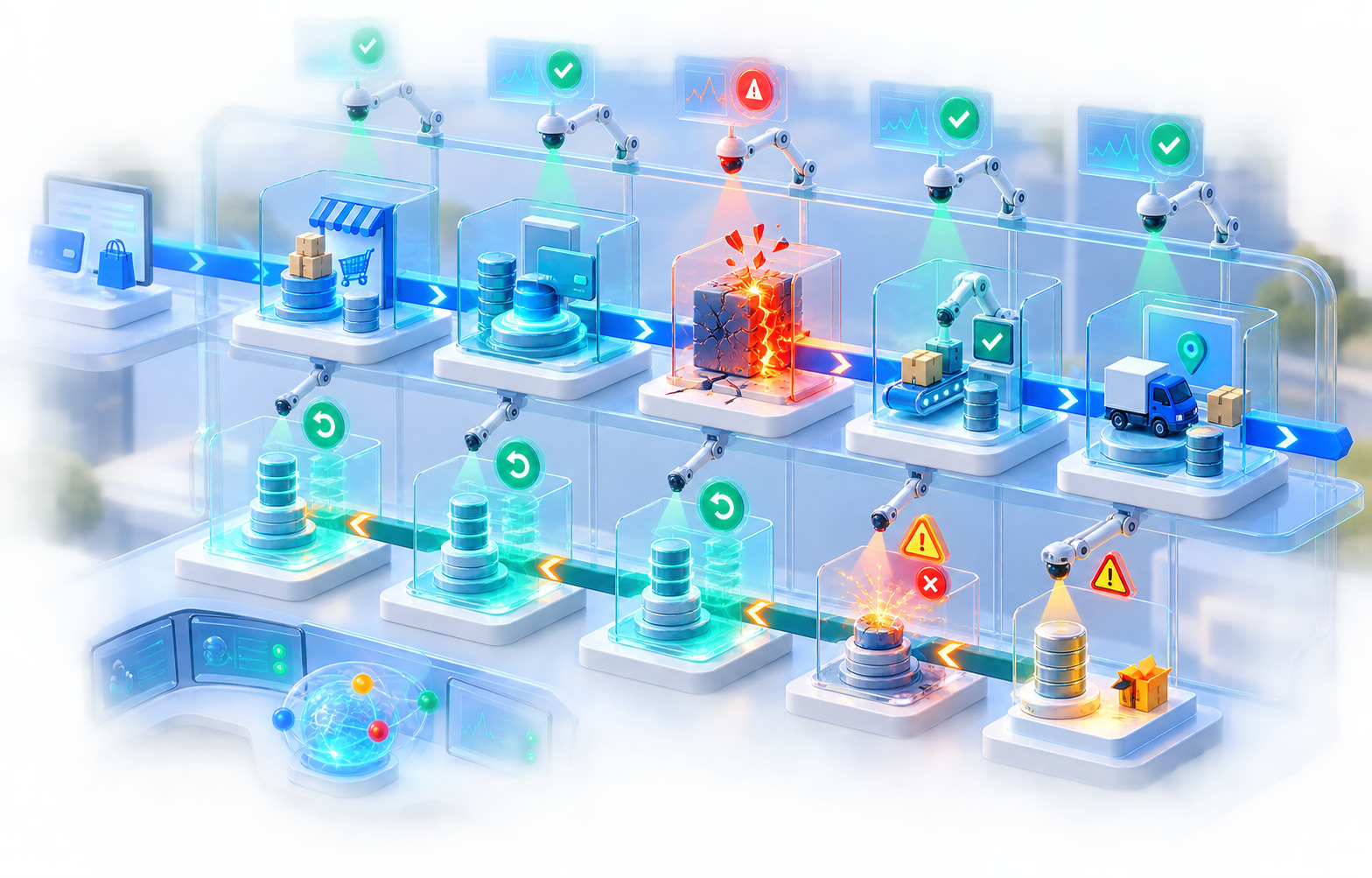
A VP of Engineering at a mid-sized SaaS company pulls up the quarterly quality review. Test coverage sits at 84%. The offshore QA team, contracted through a testing vendor, has closed 1,200 test cases this quarter and logged a defect escape rate of 2%. The dashboard is green. Leadership reads the numbers as confirmation that the QA function is working, and the conversation moves on to the next agenda item.
Three weeks later, a mid-market customer in a regulated vertical fails its own security review of the product during procurement, over an authorization flaw that let one workspace's service account read another workspace's billing data under a specific, non-obvious sequence of API calls. Nobody on the QA team missed a test case. The test suite that produced the 84% figure and the 2% escape rate was never designed to catch that class of defect. It was built to verify that features work as specified, executed by a team that is very good at exactly that and was never asked to reason adversarially about authorization boundaries. The coverage metric was accurate. It was also answering a question nobody had actually asked: not "does this software do what we told the QA team to check," but "is this software safe to hand to a regulated customer's data." Those are different questions, and the operating model that had been in place for two years was built to answer only the first one.
This is not a story about a vendor cutting corners or an in-house team getting lazy. It is a story about a QA operating model that was never actually chosen. It was inherited from what the last two engineering leaders had done at previous companies, sized against a budget line rather than a risk profile, and never revisited as the product moved upmarket into a segment with a materially different risk surface. The metric looked fine because the model was doing exactly what it was built to do. It just was not built to do the thing the business actually needed by that point.
That gap — between a QA metric that looks healthy and a structural coverage hole the metric cannot see — is the subject of this article. Every company running a software product has, whether deliberately or by default, chosen a QA operating model: fully in-house, fully outsourced or offshore, some hybrid of the two, or an embedded specialist brought in for a narrow slice of risk. Very few companies chose that model on purpose. Most inherited it, defaulted into it under budget pressure, or copied it from a founder's or engineering leader's previous employer. The model then runs quietly in the background, producing metrics that look reasonable, until a release exposes exactly the kind of risk the model was never built to catch.
There is no universally correct answer to "should QA be in-house or outsourced." Anyone who tells you otherwise is selling something, and the answer they are selling usually happens to be what they sell. Each of the four operating models examined in this article has a genuinely different cost structure, a genuinely different speed at which its testers can develop deep context on your product, a real ceiling on how deep its specialist expertise can go, and a specific, predictable way it fails when it is the wrong fit for what you are building. The job of an engineering or QA leader is not to find the model that wins on every dimension — no such model exists — but to understand which dimensions matter most for a specific product, at a specific stage, with a specific risk profile, and to choose deliberately rather than by default.
This article lays out the four models honestly, including their real limitations, builds a structured framework for matching model to risk profile, and walks through what a well-run hybrid arrangement actually looks like operationally — because "hybrid" is the model most companies claim to run and the one most poorly defined in practice.
Why This Is an Organizational Decision, Not a Staffing Preference
Most conversations about in-house versus outsourced QA get framed as a cost question, sometimes dressed up as a culture question. Someone argues that outsourced testers "don't care about the product the way employees do," someone else argues that an in-house team is "too expensive to scale with release volume," and the discussion ends in a compromise that nobody derived from first principles.
The more useful framing treats QA sourcing the way a CFO treats a make-or-buy decision on any other function: as a structural choice with measurable trade-offs along specific dimensions, made in service of a specific set of risks the business needs to manage. A company sources legal work differently for routine contract review than for a hostile litigation matter. It sources infrastructure differently for a stable core platform than for an experimental feature that might be killed in a quarter. QA capacity deserves the same discipline, because the four models available do not differ only in price. They differ in:
- Cost structure. Fixed headcount cost that scales in discrete steps, versus variable capacity cost that scales more continuously but carries margin and management overhead.
- Speed to product context. How quickly a tester can develop the judgment to know that a particular result is wrong, not just that it doesn't match a written expectation — which requires understanding the product's domain, its edge cases, and its history of past failures.
- Ceiling on specialist depth. How deep the team can go in a narrow discipline — security testing, performance engineering, accessibility conformance, regulatory validation — before the cost of maintaining that depth in-house stops making sense.
- Failure mode when mismatched. Not whether the model can fail, but specifically how it fails: what kind of defect gets through, and how visible that failure is before it becomes a customer-facing incident.
A company that treats this as a budget-line decision will optimize for the first dimension and discover the other three the hard way, usually during an incident review. A company that treats it as an organizational design decision will ask a different, better question: given what we are building, for whom, and how fast we are shipping it, which combination of these four trade-offs do we actually need to manage well, and which can we accept managing less well?
That question has a defensible answer. It is rarely the same answer twice.
Four QA Operating Models, Examined Honestly
Most public discussion of this topic collapses into a binary: in-house versus outsourced. That binary hides two important variations that behave very differently in practice — a hybrid model where strategy and execution are deliberately split, and a narrower embedded-specialist model where an outside team owns exactly one risk category and nothing else. Treating all four separately is necessary because a hybrid arrangement is not simply "some in-house, some outsourced." It is a distinct operating model with its own governance requirements, and it fails differently than either pure model does.
Fully In-House, Embedded QA
An in-house QA function means testers, SDETs, and QA leads are full-time employees, embedded in product teams, sitting in the same standups and planning sessions as the engineers building the features they test. They carry institutional memory: they remember why a particular workaround exists, which customer complained about which edge case eighteen months ago, and which part of the codebase has produced the most regressions historically.
Cost structure. This is a fixed-cost model. Salary, benefits, equity, recruiting cost, and management overhead are incurred whether release volume is high or low that quarter. In the United States, fully loaded cost for a mid-level QA engineer or SDET commonly runs well above base salary once benefits, payroll taxes, tooling, and management overhead are included — a pattern consistent with fully loaded cost multipliers reported broadly across US tech hiring (typically cited in the range of 1.25–1.4x base salary before equity). That cost does not flex down in a slow release quarter and does not flex up instantly when release volume spikes, because hiring a QA engineer takes weeks to months even in a favorable labor market.
Speed to context. This is where in-house QA is structurally superior to every other model, and it is not close. An embedded tester who has worked on the product for a year develops a form of judgment that is difficult to specify in a test case: an instinct for which changes are more likely to be risky, which parts of the system interact in surprising ways, and what "wrong" looks like even when it technically matches a written acceptance criterion. This judgment compounds. It is also the single hardest thing to replicate in any external model, because it depends on continuous exposure to the product, the customers, and the incident history, not on skill alone.
Ceiling on specialist depth. This is the model's least discussed weakness. A five-person in-house QA team can develop excellent generalist testing capability and reasonably strong automation skills. It is very difficult for that same team to also maintain deep, current expertise in web application penetration testing, load and performance engineering at scale, WCAG accessibility conformance testing, or regulatory validation testing (for example, testing to FDA software validation guidance or a specific financial services control framework), because each of those disciplines is itself a full career specialization, evolves on its own schedule, and — critically — is often needed intermittently rather than continuously. Hiring a full-time security tester to run intensive testing twice a year is a fixed cost carried year-round for value delivered in short bursts. Most companies below a certain size never make that hire, and the security or performance testing that should happen either doesn't happen, happens superficially through a generalist doing their best, or happens once during a compliance audit and never again in between.
Key-person risk. An in-house QA function of one to three people concentrates enormous institutional knowledge in very few individuals. When that person goes on leave, gets promoted into a different role, or leaves the company, the loss is not just a headcount gap — it is a loss of undocumented judgment about the product that took months or years to build and that a written knowledge base rarely captures completely.
Where this model is clearly the right call. Products where domain context is the dominant risk factor and where that context takes a long time to build — complex B2B platforms with deep configuration logic, healthcare or clinical software where clinical workflow understanding matters as much as software mechanics, or any product with a small number of very large customers where a single missed edge case can mean a lost account. Products at a stage where the QA function needs to shape product decisions early, not just verify them after the fact — because embedded QA engineers who understand the roadmap can catch design-level risk before a single line of code is written, something that is very difficult for any external party to do well.
Fully Outsourced or Offshore QA Function
In this model, an external vendor or offshore team owns most or all test execution, often with its own test leads, its own tooling choices within agreed parameters, and a service agreement defining scope, throughput, and quality metrics. The client company typically retains a much smaller internal presence — sometimes just a single point of contact — and the vendor is expected to manage day-to-day execution independently.
Cost structure. This is a variable-cost model, and the difference is real, not just marketing language. Capacity can often be scaled up or down within weeks by adjusting the contracted team size, rather than the months a direct hire requires. Offshore hourly or day rates are frequently a fraction of comparable onshore fully loaded employee cost, which is the headline economic argument for the model and, for straightforward, well-specified regression and functional testing, is often a legitimate one. The honest caveat: the effective cost advantage narrows once you account for vendor management overhead, ramp-up time on each new engagement, and the rework that comes from misunderstood requirements — none of which show up on the rate card but all of which show up on the calendar and, eventually, in escaped defects.
Speed to context — the model's central weakness. An outsourced or offshore team, particularly one structured around utilization and throughput rather than deep product ownership, faces a structural handicap in developing the same depth of product judgment an embedded employee builds over time. This is not a claim about the intelligence or diligence of offshore testers, who are frequently highly skilled; it is a claim about incentive structure and continuity. Vendor staffing models often rotate personnel across engagements to optimize utilization, communication happens across time zones with limited real-time overlap with the product team, and the commercial relationship is frequently structured around executing a defined scope rather than exercising open-ended product judgment. All of that adds friction to the exact kind of tacit, hard-to-document context that in-house QA builds naturally. A vendor team can absolutely execute a well-specified regression suite flawlessly. Asking that same team to intuit that a particular result "feels wrong" for a customer segment they've never spoken with, based on context that was never written down anywhere, is asking for something the model was not built to deliver.
Time zone and communication friction, honestly stated. A team with only two to four hours of working-day overlap with the core product team faces real constraints: a question that would take five minutes to resolve synchronously becomes a day-long asynchronous exchange, ambiguity in a requirement compounds rather than resolving quickly, and a defect discovered late in the offshore team's day may not reach the product team until the next business day, shrinking the window to fix it before a release. This is a genuine, structural cost, not a stereotype, and it scales with how much a testing task requires clarification versus how well-specified it already is.
Ceiling on specialist depth — the model's real strength, when structured correctly. This is the mirror image of the in-house weakness, and it is worth stating plainly: a reputable QA outsourcing vendor with genuine specialist practices can offer access to security testing, performance engineering, and accessibility conformance expertise that most individual companies could never justify hiring for full time. A vendor serving dozens of clients can afford to maintain a dedicated performance engineering bench because the cost is amortized across many engagements; a single company running quarterly load tests cannot. This is a legitimate, non-marketing advantage of the model for intermittent specialist needs, and it is precisely why the embedded-specialist model discussed below exists as a distinct option.
Where this model is clearly the right call. High-volume, well-specified regression and functional testing on a mature, relatively stable product where requirements are clear and context requirements are low; products with predictable, high-burst testing needs around release cycles where scaling headcount up and down would be wasteful in-house; companies that need specialist testing capacity (security, performance, localization, accessibility) intermittently rather than continuously, where a vendor's amortized specialist bench is more efficient than a full-time hire would ever be; and cost-constrained early-stage companies that need testing coverage before they can justify or attract in-house QA hires.
Hybrid: In-House Leadership, Outsourced Execution Capacity
In a properly run hybrid model, a small in-house QA leadership function — often as few as one or two senior people — owns test strategy, risk prioritization, and the definition of "done" for quality, while a mix of in-house testers for high-context work and outsourced or offshore capacity for high-volume, well-specified execution carries out the actual testing. This is distinct from simply having both an in-house team and a vendor contract running in parallel with no clear division of responsibility, which is not a hybrid model — it is two uncoordinated models operating in the same company, and it tends to produce the worst version of both: the coordination overhead of managing a vendor relationship, without the cost savings of full outsourcing, and the context gaps of external testers, without the context benefits of a fully embedded team.
Cost structure. A blend: fixed cost for the strategic core, variable cost for execution capacity. Done well, this lets a company pay full-time compensation only for the judgment-intensive work that genuinely requires continuous product context, while flexing execution capacity up during release-heavy periods and down during quieter ones. Done poorly, it means paying for a full management layer on top of vendor rates that were supposed to be cheaper than in-house execution, eroding the cost advantage the vendor relationship was meant to provide.
Speed to context. This is the model's central design challenge, not an automatic benefit. Product context does not transfer to an outsourced execution team simply because an in-house lead exists above them. Context transfers through deliberate mechanisms — structured onboarding into the product domain, direct access to production incident history, recurring synchronous sessions with product owners, and rotation of at least some outsourced testers onto longer-term engagements rather than short-cycle assignments. A hybrid model with a nominal in-house lead but no real knowledge-transfer infrastructure underneath them delivers the coordination cost of hybrid with the context ceiling of pure outsourcing. This is the most common way hybrid models underperform, and it is discussed in detail in the operational section below.
Ceiling on specialist depth. Potentially the strongest of the four models on this dimension, because a hybrid arrangement can combine an in-house lead who deeply understands the product's risk profile with access to a vendor's specialist bench for security, performance, or accessibility work — directed by someone who actually knows where the product's real risk concentrates, rather than by a generic scope-of-work document. The specialist work is only as good as the in-house leadership's ability to direct it toward the product's actual risk areas, which is why this model collapses without competent internal ownership.
The accountability trap. The most common and most damaging failure mode of a hybrid model is not a technical one — it is a governance one. When execution moves to an outsourced team, it is tempting, and common, for accountability to quietly move with it. A defect escapes to production; the postmortem conclusion becomes "the vendor missed it," full stop, with no examination of whether the in-house team gave the vendor an adequate test strategy, adequate access to context, or adequate time. This is the single most predictable way a hybrid model fails, and it is entirely an organizational-design problem, not a vendor-quality problem. Outsourcing execution should never mean outsourcing accountability for whether the right things got tested. That accountability has to stay in-house, explicitly, or the hybrid model degrades into blame-shifting rather than quality management.
Where this model is clearly the right call. Companies past early-stage that have meaningful release volume and a genuine mix of high-context and high-volume testing needs; organizations that want cost flexibility without losing all product-specific judgment; companies whose risk profile includes both routine, well-specified testing and less frequent but higher-stakes specialist work. It is also, not coincidentally, the model that requires the most deliberate design to work — it is easy to claim and hard to run well.
Embedded Specialist Partner for Specific Risk Areas
This model is narrower than full outsourcing and distinct from a general hybrid arrangement. Here, the in-house team owns essentially all day-to-day testing, and an external partner is brought in for one specific, bounded risk category — security testing ahead of a compliance audit, performance and load testing before a known traffic event, accessibility conformance testing before entering a regulated market, or a payments-flow audit before a fintech integration ships. The engagement has a defined scope, a defined duration, and a specific deliverable, rather than an open-ended execution relationship.
Cost structure. Highly variable and intermittent by design — cost is incurred only when the specific risk area needs attention, which is efficient precisely because these skills are often needed in bursts rather than continuously. This is the model's clearest economic argument: a company that needs a rigorous penetration test twice a year has no good reason to carry a full-time penetration tester on payroll, and a company that needs to validate WCAG conformance before a single enterprise procurement cycle has no good reason to build permanent in-house accessibility testing depth for a need that surfaces a few times a year.
Speed to context. Deliberately limited, and that limitation is the point, not a flaw. A specialist partner is not meant to develop deep, ongoing product context — they are meant to bring deep domain context in a narrow discipline (security, performance, accessibility, regulatory validation) and apply it against your product for a bounded engagement. The ramp-up cost is real but is scoped to the engagement; a competent specialist partner should be able to get productive within days on a narrow, well-defined scope, which is a very different ramp-up curve than an execution team trying to absorb your entire product's context.
Ceiling on specialist depth. The highest of any model, by design, because the entire value proposition is depth in one narrow area rather than breadth across the product.
Failure mode when mismatched. The most common misapplication of this model is using it for a risk that is actually continuous rather than intermittent. A company that ships weekly and has genuinely continuous security exposure — handling sensitive data on every release, not just occasionally — will underinvest in security by treating it as a once- or twice-a-year specialist engagement, when the risk profile actually calls for either an in-house security-minded QA function or a much more frequent, possibly continuous, specialist relationship. The model works when the risk truly is intermittent. It fails quietly when a genuinely continuous risk gets treated as if it were intermittent because that framing was cheaper.
Where this model is clearly the right call. Any company whose core testing is handled well in-house or through another model, but which has one or more specific risk categories — security, performance, accessibility, a specific regulatory framework — that are both high-stakes and genuinely intermittent in nature. This is frequently the right model for companies that are otherwise fully in-house and simply cannot justify a full-time specialist hire for a need that surfaces a few times a year.
Comparing the Four Models
| Dimension | Fully In-House | Fully Outsourced / Offshore | Hybrid (In-House Strategy, Outsourced Execution) | Embedded Specialist Partner |
|---|---|---|---|---|
| Cost structure | Fixed, scales in discrete headcount steps | Variable, scales with contracted capacity, margin included | Blended: fixed core, variable execution layer | Highly variable, tied to bounded engagements |
| Speed to product context | Highest; compounds continuously with tenure | Slowest by default; depends heavily on vendor structure and continuity | Depends entirely on deliberate knowledge-transfer design | Deliberately limited; deep in one discipline, not the product |
| Ceiling on specialist depth | Low, unless the company is large enough to justify full-time specialists | High, if the vendor genuinely maintains specialist practices | Potentially highest, if directed well by in-house leadership | Highest by design, in one narrow area |
| Elasticity with release volume | Low; hiring and layoffs both lag demand | High; contracted capacity can flex faster than hiring | Moderate to high, concentrated in the execution layer | High, but scoped to specific engagements, not general capacity |
| Key-person / continuity risk | High, concentrated in a small internal team | Lower for the client, but vendor turnover creates its own version of this risk | Moderate; mitigated if knowledge transfer is real | Low; engagement is bounded and scope is narrow |
| Most common failure mode when mismatched | Cannot scale with release volume; specialist gaps go unaddressed | Context loss produces defects the team wasn't positioned to catch; communication lag slows fixes | Accountability quietly shifts to the vendor with no real strategic ownership retained | Applied to a risk that is actually continuous, not intermittent, leaving gaps between engagements |
| Best fit | Complex domain products, small customer count, high context dependency | Mature, well-specified, high-volume, stable-requirement testing | Mixed workload: routine execution plus periodic specialist or high-context needs | One clearly bounded, intermittent, high-stakes risk area |
A Decision Framework: Matching Model to Risk Profile
The comparison above answers "what does each model do well and poorly." It does not answer "which one should we run." That requires scoring your own product against a small number of factors that actually predict which trade-offs matter most for you. Four factors do most of the work.
Factor 1: Product Risk Category
Not all defects carry the same consequence. A missed edge case in an internal admin tool used by six employees is an inconvenience. The same category of missed edge case in a payments flow, a healthcare data system, or a multi-tenant platform handling regulated customer data is a potential incident with legal, financial, or reputational consequences that scale well beyond the engineering cost of the bug itself. Score your product's dominant workflows, not the product as a whole — many products have a mix.
- High-stakes / regulated or financial: Handles payment data, health information, financial transactions, or data subject to specific regulatory frameworks (PCI DSS, HIPAA, SOC 2, GDPR data-subject rights, sector-specific rules). Defects here can trigger compliance failures, financial loss, or legal exposure, not just customer dissatisfaction.
- Medium-stakes / business-critical but not regulated: Core product functionality that drives revenue and retention but does not carry specific regulatory obligations — the primary workflows of most B2B SaaS products.
- Low-stakes / internal or low-blast-radius: Internal tooling, experimental features behind a flag, low-traffic surfaces where a defect is annoying but not damaging.
Factor 2: Release Cadence and Burstiness
How often does the product ship, and how evenly distributed is that shipping activity? A team that deploys continuously in small increments has a different testing rhythm than one that ships a small number of large releases per year, and a team with sharp seasonal spikes (a retail platform before a major sales event, a tax product before a filing deadline) has a fundamentally different capacity problem than one with steady, predictable volume.
- Continuous, steady: Frequent small releases, roughly even load on QA capacity.
- Continuous, bursty: Frequent releases with sharp peaks around specific events (major feature launches, seasonal traffic, compliance deadlines).
- Infrequent, large-batch: A small number of significant releases per year, each requiring a concentrated testing effort.
Factor 3: Specialization Intermittency vs. Continuity
For each specialist discipline your product genuinely needs — security testing, performance and load testing, accessibility conformance, localization, regulatory validation — is the need continuous (every release touches this risk) or intermittent (this risk needs deep attention periodically, not on every change)?
- Continuous specialist need: The discipline is relevant to nearly every release (for example, a fintech product where every release touches money-movement logic and needs security-aware review).
- Intermittent specialist need: The discipline matters deeply but only at specific moments — before a compliance audit, before a major traffic event, before entering a new regulated market.
- Minimal specialist need: The discipline is a background concern, addressed adequately by general QA competence and periodic light-touch review.
Factor 4: Team Maturity and Growth Trajectory
A five-person engineering team building its first product has different needs than a two-hundred-person engineering organization with an established QA practice. Maturity here means: does the organization already have the internal capability to define test strategy and evaluate whether testing is actually working, or does it need to build that capability first? Growth trajectory matters because the right model at ten engineers is frequently the wrong model at eighty, and companies that fail to revisit the decision at each stage transition are exactly the companies most likely to be running an inherited, unexamined model.
- Early-stage, pre-strategy: No established internal QA leadership; the team is still learning what "good testing" looks like for this product.
- Established, scaling: Internal QA leadership exists and can define strategy; the question is how to source execution capacity efficiently as volume grows.
- Mature, optimizing: A mature QA function exists; the question is refining the mix for cost efficiency and specialist coverage, not building foundational capability.
The QA Operating Model Fit Matrix
Score your product's dominant workflow on the four factors above, then read across for a directional recommendation. This is a starting point for a structured conversation, not a formula that removes judgment — a product can legitimately score differently on different workflows, which is itself often the argument for a hybrid or embedded-specialist approach rather than a single model applied uniformly.
| Your Profile | Risk Category | Release Pattern | Specialist Need | Team Maturity | Directional Fit |
|---|---|---|---|---|---|
| A | High-stakes / regulated | Continuous, steady or bursty | Continuous | Established or mature | In-house core team with embedded specialist depth for regulatory/security work; outsourcing execution only for low-risk, well-specified surfaces |
| B | Medium-stakes | Continuous, bursty | Intermittent | Established, scaling | Hybrid: in-house strategy and high-context testing, outsourced execution capacity that flexes with release volume, embedded specialist for the intermittent discipline |
| C | Medium-stakes | Continuous, steady | Minimal | Early-stage | Lean in-house team; outsourcing is premature until product context and test strategy exist to direct it |
| D | Low-stakes | Infrequent, large-batch | Minimal | Any | Fully outsourced execution is often the most efficient choice; low context requirements and low stakes reduce the model's usual weaknesses |
| E | High-stakes | Infrequent, large-batch | Intermittent | Established or mature | In-house core for the high-stakes workflow, embedded specialist partner timed to each release cycle rather than continuous outsourced capacity |
| F | Mixed across product surfaces | Mixed | Mixed | Established, scaling | Hybrid by design, segmented by surface: in-house or embedded specialist for the high-stakes surfaces, outsourced execution for the rest — not a single blended model applied uniformly |
A few patterns are worth stating explicitly, because they run against common intuition. First, high stakes and low team maturity is the single most dangerous combination in this matrix, because it usually means a company is handling regulated or financial data before it has the internal capability to define what "well tested" even means for that risk — and in that situation, neither pure in-house hiring (too slow to build the needed expertise) nor pure outsourcing (no internal capability to direct or evaluate the vendor's work) solves the problem alone. The honest answer is often that the company needs to invest in senior in-house QA leadership before it can safely use any external capacity well, because outsourcing execution to a team you cannot adequately direct or evaluate is not actually risk reduction — it just moves the risk somewhere less visible.
Second, low stakes and high team maturity is where companies most often over-invest in in-house QA out of habit, maintaining a larger internal team than the product's actual risk profile justifies, because "we've always had an in-house team" survived past the point where it was the right call.
Third, the "mixed" row is more common in practice than the matrix's other rows combined. Most real products are not uniformly high-stakes or uniformly low-stakes; they have a payments flow or an admin-permissions boundary that is high-stakes sitting next to a reporting dashboard that is not. The single biggest planning error in this entire framework is applying one operating model uniformly to a product that actually needs to be segmented by risk surface — treating the whole product like the reporting dashboard because that's most of the surface area, or treating the whole product like the payments flow because that's where the fear is, when the right answer is different models for different parts of the same product.
A Hypothetical Walkthrough: The Coverage That Wasn't
The following scenario is hypothetical and illustrative. It does not describe an actual QAtronic client, engagement, or outcome.
Initial situation. A B2B SaaS company builds workforce scheduling software for mid-sized retail and hospitality businesses. It started as a low-stakes product: schedules, shift swaps, basic time-off requests. Two years in, the company adds a payroll-adjacent feature — hourly wage calculations feeding into a payroll export used by customers' finance teams — to compete for larger accounts. The company's QA function has been fully outsourced since year one: an offshore vendor executes a well-maintained regression suite against a detailed set of written test cases, with weekly syncs and a defect-tracking process that has worked reliably for two years. Coverage metrics are consistently strong. Escape rates are low. Nobody has had a reason to question the arrangement.
The hidden assumption. Leadership assumes that because the outsourced QA process has performed well for two years on scheduling and shift-management logic, it will continue to perform equally well on the new payroll-adjacent feature. The assumption is that QA quality is a property of the vendor relationship and the process maturity built up over time, rather than a property of whether the testing approach matches the specific risk of what's being tested. Nobody explicitly re-evaluates whether wage-calculation logic — with its rounding rules, overtime thresholds, jurisdiction-specific labor rules, and downstream financial consequences for customers' payroll runs — requires a materially different testing approach than shift-swap logic did.
The organizational cause. The vendor relationship was set up, and has always operated, around a defined scope of work: execute the written test cases, verify against acceptance criteria, log defects that deviate from spec. Nobody owns the question of whether the acceptance criteria themselves are adequate for a financially consequential feature — that responsibility was never explicitly assigned to the in-house product team, to the vendor, or to anyone. The in-house side of the relationship consists of one product manager who reviews defect reports weekly; there is no in-house QA leadership function evaluating whether the test strategy fits the current risk profile of the product, because there never needed to be one when the product was purely a scheduling tool. The vendor, for its part, executes what it is asked to execute and has no contractual or practical mandate to challenge the adequacy of the test cases it's given — that was never part of the engagement, and vendor teams operating under a defined scope of work are structurally not positioned to raise "I think you're testing the wrong things" as a proactive concern, particularly across a time-zone-separated, asynchronous relationship where that kind of judgment call is hard to raise informally.
The consequence. The wage calculation logic ships with a rounding edge case affecting hourly employees working split shifts with lunch breaks that cross a specific fractional-hour boundary. It passes every written test case, because the test cases were derived from the feature specification, and the specification itself did not anticipate the edge case. Three customers' payroll exports show incorrect totals for a subset of employees over one pay period before a customer's finance team catches the discrepancy manually and escalates. No data was breached, no system went down, and by every dashboard metric the QA function had been working exactly as designed. The actual defect was never a testing execution failure. It was a test strategy gap: nobody had asked whether a payroll-adjacent feature needed a different kind of scrutiny — financial-calculation-specific edge case analysis, review against wage-and-hour rules, deliberate boundary testing around fractional time — than a scheduling feature ever required.
The decision that needs to be made. The company's engineering leadership faces a choice that is bigger than "find and fix this bug." The real decision is whether the QA operating model itself needs to change now that the product's risk profile has changed. Three paths exist. Keep the fully outsourced model as-is and hope the vendor's written test cases get better next time — which does not address the actual gap, because the gap was never about execution quality. Bring all testing in-house — which solves the context and ownership problem but is a large, slow, expensive change for a company that still has plenty of low-stakes surface area where the outsourced model was working fine. Or restructure toward a segmented hybrid: keep outsourced execution for the well-specified, low-stakes scheduling functionality where it has performed well for two years, and establish in-house ownership — even a single senior hire, or a specialist partner engaged specifically around financial-calculation testing — for the newly high-stakes payroll-adjacent surface, with that in-house owner responsible for defining test strategy and acceptance criteria adequacy, not just reviewing defect counts.
The better approach. The company chooses the third path, because it correctly diagnoses that the failure was never "our vendor missed a bug" — it was "we changed our product's risk profile and never re-evaluated whether our QA operating model still matched it." They hire a senior QA lead whose explicit mandate includes owning test strategy for the payroll-adjacent workflows, engage a specialist partner for a one-time deep review of the wage-calculation logic against relevant wage-and-hour edge cases, and keep the offshore vendor executing the scheduling regression suite where it continues to make economic sense. Coverage metrics improve, but that is not really the point. The point is that test strategy ownership for the highest-stakes part of the product now sits with someone whose job is to ask "are we testing the right things," not just "did we execute the test cases we were given" — a question that a purely execution-focused outsourced relationship, however well run, was never structured to answer on its own.
What a Hybrid Model Actually Looks Like Operationally
"We run a hybrid model" is one of the most common and least specific claims in engineering organizations. In practice it frequently means "we have some in-house testers and also a vendor contract," with no clear articulation of who owns what, which is not a hybrid operating model — it is two testing efforts running in parallel with an ambiguous seam between them, and ambiguous seams are exactly where defects like the one in the scenario above slip through. A hybrid model that actually works has three concrete structural elements.
Who Owns Test Strategy vs. Execution
Test strategy is the set of decisions about what gets tested, how deeply, at what stage of the release process, and against what risk priorities. Execution is the act of running those tests and reporting results. These are different skill sets and different levels of product context, and a functioning hybrid model separates them explicitly rather than letting the line blur.
Strategy ownership should sit in-house, held by someone senior enough to make risk-based judgment calls — someone who can look at a new feature and decide it needs deeper scrutiny than the standard test template calls for, the way the payroll-adjacent feature in the scenario above needed but didn't get. This person owns the definition of "adequately tested" for the product, maintains the map of where risk actually concentrates, and is accountable when a defect escapes not because a written test case was skipped, but because the wrong test cases were written in the first place.
Execution ownership can legitimately sit with an outsourced or offshore team, but only against a strategy that in-house leadership actively maintains and periodically re-evaluates — not a static document handed over once at the start of the engagement and never revisited as the product changes. The single clearest sign a company has confused "hybrid" with "outsourced with an in-house manager attached" is a test strategy document that has not been substantively updated since the vendor relationship began, regardless of how much the product has changed in that time.
Structuring Knowledge Transfer So the Partner Doesn't Become a Permanent Black Box
Every outsourced or hybrid arrangement starts with a context gap, because the external team has not yet built the tacit product knowledge an in-house team accumulates by default. The mistake is treating that gap as something to route around permanently rather than something to close deliberately over time. Concrete mechanisms that actually close it, rather than merely gesture at it:
- Direct access to production incident history, not just written specifications. A vendor team that can see what has actually broken in production, and why, develops sharper instincts than one working only from acceptance criteria.
- Recurring synchronous sessions with product owners, scheduled for genuine overlap rather than left to asynchronous messaging by default. Even two structured hours a week of live conversation between the external team's leads and the in-house product and engineering leadership does more for context transfer than a much larger volume of written documentation.
- Continuity of personnel on the vendor side, negotiated explicitly rather than assumed. A vendor contract that allows unlimited rotation of assigned testers between engagements guarantees that context never compounds; a contract that specifies minimum tenure commitments for testers assigned to your account is a genuine lever worth using.
- Rotating in-house engineers or QA leads through direct engagement with the outsourced team, not just management oversight from a distance — pairing sessions, joint test-case design reviews, shared retrospectives after significant defect escapes.
- A living risk map, not a static test plan, reviewed on a fixed cadence and explicitly updated whenever the product's risk profile changes — a new regulated market, a new financially consequential feature, a new class of customer with a different data sensitivity profile.
None of this eliminates the structural context gap outsourced execution carries relative to a fully embedded employee. It narrows it, deliberately, in proportion to how much narrowing the product's risk profile actually requires — which, per the decision framework above, is exactly the judgment call that should drive how much investment in knowledge transfer a given hybrid arrangement needs.
Avoiding the Accountability Trap
This deserves restating as its own operational discipline, because it is the single most common way hybrid models fail without anyone noticing until an incident forces the question. When a defect escapes, the postmortem must ask two separate questions, not one: did the execution team correctly run the tests they were given, and separately, were they given the right tests to run in the first place. Collapsing these into a single question — "did QA miss this" — almost always produces the wrong conclusion, because it implicitly assumes the test strategy was adequate and only execution failed, which is frequently not true.
A practical discipline: every significant defect escape gets logged against one of two categories before any other action is taken. Execution gap (the test existed or should obviously have existed given the strategy, and it wasn't run correctly) or strategy gap (no test existed for this scenario because nobody had identified it as a risk worth testing). Execution gaps are a vendor or team performance conversation. Strategy gaps are an in-house ownership conversation, full stop, regardless of who was executing tests at the time. Companies that skip this distinction consistently end up either unfairly blaming a vendor for a strategy failure that was never theirs to own, or failing to notice that their in-house strategy function isn't actually doing its job because the vendor is a convenient place to direct blame.
How This Changes by Company Stage
The right model is not static, and the decision framework above should be revisited at each significant stage transition, not chosen once and left alone.
Early-stage (roughly pre-seed through Series A, small engineering team). The temptation is to skip dedicated QA sourcing entirely and rely on engineers testing their own code, or to jump straight to a cheap outsourced vendor to look more "process mature" than the company actually is. Both are frequently mistakes for different reasons. Engineers testing only their own work misses the adversarial, assumption-challenging value a dedicated tester brings, even a generalist one. A fully outsourced arrangement at this stage often fails because there is no internal QA leadership yet to define strategy or evaluate whether the vendor's work is any good — exactly the dangerous combination flagged in the decision framework. The more durable pattern at this stage is usually a very lean in-house presence, sometimes a single senior QA-minded engineer, focused on establishing what "well tested" means for this specific product before any execution capacity gets outsourced to scale it.
Scale-up (roughly Series B through pre-IPO or established profitability, growing engineering org). This is where hybrid models earn their keep, because release volume typically outpaces what an in-house team can economically staff for at peak, while the product has usually accumulated enough complexity and customer-facing stakes that pure outsourcing without strong in-house strategy ownership becomes risky. This is also the stage where specialist gaps — security, performance, accessibility, regulatory — become genuinely consequential for the first time, because the product now has real customers, real data volume, and often its first brush with a regulated buyer during procurement. It is the stage most likely to need the segmented, "mixed row" approach from the decision framework: different models for different parts of the same product, rather than one uniform answer.
Enterprise (large, established engineering organization). Paradoxically, this is often where the in-house model becomes economically justified again for specialist disciplines that were too expensive to staff full-time at smaller scale — a large enough release volume and a broad enough risk surface can justify a full-time in-house security testing function or performance engineering team, where a smaller company would rightly use an embedded specialist partner instead. The risk at this stage shifts from under-resourcing to inertia: large organizations are the most likely to be running a QA operating model that was correct five years ago and has never been formally re-evaluated since, because nobody owns the decision to revisit it and the metrics, as in the opening scenario, keep looking fine.
Stage transitions triggered by events, not just growth. Organic headcount growth is not the only trigger worth watching. A few event-driven transitions deserve a deliberate model review even outside a normal planning cycle: an acquisition that merges two products with different risk profiles and, often, two different QA operating models that nobody has reconciled; a first enterprise or regulated customer whose procurement process asks questions the current test strategy was never built to answer, echoing the opening scenario's payroll feature; a security incident or near-miss anywhere in the industry that prompts a board or customer to ask pointed questions about testing rigor; and a significant change in engineering leadership, which frequently — and often silently — resets which operating model gets treated as the default, simply because a new leader brings assumptions from wherever they worked before. None of these require an annual calendar to trigger a review. They require someone with the authority to notice that the ground has shifted and ask whether the operating model still matches it.
Questions to Ask a Prospective QA Partner — or Your Own Team
Whether evaluating an external QA vendor or auditing your own in-house function, the same underlying questions apply. The goal is to surface the honest limitations discussed throughout this article before they surface as an incident.
For a prospective outsourced or specialist partner:
- How is testing personnel continuity handled across the engagement — will the same individuals work on our product over time, or does staffing rotate based on the vendor's internal utilization needs?
- What real-time working-hour overlap will we have with the assigned team, and what is the typical turnaround time on a clarifying question outside that overlap?
- Who owns the decision that a test case or acceptance criterion is inadequate for the risk involved — is that ever something your team will proactively flag, or strictly something we have to catch ourselves?
- How do you onboard a new tester onto our product's specific domain, and how long does that realistically take before they're contributing judgment, not just executing scripts?
- For our highest-stakes workflows specifically, what depth of specialist expertise do you have, and is that expertise available as part of the standard engagement or as a separately scoped addition?
- Can you show us, concretely, how you've handled a knowledge-transfer relationship with a client over multiple years, without naming confidential client details?
- What does your escalation path look like when your team believes something is wrong with the requirements themselves, not just the implementation?
For your own in-house function, asked honestly:
- If our highest-value engineer or QA lead left tomorrow, what product knowledge leaves with them that exists nowhere else?
- Which specialist disciplines does our product genuinely need — security, performance, accessibility, regulatory — and are we currently getting real depth in each, or generalist best-effort?
- When release volume spikes, does our testing capacity actually scale, or does testing quietly get compressed to fit an unchanged team size?
- Who, specifically, owns the decision that our test strategy is adequate for a new feature's risk level — not who executes tests, but who decides what needs to be tested?
- When was the last time we deliberately re-evaluated our QA operating model against our current product risk profile, rather than continuing what was set up at an earlier stage?
- If a regulated or enterprise customer audited our QA process today, what would our test strategy documentation actually show them, and does it match what we tell ourselves we do?
Cost and ROI: Beyond Headcount Comparison
The most common cost comparison in this decision is also the most misleading: comparing an offshore vendor's hourly or day rate directly against an in-house engineer's fully loaded salary and concluding the vendor is categorically cheaper. That comparison is not wrong on its face, but it is incomplete in ways that matter.
What the simple comparison leaves out. Vendor management overhead — someone in-house has to spend real time defining scope, reviewing output quality, and managing the relationship, and that time has a cost even when it doesn't appear on an invoice. Ramp-up cost on every new engagement or every rotated team member, which recurs continuously if personnel continuity isn't contractually protected. Rework cost from context gaps — a defect caught late because a tester lacked the product judgment to flag it earlier costs more to fix than the same defect caught during initial development, and that cost differential rarely gets attributed back to the QA sourcing decision that contributed to it. And the cost of an actual production incident traced back to a structural coverage gap, which is precisely the failure mode this entire article is about and is almost never modeled into the original cost comparison, because at decision time nobody is pricing in a risk they don't yet know exists.
What the simple comparison also leaves out on the in-house side. Time-to-hire and time-to-productivity for a new QA employee, which in a competitive market for skilled testers can run months before that person is contributing at full capacity — a real cost during which testing capacity is effectively lower than headcount suggests. The cost of carrying full-time specialist headcount for intermittent need, discussed at length above. And the compounding cost of key-person risk materializing at the worst possible time, such as during a release freeze or an incident, when the one person who understood a critical system's edge cases is unavailable.
A more honest ROI framing asks not "which model costs less per hour of testing" but "which model minimizes the total expected cost of the risks that actually matter for this product," where total expected cost includes the ordinary cost of running the model plus the probability-weighted cost of the failure mode each model is most prone to, given your specific risk profile. For a low-stakes, well-specified product, that calculation usually favors outsourced execution, because the probability-weighted cost of context-related defects is genuinely low when the product doesn't require deep context to test well. For a high-stakes, complex-domain product, the calculation shifts hard toward in-house ownership or a carefully structured hybrid, because the probability-weighted cost of a context-related miss — the kind that doesn't show up in a coverage metric, as in the opening scenario — can dwarf the hourly rate savings that made outsourcing look attractive in the first place.
This is not an argument that outsourcing is secretly always more expensive, or that in-house is secretly always cheaper. It is an argument that the honest cost comparison has to include the specific failure mode each model produces when mismatched to the product, weighted by how likely that mismatch actually is given the risk profile — which is exactly what the decision framework earlier in this article is designed to help estimate.
A simplified illustration, hypothetical and directional only. Consider two versions of the same mid-market SaaS company, illustrative rather than drawn from any real engagement. In the first version, the company outsources all execution at a rate substantially below fully loaded in-house cost, and the product's dominant risk is well-specified, low-context regression testing — the outsourced rate advantage holds up because the model's main weakness, context loss, rarely gets triggered. In the second version, the company runs the identical financial comparison, but the dominant risk is a complex, frequently changing permissions model with significant customer-specific configuration, where context loss translates directly into missed edge cases. The nominal hourly savings look identical on paper in both versions. The realized outcome does not, because the second company's risk profile makes it far more likely to actually incur the rework, the late-caught defects, and the occasional production incident that the first company's risk profile makes unlikely. The lesson is not a specific multiplier to apply to vendor rates — no honest one exists in the abstract — but a discipline: any cost comparison presented without reference to the product's risk profile is incomplete by construction, regardless of which model it appears to favor.
Warning Signs Your Current Model No Longer Fits
A few patterns reliably indicate that a QA operating model has drifted out of alignment with the product's actual risk profile, independent of what the coverage dashboard says:
- Coverage metrics stay flat or improve while the nature of escaped defects changes. If defects that reach production increasingly involve business logic, financial calculations, or cross-tenant boundaries rather than surface-level functional bugs, the testing approach is likely optimized for a risk profile the product has outgrown — precisely what happened in the hypothetical scenario above.
- Nobody can clearly answer who owns test strategy versus execution. If the honest answer to "who decides what needs to be tested, not just who runs the tests" is unclear or defaults to "the vendor, mostly," accountability has quietly migrated with execution.
- A specialist risk area gets addressed only reactively, in response to a specific customer's security questionnaire or a compliance deadline, rather than on a deliberate schedule matched to how continuous or intermittent that risk actually is.
- The test strategy document predates the product's current risk profile. A strategy written when the product was purely internal-facing, still governing testing after the product started handling regulated data, is a structural red flag regardless of how well it's being executed.
- Release volume has changed materially and testing capacity hasn't been re-evaluated against it, in either direction — capacity that hasn't scaled up with a busier release cadence, or an over-provisioned team maintained out of habit after release volume slowed.
- A new customer segment or market changes the stakes of an existing workflow, and nobody has asked whether the QA approach for that workflow needs to change accordingly — a payroll feature entering the picture for a company that has only ever shipped scheduling logic, for instance.
Frequently Asked Questions
Is a hybrid QA operating model always the safest default choice? No. A hybrid model is only as good as the strategy-versus-execution split and knowledge-transfer discipline behind it, both discussed above. A poorly run hybrid arrangement — one with no clear ownership of test strategy and no deliberate context-transfer mechanism — can underperform a well-run single model in either direction. Hybrid is a structural option with real advantages for mixed risk profiles, not a guaranteed safer answer for every company.
How do we know if a specialist testing need is intermittent enough to outsource rather than hire for? Look at how often the risk area genuinely requires deep attention, not how often it's mentioned in a planning meeting. If a discipline like security or performance testing needs rigorous attention only around specific events — a compliance cycle, a known traffic spike, a major architecture change — it is likely intermittent and well suited to an embedded specialist partner. If nearly every release meaningfully touches that risk category, the need is closer to continuous, and an occasional engagement will leave real gaps between visits.
Can a small company with no in-house QA leadership use an outsourced vendor safely? With real caution. The decision framework above flags this combination — high or unclear stakes with low internal QA maturity — as the riskiest quadrant, because there is often no one internally positioned to evaluate whether the vendor's test strategy is actually adequate. If a company is in this position, the first investment worth making is often a small amount of senior in-house QA judgment, even part-time or advisory, before scaling outsourced execution significantly.
Does switching QA operating models require a hard cutover, or can it be transitioned gradually? It can and generally should be gradual, particularly for the strategy-ownership piece. Moving test strategy ownership in-house while continuing to use existing execution capacity — outsourced, offshore, or otherwise — is a lower-risk transition than simultaneously changing who owns strategy and who executes tests. Segmenting by product surface, as recommended in the decision framework's "mixed" scenario, also allows a company to pilot a new model on one high-stakes workflow before deciding whether to extend it further.
How often should a company re-evaluate its QA operating model? At minimum, at every meaningful stage transition — a funding round that changes headcount trajectory, entry into a new regulated market or customer segment, or a material change in release cadence. Absent a clear trigger, an annual review against the four decision-framework factors (risk category, release pattern, specialist intermittency, team maturity) is a reasonable discipline, because product risk profiles shift gradually enough that nobody notices the drift without deliberately checking.
Is it reasonable to run different QA operating models for different parts of the same product? Yes, and for most products past early stage, it is often the most accurate answer rather than an exception. Very few real products have a uniform risk profile across every surface. Segmenting deliberately — in-house or specialist ownership for the highest-stakes workflows, outsourced execution for well-specified lower-stakes surfaces — is usually more precise than forcing one model to cover the whole product.
What's the biggest mistake companies make when they do try to change their QA operating model deliberately? Changing who executes tests without changing who owns test strategy. A company that decides its current model is wrong often moves straight to a procurement exercise — sourcing a new vendor, or starting a hiring plan — without first deciding who, specifically, will own the judgment calls about what needs testing and how deeply. Execution changes are visible and feel like progress. Strategy ownership changes are less visible and easier to skip, which is exactly why they get skipped, and exactly why the same structural gap often reappears under a new vendor or a new team within a year or two.
Does a strong QA automation suite reduce how much this operating-model decision matters? It changes the shape of the decision without removing it. A mature automation suite reduces the volume of manual regression execution needed, which can shrink the size of an outsourced execution layer or a routine in-house testing team. It does not reduce the need for someone with real product judgment to decide what the automation should cover, review results that don't fit expected patterns, or design new coverage for a feature that didn't exist when the suite was built — the strategy-ownership question from earlier in this article applies just as much to a heavily automated function as to a manual one, and arguably matters more, because a bad automated test still reports a clean pass with the same confidence as a good one.
Conclusion: The Model Is a Decision, Not a Default
The company in the opening scenario did not have a QA execution problem. Its test suite ran correctly, its dashboard was accurate, and its offshore team did exactly what it had been asked to do. The company had an operating-model problem: nobody had ever explicitly decided that the model in place was still the right one for the risk the product had grown into, because nobody had ever explicitly decided on it in the first place. It had simply persisted.
That is the pattern worth carrying forward from this entire discussion, more than any single row in the decision matrix. In-house QA, outsourced QA, a hybrid arrangement, and an embedded specialist partner are not competing philosophies where one is generally right and the others are compromises. They are four different tools with four different cost structures, four different speeds at building product context, four different ceilings on specialist depth, and four different, predictable ways of failing when misapplied. A company that understands its own product risk profile — where the real stakes concentrate, how release volume actually moves, which specialist needs are continuous versus intermittent, and how mature its internal QA judgment currently is — can choose deliberately among them, including choosing different models for different parts of the same product.
The warning worth taking back to a leadership team is not "make sure your QA metrics look good." Metrics can look good and still be measuring the wrong thing, exactly as they did before the incident in the opening scenario surfaced. The warning is this: a coverage number, an escape rate, or a vendor SLA tells you whether a model is executing well against the strategy it was given. It tells you nothing about whether that strategy — and the operating model behind it — still matches what your product actually needs to have tested. The question every engineering and QA leader should be asking on a regular cadence is not "is our QA function performing," but "did we choose this model on purpose, and is it still the right one." Most companies, if they are honest, will find they cannot answer the first half of that question with confidence. That is the real starting point.