Multi-Agent AI System Failures Live in the Handoff, Not the Model
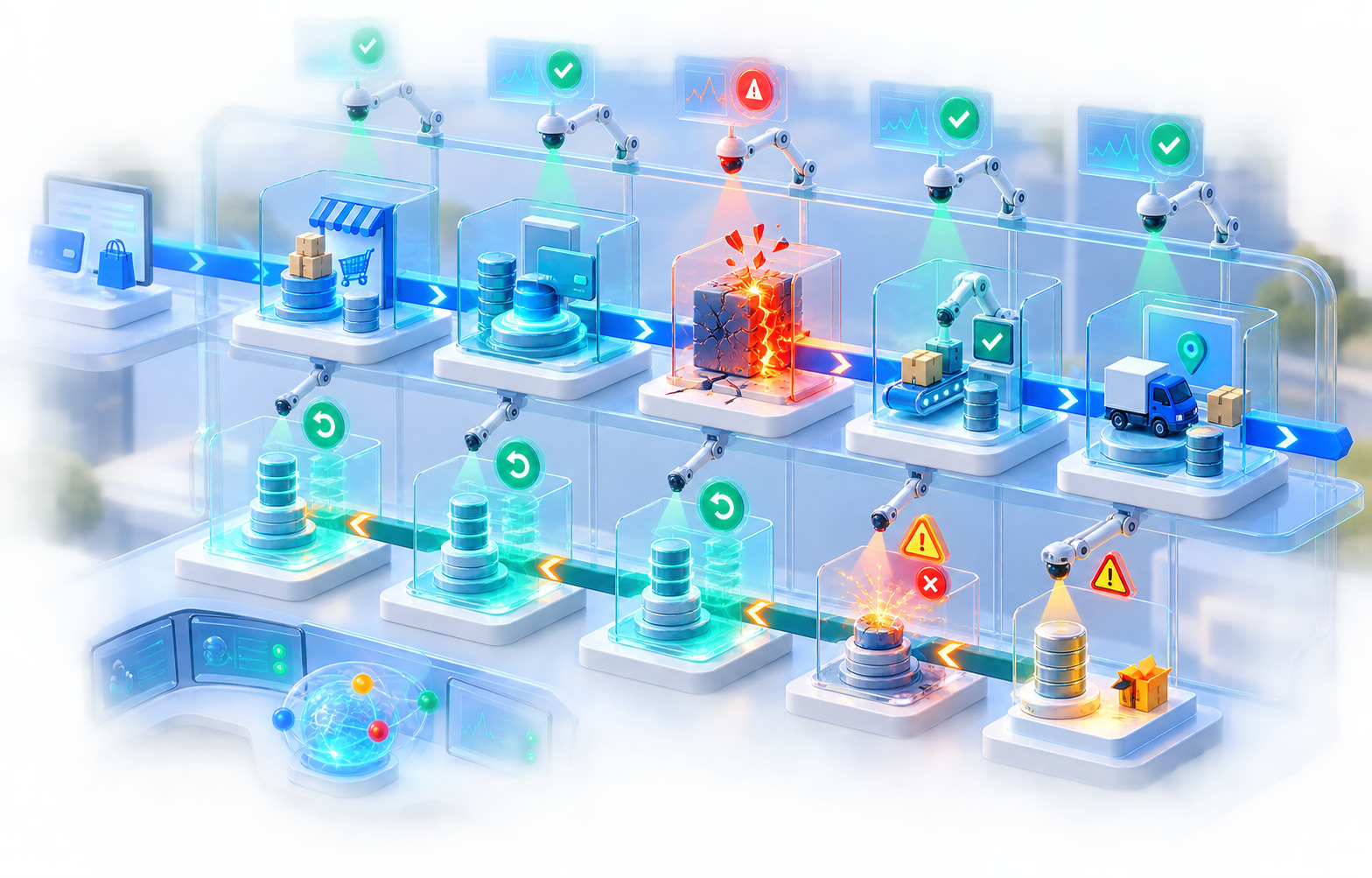
The dashboard showed three green checkmarks. The triage agent had correctly classified the ticket as a billing dispute with 91% confidence, comfortably above the 80% threshold the team had set for auto-routing. The resolution agent had generated a response, checked it against the refund policy document, and logged a policy-compliance score of "pass." The notification agent had sent the email and recorded a 200 response from the mail provider. Every component had done exactly what its own test suite said it should do. The customer received a refund for a subscription tier they had never purchased, because the triage agent's classification was built on a plan name that had been renamed in the billing system four months earlier, and nothing in the resolution agent's prompt told it to question a plan name it didn't recognize — it treated an unfamiliar string as ground truth rather than as a signal that the upstream data might be stale. Three agents, three passing internal checks, one wrong action, and by the time a human found it in a chargeback report three weeks later, sixty more tickets had passed through the same pipeline using the same stale mapping.
Nobody on the engineering team owned that failure, in the specific sense of having a name attached to a monitor that would have caught it. The triage agent's team owned the classification accuracy metric, which was fine — 91% confidence was an honest number given what the agent knew. The resolution agent's team owned policy compliance, which was also fine — the agent had, in fact, generated a response consistent with the refund policy as written, given the plan name it was told. Nobody owned the question of whether the string that crossed from the first agent to the second one still meant what the second agent assumed it meant. That question does not belong to either agent's evaluation harness. It belongs to the seam between them, and in most multi-agent systems currently in production, the seam has no owner, no test, and no monitor, because it isn't a component. It's a handoff.
This is the argument this article makes and defends in detail: as organizations move from a single AI agent performing one bounded task to pipelines where multiple agents pass work to each other — an orchestrator delegating to specialists, a triage agent routing to a resolution agent, a planning agent handing a task to a coding agent, a data-extraction agent feeding an enrichment agent — the dominant failure mode shifts. It stops being primarily "did this model produce a good response" and becomes "did the interface between two independently reasonable components silently corrupt, drop, or misinterpret something in transit." Reliability engineering for a single AI agent is a solved-enough problem that a mature discipline exists around it: evaluation suites, guardrails, staged autonomy, human-in-the-loop gates. Reliability engineering for the handoff between agents is not solved, is barely discussed outside a handful of research papers and framework documentation pages, and is the actual site of the failures that are starting to reach production incident channels as multi-agent architectures move from demos to systems of record.
The Metric Everyone Watches Isn't the Failure Mode That Actually Happens
Ask an engineering team running a multi-agent pipeline how they know it's working, and the answer is almost always some version of "we monitor each agent." Per-agent success rate. Per-agent latency. Per-agent token cost. Per-agent hallucination rate, measured against a held-out eval set. These are legitimate things to monitor, and no one should stop monitoring them. The problem is that a pipeline can show green on every one of those dashboards while producing a wrong end-to-end outcome, because none of those metrics measures the thing that actually broke: the transfer of state, intent, and confidence from one agent to the next.
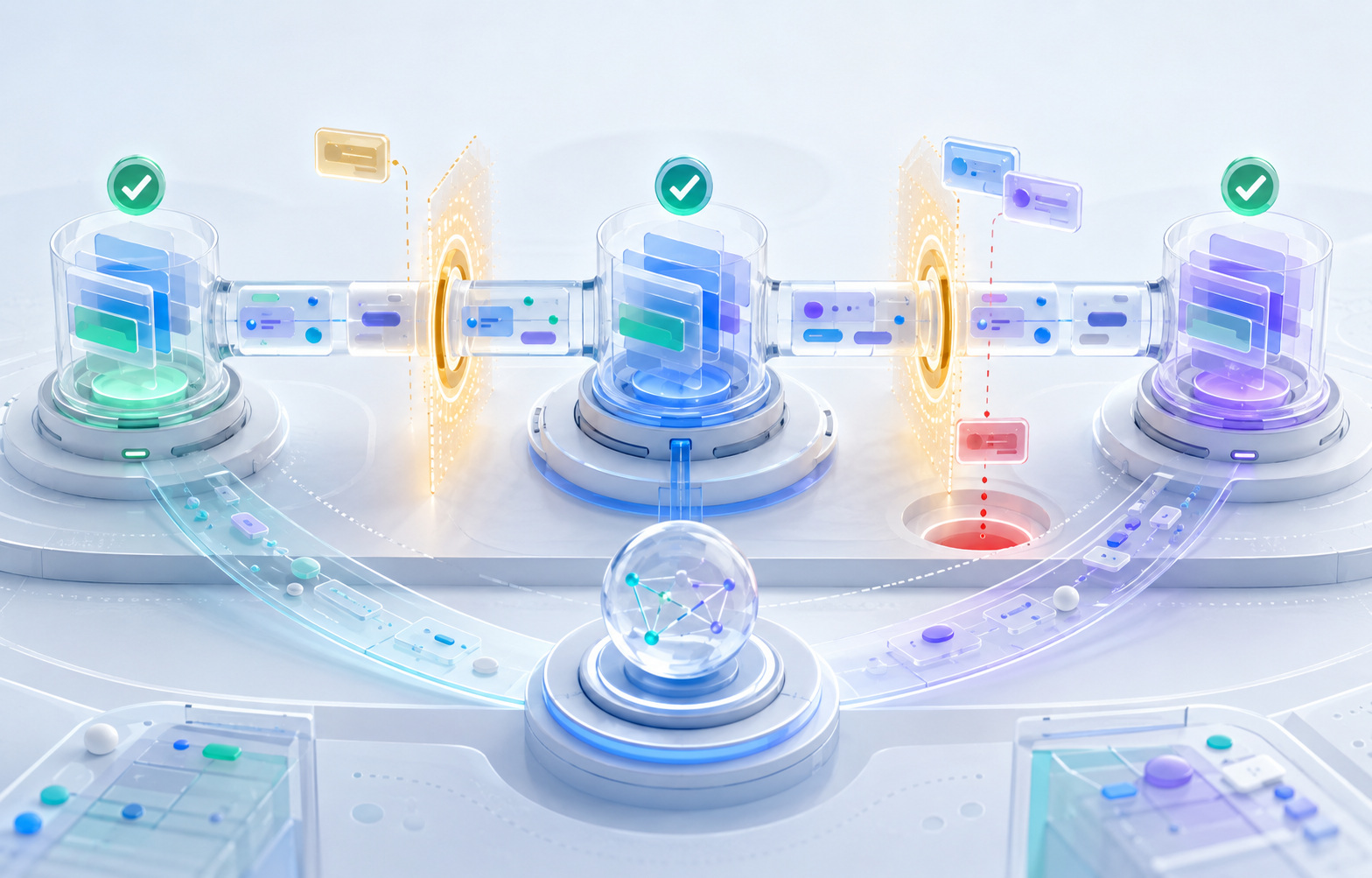
Consider the anatomy of a two-agent handoff. Agent A completes its task and produces an output — a classification, an extracted value, a plan, a draft. That output crosses a boundary and becomes Agent B's input. Between "Agent A finished" and "Agent B started," several things are true that a per-agent monitor cannot see:
Agent A's confidence in its own output does not automatically travel with the output. Most agent frameworks pass the content of a response across a handoff — a message, a structured object, a tool-call result — without a first-class, framework-enforced field for "how sure was the producing agent, and under what assumptions." A classification made at 91% confidence and a classification made at 54% confidence, if both cross the threshold that triggers a specific downstream action, look identical to the receiving agent unless someone explicitly designed the schema to carry that number and someone explicitly designed the receiving agent to condition its behavior on it. In practice, most handoffs pass the conclusion and drop the uncertainty.
Agent B has no default mechanism for distinguishing "this input came from a system that verified it" from "this input came from a system that produced its best guess." Both arrive as text or as a structured payload that satisfies the expected schema. Schema validity and semantic trustworthiness are different properties, and passing a schema check tells you nothing about the second one.
The failure, when it occurs, frequently does not look like a failure to either agent involved. Agent A did its job — it produced an output consistent with its training and its available information. Agent B did its job — it acted reasonably on the input it was given. The wrongness lives entirely in the gap, in an assumption neither agent's own logic was built to question. This is why per-agent evaluation, however rigorous, systematically under-detects this failure class: you are testing two components that each pass their own tests, and asking a different question — does the pipeline's serial composition of two locally reasonable steps produce a globally correct outcome — that neither component's test suite was designed to answer.
This is not a hypothetical concern invented for this article. A 2025 study from researchers at UC Berkeley and collaborating institutions, published as "Why Do Multi-Agent LLM Systems Fail?", analyzed traces from seven popular multi-agent frameworks across coding, math, and general agentic tasks and built a taxonomy — MAST, the Multi-Agent System Failure Taxonomy — of fourteen distinct failure modes, clustered into three categories: system design issues, inter-agent misalignment, and task verification. The paper's annotation process covered more than 150 manually reviewed traces with high inter-annotator agreement (Cohen's kappa of 0.88), expanding to a broader labeled dataset of over 1,600 traces. The framework's central finding, consistent with the argument developed here, is that a meaningful share of the failure modes it catalogs are not attributable to any single agent reasoning poorly in isolation. They occur at the coordination layer: agents talking past each other, information that one agent possessed and never surfaced to the agent that needed it, and premature or absent verification between steps. The existence of a peer-reviewed taxonomy specifically for multi-agent failure, distinct from the single-agent evaluation literature that already exists, is itself evidence that the industry has recognized this as a separate problem class. Most engineering organizations building multi-agent pipelines have not yet caught up to that recognition in how they instrument their own systems.
What a Handoff Actually Is, Mechanically
Before proposing anything about how to make handoffs more reliable, it is worth being precise about what a handoff actually consists of in the frameworks teams are using today, because the word "handoff" gets used loosely and the actual mechanisms differ in ways that matter for reliability engineering.
In LangGraph's handoff documentation, a handoff is implemented as a Command object returned by an agent node, specifying a destination node (goto) and an update to shared state. The framework explicitly warns against forwarding an agent's complete internal message history to the next agent, because "the receiving agent may become confused by irrelevant internal reasoning, and token costs increase unnecessarily" — so developers are expected to filter context deliberately, selecting which parts of Agent A's reasoning Agent B actually sees. This is a reasonable design choice for cost and clarity. It is also, mechanically, a point where information is discarded by design, which means any assumption Agent B needs but that lived only in the filtered-out portion of Agent A's reasoning is now unavailable to it, silently, unless someone specifically checked that the filter preserves what matters. LangGraph's documentation does not describe a built-in mechanism for the receiving agent to validate or reject a handoff before accepting it — the transfer completes once the Command executes.
The OpenAI Agents SDK takes a different approach: handoffs are exposed to the model as callable tools (automatically named transfer_to_<agent_name>), and the SDK supports a structured input_type — a Pydantic schema the delegating model must populate when it invokes the handoff, which can carry metadata like a reason or a priority alongside the transfer. Critically, the SDK also supports an on_handoff callback that fires when the handoff tool is invoked, before the transfer completes, giving developers an explicit point to run validation logic and raise an exception if the handoff shouldn't proceed. This is closer to a "seam with an owner" than the LangGraph pattern by default, but it is opt-in: the framework makes the hook available, it does not make validation happen automatically, and most example implementations in the wild use on_handoff for logging rather than for substantive rejection logic.
Anthropic's multi-agent orchestration documentation describes a coordinator pattern in which a lead agent delegates to specialized subagents through an agent-toolset, and each subagent runs in its own isolated session thread with its own model, system prompt, and tools. The subagents do not share context, MCP servers, or conversation history with each other by default — the coordinator is the only party with visibility across the whole delegation. The documentation is explicit that a failed or interrupted subagent consultation does not fail the coordinator's turn: the coordinator simply continues after a generic failure notice. That is a deliberate resilience choice — one flaky subagent shouldn't crash the whole pipeline — but it also means a silent partial failure is architecturally the default outcome unless the coordinator's own prompt and logic are specifically built to notice a degraded consultation and treat it differently from a successful one. The documentation does not describe built-in retry, timeout, or inter-agent verification semantics; those are left to the application layer.
Google's Agent2Agent (A2A) protocol, designed for interoperability between agents built on different frameworks or by different vendors, models work as a Task object with a defined lifecycle — states including working, input-required, auth-required, and terminal states like completed, failed, canceled, and rejected. Agents discover each other through published Agent Cards and exchange task references (taskId, contextId) rather than raw conversation history, with results retrievable through polling, streaming, or webhook push notifications. A2A's input-required state is a genuine, protocol-level mechanism for one agent to ask a human or another system for clarification mid-task, which is more disciplined than most single-framework handoff patterns. But A2A governs the transport of a task between agents that may not trust each other by default; it does not specify what either party should do with the semantic content of a task once received — that is, again, left to the implementer.
The pattern across all four of these — two of the most widely used open-source orchestration frameworks, one major vendor's managed multi-agent product, and one cross-vendor interoperability protocol — is consistent. Each defines, carefully, how control and data move between agents. None of them defines, by default, what a receiving agent should do to verify what it received before acting on it. That verification step, when it exists at all, is something a specific engineering team has to design, build, and own for their specific pipeline. The frameworks give you a phone line. They do not give you a policy for what to do when the person on the other end says something that doesn't add up.
Comparison Table 1: How Four Multi-Agent Mechanisms Handle the Handoff
| Framework / protocol | Control transfer mechanism | What crosses the boundary by default | Built-in validation or rejection before acceptance |
|---|---|---|---|
| LangGraph handoffs | Command(goto=..., update=...) returned by an agent node |
Developer-selected state and filtered message history (framework explicitly recommends filtering, not full history) | None documented; transfer completes on Command execution |
| OpenAI Agents SDK | Model-invoked transfer_to_<agent> tool call |
Structured input_type payload (developer-defined schema) plus filtered conversation history |
Optional on_handoff callback can raise an exception to block the transfer; opt-in, not default |
| Claude multi-agent orchestration (coordinator pattern) | Coordinator calls a subagent through an agent-toolset; subagent runs in an isolated session thread | Task instructions from the coordinator; subagent does not inherit coordinator's full context or other subagents' context | None documented for content verification; a failed consultation is caught structurally (doesn't crash the turn) but not semantically validated |
| Google A2A protocol | Task object with taskId/contextId, exchanged via defined API methods |
Task reference and message content per the protocol's message schema; agents discovered via Agent Cards | input-required state lets a receiving agent request clarification; explicit rejected terminal state exists, but the decision logic for when to use it is implementer-defined |
What this shows: every mechanism in production use today solves the transport problem — getting data and control from one agent to another reliably — and leaves the trust problem — deciding whether what arrived should be believed — as an exercise for the team building on top of it. Sources: LangChain handoffs documentation, OpenAI Agents SDK handoffs documentation, Claude multiagent orchestration documentation, A2A protocol specification.
Three Ways Context Dies in Transit
Understanding the mechanisms above makes it possible to name, specifically, the ways a handoff degrades information rather than treating "context loss" as a vague catch-all complaint.
Deliberate filtering that removes a load-bearing assumption. Frameworks that recommend filtering conversation history before a handoff are giving good advice for cost and clarity, but the filter is written by a developer who has to predict, in advance, every piece of context a downstream agent might need. That prediction is frequently wrong in ways that only surface under specific input conditions. A support-triage agent might reason through several candidate categories before settling on one, and the filtered handoff might pass only the final category — dropping the fact that the second-best candidate was nearly tied. A resolution agent that received both the winning category and the margin of confidence would behave differently on a near-tie than on a clear win. One that received only the winning category cannot make that distinction, because the information never crossed the seam.
Format and vocabulary drift between agents built or updated independently. In systems where different agents are owned by different teams, updated on different release schedules, or built on different underlying models, the implicit vocabulary each agent expects can drift out of sync with what the other actually sends. This is precisely what happened in the billing example that opened this article: the upstream system's plan-name field changed, nothing enforced that the downstream agent's understanding of valid plan names changed with it, and the mismatch was invisible to both agents' own testing because each one's tests used data consistent with its own current assumptions.
Confidence and provenance collapsing into a flat assertion. An agent's output typically becomes, once it crosses a handoff, an unqualified statement of fact from the receiving agent's point of view — a string, a number, a decision — stripped of the epistemic status it actually had. "I extracted this value from a clearly labeled field" and "I inferred this value because the labeled field was empty" can produce an identical downstream payload if the schema has no field for provenance. The receiving agent then applies the same level of trust to both, because nothing in what it received told it to do otherwise. This is arguably the single most consequential category, because it is the one most directly implicated in the "confident but wrong" dynamic that makes multi-agent failures hard to catch: the second agent isn't failing to notice a low-confidence input, it is being denied the information that would have let it notice.
The MAST Taxonomy, Applied to the Handoff Specifically
The MAST paper referenced earlier organizes its fourteen failure modes into three categories, and it is worth mapping those categories explicitly onto the handoff-specific argument this article is making, because the mapping clarifies which failures are addressable by better prompting and which require structural changes to how agents pass work to each other.
The first category, specification and system design issues, covers failures like unclear task assignment between agents, agents that fail to reference or use information available to them, and step repetition. In handoff terms, this is the category that includes an orchestrator delegating a task without enough specificity for the receiving agent to know what "done" looks like, or a receiving agent that had access to relevant context passed in a handoff but never actually incorporated it into its reasoning — the information crossed the seam but was effectively lost anyway because nothing forced the receiving agent to use it.
The second category, inter-agent misalignment, covers failures like agents talking past each other, working from inconsistent understandings of the shared task, or failing to ask a clarifying question when one was warranted. This maps most directly onto the handoff-quality problem: two agents can each be internally coherent and still be misaligned with each other, because coherence within one agent's reasoning says nothing about whether that reasoning is compatible with what the next agent in the chain assumes.
The third category, task verification, covers premature termination and inadequate or missing verification of intermediate or final outputs. This is the category most directly addressed by the idea of a checkpoint at the handoff itself — a deliberate, designed moment where the receiving agent (or a system component acting on its behalf) checks an incoming payload against some standard before acting on it, rather than treating arrival as equivalent to correctness.
The value of this taxonomy for an engineering team is not that it needs to be memorized. It is that it gives a vocabulary for a root-cause review after an incident that goes beyond "the model made a mistake." When a multi-agent pipeline produces a wrong outcome, the postmortem question worth asking is not only "which agent's output was wrong" but "which of these three categories does this failure belong to, and does our system have any control at all in that category, or did we simply never build one." Most teams, asked that question honestly about their own pipelines today, will find they have reasonably strong controls against category-one failures (prompt engineering and task specification get iterated on constantly) and close to nothing purpose-built against categories two and three, because those require thinking about the pipeline as a system rather than iterating on any one agent's prompt.
Hypothetical Case Study: The Silent Handoff in a Support Triage Pipeline
The following scenario is a hypothetical, illustrative example constructed for this article. It does not describe any actual QAtronic client, and the specific figures used are for illustration only.
Consider a mid-sized SaaS company that built a three-agent support pipeline: a triage agent that classifies incoming tickets and extracts structured fields (customer plan, issue category, urgency), a resolution agent that drafts a response and, for a defined set of low-risk categories, takes an action directly (issuing a credit under a fixed cap, updating a setting, resetting a password), and a QA-sampling agent that reviews a random 5% of resolved tickets after the fact and flags them for human review if something looks off.
Each agent, evaluated on its own historical accuracy, looked strong. The triage agent's classification accuracy against a labeled test set sat comfortably above the team's launch bar. The resolution agent's drafted responses, evaluated by human reviewers on a sample, were rated helpful and on-policy at a high rate. The QA-sampling agent caught a small but real number of genuinely bad resolutions and routed them for human correction, which the team pointed to as evidence the safety net was working.
The gap sat in the field the triage agent extracted as "issue category." For most tickets, this field was unambiguous — the customer said "I can't log in" and the triage agent correctly tagged it as an authentication issue. For a specific subset of tickets, the customer's language was genuinely ambiguous between two categories the team had defined with a specific business distinction in mind: "billing dispute" (which the resolution agent was authorized to resolve directly, up to a credit cap) and "billing fraud report" (which company policy required routing to a human fraud-review queue, unconditionally, regardless of dollar amount, because of downstream compliance obligations). The triage agent's own accuracy metric did not distinguish between these two categories as a special case — a misclassification between them counted the same, in the aggregate accuracy number, as any other misclassification, even though the business consequence of confusing them was categorically different from the consequence of, say, confusing "feature request" with "how-to question."
When a customer described a charge they didn't recognize using language that overlapped both categories, the triage agent's classification leaned toward "billing dispute" more often than the company's own fraud team would have, because the training signal that shaped the agent's behavior weighted overall accuracy, not the asymmetric cost of this one specific confusion. The resolution agent, receiving a ticket tagged "billing dispute," had no visibility into how close that classification was to the fraud-report boundary — the handoff carried the label, not the margin — and proceeded to resolve tickets that should have gone to the fraud queue. The QA-sampling agent's 5% random review had a real but limited chance of catching any individual instance, and nothing about its sampling was weighted toward the categories where a misclassification carried outsized consequence.
The structural lesson is not "the triage agent needed a better prompt," although that is also true and worth doing. It is that the pipeline had no component whose job was to ask a different, harder question: for this specific category boundary, given what it costs to get it wrong, what confidence margin should trigger a hold for human confirmation rather than an automatic resolution, and does the resolution agent even have access to the margin, not just the label, to make that determination possible. Building that component is a handoff-design decision, not a triage-agent-accuracy decision, and it would not show up as an improvement on the triage agent's own evaluation metric at all.
Hypothetical Case Study: The Coding-Agent Pipeline That Trusted Its Own Plan
The following scenario is a hypothetical, illustrative example constructed for this article, not a description of an actual QAtronic client or engagement.
A software team adopted a multi-agent coding pipeline structured as three stages: a planning agent that reads a feature request and an existing codebase and produces a structured implementation plan (files to change, functions to add, an outline of the approach), a coding agent that implements the plan file by file, and a test-writing agent that generates unit tests for the code the coding agent produced, based on the coding agent's diff and a summary of intended behavior.
The planning agent, working from a ticket that described a change to how discount codes stack with subscription tiers, produced a plan that made one incorrect assumption early: it assumed, based on a similarly named function elsewhere in the codebase, that discount validation happened in a particular module, when in fact that module had been deprecated eight months earlier in favor of a new pricing service, and the old module remained in the codebase only because no one had finished removing it. The planning agent's output looked complete, specific, and well-reasoned — it named real files, real function signatures, and a coherent sequence of changes. Nothing about its internal presentation signaled that its central premise rested on a stale assumption about which module actually mattered.
The coding agent received this plan as its primary input. It did not independently re-derive which module handled discount validation; its task, as scoped, was to implement the plan it was given, and the plan was specific enough that implementing it directly was the path of least resistance. It modified the deprecated module correctly, according to the plan's instructions, producing a clean diff against a part of the codebase that no live request path actually touched anymore.
The test-writing agent, working from the coding agent's diff and the planning agent's stated intent, wrote thorough, well-structured unit tests for the modified deprecated module. Those tests passed. Every stage of the pipeline had done a competent job of the specific, narrow task it was assigned. The pull request that emerged looked, to a human reviewer skimming a green test suite and a coherent diff, like reasonable, complete work. The discount-stacking bug the original ticket was meant to fix remained present in the live pricing service, untouched, and was only discovered when a customer support ticket about an unexpected discount combination arrived weeks later.
The failure here is not that any agent hallucinated in the sense of inventing something nonexistent — the deprecated module was real, its function signatures were real, the tests genuinely tested the code that was written. The failure is that an assumption embedded in the first agent's output (this module is the relevant one) was passed to the second and third agents as settled fact rather than as a claim with a specific, checkable basis, and no stage in the pipeline had a mechanism for verifying that assumption against a source of truth — a routing table, a service registry, a "last modified" or "deprecated" flag on the module — that would have caught it immediately. A human engineer with the same task might have made the same initial assumption, but would likely have noticed, while opening the file, that its imports referenced a payment gateway retired from the current architecture, and paused. The coding agent had no equivalent instinct to pause on a signal like that, because pausing on an unprompted contextual anomaly is not what "implement this plan" as a task specification asks for, and nothing in the handoff from planning agent to coding agent carried a field for "verify this assumption before proceeding" — because the planning agent did not represent its module choice as an assumption at all. It represented it as a fact.
Hypothetical Case Study: The Retry Storm in a Data-Enrichment Chain
The following scenario is a hypothetical, illustrative example constructed for this article, not a description of an actual QAtronic client or engagement.
An e-commerce company built a four-stage agent chain to process new supplier product feeds: an extraction agent that parsed incoming feed files into a normalized schema, an enrichment agent that called external APIs and an internal catalog service to fill in missing attributes (category, weight class, compliance flags), a deduplication agent that checked new entries against the existing catalog for near-duplicates, and a publishing agent that pushed approved entries live.
The enrichment agent depended on a third-party classification API that, under normal conditions, responded within a few hundred milliseconds. During a partial outage at the third-party provider, response times degraded to several seconds, with an elevated but non-total error rate. The enrichment agent's own retry logic, reasonably designed for its own scope, retried failed calls up to three times with a short backoff before giving up and passing the item downstream with a null enrichment result and an error flag.
The orchestrating layer above the four agents, however, had a separate, coarser-grained retry policy applied at the pipeline level: if the overall pipeline run for a batch did not complete within a defined time budget, the orchestrator would retry the entire batch from the extraction stage. This was a sensible-looking safeguard against a hung pipeline, designed by a different engineer, at a different time, for a different failure scenario (an actual crash, not a slow-but-functioning downstream dependency). During the third-party outage, individual items were succeeding, just slowly, which meant the pipeline as a whole was crossing the time budget without any single component reporting a hard failure. The orchestrator's retry fired, restarting the batch from extraction while the original run's items were still mid-flight through enrichment and deduplication.
The result was that a meaningful subset of products were processed twice, concurrently, by two overlapping pipeline runs, each unaware of the other. The deduplication agent, designed to catch near-duplicate products, had no logic for detecting that it was looking at two in-flight runs of the same batch — from its point of view, it was correctly comparing new entries against the existing catalog, and the other in-flight run's entries were not yet in the catalog to compare against. The publishing agent, receiving approved entries from both runs, published some products twice, with two different listing IDs, at two slightly different enriched attribute sets depending on which of the two enrichment attempts happened to complete with valid data versus a null fallback. The company's catalog ended up with duplicate listings at inconsistent quality for a subset of one supplier's feed, discovered only when the supplier's account manager noticed duplicate SKUs in a routine data audit.
This case illustrates a failure mode distinct from the first two: it is not about a semantic misunderstanding crossing a handoff, it is about retry and timeout semantics defined independently at two different layers of the same pipeline — one component-level, one orchestrator-level — interacting in a way neither designer anticipated, because neither had visibility into the other's retry policy. This is a pattern familiar to anyone who has debugged distributed systems generally: retries without idempotency guarantees, and without a shared understanding across layers of what "this unit of work is still in progress" means, produce duplicate side effects under exactly the conditions — partial, non-crashing degradation — that are hardest to catch in isolated component testing and most likely to occur in production.
Why "Each Agent Passed Its Own Eval" Is Not the Evidence It Looks Like
The three cases above share a structural feature worth naming directly: in each one, if you had pulled up the relevant agent's own evaluation dashboard on the day of the incident, it would have shown nothing alarming. This is not a coincidence, and it is not a claim that per-agent evaluation is worthless — it catches an enormous and important category of problems, and no team should stop doing it. It is a claim that per-agent evaluation, by construction, measures a component's behavior against inputs and expectations defined at the component's boundary, and a handoff failure is defined by a mismatch that exists outside that boundary, between what one component assumes and what another component actually needs.
There is a useful analogy to integration testing in traditional software, with one important difference that makes the agent case harder. In a conventional service architecture, the contract between two services is usually explicit and machine-checkable: an API schema, a set of required fields, a version number. A schema-validation test can catch a large share of integration failures before they reach production, because "does this payload conform to the contract" is a binary, automatable question. In a multi-agent AI pipeline, the "contract" between two agents is frequently semantic rather than structural — the receiving agent needs the transferred content to mean what the sending agent intended, not merely to arrive in the right JSON shape. A payload can pass every schema check and still be semantically stale, ambiguous, or built on a false premise, exactly as in the coding-agent case above, where the plan's file references were syntactically perfect and semantically wrong. Schema validation, which most teams already do reasonably well because it's a familiar, well-tooled problem, catches none of that. Semantic handoff validation is a different discipline, requires different tooling, and almost no team building multi-agent pipelines today has invested in it to the same degree they've invested in prompt quality or per-agent accuracy.
The practical consequence for engineering leadership is that "we have eval suites for all our agents" is evidence about component quality, not about pipeline reliability, and treating it as the latter is where the confidence gap between the dashboard and the actual production outcome comes from. A useful diagnostic question for any multi-agent system already in production: pick the last three incidents involving the pipeline, and for each one, ask whether the relevant agent's own evaluation metrics would have flagged it in advance. If the honest answer across all three is no, the team's evaluation investment is concentrated at the wrong layer relative to where its actual production risk lives.
The Accountability Gap: Who Owns the Seam Between Agent A and Agent B
Every one of the three hypothetical cases above, if brought to a postmortem, would surface an uncomfortable organizational question before it surfaces a technical one: whose job was it to catch this? In a single-agent system, the answer is usually clear enough — the team that owns the agent owns its failures, the same way a team that owns a service owns that service's bugs. In a multi-agent pipeline built by more than one team, or even by one team wearing different hats across different sprints, the handoff itself frequently has no owner, because it isn't a component that appears on anyone's team roadmap. It's the space between two components that do.
This is a familiar organizational pattern outside AI systems — the classic "it's not my API's problem, it's the caller's problem to validate what it receives" dynamic that shows up whenever two teams own adjacent services. The reason it is more acute in multi-agent AI pipelines than in conventional microservice architectures is twofold. First, the semantic-versus-structural contract problem described above means the traditional fix — a strict, versioned schema with a contract test — only partially applies, because so much of what needs validating is meaning, not shape. Second, multi-agent pipelines are frequently built faster and with less organizational process than conventional service integrations, precisely because agent frameworks make it easy to wire one agent's output into another agent's input with a few lines of orchestration code, which is a genuine engineering benefit and also means the deliberate contract-design conversation that a traditional service integration would force through an API review process often just doesn't happen.
Comparison Table 2: Ownership Models for the Handoff, and Their Failure Signature
| Ownership model | How it typically arises | What it catches | What it systematically misses |
|---|---|---|---|
| No explicit owner (default) | Pipeline was assembled quickly by whichever team needed it first; each agent has an owner, the transitions do not | Whatever each individual agent's own tests happen to catch | Any failure that requires understanding both sides of a handoff simultaneously; these surface only via downstream symptoms (customer complaints, chargebacks, audit findings) |
| Owned by the downstream agent's team ("validate what you receive") | Informal convention, sometimes stated explicitly, that the receiving component is responsible for sanity-checking its inputs | Structural/schema mismatches; some semantic issues if the downstream team happens to know the upstream domain well | Semantic issues specific to the upstream agent's domain that the downstream team has no visibility into (as in the billing-plan-rename case) |
| Owned by the upstream agent's team ("guarantee what you send") | Less common in practice; requires the sending team to anticipate every downstream consumer's needs | Cases where the upstream team has strong incentives to get this right (e.g., regulatory data) | Cases where the upstream team doesn't know how the output will actually be used downstream, or where a new downstream consumer is added later without the upstream team's awareness |
| Owned by a platform/orchestration team, as a first-class responsibility | Deliberate organizational design decision, typically made after at least one handoff-related incident | Cross-cutting issues: retry/timeout interaction (as in the retry-storm case), confidence/provenance propagation, tracing across the whole chain | Requires investment and a team with cross-pipeline authority; does not scale to organizations with dozens of independently built pipelines without a defined contract standard |
What this shows: the most common default — no explicit owner — is also the one that catches the least, and the model most capable of catching cross-cutting failures (a dedicated platform-level owner) is also the one requiring the most deliberate organizational investment, which is precisely why most teams don't have it until after an incident forces the question.
The practical recommendation is not that every organization needs a dedicated "handoff platform team" — for a two-agent pipeline built and maintained by one team, that would be organizational overkill. The recommendation is narrower: for any handoff between agents whose failure would have a real business consequence (financial action, customer-facing communication, an irreversible write, a compliance-relevant classification), someone specific needs to be able to answer, without hesitation, "if this handoff silently corrupted or misrepresented the data crossing it, who would notice, and how." If the honest answer is "no one, until a customer complains," that handoff has no owner regardless of what the org chart says, and it should be treated as an open risk rather than an implicit acceptable one.
Illustrative Scenario: Where Errors Enter a Pipeline Versus Where They're Caught
The following table presents a hypothetical, illustrative scenario constructed to demonstrate a pattern this article argues is common in multi-agent pipelines. The figures are not derived from real production data or a published industry benchmark; they are a plausible, labeled example for the purpose of discussion.
Consider a hypothetical four-stage pipeline (extraction → enrichment → verification → action) processing 1,000 hypothetical work items, where an error is introduced at some stage and the pipeline either catches it at a later stage, catches it via an external signal after the action stage (a human complaint, an audit, a chargeback), or never catches it within the observed period.
Illustrative Chart 1: Hypothetical Distribution of Where Errors Originate vs. Where They Are Detected
| Pipeline stage | Errors originating at this stage (hypothetical, per 1,000 items) | Of those, caught by the next agent in the pipeline | Of those, caught only by an external signal after the action stage | Of those, undetected within the observed period |
|---|---|---|---|---|
| Extraction | 40 | 22 (55%) | 12 (30%) | 6 (15%) |
| Enrichment | 65 | 18 (28%) | 35 (54%) | 12 (18%) |
| Verification | 15 | 9 (60%) | 4 (27%) | 2 (13%) |
| Action (execution logic itself) | 10 | — (no downstream agent stage) | 8 (80%) | 2 (20%) |
| Total | 130 | 49 (38%) | 59 (45%) | 22 (17%) |
What this illustrates: in this hypothetical scenario, errors introduced earlier in the pipeline (extraction) are caught by an adjacent agent more often than errors introduced in the middle (enrichment), because enrichment errors tend to look like plausible, well-formed data to the next stage rather than obviously malformed input — they pass structural checks and fail only on meaning. This is consistent with the argument that semantic handoff failures are harder to catch locally than structural ones, and that a meaningful share of total errors (45% in this illustrative scenario) are caught only after the pipeline has already taken an action, via an external signal rather than an internal one. These numbers are illustrative only and are not a claim about any specific real system's actual error distribution.
The pattern this hypothetical table is built to illustrate — that errors originating mid-pipeline, in a stage that produces well-formed but semantically compromised output, are disproportionately likely to reach the action stage before being caught — is the mechanistic reason handoff-specific monitoring earns its cost. A monitor placed only at the very end of the pipeline (did the final action succeed or fail, structurally) will not distinguish a genuinely correct action from a confidently wrong one built on a corrupted middle stage. A monitor placed at each handoff, specifically checking the assumptions the next stage is about to rely on, catches the failure closer to its source, when the fix is cheaper and the blast radius is smaller.
Designing a Handoff Contract: A Practical Framework
The single highest-leverage intervention available to a team building a multi-agent pipeline is to stop treating the interface between two agents as an implicit detail of the orchestration code and start treating it as a designed contract, analogous to how a mature engineering organization treats an API contract between two services — with the adjustment that, per the discussion above, part of what the contract needs to specify is semantic, not just structural.
A handoff contract, at minimum, should make five things explicit, in the schema itself, not merely in a comment or a design doc that lives elsewhere:
The payload schema, as with any API — required fields, types, and validity constraints. This is the part every team already does reasonably well, because it maps directly onto tooling they already understand from conventional software.
A confidence or certainty signal, carried as a first-class field rather than left implicit in the prose of a message. This does not need to be a single universal number — for a classification task it might be a probability; for an extraction task it might be a flag distinguishing "found in a labeled source field" from "inferred from context"; for a plan produced by a reasoning agent it might be an explicit list of assumptions the plan depends on. The specific shape matters less than the discipline of making the receiving agent's downstream behavior conditional on it, rather than treating every arriving payload as equally trustworthy.
Provenance, meaning enough information for the receiving agent (or a human reviewing the chain later) to trace a given field back to its source without having to reconstruct it from logs after the fact. In the billing-plan case, a provenance field on the extracted plan name — which upstream system it came from, and when that data was last refreshed — would have made the staleness visible to anyone who thought to check, rather than requiring an incident investigation to surface it.
Timeout and retry semantics scoped to the handoff specifically, not only to the individual agent's own external calls. As the retry-storm case illustrates, the dangerous failures often occur at the interaction between a component-level retry policy and an orchestrator-level retry policy that were each individually reasonable and jointly incompatible. A handoff contract should specify what "this unit of work is still in progress" means in a way visible to every layer that might otherwise decide to retry it, and every action with a real-world side effect (a write, a charge, a send) should carry an idempotency key that survives a retry at any layer, so that a duplicate attempt is a no-op rather than a duplicate action.
An explicit escalation condition, defining under what conditions the handoff should not proceed automatically at all, and should instead route to a human or to a different, more conservative path. This is the field most commonly missing entirely from real implementations, because it requires the team to have already done the harder work of deciding, in advance and in the calm of a design conversation rather than in the middle of an incident, what "this is not safe enough to proceed on autopilot" actually looks like for this specific pipeline.
Practical Checklist: Before You Wire Agent A's Output Into Agent B's Input
Use this checklist at design time for any new handoff between agents, and again as a retrospective audit for handoffs already in production.
- Schema. Is there a defined, validated schema for what crosses this handoff, checked automatically rather than assumed?
- Confidence carries over. Does the payload include the producing agent's confidence, or an equivalent uncertainty signal, rather than only its conclusion?
- Provenance is traceable. Can a human or an automated auditor determine, from the payload alone, where each critical field came from and how current it is?
- The receiving agent is told what to distrust. Has anyone explicitly defined which fields the receiving agent should treat as verified fact versus as an unverified claim to be checked before acting on it?
- A verification step exists somewhere, for the highest-consequence outputs. Not every field needs independent verification, but for the subset of outputs that trigger an irreversible or costly action, does something — a rule check, a second agent, a human — verify the claim before it is acted on, rather than trusting it on arrival?
- Retry and timeout semantics are defined at the handoff level, not only within each agent. Does everyone touching this pipeline, across every layer, share the same understanding of what "in progress" means, and does every side-effecting action carry an idempotency key?
- There is a named escalation condition. Is there an explicit, testable condition under which this handoff routes to a human instead of proceeding automatically, and has that condition actually been exercised in testing, not just described in a document?
- Someone specific owns this handoff. If this specific transfer silently corrupted or misrepresented data, is there a named person or team who would be expected to notice, and a monitor that would actually notify them?
- The handoff is observable end to end. Can a single trace ID follow a unit of work across every agent it passes through, so a postmortem does not require manually correlating logs from three separately owned systems?
- The contract has a version, and a plan for what happens when one side changes. If the upstream agent's output format or vocabulary changes, is there a mechanism — a version field, a contract test, a deprecation window — that surfaces the change to the downstream side, rather than relying on the downstream team noticing on their own, the way the billing-plan-rename case did not?
A pipeline that can answer all ten of these affirmatively is not immune to failure, but it has moved the handoff from an implicit, invisible detail of the orchestration code to a designed, owned, monitored component of the system, which is the actual shift this article is arguing for.
Timeout, Retry, and Idempotency: The Distributed-Systems Discipline Multi-Agent Pipelines Still Need
It is worth dwelling further on the retry and timeout dimension specifically, because it is the one most likely to be underestimated by teams that think of multi-agent reliability primarily as a prompting or evaluation problem, when in fact a significant share of it is a conventional distributed-systems problem that agent frameworks have not solved for you, and in some cases have made easier to get wrong by making retries so easy to add.
An LLM call inside an agent is, from a systems perspective, an external dependency with variable latency, a non-trivial error rate, and — critically — a cost model where retrying is often not free even when it succeeds, because a partially executed action might have already had a side effect before the failure that triggered the retry. A resolution agent that calls a refund API, receives a timeout before confirming success, and is retried by an orchestrator that assumes "timeout equals failure" may issue the refund twice if the original call actually succeeded server-side and only the confirmation was lost. This is not a novel problem — it is the exact class of problem idempotency keys were invented to solve in conventional distributed systems, and payment APIs in particular have supported idempotency keys for this reason for years. The novelty in the multi-agent case is that the decision to retry frequently happens at a layer — an orchestrator, a supervisor agent, a workflow engine — that has no visibility into whether the underlying action was genuinely idempotent, and the agent making the call frequently has no visibility into whether it is being retried by a layer above it, which means neither party alone has enough information to reason correctly about safety.
The practical discipline required is not exotic, but it does require deliberate design rather than default framework behavior: every action with an external side effect needs an idempotency key generated once, at the point the intent to act is first formed, and carried through every retry at every layer, so that a duplicate attempt with the same key is recognized and no-op'd by the receiving system rather than re-executed. Timeout values need to be set with an understanding of what "no response yet" actually means for the specific call — for many LLM-backed agent steps, a slow response is far more likely than an outright failure, and a timeout tuned for a traditional low-latency API call will trigger retries during ordinary load variance, which is close to what happened in the hypothetical retry-storm case. And retry policies defined at different layers of the same pipeline need to be reviewed together, not independently, specifically to check for the kind of interaction where a component-level retry and an orchestrator-level retry can both fire for the same underlying delay, multiplying the effective retry rate in a way neither policy's designer intended.
Observability Across the Chain, Not Per Agent
A recurring theme in every case discussed so far is that the failure was invisible to any single agent's own logs and became visible only through an external signal — a chargeback, a customer complaint, a supplier audit — well after the fact. This is an observability gap, and it is worth being specific about what closing it actually requires, because "add more logging" is not a sufficient answer.
Per-agent logging, however thorough, answers the question "what did this agent do." It does not, by itself, answer "what happened to this specific unit of work as it moved through the whole pipeline," because that requires correlating logs across systems that were frequently built by different teams, at different times, with different logging conventions, and no shared identifier. The fix is a trace ID (or an equivalent correlation identifier) generated once, when a unit of work enters the pipeline, and propagated through every agent and every handoff it passes through, so that a single query can reconstruct the full path an item took — which agent touched it, what each agent produced, what confidence and provenance data accompanied each step, and where, if anywhere, the path diverged from the expected sequence.
This is not a novel idea in distributed systems generally — it is standard practice in conventional microservice architectures, where distributed tracing has been a mature discipline for well over a decade. What is newer is extending the same discipline specifically to AI agent invocations and the handoffs between them, which is precisely the gap the OpenTelemetry project's GenAI semantic conventions work is attempting to standardize — defining common span, metric, and event conventions for generative AI clients and agent operations so that tracing tooling built for conventional services can be extended to cover agent invocations and tool calls in a consistent way, rather than every team inventing its own ad hoc logging schema for agent behavior. The existence of this standardization effort is itself a signal that the industry recognizes cross-agent observability as a distinct, unsolved-enough problem to warrant a dedicated specification, rather than something existing service-level tracing tools already handle by default.
For a team without the resources to adopt a full distributed-tracing stack immediately, the minimum viable version of the same idea is achievable without new tooling: generate a correlation ID at pipeline entry, include it in every log line and every payload passed at every handoff, and build one dashboard or query that can pull the full sequence for a given ID on demand. The specific tooling matters far less than the discipline of making "reconstruct this item's path through the whole pipeline" something that takes minutes rather than a cross-team log-correlation exercise that takes days, because the second version of that capability effectively means it doesn't exist for the purposes of catching a fast-moving incident.
Human Escalation Points: Placing Them Where They Actually Do Something
Most multi-agent pipelines that have any human-in-the-loop step at all place it at the edges — a human reviews the final output before it goes external, or a human handles anything the system couldn't classify at all. Both are reasonable, and neither is sufficient on its own, because both are blind to the specific failure pattern this article has been describing: a wrong outcome built from individually plausible intermediate steps, where the final output looks entirely normal and the classification succeeded cleanly, just on a false premise. A human reviewing only the final output is reviewing exactly the artifact that was engineered, unintentionally, to look correct.
The more useful design principle is to place escalation points at the specific handoffs where the cost of being wrong and the difficulty of detecting wrongness downstream are both high simultaneously — not at every handoff, which would erase the efficiency the pipeline exists to provide, and not only at the pipeline's boundary, which misses the interior failures this article has focused on.
Comparison Table 3: A Decision Matrix for Where to Place a Human Checkpoint
| Handoff characteristic | Cost of a wrong outcome is low | Cost of a wrong outcome is high |
|---|---|---|
| Downstream stages are likely to catch an error (structural mismatch, obviously malformed data, a later agent whose task naturally cross-checks the claim) | No dedicated checkpoint needed; rely on the pipeline's existing structure | Add an automated verification rule at the handoff if one is feasible (a database lookup, a rules check); reserve human review for cases the automated check can't resolve |
| Downstream stages are unlikely to catch an error (semantically plausible but wrong output, as in the enrichment and planning-agent cases discussed above) | Log and sample-review after the fact; not worth blocking the pipeline in real time | This is the highest-priority zone for a real-time human or automated-verification checkpoint before the handoff proceeds; this is where the billing-plan, coding-plan, and retry-storm cases in this article all sit |
What this shows: the two-by-two that actually matters is not "is this handoff risky" in the abstract, but the combination of consequence and detectability. The costliest blind spot is the bottom-right cell — high cost, low downstream detectability — precisely because it is the cell least likely to be caught by any control the team already has, since neither the pipeline's own structure nor a human reviewing the polished final output will reliably surface it.
Escalation points designed this way earn their cost, because they are placed specifically where the pipeline is structurally blind rather than scattered uniformly across every step out of general caution — a design that both catches more of the failures that matter and avoids the alert fatigue and throughput cost of a human reviewing every single handoff regardless of its actual risk profile. A useful test for whether an existing escalation point is theater rather than a real control: ask when it last actually fired, on a real case, and changed the outcome. A human-review step that has approved one hundred consecutive items without a single rejection is either evidence of a genuinely well-functioning upstream pipeline or evidence that the human reviewer has, understandably, started rubber-stamping a queue that never seems to need correcting — and those two explanations require very different responses.
Startups, Scale-Ups, and Enterprises Face This Differently
The reliability discipline described throughout this article scales in cost roughly with the number and criticality of a system's handoffs, and the right level of investment differs meaningfully by organizational stage, which is worth stating plainly rather than implying that every team needs the full version of everything described above immediately.
A startup running a two- or three-agent pipeline, built and maintained by a small team that can hold the whole system in their heads, faces less structural risk from the ownership-gap problem specifically — when one team owns every agent in the chain, the "who owns the seam" question has an obvious default answer, even if no one has written it down. The higher-leverage investment at this stage is usually the handoff contract discipline (confidence, provenance, and escalation conditions defined explicitly) and basic end-to-end traceability, both of which are cheap to build in from the start and expensive to retrofit later, rather than the full observability-platform investment, which is premature at this scale.
A scale-up, where the pipeline has grown to include agents owned by different teams, or where the number of pipelines has grown enough that no single person can reason about all of them, is where the ownership-gap problem becomes acute and where the absence of a deliberate answer to "who owns this handoff" starts producing exactly the kind of postmortem described at the start of this article — a wrong outcome, three green dashboards, and an uncomfortable meeting about whose job it was to catch it. This is the stage at which a lightweight, mandatory handoff-contract standard (even an internal one, not a formal specification) tends to pay for itself, because it forces the ownership question into a design review rather than leaving it to be discovered during an incident.
An enterprise, typically running many multi-agent pipelines across different business units, faces the same problems at a scale where ad hoc solutions per pipeline become genuinely unsustainable, and where the case for a shared platform-level investment — standardized tracing, a common handoff-contract schema, a central registry of what agents exist and what they're authorized to hand off to — becomes strong specifically because the marginal cost of building that capability once, centrally, is far lower than the aggregate cost of every team solving it independently, inconsistently, or not at all. The risk at this stage is usually not underinvestment in any one pipeline, but inconsistency across dozens of them, where the handoff discipline in the pipeline that happened to have a senior engineer who cared about this is far more mature than the handoff discipline in the pipeline that shipped fast under deadline pressure and never got revisited.
What to Ask Before Adding the Next Agent to an Existing Chain
Multi-agent pipelines tend to grow by accretion — a new specialized agent gets added to handle a case the existing pipeline couldn't, a new stage gets inserted to add a capability, an existing agent gets split into two more focused ones for better performance. Each individual addition usually looks locally reasonable and gets evaluated on whether the new agent itself performs well. The handoffs created by the addition — both the new one directly connecting to the new agent, and any existing ones whose behavior changes because the pipeline's shape changed — are rarely evaluated with the same rigor as the new agent's own accuracy, which is precisely how pipelines accumulate the kind of invisible risk this article has been describing, one reasonable-looking addition at a time.
Before adding a new agent to an existing chain, it is worth asking explicitly: what does the new agent assume is true about the data it will receive, and has anyone verified that the upstream agent's output actually guarantees that assumption, rather than merely happening to satisfy it in the test cases used during development? Does the new agent change the effective retry or timeout behavior of the pipeline as a whole, even if its own retry logic is scoped narrowly to itself? Does inserting this agent change which stage is now the last one before an irreversible action, and if so, has the escalation-point design been revisited, or does it still reflect the pipeline's shape before this agent existed? These questions take a fraction of the time the new agent's own development took, and they are the questions most likely to be skipped under the normal pressure of shipping a capability the business is waiting on.
Frequently Asked Questions
Is this just a testing problem, solvable by writing more integration tests for the pipeline? Integration testing helps, and most pipelines have too little of it, but it is not sufficient on its own because a handoff failure is frequently not something a fixed set of test cases will reproduce — it depends on real-world drift (a renamed field, a deprecated module, a load-induced timing condition) that a test suite written against today's assumptions cannot anticipate. Testing catches known failure shapes reliably. Handoff reliability additionally requires runtime controls — confidence propagation, provenance, escalation conditions — that operate on inputs the test suite never saw, which is a different and complementary discipline from pre-deployment testing.
Does using a single vendor's managed multi-agent product (rather than assembling open-source frameworks) solve this problem for us? It removes some of the transport-layer engineering burden — session isolation, message routing, tool invocation — but, based on the current documentation for offerings like Claude's coordinator pattern, it does not remove the semantic validation burden. The receiving agent still needs an application-layer mechanism to distinguish a verified claim from an unverified one, and that remains the implementing team's responsibility regardless of which orchestration layer sits underneath it.
How is this different from the well-known problem of LLM hallucination? Hallucination describes a model generating content not grounded in its actual input or training. The handoff failures described in this article can occur with zero hallucination in the traditional sense — every agent involved can be responding faithfully and reasonably to the input it was actually given. The failure is that the input itself, though faithfully processed, was stale, incomplete, or missing a qualifier that changed its correct interpretation. Treating this purely as a hallucination-mitigation problem misdiagnoses it and leads teams to invest in the wrong fix (better grounding for individual agents) instead of the actual gap (verification and provenance at the handoff).
Our pipeline has run for months without an incident like the ones described. Does that mean our handoffs are fine? Not necessarily, and this is worth taking seriously rather than as rhetorical caution: the failure modes described here are disproportionately likely to occur under conditions that are rare by definition — an upstream data change, a partial outage, an edge-case input near a category boundary — which means an absence of incidents over a period without any of those conditions occurring is weak evidence of resilience, not strong evidence of it. The relevant test is not "has this broken yet" but "if the specific triggering condition occurred tomorrow, is there a control that would catch it before it reached a customer."
Should every multi-agent pipeline have a human in the loop at every handoff? No — that would eliminate most of the efficiency benefit the pipeline exists to provide, and it also does not scale as a review discipline; a human reviewing every single item at every stage tends toward rubber-stamping rather than genuine scrutiny. The more effective approach, developed earlier in this article, is placing escalation points specifically at handoffs where consequence is high and downstream detectability is low, rather than distributing review effort uniformly.
We're a small team. Is a formal handoff contract, with all ten checklist items, realistic for us right now? Prioritize based on consequence, not completeness. For a low-stakes internal pipeline, the schema and basic traceability items matter most and are cheap. For any handoff touching money, customer communication, or an irreversible action, the confidence, provenance, and escalation-condition items are worth the design time even for a two-person team, because the cost of skipping them is not proportional to team size — it is proportional to what the pipeline is authorized to do.
How QAtronic Approaches This
Teams building multi-agent pipelines are usually well equipped to evaluate each agent's own output quality, because that discipline overlaps heavily with conventional model evaluation practice their teams already understand. They are far less commonly equipped to design and monitor the handoffs between agents as a distinct engineering surface — defining what confidence and provenance data should travel with a payload, building verification checkpoints at the specific junctures where consequence is high and downstream detectability is low, and instrumenting a pipeline so a single unit of work's path through multiple agents can be reconstructed in minutes rather than reconstructed manually after an incident. QAtronic works with engineering teams on exactly that layer: reviewing an existing multi-agent architecture for where handoff contracts are implicit rather than designed, building the test scenarios that exercise cross-agent failure patterns rather than only single-agent accuracy, and helping define the escalation and observability standards a specific pipeline's risk profile actually warrants, scoped to what the system does rather than applied as a generic template.
The Question to Take Back to Your Team
The distinction this article has argued for is specific enough to act on directly: a multi-agent AI system is not reliable because each of its agents is reliable, in the same way a relay race is not fast because each runner is fast — the baton pass is a distinct event with its own failure modes, and a team that only trains its runners has not trained for the race. Every agent in a production pipeline can be performing exactly as designed, passing every evaluation built for it, and the pipeline can still produce a wrong, sometimes costly, outcome, because the wrongness lives in an assumption that crossed a boundary unexamined.
The next time a multi-agent pipeline is proposed, expanded, or reviewed inside your organization, the question worth asking is not limited to whether each new agent performs well on its own task. It is whether there is a named person who owns each handoff in the chain, whether that person could answer, without hesitation, how they would find out if the handoff silently misrepresented something, and whether anyone has actually tried to make that happen on purpose, in a controlled way, before a customer, an auditor, or a chargeback found out for them.
Sources and Further Reading
- Cemri, M., et al. "Why Do Multi-Agent LLM Systems Fail?" — arXiv preprint, 2503.13657. Introduces MAST, the Multi-Agent System Failure Taxonomy, based on analysis of traces from seven multi-agent frameworks across coding, math, and general agentic tasks.
- LangChain. "Handoffs" — LangGraph multi-agent documentation. Describes the
Command-based control-transfer mechanism and guidance on filtering context during a handoff. - OpenAI. "Handoffs" — OpenAI Agents SDK documentation. Describes the
transfer_to_<agent>tool pattern, structuredinput_typeschemas, input filters, and theon_handoffvalidation callback. - Anthropic. "Multiagent orchestration" — Claude Platform documentation. Describes the coordinator/subagent pattern, session-thread isolation, and consultation-failure handling.
- Google / A2A Project. "Agent2Agent (A2A) Protocol Specification". Defines the task lifecycle, Agent Card discovery, and status states including
input-requiredandrejectedfor cross-vendor agent interoperability. - Google Developers Blog. "Announcing the Agent2Agent Protocol (A2A)". Overview of the A2A protocol's origin and goals.
- OpenTelemetry. "Semantic Conventions for Generative AI". Standardization effort for tracing, metrics, and events covering GenAI clients, MCP, and agent operations.
- QAtronic. "Your AI Agent Passed Every Eval and Still Took the Wrong Action in Production" — related QAtronic article addressing single-agent action safety and staged autonomy, a distinct problem from the multi-agent coordination failures addressed in this article.
- QAtronic. "MCP Server Testing: The Integration Risk No One Owns" — related QAtronic article addressing tool-integration protocol risk, a distinct problem from agent-to-agent handoff design addressed in this article.