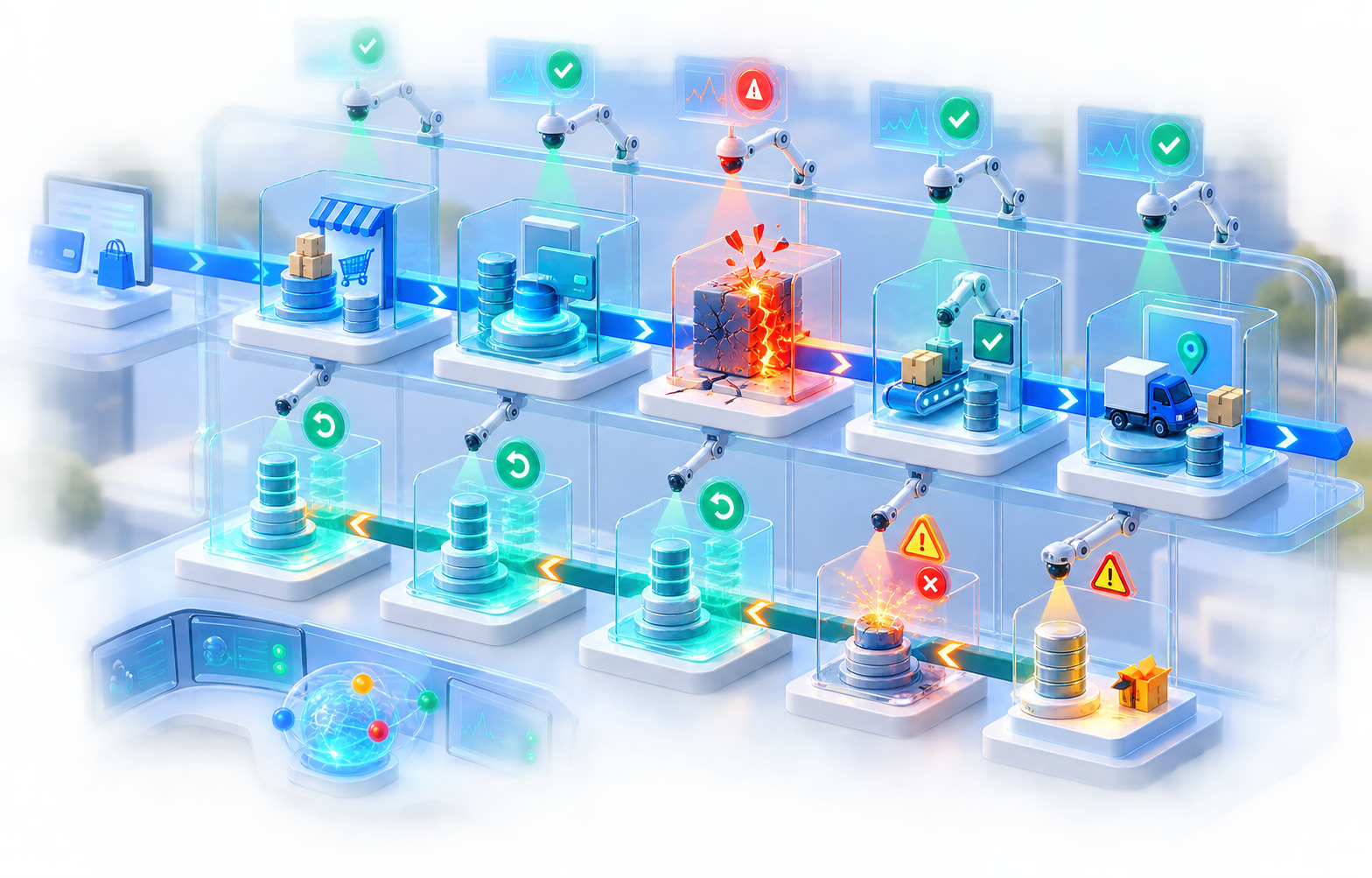
One tap on "Save" can create several simultaneously valid versions of a record, and the application will show a green checkmark for every one of them. A field technician closes a work order, sees the confirmation animation, and moves to the next job. At that exact moment, the record might exist as a confirmed local write, an unsent item in a durable queue, a half-processed request sitting in a load balancer, and a stale copy on a colleague's phone that has not yet heard about the change. All four of those states are individually legitimate. None of them alone tells you what the business actually knows to be true. This is the essence of offline sync conflicts: not a single dramatic failure, but a family of quiet disagreements about which version of a record is the one that counts.
Offline-capable software is distributed software, whether or not anyone on the team thinks of it that way. A mobile client, a backend, a queue, a downstream billing or inventory system, and a second device belonging to a different user are five independent participants that each hold their own copy of the truth and update it on their own schedule. The fact that one of those participants is a phone in someone's pocket, rather than a server in a data center, does not change the physics of the problem. It only changes how often the participants lose contact with each other, and how much damage accumulates while they are apart.
This article follows a single business operation as it moves through such a system, the way a forensic examiner follows a single transaction through a ledger, checking at each hop whether it is still the same operation, whether it has been duplicated, and whether the record that eventually lands in the canonical database still reflects what the user actually intended. The specimen is a field-service work order: a technician closes out a job with a status change, a measurement, a note, a signature, and a photograph, and the article tracks that one object from the moment the technician taps "Save" until it becomes visible, correctly or incorrectly, on someone else's screen.
A successful screen state is not proof of a durable business result. The interface can show "Saved" the instant a row is written to a local database, long before that row has any relationship to what the server, or any other device, believes about the same work order. Between the moment of user intent and the moment of durable, reconciled truth, there are several distinct checkpoints, each with its own failure modes: local persistence, durable queuing, network transmission, server-side processing, deduplication, conflict detection, and eventual visibility elsewhere. Conflating any of these checkpoints with "done" is how offline-first products end up shipping features that work in every demo and fail unpredictably in the field.
Before going further, it is worth being precise about what "offline sync conflicts" actually cause when they go wrong, because the vocabulary matters. Physical storage corruption is damage to the bytes of a local database file, journal, or index — the kind of failure a checksum can detect. Logical data corruption is different: the bytes are perfectly valid, but they describe a business state that never should have existed, such as an inventory count that is technically consistent but wrong. Replica divergence is when two copies of the same record hold different values because they have not yet exchanged information. A lost update is a specific case of divergence in which a change that once existed gets silently discarded. A duplicate side effect happens when one intended business action — one work order closed, one payment charged — is applied more than once because the system could not tell that a retried request was the same request. A stale read is simply an old but valid value, seen by a client that has not yet caught up. Orphaned data is a child record, such as a photo, that exists without the parent it was supposed to belong to. And a conflict, in the narrow technical sense used throughout this article, is a pair of operations that cannot both be applied as written without the system, or a human, making a decision about which one wins, or how they combine. These are not interchangeable words, and the rest of this article uses them deliberately, because treating every synchronization bug as generic "data corruption" makes it impossible to reason about which failure you are actually looking at, or which engineering discipline is responsible for preventing it.
Where One Operation Can Simultaneously Exist
Before the work order reaches any conflict logic, it is worth cataloging every place a single "save" can exist at once, because most incident reports assume the operation exists in exactly one place when in fact it exists, transiently or persistently, in several.
| Location | What "saved" means here | Evidence needed to prove durability |
|---|---|---|
| UI memory | The form fields reflect the user's edits; nothing has been persisted yet | None — this state disappears on process death |
| Local database | A row exists in the device's embedded database, inside a committed transaction | A durable transaction commit, verifiable after an app restart |
| Outbox / operation queue | A durable record describing the operation exists, independent of the entity row itself | The queue entry survives app restart, crash, and OS-level force-stop |
| API gateway or backend edge | A request was received and possibly accepted for processing | A server-issued acknowledgment tied to a specific operation ID |
| Canonical server database | The mutation has been committed in the system of record | A durable, queryable row change, visible to a fresh read after commit |
| Event stream or queue | A domain event describing the change has been published | Confirmed publish acknowledgment from the broker, with the operation ID as a property |
| Downstream system | A dependent system (billing, inventory, notifications) has processed the event | An idempotent, acknowledged application of that event in the downstream system |
| Second device | Another user's client has pulled or been pushed the updated state | A version or revision marker on the second device matching the canonical revision |
None of these rows implies any of the others. A record can sit safely in the local database while the outbox entry that was supposed to accompany it never got written. A backend can accept and commit a request while the acknowledgment that would tell the device about that success gets lost on the way back. An event can be published to a stream while the downstream consumer that was supposed to read it is down. Each row in this table is a distinct claim about the world, and each claim requires its own kind of evidence. The remainder of this article is organized around exactly this progression, examining each checkpoint the work order passes through and the specific way trust can be misplaced at that point.
One Operation, Several Versions of Truth
An offline-capable application is a distributed system with a particularly unreliable network partition: the one between the phone in a technician's hand and everything else. Distributed-systems literature usually treats network partitions as an occasional, recoverable anomaly. In field-service, logistics, healthcare, and retail applications, the partition is not an anomaly. It is the normal operating condition, punctuated by intervals of connectivity. Any application that treats "online" as the default state and "offline" as the exception has inverted the actual probability distribution of its users' lives.
Connectivity is not binary, and this matters more than it might first appear. A device can report a network interface as "connected" while DNS resolution fails, while a captive portal intercepts every request, or while the visible signal bars mask a link so degraded that requests time out before completing. Android's connectivity APIs distinguish between a network being merely available and actually validated for internet access, which is a useful distinction that many application-level designs quietly ignore, treating any reported connection as equivalent to a working one. A system that only reasons about "online" and "offline" as two states is already missing the majority of the real failure surface, which lives in the gray area of degraded, asymmetric, or intermittently working connections.
The work-order specimen illustrates why this distinction matters for correctness, not just for user experience. Suppose the technician's device reports a stable connection, but the connection is asymmetric: outbound requests are getting through, but responses are being dropped by a misconfigured proxy. The client sends the work-order update, the server processes and commits it, and the response — the only evidence the client would have had that the operation succeeded — never arrives. From the client's point of view, this is indistinguishable from a request that was never received at all. Any design that assumes silence means failure will now retry, and retry is where duplication begins.
This is why it helps to separate four distinct notions that are easy to collapse into one:
User intent is what the technician meant to do — close this work order, with these values — captured the instant they tapped "Save." It exists the moment it is expressed, independent of anything the software does with it afterward.
Local persistence is whether that intent has been written durably to the device, in a way that survives an app restart, a crash, or a reboot. A record that exists only in view-model memory has not yet reached this state, no matter what the screen shows.
Server commitment is whether the canonical system of record has durably applied the change. This is the state that matters for every other consumer of the data — reports, other devices, downstream systems — because it is the first point at which the change becomes visible outside the originating device.
Reconciliation is the point at which the system can affirmatively demonstrate that the locally persisted intent and the server-committed state agree, rather than merely assuming they do because no error was reported.
These four states can be far apart in time — seconds in the best case, days in the worst — and a mature offline product needs to represent each one distinctly rather than folding them all into a single "Saved" label. The following vocabulary gives product, mobile, backend, and QA teams a shared language for the states a single operation can occupy, and it recurs throughout the rest of this article:
| State | Meaning | Who can observe it |
|---|---|---|
| Draft | Entered by the user, not yet committed to durable storage | UI layer only |
| Locally committed | Durably written to the device's local database, in a transaction that will survive a crash | Device |
| Queued | An outbox entry exists describing the operation, awaiting transmission | Device |
| Sending | A transmission attempt is in flight; outcome is not yet known | Device |
| Outcome unknown | The transmission attempt ended without a definitive success or failure signal | Device |
| Acknowledged | The server has confirmed receipt and durable commitment of this specific operation | Device and server |
| Conflicted | The server detected an incompatible concurrent change and has not yet resolved it | Server, and device once notified |
| Rejected | The server has permanently refused the operation (validation, authorization, or business-rule failure) | Server, and device once notified |
| Quarantined | The operation could not be safely applied or discarded automatically and awaits review | Server, operations tooling |
| Reconciled | Independent verification confirms the client and server states agree | Backend reconciliation process |
Every one of these states is a legitimate, sometimes long-lived condition, not a transient glitch. A queue entry can sit in "Queued" for days if the technician is working a remote site with no signal. Treating "Pending" and "Failed" as the only two alternatives to "Saved" — the vocabulary many consumer apps use — erases exactly the distinctions that engineering, QA, and support teams need to diagnose a specific incident. A support agent who can see that a record is "Sending" rather than merely "Pending" already knows the retry logic is active and the device believes it recently attempted transmission; a support agent who can see "Conflicted" knows the record needs product-level attention rather than a network fix. This state vocabulary is the connective tissue for the rest of the checkpoints this article examines.
It is also worth stating plainly why "the app works offline" is an incomplete requirement, even though it appears in nearly every product brief for a field-service or logistics tool. Working offline in the sense of "the UI does not crash without a network" is a UI availability requirement. Working offline in the sense that matters to a business — that a technician's completed work order reliably becomes durable, deduplicated, correctly ordered truth on the server — is a data-integrity requirement, and it is a substantially harder one. The rest of this article is about that second, harder requirement.
The Local Commit: The First Place Data Can Disappear
The most dangerous moment in the specimen's life is not a network failure. It is the interval between the user tapping "Save" and the device's local storage engine durably committing that data, because this is the one point where a single missed step turns confirmed user intent into nothing at all, with no server, no queue, and no retry logic ever getting the chance to help.
Before anything is written, the client should validate the work order against whatever rules can be checked without a network round trip: required fields are present, numeric measurements are within a plausible range, the status transition is legal given the work order's current local state, and any client-generated identifiers are well-formed. Validation at this stage cannot enforce rules that depend on server-side knowledge — a colleague may have already closed this same work order from another device — but it can and should catch the large class of errors that would otherwise surface much later, deep in a backend queue, far from the moment the technician could still correct them.
The write itself needs to be atomic across two things that are easy to treat as separate concerns and dangerous to actually separate: the entity record itself (the work order row, its measurement values, its status) and the outbox entry that will eventually cause that change to be transmitted. If these two writes happen in separate local transactions, there is a window — however small — in which the entity is saved but no corresponding outbox entry exists, or vice versa. SQLite's atomic-commit design guarantees that everything inside a single transaction either fully commits or fully rolls back, even across an OS crash or power failure mid-write, but that guarantee only protects what is actually inside the transaction boundary. A design that writes the work order row in one transaction and the outbox entry in a second, separate transaction has manufactured a loss window that no amount of storage-engine reliability can close, because the atomicity guarantee simply does not span two independent commits.
The pattern that avoids this is usually called a local transactional outbox: the entity mutation and the outbox record describing "this entity needs to be synchronized" are written in the same local database transaction, so that either both exist after a restart or neither does.
// Illustrative pseudocode — not a production implementation.
// Demonstrates atomic local commit of entity + outbox entry.

function saveWorkOrderCompletion(workOrder, operationId):
    validateLocally(workOrder)              // required fields, range checks, legal transition

    beginLocalTransaction()
    try:
        upsertWorkOrderRow(workOrder)        // entity table
        insertOutboxEntry({
            operationId: operationId,        // client-generated, stable across retries
            entityType: "work_order",
            entityId: workOrder.id,
            payload: serialize(workOrder),
            state: "queued",
            createdAt: localClock.now(),
            retryCount: 0
        })
        commitLocalTransaction()             // atomic: both rows exist, or neither does
    catch storageError:
        rollbackLocalTransaction()
        surfaceRecoverableErrorToUser()
    return operationId
The reason this pattern matters in practice, and not only in theory, is the list of ways a mobile process can stop existing without warning. The operating system can kill a backgrounded app to reclaim memory. A user can force-stop the app from system settings. The device can lose power. The app can crash on an unrelated code path a few hundred milliseconds after the "Save" button handler started running. None of these events respects the boundary between "the UI showed success" and "the data is actually durable." If the durable commit has not happened by the time any of these events occurs, the work the technician believes they completed simply does not exist anymore, and there is no log entry, no error dialog, and no retry queue that can recover something that was never durably written in the first place. This is the sense in which local persistence is not a convenience feature; it is the first and most silent of all the places offline data can be lost, and it is entirely within the mobile team's control to close.
Attachments complicate this further. A photograph taken as part of the work order is typically far larger than the metadata describing it, and many implementations write the image file to disk separately from the database row that references it, for reasons of storage-engine efficiency. This is defensible, but it reintroduces the same atomicity problem at a different layer: if the metadata row commits but the image write fails, or vice versa, the result is an orphaned reference — a record that expects to find a photo at a path where no photo exists, or a photo file on disk that nothing in the database ever refers to. A safe pattern writes the attachment to a temporary location first, confirms the write succeeded (including a checksum comparison, if the storage medium is untrusted), and only then commits a database transaction that both records the final attachment path and marks the attachment as locally complete. Until that transaction commits, the attachment does not exist from the sync layer's point of view, regardless of what is sitting on disk.
Two identifier design decisions belong at this stage of the pipeline, because retrofitting them later is expensive. First, local primary keys — the row IDs a mobile database assigns internally — should never be confused with, or transmitted as, server-generated identifiers. A device that creates a work order offline needs an identifier it can reference immediately, before the server has ever seen the record, and that identifier needs to remain stable through the entire synchronization lifecycle. Second, and more importantly, every operation — not just every entity — should carry a client-generated, globally unique operation identifier, created once at the moment of local commit and never regenerated on retry. This operation ID is the single most important artifact this article discusses, because it is the thread that lets every downstream checkpoint recognize "this is the same save the technician performed a moment ago" rather than treating a retried request as a brand-new one. Its role in preventing duplication is covered in depth in a later section, but the identifier itself has to be born here, at the local commit, or it cannot do its job later.
Encryption of local storage is a security requirement, not primarily a sync-integrity one, but the two intersect in a specific way worth naming: if local data is encrypted with a key tied to device state — a biometric enrollment, a keystore entry — that key material needs to survive the same crash and restart scenarios the data itself needs to survive. A design where the encrypted outbox is durable but the key required to decrypt it is not reliably recoverable after a device restart produces a failure mode that looks identical to data loss, even though the bytes are technically still on disk.
Finally, none of this should be read as license to treat the local database as a solved problem once these patterns are in place. A local transactional outbox proves that data survives a crash on the device where it was created. It says nothing about what happens once that data tries to leave the device, which is where the majority of the remaining sections of this article are focused. A common design mistake is to over-invest in local durability — more encryption, more redundant local backups, more defensive local validation — under the belief that this constitutes "handling offline," while leaving the transmission, deduplication, and conflict-resolution layers comparatively undertested. Local durability is necessary. It is nowhere close to sufficient.
The Queue Is a Product Subsystem, Not a Temporary Array
Once the work order and its outbox entry are safely committed, the outbox itself deserves to be treated as first-class product infrastructure, with the same design rigor a team would apply to a backend message queue, rather than as an in-memory list that happens to get flushed to disk. Teams that treat the offline queue as an implementation detail tend to discover, months into production, that the queue's own behavior — not the network, not the server — is the source of the strangest support tickets.
A well-designed operation envelope carries enough metadata to answer every question a backend, a support engineer, or a later retry will eventually need to ask about the operation, without having to infer any of it from the payload. At minimum, this includes the operation ID; the type and identifier of the entity being mutated; the tenant and actor identity under which the operation should be executed, captured at creation time rather than looked up at send time; the revision of the entity the client believed was current when it made the change, often called a base revision; a schema version, so the server can tell which shape of payload to expect even after the mobile app has been updated several times since the operation was queued; any explicit dependency on another operation that must be applied first; a payload fingerprint, useful for detecting whether a retried operation ID arrives with different content than the original — a sign of either a bug or a security issue; the local order in which the operation was created, since wall-clock timestamps from an unsynchronized device clock cannot be trusted for ordering; a retry counter and the reason the most recent attempt failed, if any; and a policy describing how long the operation should be retained if it cannot be delivered.
{
  "operationId": "op_2f9a1c7e-4b3d-4a91-9c2e-71a6d4f8b210",
  "entityType": "work_order",
  "entityId": "wo_88213",
  "tenantId": "tenant_4471",
  "actorId": "user_10233",
  "deviceId": "device_a71f",
  "baseRevision": 17,
  "schemaVersion": 3,
  "dependsOn": null,
  "payloadFingerprint": "sha256:9e1a...c04b",
  "localSequence": 5821,
  "createdAt": "2026-08-14T09:12:41.203Z",
  "state": "queued",
  "retryCount": 2,
  "lastFailureReason": "gateway_timeout",
  "nextAttemptAt": "2026-08-14T09:18:41.203Z",
  "retentionPolicy": "expire_after_30_days"
}
This envelope is illustrative rather than a schema anyone should copy verbatim; the right fields depend on the domain. But every field earns its place by answering a question that otherwise gets answered incorrectly, by guesswork, later in the pipeline.
A naive queue design assumes strict first-in-first-out delivery is both achievable and sufficient. Neither assumption tends to hold. Global FIFO across an entire device's queue is rarely what the business actually needs; what typically matters is ordering per entity — the three edits a technician made to the same work order over the course of an hour need to apply in the order they were made, but an edit to a different, unrelated work order has no ordering relationship to them at all and can safely be sent in parallel or reordered without harm. Designing for per-entity ordering rather than global ordering both improves throughput and more accurately reflects the actual business invariant that needs protecting.
Dependencies between operations complicate this further. If a technician creates a new work order and then, still offline, adds a photo to it, the photo-attachment operation depends on the work-order-creation operation having been applied first — there is nothing on the server for the photo to attach to until the parent exists. A queue that sends these two operations out of order, or in parallel without respecting the dependency, will cause the server to reject the photo attachment, or worse, silently create an orphaned attachment if the server is not strict about referential integrity. The operation envelope's dependsOn field exists specifically to make this dependency explicit rather than inferred from timing, which is not a reliable signal once retries and backoff are involved.
Queue compaction — collapsing several queued edits to the same field into a single, smaller operation before transmission — is an attractive optimization when a technician edits the same measurement field five times before finally settling on a value, since sending all five intermediate values wastes bandwidth and, more importantly, can confuse a server that expects one operation ID per logical intent. But compaction is only safe when the operations being merged are genuinely fungible — later edits fully superseding earlier ones on the same field, with no other operation depending on an intermediate state. Compaction becomes unsafe the moment an operation targets a different aspect of the entity that a later operation does not overwrite, or when an intervening operation elsewhere in the queue depends on the specific intermediate state that compaction would discard. A queue that compacts a "mark this work order in progress" operation together with a later "mark this work order complete" operation, for instance, could inadvertently discard the in-progress transition from any downstream system that specifically listens for that state, even though the compacted result — a work order that ends up "complete" — is technically correct from the entity's point of view.
Not every operation eventually succeeds or is cleanly rejected. Some operations fail repeatedly in a way that never resolves — a validation rule the client-side check missed, a permission the technician no longer has, a payload the server genuinely cannot parse. Without a defined poison-operation policy, these operations retry forever, consuming bandwidth and battery, and silently blocking every operation queued behind them if the queue enforces per-entity ordering. A mobile client needs an explicit dead-letter state: after a bounded number of attempts, or after receiving a class of error the client recognizes as non-retryable (a validation failure, an authorization failure), the operation moves out of the active retry path and into a state that is visible to the user and, ideally, to a support tool, rather than continuing to retry silently in the background.
Retry timing itself deserves explicit design. Naive immediate retry, especially across a fleet of devices that all lost connectivity at the same moment because a cell tower went down, produces a retry storm the moment connectivity returns — every device hammering the backend simultaneously. Exponential backoff with randomized jitter spreads that load out and gives transient server-side issues time to resolve before the next wave of retries arrives. The backoff schedule itself is a product and platform decision, not a universal constant, since a healthcare inspection app with a strict compliance deadline may need a much more aggressive retry posture than a low-priority analytics queue.
Users need visibility into pending work, not because it is a nice-to-have but because it directly affects whether they trust the tool enough to keep using it in the field. A technician who has no way to see that three work orders are still queued for transmission has no way to make an informed decision about whether it is safe to hand the device to a colleague, switch it off, or drive into an area they know has no signal. Exposing queue depth, and ideally the age of the oldest queued item, in the application UI is a correctness feature disguised as a UX feature.
Two organizational hazards round out the queue's design surface. First, an application upgrade must not silently drop or corrupt a queue that has pending, unsent operations from the previous version — the queue's schema needs to be versioned and migrated with the same discipline as the entity data it describes, since a queue entry created by version 4.2 of the app needs to remain readable and sendable after the device auto-updates to version 4.3. Second, and more sensitive, is what happens to a queue when a user logs out, or the device is reassigned to a different technician, while operations are still pending. A queue entry that was created under one user's identity must never be transmitted under a different user's session, because doing so silently reattributes work — and, in regulated domains, potentially reattributes liability — to the wrong person. The correct behavior is to bind every operation's actor identity irrevocably at creation time, as the envelope example above does, and to refuse to drain any queued operation whose bound identity does not match the currently authenticated session, surfacing the mismatch for explicit resolution rather than silently either discarding the work or reassigning it. Tenant isolation follows the same logic: in any multi-tenant deployment, an operation queued under one tenant must be structurally incapable of executing against another tenant's data, even if a bug elsewhere in the client causes the wrong tenant ID to be read at send time — the server-side idempotency and authorization checks discussed in a later section are the actual backstop for this, but the client-side discipline of binding tenant identity at creation time is the first line of defense.
The Request May Have Succeeded When the Client Calls It Failed
This is the checkpoint where most naive offline implementations quietly introduce duplicate business operations, and it deserves to be treated as the central design problem of the entire pipeline, because the failure it produces — a work order closed twice, an inventory count decremented twice, a delivery confirmed twice — is exactly the kind of plausible-but-wrong state that a green checkmark in the UI does nothing to reveal.
The uncomfortable fact underlying this checkpoint is that a client-observed timeout carries almost no information about what actually happened on the server. At least seven distinct outcomes are consistent with the client believing the request failed:
- The request never left the device — the network dropped before the first byte went out.
- The request reached the server, but the server rejected it outright — a validation or authorization failure, cleanly communicated.
- The server received the request, committed the mutation durably, and then the response was lost on the way back — the operation succeeded, but the client has no way to know that.
- The response reached the client's networking stack, but the client crashed, was force-stopped, or otherwise failed to persist the acknowledgment before the response could be recorded.
- The client's request timed out from its own point of view, but the server continued processing and eventually committed the operation well after the client had already given up and moved on.
- The connection type changed mid-upload — Wi-Fi to cellular, or vice versa — severing the in-flight request in a way indistinguishable, from the client's perspective, from a server-side failure.
- The application was backgrounded by the operating system while awaiting a response, and the OS suspended networking before the response could be delivered.
Cases 3 and 5 are the dangerous ones, because in both, the operation actually succeeded on the server, and the client's belief that it failed is simply wrong. If the client's response to "I believe this failed" is to blindly resend the same operation, and the server has no way to recognize that the resend describes work it already completed, the technician's single "mark complete" action becomes two completions, two inventory deductions, two delivery confirmations, or two charges. None of these are hypothetical; they are the direct, mechanical consequence of pairing a retry-on-timeout strategy with a server that treats every incoming request as new.
It is worth being explicit about why a network-reachability signal cannot resolve this ambiguity, because it is a natural place for teams to look for a shortcut. A callback that reports "the network is available again" answers a question about the transport layer, not about the fate of a specific past request. It tells the client that a new attempt is now possible; it says nothing about whether the previous attempt's server-side processing completed, is still in flight, or never started. Treating network availability as a proxy for "my last request definitely failed" is a category error that shows up repeatedly in incident postmortems for exactly this class of bug.
| Uncertain outcome | What the client actually knows | Correct client action |
|---|---|---|
| Connection dropped before send completed | Request almost certainly never reached server | Safe to retry with the same operation ID |
| Explicit 4xx rejection received | Server processed and rejected the request | Do not retry unchanged; surface for correction or discard |
| Explicit 2xx / operation-specific success received | Server committed the operation | Mark acknowledged; stop retrying |
| Timeout with no response, request fully sent | Server's decision is unknown | Retry with the same operation ID, relying on server-side idempotency |
| App backgrounded / killed mid-request | Server's decision is unknown | On next launch, resume with the same operation ID; never regenerate it |
| 5xx or gateway timeout received | Server may or may not have committed before failing | Retry with the same operation ID after backoff |
| Connection type changed mid-transfer | Server's decision is unknown | Retry with the same operation ID |
The pattern in every "unknown outcome" row is the same, and it is the reason the operation ID introduced two sections ago matters as much as it does: the client's job is not to determine what happened before retrying. That determination is often impossible from the client's vantage point. The client's job is to retry safely, which means retrying with the exact same operation identifier every time, so that the server — not the client — can be the authority on whether this specific intended operation has already been fulfilled. This reframing, moving the responsibility for "have we already done this" off the unreliable, intermittently connected client and onto the durable, always-available server, is the foundation the next section builds on directly.
It is worth being specific about what blind retry actually produces in the running specimen's domain, because the abstract phrase "duplicate side effect" undersells how concretely damaging this is. A retried work-order completion that the server treats as a new request can trigger a second inventory deduction for parts consumed on the job, double-charge a customer for a service call, send a second customer notification that contradicts the first, write two audit-log entries for what was actually a single technician action, or — for the photograph attached to the specimen — silently store two copies of the same image under two different attachment IDs, doubling storage cost and confusing any later query that assumes one photo per work order. None of these are edge cases confined to unusual inputs; they are the default outcome of naive retry logic operating over an unreliable network, which is to say, they are the default outcome of shipping an offline-capable mobile app without deliberately engineering against this exact failure mode.
Idempotency Must Represent Business Intent
Idempotency is the mechanism that resolves the ambiguity described in the previous section, but it is frequently invoked more casually than its actual guarantees warrant, so it is worth being precise about what it does and does not promise.
HTTP method idempotency and application-level idempotency are related but distinct concepts, and conflating them is a common source of false confidence. RFC 9110 defines an idempotent method as one where the intended effect of multiple identical requests is the same as the effect of a single request, and it identifies PUT, DELETE, and the various safe methods as idempotent by definition, while explicitly leaving POST outside that guarantee. This is a statement about the HTTP method's contract, not a statement about what any particular server implementation actually does when it receives a duplicate request. A PUT endpoint that overwrites a record's full state with the payload's contents is naturally idempotent, in the sense that applying it twice produces the same end state as applying it once — but a POST endpoint that appends to a list, increments a counter, or creates a new inventory-deduction record on every call is not idempotent by any inherent property of the POST method, and marking it "idempotent" in documentation does not make it so. Most of the operations a field-service application performs — creating a work order, adding a note, decrementing inventory by some amount — are naturally closer to POST semantics than PUT semantics, which is exactly why application-level idempotency, layered deliberately on top of whatever HTTP method is in use, is necessary rather than optional.
Application-level idempotency, as described in AWS's Well-Architected guidance on making mutating operations idempotent, works by having the client attach a unique idempotency token to each logically distinct operation and having the server durably record, alongside the business mutation itself, that this specific token has already been processed — so that a repeated request carrying the same token returns the original result rather than re-executing the mutation. This is precisely the role the client-generated operation ID from the queue envelope plays: it is not merely a tracing identifier, it is the idempotency key the server uses to recognize a retry for what it is.
Several design details determine whether this mechanism actually holds up under real-world retry patterns. The scope of the idempotency key matters: a key that is unique only within a single device is not unique enough if two different devices could plausibly generate the same key by coincidence or by a client-side bug, so keys are typically scoped by tenant and by endpoint, or made globally unique through a sufficiently random generation scheme, such as a UUID. Payload fingerprint mismatch is a case worth handling explicitly rather than ignoring: if a request arrives with an idempotency key the server has seen before, but the payload this time differs from the payload associated with that key originally, this is not an ordinary retry — it is either a client bug that reused an identifier across two logically different operations, or a sign of a more serious problem, and the correct server behavior is to reject the request rather than silently applying either the old or the new payload. Expiration and retention of idempotency records need a deliberate policy: retaining them forever is wasteful, but expiring them too aggressively reopens the duplication window for any client that retries after a long offline interval — a scenario field-service and logistics applications encounter routinely, unlike typical web-request retry windows measured in seconds.
The atomicity of the idempotency check itself is where many implementations quietly fail under load. If a server first checks whether a token has been seen, and only afterward performs the business mutation and records the token as a separate step, a second copy of the same request — arriving concurrently, which happens more often than intuition suggests when a mobile client's own retry logic races against a network-level retry from an intermediate proxy — can pass the "have I seen this token" check before the first request's token-recording step completes, and both requests proceed to execute the mutation. The token record and the business mutation need to be committed together, atomically, typically within the same database transaction or through a unique constraint that makes the second concurrent attempt fail outright rather than silently succeed a second time.
// Illustrative server-side pseudocode — not a production implementation.
// Demonstrates atomic idempotency check + business mutation.

function handleWorkOrderCompletion(request):
    operationId = request.operationId
    payloadHash = hash(request.payload)

    beginServerTransaction()
    try:
        existing = selectIdempotencyRecordForUpdate(operationId)  // row lock

        if existing exists:
            if existing.payloadHash != payloadHash:
                rollbackServerTransaction()
                return HTTP_409_CONFLICT("operation id reused with different payload")
            rollbackServerTransaction()  // read-only path, nothing to commit
            return existing.storedResponse   // return original result, do not re-execute

        result = applyWorkOrderMutation(request.payload)   // the actual business effect
        insertIdempotencyRecord(operationId, payloadHash, result)
        commitServerTransaction()             // mutation + record committed atomically
        return result
    catch anyError:
        rollbackServerTransaction()
        raise
Idempotency extends naturally beyond a single request-response pair once events start flowing downstream. If the work-order completion also publishes an event to a stream that a billing service and an inventory service both consume, duplicate delivery at the messaging layer is a normal, expected occurrence in most event-streaming systems, not a bug — most brokers offer at-least-once delivery rather than exactly-once, and building a consumer that assumes otherwise is a design error, not a broker deficiency. Idempotent consumers solve this the same way idempotent servers do: by recording, durably, which event identifiers they have already processed, and skipping reprocessing for any duplicate. The inbox pattern on the consuming side mirrors the outbox pattern on the producing side discussed earlier — an inbound event is recorded as received, in the same transaction as whatever local effect processing it should have, before that effect is allowed to happen a second time.
A database uniqueness constraint on the operation ID column is a valuable defense, and one that should generally be present regardless of what application-level logic also exists, because it converts a class of race-condition bugs into a clean, loud constraint-violation error rather than a silent duplicate row. But a uniqueness constraint alone does not solve every side effect a mutation might trigger. If the mutation, beyond writing its own row, also calls an external payment processor, sends a push notification, or writes to a separate audit table, a uniqueness constraint on the primary mutation's table does nothing to prevent those secondary effects from firing twice if the transaction boundary does not actually encompass all of them. This is precisely why the phrase "exactly once" needs to be used with real caution rather than as a casual marketing claim: what most systems actually deliver is at-least-once delivery of the request, combined with at-most-once application of its effect, achieved deliberately through idempotency keys — a composition that behaves like exactly-once from the caller's perspective, but only for the specific effects the idempotency mechanism was actually designed to cover, and not automatically for every side effect a naive implementation might bolt on later.
The single most important limitation to communicate clearly to every engineer working on this system is this: an idempotency key prevents the same declared operation from executing more than once. It says nothing about whether two operations that carry two different keys actually represent the same real-world intent. If a technician, uncertain whether their first "mark complete" tap registered, taps the button a second time, and the client — reasonably, from its own point of view — generates a fresh operation ID for what it perceives as a fresh user action, idempotency will not catch this. Both operations will execute, because both are, to the server, legitimately distinct declared operations. Preventing this class of duplication is a product and UX problem — disabling the button after the first tap, showing an explicit pending state, requiring the user to actively cancel and retry rather than simply tapping again — layered on top of, not a substitute for, the idempotency mechanism this section describes.
Sync Conflict Resolution Is a Product Decision
Everything up to this point has assumed a single actor modifying a single record. Once a second technician, or an administrator working from a desktop console, can modify the same work order while the first technician's device is offline, the system needs an actual policy for what happens when two legitimate, individually valid changes disagree — and this policy is fundamentally a product decision about domain semantics, dressed up as a technical implementation detail.
Conflicts in the specimen's domain take several concrete shapes. Two devices might each independently edit different fields of the same work order while both offline, in which case the "conflict" may not even represent a real disagreement — it may simply be two non-overlapping edits that a naive merge strategy handles incorrectly anyway. A mobile technician might edit a work order that an office administrator has, in the meantime, reassigned to a different technician entirely, which is a genuine business conflict, not just a data conflict. An update might race against a delete — the technician edits measurement values on a work order that a supervisor, from the web console, has simultaneously canceled. Two devices might each create what they believe is a new work order for the same job, producing duplicate creation rather than a conflicting edit. A status transition might be attempted twice, concurrently, from two different starting assumptions about the current status. A parent-child relationship might conflict, as when the work order itself is deleted on the server while a device is still offline uploading a photo attachment meant for it. Inventory or counter fields present their own special case, discussed further in the next section, because naive merge strategies for counters are particularly prone to silently discarding real changes. And an offline edit might have been made against reference data — a parts catalog, a pricing table — that has since changed on the server, meaning the edit was valid when made but is no longer valid against current data.
No single resolution strategy handles all of these well, which is exactly why treating "conflict resolution" as a single configuration switch, rather than a set of domain-specific rules chosen deliberately per entity and per field, tends to produce systems that are technically consistent and practically wrong.
Reject and require refresh is the simplest strategy: the server refuses any write that does not carry the current revision, forcing the client to pull the latest state and reapply its change against it. This preserves correctness completely — nothing is ever silently overwritten — but it requires connectivity at the moment of conflict resolution, which is precisely the resource an offline-capable application cannot assume is available, making this strategy poorly suited to genuinely offline workflows despite being the easiest to reason about.
Optimistic concurrency using revisions or ETags lets the write proceed only if the base revision the client believed was current still matches the server's current revision, failing the write explicitly otherwise rather than silently overwriting. This preserves the same correctness guarantee as reject-and-refresh but gives the client a precise, structured signal about exactly what went stale, which a well-designed client can use to attempt an automatic merge rather than simply discarding the user's work and demanding they start over.
Last-write-wins, examined in detail in the next section because of how often it silently destroys correct information, resolves any conflict by keeping whichever write carries the later timestamp and discarding the other entirely. It requires no coordination and produces a deterministic, always-available result, which is precisely why it is so commonly reached for — but "deterministic" and "correct" are not the same property, and the next section is dedicated to exactly that distinction.
First-write-wins is the mirror image, keeping the earlier change and rejecting the later one. It is occasionally appropriate for domains where an early commitment should be binding — a first-come reservation of a limited resource — but it discards the later change's information just as completely as last-write-wins discards the earlier one, and for most business data it is no more defensible.
Field-level merge narrows the conflict to only the specific fields both changes actually touched, applying each side's non-overlapping edits without loss and requiring resolution only for genuine overlaps. This preserves substantially more information than record-level strategies, at the cost of real implementation complexity: the server needs to track changes at field granularity rather than treating the entity as an opaque blob, and the merge logic needs domain knowledge about which fields can be safely combined.
Three-way merge, borrowed directly from version-control systems, compares both conflicting versions against their common ancestor — the base revision both edits started from — and can often resolve non-overlapping changes automatically while flagging only genuine overlaps for explicit handling. This is more sophisticated than plain field-level merge and correspondingly more expensive to implement correctly.
Operation-based merge shifts the unit of conflict resolution from the final state of a record to the sequence of operations that produced it — rather than merging two snapshots, the system replays both sequences of intent (append this note, increment this counter by two, transition this status) against each other, which can preserve semantic intent that a snapshot-based merge would lose. This requires a durable, ordered log of operations rather than just current state, which is a substantially different architecture than most CRUD-oriented backends default to.
Domain-specific merge rules hard-code the actual business logic for a given entity and field: notes append rather than overwrite; a status transition follows an explicit state machine that determines which of two proposed transitions is legal given the other; a signature, once captured, is immutable and any conflicting signature attempt is rejected outright rather than merged. This is the most accurate strategy per field, and also the most expensive to build and maintain, since it requires a distinct rule for every field or field-group that can meaningfully conflict.
Multi-value retention keeps both conflicting values rather than choosing between them, surfacing the ambiguity explicitly — appropriate for genuinely ambiguous business data like two different measurement readings, less appropriate for fields that must have a single unambiguous value, like a status.
Human review routes the conflict to a person rather than resolving it automatically, which is the right answer whenever the business cost of an automated wrong decision exceeds the operational cost of a delay, but which does not scale to high-frequency conflicts and needs its own queue, ownership model, and service-level expectation to avoid becoming a silent backlog.
CRDTs, conflict-free replicated data types, are data structures specifically designed so that concurrent updates always converge to the same state regardless of the order in which replicas receive them, without requiring any coordination between replicas at write time. This is a genuinely powerful mathematical property, and it is frequently oversold. Shapiro et al.'s foundational treatment of CRDTs establishes the convergence guarantee rigorously, but convergence is a statement purely about the data structure's internal consistency, not about whether the converged result is what the business actually wanted. A CRDT-based counter that merges two concurrent decrements correctly, in the sense of arithmetic, can still converge to an inventory value that violates a business rule the CRDT was never told about, such as never allowing stock to go negative for a specific high-value part. Treating CRDTs as a universal solution to conflict resolution mistakes a mathematical guarantee about structural convergence for a business guarantee about semantic correctness, and those are not the same thing.
The comparison below summarizes what each approach preserves, what it can discard, and where it fits.
| Approach | Preserves | May discard | Needs coordination | Typically clear to end users | Good fit | Poor fit |
|---|---|---|---|---|---|---|
| Reject and require refresh | Everything, by forcing serialization | Nothing (blocks instead) | Yes, at write time | Yes | Low-frequency edits, admin tools | Genuinely offline field workflows |
| Optimistic concurrency (version/ETag) | Everything, by failing explicitly | Nothing (fails instead) | No at write time, yes at resolution | Yes, with the right client UX | Any entity where silent overwrite is unacceptable | High-frequency concurrent edits without a merge UI |
| Last-write-wins | Only the winning write | The entire losing write | No | Rarely, without extra tooling | Ephemeral, low-value fields (a "last seen" timestamp) | Business-critical fields, deletes vs. updates |
| First-write-wins | Only the winning write | The entire losing write | No | Rarely | Reservation-style, first-come semantics | Most general business data |
| Field-level merge | Non-overlapping edits from both sides | Only genuinely overlapping fields | No | Sometimes | Multi-field forms edited by different roles | Entities with few, tightly coupled fields |
| Three-way merge | Non-overlapping changes vs. common ancestor | Only genuine overlaps | No | Sometimes, with tooling | Structured documents, configuration | Simple flat records where it adds needless complexity |
| Operation-based merge | Semantic intent of both operation sequences | Rarely, if operations are well-modeled | No | Rarely, without dedicated tooling | Counters, append-only logs, collaborative text | Systems without an operation log architecture |
| Domain-specific rules | Whatever the business defines as correct | Only what the rule explicitly discards | No | Yes, if rules match user mental models | High-value, well-understood fields | Fields where no one has actually defined the rule |
| Multi-value retention | Both values, explicitly | Nothing, but defers the decision | No | Yes, the ambiguity is visible | Genuinely ambiguous readings | Fields that must be single-valued downstream |
| Human review | Whatever the reviewer decides | Nothing, but adds latency | Yes, eventually | Yes | Low-frequency, high-stakes conflicts | High-frequency conflicts at scale |
| CRDTs | Structural convergence, always | Business rules the structure doesn't encode | No | Rarely, without domain wrapping | Counters, sets, collaborative text with simple semantics | Anything with cross-field business invariants |
Testing implications follow directly from which strategy a given field uses. A field governed by optimistic concurrency needs tests that deliberately create a stale base revision and confirm the write fails cleanly rather than silently overwriting. A field governed by domain-specific merge rules needs tests for every documented rule, plus tests for the specific undocumented case the rule author did not consider, which is usually where the real bugs live. A field governed by CRDTs needs tests that confirm convergence across every possible delivery order, not just the order the happy-path test happens to exercise — and separately, tests that confirm the converged result actually satisfies the business invariants the CRDT itself has no knowledge of.
The single point this section most needs to leave the reader with is that deterministic convergence is not automatically a correct business result. A system where every replica always ends up agreeing on the same final state has solved a real and valuable problem — the divergence described earlier in this article — but agreement is not the same as correctness, and a team that stops asking "does this converge?" without also asking "is what it converges to actually right?" has only solved half the problem.
Why Last-Write-Wins Can Quietly Delete Correct Data
Last-write-wins deserves its own extended treatment, separate from the broader conflict-resolution comparison above, because it is simultaneously the most commonly deployed strategy and the one most likely to be misunderstood by the people deploying it.
The core mechanical problem is that most last-write-wins implementations operate at the level of the whole record, not the individual field, even when the two conflicting writes only actually touched different fields. Consider the specimen work order: while offline, one technician updates the measurement values and leaves everything else unchanged; concurrently, an administrator working from a web console, also without seeing the technician's pending change, updates the assigned parts list and leaves the measurements unchanged. Neither edit conflicts with the other in any meaningful business sense — they touch entirely different fields. But if the synchronization layer treats each incoming write as a full replacement of the record, whichever write reaches the server second will silently overwrite the other party's change, even though that change had nothing to do with the field the "winning" write actually cared about. This is a lost update in the precise sense defined earlier in this article: a successfully created, individually valid change disappears, not because anyone intended to discard it, but because the record-level granularity of the conflict check could not see that the two changes never actually overlapped.
The timestamp that determines "last" is itself a source of subtle failure. Device clocks are not reliably synchronized, and a device whose clock is running fast, whether through user error, a stale time zone setting, or a hardware clock drift issue, can cause its writes to consistently and incorrectly "win" against writes from correctly configured devices, regardless of which edit was actually made later in real time. This is why systems that need last-write-wins semantics but cannot tolerate this failure mode generally avoid depending directly on client-supplied wall-clock timestamps, using instead a server-assigned timestamp recorded at the moment of commit, or a logical clock — a counter that increments with each write and establishes a causal ordering without depending on any device's notion of wall-clock time. A hybrid logical clock, which combines a logical counter with a loosely synchronized physical timestamp, is a common middle ground, giving both a meaningful causal ordering and an approximate real-world time, without depending entirely on any single device's clock being correct. It bears repeating that not every last-write-wins implementation actually relies on an uncontrolled device clock — Azure Cosmos DB's default last-write-wins policy, for instance, is explicitly documented as based on a system-defined timestamp under a time-synchronization protocol, with the option to substitute an application-defined numeric property instead, which is a meaningfully different and more defensible design than trusting whatever timestamp an arbitrary mobile client happens to report. The failure mode described in this section is specific to implementations that trust client clocks directly, not an inherent property of last-write-wins as a category.
Equal timestamps present their own edge case worth naming explicitly, because "last write wins" implicitly assumes writes can always be strictly ordered, and in practice they sometimes cannot be, down to whatever resolution the clock provides. A well-specified system needs a deterministic tie-breaker for this case — commonly an operation or device identifier used as a secondary sort key — precisely so that the outcome is at least reproducible, even if it is not necessarily the outcome a person would have chosen.
The interaction between last-write-wins and long offline intervals compounds the problem in a specific way. Cosmos DB's conflict policy documentation is explicit that, in a delete-versus-update conflict, the deleted version always wins regardless of the conflict resolution path's value — a deliberate and reasonable design choice for that system, but one that has real consequences worth thinking through for any comparable design: a technician who was offline for several days, made a legitimate edit to a work order early in that period, and reconnects only to discover that an administrator deleted the same work order somewhere in the middle of that interval, will have their edit discarded entirely, with no visible record that the edit was ever attempted, unless the system explicitly surfaces this outcome rather than resolving it silently. Whether "delete always wins" is the correct business rule depends entirely on the domain — it is defensible for a canceled service call, and considerably less defensible for a healthcare record that should never simply vanish along with whatever edits were made to it — which is precisely why this needs to be a deliberate, documented product decision, not an inherited default from whichever database happens to be underneath the application.
The distinction to hold onto throughout all of this is that "latest" and "correct" are different concepts, described by different mechanisms, and a system that only implements the mechanism for determining "latest" has not thereby implemented a mechanism for determining "correct." Last-write-wins is not wrong to use — it is often the right, pragmatic choice for fields where the cost of an occasional lost update is genuinely low, such as a "last active" timestamp or a UI preference. It becomes a silent data-integrity failure specifically when it is applied, by default and without deliberate review, to fields where a lost update has real business cost: a measurement value on a compliance-relevant inspection, a status transition on a billable service, an inventory count that determines whether a truck gets dispatched with the right parts on board.
Several Days Offline Can Change the Contract
The scenarios examined so far mostly assume a device reconnects within minutes or hours. Field-service, logistics, and remote-inspection applications routinely encounter devices that stay offline for days, and the interval matters because the world the device left does not wait for it to come back — the contract the device is operating under can quietly expire while it is disconnected.
Authentication and authorization are the most immediate concern. An access token that was valid when the device went offline may have expired well before it reconnects, and if the token refresh mechanism itself requires connectivity — which it typically does — the device may find itself holding a queue of fully valid, correctly formed operations that it is no longer authorized to submit under any currently valid credential. Worse, the technician's access could have been revoked entirely in the interim, or their tenant membership removed, or their role changed such that operations they queued while authorized are no longer permitted by the time the queue drains. A queue that blindly replays under whatever credential it can obtain at reconnection time, without re-validating that the original actor is still authorized for the specific operations queued, creates exactly the security and audit problem the earlier discussion of tenant and actor isolation was designed to prevent — replaying unauthorized queued operations after permissions have changed underneath them.
The application and API themselves can also have moved on. A device that has been offline for an extended period may still be running a mobile app version several releases behind current, targeting an API version or a payload schema the server no longer accepts without translation, or entirely deprecated. Server-side and local schema migrations that happened during the offline interval may have renamed fields, changed validation rules, or retired workflow states the queued operation still references. A queued "mark work order in progress" operation, for instance, becomes meaningless if the workflow has since been redesigned to remove the "in progress" state entirely in favor of a more granular set of sub-states. Reference data the offline edit depended on — a parts catalog entry, a pricing table row — can also have changed or been retired entirely during the offline interval, meaning an operation that was completely valid at the moment it was created is invalid against the server's current understanding of the world by the time it finally arrives.
Server-side retention policy adds another dimension: if the parent entity a queued operation depends on has been deleted and tombstoned on the server in the interim, the queued operation is now referencing a tombstone — a marker recording that an entity used to exist and no longer does — and the correct behavior is very much not to let the queued operation silently resurrect the deleted entity, which is one of the explicit invariants discussed in a later section.
Encryption key rotation and attachment upload expiration are two more concrete failure points specific to long offline intervals. If local data is encrypted with a key that has since been rotated server-side, or if an attachment upload URL — commonly a time-limited, pre-signed URL in many cloud storage architectures — has expired by the time the device finally attempts to use it, the operation fails in a way that has nothing to do with the business logic of the operation itself, and needs to be distinguished cleanly from a business-rule rejection so the client can retry the underlying mechanism (re-request a valid upload URL, re-authenticate) rather than treating the operation as permanently invalid.
Practically, a device offline for days can also simply accumulate an enormous queue — thousands of pending operations is not an unusual number for a technician who has been working a remote site for a week — and draining that queue on reconnection needs to respect the same battery, bandwidth, and metered-connection constraints that motivated offline support in the first place. A queue-drain strategy that blindly attempts to send everything as fast as the network allows can exhaust a device's battery or a technician's data plan in minutes, which is its own kind of operational failure even when every individual operation resolves correctly.
The policy question this section is really building toward is: what should happen to a queued operation that was valid when created but is no longer valid against the server's current state by the time it is replayed? Five broad policies are worth naming, because different fields and different domains genuinely warrant different answers.
| Policy | Behavior | When it fits |
|---|---|---|
| Reject | The operation fails outright, with a clear reason surfaced to the client | The invalidating change is authoritative and irreversible (parent deleted, permission revoked) |
| Transform | The operation is automatically translated to the current schema or workflow state | The change is a well-understood, mechanical evolution (a renamed field, a merged status) |
| Quarantine | The operation is held in a review state, neither applied nor discarded | The correct outcome genuinely depends on context a person needs to evaluate |
| Request user review | The client is prompted to re-confirm or re-enter the operation against current data | The user is best positioned to decide whether the original intent still applies |
| Privileged reconciliation | A backend or operations process applies domain-specific rules to resolve the case | High-volume, well-understood cases where human review does not scale but simple rejection is too blunt |
None of these policies is universally correct, and a mature system typically uses several of them across different entity types and different classes of invalidating change, chosen deliberately rather than defaulting to whichever policy happened to be easiest to implement first.
Local Storage Failure Happens Before the Network Is Involved
It is worth returning, deliberately, to a category of failure that has nothing to do with synchronization at all, because it is easy to let a discussion focused on network and conflict behavior crowd out the fact that a meaningful share of "sync bugs" reported in the field actually originate in local storage failures that occur before any network request is ever attempted.
The terminological distinction introduced at the start of this article matters most here: physical storage corruption — damage to the actual bytes of the database file, its journal, or its indexes — is a different failure from logical sync corruption, which is structurally valid data that simply represents the wrong business state. This section is about the former.
SQLite's atomic-commit design is genuinely robust against the most common interruption scenarios — an application crash or an operating-system crash mid-transaction — through its rollback-journal and write-ahead-log mechanisms, which are engineered specifically so that an interrupted transaction leaves the database in the state it was in before the transaction began, rather than in some undefined partial state. This guarantee is real, and it is also narrower than it is sometimes assumed to be. SQLite's own documentation on how a database file can nonetheless become corrupted lists causes entirely outside the atomic-commit mechanism's scope: a rogue process or thread overwriting the database file directly, because SQLite database files are ordinary files any process with sufficient permission can open and write to; a backup or restore process copying the file while a transaction is actively in progress, producing a backup that mixes old and new content; a hot journal — the recovery file SQLite needs after an interrupted transaction — being manually deleted or renamed by a well-meaning user or administrator who does not realize its purpose, which removes the exact information SQLite needs to complete its automatic recovery; broken or missing file-locking implementations, particularly on certain network filesystems, that allow two processes to write to the same database concurrently without the coordination SQLite's locking is designed to enforce; and storage hardware or firmware, particularly some flash memory controllers, that does not honor sync requests correctly, meaning data SQLite believes has been safely written to durable storage may not actually be there yet when power is lost.
Several of these causes are directly relevant to mobile deployment specifically. A destructive schema migration — one that drops and recreates a table rather than altering it in place — that is interrupted partway through an app upgrade can leave a database in a state where some tables reflect the old schema and others reflect the new one, a form of partial migration that is not caught by SQLite's own transactional guarantees if the migration itself was not correctly wrapped in a single transaction. An attachment-file mismatch — the metadata database claims a photo exists at a path where no file is actually present, typically because the metadata write and the file write were not made atomic with each other, exactly the failure mode discussed earlier in the local-commit section — produces symptoms that look identical to sync corruption but originate entirely on the device, before any network request was ever made. Aggressive OS-level cache clearing, which some platforms perform under storage pressure without always distinguishing clearly between disposable cache data and an application's genuinely durable local database, can also destroy data an application assumed was safe.
What should be tested at the application layer, given that the storage engine already provides strong atomic-commit guarantees, is specifically everything the storage engine's guarantee does not cover: whether the application's own migration logic is itself transactional and safely resumable if interrupted; whether attachment writes and their corresponding metadata rows are made atomic with each other, using the same commit-together discipline described in the local-commit section; whether the application correctly detects and reacts to storage-engine-reported corruption, rather than crashing opaquely or, worse, silently continuing to operate against data it should no longer trust; and whether backup or export functionality, if the application offers any, correctly avoids copying the database file while a transaction is in progress, deferring instead to whatever safe-copy mechanism the storage engine provides.
Safe recovery behavior, once corruption is actually detected, follows a fairly consistent shape regardless of the specific storage engine involved. Integrity detection — actively checking the database's internal consistency, not merely waiting for a query to fail — should run periodically and always immediately after any restart following an unclean shutdown. Detected corruption should trigger quarantine of the affected local database rather than continued operation against it, because continuing to write to a corrupted database risks compounding the damage. Recovery, where possible, should restore from the most recent known-good local backup, or fall back to full rehydration from the server, treating the server as the authoritative source of truth the local state should be rebuilt from. Critically, any locally queued, unsynchronized operations need to be identified and preserved separately before the corrupted database is discarded, if at all possible, because those operations represent real user work that has not yet reached the server and would otherwise be lost entirely rather than merely delayed. The user needs a clear, honest warning that recovery occurred and what, if anything, may have been affected, rather than a silent recovery that leaves them unaware their local data was ever at risk. And whatever diagnostic information can be safely captured about the corruption event — without capturing sensitive payload contents — should reach a support or engineering channel, because recurring corruption on a specific device model, OS version, or storage configuration is a signal worth acting on rather than treating each incident as isolated.
This is emphatically not a suggestion to deliberately corrupt real user devices or production databases in the course of testing any of this; the crash-and-recovery testing described in the network-transition and invariant-testing sections that follow should always run against controlled test environments, using the storage engine's own documented fault-injection or crash-simulation facilities rather than inflicting real damage on any device or dataset that matters.
Build a Network-Transition Test Lab
Most mobile QA practice still organizes network testing around two static states, online and offline, and tests behavior within each state in relative isolation. The overwhelming majority of the failures this article has described so far do not occur in either static state. They occur during the transition between states, or during an interruption that happens to coincide with a specific, narrow window in the application's processing — exactly the kind of timing-dependent bug that a test suite organized around static states will never exercise.
The transitions and conditions worth deliberately engineering into a network-transition test lab fall into several groups. Connectivity-type transitions cover the straightforward cases — stable Wi-Fi dropping to no network, stable cellular dropping to no network, Wi-Fi to cellular handoff, and the reverse — plus the more subtle cases where the device reports connectivity that does not actually reach the internet: a network available without functioning internet access, a captive portal intercepting requests before they reach their real destination, DNS resolution failure, a TLS handshake failure, a certificate error, and a proxy or VPN configuration changing mid-session. Degradation-type conditions cover extremely high latency, packet loss, a sudden collapse in available bandwidth, a connection reset partway through a request, and the particularly troublesome case of a half-open connection, where one side believes the connection is still active while the other has already silently dropped it. Server-response conditions cover a request timing out after the server has actually committed the operation — the scenario examined in depth earlier in this article — along with explicit 429 rate-limiting responses, 5xx server errors, and gateway timeouts. Device and application lifecycle conditions cover the app being backgrounded mid-operation, force-stopped by the user, or terminated by the operating system under memory pressure, plus a full device reboot. Resource-constraint conditions cover low battery, and storage reaching capacity mid-write. Time-related conditions cover the device clock being moved forward or backward, a time-zone change, and reconnection after an extended offline interval measured in hours or days. And coordination conditions cover multiple devices editing the same record concurrently, an application upgrade occurring while operations remain queued, a backend deployment happening while a device's queue is actively draining, and an authentication token expiring partway through a queue-drain operation.
Enumerating every combination of these dimensions exhaustively is neither practical nor useful — the combinatorial space is enormous, and most combinations carry very similar risk to their neighbors. A workable scenario matrix instead organizes around a small number of dimensions and uses deliberate selection strategies to choose which combinations actually get automated.
| Dimension | Example values |
|---|---|
| Starting state | Stable Wi-Fi, stable cellular, offline, degraded (high latency / packet loss) |
| Transition | Wi-Fi to offline, cellular to Wi-Fi, offline to cellular, no transition (steady state) |
| Interruption point | Before send, mid-send, after server commit but before response, after response received but before local ack persisted |
| Operation type | Create, update, status transition, delete, attachment upload |
| Expected client state | Queued, sending, outcome unknown, acknowledged |
| Expected server state | Not received, received and rejected, committed |
| Retry behavior | Immediate retry, backoff retry, no retry (terminal rejection) |
| Conflict behavior | No conflict, field-level conflict, delete-vs-update conflict |
| Recovery evidence | Local queue state after restart, server audit log entry, reconciliation query result |
Even this reduced matrix produces thousands of theoretically possible combinations once every dimension's values are crossed against every other dimension. Three selection strategies keep this tractable without sacrificing the coverage that actually catches bugs. Pairwise selection — generating a test set that covers every pairing of values across any two dimensions, without requiring every combination of three or more dimensions simultaneously — captures the overwhelming majority of real defects at a small fraction of the combinatorial cost, because most bugs in this class of system turn out to depend on the interaction of two conditions, not four or five simultaneously. Risk-based selection layers on top of pairwise coverage by deliberately over-sampling the combinations involving the operation types and interruption points identified elsewhere in this article as highest-consequence — specifically, any combination that places an interruption point at "after server commit but before response," since this is where duplicate side effects originate. Boundary-case selection targets values at the edges of a dimension's range rather than its middle — the retry attempt that is exactly at the configured maximum count, the queue that is exactly at its configured size limit, the reconnection that happens exactly at the moment a token was scheduled to expire — because boundary conditions are disproportionately likely to expose off-by-one and edge-handling bugs that interior values never trigger. A fourth technique, generated sequences, produces longer chains of transitions rather than single-hop scenarios — connect, queue three operations, disconnect mid-transmission of the second, reconnect, disconnect again before the retry completes, then finally reconnect and stay connected — because some of the most damaging bugs in this domain only manifest after several transitions compound, not after any single one in isolation.
Executing this kind of test lab in practice draws on a specific set of tools and techniques, without needing to become an exhaustive product catalogue. Controlled network proxies, capable of deliberately injecting latency, packet loss, and connection resets on demand, allow degradation scenarios to be reproduced reliably rather than waiting for them to occur naturally. Emulator and device-level network controls, available on both major mobile platforms, allow connectivity type and availability to be toggled programmatically as part of an automated test rather than requiring a human to physically walk out of Wi-Fi range. Fake or stub backend servers, configured to deliberately delay responses, return specific error codes, or accept a request and then simply never respond at all, are essential for reproducing the "outcome unknown" scenarios that are otherwise nearly impossible to trigger reliably against a real backend. Deterministic clocks — an injectable, controllable time source rather than the device's actual system clock — are necessary for testing every scenario in the "several days offline" section, since waiting several real days for each test run is not a viable testing strategy. Fault injection at the storage layer, deliberately simulating write failures, disk-full conditions, and interrupted transactions, exercises the local-durability failure modes discussed in the storage section without risking real device damage. Application lifecycle control — the ability to programmatically background, force-stop, and relaunch the application under test — is necessary to reproduce the process-death scenarios that are otherwise timing-dependent and hard to reproduce on demand. Backend stubs and database fixtures, seeded with specific known states before a test runs, make server-side scenarios like a stale reference-data lookup or a pre-existing conflicting record reproducible rather than dependent on whatever state a shared test environment happens to be in. And real-device testing, across a genuinely representative range of OS versions, manufacturers, and storage configurations, remains necessary because some of the most damaging failure modes described in this article — non-powersafe flash storage behavior, OS-specific process-lifecycle quirks, manufacturer-specific background-task throttling — are hardware- and platform-specific in ways that no emulator fully replicates.
Prove Correctness with Invariants, Not UI Screenshots
A test suite built entirely around confirming that specific screens show specific expected values, after specific sequences of user actions, will pass reliably and still miss the entire class of failures this article has described, because none of those failures necessarily produce an incorrect screen at the moment the screenshot is taken. A duplicated inventory deduction looks identical, on the screen where it happened, to a correctly applied single deduction. The bug is only visible in a place the screenshot never looked: the inventory system's actual state, some time later, compared against what it should be. This is the argument for testing against explicit, durable invariants — properties that must hold true of the system's data at any point in time, independent of any specific UI state — rather than relying on scenario-specific assertions about what a screen displays.
The invariants worth defining explicitly for a system like the one this article has traced include the following, stated as properties that should be continuously true rather than as one-off test assertions: no accepted user operation silently disappears — every operation the local system accepted from the user either reaches a terminal acknowledged, rejected, or quarantined state, or remains visibly pending, but never simply vanishes without a trace. One declared business operation produces no more than one intended effect — the duplication scenarios examined at length in earlier sections never actually occur, verified by checking that the number of downstream effects attributable to a given operation ID never exceeds one. A queued operation survives an application restart, in whatever state it was in before the restart, until it reaches a terminal state — nothing queued is ever silently dropped by a crash or forced restart. Acknowledgments correlate with durable server state — a client that believes an operation is acknowledged can always find that operation's effect present and correct in the canonical server database, not merely present in some intermediate cache. A conflict is either resolved by a specific, documented rule, or becomes visible for human review — no conflict is ever silently discarded without either an applied rule or an explicit escalation. Replicas converge after writes stop and communication succeeds — given enough time and connectivity, every device's local view of a given entity eventually matches the server's canonical view, with no permanent divergence. A tombstoned entity is not silently resurrected — a queued operation referencing a deleted parent is handled by one of the explicit policies described earlier, never by accidentally recreating the deleted entity. Child records and attachments do not become detached from their parent — no photo, note, or line item exists on the server referencing a work order that does not itself exist. Unauthorized queued operations are not replayed after a permission change — an operation queued under credentials that have since been revoked is rejected, not silently executed under whatever session happens to be active at drain time. Operations from one tenant never execute against another tenant's data, under any combination of client bug, retry, or race condition. Reconciliation identifies unexplained differences — any divergence between client and server state that cannot be attributed to a normal, expected in-flight condition is surfaced rather than assumed away. And user-visible state corresponds to actual durability guarantees — the specific state-vocabulary label shown to the user (queued, acknowledged, conflicted) always accurately reflects what the system can actually prove about that operation, never a more optimistic label than the evidence supports.
Verifying invariants like these calls for a different testing style than conventional scenario-based functional testing, and several complementary techniques earn their place here. State-machine testing models the full set of legal states an operation or entity can occupy — the state vocabulary introduced early in this article — and the legal transitions between them, then verifies that the implementation never reaches an illegal state or performs an illegal transition, regardless of the specific sequence of events that led there. Model-based testing builds on this by generating test scenarios automatically from the state model itself, rather than requiring an engineer to hand-write every scenario, which both increases coverage and removes the bias toward only testing scenarios a human happened to think of. Property-based testing generates large numbers of randomized inputs — random sequences of operations, random interruption points, random network conditions — and checks that the invariants hold across all of them, rather than checking a small, hand-picked set of specific examples; this technique is particularly effective at this domain's failure modes because the bugs it catches are frequently ones no engineer would have thought to write a specific test for. Randomized operation sequences, combined with crash-point testing that deliberately interrupts execution at every plausible point in a sequence rather than only at the end, systematically exercise the kind of timing-dependent local-commit and transmission failures discussed earlier in this article. Concurrency testing deliberately drives multiple simulated devices against the same backend entity simultaneously, to exercise the conflict-detection and resolution logic under genuine concurrent load rather than only under artificially serialized test conditions. Metamorphic testing checks relationships between outputs rather than checking any single output against a fixed expected value — for instance, verifying that applying a set of operations in one valid order and then in a different valid order, where the operations are known to commute, produces the same final state either way, which is a way of testing correctness properties that do not require knowing the exact expected output in advance. Deterministic replay captures the exact sequence of events, interruptions, and timing from a real or simulated failure and allows it to be replayed exactly, which turns an intermittent, hard-to-reproduce bug into a reliably reproducible regression test. Golden traces — a library of known-correct sequences of state transitions for representative scenarios — serve as regression baselines that new changes can be checked against. And test oracles — the logic that determines whether a given test outcome is actually correct — need particular care in this domain, because for many of the scenarios described in this article, the correct outcome depends on which conflict-resolution policy is in effect for the specific field involved, not on a single universal expectation.
// Illustrative pseudocode — not a production implementation.
// Sketches a property-based test generating randomized operation
// sequences with injected interruptions, then checking invariants.

function propertyTest_noDuplicateEffects(iterations):
    for i in range(iterations):
        seed = randomSeed()
        operations = generateRandomOperationSequence(seed, maxOps=20)
        interruptionPoints = generateRandomInterruptionPoints(seed, operations)

        systemState = freshTestEnvironment()
        for op, interruption in zip(operations, interruptionPoints):
            simulateClientSubmit(systemState, op, interruptAt=interruption)
            if interruption in [MID_SEND, AFTER_SERVER_COMMIT_BEFORE_RESPONSE]:
                simulateClientRetry(systemState, op)   // same operationId, per this article's guidance

        // Let system settle: retries exhausted, connectivity restored
        drainAllQueues(systemState)

        // Check invariants, not a single expected end-state
        assertNoOperationProducedMoreThanOneEffect(systemState)
        assertNoQueuedOperationSilentlyDisappeared(systemState)
        assertEveryAcknowledgedOperationHasDurableServerEffect(systemState)
        assertNoTombstoneWasResurrected(systemState)

        if any assertion failed:
            recordFailingSeed(seed)   // enables deterministic replay of this exact failure
Reconciliation, the process of independently comparing client and server state after the fact rather than trusting either side's self-report, is the operational backstop for every invariant listed above, and it deserves concrete examples rather than remaining an abstract concept. A count-based reconciliation query compares the number of operations a device's local log records as sent against the number of corresponding idempotency records the server holds for that device and time window, flagging any mismatch for investigation. An orphan-detection query checks for attachment records whose parent entity does not exist, or entity records whose required child attachments are missing, surfacing exactly the parent-child conflict scenario discussed in the sync-conflict section. A tombstone-integrity query checks whether any entity marked deleted on the server has, at any point, reappeared with a status other than deleted, which would indicate the resurrection invariant was violated. A cross-tenant query, run periodically as a security-adjacent check rather than only a data-integrity one, verifies that no operation's recorded tenant ID differs from the tenant ID of the entity it modified — a check that should, ideally, never find anything, precisely because it is meant to catch the class of bug that authorization logic failed to prevent. None of these queries need to be exotic; their value comes from running continuously and from being designed around the specific invariants this article has described, rather than from any particular query technique.
Observe Data Integrity, Not Only Sync Availability
A conventional operations dashboard for a sync system tends to answer one question well — is the sync service up and responding — and answers almost none of the questions that actually matter for the kind of failures this article has described, because every one of those failures can occur while the sync service itself remains perfectly healthy, responsive, and fast.
The metrics worth building deliberately toward data integrity, rather than mere service availability, include pending queue depth across the device fleet, both in aggregate and broken out by device, since a small number of devices carrying unusually deep queues is a more actionable signal than a fleet-wide average; the age of the oldest still-pending operation, which surfaces the technician who has genuinely been offline for days before that becomes a support escalation; the distribution of retry counts across in-flight operations, since a shift in this distribution toward higher counts is often the earliest available signal of a backend-side regression, visible well before error-rate alerts would fire; the rate of operations reaching a terminal rejection state, tracked separately from the rate of operations still actively retrying, since conflating these two obscures whether a spike is a transient network issue or a genuine, persistent business-rule problem; the count of operations in the unknown-outcome state described earlier in this article, which is a direct, quantified measure of exactly the ambiguity this article has spent considerable space describing; the deduplication hit rate at the idempotency layer, since a sudden increase indicates either a client-side retry bug generating far more redundant attempts than expected, or a genuine backend or network degradation forcing legitimate retries; conflict frequency, broken down by entity type and by which specific conflict-resolution policy handled each occurrence, which is the single most direct signal of whether the domain-specific merge rules described earlier in this article actually match how the business is being used in practice; queue-drain duration, measured from reconnection to the queue reaching empty, which is a direct proxy for whether the backoff and batching strategy is appropriately tuned; sync latency expressed as percentiles rather than an average, since the median sync latency can look perfectly healthy while a meaningful tail of operations takes dramatically longer, and it is precisely that tail that tends to correlate with the conditions most likely to produce ambiguous outcomes; the population of clients running schema or app versions old enough to be at risk of the long-offline contract-change failures described earlier; the count of operations that a quarantine policy has held for review, tracked over time to ensure the quarantine queue is actually being worked rather than silently accumulating; attachment-mismatch counts, surfacing the orphaned-attachment failure mode directly; the results of the reconciliation queries described in the previous section, tracked as a time series rather than only inspected ad hoc; tombstone-resurrection events, which should ideally register as zero and serve as an immediate, high-priority alert whenever they do not; duplicate downstream side effects, measured directly against the systems that actually matter to the business — a duplicate charge, a duplicate notification — rather than inferred indirectly from sync-layer metrics alone; and local database recovery events, tracked per device and per platform version, surfacing exactly the storage-corruption patterns discussed in the earlier section on local storage failure.
These need to be organized deliberately across several distinct layers, because conflating them produces dashboards that are technically comprehensive and practically unreadable. Device-local telemetry — queue depth, retry counts, and local recovery events as observed from an individual device — tells you about that device's specific health and is the right granularity for diagnosing an individual support ticket. Backend metrics — deduplication hit rate, conflict frequency, sync latency percentiles across the fleet — tell you about the system's aggregate health and are the right granularity for detecting a systemic regression. Business reconciliation — the count-based, orphan-detection, and tombstone-integrity queries from the previous section — tells you whether the data itself is actually correct, independent of whether the sync mechanism reports itself as healthy, and is the layer most directly connected to the actual business outcomes this entire article is concerned with. And a fourth consideration cuts across all three: privacy-sensitive data — the actual content of a customer's signature, the specific text of an inspection note — should never appear directly in telemetry or dashboards; every metric described above is expressible entirely in terms of counts, durations, and identifiers, without ever needing to surface the underlying business content, and any implementation that finds itself needing raw payload content in a metrics pipeline should treat that as a design smell worth correcting rather than a convenient shortcut.
The single most important point this section makes is that a dashboard showing "sync service: healthy, 99.98% uptime" can be entirely accurate and simultaneously coexist with a real, ongoing problem of missing or duplicated business data, because uptime measures whether the service is responding to requests, not whether the requests it is responding to are producing correct outcomes. Both kinds of monitoring are necessary. Only one of them is commonly built.
| Metric | Primary risk it surfaces | Reasonable response |
|---|---|---|
| Pending queue depth (per device, outlier-focused) | Devices accumulating unsynchronized work | Investigate the specific outlier devices, not the fleet average |
| Age of oldest pending operation | Extended offline intervals approaching contract-change risk | Cross-check against token expiry and schema-version policy |
| Retry-count distribution shift | Backend or network regression, often before error rates move | Correlate with recent backend deployments |
| Terminal rejection rate (isolated from retry rate) | Business-rule or validation regression | Sample rejected operations for a specific, recurring cause |
| Unknown-outcome count | The specific ambiguity this article addresses at length | Confirm idempotency coverage for the affected operation types |
| Deduplication hit rate | Client retry-storm bug, or genuine network degradation | Distinguish by correlating with device population vs. network conditions |
| Conflict frequency by entity and policy | Domain rules that no longer match real usage patterns | Review whether the applied policy still matches product intent |
| Reconciliation discrepancy count | Any invariant violation not yet caught by other metrics | Treat any nonzero, unexplained value as a priority investigation |
| Tombstone resurrection events | Deleted-entity invariant violation | Alert immediately; this should not occur under correct operation |
| Local recovery events, by platform/version | Storage-layer defects concentrated on specific configurations | Correlate with device model, OS version, and storage type |
Setting concrete numeric alert thresholds for these metrics is deliberately left out of this list, because the right threshold depends entirely on domain risk and on each specific system's normal operating baseline — a conflict frequency that would be alarming for a single-editor inventory system might be entirely expected for a highly collaborative multi-technician workflow, and manufacturing a universal number here would misrepresent how these thresholds should actually be set.
Five Domain Labs with Different Definitions of Correctness
The principles this article has developed apply differently depending on the domain, because what counts as an acceptable automatic resolution in one field of work can be a serious, even dangerous error in another. Five brief domain labs illustrate this variation concretely, without inventing specific incidents or unsupported statistics.
Field-service inspections. A representative offline operation is recording a compliance-relevant measurement — a pressure reading, a safety-critical dimension — against an asset, while disconnected. A likely conflict arises when two inspectors, working the same asset on different shifts, each record a reading offline before either device has synced. An unacceptable automatic merge would be a record-level last-write-wins resolution that silently discards one inspector's reading in favor of whichever device happened to sync second, with no indication either reading was ever in conflict. The relevant business invariant is that every submitted inspection reading must be individually traceable to its author and timestamp, permanently, even if a later reading supersedes it for reporting purposes — nothing is ever silently overwritten without a retained record of what was overwritten. A high-value test directly exercises two devices submitting readings for the same asset within the same offline window and confirms both readings are retained and attributable, rather than one silently disappearing. The natural reconciliation source is a query comparing the count of readings recorded locally across all devices assigned to a given asset against the count of readings the server holds for that asset in the same period.
Logistics and proof of delivery. The representative operation is a driver confirming delivery, capturing a signature and a timestamp, offline, at the point of drop-off. The likely conflict is a delivery confirmation submitted twice — once from an initial attempt that appeared to fail and was retried, and once genuinely intended as a correction — arriving indistinguishably at the server without a reliable operation identifier. An unacceptable automatic merge treats the second submission as a routine update that silently overwrites the first captured signature and timestamp, destroying the original proof-of-delivery record a customer dispute might later depend on. The relevant invariant is that a captured signature, once durably acknowledged, is immutable; any subsequent submission for the same delivery is treated as a distinct, explicitly flagged correction event rather than a silent overwrite. A high-value test submits the same delivery confirmation twice, with the same operation ID, under a simulated ambiguous-outcome condition, and confirms the server returns the original result rather than creating a second delivery record. The natural reconciliation source is a comparison between the count of delivery confirmations recorded in the driver-app queue logs and the count of distinct, non-duplicate proof-of-delivery records in the canonical logistics database for the same route and day.
Healthcare data capture. This domain lab is limited deliberately to software data-integrity concerns and offers no medical guidance. The representative operation is a clinician recording a structured observation into a patient's record from a mobile device, offline, during a home visit. The likely conflict is a concurrent edit to the same record from a second care-team member, working from a different device, updating a different but adjacent field during the same visit window. An unacceptable automatic merge is any resolution strategy that can silently discard part of a clinical record without an explicit, auditable trace of what was discarded and why, since an undocumented loss of clinical data carries consequences well beyond a typical business application. The relevant invariant is that every change to a patient record is retained in an append-only audit trail, regardless of which conflict-resolution policy ultimately determines the record's current displayed state, so that no clinically relevant information is ever unrecoverable even if it is superseded. A high-value test confirms that a simulated concurrent edit from two devices results in both edits being present in the audit trail, independent of which one is reflected in the record's current summary view. The natural reconciliation source is an audit-log completeness check, comparing the count of locally logged edit operations against the count of corresponding audit entries in the canonical clinical system.
Retail inventory and sales operations. The representative operation is a store associate adjusting a stock count, offline, following a physical count or a damaged-goods write-off. The likely conflict is two associates, or an associate and an automated point-of-sale transaction, adjusting the same item's count concurrently while the device performing the manual adjustment is offline. An unacceptable automatic merge is a naive counter-merge strategy that simply sums both deltas without checking whether the resulting count is plausible, which can mask a genuine data-entry error as a legitimate concurrent adjustment, or, in the other direction, a last-write-wins strategy that discards one of two genuinely valid adjustments entirely. The relevant invariant is that inventory counts should never go negative as a direct result of an automatic merge, and any merge result that would produce a negative or implausible count should route to quarantine rather than apply silently. A high-value test simulates two concurrent decrements that, summed, would take a low-stock item's count below zero, and confirms the system quarantines rather than silently applying the result. The natural reconciliation source is a periodic comparison between the sum of all individually logged inventory-adjustment operations for an item and that item's current recorded count, flagging any item where the two do not reconcile.
Maintenance and asset management. The representative operation is a technician logging a completed maintenance action against a piece of equipment, offline, including parts consumed and the equipment's resulting operational status. The likely conflict is a status-transition race: two technicians, or a technician and an automated monitoring system, each attempt to transition the same asset's status — one to "returned to service," another to "requires further inspection" — based on information that was current for each of them individually but conflicting when both changes reach the server. An unacceptable automatic merge is any resolution that lets a "returned to service" transition silently win over a concurrently submitted "requires further inspection" flag purely because it happened to sync a few seconds later, since the safety consequence of the two outcomes is not symmetric. The relevant invariant is that safety-relevant status transitions follow an explicit state machine in which certain transitions are asymmetric by design — a flag indicating further inspection is required should never be silently overridden by a routine status update, regardless of timing. A high-value test submits both transitions concurrently and confirms the domain-specific rule, not raw timestamp ordering, determines the outcome. The natural reconciliation source is a query checking every asset currently marked "returned to service" against the full history of status-transition operations submitted for that asset, confirming no unresolved "requires inspection" flag was ever silently overridden.
Ownership Must Follow the Data Path
No single team can own every checkpoint this article has traced, and attempting to assign the entire problem to one department — usually whichever team is most visible when something goes wrong — tends to produce either an under-resourced owner drowning in a cross-functional problem, or a diffusion of responsibility where every team assumes another team is covering a given checkpoint.
Product management owns the definition of conflict semantics themselves: which fields tolerate last-write-wins, which require domain-specific merge rules, which conflicts warrant automatic resolution versus human review, and what "correct" actually means for each entity and field in the domain — decisions this article has repeatedly emphasized are business decisions, not technical defaults, and product is the team positioned to make them deliberately rather than by accident. Backend and API engineering own the durable mutation and idempotency contract: the atomic commit-together of idempotency records and business effects, the deduplication and inbox patterns for downstream event consumers, and the server-side enforcement of tenant and authorization isolation that the client-side discipline described earlier can only partially guarantee on its own. Mobile engineering owns local state and queue behavior: the transactional local outbox, the operation-envelope design, retry and backoff logic, and the state-vocabulary presentation that gives users and support staff an honest picture of what the client can actually prove about its own pending work. QA and quality engineering own proving the invariants across transitions: building and maintaining the network-transition test lab, the property-based and model-based test suites, and the reconciliation queries that serve as the system's ongoing self-check, rather than treating correctness as demonstrated once a scripted set of scenario tests passes. Platform and SRE teams own the fault-control and observability capabilities every other team depends on: the network-fault-injection infrastructure the test lab requires, the deterministic-clock and lifecycle-control tooling that makes crash-point and long-offline testing tractable, and the telemetry pipeline that carries the data-integrity metrics described earlier without leaking sensitive payload content. Data and analytics teams own business-level reconciliation: running the count-based, orphan-detection, and discrepancy queries as an ongoing operational practice, not a one-time audit, and surfacing patterns that individual engineering teams, focused on their own layer, are unlikely to notice on their own. Security owns the authorization and tenant-isolation guarantees at the layers where they are enforceable server-side, and the review of how encryption and key-rotation interact with the long-offline scenarios described earlier. Customer support needs access to explainable sync states — the state vocabulary this article introduced early on exists partly so that a support agent looking at a specific customer's ticket can see "conflicted, awaiting a domain-specific merge rule" rather than an opaque "pending" that gives them no actionable information. And operations teams, in domains where field-level or manual-review conflict resolution routes through a real workflow, own actually working that queue promptly rather than letting it silently accumulate as an unaddressed backlog.
The throughline across all of these is that ownership follows the data path the specimen traveled through this entire article, not any single organizational chart. A bug that manifests as a duplicated inventory deduction might trace back to a mobile-team retry-logic decision, a backend-team idempotency-scope decision, or a product-team decision that never actually specified what should happen in that scenario at all — and diagnosing it correctly requires everyone involved to understand the full path well enough to know which checkpoint actually failed, rather than assuming the checkpoint nearest their own team is automatically the one at fault.
Evidence Required Before an Offline-Capable Release
Passing a scripted set of happy-path mobile tests — create a record online, create a record offline, reconnect, confirm the record appears — demonstrates that the system works when nothing goes wrong. It says nothing about the overwhelming majority of the failure surface this article has described, because none of that failure surface requires anything going conspicuously wrong; it only requires ordinary timing, ordinary network variability, and ordinary concurrent use, all of which happy-path testing deliberately excludes by construction.
A more honest release-readiness posture is a compact evidence package, assembled deliberately rather than a sprawling checklist, containing: a documented operation state machine, matching the state vocabulary this article introduced early on, with every legal transition explicitly defined; that same state vocabulary made visible to product and support teams, not buried in engineering documentation only; a written idempotency contract specifying key scope, retention, and payload-mismatch handling for every mutating endpoint the offline queue can reach; a conflict policy defined explicitly per entity and per operation type, matching the granularity the sync-conflict section of this article argued for, rather than a single global default; documented network-transition test coverage, showing which combinations from the scenario matrix were actually exercised and which were deliberately deferred, with the reasoning for that deferral recorded; crash-recovery test results, covering both the local-commit interruption scenarios and the storage-corruption recovery behavior described earlier; results from long-offline replay testing, specifically covering the contract-change scenarios — expired tokens, schema drift, deleted parents — examined in the several-days-offline section; reconciliation evidence, demonstrating that the discrepancy-detection queries described earlier actually run and actually produce zero unexplained discrepancies against realistic test data, not merely that the queries exist; clear ownership of the telemetry and alerting described in the observability section, naming which team responds to which signal; an honest, written account of known limitations — which conflict scenarios still route to human review rather than automatic resolution, which edge cases the test matrix deliberately does not cover yet, and why; and a documented safe-recovery procedure for the local-storage-corruption scenarios described earlier, so that when corruption does occur in the field, the response is a known, tested procedure rather than an improvised one.
None of these artifacts need to be exhaustive on day one of a release; several of them are more honestly framed as living documents that mature over subsequent releases than as one-time gates. What they collectively replace is the far weaker implicit claim that a passing happy-path test suite constitutes evidence of offline reliability. It does not, because the entire premise of this article is that the most damaging offline failures are precisely the ones that produce a passing, plausible-looking screen state while the underlying business data has already quietly diverged.
Reliability Begins Where the Client Loses Certainty
Return, one last time, to the technician who tapped "Save" on the specimen work order at the start of this article. The screen changed. The confirmation animation played. From the technician's chair, the job was done. Everything this article has traced since that moment — the local transaction, the outbox entry, the uncertain network round trip, the server-side idempotency check, the possible conflict against a concurrent edit, the eventual, or not-so-eventual, appearance of the change on a colleague's device — happened entirely behind that single, deceptively simple confirmation, and none of it was visible from the screen where the confirmation appeared.
A visually successful save and a proven business outcome are not the same event, and the gap between them is not a rare failure condition; it is the normal operating state of any offline-capable system, present in every save, most of the time closing quickly and without incident, and occasionally not closing at all. The engineering discipline this article has described is not really about preventing that gap from existing — the gap is structural, a direct consequence of a client and a server being two independent systems that communicate over an unreliable channel, and no amount of careful design eliminates it. The discipline is about representing that gap honestly: giving the technician's device, the backend, the support team, and the business itself an accurate, evidence-based picture of exactly which of the states described throughout this article — locally committed, queued, sending, acknowledged, conflicted, reconciled — a given operation is actually in, at any given moment, rather than collapsing all of them into a single, falsely reassuring "Saved."
Uncertainty that is represented explicitly can be managed: retried safely, escalated appropriately, reconciled deliberately. Uncertainty that is hidden behind a green checkmark can only be discovered later, usually by a customer, an auditor, or a technician standing in front of equipment that the system insists was already inspected.
QAtronic works with engineering teams to validate exactly the checkpoints this article has traced — offline queues, ambiguous retry outcomes, idempotency contracts, conflict-resolution rules, local storage recovery, and reconciliation between devices and the canonical server — across real devices and deliberately engineered network transitions rather than static online and offline states alone. That validation work sits precisely where this article has argued the real risk lives: not in whether the app functions without a connection, but in whether the data it produces can be trusted once the connection comes back.