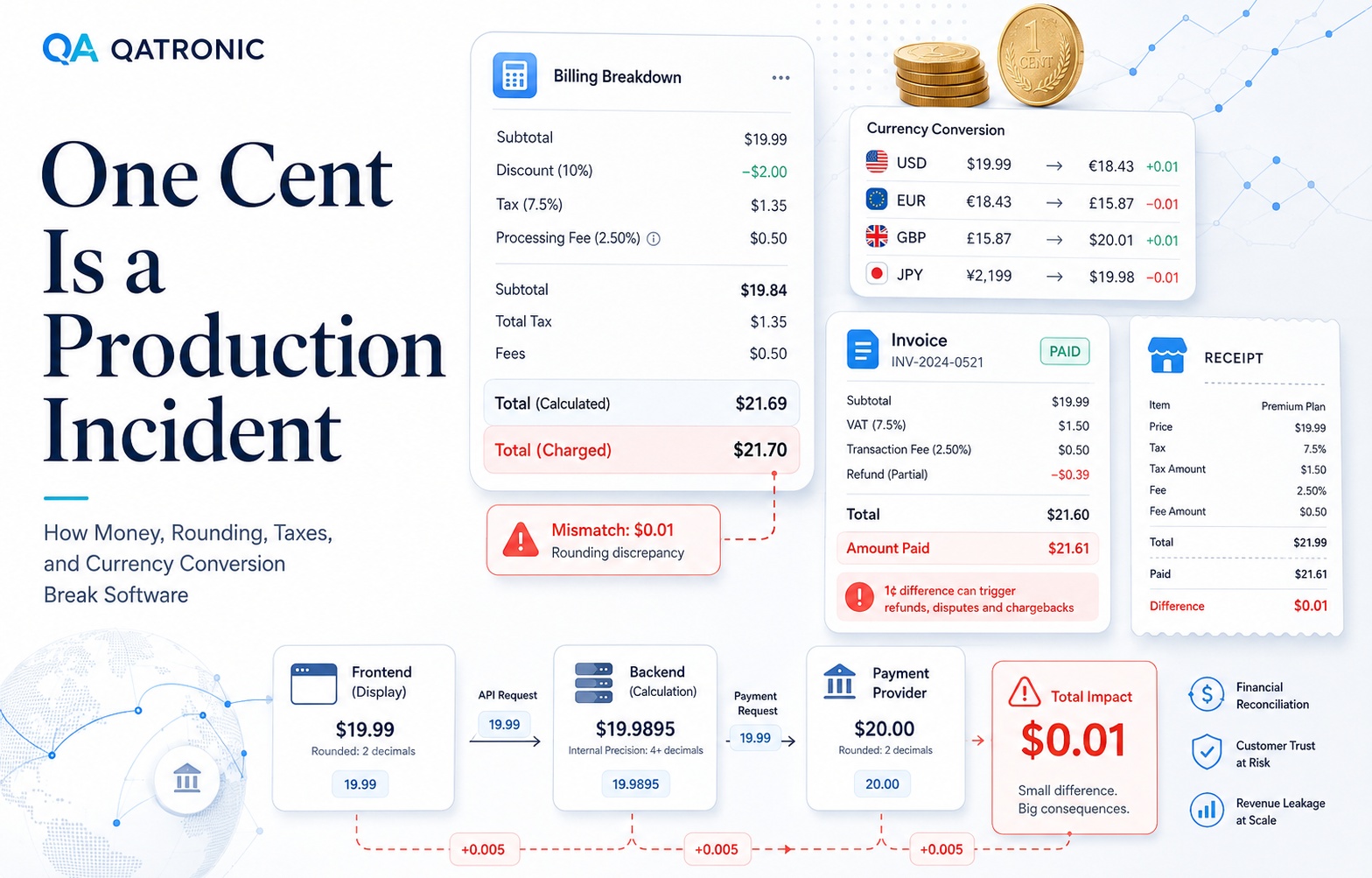
Take a single purchase. A customer buys something for what the receipt calls $19.99. Trace that number backward through the system that produced it, and you will usually find more than one correct answer.
The pricing engine may have computed 19.9875 before display rounding. The tax service may have applied its own rate to a slightly different base and arrived at a total that, once rounded independently, differs from the checkout page by a fraction of a cent. The payment processor, which only understands integer minor units, received 1999 and has no idea that the number was ever anything else. The invoice generator, running on a different code path than checkout, recomputed the same order from stored line items and got 19.98. The ledger, crediting revenue and tax as separate postings, closed the day with a one-cent suspense entry that nobody assigned to an account. Each of these numbers was produced by a defensible calculation. Only one of them is the number the customer was actually charged, and depending on which system you ask, more than one candidate will claim that title.
This is the condition financial software lives in permanently, not occasionally. It is not a bug in the conventional sense — nothing crashed, no exception was thrown, no test assertion failed in isolation. Every component did what it was told. The failure is that the components were told slightly different things, and nothing in the system was responsible for making sure their answers agreed.
That is the argument this article makes, in some detail: financial correctness is not the same thing as arithmetic correctness. A number can be computed with total mathematical precision and still be wrong, because correctness in a financial system is not a property of a formula — it is a property of agreement. A price is correct only if the frontend, the backend, the tax engine, the payment processor, the ledger, the invoice, and the reporting warehouse would all independently derive the same figure from the same facts, using rules they all recognize as authoritative. When they don't, you don't get a crash. You get a one-cent discrepancy that reconciliation catches six weeks later, or doesn't.
Money, in other words, is not merely a numeric datatype passed between functions. It is a distributed business invariant — a fact that many independent systems must agree on, continuously, across time, currencies, tax jurisdictions, discounts, refunds, and retries, even though those systems were built by different teams, deployed on different schedules, and in many cases never designed to talk to each other about how they arrived at a figure.
The rest of this article follows that invariant as it travels through a system: from a floating-point representation in memory, through pricing and tax logic, into a payment provider's integer minor units, into a ledger that has to explain itself months later, and out the other side into refunds, subscriptions, and financial reports that a warehouse team assembles without ever having read the original pricing code. At every one of those boundaries, the number changes hands, and at every handoff there is an opportunity for two systems to each be right by their own rules and wrong together.
The one-cent discrepancy is not the subject of this article. It is the symptom. The subject is what it reveals: that in most software systems, nobody actually owns the definition of a correct financial number, and the disagreement that produces a one-cent difference on a $19.99 order is the same disagreement that, at different amounts and larger volumes, produces failed reconciliations, disputed invoices, incorrect revenue recognition, and audits that take months longer than they should.
Part I — What Is the Number?
Money is not a float
Binary floating-point arithmetic, the kind implemented in hardware and exposed by default numeric types in most programming languages, represents numbers as sums of powers of two. Most decimal fractions that look simple to a human — 0.1, 0.2, 0.3 — have no exact representation in that scheme, in the same way that 1/3 has no finite representation in base 10. The stored value is the closest binary approximation available at a given precision, and arithmetic performed on those approximations accumulates small errors that are individually invisible and collectively unpredictable.
Python's own documentation on the subject notes plainly that 0.1 cannot be represented exactly as a binary floating-point number; the actual stored value is closer to 0.1000000000000000055511151231257827021181583404541015625, and operations built on approximations like this one are why an expression such as 0.1 + 0.2 does not evaluate to exactly 0.3 and why repeated addition of 0.1 does not reliably equal three times 0.1. None of this is a defect in any particular language. It is IEEE 754, the standard nearly every mainstream runtime uses for its default floating-point types, doing exactly what it is specified to do. The standard was designed for scientific and engineering computation, where a relative error of one part in 10^15 is irrelevant. It was never designed to guarantee that a specific decimal fraction, entered by a person and expected to round-trip exactly, would survive arithmetic unchanged.
Money needs the second property, not the first. A ledger does not care that a float is accurate to fifteen significant digits; it cares that $10.10 plus $0.05 equals exactly $10.15, every time, on every machine, forever. Floating-point types cannot promise that, because exactness was never the design goal.
The practical fix is not exotic. Most ecosystems provide an exact decimal type precisely for this purpose:
- Java provides
BigDecimal, an arbitrary-precision signed decimal, constructed from a string rather than a double whenever exactness matters, since constructing it from adoublemerely imports the double's existing imprecision. - Python provides the
decimalmodule, whoseDecimaltype implements base-10 arithmetic with configurable precision and explicit rounding rules, and which — as with Java — should be constructed from strings or integers, not from floats, or the float's rounding error is baked in beforeDecimalever sees the value. - C# provides a native
decimaltype, a 128-bit floating-decimal-point type distinct fromfloatanddouble, intended for financial and monetary calculations. - Ruby provides
BigDecimalin its standard library for the same purpose. - PHP has no native arbitrary-precision decimal type in the language core; developers typically reach for the BCMath extension, which performs arithmetic on numeric strings, or a well-audited third-party decimal library, because native PHP floats have the same binary limitations as everywhere else.
- SQL databases expose
DECIMAL/NUMERICcolumn types, which store an exact base-10 value with a defined precision and scale rather than a binary approximation. PostgreSQL's own documentation is direct on this point:realanddouble precisionare inexact, variable-precision types built on IEEE 754, and if you require exact storage and calculation — the documentation names monetary amounts specifically — usenumericinstead.
Choosing the exact type is necessary, but it is not sufficient, and this is the point where a lot of engineering guidance stops short. Decimal arithmetic prevents representation error. It does not tell you what scale to store values at, what to do when a division produces more digits than your target precision allows, or which of several defensible ways to round a boundary value your business considers correct. Those are policy questions, not datatype questions, and no type system answers them for you.
Precision is different from scale
Three numbers can all be true at once, at different points in a pipeline, without any of them being wrong:
- Internal precision: the number of significant digits a system carries through intermediate calculations. A billing engine computing a per-second usage charge might carry six or more decimal places internally so that a rate of $0.0000023 per API call doesn't collapse to zero before it's multiplied by volume.
- Displayed precision: what the customer sees. Almost always two decimal places for most currencies, regardless of how many decimal places were used to get there.
- Settlement precision: what actually moves between banks or card networks, which is dictated by the payment rail and the currency's minor unit, not by the merchant's internal convention.
- Accounting precision: what the general ledger records, which may match displayed precision exactly, or may retain a few extra digits specifically to track rounding residue as its own line item, so that the sum of all postings ties out to the penny even though individual calculations didn't.
Storing four or six decimal places internally while showing customers two is not a bug and not overengineering — it is often the only way to keep a usage-based system from losing money to rounding on every single calculation. The mistake is not carrying extra internal precision. The mistake is failing to define, explicitly and in one place, exactly where that extra precision gets collapsed down to the customer-facing figure, and making sure every system that needs to reproduce that figure collapses it the same way.
Currency does not mean two decimal places
A large fraction of financial software hardcodes an assumption that every currency divides into 100 minor units, because that happens to be true of the currencies most Western engineering teams grow up using. It is not true in general. ISO 4217, the international standard governing currency codes, assigns each currency a minor-unit exponent, and that exponent is not uniformly 2.
Japanese yen (JPY), Korean won (KRW), and a number of other currencies have an exponent of zero — there is no minor unit in ordinary use, and amounts are whole numbers. Kuwaiti dinar (KWD), Bahraini dinar (BHD), Omani rial (OMR), Jordanian dinar (JOD), and Tunisian dinar (TND), among a few others, have an exponent of three, meaning a price is properly expressed to three decimal places, and a payment API expecting minor units for one of these currencies expects the amount multiplied by 1,000, not 100. Adyen's own currency documentation makes this exact distinction explicit for integrators, and separately flags that a handful of currencies — CLF, CVE, IDR, and ISK among them — are handled with a different number of decimals in payment processing than the ISO 4217 standard technically specifies for the currency, because the processor's minor-unit convention and the "official" exponent have diverged in practice for historical reasons. That gap between the standard and what a given payment provider actually expects is itself a source of defects: code that hardcodes ISO 4217 exponents and code that hardcodes provider-specific exponents can silently disagree.
A currency-conversion utility, a payment integration, or an invoicing engine that assumes amount * 100 reliably converts a major-unit price into minor units will misprice every zero-decimal and three-decimal currency it touches — sometimes by a factor of 100, which is the kind of error that gets caught immediately, and sometimes by a factor of 10, which is subtler and more dangerous because it produces a plausible-looking wrong number rather than an obviously absurd one. The correct engineering response is not to memorize the exception list. It is to treat currency, in code, as metadata that always travels with an amount and determines that amount's precision — never as a constant.
Money needs a rounding policy
Every financial calculation that doesn't divide evenly eventually needs to decide what happens to the remainder, and there is more than one legitimate answer:
| Rounding mode | Behavior at a tie (e.g., 0.5) | Typical use |
|---|---|---|
| Half up | Rounds away from zero | Common default in consumer-facing pricing |
| Half down | Rounds toward zero | Less common; conservative in the payer's favor |
| Half even (banker's rounding) | Rounds to whichever neighbor is even | Statistical and accounting contexts where repeated rounding should not introduce systematic bias |
| Toward zero (truncation) | Always drops the remainder | Rare in pricing; more common in low-level numeric conversions |
| Away from zero | Always increments the discarded digit | Used in some fee calculations |
| Floor | Always rounds down, regardless of sign | Certain tax and allocation contexts |
| Ceiling | Always rounds up, regardless of sign | Minimum-charge and fee-rounding contexts |
Half-even rounding deserves particular attention because it is the default in more places than most engineers realize, and its behavior surprises people who expect ordinary "round half up" arithmetic. Java's RoundingMode.HALF_EVEN documentation describes it directly: it behaves like HALF_UP when the digit before the discarded fraction is odd, and like HALF_DOWN when that digit is even, and the documentation notes this is the rounding mode that statistically minimizes cumulative error when applied repeatedly across a long sequence of calculations — which is exactly why it is colloquially known as banker's rounding and why Python's decimal module uses ROUND_HALF_EVEN as its default context rounding rule. A payment integration that assumes "round half up" everywhere and a decimal library that defaults to "round half even" will occasionally, on values landing exactly on a boundary, disagree by one minor unit — not because either implementation is broken, but because "round the 0.5 case" is genuinely ambiguous until a policy says otherwise.
There is no universally correct rounding mode for money. Accounting contexts often prefer half-even specifically because it doesn't systematically favor the house or the customer across a large number of transactions. Consumer-facing pricing more often uses half-up because it's what people expect from grade-school arithmetic and because a merchant may have accounting reasons to prefer amounts to round in a predictable direction. Tax jurisdictions sometimes mandate a specific rounding treatment by regulation. The engineering requirement is not to pick the "right" one in the abstract — it's to pick one, write it down, and enforce that every system computing a financial figure for the same business process uses the same rule, because two systems each individually using a defensible rounding mode is precisely how a one-cent disagreement gets born.
Part II — Where One Cent Appears
A single order is not one number. It's a sequence of operations — multiply, subtract, add a percentage, add another percentage, subtract again — and every operation in that sequence is a place where a fractional remainder can appear and has to go somewhere.
product price
  × quantity
  − discount
  + tax
  + fee
  − credit
  × currency conversion rate
The question that determines correctness is not "what's the formula" — the formula is usually agreed on. The question is at which stage rounding is allowed to happen, and whether every system computing this total agrees on the answer.
Consider two strategies for a cart with several line items, each individually taxed:
Strategy A — round each line, then sum: Compute tax on each line item, round that line's tax to the currency's minor unit, and sum the rounded per-line tax amounts to get the invoice total.
Strategy B — sum first, then round: Sum the exact (unrounded) tax across every line item, and round only the final total once.
These two strategies do not, in general, produce the same result, and the difference is not exotic — it shows up on ordinary invoices with ordinary tax rates. Stripe's own published guidance on how it rounds tax on invoices demonstrates this with a concrete worked example: an invoice with two line items, one priced at $0.43 and one at $4.84, both taxed at 15%. Line one's exact tax is $0.0645, which rounds to $0.06. Line two's exact tax is $0.7265, which rounds to $0.73. Summed after rounding, that's $0.79 in tax on a $5.27 subtotal, for a total of $6.06. Had the two exact tax figures been summed first (0.0645 + 0.7265 = 0.791) and only then rounded, the result would still land on $0.79 in this particular case — but it is easy to construct line-item combinations where the two approaches diverge by exactly one minor unit, because rounding is not a linear operation and "round the sum" and "sum the rounded values" are mathematically different functions that happen to agree most of the time and disagree at the margins.
This is not a hypothetical concern invented for illustration. European VAT law has litigated it. In a case referred to the Court of Justice of the European Union involving the UK pub chain J D Wetherspoon, the question at issue was whether VAT should be rounded down per line item or calculated and rounded once at the level of the whole invoice or return — and the court's conclusion was that EU directives do not, by themselves, mandate one approach over the other, leaving the specific rounding methodology to national law. The practical result is that VAT rounding rules genuinely differ by country: UK guidance from HMRC permits rounding the total VAT on a B2B invoice down to the nearest whole penny, while accepting either line-level or invoice-level calculation; Dutch and German practice call for arithmetic rounding to the nearest cent, applied consistently at either the per-product or per-invoice level, but not switched between the two. A tax engine, a checkout page, and an ERP system that each assume a different one of these conventions will each be defensible under some jurisdiction's rules and will still disagree with each other on the same order.
Line-item allocation
A related but distinct problem appears whenever a single aggregate amount — a discount, a shipping charge, a loyalty credit — has to be spread across multiple line items that were each priced independently. A $10 discount applied to an order of three items priced at $12.99, $8.50, and $6.51 cannot, in general, be divided into three amounts that are each a "fair" proportional share and that also sum to exactly $10.00 when each share is independently rounded to the cent. Proportional allocation almost always leaves a remainder of one or two minor units that has to be assigned somewhere by an explicit rule, not left to whichever line happens to compute last.
Common deterministic strategies include assigning the entire remainder to the largest line item (minimizing the relative distortion any single line experiences), assigning it to the first or last line item in a defined sort order (simple and fully reproducible, though arbitrary-looking to an auditor), or using the "largest remainder" method borrowed from apportionment mathematics, where every line gets its rounded-down proportional share first, and the leftover units are handed out one at a time to whichever lines had the largest fractional remainder before rounding. None of these is objectively correct. What matters is that the business picks one, documents it, and every system that ever needs to reconstruct or re-derive a historical allocation — support tooling, refund calculation, tax reporting — implements the identical rule, because "just put the extra cent somewhere" is not a specification a second engineer can reproduce six months later without asking someone.
Quantity multiplication
Multiplying a unit price by a quantity is the least suspicious-looking operation in the whole pipeline, and it is where a surprising number of usage-based billing systems quietly lose money. A price of $0.0025 per API call, multiplied by 3,741 calls, is a calculation that needs more precision than two decimal places carries, and if the unit price itself was ever rounded to two decimal places before this multiplication happened, the result is wrong before the multiplication even starts. Telecommunications billing, cloud compute-minute billing, storage billing, and any system charging by a fractional or continuously variable quantity all face this same shape of problem: the unit price is often smaller than the currency's minor unit, and the arithmetic has to be done at higher precision than the display precision, with a single, well-defined point where the running total is finally rounded down to something a customer can be charged.
Percentage discounts
Chained percentage discounts are not commutative or associative in the way plain-language descriptions suggest. "10% off, then an additional 20% off" is not the same as "30% off." Applying 10% to $100 leaves $90; applying a further 20% to $90 leaves $72 — an effective discount of 28%, not 30%. This is ordinary arithmetic, not a bug, but it is a frequent source of customer complaints and support escalations when marketing copy says "up to 30% off" and a shopper who stacks two individually-true discounts arrives at a number that looks smaller than expected. The QA implication is concrete: discount-stacking logic needs explicit test cases for order-of-application (does a fixed-amount coupon apply before or after a percentage discount?), for combination limits (can this promotion legally stack with that one at all?), and for the arithmetic identity that marketing and legal teams assume holds, because in a percentage-based system it frequently does not.
Minimum charges and thresholds
Rounding and allocation errors become more consequential when they sit near a business-logic boundary rather than only affecting a displayed total. A one-cent difference that pushes an order from $49.99 to $50.01 can flip a "free shipping over $50" threshold. A one-cent difference in a computed fee can push a transaction below a payment gateway's minimum charge amount — Stripe, for instance, documents a $0.50 USD (or equivalent) minimum for charges — causing a rejection rather than a rounding discrepancy. A discount computed slightly differently than expected can exceed a configured maximum-discount cap by a fraction of a cent and trigger a validation error, or fail to trigger one when it should. These are not purely cosmetic issues; a one-cent arithmetic difference at a threshold changes which branch of the business logic executes, and threshold-adjacent values are exactly the boundary cases that deserve deliberate test design rather than incidental discovery.
Part III — Tax Is Not Just Price × Rate
Tax calculation is where the gap between "the formula is simple" and "the system is correct" is widest, and it is worth being explicit up front: nothing in this section is legal advice, and specific jurisdictional rules should always be sourced from current regulations or from a tax-calculation provider's documentation, not inferred from an engineering article.
What an engineering team does need to understand is the shape of the complexity, because the shape is what determines where the software needs seams.
Inclusive versus exclusive pricing. A price can be quoted with tax already folded in (common in many consumer VAT jurisdictions) or quoted before tax, with tax added at checkout (common in US sales tax contexts). These are not just display choices — they change which number is the "base" for every downstream calculation, including discounts, refunds, and revenue recognition, and a system built assuming exclusive pricing will misprice every inclusive-pricing market it expands into unless the distinction is modeled explicitly rather than assumed globally.
Multiple rates on one order. A single cart frequently mixes items taxed at different rates — a standard rate, a reduced rate for certain goods, and a zero rate for exempt items are all common within a single jurisdiction's VAT or sales tax scheme. This means "tax" is not a single percentage applied to an order total; it's a set of sub-totals, each taxed independently, each subject to its own rounding, and each potentially reported separately on the resulting invoice.
Jurisdiction. Which jurisdiction's rate applies is itself a nontrivial determination — it can depend on the seller's location, the buyer's location, the nature of the good or service (physical goods versus digital goods are frequently treated differently), and whether the transaction crosses a national or sub-national tax boundary at all. Digital goods sold cross-border raise their own well-known complications around where the sale is considered to occur for tax purposes, and reverse-charge mechanisms — where the obligation to remit tax shifts to the buyer, most commonly in B2B cross-border transactions — change not just the rate but which party in the transaction owes the government money in the first place.
Exemptions. Certain customers (nonprofits, government entities, resellers with a valid exemption certificate) and certain products can be exempt from tax entirely, or taxed at a different rate than the same product would be for a different buyer. This means the tax calculation isn't purely a function of the cart — it's a function of the cart and the customer's tax status, and that status can change between when an order is placed and when it's invoiced.
Rounding. As established in Part II, whether tax is rounded per line item or once at the invoice level is a real, sometimes jurisdiction-specific decision, not an implementation detail free for an engineer to choose unilaterally. The same order can legitimately owe a different total tax amount depending on which rounding convention the seller's accounting system has adopted, and switching conventions mid-stream — say, when a company migrates checkout platforms — can produce invoices that don't match the prior period's totals for reasons that have nothing to do with a bug.
Discounts and tax order. Whether a discount is applied before or after tax is computed changes the tax owed, not just the customer's final price. A coupon that reduces the taxable base produces a different tax bill than a coupon applied as a post-tax credit, and which of these two a given promotion is supposed to be is a business and legal question that the checkout, invoicing, and tax-reporting systems all need to agree on identically.
Shipping. Whether shipping charges are themselves taxable, and at what rate, varies by jurisdiction and by whether shipping is bundled into the price of goods or itemized separately — another place where "tax = rate × total" silently breaks down into "tax = rate × (some subset of the total, determined by rules that live outside the pricing engine)."
Refunds and recalculation. When an order is partially refunded, the tax associated with the refunded portion has to be recalculated and, in most jurisdictions, separately reported — refunding the pre-tax amount and leaving the tax untouched is generally wrong, but so is naively refunding a proportional share of tax without accounting for how that order's tax was originally rounded and allocated across line items in the first place.
The engineering consequence of all this is that a tax engine, a checkout page, an invoice service, an ERP, and a payment processor are five different systems that can each implement a locally reasonable interpretation of "calculate the tax" and disagree with each other by construction, not by accident. Effective QA coverage in this domain means deliberately constructing test orders that combine mixed tax rates within one cart, discounts applied both before and after tax, taxable and tax-exempt line items in the same order, shipping charges under different taxability rules, and — critically — partial refunds against orders that were already tax-adjusted once. Every one of these combinations is a place where two systems computing "the same" tax figure by two individually defensible methods will produce two different numbers, and the only way to catch that before a customer or an auditor does is to test the combinations deliberately rather than trusting that a rate lookup and a multiplication are the whole story.
Part IV — Currency Conversion Creates a Second Number
The moment a transaction crosses a currency boundary, "the amount" stops being one number and becomes a small family of related numbers, each correct in its own frame of reference:
- Transaction currency — what the customer saw and agreed to pay, in the currency of the storefront or price list.
- Billing currency — what actually appears on the customer's card or bank statement, which may differ from the transaction currency if a card network or acquiring bank performs its own conversion.
- Merchant currency — the currency the seller's business operates and reports in.
- Settlement currency — the currency that actually lands in the seller's bank account, which the payment provider may convert to on the merchant's behalf, at a rate and fee schedule the provider controls.
- Reporting currency — the currency used for consolidated financial statements, especially for a multinational business, which may differ again from all of the above and typically applies its own conversion convention (often a period-average or period-end rate) that has nothing to do with the rate in effect at the moment of the original transaction.
A single $49.99 USD purchase, in other words, can legitimately have five different correct monetary representations depending on which system and which purpose you're asking about, and none of the five is "the real one" in isolation — they are all real, in their own context, simultaneously.
Currency conversion architecture has to account for a handful of variables that are easy to omit from a first design and expensive to retrofit later:
- Rate source and timestamp. Exchange rates move continuously. A rate quoted at the moment of checkout is not the same rate that will be in effect an hour later when a payment actually settles, and depending on the payment flow, authorization and settlement can happen at meaningfully different times.
- Bid/ask spread and provider markup. The rate a payment provider or card network actually applies is rarely the raw interbank mid-market rate; it typically includes a spread or an explicit markup, and that markup is itself a cost that needs to be accounted for somewhere, usually as a fee rather than folded silently into the displayed rate.
- Rate locking. Some systems lock in a rate at the moment of quote or checkout and honor that rate through settlement; others recompute at settlement time using whatever rate is then current. These are different product decisions with different financial exposure, and a system that doesn't clearly document which one it does will produce settlement amounts that mysteriously don't match what was quoted.
- Conversion fees, charged either by the payment provider, the card network, or the customer's own bank, none of which is necessarily visible to the merchant's system at the time of the original transaction.
What has to be persisted to make any of this auditable later is more than just the final converted figure. A defensible design retains, per transaction: the source amount and source currency, the exchange rate actually applied, which provider or rate source supplied that rate, the timestamp the rate was captured at, the resulting converted amount and target currency, and the rounding policy used to get from an exact conversion to a currency-appropriate figure. Storing only the final number and discarding everything that produced it is a common shortcut, and it is precisely what makes later reconciliation — matching what your system believes happened against what a bank statement or provider settlement report says happened — effectively impossible, because there's no way to tell, after the fact, whether a discrepancy is a bug or simply a different, equally legitimate rate.
This matters acutely for historical reporting. Recalculating an old transaction using today's exchange rate, rather than the rate that was actually in effect and stored at the time, produces a number that has never been true of that transaction at any point in time — it's neither what the customer paid nor what the business received, it's a hypothetical that happens to use real historical transaction data as its input. Financial reports that regenerate historical figures using current rates rather than stored historical rates will not tie out to bank statements, and will not tie out to the same report run a month earlier, which is exactly the kind of instability that erodes trust in a reporting system even when every individual number in it is "correct" by some definition.
Refunds compound the problem directly. If a customer paid in EUR, the merchant settled in USD, and a refund is issued weeks later after the EUR/USD rate has moved, what amount should the customer actually receive back — the original EUR amount converted at today's rate, the original EUR amount fixed regardless of rate movement, or the USD amount the merchant actually received, converted back to EUR at whatever rate applies now? There is no universally correct answer; different businesses adopt different policies, and card network rules and local consumer-protection regulations can constrain which policies are even permissible in a given market. What's non-negotiable from an engineering standpoint is that the refund calculation has to reference the rate and amounts actually stored against the original transaction, apply a documented, consistent policy for how rate movement between purchase and refund is handled, and produce a result that a support agent — and eventually an auditor — can reconstruct from persisted data rather than from a fresh currency-API call that returns a different number every time it's queried.
Part V — The Payment Provider Has Its Own Rules
Every payment provider — Stripe, Adyen, PayPal, a direct bank integration, a card processor — is a system boundary with its own internal model of money, and that model does not automatically match the merchant's internal model just because both sides are talking about "the same" transaction.
The most immediate mismatch is representation. Stripe's API, like most modern payment APIs, expects amounts as integers in the currency's smallest unit rather than as decimal major-unit values — 1999 to charge $19.99, or 100 to charge ¥100 for a zero-decimal currency, with Stripe's documentation noting the amount field supports up to eight digits and specifying an explicit minimum charge, $0.50 USD or the equivalent in the charge currency. A merchant system that converts an internal decimal amount to this integer representation using ordinary floating-point multiplication — amount * 100 on a JavaScript Number, for instance — runs directly into the binary-representation problem from Part I: a value like 33.80 multiplied by 100 in IEEE 754 double-precision arithmetic does not reliably produce exactly 3380; it can produce 3379.9999999999995, which then either gets truncated to the wrong integer or rejected outright by the provider's stricter validation. This is not a theoretical edge case — it is a commonly reported integration bug precisely because the failure is silent until a specific value happens to land on an inexact binary boundary.
Beyond representation, there is a whole lifecycle of transaction states that a merchant's internal order model has to map onto correctly: authorization (a hold placed on funds, not yet a transfer), capture (converting some or all of an authorized hold into an actual charge), partial capture, void (canceling an authorization before capture), refund, partial refund, chargeback, dispute, and eventual settlement. "Payment succeeded" from a merchant's perspective often really means "authorization succeeded," and conflating that with "money has moved and our internal financial state is now correct" is a common source of drift between what a payment dashboard shows and what an order-management system believes.
This lifecycle intersects directly with distributed-systems failure modes, because a payment request is a network call, and network calls fail in the usual ways: the request times out after the provider has actually processed it, so the client doesn't know whether to retry; the client retries and now risks a duplicate charge; a webhook describing the payment's outcome arrives before the original API call's response does; the same webhook is delivered more than once; webhooks describing logically sequential events — a subscription being created, then updated, then canceled — arrive out of order.
Payment providers are explicit that this is expected, not exceptional, behavior. Stripe's idempotency documentation describes exactly the mechanism built to survive it: a client generates an idempotency key — Stripe recommends a V4 UUID or another string with enough entropy to avoid collisions — attaches it to a request, and if a connection error occurs, the client can safely resend the identical request with the same key without risking a duplicate charge or duplicate object, because Stripe saves the resulting status code and body of the first request made under that key and returns the same result for any retry, including retries of a request that originally failed with a server error. Keys aren't permanent; Stripe documents pruning them after roughly 24 hours, after which a reused key simply starts a fresh request. Crucially, the idempotency layer also compares the parameters of a retried request against the original and returns an error if they don't match, specifically to prevent a key being reused for a different operation by accident.
Webhook delivery carries a parallel, separate guarantee — or rather, a parallel absence of one. Stripe's documentation and the broader engineering literature on webhook handling are consistent on two points: an endpoint can receive the same event more than once, and event ordering is not guaranteed, meaning an update event can in principle arrive before the creation event it logically follows, particularly under retry conditions. The standard, well-documented mitigation is to persist the event's unique ID before acting on it and to make every webhook handler idempotent against redelivery of an event it has already processed — typically by checking a stored table of already-handled event IDs before applying any side effect, and designing state transitions so that receiving events out of order doesn't corrupt state, for instance by comparing an event's timestamp against the currently stored state rather than assuming every update event represents forward progress.
None of this is optional plumbing that can be deferred to "later." A payment integration that doesn't idempotently handle both request retries and webhook redelivery will, at sufficient volume, eventually double-charge a customer, double-fulfill an order, or leave an order stuck in an inconsistent state — not because of a rare edge case, but because retries and duplicate deliveries are a normal, expected part of how these systems operate under real network conditions. This is also the clearest place in the entire subject where financial correctness and distributed-systems correctness are not two related disciplines — they are the same discipline wearing two different names. Testing a payment integration properly means testing it the way you would test any at-least-once delivery system: duplicate event delivery, out-of-order event delivery, retried requests with identical idempotency keys, retried requests with reused keys and different parameters (which should be rejected), and timeouts where the client genuinely cannot know whether the original request succeeded.
Part VI — The Ledger Must Have a Memory
A balance column that a system updates in place — incrementing it on a charge, decrementing it on a refund — is a convenient read model and a dangerous system of record. The moment a balance is only ever a mutated field, the history of how it arrived at its current value stops existing. If that value is ever wrong, there is no way to determine when it went wrong, what event caused it, or what the correct value should have been at any prior point in time, short of reconstructing events from application logs that were never designed to be a financial record.
The alternative — standard in serious financial infrastructure — is to treat the balance not as stored state but as a derived value: the sum of an append-only history of immutable transactions, where a balance at any point in time is computed by replaying or aggregating every transaction up to that moment, rather than trusted as a field that was incremented and might have been incremented incorrectly, twice, or not at all. Modern Treasury's engineering writing on ledger design puts the underlying argument directly: in a double-entry system, discrepancies can generally be reverse-engineered from the transaction history, but if the underlying data has been mutated in place, that history is destroyed, and reconstructing what actually happened becomes impossible rather than merely inconvenient.
Double-entry accounting — where every transaction is recorded as a balanced pair of postings, a debit to one account and a matching credit to another, such that the two always sum to zero — is centuries old for a specific engineering reason as much as an accounting one: it makes it structurally impossible for a single erroneous entry to pass silently, because every entry has to balance against its counterpart, and any transaction that doesn't is immediately detectable as an integrity violation rather than something that has to be noticed by a human auditor sampling the books. This is worth treating as an engineering pattern, not merely an accounting convention imported wholesale — it functions, in a financial ledger, roughly the way a checksum or a foreign-key constraint functions elsewhere: a structural guarantee that catches a class of corruption automatically rather than relying on someone noticing it later.
Whether or not a given system implements full double-entry bookkeeping, the more general principle generalizes cleanly to engineering practice: a number without provenance is difficult to trust. A well-designed financial system should be able to answer, for any stored monetary figure, a specific and non-negotiable set of questions: Where did this amount come from — which order, which line items? What rule computed it — which pricing version, which tax rate, which discount logic? Which exchange rate was applied, from which provider, captured at what timestamp? Which specific transaction changed the account balance, and in which direction? Was the value later adjusted, reversed, or corrected, and if so, by what subsequent transaction, authorized by whom?
A system that can't answer these questions isn't necessarily wrong today. But when it is wrong — and at sufficient scale and time horizon, every financial system eventually is, somewhere — the cost of finding out why scales directly with how much of this provenance was actually captured at the time the number was produced, rather than reconstructed afterward from incomplete logs and best guesses.
Part VII — Refunds Are Not Negative Purchases
A common and understandable first implementation of refunds treats them as the purchase transaction run in reverse: take the original charge, multiply by negative one, and reverse it. This is correct in exactly one case — a full refund of a simple, single-line, untaxed, undiscounted order — and increasingly wrong as any real-world complexity is layered on top.
Consider a concrete multi-line order: three products at $12.99, $8.50, and $6.51, a $10.00 order-level discount allocated proportionally across the three lines, 8% sales tax applied after the discount, and a $5.00 flat shipping charge that is itself non-taxable in this jurisdiction. The subtotal is $27.99 less allocation-adjusted per-line discounts (Part II already established that this $10 discount cannot divide evenly across the three lines without a defined remainder rule); assume the allocation lands the lines at effective post-discount prices of roughly $8.30, $5.43, and $4.16, with the one-cent remainder assigned to the largest line by the store's documented policy. Tax at 8% is computed and rounded per line, shipping is added untaxed, and the order settles at some total the customer actually paid — call it $22.90.
Now the customer returns one item — the $12.99 one — and requests a refund. What should come back?
It is not simply that item's original list price. It's that item's allocated, post-discount, taxed share of the order — the $8.30-ish effective price it actually contributed after its portion of the discount, plus the tax that was charged on that specific reduced amount, since refunding pre-discount tax overstates what the customer is owed. Shipping is a separate question entirely, governed by the merchant's own policy on whether a partial return entitles the customer to any shipping refund at all. And if this is not the first refund against this order — if a different item was already partially refunded last week — the calculation has to account for exactly what has already been returned, because the sum of everything refunded so far must never exceed what remains refundable, and "refundable" is not one number but several: there's a refundable-product-amount ceiling, a refundable-tax ceiling, a refundable-shipping ceiling, and typically a non-refundable-fee category (a payment processing fee, a restocking fee) that shouldn't be returned at all under most merchant policies.
This is the concrete, worked shape of what the article's opening argument means by refunds needing more care than "reverse the transaction." Full refunds are comparatively simple. Partial refunds against discounted, multi-line, taxed orders require proportional recalculation against the effective price the customer actually paid for the specific item being returned, not the catalog price; multiple sequential partial refunds against the same order require tracking a running total against each of several independent refundable ceilings, not one; refunds involving a currency conversion inherit every question raised in Part IV about which exchange rate applies to money moving backward; and refunds issued as store credit, gift card balance, or loyalty points rather than a reversal of the original payment method introduce yet another representation of "money" that has to reconcile against the same underlying order.
Refund idempotency deserves the same rigor described in Part V for payments generally — a refund request that times out and gets retried must not produce two refunds, and the same idempotency-key discipline that prevents duplicate charges applies with equal force to preventing duplicate refunds, which are, from a pure cash-flow perspective, exactly as damaging as duplicate charges, just in the opposite direction.
Part VIII — Subscriptions Multiply the Problem
Every complication catalogued so far — rounding, allocation, tax, currency, provider state, ledger provenance, refund correctness — recurs inside subscription billing, and recurs on every billing cycle, for every customer, indefinitely. Subscription billing doesn't introduce a new category of financial bug so much as it multiplies the exposure of every existing category by the number of renewal cycles a customer lives through, and it adds one genuinely new hazard on top: proration.
Proration is the calculation of a partial charge or credit when a subscription changes mid-cycle — an upgrade, a downgrade, a quantity change, or a billing-date reset that happens before the current period has finished. Stripe's own documentation on how it prorates subscription changes lays out the shape of the calculation directly, and it's a useful concrete reference because it shows how much surface area a "simple" mid-cycle plan change actually has: a customer who signs up on May 1st for a $100/month plan is billed $100 immediately; if they switch to a $200/month plan on May 15th, they're billed $250 on June 1st — $200 for the renewal of the new plan, plus a $50 proration charge representing half of the $100 difference between the two plans for the second half of May that was already paid for at the old rate. The underlying formula, as Stripe frames it more generally, is a proration factor: the fraction of the billing period the item was actually in effect, applied as a positive multiplier to new charges and a negative multiplier to credits for unused time on the old plan — and, notably, Stripe's documentation specifies this is calculated down to the second, not the day, meaning the exact timestamp of the change, not just the date, determines the final figure.
That level of precision is not incidental complexity — it's necessary complexity, because a day-level proration model produces visibly wrong results for a change made at 11:58 PM versus one made at 12:02 AM the same billing period, and a system that rounds to the nearest day rather than tracking exact elapsed time will produce charges that a careful customer can catch as unfair even if they're individually small.
Layer the following on top of a base proration calculation, and each one interacts with it rather than sitting alongside it independently: an existing percentage or fixed-amount discount that has to be applied to both the old-plan credit and the new-plan charge, correctly, without double-applying or dropping it entirely on one side of the calculation; tax, which has to be recalculated on the new prorated amounts rather than reused from the last full-price invoice; any existing account credit or balance that should offset the prorated charge; a trial period that hasn't yet ended, which changes whether a proration should generate a charge at all; and usage-based charges accrued during the shortened or lengthened billing period, which Stripe's own documentation notes are explicitly not subject to proration in the same way fixed-price items are, because usage is metered rather than time-based.
Every one of these interacting factors is individually a small rounding or allocation decision. The reason subscription billing is disproportionately dangerous compared to one-time purchases is that these small decisions compound across every renewal a customer experiences, across every plan change, and the invoice that results from all of them has to be independently reconstructible later — a support agent investigating a customer's billing history eight months from now needs to be able to see not just the final charged amount, but which pricing rule, which discount, which tax rate, and which proration factor were in effect at that specific moment, using the rules that applied then, not the rules that apply today.
This leads directly to a requirement that is easy to skip in an initial implementation and expensive to retrofit: current catalog pricing changing must never silently rewrite the economics of a historical invoice. If a plan's price changes from $20 to $25 next quarter, every invoice already generated at $20 needs to remain explainable at $20 — which means pricing, discount, and tax rules all need some notion of versioning, a concept developed further in Part XIX, rather than being treated as a single mutable global configuration that every calculation, past and present, reads from live.
Part IX — UI Numbers Can Lie Without Being Wrong
A frontend and a backend can display two different totals for the same order without either one containing a bug, and this deserves to be stated as plainly as possible because it's counterintuitive: the frontend showing $19.98 while the backend charges $19.99 is not automatically evidence of an error. It's evidence that two systems independently calculated a number, and independent calculation of a value that's supposed to be authoritative in exactly one place is the underlying design mistake, not the specific arithmetic that produced the mismatch.
This happens for a handful of recurring, identifiable reasons. The frontend may be running its own simplified pricing logic — reasonable for showing a live estimate as a customer adjusts quantity in a cart, dangerous if that estimate is ever treated as the final authoritative figure rather than a preview pending server confirmation. Cached or stale pricing data can leave a frontend showing a price that changed on the backend moments ago. Currency and locale formatting differences — not calculation differences, purely display differences — can make identical underlying values look inconsistent: 1,234.56 in US formatting is the same number as 1.234,56 in much of continental Europe, and a system that formats a number using the wrong locale convention produces output that a user will, quite reasonably, read as a completely different value, off by three orders of magnitude, rather than as a formatting mismatch.
Locale-aware formatting has more edge cases than the comma-versus-period distinction. Negative amounts are sometimes shown with a leading minus sign and sometimes with surrounding parentheses, a convention borrowed from accounting practice that a payment confirmation screen and an invoice PDF can disagree on even within the same product. Currency symbol placement varies — before the number, after the number, with or without a space, sometimes using a narrow no-break space that renders invisibly different across fonts and email clients. None of these are calculation bugs. All of them can make a technically correct number look wrong to the person reading it, which — from the perspective of a support ticket queue — is functionally indistinguishable from an actual calculation error, because the customer experience and the resulting cost to the business are the same either way.
The general engineering principle worth stating explicitly: the frontend should not independently reimplement complex financial business rules — discount stacking, tax jurisdiction logic, proration — and should instead treat any number it displays before final confirmation as a preview, sourced from the same calculation path the backend will use to actually charge the customer, rather than a parallel client-side approximation of it. Where a frontend does need to show an estimate before that server round-trip completes — for responsiveness, most commonly — that estimate should be clearly framed to the user as provisional, and the relationship between "what you're seeing now" and "what you'll actually be charged" needs to be unambiguous rather than implied. A displayed subtotal that quietly becomes a different total at the next screen, with no visible explanation for the difference, reads to a user as a bait-and-switch regardless of how legitimate the underlying tax or fee calculation actually was.
Part X — Financial Invariants
Individual test cases catch individual bugs. What catches classes of bugs, including ones nobody thought to write a specific test for, is treating certain properties of a financial system as invariants — statements that must hold true across every possible transaction, every code path, and every point in time, rather than facts that happen to be true of the specific examples someone wrote down.
A representative, non-exhaustive set of invariants a financial system should be able to state and mechanically verify:
- An invoice's total must always equal the defined composition of its own components — subtotal, discounts, tax, shipping, fees — recomputed from those stored components, not merely equal to whatever value happened to be written to a
totalcolumn. - The amount actually captured or charged must never exceed the amount authorized, unless the system explicitly and deliberately supports over-capture as a distinct, documented behavior.
- The sum of every refund issued against an order must never exceed that order's refundable amount, tracked separately across product, tax, shipping, and fee ceilings as established in Part VII.
- Every payment the provider considers settled should, eventually, map to exactly one corresponding internal financial record — no more, no fewer.
- Every internal transaction marked settled should, where a provider is involved, have a corresponding state at that provider — an internal "succeeded" with no matching provider record is itself a defect signal.
- A monetary value should never exist in storage or in a message payload without an accompanying currency — an amount alone, absent its currency, is not partial data; it is essentially meaningless data that happens to type-check.
- A historical transaction must retain the pricing, tax, and discount context that was actually in effect when it occurred, immune to later changes in current catalog pricing or tax rates, as established in Part VIII.
- A retried request or a redelivered event must never cause additional money to move, beyond whatever happened on the first successful attempt, as established in Part V.
The reason invariant-based testing is a meaningfully stronger practice than screen-by-screen or endpoint-by-endpoint testing is that an invariant is checked against every code path that can produce a financial state change, including ones a test author never specifically anticipated — a new discount type added eight months from now, a new payment method integrated by a different team, a bulk-import script written under deadline pressure that bypasses the normal order-creation flow entirely. A conventional test suite verifies that the paths someone thought to test behave correctly. An invariant, enforced continuously — via property-based generative testing, database-level constraints, reconciliation jobs, or ideally more than one of these simultaneously — verifies that no path, known or unknown, violates a property the business genuinely cannot tolerate being false, which is a categorically different and stronger guarantee.
Part XI — Testing Strategy
A financial system's test coverage is more usefully organized by which risk surface a defect would emerge from than by the conventional unit/integration/end-to-end pyramid, because the same underlying bug — an off-by-one-cent rounding error, say — looks completely different and requires a different kind of test depending on which layer it originates in.
Arithmetic layer. Precision, rounding-mode correctness at tie-breaking values, correct behavior at zero and at negative amounts, correct behavior at very large amounts (where integer overflow becomes a real, not theoretical, concern in some representations), and correct handling of fractional quantities as covered in Part II.
Rule layer. Discount logic — including the stacking and ordering behavior from Part II — tax logic across the dimensions cataloged in Part III, fee calculation, pricing-tier logic, and promotional-code redemption logic, tested as compositions of rules rather than as isolated formulas, since the interactions between rules are where most real defects live.
Transaction layer. The full state-machine lifecycle from Part V — authorize, capture, partial capture, void, refund, cancellation — including retried requests and duplicate submissions, tested specifically for the idempotency guarantees the system claims to provide rather than only for the happy path where every request succeeds on the first attempt.
Integration layer. Provider disagreement — a state the merchant's system believes is true that the provider's records don't confirm — webhook duplication, delayed webhook delivery, out-of-order event delivery, API timeouts where the outcome is genuinely unknown to the client, and provider-side outages, all as described in Part V, tested against realistic failure injection rather than assumed away because "the provider is usually reliable."
Accounting layer. Ledger consistency under the double-entry-style invariants from Part VI, balance reconstruction from transaction history rather than trust in a stored balance field, and the specific scenario of reconstructing a historical balance as of an arbitrary past date, which is a meaningfully harder test than checking the current balance and is exactly the kind of query a real audit will eventually ask for.
Reporting layer. Whether the dashboard a business user looks at, the invoices sent to customers, the transactional database, the data warehouse, and the payment provider's own reporting all agree with each other over the same period — not individually correct in isolation, but mutually consistent, which is a distinct and often-skipped property.
The uncomfortable fact this layered structure surfaces is that a system can pass every checkout-flow test in its suite — every arithmetic test, every rule test, every transaction-lifecycle test — and still fail reconciliation, because reconciliation is testing a property none of those layers individually cover: whether the aggregate, over time, across every transaction and every system that touched it, still agrees. A checkout flow can be locally correct on every single transaction and still drift, in aggregate, from what a bank statement or a payment provider's settlement report says happened, because the accumulation of many individually-tiny, individually-defensible rounding and timing differences is exactly the kind of property that only becomes visible in aggregate, over volume, over time — which is precisely why Part XIV treats reconciliation as its own distinct, continuously running form of testing rather than a one-time integration check.
Part XII — Test Data That Actually Finds Money Bugs
Round numbers are comfortable and almost useless as financial test data. $10, $20, and $100 divide evenly by nearly everything, round predictably in every rounding mode, and convert cleanly across most currency pairs — which means they are exactly the values least likely to expose a rounding, allocation, or precision defect, because those classes of bug live specifically at the boundaries that round numbers are constructed to avoid.
Test data that actually exercises the failure modes catalogued in this article looks different: amounts ending in .01 and .99, specifically chosen to sit adjacent to a rounding or threshold boundary; amounts that land exactly on a rounding tie, like .005 at the third decimal place, chosen specifically to expose whether a system's rounding mode is half-up, half-down, or half-even, since these three modes only produce different output at exactly this kind of boundary value; amounts and rates that produce recurring or non-terminating decimals when multiplied or divided, forcing an explicit decision about where precision gets truncated; quantities that are fractional or very large, to test both allocation math and integer-overflow behavior at scale; percentage combinations that are individually round but jointly awkward, of the kind described in Part II's discount-stacking discussion; amounts small enough to be smaller than a currency's minor unit once a percentage is applied, testing whether a system correctly handles a computed value that rounds to zero; amounts large enough to approach a payment provider's documented maximum charge, such as the eight-digit ceiling Stripe documents for its amount field; and prices in currencies with non-standard minor-unit exponents — a JPY amount, a KWD amount — specifically to test whether currency-handling code that was only ever exercised against two-decimal currencies breaks when the exponent isn't 2.
| Scenario | Risk | Example input | Expected validation |
|---|---|---|---|
| Rounding tie | Ambiguous rounding mode | Amount computing to exactly X.XX5 | Result matches the documented rounding policy, not an incidental library default |
| Zero-decimal currency | Off-by-100× or off-by-10× conversion | ¥1,500 (JPY) | Minor-unit conversion treats JPY as 1:1, not 1:100 |
| Three-decimal currency | Off-by-10× conversion | 1.500 KWD | Minor-unit conversion multiplies by 1,000, not 100 |
| Discount remainder | Unassigned or double-assigned cent | $10 discount across 3 unevenly priced lines | Allocated shares sum exactly to $10.00 under the documented remainder rule |
| Sub-minor-unit computed tax | Silent zero rounding | 1% tax on a $0.01 line item | Explicit handling, not silent disappearance of the tax owed |
| Threshold adjacency | Wrong business-logic branch | Order total of $49.995 pre-rounding | Free-shipping threshold evaluated against the correctly rounded, not pre-rounded, total |
| Sequential partial refunds | Over-refund | Two partial refunds against one discounted, taxed order | Cumulative refund never exceeds any of the independent refundable ceilings |
The goal of a table like this is not to enumerate every case a team should test — that list is effectively unbounded once every dimension in this article is combined with every other one — but to teach the underlying method of deriving adversarial financial test data: identify every operation in the pricing-to-settlement pipeline that involves a division, a percentage, a rate, or a rounding step, and construct inputs specifically chosen to sit at that operation's boundary conditions, rather than inputs chosen for narrative plausibility as a "realistic-looking" order.
Part XIII — Property-Based Testing for Financial Software
Property-based testing inverts the usual relationship between a test and its input. A conventional test specifies one input and one expected output. A property-based test specifies a property that should hold across an entire space of inputs, and a generator — a library like Hypothesis for Python, or comparable tools for other ecosystems, all descending conceptually from Haskell's original QuickCheck — produces a large number of varied inputs and checks whether the property holds for each one, automatically narrowing ("shrinking") any failing case down to the smallest input that still reproduces the failure, which is often far more informative than the original randomly generated counterexample.
For financial software specifically, a number of the invariants already established in Part X translate directly into properties a generative test can check across a wide space of amounts, quantities, currencies, and rates, rather than the handful of example values a human would think to write by hand:
- Adding a line item to an order should never decrease the order's total, under any combination of pricing rules that don't specifically include a credit or discount item — a property that should hold across randomly generated combinations of items, quantities, and existing discounts, not just the two or three combinations a developer happened to think of.
- Applying a 0% discount, or a discount coupon with no eligible items in the cart, should leave the total unchanged to the minor unit — an identity property that's trivial to state and surprisingly easy to violate with an off-by-one in discount-eligibility logic.
- Processing the same idempotent event twice — a webhook redelivery, a retried payment request — must never change the account balance by more than processing it once did, checked not against one hand-picked duplicate-delivery scenario but against many randomly generated ones with varying timing and ordering.
- The sum of allocated per-line discount amounts, computed by whatever remainder-assignment rule Part II's discount allocation uses, must always equal the total discount amount exactly, across randomly generated combinations of line-item prices and cart sizes, not just the specific three-item example a developer manually verified.
- The sum of per-line tax amounts, plus any documented rounding-residue adjustment, must always equal the invoice-level tax total the business has defined as authoritative — checked across generated combinations of tax rates, line-item counts, and prices specifically because, as established in Part III, the "round each line then sum" and "sum then round" strategies genuinely diverge at some inputs and a property-based test is well suited to searching for exactly which inputs those are.
The genuine value of this approach for a financial codebase is that it systematically searches a combinatorial space — amounts, quantities, currencies, discount percentages, tax rates, all varied simultaneously — that no team, however careful, is going to enumerate by hand across every possible interaction, and it is precisely at the unexpected intersections of these dimensions, not at the individually obvious cases, that rounding and allocation bugs tend to live.
Part XIV — Reconciliation: The Test That Runs After Production
Some financial correctness checks cannot be performed before a transaction happens, because they depend on comparing what the application believes occurred against what an external, independent system — a payment provider's settlement report, a bank statement, an accounting platform — says actually occurred. This comparison, run against internal transactions, provider reports, bank settlement records, invoices, and the accounting system, all in relation to each other, is reconciliation, and it functions as a correctness check that continues to run long after the original code path has finished executing and returned a success response to the user.
Reconciliation surfaces a distinct set of discrepancy types: transactions present internally with no matching provider record, or the reverse — a provider settlement with no corresponding internal transaction; genuine duplicates on either side; amount differences between what the internal system recorded and what the provider actually settled, which is exactly the kind of gap the currency-conversion and rounding-policy questions from earlier sections produce when two systems apply defensible but different rules; currency mismatches, where an amount was recorded correctly but tagged with the wrong currency somewhere in the pipeline; and status mismatches, where an internal record shows a payment as succeeded while the provider's own record shows it as disputed, refunded, or still pending.
Tolerance is a concept that needs handling carefully in this specific context. Many analytical and reporting systems tolerate a defined margin of acceptable variance — a dashboard metric that's off by a fraction of a percent is rarely worth an incident. Actual money movement is a different category. A reconciliation process that treats a one-cent discrepancy as "close enough" and suppresses it is, in effect, deciding in advance not to notice the exact class of disagreement this entire article is about — and a one-cent discrepancy that recurs consistently across many transactions, rather than appearing once, is very rarely random noise. It is close to always a systematic disagreement between two components about which rule applies, silently accumulating at whatever volume the business processes, and a reconciliation process with a blanket tolerance threshold will never surface it, because each individual instance falls safely under the threshold by design.
The framing worth internalizing is that production financial systems need a class of test that compares what the software believes happened against what the broader financial network independently confirms happened, running continuously rather than once, and that this comparison is not a peripheral operations concern bolted onto engineering — it is, functionally, the most powerful correctness test the system has, precisely because it is the only one checking the property that unit tests, integration tests, and even the property-based tests from Part XIII structurally cannot: whether independent systems, over real volume and real time, actually agree.
Part XV — Observability for Money
A log line reading "payment processed successfully" answers exactly one question — did the call return without an error — and answers none of the questions that actually matter when a specific transaction needs to be investigated six weeks after the fact. Financial observability needs to be structured, not narrative, and needs to carry enough context that an engineer or support agent can reconstruct a transaction's full financial reasoning without querying five different systems and hoping their records line up.
A useful minimum bar for what a transaction's diagnostic trail should be able to surface: the internal transaction ID, the associated order and invoice IDs, the payment provider's own ID for the same operation (so the two systems' records can be joined directly), the amount and currency at each stage of the pipeline described in Part II, the specific tax amount and the tax rule version that produced it, the discount amount and which promotion or coupon produced it, any rounding adjustment applied and at which stage, the exchange rate used and its source and timestamp if a currency conversion occurred, and the specific version of whatever pricing or tax rule set was in effect at the time — the versioning concept developed fully in Part XIX.
This has to be traceable across service boundaries, not just logged locally within whichever service happened to compute a given figure, because — as established from Part I onward — no single service in a modern financial pipeline owns the whole calculation; the number is assembled across a pricing service, a tax service, a payment service, and a ledger, and a diagnostic trail that stops at one service's boundary is only ever telling part of the story.
This objective sits in real tension with a separate, non-negotiable requirement: payment card data and other sensitive financial credentials must never appear in logs, regardless of how useful that data might seem for debugging. Card numbers, CVVs, full bank account numbers, and authentication secrets have no legitimate reason to exist in an application log, a trace, or a metrics system, and the correct engineering response to "we need better debugging information" is never to widen what gets logged in that direction. The two goals — rich, structured financial context for every transaction, and strict exclusion of sensitive payment credentials from anything that gets logged — are entirely compatible, because the fields genuinely needed to reconstruct a transaction's financial logic (IDs, amounts, currencies, rule versions, rates) are a completely different set of fields from the ones that need to stay out of any log entirely, and a deliberate, reviewed logging schema — rather than an ad hoc "log the request object" habit — is what keeps those two sets from ever accidentally overlapping.
Part XVI — Database Design
The choice of column type for a monetary value is not a minor implementation detail deferred to whoever happens to write the migration; it determines, structurally, whether the values that column stores can ever drift from exact.
FLOAT and REAL column types share the exact binary-representation limitation described in Part I — they are, after all, the same IEEE 754 encoding, just persisted rather than held in memory — and PostgreSQL's own documentation is unambiguous that these types are inexact and variable-precision, explicitly recommending NUMERIC instead specifically for monetary amounts and any other value where exactness is required. DECIMAL / NUMERIC types store an exact base-10 value at a defined precision and scale rather than a binary approximation, at some real cost in storage size and computational speed relative to native floating-point or integer types — a cost that is essentially always worth paying for a value where "close enough" is not an acceptable property. An integer-minor-units approach — storing 1999 rather than 19.99, exactly the representation payment providers themselves use at their API boundary — sidesteps the decimal-precision question entirely by making every stored value a plain integer, at the cost of pushing currency-aware scaling logic (What does this integer mean, given this row's currency? Is it hundredths, or is it whole units, or is it thousandths?) into the application layer rather than the storage layer.
None of these three approaches is universally correct; each is a real trade-off between storage cost, computational overhead, and where the burden of currency-aware precision handling lives in the system. What is close to universally incorrect is storing an amount without an accompanying currency column, or worse, without any explicit currency at all and an implicit assumption baked into application code — an amount by itself is not a partial fact awaiting a default; it's an incomplete fact that happens to pass a type checker.
Two closely related schema patterns each solve the amount-currency pairing problem, with a meaningful trade-off between them: storing amount_minor (an integer) alongside currency, matching the representation payment providers themselves use and eliminating decimal-representation risk entirely; or storing amount_decimal (a NUMERIC value) alongside currency, which is more directly human-readable in a database client and in ad hoc queries, at the cost of needing the same discipline decimal types demand everywhere else in the system.
Migrating an existing production system's monetary precision — changing a column from FLOAT to NUMERIC, for instance, or changing the assumed minor-unit scale for a currency that was implemented incorrectly — is a genuinely high-risk operation, not a routine schema change, because it requires a backfill of every existing historical value using a transformation that has to be verified against every historical record rather than just new ones going forward, and because any systems downstream of that table — reporting pipelines, exports, cached aggregates — need to be simultaneously aware of the change or they will silently begin disagreeing with the source of truth the moment the migration completes. This category of migration deserves the same rigor as a security-sensitive change: a written, reviewed plan, a reversible rollout, and validation against a reconciliation process (Part XIV) both before and after the change, comparing totals computed the old way against totals computed the new way for a substantial sample of historical data before trusting the new column in production.
Part XVII — APIs and Contracts
An API field named amount with a value of 1000 is genuinely ambiguous without additional context, and that ambiguity is exactly the kind of thing that looks like a minor documentation gap and turns into a real production defect the first time two teams interpret the same field differently. Is 1000 ten dollars, expressed in minor units the way a payment provider's API would expect? Or is it one thousand dollars, expressed as a decimal major-unit value that happens to have no fractional part in this particular example? The number alone cannot answer that question — the contract has to.
A representative comparison of two common JSON representations for the same $19.99 charge:
{
  "amount": 1999,
  "currency": "USD"
}
versus
{
  "amount": "19.99",
  "currency": "USD"
}
The first represents the amount as an integer in minor units, matching the convention most payment providers use at their own API boundary and entirely avoiding the binary floating-point risk from Part I, since integers have no representation ambiguity. The second represents the amount as a string containing a decimal value — deliberately a string, not a native JSON number, because JSON numbers are commonly parsed into a language's default floating-point type on the receiving end, reintroducing exactly the representation problem the string format exists to avoid. A JSON number field holding 19.99, parsed by a client into a native double or float, has silently smuggled IEEE 754's imprecision across an API boundary that looked, on the wire, like a perfectly clean decimal value.
Whichever convention an API adopts, the documentation has to be explicit about a handful of properties that are easy to leave implicit and expensive to leave ambiguous: the unit the amount is expressed in (major units or minor units), the scale (how many decimal places, and — per Part I — whether that scale is fixed globally or varies by currency), the currency itself and whether it's a required field on every amount or assumed contextually, the rounding behavior the API applies if a caller submits a value with more precision than the API supports, and the allowed range, including both a documented minimum (mirroring, for instance, the minimum charge amounts payment providers themselves enforce) and a maximum that guards against both fat-fingered input and integer overflow in whatever representation is used downstream.
An API contract that specifies a data type but not these surrounding semantics has specified less than it appears to. Two teams integrating against the same underdocumented amount: 1000 field can each build a perfectly reasonable, internally consistent interpretation and be incompatible with each other from the first real transaction that crosses both systems.
Part XVIII — Microservices and Financial Ownership
In a system built from multiple independently deployed services, the question "which service's number is the correct one" is not automatically self-answering, and a system that never asks it explicitly tends to arrive at an implicit, accidental answer: whichever service's number happened to reach the customer's screen last.
A plausible service boundary for an e-commerce or SaaS platform might separate catalog (owns product prices), promotions (owns discount rules and eligibility), tax (owns rate lookup and tax calculation), billing (owns invoice assembly), payments (owns the charge itself), and ledger (owns the durable financial history). Each of these is a reasonable, independently defensible service boundary. None of them, alone, owns "the final amount the customer is charged" — that figure only exists as the composition of all of them, computed correctly, in the right order, using consistent versions of each service's rules.
This is exactly the condition that makes explicit ownership necessary rather than a nice-to-have. Without a clearly designated financial system of record — one service, or one well-defined event, that is authoritative for what the final, binding amount actually is once it has been determined — every downstream consumer of "the total" is implicitly free to recompute it independently from its own view of catalog, promotion, and tax state, and independent recomputation is precisely the mechanism by which two individually correct services arrive at two different numbers, for all the reasons detailed in Parts II through IV.
The distinction that matters architecturally is between an event that carries an already-calculated, immutable monetary value — "this order's tax was calculated as $4.32, using tax-rule-version 17, at 2026-08-14T09:12:03Z" — versus an event that carries only the inputs a downstream service is expected to recompute the tax from independently. The first pattern preserves a single source of truth and lets every downstream consumer simply read and store that value. The second pattern silently duplicates business logic across every service that consumes the event, and duplicated business logic is duplicated opportunity for drift, especially once the tax-calculation logic inevitably gets updated in one place and not, immediately, in every other place that reimplemented it. The general architectural preference this argues for is straightforward to state and genuinely difficult to enforce under delivery pressure: calculate a financial figure exactly once, in the service that owns the domain concept it represents, and propagate the result, not the ingredients, to everything downstream that needs to display, invoice, or report on it.
Part XIX — Versioning Financial Rules
Businesses change pricing. They change tax rates, discount structures, fee percentages, and rounding policies, sometimes because a regulation changed, sometimes because of a product decision, sometimes because a bug in the original rule needs correcting going forward without touching the past. Every one of these changes creates the same structural hazard: a transaction calculated last quarter, under last quarter's rules, has to remain fully explainable using those rules indefinitely into the future, even after the current, live configuration has moved on.
This is a reproducibility requirement as much as an accounting one. If a customer disputes an invoice from eight months ago, or a support engineer is asked to explain why a specific charge came out to a specific figure, the system needs to be able to answer using the pricing rule, tax rate, and promotion logic that were actually in effect at the moment that invoice was generated — not the current configuration, which may well have changed in the intervening months in ways that would produce a visibly different number if naively reapplied to the old transaction.
The practical mechanism is versioning each category of financial rule independently, tagging every transaction, at the time it's calculated, with the specific version identifiers that produced it: pricing_rule_version, tax_rule_version, promotion_version, and so on for whatever other rule categories a given business's calculation depends on. A historical transaction record isn't just an amount — it's an amount plus a pointer to the exact configuration state that produced it, and that configuration state needs to be retained (or at minimum reconstructible) indefinitely, not discarded the moment a newer version supersedes it in production. This is precisely what makes the earlier discussion in Part VIII — about a catalog price change never silently rewriting a historical invoice's economics — actually implementable rather than merely a stated aspiration: a historical invoice doesn't look up "the current price" when it's rendered or re-verified; it looks up the price as it existed under the rule version tagged on that specific transaction, permanently.
Part XX — Data Warehouses and Analytics
Financial discrepancies that never surface in the transactional database can still appear downstream, in a data warehouse or a BI dashboard, and when they do, the natural first instinct — that the warehouse pipeline introduced a bug — is only sometimes correct. Aggregation itself is a place where the same rounding questions from Part II resurface in a new form, at a different scale.
Consider computing total daily revenue from a table of individual transactions. One approach rounds every individual transaction to its display precision first, then sums the rounded values. A different approach sums the exact, full-precision values across every transaction, and rounds only the final daily total once. Exactly as with the per-line-item tax example from Part III, these two approaches are not guaranteed to agree, and a warehouse team building a revenue dashboard on top of transactional data has to make — and document — the same rounding-order decision the checkout and tax-calculation teams already had to make, or risk a dashboard total that doesn't match the sum a finance team gets by adding up individual invoices by hand.
Currency conversion for reporting purposes raises the historical-rate problem from Part IV in a warehouse-specific way: a consolidated revenue report spanning multiple currencies has to convert every transaction into one reporting currency, and doing that using a single current exchange rate applied uniformly across a whole historical period — rather than the rate that was actually in effect on each individual transaction's date, or a defined period-average convention consistently applied — produces a number that doesn't correspond to any actual moment in the business's financial history, even though every input value was pulled correctly from the source system.
The broader discipline worth naming explicitly: analytics and reporting pipelines should not become a second, informal accounting system that quietly diverges from the actual system of record. When a warehouse team's revenue figure and a finance team's revenue figure disagree, the instinct in most organizations is to treat the warehouse number as directionally useful and the finance number as authoritative — which is a reasonable operational stance, but only if someone has actually verified that the two numbers should differ for a known, understood reason, rather than simply accepting the gap as an inherent, unexplained property of having two systems that happen to compute similar-sounding figures independently.
Part XXI — Security and Abuse
Every calculation described so far assumed the inputs were honest. That assumption doesn't hold once a system is exposed to anyone with an incentive to manipulate it, and financial logic that trusts client-supplied values is a security defect wearing the shape of a pricing bug.
The recurring pattern across this category of issue: a client sends a quantity, a price, or a discount code, and a naive implementation trusts that value directly rather than treating it as an unverified claim to be checked against server-side truth. A negative quantity, submitted to a cart or order API that doesn't validate for it, can turn a purchase into an unintended refund. A price that was only ever validated on the client — displayed correctly in the UI, but never re-verified against the server's own catalog at the moment an order is actually placed — can be overridden by any client capable of sending an arbitrary API request directly, bypassing the UI entirely. A coupon code with no server-side enforcement of its usage limit can be applied repeatedly by an attacker replaying the same request. A refund flow with a race condition — two concurrent requests both checking "has this order already been refunded?" before either one commits its result — can produce a double refund even when the endpoint's ordinary, sequential logic looks perfectly correct in isolation. Retried or replayed requests, absent the idempotency protections described in Part V, are exploitable the same way they're accidentally triggerable: an attacker who can force or fake a retry gets the same duplicate-charge or duplicate-credit outcome an honest client's network failure would produce by accident.
The underlying engineering principle connects directly back to where this article began: price and total are not values a client is trusted to supply — they are values the server computes independently, from its own catalog, tax, and discount state, regardless of what a client claims those values should be. Any financial calculation that accepts a client-supplied price, total, or discount amount without independently recomputing and verifying it server-side is, in effect, letting the least-trusted party in the system dictate a number every downstream financial system will subsequently treat as authoritative. This is precisely the reason financial QA and security testing overlap as heavily as they do — a negative-quantity test case, a replayed-request test case, and a race-condition test case are simultaneously security tests and financial-correctness tests, because in this domain, the two categories describe the same underlying set of failure modes from two different angles.
Part XXII — Failure Modes That Look Like Business Problems
Financial software defects rarely announce themselves as financial software defects. They surface as a reconciliation team's spreadsheet not tying out, a support queue with a cluster of "you charged me the wrong amount" tickets, a subscription renewal that silently failed for a segment of customers, a dispute rate that's crept up without an obvious cause, a batch of credits nobody can explain the origin of, a quarter-over-quarter revenue number that looks subtly off to a finance team that can't immediately say why, or a tax filing that doesn't match what the transactional system reports it should.
Each of these symptoms has an obvious first suspect that is frequently the wrong one. A reconciliation gap gets attributed to the accounting team's process before anyone checks whether the underlying transactional data itself is internally consistent. Support tickets about incorrect charges get triaged as one-off customer confusion rather than sampled for a systemic pattern. Chargebacks and disputes get treated purely as a fraud or customer-service problem, when a spike concentrated around a specific promotion, currency, or subscription-change flow is frequently a signal pointing directly back at a calculation defect in that specific code path — Part VIII's proration hazards, Part III's tax-and-discount-order hazards, Part IV's currency-conversion hazards — rather than a marketing or support issue at all.
This is where QA and engineering functions add value that is easy to undersell internally: connecting a business-shaped symptom back to its technical root cause requires someone who understands both the domain complexity cataloged throughout this article and the specific code paths that implement it, and that combination is frequently missing from whichever team first receives the symptom, because reconciliation discrepancies land on an accounting team's desk, disputed invoices land on a support team's desk, and revenue anomalies land on a finance team's desk — none of which is positioned, by itself, to recognize "this looks like a proration bug" or "this looks like a per-line-versus-per-invoice tax rounding mismatch" from the shape of the symptom alone.
Part XXIII — How to Review an Existing System
For a CTO, VP Engineering, or engineering lead inheriting or auditing a system that already exists in production, the following questions form a reasonably fast, high-signal way to locate where this article's failure modes are most likely already present, without requiring a full architectural rewrite to answer:
Where, specifically, is money calculated — and can you name every service or code path that performs a calculation rather than merely displaying or forwarding a value someone else calculated? How many of those services independently recalculate a figure that should have a single authoritative source, per the ownership question raised in Part XVIII? What datatype actually stores monetary values in the database and in each service's in-memory representation — and does it match across every service that touches the same figure? What rounding rules exist, are they documented anywhere a second engineer could find and follow them, and — critically — are they the same rule everywhere a rounding decision happens? Are currency-specific rules — minor-unit exponents, in particular — hardcoded as a two-decimal assumption anywhere in the codebase? Who owns tax calculation, in the organizational sense as well as the architectural one, and is that ownership actually reflected in the code, or is tax logic quietly duplicated somewhere it shouldn't be?
Who owns the final, binding invoice amount once every contributing calculation has run? Can a historical transaction actually be reconstructed and explained using the rule versions that were in effect when it occurred, or only using whatever the current configuration happens to be? How are partial refunds calculated against discounted, taxed, multi-line orders — and specifically, is there more than one refundable ceiling being tracked, per Part VII, or just one aggregate number? Can a retried request or a redelivered webhook create a duplicate charge, a duplicate refund, or duplicate ledger state, and has that specific scenario actually been tested under simulated failure conditions rather than assumed safe? How is reconciliation performed, how often, and does it treat any nonzero systematic discrepancy as worth investigating, or does it apply a tolerance threshold that would hide exactly the kind of recurring one-cent disagreement this article is about? Are pricing, tax, and promotion rules versioned in a way that supports the reproducibility requirement from Part XIX, or only the current configuration retained? How are exchange rates stored against historical transactions, and can a refund or a report from six months ago be recalculated using the rate that actually applied then? Are financial discrepancies actively monitored and alerted on, or only discovered when a customer, an auditor, or a finance team member happens to notice one manually?
This list is deliberately not exhaustive, and it is not meant to be worked through as a rigid checklist independent of a system's specific architecture and business model. Its purpose is to give a leader without deep hands-on familiarity with the codebase a fast, structured way to locate where the concepts in this article are most likely to already be live, unaddressed risk in a system they're responsible for — a starting point for a focused technical review, not a substitute for one.
Part XXIV — When One Cent Becomes a Systemic Failure
The naive way to make a one-cent error sound serious is to multiply it: one cent across ten thousand transactions is a hundred dollars; across a million transactions, it's ten thousand dollars. That framing isn't false, but it understates the actual danger, because it treats the cent as the cost, when the cent is better understood as a symptom whose real cost is almost entirely second-order.
A one-cent discrepancy that recurs consistently, rather than appearing once, generates a specific chain of downstream costs that scale independently of the raw dollar amount involved. It generates reconciliation work — someone has to notice the discrepancy, investigate it, and determine whether it's benign or a genuine problem, and that investigation costs the same amount of skilled engineering or finance time whether the discrepancy is one cent or one hundred dollars. It generates accounting adjustments, entries that have to be booked, reviewed, and approved to bring the books back into agreement, adding friction to a close process that was already time-constrained. It generates support effort, disproportionate to the dollar amount at stake, every time a customer notices a charge that doesn't match what they expected and opens a ticket to ask why. It erodes customer trust in a way that isn't proportional to the cent amount at all — a customer who catches a business's math being wrong, even by a trivial amount, reasonably wonders what else might be wrong that they haven't caught, and that erosion of confidence is a real cost even though it never appears as a line item on any invoice. It generates refund disputes when a customer's own calculation, done by hand, doesn't match the business's. It adds audit complexity, because every unexplained discrepancy an auditor encounters has to be either explained or flagged, and a system that can't cleanly explain its own one-cent differences invites exactly the kind of closer scrutiny of everything else that no engineering or finance team wants to invite. It produces incorrect analytics, quietly, in every downstream report that aggregates the affected transactions. And depending on the jurisdiction, the transaction volume, and the specific nature of the discrepancy, it can create genuine regulatory exposure — tax authorities and financial regulators are not, in general, sympathetic to "our two systems rounded differently" as an explanation for a filing that doesn't match the underlying transactional records.
The actual danger, in other words, is essentially never the cent itself. It's that the cent is direct, observable, load-bearing evidence that two parts of a system disagree about what "correct" means for the same transaction — and a disagreement small and localized enough to survive undetected at one cent, on one transaction type, is structurally the same disagreement that, applied to a different code path, a different currency, a different discount combination, or simply a larger transaction, produces an error that is no longer one cent, no longer subtle, and no longer survivable without someone noticing.
Part XXV — Conclusion
Every section of this article has followed the same underlying pattern from a different starting point: a component computes a monetary value using rules that are, in isolation, entirely reasonable — a rounding mode, a tax-allocation strategy, a currency-conversion timestamp, a proration formula — and the resulting number is correct by that component's own logic and still capable of disagreeing with another component's equally reasonable, equally correct number for the same underlying fact. Floating-point representation, rounding policy, tax jurisdiction, currency conversion, payment-provider state, ledger design, refund allocation, subscription proration, frontend display, database schema, API contract, service ownership, rule versioning — each of these is a different place the same underlying disagreement can originate, but it is, structurally, always the same disagreement.
Money should be engineered as a domain with explicit, enforced invariants, propagated deliberately from a single authoritative source through every system that touches it — not treated as a primitive numeric type that happens to get passed between services, each of which is implicitly trusted to interpret, recompute, or reformat it correctly on its own. A financial system genuinely worth relying on should be able to explain, for any monetary value it has ever produced, exactly how that value came to exist — not as a debugging convenience for engineers, but as the actual, load-bearing definition of what it means for a financial number to be trustworthy at all.
The question this article has been circling from its opening line is not, in the end, "did we calculate $19.99 correctly." Calculating $19.99 correctly, once, in one place, is rarely the hard part. The real question is whether every system involved in that transaction — checkout, tax, payment, ledger, invoice, and report — can each independently explain why the amount is $19.99, and whether they will still agree with each other after a discount is applied, after tax is calculated, after a request is retried, after a partial refund is issued, after a currency is converted, after the payment settles days later, and after enough time has passed that the rules currently in production are no longer the rules that were in effect when the original transaction occurred.
A one-cent difference on a single transaction is a fact any support agent can dismiss. What it represents — a live disagreement, somewhere in the system, about the definition of a correct number — is the kind of defect that testing built specifically to look for cross-system disagreement, rather than testing built to check that each system individually does what it was told, is what actually catches, before a customer, an auditor, or a regulator does instead.
Sources / Further Reading
- Stripe, "Working with currencies" — minor units, zero-decimal and three-decimal currencies, and per-currency API formatting.
- Stripe, "The Charge object" and "The PaymentIntent object" — integer minor-unit amounts, minimum charge amounts, and digit limits.
- Stripe Support, "Rounding rules for Stripe fees" — worked example of per-line-item tax rounding versus invoice-level rounding.
- Stripe, "Idempotent requests" — idempotency key behavior, retry safety, and key expiration.
- Stripe, "Prorations" and "Update a subscription" — proration factor calculation and worked mid-cycle upgrade examples.
- Adyen, "Currency codes and minor units" — zero-decimal, three-decimal, and provider-specific currency exceptions.
- Wikipedia, "ISO 4217" — the standard governing currency codes and minor-unit exponents.
- PostgreSQL Documentation, "Numeric Types" — exact versus inexact numeric types and the recommendation to use
numericfor monetary amounts. - Oracle,
java.math.RoundingMode— rounding-mode definitions, includingHALF_EVEN("banker's rounding"). - Python Module of the Week, "decimal — Fixed and Floating Point Math" — binary floating-point imprecision and the
decimalmodule's exact base-10 arithmetic. - Court of Justice of the European Union, Case C-302/07 (J D Wetherspoon) — EUR-Lex — VAT rounding left to national law; per-line versus per-invoice rounding conventions.
- Modern Treasury, "Enforcing Immutability in your Double-Entry Ledger" — mutable balances versus immutable transaction history.
- Formance, "Defining Double-Entry Accounting: A Formal Model for Engineers" — double-entry accounting as an engineering, not purely bookkeeping, pattern.
- Antithesis, "Property-based testing — how it works and when to use it" — generative testing and its application to financial transaction engines.