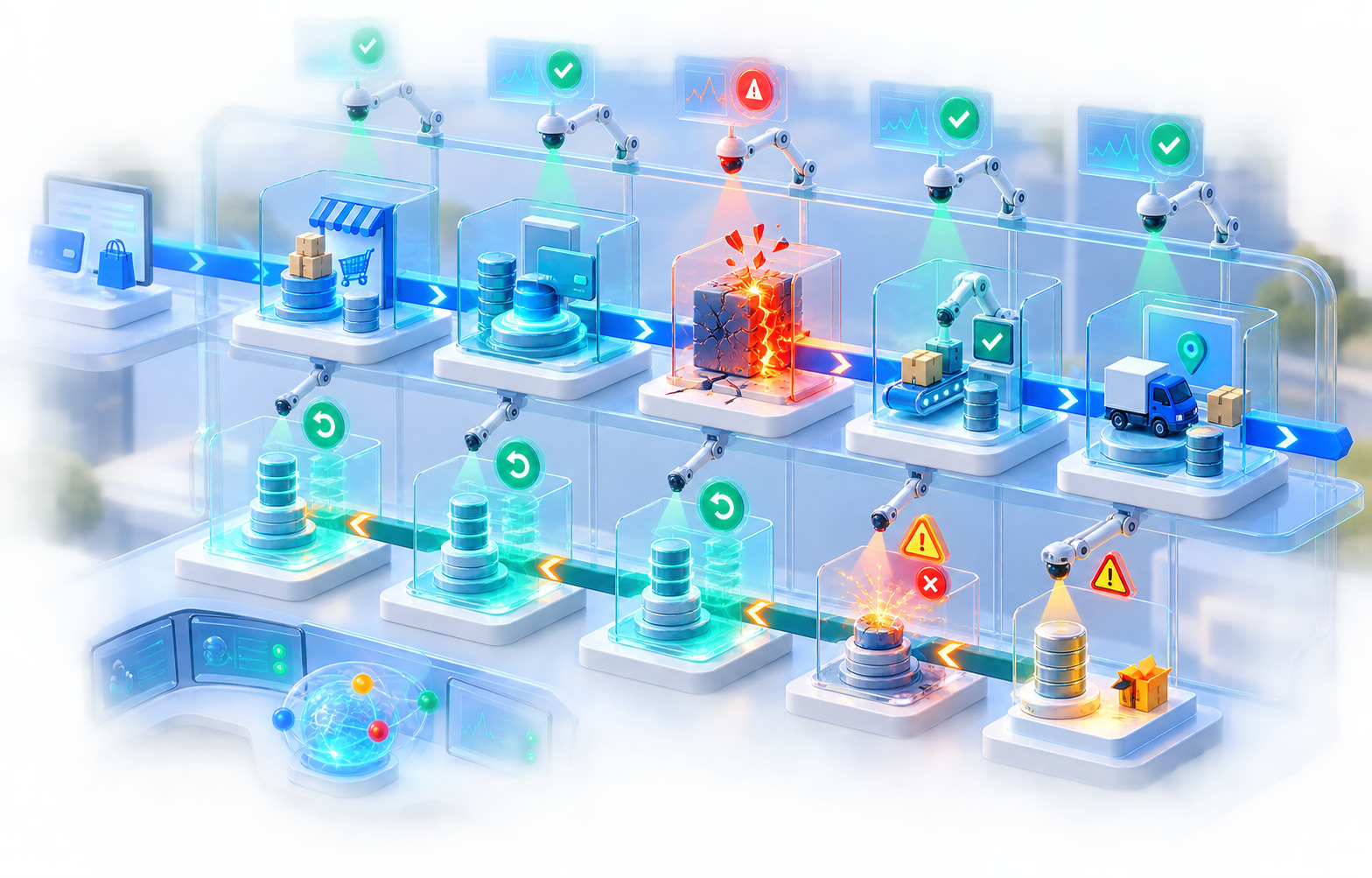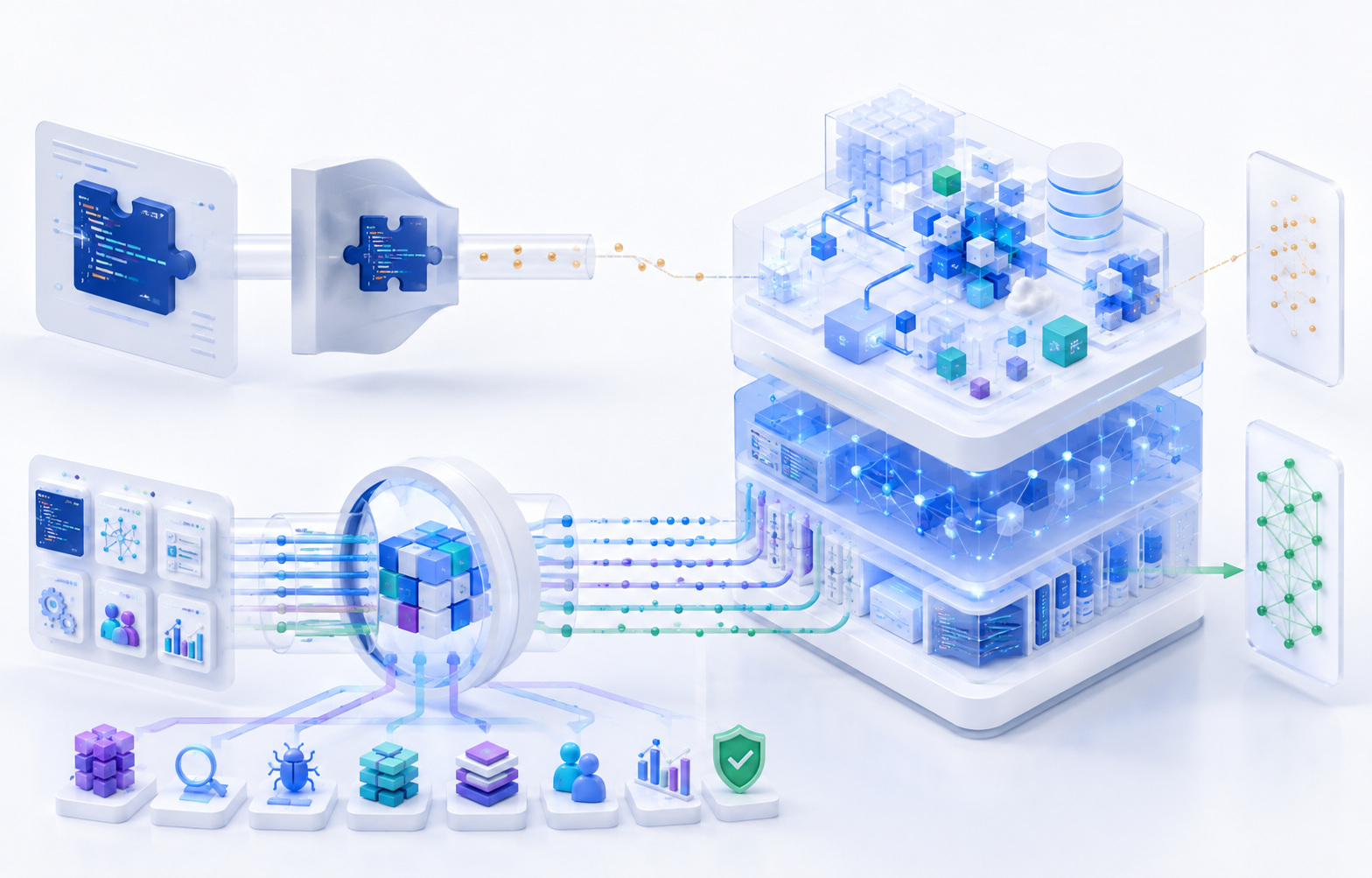
Every row in a multi-tenant SaaS database sits behind the same, single-sentence promise: a customer can only see their own data. The entire commercial viability of running one shared application for thousands of customers rests on that sentence holding true in every code path, every cache layer, every log line, and every background job that touches the data — and the sentence is enforced, in most real systems, not by a single, auditable, centralized mechanism, but by a WHERE tenant_id = ? clause that a developer has to remember to add, correctly, every single time a query touches tenant-scoped data, for the entire life of the application.
This is a strange place to put this much risk. Authentication — who is this user — gets dedicated libraries, security review, and often a specialized identity provider. Authorization at the tenant boundary — can this authenticated user's queries only ever touch their own tenant's data — is, in a large share of real production systems, enforced by developer discipline applied consistently across every query, every table, every new feature, indefinitely, with no single point where a mistake gets caught before it ships. The OWASP Foundation's Multi-Tenant Security Cheat Sheet makes the underlying risk explicit: tenant context should be derived from authenticated, verified tokens and validated at every application layer, with every database lookup including tenant verification — a standard most multi-tenant applications state they follow and a meaningfully smaller number actually verify they follow, systematically, across their full codebase.
QAtronic works with SaaS engineering and QA teams on exactly this gap — the space between "our architecture supports multi-tenancy" and "we have actually tested that a customer cannot see another customer's data, in every place that data can leak." This article maps where that promise actually breaks in practice, why conventional feature testing doesn't catch it, and how to build a testing discipline that treats tenant isolation as a first-class, continuously verified property rather than an assumed consequence of the architecture diagram.
Why Tenant Isolation Is a Testing Problem, Not Just an Architecture Decision
Ask an engineering leader whether their multi-tenant application is secure, and the answer usually describes the architecture: "we use row-level security," or "every table has a tenant_id column and our ORM filters by it automatically." These are real, meaningful design decisions, and they matter. They are also, on their own, descriptions of intent rather than evidence of verified behavior — the same category of gap this publication has examined in other contexts: a design that is correct in principle can still fail in the specific, unglamorous places where a developer, under deadline pressure, writes one query that doesn't go through the ORM's automatic filtering, or adds one new feature that introduces a new code path nobody thought to check against the isolation guarantee.
The reason this gap persists, even at careful organizations, is that a missing tenant filter does not fail loudly. A functional bug — a broken button, a miscalculated total — is visible to the customer experiencing it and gets reported. A cross-tenant data leak is frequently invisible to everyone involved unless the specific customer who was exposed happens to notice someone else's data appearing where their own should be, or unless a security researcher or penetration test specifically goes looking for it. This means tenant isolation defects can exist in production for extended periods — sometimes indefinitely — without any of the normal signals (customer complaints, error rates, failed tests) that would surface almost any other category of bug, which is precisely why deliberate, adversarial testing for this specific failure mode is not optional the way it might reasonably be deprioritized for a lower-stakes feature.
The framing that clarifies why this deserves dedicated testing attention, distinct from general functional QA, is this: a functional bug affects the customer who triggers it. A tenant isolation bug affects a customer who did nothing wrong at all — who simply happened to be the tenant whose data leaked to someone else's session — which means the customer with the most at stake in this specific risk category has no way to detect or prevent the exposure themselves. That asymmetry is exactly what makes deliberate, provider-side testing the only real defense.
The Isolation Models and What Each One Actually Guarantees
Different multi-tenant architectures place the isolation boundary at different layers, and understanding which layer your architecture relies on is the prerequisite for knowing what actually needs to be tested, because a testing approach designed for one model will miss the specific failure modes relevant to another.
Separate databases per tenant (the "silo" model) places the isolation boundary at the infrastructure level: each tenant's data lives in a physically or logically distinct database, and a query malformed enough to omit a tenant filter simply cannot return another tenant's data, because that data isn't reachable through the same database connection at all. This is the strongest isolation guarantee available and the standard many regulated industries and the largest enterprise customers specifically require, but it comes with real operational cost: schema migrations, maintenance, and scaling all need to happen across potentially thousands of independent database instances, and the cost per tenant is meaningfully higher than shared-infrastructure models, which is why it's typically reserved for the highest-value or most compliance-sensitive customer segments even at companies that use it at all.
Separate schemas within a shared database instance offers a meaningful step up in isolation over a fully shared model, using the database engine's own schema-level access boundaries, while sharing the underlying infrastructure and reducing per-tenant operational overhead relative to fully separate databases — though it introduces its own complexity in migration management, since a schema change now needs to be applied consistently across every tenant's schema rather than once.
Shared tables with row-level filtering (the "pooled" model), where every tenant's data lives in the same physical tables distinguished only by a tenant identifier column, is the most common model for cost and operational reasons — it scales efficiently, requires a single schema to maintain, and is the natural default for a growing SaaS product not yet segmenting customers by isolation tier. It is also the model with the largest attack surface for the specific failure mode this article addresses, precisely because the isolation guarantee depends entirely on every single query, in every code path, correctly applying a tenant filter, rather than on a structural boundary that makes an unfiltered query physically incapable of crossing tenants.
Hybrid models, increasingly common as SaaS companies mature, apply different isolation levels to different customer segments — pooled tables for a self-service, lower-tier customer base, with dedicated schemas or databases reserved for enterprise customers who require or pay for stronger guarantees. This is a reasonable and often necessary cost-risk trade-off, but it introduces its own testing requirement: verifying that a customer correctly provisioned into a higher-isolation tier actually receives the isolation guarantee their tier promises, rather than silently sharing pooled infrastructure due to a provisioning or configuration error — a gap that is functionally invisible until specifically tested for, since the pooled and dedicated code paths may look identical from the application layer.
The critical point connecting this section to the rest of the article: only the silo model provides isolation as a structural property that doesn't depend on every query being written correctly. Every other model — schema-based, pooled, and the pooled-tier portion of a hybrid model — depends, to varying degrees, on code-level correctness that needs to be actively, continuously tested rather than assumed from the architecture diagram.
Insecure Direct Object References: The Simplest Way Isolation Breaks
The single most common technical mechanism behind a real-world cross-tenant data leak has a name and a well-established place in security literature: the Insecure Direct Object Reference, or IDOR, classified by OWASP under Broken Access Control — consistently one of the most prevalent categories in the OWASP Top 10 web application security risks. OWASP's own definition is direct: an IDOR occurs when an application "fails to verify that the requesting user is authorized to access the referenced object," exposing an internal reference — typically a database ID — that a client can manipulate to access a different, unauthorized resource simply by changing a value in a URL, a query parameter, or a request body.
Applied to multi-tenant SaaS specifically, this failure mode has a precise and common shape: an authenticated user requests /api/invoices/1042, and the application correctly verifies the user is authenticated and has general permission to view invoices — but never checks whether invoice 1042 actually belongs to that user's tenant, because the query that retrieves the invoice was written to filter by invoice ID alone, on the reasonable-sounding but incorrect assumption that a valid session implies the request can only ever reference the requester's own data. Changing the URL to /api/invoices/1043 then returns a different tenant's invoice, with no error, no warning, and no evidence in the response that anything unusual has occurred from the requesting user's side of the interaction — which is exactly why this failure mode is so persistent: from the perspective of the tenant whose data was exposed, nothing about their own experience changes at all, and from the perspective of the tenant who exploited or accidentally stumbled onto the gap, the response looks like a normal, successful API call.
This failure mode is not limited to obviously sequential numeric IDs, though sequential IDs make it trivially easy to discover by simple incrementing. Non-sequential identifiers — UUIDs, hashed references — raise the difficulty of guessing a valid cross-tenant reference but do not eliminate the underlying vulnerability if the authorization check is still missing; a UUID that leaks through any other channel (a shared link, a browser history, a referrer header, a support ticket that includes a resource link) is just as exploitable against a system with no tenant-ownership check as a guessable sequential ID would be. The actual fix has nothing to do with the identifier's format and everything to do with the authorization check: every retrieval of a tenant-scoped resource needs to verify, as OWASP's guidance for multi-tenant systems states plainly, that the requested resource belongs to the current tenant, using a composite check — tenant identifier and resource identifier together — rather than trusting the resource identifier alone to be safe simply because it's hard to guess.
What to test, specifically: for every endpoint that retrieves a resource by identifier, deliberately attempt to access a resource belonging to a different, known test tenant using a valid, authenticated session from another tenant, and confirm the request is rejected rather than merely difficult to construct; treat this as a required test case for every new resource-retrieval endpoint as a matter of course, not an occasional penetration-test finding; and specifically prioritize this test for any endpoint accepting a resource identifier as a URL path parameter, query parameter, or request body field, since these are the concrete places an IDOR vulnerability actually manifests.
Where Tenant Context Comes From, and Why That Question Matters
A subtler and, in some ways, more dangerous version of the isolation failure described above doesn't involve an obviously missing check at all — it involves a check that exists, but relies on a tenant identifier the application trusted from the wrong source.
OWASP's multi-tenant security guidance is specific and unambiguous on this point: tenant context should be derived from authenticated, verified tokens — established once, server-side, at the point of authentication — and never trusted directly from a client-supplied value in a request header, a query parameter, or a hidden form field, however convenient that might be for a specific implementation. The failure this guards against is a case where an application does perform a tenant check, but the tenant identifier it checks against is read from a request parameter the client controls, rather than derived independently from the authenticated session — meaning a malicious or simply curious user can modify that parameter directly and have the application's own tenant-filtering logic dutifully enforce isolation against the wrong tenant, faithfully filtering the query by whatever tenant ID the attacker chose to supply.
This failure mode is particularly easy to introduce accidentally in systems built around convenience patterns that seemed reasonable in isolation: an internal admin tool that accepts a tenant ID as a parameter specifically so support staff can view any customer's data for troubleshooting purposes, later reused or extended into a code path that a regular authenticated customer can also reach; a client-side single-page application that stores the current tenant context in local state and sends it explicitly with each API request for convenience, with the backend trusting that value rather than independently deriving it from the session token; or a multi-tenant-per-user model, where a single user account can belong to multiple tenants (common in agency, consulting, or enterprise-with-multiple-subsidiaries scenarios), where a "switch tenant" feature's authorization check is weaker than it should be, allowing a switch to a tenant the user was never actually granted access to.
What to test, specifically: audit every code path that determines "which tenant does this request belong to" and confirm it derives that answer exclusively from the authenticated, server-validated session or token, never from a client-supplied header, parameter, or body field, treating any exception discovered as a finding requiring immediate remediation rather than a documented, accepted risk; specifically test any "switch tenant" or multi-tenant-membership feature by attempting to switch into a tenant the current user was never granted membership in, confirming the switch is rejected; and treat internal admin and support tooling that accepts an explicit tenant parameter as a distinct, higher-risk category requiring its own, more rigorous authorization checks — since these tools are, by design, meant to cross tenant boundaries for legitimate operational reasons, which makes a missing or weak authorization check on who can use them, and for which tenants, a uniquely high-impact gap if it exists.
Beyond the Database: Caches, Search Indexes, and Queues
Testing focused exclusively on direct database queries misses an entire category of isolation risk that lives in the caching, search, and messaging infrastructure most modern applications layer on top of the primary database — infrastructure that frequently has weaker, less consistently enforced tenant-scoping than the primary data store, because it was added later, by a different team, optimizing for a different concern (performance, search relevance) without the same isolation discipline applied to the original schema design.
Cache keys need tenant scoping as rigorously as database queries do. A caching layer that stores a computed value — a dashboard summary, a frequently accessed lookup — keyed only by a resource identifier, without including the tenant identifier in the cache key itself, creates a direct cross-tenant leakage path: if two tenants happen to reference the same underlying key (a common risk when cache keys are derived from something not inherently tenant-unique, like a product SKU in a system that also supports tenant-specific product catalogs), one tenant's cached data can be served directly to another tenant's request, entirely bypassing whatever correct tenant-filtering logic exists in the database query that originally populated the cache. OWASP's guidance is direct on this point: cache keys should be prefixed with a tenant identifier, and tenant validation should ideally be checked against the cached data itself as a secondary defense, not solely trusted based on how the cache was originally populated.
Search indexes are a commonly overlooked and high-risk surface, because search functionality is frequently built by copying data into a specialized search engine (a dedicated full-text search service, for instance) optimized for query performance rather than for replicating the primary database's access-control logic faithfully. A search index that stores tenant data without a corresponding, consistently enforced tenant filter on every search query is a direct route to a customer searching and finding another tenant's records, and this risk is compounded by the fact that search relevance ranking, caching, and index update timing all introduce additional places where a tenant filter might be present in the primary query path but silently absent from the search-specific path.
Message queues and event streams used for asynchronous processing need tenant context carried through the entire message lifecycle, not just at the point a message is published, because a consumer processing a message from a shared queue — common in event-driven architectures where events from all tenants flow through the same topic or queue for processing efficiency — needs to correctly extract and enforce the tenant context on every downstream action the message triggers, and a consumer that processes messages generically, without re-verifying tenant scoping at each processing step, can propagate a leak that originated from a single misconfigured publisher across every system that subscribes to the resulting event.
What to test, specifically: audit every caching layer for tenant-prefixed cache keys and, where feasible, embed the tenant identifier within the cached payload itself as a validation check performed on cache read, not just cache write; specifically test search functionality by creating data for two distinct test tenants and confirming that searching from one tenant's context never surfaces results belonging to the other, across every search feature the product offers, not just the primary search bar; and review message queue and event-processing code specifically for tenant context propagation, confirming that a consumer processing a shared-topic message independently verifies tenant scoping rather than trusting that the message's origin implies correct downstream handling.
Logs, Analytics, and Support Tooling: The Overlooked Leakage Surface
Tenant isolation testing conventionally focuses on customer-facing application behavior — can tenant A see tenant B's data through the product itself — and this framing, while correct as far as it goes, misses an entire category of exposure that occurs through internal tooling rather than the customer-facing product: application logs, analytics pipelines, and internal support and administrative tools.
Application logs frequently capture request payloads, response bodies, or error details for debugging purposes, and a logging configuration that captures this data without tenant-aware redaction or access control creates a situation where any internal employee with log access — which, in many organizations, is a broader group than those with direct database access — can potentially view cross-tenant data simply by searching logs for a specific value, an error message, or a time window, regardless of how rigorously the actual application code enforces tenant isolation at the database layer. This is a genuine and common gap precisely because logging is typically implemented and reviewed by engineers focused on operational debugging, not security, and log access policies frequently lag well behind the access-control rigor applied to the production database itself.
Analytics and business intelligence pipelines, which frequently aggregate data across the entire customer base for legitimate business reporting purposes, introduce a related but distinct risk: an analyst or a self-service reporting tool with access to the aggregated analytics warehouse, if not carefully scoped, can potentially query and cross-reference individual tenant records in ways the production application's own access controls would never permit, because the analytics warehouse was built for internal business use and reasonably assumed a smaller, more trusted internal audience — an assumption that becomes considerably riskier as self-service analytics tools proliferate and the internal user base with query access grows.
Support and administrative tooling, built to let internal staff assist customers by viewing their account and data directly, is simultaneously the most operationally necessary cross-tenant-crossing tool in most SaaS organizations and one of the least rigorously access-controlled, because it is explicitly designed to let a single internal user view any customer's data, which means its own internal authorization model — which support staff can view which tenants' data, and whether that access is logged and monitored — is doing a substantial share of the isolation enforcement that customer-facing code doesn't need to do at all, and this internal authorization model receives, in practice, far less security scrutiny than the customer-facing application's tenant isolation, precisely because it's categorized as "internal" and therefore assumed to be lower-risk, when in fact its blast radius, if compromised or misused, can span the entire customer base at once.
What to test, specifically: audit logging configuration for any capture of full request or response payloads containing tenant data, and confirm log access itself is scoped, monitored, and limited to personnel with an actual operational need, rather than broadly available by default; review analytics and business intelligence tooling access lists against actual need, treating broad, unreviewed access to a warehouse containing granular per-tenant data as a finding requiring remediation even when no specific misuse has occurred; and specifically test and monitor support and administrative tooling access, confirming that every cross-tenant access through this tooling is logged with enough detail to support a later audit, and that the list of personnel with this access is reviewed on a regular schedule rather than growing indefinitely as roles change and access is never revoked.
Background Jobs and Asynchronous Processing
Scheduled jobs, batch processes, and background workers — the class of code that runs without a directly attached user session — deserve specific attention because the tenant-scoping patterns that work naturally for request-response code (deriving tenant context from an authenticated session, as described earlier) often don't map cleanly onto this category of code at all, which means background processing is a common place for tenant-scoping logic to be implemented inconsistently, or missed entirely, relative to the main application.
A batch job that processes "all pending invoices" or "all users due for a renewal reminder" across the entire customer base needs to correctly scope every downstream action it takes — sending a notification, writing a computed value back to storage, calling an external API — to the correct tenant for each record it processes, and a bug in this scoping (a shared configuration value applied globally instead of per-tenant, a notification template that pulls branding or contact information from the wrong tenant's settings) produces a class of leak that looks different from the request-response IDOR pattern described earlier but is equally serious: a customer receiving an email that references another tenant's data, or a scheduled export that bundles the wrong tenant's records, are both real, reported categories of multi-tenant SaaS incidents, and both originate in background processing code that is frequently tested less rigorously than the main, interactive application, in part because it's harder to trigger and observe a background job's behavior through the kind of manual, exploratory testing that catches many interactive-application bugs.
What to test, specifically: for any batch or scheduled process that iterates across multiple tenants' data, explicitly test with at least two distinct, populated test tenants and verify that every output the job produces — a notification, a generated report, a written database record — is correctly attributed to the tenant whose data was actually being processed at that iteration, not to a globally shared configuration or a value carried over incorrectly from a previous iteration; and treat any shared, mutable state used across iterations of a multi-tenant batch job (a cached configuration value, a shared object reused across loop iterations for performance) as a specific area of scrutiny, since this pattern is a common, subtle source of cross-tenant data bleeding between records processed in sequence within the same job run.
A Realistic Failure Scenario, Walked Through
The following is a hypothetical composite scenario, built to illustrate how the failure modes described above interact in practice — it does not describe a specific QAtronic client or a real, identified incident, though it reflects a pattern consistent with publicly documented categories of multi-tenant SaaS vulnerabilities, including the cross-tenant leakage patterns referenced by OWASP and independent security researchers.
The initial situation. A hypothetical mid-sized B2B SaaS company operates a pooled multi-tenant architecture with consistent, well-implemented tenant filtering on its primary database queries, verified through the company's existing test suite and a prior third-party security assessment that found no significant issues in the core application. The company adds a new feature: a dashboard widget showing recently viewed documents, implemented using a lightweight caching layer for performance, since recomputing the "recently viewed" list on every page load was judged too expensive to run against the primary database directly.
The hidden assumption. The engineer implementing the caching layer keys the cache by user ID alone, reasoning that "recently viewed documents" is inherently a per-user concept and that user IDs are globally unique across the entire platform, which is true — but the engineer does not additionally scope the cache key by tenant, on the unstated and never explicitly examined assumption that this doesn't matter, since a given user ID only ever belongs to one tenant anyway in the company's current data model.
The technical cause. Months later, the company introduces a feature allowing a single user account to belong to multiple tenants — supporting, for instance, a consultant who works across several client accounts using one login — a data-model change reviewed carefully for its effect on the primary database's tenant-scoped queries, which are correctly updated to handle the new multi-tenant-membership model. The caching layer built earlier, keyed only by user ID, is not part of this review, because nobody working on the multi-tenant-membership feature is aware the caching layer exists or that it was ever keyed by user ID alone — it lives in a different part of the codebase, owned by a different team, and was never flagged in the original code review as tenant-sensitive infrastructure, since at the time it was built, the assumption that one user equals one tenant was still true.
The consequence. A user who now belongs to two tenants, switching between them in the interface, sees the "recently viewed documents" widget populated with documents from whichever tenant's session most recently wrote to the shared, user-ID-keyed cache entry — meaning a consultant viewing Tenant A's dashboard can, under specific timing conditions, see a "recently viewed" list containing Tenant B's document titles, a leak that is narrow in scope (limited to document titles in a specific widget, not full document contents) but is a genuine, real cross-tenant data exposure, discovered when an attentive user of the new multi-tenant-membership feature notices document names that don't belong to the tenant they're currently viewing and reports it as a bug, rather than through any internal testing process.
The decision that needs to be made. The engineering organization, in the aftermath, faces a now-familiar choice: treat this as a narrow, low-severity, one-off implementation oversight in a single caching layer, fixed by adding tenant scoping to that one cache key — or recognize it as evidence of a broader gap, specifically that infrastructure added incrementally over time (caching layers, search indexes, background jobs) was never subject to the same tenant-isolation review discipline applied to the primary database schema, and that other similar gaps likely exist elsewhere in the codebase, introduced by the same pattern: a reasonable assumption, true at the time it was made, that silently became false when an unrelated later feature changed the underlying data model.
The better approach. Beyond the immediate fix, the more durable response is exactly the systemic view: an audit of every caching layer, search index, and background job in the codebase specifically for tenant-scoping correctness, treating this as a one-time but comprehensive sweep rather than an ongoing assumption that the original, careful primary-database design continues to cover infrastructure added later by teams who may not have had full visibility into the original isolation model. Going forward, the organization also adds an explicit item to its code review checklist for any new caching, indexing, or background-processing infrastructure: does this component correctly scope by tenant, and has that scoping been specifically tested with a multi-tenant test scenario — converting what had been an implicit, easily-forgotten assumption into an explicit, checked requirement.
Row-Level Security: A Stronger Default, Not a Complete Solution
Database-level row-level security (RLS) — a feature available in PostgreSQL and several other modern database engines that enforces tenant-scoping policies directly within the database itself, rather than relying entirely on application code to include a correct filter in every query — is a genuinely strong architectural improvement over relying purely on application-level discipline, and is increasingly recommended, including in AWS's own published guidance on multi-tenant SaaS architecture, as a meaningful additional layer of defense specifically because it enforces the tenant boundary even against a query that the application code forgot to filter correctly.
The mechanism, in a typical PostgreSQL implementation, associates a tenant identifier with the current database session or connection, and the database engine itself then automatically filters every query against tables with RLS policies enabled, refusing to return rows belonging to a different tenant regardless of whether the application's own query included an explicit tenant filter — which directly closes the exact gap responsible for the IDOR-style failure described earlier in this article, since even a query that forgot to filter by tenant ID would still be constrained by the database's own enforcement.
This is a substantial, genuinely valuable improvement, and organizations running a pooled multi-tenant model on a database engine that supports it should seriously evaluate adopting it as a defense-in-depth layer. It is not, however, a complete solution to every failure mode this article has described, and treating it as one would be a mistake worth naming explicitly. RLS operates at the database query level, which means it does nothing to address cache key scoping, search index isolation, log-based leakage, or the background-job and multi-source cache scenario described in the walked-through failure above — all of which involve data that has already left the database and is being handled by a separate system with its own, independent access patterns that RLS has no visibility into or control over. RLS also depends on the tenant context being correctly established at the database session level in the first place, which loops back to the question addressed earlier in this article: if that context is derived from a client-trusted value rather than the authenticated session, RLS will faithfully and correctly enforce isolation against the wrong tenant, exactly as a flawed application-level check would.
The practical framing: row-level security is a strong, recommended structural improvement for the pooled model specifically, and it meaningfully reduces the risk of the most common IDOR-style failure — but it needs to be understood as one layer in a defense-in-depth strategy, tested on its own terms (confirming policies are actually enabled and correctly configured on every relevant table, not just some of them) rather than treated as a single control that, once enabled, eliminates the need for the broader testing discipline this article describes across caching, search, logging, and background processing.
Testing Tenant Isolation Deliberately: Techniques That Actually Find Gaps
Given the range of places isolation can break, described throughout this article, a correspondingly deliberate set of testing techniques is needed — general functional QA, run against a single test tenant's data as most functional test suites are structured by default, will not surface any of the failure modes described above, because a single-tenant test environment cannot, by construction, ever exhibit a cross-tenant leak.
Dual-tenant test fixtures as a standing requirement. The single most important structural change most organizations can make is maintaining at least two fully populated, realistic test tenants in every test and staging environment, as a standing requirement rather than an occasional, manually assembled setup for a specific security review. Functional and automated tests that exercise any tenant-scoped feature should, wherever feasible, run against this two-tenant setup and explicitly assert that tenant A's session never returns tenant B's data, converting isolation verification from a special, separate activity into a property checked continuously as part of ordinary feature testing.
Automated cross-tenant fuzzing of resource-retrieval endpoints. Beyond manually-written test cases for specific known endpoints, an automated approach that enumerates every API endpoint accepting a resource identifier and systematically attempts to retrieve resources across tenant boundaries — using tooling that can be built in-house or drawn from existing API security testing frameworks — provides ongoing, broad coverage against the IDOR-style failure described earlier, and is particularly valuable for catching isolation gaps in newly added endpoints that a manual test-case-writing process might not get to promptly.
Dedicated penetration testing scoped specifically to tenant isolation, rather than general application security, engages the specific adversarial mindset — actively trying to cross tenant boundaries through every available surface, not just the ones a development team happened to think of — that internal testing, however disciplined, tends to underweight relative to an external tester whose entire mandate is finding exactly this class of gap. This is a periodic, not continuous, activity for most organizations, but it should be explicitly scoped to include the caching, search, logging, and background-processing surfaces described in this article, not just the primary application API, since a generic penetration test engagement may default to testing the most visible, customer-facing surface without prompting to also probe less obvious infrastructure.
Monitoring and alerting on cross-tenant access attempts in production, treating any detected attempt — successful or blocked — as a security event requiring investigation, closes the loop between testing and live operation: OWASP's guidance specifically recommends monitoring and alerting on cross-tenant access attempts, which requires the application to actually log and flag cases where a tenant-scoping check fails or where a request pattern suggests an attempt to enumerate or guess cross-tenant resource identifiers, rather than silently rejecting the request with no record that the attempt occurred at all.
AI Features and Retrieval: A New and Growing Isolation Surface
Organizations adding AI-powered features to a multi-tenant product — a chat interface that answers questions using the customer's own data, a recommendation system, a document-summarization feature — introduce a distinct and rapidly growing isolation risk surface that deserves explicit attention, because retrieval-augmented AI systems commonly work by searching across a vector database or similar retrieval index to find relevant content before generating a response, and this retrieval step is functionally a search index, carrying exactly the tenant-scoping risks described earlier in this article, in a newer and less mature category of infrastructure that many teams are building and deploying faster than they're building the corresponding security review discipline around it.
The specific risk shape: a retrieval-augmented AI feature that searches a shared vector index across all tenants' documents, without a correctly enforced tenant filter on the retrieval query, can surface another tenant's content directly into a generated response — a failure mode that is arguably worse than a conventional cross-tenant data leak in one specific way: the leaked content doesn't appear as a raw, identifiably "foreign" data record the way a misplaced invoice or document title would; it appears blended into a fluent, generated response that can obscure the fact that the underlying source material came from outside the requesting tenant's own data at all, making the leak harder for the affected user to even recognize as a cross-tenant exposure rather than simply an odd or unexpected AI-generated answer.
This risk is compounded by the genuinely new complexity of testing retrieval correctness at all — verifying that a retrieval system returns semantically relevant results is already a harder testing problem than verifying that a conventional database query returns exact matches, and adding a tenant-isolation dimension on top of that relevance-testing challenge means many teams building these features are, in practice, testing relevance and functionality thoroughly while testing tenant isolation within the retrieval pipeline specifically far less rigorously, often because the retrieval infrastructure was stood up quickly by a small team focused on making the AI feature work at all, without the same isolation-specific review that the organization's primary database schema received years earlier.
What to test, specifically: treat any vector database, embedding index, or retrieval system underlying an AI feature with the same tenant-isolation testing rigor described for conventional search indexes earlier in this article — populate two distinct test tenants with distinct content and confirm retrieval never crosses the boundary; specifically test the generated-response layer, not just the raw retrieval layer, since a filtering bug at the retrieval stage will still manifest in the final AI-generated output even if the underlying retrieval index itself is correctly scoped, meaning the isolation check needs to happen at both stages independently; and treat any third-party AI or embedding service integrated into the product as requiring the same tenant-boundary scrutiny given to any other third-party dependency handling customer data, confirming the specific mechanism by which tenant scoping is maintained when data leaves your own infrastructure to be processed by an external service.
Third-Party Integration Credentials: A Frequently Missed Isolation Surface
Many multi-tenant SaaS products let individual tenants connect their own third-party accounts — a CRM, an accounting platform, a communication tool — through OAuth or a similar credential-delegation flow, storing the resulting access tokens so the application can act on that tenant's behalf against the connected external service. This is a distinct and easily overlooked isolation surface, because the credentials themselves are tenant-specific secrets that, if scoped or retrieved incorrectly, grant not just data access but an actual ability to take action against a third party's system using another tenant's authorized identity.
The specific risk shape parallels the caching and background-job failures described earlier in this article: a credential storage or retrieval mechanism that isn't rigorously scoped by tenant — a lookup keyed by an integration type alone rather than by the composite of tenant and integration type, or a background sync job iterating across "all connected accounts" that retrieves the wrong tenant's stored token due to an indexing or query error — doesn't just leak data, it can cause the application to take real, external, attributable actions (sending an email through a connected email service, creating a record in a connected CRM, posting to a connected messaging platform) using one tenant's authorized third-party identity while actually processing another tenant's data or acting on another tenant's behalf. This is a more severe consequence than a typical read-only data leak, because it can be visible to the third-party service itself and to the tenant whose external system was affected, and because unwinding an incorrect external action (an email already sent, a record already created in an external system) is often not fully reversible the way correcting an internal data display error usually is.
What to test, specifically: verify that every credential storage and retrieval path for third-party integrations uses a composite key including the tenant identifier, never an integration type or external account identifier alone; specifically test any background synchronization job that processes multiple tenants' connected integrations in sequence, using the same multi-tenant test methodology described earlier for other background jobs, confirming each sync operation uses the correct tenant's stored credentials; and treat credential-scoping bugs in this category as a higher-severity finding than an equivalent read-only data leak, given the potential for real, external, difficult-to-reverse consequences.
A Tenant Isolation Testing Framework
The following framework consolidates the layers discussed throughout this article into a structured testing checklist, organized by where in the stack isolation can break.
| Layer | Key risk | Primary testing approach |
|---|---|---|
| Primary database queries | Missing or incorrect tenant filter (IDOR) | Dual-tenant fixtures with explicit cross-tenant retrieval attempts on every resource endpoint |
| Tenant context source | Trusting a client-supplied tenant identifier | Code audit confirming tenant context always derives from the authenticated session, never a request parameter |
| Row-level security (if used) | Policies not enabled or misconfigured on some tables | Explicit verification that RLS policies are active and correctly scoped on every tenant-scoped table |
| Caching | Cache keys not scoped by tenant | Audit every cache key construction; test with two tenants sharing a non-unique secondary key |
| Search and retrieval indexes | Index queries missing tenant filters | Populate two test tenants with distinct content; confirm zero cross-tenant results |
| AI/retrieval-augmented features | Retrieval crossing tenant boundaries into generated output | Test both the raw retrieval layer and the final generated response independently |
| Logs and internal tooling | Broad, unmonitored internal access to cross-tenant data | Access review of logging, analytics, and support tooling; confirm access is logged and scoped |
| Background jobs and queues | Shared state or missing per-record tenant scoping | Multi-tenant test data run through every batch process; verify per-tenant output attribution |
| Tenant offboarding | Residual data or access after a tenant leaves | Verify complete data removal and access revocation, tested explicitly, not assumed |
| Monitoring | No visibility into attempted or actual cross-tenant access | Alerting on failed or suspicious tenant-scoping checks, treated as a security event |
Tenant Offboarding: The Isolation Test Nobody Runs
A specific and commonly overlooked scenario deserves its own attention because it sits at the intersection of tenant isolation and data lifecycle management: what happens, concretely and verifiably, when a tenant's subscription ends and their account is offboarded.
OWASP's multi-tenant security guidance explicitly warns against retaining tenant data indefinitely after offboarding, and the risk this addresses is not merely a data-retention or compliance concern in the abstract — it's a live isolation risk, because data belonging to a departed tenant that isn't fully and correctly purged remains a potential source of cross-tenant leakage if a tenant identifier is ever reused, if a background job iterates over "all tenants" without correctly excluding offboarded ones, or if a support tool's search functionality doesn't distinguish between active and offboarded tenant records when an internal user searches by a name or identifier that happens to collide with residual, un-purged data.
Offboarding is also, structurally, one of the least-tested user journeys in most SaaS products, because it's the opposite of the growth-oriented, revenue-generating flows (signup, upgrade, feature adoption) that naturally receive the most product and engineering attention — nobody is incentivized to polish and thoroughly test the offboarding experience the way they are the onboarding experience, which means the isolation-relevant question of "did this tenant's data actually get fully and correctly removed, everywhere it existed" is frequently never explicitly verified at all, simply assumed to have happened correctly because a deletion process exists and appears, on the surface, to run without error.
What to test, specifically: explicitly verify, after a test tenant offboarding, that the tenant's data is actually gone from every layer discussed in this article — not just the primary database, but caches, search indexes, logs (where legally and operationally appropriate to purge), and any downstream analytics or backup systems, rather than only checking that the primary application no longer displays the account; verify that access credentials, API keys, and any standing integrations belonging to the offboarded tenant are actually revoked, not merely deactivated in a way that a background process might still honor; and treat offboarding verification as a required test case attached to the offboarding feature itself, with the same rigor as any other feature's test coverage, rather than as an assumed side effect of a deletion button working correctly in a single, surface-level manual check.
Measuring Isolation Assurance as an Ongoing Property
Everything described in this article can exist as a well-intentioned practice that quietly decays without anyone noticing, in the same way any unmeasured discipline decays — the dual-tenant test fixtures stop being maintained as the schema evolves, the isolation-review checklist item gets skipped under deadline pressure often enough that it stops functioning as a real gate, and nobody notices until an incident or an audit forces the question. A small set of concrete, tracked measures makes the difference between an assurance practice and an assurance aspiration.
Test coverage against actual tenant-scoped surfaces, not just endpoints. Rather than a vague sense that "we test multi-tenancy," a concrete, trackable measure is the percentage of tenant-scoped database tables, cache namespaces, search indexes, and background job types that have an associated, currently passing, dual-tenant isolation test — a number that should be recalculated whenever new infrastructure is added, precisely because, as the walked-through scenario in this article illustrates, new infrastructure is exactly where coverage gaps open up silently.
Cross-tenant access attempt rate, tracked as a monitored security signal. If the application logs and flags failed or suspicious tenant-scoping checks, as recommended earlier in this article, the resulting rate — and any anomalous spike in it — becomes a genuine, ongoing security signal rather than a one-time architecture decision. A rate of zero detected attempts is not, on its own, reassuring; it may simply mean the detection and logging isn't actually wired up to catch anything, which is why this metric needs to be validated periodically by deliberately triggering a test cross-tenant access attempt and confirming it's correctly detected and logged, not just trusted at face value.
Time since the last isolation-focused penetration test or comprehensive audit, tracked explicitly rather than left as an informal, easily-forgotten fact, keeps the periodic testing cadence honest — an organization that can state precisely when its isolation testing was last comprehensively refreshed, and what was found, is in a fundamentally stronger position, both operationally and in an enterprise procurement conversation, than one that would need to research the answer before responding to the question.
Isolation-relevant findings per release, tracked over time, whether from automated testing, manual review, or production incidents, reveals whether the practice is actually catching gaps before they ship or only after — a healthy, maturing practice should show a shift over time toward findings caught earlier in the pipeline (in code review or automated testing) relative to findings discovered in production, and a practice showing the opposite trend, or no findings at all despite known feature growth, deserves scrutiny into whether the testing is actually effective or simply not looking hard enough.
Time to detect and time to remediate, for any actual cross-tenant exposure that does occur. However rare, tracking how quickly an exposure was detected once it began, and how quickly it was fully remediated across every affected layer (not just the immediately obvious one), provides the same kind of concrete, improvable measure that incident response teams track for any other category of security event, and prevents an isolation incident from being treated as a one-off anomaly rather than an input into improving the detection and testing practice going forward.
Ownership: Who Is Actually Responsible for This
Tenant isolation testing fails organizationally for reasons parallel to the localization and test-data governance gaps this publication has examined elsewhere: it sits at the intersection of several functions, each of which reasonably assumes another has it covered. Security teams often assume the architecture — "we use row-level security" or "our ORM filters by tenant automatically" — is sufficient and don't have visibility into every new caching layer, search feature, or background job added by product engineering teams operating independently. Individual feature teams, focused on shipping a specific feature correctly and on schedule, often don't have the security or architecture context to recognize that a new caching layer they're building is tenant-sensitive infrastructure requiring the same isolation discipline as the primary database — as illustrated directly in the walked-through failure scenario above. And QA, absent an explicit mandate and the dual-tenant test infrastructure described earlier, defaults to testing features in a single-tenant context, because that's the simpler, faster, and more common way to structure functional test environments.
The practical fix parallels the recommendation made elsewhere in this publication for comparable cross-cutting risks: tenant isolation needs an explicit, named owner — not necessarily a dedicated full-time role at every company size, but a specific, accountable function whose responsibilities explicitly include reviewing new infrastructure (caching, search, background jobs, AI/retrieval features) for tenant-scoping correctness before it ships, maintaining the dual-tenant test fixtures this article has emphasized throughout, and tracking cross-tenant access monitoring as an ongoing, reviewed responsibility rather than a one-time architecture decision that's assumed to remain correct indefinitely as the codebase grows around it.
What Enterprise Buyers and Auditors Actually Ask
For organizations selling to enterprise customers, tenant isolation is not only a technical risk but an increasingly explicit and detailed procurement and audit question, and being able to answer it credibly and specifically — rather than with a general architecture description — matters directly to sales cycles and audit outcomes.
A mature enterprise security questionnaire or SOC 2 audit will typically probe well beyond "do you support multi-tenancy" into specifics closely aligned with the risk surfaces described throughout this article: what isolation model is used and why; whether row-level security or an equivalent database-level control is in place, not just application-level filtering; how tenant context is established and verified, and specifically whether it can be influenced by client-supplied input; what testing is performed to verify isolation, and how often; how caching, search, and background-processing infrastructure specifically maintain tenant scoping; how internal tooling and support access to customer data is controlled, logged, and reviewed; and what the tenant offboarding process verifies and how that verification is documented.
An organization that can answer these questions with specific, evidenced practices — a documented testing framework, a recent isolation-focused penetration test, monitored cross-tenant access attempt logs — moves through enterprise procurement and audit processes measurably faster than one that can only offer a general architecture description, and the gap between these two positions is precisely the gap this article has tried to close: from "our architecture is designed for isolation" to "we have specific, ongoing, evidenced practices verifying that isolation actually holds, across every layer where it could break."
Startups, Scale-Ups, and Enterprises: Proportionate Investment
Early-stage startups building a first multi-tenant product should prioritize getting the fundamentals right from the start — tenant context always derived from the authenticated session, never a client-supplied value; a consistent, reviewed pattern for tenant-scoped queries; and, where the database engine supports it, row-level security enabled from the beginning rather than retrofitted later — because these foundational patterns are dramatically cheaper to establish correctly at the outset than to audit and retrofit across a growing codebase later, a dynamic parallel to the internationalization pattern discussed elsewhere in this publication, where early structural correctness pays compounding dividends relative to later remediation.
Scale-up companies adding features rapidly — new caching layers, search functionality, AI-powered capabilities, background processing — are the segment most likely to be accumulating exactly the kind of incremental, unreviewed isolation risk illustrated in the walked-through scenario earlier in this article, because the pace of feature development at this stage frequently outpaces the establishment of a formal review process requiring new infrastructure to be checked against tenant-isolation requirements before shipping. This is the point at which establishing dual-tenant test fixtures as a standing requirement and adding an explicit isolation-review checklist item to the code review process for new infrastructure typically delivers the highest return relative to implementation cost.
Enterprise-scale SaaS organizations, particularly those serving large enterprise customers who explicitly scrutinize isolation practices during procurement, should be operating close to the full framework described in this article: row-level security or equivalent database-level enforcement, dedicated periodic isolation-focused penetration testing, cross-tenant access monitoring and alerting treated as a live security operations concern, and a documented, evidence-based answer to every question an enterprise security questionnaire is likely to ask. At this scale, the cost of a genuine cross-tenant data exposure — in regulatory exposure, in the loss of enterprise customer trust that took years to build, and in the direct cost of incident response and disclosure — substantially exceeds the cost of the testing and governance investment described throughout this article.
When the Pooled Model and Lighter Testing Are the Right Call
Not every organization needs the full framework described in this article applied at maximum intensity, and it's worth naming the legitimate scope-narrowing decisions honestly, consistent with the practice of this publication elsewhere.
A very early-stage product with a small number of design-partner customers, all in close, trusted, ongoing communication with the founding team, carries meaningfully lower risk from a pooled architecture with less exhaustive automated isolation testing than a product serving thousands of self-service customers with no direct relationship to the provider — though the foundational correctness practices described in the previous section (session-derived tenant context, consistent query patterns) should still be established from the start regardless of company stage, since they cost little to build correctly from the outset and become progressively more expensive to retrofit as the codebase and customer base grow.
A product whose tenant-scoped data is genuinely low-sensitivity — not personal, financial, health, or otherwise regulated data, and not information whose exposure would cause meaningful competitive or reputational harm to the affected customer — can reasonably calibrate its testing investment below what this article recommends for higher-stakes data categories, provided that calibration is a deliberate, documented decision based on an honest assessment of what's actually at risk, rather than an assumption never explicitly examined.
An organization already operating a fully siloed, separate-database-per-tenant model has structurally eliminated the largest category of risk this article addresses — a query missing a tenant filter simply cannot cross a database boundary that doesn't exist — and can reasonably direct a larger share of its isolation-testing effort toward the remaining surfaces that a database-level boundary doesn't address on its own: shared internal tooling, any shared infrastructure that spans the otherwise-separate databases (a shared search service indexing across all tenant databases, for instance, would reintroduce exactly the pooled-model risk the database architecture was designed to avoid), and tenant offboarding.
Questions Executives Should Ask Their Engineering Team
A short set of direct questions in a security or architecture review tends to reveal the real state of tenant isolation practice: Do we maintain at least two fully populated test tenants in our staging environment, and do our automated tests actually assert that one tenant's session never returns another tenant's data? Is our tenant context ever derived from a client-supplied value — a header, a parameter — anywhere in our codebase, and when was that last actually audited rather than assumed? Have we specifically tested our caching, search, and background-job infrastructure for tenant scoping, separately from our primary database queries? If we're building AI or retrieval-based features, have we tested tenant isolation at both the retrieval layer and the generated-output layer? And what would our honest, evidenced answer be if an enterprise prospect's security team asked us, in detail, how we verify — not just how we've architected — tenant isolation?
FAQ
Is row-level security alone sufficient for tenant isolation? No. Row-level security is a strong, recommended defense-in-depth layer for database queries specifically, but it doesn't address caching, search indexes, logs, background job scoping, or internal tooling access, all of which require their own, independent testing and controls, as described throughout this article.
How often should tenant isolation penetration testing be performed? This depends on the pace of feature development and the sensitivity of the data involved, but a periodic cadence (commonly annual at minimum, more frequently for organizations serving highly regulated or high-value enterprise customers) combined with the continuous, automated dual-tenant testing described in this article — rather than relying on periodic penetration testing as the sole isolation-verification mechanism — reflects the reality that new isolation-risk infrastructure (a new caching layer, a new AI feature) can be introduced between penetration testing engagements and needs its own, more immediate verification.
Does using a well-known cloud provider's managed database service guarantee tenant isolation? No. A managed database service can provide the underlying infrastructure and features (including row-level security support, in several cases) that make strong isolation achievable, but the actual tenant-scoping logic — which queries filter by tenant, how tenant context is established, whether row-level security policies are actually enabled and correctly configured — remains the application team's responsibility to implement and test correctly, regardless of how capable the underlying managed infrastructure is.
What's the single highest-leverage first step for an organization with no formal isolation testing today? Establishing two fully populated, realistic test tenants in a shared staging environment and running a manual or automated pass attempting to access one tenant's resources from the other's authenticated session, across every major feature, is typically the fastest way to surface the most severe, most exploitable gaps — IDOR-style failures on primary resource endpoints — before investing in the more comprehensive framework (caching, search, AI retrieval, background jobs) described throughout this article.
How does this relate to general application security testing? Tenant isolation testing is a specific, high-stakes subset of broader access control testing, distinguished by its specific failure mode (one customer's data reaching a different customer, rather than an unauthorized individual reaching data they shouldn't have any access to at all) and by the specific infrastructure surfaces — caching, search, multi-tenant background processing — that don't always receive attention in a generic application security review focused primarily on the customer-facing API. Organizations with strong general application security practices still need to explicitly scope tenant isolation as its own testing category, for the reasons detailed throughout this article.
Does this apply the same way to a product with only a handful of very large enterprise customers, rather than thousands of self-service tenants? The specific risk calculus shifts, but the underlying discipline still matters, often more urgently. With fewer, larger tenants, the blast radius of a single isolation failure is concentrated on a smaller number of customers, each individually higher-stakes — losing the trust of one major enterprise account to a preventable cross-tenant exposure can be proportionally more damaging than a similar incident affecting one of many smaller self-service customers, and large enterprise tenants are also the customer segment most likely to explicitly test for and ask detailed questions about exactly this risk during procurement and ongoing vendor review, as discussed earlier in this article.
Conclusion: The Sentence That Has to Hold Every Time
The promise underneath every multi-tenant SaaS product — a customer can only see their own data — is simple to state and, in a pooled architecture, genuinely difficult to guarantee, because it depends not on a single control that can be built once and verified once, but on every query, every cache key, every search index, every background job, and every piece of internal tooling correctly honoring a boundary that nothing in the architecture diagram enforces by default.
The distinction worth carrying forward from this article is that tenant isolation is not a property an architecture has; it's a property an organization continuously verifies, across every layer data can move through, using the kind of deliberate, adversarial, dual-tenant testing this article has described — because the alternative, as the walked-through scenario illustrates, is discovering the gap the way most organizations actually discover it: not through a test that was looking for it, but through a customer who noticed something that should have been impossible.
The question worth taking back to your engineering team this quarter is not whether your architecture is designed for isolation — most multi-tenant SaaS architectures are. It's whether anyone has actually, recently, deliberately tried to break it, across every layer described in this article, and can show you the evidence of what they found.
That evidence is the actual deliverable worth asking for — not a diagram, not a design document, but a specific, dated record of a dual-tenant test that tried to cross the boundary and failed to, run recently enough to reflect the system as it exists today rather than as it was architected two years and a dozen features ago.
QAtronic helps SaaS engineering and QA teams build tenant isolation testing practices that go beyond the primary database — covering caching, search, AI retrieval, background processing, and internal tooling access — matched to your architecture's actual isolation model and your customers' actual risk exposure. If your organization's honest answer to "how do we know isolation holds" is "because of how we built it" rather than "because of what we've tested," that gap is worth closing deliberately, before an enterprise security questionnaire or a customer discovers it for you.