Two Companies
Start with a story that most engineering leaders will recognize uncomfortably well.
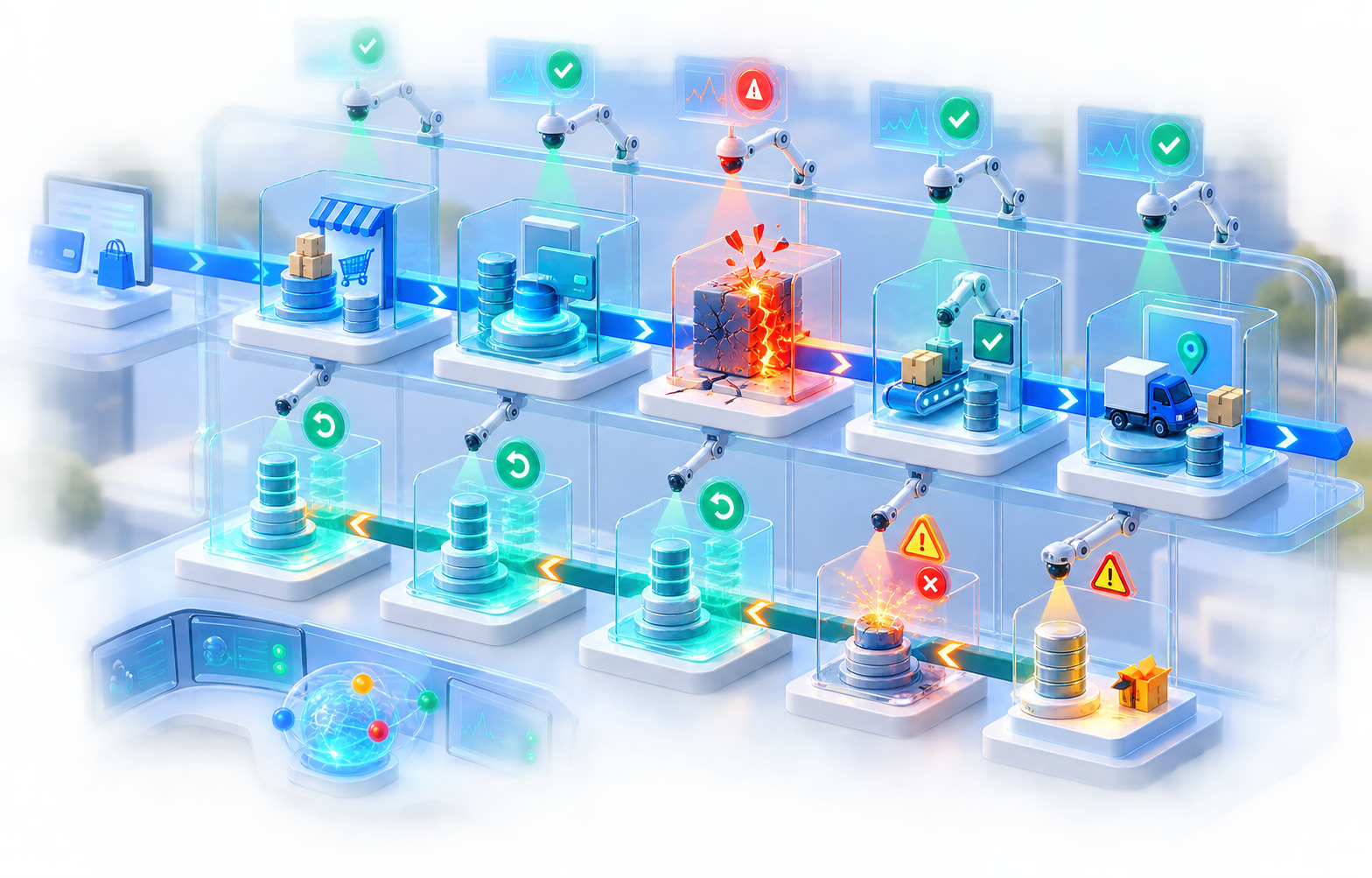
Company A is a payments company. In 2021 they had forty engineers and three people who called themselves DevOps. Deployments were slow but survivable. Someone knew how the staging cluster worked. When a new service needed a database, you filed a ticket, and the ticket was usually resolved in two or three days, which felt reasonable at the time.
Their answer to growth was arithmetic. Forty engineers needed three DevOps engineers, so eighty engineers would need six, and a hundred and twenty would need nine. This was never written down as a policy. It was simply what happened every time the delivery pipeline groaned: the VP of Engineering opened a requisition, and a recruiter went looking for someone who knew Terraform and Kubernetes and could take some load off the queue.
By 2024 Company A had a hundred and ten engineers and eleven people in the infrastructure group. The ticket queue had not shrunk. It had grown from a shared Slack channel into a Jira board with a triage rotation, an SLA policy, three swimlanes, and a weekly meeting to discuss why the SLA policy was not being met. Deployment lead time had gone from four hours to eleven. Onboarding a new engineer to their first production change took nineteen days on average — a number they knew precisely, because they had built a dashboard to track it, and the dashboard had been red for seven quarters.
The eleven infrastructure engineers were not lazy or incompetent. They were, individually, some of the strongest people in the building. They were also permanently interrupted. Each of them held a piece of tribal knowledge that no one else had, and every one of them had a browser tab open to a ticket that could only be closed by them personally. Their calendars looked like shrapnel. Two of them had quit in the last year and each departure had triggered a small internal crisis, because it turned out that the Kafka topic provisioning process lived entirely inside one person's memory and a bash script in a private repository.
Company B is a logistics company. In 2021 they had forty-five engineers and a similar problem. The difference was one decision made by a Director of Engineering who had read too many post-mortems and had a suspicious mind about linear scaling.
She asked her infrastructure leads a question that sounded pedantic and turned out to be structural: how many of the tickets in our queue are genuinely unique, and how many are the eleventh instance of the same request?
The answer came back two weeks later. Seventy-eight percent of infrastructure requests over the prior quarter fell into nine repeating shapes. New service scaffold. New Postgres instance. New S3 bucket with policy. New DNS entry. New secret. New CI pipeline. New dashboard. New alert route. New staging namespace. Nine shapes, four hundred and thirty tickets.
She did not open a requisition. She took two of her four infrastructure engineers off the queue entirely — a decision that made the queue measurably worse for five months and generated real political heat — and told them to build the nine shapes as self-service capabilities with a front door developers could find without asking permission.
By 2024, Company B had a hundred and twenty engineers and seven people in what was now called the Platform team. Deployment lead time was under thirty minutes. A new engineer shipped to production on day two, sometimes day one. The Platform team's ticket queue existed, but it contained roughly forty items a quarter, and most of them were feature requests for the platform rather than pleas for manual intervention.
Three years. Both companies roughly doubled. One built an organization that could absorb growth. The other built an organization where growth was the problem.
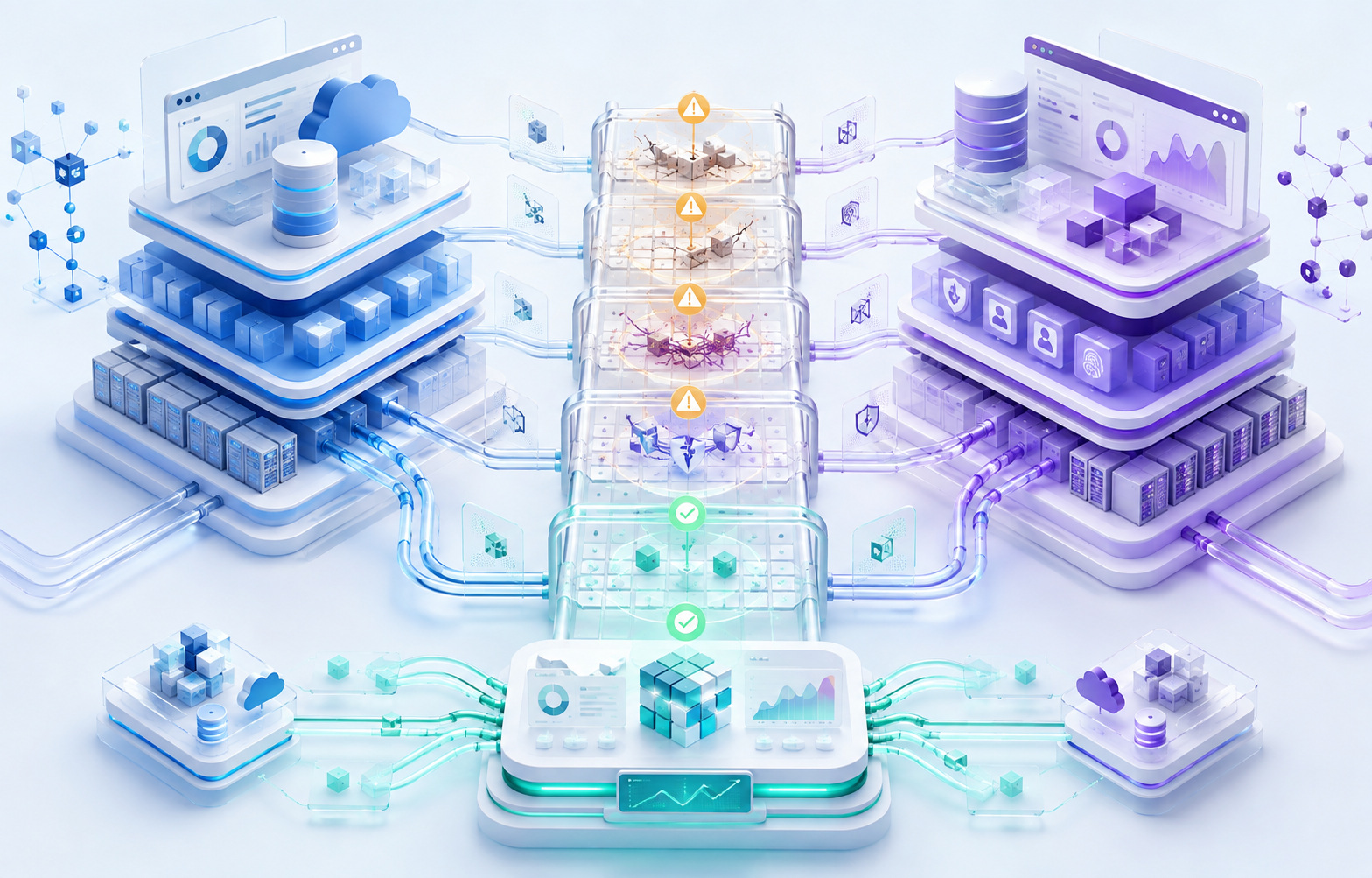
The difference was not tooling. Both companies ran Kubernetes. Both used Terraform. Both had CI. Both had adopted, at various points, more or less the same conference-approved technology stack. If you diffed their infrastructure repositories you would find the same words in different arrangements.
The difference was that Company A treated infrastructure work as labor to be staffed, and Company B treated infrastructure work as a product to be built.
That reframing is the whole subject of this handbook.
The Observation
Everything that follows is an elaboration of a single sentence, and it is worth writing it down cleanly before we start decorating it:
Great engineering organizations don't scale people to operate infrastructure. They scale platforms that let people operate themselves.
This is not a slogan about automation. Automation is a tactic and Company A had plenty of it — eleven engineers running scripts is still eleven engineers running scripts. The observation is about where the operating knowledge lives.
In Company A, the knowledge of how to correctly stand up a production service lived in people's heads, was transmitted by conversation, and was applied by hand. Every application of that knowledge required a human being with the knowledge to be available, awake, and not already in a meeting. The organization's delivery throughput was therefore bounded by the calendar availability of its most knowledgeable operators. Adding engineers to the product teams increased demand on that bound. Adding engineers to the infrastructure team raised the bound slightly and increased the coordination cost of everyone already inside it.
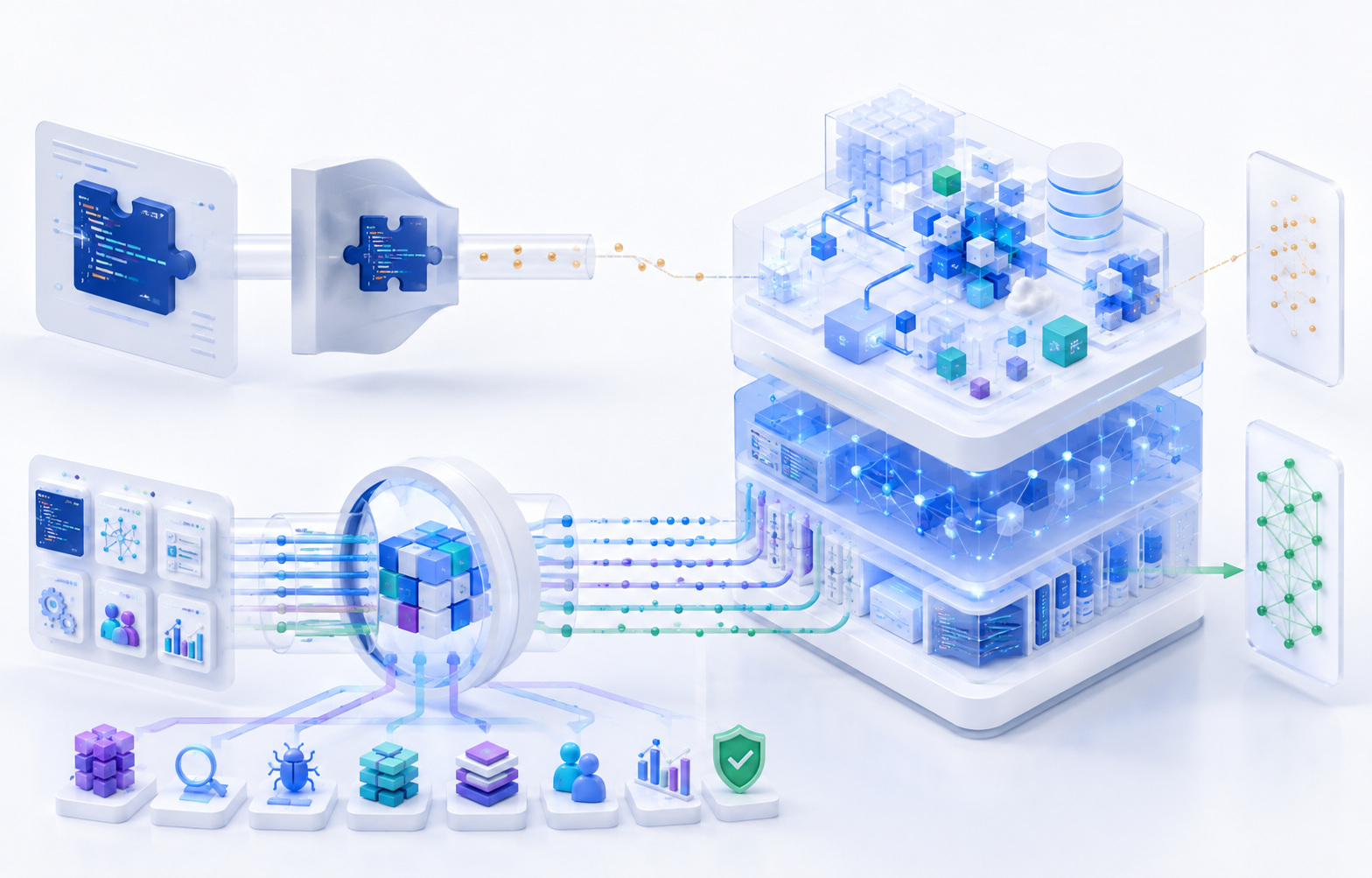
In Company B, the knowledge of how to correctly stand up a production service was encoded into an interface. Not into documentation — documentation is knowledge that still requires a human to execute it. Into a running system that a developer invokes and that produces a correct outcome. Once encoded, the knowledge could be applied a thousand times without consuming any of the platform team's calendar.
DevOps, as a movement, was correct about culture and mostly silent about interfaces. It said: tear down the wall between development and operations, share responsibility, automate your pipeline, build a blameless culture. All of that was right and none of it was sufficient, because "developers own their infrastructure" turned out in practice to mean "every developer must independently become competent at infrastructure," which is a cognitive load distribution problem disguised as an empowerment strategy.
Platform Engineering is the correction. It keeps the DevOps insight — teams own what they ship — and adds the missing half: ownership does not require expertise if the platform supplies the expertise. A product engineer should own their service's availability, their error budget, their on-call rotation, and their deployment cadence. They should not have to own the correct configuration of a Terraform provider, the choice of a Kubernetes ingress class, or the seventeen decisions required to make a Postgres instance production-safe.
Ownership at the outcome layer. Expertise at the platform layer. The line between those two things is where all the interesting arguments in this handbook happen.
We will return to the observation repeatedly, because in practice it is easy to agree with and hard to hold. Every serious platform decision is a test of whether you actually believe it.
A Walk Through the Platform
Before we argue about anything, walk through one. Not a diagram of one — a walk, in order, the way a developer experiences it on a Tuesday afternoon when they have been asked to build a service that reconciles shipment events.
Stop One: The Developer Portal
The front door. In our reference platform this is Backstage, but the specific implementation matters far less than the property it provides: a single place where the answer to "where do I start?" is always yes.
The developer opens the portal. They do not open a wiki, a Confluence space, a Slack channel, a Google Doc named infra_onboarding_v3_FINAL, or a ticket. They open one URL. On that URL they can see every service in the company, who owns it, what its dependencies are, what its current health looks like, where its docs live, and — critically — a button that says Create.
The cognitive load reduction here is not about the button. It is about the absence of the routing decision. In Company A, the first question a developer asks is not "how do I create a service" but "who do I ask how to create a service?" That question has a variable answer, depends on tenure, is answered differently in different Slack channels, and costs anywhere from ten minutes to two days. The portal deletes an entire class of question by making the routing decision constant.
A good developer portal is a map of the organization's engineering reality that is accurate because it is generated, not maintained. The moment a portal's contents are hand-curated, it begins to rot, and a rotting portal is worse than no portal because it teaches developers not to trust the front door.
Stop Two: Golden Paths
The developer clicks Create and sees a small number of options. Not a form with forty fields. Not a catalog of every conceivable architecture. Six or seven named paths:
- HTTP Service (Go)
- HTTP Service (TypeScript)
- Event Consumer
- Scheduled Job
- Data Pipeline
- Internal Library
- Frontend Application
They pick Event Consumer. This is a Golden Path: a fully supported, opinionated, end-to-end route from idea to production for a common shape of software.
The word "golden" is doing specific work. It does not mean "the only path." It means "the path where everything works, is monitored, is documented, is patched by someone else, and where you will get help at 3am." Off-path is legal. Off-path is sometimes correct. Off-path simply comes without the warranty, and the developer knows that going in.
The reduction in cognitive load at this stop is a reduction in decisions. A developer building an event consumer from scratch faces perhaps sixty consequential decisions — language runtime, base image, dependency management, consumer group semantics, retry topology, dead-letter handling, metric naming, log format, health check semantics, graceful shutdown behavior, resource requests, autoscaling signals, and so on. Roughly fifty-five of those decisions have a correct organizational answer that has nothing to do with the shipment reconciliation problem the developer was actually hired to solve.
The Golden Path pre-answers fifty-five decisions. It leaves the other five, which are the ones that carry the business.
Stop Three: Templates
The path materializes as a template. The developer fills in four fields: service name, owning team, description, and the Kafka topic to consume.
Behind that form is the scaffolding engine. It produces a repository containing working code that starts, connects, consumes, emits metrics, exposes health endpoints, and passes its own tests. It produces a CI pipeline definition. It produces a Terraform module invocation for the infrastructure the service needs. It produces an ownership manifest. It produces a starter runbook. It registers the service in the catalog.
The distinction that matters here — and this is one of the most misunderstood points in platform design — is that the template is not a starting point that then diverges. It is a versioned dependency.
A template that is copy-pasted once and then forgotten is a snowflake generator with extra steps. Six months later the organization has ninety services scaffolded from eleven different template generations, and a security patch to the base image requires ninety pull requests written by hand. The template must remain a live relationship: the platform must be able to propagate changes into scaffolded repositories, either automatically or through generated pull requests that developers merge.
We call this the Infrastructure Reuse Loop, and it is one of the frameworks we will return to. Reuse that only flows outward at creation time is not reuse; it is distribution. Reuse that flows outward and allows updates to flow back through is what actually compounds.
Stop Four: The Infrastructure Catalog
The developer's service needs a Postgres database and an S3 bucket. They do not write Terraform. They do not know which VPC they are in. They add nine lines to a manifest in their repository:
resources:
  - type: postgres
    name: reconciliation
    size: small
    retention: 7d
  - type: object-store
    name: shipment-archive
    lifecycle: standard-90d
This is the single most consequential abstraction in the platform, and it deserves a name: developers request outcomes, not infrastructure.
type: postgres, size: small is an outcome. Behind it, the platform makes roughly forty decisions: engine version, instance class, storage type, IOPS provisioning, multi-AZ topology, backup schedule, retention policy, encryption at rest, encryption in transit, parameter group tuning, subnet placement, security group rules, connection pooling, credential rotation cadence, monitoring thresholds, and the tagging scheme that makes the cost dashboard work.
Every one of those forty decisions is a place where a well-meaning product engineer could accidentally create a compliance incident, a cost incident, or a 3am incident. Every one of them is also a place where the platform team has genuine, hard-won expertise. Moving those decisions from the developer to the platform is not a loss of autonomy. It is a transfer of forty obligations the developer never wanted.
Note the word size: small. Not db.r6g.large. The platform owns the mapping from t-shirt size to instance class, which means the platform can change that mapping — during a cost optimization, a region migration, a graviton transition — without a hundred and twenty developers needing to know it happened.
Stop Five: CI/CD
The developer commits. A pipeline runs that they did not write.
It builds, tests, scans dependencies for known vulnerabilities, signs the artifact, publishes it to the registry, and opens a deployment to the development environment. Progressive delivery to staging happens on merge to main. Production requires a promotion, which is an approval on a generated pull request against a GitOps repository, not a button in a CI tool.
The GitOps distinction matters. The desired state of production is a file in a repository, and a controller reconciles reality toward that file continuously. This is not a stylistic preference. It gives you three things that imperative pipelines cannot: an auditable history of every production change without any additional tooling, drift detection as a natural consequence of the architecture rather than a separate product, and a rollback that is a git revert rather than a procedure.
Cognitive load reduction: the developer never learns the deployment mechanism. They learn that merging to main deploys to staging and that promotion is a PR. Two facts. In Company A, the equivalent knowledge is a nine-page document, and it is out of date.
Stop Six: Observability
The service, on its first deploy, already has dashboards. It already has an SLO. It already has alerts routed to the owning team's on-call rotation. It already emits structured logs with trace correlation. The developer wrote none of this.
This is the stop where most platforms are weakest, and the weakness has a distinctive smell: an organization where observability is opt-in has services that are invisible until they fail.
The platform's job is not to provide a metrics backend. Everyone has a metrics backend. The platform's job is to make it impossible to deploy a service that cannot be debugged. Instrumentation ships in the template. Dashboards are generated from the service manifest. SLOs have defaults that the team can tighten but not delete. Alert routing derives from the ownership record, which means it is correct by construction rather than correct by someone remembering to update PagerDuty.
Stop Seven: Secrets
The service needs a Kafka credential and a third-party API key.
The developer never sees either one. They declare a secret reference in their manifest; the platform provisions the credential, injects it at runtime through a workload identity mechanism, and rotates it on a schedule. There is no secret in the repository, no secret in the CI configuration, no secret in a shared password manager, no secret in a Slack DM from 2023 that is still valid.
The design principle: a secret that a human has seen is a secret that must be rotated. The best secrets platform is one where the number of human eyeballs on any given credential over its lifetime is zero.
Cognitive load reduction here is largely invisible, which is characteristic of good security platform work. The developer's experience is that they simply never had to think about it. The alternative experience — a quarterly security review that produces a spreadsheet of forty-one secrets of unknown provenance — is one they will never have.
Stop Eight: Service Ownership
The ownership manifest generated at scaffold time is not metadata. It is the load-bearing structure of the entire platform.
owner: team-fulfillment
tier: 2
oncall: fulfillment-primary
slack: "#team-fulfillment"
dependencies:
  - shipment-events-topic
  - carrier-gateway
From this file, the platform derives: who gets paged, who approves production changes, which cost center is charged, who receives the vulnerability report, who is asked to confirm the runbook is current, and who appears in the catalog when another team needs to ask a question.
We call the resulting structure the Service Ownership Graph. It is not an org chart. It is the actual dependency and responsibility topology of the running system, and it is one of the highest-value artifacts a platform produces, because it answers questions that are otherwise unanswerable at scale: what breaks if this team is unavailable? Which services have no owner? Which team is carrying disproportionate on-call load because of dependencies they did not choose?
An unowned service is a production incident with a delayed fuse. Platforms that make ownership a required field, checked continuously, do not accumulate orphans.
Stop Nine: Production
The developer's service is in production. Elapsed time from portal to first production deployment: under a day, most of it spent writing the reconciliation logic, which is the thing the company actually pays them for.
Walk back through the stops and count what the developer did not have to know: Terraform syntax, the VPC layout, the ingress controller, the certificate authority, the base image hardening standard, the vulnerability scanning threshold, the artifact signing scheme, the GitOps controller, the metric naming convention, the log schema, the secret rotation mechanism, the cost allocation tag scheme, the on-call routing configuration.
Thirteen bodies of knowledge. In Company A, a developer must acquire some fraction of all thirteen, and the fraction varies by individual, which is why Company A's production environment is a collection of dialects.
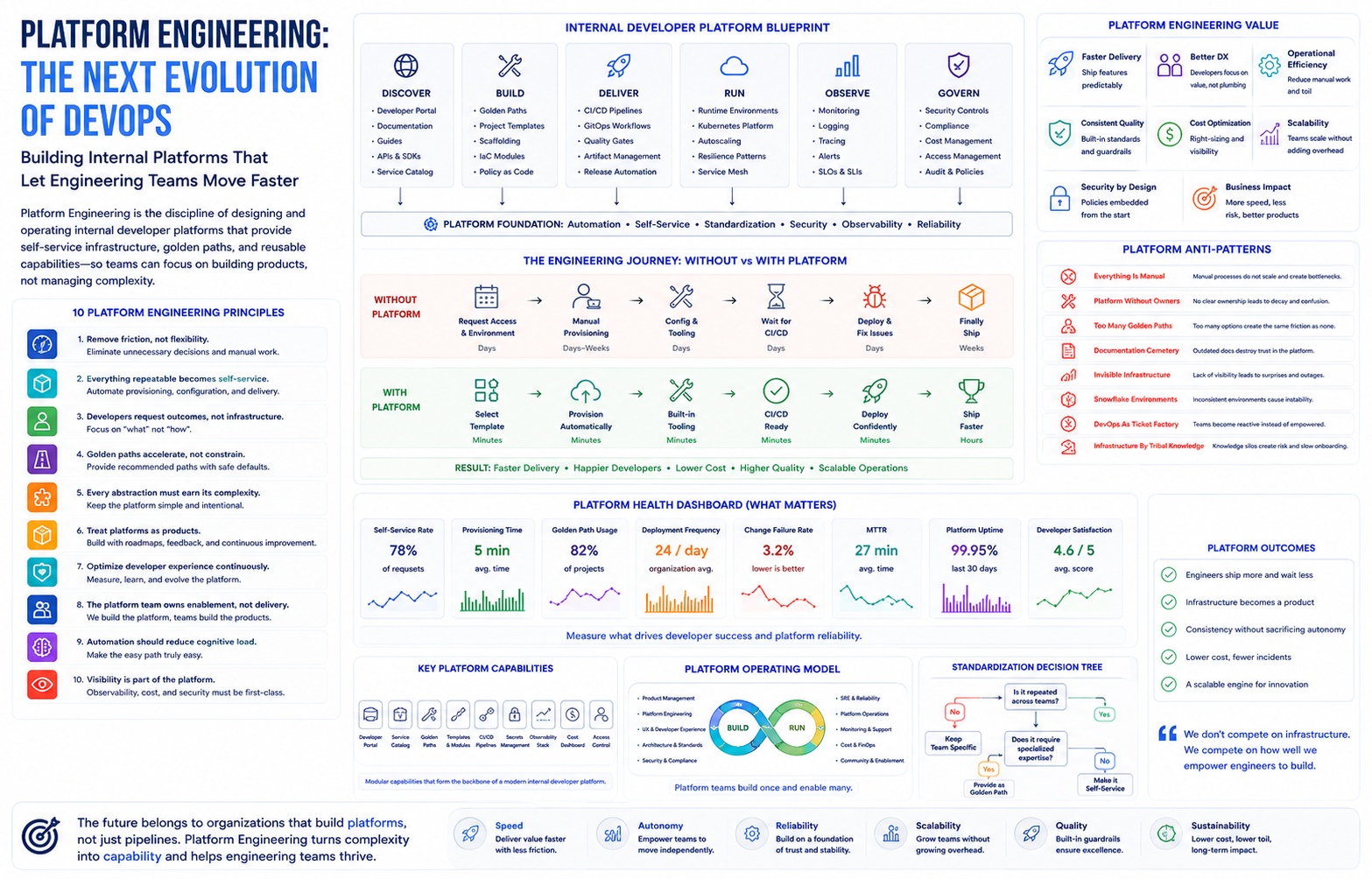
That is what a platform is: the systematic conversion of things every engineer must know into things no engineer must know.
Design Studio: The Standardization Argument
Transcript, lightly edited. Architecture workshop, Thursday, room booked for ninety minutes, ran to two hours and fifteen. Present: Priya (Platform Lead), Marcus (Staff Engineer, Payments), Wen (Principal, Infrastructure), Dee (Engineering Manager, Growth), Tomás (SRE).
Priya: The question on the board is whether we standardize the runtime. Right now we support Go, TypeScript, Python, and there are two JVM services in Payments. Proposal is: two supported languages on the Golden Path, everything else is off-path and unsupported.
Marcus: Which two?
Priya: Go and TypeScript.
Marcus: Then you've just told my team their two highest-throughput services are unsupported.
Priya: No, I've told you they're off-path. Those are different words on purpose.
Marcus: They're not different in practice. Off-path means when the base image CVE lands, nobody patches mine.
Wen: That's actually the real question. Not "which languages" — "what does the platform owe an off-path service?" Because if the answer is nothing, we've built a coercion mechanism and called it a paved road.
Dee: Can I say the uncomfortable thing? Growth has eleven services and every one of them is on the path, and I don't care what language we standardize on because we get the value either way. The people fighting this are the people who already have working systems. Which is a signal, not a complaint.
Tomás: The signal being that standardization is cheap for greenfield and expensive for brownfield, and we keep pricing it as if it's uniform.
Priya: Say more.
Tomás: We keep doing this thing where we design a standard, announce it, and then act surprised that migration is the whole cost. The standard is free. The migration is a person-year. If we're standardizing on two runtimes, the honest proposal isn't "two runtimes." It's "two runtimes plus a funded migration for the six services that aren't."
Marcus: Thank you. That's my actual objection. Not the choice. The unfunded mandate.
Priya: Fair. Let me reframe. Where should flexibility remain? Because I don't want the answer to be "everywhere" and I don't want it to be "nowhere."
Wen: I have a rule I've been using and I'll offer it. Standardize where variance produces no differentiated value and creates operational surface area. Leave flexibility where variance is the point.
Dee: That's abstract. Concretely?
Wen: Concretely: log format, metric naming, deployment mechanism, secret handling, base images, CI structure, and infrastructure provisioning — standardize hard, no exceptions, these are pure operational surface area. Nobody's business advantage comes from having a distinctive log format.
Dee: And the flexible side?
Wen: Data modeling, internal architecture, testing strategy above the minimum bar, framework choice inside a supported runtime, how you decompose your domain. That's where teams are actually thinking, and standardizing there just makes us slower and dumber.
Marcus: Runtime is on the boundary though. It's not pure operational surface — a runtime choice can genuinely matter for a latency-sensitive path.
Wen: Agreed. That's why runtime is a small set, not a single value. Two or three is defensible. Seven is an accident.
Priya: Let's go to the third question, because it's the one I actually lose sleep over. When does abstraction become harmful?
Tomás: When the abstraction fails and the developer has no path to understanding why.
Priya: Example.
Tomás: The Postgres module. It's beautiful. type: postgres, size: small. Last month Fulfillment had a connection exhaustion issue. The developer looked at their manifest, saw nine lines, and had absolutely nowhere to go. They couldn't see the pool config because we own it. They couldn't see the parameter group. They filed a ticket and waited six hours. Our abstraction turned a forty-minute debugging session into a six-hour outage because we hid the thing they needed to see.
Wen: Abstractions should hide decisions, not state.
Tomás: Say that again.
Wen: Hide decisions, not state. The developer shouldn't have to decide the pool size. But they must be able to see the pool size, and the current connection count, and what the limit is, at 3am, without asking us. We conflated "you don't need to choose this" with "you don't need to know this," and those are completely different claims.
Marcus: That's the best thing anyone's said in this room in a month.
Priya: So the rule is: every abstraction ships with an inspection surface.
Wen: And an escape hatch. Three properties. It hides the decision. It exposes the state. And there is a documented, supported way to break glass and take manual control when the abstraction is wrong for your case — with the understanding that you now own what you touched.
Dee: Doesn't the escape hatch destroy the standardization?
Wen: No, because the escape hatch is observable. If forty percent of teams are breaking glass on the same abstraction, that's not a discipline problem, that's a product defect in the platform and we should go fix it. The escape hatch is a feedback channel. Platforms without escape hatches don't get compliance; they get shadow infrastructure they can't see.
Tomás: Which is strictly worse.
Priya: Okay. Writing this down as three decisions. One: Golden Path runtimes reduce to Go and TypeScript, with a funded migration plan for the six off-path services, and we do not announce the standard until the migration is staffed. Two: standardization applies to operational surface area, not to domain design, and we publish the boundary explicitly so people stop arguing about it in every review. Three: every platform abstraction must expose state and provide a documented escape hatch, and escape-hatch usage is a tracked platform metric.
Marcus: I can live with all three.
Priya: Marcus, that's the most enthusiasm you've shown since the offsite.
Marcus: Don't push it.
Three durable ideas came out of that room, and they recur throughout this handbook:
Standardization is free to design and expensive to migrate. Any standardization proposal that does not include a funded migration plan is not a proposal; it is a wish, and it will produce a two-tier estate where new services comply and old services quietly don't.
Hide decisions, not state. This is the single most useful test for whether an abstraction is helping or hurting. A developer should never have to choose the connection pool size and should always be able to see it.
Escape hatches are instrumentation. A platform with no way out produces shadow infrastructure. A platform with a measured way out produces a prioritized backlog.
Internal Memo: On Not Hiring Another DevOps Engineer
To: Engineering Leadership From: Platform Engineering Re: Headcount request Q3 — recommendation to decline, and what to do instead Classification: Internal
We are declining our own headcount request. This memo explains why, because the decision looks perverse from the outside and we would rather be understood than merely obeyed.
The request as filed. Infrastructure ticket volume is up 34% quarter over quarter. Median time to resolution has moved from 1.2 days to 3.8 days. Four teams have escalated. The obvious remedy is two additional infrastructure engineers, which is what we asked for in the planning cycle and what we are now withdrawing.
Why we are withdrawing it.
We categorized every ticket resolved in the last quarter — 612 of them. The distribution:
| Category | Volume | Share |
|---|---|---|
| Repeat provisioning requests (11 distinct shapes) | 401 | 65.5% |
| Access and permission changes | 94 | 15.4% |
| Environment repair and drift correction | 61 | 10.0% |
| Genuinely novel infrastructure work | 38 | 6.2% |
| Incident response and escalation | 18 | 2.9% |
Six percent of our work is work that requires us. Ninety-four percent is the repeated manual application of knowledge we already possess.
Adding two engineers to this queue increases our capacity to perform repetitive work by roughly 25%. Ticket volume grows with engineering headcount, and engineering headcount is planned to grow 40% next year. We would be buying a 25% capacity increase against a 40% demand increase, using the most expensive labor available, and the arithmetic does not close. It has not closed for six consecutive quarters, which we should have noticed sooner.
The structural point.
Every ticket we resolve is an act of expertise that evaporates on completion. We know how to provision a production-safe Postgres instance. We demonstrate that knowledge 40 to 60 times a quarter. Each demonstration costs 45 minutes to 2 hours and leaves behind nothing except a running database and a closed ticket. The next request costs the same again.
The alternative is to spend that expertise once, in a durable form, so that it can be applied without us. We estimate the eleven repeating shapes represent approximately fourteen engineer-weeks of platform work to encode as self-service capabilities. Against that, the eleven shapes currently consume approximately nine engineer-weeks per quarter in manual resolution.
Payback is under two quarters. After that, the capability is free forever and gets better with maintenance, while the manual approach gets worse with scale.
Why this is not "just automate it."
We want to be precise, because "automate the tickets" has been proposed in this organization twice before and both attempts produced scripts that only we could run — which improved our throughput slightly and changed nothing structural.
The difference between automation and a platform is the interface and the ownership model. A script that a platform engineer runs on request is a faster ticket. A capability that a product engineer invokes without asking is a removed ticket. The work is not in the automation; it is in making the automation safe, discoverable, self-documenting, and governed well enough that we can let go of it.
That last part is the hard part and it is mostly cultural. It requires us to accept that developers will provision things we did not personally approve. Our guardrails must be good enough that this is safe, because it is going to happen either way — the current alternative is not "nothing gets provisioned," it is "things get provisioned in ways we can't see."
What we are asking for instead.
- No new infrastructure headcount this cycle. We will not staff the queue.
- Protected capacity. Three of our seven engineers move to platform construction full-time for two quarters, with explicit executive air cover. They do not carry tickets. They are not "50% platform" — that ratio has been tried and it converges to 5% platform within a month, because tickets have deadlines and platform work does not.
- Acknowledged degradation. The remaining four engineers will service the queue. Resolution times will get worse before they get better. We estimate a peak of 5-6 days at the trough, around month three. We are telling you this in advance so that it reads as a plan rather than a failure. If leadership cannot tolerate the trough, do not approve this — the worst outcome is starting and reversing at month three, which spends the cost and buys none of the benefit.
- A different success metric. Do not measure us on tickets closed. Measure us on tickets that no longer need to exist. We propose tracking the Developer Self-Service Rate: the percentage of infrastructure state changes executed by product engineers without platform involvement. It is currently 12%. Our target for the end of next year is 80%.
The uncomfortable framing.
Every additional infrastructure engineer we hire under the current model is a permanent operating cost that scales linearly with the company and produces no compounding asset. Every platform capability we build is a one-time cost that produces an asset which serves the hundredth engineer as cheaply as the tenth.
We are asking to stop buying labor and start building leverage. We recognize this makes our own group smaller in the long run relative to engineering headcount. We think that is the correct outcome and we would rather propose it than have it proposed to us.
— Platform Engineering
Blueprint: MERIDIAN
Reference architecture for an Internal Developer Platform. Named so that people can say "is that in Meridian?" instead of "is that in the platform?", which turns out to matter — an unnamed platform is experienced as a policy, and a named platform is experienced as a product.
Meridian is composed of ten modules. The composition is deliberate: each module is independently useful, and the value is superlinear because they share the same ownership and manifest substrate.
                        ┌──────────────────────────┐
                        │   ENGINEERING PORTAL     │
                        │   (single front door)    │
                        └────────────┬─────────────┘
                                     │
         ┌───────────────┬───────────┼───────────┬────────────────┐
         │               │           │           │                │
   ┌─────▼─────┐  ┌──────▼─────┐ ┌───▼────┐ ┌────▼──────┐  ┌──────▼──────┐
   │  SERVICE  │  │   GOLDEN   │ │ INFRA  │ │   CI/CD   │  │  DEVELOPER  │
   │  CATALOG  │  │   PATHS    │ │TEMPLATE│ │ TEMPLATES │  │    DOCS     │
   └─────┬─────┘  └──────┬─────┘ └───┬────┘ └────┬──────┘  └──────┬──────┘
         │               │           │           │                │
         └───────────────┴───────────┼───────────┴────────────────┘
                                     │
         ┌───────────────┬───────────┼───────────┬────────────────┐
         │               │           │           │                │
   ┌─────▼─────┐  ┌──────▼─────┐ ┌───▼────┐ ┌────▼──────┐  ┌──────▼──────┐
   │  SECRETS  │  │OBSERVABILITY│ │  COST  │ │ SECURITY  │  │  OWNERSHIP  │
   │ PLATFORM  │  │    STACK    │ │DASHBOARD│ │ CONTROLS │  │   REGISTRY  │
   └───────────┘  └─────────────┘ └────────┘ └───────────┘  └─────────────┘
                                     │
                         ┌───────────▼───────────┐
                         │  KUBERNETES PLATFORM  │
                         │  + CLOUD SUBSTRATE    │
                         └───────────────────────┘
Module 1 — Service Catalog
Purpose: to be the authoritative answer to "what exists, who owns it, and what does it depend on."
Not a list of repositories. A graph of services, their owners, their dependencies, their tiers, their SLOs, their runbooks, their APIs, and their current operational state. Populated by discovery, not by data entry: the catalog reads from the ownership manifests in each repository, from the running cluster, and from the cloud provider, and it flags anything it finds in one source and not another.
Why it is first: every other module needs to answer "whose is this?" Cost allocation needs it. Alert routing needs it. Vulnerability triage needs it. Deprecation campaigns need it. The catalog is not a nice-to-have discovery tool; it is the identity layer of the platform.
Failure mode: a catalog that requires manual registration. Adoption stalls at 60%, the missing 40% is disproportionately the legacy that most needs governance, and every downstream module inherits a hole.
Module 2 — Golden Paths
Purpose: to make the well-lit route obviously better than the improvised one.
Each Golden Path is a committed product, not a document. It has an owner, a version, a changelog, a support level, and a deprecation policy. A path in Meridian covers the full lifecycle: create → develop → test → deploy → observe → operate → deprecate. A path that stops at deployment is half a path, and half a path is where most organizations stop.
Sizing rule: the number of Golden Paths should be small enough that a developer can hold all of them in memory. Practically: five to eight. Beyond that, path selection itself becomes a decision requiring expertise, and you have reinvented the problem in a nicer typeface.
Module 3 — Infrastructure Templates
Purpose: to convert infrastructure requests into infrastructure declarations.
A versioned library of Terraform modules exposing outcome-level interfaces. postgres, object-store, cache, queue, topic, service-account, dns-record, cdn-distribution. Each module encodes the organization's production standard: encryption, backup, tagging, network placement, monitoring, and least-privilege access.
Interface rule: the module's public interface expresses what the service needs; the module's internals express how this organization does it. size: small is a need. instance_class: db.r6g.large is an implementation. If implementation details leak into the interface, the module cannot evolve, because every change becomes a breaking change for every consumer.
Versioning rule: semantic, pinned by consumers, with automated upgrade pull requests. Consumers who fall more than two minor versions behind receive escalating nudges. Consumers more than one major version behind are surfaced on the platform health dashboard as reuse debt.
Module 4 — Golden Path CI/CD Templates
Purpose: to make the correct pipeline the default pipeline.
Pipeline definitions are consumed as versioned templates, not copied. A service's CI configuration is typically under fifteen lines: which template, which version, which parameters. The template supplies build, test, dependency scanning, SAST, artifact signing, SBOM generation, image publication, and deployment manifest rendering.
Consequence: when the organization adopts a new supply-chain requirement — signing, provenance attestation, a new scanner — it is implemented once in the template and rolled out through version bumps. In the copy-paste model, the same change is a hundred and twenty pull requests and a quarter of migration nagging.
Module 5 — Observability Stack
Purpose: to make every service debuggable on the day it is born.
Metrics, logs, traces, and profiles, with correlation by trace ID enforced through the instrumentation library shipped in the templates. Dashboards generated from service manifests. SLOs declared in the manifest and rendered into recording rules and error budget tracking automatically. Alert routing derived from the Ownership Registry.
Design stance: observability is not a product the platform integrates; it is a property the platform guarantees. The test is whether a service can reach production without it. If yes, you have an observability vendor, not an observability platform.
Module 6 — Secrets Platform
Purpose: to eliminate human custody of credentials.
Workload identity as the primary mechanism — services authenticate as themselves to obtain short-lived credentials, and static secrets exist only where a third party forces the issue. Where static secrets are unavoidable, they are stored centrally, injected at runtime, rotated on schedule, and audited on access.
Standard: zero secrets in repositories, zero secrets in CI configuration, zero secrets in developer possession. Enforced by pre-commit hooks, repository scanning, and a nightly job that attempts to find credentials and files a ticket against the owning team when it succeeds.
Module 7 — Cost Dashboard
Purpose: to make spend legible at the unit that teams control.
Cloud bills arrive organized by cloud provider concepts. Teams think in services. The cost module bridges the two using the tagging scheme enforced by the infrastructure templates, presenting spend per service, per team, per environment, and per unit of business throughput.
Why it belongs in the platform rather than in Finance: cost is a developer experience surface. An engineer who can see that their staging environment costs $4,100 a month will fix it. An engineer who receives a quarterly email from Finance about cloud efficiency will not. Feedback loops must be short and local to change behavior.
Module 8 — Security Controls
Purpose: to make compliance a byproduct of the paved road rather than an audit event.
Policy-as-code at admission: no privileged containers, no latest tags, no unencrypted storage, no public buckets without an explicit exception record, no images from unapproved registries, no services without an owner. Vulnerability scanning with severity-based SLAs routed automatically to owners. Change history derived from GitOps commits.
The reframing that matters: in Company A, security is a gate that developers experience as friction at the end. In Meridian, security is a property of the templates that developers experience as nothing at all, because the scaffold they started from was already compliant. The most successful security control is the one nobody knows they are subject to.
Module 9 — Engineering Portal
Purpose: to be the one URL.
Search across services, docs, APIs, teams, and runbooks. The Create button. Live service health. Ownership lookup. Cost view. Dependency graph. Deprecation notices. Platform changelog. The portal is not a dashboard aggregator; it is the interaction surface of every other module.
Adoption test: if the portal is not in the daily rotation of the median engineer, it is not a portal, it is a website. Portals earn daily use by being the fastest path to answers people need daily — most commonly "who owns this?" and "is this thing healthy?"
Module 10 — Developer Documentation
Purpose: to make documentation a build artifact.
Docs live in the service repository, are rendered by the platform, are versioned with the code, and are checked for freshness. Every service's docs page shows a last-verified date. Every Golden Path has a tutorial that is executed by CI — if the tutorial's commands stop working, the pipeline fails.
The principle: documentation that is not executable becomes fiction on a predictable schedule. The half-life of unexecuted infrastructure documentation in a growing organization is roughly one quarter.
Field Guide: Day One, Twice
The same engineer. The same skills. Two organizations.
Day One at Northwind (traditional operating model)
09:00 — Laptop arrives. IT provisioning ticket was filed last Thursday; it is partially complete. She has email and Slack. She does not have VPN.
09:40 — Her manager sends a link to the onboarding wiki. The wiki has forty-one pages. Eleven have a banner reading "this page may be out of date."
10:15 — She asks in #engineering how to get repository access. Three people respond with three different answers. The correct answer is a fourth thing: there is a form, it is in a different Confluence space, and it requires a manager approval that her manager does not know he needs to give.
11:30 — VPN request submitted. SLA is two business days.
13:00 — She reads code in the GitHub web interface, because she cannot clone anything.
14:20 — She discovers the local development setup guide. It requires a version of a runtime that is no longer downloadable from the vendor's website. A Slack search reveals that everyone uses a different version and someone has a Homebrew formula in a personal tap.
16:00 — She has a working editor and a repository she cannot build.
Day 3 — VPN arrives. She clones. The build fails on a dependency that requires credentials to an internal artifact registry. New ticket.
Day 6 — Build succeeds. She runs the test suite. Fourteen tests fail. She asks. She is told those tests always fail locally and there is a flag.
Day 9 — She needs a development environment. She learns that development environments are shared, that there are three, that they are booked in a spreadsheet, and that #2 is broken.
Day 14 — Her first pull request merges. It is a documentation fix.
Day 19 — Her first production change ships, shepherded by a senior engineer who performs three manual steps on her behalf and mentions that she will "pick it up eventually."
Fourteen days of a senior-level salary spent on access control and environment archaeology. And the deeper cost is not the fourteen days — it is what she learned. She learned that this organization's infrastructure is a maze, that the correct move is to ask a person rather than consult a system, and that the reward for curiosity is a ticket. That lesson persists for years.
Day One at Sable (platform operating model)
09:00 — Laptop arrives, pre-enrolled. She signs in with SSO. Group membership derives from the HR system, which derives her team, which grants access to her team's repositories and namespaces automatically. No form. No ticket.
09:20 — Onboarding message contains one link: the Engineering Portal. The portal shows her team, her team's eleven services, their current health, and a "Get Started" path.
09:35 — She runs one command from the portal. It installs the platform CLI, authenticates her, and verifies her environment. Total time: four minutes, most of it downloading.
10:00 — She opens her team's primary service. platform dev starts it locally against ephemeral dependencies provisioned on demand. It works on the first attempt, which is not luck — the same command runs in CI on every commit to that repository, so a broken local development path breaks the build.
11:00 — She reads the service's docs, rendered in the portal, generated from the repository, last verified nine days ago by an automated check.
13:30 — Her manager suggests she create a scratch service to learn the path. She opens the portal, clicks Create, picks HTTP Service (Go), fills in four fields.
13:39 — Repository exists. CI is green. The service is deployed to development. It has a dashboard, an SLO, alert routing to her team, a runbook stub, and a catalog entry. She did not write any of it.
14:00 — She adds a Postgres instance by adding four lines to her manifest. It exists eleven minutes later.
16:20 — She opens her first pull request against a real service: a small bug fix from the team's backlog.
Day 2, 11:00 — The pull request merges, promotes through staging, and she approves the production promotion herself. She is on the on-call rotation shadow list starting Monday.
Time to first production change: one day. Tickets filed: zero. Senior engineer hours consumed: approximately forty minutes, all of it on the substance of the bug rather than on the mechanics of the environment.
The comparison that matters
The naive reading is that Sable is nineteen times faster at onboarding. That is true and it is the least interesting difference.
The important differences are structural:
Northwind's onboarding cost scales with hiring rate. Each new engineer consumes senior engineer time to navigate the maze. Hiring faster makes onboarding worse, because the guides are the same people who are already interrupted. Sable's onboarding cost is nearly flat — the platform serves the fiftieth hire as cheaply as the fifth.
Northwind teaches dependence; Sable teaches self-sufficiency. The first week is the highest-signal learning period an employee ever has. Northwind spends it teaching that systems don't work and people do. That belief, once installed, generates tickets for the rest of the engineer's tenure.
Northwind's environment is unknowable; Sable's is uniform. After a year, the Northwind engineer knows her corner. After a year, the Sable engineer can move to any team in the company and be productive on day one, because every service looks the same from the outside. Internal mobility, which every VP of Engineering claims to want, is a downstream property of standardization.
Architecture Decision Records
Excerpted from the platform ADR repository. Format has been stable since ADR-0003, which was the ADR establishing the format, which nobody enjoys pointing out.
ADR-0011: Adopt Backstage as the Engineering Portal
Status: Accepted · Superseded review scheduled 18 months
Context. Service discovery currently requires asking a person. We have 94 services, 14 teams, and no authoritative record of ownership. Three incidents in the last six months were extended by more than 30 minutes because responders could not determine who owned a failing dependency. We also have four partial solutions: a Confluence page, a spreadsheet maintained by SRE, a CODEOWNERS convention followed by roughly half the repositories, and institutional memory.
Problem. We need a single authoritative interaction surface for engineering. The requirements are: authoritative ownership records, service discovery, template-driven scaffolding, documentation rendering, and extensibility for our own plugins.
Options considered.
A. Build a custom portal. Full control over data model and UX. Estimated 9-12 engineer-months to reach parity with off-the-shelf, plus indefinite maintenance. Rejected: the portal is not our differentiation, and the failure mode of custom internal tooling is that it is loved for a year and abandoned when its author leaves.
B. Adopt Backstage. Open source, CNCF-graduated, established plugin ecosystem, software catalog and scaffolder are the two features we most need. Cost is a real ongoing engineering investment — Backstage is a framework, not a product, and organizations consistently underestimate this.
C. Adopt a commercial IDP product. Faster time to value, lower operational burden, but a constrained extension model and a pricing structure that scales with engineer count. Our extension requirements are unusual (regulatory reporting integration) and we were not confident of a fit.
D. Do nothing; improve the spreadsheet. Zero cost. Does not address discovery or scaffolding, and the spreadsheet's accuracy is already below 70%.
Decision. Adopt Backstage (Option B), with a dedicated owner and an explicit budget of 1.5 engineers ongoing.
Trade-offs accepted. Backstage is a framework and requires real staffing; we have seen peer organizations deploy it, staff it at 0.2 FTE, and end up with an abandoned catalog that is worse than the spreadsheet because it looks authoritative. We accept a higher cost than Option C in exchange for extensibility and no per-seat pricing. We accept upgrade burden — the Backstage release cadence is fast and the upgrade path is occasionally rough.
Future consequences. The catalog becomes load-bearing for alert routing, cost allocation, and compliance reporting within two quarters. This is intentional and it is also a single point of failure: portal downtime will not stop deployments (the portal is not in the deployment path, by design) but will impair incident response. We commit to keeping the portal out of any runtime critical path, and to maintaining a read-only export of the ownership graph that survives portal unavailability.
ADR-0014: Infrastructure Modules Expose Outcome Interfaces, Not Resource Interfaces
Status: Accepted
Context. Our Terraform module library has grown organically. Several modules are thin wrappers that pass through provider arguments — module "db" requires the consumer to supply instance_class, allocated_storage, parameter_group_name, and eleven other provider-level values. Consumers copy these values from each other, which propagates mistakes, and we have four different Postgres configurations in production that differ only by accident.
Problem. Thin wrappers do not encode expertise; they relocate it. The consumer still needs to know what a good value is.
Options considered.
A. Status quo: pass-through modules with documented recommended values. Zero migration cost. Does not solve the knowledge problem — documentation of recommended values is exactly the thing that goes stale.
B. Outcome interfaces with a fixed set of profiles. Consumers specify size: small|medium|large and workload characteristics; the module maps to concrete resources. Maximum encoding of expertise, minimum consumer knowledge. Migration required for 31 existing consumers.
C. Layered: outcome module built on top of the existing pass-through module, both supported. Gentler migration. Doubles the surface area we maintain and creates ambiguity about which to use, which in practice means both get used forever.
Decision. Option B. Outcome interfaces only. The pass-through modules are deprecated with a two-quarter migration window, and the platform team writes the migration pull requests rather than asking teams to write them.
Trade-offs accepted. Some consumers have genuinely unusual requirements that the profile set will not cover. We accept this and provide a documented escape hatch: an overrides block that accepts raw provider arguments, with the explicit contract that overridden resources fall outside the platform's support and upgrade guarantees. Override usage is reported on the platform dashboard; sustained override usage above 15% on any module is treated as a defect in the profile set rather than as user error.
Future consequences. We gain the ability to change implementation globally — instance families, storage types, backup mechanisms — without consumer changes. This is worth more than it appears: the graviton migration that followed took eleven days instead of the two quarters it would have taken under Option A. We also accept that the profile set becomes a governance object requiring periodic review, since profiles that were correct in 2024 will be wrong in 2027.
ADR-0019: Golden Paths Are Products With Named Owners and Deprecation Policies
Status: Accepted
Context. We have shipped four Golden Paths. Two are actively maintained. One was built by an engineer who has since moved to a product team and receives ad-hoc fixes when someone complains loudly. One is undocumented and, on inspection, generates services with a base image that has not been rebuilt in eight months.
Problem. An unowned Golden Path is worse than no Golden Path, because it carries an implicit promise of support that the organization does not intend to keep. Developers reasonably assume the paved road is maintained. When it is not, the failure is discovered during an incident.
Options considered.
A. Best-effort maintenance across all paths. What we do today. Produces exactly the current situation.
B. Each path has a named owner, a documented support tier, and a deprecation policy. Paths without an owner are retired. Forces us to retire things, which is politically unpleasant.
C. Reduce to a single Golden Path. Radically simple. Does not fit our actual workload shapes — an event consumer and a frontend application do not share a useful template.
Decision. Option B. Every Golden Path has: a named owning engineer, a support tier (Tier 1 = 24h response, Tier 2 = 5 business days), a published changelog, an upgrade mechanism, and a deprecation policy with a minimum 2-quarter notice. Paths that cannot be assigned an owner are deprecated immediately, and existing consumers are migrated by the platform team.
Trade-offs accepted. We will support fewer paths than teams request. We are choosing depth over breadth, on the reasoning that a developer's trust in the paved road is a single global variable — one broken path damages confidence in all of them.
Future consequences. Path count becomes a budgeted resource. New path proposals require a business case including the ongoing maintenance cost, evaluated against the Platform Capability Canvas (see below). This will feel bureaucratic and will occasionally be wrong, but it is less wrong than the current model in which any enthusiastic engineer can create a permanent organizational liability in an afternoon.
ADR-0022: GitOps for All Production State Changes
Status: Accepted
Context. Production deployments currently happen through CI jobs with cluster credentials. We have no reliable record of what is running versus what was intended. Drift between environments is discovered by incident. Our SOC 2 change-management evidence is assembled quarterly by hand from CI logs, which takes an engineer roughly four days each time.
Problem. Imperative deployment provides no continuously verified relationship between intended state and actual state.
Options considered.
A. Continue with imperative CI deployment, improve auditing. Lower change cost. Auditing an imperative system means reconstructing intent from logs, which is inference rather than record.
B. GitOps with a pull-based reconciliation controller. Desired state in Git, controller reconciles continuously, drift is detected and corrected automatically, audit trail is the commit history. Requires restructuring pipelines and a new operational component in every cluster.
C. Hybrid: GitOps for infrastructure, imperative for applications. Minimizes application team disruption. Creates two mental models and two audit stories, which is the worst of both.
Decision. Option B, applied to both infrastructure and applications, with a phased rollout by service tier.
Trade-offs accepted. Deployment becomes eventually consistent rather than synchronous, which developers experience as "my deploy takes 90 seconds to start" and dislike for approximately one month. Debugging gains a layer of indirection — "why isn't my change live" now has more possible answers — which we mitigate with a deployment status view in the portal that traces a commit through to reconciliation. The controller itself becomes critical infrastructure requiring its own reliability engineering.
Future consequences. Rollback becomes a revert, which is the single largest reduction in incident-response cognitive load we have achieved. Compliance evidence becomes a query rather than a project — the four-day quarterly exercise became a report. Emergency manual intervention becomes visible: manual cluster changes are now reverted automatically by the controller, which forces break-glass procedures to be explicit and recorded rather than informal and forgotten.
ADR-0026: Shared Multi-Tenant Kubernetes Clusters, Namespace-Isolated
Status: Accepted · Contested
Context. We run 94 services. Cluster topology is currently one cluster per environment per business unit: 11 clusters. Operational cost of upgrades is 11× everything. Utilization averages 23%.
Problem. Cluster proliferation multiplies operational load and wastes capacity, but consolidation concentrates blast radius.
Options considered.
A. Cluster per team. Strong isolation, clear ownership, trivially avoids noisy-neighbor issues. Upgrade and patch burden scales with team count. Utilization stays poor. Cost roughly 3× consolidated at our scale.
B. Shared clusters per environment, namespace isolation, resource quotas, network policies, and a per-service ceiling. Best utilization and lowest operational burden. Blast radius is the cluster. Requires genuine multi-tenancy discipline: quotas, priority classes, pod disruption budgets, and admission policy.
C. Shared clusters with dedicated node pools for Tier-1 services. Middle path. Isolation where it matters, sharing elsewhere. More complex scheduling configuration.
Decision. Option C, described as Option B with exceptions. Shared clusters per environment and per region; Tier-1 services scheduled onto dedicated node pools; hard resource quotas and network policy default-deny for all namespaces.
Trade-offs accepted. A control-plane failure affects many services. We mitigate with multi-region and by ensuring that a cluster failure degrades rather than destroys — no service's data lives in the cluster. We accept ongoing noisy-neighbor investigation as a permanent class of operational work; the quota and priority configuration is not fire-and-forget.
Future consequences. Upgrades become a manageable quarterly exercise rather than an eleven-part campaign, which in turn means we actually stay current on Kubernetes versions — the previous state had two clusters more than a year behind. Utilization improved from 23% to 61% within two quarters, which is a larger cloud saving than any negotiated discount we have obtained. The contested status remains because the Payments organization continues to prefer dedicated clusters for regulatory reasons; we revisit annually and have documented the specific regulatory claim so that it can be evaluated rather than asserted.
ADR-0031: Self-Service Provisioning With Policy Guardrails, Not Approval Gates
Status: Accepted
Context. All infrastructure provisioning currently requires platform team approval. Median approval latency is 1.4 days. Analysis of the last 300 approvals found that 291 were approved without modification, 6 were approved after a comment, and 3 were rejected. Of the 3 rejections, 2 were cost-related and 1 was a security misconfiguration.
Problem. The approval gate costs 1.4 days on every request and catches issues in 1% of cases. It is functioning as a very expensive linter.
Options considered.
A. Retain approval. Preserves the 1% catch rate and the sense of control. Cost is roughly 420 engineer-days of aggregate waiting per year at current volume.
B. Remove approval; encode the checks as policy. Cost checks, security checks, and naming checks become automated policy evaluated at plan time. Requests that pass proceed without human involvement; requests that fail are blocked with a specific, actionable message. Rejection reasons become code.
C. Risk-tiered approval. Automatic below a cost threshold and outside sensitive categories; human approval above. Preserves control where it matters and removes it where it does not.
Decision. Option C, which we describe internally as Option B with a small exception list, because the framing matters — the default is self-service and the exceptions are enumerated, rather than the default being approval with self-service carve-outs.
Automatic: anything under $500/month projected, in a non-production environment, or matching an established pattern in production. Human review: projected spend above $500/month, anything touching customer data classification boundaries, anything public-facing, anything requiring a new IAM role with write permissions outside the service's own resources.
Trade-offs accepted. We will provision things we would have questioned. Some of them will be wasteful. We are trading a bounded, visible cost (occasional waste, detected by the cost dashboard within days) for a large, invisible cost (organization-wide waiting). We accept that policy-as-code has false negatives that human review would have caught; we handle these by continuous detection rather than upfront prevention, which is a genuine philosophical shift and not everyone in the security organization is comfortable with it.
Future consequences. The platform team stops being a bottleneck and starts being a policy author, which is a materially different job requiring different skills. Our on-call load drops. Our policy authoring load rises. Detection-based controls require sustained investment in the cost and security dashboards; if those degrade, this ADR becomes unsafe, and we note that dependency explicitly here so that a future reader understands the coupling.
Platform Diary
Observations recorded by the platform team over eighteen months. Kept because the useful lessons rarely arrive as conclusions; they arrive as things that surprised us.
Week 3. Shipped the Postgres self-service module. Eleven people used it in the first four days. Two of them used it for things we did not anticipate — one is running a queue in it. We have opinions about that. We are not going to share them yet.
Week 6. Ticket queue is up. We expected down. Investigation: self-service made provisioning cheap, so people are provisioning more, and the new tickets are questions about the self-service module rather than requests to provision. Different tickets. Better tickets. Still tickets.
Week 11. The first time someone said "just use the platform" in a channel we weren't in. Wrote it down. It felt disproportionately good.
Week 14. Golden Path adoption is 40% and stuck. Interviewed six teams who aren't using it. None of them had objections to the path. Four of them didn't know it existed. Discoverability was a bigger blocker than quality and we had spent zero time on it.
Week 15. Added the Create button to the portal home page. Adoption 40% → 58% in three weeks. Cost: two days of work.
Week 19. Someone asked us to add a field to the scaffolder. Then someone else. Then a third. We added all three fields. The form now has nine fields and the completion rate has dropped. Feature requests are individually reasonable and collectively corrosive. We need a rule for saying no.
Week 22. Rule for saying no: a field goes in the scaffolder only if it cannot be defaulted, cannot be derived, and cannot be changed later. Removed five of nine fields under this rule. Completion rate recovered and exceeded the previous peak.
Week 26. Our ticket queue shrank by 61% this quarter. Nobody noticed. Nobody thanked us. This is the correct outcome and it is also organizationally dangerous — invisible success does not get funded. We need to publish the number ourselves, because the absence of pain generates no advocacy.
Week 30. Developers stopped asking us for infrastructure. They started asking us for capabilities. "Can the platform do canary analysis?" instead of "can you deploy this for me." The change in the shape of the question is the clearest signal we've had that something structural shifted.
Week 33. An engineer told us that standardization made her feel more autonomous, not less, and we made her explain it. Her explanation: she used to need permission because she didn't know if what she was doing was safe. Now she doesn't need permission because the platform makes unsafe things hard. Constraints removed the need to ask. This inverts everything we assumed about the autonomy/standardization trade-off.
Week 38. Documentation became executable. We started running the "getting started" tutorial in CI. It failed immediately. It had been broken for five weeks and nobody had reported it — new engineers had assumed the failure was their fault. This is the most damning single fact we uncovered all year.
Week 41. First platform incident. The scaffolder generated 4 services with a misconfigured resource limit. Blast radius: 4 services in one afternoon. Under the old model, a mistake like this would have affected one service, because a human would have made it once. Platforms amplify correctness and they amplify error at the same rate. We now have a canary process for template changes.
Week 47. Escape hatch usage on the Postgres module is 22%, above our 15% threshold. Investigated. Nineteen of twenty-three overrides set the same parameter — max_connections. Our small profile was too small. Fixed the profile; override usage fell to 4%. The escape hatch worked exactly as designed: it told us we were wrong without anyone having to file a complaint.
Week 52. Ran our first developer experience survey. Score was lower than we expected in one specific area: local development. We had optimized the entire cloud path and left the laptop alone. The place developers spend the most hours was the place we had invested the least.
Week 58. Onboarding time to first production change: 1.4 days, down from 12. The number that changed leadership's mind was not this one. It was the derived one: at our hiring rate, that difference is 640 engineer-days per year.
Week 63. A team built their own deployment tooling because ours didn't support their use case. Old reflex: enforce compliance. New reflex: ask what they needed. It was a legitimate gap. We adopted their tool into the platform and made its author the owner. Shadow platforms are unfunded product research.
Week 71. Version drift on the CI template is worse than we thought — 30% of services more than three minor versions behind. Automated upgrade PRs alone didn't fix it, because unattended PRs just accumulate. Added the drift number to each team's page in the portal, visible to their manager. Drift fell to 8% in six weeks. Making a number visible to the person accountable for it is more effective than any automation we've built.
Week 78. Someone described the platform as "boring" in a retro. Best review we've received.
Anti-Pattern Gallery
Exhibits, with commentary. Each was observed in a real organization, several of them in ours.
Exhibit I — Everything Is Manual
What it looks like: an infrastructure team of skilled engineers, a shared Slack channel, a Jira board, and a culture of responsiveness. People are helpful. Requests get done. Everyone is busy in a way that feels productive.
Why it slows engineering: throughput is bounded by the calendar of the operators. Every organizational growth increment increases demand without increasing supply. The team's most skilled engineers become the most interrupted, which means the organization's deepest expertise is spent on its shallowest work. The failure is invisible in month six and structural in year two.
The tell: the infrastructure team's most common sentence is "sure, I can do that for you."
Exhibit II — Platform Without Owners
What it looks like: a platform exists. It was built during a Q3 initiative by three engineers who have since been reassigned. It mostly works. Nobody's name is on it.
Why it slows engineering: developers cannot distinguish between "not supported" and "supported but broken," so they route around the platform at the first friction. Bugs accumulate silently because the reporting path is unclear. The base images stop being rebuilt. Eighteen months later the platform is a liability with a trustworthy appearance, which is more dangerous than an obvious absence.
The tell: you ask who owns the deployment pipeline and get three names, hedged.
Exhibit III — Too Many Golden Paths
What it looks like: fourteen templates in the scaffolder. Each was created for a real need. Each has one or two consumers.
Why it slows engineering: the paths stop being paths and become a catalog requiring expertise to navigate. Selecting the right one is now a decision the developer cannot make confidently, which reintroduces the exact cognitive load the paths were meant to remove. Maintenance is spread so thin that no path is fully current, which means the support promise is false across the board — and developers, correctly, stop trusting all of them.
The tell: developers ask which template they should use, and the answer varies by who you ask.
Exhibit IV — Documentation Cemetery
What it looks like: a wiki with 400 pages. A search function. A "last edited" column, mostly showing dates more than a year old. Several pages titled with v2, NEW, or FINAL.
Why it slows engineering: the cost of stale documentation is not that people fail to find answers. It is that they find wrong answers and act on them, then lose hours to a problem that documentation created. After enough of these, the organization learns to distrust all documentation, which means the good pages are also ignored, and the only reliable source of truth is a person — returning us to Exhibit I.
The tell: onboarding advice includes "ignore the wiki, ask in Slack."
Exhibit V — Invisible Infrastructure
What it looks like: an elegantly abstracted platform. Developers declare intent; magic happens. Nobody knows what the magic is.
Why it slows engineering: during normal operation, this is excellent. During an incident, it is catastrophic. The developer whose service is failing cannot see the layer beneath their abstraction, so their debugging capability is zero and their only recourse is to escalate. Mean time to resolution for any issue below the abstraction line becomes gated on platform team availability. The platform has converted a distributed debugging capability into a centralized one, which is precisely the bottleneck it was built to eliminate.
The tell: the escalation path for "my database is slow" is a Slack message to the platform team.
The correction: hide decisions, not state. Every abstraction ships with an inspection surface.
Exhibit VI — Snowflake Environments
What it looks like: production, staging, and development, all serving the same purpose, all subtly different. Staging has an extra environment variable. Development runs an older ingress controller. Nobody can say when they diverged.
Why it slows engineering: testing loses its meaning. A change that passes staging may fail production for environmental reasons, which teaches engineers that staging is unreliable, which causes them to test less rigorously, which increases production failures. The organization ends up with the cost of a staging environment and none of the benefit. Worse, every incident begins with the question "is this an environment difference?", which consumes the first twenty minutes of every investigation.
The tell: the phrase "it works in staging" is used as a joke.
Exhibit VII — DevOps As Ticket Factory
What it looks like: a well-run queue. SLAs. Triage rotation. Dashboards showing tickets closed. A team that hits its targets.
Why it slows engineering: the metrics measure the throughput of a system that should not exist. Optimizing ticket resolution time is optimizing the efficiency of a bottleneck rather than removing it. Worse, the metrics create an incentive against elimination: a team measured on tickets closed has no reason to make tickets unnecessary, and may unconsciously resist self-service because it makes their contribution invisible.
The tell: the infrastructure team's quarterly review leads with volume, not with reduction.
The correction: measure tickets that no longer need to exist.
Exhibit VIII — Infrastructure By Tribal Knowledge
What it looks like: things work. The people who know why are still here.
Why it slows engineering: the organization's operational capability is stored in a medium that resigns, goes on vacation, and gets sick. Every piece of tribal knowledge is a single point of failure with a notice period. The cost is not usually paid as a dramatic outage; it is paid as a slow tax on everyone else's speed, because every question routes to a person and every person is finite.
The tell: someone says "ask Dmitri, he knows how that works," and everyone accepts this as a satisfactory answer.
Exhibit IX — The Platform Nobody Asked For
A late addition to the gallery, and the one we are most embarrassed by.
What it looks like: a platform team with a roadmap derived from conference talks. Beautiful abstractions solving problems no team in this company has. Meanwhile the actual top complaint in the developer survey — flaky integration tests — is on nobody's roadmap because it is not architecturally interesting.
Why it slows engineering: platform capacity is finite, and capacity spent on speculative capability is capacity not spent on measured friction. Adoption stays low, which the team interprets as a communication problem and addresses with more documentation, which does not help, because the problem was never awareness.
The tell: the platform roadmap and the developer survey have no overlapping items.
Platform Economics
Platform Engineering is usually funded as an infrastructure expense and evaluated as a cost center. Both are category errors. The following is the argument we make to finance, stripped of engineering romance.
The unit of analysis is the marginal engineer
Every organization has an implicit answer to: what does it cost to make the next engineer productive? In a ticket-driven model that cost is roughly constant per engineer and includes a fraction of a senior engineer's time forever, because the new engineer will keep filing tickets. In a platform model, the cost of the marginal engineer approaches the cost of an SSO group membership.
At 40 engineers, the difference is a rounding error. At 400, it is the difference between an infrastructure organization of 45 people and one of 12.
Six ledgers
Engineering productivity. The measurable quantity is not lines or story points; it is waiting. Aggregate waiting is the sum, across all engineers, of time spent blocked on someone else. In our pre-platform state we measured 1.4 days of median wait on infrastructure requests, at roughly 3.2 requests per engineer per month. For 120 engineers: approximately 540 engineer-days per year, spent waiting. That is 2.4 full-time engineers' worth of output, purchased at full salary and delivered as nothing.
Operational cost. Infrastructure headcount under a ticket model scales at roughly 1 infrastructure engineer per 10-12 product engineers, and that ratio degrades as the estate ages because maintenance load accumulates. Under a platform model, mature organizations run 1 per 25-40. On a 300-engineer organization, that is a difference of roughly 18 engineers — call it $4M annually, permanently.
Developer onboarding. Time-to-first-production-change is the cleanest available measure. Twelve days versus one and a half. At a hiring rate of 60 engineers per year, the difference is 630 engineer-days, plus roughly 40% of that again in senior engineer shepherding time that does not appear in the primary number.
Cloud efficiency. This is where the finance conversation usually starts, and it is the smallest ledger. But the effects are real and they are structural rather than negotiated: shared clusters moved utilization from 23% to 61%; standardized modules made the graviton migration an eleven-day project instead of a two-quarter one; consistent tagging made 100% of spend attributable, which surfaced $310K/year of orphaned resources in the first sweep. The important property is that standardization makes optimization cheap. In a snowflake estate, every optimization is a per-service project. In a standardized estate, it is a module change.
Incident reduction. Two mechanisms. First, uniformity: when every service is configured the same way, a class of misconfiguration incidents simply stops occurring. Second, response time: a responder who can rely on every service having the same dashboards, the same log format, and a discoverable owner resolves faster. Our MTTR fell 38% over four quarters, and the largest single contributor was not tooling — it was the ownership registry making "who owns this dependency" a two-second lookup.
Infrastructure reuse. The compounding ledger. A Terraform module written once and consumed 94 times has an effective cost per consumption approaching zero, and — more importantly — an improvement applied once propagates 94 times. This is the only ledger where the platform's value grows superlinearly with organization size, and it is the reason platform investment gets better the longer you hold it.
Why this is an investment, not an expense
An expense is consumed on use. A ticket resolved is consumed on use: it produces a running database and no residual asset. Next quarter's identical ticket costs the same.
An investment produces an asset with a return. A self-service Postgres capability produces a running database and the ability to produce all subsequent databases at near-zero marginal cost. Its return is the avoided cost of every future instance, and that return grows as the organization grows.
The distinction has a practical consequence for how platform work should be funded: you cannot fund an investment out of the operational budget of the team that is drowning in operational work. This is why the internal memo above asks for protected capacity rather than headcount. Headcount added to an operational queue is absorbed by the queue. The only way to build the asset is to remove people from the queue and accept a temporary degradation, which requires leadership to make an explicit, publicly-owned trade.
The honest counter-argument
Platform investment fails often. The common failure modes are: building capabilities nobody asked for (Exhibit IX), underfunding maintenance so that the asset decays into a liability (Exhibit II), and starting the investment and abandoning it at the trough (the month-three problem in the memo). A platform bet that is reversed halfway is strictly worse than never starting, because you have paid the migration cost and captured none of the compounding return.
We include this because the economics above are a genuine argument and not a guarantee, and platform teams that oversell it get exactly one funding cycle.
The Platform Health Dashboard
Standard DevOps metrics — deployment frequency, lead time, change failure rate, MTTR — measure the output of the delivery system. They are necessary and they are lagging. They tell you the system is slow; they do not tell you where.
The dashboard below measures the platform itself. It is reviewed monthly by the platform team and quarterly with engineering leadership.
| Metric | Definition | Why it matters | Reference band |
|---|---|---|---|
| Developer Self-Service Rate | % of infrastructure state changes executed by product engineers with no platform involvement | The single best proxy for whether the platform is a product or a queue | >80% |
| Platform Adoption | % of active services consuming at least three core platform capabilities | Distinguishes a platform in use from a platform that exists | >90% |
| Golden Path Usage | % of services created in the last 90 days that were scaffolded from a supported path | Measures whether the paved road is actually the easiest road | >85% |
| Infrastructure Provisioning Time | p50 and p95 from declaration to usable resource | p95 is the real number; p50 hides the cases that generate escalations | p50 <10min, p95 <45min |
| Environment Consistency | % of environments passing automated configuration equivalence checks against production | Directly predicts "works in staging" incidents | >95% |
| Template Reuse | Distribution of module/template versions in use; % more than 2 minor versions behind | The leading indicator of reuse debt; drift precedes divergence | <10% behind |
| Engineering Friction Index | Composite: aggregate wait time + escape-hatch rate + unresolved developer-reported blockers, normalized per engineer per month | Our primary north-star; see the frameworks section | Trend down |
| Service Ownership Coverage | % of running services with a verified owner and a reachable on-call route | Orphans are latent incidents | 100%, no exceptions |
| Platform Reliability | Availability and error rate of platform control planes (portal, scaffolder, provisioning, CI, GitOps controller) | The platform has customers and therefore has an SLO | 99.9% |
| Developer Satisfaction | Quarterly survey, segmented by tenure and by team | The only metric that catches problems the platform team cannot see | >4.0/5 |
| Internal Portal Engagement | Weekly active engineers / total engineers | A portal below 50% WAU is not the front door | >70% |
| Documentation Freshness | % of service docs verified within 90 days; % of tutorials passing automated execution | Stale docs are a slow-acting outage | >90% verified, 100% tutorials passing |
| Cloud Efficiency | Utilization %, spend per unit of business throughput, % of spend attributable to an owner | Attribution matters more than the absolute number | >60% util, 100% attributed |
| Operational Interruptions | Unplanned interrupts per platform engineer per week | Measures whether the platform team can do platform work | <5 |
Two rules govern this dashboard.
No metric is a target in isolation. Golden Path Usage can be driven to 100% by removing alternatives, which produces compliance and resentment. It is only meaningful when read against Developer Satisfaction and escape-hatch rate. Every number here is part of a pair.
The dashboard is public. Not to leadership — to every engineer, on the portal. A platform team that measures itself privately is a team that will eventually measure the wrong things.
Ten Platform Principles
1. Platforms should remove decisions, not flexibility. The developer who no longer chooses the instance class has lost nothing they wanted. The developer who can no longer choose their domain model has lost the job. Know which decisions are load-bearing for the business and leave those alone.
2. Everything repeatable should become self-service. The second time you do something manually, note it. The third time, it is a defect in the platform. Repetition is the platform team's backlog arriving in the form of work.
3. Developers should request outcomes, not infrastructure. "I need a database" is an outcome. "I need a db.r6g.large in subnet-0a3f with parameter group pg15-tuned-v2" is forty decisions the developer was never equipped to make and never wanted to own.
4. Golden Paths should accelerate, not constrain. If teams are using the path because it is mandatory rather than because it is fastest, the path has failed and the mandate is concealing the failure. Measure voluntary adoption before you consider enforcement.
5. Every abstraction must earn its complexity. An abstraction that saves one team one afternoon and costs the platform team a permanent maintenance obligation is a net loss. Abstractions are liabilities that happen to be useful; price them accordingly.
6. Treat internal platforms as products. Products have users, roadmaps, owners, support tiers, changelogs, deprecation policies, and feedback loops. Internal software that lacks these is not a platform; it is a set of tools with good intentions.
7. Optimize developer experience continuously. Developer experience is not a project with a completion date. It is a permanent function, and the friction it addresses regenerates as the organization changes. The moment DX becomes an initiative rather than a practice, it is over.
8. Platform teams own enablement, not delivery. The moment the platform team deploys code on behalf of a product team, the platform has become a service desk and the product team has lost ownership. Help them do it. Do not do it.
9. Automation should reduce cognitive load, not relocate it. Automation that requires a human to know which script to run, in what order, with which flags, has moved the load rather than removed it. The test: could a new hire invoke this correctly on day one without asking?
10. Visibility is part of the platform. A capability nobody can discover does not exist. A cost nobody can see does not get optimized. A dependency nobody can trace extends every incident. Half of platform engineering is building the thing; the other half is making it findable, inspectable, and legible.
Operational Playbook
Non-negotiable operating standards. These are stated as absolutes because the exceptions are what erode them.
Every service has an owner. A team, not a person. Recorded in the manifest, verified continuously against the org directory, and surfaced in the catalog. A service whose owning team no longer exists enters a 30-day adoption window and is then decommissioned.
Every environment is reproducible. Any environment can be destroyed and recreated from version control within a defined window (production: 4 hours; staging: 1 hour; development: 15 minutes). Untested reproducibility is not reproducibility, so we destroy and rebuild staging monthly.
Every deployment is automated. No human performs a production deployment step by hand. Break-glass procedures exist, are documented, require a second person, and generate an automatic incident record. Reconciliation reverts unrecorded manual changes, which makes the informal path formally impossible.
Every infrastructure module is versioned. Semantic versioning, pinned consumers, published changelogs, automated upgrade pull requests. Nothing consumes main.
Every template is reviewed. Template changes require review by the template owner plus one engineer outside the platform team, and roll out to a canary cohort before general availability. A template defect is a fleet-wide defect.
Every team can provision safely. Safety is a property of guardrails, not approvals. If a team can cause harm through the self-service path, the fix is a policy, not a gate.
Every operational action is observable. Provisioning, deployment, scaling, secret rotation, and policy exceptions all emit auditable events attributable to a human or a workload identity.
Every platform feature has a product feedback loop. Usage instrumentation, a visible support channel, a published roadmap, and a quarterly interview cycle. Features with no measurable usage after two quarters enter deprecation review.
Scenarios From Production
A startup, 10 → 80 engineers, 22 months. At 10, everything was in one repository, deployed by a script, and the CTO knew every moving part. At 35 it stopped working: three engineers had become de facto infrastructure, unwillingly. They introduced a single Golden Path — one language, one deployment shape — and refused to add a second for nine months. That refusal was the decision that mattered. By 80 engineers they had four paths, one platform engineer per 25 developers, and a two-day onboarding. What changed: they front-loaded standardization while the estate was small enough that standardization was free. The window for cheap standardization closes early and quietly.
An enterprise migrating from manual infrastructure. 900 engineers, 1,400 services, a change advisory board, and a six-week lead time for a new environment. The successful move was not a platform rollout; it was a beachhead. One business unit, 60 engineers, full platform, measured. They published the comparison — 6 weeks versus 20 minutes — internally, and demand pulled the platform into the next three units without a mandate. What changed: they stopped trying to convince the organization and started producing evidence it could not ignore. Top-down platform mandates in large enterprises reliably produce compliance theatre; internal demand produces adoption.
A FinTech introducing platform governance. Regulated, audited, with a security organization that reviewed every change. The insight was that the review was checking for properties, not judgment: encryption, network placement, access scope, logging, retention. All five are expressible as policy. They encoded the checks into admission control and the Terraform modules, and the security team's role shifted from reviewing changes to authoring and auditing policy. What changed: audit evidence became a query. Their SOC 2 evidence-gathering went from a four-week annual project to a report. Compliance stopped being an event.
A SaaS company reducing deployment lead time. 14 hours to 25 minutes over three quarters. The wins were not where they expected. Only 20% of the reduction came from faster pipelines. 45% came from removing the manual approval gate (ADR-0031's ancestor), and 35% came from eliminating the shared staging environment queue by making environments ephemeral and on-demand. What changed: they instrumented the wait, not the work. Almost all deployment lead time in a mature organization is queueing, and queueing is invisible unless you measure it deliberately.
A healthcare platform improving compliance. HIPAA, PHI classification, and an estate where nobody could enumerate which services touched protected data. They added a single required field to the service manifest — data classification — and derived everything from it: network policy, encryption requirements, log redaction, retention, access review scope. Services classified as PHI-handling were automatically placed into a stricter admission policy and a separate audit stream. What changed: the compliance boundary became a property of the platform rather than a document describing the platform. The enumeration question — which services touch PHI — went from a two-week investigation to a catalog filter.
Review Notes: An External Platform Assessment
Comments from a peer review of another organization's IDP. Reproduced with permission and lightly anonymized. Included because critique is more instructive than description.
Platform ownership is unclear. Four capabilities, three different de facto owners, no published support tiers. When we asked who owns the scaffolder, we got a team name; when we asked who on that team, we got a shrug. Developers cannot calibrate their trust without knowing the support commitment, and uncalibrated trust defaults to zero at the first failure.
Templates hide infrastructure too early. The scaffolder produces a repository with no visible relationship to the resources it creates. A developer cannot answer "what does my service actually run on" without reading platform source. This is a debugging cliff waiting for an incident. Hide the decisions; surface the state.
Golden Paths cover only half the engineering journey. Excellent from create to deploy. Nothing after. No path for adding a dependency, rotating a credential, scaling a component, deprecating a service, or transferring ownership. Day-2 operations are where services spend 98% of their lifetime and where this platform is silent.
Developer experience ends after deployment. The portal shows deployment status and stops. During an incident a developer must leave the portal and assemble context from four systems. The front door should still be the front door at 3am.
Automation exists, but discoverability does not. We found six genuinely good self-service capabilities that the developers we interviewed did not know about. Two teams had built local equivalents. This is a marketing failure, not an engineering one, and it is the cheapest problem on this list to fix.
The platform has no SLO. The scaffolder was unavailable for most of a day last month and it was not treated as an incident. If engineering cannot create services, engineering is down.
Escape hatches are undocumented but widely used. We found override patterns spreading by copy-paste between teams. Undocumented escape hatches still get used; they just get used badly and invisibly. Document them and instrument them, and they become your best source of product feedback.
Decision Cards
Used in platform planning. Each card is a question with criteria, replacing a checklist that nobody read.
CARD 01 — Should this become a platform capability?
Build it if: three or more teams need it; the need recurs rather than resolves; a wrong implementation carries real risk; expertise is currently concentrated in fewer than three people; and the platform team can commit to owning it indefinitely.
Do not build it if: fewer than three consumers; the requirement is still changing shape; or you cannot name the owner. The maintenance commitment, not the build cost, is the decision.
CARD 02 — Should this stay team-specific?
Keep it local if: it encodes domain knowledge specific to one business area; the team's requirements are genuinely divergent rather than merely first; or generalizing it would produce an abstraction with more parameters than the thing it abstracts.
Warning sign: a second team asks to copy it. Copying is how local solutions become fleet-wide liabilities without anyone deciding.
CARD 03 — Should this be standardized?
Standardize if: variance creates operational surface area without differentiated value; consistency enables fleet-wide change; or divergence is currently causing incidents. Log formats, deployment mechanisms, secret handling, base images: yes.
Leave varied if: variance is where the thinking happens. Domain design, testing strategy, internal architecture: no.
Required companion: a funded migration plan. A standard without migration funding produces a two-tier estate and a credibility loss.
CARD 04 — Should this be self-service?
Make it self-service if: the request recurs; the correct answer is deterministic given inputs; the failure modes can be bounded by policy; and the cost of a mistake is detectable and reversible.
Keep human review if: the decision requires judgment that cannot be expressed as policy; the cost of a mistake is irreversible; or the blast radius is unbounded.
Test: review the last 100 instances. If more than 90 were approved unmodified, you have a linter wearing a person's clothes.
CARD 05 — Should this become a reusable template?
Templatize if: the shape is stable; you have three real examples that differ only in parameters; and you can commit to versioning, changelogs, and upgrade automation.
Do not templatize if: you have two examples and a hypothesis. Premature templates encode the wrong abstraction and are harder to remove than to create.
Rule: a template you cannot upgrade in place is a snowflake generator. Build the upgrade path before the template.
Original Frameworks
These are ours. They were built because the standard instruments — maturity models, capability pyramids, scorecards — measure conformance to a reference architecture rather than the actual experience of building software here.
Engineering Friction Index (EFI). A composite, per-engineer, per-month measure of impedance: aggregate blocked-wait hours + escape-hatch invocations + unresolved self-reported blockers, weighted and normalized. Its virtue is that it is not a productivity metric — it does not measure output, so it cannot be gamed by working harder. It measures the resistance the environment offers. Our north star.
Platform Capability Canvas. A one-page artifact completed before any capability is built: who consumes it, what they do today, what it replaces, what it costs to maintain per quarter, who owns it, how success is measured, and what triggers deprecation. Capabilities without a completed canvas do not enter the roadmap. The maintenance field is the one that kills most proposals, which is the point.
Developer Autonomy Matrix. Two axes: decision authority (can the team act without asking) and supporting capability (does the platform make acting safe). Four quadrants. High authority + low capability is the dangerous one — teams empowered to build things they cannot build safely, which is what "you build it, you run it" degrades into without a platform. High capability + low authority is the bureaucratic one. The platform's job is to move the organization toward high/high, and the matrix makes it possible to see which quadrant a given capability actually sits in.
Infrastructure Reuse Loop. Reuse is not distribution. The loop has four stages: encode (expertise becomes a module), distribute (consumers adopt), observe (usage and override patterns are instrumented), refine (findings update the module and propagate back). A reuse model that stops at distribute is a one-way copy. The loop is what makes the asset appreciate.
Golden Path Lifecycle. Paths are born, mature, and die: proposed → piloted → supported → deprecated → retired, each with entry criteria and an owner. Formalizing death is the important part; every organization that skips it accumulates Exhibit III.
Platform Product Model. The operating model that treats platform capabilities as products with users, roadmaps, SLOs, changelogs, support tiers, and deprecation policies. Stated as a framework because "treat it as a product" is a slogan until you enumerate the artifacts it requires.
Service Ownership Graph. The runtime topology of responsibility: services, dependencies, owning teams, on-call routes, and tiers, generated from manifests and reality rather than declared. It answers questions no org chart can: which team carries on-call load from dependencies they did not choose; which service has no owner; what fails if this team is unavailable.
Operational Enablement Curve. Plots the platform team's time allocation between doing operational work and building capability that removes it, over time. Healthy curves cross early and diverge. A curve that never crosses describes Exhibit VII. Plotting it monthly is the simplest early warning that a platform team has been reabsorbed into the queue.
Self-Service Evolution Map. The five states any capability passes through: manual → documented → scripted → self-service → invisible. Invisible is the terminal state — the capability happens correctly without anyone invoking it, because it is a property of the path rather than an action. Most organizations stop at scripted and describe it as automation.
Platform Value Chain. Traces a unit of platform investment through to business outcome: capability → reduced friction → reduced wait → faster delivery → business result. Its purpose is entirely political: it is the artifact that makes platform investment legible to people who do not care about Kubernetes, and platform teams that cannot draw it do not get funded twice.
Recommended Visual Assets
For teams producing their own handbook, the following carry the most explanatory weight per unit of effort:
Internal Developer Platform Blueprint — the module map; the single most-referenced diagram in any platform organization. Engineering Journey Map — a developer's path from idea to production, annotated with wait states. Self-Service Workflow Diagram — declaration to running resource, showing where policy evaluates. Golden Path Lifecycle — the five states, with entry criteria. Platform Capability Map — capabilities against consuming teams, revealing coverage gaps. Platform Product Canvas — the one-page artifact from the frameworks section. Service Ownership Network — the generated ownership graph; unusually good at making orphans visible. Infrastructure Reuse Flow — the four-stage loop. Developer Experience Timeline — day one, hour by hour, in both operating models. Engineering Friction Heatmap — friction by team and by lifecycle stage; the best roadmap-prioritization artifact we have. Platform Adoption Dashboard — the health metrics, public. Cloud Provisioning Pipeline — manifest to resource, with policy checkpoints. Standardization Decision Tree — Card 03 as a diagram. Platform Operating Model — funding, ownership, and support tiers. Team Interaction Diagram — how platform, product, and SRE teams exchange work, in the Team Topologies sense.
Closing: On Organizational Evolution
It would be easy to end by arguing that Platform Engineering is better than DevOps. That would be both wrong and uninteresting.
DevOps was a response to a real problem: development and operations were separate organizations with opposed incentives, and software moved slowly because it had to cross a wall. DevOps removed the wall. That was correct and it worked.
What DevOps did not anticipate is what happens at scale when responsibility is distributed but expertise is not. Telling every team to own their infrastructure works beautifully at twenty engineers, where the infrastructure is simple and everyone is senior. At two hundred engineers, with a cloud estate that has accumulated seven years of decisions, "you build it, you run it" becomes an instruction to two hundred people to independently become competent at something that takes years to learn and changes every quarter. The organizations that took it most literally are the ones with the most snowflakes.
Platform Engineering is not a repudiation of that. It is the recognition that distributing responsibility requires centralizing expertise, and that the mechanism for centralizing expertise without centralizing control is an interface. The platform is that interface. It is how an organization holds its accumulated operational knowledge in a form that does not require the knowledgeable person to be in the room.
Seen that way, this is not a story about infrastructure at all. It is a story about how organizations encode what they have learned. Every company that has been building software for a decade knows an enormous amount about how to build software in that company — which patterns work, which fail at 2am, which shortcuts compound. The question is whether that knowledge lives in the heads of the people who acquired it, transmitted by conversation and lost on resignation, or whether it lives in systems that apply it automatically, at scale, to people who have never met its authors.
That is an evolutionary question, not a technical one. Organizations that solve it get faster as they grow, because each thing they learn becomes permanently cheaper to apply. Organizations that do not get slower as they grow, because each thing they learn becomes another thing every new person must be told.
Both outcomes look identical at forty engineers. They are unrecognizable at four hundred.
The next generation of engineering organizations will not compete through infrastructure. Everyone has the same clouds, the same orchestrators, the same open-source stack, the same conference talks. They will compete through the quality of the platforms that make engineering predictable, scalable, and enjoyable — through how little friction stands between an engineer's intent and its arrival in production.
Which leaves one measure of whether any of this has worked, and it is not a dashboard metric. It is what an engineer says at the end of a week in which they shipped something difficult. In the organizations that get this right, they do not talk about the deployment. They talk about the problem they solved, because the deployment was the easy part.
That is the whole objective. Platform Engineering isn't about building better infrastructure. It's about building an engineering environment where delivering software becomes the easiest part of the job.