Every field guide begins with a confession: the terrain does not care what you name it. A geologist walking a canyon does not see "rock." She sees deposition, pressure, and time made visible. An engineer walking into a failing system should learn to see the same way — not code, not tickets, not sprints, but the accumulated pressure of decisions made long before anyone opened an editor.
This guide is written for that kind of seeing. It will not offer a checklist of best practices. It will teach you to read terrain — the terrain that exists before software exists, the ground that determines whether whatever gets built on top of it will hold weight or slide away in the first heavy rain.
I. The Surface Feature Everyone Mistakes for the Foundation
Stand at the edge of most engineering organizations and ask when a project "starts," and you will get the same answer almost everywhere: it starts when someone opens a repository and commits the first file. This is a surface feature, in the geological sense — visible, dramatic, and almost entirely uninformative about what lies beneath.
Organizations celebrate this moment because it is legible. A commit has a timestamp. A sprint has a burndown chart. A demo has an audience. None of these things are true of the weeks or months that preceded them, when someone was deciding what problem was worth solving, what a "solution" would even mean, and which constraints were real versus assumed. That work leaves no commit history. It leaves meeting notes nobody reread, Slack threads nobody indexed, and half-finished diagrams on whiteboards that got erased for the next meeting.
The myth is not that coding is unimportant — it obviously matters enormously — but that coding is where quality is decided. It isn't. Code is where decisions are executed. A team can write flawless code against a flawed premise and produce a flawless failure. This happens constantly, and it happens quietly enough that organizations rarely connect the outcome to its origin.
Consider a simpler analogy than software, one drawn from construction rather than geology this time: nobody blames the bricklayer when a building sinks because it was built on unsurveyed soil. The blame conversation happens at the wrong layer. Yet in software, the equivalent conversation — "the developers should have caught this," "QA should have found it," "the architecture should have anticipated it" — happens constantly, aimed at the layer that had the least freedom to prevent the outcome.
There is a reason for this misdirection. Coding is observable, measurable, and attributable to a person. Discovery — the work of understanding a problem before attempting to solve it — is diffuse, unglamorous, and resistant to being tracked in a ticketing system. Organizations that reward what they can measure will, by construction, underinvest in what they cannot. This is not a moral failing. It is an incentive failure, and incentive failures are far more durable than good intentions.
So the first fact this field guide asks you to accept is unglamorous but load-bearing: the moment everyone thinks software begins is not the moment that determines whether it survives.
II. Reading the Cross-Section
Geologists read exposed rock faces the way a physician reads an X-ray: each layer tells you what conditions existed when it formed, and the boundaries between layers tell you where something changed — a flood, an eruption, an extinction. Engineering systems have the same structure, if you know how to cut the cross-section.
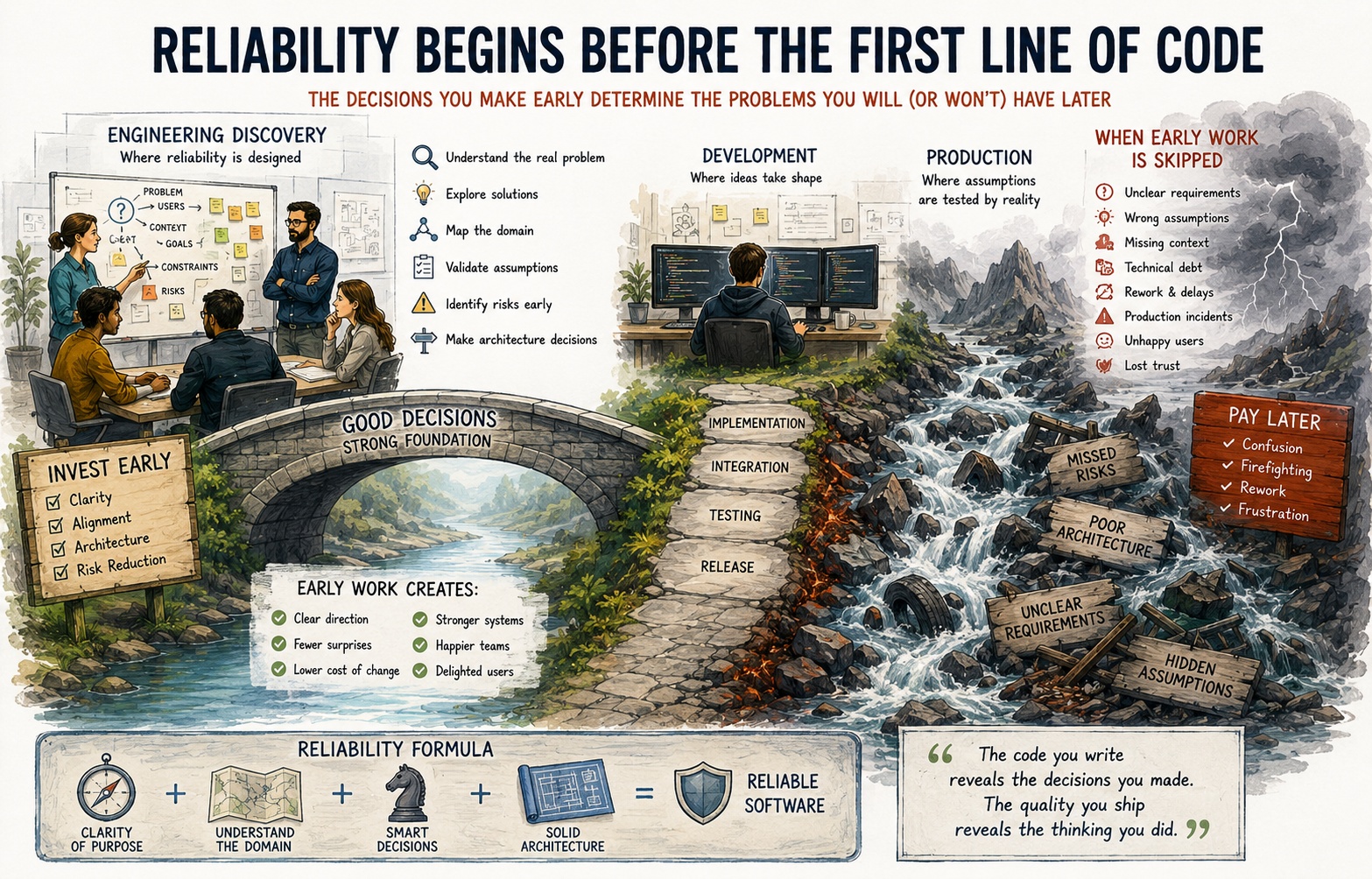
Picture a vertical slice through any software system, from the ground it sits on to the surface where users interact with it. At the top: production behavior — what actually happens when real people use the real system. Just beneath: the release process that shipped it. Beneath that: the testing that was supposed to catch what shipped wrong. Beneath that: the implementation choices made while writing it. Beneath that: the architecture that shaped what implementation choices were even possible. Beneath that: the requirements that shaped the architecture. Beneath that: the discovery work — or absence of it — that shaped the requirements. And at the very bottom, the bedrock: the business assumption and the original customer problem the whole structure was meant to address.
Most engineering conversations happen entirely within the top three layers. A bug is found in production; the fix is made in implementation; the process improvement is a new testing rule. This is like patching a crack in a wall without asking whether the foundation is settling. It works, for a while, and then it doesn't, and nobody can explain why the same category of problem keeps recurring in slightly different clothing.
Here is what each layer actually tells you, read from the bottom up:
The original customer problem is the bedrock. If it was never precisely understood — if "the user wants faster checkout" was accepted without asking faster relative to what, faster for whom, faster at the cost of what — then everything built above it inherits that vagueness. Vagueness does not disappear as you move up through the layers. It hardens into false specificity. A requirement says "checkout under two seconds." Nobody remembers this number came from a hallway guess, not a study. Six months later, an architecture is optimized around a target nobody can defend.
The business assumption layer is where ambition and evidence are supposed to reconcile, and frequently don't. "This will save the sales team ten hours a week" is a hypothesis dressed as a fact by the time it reaches an engineering roadmap. Nobody re-tests it. It becomes bedrock by repetition rather than by verification.
The discovery layer — user interviews, competitive analysis, technical spikes, feasibility checks — is where assumptions are supposed to be interrogated before they're built on. When this layer is thin or skipped, the requirements above it are built on sediment that hasn't settled. They look solid. They are not load-bearing.
Requirements translate a business need into something buildable. This is where ambiguity either gets resolved or gets quietly passed along, dressed in more technical language, to look resolved. "The system should be scalable" is not a requirement; it is a wish wearing a requirement's clothes. A real requirement says what scale, under what load pattern, with what degradation acceptable.
Architecture is where requirements become structure — the load-bearing walls of the system. An architecture built against vague requirements will be structurally sound for the wrong building. It will be resistant to exactly the wrong set of changes, because nobody could tell it what changes were coming.
Implementation inherits everything above it and has the least room to correct any of it. A brilliant engineer given a flawed architecture and vague requirements will produce brilliant code that solves the wrong problem efficiently.
Testing verifies behavior against expectations — but if the expectations themselves were never pressure-tested, testing simply confirms that the system does the wrong thing consistently.
Release and production are where all of this becomes visible, usually in the worst possible order: to the customer first, to the team second.
When you read a system this way, the question stops being "what went wrong in production" and becomes "which layer was never properly formed." Almost every recurring category of failure — the feature nobody uses, the outage that "shouldn't have been possible," the integration that breaks every quarter — traces to a layer far below where the postmortem conversation usually stops.
III. Subsurface Currents: The Work Nobody Measures
Beneath any visible terrain, water moves. You cannot see it from the surface, but it explains why one hillside is stable and the identical-looking hillside next to it slides in the first storm. Engineering organizations have an equivalent hidden hydrology, and it explains far more about eventual system quality than anything visible in a sprint board.
This subsurface work includes: framing a problem precisely enough that two different people would build the same thing from the same description; defining constraints honestly, including the ones that are political or organizational rather than technical; understanding users as they actually behave rather than as a persona document describes them; modeling a domain so that its vocabulary is unambiguous inside the system, not just in a glossary nobody consults; identifying assumptions explicitly enough that they can be checked rather than inherited; validating risk before it becomes cost; and documenting intent so that six months later, a different engineer can tell why a decision was made, not just what the decision was.
None of this produces a demoable artifact. A team can spend two focused weeks doing this work and have nothing to show an executive except confidence — which is, frustratingly, the least demoable output an engineering organization can produce. This is precisely why it gets cut under deadline pressure. It is the first thing to go because it is the hardest thing to defend in a resourcing conversation, even though it is frequently the reason the resourcing conversation exists at all.
There is a useful distinction between visible risk and submerged risk. Visible risk is the kind a status report already tracks: a vendor delay, a headcount gap, a dependency not yet available. Submerged risk is the kind nobody is tracking because nobody framed it as risk in the first place — an assumption about user behavior that was never validated, a domain concept that means two different things to two different teams, a constraint that was true when discussed in January and quietly stopped being true in March without anyone updating the requirement built on it.
Submerged risk does not announce itself. It surfaces as a symptom disconnected, in time and in appearance, from its cause — a support ticket volume that spikes for reasons nobody can trace, a feature that technically works but nobody adopts, an integration that breaks in a way engineering swears is "impossible" because the assumption it violated was never written down anywhere for anyone to violate knowingly.
The invisible work is not invisible because it is unimportant. It is invisible because organizations have not built instruments sensitive enough to detect it — the engineering equivalent of a seismograph that can register tremors too small to feel but large enough, over time, to reshape the ground.
IV. Surveying the Site Before Anyone Breaks Ground
There is a particular kind of engineering activity that produces no code, ships no feature, and closes no ticket, and yet is unmistakably engineering work of the highest order. It looks, from the outside, like a group of people talking. It is, in fact, a survey — the deliberate act of understanding terrain before committing weight to it.
A healthy version of this work does not follow a rigid sequence, but it reliably covers the same ground, in roughly this order of dependency, even if the calendar order varies.
It begins with problem framing conducted as inquiry, not confirmation — sessions where the goal is explicitly to disprove the initial idea, not validate it. Teams that skip this step tend to fall in love with the first plausible solution and spend the rest of the project defending it rather than testing it.
It continues with direct exposure to the people who will use the system, not filtered through a requirements document written by someone who spoke to them once, three months ago. There is no substitute for watching someone struggle with the actual problem you intend to solve. Descriptions of struggle are compressed and lossy; watching it is not.
It includes architecture explored as a space of options, not a single answer arrived at prematurely. Good architectural discovery produces two or three genuinely different shapes for the system, with their trade-offs made explicit, before anyone commits to one. An architecture chosen because it was the first idea anyone had is usually indistinguishable, on a diagram, from an architecture chosen after genuine comparison. It is only distinguishable eighteen months later, when the first one starts resisting every change the business actually needs.
It includes risk surfaced deliberately rather than left to be discovered by production. This is not a formality where a spreadsheet gets a column labeled "risk" filled in with low-effort guesses. It is a structured attempt to answer: what would have to be true for this to fail, and how would we know if it were?
It includes domain modeling — establishing a shared, precise vocabulary for the concepts the system will manipulate, so that "customer," "order," and "active" mean exactly one thing across every team touching them. Ambiguous vocabulary is one of the most underrated sources of software defects, because it doesn't look like a defect. It looks like a difference of opinion in a meeting, and it gets resolved informally, inconsistently, and differently by every team that encounters it.
It includes defining quality not as an adjective but as a testable scenario — not "the system should be reliable" but "the system should recover from a database failover in under thirty seconds without losing an in-progress transaction." A quality attribute that cannot fail a test was never actually specified.
And it closes with a decision review where the reasoning, not just the conclusion, is recorded — because six months later, someone will want to change the decision, and the only responsible way to change a decision is to first understand why it was made.
None of this requires a fixed time of day or a rigid ritual. What it requires is permission — organizational permission to spend real time in a state that produces no artifact a dashboard can track, because the artifact it produces is a system that does not surprise anyone once it exists.
V. Instruments You Carry: Questions Worth Asking Before Code Exists
A field surveyor does not walk into unfamiliar terrain empty-handed. She carries instruments — instruments that ask the terrain questions it cannot answer by simply looking. Engineering has its own instrument set, and it is made almost entirely of questions.
On the problem itself: What assumption, if wrong, would make this entire effort pointless? What would we build differently if we were certain this problem exists, versus merely convinced? What is the smallest version of this problem we could solve to learn whether the larger version is worth solving? Who benefits if we're wrong and nobody notices for a year?
On users: What do users actually do today that our solution assumes they won't need to do anymore? What would make a user actively distrust this system, even if it works correctly? Whose workflow are we optimizing, and whose are we quietly making worse?
On the business: What happens to this decision if the business's priorities change in six months? What are we optimizing for that we haven't said out loud — speed, cost, defensibility, optionality? If this succeeds beyond expectation, what breaks first?
On architecture: What happens if adoption is a hundred times higher than we planned for? What happens if it's a tenth as high, and this has to justify its existence on a fraction of the budget? What would make this architecture impossible to explain to a new engineer in their first month? Which of today's constraints are physical, and which are merely organizational habits we've mistaken for physics?
On scalability: What is the first resource that runs out as this grows — and do we know that, or are we guessing? What happens if this system's success depends on another system that was never designed to scale with it?
On operations: What would make this feature impossible to operate at 3 a.m. by someone who didn't build it? What is the smallest failure that would require waking a human being, and have we tried to eliminate it?
On observability: If this breaks in a way we haven't imagined, will we know within minutes, or will a customer tell us first? What question about this system's health can we not currently answer, even in principle?
On security: What happens if this dependency disappears, is compromised, or changes its behavior without warning? Who has access to this system that doesn't need it, and why do they still have it?
On testing: What is the one behavior that, if wrong, would be catastrophic and yet is easy to accidentally leave untested because it's rare? Have we tested the boundary conditions, or only the conditions someone happened to think of?
On ownership: Who owns this decision after the person who made it moves to a different team? Is there a single name attached to this system's long-term health, or does everyone assume it's someone else's responsibility?
These are not rhetorical exercises. Each question, asked honestly and answered specifically, either surfaces a risk worth addressing now or confirms — genuinely confirms, not merely assumes — that the terrain is solid enough to build on. The value of the instrument is not the question itself. It is the discipline of refusing to proceed until the question has a real answer, not a comfortable one.
VI. The Instruments Left Behind: Discovery Artifacts and What They Prevent
A surveyor does not just walk the land and remember what she saw. She leaves markers — maps, stakes, notes — so that the next person to walk the same ground does not have to rediscover what she already learned. Engineering has equivalent instruments, and each exists to prevent a specific, recurring category of future failure.
An Architecture Decision Record exists because organizations forget why faster than they forget what. Without one, every architectural choice eventually looks arbitrary to whoever inherits it, and arbitrary-looking decisions get reversed by people who don't know what they'd be giving up. The record prevents the expensive cycle of re-litigating settled trade-offs every time the team turns over.
A Risk Register exists because risk that isn't written down doesn't get smaller — it just gets forgotten until it becomes an incident. Writing it down doesn't eliminate the risk, but it converts it from something that ambushes the team to something that was, at minimum, chosen with open eyes.
A Domain Model exists to prevent the specific and insidious failure where two teams use the same word to mean two different things, and nobody notices until a bug report reveals that "cancelled" meant something different to billing than it did to fulfillment.
A Context Map — showing how different parts of a system, and different teams, relate to and depend on one another — prevents the failure where a change made safely in one place breaks something invisible in another, because nobody had a shared picture of how the pieces actually touch.
Quality Attribute Scenarios — concrete, testable statements of non-functional requirements — prevent the failure where "the system is fast enough" is asserted by everyone and defined by no one, so that when a performance complaint arrives, there is no baseline to measure it against.
Acceptance Criteria, written before implementation rather than reconstructed after, prevent the quiet renegotiation of scope that happens when "done" is defined only in the mind of whoever is under the most deadline pressure.
Architecture Diagrams, kept current rather than drawn once and abandoned, prevent the failure where the diagram everyone references no longer describes the system anyone is actually running.
Decision Logs and Assumption Logs — distinct from architecture decisions specifically because not every important choice is architectural — prevent smaller but no less costly failures: a pricing assumption baked into a billing system, a compliance assumption baked into a data retention policy, each quietly wrong by the time anyone checks.
Event Storming outputs — collaborative maps of how events flow through a business process — prevent the failure where a system is built around how engineers imagine a process works, rather than how it actually unfolds across the people and systems that touch it.
User Journey Maps prevent the failure where a feature technically satisfies every individual requirement and yet, assembled together, produces an experience nobody who commissioned it would recognize as coherent.
An Operational Readiness Review prevents the specific failure of a system that was engineered beautifully and operated disastrously, because nobody asked, before launch, whether the people who would run it at 3 a.m. actually could.
None of these artifacts is valuable as a document. Their value is entirely in the thinking required to produce them honestly — the artifact is just the residue, the fossil record, of a decision that was actually made rather than merely assumed.
VII. The Cost of Moving Earth
There is a principle in excavation that every civil engineer learns early: moving earth is cheap when it's still loose and expensive once something has been built on top of it. Move a boulder before you pour a foundation, and it's an afternoon's work. Discover the same boulder after the foundation is poured, and you are no longer moving a boulder — you are demolishing and rebuilding a foundation, at a cost that has nothing to do with the boulder's actual size.
Software has an almost exact analog, and the multiplier is not metaphorical. A misunderstanding caught during discovery — before requirements are written — costs a conversation. The same misunderstanding, caught during requirements review, costs a rewritten document. Caught during architecture, it costs a redesign. Caught during implementation, it costs rewritten code, often code that other code now depends on. Caught during testing, it costs a fix plus the retesting of everything that fix touches. Caught in production, it costs an incident, a fix, a retest, a redeployment, and — the part that rarely makes it into the cost accounting — the erosion of customer trust that no engineering effort can directly repair.
Consider a concrete, realistic shape of this: an enterprise system built around an assumption that a customer's account maps to exactly one organization. This is caught in a discovery conversation, it costs an hour of debate and a paragraph in a requirements document. Caught during architecture, it costs redesigning the data model before anything is built — a week, perhaps two. Caught after implementation, when a large customer with three subsidiaries tries to onboard, it costs a migration of live data, a period of degraded service, and an uncomfortable conversation with that customer about why the platform they were sold doesn't yet support their structure. The underlying misunderstanding did not change in size. Its cost multiplied by roughly an order of magnitude at each layer it survived undetected.
This is not an argument for infinite upfront analysis — that failure mode is real too, and organizations that never ship because they are perpetually "still discovering" pay their own kind of cost, just a slower and less visible one. The argument is narrower and more precise: the return on early thinking is not linear, it is exponential, because each layer a flawed assumption survives multiplies the structure built on top of it, and demolition cost scales with what has been built, not with the size of the original flaw.
Executives intuitively understand this principle in physical infrastructure — nobody proposes skipping the geological survey to save two weeks before pouring a skyscraper's foundation. The same intuition rarely transfers to software, because software's foundation is invisible, and its failure modes are often silent for months before they're loud for a day.
VIII. Ground That Doesn't Shift: Organizations That Rarely Surprise Themselves
Some engineering organizations are, over years, quietly unsurprising. Their outages are boring. Their launches are uneventful. Their retrospectives are short, because there isn't much to relitigate. This is not because they are lucky, and it is not because they have better engineers than everyone else. It is because they have cultivated a small number of behaviors that, compounded over time, function like stable bedrock under everything they build.
They ask questions before forming opinions. This sounds trivial and is almost never practiced: most engineering discussions begin with someone proposing a solution, and the ensuing conversation is a negotiation between competing solutions rather than a shared investigation of the problem. Organizations that rarely surprise themselves delay the solution conversation deliberately, sometimes uncomfortably, until the problem has been interrogated from enough angles that a good solution becomes almost obvious rather than clever.
They run experiments before declaring certainty. An assumption that could be tested cheaply and wasn't is a choice, whether or not anyone frames it that way. Teams with this discipline treat unverified confidence as a form of technical debt — a liability that compounds until something forces it due.
They build architecture before implementation begins in earnest, and treat implementation as the execution of a decided shape rather than the discovery of one. This does not mean architecture is frozen or perfect before a line of code is written; it means the shape has been reasoned about deliberately rather than accreted accidentally, one convenient shortcut at a time.
They validate before they optimize. It is a peculiar and common failure mode to make something fast before confirming it does the right thing, because speed is measurable and correctness, in the early stages, often isn't — yet. Organizations resistant to surprise resist this order of operations specifically.
And they choose clarity over velocity when the two genuinely conflict, which is less often than most teams assume. Most of the time, clarity and velocity are not actually opposed — a clearly understood problem is usually solved faster than an ambiguous one, not slower. The organizations that understand this stop treating "we don't have time to think this through" as a serious argument, because in the majority of cases, it is thinking it through that saves the time, not spends it.
None of these behaviors require a framework, a certification, or a tool purchase. They require an organization willing to tolerate a slower-looking start in exchange for a faster, quieter middle and end — a trade most organizations claim to want and very few are structurally willing to make when a deadline is actually in the room.
IX. Fault Lines: The Sentences That Signal Instability Ahead
A field geologist learns to recognize certain surface signs — a particular pattern of cracking, a certain color of vegetation stress — as reliable indicators of instability below. Engineering has its own surface signs, and they are, almost without exception, sentences.
"We'll figure it out later." This sentence is not wrong because teams shouldn't defer decisions — deferring genuinely undecidable decisions is often correct. It is dangerous because it is rarely applied to genuinely undecidable decisions. It is applied to decisions that are uncomfortable to make now, which is a different category entirely, and "later" for those decisions typically arrives only after the cost of having skipped them has already been paid.
"Let's just build an MVP." An MVP is a legitimate and valuable discipline when it is used to test a genuine hypothesis about the world. It becomes a fault line when it is used instead to avoid the harder work of deciding what "minimum" and "viable" actually mean for this specific problem — at which point "MVP" quietly becomes a license to skip discovery rather than a method for conducting it cheaply.
"We can refactor later." This sentence treats architectural debt as though it accrues no interest between now and later, which is precisely backward: every additional feature built on a flawed foundation increases the cost of eventually fixing that foundation, because there is now more built on top of it that also has to survive the fix.
"The developers will solve it." This sentence relocates a decision that belongs at the requirements or architecture layer down into implementation, where it will be solved — but solved locally, by someone with the least visibility into the business context that should have shaped the decision in the first place. The solution will often work. It will rarely be the solution that would have been chosen with full context.
"QA will catch it." This sentence treats testing as a backstop for decisions that should never have needed catching in the first place. Testing is extraordinarily good at verifying that a system behaves as specified. It is a poor substitute for ensuring the specification was right, and organizations that lean on it as though it were one are consistently surprised by the category of bug that "passed all the tests."
What unites these sentences is not carelessness — they are usually said by capable, well-intentioned people under real time pressure. What unites them is that each one relocates a decision from where it is cheap to make to where it is expensive to unmake, and does so quietly enough that nobody notices the relocation has happened until the bill arrives, addressed to a different team than the one that deferred it.
X. Closing Reflection
A field guide does not end with a summary of everything it covered. It ends where the walk ends — at the edge of the terrain, looking back at what you now know how to see that you couldn't see before.
Somewhere beneath every system that surprises its own creators, there is a layer that was never properly surveyed — a question that was never asked because asking it felt slower than building, an assumption that hardened into a requirement before anyone tested whether it was true. The system did not fail because the people building it were careless. It failed because the ground had already shifted before anyone poured the foundation, and nobody had walked it first to check.
Reliable software isn't created by writing better code. It is created by making better decisions before code becomes necessary.