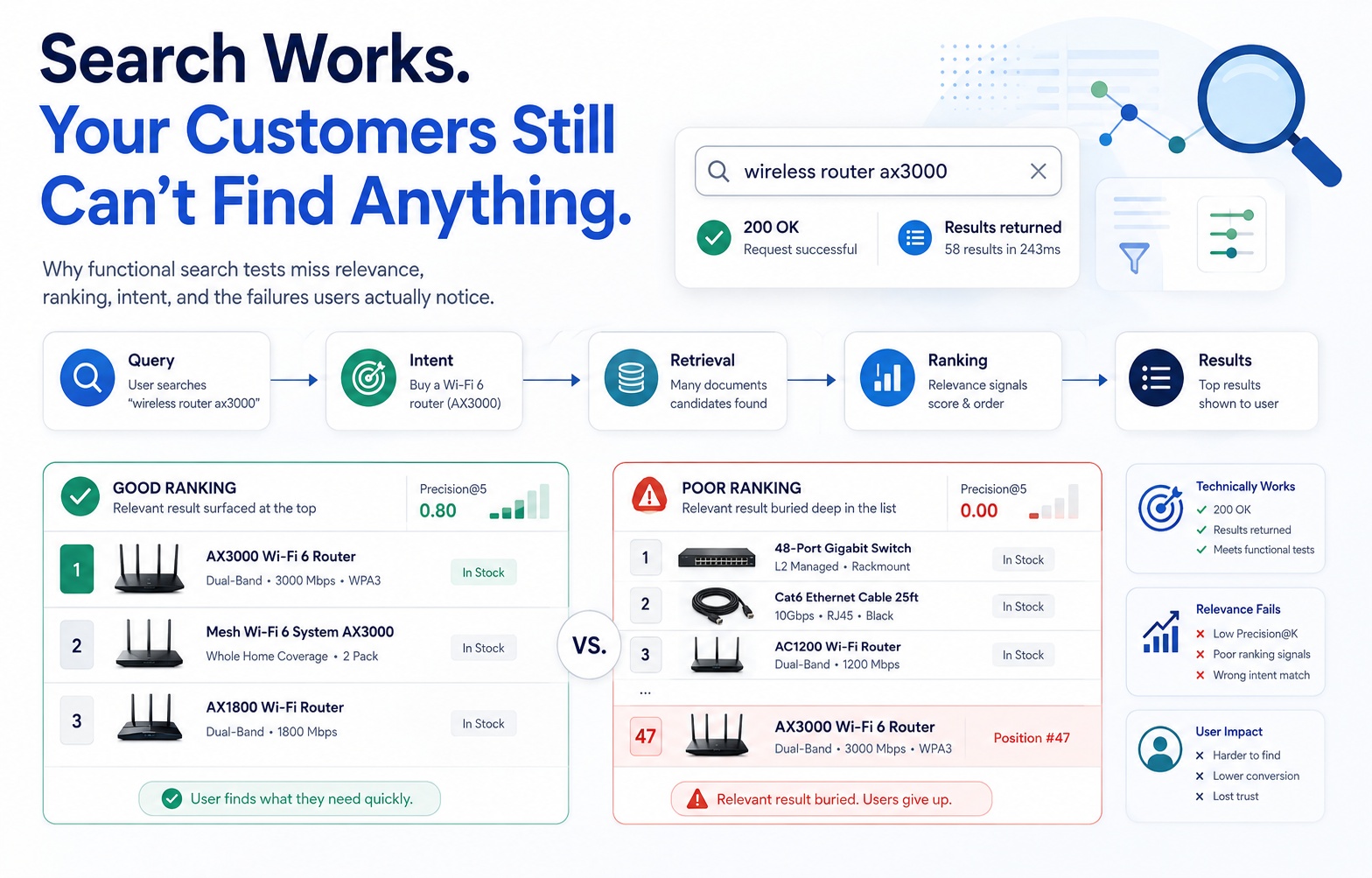
Why Functional Search Tests Miss Relevance, Ranking, Intent, and the Failures Users Actually Notice
Two search systems are given the same catalog, the same query, and the same user. Both return ten results. Both respond in under 200 milliseconds. Both requests complete with HTTP 200. Both result sets contain products that genuinely match the query terms — the same brand, the same category, overlapping keywords, no broken data, no missing fields.
In System A, the product almost every user is trying to find sits at position one.
In System B, that same product is technically present in the result set — but it sits at position forty-three, beneath a long tail of accessories, discontinued variants, and loosely related items that all happen to share a few keywords with the query.
Run a conventional test suite against both systems and they pass identically. Status code: 200. Result count: greater than zero. Response time: acceptable. Schema: valid. Every assertion a typical QA engineer would write against a search endpoint is satisfied by both systems, and yet one of them is going to convert users and the other is going to lose them.
This is the paradox at the center of search quality, and it is worth stating precisely, because most testing strategies quietly assume it doesn't exist: a search system does not fail the way a login form fails. A login form either authenticates the user or it doesn't. A payment either processes or it doesn't. Search almost never fails that cleanly. It degrades. It returns something plausible, something defensible, something that passes every binary check anyone thought to write — and it still sends the user away empty-handed, because the thing they wanted was buried under forty-two other things that were also, technically, matches.
A search engine does not answer one question. It answers three, in sequence, and most test suites only check the first one.
The first question is does this record match the query at all? That's a retrieval question, and it has a mostly binary answer — a candidate either belongs in the pool of possible results or it doesn't.
The second question is how well does this record match, relative to every other candidate? That's a scoring question, and it produces a number, not a boolean.
The third question is given all of those scores, which order should the user see? That's a ranking question, and it's the one that actually determines whether the user finds what they came for in the first three seconds of scanning a results page, or gives up after the fourth scroll.
Functional testing is very good at the first question and almost silent on the second and third. This article is about the second and third — about what it means to test not whether search executes, but whether the decisions it makes on the way to a result page are the right decisions.
Search Is Not a Boolean Function
Most software testing inherits its mental model from deterministic functions: given this input, expect that output. A discount calculator either returns the correct total or it doesn't. A validation rule either accepts or rejects. QA engineers are trained, correctly, to think in terms of expected values and equality assertions.
Search breaks that model, not because it's inherently unpredictable, but because its output isn't a value — it's an ordering. A query doesn't map to an answer; it maps to a sequence:
query("wireless router")
   → [ product_412, product_88, product_1901, product_7, product_3390, ... ]
That ordered list is the actual behavior of the system, and a test that only checks membership — "is the correct product somewhere in this array?" — is discarding almost all of the information that determines whether the search experience is good. A product sitting at index 0 is not behaviorally equivalent to the same product sitting at index 86, even though a naive assert expected_product in results statement treats them identically.
This produces a principle worth stating on its own, because it recurs throughout every layer of search testing:
Rank is part of behavior. Where a record appears in the result set is not a cosmetic detail layered on top of "real" search behavior — it is the behavior a user actually experiences.
Once rank is treated as a first-class output, a different category of test becomes necessary. Not "did the system return a value," but "did the system return this value in an acceptable position, relative to a defined tolerance." That's a fundamentally different testing discipline, closer to statistical quality control than to unit testing, and the rest of this article builds toward the vocabulary and tooling that discipline requires.
Start With a Test That Passes
It's worth being concrete about where conventional search testing stops, because the boundary is easy to miss from the outside. Here is a test that most teams would write, and that most teams should write — it is not a bad test, it's simply an incomplete one.
Given searchable products exist in the catalog

When the user searches for:
  "wireless router"

Then:
  HTTP status = 200
  results.count > 0
  results are rendered in the UI
This test is legitimate, and it proves real things:
- the search endpoint is reachable and responding;
- the request is parsed and processed without error;
- the underlying index is queryable and contains data;
- some subset of that data satisfies the basic match criteria;
- the frontend successfully receives and renders a payload.
Those are not trivial guarantees. A system that fails this test is broken in an obvious, catastrophic way, and catching that failure early has real value. But notice everything this test is silent on:
- whether the best matching router appears near the top, or near the bottom;
- whether an exact product-name match outranks a page that merely mentions the words "wireless" and "router" in unrelated contexts;
- whether an out-of-stock or discontinued product is handled the way the business intends;
- whether a query for a specific model number returns that model, or a family of loosely related ones;
- whether a misspelled query ("wirless router") returns anything useful at all;
- whether a query using a synonym ("wifi router" vs. "wireless router") behaves consistently;
- whether a product that was deleted from the catalog yesterday still shows up today;
- whether a document the current user isn't authorized to see is quietly excluded — or quietly leaked;
- whether the information shown in the result (price, availability, snippet) is current;
- whether the snippet or title gives the user enough context to recognize the item they want;
- and ultimately, whether a real person, under time pressure, would actually find what they came for.
None of that is covered by "status 200 and count greater than zero." That gap — between an endpoint that executes and a system that helps — is not a minor edge case. For most production search systems, it's the majority of the actual product surface area. The rest of this article is a systematic walk through that gap, organized around the sequence of decisions a query passes through before it becomes a ranked page a human being looks at.
The Pipeline of Decisions Behind Every Result Page
It helps to have a shared mental model of what actually happens between a keystroke and a rendered results page. The exact implementation varies by system, but conceptually, nearly every search architecture — lexical, vector, or hybrid — makes the same sequence of decisions:
Query
   ↓
Intent / Query Understanding      (what is the user actually trying to do?)
   ↓
Normalization                     (casing, punctuation, Unicode, tokenization)
   ↓
Candidate Retrieval               (which records could possibly qualify?)
   ↓
Filtering                         (which candidates are excluded by constraints?)
   ↓
Scoring                           (how well does each surviving candidate match?)
   ↓
Ranking                           (in what order should scored candidates appear?)
   ↓
Business Rules                    (do boosts, demotions, or overrides apply?)
   ↓
Permissions                       (is the requesting user allowed to see this?)
   ↓
Presentation                      (how is the result rendered, snippeted, labeled?)
   ↓
User Action                       (does the user actually find and use what they need?)
Every stage in that pipeline is a place where a defect can hide behind a passing functional test, because every stage produces output that is plausible even when it's wrong. A query understanding failure doesn't crash the system — it just silently misinterprets what the user meant. A ranking failure doesn't throw an exception — it just puts the wrong thing first. A permissions failure at the presentation layer doesn't 500 — it renders a document title the requesting user was never supposed to see.
This is the organizing idea for everything that follows: search is not a single operation to be verified once, but a chain of independent decisions, each of which can be individually correct or individually wrong, in ways that don't show up unless you test that specific decision. A test suite that only exercises the pipeline end-to-end and checks the final HTTP response is, in effect, testing whether the chain executed — not whether each link in it made the right call. The remainder of this article walks the pipeline stage by stage, showing what "testing the decision" looks like at each point, and closes by describing how to evaluate the pipeline as a whole using techniques built for ranked, non-deterministic output rather than pass/fail assertions.
Matching Finds Candidates. Ranking Decides What Users See
Before going stage by stage, it's worth separating two concepts that get collapsed constantly in casual conversation about search, and almost never in careful engineering conversation: matching and ranking.
Matching answers: which records qualify as candidates at all? Ranking answers: given a pool of qualifying candidates, what order should they appear in? These are different systems, solving different problems, and they fail in different ways.
Take a query like iphone 15 case. A reasonably permissive matching stage might legitimately retrieve all of the following as candidates:
- a protective case built specifically for the iPhone 15;
- an iPhone 15 Pro case (different model, same family, arguably relevant);
- an iPhone 14 case whose description happens to mention "also compatible with iPhone 15";
- a charging cable listed under an "iPhone 15 accessories" category;
- a blog article containing the unrelated phrase "case study" alongside a mention of "iPhone 15";
- a case for an older model that has been discontinued but not yet removed from the index;
- a promoted, sponsored accessory that a merchandising team paid to boost.
Every one of those is, in some technical sense, a legitimate candidate — each one shares terms or metadata with the query. A matching stage that retrieves all seven has not made an error. The system has correctly identified a broad candidate pool. Whether that pool becomes a good search experience is now entirely the responsibility of ranking. If the discontinued case or the unrelated blog post ends up above the actual iPhone 15 case, the failure isn't in matching — matching did its job, arguably too generously — the failure is in scoring and ordering.
This distinction matters operationally because it tells an engineering team where to look when search "feels wrong." If the correct item never entered the candidate pool, no amount of ranking tuning will fix it — you have a retrieval problem, likely in tokenization, filters, or query understanding. If the correct item is in the pool but buried, you have a ranking problem, likely in scoring, boosts, or business rules. Conflating the two leads teams to tune ranking weights for weeks in an attempt to fix what is actually a retrieval defect, or vice versa. Diagnosing which stage is responsible is the single most useful skill in search QA, and it's covered in detail later as a standalone diagnostic framework.
Query Intent Is Not One Thing
A query like ABC-4912 and a query like best router for a small office are not the same kind of request wearing different words. They represent fundamentally different user intents, and testing them against the same expected behavior — "return relevant results" — obscures more than it reveals.
A practical, non-exhaustive taxonomy of query intent, useful as a working framework rather than a formal standard, might include:
- Known-item search — the user has a specific object in mind and wants exactly that object (
Sony WH-1000XM6). - Exact identifier search — SKU, part number, serial number, ticket ID, account ID (
XG3100-SX). - Category search — the user wants a class of things, not one thing (
laptops,switches). - Attribute search — filtering by a property rather than a name (
48-port PoE switch). - Navigational search — the user is trying to reach a known page or feature, not evaluate options (
billing settings). - Discovery / exploratory search — the user doesn't know exactly what they want yet (
gift for someone who works from home). - Troubleshooting search — the user has a symptom and wants a diagnosis (
router keeps disconnecting). - Question / natural-language search — phrased as a question or full sentence (
what's the difference between OpenSearch and Elasticsearch). - Compatibility search — the user wants something that works with something else (
SFP module for Catalyst 9300). - Multilingual or mixed-language search — terms drawn from more than one language in a single query.
Two queries from different categories can share surface-level features — overlapping vocabulary, similar length — and still require entirely different system behavior to be considered "correct." A category query like laptops has no single right answer; a thousand reasonable orderings exist depending on business priorities. A known-item query like Sony WH-1000XM6 effectively has one right answer, and if it doesn't appear at or near position one, the system has failed regardless of how many other "relevant" headphones surround it.
This has a direct testing consequence: a single relevance test template cannot cover a search system. Teams that maintain one generic test pattern — "search for X, assert results contain something related to X" — end up with a suite that can't distinguish a system that nails known-item lookup from one that nails it only accidentally, because the pattern never distinguishes between intent categories that demand fundamentally different levels of precision.
Exact Identifiers Need Different Rules Than Natural Language
This deserves to be treated as its own major concern, because it's one of the most common and most damaging blind spots in production search systems, especially in B2B, industrial, IT hardware, and enterprise contexts where users routinely search by SKU, part number, model number, or ticket ID rather than descriptive language.
Consider a query for XG3100. A ranking system tuned for natural-language relevance — one that rewards partial term overlap, stemming matches, and semantic proximity — can easily rank a different product, XG3108, above the exact match, simply because both strings share five of six characters and the scoring function treats that as strong lexical similarity. For a natural-language query, that kind of fuzzy proximity is often exactly the right behavior. For an identifier query, it can be actively harmful: a technician ordering a replacement part, or a support engineer looking up a specific serial number, needs the exact record, and a near-miss substitution is not a graceful degradation — it's a wrong answer delivered with confidence.
The underlying issue is that identifier strings and natural-language phrases have different statistical structure and should generally be treated by different analysis pipelines. A general-purpose text analyzer — the kind tuned for prose, with stemming, synonym expansion, and permissive fuzzy matching — is often the wrong tool for a field that holds SKUs, because:
- stemming assumes morphological variation (
connect/connected/connecting) that identifier strings don't have; - synonym expansion has no meaningful concept of "related" identifiers —
XG3100andXG3108are not synonyms, they're different products; - fuzzy/edit-distance matching, useful for correcting human typing errors in prose, can silently substitute one part number for a physically different one.
The practical implication for both architecture and QA is that identifier fields typically warrant a distinct indexing and query strategy — often an exact or near-exact match field (a keyword-style field with minimal analysis, in Lucene-derived systems) evaluated with high priority whenever a query looks identifier-shaped, layered alongside or ahead of the general relevance scoring used for descriptive text. Whether that's implemented as a separate field, a query-time intent classifier that routes identifier-shaped queries differently, or a boosted exact-match clause in a compound query depends on the platform, but the QA obligation is constant regardless of implementation: there must be an explicit test asserting that a query matching a real identifier returns that exact record first, and that closely-spelled but different identifiers do not outrank it. This is one of the few places in search testing where the correct answer really is closer to a single expected value than an acceptable region — which makes it an unusually good candidate for strict regression testing, and a common site of quiet, undetected regressions when synonym or fuzziness settings change for unrelated reasons elsewhere in the system.
What Happens to a Query Before Ranking Ever Sees It
Long before any scoring function runs, the query has already been transformed — sometimes heavily — by a chain of processing steps that most product teams never look at directly, and that most functional tests never exercise explicitly. This matters because a defect introduced during query understanding doesn't look like a defect; it looks like a slightly different, slightly wrong query being executed perfectly.
Typical transformations include:
- whitespace normalization — collapsing repeated spaces, trimming input;
- tokenization — splitting the query string into discrete search tokens;
- Unicode normalization — resolving different byte representations of visually identical characters;
- punctuation handling — deciding whether symbols are noise or meaningful content;
- casing — lowercasing for case-insensitive matching (or deliberately not, for case-sensitive fields);
- stemming and lemmatization — reducing words to a root or dictionary form;
- language detection — determining which language-specific analysis pipeline applies;
- synonym expansion — adding related terms to broaden the candidate pool;
- typo correction or fuzzy handling — accounting for likely spelling errors;
- query rewriting — restructuring the query into a different internal representation;
- entity recognition — identifying that part of the query is a brand, model, or category rather than free text.
Every one of these steps changes system behavior before the ranking algorithm ever runs, which means bugs introduced here masquerade as ranking bugs, retrieval bugs, or "search just feels off" complaints that are very hard to trace without testing the transformation stages in isolation.
Tokenization Breaks on the Exact Strings That Matter Most
Tokenization deserves particular scrutiny in technical and ecommerce domains, because the tokenizers shipped by default with most search engines are tuned for natural prose, and natural-prose tokenizers routinely mangle the punctuation-heavy strings that dominate technical catalogs. Consider how a standard tokenizer might handle:
Wi-Fi 6E
10GbE
USB-C
C++
C#
.NET
Node.js
RTX 5090
2.8mm
DH-IPC-HDW1230T1
AB-3100/SX+
A tokenizer designed to split on whitespace and strip punctuation will often turn C++ into the single character c, indistinguishable from the letter C used elsewhere, and will strip the # from C#, silently merging a query for the C# programming language with any document containing the letter C. .NET may become net, colliding with an unrelated networking term. USB-C may split into usb and c, changing what "matches" means for that query in ways that are easy to miss unless someone deliberately checks the resulting token stream.
This is why punctuation cannot be treated as universally disposable noise. In prose, stripping punctuation is usually harmless. In technical identifiers and brand names, punctuation frequently is the meaning. The correct behavior is domain-specific, not a global default, and it needs to be verified directly — not inferred from whether an end-to-end search "seems to return something reasonable." A useful, low-cost test pattern here is an analyzer unit test: feed a string directly into the configured analyzer and assert on the resulting token list, independent of any ranking or retrieval logic:
input:  "Wi-Fi 6E Router"
expected tokens: ["wifi", "6e", "router"]   (example — actual policy is domain-specific)
This kind of test isolates the transformation stage completely. When it fails, the diagnosis is immediate and unambiguous — no need to reverse-engineer whether a bad result came from tokenization, scoring, or business rules three stages downstream.
Normalization Cuts Both Ways
A closely related concern is normalization: deciding whether WiFi, Wi-Fi, and wifi should be treated as equivalent. In most contexts, they should — a user typing any of the three almost certainly means the same thing, and failing to unify them fragments the candidate pool for no good reason.
But normalization is not free, and the opposite failure mode is just as real: over-normalization erases distinctions the business actually cares about. Stripping hyphens uniformly, for instance, can collapse AB-100 and AB100 usefully — or it can collapse two genuinely different SKUs that happen to differ only by a hyphen into the same normalized token, creating false matches in exactly the identifier context described above. There is no universal correct normalization policy; the correct policy is a function of the specific field, the specific domain, and the specific catalog, which is precisely why it needs to be defined explicitly and tested explicitly, rather than inherited as a framework default and assumed to be fine.
Stemming Trades Recall for Precision, Automatically
Stemming and lemmatization reduce inflected words to a common root — connect, connected, connecting, and connection might all reduce to a shared stem — which increases the chance that a query using one form matches a document using another. That's a real benefit: without it, a search for running shoes might fail to match a product titled run shoe.
But stemming is a blunt instrument, and every increase in morphological matching is also, mechanically, an increase in the number of documents that qualify as candidates — some of which will not actually be relevant. This is the concrete, mechanical origin of the tradeoff between precision and recall, which is worth defining carefully rather than gesturing at, because it underlies nearly every relevance decision described later in this article.
Precision and Recall, With Numbers
Precision answers: of the results the system actually returned, how many were genuinely relevant? Recall answers: of all the relevant items that exist in the catalog, how many did the system manage to retrieve?
A compact example makes the relationship concrete. Suppose a catalog contains exactly 10 documents that a domain expert would judge relevant to a given query. A search system retrieves 8 documents in response to that query, and of those 8, 6 are genuinely relevant (the other 2 are near-misses or noise).
Relevant documents in catalog: 10
Documents retrieved:            8
Relevant documents retrieved:   6

Precision = 6 / 8  = 0.75
Recall    = 6 / 10 = 0.60
Precision of 0.75 means three out of every four things the user sees are actually useful — a reasonably clean result set. Recall of 0.60 means the system is missing four out of ten relevant items entirely — they never surface at all, no matter how far the user scrolls.
The practical tension is direct: pushing recall up (broader matching, more synonym expansion, looser fuzziness) tends to pull precision down, because the easiest way to catch more relevant documents is to relax the criteria for what counts as a match — and relaxed criteria also let in more irrelevant ones. Pushing precision up by tightening matching criteria tends to suppress recall, because some genuinely relevant documents get excluded along with the noise. Neither direction is universally correct. A support-ticket search tool used by engineers debugging a live incident may reasonably prioritize recall — better to see some noise than to silently miss the one relevant ticket. A product search on a high-traffic ecommerce homepage may reasonably prioritize precision — a user who sees ten clean, on-target results is more likely to convert than one shown thirty results where six are genuinely on point.
Global Metrics Miss What Users Actually Experience
Precision and recall, computed globally across an entire result set, are useful diagnostic numbers, but they understate a fact users experience directly: position matters enormously, and most users never look past the first handful of results. A system that achieves excellent recall by burying the right answer at position 40 has not delivered a good search experience, even though its recall number looks fine on a dashboard.
This is why information retrieval as a field developed a family of rank-aware metrics — measures that explicitly weight where in the ordering a relevant result appears, rather than treating "somewhere in the result set" as sufficient. Four of them are worth understanding in enough depth to actually use, not just define.
Precision@K
Precision@K restricts the precision calculation to only the top K results — the part of the page a user will realistically see. If the top 5 results for a query contain 4 relevant items and 1 irrelevant one:
Precision@5 = 4 / 5 = 0.80This is a meaningfully different — and more useful — question than "does a relevant result exist anywhere in the full result set of 500." A system can have perfectly reasonable global recall while delivering a poor top-5 experience, and Precision@K is what catches that. It's the natural metric for category and discovery queries, where the goal is a good first impression across several options, not a single correct answer.
Mean Reciprocal Rank (MRR)
MRR is built for queries where the user is looking for one specific, correct object — the known-item and exact-identifier intent categories described earlier. For each query, take the reciprocal of the rank at which the first correct result appears, then average across a query set:
query 1: correct result at position 1  →  reciprocal rank = 1/1 = 1.00
query 2: correct result at position 2  →  reciprocal rank = 1/2 = 0.50
query 3: correct result at position 25 →  reciprocal rank = 1/25 = 0.04

MRR = (1.00 + 0.50 + 0.04) / 3 ≈ 0.51
The shape of this metric is deliberate: it rewards the correct answer being at position 1 heavily, gives partial credit for position 2, and treats position 25 as barely different from complete failure — because to a real user, "technically retrievable at position 25" and "not found" are nearly the same experience. MRR is the right metric to track for SKU search, employee directory search, documentation lookup, and any other scenario where each query has a small number of genuinely correct answers rather than a spectrum of acceptable ones.
Normalized Discounted Cumulative Gain (NDCG)
Precision@K and MRR both treat relevance as binary — a result is relevant or it isn't. Many real search problems need graded relevance instead: a result can be the exact match, a strongly relevant alternative, a marginally useful tangent, or completely irrelevant. NDCG is built for exactly that case.
A typical graded scale might look like:
3 = exact / ideal result
2 = strongly relevant
1 = marginally relevant
0 = irrelevant
The underlying idea is to compute a cumulative gain — the sum of relevance grades across the top K results — but discount each result's contribution by its position, so that a highly relevant result near the top contributes far more than the same result buried lower down. That raw discounted gain is then divided by the ideal discounted gain — the score an optimal ordering of the same result set would achieve — which normalizes the metric to a 0–1 range and makes it comparable across queries with different numbers of relevant documents. A perfect ordering scores 1.0; a completely inverted ordering (least relevant results first) scores close to 0.
The intuition worth keeping, without getting lost in the algebra, is: NDCG rewards a ranking not just for including the right results, but for putting the more relevant ones ahead of the less relevant ones. Two result sets containing identical documents but different orderings will score differently under NDCG — which is exactly the property a rank-aware metric needs, and exactly the property Precision@K alone cannot capture, since Precision@K treats every document within the top K as interchangeable.
Choosing the Right Metric for the Right Query
None of these three metrics is universally superior; they answer different questions, and applying the wrong one produces a misleading picture of quality. MRR is the right instrument for known-item and identifier queries, where there's essentially one correct answer and position 1 is the only fully successful outcome. Precision@K is the right instrument for category and discovery queries, where several results can reasonably satisfy the user and the goal is a clean, useful top-of-page. NDCG is the right instrument whenever relevance genuinely comes in degrees rather than a binary — which describes most real catalogs — and it's the metric most suited to detecting ranking regressions, since it's sensitive to reordering even when the same set of documents survives.
A mature search QA practice tracks more than one of these, segmented by query intent, rather than reporting a single blended average — a point this article returns to later, because averaging across intent categories is one of the most common ways search quality problems hide from dashboards.
Relevance Is Not a Fact — It's a Product Decision
It's tempting to treat "relevance" as an objective property a search engine either computes correctly or doesn't, the way correctness of arithmetic is objective. It isn't. Consider a bare query like laptop on an ecommerce site with no further qualifiers. What should rank first? Reasonable candidates for "correct" include:
- the laptop with the strongest textual match to the word "laptop" in its title;
- the best-selling laptop;
- the laptop currently in stock, as opposed to a backordered one;
- the newest model released;
- the laptop the merchandising team has decided to feature this week;
- the laptop with the highest margin;
- a laptop chosen based on the individual user's browsing history.
Every one of these is a defensible answer to "what should rank first for laptop," and they are not the same answer. A search engineer cannot resolve this ambiguity from first principles, and neither can a QA engineer working in isolation — this is fundamentally a product decision, one that requires input from product management, domain experts, customer-facing teams who hear directly what users are trying to accomplish, and often the underlying search or data science team responsible for the ranking model. QA's role is not to invent the intended ranking; it's to make whatever ranking decision the business has actually made explicit, testable, and stable over time — so that when it silently changes (which it will, as boosts get added, models get retrained, and analyzers get reconfigured), someone notices before customers do.
Text Relevance Versus Business Ranking
Most production ranking functions aren't pure text-similarity scores — they're a blend of textual relevance and deliberate business boosts: preference for in-stock products, preferred suppliers, verified or high-quality content sources, recently published documents, or paid and promoted listings. These boosts can be entirely legitimate; a retailer is not obligated to rank a discontinued, unavailable product above one it can actually ship.
The tension worth naming explicitly is that business ranking, applied without limits, can override relevance to the point of breaking the search experience. If a high-margin but only loosely related product is consistently boosted above an exact textual match, users will notice — not necessarily consciously, but behaviorally, through lower click-through rates, more query reformulation, and eventually reduced trust in the search box altogether. The reasonable engineering position is not "business rules are bad" — it's that boosts should be deliberate, bounded, and documented, not an unlimited override that can silently overwhelm textual relevance. A product that barely matches a query should not be able to outrank an exact match unless that is a specific, intentional, and reviewed product decision — not an accidental side effect of an aggressive boost weight set six months ago by someone who has since left the team.
Popularity Creates Its Own Feedback Loop
A particularly important instance of the business-ranking tension is popularity-based boosting, because it has a self-reinforcing structure that's easy to underestimate. A product that ranks highly gets seen more, which generates more clicks, which — if click data feeds back into the ranking signal, directly or through a learning-to-rank model — pushes it to rank even higher next time. That loop is not inherently wrong; popularity genuinely correlates with relevance much of the time. But left unchecked, it has a predictable failure mode: new products, niche or long-tail items, and anything without an existing click history start from a rank position low enough that they rarely get seen, which means they rarely get clicked, which means they never accumulate the signal that would let them rise. They become permanently buried, not because they're irrelevant, but because the ranking system never gave them the exposure needed to prove otherwise.
The practical implication is that popularity should typically function as one signal among several, not the dominant one, and that search quality evaluation should specifically check long-tail and newly added items rather than relying exclusively on the well-worn queries that populate most manual test scripts — a point developed further in the discussion of golden query sets later in this article.
Freshness Depends on What's Being Searched
Freshness is another signal that's frequently treated as an unconditional good — "newer is better" — when its correct weight is entirely dependent on the query and the content domain. A query like latest API documentation genuinely benefits from freshness bias; an outdated result is actively harmful. A query like HTTP 404 definition, by contrast, has a stable, largely timeless correct answer, and biasing toward the newest indexed document about it accomplishes nothing useful and can actively surface a lower-quality recent page over a canonical, well-established one. Freshness needs to be tuned per content type and per intent category, not applied as a global multiplier — and testing it means checking both directions: that time-sensitive queries surface current content, and that time-insensitive queries aren't unnecessarily destabilized by a freshness boost that has no business being there.
Synonyms Expand Recall and Risk Precision in the Same Motion
Synonym handling is one of the highest-leverage and highest-risk levers in a relevance system, and it deserves treatment as a substantial topic on its own rather than a bullet point under "text processing."
Common synonym relationships include pairs like TV and television, laptop and notebook, QA and quality assurance, SSO and single sign-on, mobile phone and cellphone. Configuring these correctly can meaningfully increase recall — a user typing SSO should find documentation titled "Single Sign-On Configuration Guide" even though the literal string doesn't appear.
But synonym relationships are not always symmetric, and treating them as if they were is a common source of quiet relevance damage. A bidirectional synonym means A and B should be treated as fully interchangeable in both directions. A one-way synonym means a search for A should also match B, but a search for B should not necessarily be broadened to include A — because the relationship is closer to "specific term implies broader term" than genuine equivalence. And many pairs that look like synonyms in casual conversation are not true synonyms in a specific product domain at all — related concepts are not automatically interchangeable, and a synonym rule built on a loose intuitive association rather than a domain expert's judgment can dramatically inflate the candidate pool with tangentially related noise, quietly damaging precision across every query that happens to touch the affected term.
This makes synonym configuration a natural candidate for regression testing, since synonym files tend to accumulate additions over time from many different contributors, and a single overly broad rule added for one use case can degrade relevance broadly across the catalog without anyone noticing until precision metrics move. A synonym regression suite — a fixed set of queries with expected top results, re-run every time the synonym configuration changes — catches this class of defect far more reliably than manual spot-checking.
Typo Tolerance Has to Know What It's Correcting
Fuzzy matching — typically implemented via edit distance, which measures how many character insertions, deletions, substitutions, or transpositions separate two strings — exists to handle the reality that people mistype things: wirless router, playright, iphnoe. Allowing a bounded edit distance between the query and indexed terms lets these queries still surface the intended results, which is a real and valuable feature for natural-language queries.
The danger appears at the intersection of fuzzy matching and identifier search, already introduced above but worth restating in this specific context: fuzziness that helps wirless find wireless is the same mechanism that can let AB-1031 match AB-1037, silently substituting one product identifier for a different, physically distinct one. For natural language, a near-miss is usually still useful. For an identifier, a near-miss is usually a wrong answer delivered confidently. This is the concrete argument for the general principle raised earlier: fuzziness should generally be a function of detected or configured intent, not a single global setting applied uniformly across every field and every query shape.
Rewriting a Query Silently Is Riskier Than Suggesting an Alternative
A closely related design decision is whether the system should silently autocorrect a suspected misspelling and search for the corrected term, or offer a "did you mean" suggestion while still executing the user's literal query. Silent autocorrection carries a specific risk in technical and branded catalogs: rare technical terms, brand names, model numbers, and acronyms frequently look statistically similar to common misspellings, and a system that aggressively rewrites them can substitute a completely different, more common term for the one the user actually intended. A user searching for an uncommon but real brand name may be silently redirected to a more popular, unrelated brand that happens to be a shorter edit distance from common vocabulary.
There is no single globally correct policy here — the right choice depends on how much the catalog relies on rare or invented terms, how damaging a wrong silent correction would be, and how tolerant the user base is of an extra click. What matters for QA is that this behavior is a deliberate, tested decision rather than an inherited default, and that the test suite explicitly includes rare-but-real terms — brand names, model numbers, internal product codes — to verify they survive typo-correction logic intact rather than being "fixed" into something else.
Zero Results Are a Symptom, Not a Diagnosis
A query that returns zero results is frequently treated as an automatic defect, and that instinct is understandable but wrong often enough to matter. Sometimes zero results is exactly the correct behavior — a query for a SKU that genuinely doesn't exist, a search for content the requesting user isn't authorized to see, or a search for a product the catalog genuinely doesn't carry should all legitimately return nothing.
But zero results is also the most common symptom of several distinct, and distinctly serious, failure modes:
- a synonym that should have connected the query to existing content is missing;
- typo tolerance failed to bridge a minor misspelling to real inventory;
- an overly restrictive filter combination eliminated every candidate, even though relaxing any single filter would have produced results;
- the index is stale and hasn't caught up with recently added inventory;
- an indexing pipeline failure means a whole category or supplier feed silently never made it into the index at all;
- a language-detection or analyzer mismatch means the query is being processed with the wrong pipeline;
- a permissions bug is incorrectly filtering out content the user should actually be able to see.
Because the same observable symptom can indicate either "correct behavior" or "one of several distinct serious bugs," a zero-result rate metric is diagnostic, not evaluative on its own — a rising zero-result rate is a signal that something needs investigation, not proof that something is broken, and a low zero-result rate is not proof of health, since a system can return non-empty but useless results just as easily as it can return nothing. Effective zero-result monitoring pairs the rate itself with sampled query review, so that a spike can be quickly attributed to one of the specific causes above rather than treated as an undifferentiated alarm.
Recovering Gracefully From a Zero-Result Query
When zero results genuinely is the correct outcome, or genuinely can't be avoided, the system's recovery behavior becomes part of the experience worth testing in its own right: spelling suggestions, related category suggestions, automatic query broadening, or filter-removal prompts. The QA-relevant risk in recovery flows is intent drift — a broadening mechanism that quietly changes what the user is searching for rather than genuinely expanding around their original intent. A query for Cisco 48-port PoE switch in stock that returns zero results because nothing matches all three constraints simultaneously should ideally offer to relax the least essential constraint first (perhaps availability) rather than defaulting to a generic "here are some switches" response that discards the brand and port count the user explicitly specified.
Autocomplete Is Effectively a Second Ranking System
Autocomplete — search-as-you-type suggestions — is frequently treated as a lightweight UI feature bolted onto the "real" search system, but it's more accurate to think of it as an entirely separate ranking system with its own candidate pool, its own scoring signals, and its own failure modes. It may draw on prefix matching, product or query popularity, recency of the user's own past searches, category structure, or named-entity recognition, in combinations that differ meaningfully from the main search ranking.
Because it's a separate system, it needs separate test coverage, specifically including: very short queries (a single character can produce an enormous, expensive candidate pool); exact identifiers typed partially (does typing the first few characters of a SKU actually surface it, or does the autocomplete index only cover product names?); typos (does autocomplete tolerate the same misspellings the main search does, or is it stricter?); permission and tenant boundaries (does autocomplete leak suggestions for content the user can't access, even though the underlying search correctly blocks it?); deleted objects (does autocomplete continue suggesting a product that no longer exists, because its own index refreshes on a different schedule than the main one?); and language behavior for non-English or mixed-language input.
The Race Condition Hiding in Every Search-As-You-Type Box
There's a specific, concrete concurrency bug worth calling out by name, because it's extremely common and rarely covered by conventional test suites: the stale-response race condition. A user types rou, triggering a request for that partial query. Half a second later, they've typed the rest and the query is now router, triggering a second request. Because network timing is not guaranteed to preserve request order, it's entirely possible for the response to the second, more specific request (router) to arrive first, followed shortly after by the response to the first, broader request (rou) — and a naive frontend implementation will simply render whichever response arrives most recently, overwriting the correct, specific results for router with the stale, broader results for rou.
The fix requires the frontend to track which query a given response actually corresponds to and discard any response that doesn't match the current input — commonly implemented through request cancellation, monotonically increasing sequence IDs attached to each request, or explicit "latest query owns the render" logic, sometimes combined with debouncing to reduce request volume in the first place. This is a genuinely search-specific instance of a concurrency bug, and it's a useful, concrete example of why search testing needs to include scenarios that conventional CRUD-style test suites rarely think to construct — rapid sequential input against an asynchronous backend, verified against final rendered state rather than any single response in isolation.
Filters Are Part of Search Quality, Not a Separate Feature
Filters — brand, category, price range, region, availability, status, owner, date range, and technical attributes specific to the domain — are often built and tested as though they're an independent feature layered on top of search, when in practice they interact with matching and ranking in ways that create their own class of defects.
A reasonably complete filter test matrix needs to include: each filter tested individually; realistic combinations of multiple filters together; the displayed count of results at each filter state; the boolean semantics of filters both within a facet (is selecting two brands an OR, showing items matching either, or incorrectly an AND, showing none?) and across facets (is selecting a brand and a category an AND, narrowing the results, as it almost always should be?); the specific case where a filter combination legitimately produces zero results; the behavior of a "reset filters" action; and whether filter state persists correctly across page reloads, browser back/forward navigation, and shared or bookmarked URLs.
Facet Counts Are a Promise the System Has to Keep
A specific, high-value class of defect lives in facet counts — the numbers shown next to each filter option, like "Cisco (34)." These counts are frequently computed through a different code path than the actual filtered result set — often a separate aggregation query, sometimes cached on a different schedule, sometimes computed before permission filtering is applied while the actual results are computed after. When those two paths drift out of sync, users see a count that doesn't match reality: the facet says "Cisco (34)," but clicking it produces 19 results. This is a small-looking bug with an outsized effect on trust, because it's the kind of inconsistency users notice immediately and generalize from — if the count is wrong, why would they trust anything else the search system tells them? Testing facet counts specifically means asserting that the number shown next to a filter option matches the number of results actually returned when that filter is applied, under realistic combinations of prior filters, cache states, and — critically — the permission context of the requesting user, since a facet count computed before authorization filtering can leak the existence of documents a user isn't allowed to see even if clicking through correctly returns nothing.
Filter Combinations Reveal What Individual Filters Hide
A realistic example: Brand = Cisco, Category = Switches, Ports = 48, Availability = In Stock. Each of these filters, tested individually against the full catalog, may pass cleanly — Cisco alone returns something reasonable, switches alone returns something reasonable, and so on. The defect surface that matters is the intersection: does applying all four together produce the correct subset, or does the combination expose an indexing gap (perhaps the "ports" attribute isn't populated for some Cisco switches, silently excluding them), a boolean logic error (perhaps the query engine applies some filters as AND and others as OR inconsistently), or a data quality problem (perhaps availability status is stale for a subset of the catalog)? Filter combination testing is where these individually invisible problems become visible, which makes combinatorial coverage — not just individual filter coverage — a real requirement, not an optional nicety.
Sorting Is Different From Ranking, and Both Need Determinism
It's worth distinguishing relevance ranking — the system's own judgment about result order, based on scoring and business rules — from explicit user-requested sorting, such as "price: low to high," "newest first," "highest rated," or "alphabetical." These are different mechanisms serving different intents, but they share a requirement that's easy to overlook: deterministic tie-breaking.
When many records share the same sort value — the same price, the same rating, the same creation date — the underlying order among those tied records needs a stable, defined secondary sort key. Without one, different requests for the same sorted view can return the tied records in different relative orders on different requests, which produces a specific, frustrating class of bug: items that appear to duplicate across pages (because the same tied record appeared near a page boundary in two different relative orders on two different requests), items that appear to vanish entirely between pages (for the same underlying reason, in reverse), and automated tests that fail intermittently because they assert on an order the system never actually guaranteed. The fix is straightforward — always define an explicit, stable secondary sort key, commonly a unique ID — but it's frequently skipped, because it only becomes visible under load or at scale, exactly the conditions under which manual testing is least likely to catch it.
Pagination Has to Survive a Moving Target
Pagination interacts with the fact that a result set isn't necessarily static between the moment a user requests page one and the moment they request page two — new items can be indexed, existing items can be updated or removed, and in some architectures, ranking itself can shift slightly between requests due to caching or shard-level variance. Offset-based pagination (from / size) is simple but is specifically vulnerable to this kind of drift: if an item is inserted ahead of the current page boundary between requests, everything after it shifts by one position, which can cause an item to be skipped entirely or to appear twice across two consecutive page requests. Cursor-based approaches — sequencing through results using a stable reference point from the previous page rather than a numeric offset — are generally more resilient to this kind of drift and are the pattern most search engines recommend for deep or reliable pagination; Elasticsearch and OpenSearch both document search_after as their supported mechanism for stable pagination beyond what offset-based pagination can reliably support, particularly at depth. Worth noting for teams building hybrid search specifically: pagination through fused rank-based results (such as those produced by reciprocal rank fusion) has its own documented constraints, since the fused ranking depends on how many candidates were retrieved per sub-query before fusion — OpenSearch's hybrid search pagination, for example, requires keeping a pagination_depth parameter constant across requests to preserve a consistent ordering while paging, precisely because changing it changes the underlying candidate set the fusion was computed over.
QA coverage for pagination should specifically include: duplicate detection across consecutive pages, missing-item detection across consecutive pages, behavior when the underlying data changes between page requests (a realistic condition, not an edge case, for any catalog with active writes), and deep pagination performance and correctness, which is often where offset-based approaches degrade most visibly.
Duplicate Results Erode Confidence Quietly
Duplicate results in a result set — the same effective item appearing more than once — typically trace back to one of a small number of root causes: duplicate ingestion from a source system (the same product loaded twice through separate feed runs), legitimate product variants that haven't been correctly grouped (a shirt in five sizes indexed as five separate documents with no variant relationship), multiple upstream source systems feeding the same catalog without deduplication, denormalized document structures where the same underlying entity gets indexed once per related object, or index alias and reindexing mistakes that leave both an old and a new copy of a document searchable simultaneously.
The QA-relevant question is rarely "are there duplicates" in isolation — it's "does the intended grouping behavior match what's actually happening." For product variants specifically, the correct behavior is a product decision, not a technical default: should ten color variants of the same underlying product occupy ten separate positions in a results page, or should they collapse into a single result with a "5 colors available" indicator? Neither answer is universally correct, but whichever one the business intends needs an explicit test verifying it's actually what happens, because variant grouping logic is exactly the kind of feature that tends to work correctly at launch and quietly break as new variant types get added without corresponding updates to the grouping rules.
Availability Handling Is Also a Deliberate Decision, Not a Default
Should an out-of-stock, discontinued, or preorder product disappear from search results entirely? The intuitive answer is often "yes, obviously" — but many retailers deliberately keep unavailable products discoverable, either to let users find genuinely comparable in-stock alternatives, to preserve SEO value on high-traffic product pages, or to support "notify me when back in stock" workflows. There's no universally correct policy here either; the correct behavior is whatever the business has actually decided, applied consistently, and clearly signaled to the user through presentation (a clearly labeled "out of stock" badge, for instance) rather than either silently hiding unavailable items or silently mixing them in without distinction. QA's job is to verify the actual, intended policy is implemented consistently across every entry point — search, category browsing, filters, and autocomplete — since it's common for one of these surfaces to correctly exclude discontinued items while another, built or updated separately, doesn't.
The Index Is a Second Copy of the Truth, and Copies Drift
This is one of the most consequential engineering realities in search systems, and one of the most invisible to functional testing, because it's a defect category that no single-request test can ever catch — it only shows up as a discrepancy between two systems over time.
The typical architecture looks something like this:
Primary Database (source of truth)
        ↓
Change Data Capture / Event Stream
        ↓
Indexing Pipeline
        ↓
Search Engine (secondary, derived representation)
The search index is not the source of truth — it's a derived, asynchronous copy of it, kept in sync through some kind of pipeline: change data capture, an event bus, a batch reindex job, or some combination. That pipeline can lag, drop events, apply partial updates, or fail silently, and every one of those failure modes produces the same class of symptom: search reflects a version of reality that no longer matches the actual database.
Concretely, this looks like: a price change goes live in the primary database, but the index still returns the old price for hours or days; a product is deleted outright from the catalog, but continues to appear in search results because the delete event never reached the indexing pipeline, or reached it but failed to process; an inventory update marks an item out of stock, but search continues to display it as available, and a customer places an order the business can't fulfill.
A conventional API functional test cannot catch any of this, because the test typically queries the search endpoint in isolation and checks the response against expected values defined by the test itself — it never cross-references the search response against the actual current state of the primary database at the moment of the test. Catching this class of defect requires either dedicated freshness testing — deliberately creating, updating, and deleting records, then measuring how long each change takes to become correctly reflected in search — or an ongoing reconciliation process.
Defining Freshness as a Measurable Property, Not a Vague Aspiration
Search freshness should be defined operationally, in terms of three specific transitions, each independently measurable: how long after a record is created does it become searchable; how long after a record is updated does the change appear in search results; and how long after a record is deleted does it stop appearing in search results. These three numbers are not necessarily equal in a given system — deletes are sometimes handled with lower latency than updates, for instance, because a delete event is simpler to process correctly — and the acceptable value for each is a product and business decision, not a universal engineering constant. A catalog updated by a handful of internal editors a few times a day can tolerate much longer freshness windows than a marketplace with thousands of independent sellers changing inventory continuously. What matters for QA is that these three numbers are explicitly defined as requirements and explicitly measured, rather than left as an implicit assumption that "the index is probably pretty close to real-time."
Reconciliation Catches What Point-in-Time Testing Cannot
Because index drift accumulates gradually and silently, a valuable complementary practice — beyond one-off freshness tests — is periodic reconciliation: systematically comparing the set of records in the primary database against the set of documents in the search index, looking specifically for documents that exist in the index but shouldn't (records deleted from the source but never removed from search), records that should be indexed but aren't (a subset that silently failed during ingestion), documents whose indexed version doesn't match the current source version (partial or failed updates), duplicate documents representing the same underlying record, and documents whose indexed permission or visibility metadata doesn't match the source's current authorization state. Reconciliation is less about any single test passing or failing and more about establishing an ongoing signal for how much drift currently exists between the two systems — a number that should be close to zero and stable, and that becomes an early warning system for pipeline degradation long before it manifests as a customer-visible complaint.
Reindexing Needs More Verification Than a Document Count
Full index rebuilds — triggered by a mapping change, an analyzer update, a search engine version upgrade, or disaster recovery — carry their own distinct risk profile. A superficially reassuring but genuinely insufficient way to verify a reindex succeeded is to compare the document count between the old and new index; matching counts can mask an incomplete rebuild that happens to have failed and re-added documents in equal measure, a mapping error that indexed every document with the wrong field types, systematic duplication that inflates the count without indicating a healthy state, or an old index still silently serving traffic because the alias switch to the new index didn't actually take effect. A rigorous reindex verification checks specific known documents by ID, validates mapping and field types against expectations, re-runs the golden query set described later in this article against the new index to catch ranking changes introduced unintentionally by the rebuild, and only then completes the alias cutover — ideally with the ability to roll back quickly if anything in that verification fails.
What Elasticsearch, OpenSearch, and Lucene Actually Do Underneath
It's worth grounding this discussion in a small amount of concrete mechanism, because a surprising amount of confusing search behavior becomes obvious once the underlying model is understood, and because Elasticsearch and OpenSearch — despite sharing a common ancestor and much surface-level API similarity — have diverged since OpenSearch's fork and should not be assumed to behave identically in every respect, particularly around newer hybrid-search and licensing-gated features.
Both are built on Apache Lucene, which uses an inverted index as its core data structure: instead of storing documents and scanning through them at query time to find matches (the way a simple substring search would), Lucene precomputes, at indexing time, a mapping from each distinct term to the list of documents that contain it. A query is answered by looking up the relevant terms in this index and intersecting or combining the document lists, which is dramatically faster than scanning raw text at query time — but it also means that whatever analysis was applied at indexing time is baked into the index structure, and changing query-time processing alone cannot fix documents that were indexed under a different, incorrect analyzer. This is a genuinely important operational fact: a tokenization or analyzer bug discovered in production typically requires a reindex to fully resolve, not just a configuration change, because the existing index already reflects the old, incorrect tokenization.
The default scoring algorithm in both Elasticsearch and OpenSearch is BM25 (specifically, Elasticsearch has used Okapi BM25 as its default similarity since version 5.0, and it remains the out-of-the-box default today). BM25 scores a document's relevance to a query based on three interacting factors: how often a query term appears in the document (term frequency), with diminishing returns as the count increases rather than a purely linear reward; how rare that term is across the whole corpus (inverse document frequency), so that a term appearing in nearly every document contributes little to the score while a rare, distinctive term contributes heavily; and the length of the document relative to the corpus average (length normalization), which prevents very long documents from scoring artificially high purely by containing more words. Both engines expose the underlying k1 (term-frequency saturation) and b (length-normalization strength) parameters for teams that need to tune scoring behavior for a specific catalog, though the built-in defaults are reasonable starting points for most general text and shouldn't be adjusted without a clear, measured reason grounded in the golden query set's before-and-after behavior.
Field Boosts Change What "Matching" Means, Not Just How Much It Counts
Search fields typically differ in how much weight a match in that field should carry — an exact match in a product's title generally signals stronger relevance than the same terms appearing somewhere in a long description, and an exact SKU or brand match often deserves more weight still. Field boosting lets teams express this by weighting matches in specific fields more heavily in the combined score. This is a legitimate and often necessary tuning lever, but it's also a common source of quiet regressions, because boost weights interact with each other and with the underlying BM25 scoring in ways that aren't always intuitive — increasing a description-field boost to help one underperforming query category can easily degrade a completely unrelated category that happened to be relying on the previous balance. This is a direct, concrete argument for the ranking regression testing discussed later: any change to field boosts should be verified against a stable, representative query set before shipping, not evaluated only against the specific query that motivated the change.
Score Explainability Is a Diagnostic Tool, Not a User-Facing Feature
Both Elasticsearch and OpenSearch expose an _explain-style API that returns a detailed breakdown of exactly how a document's score for a given query was computed — which fields matched, which boosts applied, and how each component contributed to the final number. This is invaluable for engineers diagnosing why result A outranked result B, and it should be a standard part of the search debugging toolkit — but it's an internal diagnostic surface, not something to expose directly to end users, both because raw relevance scores are meaningless without context and because exposing scoring internals can reveal information about business logic, boost weights, or even the existence of restricted content that shouldn't be surfaced.
Permissions Have to Be Enforced Before a Result Is Ever Shown
Enterprise, SaaS, and multi-tenant search systems carry an obligation that goes beyond finding relevant information: they must never reveal information the requesting user isn't authorized to see, and this deserves treatment as one of the most important sections in this entire discussion, because search-layer permission failures are both easy to introduce and unusually damaging when they occur.
The subtle point that distinguishes search permission testing from ordinary access-control testing elsewhere in an application is that a search result can leak information before the user ever clicks it. A document's title, a snippet of its content, the name of the person who created it, its category, or even just its presence in a result count can all reveal something the user wasn't supposed to know exists — regardless of whether clicking through to open the document is correctly blocked with a 403. If a search for a confidential internal project name returns a result titled "Q3 Layoff Planning — Draft," the fact that clicking it produces an access-denied page is nearly irrelevant; the sensitive information — that this document exists, with this title, authored by this person — has already been disclosed the instant the search results rendered. This means authorization has to happen before presentation, as an intrinsic part of the retrieval and filtering stages, not as an afterthought bolted onto the click-through path.
Counts and Facets Can Leak Information Even When Titles Don't
A subtler version of the same failure appears in aggregate numbers rather than individual results. A search interface stating "147 results found," where the user is only actually permitted to view 3 of them, discloses the existence of 144 documents the user has no right to know about, even if none of their individual titles or content is ever shown. The same applies to facet counts, autocomplete suggestions drawn from restricted content, and "did you mean" or related-search suggestions generated from a broader, unfiltered index. Every one of these needs to be computed on the permission-filtered candidate set, not the full unfiltered one — which has real performance implications, since permission filtering typically has to happen earlier in the pipeline (ideally as part of retrieval, not as a post-processing step) precisely so that counts, facets, and suggestions are all computed against a pool the user is actually allowed to see.
Multi-Tenant Isolation Has to Survive Every Query Shape, Not Just the Obvious Ones
For multi-tenant SaaS search specifically, the architectural approaches generally fall into a shared index with tenant-identifying filters applied to every query, fully separate indices per tenant, or some hybrid combining both depending on tenant size and data volume. None of these approaches is universally superior — the right choice depends on tenant count, data volume per tenant, and operational complexity tolerance — but regardless of which architecture is chosen, the QA invariant is the same and non-negotiable: no query shape should be able to return, suggest, count, or otherwise expose another tenant's data, and that invariant needs to be tested not just against the obvious, straightforward search path, but against every variation that touches the index — typo-tolerant fuzzy search, filtered search, sorted search, autocomplete, pagination, and any bulk export or reporting feature that queries the search layer directly. It's a common and serious mistake to thoroughly test tenant isolation on the primary search flow while leaving autocomplete or an export feature querying the same underlying index with a subtly different, unfiltered query path — these are exactly the kind of secondary access paths that get added later, by a different engineer, without the same security review the original search implementation received.
Search Doesn't Read One Language at a Time
Multilingual search deserves serious treatment rather than a brief mention, because the assumptions baked into a well-tuned English-language analyzer frequently don't transfer to other languages, and treating "multilingual support" as a checkbox rather than a distinct engineering problem produces search systems that work acceptably for English speakers and poorly for everyone else.
Different languages require meaningfully different tokenization strategies — languages that don't use whitespace to separate words, such as many East Asian languages, require fundamentally different segmentation approaches than whitespace-delimited languages. Stemming and morphological analysis are language-specific; a stemmer built for English inflection patterns produces nonsensical or actively harmful results applied to a heavily inflected language like Ukrainian or a language with extensive compounding like German, where a single long compound word may need to be decomposed into meaningful sub-components to be searchable at all. Accent and diacritic handling varies by language and even by specific term within a language — normalizing away accents is helpful in some contexts and destructive in others, where the accent changes the word's meaning entirely. Synonym relationships are also language-specific and don't transfer through direct translation; a synonym pair that's natural in English may not have a natural equivalent structure in another language at all.
Real Queries Mix Languages Within a Single Search Box
A specific and commonly under-tested reality: real user queries in international products are frequently not cleanly monolingual. A query like Cisco комутатор 48 port — an English brand name, a Ukrainian word for "switch," and an English technical specification, all in a single query string — is entirely plausible from a real bilingual or multilingual user, and a search system tested exclusively against clean, single-language test datasets will never encounter this pattern until it appears in production. Building and maintaining a monolingual-only test corpus, however thorough, systematically understates the diversity of real input for any product with meaningful international usage, and mixed-language query handling deserves explicit, deliberate test coverage rather than being left to whatever the default analyzer configuration happens to do.
Transliteration Adds Another Axis of Ambiguity
Related to mixed-language queries is transliteration — the same name or term rendered in different writing systems, such as Kyiv and Київ, or a product name a user might type using a different alphabet than the one it's indexed under. Supporting transliteration can meaningfully improve findability for international users, but it introduces its own false-match risk, since transliteration mappings aren't always one-to-one and can inadvertently connect terms that only coincidentally resemble each other when converted between writing systems. As with synonym expansion generally, transliteration rules benefit from being reviewed by someone with genuine fluency in the relevant language rather than generated purely algorithmically and trusted without verification.
Numbers and Units Need Domain Context to Mean Anything
A bare numeric query — 24, 48, 1000, 5 — carries essentially no inherent meaning on its own; its correct interpretation depends entirely on domain context. In a networking equipment catalog, 48 most plausibly means a 48-port switch. In a different context, the same string could mean a model number, a quantity, a capacity in gigabytes, a price point, or a software version number. A search system that treats all numeric queries identically, without any domain-aware interpretation, is likely to produce poor results for at least some of these interpretations — while a system that tries to be too clever about inferring intent from a bare number risks confidently guessing wrong.
Closely related is the handling of units, which appear constantly in technical and ecommerce catalogs in inconsistent forms: 10Gbps, 10 Gbps, 10G, 5MP, 2.8mm, 500GB. Normalizing these variants so they're treated as equivalent can meaningfully improve discoverability — a user shouldn't fail to find a product because they typed a space where the catalog omits one, or vice versa. But unit normalization carries the same over-normalization risk discussed earlier for text generally: collapsing distinct units carelessly (for instance, treating 10G as unambiguously equivalent to 10Gbps when in some contexts 10G refers to a mobile network generation or a different measurement entirely) can produce results that are confidently wrong rather than usefully broad. As with most of the normalization decisions covered in this article, the correct unit-handling policy is domain-specific and needs explicit test coverage against the specific units that actually appear in the catalog, not a generic assumption inherited from a different product's configuration.
What the User Reads Before They Click
It's possible for every upstream decision — matching, scoring, ranking, permissions — to be entirely correct, and for the search experience to still fail at the final stage, because the way a result is presented doesn't give the user enough information to recognize it as the thing they're looking for. This is presentation quality, and it's frequently overlooked because it sits downstream of everything usually considered "the hard part" of search engineering.
Highlighting — visually marking the portion of a result's text that matched the query — is one of the more failure-prone presentation features in practice. Common defects include highlighting the wrong fragment of text (one that doesn't actually correspond to why the document matched), improperly escaped HTML in highlighted output creating rendering or security issues, highlighting a synonym-expanded term in a way that's confusing because the highlighted text doesn't literally appear in the user's original query, snippets built from stale or outdated content that no longer matches the current state of the document, and truncation that cuts off the highlighted match itself or removes the surrounding context needed to understand why the match is relevant. For document and content search specifically — as opposed to simple product catalogs — users very often make their click decision based entirely on the snippet, before ever opening the underlying document, which means a technically correct ranking undermined by a poor or misleading snippet still produces a bad outcome: the user skips over the genuinely correct result because the presentation didn't communicate its relevance clearly enough.
Empty, Very Short, Very Long, and Symbol-Heavy Queries All Deserve Deliberate Behavior
A handful of query shapes sit at the edges of "normal" usage and deserve explicit, deliberate design decisions rather than whatever the default pipeline happens to produce. An empty query — the search box submitted with no text — has several defensible behaviors: showing nothing, showing the user's recently viewed items, showing generally popular items, or showing a default curated view of the catalog; the correct choice is a product decision, but it needs to be a decision, not an accident of what happens to fall out of an unhandled edge case. A very short query — a single character — can produce an enormous, computationally expensive candidate pool with very poor precision, and deserves specific handling (a minimum-length threshold before triggering full search, for instance) rather than being processed identically to a normal query. A very long query — pasted error messages, full sentences, entire product descriptions — tests parser robustness, input length limits, and whether the relevance model degrades gracefully or breaks down entirely when given far more text than a typical query contains. And special characters — +, #, ., /, -, _, parentheses — need deliberate handling rather than blanket stripping, precisely because they're frequently meaningful in exactly the technical identifiers and product names (C++, C#, .NET) discussed earlier in the tokenization section, and stripping them by default is one of the most common ways technical catalogs quietly lose the ability to be searched by the terms that matter most to their own users.
Speed Without Relevance Is Not Good Search
It's worth stating directly, because it's easy to lose sight of amid the technical detail: a search response returned in 50 milliseconds with poor relevance is not good search, and a perfectly relevant response that takes ten seconds to return is also not good search. Search quality is genuinely multidimensional — relevance, latency, availability, freshness, consistency, and security are all independently necessary, and no single metric, including any of the ranking metrics discussed at length in this article, captures the whole picture on its own. A dashboard reporting excellent NDCG scores says nothing about whether the search cluster is falling over under load, and a dashboard reporting excellent uptime says nothing about whether the results being served quickly and reliably are actually any good.
Latency itself is best understood through percentile distributions rather than a single average — P50 (median), P95, and P99 latency tell meaningfully different stories, since a system with excellent median latency can still have a P99 tail bad enough to represent a poor experience for a meaningful fraction of real queries, particularly under load or for the more computationally expensive query shapes (broad fuzzy matching, deep pagination, large aggregations, wildcard-heavy queries) that tend to cluster in the tail. Latency is also worth segmenting rather than viewing in aggregate — by query type, by whether filters are applied, by language, by tenant, and by result-set complexity — because averaging across all of these can mask a specific, addressable problem (for instance, multilingual queries or a specific filter combination consistently landing in the slow tail) behind an acceptable-looking overall number.
Caching search responses introduces its own specific risk that deserves explicit mention rather than being treated as a routine performance optimization: a cache key that doesn't fully account for the relevant query context — permissions, tenant, personalization state — can result in a response generated for one context being served to a different one entirely. The clearest and most severe version of this failure is a response cached for one tenant in a multi-tenant system being served to a different tenant, which is a security incident, not merely a staleness bug. Cache key design for search results needs to be treated with the same rigor as the authorization logic it sits downstream of, precisely because a caching layer that ignores authorization context can silently undo correctly implemented permission filtering.
Behavioral Signals Are Evidence, Not Verdicts
User behavior — clicks, add-to-cart actions, document opens, successful task completion, query reformulation, abandonment, repeated searches for the same term — is a genuinely valuable source of information about search quality, and production systems increasingly incorporate some of these signals into ranking directly. But none of these signals is a clean, direct measurement of relevance on its own, and treating any of them as such introduces specific, well-documented distortions.
Click-through rate is not relevance — or more precisely, it's relevance entangled with position bias: users click top-ranked results more often partly because those results are ranked at the top and therefore receive disproportionate visual attention and trust, independent of whether they're actually the best answer. A ranking system that feeds raw click data back into its own ranking signal without correcting for this effect can enter a self-reinforcing loop where whatever happened to rank highly first continues to rank highly, regardless of whether it deserves to, simply because its elevated position generates the clicks that justify keeping it there. Correcting for position bias properly is a substantial topic in its own right within the causal-inference literature on learning to rank, and it's enough for this discussion to establish the core caution: raw click-through data should inform relevance evaluation, not define it outright.
Query reformulation — a user immediately re-searching for a closely related but differently worded query, such as searching vpn router and then, moments later, router with vpn support — is a meaningful signal that the first query's results didn't satisfy the user, and a pattern of repeated reformulation around a particular query cluster is genuinely useful for identifying where query understanding is failing. But it's a signal to investigate, not proof on its own — a user might reformulate for reasons unrelated to result quality, such as simply refining an already-successful search to narrow further. Behavioral signals, across the board, are most useful in aggregate and in combination with other evidence, not as a standalone verdict on any single query's quality.
Offline Evaluation: Building a Golden Query Set
Everything discussed so far establishes why search quality needs a different testing discipline than binary pass/fail assertions. This section and several that follow describe the concrete methods that discipline actually uses in practice, starting with the single most important tool available to a search QA practice: the golden query set.
A golden query set is a curated, maintained collection of representative queries, each annotated with the information needed to evaluate whether a given result set for that query is good — not a single expected output, but a structured judgment. A practical schema for each entry includes the query text itself, its classified intent (drawing on the taxonomy introduced earlier), the expected top result or results, a broader list of results that would be acceptable even if not ideal, and — critically — a list of results that should never appear at all, regardless of how the ranking algorithm changes.
| Query               | Intent            | Expected Top Result       | Acceptable                          | Forbidden                          |
|----------------------|-------------------|-----------------------------|--------------------------------------|--------------------------------------|
| XG3100-SX            | Exact identifier  | XG3100-SX product page      | (none — this is a known-item query) | XG3108-SX, discontinued XG3100 rev A |
| wifi router          | Category/broad    | Any current in-stock router | Multiple reasonable routers          | Ethernet switches, unrelated cables  |
| billing settings     | Navigational      | Billing settings page       | Account settings page                | Any other tenant's billing page      |
| SSO configuration    | Known-item/synonym| SSO setup documentation     | Single sign-on setup documentation   | Unrelated authentication docs        |
This table format is illustrative, not prescriptive — the specific columns and grading structure should reflect the product's actual query patterns and business priorities. What matters is the underlying discipline: the golden set turns "does search work well" from an impressionistic judgment into something a test suite can actually evaluate, repeatedly, against every proposed change to analyzers, synonym rules, boost weights, or ranking models.
Building a Representative Set, Not Just a Convenient One
A golden query set built only from the ten most obviously popular queries creates a specific, dangerous form of false confidence: a ranking change can pass every check against those ten well-worn queries while quietly degrading everything else, because popular queries tend to be exactly the ones a search system has already been most heavily tuned for, and are therefore the least sensitive test of whether a new change generalizes. A representative golden set deliberately spans the intent taxonomy introduced earlier — exact identifiers, broad category queries, synonym-dependent queries, deliberately misspelled queries, long-tail and rare queries, multilingual and mixed-language queries, attribute-based queries, natural-language descriptive queries, queries expected to legitimately return zero results, and permission-sensitive queries that specifically test whether restricted content stays excluded.
Relevance Judgments Should Not Come From QA Working Alone
It bears repeating from the earlier discussion of relevance-as-product-decision: the judgments recorded in a golden query set — which result is ideal, which are acceptable, which are forbidden — should be established collaboratively, drawing on product management, domain experts, customer support (who hear directly what users were actually trying to find), and search or data engineering, not invented unilaterally by QA. QA's distinctive contribution is turning those judgments into something explicit, versioned, repeatable, and automatically checkable — not generating the judgments from scratch.
Forbidden Results Are a Distinct Category, Not Just "Low Relevance"
The "forbidden" column deserves particular emphasis because it captures something graded relevance scales don't fully express on their own: some results aren't merely low-quality matches, they're categorically unacceptable regardless of how well they might score on textual similarity. Another tenant's private data appearing in a shared multi-tenant index; a deleted product resurfacing through an overly broad synonym expansion; a document a user isn't authorized to view; an explicitly archived record showing up in a view meant to exclude archived content — these are not "results that scored a 1 out of 3 on the relevance scale," they're results that should have zero probability of appearing at all, under any query variation. Encoding these as explicit forbidden-result assertions, tested the same way an exact-match test is tested, gives a search QA suite the ability to catch an entire class of defect — permission leaks, stale-data leaks, deletion failures — that a purely graded-relevance evaluation would tend to underweight, since a forbidden result appearing at position 15 might barely move an aggregate NDCG score even though its mere presence is a serious problem in its own right.
Ranking Regression Testing Catches What Averages Hide
Every meaningful change to a search system — a new analyzer, an updated synonym list, adjusted ranking weights, a reindex, a search engine version upgrade, or a newly trained ranking model — is capable of improving some queries while quietly degrading others. This is close to unavoidable in any sufficiently complex ranking function, because different query types respond differently to the same underlying change; a synonym expansion that helps broad category queries can simultaneously hurt precision on exact-identifier queries by introducing false matches. This is precisely why ranking changes need to be evaluated against the golden query set as a required gate before shipping, with specific, explicit assertions rather than a single blended score: an exact-SKU query should still rank the correct item first; a known synonym query should still surface the intended item within the top three positions; a category query should still maintain roughly the expected proportion of genuinely on-category results within the top K. These specific numbers are illustrative examples of the kind of assertion worth writing, not universal thresholds to copy — the right thresholds depend entirely on the specific product and query.
Global Averages Can Hide a Business-Critical Regression
This point deserves to stand on its own, because it's one of the more counterintuitive and consequential lessons in search quality evaluation, and it's worth walking through concretely. Suppose a ranking change is deployed, and the team's dashboard reports that average NDCG across the full query set has improved — a seemingly unambiguous win. But suppose that improvement was driven entirely by gains on broad, high-volume category queries, while every exact-SKU query in the set got measurably worse, because the change happened to weaken the exact-match boost relative to general text relevance. If SKU search is business-critical — as it typically is for any B2B, industrial, or technical catalog, where a meaningful fraction of users arrive already knowing the exact part number they need — this release is harmful in a way the aggregate metric actively conceals. The average went up while the segment that matters most went down, and a team relying solely on the blended average would ship this change confidently, then spend weeks confused about why a specific, important user segment started complaining.
The concrete lesson is that search quality metrics should always be reviewed segmented by query intent, not exclusively as a single global average, and that a release gate should specifically check whether any individual segment regressed beyond an acceptable tolerance — even if, especially if, the overall average looks fine. This is a genuinely important point for engineering leadership specifically, because "the average metric improved" is exactly the kind of evidence that gets presented in a release review as unambiguous success, and segment-level regression is exactly the kind of failure that gets discovered weeks later through customer complaints rather than caught before shipping.
A Search Quality Gate Is Not the Same as a Green Test Suite
It's worth naming a specific organizational failure mode directly: a team can have a fully green, entirely passing automated test suite — every functional test, every integration test, every end-to-end browser test passing cleanly — and still ship a serious search relevance regression, simply because none of those tests were actually evaluating ranking quality in the first place. "All tests passing" and "search quality is acceptable" are not the same claim, and treating them as interchangeable is one of the more common and consequential mistakes in how teams reason about search readiness.
A genuine search quality gate, sitting alongside conventional functional testing rather than replacing it, needs to specifically evaluate: performance against the golden query set, including segment-level breakdowns rather than a single blended average; exact-identifier query correctness, given how sensitive this intent category is to specific breakage; permission and forbidden-result invariants, verified explicitly rather than assumed to be covered incidentally by functional tests; zero-result rate, checked for unexpected regressions rather than an absolute threshold; index freshness, verified against the operational definitions established earlier; latency, segmented by query type and checked against percentile thresholds rather than a single average; and filter and facet behavior, including the count-consistency checks discussed earlier. None of these checks is exotic or requires unusual infrastructure — what they require is a deliberate decision to treat them as release-blocking criteria with the same seriousness as conventional functional test failures, rather than as optional dashboards someone might glance at after the fact.
Metamorphic Testing: Reasoning About Relationships, Not Just Outputs
Search often doesn't have a single, unambiguous correct output for a given query — as established repeatedly throughout this article, the correct output is frequently a graded, negotiable region rather than one exact answer. But even where an exact expected output doesn't exist, relationships between queries can still be tested rigorously, and this is the core idea behind metamorphic testing applied to search: instead of asserting "query X produces exact output Y," assert "query X and a systematically modified version of query X should relate to each other in a specific, predictable way."
Concrete examples of useful metamorphic relations for search include: wireless router and Wireless Router should produce equivalent results under whatever case-sensitivity policy the system actually intends (if the intended policy is case-insensitive matching, a metamorphic test that varies only casing and asserts on result-set equivalence catches a case-handling regression immediately, without needing to define what the "correct" result set for either query looks like in isolation); adding a specific, unambiguous term like Cisco to a broader query should shift the resulting candidate set meaningfully toward Cisco-related results, even without needing to specify the exact resulting order; removing a restrictive filter should never unexpectedly shrink a candidate set, given standard AND-based filter semantics, since removing a constraint should only ever widen or maintain the eligible pool, never narrow it — a violation of this relation reliably indicates a filter logic bug rather than a relevance judgment call.
The genuine strength of metamorphic testing in this domain is that it sidesteps the need for a human-labeled expected answer for every single test case — instead, it encodes structural properties the system should obey regardless of what the specific correct answer happens to be for any given query. The corresponding caution is that these relations aren't universal truths to be copied from a reference list; each one needs to be derived from the actual, intended behavior of the specific system under test, since a relation that's a valid invariant for one product's filter semantics might not hold for a different product with genuinely different (and equally legitimate) filter logic.
Property-Based Invariants Search Should Never Violate
Closely related to metamorphic testing, but framed slightly differently, is a set of general invariants — properties the system should maintain across essentially all inputs, rather than relationships between two specific related queries. These make excellent property-based test candidates, generated across a wide range of randomized or systematically varied inputs rather than a small fixed set of hand-picked examples:
- applying a restrictive filter should never introduce a result that violates that filter;
- case changes should never alter results in ways that contradict the system's intended case-sensitivity policy;
- a deleted document should never reappear in results through any query variation, including synonym expansion, that would otherwise have matched it;
- an unauthorized result must remain unauthorized and excluded regardless of spelling variation, synonym use, or any other query reformulation that would otherwise retrieve it;
- the same underlying record should never appear more than once in a single result set unless product semantics explicitly permit it (as with intentionally ungrouped variants);
- explicit user-requested sorting should always follow the documented ordering rule, with ties broken deterministically as discussed earlier.
These invariants complement rather than replace the ranking metrics discussed earlier — NDCG, MRR, and Precision@K measure how good the ranking is along a graded scale, while invariants establish a small number of properties that must hold absolutely, with zero tolerance, because their violation represents a category of failure (security, data integrity, deletion correctness) qualitatively different from "the ranking could be a bit better."
Contracts and Mocks Confirm the Interface, Not the Judgment
It's worth being precise about what different layers of the testing pyramid actually verify in a search system, because it's easy to over-credit lower layers with guarantees they don't actually provide. Contract testing — verifying the interface between an application and its search service, including schema, field types, filter shapes, and serialization — confirms that the two systems agree on how to talk to each other. This is genuinely valuable and catches a real class of integration bugs. But a contract test, by construction, has no opinion about relevance; a perfectly satisfied contract can still wrap a search response that's completely irrelevant to the user's actual query, because contract testing verifies structure, not judgment.
Integration testing against a real search engine instance — rather than a mocked one — is necessary specifically because mocks cannot accurately reproduce the genuinely complex behavior of analyzers, tokenizers, scoring functions, filters, and aggregations; a mock, by definition, returns whatever the test author decided it should return, which tells you nothing about whether the real analyzer configuration actually tokenizes a technical product code the way the team assumes it does. This is one of the more important practical rules in this entire discipline: mocks cannot tell you whether the right product ranked first, because a mock has no scoring function to get right or wrong in the first place — it simply returns whatever a human decided in advance, which defeats the entire purpose of testing ranking behavior at all.
End-to-end browser testing earns its place for verifying the parts of the experience that only exist in the rendered UI — the search input itself, result rendering, URL state synchronization, filter interaction, pagination controls, autocomplete behavior, and navigation — but it's a poor tool for encoding the entire ranking model, since browser-level tests are inherently slower and more brittle than lower-level tests, and asserting on specific result ordering at the browser layer tends to produce exactly the kind of flaky, over-specified test that erodes trust in the suite over time. The practical guidance is to keep browser-level search tests focused on interaction and rendering correctness, and to push ranking-quality evaluation down to the golden-query-set and metamorphic testing layers described above, where it belongs and where it's far less brittle.
Accessibility deserves a brief, proportionate mention within this same layer: a search interface needs a properly labeled input, full keyboard navigability through results and filters, correctly announced result-count and loading-state updates for assistive technology, and accessible filter controls — not because accessibility is a separate concern from search quality, but because a user who can't operate the search interface at all has a search failure just as real as one who receives poor rankings, even though it's a different kind of failure requiring different test coverage.
Two Dashboards: Infrastructure Health and Relevance Health
This is one of the more useful organizing frameworks for how a team should actually monitor a production search system, and it's worth stating as sharply as possible: a search cluster can be entirely green on every infrastructure metric while the relevance quality of what it's serving is genuinely poor — and the reverse is equally true, a system serving excellent, well-tuned rankings can be one bad deploy away from falling over operationally. These are independent axes, and conflating them into a single dashboard tends to result in whichever axis is easier to measure — almost always infrastructure health — dominating attention, while relevance quality degrades unnoticed until it shows up as a business metric like conversion or task completion rate, at which point the root cause is much harder to trace back to its origin.
Operational health metrics include query rate, error rate, latency percentiles, resource saturation (CPU, memory, disk I/O on the search cluster), index availability, and indexing pipeline lag or backlog. These answer the question: is the search system running correctly as a piece of infrastructure?
Relevance health metrics include the golden-query-set regression results, ranking metrics like NDCG, MRR, and Precision@K segmented by intent, zero-result rate, query reformulation rate, and known-item search success rate. These answer a genuinely different question: is the search system, while running correctly, actually helping users find what they need?
Maintaining these as two visibly distinct dashboards — not merged into a single "search health" view — is a small organizational change with an outsized effect, because it forces an explicit answer to "which one of these are we actually looking at right now" every time someone checks on search, and it prevents the common failure pattern where a team declares search "healthy" based entirely on infrastructure metrics while relevance has been silently degrading for weeks.
Search Quality Debt Accumulates the Same Way Technical Debt Does
Over the lifetime of a production search system, a specific and underappreciated form of debt tends to accumulate: a growing collection of synonym patches added to fix one specific complaint, special-case boosts introduced to force a particular product or document to rank higher for a particular query, manual demotions added to suppress something that was ranking too high for reasons nobody fully diagnosed, hardcoded overrides for specific known-problematic queries, and analyzer or mapping configurations that were reasonable when first written but have never been revisited as the catalog and query patterns evolved. Individually, most of these changes were entirely reasonable responses to a real, specific problem at the time. Collectively, they accumulate into a ranking system where nobody can fully explain why result A outranks result B for a given query — the actual behavior is the emergent product of dozens of small, locally justified interventions layered on top of each other over years, none of which was wrong in isolation.
This is worth naming explicitly as search quality debt, because naming it makes it something a team can actually manage rather than something that simply happens invisibly. It grows the same way conventional technical debt grows — through a series of individually reasonable, locally optimal decisions made under time pressure, without anyone stepping back to evaluate the cumulative effect. And it's detected the same way conventional technical debt is best detected: not through a single audit, but through the kind of regression testing and score-explainability tooling described throughout this article, applied consistently enough over time that boost sprawl and special-case accumulation become visible early rather than discovered years later during a difficult migration.
Managing this sprawl requires basic governance most engineering teams already apply to application code but frequently neglect for search configuration specifically: version-controlling synonym files, analyzer configurations, mapping definitions, and boost or ranking-weight parameters as code, subject to code review, with a clear history and the ability to diff and roll back changes; and periodically reviewing the accumulated set of special-case rules against the golden query set to identify which ones are still earning their complexity and which have become vestigial, forgotten, or actively counterproductive as the catalog has changed around them.
Migrations Deserve More Scrutiny Than a Document Count
Search migrations — moving to a new Elasticsearch or OpenSearch major version, switching between the two platforms, rebuilding an index with new analyzers, or introducing vector or hybrid search alongside an existing lexical system — carry meaningfully elevated risk, and the most common mistake in evaluating them is verifying success through a single superficial signal, typically a matching document count between old and new systems, which as established earlier in the reindexing discussion can mask serious underlying problems while still appearing to match.
A properly scoped migration verification compares the old and new systems across every dimension this article has covered: ranking behavior against the golden query set, specifically checking for regressions in exact-identifier and other business-critical intent segments; filter and facet behavior, including count consistency; latency, across the full percentile distribution rather than a single average; permission enforcement, re-verified explicitly rather than assumed to carry over automatically; freshness characteristics of the new indexing pipeline; and zero-result behavior for the query set that previously returned zero results, to confirm the migration hasn't either newly introduced or newly eliminated legitimate zero-result cases.
Shadow Testing Lets a New System Prove Itself Before It's Trusted
A particularly valuable technique for major ranking changes or platform migrations is shadow testing: running the new ranking logic or search platform in parallel with the existing production system against a sample of real, live queries, without ever exposing the new system's results to actual users. The new system's output is captured and compared against the existing system's output for the same queries — differences in ranking, scoring, and top-result composition can be measured and reviewed at scale, against real production query traffic rather than only the curated golden set, before the new system is ever trusted with a real user-facing request. This approach does carry real infrastructure and cost overhead, since it requires running two systems in parallel, and it requires careful handling of any real user query data used for the comparison, but for a change with genuine business risk — a full platform migration, a newly trained ranking model, a fundamental change to the retrieval architecture — it's one of the most reliable ways to validate a change against the true diversity of production traffic before committing to it.
Vector Search and Hybrid Retrieval, Evaluated on Their Actual Merits
It's worth addressing vector and semantic search directly, without either dismissing it or overselling it, because both distortions are common and both lead to poor engineering decisions.
Traditional lexical search — the BM25-based, term-matching approach described earlier — is genuinely strong at exactly the things it was built for: exact terms, identifiers, model numbers, and precise brand or product names, because it fundamentally operates on the literal tokens present in the text. Vector or semantic search, which represents both queries and documents as dense numerical embeddings and retrieves based on proximity in that embedding space rather than literal token overlap, is genuinely strong at a different and complementary category of problem: conceptual and semantic similarity, natural-language descriptions, and queries phrased in ways that don't share exact vocabulary with the documents that would actually satisfy them. Neither approach is a universal replacement for the other, and framing the choice as a competition where one wins outright misunderstands the actual tradeoff, which is why the current production default across most major platforms — Elasticsearch, OpenSearch, Weaviate, Vespa, Qdrant, and others — is some form of hybrid retrieval, running both approaches and combining their results, rather than choosing one exclusively.
Where Semantic Similarity Actively Works Against the User
Semantic search's specific failure mode is directly relevant to a point already established at length in the exact-identifier discussion earlier: a query for a specific identifier, such as XG-3100-SX, poses no ambiguity to lexical matching, but a semantic embedding model can easily place that query close in embedding space to a related but different product — perhaps the same product family, or a similar-sounding successor model — without any literal token overlap grounding the match to the exact string the user actually typed. For many query intents this kind of conceptual proximity is exactly the desired behavior; for exact-identifier intent, it's actively unacceptable, and the same principle raised earlier applies here directly: exact-match logic frequently needs to override or take priority ahead of semantic similarity for identifier-shaped queries, regardless of how the underlying retrieval architecture is implemented.
Fusing Two Ranked Lists Into One
The mechanics of combining lexical and semantic results deserve brief, concrete grounding rather than vague gesturing at "combining the two." A naive approach — weighting and summing the raw scores from each system — runs into an immediate practical problem: BM25 scores are unbounded and can vary enormously across queries and corpora, while cosine similarity from a vector search is bounded within a fixed range; combined naively without careful normalization, the unbounded lexical score tends to dominate the blend regardless of the intended weighting. Reciprocal Rank Fusion (RRF) — originally described in a 2009 information retrieval paper and now implemented as a built-in combination method in both Elasticsearch and OpenSearch — sidesteps this problem entirely by ignoring the raw scores from each source system and instead combining results based purely on each document's rank position within each individual result list, summing a reciprocal-rank-based contribution across all the source lists a document appears in. Because it operates on rank position rather than raw score magnitude, RRF requires no score normalization or careful weight tuning to produce a sensible blend, which is a meaningful part of why it has become a common default fusion approach across multiple platforms.
Rerankers Can Only Improve What They're Given
A closely related architectural pattern worth understanding for testing purposes is the two-stage retrieve-then-rerank pipeline: a first, computationally cheap stage retrieves a broad candidate pool using lexical search, vector search, or a fused combination of both, and a second, more computationally expensive stage — often a cross-encoder model that jointly evaluates the query and each candidate together rather than comparing precomputed independent representations — reranks that smaller candidate pool with higher precision. This is a genuinely valuable architecture for balancing retrieval speed against ranking quality, but it carries one critical, easily overlooked constraint that deserves to be treated as a standalone principle: if the correct result never makes it into the first-stage candidate pool, no amount of sophistication in the second-stage reranker can recover it — a reranker can only reorder what it's given, it cannot retrieve what was never handed to it. This makes first-stage retrieval quality, not just final ranking quality, an independent and equally important thing to evaluate — a search QA practice that only measures the final, reranked output risks missing retrieval-stage defects entirely, since a reranker that's genuinely good at ordering a flawed candidate pool can produce a final ranking that looks locally reasonable while still failing to surface the actual best answer, simply because that answer was never a candidate to begin with.
Retrieval-Augmented Generation Inherits Every Retrieval Problem Discussed Above
It's worth addressing large-language-model-assisted search briefly, without letting it take over the discussion, because its relevant relationship to everything covered in this article is actually quite direct rather than exotic. LLMs can play several roles adjacent to search — rewriting an ambiguous or poorly phrased query into a clearer one, extracting structured filters from natural-language input, acting as a sophisticated reranking stage, or generating a direct natural-language answer grounded in retrieved content, commonly described as retrieval-augmented generation (RAG).
The critical, easily overlooked point about RAG specifically is that the quality of the generated answer is fundamentally constrained by the quality of the retrieval step that fed it, in the same way a reranker is constrained by its first-stage candidate pool. A language model can compose a fluent, confident, well-structured answer from retrieved content that was itself incomplete, outdated, or simply the wrong content for the question asked — and the resulting fluency of the output actively works against noticing the underlying retrieval failure, because a badly-retrieved answer expressed poorly is obviously wrong, while the same underlying retrieval failure expressed fluently by a language model can be genuinely difficult to distinguish from a correct answer without independently verifying the retrieval. Every principle established in this article — matching versus ranking, freshness, permissions, exact-identifier handling, forbidden results — applies directly and without modification to the retrieval layer underneath a RAG system; adding a language model on top changes how the final answer is presented, but it does not change, and cannot fix, any defect in what was actually retrieved beneath it.
Domain-Specific Search Deserves Domain-Specific Testing
The principles established throughout this article apply broadly, but they manifest with different emphasis across different kinds of search systems, and it's worth walking through several of the most common ones concretely.
Ecommerce search typically weighs text relevance, brand, availability, category, price, model or attribute matching, compatibility, and popularity together, and benefits from explicit test coverage across product-name queries, brand-plus-category queries, exact SKU queries, technical attribute queries, and — a category that deserves particular attention because it's frequently underserved by generic relevance tuning — compatibility queries. A query like SFP module for switch X or battery compatible with model Y is not well served by textual similarity alone, no matter how sophisticated the underlying relevance model is, because compatibility is a structured, factual relationship between two specific products, not a matter of semantic proximity between query and description text. Getting these queries right generally requires structured compatibility data — an explicit mapping of which parts work with which equipment — modeled and indexed as data, with search surfacing that structured relationship directly, rather than relying on ranking algorithms to infer compatibility from loosely related product descriptions. This is a clear, concrete illustration of a broader point worth generalizing: search quality frequently depends on the quality of domain data modeling underneath it, not solely on ranking algorithm sophistication — no amount of relevance tuning compensates for compatibility information that was never actually captured as structured data in the first place.
SaaS search, covering entities like users, projects, tickets, files, and messages within a single product, needs ranking that's aware of entity type and workspace context, since a search for a person's name and a search for a project with a similar name are different intents that happen to share vocabulary, and blending them into a single undifferentiated relevance score often serves neither well.
Enterprise search, frequently aggregating content across multiple source systems through separate connectors, faces its own distinct challenges: connector-specific indexing lag becomes part of overall freshness (a document updated in one source system might sync into search minutes after a change while another connected source takes hours), duplicate content across systems needs deliberate handling, and — a genuinely important, frequently overlooked concern — document versioning and authority need explicit modeling, since search should generally not rank an outdated, superseded policy document above the current active version simply because the outdated one has accumulated more historical engagement signal; version state, active/archived status, and source authority all need to factor into ranking as first-class signals, not be left to emerge accidentally from whatever generic relevance scoring happens to favor.
Universal or blended entity search — a single search box returning people, documents, projects, and tickets together — raises a genuinely hard evaluation question this article won't pretend has a universal answer: relevance across fundamentally different entity types isn't directly comparable using a single unified score, since "highly relevant person" and "highly relevant document" aren't measuring the same underlying thing. Common product approaches include separating results into distinct tabs by entity type, or blending them into a single ranked list using a cross-entity-type ranking model specifically trained or tuned for that purpose — neither is a universally correct UI decision, and the right choice depends heavily on the specific product and how users actually navigate it, but whichever approach a team chooses, the evaluation methodology needs to account for the entity-type dimension explicitly rather than treating a blended result set as though it were evaluating one uniform kind of relevance.
Search Cannot Fully Compensate for Bad Source Data
It's worth stating a limitation directly, because it's genuinely important and frequently misattributed: a meaningful fraction of what gets reported as a "search problem" is actually a data quality problem wearing search's clothing. A product with a missing brand field, an incorrectly assigned category, a poorly written or incomplete title, missing key attributes, or duplicate underlying records in the source system will produce poor search behavior no matter how well-tuned the ranking algorithm sitting on top of that data happens to be — because ranking can only work with the information it's actually given, and information the source data never captured can't be conjured by even the most sophisticated relevance model. When a search complaint arrives, one of the first diagnostic questions worth asking, before assuming the defect lives in the ranking or retrieval layer, is whether the underlying source record for the item in question is actually complete and accurate — a substantial share of real-world "search is broken" reports resolve, on investigation, to "the catalog record was broken," which is a different problem requiring a different fix, usually located in data entry, ingestion, or catalog governance rather than anywhere in the search stack itself.
A Layered Framework for Diagnosing Why Search Feels Wrong
Given everything established across this article — the sequence of decisions a query passes through, and the many independent ways each stage can go wrong while still producing a plausible-looking response — it's useful to close the diagnostic portion of this discussion with an explicit, reusable framework for triaging a reported search quality problem. When a specific result is missing, buried, or wrong, work through the pipeline in order, asking at each stage whether that specific stage is responsible:
Query understanding — was the query interpreted incorrectly before retrieval even began? Did tokenization mangle a meaningful identifier, did language detection misfire, did an inappropriate synonym expansion or typo correction silently change what was actually being searched for?
Candidate retrieval — setting query understanding aside, was the correct item actually retrieved as a candidate at all? If it never entered the candidate pool, no downstream stage can recover it, and the defect lives here, not in ranking.
Filtering — was the correct item retrieved, but then incorrectly excluded by a filter — an overly restrictive default, a filter logic error, or missing attribute data that caused it to fail a filter it should have passed?
Ranking — was the item correctly retrieved and correctly survived filtering, but simply scored and ordered too low relative to its actual relevance?
Business rules — did an explicit boost, demotion, or override change the natural ranking outcome, deliberately or by accident?
Permissions — was the item incorrectly excluded (or, in the more serious direction, incorrectly included) due to an authorization defect?
Data — is the underlying source record for the item actually complete and accurate, or is this fundamentally a catalog data quality issue rather than a search engineering issue at all?
Presentation — was the item correctly retrieved, correctly ranked, and correctly authorized, but rendered in a way — a poor snippet, a truncated or misleading title, absent highlighting — that made it hard for the user to recognize as the thing they were looking for?
Working through these questions in order, rather than guessing based on where the last search bug happened to live, is a substantially faster and more reliable diagnostic process than treating "search is returning bad results" as an undifferentiated problem to be poked at randomly — and it's a framework any engineer on the team, not just search specialists, can apply, precisely because it doesn't require deep information-retrieval expertise to work through systematically, only a clear understanding of which stage in the pipeline is responsible for which kind of decision.
Testing Without a Single Exact Answer Is Still Rigorous Testing
It's worth closing the technical portion of this discussion by addressing an objection that surfaces naturally once the case for ranked, graded, invariant-based evaluation has been laid out: does moving away from strict input → expected output assertions mean search testing is inherently softer, more subjective, or less rigorous than conventional functional testing? The honest answer is no — it means search testing requires a different, and in some respects more sophisticated, mathematical and product model, not a lower standard of rigor.
Traditional software testing's input → exact output model works well because most of what it tests genuinely has one correct answer. Search, as established from the opening of this article, genuinely doesn't — its correct output is an ordered, graded region of acceptable answers, not a single point. Given that, the right response isn't to abandon rigor and fall back on impressionistic judgment about whether results "look reasonable" — it's to adopt the tools actually built for evaluating ordered, graded output: Top-K expectations that define an acceptable window rather than a single position; graded relevance scales that distinguish degrees of correctness rather than forcing a binary judgment; forbidden-result assertions that behave exactly like strict, zero-tolerance test assertions for the specific category of failure that genuinely does have a single correct answer (a result is either permitted or it isn't); property-based invariants that hold across the full space of inputs rather than a single example; and metamorphic relations that verify consistency between related queries even without a labeled expected answer for either one. Every one of these techniques produces a pass/fail (or pass/fail-with-tolerance) verdict, automatable and repeatable in exactly the way conventional tests are — the difference from conventional testing lies entirely in what shape of question each technique is built to ask, not in whether the resulting evaluation is rigorous.
Questions Worth Asking in a Search Architecture Review
Bringing the preceding sections together into something immediately actionable, a team evaluating the maturity of its own search system — whether building new, inheriting an existing implementation, or preparing for a significant migration — can use a short set of pointed questions as a starting framework, not a checklist to complete mechanically:
What are the major query intents this system actually needs to serve well, and are they explicitly enumerated anywhere? Which specific queries require exact or near-exact matching rather than fuzzy relevance? Which fields are actually searchable, and is that list intentional or historical accident? Which analyzers are applied to which fields, and were those choices verified against the actual content in those fields? What synonym rules exist, who defined them, and when were they last reviewed for continued accuracy? How are typos and misspellings handled, and does that handling correctly differentiate identifier fields from natural-language fields? What determines final ranking — text relevance alone, or some blend with business rules — and is that blend documented anywhere a new engineer could find it? What business boosts currently exist, and can anyone currently on the team explain why each one was added? How is product or content availability handled in ranking and filtering? What is the actual, measured latency between a source-data change and that change being reflected in search results? Can a deleted record remain visible in search, and if so, for how long, and is that duration a deliberate decision? How are permissions enforced in the search pipeline specifically, and at which stage? Are facet counts and autocomplete suggestions permission-aware, or computed against an unfiltered index? How do multilingual and mixed-language queries actually behave, and has anyone tested that behavior deliberately? Does a golden query set exist, and is it actively maintained, or is it a one-time artifact from a launch two years ago? Which ranking metrics are actually tracked on an ongoing basis, and are they segmented by query intent? What validation runs before a ranking-affecting change ships? Can an engineer on the team currently explain, using an actual explainability tool rather than a guess, why one specific result outranks another? Are ranking-affecting configurations — synonyms, analyzers, mappings, boosts — version-controlled the same way application code is? And how would the team actually detect an indexing pipeline failure — silently missing documents — before a customer discovers it first?
No single answer to any of these questions is universally correct. What matters is whether a team can answer them at all, with confidence and specificity, rather than discovering the answer only when something breaks.
Search Works Is Not a Complete Sentence
Return, finally, to the phrase this article opened by taking apart: "search works." By the time a system has passed through everything described above, that phrase has fragmented into a dozen genuinely distinct claims, each of which can be true or false independently of the others. Does the search endpoint respond correctly? Does the index reflect current data? Does basic matching retrieve the right candidates? Does ranking put the best candidates near the top? Does exact-identifier lookup behave with the precision it requires? Does the system tolerate realistic typos without silently substituting the wrong answer? Are permissions enforced before results are ever rendered, not just before they're opened? Can a user searching in a language other than English find what they need as reliably as one searching in English? A technically mature team doesn't say "search works" as a single verdict — it says something closer to: the search service is available, the index is fresh within its defined tolerance, exact-lookup queries are behaving correctly, relevance metrics are within their expected regression bounds by segment, permission invariants are passing, and the business-critical query intents are meeting their Top-K expectations. That's not more elaborate phrasing for its own sake — it's a more accurate description of what "search works" actually needs to mean, because each of those claims can independently be true while the others are false, and a single blended verdict obscures exactly the information a team needs to know where to look when something isn't right.
A search system can have zero errors, comfortable latency, a fully healthy cluster, and a perfect record of successful API responses — every signal a conventional operations dashboard would call green — and still fail the product it's supposed to serve, because availability answers can search return something, and relevance answers an entirely different, harder question: did search return the right thing, in an order a real person would actually notice. A result sitting at position eighty-seven is, in every technical sense, present in the response. It is also, for nearly every practical purpose a user cares about, invisible. That gap — between technically present and practically findable — is where search quality actually lives, and it's a gap that binary pass/fail testing was never built to see. Closing it requires treating ranking as behavior worth testing in its own right, matching as a separate concern from ordering, relevance as a deliberate and collaborative product decision rather than an algorithmic default, and evaluation as a discipline built for graded, ordered output rather than borrowed unchanged from testing that was designed for functions with one correct answer.
Sources and Further Reading
- Elastic, "Similarity settings," Elasticsearch Reference — documentation on BM25 as Elasticsearch's default similarity algorithm and its configurable parameters. https://www.elastic.co/docs/reference/elasticsearch/index-settings/similarity
- Elastic, "Reciprocal rank fusion," Elasticsearch Reference — documentation on the RRF retriever, its scoring formula, and pagination behavior. https://www.elastic.co/docs/reference/elasticsearch/rest-apis/reciprocal-rank-fusion
- Elastic, "Hybrid Search: Combined Full-Text and kNN Results," Elastic Search Labs — tutorial on combining full-text and vector (kNN) search using RRF. https://www.elastic.co/search-labs/tutorials/search-tutorial/vector-search/hybrid-search
- Elastic, "Practical BM25 – Part 1: How Shards Affect Relevance Scoring in Elasticsearch," Elastic Blog. https://www.elastic.co/blog/practical-bm25-part-1-how-shards-affect-relevance-scoring-in-elasticsearch
- Elastic, "Practical BM25 – Part 2: The BM25 Algorithm and its Variables," Elastic Blog — explanation of the k1 and b parameters and their effect on scoring. https://www.elastic.co/blog/practical-bm25-part-2-the-bm25-algorithm-and-its-variables
- OpenSearch Project, "Hybrid search," OpenSearch Documentation — overview of OpenSearch's hybrid search architecture and the score ranker processor. https://docs.opensearch.org/latest/vector-search/ai-search/hybrid-search/index/
- OpenSearch Project, "Introducing reciprocal rank fusion for hybrid search," OpenSearch Blog. https://opensearch.org/blog/introducing-reciprocal-rank-fusion-hybrid-search/
- OpenSearch Project, "Paginating hybrid query results," OpenSearch Documentation — documentation on the
pagination_depthparameter and its effect on fused ranking consistency. https://docs.opensearch.org/latest/vector-search/ai-search/hybrid-search/pagination/ - OpenSearch Project, "Hybrid search with search_after," OpenSearch Documentation. https://docs.opensearch.org/latest/vector-search/ai-search/hybrid-search/search-after/
- OpenSearch Project, "[RFC] Design for Incorporating Reciprocal Rank Fusion into Neural Search," GitHub Issue #865, opensearch-project/neural-search — design discussion referencing the original RRF formulation by Cormack, Clarke, and Büttcher. https://github.com/opensearch-project/neural-search/issues/865
- Wikipedia, "Elasticsearch" — version history and release timeline used to confirm current release status. https://en.wikipedia.org/wiki/Elasticsearch