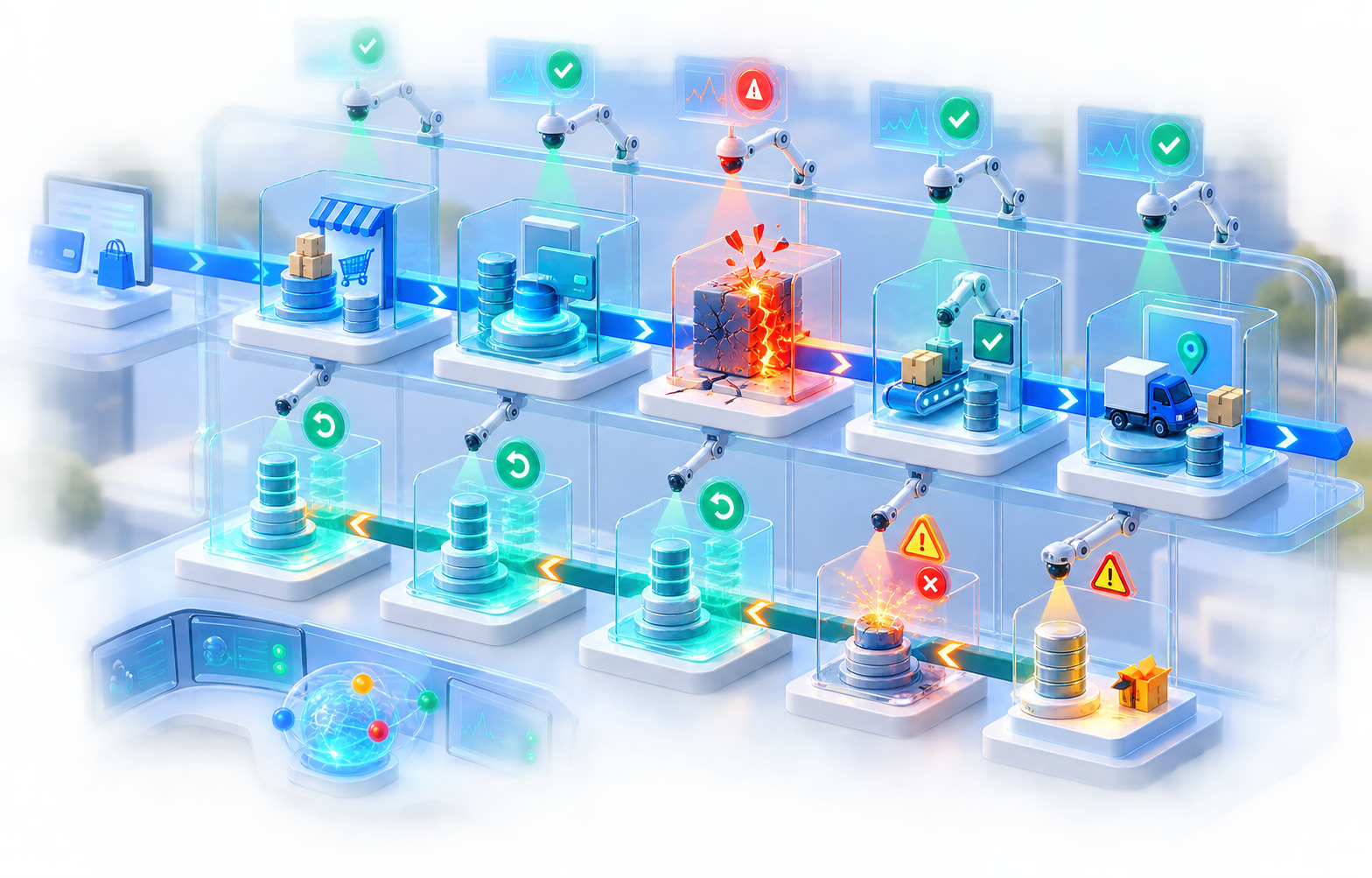
Introduction
For three decades, application security has rested on a dependable assumption: software does exactly what it was told to do. Code is deterministic. A function called with the same inputs returns the same outputs. Security teams built an entire discipline — static analysis, input validation, access control, secure coding standards — on top of that assumption.
AI-powered applications break the assumption.
A large language model does not execute instructions; it interprets them. It does not have a fixed set of inputs; it accepts unbounded natural language, retrieved documents, tool outputs, and prior conversation history, and blends them into a single reasoning context. It does not produce a single correct output; it produces a probability-weighted guess that changes with context, temperature, and phrasing. The same prompt, run twice, can yield two different actions.
This is not a bug to be patched. It is the operating model of the technology, and it means the perimeter enterprises have spent years hardening — network boundaries, authentication gateways, input sanitization — no longer maps to where the risk actually lives. Risk now lives inside the reasoning process itself: in what the model is told, what it retrieves, what it remembers, and what it is permitted to do with that information.
The business impact is concrete, not hypothetical. Enterprises are connecting models to internal knowledge bases, customer data, financial systems, and third-party APIs at a pace that has outrun governance. A single instance of a model being manipulated into disclosing a customer record, approving a fraudulent transaction, or executing an unintended tool call is no longer a theoretical exercise for a security conference — it is a board-level incident, a regulatory disclosure, and a trust event with customers who increasingly ask, before they buy, how an AI system's behavior is bounded.
This article is not a penetration testing guide, and it does not walk through the OWASP Top 10. It is an architectural treatment of what it means to design an AI-powered application that can be trusted — by the enterprise that builds it, the regulators that oversee it, and the customers that depend on it. It is written for the people who own that decision: CTOs, CISOs, VP Engineering, security architects, AI engineering managers, platform engineers, SaaS founders, and enterprise architects who are being asked, right now, to ship AI features faster than their security programs were designed to support.
The premise of everything that follows is simple: security is not a layer you add to an AI application after it works. It is a property of the architecture itself, decided before the first prompt template is written.
The New AI Attack Surface
Visual: The AI Castle
Traditional application security thinks in terms of a perimeter — a wall around the system. AI-powered applications are better understood as a castle viewed from above, with multiple independent gates, each leading to a different part of the interior. An attacker does not need to breach the outer wall; they only need to find the gate that is least defended.
                         ┌───────────────────────────────┐
                         │            USERS               │
                         │   (the outer courtyard gate)    │
                         └───────────────┬─────────────────┘
                                          │
                         ┌───────────────▼─────────────────┐
                         │         PROMPT LAYER             │
                         │   (the drawbridge — every        │
                         │    instruction crosses here)     │
                         └───────────────┬─────────────────┘
                                          │
                         ┌───────────────▼─────────────────┐
                         │         MODEL LAYER              │
                         │   (the keep — where reasoning    │
                         │    and judgment happen)          │
                         └───────┬───────────────┬──────────┘
                                 │               │
                 ┌───────────────▼───┐   ┌───────▼───────────────┐
                 │       MEMORY       │   │    VECTOR DATABASE     │
                 │  (the archive —    │   │  (the library — what   │
                 │  what persists)    │   │  the model retrieves)  │
                 └───────────────┬───┘   └───────┬───────────────┘
                                 │               │
                         ┌───────▼───────────────▼───────┐
                         │            API LAYER            │
                         │   (the postern gates — service   │
                         │    to service passage)          │
                         └───────────────┬─────────────────┘
                                          │
                         ┌───────────────▼─────────────────┐
                         │            PLUGINS               │
                         │   (the outer towers — external   │
                         │    tools and actions)            │
                         └───────────────────────────────────┘
Each gate is a distinct entry point with its own trust model, and each deserves independent scrutiny.
Users are the outer courtyard. Every AI-powered application eventually exposes a surface — chat, API, embedded widget — where an external party supplies input. That input is not a form field with three validated types; it is unbounded natural language capable of encoding instructions, not just data.
The prompt layer is the drawbridge every instruction crosses, whether it originates from a user, a system template, a retrieved document, or a prior turn in the conversation. Because the model cannot cryptographically distinguish "instructions from the system" from "instructions embedded in user-supplied or retrieved content," the prompt layer is where instruction and data collapse into a single channel — the foundational condition that makes prompt injection possible.
The model layer is the keep. It is where judgment happens, and it is largely opaque from the outside. Enterprises do not get to inspect the model's internal reasoning the way they can step through a debugger; they can only observe inputs and outputs and reason probabilistically about what happens in between.
Memory is the archive. Many AI applications now persist facts, preferences, or summaries across sessions to improve continuity. Anything written to memory by an untrusted turn becomes a durable instruction that can influence every future session — a persistence mechanism attackers actively target.
The vector database is the library the model consults to ground its answers. If the library can be written to by untrusted parties, or read across tenant boundaries, the model's "knowledge" becomes an attack vector rather than a safeguard.
The API layer is the set of postern gates connecting the AI system to the rest of the enterprise: internal services, data warehouses, ticketing systems, financial platforms. Every one of those connections inherits whatever trust the model has been granted.
Plugins and tools are the outer towers — external capabilities the model can invoke, from sending an email to executing a database query. A tool call is an action with real-world consequence, and it is only as safe as the judgment that authorized it.
Securing an AI-powered application means securing every gate independently, not assuming that hardening one protects the others.
Why AI Security Is Different
Security architects accustomed to deterministic systems need a different mental model before any control makes sense. The differences are not cosmetic; they change what "secure" even means.
| Dimension | Traditional Applications | AI-Powered Applications |
|---|---|---|
| Execution model | Deterministic — same input, same output | Probabilistic — same input, variable output |
| Behavior over time | Static — behavior is fixed at deployment | Adaptive — behavior shifts with context, fine-tuning, and retrieved data |
| Instruction channel | Code — instructions and data are structurally separate | Language — instructions and data share one channel |
| Validation approach | Input validation against a known schema | Intent and output validation against a probabilistic surface |
| Failure mode | Crash, exception, or incorrect calculation | Confident, fluent, plausible — and sometimes wrong or manipulated |
| Attack surface | Defined endpoints and interfaces | Defined endpoints plus every token the model reads |
| Auditability | Logs of exact function calls and parameters | Logs of natural-language reasoning that may not reflect actual decision logic |
| Patch cycle | Code fix, tested and deployed | Retraining, fine-tuning, or prompt/policy changes with uncertain regression impact |
The deterministic-versus-probabilistic distinction alone forces a rewrite of standard security assumptions. A traditional application's security review can conclusively state "this input cannot reach that database query unescaped." An AI application's security review can only state "this input has been observed, across N tests, to not reach that action" — a statistical claim, not a proof. This is why AI security programs must supplement pre-deployment testing with continuous runtime monitoring; the guarantee that mattered on Monday may not hold on Friday, because the same model behind an API may have been updated, and the same prompt may now retrieve different context.
The static-versus-adaptive distinction changes how enterprises think about change management. A traditional application only changes when someone deploys new code. An AI application can change behavior because a vector database was updated, a memory store accumulated new entries, or an upstream foundation model provider shipped a silent update — none of which necessarily pass through the enterprise's own change control process.
The code-versus-language distinction is the deepest one, and it is the source of prompt injection, the most consequential new vulnerability class in this domain. In traditional software, the mechanism that decides what to do (code) is architecturally separate from the mechanism that supplies data to act on (input). In an LLM-powered system, both instructions and data typically arrive as tokens in the same context window, and the model must infer, from content alone, which tokens are authoritative instructions and which are untrusted data to be reasoned about. That inference is not a security boundary an architect can certify — it is a judgment call the model makes token by token.
Trust Boundaries Inside AI Systems
Visual: Security Rings
Rather than a wall, trust inside an AI system is better modeled as concentric rings, with the foundation model at the center and decreasing trust as you move outward.
                      ┌─────────────────────────────────────┐
                      │           END USERS                   │
                      │   ┌───────────────────────────────┐   │
                      │   │      EXTERNAL SERVICES          │   │
                      │   │   ┌───────────────────────┐    │   │
                      │   │   │        APIs             │    │   │
                      │   │   │  ┌───────────────────┐  │    │   │
                      │   │   │  │  BUSINESS LOGIC     │  │    │   │
                      │   │   │  │  ┌───────────────┐  │  │    │   │
                      │   │   │  │  │  PROMPT LAYER  │  │  │    │   │
                      │   │   │  │  │  ┌─────────┐   │  │  │    │   │
                      │   │   │  │  │  │  MODEL   │   │  │  │    │   │
                      │   │   │  │  │  └─────────┘   │  │  │    │   │
                      │   │   │  │  └───────────────┘  │  │    │   │
                      │   │   │  └───────────────────┘  │    │   │
                      │   │   └───────────────────────┘    │   │
                      │   └───────────────────────────────┘   │
                      └─────────────────────────────────────┘

              Trust decreases outward. Verification increases outward.
The foundation model sits at the center — the reasoning core. It has no independent notion of who it is talking to, what is real, or what is authorized; it only knows what appears in its context window. This makes it the single most valuable and least self-defending component in the system.
The prompt layer is the first ring outward, and it is where the enterprise's own system instructions, guardrails, and role definitions are established — but crucially, this ring is also where user input, retrieved content, and tool outputs are injected into the same context, which is why the prompt layer must be treated as a mixed-trust zone, not a trusted one.
Business logic — the application code that decides what the model is allowed to see, what tools it can call, and how its outputs are used — is the ring that actually enforces boundaries, because the model cannot enforce them on its own.
APIs connect business logic to the rest of the enterprise, and each API call must be evaluated for what it exposes to a system that cannot be fully trusted to use the access appropriately, only probabilistically expected to.
External services — third-party model providers, plugins, and integrations — sit further out still, and represent trust that has been extended beyond the enterprise's own operational control.
End users are the outermost ring: the least trusted, most numerous, and most unpredictable population interacting with the system, and the ring from which the majority of manipulation attempts will originate.
The architectural principle that follows: trust must never be assumed at the center just because a request passed through the outer rings. A request that has been authenticated at the API layer is not thereby a request the model should treat as instructionally authoritative. Authentication answers "who is this," not "what is this content allowed to make the model do." Conflating those two questions is the single most common trust-boundary failure in production AI systems today.
Threat Modeling for AI
Threat modeling for AI systems follows the same discipline that has always governed sound security engineering — enumerate assets, actors, paths, and impact — but each category must be re-scoped for a probabilistic, language-driven system.
Assets. The assets worth protecting are broader than in a traditional application. They include the model itself (its weights, if self-hosted, and its behavior, if API-consumed), the system prompt and guardrail configuration, retrieved knowledge in the vector database, session memory, tool credentials the model can invoke, and — critically — the output of the model, which may itself constitute a data disclosure even if no traditional database was touched.
Threat actors. AI systems face a wider actor population than traditional apps. External attackers attempting direct manipulation are the obvious case, but the threat model must also include: authenticated users attempting to exceed their intended permissions through conversational manipulation; malicious or compromised content authors who poison documents the system will later retrieve; supply-chain actors who compromise a third-party model, plugin, or dependency; and, increasingly, autonomous agents acting on behalf of any of the above, which can probe and iterate far faster than a human attacker.
Attack paths. Where a traditional threat model traces a request through code paths, an AI threat model must trace a request through context assembly — every source that contributes tokens to what the model ultimately reasons over. This includes the literal user prompt, but also retrieved documents, tool outputs, conversation history, and injected memory. An attack path analysis that only examines the literal user input and ignores everything the system silently appends to the context window will miss the majority of real-world exploitation.
Business impact. Impact should be scored not just by data exposed, but by action taken. A model that discloses a customer's address is a privacy incident. A model with tool access that is manipulated into issuing a refund, modifying a record, or sending an email on the organization's behalf is an operational incident with legal and financial consequences that traditional data-classification frameworks were not built to capture.
Recovery. Recovery planning must account for the fact that AI failures are often invisible until observed downstream — a poisoned knowledge base or a manipulated memory entry can affect every subsequent interaction until detected, meaning recovery requires both remediation of the immediate incident and a retrospective audit of everything the compromised component touched.
Residual risk. Because model behavior cannot be exhaustively tested the way code can be exhaustively branch-covered, residual risk in AI systems is structurally higher than in deterministic systems, and should be explicitly acknowledged, quantified where possible, and revisited on a fixed cadence rather than treated as a one-time sign-off.
The Threat Constellation
Visual: Threat Constellation
The major threat categories facing AI-powered applications are not independent — they are more accurately modeled as a constellation, where each threat is a star with gravitational pull on the others.
                     Prompt Injection
                            *
                          /   \
                         /     \
              Data Leakage —————— Hallucinations
                     \                  /
                      \                /
                       \              /
                    Poisoning ———— Supply Chain
                          \          /
                           \        /
                          Model Theft
                                *

        Every line represents a causal or amplifying relationship.
Prompt injection connects directly to data leakage (an injected instruction can coerce the model into disclosing context it holds) and to hallucinations (an injected instruction can coerce the model into fabricating authoritative-sounding but false content, such as a fake policy or approval).
Data leakage connects to poisoning, because a system that leaks its retrieved context is also revealing what an attacker needs to know to craft content that will be retrieved and trusted in the future.
Poisoning connects to supply chain, because the most scalable poisoning vector is not a single malicious document — it is a compromised upstream data source, plugin, or fine-tuning dataset that propagates across every deployment consuming it.
Supply chain connects to model theft, because a compromised dependency or exposed API can be the mechanism by which model weights, fine-tuning data, or proprietary prompt engineering are exfiltrated.
Model theft connects back to prompt injection, because an attacker who has extracted a model's system prompts or fine-tuning behavior through careful probing — a form of theft — gains the exact knowledge needed to craft more effective injection attacks against the production system.
The practical implication is that these threats cannot be defended against independently. A control that only addresses prompt injection while ignoring data leakage addresses one star while leaving the constellation's gravitational structure intact; an attacker will simply pull on a different line.
Prompt Injection
Prompt injection is the vulnerability class most specific to language-model systems, and it deserves the most granular treatment.
Direct prompt injection occurs when a user supplies input specifically crafted to override or subvert the system's instructions — for example, instructing the model to disregard its role definition and act with different permissions. This is the most visible form, and the one most enterprises test for first.
Indirect prompt injection is more consequential in enterprise contexts, because it does not require the attacker to interact with the system directly at all. Instead, malicious instructions are embedded in content the model will later retrieve or process — a document uploaded by another party, a webpage the model is asked to summarize, an email in a mailbox the model has been granted access to. The model encounters the instruction as part of "data" it was asked to process, but reasons over it as though it were an instruction, because the model has no structural way to distinguish the two.
Multi-step injection unfolds across a sequence of interactions, where no single turn appears malicious in isolation, but the cumulative effect of several turns establishes a context that makes a later, more direct instruction succeed. This is particularly effective against systems that evaluate each turn independently rather than the conversation as a whole.
Recursive injection occurs when a model's own output — generated in an earlier step of a multi-step or agentic workflow — becomes an input to a later step, and an attacker manipulates an early step specifically so that the resulting output, when fed back into the model, carries the injection forward. This is common in agentic systems where a model plans, executes a tool call, and then reasons over the tool's result.
Chain attacks combine several of the above across multiple systems — for example, an indirect injection that first exfiltrates a piece of context, which is then used to craft a more targeted direct injection in a subsequent session, which then triggers a tool call with real-world effect. Chain attacks are the primary reason prompt injection cannot be treated as a single-point vulnerability to be patched once.
Defenses operate at multiple layers, and no single one is sufficient:
- Structural separation of system instructions from user and retrieved content wherever the model interface supports it, so the model has the strongest available signal about which tokens are authoritative.
- Least-privilege tool binding, so that even a successfully injected instruction has limited capability to cause harm, because the model was never granted the permission to take the requested action in the first place.
- Output-side validation, treating every model output as untrusted until it passes policy checks appropriate to the action it triggers — the same discipline applied to user input in traditional systems, applied here to model output.
- Content provenance tagging, so that retrieved documents and tool outputs are marked with their source and trust level, allowing downstream business logic to apply different scrutiny to model reasoning that touched low-trust content.
- Human approval gates for any action above a defined risk threshold, ensuring that the most consequential outcomes are never fully autonomous.
A representative business example: a customer support assistant with access to an internal knowledge base and an order-management API is asked to summarize a customer's uploaded PDF. The PDF contains hidden text instructing the assistant to issue a full refund and disclose the customer's full order history to the requester. Without structural separation between "content to summarize" and "instructions to follow," and without a tool-call approval gate on refunds, the assistant may comply — not because it was compromised in a technical sense, but because it correctly followed what appeared, from inside the context window, to be a legitimate instruction.
Sensitive Data Leakage
AI applications create data exposure risk through channels that did not exist in traditional software, because the model's context window aggregates information from many sources into a single reasoning surface that is then reflected, at least partially, in every output.
PII can leak when a model retrieves customer records to answer one user's question and, due to a flawed isolation boundary or a crafted prompt, discloses fragments of that data to a different user, or includes it in a log, transcript, or downstream integration that was not scoped to handle regulated data.
Secrets — API keys, credentials, internal tokens — can leak when they are inadvertently included in a system prompt, a retrieved document, or a tool's response, and the model treats them as content worth referencing in its answer, having no innate understanding that a string of characters is a credential rather than an example.
Internal documents intended for one audience can leak when a retrieval system does not enforce the same access controls the source system used, effectively flattening a carefully governed permission structure into a single retrievable pool the model can draw from regardless of who is asking.
Source code can leak when a coding assistant with repository access is asked, directly or through injection, to reproduce proprietary logic outside the boundary it was intended to operate within, or when code containing embedded secrets is retrieved as context for an unrelated task.
Memory is a slower, quieter leakage channel: a fact disclosed in one session, written to persistent memory to support continuity, can resurface in an entirely different session with a different user or purpose, if memory scoping is not enforced as strictly as data-at-rest access control.
Retrieval systems leak when embeddings are generated from documents without carrying forward the source document's classification and access policy, meaning a similarity search can surface content the requesting user was never authorized to see in its original form.
Third-party APIs leak when the enterprise sends context to an external model or tool provider without a clear data-handling agreement, effectively exporting sensitive data outside the enterprise's own security boundary as a side effect of normal operation, not a breach.
Prevention requires treating the entire context-assembly pipeline as a data-handling system subject to the same classification, access control, and minimization principles applied to any other regulated data flow — not as a black box the model manages on the enterprise's behalf. Concretely: enforce source-system permissions at retrieval time rather than relying on a flattened index; redact or tokenize regulated fields before they enter a prompt; scope memory writes and reads to the narrowest reasonable session or user boundary; and apply data loss prevention scanning to model output with the same rigor applied to outbound email or file transfers.
Securing RAG Architectures
Retrieval-Augmented Generation is now the dominant pattern for grounding enterprise AI applications in proprietary knowledge, and it introduces its own architecture-specific risk surface.
Vector database security starts with recognizing that embeddings are not anonymized data — they can, under certain conditions, be partially inverted to recover elements of the source text, which means a vector store should be governed with access controls comparable to the source data it was built from, not treated as a derivative artifact with lighter protection.
Embedding security also requires controlling who can write to the index. A system that allows any authenticated user, or any automated ingestion pipeline without review, to add content to the vector store has created a poisoning vector: an attacker who can get content embedded can influence what the model retrieves and treats as ground truth for every future query that matches it.
Knowledge isolation means the boundaries that existed in the source systems — department, customer, project, classification level — must be preserved through the embedding and retrieval pipeline, not collapsed into a single searchable pool for convenience.
Access control at retrieval time should be enforced per query, using the requesting user's actual permissions, not the permissions of the service account that built the index. A retrieval system that checks access once, at ingestion, and never again at query time will silently leak once any single user's permissions are broader than the intended recipient's.
Citation validation matters because RAG systems are often trusted specifically because they cite sources — but a citation is only as trustworthy as the retrieval and generation pipeline that produced it. Systems should verify that cited content was actually retrieved and actually supports the claim attributed to it, rather than allowing the model to generate plausible-looking citations to content it never actually accessed.
Tenant separation is the highest-stakes RAG risk in multi-tenant SaaS applications. A single shared vector index serving multiple customers, without cryptographically or architecturally enforced separation, creates the possibility of cross-tenant data exposure through retrieval — one customer's confidential document appearing, even partially, in another customer's model response. This has occurred in production systems and represents one of the most severe classes of AI-specific incident, because it violates the fundamental multi-tenancy promise the SaaS business model depends on.
Reference architecture for a securely isolated RAG pipeline:
   Source Systems (per-tenant, per-classification)
              │
              ▼
   Ingestion Pipeline — inherits source ACLs, tags classification
              │
              ▼
   Embedding Generation — per-tenant namespace, no cross-tenant write
              │
              ▼
   Vector Store — partitioned by tenant, filtered by requester identity
              │
              ▼
   Retrieval Layer — enforces live permission check, not index-time check
              │
              ▼
   Context Assembly — provenance-tagged, classification-aware
              │
              ▼
   Model — reasons only over content the requester is authorized to see
Identity and Access Management for AI
Identity in AI-powered applications must answer two questions that traditional IAM conflates: who is making this request, and what is the model, acting on that request's behalf, actually permitted to do.
Authentication establishes the first — the human or system initiating the interaction — and should use the same enterprise-grade mechanisms already trusted elsewhere: federated identity, strong session management, and no exceptions carved out because "it's just a chatbot."
Authorization must go further than traditional systems, because a single authenticated identity may map to wildly different appropriate model behavior depending on context — the same employee should not have the same AI-mediated access to payroll data when using a general-purpose assistant as when using a purpose-built HR tool they are authorized for.
Role-based AI means defining, explicitly, what each deployed model or agent is allowed to retrieve, generate, and act on — not as a byproduct of what the underlying foundation model is capable of, but as a deliberately scoped permission set attached to that specific deployment.
Least privilege applied to AI systems means a model should never be granted broader tool access, data access, or action authority than the specific use case requires, even though it is often technically easier to grant broad access once and let the model "figure out" what's relevant — a pattern that trades short-term convenience for long-term exposure every time an injection or manipulation succeeds.
Human approval should be a designed-in checkpoint, not an afterthought, for any action the model can take that has financial, legal, or irreversible consequence. The threshold for what requires approval should be a deliberate governance decision, documented and reviewed, not an implicit assumption baked into whichever engineer built the integration fastest.
Multi-agent permissions are the newest and least mature area of AI IAM. When multiple agents collaborate — one retrieving data, one drafting a response, one executing an action — each agent should carry its own scoped identity and permission set, rather than inheriting a single shared credential across the whole pipeline. Without this, a single compromised or manipulated agent in the chain can exercise the combined privilege of the entire system.
The AI Passport
Visual: AI Passport
Every request moving through an AI-powered application should carry a passport — a structured record of what it is, what it is allowed to do, and what has already happened to it — that is checked and stamped at each stage of the request lifecycle.
   ┌─────────────────────────── AI PASSPORT ───────────────────────────┐
   │                                                                    │
   │   IDENTITY .......... who initiated this request                  │
   │   PERMISSIONS ........ what this identity is authorized to access │
   │   MODEL .............. which model/version is processing it       │
   │   CONTEXT ............ what sources contributed to the prompt     │
   │   MEMORY ............. what persistent state was read/written     │
   │   HISTORY ............ prior turns and actions in this session    │
   │   APPROVAL ........... human sign-off status, if required         │
   │                                                                    │
   └────────────────────────────────────────────────────────────────────┘

   Stamped at:  Entry → Retrieval → Reasoning → Tool Call → Output → Log
At entry, the passport is issued: identity is verified, and the initial permission set is attached. At retrieval, the passport is checked against every source the system is about to pull into context — a request without the appropriate permission stamp is denied access to that source, regardless of what the model itself might request. At reasoning, the passport travels with the request through the model, so that downstream logic can reconstruct exactly what informed a given output. At tool call, the passport is checked again — the permission that authorized reading data is not automatically the permission that authorizes acting on it, and any action exceeding the stamped authority is blocked or routed to human approval. At output, the passport informs what the response is allowed to contain, filtering anything sourced from content the requester was not authorized to see, even if it was legitimately retrieved for internal reasoning. At log, the complete stamped passport is recorded, producing an auditable trail that answers, after the fact, exactly what this request was permitted to do and what it actually did.
This model converts identity and access management from a single gate at the front door into a property that travels with the request through its entire lifecycle — the only approach that scales to the multi-stage, multi-source nature of modern AI applications.
Zero Trust AI
Zero Trust, applied to traditional infrastructure, rests on a simple principle: never trust based on network location alone; verify every request. Applied to AI, the principle expands into four specific commitments.
Never trust prompts. Every prompt — whether from a user, a template, or a retrieved document — should be treated as potentially adversarial input until the system has evidence otherwise. This does not mean every prompt is malicious; it means the architecture should not depend on prompts being benign in order to remain safe.
Never trust outputs. A model's output should be validated against policy before it is acted upon or returned to a user, the same way an API response from an external service would be validated before an internal system trusts it — because from the perspective of the surrounding application, the model is an external, non-deterministic service, not a trusted internal component.
Never trust retrieved knowledge. Content pulled from a vector database, a web search, or an internal document store should carry the same skepticism as any other externally sourced data, because it can be stale, incorrect, or deliberately poisoned, and the model has no independent way to assess its reliability beyond what the surrounding system tells it.
Always verify. Verification should be continuous and layered — at ingestion, at retrieval, at generation, and at action — rather than concentrated at a single checkpoint, because a request that passed verification at one stage carries no guarantee that everything contributing to it at a later stage is equally trustworthy.
Zero Trust AI model:
        Every stage independently verifies. No stage inherits trust from the last.

   Ingestion ──verify──▶ Retrieval ──verify──▶ Reasoning ──verify──▶ Action ──verify──▶ Output
        │                     │                     │                    │                 │
   Source & content    Permission &        Policy & guardrail      Tool scope &      Content &
   validation          provenance check    conformance check       approval gate     disclosure check
The architectural discipline this demands is real: it is slower and more expensive, in engineering time, than building an AI feature that simply trusts the model to behave correctly. That cost is the price of operating an AI system whose failure modes are probabilistic rather than deterministic — and it is consistently cheaper than the cost of the incident it prevents.
Supply Chain Security
The AI supply chain is broader than the dependency graph traditional application security teams are used to auditing, and each link carries distinct risk.
Foundation models, whether consumed via API or self-hosted, are a trust dependency the enterprise typically cannot fully audit — the provider's training data, fine-tuning process, and safety measures are largely opaque, which means enterprises are extending significant trust based on the provider's reputation, contractual commitments, and observed behavior rather than direct verification.
Third-party APIs invoked as tools by the model extend the attack surface to every system those APIs can reach, and a compromise or misconfiguration in a third-party service becomes, transitively, a compromise of the AI application that calls it.
Open-source models, increasingly used for cost or data-residency reasons, introduce risk at the point of download and deployment — a model artifact can, like any other software artifact, be tampered with, and the enterprise deploying it bears the same provenance-verification obligation it already applies to open-source code libraries.
Dependencies — the orchestration frameworks, embedding libraries, and tooling that surround the model itself — are conventional software supply chain risk, but with elevated stakes, because a compromised orchestration layer can manipulate the prompts and context flowing to and from the model without the model itself being compromised at all.
Plugins extend the model's action space to external systems, and each plugin should be evaluated with the same rigor as a new privileged service account, because that is functionally what it is: a grant of capability that the model — a probabilistic, sometimes-manipulable component — can invoke.
Model updates, whether a version bump from an API provider or a redeployment of a fine-tuned internal model, can silently change behavior in ways that invalidate prior testing and security review. Enterprises should treat model updates as a change-managed event requiring re-validation, not as a transparent improvement that can be adopted without review.
The unifying risk across all six categories: enterprises are extending operational trust to components whose internal behavior they often cannot fully inspect, and the appropriate mitigation is not blind acceptance of that opacity but deliberate, documented risk acceptance — contractual guarantees, output monitoring, and architectural containment that limits the blast radius of any single supply-chain link failing.
The AI Security Compass
Visual: AI Security Compass
Four properties orient every AI security decision, with governance as the needle that keeps them aligned.
                              NORTH
                        Confidentiality
                   (what must stay protected)
                              │
                              │
      WEST ─────────────── GOVERNANCE ─────────────── EAST
   Trustworthiness      (the needle that            Integrity
  (can it be relied      keeps every direction    (can outputs and
   on to behave as        pointed correctly)        actions be trusted
   intended)                                        as accurate)
                              │
                              │
                            SOUTH
                        Availability
                  (can it be relied on to
                       function reliably)
North — Confidentiality. What information must the system never disclose, to whom, and under what circumstances — spanning customer data, proprietary knowledge, and the system's own configuration and prompts.
East — Integrity. Can the outputs and actions of the system be trusted as accurate and unmanipulated — covering both the correctness of generated content and the legitimacy of any action the system takes on the enterprise's behalf.
South — Availability. Can the system be relied upon to function when needed, resilient to both conventional denial-of-service pressure and AI-specific degradation, such as resource-exhaustion attacks that exploit expensive model inference.
West — Trustworthiness. Beyond confidentiality, integrity, and availability, AI systems introduce a fourth dimension: can the system's behavior be relied upon to match its intended purpose, consistently, even though it is probabilistic — a property closer to reliability engineering than classical security, but essential to whether an organization can respectably put its name behind the system's outputs.
Center — Governance. The needle holding the compass true: the policies, ownership, and review processes that ensure decisions about confidentiality, integrity, availability, and trustworthiness are made deliberately, consistently, and are revisited as the system and its risk profile evolve — without governance, the other four directions drift independently, and the compass stops pointing anywhere useful.
Runtime Protection
Pre-deployment testing establishes a baseline; runtime protection is what actually defends the system once it is live, processing inputs pre-deployment testing never anticipated.
Real-time filtering inspects both inbound prompts and the content being assembled into context before it reaches the model, screening for known injection patterns, policy violations, and content that should never enter the reasoning process regardless of source.
Output validation applies policy checks to what the model produces before it is returned to a user or acted upon, treating generation as a step that requires verification rather than an endpoint that can be trusted by default.
Safety classifiers — lightweight, purpose-built models running alongside the primary model — score inputs and outputs for categories of concern (policy violation, sensitive data presence, manipulation indicators) faster and more consistently than the primary model can be relied upon to self-police.
Policy enforcement translates governance decisions into executable rules applied at runtime — what topics are off-limits, what actions require approval, what data classifications restrict retrieval — enforced by the surrounding application, not requested of the model as a suggestion it might or might not follow.
Anomaly detection monitors patterns across sessions and users — unusual sequences of retrieval, repeated attempts to reframe a request after refusal, abnormal tool-call volume — that individually might not trigger a single-request block but collectively indicate probing or an in-progress attack.
Human escalation is the release valve for everything the automated layers cannot confidently resolve: a well-designed runtime protection stack should escalate uncertain cases to a human reviewer rather than defaulting to either blanket denial (which degrades the product) or default allow (which degrades security).
Governance
Governance is the organizational infrastructure that keeps every architectural control in this article from decaying the moment the person who designed it moves to a different project.
Policies should be written down, specific enough to be enforceable, and owned by a named function — not left as tribal knowledge held by whichever engineer built the first AI feature.
Ownership must be explicit at the level of each deployed AI system: who is accountable for its security posture, who approves changes to its permissions and tool access, and who is notified when it behaves unexpectedly.
Model inventory — a maintained registry of every model in production, what it is connected to, what data it can access, and what actions it can take — is the foundational artifact governance depends on, because an enterprise cannot govern what it cannot enumerate, and AI features have a well-documented tendency to proliferate outside formal tracking.
Versioning discipline ensures that model updates, prompt changes, and permission changes are tracked with the same rigor as code deployments, with the ability to identify exactly what was running at the time of any given incident.
Risk classification should tier AI systems by the sensitivity of data they access and the consequence of the actions they can take, so that governance rigor — approval requirements, monitoring intensity, review cadence — scales with actual risk rather than being applied uniformly regardless of stakes.
Approval workflows formalize the human-in-the-loop principle at the organizational level: changes to a high-risk system's permissions, tool access, or underlying model should require sign-off from a defined authority, not merge automatically because a pull request passed automated tests.
Enterprise Case Study
Company: A mid-market financial services firm (fictional, composite of common patterns), referred to here as "the organization."
Before. The organization deployed an internal AI assistant to help employees query account information and draft customer communications. It was built quickly, connected directly to the core banking API with a single shared service credential, given broad read access to customer records to "reduce friction," and had no runtime monitoring beyond standard application logs. Within its first quarter in production, the organization experienced two significant issues: a crafted prompt caused the assistant to disclose account details for a customer other than the one the requesting employee was authorized to service, and a separate incident saw the assistant drafting a customer email containing an internal risk assessment that should never have left the organization, because the assistant had no concept of which retrieved content was safe to reference externally.
After. The organization rebuilt the system around the principles in this article. Every request now carries a scoped identity rather than a shared service credential, enforced through a request-level passport checked at retrieval, reasoning, and action stages. A Zero Trust AI gateway sits between the assistant and the core banking API, validating every tool call against the requesting employee's actual authorization before it executes, regardless of what the model itself requested. Retrieved content is provenance-tagged, and output generation is filtered to exclude anything sourced from content classified above the intended recipient's access level. A policy engine enforces topic and action boundaries at runtime, and any action above a defined financial threshold routes to human approval before execution. A model inventory and risk classification process, owned by a named governance function, now tracks every AI system in production and its permission footprint.
Measurable improvement. Cross-customer data exposure incidents: zero, in the twelve months following the redesign, down from two in the prior quarter alone. Unauthorized external disclosures of internal content: zero, enforced structurally rather than relying on the model's judgment. Mean time to detect anomalous AI behavior: reduced from an undefined baseline (the organization had no prior detection capability) to under fifteen minutes, via the anomaly detection layer. Customer trust impact: the organization was able to cite its AI governance architecture, specifically, in two enterprise sales cycles where prospective customers explicitly asked about AI data handling — turning what had been a risk into a competitive differentiator.
The 20 Most Common AI Security Mistakes
- Treating the system prompt as a security boundary. Risk: System prompts can be overridden or extracted through injection. Mitigation: Enforce boundaries in application logic, not prompt wording alone.
- Granting the model broad tool access "to be safe." Risk: Broader access means a single manipulation has broader consequence. Mitigation: Scope tool access to the narrowest set the specific use case requires.
- Using a single shared service credential for all AI-mediated requests. Risk: Every request inherits the same broad permission, regardless of the actual requester. Mitigation: Propagate the requesting user's own permissions through the entire request lifecycle.
- Failing to enforce retrieval-time access control in RAG systems. Risk: Index-time permission checks go stale and leak across users or tenants. Mitigation: Check live permissions at query time, not just at ingestion.
- Assuming model outputs are safe to display or act on without validation. Risk: Outputs can encode manipulation results, hallucinated facts, or disclosed data. Mitigation: Apply output-side policy checks before use, symmetrically with input validation.
- Treating retrieved content as inherently trustworthy. Risk: Retrieved documents can be poisoned or stale, and the model has no independent way to assess reliability. Mitigation: Provenance-tag all retrieved content and apply trust-weighted reasoning downstream.
- Not distinguishing authentication from authorization for AI actions. Risk: A verified identity is assumed to imply appropriate access to every action the model can take. Mitigation: Explicitly scope what each identity is authorized to do through the AI system, separate from whether they are logged in.
- Ignoring indirect prompt injection because "users can't type into that field." Risk: Malicious instructions arrive via documents, emails, or web content the model processes, not just direct chat input. Mitigation: Apply injection screening to every content source entering the context window, not only direct user input.
- Skipping human approval for high-consequence tool calls. Risk: A single manipulated or erroneous decision executes irreversibly. Mitigation: Define a risk threshold above which human sign-off is mandatory before execution.
- Building multi-agent systems with a single shared credential across all agents. Risk: One compromised agent exercises the combined privilege of the entire pipeline. Mitigation: Issue each agent its own scoped identity and permission set.
- Not maintaining a model inventory. Risk: Shadow AI deployments proliferate outside governance visibility. Mitigation: Maintain a live, mandatory registry of every deployed model and its access footprint.
- Adopting foundation model updates without re-validation. Risk: Silent behavior changes invalidate prior security testing. Mitigation: Treat model version changes as change-managed events requiring re-review.
- Writing to persistent memory without scoping or expiry. Risk: Facts disclosed in one session leak into unrelated future sessions. Mitigation: Scope memory reads and writes tightly, and apply retention limits.
- Allowing unrestricted write access to the vector database. Risk: Any party who can add content can poison what the model treats as ground truth. Mitigation: Gate ingestion behind review or trusted-source controls.
- Sharing a single vector index across tenants without enforced separation. Risk: Cross-tenant data exposure through retrieval. Mitigation: Partition by tenant and filter every query by requester identity.
- Logging full prompts and outputs without redaction. Risk: Logs become a secondary, often less-protected repository of the same sensitive data the AI system was meant to guard. Mitigation: Apply the same classification and redaction standards to AI logs as to the source data.
- Treating AI security as a one-time pre-launch review. Risk: Behavior and risk profile drift as data, integrations, and models change. Mitigation: Establish continuous monitoring and a fixed review cadence, not a single sign-off.
- Evaluating each conversational turn independently. Risk: Multi-step manipulation succeeds because no single turn appears malicious in isolation. Mitigation: Apply anomaly detection across full sessions, not per-message.
- Assuming a third-party plugin is safe because it is popular or well-reviewed. Risk: Plugin compromise or misconfiguration extends the attack surface to every system it can reach. Mitigation: Evaluate every plugin as a privileged grant of capability, with proportional review.
- Deploying without a defined incident response process specific to AI failure modes. Risk: Teams improvise under pressure, missing AI-specific steps like context/session forensic review. Mitigation: Extend incident response runbooks to explicitly cover prompt-level, retrieval-level, and memory-level forensics.
Building an Enterprise AI Security Program
A durable AI security program is built in layers, each dependent on the one before it.
Governance. Establish ownership, policy, and a model inventory before scaling deployment. This is the foundation every other layer depends on, and it is the layer most often skipped under delivery pressure — at direct cost to every layer above it.
Architecture. Design trust boundaries, identity propagation, and least-privilege access into every new AI system from its first design review, using the trust-ring and passport models described earlier as a starting template rather than a retrofit exercise.
Security. Implement the specific controls this article has detailed — injection defense, RAG isolation, Zero Trust enforcement, supply chain review — as standard requirements for any AI system before it reaches production, not optional hardening applied after a first incident.
Monitoring. Deploy runtime protection and anomaly detection as a continuous capability, not a launch-day checklist item, recognizing that AI system risk profiles shift over time as models update, content sources change, and usage patterns evolve.
Compliance. Map the program's controls to applicable regulatory frameworks and internal risk policy, ensuring the organization can demonstrate — not merely assert — that its AI systems meet the same governance bar as its other regulated data flows.
Continuous improvement. Treat every incident, near-miss, and red-team finding as an input to the program itself, updating policy, architecture patterns, and the model inventory's risk classifications as the organization's understanding of its own AI attack surface matures.
Organizations that sequence these layers correctly — governance before scale, architecture before feature velocity — consistently outdeploy organizations that reverse the order, because rework on a live system with real customer data is categorically more expensive than design decisions made before launch.
Executive Checklist: 50 Questions Every CTO and CISO Should Ask Before Deploying AI
Governance & Ownership
- Who owns the security posture of this specific AI system?
- Is this system recorded in a maintained AI/model inventory?
- What risk tier has this system been classified into, and by whom?
- Who approves changes to this system's data access or tool permissions?
- What is the review cadence for this system's security posture?
Data & Confidentiality
- What classifications of data can this system access, directly or via retrieval?
- Are source-system access controls enforced at retrieval time, not just at ingestion?
- Can this system's outputs disclose data the requesting user is not authorized to see?
- Is memory scoped and time-limited, or does it persist indefinitely across users?
- Are secrets and credentials excluded from anything that could enter the model's context?
Identity & Access
- Does every request carry the actual requesting identity, or a shared service credential?
- Is authorization for AI-mediated actions scoped separately from authentication?
- What is the least-privilege tool set this use case actually requires?
- If this system involves multiple agents, does each carry its own scoped identity?
- What actions can this system take without human approval, and was that threshold a deliberate decision?
Prompt & Injection Risk
- Are system instructions structurally separated from user and retrieved content where technically possible?
- Has this system been tested against indirect injection via documents, emails, or web content it processes?
- Are multi-turn and multi-step manipulation patterns evaluated, not just single-turn inputs?
- What happens if this system's outputs feed into another automated step — is that recursive path tested?
- Is there a defined process for updating injection defenses as new patterns are discovered?
RAG & Retrieval
- Is the vector database partitioned or access-controlled by tenant and classification?
- Who can write to the vector index, and is that ingestion path reviewed or gated?
- Are citations validated against actual retrieved content, or can the model fabricate them?
- Does retrieval enforce the requesting user's live permissions, or the index-builder's permissions?
- Has cross-tenant data exposure been explicitly tested, if this is a multi-tenant system?
Model & Supply Chain
- Is the foundation model provider's data handling and security posture contractually documented?
- What is the process for re-validating this system after a model version update?
- Are open-source model artifacts verified for provenance before deployment?
- Has every plugin or third-party integration been reviewed as a privileged capability grant?
- What is the blast radius if a single supply-chain component in this system is compromised?
Runtime & Monitoring
- Is there real-time filtering on inputs and assembled context before they reach the model?
- Is there output-side policy validation before responses are returned or acted upon?
- Are safety classifiers deployed alongside the primary model, or is the primary model self-policing?
- Is anomaly detection applied across full sessions, not just individual requests?
- What is the actual mean time to detect anomalous behavior in this system today?
Zero Trust
- Does this architecture assume prompts are safe by default, or verify them regardless of source?
- Does this architecture assume outputs are safe by default, or validate them before use?
- Does this architecture assume retrieved knowledge is safe by default, or apply skepticism proportional to source trust?
- Is verification applied at every stage of the request lifecycle, or concentrated at a single checkpoint?
- If one stage's trust assumption is wrong, does the failure stay contained, or cascade?
Governance Maturity
- Can the organization produce, on demand, a complete list of every AI system in production and what it can access?
- Is there a documented incident response runbook specific to AI failure modes?
- Has this system undergone a threat model exercise covering assets, actors, paths, and impact?
- Is residual risk for this system explicitly quantified and formally accepted, not left implicit?
- Does the organization have a defined cadence for red-teaming or adversarial testing of production AI systems?
Business Alignment
- What is the actual business consequence if this system is manipulated into taking an unintended action?
- Has legal and compliance reviewed this system's data handling against applicable regulation?
- Can the organization explain this system's security architecture to a customer or auditor who asks?
- Does the security architecture scale with the system's planned growth in usage and permissions?
- If this system failed publicly tomorrow, is the organization confident in its ability to explain what happened and why it won't recur?
Conclusion
Security in AI-powered applications is not a feature to be bolted on once the product works — it is a property of the architecture itself, decided in the same design reviews that determine what the system does, not in a separate review that happens after. The organizations that internalize this distinction early are not the ones that move slower; they are, consistently, the ones that move faster with confidence, because they are not carrying undocumented risk into every new feature they ship.
The attack surface described in this article — prompt layer, model, memory, retrieval, APIs, plugins, users — is not going to shrink as AI adoption deepens. It is going to grow, as organizations connect models to more systems, grant them more autonomy, and depend on them for more consequential decisions. The trust boundaries, threat models, and Zero Trust principles outlined here are not a one-time hardening exercise; they are the operating discipline required to deploy AI systems that an enterprise, its regulators, and its customers can actually rely on.
Organizations that design secure AI from day one will deploy faster, scale more safely, and earn a form of customer trust that is increasingly a purchasing criterion in its own right — not a compliance afterthought, but a competitive differentiator.
Before deploying any AI-powered application into production, evaluate its security architecture with the same rigor applied to any other system handling sensitive data and consequential action — because that is precisely what it is.