Introduction
The moment an AI stops answering questions and starts making decisions, security changes forever.
A chatbot that answers wrong is an embarrassment. An agent that acts wrong is an incident. That distinction — between saying and doing — is the entire subject of this piece, and almost every article written about "AI security" in the last two years has missed it. They talk about prompt injection, jailbreaks, and hallucination, which are real problems, but they are problems of conversation. Autonomous agents fail differently. They fail as systems — the way a payment processor fails, or a CI/CD pipeline fails, or a poorly configured IAM role fails. They fail in ways that show up in your audit log three weeks later, not in the chat window in front of you.
An autonomous AI agent is software that reasons about a goal, plans a sequence of steps, calls tools and APIs, touches enterprise systems, and executes actions — often without a human confirming each step. It can read a ticket, decide it needs data from three systems, pull that data, draft a change, and in some architectures, ship the change. No human clicked "send." No human clicked "deploy." The agent decided, and the agent acted.
That is a fundamentally different category of software from anything a typical security review process was built to handle. Traditional application security assumes a human is behind every action, and that the software's job is to faithfully execute deterministic logic. Autonomous agents break both assumptions. The "user" behind an action might be a plan the agent generated a few seconds earlier. The "logic" is probabilistic, shaped by a model that behaves somewhat differently every time you ask it the same question.
This piece is not another prompt-injection article. It's an architecture and governance guide for the people who actually have to make these systems safe to run at scale: CTOs, CISOs, platform engineers, and the AI engineering leads building the next generation of enterprise software. We'll walk through identity, permissions, tool calling, memory, multi-agent coordination, runtime control, and three original frameworks you can use in an architecture review this quarter — not in five years, once the standards bodies catch up.
Key Takeaway: Securing a chatbot means securing a conversation. Securing an agent means securing a worker — with credentials, permissions, a job description, and a manager. Treat it that way from day one.
From Assistants to Autonomous Workers
Software has been climbing a staircase of responsibility for thirty years, and each step has quietly doubled the blast radius of a mistake.
Step 1 — Search. Software retrieves information. If it's wrong, you notice and move on.
Step 2 — Chatbots. Software converses. If it's wrong, you get bad advice, but nothing happens on your behalf.
Step 3 — LLMs. Software reasons over open-ended input. If it's wrong, the reasoning is flawed, but it's still just text.
Step 4 — AI Assistants. Software drafts actions for a human to approve — an email, a query, a code diff. If it's wrong, a human catches it before it ships, most of the time.
Step 5 — Autonomous AI Agents. Software decides and executes — calling APIs, modifying records, sending communications, triggering workflows — with a human reviewing outcomes rather than individual steps. If it's wrong, the mistake is already live.
Step 6 — Multi-Agent Organizations. Software delegates to other software. Agents assign work to agents, review each other's output, and escalate to humans only at the edges. If it's wrong, the mistake can propagate laterally before anyone notices.
Every step up this staircase removes a human checkpoint and replaces it with a policy, a permission, or a piece of trust placed in the system itself. That's not inherently bad — it's exactly how we scaled from manual deployment to CI/CD, and from manual fraud review to automated fraud engines. But those transitions took the industry a decade of hard-won operational discipline: circuit breakers, canary releases, blast-radius limits, audit trails. Enterprise AI agents are trying to compress that decade into eighteen months. This guide is about not skipping the parts that matter.
Visual concept — "The Responsibility Staircase": an editorial illustration of six ascending stone steps, each cut slightly deeper and wider than the last, with a single object resting on each step (a magnifying glass, a speech bubble, an open book, a pen, a stamped document, a set of keys). No arrows, no timeline markers — the increasing width and depth of each step alone communicates rising autonomy and rising consequence.
Why AI Agents Introduce New Risks
Eight properties separate agents from every prior generation of enterprise software, and none of them are adequately covered by a standard security review checklist.
Persistent memory. An agent that remembers yesterday's conversation can also carry yesterday's mistake, yesterday's manipulated instruction, or yesterday's stale credential into today's task.
Autonomous planning. The agent doesn't follow a script you wrote — it generates its own sequence of sub-goals. You are securing a process the system invents at runtime, not a process you designed in advance.
Long-running tasks. A task that runs for six hours has six hours of exposure window, six hours during which the environment can change underneath the agent's assumptions.
API execution. Every tool call is a live action against a real system, with real side effects and real, often irreversible, consequences.
Tool usage. Each tool the agent can call is a new attack surface and a new way to make an unrecoverable mistake — tools compound risk multiplicatively, not additively.
Self-correction. An agent that "retries" a failed action can retry it in a way that's worse than the original failure — for instance, escalating privileges to work around a permission error it doesn't understand.
Recursive reasoning. An agent that reasons about its own reasoning can talk itself into unauthorized action through a chain of individually plausible steps, none of which triggered a policy check.
External integrations. The moment an agent talks to a system outside your security boundary, your threat model now includes that system's failure modes, not just your own.
None of these risks require an adversary. They emerge from ordinary operation. That's the part traditional security teams underestimate: the biggest risk in agentic systems isn't usually a malicious actor — it's a well-intentioned agent operating exactly as designed, inside a design that didn't anticipate the situation it now faces.
CTO Decision: Before approving any agent for production, ask "what does this agent do when it's confused, when a tool fails, and when its plan runs longer than expected?" If the answer isn't documented, the agent isn't ready — regardless of how good its outputs look in a demo.
Visual concept — "The Operations Floor": a wide-angle editorial illustration of a single operator's desk positioned at the center of a large room, with taut cables running outward to eight distinct terminals labeled by icon only (a ledger, an envelope, a calendar, a server rack, a folder tree, a chat bubble cluster, a database cylinder, a code bracket). The operator is small; the cables and terminals dominate the frame — visually communicating scope of responsibility rather than menace.
The Anatomy of an AI Agent
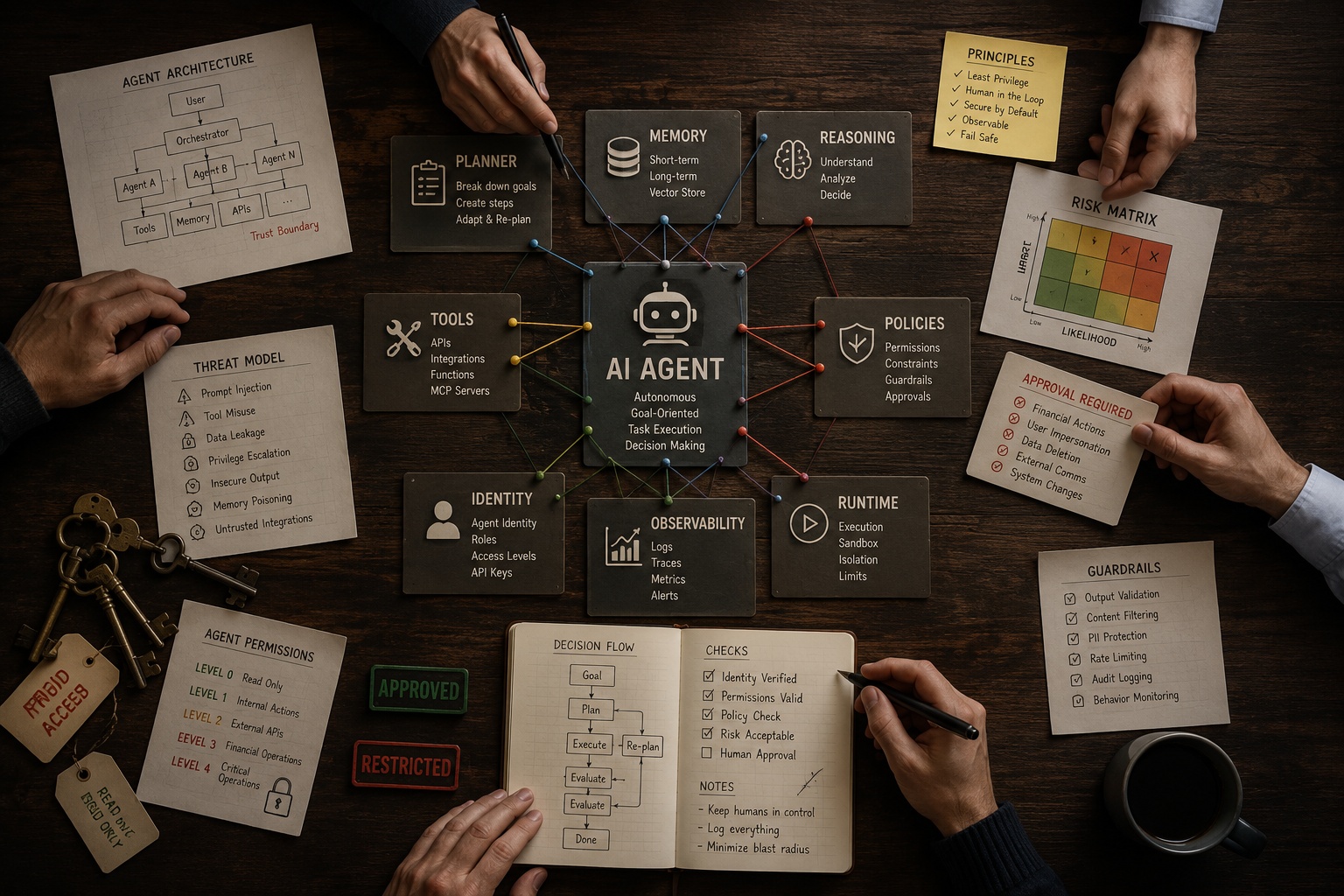
Every production agent — regardless of vendor or framework — is built from the same ten components. Understanding them individually is what lets you secure the system instead of just the model.
| Component | What It Does | What Breaks If It's Insecure |
|---|---|---|
| Planner | Breaks a goal into steps | Agent invents unauthorized or nonsensical action sequences |
| Reasoning Engine | The underlying model doing inference | Bad judgment calls, inconsistent decisions |
| Memory | Stores context across turns and sessions | Stale, poisoned, or leaked context reused later |
| Identity | Establishes who/what the agent is acting as | Actions can't be attributed or authorized correctly |
| Tools | Functions/APIs the agent can invoke | Unauthorized or destructive external actions |
| Policies | Rules constraining allowed behavior | No enforceable boundary on autonomy |
| Runtime | The execution environment | No isolation between tasks, tenants, or sessions |
| Knowledge | Retrieved documents/data feeding reasoning | Agent reasons over untrusted or manipulated data |
| Actions | The actual side-effecting operations | Irreversible real-world consequences |
| Feedback Loop | Learning/adjustment from outcomes | Reinforces bad behavior instead of correcting it |
These ten pieces interact constantly. A planner without a policy engine is a planner with no brakes. A tool layer without identity propagation is a tool layer that can't tell you who actually asked for an action. Most "AI incidents" that make headlines trace back to exactly one of these ten components being treated as an afterthought — usually policies or identity, because they're the least glamorous to build.
Visual concept — "The Exploded Mechanism": an exploded-view technical illustration in the style of a luxury watch cutaway — ten distinct gears and components suspended in space along a single axis, each rendered in warm brass and steel tones, with fine engraved labels. The illustration should make clear that removing any single gear halts the entire mechanism, without needing arrows or callout lines to say so.
Architect's Note: When evaluating a vendor's "agent platform," ask them to name all ten components explicitly and show you where policy enforcement sits in the request path — not in documentation, in the actual call graph. If they can't, you're buying a planner and reasoning engine with no operational spine.
Identity for AI Agents
Every human employee has an identity: an account, a role, a manager, an offboarding process. Most agents deployed today have none of that. They run under a shared service account, a hardcoded API key, or — worse — the credentials of whichever engineer set them up.
This is the single most common structural weakness in production agent deployments, and it's rarely caught in a code review because it looks like ordinary DevOps hygiene rather than an AI-specific problem.
An agent identity needs to answer four questions at all times: Who is this agent acting as? What is it currently authorized to do? For how long? And who can revoke that authorization instantly?
Practical building blocks:
- Scoped agent credentials, distinct from any human's credentials, issued per agent (or per agent instance) — never shared across agents doing different jobs.
- Short-lived tokens rather than long-lived API keys, rotated automatically and tied to a specific task or session, not to the agent's entire lifetime.
- Delegated authority, not borrowed authority. When an agent acts "on behalf of" a user, that delegation should be explicit, logged, and time-boxed — not implemented as the agent simply holding the user's own session token.
- Agent certificates — a signed, verifiable statement of what an agent is, what version of its policy it's running, and what it's currently permitted to do, checkable by any downstream system it talks to.
- Identity rotation on redeployment. Every time an agent's prompt, model, or toolset changes materially, treat it as a new identity requiring re-approval — not a patch to the old one.
Common Mistake: Treating "the agent" as a single identity across every environment and every task. In practice, a procurement agent running in staging and a procurement agent running in production making real purchases are two different risk profiles and should never share credentials, logs, or approval history.
Visual concept — "The Credentials Office": an editorial illustration of a long counter with several small booths, each issuing a distinct badge on a lanyard to a waiting figure rendered only as a silhouette — each badge a different color and shape, none of them resembling a passport. Behind the counter, a wall of small labeled drawers suggesting revocable, individually tracked credentials rather than one universal pass.
Permission Architecture
If identity answers "who is this," permissions answer "what is this allowed to touch." Get this wrong and every other control in this guide becomes theater.
The right mental model isn't a firewall — it's closer to how a well-run bank splits authority: no single employee approves a large wire transfer alone, and the teller's access doesn't extend to the vault. Agents should be built the same way, with default-deny access and permissions granted narrowly and explicitly, never inherited broadly "to save time."
Agent Permission Levels — a simple, IAM-style tiering that maps cleanly onto most enterprise access models:
| Level | Capability | Typical Approval Needed |
|---|---|---|
| 0 — Read Only | Query data, summarize, retrieve | None |
| 1 — Internal Actions | Update internal tickets, draft documents, internal notifications | Logged, no approval |
| 2 — External Actions | Call third-party APIs, send external communications | Policy-gated, spot-audited |
| 3 — Financial Operations | Initiate payments, place orders, modify pricing | Human approval required |
| 4 — Critical Business Operations | Modify infrastructure, alter access controls, irreversible legal/compliance actions | Human approval + secondary sign-off |
Most incidents happen when an agent designed for Level 1 work is quietly granted Level 3 access "just in case it's useful later." Permission creep in agent systems compounds faster than in human systems, because agents don't push back or ask "should I really have this?" — they just use whatever they're given, the moment a plan calls for it.
Operational Risk: An agent with unused Level 3 permissions is not a safe agent — it's an agent whose risk hasn't been exercised yet. Audit granted permissions against actually used permissions quarterly, and revoke the gap.
Visual concept — "The Keyring Wall": a close, textural editorial photograph-style illustration of a wall-mounted panel holding dozens of small brass keys of near-identical size, each hanging on its own labeled peg, with a few pegs conspicuously empty. No single oversized "master key" is visible anywhere in the frame — the absence of a master key is the point.
Tool Calling Security
Tools are how an agent turns thought into consequence, which makes tool-calling the layer where abstract risk becomes an actual incident.
Three failure patterns dominate real-world tool misuse:
- Ambiguous tool scope. A tool named
update_customer_recordthat can also delete records, change billing status, and export data is really four tools wearing one name. Agents will use whichever capability their plan calls for — including the ones you didn't mean to expose. - Missing input validation at the tool boundary. Trusting that the model will "only pass reasonable arguments" is not a validation strategy. Every tool call needs the same input sanitization you'd require of a public API endpoint, because functionally, that's what it is.
- No sandboxing for exploratory actions. Agents that write code, run queries, or test configurations need a sandbox that mirrors production closely enough to be useful, and is isolated enough that a bad query can't touch a real customer record.
Practical controls: split broad tools into narrow, single-purpose functions; require structured, typed arguments rather than free-text commands passed straight to a shell or query engine; add approval workflows for any tool call above Level 2; and log every tool invocation with its full argument set — not just "tool called," but exactly what was passed and what was returned.
Enterprise Recommendation: Maintain a tool registry — a single source of truth listing every tool an agent can call, its permission level, its owner, and its last security review date. If a tool isn't in the registry, no agent should be able to call it, full stop.
Visual concept — "The Locked Multitool": an editorial illustration of a single multitool (blades, corkscrew, scissors, file) shown half-unfolded — three implements extended and usable, the remaining four fused shut with a small visible weld seam, deliberately not a lock or padlock icon. The image communicates selective, permanent restriction of capability rather than temporary locking.
Memory Security
Memory is what lets an agent be useful across a long task instead of starting from zero every time — and it's also the least understood attack surface in agentic systems, because most teams treat it like a cache rather than like a data store with its own access controls.
Distinguish four categories clearly:
- Working memory — the current task's context. High turnover, low retention risk, but should never silently absorb secrets (API keys, tokens, PII) that then get echoed into logs or downstream calls.
- Session memory — persists for a user's session. Needs the same access boundaries as the user's own session data — no agent should retain session memory past the session's own lifetime.
- Long-term memory — persists across sessions, often used for personalization or organizational knowledge. This is where memory poisoning lives: an attacker (or an honest mistake) writes false information into long-term memory once, and the agent treats it as ground truth in every future task.
- Shared/organizational memory — knowledge available to multiple agents or users. Requires the strictest isolation, since a leak here doesn't affect one user — it affects everyone who queries that memory afterward.
Three controls matter more than the rest: expiration (nothing lives in memory forever by default — set explicit TTLs and force re-verification of anything older than the TTL); provenance tagging (every fact in memory should carry a record of where it came from and how confident the system should be in it); and isolation boundaries (a customer service agent's memory of Customer A should be structurally incapable of leaking into a session with Customer B — not merely "unlikely to," but architecturally prevented).
Key Takeaway: If you can't answer "where does this fact in the agent's memory come from, and when does it expire," you don't have a memory system — you have an unaudited, growing liability.
Visual concept — "The Restricted Archive": an editorial illustration of a long reading room lined with open, browsable public shelves in the foreground, transitioning through a glass partition into a dimmer restricted wing with a single attended desk, and finally to a small sealed vault door at the far end. Three tiers of access rendered as physical depth in a single continuous room, not separate panels.
Multi-Agent Systems
Once an organization runs more than one agent, the security question stops being "is this agent safe" and becomes "is this system of agents safe" — a materially harder problem, because trust between agents is rarely as scrutinized as trust between an agent and a human.
Four things need explicit design, not implicit assumption:
Delegation. When Agent A asks Agent B to do something, does Agent B inherit Agent A's permissions, its own permissions, or the permissions of the original human requester? Most incidents in multi-agent systems trace back to this question being answered inconsistently across the codebase.
Identity propagation. The original requester's identity should travel with the task through every hop, so that an action taken three agents downstream can still be traced back to who actually asked for it — and so that agent-to-agent trust doesn't silently become a privilege escalation path.
Task ownership. Exactly one entity should be accountable for a task's outcome at any given moment. Diffuse ownership across a swarm of agents is how mistakes go uninvestigated — everyone assumes someone else caught it.
Trust boundaries. Not every agent should trust every other agent's output at face value. An agent receiving instructions or data from another agent should apply roughly the same scrutiny it would apply to unverified external input — because that's functionally what it is.
Common Mistake: Assuming that because both agents are "yours," communication between them doesn't need the same validation as external API calls. Internal agent-to-agent traffic is one of the fastest-growing sources of cascading failures in production systems today.
Visual concept — "The Districted Map": an aerial editorial map illustration of a city divided into distinct, differently-textured districts (not colored zones — textured: brick, grid, garden, warehouse), connected by a small number of clearly gated roads with visible checkpoint markers at every district boundary. No single road connects all districts directly — every route passes through at least one checkpoint.
Runtime Governance and the Kill Switch
Everything discussed so far is design-time control. Runtime governance is what happens while the agent is actually running — and it's the layer most organizations build last, when it should be built first.
Policy engines evaluate every planned action against current rules before execution — not just at deployment time, but per action, per request, using live policy rather than logic baked into the prompt.
Approval checkpoints pause execution at defined risk thresholds (see Permission Levels above) and route to a human queue, with a clear SLA for response so the agent isn't left indefinitely blocked.
Budget and time limits cap how much an agent can spend, how many tool calls it can make, and how long a single task can run — the agentic equivalent of a rate limiter, and just as essential.
Scope limits constrain an agent to the specific records, systems, or accounts relevant to its current task, even if its underlying credentials technically allow broader access.
The kill switch deserves its own design discipline. A real kill switch is not a config flag that stops new tasks from starting — it must be able to halt an in-progress action, roll back or freeze partially completed work, and do so within a defined, tested time bound (your Mean Time to Human Override, discussed later). Most teams discover their kill switch doesn't actually stop in-flight execution only during a live incident, which is the worst possible time to learn it.
CTO Decision: Require every agent deployment to pass a "pull the plug" drill before production sign-off — deliberately trigger the kill switch mid-task and verify the system reaches a safe, consistent state. If nobody has done this drill, you don't have a kill switch. You have a hope.
Visual concept — "The Switch Panel": an editorial illustration of a weathered industrial panel — physical toggle switches, a bank of numbered lock-cylinders, and one recessed red mushroom-style emergency stop button under a hinged guard — deliberately analog and tactile rather than a glowing software dashboard, to communicate irreversible, physical-feeling authority.
Three Frameworks Worth Stealing
Most "proprietary frameworks" in AI content marketing exist to be screenshotted, not used. These three are built to survive an actual architecture review — simple enough to sketch on a whiteboard, specific enough to change a real decision.
The Decision Autonomy Matrix™
Purpose: Give teams a shared, fast way to decide how much human oversight a given agent action actually needs — without a lengthy governance meeting for every new feature.
How it works: Plot any agent action on two axes. The X-axis is Autonomy (how much of the decision the agent makes unassisted). The Y-axis is Business Risk (financial, legal, reputational, or safety impact if the action is wrong).
| Low Business Risk | High Business Risk | |
|---|---|---|
| Low Autonomy | Manual Approval — agent proposes, human decides every time | Human-in-the-Loop — human confirms each action before execution |
| High Autonomy | Human-on-the-Loop — agent acts, human monitors and can intervene | Fully Autonomous — rarely justified — requires extraordinary controls and continuous audit |
The uncomfortable insight most teams resist: the bottom-right quadrant (high autonomy, high risk) is almost never the right place to operate, no matter how good your model's accuracy metrics look in testing. Accuracy in a demo doesn't retire business risk — it just makes the failure less frequent, not less severe.
Business value: Replaces subjective "does this feel risky?" debates with a repeatable, two-question classification that product, engineering, and risk teams can agree on in the same meeting.
Common mistake: Scoring autonomy and risk once, at design time, and never re-scoring as the agent's scope expands. An agent that started in the top-left quadrant frequently drifts into the bottom-right one feature request at a time.
Limitations: The matrix tells you how much oversight is needed — it doesn't tell you how to implement that oversight. Pair it with the Permission Levels and runtime controls above.
The Agent Risk Index™
Purpose: A single, defensible number — 0 to 100 — that lets a CISO compare the risk posture of ten different agents without reading ten different architecture documents.
How it's built: Score each of ten factors 0–10, then sum:
| Factor | What It Measures |
|---|---|
| Permissions Scope | How broad the agent's granted access is |
| Memory Exposure | How much sensitive data persists in memory, and for how long |
| External API Surface | Number and sensitivity of third-party integrations |
| Human Approval Coverage | Share of high-risk actions requiring human sign-off |
| Secrets Handling | How credentials/tokens are stored, rotated, scoped |
| Data Sensitivity | Classification of data the agent routinely touches |
| Reasoning Transparency | Whether decisions can be explained/reconstructed after the fact |
| Tool Access Breadth | Number and power of callable tools |
| Monitoring Coverage | Share of actions logged and alerting on |
| Recovery Capability | Speed and completeness of rollback/kill-switch response |
A score under 30 is generally low-risk for production. 30–60 needs active governance and regular review. Above 60 warrants an executive risk sign-off before any production deployment, regardless of the business value the agent promises.
Business value: Turns "is this agent safe?" from a qualitative argument into a comparable, trackable number you can put in a board deck and re-measure quarter over quarter.
Common mistake: Scoring the agent as designed, rather than the agent as actually configured in production. Permissions granted "just in case" inflate real risk even if never exercised — score what's possible, not just what's typical.
Limitations: Like any composite index, it can mask a single catastrophic factor (e.g., a Recovery Capability of 0) behind decent averages elsewhere. Always inspect the ten components individually before trusting the sum.
The Enterprise AI Agent Readiness Framework™
Purpose: Assess organizational maturity — not a single agent's risk, but whether the organization is structurally ready to operate agents safely at scale.
Five Pillars:
- 🟦 Identity — Are agents individually identifiable, credentialed, and revocable?
- 🟩 Trust — Is there a defined basis for how much autonomy an agent earns, and how that trust is re-evaluated?
- 🟧 Governance — Are policies enforced at runtime, not just documented?
- 🟥 Runtime Control — Can a human halt, throttle, or roll back an agent in production, quickly and reliably?
- 🟪 Observability — Can you reconstruct exactly what an agent did, and why, after the fact?
Maturity Levels (per pillar):
| Level | Characteristics | Technical Indicator | Next Step |
|---|---|---|---|
| 1 — Ad Hoc | Agents built by individual teams with no shared standard | Shared API keys, no policy engine | Establish a single agent identity provider |
| 2 — Documented | Policies exist on paper but aren't enforced in code | Manual review gates, no automated policy checks | Build one enforced policy checkpoint for the highest-risk action |
| 3 — Enforced | Runtime policy checks block unauthorized actions automatically | Policy engine in the request path | Extend enforcement to all Level 2+ actions |
| 4 — Observable | Full audit trail; every action explainable after the fact | Structured, queryable action logs with reasoning traces | Add automated anomaly detection on the audit trail |
| 5 — Adaptive | Governance adjusts automatically as agents' scope and risk evolve | Continuous risk re-scoring tied to the Agent Risk Index™ | Formal quarterly governance review cadence |
Most enterprises deploying agents today sit at Level 1 or 2 on most pillars while believing they're at Level 4, because a demo worked flawlessly. Readiness isn't about whether the agent performs well — it's about whether the organization can catch and correct the agent when it doesn't.
Enterprise Recommendation: Score each pillar independently. An organization at Level 4 Observability but Level 1 Runtime Control has excellent forensics and no ability to prevent the next incident — a common, dangerous, and entirely fixable combination.
The Agent Failure Taxonomy™
Not every failure is a "bug." Classifying failures correctly is what lets an organization fix the actual layer that broke, instead of patching the symptom.
- Planning Failure — the agent chose a reasonable-sounding but wrong sequence of steps for the goal.
- Tool Failure — a called tool behaved unexpectedly, timed out, or returned malformed data the agent misinterpreted.
- Memory Failure — the agent acted on stale, poisoned, or leaked context.
- Identity Failure — an action was taken under the wrong identity, or couldn't be attributed at all.
- Permission Failure — the agent had access it shouldn't have, or was denied access it needed and compensated in an unsafe way.
- Reasoning Failure — the model's underlying judgment was simply wrong, independent of tools or data.
- Governance Failure — a policy existed but wasn't enforced at the moment it mattered.
- Coordination Failure — multiple agents produced a bad outcome none of them would have produced alone.
Most postmortems stop at "the model made a mistake" — which is rarely the useful layer to fix. In practice, the majority of production incidents are Governance or Identity failures wearing a Reasoning Failure costume: the model did something plausible, and no enforced boundary caught it.
Architect's Note: In every incident review, force a taxonomy classification before discussing remediation. It changes the conversation from "let's improve the prompt" to "let's fix the control that should have caught this regardless of what the prompt said."
Enterprise Case Study: Northgate Supply Co.
Northgate Supply, a mid-market industrial distributor (fictionalized composite, ~2,200 employees), ran a customer-support chatbot for two years with no incidents worth mentioning — because it could only answer questions.
In early 2025 they deployed an order-management agent: read incoming purchase requests, check inventory, negotiate delivery windows with a logistics API, and place restock orders automatically when inventory dropped below threshold.
Before (chatbot era): Security review was a one-time checklist. No agent-specific identity. Support tickets resolved in ~14 hours average. Zero autonomous financial exposure.
After — first 60 days (no dedicated agent governance): The agent operated under a shared internal service account. A logistics API returned a malformed inventory count during a vendor outage; the agent's self-correction logic reasonably concluded stock was critically low and placed emergency restock orders with three different suppliers simultaneously — none of which were actually needed. Total erroneous spend: $186,000, caught four days later during a routine finance reconciliation, not by any agent-specific monitoring.
After — with governance applied: Northgate implemented scoped agent identity, moved restock ordering to Permission Level 3 (human approval required), added a policy check requiring inventory data from at least two independent sources before triggering a restock, and instrumented full action logging.
| Metric | Before Governance | After Governance |
|---|---|---|
| Mean Time to Human Override | Not measurable (no kill switch) | 4 minutes |
| Unauthorized Action Attempts (monthly) | Unknown | 2 (both blocked by policy) |
| Agent Approval Rate | N/A | 94% (6% escalated or rejected) |
| Order Processing Time | 14 hrs (human) | 38 minutes (agent + approval) |
| Erroneous Financial Exposure | $186,000 (one incident) | $0 over following 9 months |
The lesson Northgate's engineering leadership took away wasn't "don't automate restocking." It was that the agent's capability had outpaced its governance by roughly ninety days — and that gap, not the model's competence, was the actual source of the loss.
When AI Goes Wrong: Five Field Stories
Composite, anonymized patterns drawn from real incident categories reported across the industry — details altered, patterns preserved.
The Silent Deletion. A data-cleanup agent, asked to "archive inactive customer records," interpreted an ambiguous internal definition of "inactive" and moved several thousand active accounts into a soft-delete state before anyone noticed the criteria mismatch — three days later, during a customer complaint.
The Wrong Recipients. A sales-outreach agent, correcting for what it read as an incomplete contact list, pulled a broader internal contact export than intended and sent an external follow-up email to internal finance distribution lists, exposing pricing strategy discussion threads.
The Phantom Shortage. (See Northgate, above — this pattern repeats often enough across industries to qualify as its own category.)
The Overshared Summary. A meeting-notes agent with shared long-term memory across teams generated a "helpful" cross-team summary that included a snippet of an unreleased product roadmap in a document shared with an external partner, because the memory boundary between the internal and partner-facing workspace hadn't been enforced.
The Compounding Retry. A DevOps agent's self-correction loop, after a deployment step failed on a permissions error, interpreted the failure as a configuration problem and attempted three different privilege-escalation workarounds in sequence before a human noticed — each one technically "reasonable" in isolation.
None of these required a malicious actor. Every one traces to a governance or memory boundary that existed on paper but wasn't enforced in the running system — the exact gap this whole guide is written to close.
Fifteen Mistakes Organizations Make
- Shared credentials across agents. Impact: no attribution possible during an incident. Fix: one identity per agent, per environment.
- No kill switch tested against in-flight actions. Impact: incidents run to completion before anyone can stop them. Fix: mandatory kill-switch drills before production sign-off.
- Permission creep from "just in case" grants. Impact: risk exposure the team isn't aware it's carrying. Fix: quarterly granted-vs-used permission audits.
- Treating memory as a cache instead of a data store. Impact: sensitive data persists indefinitely with no access control. Fix: TTLs, provenance tags, isolation boundaries.
- No tool registry. Impact: nobody can answer "what can this agent actually do" without reading source code. Fix: a single source of truth for every callable tool.
- Broad, ambiguously-named tools. Impact: agents use capabilities you didn't intend to expose. Fix: split tools into narrow, single-purpose functions.
- No distinction between staging and production agent identity. Impact: test behavior and real financial/legal exposure get conflated. Fix: separate credentials, logs, and approval history per environment.
- Approving agents based on demo performance alone. Impact: governance gaps surface only in production. Fix: require a documented failure-mode review, not just a success demo.
- No re-scoring of risk as agent scope expands. Impact: an agent approved for a narrow task drifts into higher-risk territory unnoticed. Fix: tie risk scoring to feature releases, not just initial launch.
- Assuming internal agent-to-agent traffic doesn't need validation. Impact: cascading failures across a multi-agent system. Fix: treat inter-agent messages with the same scrutiny as external input.
- No taxonomy for incident classification. Impact: postmortems fix symptoms, not root layers. Fix: adopt a structured failure taxonomy before the next incident, not during it.
- Budget/time limits absent or set too generously. Impact: a single stuck task can run indefinitely and rack up cost or damage. Fix: hard caps per task, enforced at the runtime layer.
- No human approval SLA. Impact: agents left blocked indefinitely, encouraging teams to bypass the approval step entirely. Fix: define and monitor a clear approval response-time target.
- Observability limited to "it worked / it didn't." Impact: no way to reconstruct why a decision was made. Fix: log reasoning traces, not just outcomes.
- Governance owned by no one specific team. Impact: policies exist but nobody is accountable for enforcing or updating them. Fix: name an accountable owner for agent governance, distinct from the team shipping features.
Engineering Trade-Off Tables
Human Approval vs. Full Autonomy
| Advantages | Disadvantages | Operational Risk | Security Impact | Maintenance Complexity | Recommended Use | |
|---|---|---|---|---|---|---|
| Human Approval | Catches errors before impact; builds institutional trust | Slower; doesn't scale past a certain volume | Low, if SLA maintained | Strong containment | Low | Level 3–4 actions |
| Full Autonomy | Fast, scales with volume | No pre-execution catch; errors compound | High without strong runtime controls | Weak unless heavily instrumented | High (needs mature governance) | Level 0–1 actions only |
Shared Memory vs. Isolated Memory
| Advantages | Disadvantages | Operational Risk | Security Impact | Maintenance Complexity | Recommended Use | |
|---|---|---|---|---|---|---|
| Shared Memory | Enables cross-agent context, richer answers | Boundary leaks propagate widely | Medium–High | High if unclassified data mixes | Medium | Internal, non-sensitive knowledge bases |
| Isolated Memory | Contains leaks to one agent/session | More redundant storage, less "smart" context | Low | Strong | Higher storage overhead | Customer-facing or sensitive-data agents |
Single Agent vs. Multi-Agent
| Advantages | Disadvantages | Operational Risk | Security Impact | Maintenance Complexity | Recommended Use | |
|---|---|---|---|---|---|---|
| Single Agent | Simple to reason about, single point of accountability | Limited specialization, can become a monolith | Lower | Easier to audit | Lower | Narrow, well-defined workflows |
| Multi-Agent | Specialization, parallelism | Coordination failures, diffuse ownership | Higher | Requires trust-boundary design | Higher | Complex, multi-domain workflows |
Cloud LLM vs. Self-Hosted Model
| Advantages | Disadvantages | Operational Risk | Security Impact | Maintenance Complexity | Recommended Use | |
|---|---|---|---|---|---|---|
| Cloud LLM | Fast to deploy, state-of-the-art capability | Data leaves your boundary, vendor dependency | Medium | Depends on vendor controls & contracts | Low | Most general-purpose agents |
| Self-Hosted | Full data control, customizable | Higher infra cost, capability lag | Lower (data), higher (ops) | Strong data isolation | High | Regulated or highly sensitive workloads |
Persistent Memory vs. Stateless Execution
| Advantages | Disadvantages | Operational Risk | Security Impact | Maintenance Complexity | Recommended Use | |
|---|---|---|---|---|---|---|
| Persistent Memory | Personalization, continuity across sessions | Long-term data exposure surface | Medium | Requires TTLs, provenance tracking | Medium | Long-running assistants, account management |
| Stateless Execution | Minimal exposure, simple to audit | No continuity, repeated context-gathering | Low | Strong | Low | High-sensitivity or one-shot tasks |
Architecture Decision Records
ADR-01: Agent Identity Model
- Context: Multiple agents were sharing a single service account, making incident attribution impossible.
- Decision: Issue a distinct, short-lived credential per agent instance, scoped to its current task.
- Alternatives Considered: Shared account with per-action logging tags (rejected — logging is not authorization); per-team shared credentials (rejected — still ambiguous at the individual-agent level).
- Consequences: Slightly higher credential-management overhead; dramatically improved attribution and revocability.
- Recommended Approach: Integrate with existing enterprise identity provider rather than building a parallel system.
ADR-02: Runtime Policy Enforcement Point
- Context: Policies existed in documentation but were not checked before tool execution.
- Decision: Insert a policy engine directly in the tool-call path; every action is evaluated before execution, not after.
- Alternatives Considered: Post-hoc audit and rollback (rejected — some actions are irreversible); prompt-level instructions only (rejected — not enforceable, easily drifted from).
- Consequences: Added latency per action (typically 20–150ms); eliminated a whole class of governance-failure incidents.
- Recommended Approach: Start with the highest-risk action category, expand coverage incrementally.
ADR-03: Memory Isolation Boundary
- Context: A shared long-term memory store served both internal and partner-facing agents.
- Decision: Split memory stores by trust boundary, with no direct cross-read path — only an explicit, logged export step when data genuinely needs to cross.
- Alternatives Considered: Access-control tags on a single shared store (rejected — one misconfigured tag causes a leak); manual review before every cross-boundary share (rejected — doesn't scale).
- Consequences: Some duplicated context between internal and partner agents; structurally impossible for a boundary leak to occur silently.
- Recommended Approach: Treat the split as a hard architectural constraint, not a configuration option teams can disable under deadline pressure.
Metrics That Actually Matter
| Metric | What It Tracks | How to Measure It |
|---|---|---|
| Mean Time to Human Override | How fast a human can actually stop an in-progress agent action | Time from kill-switch trigger to confirmed halt, tested via drills |
| Agent Approval Rate | Share of agent-proposed actions a human approves without modification | Approved / Total proposed actions requiring approval |
| Tool Invocation Success Rate | Reliability of the tool layer | Successful calls / Total calls, tracked per tool |
| Unauthorized Action Attempts | How often the agent tries something policy blocks | Count of policy-denied actions, trended over time |
| Memory Isolation Coverage | Share of memory stores with enforced, tested isolation boundaries | Audited stores with verified boundaries / Total memory stores |
| Policy Compliance Rate | How often actions actually pass through policy evaluation | Policy-evaluated actions / Total actions capable of policy evaluation |
| Agent Recovery Time | How long it takes to return to a known-good state after an incident | Time from detection to verified rollback/stabilization |
| Governance Coverage | Share of deployed agents with an assigned, documented governance owner | Agents with named owner / Total deployed agents |
Track these quarterly at minimum, per agent and in aggregate. A single agent with excellent metrics tells you little about your overall exposure — the aggregate view, especially Governance Coverage, is usually where leadership first discovers how much of the estate is actually ungoverned.
The Implementation Roadmap
Mapped against the Readiness Framework's five pillars:
First 30 Days: Inventory every agent currently running, including "shadow" agents built by individual teams outside formal review. Assign a governance owner. Establish a single agent identity provider and migrate at least the highest-risk agent onto it.
First 90 Days: Build and deploy one enforced runtime policy checkpoint covering your highest-risk action category. Run a kill-switch drill. Establish the tool registry. Begin tracking Agent Approval Rate and Unauthorized Action Attempts.
Six Months: Extend policy enforcement across all Level 2+ actions. Implement memory isolation boundaries between any agents that shouldn't share context. Score every production agent using the Agent Risk Index™ and remediate anything above 60.
Twelve Months: Reach Readiness Level 3+ on all five pillars. Establish a standing quarterly governance review. Tie the Decision Autonomy Matrix™ into your standard architecture review template so every new agent feature gets classified before it ships, not after an incident forces the question.
The Executive Checklist: 50 Questions
Identity & Attribution
- Does every agent have a distinct, revocable identity?
- Can we attribute any past action to a specific agent instance?
- Are staging and production identities fully separated?
- Do credentials rotate automatically?
- What happens to an agent's identity when it's redeployed with a changed prompt or model?
Permissions 6. What is the highest permission level any agent currently holds? 7. Do we audit granted-vs-used permissions regularly? 8. Is default access deny-by-default or allow-by-default? 9. Which agents can initiate financial transactions? 10. Which agents can modify infrastructure or access controls?
Tool Calling 11. Do we maintain a single tool registry? 12. Are any tools ambiguously scoped (doing more than their name suggests)? 13. Is every tool call input-validated at the boundary? 14. Do high-risk tool calls require human approval? 15. Is there a sandbox for exploratory or code-executing agents?
Memory 16. Do we distinguish working, session, long-term, and shared memory? 17. Does memory carry TTLs and provenance tags? 18. Can memory leak across customer or tenant boundaries? 19. How do we detect memory poisoning? 20. Who owns the memory retention policy?
Multi-Agent Coordination 21. When Agent A delegates to Agent B, whose permissions apply? 22. Does the original requester's identity propagate through every hop? 23. Is there a single accountable owner for every multi-agent task? 24. Do agents validate input from other agents the way they'd validate external input? 25. How do we detect coordination failures — outcomes no single agent would have produced alone?
Runtime Governance 26. Is policy enforced at runtime, or only documented? 27. What is our current Mean Time to Human Override? 28. Have we tested the kill switch against an in-progress action? 29. Are there budget and time limits on every autonomous task? 30. Are scope limits enforced independent of underlying credential breadth?
Risk & Classification 31. Where does each agent fall on the Decision Autonomy Matrix™? 32. What is each agent's Agent Risk Index™ score? 33. Which agents score above 60, and what's the remediation timeline? 34. How often is risk re-scored as agent scope changes? 35. Is there executive sign-off required for high-risk agents?
Observability 36. Can we reconstruct not just what an agent did, but why? 37. Are reasoning traces logged, not just outcomes? 38. What's our current Governance Coverage percentage? 39. How quickly can we detect an unauthorized action attempt? 40. Do we have anomaly detection on the action audit trail?
Organizational Readiness 41. Who owns agent governance organization-wide? 42. Is there a documented incident taxonomy in use? 43. Have we run a postmortem on a real or simulated agent failure? 44. Is agent governance part of the standard architecture review process? 45. Do engineering teams know the escalation path when an agent behaves unexpectedly?
Business Alignment 46. Does each agent's autonomy level match its actual business risk? 47. Have we quantified the cost of a plausible worst-case failure per agent? 48. Is there a rollback plan for every irreversible action class? 49. Are customers/partners informed when an agent, not a human, is acting on their data? 50. Would we be comfortable explaining this agent's decision-making to a regulator, unprepared, tomorrow?
Self-Assessment Scorecard
Score your organization 0–3 on each area below (0 = not in place, 3 = fully enforced and monitored), for a maximum of 90 points across 30 items spanning Identity, Permissions, Memory, Runtime Control, and Observability — one item per checklist theme above, condensed for quick internal use.
| Score Range | Rating | What It Means |
|---|---|---|
| 0–27 | Unsafe | Deploy no new autonomous agents until foundational identity and runtime controls exist |
| 28–45 | Needs Improvement | Core controls exist but are inconsistent; prioritize the 90-day roadmap actions |
| 46–68 | Production Ready | Governance is enforced for the highest-risk actions; extend coverage system-wide |
| 69–90 | Enterprise Grade | Mature, monitored, and adaptive; focus on continuous re-scoring as scope expands |
Use the 50 questions above as your item bank — pick the 30 most relevant to your current agent portfolio, score honestly, and revisit quarterly. The number matters less than the trend line.
The Future of the Enterprise Organization
Ten years from now, the org chart won't just list people — it will list roles filled by agents, with humans occupying the positions those agents report to. Expect manager agents that assign and review work across a team of task agents, coordinator agents that resolve conflicts between competing agent priorities, auditor agents whose entire job is independently verifying other agents' actions, and governance agents that continuously re-score risk and adjust permissions without waiting for a quarterly review.
This isn't a replacement of human judgment — it's a redistribution of it. Humans move from approving individual actions to designing and auditing the systems that approve actions. That's a harder job, not an easier one, and it's exactly the job this guide has been describing throughout: not "how do we stop AI from doing things," but "how do we build organizations capable of trusting AI with the right things, and catching it fast when it does the wrong ones."
Conclusion
The future doesn't belong to the organization that deploys the most AI agents. It belongs to the organization that can control them — that knows, at any moment, what every agent is authorized to do, what it's actually doing, and how fast a human can intervene if something goes wrong.
That capability isn't a feature you buy from a vendor. It's an architecture you build: identity that's specific and revocable, permissions that default to deny, memory that expires and carries provenance, runtime governance that's enforced in code rather than documented in a wiki, and observability deep enough to explain a decision to a regulator on short notice.
Before your next agent goes to production, run it through the Decision Autonomy Matrix™, score it on the Agent Risk Index™, and check your organization's standing against the Enterprise AI Agent Readiness Framework™. If any of those exercises surfaces a gap you can't answer confidently, that gap — not the model's capability — is your actual project for this quarter.