Friday Evening
The sprint is complete.
Velocity is the highest it has ever been. Forty-two story points, up from thirty-one the sprint before. The burndown chart is a clean diagonal line, exactly the shape a textbook would draw. Every ticket in the board has migrated to the rightmost column. Someone drops a champagne emoji in the team channel. Someone else posts a screenshot of the sprint report to the company-wide Slack, captioned "personal best."
The CEO, who has learned to read a burndown chart the way a new boat owner learns to read a barometer, feels something rare: relief. The board meeting is in ten days, and for the first time in two quarters, the roadmap slide will not need a footnote explaining a slip.
Engineering leadership takes the team out for drinks. It is, by every internal measure the company tracks, a good week.
Monday Morning
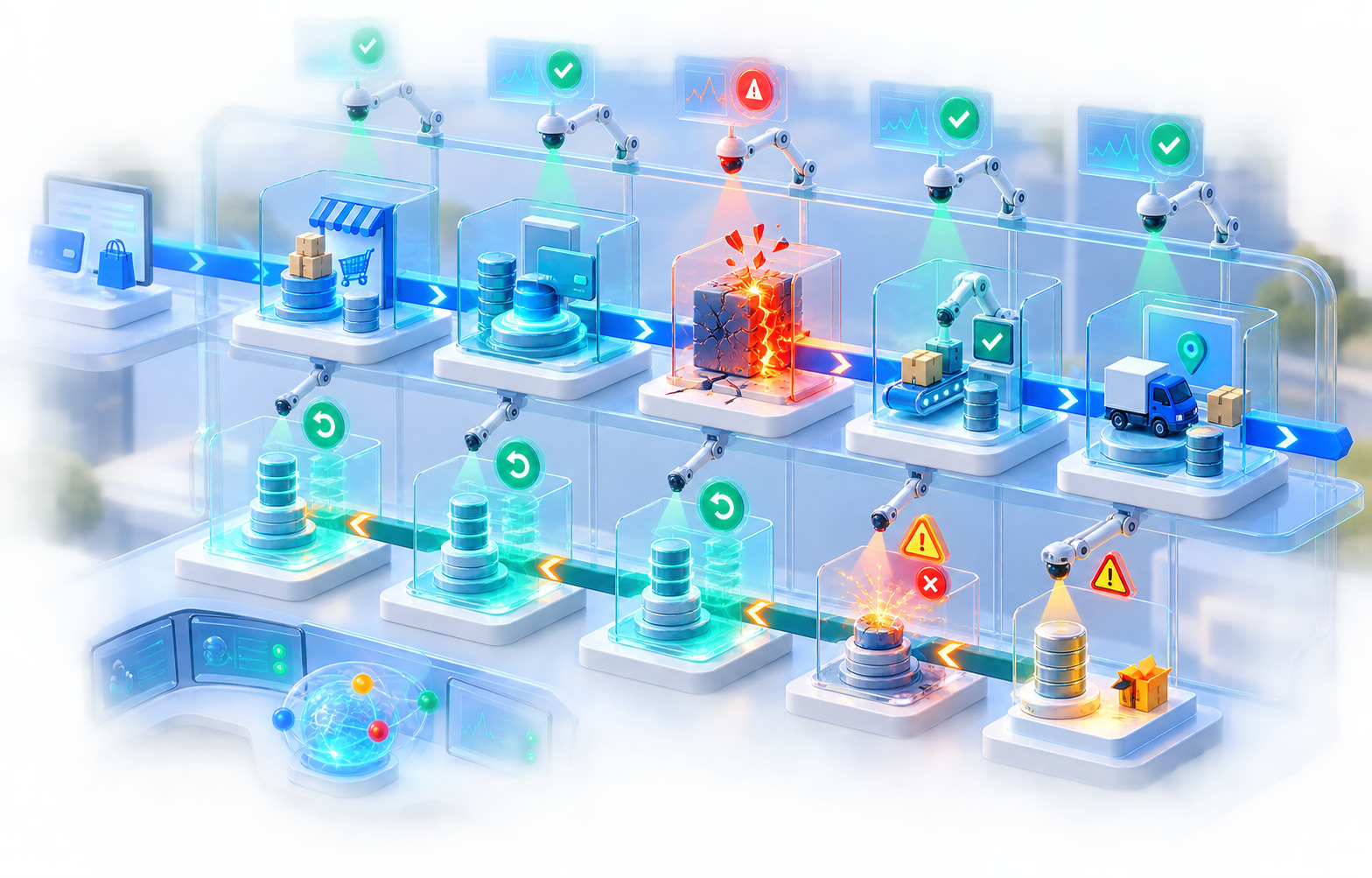
The first support ticket comes in at 6:47 a.m., filed by a customer on the East Coast who has already been awake for two hours trying to process payroll. By 7:15 there are eleven more. By 8:00 the on-call engineer has escalated to a full incident, and by 8:20 a rollback is underway — not of one service, but of a chain of three, because the fast sprint had shipped a dependency graph nobody had fully mapped.
The emergency Slack channel fills the way these channels always fill: fast, then chaotic, then quiet as everyone waits for someone else to have the answer.
The CEO asks the only question that matters in that moment.
"What happened?"
Nobody answers right away. Not because no one is smart enough, and not because no one worked hard enough. Everyone worked hard. Everyone hit their numbers. The sprint report from four days earlier is still open in a browser tab, its green checkmarks now faintly obscene.
What nobody can produce, in that room, is confidence. Not confidence that the fix will work. Not confidence that another dependency isn't about to break somewhere else. Not confidence in the number they will eventually give the board about how long the incident cost them.
The problem on that Monday was never speed. The team had plenty of speed. The problem was that speed had been the only thing anyone was measuring, and so it was the only thing anyone had optimized for.
This article is about the metric that was missing from that sprint report, why almost every growth-stage software company is missing the same one, and what changes — financially, operationally, and psychologically — when a company starts measuring it deliberately.
Part One: The Metric That Misleads Almost Everyone
Every engineering organization above a certain size eventually builds a dashboard. It has story points. It has sprint velocity. It has deployment frequency. It has lead time for changes. It has a developer productivity score of some kind, however it's dressed up. These numbers get reported upward — to the VP, to the CEO, to the board — as evidence that engineering is functioning well.
They are, almost without exception, measures of activity. They describe how much motion occurred. None of them describe whether that motion moved the business toward a state that customers, investors, or the engineering team itself could rely on.
This is not a controversial claim inside engineering organizations that have been burned by it. It is, however, a deeply uncomfortable one for leadership teams, because activity metrics are so much easier to produce than confidence metrics. A story point total appears automatically at the end of a sprint. Confidence has to be actively assessed, and assessment requires someone to ask a harder question: if we shipped this today, would we bet the company's reputation on it holding up?
Organizations gravitate toward what is easy to measure, not what is important to know. This is not a moral failing. It is an incentive structure. A velocity number can be put on a slide with no further explanation and nobody in the room will ask what it means, because everyone has silently agreed that a bigger number is a better number. Try putting "Release Confidence: Medium" on the same slide, and the room will ask you five follow-up questions. Most leaders, understandably, would rather not invite the follow-up questions. So the metric that would actually protect the business quietly disappears from the deck, and the one that flatters the last quarter survives.
Velocity tells you how fast the team moved. Confidence tells you whether you should trust where they moved to.
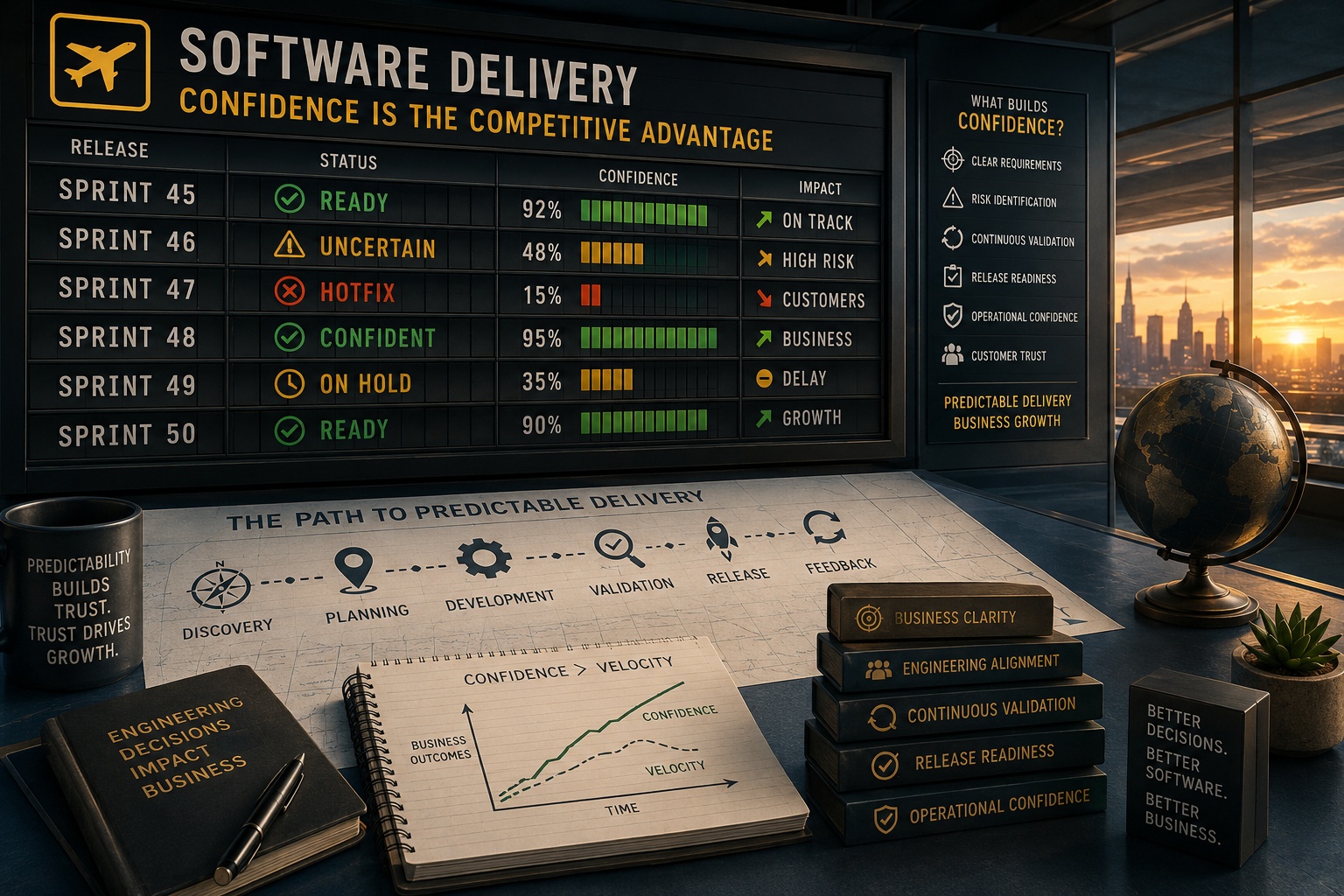
Picture an airport departure board — the kind with amber split-flap characters that click over one at a time. Now imagine it is not showing flights but releases. Each row is a piece of software leaving the building and heading toward a customer. Most departure boards, if engineering ran them the way it runs sprint reports, would only ever show one status: DEPARTED. It would tell you the plane left the gate. It would tell you nothing about turbulence, nothing about whether it will land, nothing about whether the plane behind it is delayed because this one left in a hurry.
A board that actually served the business would carry different words: READY. ON HOLD. HOTFIX. ROLLED BACK. DELAYED. CONFIDENT. UNCERTAIN. That board would be a harder thing to look at on a Friday. It would also be the only board worth trusting on a Monday.
Part Two: Velocity Without Confidence Is Dangerous
Consider two engineering organizations, both real in shape even if the specifics here are composites.
Team A ships constantly. Deploys happen multiple times a day. The velocity chart trends upward every quarter, and the CEO uses it in investor updates as proof of execution speed. Underneath that chart, support ticket volume is also trending upward. Engineers increasingly spend their sprints fixing what the previous sprint broke, which of course still counts as "output" on the board, so the velocity number keeps climbing even as an increasing share of it is repair work rather than progress. Customers begin timing their upgrades to lag several versions behind, quietly protecting themselves from a company that ships faster than it can guarantee. Enterprise deals start including unusual clauses about advance notice of releases. Engineers, who know exactly how thin the margin under each deploy has become, start leaving — not because the work is hard, but because the anxiety of shipping without confidence is exhausting in a way that shipping quickly never was.
Team B ships less often. Their velocity chart, if you plotted it next to Team A's, would look unimpressive. But every release that leaves their door tends to stay where it lands. Enterprise customers schedule their own change windows around this team's release calendar, because the calendar has never once lied to them. The roadmap a sales rep shares in Q1 still roughly resembles what ships in Q3. Because so little energy is spent on unplanned firefighting, the engineering organization has bandwidth for the work that actually differentiates the product, and that work compounds. Investors, when they run diligence, find a team that can answer "what happens if this breaks" with a specific, rehearsed answer instead of a shrug.
Team A is faster. Team B is trusted. Only one of them compounds.
| Dimension | Optimizing for Velocity Alone | Optimizing for Confidence |
|---|---|---|
| Customer Trust | Erodes gradually, then suddenly | Builds steadily, becomes a moat |
| Support Costs | Rise as a hidden tax on every release | Stay proportional, predictable |
| Engineering Stress | Chronic, disguised as "moving fast" | Present but bounded and named |
| Revenue Predictability | Volatile, dependent on the last release | Forecastable, board-ready |
| Sales Cycle | Longer, as prospects sense instability | Shorter, references sell themselves |
None of this argues for slowness. Confidence and speed are not opposites; a team with genuine confidence in its own delivery process is often faster in the long run, because it spends none of its energy relitigating whether last week's work is safe to build on. The argument is narrower and sharper: speed without confidence is a withdrawal against a balance the company hasn't checked in months.
It's worth being precise about what "confidence" is not, because the word gets used loosely enough in engineering conversations that it risks meaning nothing. Confidence is not the absence of bugs — every system of meaningful complexity will have defects, and a company that treats zero defects as the goal will simply teach its engineers to hide the ones they find. Confidence is not a feeling, either; a team can feel confident and be wrong, and feeling is precisely the mechanism by which false confidence spreads unchecked through an organization. Confidence, in the sense this article means it, is a demonstrated, testable property: the ability to state in advance, with reasonable accuracy, what a release will and won't do, and to be right often enough that people downstream stop double-checking your work. That last clause is the actual test. The moment Sales stops quietly padding your delivery dates, the moment Support stops staffing up defensively before a release, the moment a customer stops waiting for three other customers to upgrade first — that is what confidence actually looks like from the outside. Everything else is a proxy for it.
This is also why confidence resists being reduced to a single dashboard number the way velocity can be. Velocity is arithmetic: sum the points, plot the trend. Confidence is closer to a credit rating — an aggregate judgment built from many smaller signals, some quantitative and some not, that only means something when it has been tested against reality repeatedly over time. A company can't declare itself confident any more than a bond issuer can declare itself investment-grade. It has to be earned across enough releases that the pattern becomes undeniable.
Part Three: Companies Don't Ship Code. They Ship Promises.
Every release note is a sentence with a hidden clause attached to it. "This upgrade adds multi-currency support" quietly also says and we are confident enough in it to put our name on it in your production environment. Customers don't experience your commit history. They experience the promise, and then they experience whether the promise was kept.
This reframes what a deployment actually is inside a company. It is not a technical event that happens to be visible to the business. It is a business commitment that happens to be executed through code. Sales made a promise about a launch date. Support implicitly promised customers that the last twelve releases were a reasonable predictor of how the thirteenth would go. Investors were promised a roadmap. Every one of those promises is backed, whether anyone said so explicitly or not, by engineering's confidence that the thing being shipped will behave as described.
Trust between departments runs on this same current. When Sales doesn't trust a release date, they quietly build slack into every customer conversation, and that slack shows up later as a longer sales cycle nobody can quite explain. When Support doesn't trust a release, they staff up defensively before every ship, and that staffing cost never appears on an engineering dashboard even though engineering caused it. When Engineering doesn't trust its own deployment pipeline, individual engineers begin adding private safety margins — testing things twice, deploying at odd hours to minimize blast radius, avoiding architectural improvements that might destabilize a fragile system. Every one of these behaviors is a rational response to an environment where confidence hasn't been established. Every one of them is also a hidden cost that never shows up as a line item, which is exactly why it survives so long unaddressed.
Think of engineering delivery as a bridge built from seven pillars: Requirements, Architecture, Development, Validation, Deployment, Monitoring, and Customer Feedback. A bridge doesn't need every pillar to be extraordinary. It needs every pillar to hold. Most engineering post-mortems, when you read past the technical root cause, describe exactly one pillar that quietly gave way while everyone was admiring how nice the others looked. Requirements were ambiguous, so Development built the wrong thing well. Architecture assumed a scale that Monitoring was never built to observe, so the failure was invisible until it was enormous. The bridge rarely collapses because every pillar failed. It collapses because the company had convinced itself that six strong pillars made up for one that nobody had checked in a year.
Part Four: The Confidence Gap
Confidence is not one thing. Treating it as a single dial — "are we confident or not" — is exactly the kind of flattening that got engineering organizations into the velocity trap in the first place. In practice, confidence is a stack, and each layer depends on the integrity of the layer beneath it.
Requirements Confidence — Do we actually know what we're building, and has anyone who understands the customer's business confirmed it?
Architecture Confidence — Will the system we're designing still make sense at the scale, integration complexity, and failure modes we'll actually encounter?
Developer Confidence — Do the engineers building this feel they understand it well enough to reason about its edge cases, or are they assembling it from familiar patterns and hoping?
Quality Confidence — Has this been validated against real usage patterns and failure conditions, not just the happy path a demo would follow?
Release Confidence — Do we know, specifically, what could go wrong on the way out the door, and do we have a plan if it does?
Operational Confidence — Once it's live, will we know within minutes if something is wrong, or will we find out from a customer?
Customer Confidence — Does the person using this trust it enough to build their own workflow on top of it without a backup plan?
Investor Confidence — Does the roadmap this quarter resemble the roadmap actually delivered, consistently enough that a forecast means something?
Picture these as a pyramid, widening as it rises: Requirements Confidence at the foundation, then Engineering Confidence, then Operational Confidence, then Release Confidence, and finally Customer Trust at the peak — the layer everyone outside the company can actually see. The uncomfortable truth of the pyramid is that Customer Trust is never actually built at the top. It is only ever revealed at the top. It was built, or eroded, in the requirements conversation that happened eight weeks earlier and that nobody in the room that day thought was very important.
Customers don't experience your architecture. They experience whether your architecture kept its promise.
The layers compound rather than average. A team can have excellent Developer Confidence — genuinely skilled engineers who understand their code deeply — sitting on top of poor Requirements Confidence, and the result is not a mediocre outcome. It's a well-built, well-tested version of the wrong thing, shipped with total conviction. This is arguably worse than a poorly-built version of the right thing, because the wrong-thing failure mode doesn't announce itself in code review or in a test suite. It announces itself months later, when a customer explains, patiently and a little exasperated, that this was never actually what they needed. Every layer beneath a gap in the pyramid inherits that gap silently, and no amount of rigor above it can fully compensate.
This is the deepest reason velocity is such a seductive trap. Velocity measures activity within a single layer — almost always Developer Confidence, occasionally spilling into Quality Confidence — while remaining structurally blind to every layer beneath it. A team can post record velocity while standing on a foundation of Requirements Confidence that nobody has checked in two quarters, and the dashboard will never once suggest a problem, because dashboards built around output can only ever measure the layer where the output is produced.
Part Five: The Economics of Confidence
Set testing aside entirely for a moment and look at this purely as a finance problem, because that is what it actually is.
Every unit of missing confidence converts into a specific, findable cost somewhere in the business. Delayed revenue, because a release that can't be trusted gets held back from the customers who were promised it. Rework, because features built on shaky requirements get rebuilt once the real requirement surfaces. Context switching, because engineers pulled off the roadmap to fight yesterday's fire don't context-switch back for free — there is a well-documented tax on every interruption. Lost sales opportunities, because a sales team that has been burned twice starts quietly under-promising, which shows up as a smaller number in a forecast nobody can trace back to its root cause. Reputational cost, which is the slowest-moving and most expensive of all, because it is repaid not in dollars but in the multiple an acquirer or investor is willing to apply to the business.
It helps to picture this as a reservoir. Revenue flows in. But the reservoir has cracks, and every crack has a name: Production Bugs. Rollbacks. Rework. Delayed Releases. Lost Trust. Poor Decisions Made Under Pressure. None of these cracks show up as a single catastrophic failure most quarters. They show up as a reservoir that never quite fills to the level the business plan assumed it would, and nobody can point to the exact leak, because the water is gone by the time anyone checks the level.
Confidence, understood this way, isn't a virtue. It's a financial asset with a balance sheet of its own — one that compounds when it's invested in deliberately, and depreciates quietly when it's ignored.
Part Six: The Cost of False Confidence
There is a worse failure mode than knowing you lack confidence: believing you have it when you don't. A dashboard that says green while the underlying reality is red is more dangerous than an honest red, because an honest red at least prompts someone to ask a question.
False confidence tends to come from the same handful of sources, repeated across almost every organization that experiences it. Untested assumptions inherited from an earlier version of the product that nobody re-validated. Unknown risks that were never modeled because nobody was assigned to look for them. Edge cases that were identified in a planning meeting and then quietly dropped when the schedule got tight, with a mental note to "revisit later" that both parties knew, even as they said it, would never happen. Leadership optimism, which is a genuine organizational asset in most contexts and a genuine liability in this one specific context, because optimism is very good at filling gaps in information with hope. And increasingly, AI-generated code — which can produce output that looks structurally complete and reads as confident, while carrying assumptions about the surrounding system that were never verified by anyone who understood that system. Fluency is not the same thing as correctness, and a plausible-looking answer is precisely the kind of artifact that slips past a team that has stopped asking hard questions.
None of these sources of false confidence are exotic. They are the ordinary residue of ordinary pressure. The organizations that avoid the worst of them are not the ones with the most talented engineers — talent is evenly distributed across most well-funded companies at this point. They are the ones that built a specific habit of asking, before every release, "what would have to be true for this confidence to be false?" That single question, asked consistently, catches more incidents than almost any tool a company can buy.
Part Six and a Half: Confidence in the Age of AI-Built Software
Everything above predates AI-assisted development, and everything above still applies to it — but AI introduces a specific new way for false confidence to enter a system, and it deserves its own attention rather than a footnote.
The pattern that used to require a careless engineer now requires no one to be careless at all. A model can generate a plausible-looking function, a plausible-looking integration, even a plausible-looking test suite, all of which read as complete and confident without any of it having been genuinely validated against the surrounding system's real behavior. This is a different failure mode than a human engineer cutting a corner under deadline pressure. It's a failure mode where the corner was never visible to begin with, because the output looked finished.
This is why LLM testing has become its own discipline rather than a subset of ordinary QA — validating a model-driven feature means testing not just whether the code runs, but whether the model's judgment holds up across the edge cases a customer will actually hit, which rarely resemble the benchmark the model was tuned against. It's also why AI monitoring in production looks different from traditional uptime monitoring: a model-driven feature can be technically "up" and still be silently wrong, drifting away from correct behavior in a way no server-health dashboard would ever flag. Teams that have been through this the hard way have learned to watch for AI security exposure and AI data leakage risk as first-class release-readiness concerns, not afterthoughts bolted on once a security review finally happens — because a model that has access to more context than a feature strictly requires is a liability whether or not it ever misbehaves. And as AI agents move from generating suggestions to taking autonomous action inside a system, the confidence question gets sharper, not softer: an agent that's wrong doesn't just produce a bad suggestion for a human to catch, it can execute the mistake directly.
None of this is an argument against using AI in the delivery process. It's an argument for treating AI-assisted and AI-driven work with at least the same rigor applied to human-written work, and in the highest-risk cases, more. The organizations that will look back on this period as having navigated it well are not the ones that adopted AI fastest. They're the ones that built confidence practices sturdy enough to hold up under a new and faster-moving source of assumptions.
Part Seven: Illustrative Case Studies
The following eight scenarios are illustrative composites built to demonstrate common patterns across industries. They are not accounts of specific real companies, and any numbers included are representative rather than factual.
1. Healthcare SaaS — Series B, ~120 employees
Problem: A patient-scheduling platform pushed aggressive quarterly release targets to satisfy a new enterprise health-system contract. Wrong decision: Compressed validation cycles to hit a launch date tied to a sales commission structure. Business consequence: A scheduling conflict bug caused missed appointments across three hospital systems in the same week, triggering a contractual review clause. Engineering consequence: Two senior engineers were pulled from roadmap work for six weeks of remediation and audit response. Corrective action: Introduced a formal Release Readiness gate requiring sign-off from Support and Compliance, not just Engineering. Result: Time-to-detect for scheduling conflicts dropped from days to under two hours in the following two quarters; the health-system contract was renewed with an expanded scope.
2. FinTech — Seed to Series A, ~35 employees
Problem: A payments startup optimized purely for deployment frequency to impress investors during a fundraise. Wrong decision: Removed a manual reconciliation check to reduce release friction ahead of a board meeting. Business consequence: A rounding-logic edge case went undetected for eleven days, requiring manual customer refunds and a disclosure to the payment processor. Engineering consequence: Engineering trust in the deployment pipeline collapsed internally; engineers began manually verifying releases outside the pipeline, slowing everything down anyway. Corrective action: Rebuilt the reconciliation check as an automated, non-optional gate rather than a manual step that could be skipped under pressure. Result: Reconciliation-related incidents fell to zero over the following year; the next fundraising round's due diligence process took roughly 40% less time than the previous round.
3. Cybersecurity — Series C, ~300 employees
Problem: A security vendor's own product had a delayed patch cycle relative to competitors, creating pressure to accelerate. Wrong decision: Shortened the internal validation window for a critical detection-engine update. Business consequence: A false-positive spike caused several enterprise customers to disable a core detection feature entirely, undermining the product's core value proposition. Engineering consequence: The detection team spent a full quarter rebuilding customer trust in alert accuracy rather than shipping new capability. Corrective action: Instituted staged rollout with confidence checkpoints at each customer tier, rather than simultaneous full release. Result: Alert-accuracy complaints dropped by roughly two-thirds; staged rollout became a differentiator cited in win/loss interviews with prospects.
4. Marketplace — Series B, ~90 employees
Problem: A two-sided marketplace prioritized checkout-flow velocity metrics as the primary engineering KPI. Wrong decision: New checkout experiments were shipped weekly without a clear rollback plan for supply-side impact. Business consequence: A pricing-display bug reduced seller payouts for four days before detection, damaging trust with the platform's most active sellers. Engineering consequence: Engineers began avoiding checkout-related work due to the reputational risk, concentrating expertise and creating a single point of failure. Corrective action: Added seller-facing monitoring as a first-class signal, not just buyer-facing conversion metrics. Result: Seller churn attributable to platform errors dropped materially; the team rotated checkout ownership across more engineers, reducing key-person risk.
5. AI SaaS — Series A, ~50 employees
Problem: A company building an AI-assisted drafting tool relied heavily on model output without sufficient validation of edge-case behavior. Wrong decision: Shipped a new model version based on aggregate benchmark improvement, without evaluating regression on high-value customer workflows. Business consequence: A top-tier customer's workflow silently degraded in quality for two weeks before being reported. Engineering consequence: No one on the team could explain, when asked, exactly which workflows had been validated before release. Corrective action: Built a customer-workflow regression suite tied to real usage patterns, reviewed before every model version change. Result: Customer-reported quality regressions dropped significantly; the regression suite became a selling point in enterprise sales conversations about AI reliability.
6. Manufacturing Software — Enterprise, ~800 employees
Problem: A factory-floor scheduling system prioritized feature velocity to keep pace with a competitor's marketing claims. Wrong decision: A scheduling-optimization change was deployed during a customer's peak production period without a defined rollback window. Business consequence: A production line stoppage at one customer site led to a formal escalation to the customer's executive team. <br>Engineering consequence: Deployment scheduling had to be renegotiated across every customer contract, adding significant coordination overhead. Corrective action: Introduced customer-specific deployment windows tied to their operational calendars, coordinated jointly with Customer Success. Result: Zero production-impacting incidents in the following twelve months; the coordinated deployment model was later cited by the customer in a renewal negotiation as a reason for continued trust.
7. EdTech — Series A, ~60 employees
Problem: An EdTech platform pushed rapid feature releases ahead of a back-to-school enrollment period. Wrong decision: Skipped load testing for a new grading module under the assumption that existing infrastructure would scale linearly. Business consequence: The grading module became unusable during the first week of the school year for several district customers, at the exact moment usage peaked. Engineering consequence: The team spent the first month of the school year in reactive firefighting instead of executing the planned roadmap. Corrective action: Established a seasonal load-testing cadence tied to the customer's academic calendar rather than the company's internal release calendar. Result: The following back-to-school period passed with no capacity-related incidents; district renewal rates for the affected cohort improved year over year.
8. Enterprise SaaS — Series D, ~1,200 employees
Problem: A large enterprise platform's engineering organization had grown through acquisition, with inconsistent release practices across business units. Wrong decision: Assumed that each acquired team's existing release process was "good enough" without establishing a shared confidence standard. Business consequence: One business unit's release caused a cross-product authentication failure, affecting customers who used products from multiple acquired units together. Engineering consequence: No single team had visibility into the full dependency graph across business units, extending incident resolution time significantly. Corrective action: Created a shared Release Readiness standard across all business units, with a common definition of operational confidence. Result: Cross-unit incidents dropped substantially over the following year; the unified standard became part of the due-diligence materials for the company's next acquisition.
Part Eight: Confidence Is Built Before Coding Begins
The most common mistake in how companies think about quality is believing it is something applied to code after the code exists. In every case study above, the actual point of failure predates the first line of code written for the feature that eventually broke. It happens in Discovery, when nobody asks a hard enough question about the customer's real workflow. It happens in Requirements, when ambiguity gets resolved by whoever is in the room rather than by the person who actually understands the business need. It happens in Architecture, when a design decision quietly assumes a scale or a failure mode nobody stated out loud. It happens in Risk Analysis that never occurred, in Acceptance Criteria left vague enough that "done" became a matter of interpretation, in a Definition of Ready that existed on paper but wasn't enforced, and in stakeholder alignment that was assumed rather than confirmed.
Picture a chain of dominoes. The first domino is always labeled Assumptions. Every other domino in the chain — architecture decisions, development choices, testing coverage, deployment plans — is positioned relative to where that first domino fell. Teams spend enormous energy inspecting the fifth, sixth, and seventh dominoes for defects, when the actual instability was set in motion by the first one, quietly, before anyone was watching closely.
This is why the strongest engineering organizations invest disproportionately in the earliest, least glamorous parts of the process. It is unglamorous to spend an extra week validating requirements with a customer. It produces no commits, no story points, nothing that shows up on a velocity chart. It is also, almost without exception, the single highest-leverage activity available to a team that wants to stop discovering its assumptions in production.
Part Nine: The Founder Questions Nobody Asks
Most founders ask their engineering leaders about output: what shipped, and when is the next thing shipping. Few ask the questions that actually predict whether the business will be stable in six months:
- Can Sales trust the release dates they're quoting to prospects right now, today, without a private mental discount applied?
- Can Support predict, with any accuracy, which upcoming releases are likely to generate a spike in tickets?
- Can Investors trust that the roadmap presented in this quarter's update will resemble what's actually delivered by the next one?
- Can Engineering give a specific, non-hand-wavy estimate for a piece of work, or does every estimate carry a silent 2x buffer that everyone has agreed not to mention?
- Can customers upgrade to the latest version without first waiting for three other customers to try it first?
- Can Marketing announce a launch date publicly without a private contingency plan for missing it?
Every "no" to one of these questions is a confidence gap with a specific, identifiable owner and a specific, fixable cause. Most companies never ask these questions directly, so the gaps persist for years, quietly taxing every department that depends on engineering's output.
Part Ten: The QAtronic Release Confidence Model™
A useful framework for translating this thinking into practice has five stages. It is deliberately not testing methodology — it is a way of assigning ownership for confidence at each phase of delivery.
Stage 1 — Business Clarity
Objective: Confirm the business problem is real, specific, and worth solving before engineering commits resources. Engineering activities: Technical feasibility assessment, dependency mapping. Quality activities: Risk identification against known failure patterns. Leadership responsibility: Confirm the business case with the actual stakeholder who owns the outcome, not a proxy. Success metric: Percentage of features that ship without a mid-development requirement change. Typical mistake: Treating a sales request or a competitor feature as sufficient justification without validating the underlying customer need.
Stage 2 — Engineering Alignment
Objective: Ensure the team building the solution shares one architectural and technical understanding of it. Engineering activities: Architecture Decision Records, technical design review. Quality activities: Risk-based test strategy defined before development starts. Leadership responsibility: Protect the team's time to actually complete this stage rather than compressing it under schedule pressure. Success metric: Reduction in mid-sprint architectural rework. Typical mistake: Treating design review as a formality to get through rather than a genuine risk-reduction exercise.
Stage 3 — Continuous Validation
Objective: Validate against real usage patterns and failure conditions throughout development, not only at the end. Engineering activities: Incremental integration, realistic data and load conditions. Quality activities: Exploratory testing focused on edge cases and failure modes, not just happy-path confirmation. Leadership responsibility: Resist the instinct to treat validation time as the first thing to cut when a deadline tightens. Success metric: Defect escape rate into later stages. Typical mistake: Deferring all validation to a single phase at the end, creating a bottleneck and an incentive to rush it.
Stage 4 — Release Readiness
Objective: Confirm, explicitly, that the organization is prepared for what happens after release — not just that the code works. Engineering activities: Rollback plan, deployment sequencing, dependency verification. Quality activities: Release-readiness review against a defined checklist, not an informal gut check. Leadership responsibility: Empower the team to say "not yet" without it being treated as a failure. Success metric: Percentage of releases requiring rollback or hotfix within 48 hours. Typical mistake: Treating "not yet" from the team as a morale problem to manage rather than a signal to investigate.
Stage 5 — Operational Confidence
Objective: Know, quickly and specifically, whether the release is behaving as promised in production. Engineering activities: Monitoring, alerting, and a defined incident response path. Quality activities: Post-release validation against real customer behavior, not just system health metrics. Leadership responsibility: Review confidence data as seriously as revenue data in regular leadership meetings. Success metric: Time to detect a customer-impacting issue. Typical mistake: Learning about a problem from a customer complaint before an internal monitor ever surfaces it.
Part Eleven: Engineering Workshop — Twenty Questions for Leadership Teams
A useful quarterly exercise: sit the leadership team down with these twenty questions and see how many produce a confident, specific answer versus a shrug.
- What was our last release that required an unplanned rollback, and why?
- Which upcoming release worries our engineering leads the most, and have they said so out loud?
- If our top customer churned next month, would we know within a day which release caused it?
- How much of this quarter's "output" was spent fixing something we shipped ourselves?
- Does Sales privately discount the dates Engineering gives them?
- What's our current definition of "release ready," and does everyone on the team actually agree with it?
- Which parts of our system does no single engineer fully understand anymore?
- When did we last validate a core assumption that hasn't been checked since the product launched?
- How long would it take us to detect a silent data-quality issue in production?
- Does our roadmap commentary to the board match what Engineering privately believes is achievable?
- What's the largest hidden cost of instability we've never put a number on?
- If we doubled our release frequency tomorrow, what would break first?
- Which customer segment is most exposed if our next release has a defect?
- Do we know our mean time to detect, separate from our mean time to resolve?
- What decision did we make under schedule pressure that we'd make differently with more time?
- Where in our stack are we relying on AI-generated code we haven't independently verified?
- What would our next investor's technical due diligence find if they looked closely?
- Which engineer, if they left tomorrow, would take irreplaceable system knowledge with them?
- How often does "it works on my machine" precede a production incident here?
- If we described our release process to a new enterprise customer in plain language, would they feel reassured or nervous?
Part Twelve: Founder Self-Assessment — Forty Questions
Answer YES or NO to each. Score one point per YES.
Business Clarity (1–8): Requirements are validated with actual customers before development begins (1); Every feature has a stated business outcome, not just a description (2); Sales and Engineering agree on what "committed" means for a release date (3); Roadmap changes are communicated to all stakeholders within a week of the decision (4); We track how often requirements change mid-development (5); Investors receive the same roadmap picture that Engineering privately believes (6); We have said no to a feature request in the last quarter for confidence reasons (7); Every major initiative has a named business owner outside engineering (8).
Engineering Alignment (9–16): We maintain Architecture Decision Records for significant technical choices (9); New engineers can find documented rationale for key architectural decisions (10); We know which parts of our system are the most fragile (11); Technical debt is tracked with the same rigor as feature work (12); Design reviews happen before, not after, significant development effort (13); We have a documented dependency map for critical services (14); Engineers feel empowered to flag architectural risk without penalty (15); We revisit architecture decisions on a defined cadence rather than only during incidents (16).
Validation (17–24): We test against realistic data volumes, not just sample data (17); Edge cases are identified before development, not discovered after release (18); We track defect escape rate into production (19); Exploratory testing happens in addition to scripted testing (20); AI-generated code is validated with the same rigor as human-written code (21); We have a documented, risk-based test strategy (22); Validation time is protected from schedule compression (23); We know our current defect density trend over the last four quarters (24).
Release Readiness (25–32): Every release has a documented rollback plan (25); We use staged or phased rollouts for meaningful changes (26); Release readiness reviews include Support and Customer Success, not just Engineering (27); We track the percentage of releases requiring a hotfix (28); The team can say "not ready" without professional consequence (29); Deployment windows are coordinated with customer operational calendars where relevant (30); We have a defined Definition of Ready and Definition of Done that the whole team follows (31); Release notes are reviewed for business risk, not just technical accuracy (32).
Operational Confidence (33–40): We know our mean time to detect for customer-impacting issues (33); Monitoring covers business-level indicators, not just system uptime (34); Incidents trigger a blameless post-mortem with tracked action items (35); We can distinguish a false-positive alert from a real one quickly (36); Customer feedback loops are treated as an engineering input, not just a support function (37); We track confidence metrics in the same leadership meetings as revenue metrics (38); We have a clear owner for operational confidence, separate from feature delivery (39); We would be comfortable showing our release history to an acquirer today (40).
Scoring:
- 32–40 — High Confidence Organization. Confidence practices are structurally embedded. Focus on maintaining discipline as you scale headcount.
- 21–31 — Developing Confidence. Strong foundations exist in some areas but gaps will surface under growth pressure. Prioritize the lowest-scoring category.
- 11–20 — Confidence at Risk. Velocity is likely outpacing the organization's ability to guarantee outcomes. A near-term structural review is warranted.
- 0–10 — Confidence Crisis. The organization is likely one significant incident away from a customer, investor, or acquisition-level trust event.
Part Thirteen: Six Illustrative Architecture Decision Records
ADR-01: Synchronous vs. Asynchronous Payment Confirmation Context: A payments feature needed to confirm transactions across two external providers with different latency profiles. Decision: Adopted asynchronous confirmation with a customer-visible pending state rather than forcing synchronous confirmation. Consequence: Slightly more complex UX, but eliminated a class of timeout-related failures that had caused prior incidents.
ADR-02: Feature Flag Strategy for Regulated Workflows Context: A healthcare feature needed staged rollout without risking partial-state data in regulated workflows. Decision: Used flag-gated logic branches rather than parallel code paths to reduce divergence risk. Consequence: Slower initial development, but eliminated a recurring source of "it worked in one environment but not another" incidents.
ADR-03: Database Migration Sequencing Context: A schema change risked downtime for a high-traffic table during business hours. Decision: Adopted an expand-contract migration pattern executed over two release cycles instead of one. Consequence: Doubled the migration timeline but removed the need for a maintenance window entirely.
ADR-04: Third-Party API Failure Handling Context: A core feature depended on a third-party API with inconsistent uptime guarantees. Decision: Built a circuit breaker with a documented degraded-mode experience rather than treating the dependency as always-available. Consequence: Additional engineering effort upfront, but the following year's third-party outage caused no customer-visible impact.
ADR-05: Monolith Decomposition Boundary Context: A growing engineering team was experiencing merge conflicts and deployment coupling in a shared monolith. Decision: Extracted the billing domain first, based on its lowest coupling to other domains, rather than the most frequently requested extraction. Consequence: Slower perceived progress initially, but established a decomposition pattern the rest of the organization later reused successfully.
ADR-06: AI-Assisted Code Review Policy Context: Engineers began using AI coding assistants extensively, raising questions about review rigor. Decision: Required the same human review standard for AI-assisted code as for any other code, with no expedited path. Consequence: No reduction in review time initially, but avoided a class of subtly incorrect assumptions that had appeared in early AI-generated pull requests.
Part Fourteen: Confidence Roadmaps by Company Stage
Small Startup (Pre-Seed / Seed):
- 30 days: Document current requirements-gathering process, even informally.
- 90 days: Establish a lightweight Definition of Ready for features.
- 180 days: Introduce basic release-readiness checklist before customer-facing launches.
- 365 days: Build the first version of a confidence dashboard alongside the velocity dashboard.
Growing SaaS (Series A–B):
- 30 days: Audit which releases in the last two quarters required rollback or hotfix.
- 90 days: Formalize Architecture Decision Records for new significant technical choices.
- 180 days: Introduce staged rollout for customer-facing changes above a defined risk threshold.
- 365 days: Establish confidence metrics as a standing agenda item in leadership meetings.
Scale-up (Series C–D):
- 30 days: Map cross-team dependencies that could cause a multi-service incident.
- 90 days: Standardize release-readiness criteria across all engineering teams.
- 180 days: Build shared operational confidence dashboards visible to non-engineering leadership.
- 365 days: Tie confidence metrics into investor and board reporting alongside growth metrics.
Enterprise:
- 30 days: Audit consistency of release practices across business units, especially post-acquisition.
- 90 days: Establish a unified confidence standard across all units and products.
- 180 days: Build confidence-readiness into the M&A and integration playbook.
- 365 days: Include confidence metrics as a formal part of customer and analyst communications.
Executive Checklist — Fifty Prioritized Actions
Critical:
- Establish a shared definition of "release ready" across the organization.
- Track defect escape rate as a core engineering metric.
- Require a rollback plan for every customer-facing release.
- Review confidence metrics in the same meeting as revenue metrics.
- Identify the single most fragile part of your system and name an owner for it.
- Confirm requirements with actual customers before development begins on major features.
- Apply the same code review rigor to AI-generated code as human-written code.
- Build a blameless post-mortem process with tracked follow-through.
- Know your mean time to detect for customer-impacting issues.
- Give engineering explicit permission to say "not ready" without penalty.
Important: 11. Maintain Architecture Decision Records for significant technical choices. 12. Introduce staged or phased rollouts for high-risk changes. 13. Coordinate deployment timing with customer operational calendars where relevant. 14. Map cross-service dependencies before major releases. 15. Separate "output" metrics from "outcome" metrics in leadership reporting. 16. Build monitoring around business-level indicators, not just uptime. 17. Track the ratio of new feature work to unplanned rework each quarter. 18. Validate third-party dependency failure modes before relying on them. 19. Establish a technical due diligence readiness review ahead of fundraising. 20. Create a shared confidence standard across acquired or merged engineering teams. 21. Review release notes for business risk, not just technical completeness. 22. Protect validation time from schedule compression during crunch periods. 23. Build a dependency map for critical services and keep it current. 24. Track customer upgrade lag as a proxy for release trust. 25. Establish a quarterly leadership workshop on confidence gaps.
Optional but Valuable: 26. Rotate ownership of high-risk system components to reduce key-person risk. 27. Build a confidence dashboard visible to the whole company, not just engineering. 28. Include confidence metrics in board decks alongside growth metrics. 29. Conduct exploratory testing in addition to scripted test coverage. 30. Track false-positive rates in monitoring and alerting systems. 31. Formalize a Definition of Ready in addition to a Definition of Done. 32. Benchmark defect density trends over time, not just per release. 33. Build a customer-workflow regression suite for AI-driven features. 34. Document degraded-mode behavior for every critical external dependency. 35. Create an internal glossary of confidence terms so leadership shares vocabulary. 36. Review estimate accuracy quarterly, not just delivery speed. 37. Include Support and Customer Success in release-readiness reviews. 38. Track incident recurrence rate, not just incident count. 39. Establish a lightweight risk-scoring model for upcoming releases. 40. Audit which features shipped without a clear business outcome attached. 41. Build a public-facing summary of your release confidence practices for enterprise buyers. 42. Include confidence readiness in onboarding for new engineering leaders. 43. Track sales-cycle length changes relative to release stability. 44. Review architecture decisions on a defined cadence, not only after incidents. 45. Build confidence metrics into individual and team performance conversations carefully and constructively. 46. Establish an internal "pre-mortem" practice before major releases. 47. Track time-to-recovery separately from time-to-detect. 48. Periodically re-validate assumptions made at product launch that have never been revisited. 49. Include confidence metrics in customer renewal conversations where appropriate. 50. Revisit this checklist itself every two quarters — confidence practices decay if unattended, just like code.
Part Fifteen: When External Engineering Perspective Creates Competitive Advantage
Everything in this article can, in principle, be built entirely in-house. Most of it should be. But there are specific, recurring moments where an internal team benefits from an outside perspective that isn't carrying the same assumptions, incentives, or blind spots as the people who built the system.
An aggressive release schedule ahead of a major customer commitment is one of those moments — not because the internal team lacks the skill to hit the date, but because the internal team is the least objective party available to assess whether hitting the date is actually safe. An AI product launch is another, precisely because AI-driven features fail in ways that are newer and less intuitively understood than traditional software failures, and a team that has seen the failure pattern before across other companies brings genuine pattern-recognition that a first-time team hasn't yet earned the hard way. Enterprise customer onboarding raises the stakes of every confidence gap simultaneously, because a single incident with a large customer carries disproportionate reputational and revenue risk. A limited hiring budget often means the confidence-building work — the ADRs, the risk-based test strategy, the release-readiness discipline — is exactly the work that gets deprioritized first, because it doesn't look like shipping. And investor due diligence has a way of surfacing every confidence gap a company has been quietly living with for years, usually at the worst possible moment to discover them.
In each of these situations, the value an external quality engineering partner brings isn't extra hands typing extra code. It's an outside vantage point that can see the assumptions a team has stopped noticing, because they've been standing next to them for too long. This is, in practice, exactly the kind of engineering perspective organizations like QAtronic are built to provide: not a testing vendor brought in to find bugs at the end of a process, but a partner brought in earlier, to help a company build the kind of delivery confidence that customers, employees, and investors can all actually rely on.
Closing
The team that celebrated on that Friday evening was not lazy, careless, or unskilled. They were simply looking at the wrong number. Velocity told them how much they had moved. It could never have told them whether they should trust where they'd moved to — because that was never the question it was built to answer.
The companies that grow the way founders hope their companies will grow are, almost without exception, the ones that eventually stop asking "how fast did we ship" as their primary question and start asking "how much can we trust what we shipped." The first question makes for an impressive slide. The second question is the one that actually protects the business.
Speed is what a team can do once. Confidence is what a team can do again, on purpose, every time.
That is the metric worth building an organization around.
Appendix: Editorial Illustration Concepts
For teams adapting this piece into a designed publication, the following conceptual illustrations are referenced throughout and can anchor each section visually. All are deliberately abstract and conceptual — no depictions of people, screens, or code — in keeping with an editorial, Harvard Business Review–style treatment.
- Airport Departure Board — releases as flights, statuses in split-flap type.
- Confidence Thermometer — a rising/falling gauge with no numeric units, just zones.
- Engineering Chessboard — pieces mid-game, representing deliberate versus reactive moves.
- Bridge of Trust — seven pillars, one visibly cracked.
- Domino Decisions — a chain beginning with a domino labeled "Assumptions."
- The Invisible Iceberg — a small visible tip labeled "Release," a vast submerged mass labeled "Unvalidated Assumptions."
- Financial Reservoir — cracks labeled with the sources of leaked confidence.
- Broken Compass — a compass with a needle split between "Speed" and "Direction."
- Launch Control Room — an empty control panel, dials without operators.
- Roadmap Wall — a wall map with several roads fading into fog.
- Decision Tree Forest — branching paths, one path lit, others in shadow.
- Construction Blueprint — a blueprint with one load-bearing wall highlighted in red.
- Shipping Container Port — containers labeled with release names, one adrift at sea.
- Mission Control Silence — a bank of monitors, all green, one subtly flickering.
- Engineering Map — a topographic map with "known terrain" and "uncharted terrain" zones.
- Mechanical Watch, Open Case — gears in view, one gear slightly misaligned.
- Confidence Scale — a balance scale weighing "Speed" against "Certainty."
- Release Calendar — a wall calendar with some dates circled, others crossed out.
- Control Tower at Dusk — a lone tower overlooking a runway of departing releases.
- Navigation Chart — a nautical chart with marked hazards and a plotted course.
- The Confidence Pyramid — the layered stack described in Part Four, rendered as architecture.
- Water Level Gauge — a reservoir gauge showing "planned" versus "actual" fill lines.
- Signal Tower Array — several towers, one transmitting a weak or intermittent signal.
- The Long Bridge at Night — a suspension bridge with lights tracing each cable's tension.
- Empty Departure Gate — a single gate marked "ON HOLD," suitcases neatly queued.
- The Weighing Room — an old-fashioned scale house, freight being weighed before departure.
- Cracked Foundation, Intact Facade — a building whose visible face looks flawless, foundation exposed in cutaway.
This article is intended as evergreen executive reading for founders, CTOs, and engineering leaders building organizations meant to last well beyond any single product cycle.