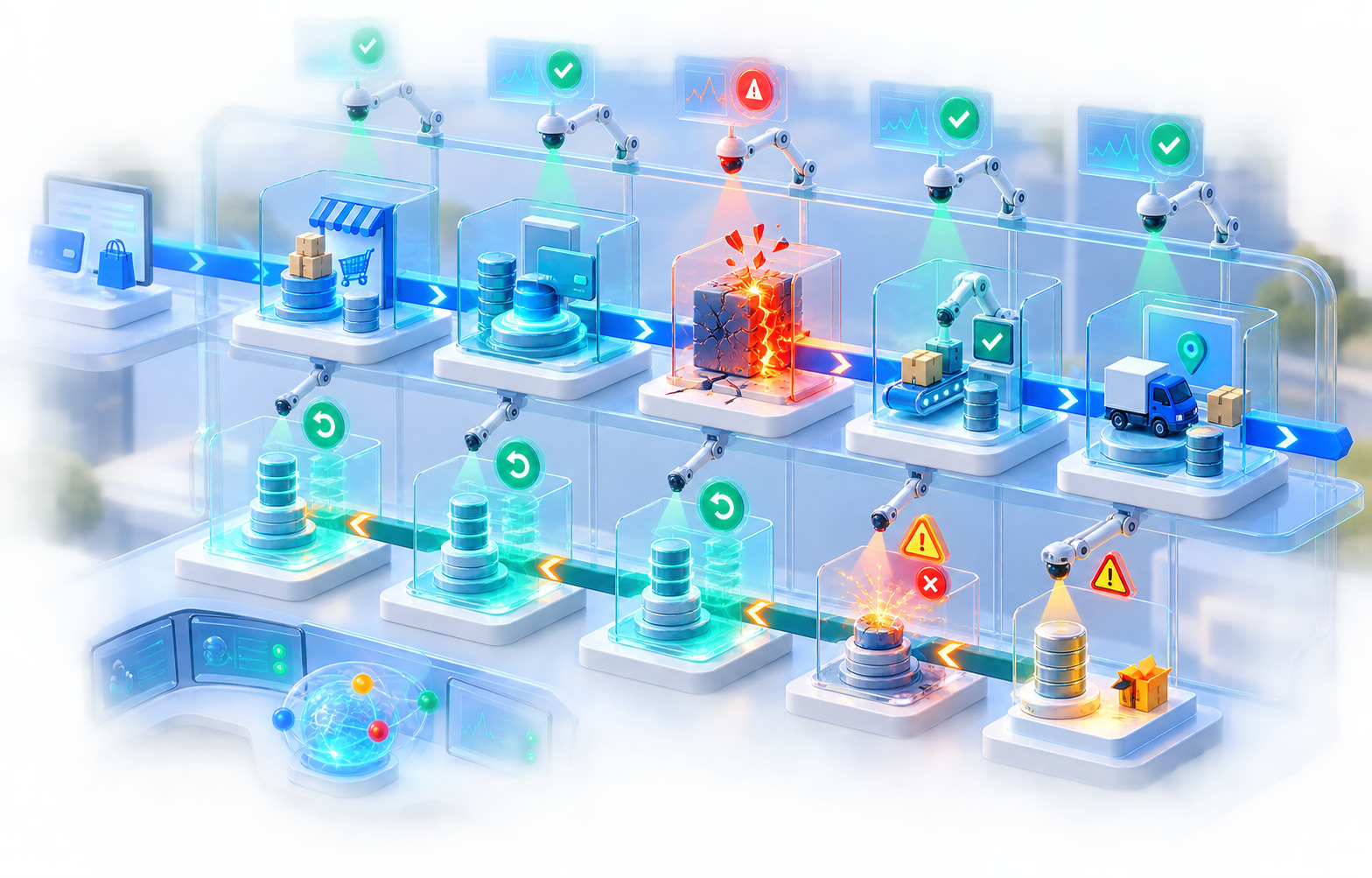
A security team at a mid-sized SaaS company (this is a hypothetical, illustrative scenario, not a real QAtronic engagement) closes out its annual penetration test and cryptography review with a clean report. TLS 1.3 everywhere. AES-256 at rest. No deprecated cipher suites. No expired certificates. The audit finds zero cryptographic findings, which is the best possible outcome an auditor can hand you, and the security team understandably treats it as validation that encryption is a solved problem for another year.
Three weeks later, a different conversation is happening two floors away, and nobody has connected it to the audit. The company's largest prospective customer, a regional bank evaluating the platform for a core workflow, has sent back a vendor security questionnaire. Buried in a section labeled "Emerging Risk" is a question the sales engineering team has never seen before: "Describe your organization's timeline and technical approach for migrating to NIST-approved post-quantum cryptographic algorithms, including your plan for supporting hybrid classical/post-quantum key exchange during the transition period." The account executive forwards it to engineering with a note: "Can we just say yes to this?"
Nobody can say yes to it, not honestly, because nobody in the company has actually tested whether the TLS termination layer, the mobile app's pinned certificate logic, the internal service mesh, or the third-party payment gateway integration could support a different key-exchange algorithm without months of rework. The audit was clean because it measured whether current cryptography was implemented correctly. The questionnaire is asking a completely different question: whether the organization could change its cryptography at all, and how it would know.
That gap, between "our current cryptography passes audit" and "we can prove our systems can migrate to new cryptography on a known timeline," is the actual post-quantum problem for most engineering organizations in 2026. It is not a cryptography-research problem anymore. The National Institute of Standards and Technology finished that part. It is a software architecture and testing problem, and it behaves like every other software architecture and testing problem QAtronic writes about: invisible until an external party asks a question your internal systems were never built to answer, and expensive to fix retroactively once you're the one on the hook for a contractual deadline instead of a preference.
This article treats post-quantum cryptography (PQC) migration as what it actually is for the vast majority of companies that are not choosing the mathematics: a crypto-agility, interoperability-testing, and dependency-readiness problem, with a real but not urgent-tomorrow compliance clock attached to it. It maps the risk, verifies the current regulatory and technical facts against primary sources, and lays out a testing-led playbook for starting the work now, before a deadline or a lost deal forces it.
What NIST Actually Finalized, and What Is Still in Motion
Before going further, it's worth being precise about what is settled and what is not, because a surprising amount of PQC commentary blurs the two.
On August 13, 2024, the U.S. Secretary of Commerce approved three Federal Information Processing Standards publications, which NIST had been developing since opening its post-quantum cryptography standardization project in 2016. These are not drafts, proposals, or recommendations. They are final, published federal standards:
- FIPS 203, Module-Lattice-Based Key-Encapsulation Mechanism Standard, which specifies ML-KEM, derived from the CRYSTALS-Kyber submission. This is a key-establishment mechanism — the algorithm two parties use to agree on a shared secret at the start of an encrypted session, the post-quantum equivalent of what Diffie-Hellman or elliptic-curve Diffie-Hellman (ECDH) does today.
- FIPS 204, Module-Lattice-Based Digital Signature Standard, which specifies ML-DSA, derived from CRYSTALS-Dilithium. This is a general-purpose digital signature algorithm, the post-quantum counterpart to RSA and ECDSA signatures.
- FIPS 205, Stateless Hash-Based Digital Signature Standard, which specifies SLH-DSA, derived from SPHINCS+. This is a second, structurally different signature algorithm, built on hash functions rather than lattice mathematics, offered as a conservative alternative in case unexpected weaknesses are ever found in lattice-based approaches.
NIST has stated it is also developing a fourth standard, provisionally called FN-DSA, based on the FALCON submission, intended as an additional signature option with a smaller footprint than ML-DSA for some use cases. As of this writing, FN-DSA has not been finalized as a FIPS standard, and organizations should not architect around it as if it were.
This matters for how you plan. The three finalized standards cover the core building blocks, one key-establishment mechanism and two structurally distinct signature algorithms, that essentially every TLS connection, code-signing pipeline, and certificate chain will eventually need. The algorithm-selection debate that dominated PQC discussion for the better part of a decade is over. What remains open is narrower and more implementation-specific: which signature scheme fits a given constrained environment, how certificate authorities structure hybrid and composite certificates, and how specific vendors expose these primitives in their SDKs and hardware. None of that open work should be used as a reason to delay building the architectural capacity to adopt whichever algorithm ends up being required in a given context.
The Compliance Clock Your Engineering Team Probably Isn't Watching
The opening scenario is illustrative, but the pressure behind it is not invented. Several real, dated policy developments are converging on the same multi-year window, and they explain why enterprise procurement teams, auditors, and regulated-industry customers have started asking questions that didn't exist two years ago.
National Security Memorandum 10 (NSM-10), issued by the White House in 2022, set a policy goal that all National Security Systems (NSS), the classified and sensitive systems used by U.S. defense and intelligence agencies and their contractors, become quantum-resistant, with 2035 named as the target horizon for that transition to be substantially complete.
CNSA 2.0, the NSA's Commercial National Security Algorithm Suite update, translates that policy goal into a specific technical and scheduling framework for NSS. According to the NSA's own Cybersecurity Information Sheet (version 2.1, December 2024), the schedule runs in stages: no enforcement action before December 31, 2025; new NSS acquisitions required to support CNSA 2.0 algorithms starting January 1, 2027; a phase-out of non-compliant legacy equipment by December 31, 2030; the mandate fully in effect by December 31, 2031; and the overall goal of full NSS quantum-resistance by 2035, consistent with NSM-10. CNSA 2.0 specifies ML-KEM-1024 for key establishment, ML-DSA-87 for general-purpose signatures, and LMS or XMSS — older, stateful hash-based signature schemes — specifically for firmware and software signing, where their operational constraints are more manageable.
Two things happened more recently that materially compress this timeline for a broader set of organizations. In June 2026, two executive orders were signed addressing quantum computing and cryptographic security. One directs continued federal investment in quantum computing research and workforce development. The other, focused specifically on cryptographic security, directs federal agencies to accelerate the migration of high-value assets to post-quantum cryptography to a 2030–2031 window — earlier than the original 2035 NSM-10 horizon — and requires a Commerce-led PQC migration pilot to be completed by December 31, 2027, along with cybersecurity and disclosure requirements for federal contractors by the end of 2030.
Following that order, the Office of Management and Budget issued implementation guidance (memorandum M-26-15, "Execution of the Migration to Post-Quantum Cryptography," dated June 24, 2026) that lays out a phased federal timeline: agencies must submit a PQC migration plan to OMB and the Office of the National Cyber Director within 120 days (by October 22, 2026); agencies must support TLS 1.3 or a successor protocol version no later than January 2, 2030; and agencies are directed to mitigate as much quantum risk as feasible for high-value assets by December 31, 2030, with digital-signature migration following in 2031 and full migration, including lower-priority systems, targeted for 2035 based on risk and commercial product availability.
Separately, NIST's own draft transition guidance, NIST IR 8547 (initial public draft, November 2024), lays out when classical algorithms should be phased out regardless of who a company sells to. For algorithms providing 112-bit security strength — this includes 2048-bit RSA and several widely deployed elliptic-curve configurations — NIST recommends deprecation after 2030 and disallowance after 2035, for both digital signatures and key establishment. For algorithms at 128-bit security or higher, NIST recommends disallowance after 2035. "Deprecated" in NIST's usage means an algorithm may still be used but is discouraged and requires explicit risk acceptance; "disallowed" means it should no longer be used at all in a NIST-conformant deployment.
None of this means a company outside the federal supply chain is legally required to do anything on a specific date. What it does mean, reliably, is that the customers, auditors, cloud providers, and certificate authorities that regulated-industry SaaS companies depend on are themselves subject to these timelines, directly or through their own downstream obligations, and they are already beginning to push the resulting questions down their vendor chains. A bank, an insurer, a defense contractor, or a healthcare payer that must show quantum-readiness planning to its own regulators has every incentive to start asking its software vendors about it years before any enforcement date arrives. That is precisely the mechanism in the opening scenario, and it is why "our audit had no findings" and "we have no answer for the questionnaire" can both be true at the same company on the same day.
Redefining the Problem: Crypto-Agility Is an Architecture Property, Not a Feature Flag
Given that the algorithms are fixed, the natural instinct is to treat PQC migration as a swap: replace the TLS library, update the cipher suite list, redeploy. For a small number of systems, that instinct is close to correct. For most production systems built over the last decade, it isn't, because cryptographic assumptions tend to get embedded in places nobody labeled as "cryptography."
Crypto-agility is the property of a system that lets it change cryptographic algorithms, key sizes, and protocol parameters without requiring a structural rewrite of the application, its data formats, or its integrations. Concretely, in architecture terms, a crypto-agile system has most of the following characteristics:
- Cryptographic operations are called through an abstraction layer or provider interface, not hardcoded to a specific library function or algorithm identifier scattered across the codebase.
- Key, signature, ciphertext, and certificate sizes are treated as variables read from configuration or negotiated at runtime, not as constants baked into buffer allocations, database column widths, message schemas, or wire-format headers.
- Protocol version and algorithm negotiation is explicit and observable — the system can log, monitor, and alert on which algorithm and key-exchange group were actually used for a given connection or signature, not just assume a default.
- Certificate and key rotation is automated and tested, not a manual, rarely exercised runbook. An organization that has never actually rotated its root of trust in production is unlikely to discover the rotation process works cleanly during a mandatory migration under deadline pressure.
- Backward and forward compatibility between algorithm versions is a tested code path, not an assumption. The system can serve or reject older clients predictably, and that behavior is covered by automated tests, not manual verification after an incident.
- Third-party and vendor dependencies for cryptographic functions are inventoried, with known upgrade paths and support timelines, not implicitly trusted to "just work."
The point of building and testing this negotiation path deliberately, rather than trusting a library default, is that the fallback branch is exactly where crypto-agility either proves itself or quietly fails. A system that only ever tests the "both sides support hybrid PQC" branch has not actually verified crypto-agility — it has verified that the happy path works when every dependency happens to be current, which is a much weaker and more fragile claim.
What Breaks When Keys and Signatures Get Bigger
The part of this migration that gets the least attention outside cryptography circles, and the part most directly relevant to QA and platform engineering, is size. Classical elliptic-curve cryptography is prized partly because its keys and signatures are extremely small — that compactness is baked into decades of protocol design, storage schemas, and performance budgets. Post-quantum lattice-based and hash-based schemes are not similarly compact, and the difference is not marginal.
Chart 1 — Cryptographic Material Size: Classical vs. NIST-Standardized Post-Quantum Algorithms
| Algorithm | Type | Security basis | Public key (bytes) | Signature / ciphertext (bytes) |
|---|---|---|---|---|
| Ed25519 | Classical signature | Elliptic curve | 32 | 64 |
| ECDSA P-256 | Classical signature | Elliptic curve | ~65 (raw) / ~91 (SPKI DER) | ~70–72 (DER-encoded) |
| RSA-2048 | Classical signature | Integer factorization | ~270 (SPKI DER) | 256 |
| X25519 | Classical key exchange | Elliptic curve | 32 | 32 (shared value) |
| ML-KEM-768 (FIPS 203) | PQC key encapsulation | Module lattice | 1,184 | 1,088 (ciphertext) |
| ML-KEM-1024 (FIPS 203) | PQC key encapsulation | Module lattice | 1,568 | 1,568 (ciphertext) |
| ML-DSA-44 (FIPS 204) | PQC signature | Module lattice | 1,312 | 2,420 |
| ML-DSA-65 (FIPS 204) | PQC signature | Module lattice | 1,952 | 3,309 |
| ML-DSA-87 (FIPS 204) | PQC signature | Module lattice | 2,592 | 4,627 |
| SLH-DSA-128s (FIPS 205) | PQC signature | Hash-based | 32 | ~7,856 |
Sources: Classical algorithm sizes reflect standard, widely documented X.509/RFC conventions (RFC 5280, RFC 8032) and are not separately cited per-value. ML-KEM figures are drawn from the Go standard library's crypto/mlkem package documentation (pkg.go.dev/crypto/mlkem), which implements FIPS 203. ML-DSA figures are drawn from the Open Quantum Safe project's ML-DSA algorithm reference (openquantumsafe.org/liboqs/algorithms/sig/ml-dsa.html), which implements FIPS 204. The SLH-DSA-128s signature size is drawn from Encryption Consulting's technical explainer of FIPS 205 (encryptionconsulting.com/education-center/slh-dsa-fips-205), consistent with the NIST FIPS 205 specification.
What it shows: A single ML-KEM-768 key exchange moves roughly 35 times more key-exchange data over the wire than the classical X25519 exchange it is replacing in a hybrid handshake. A single ML-DSA-65 signature is roughly 46 times larger than the ECDSA P-256 signature it might replace, and the conservative hash-based alternative, SLH-DSA, is larger still. These are not edge-case numbers reserved for high-security deployments — ML-KEM-768 and ML-DSA-65 are the mainstream, mid-security-level parameter sets most organizations will encounter first, well before the higher CNSA 2.0-mandated levels (ML-KEM-1024, ML-DSA-87) come into play for national-security-adjacent contexts.
This size growth interacts badly with a long list of assumptions that were reasonable when they were written and are now quietly load-bearing risks:
TLS record and handshake overhead. A hybrid ClientHello carrying both a classical and a post-quantum key share can push the initial handshake message across common IP fragmentation thresholds. Cloudflare's own public reporting on the state of post-quantum TLS (October 2025) notes that ML-KEM-768 alone requires roughly 3 kilobytes of data on the wire for its lowest-overhead configuration, and that post-quantum signature schemes typically require "more than double" the data and CPU cost of their classical counterparts as security levels rise. Middleboxes, load balancers, and firewalls that assume a ClientHello fits in a single TCP segment have, in practice, caused real interoperability failures during early PQC rollouts — this is a documented category of bug in the PQC transition, not a theoretical one.
Fixed-width storage and message schemas. Database columns, message queue payload limits, JWT and cookie size assumptions, HTTP header size caps at load balancers and API gateways, and QR-code payload capacity in authentication flows are all frequently sized against classical cryptographic material. A varchar(255) signature column, a webhook header limit inherited from a partner's legacy infrastructure, or a mobile deep link encoding a signed token in a URL are all places where "signatures are small" was never written down as a requirement but was nonetheless assumed.
Timeout and retry budgets. Larger handshakes and signature verifications take measurably longer to compute and transmit, particularly on constrained hardware. Timeout values tuned against classical-algorithm latency — in mobile clients, IoT devices, or synchronous request paths with aggressive SLAs — can start producing false failures under PQC or hybrid PQC load, especially at the tail latency percentiles that matter most for customer experience.
Embedded and IoT constraints. Devices with kilobytes, not megabytes, of RAM and flash, and severely constrained radio bandwidth, were frequently designed around the assumption that a public key and signature would together occupy well under a kilobyte. Several PQC signature schemes exceed that budget on their own, before accounting for the certificate chain around them.
Message queues, API gateways, and rate-limit tiers. Systems that batch, sign, or route messages — Kafka producers signing payloads for downstream consumers, API gateways enforcing per-request size tiers tied to a pricing plan, webhook relay services capping total payload size for reliability reasons — often carry the same unstated "signatures and keys are small" assumption as the fintech scenario above, just at a different layer of the stack. A message that fit comfortably under a gateway's size tier with a classical signature attached can cross into a more expensive pricing tier, or fail outright, once a post-quantum signature is added, and that failure mode is easy to miss in testing if the test payloads used during development were never sized against the specific limits of production infrastructure.
Mobile app-store review and update latency. Even once a mobile client is technically capable of hybrid PQC negotiation, the lag between shipping that capability and it actually running on a majority of users' devices can run into months, driven by app-store review timelines and the reality that a meaningful fraction of users delay or never install updates. A migration plan that assumes "we shipped the update" is equivalent to "our clients are protected" will consistently overestimate actual coverage, which matters directly for any organization that needs to report a measured, not aspirational, quantum-readiness percentage to a customer or regulator.
None of this is a reason to avoid the migration. It is a reason to test for it specifically, rather than assuming a library upgrade is a drop-in replacement.
Hybrid Key Exchange: Living in the Transition Period on Purpose
Because classical algorithms remain acceptable under current NIST guidance until deprecation and disallowance dates years out, and because a conservative posture doesn't want to bet an entire connection's confidentiality on an algorithm that is only a few years old, the industry-standard approach for the transition period is hybrid key exchange: combining a classical algorithm (typically X25519) with a post-quantum algorithm (ML-KEM) in the same handshake, deriving the session's shared secret from both. If either the classical or the post-quantum component were somehow broken, the combined secret still requires breaking the other. This is the approach browsers and major TLS libraries have already deployed for key exchange; digital signatures and certificates are moving more slowly toward hybrid or composite approaches, as discussed below.
The practical significance of hybrid deployment, for engineering and QA teams, is that it is already live in production traffic today, not a future state. According to Cloudflare's October 2025 report on the state of the post-quantum internet, more than half of human-initiated HTTPS traffic through Cloudflare's network was already using post-quantum key exchange, and recent versions of all major browsers, along with widely used libraries and platforms including OpenSSL, Go, and recent Apple operating systems, have enabled the hybrid group X25519MLKEM768 by default. That means any organization running its own TLS termination is very likely already negotiating hybrid PQC handshakes with a meaningful share of its client traffic today, whether or not anyone on the engineering team has verified that this is happening correctly, that it's being monitored, or that fallback behavior for older clients is what the team actually intends.
A real, verified example illustrates why testing this negotiation path matters, rather than assuming it's automatically compatible. Google Chrome initially shipped support for a hybrid group based on the draft version of Kyber, using the codepoint 0x6399, ahead of NIST's final standardization. When NIST finalized ML-KEM in FIPS 203, the final specification differed from the pre-standardization Kyber draft closely enough to be conceptually similar but not bit-compatible. Chrome had to introduce a new codepoint, 0x11EC, for the standardized X25519MLKEM768 group, effectively deprecating its own earlier implementation in Chrome version 131, released in late 2024. Any server or client that had hardcoded support for the draft Kyber codepoint, rather than negotiating groups dynamically and handling unrecognized or superseded codepoints gracefully, would have experienced a real interoperability break at that transition — not a theoretical one, but a documented change that shipped to hundreds of millions of browser instances.
That episode is a useful, low-stakes preview of the exact failure mode this article is arguing against: an organization that treats "we support post-quantum key exchange" as a one-time implementation task, rather than a negotiated, monitored, and periodically re-verified capability, will be repeatedly surprised by exactly this kind of non-breaking-in-theory-but-breaking-in-practice change, because the PQC ecosystem is still moving through draft-to-final transitions, codepoint reassignments, and library version churn. The organizations that handled the Kyber-to-ML-KEM transition without customer-visible disruption were the ones whose systems negotiated algorithms dynamically and had test coverage for "the other side doesn't support what we expect" — which is precisely the crypto-agility property this article is describing, not a cryptographic property at all.
Confidentiality Risk and Authenticity Risk Migrate on Different Clocks
One distinction gets lost when PQC migration is discussed as a single undertaking, and it matters enough for planning purposes to call out explicitly: key exchange and digital signatures protect against different threats, on different timelines, and the readiness of the ecosystem behind each is not the same.
Key exchange protects confidentiality at the moment of transmission. The specific risk that motivates urgency here is harvest-now-decrypt-later: an adversary who captures encrypted traffic today cannot read it today, but could potentially decrypt it later if sufficiently capable quantum computing hardware eventually exists and the traffic was protected only by classical key exchange. This is why hybrid key exchange has moved fastest — it is the lowest-friction, highest-leverage mitigation available right now, it requires no change to the public certificate ecosystem, and it can be deployed unilaterally by any organization that controls its own TLS termination, without waiting on a certificate authority, a customer, or a standards body. This is also why Cloudflare's data shows the majority of observed HTTPS traffic already negotiating hybrid PQC key exchange while zero public post-quantum certificates existed in production as of the same measurement period: the two migrations are decoupled, and key exchange is structurally easier to move first.
Digital signatures protect authenticity and integrity — proof that a certificate, a piece of firmware, or a signed message actually came from who it claims to. Harvest-now-decrypt-later does not apply to signatures the same way it applies to key exchange, because there is no equivalent benefit to an adversary in "harvesting" a signature today to forge it later; a forged signature is only useful at the moment of use, not retroactively. This is part of why the signature side of the migration, and specifically the public certificate ecosystem built around ML-DSA and SLH-DSA, has been permitted to move more slowly and carry less urgency than key exchange, even though the underlying standards (FIPS 204 and FIPS 205) were finalized on the same day as FIPS 203.
The practical consequence for planning is that "are we quantum-ready" is really two separate questions with two separate readiness timelines, and conflating them produces either false confidence (assuming hybrid key exchange alone means the whole migration is handled) or unnecessary alarm (treating the absence of production PQC certificates as a sign that nothing has been done, when key-exchange migration may already be substantially complete). The OMB's own phased federal timeline reflects this same separation: key establishment for high-value assets is prioritized for completion by the end of 2030, with digital-signature migration following in 2031, a full year later. Organizations planning their own migration should adopt the same sequencing logic rather than treating the two as a single monolithic project with one deadline.
Certificate-chain migration carries an additional complication worth naming directly: a certificate authority issuing a post-quantum or hybrid certificate today would create trust chains that many currently deployed clients — browsers, mobile apps, embedded devices, older server software — cannot yet validate, because those clients haven't been updated to recognize the new signature algorithms. This is part of why the IETF's LAMPS working group has been developing composite signature approaches — schemes that combine a classical and a post-quantum signature in a single certificate, similar in spirit to hybrid key exchange, so that a certificate can remain valid to older clients that only check the classical component while offering post-quantum assurance to clients that check both. This work was still moving through standardization as of this writing and should be tracked rather than assumed complete.
Three Situations Where the Assumptions Break
The following three scenarios are hypothetical and illustrative, constructed to be representative of patterns reported across the PQC transition literature and consistent with the technical constraints verified above. They are not QAtronic client engagements, and no specific company, product, or outcome described here is real.
Scenario 1: The Fintech Webhook Signature That Didn't Fit
Initial situation. A payments infrastructure company signs every outbound transaction webhook to its merchant customers using ECDSA over P-256, attaching the signature in an HTTP header, X-Payment-Signature, alongside a timestamp and a nonce. The signature is roughly 70 bytes, comfortably inside every header size limit anyone has ever tested against. A downstream audit-logging pipeline stores the signature in a database column sized varchar(256), and a partner bank's decade-old webhook receiver enforces a hard 2-kilobyte limit on total request header size, inherited from infrastructure nobody at either company still actively maintains.
Hidden assumption. Nobody explicitly decided that signatures would always be small. It was simply never a constraint anyone wrote down, because for the life of the system, it was true by default. The database column, the header budget, and the partner's legacy receiver all encode "signatures are small" as an unstated structural assumption.
Technical/organizational cause. As part of a broader move to align with CNSA 2.0-adjacent customer requirements, the payments company migrates webhook signing to ML-DSA-65 for longer-term cryptographic assurance on financial transaction records. An ML-DSA-65 signature is 3,309 bytes — more than 47 times larger than the ECDSA signature it replaces, and well beyond both the database column width and a meaningful fraction of the partner's total header budget once other required headers are included.
Consequence. In staging, against a modern test harness with generous defaults, everything passes. In production, against the partner bank's decade-old receiver, requests begin failing with header-size errors that look, from the payments company's side, like intermittent network issues rather than a cryptography problem, because nobody connected the recent signing algorithm change to the failure pattern. Meanwhile, the audit-logging pipeline silently truncates signatures written to the varchar(256) column, which is worse than an outright failure: verification later reports signatures as invalid without any indication that the actual cause was storage truncation rather than tampering, and the security team spends a week investigating a phantom integrity incident.
Decision to make. Whether to redesign the signature transport mechanism — for example, moving to a detached-signature pattern with a reference URL or object-storage pointer rather than an inline header, and widening the audit-log schema to accommodate any current or future PQC signature size — before the algorithm change goes live, or to force-fit the new signature into the old transport and accept ongoing fragility.
Better approach. Treat signature and key material as variable-length, tested against realistic size boundaries in CI — including boundaries owned by third parties, not just the company's own infrastructure — before an algorithm migration ships. A crypto-agile envelope format doesn't need to know in advance exactly how large a future signature will be; it needs to not assume an upper bound that happens to match today's algorithm.
Scenario 2: The IoT Fleet Whose Bootloader Ran Out of Room
Initial situation. A manufacturer of industrial sensor gateways ships a secure bootloader that verifies firmware update signatures using ECDSA P-256 before applying an over-the-air update. The bootloader's flash partition table reserves 512 bytes for the public key and signature combined — comfortable headroom over the roughly 135 bytes ECDSA actually needs, treated as generous margin when the hardware was designed years earlier.
Hidden assumption. The 512-byte reservation was sized against "classical signature plus reasonable future growth," not against the possibility of a structurally different signature scheme. Nobody modeled hash-based or lattice-based post-quantum signatures against that budget because, at design time, those algorithms weren't yet standardized.
Technical/organizational cause. Facing customer pressure tied to CNSA 2.0-adjacent supply-chain requirements — CNSA 2.0 specifically recommends LMS or XMSS, stateful hash-based schemes, for firmware and software signing — the manufacturer evaluates its options. ML-DSA-87 signatures run 4,627 bytes; even the more compact SLH-DSA-128s option runs roughly 7,856 bytes. Both blow far past the 512-byte reservation. LMS and XMSS are more compact per signature than SLH-DSA, but they introduce a different problem entirely: they are stateful. Each key can only be used to sign a bounded number of times, and the signer must track exactly which one-time keys have already been used. If that state is ever lost, cloned, or duplicated across devices — for instance, by restoring a device image without correctly restoring signing state — the security guarantee of the entire scheme collapses, because a one-time key gets reused.
Consequence. The engineering team discovers, mid-project, that the flash partition problem and the state-management problem are two separate migration risks, not one. Solving the size problem (choosing a hash-based scheme) reintroduces a stateful key-management requirement the existing firmware update pipeline was never built to track, especially across device cloning and factory-reset workflows already in the field. Retrofitting either fix into devices already deployed in remote industrial sites, with infrequent physical access and constrained OTA bandwidth, is far more expensive than it would have been at design time.
Decision to make. Whether to allocate additional flash headroom and design explicit signing-state tracking now, while the next hardware revision is still in design, accepting near-term cost and bill-of-materials impact, versus deferring and accepting a substantially more expensive and operationally riskier retrofit once devices are already deployed at scale in the field.
Better approach. For constrained hardware, crypto-agility means reserving size headroom deliberately rather than optimistically, and treating stateful hash-based signature schemes as an explicit key-management design problem, not a drop-in signature algorithm swap. Testing needs to cover not just "does the new signature verify," but "does the signing state survive device cloning, factory reset, and firmware rollback without ever reusing a one-time key."
Scenario 3: The Compliance Questionnaire With No Rehearsed Answer
Initial situation. This scenario extends the article's opening. A SaaS analytics company serving healthcare and financial-services clients receives a vendor security questionnaire from a prospective enterprise customer, including a new section on post-quantum readiness that the sales and security teams have not previously encountered in this level of detail.
Hidden assumption. The company's annual third-party penetration test and its SOC 2 audit both evaluate current cryptographic implementation correctness — are the right protocols and cipher suites configured, are certificates valid and appropriately scoped, is data encrypted at rest with an approved algorithm. Both processes are functioning exactly as designed. The unstated assumption is that a clean result on those audits is equivalent to being able to answer any forward-looking cryptographic question a customer might ask, which was true until customers started asking questions that current-state audits were never designed to answer.
Technical/organizational cause. No one owns a cryptographic inventory: a living list of what algorithms are used where, in what libraries, with what vendor dependencies, and what each dependency's public post-quantum roadmap looks like. TLS termination is managed by a cloud load balancer the platform team configured years ago and rarely revisits; the mobile app pins certificates using a third-party SDK whose PQC roadmap nobody has checked; the database encryption-at-rest configuration was set once during a compliance audit two years earlier and hasn't been revisited since. Each piece may individually be fine. Nobody can currently produce a single accurate answer covering all of them.
Consequence. The response to the questionnaire slips by six weeks while security, platform engineering, and a vendor-management contact scramble to inventory dependencies they've never had to enumerate together before. The deal doesn't fall through, but the customer's procurement team notes the delay, and the account team now has to explain, in every subsequent enterprise deal, why quantum-readiness questions take so long to answer.
Decision to make. Whether to build a standing cryptographic inventory and a lightweight migration plan — the same kind of artifact the OMB is now requiring federal agencies to produce on a fixed schedule — proactively, before the next enterprise deal or audit cycle raises the question again, or to keep answering each questionnaire as a one-off fire drill.
Better approach. Maintain a cryptographic bill of materials as a living artifact, owned by a named team, updated as dependencies change, and periodically tested — not just documented — by actually verifying that hybrid PQC negotiation works correctly across the TLS termination layer, the mobile client, and any service mesh in use. An answer to "what is your quantum-readiness timeline" that is backed by a tested capability is categorically different, and categorically faster to produce, than one that has to be reconstructed from scratch under deadline pressure.
The Dependency Problem: Your Timeline Is Only as Fast as Your Slowest Vendor
Even a perfectly crypto-agile internal architecture depends on an external supply chain of libraries, hardware, certificate authorities, and cloud providers, and that supply chain is at very different levels of PQC maturity depending on the layer.
TLS libraries and browsers are, at this point, comparatively far along. Cloudflare's October 2025 reporting confirms that OpenSSL, the Go standard library, and recent Apple operating systems have enabled hybrid X25519MLKEM768 by default, alongside all major browsers. This is the most mature layer of the stack.
Cloud provider key management has also moved. AWS announced ML-KEM support for TLS connections to AWS KMS, AWS Certificate Manager, and Secrets Manager, and on June 13, 2025, extended AWS KMS to support ML-DSA (FIPS 204) digital signatures directly, across all three standardized parameter sets (ML-DSA-44, ML-DSA-65, ML-DSA-87), rolling out region by region. Other major cloud providers have made comparable public commitments to post-quantum key management, though the specific feature set and regional availability should always be verified directly against current vendor documentation rather than assumed, since this is an actively moving target.
Public certificate authorities are the least mature layer, and this is a genuine, verified constraint rather than a pessimistic guess. Cloudflare's own October 2025 report states plainly that, as of that writing, not a single public post-quantum certificate was in production use anywhere on the internet it observed, despite the majority of key-exchange traffic already using hybrid PQC. Post-quantum certificates were anticipated to begin appearing in 2026, with broader trust and adoption expected by 2027. This means an organization today can reasonably deploy hybrid PQC key exchange — protecting confidentiality against harvest-now-decrypt-later risk — well ahead of being able to deploy a fully post-quantum certificate chain for authentication, because the certificate ecosystem, including CA/Browser Forum policy work and composite/hybrid certificate formats still moving through IETF standardization, is simply not there yet.
Hardware security modules (HSMs) and embedded cryptographic hardware sit somewhere in between, with meaningful variation by vendor and product line. Firmware updates to support new algorithms, sufficient memory and compute headroom for larger key material, and support for hybrid or composite operations are all vendor-specific questions that require direct verification rather than assumption, particularly for organizations with long hardware refresh cycles.
Table — PQC Algorithm Comparison and Primary Use Case
| Standard | Algorithm | Type | Primary use case | Notable characteristic |
|---|---|---|---|---|
| FIPS 203 | ML-KEM | Key encapsulation (lattice) | TLS/session key exchange | Fast; moderate size growth; broadest current deployment (hybrid mode) |
| FIPS 204 | ML-DSA | Digital signature (lattice) | General-purpose signing: TLS certs, API tokens, document signing | Fast verification; largest general-purpose adoption target |
| FIPS 205 | SLH-DSA | Digital signature (hash-based) | Conservative/high-assurance signing where lattice risk tolerance is lowest | Stateless (safer key management); much larger signatures; slower signing |
| CNSA 2.0 recommendation (not a NIST FIPS) | LMS / XMSS | Digital signature (hash-based, stateful) | Firmware and software signing specifically | Compact signatures; requires careful one-time-key state management |
| In development | FN-DSA (FALCON-based) | Digital signature (lattice) | Constrained environments needing smaller signatures than ML-DSA | Not yet finalized as a FIPS standard; do not architect around it yet |
Evaluating a vendor's claim in this space is worth doing deliberately rather than accepting a marketing page at face value, because "post-quantum ready" has become a phrase vendors reach for with widely varying levels of substance behind it. A useful practice is to ask a vendor three specific things and treat the answers as data, not reassurance: which named FIPS standard they support, whether that support is available in the specific product tier and region your contract covers today or only on a roadmap, and whether they can demonstrate a successful hybrid or PQC-only negotiation against a test client you control, rather than only against their own internal test suite. A vendor that answers all three concretely has done real work. A vendor that answers only the first, in general terms, has usually done less than the marketing language suggests, and that gap is worth surfacing before it becomes your gap during an audit or a customer questionnaire, not after.
This uneven readiness across dependency layers is precisely why "when will we be quantum-ready" cannot be answered as a single date for most organizations. It has to be answered per dependency category, which is what the readiness matrix below is designed to do.
Table — Crypto-Agility Dependency Readiness Matrix
| Dependency category | Typical current maturity (2026) | Primary risk if untested | Who usually owns it |
|---|---|---|---|
| TLS termination / load balancer | High — hybrid PQC often available and sometimes default | Fallback-to-classical behavior unverified; monitoring absent | Platform/infrastructure team |
| Internal service-to-service TLS / mesh | Medium — depends heavily on mesh vendor and version | Internal traffic assumed "already handled" without verification | Platform/security team |
| Public certificate chain | Low — no public PQC certificates broadly trusted yet | False assumption that certs will be a simple swap when they're not yet available | Security/PKI owner |
| Cloud KMS / secrets management | Medium-High — major providers rolling out ML-KEM/ML-DSA support | Assuming provider support equals application support without integration testing | Platform/cloud team |
| Mobile and embedded clients | Low-Medium — highly device- and SDK-dependent | Long update cycles; app-store review delays; hardware size constraints | Mobile/firmware engineering |
| Third-party vendor integrations (payments, auth, messaging) | Unknown by default | No visibility into vendor's own PQC roadmap or timeline | Vendor management/security |
| Code signing / firmware signing | Low-Medium — CNSA 2.0 guidance exists but stateful scheme adoption is early | Stateful key mismanagement (LMS/XMSS one-time-key reuse) | Firmware/release engineering |
| Data at rest (databases, backups, archives) | High for symmetric (AES-256 already quantum-resistant at 256-bit strength) | Long-lived encrypted archives assumed safe without harvest-now-decrypt-later review | Data platform/security |
Note the last row: AES-256, the workhorse symmetric encryption algorithm already in near-universal use for data at rest, is generally considered adequately quantum-resistant at its current key length and is not part of the FIPS 203/204/205 migration story. The urgency here concentrates specifically on asymmetric cryptography, key exchange and digital signatures, which is where quantum algorithms pose a structural threat that symmetric encryption at sufficient key length does not share to the same degree. Conflating the two is a common source of unnecessary alarm; it's worth being precise about which layer of your stack actually needs to change.
How to Actually Test for Crypto-Agility and Interoperability
This is the part most PQC guidance skips, because it's written by cryptographers rather than by people responsible for verifying that production systems behave correctly under changing conditions. Testing crypto-agility is not fundamentally different in kind from testing any other cross-cutting system property — it just requires deliberately exercising paths that normally never get exercised, because the algorithm "never changes" until, on a fixed timeline, it has to.
Build an interoperability test matrix, not a single happy-path test. The goal is to verify behavior across every realistic combination of client and server capability, not just the case where both sides are current. A representative matrix for a TLS-facing service looks like this:
| Client capability | Server config: classical only | Server config: hybrid (classical + PQC) | Server config: PQC-preferred |
|---|---|---|---|
| Legacy client (classical only) | Connects normally | Connects, negotiates classical fallback | Connects, negotiates classical fallback |
| Modern browser (hybrid-capable) | Connects, uses classical (server can't do better) | Connects, negotiates hybrid PQC | Connects, negotiates hybrid PQC |
| Mobile app with pinned older TLS library | Connects normally | Test explicitly — may fail if hybrid ClientHello exceeds assumed size limits in the pinned library | May fail entirely if library rejects unrecognized groups instead of ignoring them |
| Internal service (mesh sidecar, specific version) | Connects normally | Test explicitly — mesh version dependent | Test explicitly — mesh version dependent |
The cells marked "test explicitly" are where real interoperability breaks concentrate, and they are exactly the cells that a team relying on default library behavior in a single staging environment will never exercise, because staging environments are usually populated with current, matched-version clients and servers on both sides.
Verify fallback behavior is a deliberate choice, not an accident. A server that silently falls back to classical-only cryptography when a client doesn't support hybrid PQC is often the correct behavior for a transition period — but it needs to be a tested, monitored, intentional configuration, not an assumption. Track and alert on the distribution of negotiated groups and algorithms in production traffic, the same way you'd track any other dependency version distribution, so a drop in hybrid-PQC negotiation rate is visible before it becomes a customer-facing problem or a compliance-reporting gap.
Test against realistic size boundaries, not synthetic minimal payloads. As Scenario 1 illustrates, the interoperability breaks that matter often live in third-party infrastructure — a partner's legacy header limit, a database column width — that your own staging environment doesn't reproduce. Build size-boundary tests into CI that specifically assert current PQC key and signature sizes fit within every size constraint your system depends on, internal and external, and re-run those assertions whenever a dependency's default algorithm changes, not just when you change it yourself.
Test performance and timeout budgets under realistic load, not isolated benchmarks. A single hybrid handshake might add single-digit milliseconds of latency on modern server hardware, which sounds negligible until it's multiplied across a connection-heavy service under peak load, or measured on constrained mobile or IoT hardware rather than a data center CPU. Load-test the actual latency distribution, not just the median, with hybrid PQC enabled, and verify that timeout budgets throughout the request path — client-side, load balancer, upstream service — have enough margin.
Sketch: a minimal interoperability test scenario. A concrete way to start, for a team with an existing TLS-terminating service, is to script explicit negotiation tests rather than relying on whatever a library defaults to:
# Explicitly request hybrid PQC group, falling back to classical if unsupported
openssl s_client -groups X25519MLKEM768:X25519 -connect <host>:443 </dev/null 2>&1 \
  | grep -E "Server Temp Key|TLSv1.3|Cipher"

# Explicitly request classical-only, to verify legacy-client fallback still works
openssl s_client -groups X25519 -connect <host>:443 </dev/null 2>&1 \
  | grep -E "Server Temp Key|TLSv1.3|Cipher"

# Explicitly request PQC-only (no classical fallback offered), to see how a
# strict PQC-preferred client is actually handled — this is the case most
# likely to be untested and most likely to reveal a hard failure
openssl s_client -groups X25519MLKEM768 -connect <host>:443 </dev/null 2>&1 \
  | grep -E "Server Temp Key|TLSv1.3|Cipher"
Running these three variants against every externally facing endpoint, on a recurring schedule rather than once, turns "we support post-quantum key exchange" from a claim into a monitored, falsifiable fact. That distinction is the entire difference between the security team in the opening scenario and one that can actually answer the questionnaire.
Stage the rollout, and treat each stage as a release with a rollback path. Enabling hybrid PQC support internally first, then for a small percentage of external traffic, then broadly, mirrors any other risky infrastructure change and should be treated with the same discipline: feature-flag-controlled exposure, monitoring of error rates and latency by cohort, and a tested rollback path if a specific client population turns out to be incompatible. This is not a special category of change that deserves less rigor than a database migration or an API version bump — if anything, given how invisible cryptographic negotiation failures can be to end users until they manifest as a support ticket weeks later, it deserves more.
Run periodic algorithm-swap drills, not just algorithm-swap tests. A test suite verifies that code behaves correctly when exercised. A drill verifies that a team can actually execute a change under realistic operational conditions — coordinating a configuration change across a load balancer, a certificate authority, a monitoring dashboard, and an incident-response channel, on a schedule nobody has told them about in advance. Organizations that run disaster-recovery drills or game days for infrastructure failures already have the operational muscle for this; applying the same discipline to "swap the negotiated key-exchange group in a lower environment and see what breaks, who notices, and how long it takes to diagnose" builds organizational readiness that a passing test suite alone does not capture. This is a deliberately low-stakes way to discover that, for instance, a dashboard nobody remembered to update still assumes the old algorithm identifier, or that an on-call engineer's runbook references a codepoint that no longer matches what's deployed — exactly the kind of gap that turned Chrome's Kyber-to-ML-KEM transition into a real, if contained, disruption for anyone who hadn't rehearsed it.
Instrument before you migrate, not after. A recurring failure pattern in staged rollouts of any kind, cryptographic or otherwise, is discovering after the fact that the system couldn't actually distinguish "this connection used the new algorithm and succeeded" from "this connection used the new algorithm and silently fell back" from "this connection never attempted the new algorithm at all." Before enabling hybrid PQC anywhere in production, confirm that the negotiated group and algorithm are logged, queryable, and dashboarded per connection, per client type, and per endpoint. Without that visibility, a staged rollout is really just an untracked configuration change, and the team will not be able to answer, with evidence, exactly the kind of question a compliance questionnaire or an internal executive is likely to ask: what fraction of our traffic is actually protected today, right now, not in aspiration.
The Cost of Acting Now vs. Acting Under Deadline Pressure
None of the deadlines discussed above require a company outside the federal supply chain to act immediately. That's a legitimate reason not to panic. It is not, on its own, a good reason to wait, and the economics of large infrequent cryptographic migrations — drawn from repeated historical experience with transitions like the deprecation of TLS 1.0/1.1, the SHA-1 signature phase-out, and the Y2K remediation effort, none of which involved quantum computers but all of which shared the same "large number of dependencies must change roughly in sync" structure — consistently favor early, incremental investment over late, compressed retrofitting.
Chart 2 — Estimated Relative Cost of Crypto-Agility Investment: Early vs. Deadline-Driven (Illustrative, Not a Real Benchmark)
| Years before deadline | Relative cost — early, incremental investment | Relative cost — deadline-driven retrofit |
|---|---|---|
| 5 years out | 1.0 (baseline: architecture review, inventory, test harness build-out) | N/A (not yet started) |
| 4 years out | 1.2 (incremental crypto-agility work folded into normal roadmap) | N/A (not yet started) |
| 3 years out | 1.5 (staged rollout, dependency upgrades as they become available) | 2.0 (starting late; still time for planning, but less flexibility) |
| 2 years out | 1.7 (final verification, edge-case testing) | 3.5 (vendor bottlenecks emerge; less negotiating leverage; parallel workstreams) |
| 1 year out | 1.8 (largely complete; monitoring and maintenance mode) | 6.0+ (compressed timeline, overtime cost, emergency vendor contracts, elevated error risk) |
This chart is explicitly hypothetical and illustrative, not a benchmarked industry figure. It is constructed to represent a widely observed pattern in large, infrequent, dependency-heavy technology migrations: cost grows roughly linearly when work is distributed across normal roadmap capacity, and grows non-linearly as a deadline compresses, because vendor dependencies, hiring, and testing all become harder to parallelize under time pressure, and because errors made under compressed timelines are typically more expensive to find and fix than errors caught during unhurried, staged testing.
What it shows: The argument for starting now is not that a specific deadline is imminent — it isn't, for most companies. The argument is that crypto-agility work is unusually well suited to being absorbed incrementally into normal engineering capacity if started early (inventory work, test harness construction, and staged dependency upgrades can all be scheduled around other priorities), and unusually badly suited to being compressed into a short window later (vendor certificate availability, HSM firmware updates, and mobile app-store review cycles all have fixed external lead times that money and headcount cannot simply buy away under pressure).
Sequencing by company stage. The right starting point differs meaningfully by organizational maturity, and treating every company as if it needs the same playbook is a mistake in the other direction.
For startups and early-stage companies, the highest-leverage action is architectural, not procedural: choose current libraries, cloud KMS services, and TLS termination layers that already default to or clearly support hybrid PQC negotiation, and avoid hardcoding algorithm identifiers or fixed-size assumptions into new schemas and protocols from day one. This costs close to nothing extra at this stage and avoids creating tomorrow's legacy debt today. A dedicated PQC program is premature; a crypto-agile default architecture is not.
For scale-ups with an existing production system and paying enterprise customers, the priority is the cryptographic inventory and dependency readiness matrix described above, paired with the interoperability test matrix, executed against real production traffic and real third-party dependencies, not just internal infrastructure. This is also the stage where the compliance-questionnaire scenario becomes a live risk rather than a hypothetical one, so building a rehearsed, tested answer is a direct, near-term return on the investment, independent of any long-term deadline.
For enterprises and regulated-industry companies, particularly those selling into or operating within sectors touched by CNSA 2.0-adjacent requirements or federal supply chains, the OMB's phased federal model is a reasonable template to adapt directly: a documented, risk-prioritized migration plan; staged pilots on a subset of systems; prioritized migration of key establishment before signatures (mirroring the federal 2030-then-2031 sequencing); and an explicit governance owner, because a migration this cross-cutting fails reliably when no single team is accountable for it end to end.
Within each of these stages, the sequencing decision that carries the most leverage is prioritizing by data sensitivity and expected lifetime, not by system size or visibility. A high-traffic marketing website carries essentially no harvest-now-decrypt-later exposure, because the data it transmits has little value to an adversary who decrypts it years from now. A long-term contract archive, a health record system, or a financial transaction ledger that must remain confidential for a decade or more carries substantially more exposure, even if the system serving it is small and low-traffic by comparison. Building the cryptographic inventory recommended earlier with a sensitivity and retention-period column, not just an algorithm and vendor column, turns a flat list of dependencies into an actual prioritization tool, and it is usually the single change that most improves the quality of a first-pass migration plan.
It's also worth being explicit about what this sequencing logic argues against: treating the migration as a single company-wide cutover date, announced once and executed as one large program. That model concentrates risk exactly where the cost curve in the chart above shows it compounds fastest — late, under deadline pressure, across every dependency simultaneously — and it discards the main structural advantage available to a company that starts early, which is the ability to move dependency by dependency, verify each one against real test coverage, and absorb the work into normal release cycles rather than a single high-stakes program.
Warning Signs an Organization Isn't Actually Crypto-Agile
Some patterns reliably predict that a system will struggle when it eventually has to change cryptographic algorithms, and most of them are visible today, well before any migration is underway, to anyone who goes looking. None of these are exotic — they're the same categories of technical debt that show up in any system where a foundational assumption was never revisited after the system grew past the scale it was designed for.
The first is an inability to answer, quickly and confidently, which cryptographic algorithms are in use where across the organization's systems. If producing that list requires spelunking through configuration files, asking three different teams, and still not being fully sure about a fourth system nobody currently owns, that's not a documentation gap — it's evidence that nobody has ever needed to change these algorithms before, which is exactly the condition that makes the next required change expensive.
The second is algorithm identifiers or key sizes appearing as literal constants in application code, rather than as configuration values read at startup or negotiated at connection time. A codebase where "P-256" or a specific key length appears as a string literal in a dozen unrelated files, rather than behind a single abstraction, will require a code change — and a full test and deployment cycle — for every future algorithm transition, which is precisely the opposite of what crypto-agility is supposed to provide.
The third is the absence of any test that deliberately exercises a fallback or negotiation-failure path. If every cryptography-related test in the suite assumes both sides of a connection support the same, current algorithm, the system's actual behavior when that assumption breaks is unknown, not just untested — and unknown behavior in a security-critical code path is a materially different risk than a documented, deliberate design choice.
The fourth is treating key and certificate rotation as a manual, rarely executed procedure rather than an automated, frequently exercised one. Organizations that rotate keys automatically and often — as a matter of routine hygiene, independent of any PQC deadline — have already proven, through repetition, that their systems tolerate algorithm and key material change gracefully. Organizations where the root certificate hasn't been rotated in years, and where the rotation runbook exists only as a document nobody has followed recently, are discovering whether that process actually works for the first time precisely when they can least afford a mistake.
The fifth is a vendor-management process that has never asked a cryptography-specific question of a supplier. If every vendor security review focuses on data handling, access control, and incident response, but has never asked what cryptographic algorithms a vendor uses internally or what their PQC roadmap looks like, that's a blind spot that will surface, unplanned, the first time a customer or auditor asks the same question of you and you have to go find out secondhand.
Risk Map: Where Migration Risk Actually Concentrates
Pulling the analysis above together, the risk is not evenly distributed. It concentrates predictably in a small number of places, and the risk map below is intended as a working tool a team can adapt, not a definitive external audit.
| Risk area | Likelihood of being a bottleneck | Business impact if unaddressed | Primary mitigation |
|---|---|---|---|
| Hardcoded algorithm identifiers in application code | High | High — blocks any future algorithm swap without code changes | Introduce a crypto-provider abstraction layer; audit for hardcoded references |
| Fixed-size assumptions in schemas, headers, buffers | High | Medium-High — silent truncation, intermittent partner-integration failures | Size-boundary tests in CI against current and near-future PQC sizes |
| Third-party vendor PQC roadmap unknown | High | High — timeline is only as fast as the slowest dependency | Build and maintain a vendor PQC-readiness inventory |
| Public certificate authority PQC availability | Medium (known gap, but time-bound and improving) | Medium — affects authentication migration timing, not confidentiality | Monitor CA/Browser Forum and vendor announcements; plan signature migration to follow key-exchange migration |
| Stateful hash-based signature key management (LMS/XMSS) | Medium (concentrated in firmware/embedded) | High if mishandled — one-time key reuse breaks the security guarantee entirely | Explicit signing-state tracking and testing, especially across device cloning/reset |
| No owned cryptographic inventory or migration plan | High | High — drives compliance-questionnaire and audit delays, and blocks informed prioritization | Assign a named owner; treat the inventory as a living, tested artifact |
| Untested fallback/negotiation behavior | Medium-High | Medium — invisible until a specific client population fails | Interoperability test matrix, run on a recurring schedule against real dependency versions |
A Crypto-Agility Readiness and Testing Checklist
This checklist is built specifically for this article and is intended as a starting point for a first internal review, not an exhaustive compliance framework.
- Inventory every cryptographic dependency — libraries, cloud KMS services, HSMs, certificate authorities, TLS termination points, and third-party integrations that perform or rely on asymmetric cryptography. Record current algorithm, library version, and vendor-published PQC roadmap (or lack of one) for each.
- Identify every place algorithm choice or key/signature size is hardcoded — buffer sizes, database column widths, message schema fields, header size assumptions, QR-code payload budgets, mobile deep-link encodings. Treat each as a defect to remediate, not a future nice-to-have.
- Confirm which TLS termination points already support hybrid PQC negotiation, and explicitly test — not assume — fallback behavior for classical-only legacy clients.
- Build and run an interoperability test matrix covering legacy clients, current hybrid-capable clients, and internal service-to-service connections, on a recurring schedule, not as a one-time verification.
- Add size-boundary assertions to CI that check current PQC key and signature sizes against every internal and third-party size constraint the system depends on.
- Load-test latency and timeout budgets with hybrid PQC enabled, focusing on tail latency and constrained-hardware clients (mobile, IoT), not just server-side median performance.
- Review any stateful hash-based signature usage (LMS/XMSS) for correct one-time-key state management, especially across firmware rollback, device cloning, and factory reset paths.
- Assign a named owner for the cryptographic inventory and migration plan, with a defined review cadence — this single step is usually the difference between an organization that can answer a compliance questionnaire in a day versus six weeks.
- Draft a lightweight, risk-prioritized migration plan — even a one-page version — covering which systems handle the most sensitive or longest-lived data, since that data is the most exposed to harvest-now-decrypt-later risk regardless of when full migration completes.
- Re-run the interoperability and size-boundary tests whenever a dependency updates its default algorithm behavior, not only when you initiate a change yourself — as the Chrome Kyber-to-ML-KEM transition demonstrated, the ecosystem can change under you.
Frequently Asked Questions
Do we need to worry about a quantum computer breaking our encryption in the near term? No cryptographically relevant quantum computer capable of breaking current standard encryption exists today, and NIST's guidance reflects a multi-year transition window, not an imminent break. The realistic near-term risk is narrower and different in kind: "harvest now, decrypt later," where an adversary captures encrypted traffic today with the intent of decrypting it once sufficiently capable quantum hardware exists. That risk is proportional to how long your data needs to stay confidential — it matters far more for long-lived sensitive records than for data with a short useful shelf life, which is why prioritizing by data sensitivity and longevity, rather than treating all systems as equally urgent, is the correct first move.
Is enabling hybrid PQC in TLS enough, or do we need to re-encrypt data at rest too? They're separate problems. AES-256, already standard for most data at rest, is generally considered adequately quantum-resistant at that key length and is not the focus of the FIPS 203/204/205 migration. The urgency concentrates on asymmetric cryptography: key exchange (addressed by hybrid TLS with ML-KEM) and digital signatures (addressed by ML-DSA or SLH-DSA). Re-encrypting data at rest with a different symmetric algorithm is generally not the priority driver here.
A vendor claims to be "quantum-safe." What should we actually verify before trusting that? Ask which specific standard they support (FIPS 203, 204, or 205, by name, not just "post-quantum"), whether it's deployed in hybrid or PQC-only mode, in which regions and product tiers it's actually available versus roadmapped, and whether they can demonstrate — not just assert — successful negotiation against a client you control. "Quantum-safe" without a specific standard and a testable claim is a marketing statement, not a verified capability.
Do we need to fully migrate everything by 2030, or is that only a federal requirement? The 2030–2031 acceleration in the June 2026 executive order and OMB guidance applies directly to federal agencies and, indirectly, to federal contractors and high-value federal systems. It does not create a direct legal obligation for a typical private-sector SaaS company. It does, however, shape the expectations of any customer, auditor, or partner who is themselves subject to those or adjacent requirements, which is the mechanism behind the compliance-questionnaire pressure most companies will feel well before any deadline that technically applies to them.
What's the practical difference between NIST's "deprecated" and "disallowed" language, and does it matter if we're not a federal agency? "Deprecated" means an algorithm may still be used but requires documented risk acceptance and is discouraged for new systems; "disallowed" means it should not be used at all under NIST-conformant guidance. Even without a direct legal obligation, these terms are likely to show up in customer contracts, cyber-insurance underwriting questions, and audit frameworks as they get adopted more broadly over the next several years, so tracking them now avoids being caught flat-footed when a customer's own compliance team starts citing them.
Should we wait for FN-DSA or for public post-quantum certificates to mature before doing anything? No. Waiting for a specific unfinished standard or for public CA support to catch up is a reasonable justification for delaying one specific decision — which signature algorithm to standardize on for a given constrained environment, or when to switch your public certificate chain — but it is not a reason to delay building the crypto-agile architecture and test practices this article describes. Those investments pay off regardless of which specific algorithm variant eventually gets deployed where.
How does this affect mobile apps and other clients with long update cycles? This is one of the more underappreciated risk areas. A mobile app with certificate pinning, a bundled TLS library, or hardcoded algorithm assumptions can take months to update in the field even after a fix ships, due to app-store review timelines and user update behavior. This argues for building crypto-agility into mobile clients earlier rather than later, since the lag between "we can ship a fix" and "the fix is actually running on most users' devices" is longer here than almost anywhere else in the stack.
Roughly how much should we budget for this, and where should the first investment go? There is no reliable industry-wide cost figure to cite here, and any specific number offered without knowing your architecture would be invented rather than researched. What can be said with confidence is where the first dollar returns the most: building or confirming a crypto-provider abstraction layer, and standing up the interoperability and size-boundary tests described in this article, both cost far less than a retrofit and both pay off immediately in the form of a faster, evidence-backed answer to the next compliance questionnaire, independent of when any hard deadline eventually applies to your systems. Treat that work as the first budget line, before committing to a broader migration timeline.
Where QAtronic Fits
Post-quantum migration is not a cryptography-design problem QAtronic solves — the algorithms are standardized, and choosing among them for a given constrained environment is a decision for your security architects. Where this becomes a QA and engineering-quality problem, and where QAtronic works, is in verifying the claim rather than trusting it: building interoperability test matrices across legacy and hybrid-capable clients, auditing codebases and schemas for hardcoded algorithm and size assumptions before they become production incidents, and validating that a "quantum-safe" claim from an internal team or a vendor actually holds up under realistic negotiation, load, and fallback conditions rather than only in a clean staging environment. If your organization has recently been asked a quantum-readiness question it couldn't answer with a tested capability rather than a hopeful one, that's the specific gap worth closing before the next audit or the next enterprise deal raises it again.
The Decision This Actually Comes Down To
The organizations that will struggle most with post-quantum migration are not the ones that end up choosing a suboptimal algorithm — NIST effectively made that choice for the industry in August 2024, and the remaining algorithm-selection questions are narrow and well-scoped. The organizations that will struggle are the ones whose systems cannot change cryptographic algorithms at all without a structural rewrite, because nobody ever tested that capability, treated it as a requirement, or assigned anyone to own it.
That is a testable, falsifiable property of a system today, years before any deadline that technically applies to your company arrives. It doesn't require predicting when quantum computers will become cryptographically relevant, and it doesn't require betting on which specific PQC parameter set becomes the long-term industry default. It requires an honest answer to a much narrower question: if you had to change your primary key-exchange or signing algorithm next quarter, how long would it actually take, what would break first, and how would you know before a customer or an auditor found out for you?
That is the question worth taking back to your engineering and security teams this week — not as an item on next year's roadmap, but as a test you can actually run.