Preface
This is not an Agile article. It is not about Scrum, story points, sprint ceremonies, or velocity charts. It is not about IDEs, AI pair-programmers, or how to make developers type faster.
It is about the thing every engineering leader eventually discovers and almost none of them name out loud: code was never the bottleneck. Waiting was.
Waiting for requirements. Waiting for architecture reviews. Waiting for someone — anyone — to say yes. Waiting for a Slack thread to resolve itself. Waiting for a meeting that will, itself, produce more waiting.
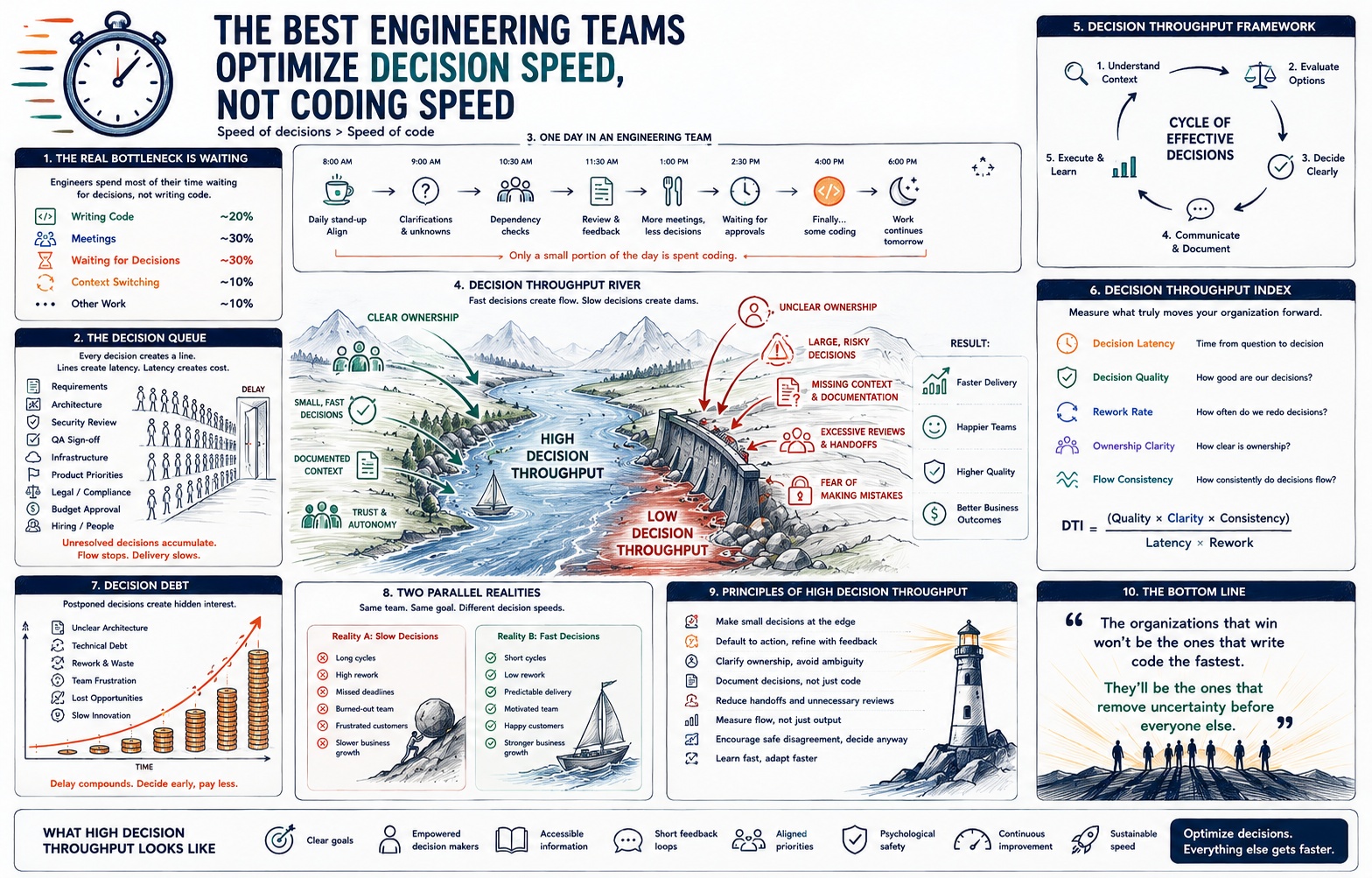
This document introduces a concept we'll return to from a dozen angles: Decision Throughput — the organizational capability to consistently make correct engineering decisions with minimal delay and minimal rework. Treat it the way you'd treat compute capacity, or headcount, or technical debt. It is an asset. It can be measured, starved, invested in, or quietly bankrupted.
The format of this document will shift constantly — narrative, field notes, Slack transcripts, journal entries, meeting minutes, decision logs, executive memos, future forecasts. That's intentional. Organizational friction doesn't show up in one format either. It hides in emails, in silences, in meetings that produce excellent slides and no decisions. To see it clearly, you have to look at it from every angle at once.
Part One — One Working Day
8:00 AM
Maya opens her laptop. Three Slack channels have overnight messages. One is from the on-call engineer in a different timezone, flagging a schema question that's been sitting unanswered since yesterday afternoon. She reads it, has an opinion, but isn't the owner of that service anymore — ownership moved teams eight weeks ago and nobody updated the CODEOWNERS file. She pings the new owner. He's not online yet.
8:20 AM
Daniel, a senior backend engineer, opens a pull request that's been sitting for two days. It implements a caching layer they discussed in a design doc three weeks ago. The design doc has four open comments. Two are from the security team, unanswered. One is from a staff engineer who suggested a different eviction strategy and never followed up. Daniel can't merge until the comments resolve, but resolving them isn't his decision to make.
He starts on something else.
9:00 AM
Standup. Six people. Five of them say some version of "still blocked on the same thing as yesterday." Nobody in the room can unblock anyone else. The blockers live one layer up — with a director who is in back-to-back external meetings until Thursday.
10:00 AM
Architecture review. Twelve people, ninety-minute meeting compressed into sixty due to a calendar conflict. The proposal is solid. Three people ask thoughtful questions. The room runs out of time before reaching a recommendation. Someone says, "Let's take this offline." It will not be taken offline. It will resurface, unresolved, in two weeks.
11:30 AM
Priya, a product manager, needs an engineering estimate for a roadmap review happening at 2 PM. The feature touches three services owned by two different teams, one of which is mid-reorg and doesn't currently have a confirmed tech lead. She spends ninety minutes trying to find someone authorized to give an estimate rather than actually getting an estimate.
1:00 PM
Lunch. The only true no-decision hour of the day.
2:00 PM
Roadmap review. Priya presents without the estimate. The room asks her to "follow up." The feature slips another sprint — not because anyone worked on it slowly, but because nobody could agree, quickly enough, on who was allowed to answer a question.
3:15 PM
Daniel's caching layer PR gets one of its two blocking comments resolved. The security reviewer, finally free, approves with a caveat: "let's revisit eviction strategy post-launch." Nobody writes this down anywhere durable. It lives in a PR comment thread that will be functionally invisible in three months.
4:30 PM
Maya's schema question from 8 AM finally gets an answer — from someone who isn't sure it's the right answer, because the actual owner is still not confirmed. The fix ships anyway, because shipping something felt better than shipping nothing.
5:45 PM
The engineering leadership Slack channel has a message from the CEO: "Why did the search feature slip again?"
Nobody replies immediately. Everyone is thinking through how to answer without saying the true thing, which is:
The code wasn't slow. The decisions were.
Part Two — The Invisible Queue
Picture the org chart not as boxes and lines but as a building with a single hallway, and in that hallway, invisible lines of people, each holding a decision that needs to be made before they can move.
The Requirements Queue. Product waiting on customers. Customers waiting on their own stakeholders. Engineers waiting on Product. The queue rarely empties; it just changes shape.
The Architecture Queue. A proposal, submitted, then re-explained three times to three different reviewers who each ask a version of the same question because none of them read each other's comments.
The Security Queue. Perpetually understaffed relative to the volume of things that need review, so everything gets triaged, and triage itself becomes a queue.
The QA Queue. Waiting for a test environment. Waiting for a flaky test to stop being flaky. Waiting for someone to decide whether a known issue is a blocker or "acceptable for launch."
The Infrastructure Queue. A ticket for a new IAM role. A ticket for a subnet. A ticket for a ticket about the ticket.
The Product Queue. Waiting for a PM to prioritize between two things engineering has already built halfway.
The Legal Queue. Slow by design, and reasonably so — but nobody tells engineering why it's slow, so engineering assumes it's just slow.
The Compliance Queue. Similar to Legal, except the criteria for "done" are rarely written anywhere engineers can find them.
The Budget Queue. A cloud spend approval that takes longer than the infrastructure work it's gating.
The Hiring Queue. The slowest queue of all — because an unfilled role is a permanent, silent tax on every decision that role would otherwise have made faster.
If you could see these queues physically, stretching down a hallway, you would immediately understand why "just write more code" was never going to fix anything. The hallway is the actual constraint. The desks are fine.
Part Three — Engineering Time Audit (Field Notes)
Not a percentage breakdown — a set of situations, reconstructed from what actually happens inside real orgs.
- An engineer opens a ticket, reads it, realizes it references a decision from a meeting she wasn't in, and spends twenty minutes trying to find notes from that meeting before she can start.
- A team finishes a feature, then discovers — in code review — that two other teams made conflicting assumptions about the same shared service, because nobody had declared a single source of truth for that domain.
- A senior engineer gets pulled into three unrelated Slack threads before 10 AM, each one needing his specific knowledge, none of which anyone else can supply, because ownership was never explicitly documented anywhere durable.
- A team re-litigates a technology choice that was "decided" six months ago, because the decision was never written down, only remembered — and memories disagree.
- An engineer finishes a PR and waits four days for review, not because reviewers are lazy, but because there is no shared expectation of review SLA, so review happens whenever it happens.
- A dependency is deprecated, and three teams independently discover this the hard way, because there was no clear decision-owner for the platform layer that would have caught it centrally.
- A meeting is scheduled to "align on approach," attended by nine people, four of whom didn't need to be there, because nobody was confident enough to decide who actually needed to be in the room.
None of this shows up on a burndown chart. All of it shows up, eventually, in the delivery date.
Part Four — The Decision Map
Think of the engineering organization as a transportation network, and every decision as a vehicle trying to get somewhere.
Highways are the decisions that move fast because ownership is unambiguous — a tech lead with real authority, a documented default, a precedent everyone trusts.
Traffic lights are the decisions that must pause for coordination — cross-team dependencies, shared infrastructure changes — necessary, but only efficient when the timing is well-tuned.
Roundabouts are the recurring debates that never fully resolve — naming conventions, tooling preferences, "should this be a monorepo" — decisions that keep circling without ever exiting toward a destination.
Dead ends are decisions routed to a person or committee that, in practice, cannot or will not decide — a working group with no mandate, an "owner" who was never actually given authority.
Broken bridges are the places where two parts of the organization can no longer efficiently reach each other at all — usually after a reorg, when reporting lines moved but working relationships didn't.
Every decision in your organization is currently traveling one of these five routes. Most engineering leaders have never actually drawn the map. They've only ever felt the traffic.
Part Five — CTO Notebook
Loose reflections, collected over several years, in no particular order.
- Every unanswered question becomes tomorrow's blocker.
- Fast code cannot outrun slow approvals.
- Ownership reduces latency more reliably than any process improvement.
- Architecture is compressed decision history.
- Documentation stores decisions, not files.
- A meeting without a decision is a tax with no service delivered.
- The org chart tells you who reports to whom. It rarely tells you who decides what.
- Silence is the most expensive response an organization can give.
- "Let's take this offline" usually means "let's take this nowhere."
- Every reorg resets institutional trust to zero, even when it preserves the org chart's logic.
- Speed without authority is just motion.
- The real cost of a blocked engineer isn't the hours lost — it's the context that decays while they wait.
- Consensus is expensive. Sometimes it's worth the price. Often it isn't.
- Escalation paths that nobody has ever used aren't escalation paths. They're decoration.
- A team that argues about naming conventions for an hour has told you something true about how it handles bigger decisions.
- Uncertainty doesn't go away when you ignore it. It compounds.
- The fastest teams aren't the ones with the fewest meetings. They're the ones whose meetings end in decisions.
- Every "TBD" in a design doc is a future incident report waiting to be written.
- Process exists to make decisions faster, not to replace the need for someone to make one.
- If two people can both say no and neither can say yes, you don't have a decision-maker. You have a veto committee.
- Clarity is a form of respect for other people's time.
- Most postponed decisions were never actually hard — they were just unowned.
- A roadmap is a set of commitments about decisions not yet made. Treat it accordingly.
- The org that documents its defaults spends less time re-deciding them.
- Trust is the mechanism that lets decisions move without full verification. Losing it slows everything, permanently, until rebuilt.
- Ambiguity delegated downward without authority is just anxiety with better production values.
- The best architecture reviews end with a decision and an owner, not a summary and a follow-up.
- Engineers don't fear hard decisions. They fear decisions nobody will stand behind.
- A blocked PR is a symptom. An unowned domain is the disease.
- Every hour spent clarifying scope is an hour not spent building the wrong thing slowly.
- The absence of a decision is itself a decision — usually the worst available option, chosen by default.
- If your best engineers are your bottleneck, it's not because they're slow. It's because everyone routes decisions through them.
Part Six — Meeting Without Decisions (Transcript)
Meeting: "Sync on Notification Service Redesign" Attendees: 9 | Duration: 60 minutes | Decisions made: 0
PM: So the goal today is to align on approach before we lock the roadmap.
Staff Engineer: I think we're overcomplicating this. A pub/sub model solves 90% of what we need.
Platform Lead: We looked at that last year and ran into throughput issues at our scale.
Staff Engineer: That was a different implementation, though.
Security: Before we go further, has this been threat-modeled?
PM: Not formally, no.
Security: We'd want that before commit.
Eng Manager: Can we timebox that so it doesn't block the sprint?
Security: Depends on scope. Can someone send me the design doc?
PM: I'll share it after this.
Staff Engineer: I still think pub/sub is right, but I'm open to being wrong.
Platform Lead: Let's take this offline and regroup.
PM: Great, sounds like good progress. I'll send a follow-up.
The slides were clean. Everyone contributed. Nobody was rude, dismissive, or unprepared. And yet the meeting produced nothing except a longer list of people now individually responsible for following up on things that, collectively, nobody owns. This is the most dangerous kind of meeting: the kind that feels productive because the conversation was intelligent, while producing zero forward motion. The real cost isn't the sixty minutes nine people spent in the room — it's the two weeks the redesign now sits, unstarted, waiting for a decision that never actually got made, only discussed.
Part Seven — The Organization Orchestra
Every engineer in your organization is a skilled musician. Give them a part, and they'll play it well — often brilliantly.
But an orchestra without a conductor doesn't produce silence. It produces noise — confident, well-rehearsed, technically proficient noise. Each section plays its own tempo. The strings finish early. The brass is still building toward a climax nobody else is playing toward. Individually, every musician is excellent. Collectively, the audience hears chaos.
Coding is playing the instrument. Decision-making is conducting. An organization that invests entirely in developer skill and never in decision clarity is an orchestra that hires world-class musicians and never hires a conductor — then wonders, every quarter, why the music doesn't come together on schedule.
The conductor doesn't play a single note. Their entire value is timing, sequencing, and the authority to say now — and that is precisely why their role is so easy to underinvest in. It produces no visible artifact. It only produces coherence.
Part Eight — Engineering Weather Report
Forecast: This Quarter
Fog over the payments team. Requirements are present but low-visibility — everyone can sense the shape of what's needed, nobody can see it clearly enough to commit. Expect slow, cautious movement.
Storm warning on the platform migration. Multiple fronts colliding: a leadership change, an unresolved architecture debate, and a deadline set before either was settled. High probability of disruption.
Clear skies on the mobile team. A confirmed owner, a documented decision framework, and a backlog with no ambiguous dependencies. Expect high velocity and few surprises.
Crosswinds around the identity service. Two teams pulling in adjacent but not identical directions — not a storm, but enough turbulence to knock things off course if unaddressed.
Rising pressure in the security queue. Volume increasing faster than review capacity. If unaddressed, expect a squall — a sudden, forced prioritization when something breaks.
Uncertainty, like weather, is not a moral failing. It cannot be eliminated. But it can be forecast, prepared for, and — critically — routed around, if you know it's coming.
Part Nine — Parallel Universes
Universe A
An eight-person team, exceptional engineers, ships code at a blistering pace. But every architectural question routes through a director who is available two hours a week. Every ambiguous requirement waits for a product leader juggling four other initiatives. The code is fast. The decisions are not.
Universe B
A similarly sized team, competent but not exceptional engineers, ships code at a moderate, sustainable pace. But every domain has a single clear owner. Every ambiguous requirement has a documented default answer, revisited only when it stops working. Escalation, when needed, resolves in hours, not weeks.
Six Months Later
Universe A has produced more commits, more pull requests, more raw lines of code — and shipped fewer completed features to production. Half its "done" work sits behind unresolved architecture questions. Its best engineers are exhausted, not from coding, but from being the only people anyone trusts to decide anything.
Universe B has shipped less code, in total, and delivered more business outcomes. Its team is not visibly heroic. It simply never got stuck for long.
The difference wasn't talent. It wasn't tooling. It was the average distance between an open question and a confident answer.
Part Ten — Internal Email Archive
From: Security Review To: Platform Team Subject: Notification Service — Threat Model Needed
We can't sign off without a threat model. Please advise timeline. This has been in our queue for 9 business days.
From: Platform Lead To: Security Review Subject: RE: Notification Service — Threat Model Needed
We didn't realize this was blocking on us — I thought PM was coordinating the threat model with your team directly. Can we sync this week?
From: Product Manager To: Platform Lead, Security Review Subject: RE: RE: Notification Service — Threat Model Needed
I thought Security owned initiating threat models for new services? Happy to help however's useful, just need someone to tell me what's needed from my side.
From: Staff Architect To: Platform Team Subject: Quick question on the pub/sub assumption
Following up from the sync last week — are we still assuming the old throughput ceiling applies? That was measured on the previous infra generation. Might change the whole calculus.
From: CEO To: VP Engineering Subject: Notification redesign timeline
Saw this slipped again on the roadmap review. What's actually going on here? Do we need more engineers on this?
No single email is unreasonable. Nobody is negligent. Read individually, each message looks like ordinary business correspondence. Read together, the pattern is unmistakable: three separate people each believed someone else owned the next step, and the actual work — writing code — was never the constraint at any point in this thread.
Part Eleven — Decision Ecology
Treat your organization's decisions as a living ecosystem, not a checklist.
Small decisions are the plankton — naming a variable, choosing a default timeout, picking a library version. Individually trivial. Collectively, they feed everything above them.
Some decisions become predators: a single unresolved architectural choice that consumes every smaller decision downstream, forcing them all to wait, restart, or re-justify themselves once it's finally settled.
Some decisions go extinct: important choices that were needed at one point, never made, and eventually become irrelevant — not because they were resolved, but because the moment passed and the organization moved on without them, leaving a fossil record of half-finished designs and abandoned tickets.
And some patterns become invasive species. A single well-intentioned exception — "just this once, let's skip the review for speed" — reproduces. Within two quarters, "just this once" is the default path, and the review process it bypassed has quietly died out, unmissed until the incident that proves it was load-bearing.
Healthy decision ecosystems are diverse: fast paths for small decisions, careful paths for consequential ones, and enough visibility that nobody has to guess which is which.
Part Twelve — Decision Debt
Definition: Decision Debt — the compounding cost of a choice that was postponed rather than made, resolved not through avoidance but through eventual, more expensive resolution.
Like technical debt, it's invisible on the balance sheet and entirely real in its consequences.
Naming. A service is named provisionally, "just for now." Eighteen months later, the name is load-bearing in a hundred places, and renaming it costs a sprint nobody wants to spend.
Architecture. A "temporary" synchronous call between two services becomes permanent infrastructure, because the interest payment — a small performance cost — is quieter than the principal payment — a redesign.
Ownership. A service with no clear owner accumulates orphaned incidents, each one slightly harder to resolve than the last, because the person closest to the code changes every time.
Technology selection. A framework chosen "to unblock the prototype" ships to production, then becomes the reason hiring is harder, because nobody wants to learn it and nobody who knows it wants to stay.
Prioritization. A "we'll get to it next quarter" item survives four consecutive quarters, silently blocking three other initiatives that depend on it, none of which realize the dependency until it's on the critical path.
Hiring. A role left open "until we're sure about the org design" delays every decision that role would have made, for every week it stays open — and the interest compounds fastest here, because an empty seat is a permanent decision-latency tax.
Documentation. An undocumented decision has to be reconstructed from memory every time it's questioned — and memory, unlike documentation, charges interest in the form of disagreement.
Platform strategy. A deferred platform decision gets made implicitly, team by team, until the organization discovers it now has five slightly different answers to the same question, and reconciling them costs far more than deciding once would have.
Decision Debt, like technical debt, is sometimes the right call — a deliberate trade against a real deadline. The danger isn't taking it on. The danger is not tracking it, and being surprised, a year later, by the interest.
Part Thirteen — The Fastest Engineering Team (A Micro Case Study)
There's a team — call it Aurora, though that's not its real name — with an outsized reputation for shipping fast. Competitors assume they have more engineers. They don't. They assume better tooling. Their tooling is unremarkable. They assume aggressive use of AI code generation. It helps, but it's not the differentiator.
Their real advantage is boring, structural, and almost entirely invisible from the outside: every domain has exactly one accountable decision-maker, and every decision-maker has a documented default answer for the ninety percent of questions that don't need a meeting.
When ambiguity shows up, it doesn't wander the hallway looking for someone willing to own it. It has an address. It arrives, gets resolved — usually in under a day — and moves on. Their architecture reviews aren't longer or more rigorous than their competitors'. They're just conclusive: every review ends with a decision and a name attached to it, not a follow-up.
Aurora doesn't optimize for developer happiness surveys or commit velocity dashboards. They optimize, relentlessly, for one number nobody else is tracking: the average time between a question being asked and a decision being made. Everything else about their engineering culture is ordinary. That one thing is not.
Part Fourteen — Future Snapshot: 2035
Forecast — Confidential Strategy Memo
By the mid-2030s, AI-assisted code generation has made the act of writing correct, working software nearly instantaneous for the majority of well-specified problems. Coding, as a bottleneck, has largely disappeared. This does not make engineering organizations faster. It makes the actual bottleneck — decision quality — impossible to hide behind anymore.
When code is nearly free, the entire value of a human engineering organization concentrates into a small set of irreducibly human functions: judgment about trade-offs, prioritization under uncertainty, risk assessment with incomplete information, architectural taste, and the organizational leadership required to make a decision stick once it's made.
Organizations that spent the 2020s investing exclusively in developer productivity tooling — without ever investing in decision infrastructure — will find themselves with extraordinarily fast production lines and no reliable way to decide what to produce. Decision Throughput, largely unmeasured and unmanaged in this era, becomes the dominant, almost the only, durable competitive advantage in software organizations. The winners of this era will not be recognizable by their engineering headcount or their AI tooling stack. They'll be recognizable by how quickly uncertainty, once identified, stops being uncertain.
Part Fifteen — A Letter to New CTOs
You're going to inherit a team that already knows how to write code. That was never going to be the hard part, and within your first quarter, you'll feel the real constraint before you can name it — the strange sensation of watching capable people spend entire days waiting for permission, clarity, or each other.
Don't measure your organization by how fast it writes code. Measure it by how long uncertainty survives once it's identified. Watch a single ambiguous question from the moment it's raised in a standup to the moment someone with real authority resolves it. That interval — not your commit graph, not your sprint velocity — is the truest health metric you have.
Give people unambiguous ownership before you give them more process. Write down your defaults before you write down your policies. End every meeting that was supposed to produce a decision with an actual decision, attached to a name, or don't schedule the follow-up — cancel the meeting series entirely and let the decision find its owner directly.
The organizations that win won't be the ones that write code the fastest. They'll be the ones that remove uncertainty before everyone else.