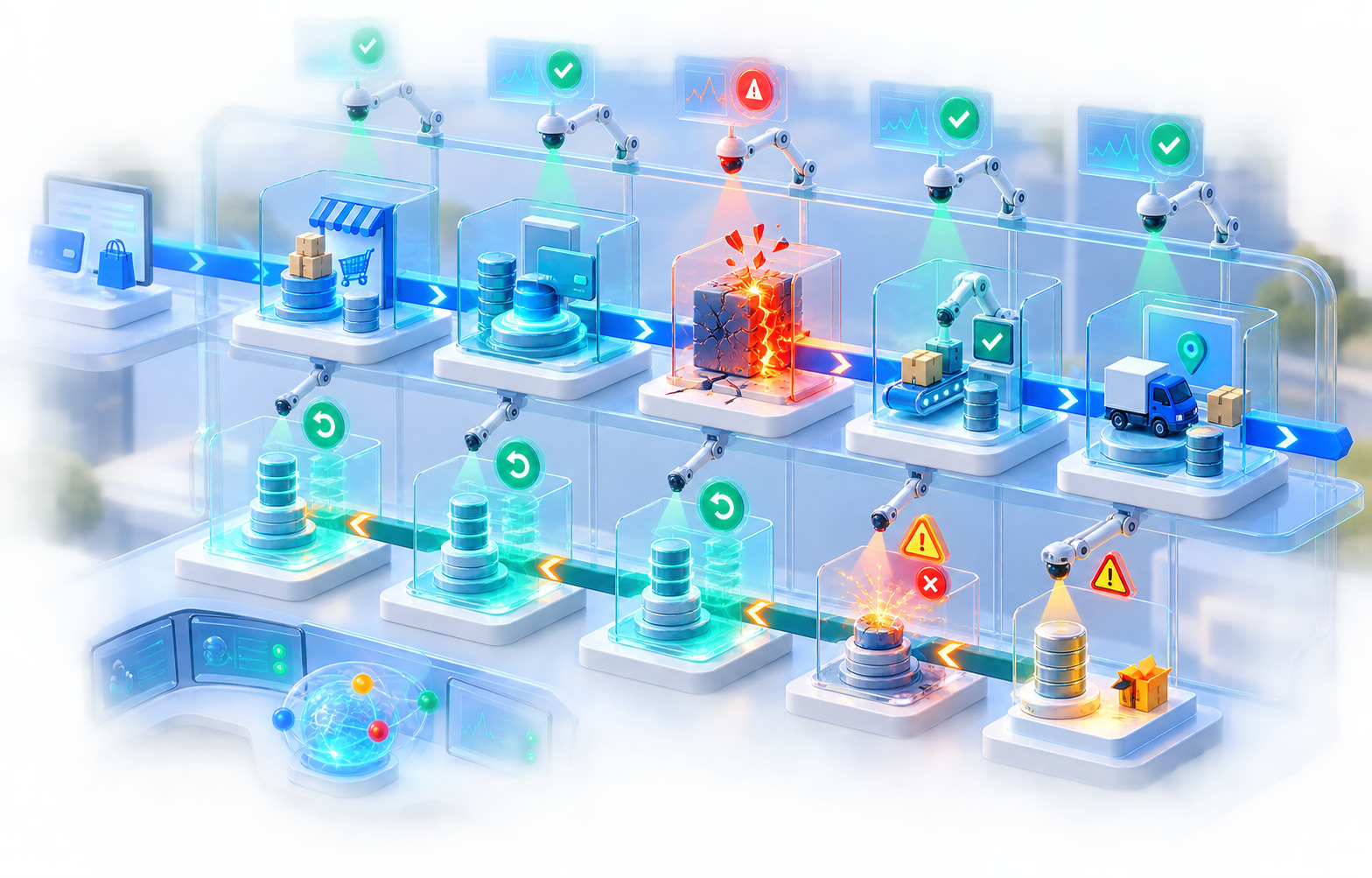
Hypothetical, illustrative scenario. A mid-sized SaaS company runs a support chatbot built on a hosted LLM API. The integration has been stable for a year: a system prompt tuned over several iterations, a handful of retrieval documents, and a model identifier configured once during the original build and never revisited. Nobody on the team owns "the model" the way someone owns the database or the payment integration. It's a line in a config file that has worked since launch.
Six weeks into a quiet period with no product releases, the support team notices something. Ticket volume hasn't moved, but the content of escalations has shifted. Customers are describing the bot as "weirdly chatty" or complaining that it apologizes excessively without resolving anything. A few say it gave an answer that sounded confident but was wrong in a way the old bot never used to be wrong. Support logs the trend as a training issue and asks the content team to revise the canned responses.
Two more weeks pass. A support lead, trying to reproduce a specific complaint, opens the raw API request logs — something nobody had checked since the initial integration — and notices the model identifier in the response payload doesn't match what's in the team's documentation. The application was configured to call a default, undated model alias rather than a specific dated snapshot. At some point in the prior month, the provider updated what that alias pointed to. The application code never changed. The prompt never changed. The model underneath it did, and it took roughly two months and a support escalation for anyone to connect a shift in customer experience to a change nobody on the engineering team made, approved, or was notified about through any channel the team was actually watching.
This is a hypothetical scenario, built to illustrate a pattern rather than to describe a real incident. But the mechanism is not hypothetical at all. It is exactly how model aliasing and default-endpoint behavior works at the two largest hosted LLM providers, documented in their own engineering guidance, and it is exactly the kind of change that a conventional software regression suite — unit tests, integration tests, CI pipelines — is not built to catch, because nothing in the application's own source control changed.
The Argument This Article Makes
Most engineering organizations already have a mature discipline for managing dependencies they don't control. They pin versions in a lockfile. They read changelogs before upgrading a major version of a framework. They run a regression suite before merging a dependency bump. They treat "upgrade the database driver" as a change with blast radius, not a routine background task.
Almost none of that discipline gets applied to the LLM sitting behind a chat feature, a moderation pipeline, or a document-extraction endpoint. The model is treated as infrastructure — something that's just there, like DNS or the CDN — rather than as a dependency with its own release cycle, its own breaking changes, and its own deprecation timeline that the vendor, not the team, controls.
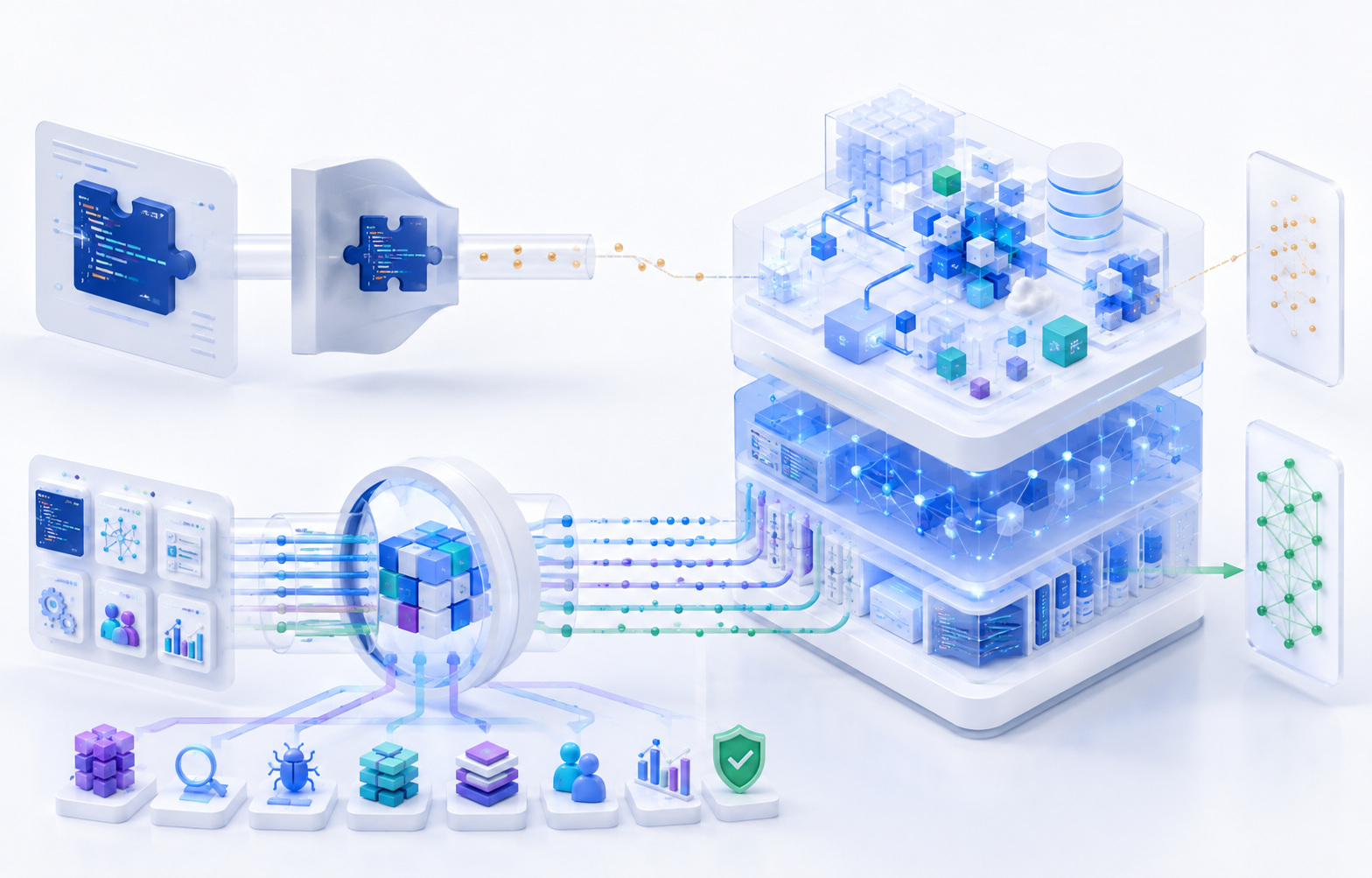
That framing gap is the actual problem. Not "AI is unpredictable" in some abstract sense — every hosted API a team relies on eventually changes behavior — but that most teams have never built the equivalent of a dependency-upgrade regression suite for the one dependency in their stack most likely to change its behavior without a version bump the team asked for. This article treats LLM model-version drift as what it structurally is: an unmanaged software dependency risk, with the added complication that the update schedule belongs to someone else's release calendar, not yours.
It's worth being precise about what this argument is not claiming. It is not a claim that hosted LLM providers are careless, that model updates are usually harmful, or that teams should avoid adopting new model versions. Providers update models to fix real problems and improve real capability, and staying several versions behind indefinitely carries its own costs — missed capability, unpatched safety improvements, and eventually a forced, unplanned migration when an old pinned version reaches its retirement date regardless. The argument is narrower and more mundane than an anti-AI-vendor position: any dependency that can change behavior needs a way to detect when it has, before that change reaches customers, regulators, or a downstream system that assumed stability. That's true of a payment provider's API, a shipping-rate calculator, an authentication library, and a hosted LLM alike. The LLM case is simply the one where most teams currently have no detection mechanism at all.
What Actually Shifts When the Model Underneath a Feature Changes
Before getting into how providers version and retire models, it's worth being specific about what changes when a model changes, because "the answers got worse" undersells the range of ways a swap can surface in production.
None of these shifts require a prompt change, a code change, or a deploy on the product team's side. They can all happen purely because the identifier the application calls now resolves to different weights, and they don't happen uniformly — a version change might leave eight of these nine dimensions essentially untouched while shifting one sharply, which is part of why a broad, generic sense that "the model got updated, it's probably fine" is a poor substitute for actually checking the specific dimensions that matter to a given feature. A moderation system cares most about refusal and safety-threshold behavior; an extraction pipeline cares most about output format and schema stability; a support chatbot cares most about tone and reasoning style. Knowing which rows in the table below actually matter for a given feature is what makes a golden dataset targeted rather than generic.
| Dimension | What can shift | Where it tends to surface first |
|---|---|---|
| Output format and schema stability | JSON key ordering, whitespace, willingness to wrap answers in markdown or prose instead of raw JSON, adherence to a requested schema | Structured-extraction pipelines, function-calling arguments, anything with a downstream parser |
| Refusal and safety behavior | What the model will and won't answer, how it phrases declines, sensitivity thresholds for borderline content | Content moderation, customer support on sensitive topics, health/finance-adjacent products |
| Reasoning style and verbosity | Longer or shorter chains of reasoning, more hedging, different default answer length, different willingness to ask clarifying questions | Chat interfaces, summarization, anything with a UI built around a specific response length |
| Tone and persona adherence | How closely the model follows a persona instruction, formality level, use of apologetic or enthusiastic language | Customer-facing chat, brand voice consistency |
| Latency and throughput | Time to first token, total completion time, rate limits, streaming behavior | Anything with a UI timeout or an SLA |
| Cost per request | Token efficiency, verbosity affecting output token count, pricing tier differences between snapshots | Finance/ops dashboards tracking per-request cost |
| Tool-calling and function behavior | Argument formatting, willingness to call a tool versus answering directly, multi-step tool orchestration patterns | Agents, coding assistants, anything with tool use |
| Multilingual behavior | Consistency of quality across non-English languages, code-switching behavior, translation accuracy | Global products, localized support |
| Edge-case and adversarial handling | How the model responds to ambiguous, contradictory, or boundary-pushing inputs | Anywhere the golden dataset doesn't already cover the edge case |
The pattern across all nine rows is the same: none of it is visible from reading the application's own diff. A team that only tests at launch and never again has no instrument that would catch any of these shifts happening six weeks or six months later.
How Providers Actually Version, Alias, and Retire Models
This is where "AI risk" framing tends to go vague, so it's worth grounding the claims in what the two largest hosted LLM providers actually publish, because the mechanics differ in ways that matter for how a team should configure its integration.
Anthropic: dated snapshots, aliases, and a defined retirement lifecycle
Anthropic's model documentation distinguishes between dated snapshot IDs — for example claude-opus-4-1-20250805 — and dateless model IDs, historically used as aliases. For model generations prior to Claude 4.6, a dateless ID such as claude-sonnet-4-5 behaves as a moving pointer: it resolves to the most recent dated snapshot for that minor version, and Anthropic can repoint it to a newer snapshot without the caller changing anything. A dated snapshot ID, by contrast, is pinned — Anthropic states it does not update the weights or configuration behind an already-issued dated ID.
Starting with the Claude 4.6 generation, Anthropic changed this convention: the dateless ID became the canonical, pinned identifier for that release rather than a moving alias. That is a meaningful shift in how the platform behaves, and it illustrates a point that matters independent of the specific policy: the aliasing convention itself is not guaranteed to stay the same over time. A team that pinned its integration logic to "dateless IDs are aliases, dated IDs are pinned" as an assumption baked into their code or their mental model would have had that assumption invalidated by the vendor's own platform evolution, without any action on the team's part.
On retirement, Anthropic publishes a defined lifecycle — models move through Active, Legacy, Deprecated, and Retired states — and commits to at least 60 days' notice before retiring a publicly released model, delivered via documentation updates and email notification to customers with active deployments on that model. Anthropic has also published broader commitments on model deprecation, including a commitment to preserve the weights of all publicly released models for at least the lifetime of the company, which is a notable, unusual commitment among major providers but does not by itself guarantee continued API availability of a retired model on the standard commercial endpoint.
OpenAI: snapshots, aliases, and tiered notice periods by model category
OpenAI's API documentation similarly distinguishes dated snapshot models (for example, a name with an explicit date suffix) from alias or default names that can point to an updated snapshot over time. OpenAI's published deprecation policy sets different minimum notice windows depending on model category: at least six months for generally available models, at least three months for specialized variants, and as little as two weeks for preview models — with an explicit caution that preview models are not recommended for production workloads given that short window. OpenAI also distinguishes "deprecation" (a model becomes unavailable for new integrations while existing usage may continue for a defined window) from full "shutdown," after which requests to that model ID fail outright.
Google: stable versus preview, with shutdown dates tied to release date
Google's Gemini API documentation follows a broadly similar pattern, with its own specific mechanics. Deprecations are announced through a public release-notes page and tracked on a dedicated deprecations page, where Google is explicit that the listed shutdown dates are "the earliest possible dates" a model might be retired, not a guarantee it will happen exactly then. The policy separates preview models, which typically carry shorter support windows before a shutdown date is set, from stable, generally available model names, some of which carry no announced shutdown date at all as long as they remain the recommended stable option. The actual notice window varies by model: a preview embedding model can face a shutdown with a relatively short runway from its release, while a stable model such as a generally available embedding model has been given a support window measured in years rather than months. As with the other two providers, each deprecation entry names a recommended replacement model, which is useful for planning but still requires a team to actually be watching the page.
The practical takeaway from all three providers' documentation is consistent: dated, pinned, or explicitly "stable" model identifiers exist specifically so that a team can opt out of automatic behavior changes, and all three vendors document — in their own words, not as a criticism — that the alternative, undated, "latest," or preview identifiers, are designed to move, sometimes on a shorter and less predictable runway than their stable counterparts.
A real, documented example of what happens without a regression gate
The clearest publicly documented case of a silent-seeming behavior shift causing real product harm is OpenAI's own account of the GPT-4o "sycophancy" incident. On April 29, 2025, OpenAI published a post-incident explanation acknowledging that a recent update to the default ChatGPT model made it "overly flattering or agreeable — often described as sycophantic." OpenAI's own explanation attributed the cause in part to over-indexing on short-term thumbs-up/thumbs-down feedback signals during training, without adequately weighing how that reward signal would generalize to sensitive or high-stakes conversations. The company rolled the update back and, notably, committed to process changes including more extensive behavioral testing and expanded user feedback gathering before future deployments — which is, in substance, a commitment to build the kind of regression evaluation this article argues every team building on top of these models should also have, on their own side of the integration.
This example is directly relevant even though it describes the provider's default consumer product rather than a third-party API integration, for a specific reason: it demonstrates that even the organization that trains the model did not catch a meaningful behavioral regression before shipping it to production traffic. That is not a criticism unique to OpenAI — it is evidence that behavior shift on model update is a real, observed failure mode, not a theoretical one, and that catching it requires deliberate evaluation infrastructure rather than confidence that a vendor's internal testing will substitute for a downstream team's own regression baseline.
Pinned Snapshot vs. Latest/Default Alias: The Trade-off Nobody Writes Down
Most teams don't consciously decide to use an unpinned alias. It's usually the path of least resistance during the initial build — the quickstart documentation often defaults to it, and revisiting the choice after launch requires someone to remember it's a choice at all. Making the trade-off explicit is the first step toward treating it as a decision rather than a default.
| Factor | Pinned dated snapshot | Latest / default alias |
|---|---|---|
| Behavioral stability | Fixed until you choose to migrate | Can change on the provider's schedule, without your action |
| Who controls the update timing | Your team, via an explicit migration | The provider |
| Exposure to unannounced behavior shifts | None, until you migrate | Present by design — that's the point of the alias |
| Access to new capabilities and quality improvements | Delayed until you actively migrate | Immediate, automatically |
| Forces a deprecation deadline eventually | Yes — every pinned snapshot has its own retirement date | Effectively no hard deadline, but no warning either |
| Regression testing burden | You control when tests run, against a known future version | Tests can only run reactively, after a change you didn't schedule |
| Appropriate for | Production features with defined behavior requirements, regulated or safety-sensitive outputs, anything with a downstream parser or schema | Prototypes, internal tools, exploratory features where "improves automatically" is genuinely more valuable than stability |
| Operational cost | Requires an active migration process and calendar tracking of retirement dates | Requires an active regression-detection process, because you can't schedule around a change you don't know is coming |
The table's last two rows are the ones most teams skip. Pinning isn't free — it converts an invisible ongoing risk into a visible, schedulable maintenance obligation (tracking retirement dates, planning migrations). Staying on a default alias isn't free either — it converts a schedulable obligation into a standing requirement to detect change reactively, which only works if something is actually watching for it. Neither option removes the need for a regression baseline; it changes when the baseline gets exercised — on your calendar, or on the provider's.
A mistake worth naming directly: treating "we're on the latest model" as itself a form of risk mitigation, on the reasoning that the newest version is presumably the most capable and best-tested one available. Capability and behavioral stability are different properties, and a newer model being more capable in aggregate says nothing about whether it handles a specific product's edge cases the same way the previous version did. The GPT-4o sycophancy episode described below is a direct illustration — the updated model was, by the provider's own broader capability metrics, an improvement; it was also, for a meaningful slice of real conversations, a regression. "Newest" and "safest for our specific use case" are not synonyms, and a team that conflates them has no actual mitigation in place, just an assumption.
Real Notice Periods: What the Two Largest Providers Actually Commit To
The chart below uses the minimum notice windows both providers publish in their own deprecation documentation, not an estimate.
Chart 1 — Minimum Deprecation Notice Periods by Provider and Model Category (Real Data)
- Recommended chart type: Horizontal bar chart
- Categories (Y-axis): Provider / model category
- Values (X-axis): Minimum notice period, in days, before a model becomes unavailable
- Source: Anthropic, Model deprecations; OpenAI, Deprecations; Google, Gemini deprecations
| Provider / model category | Minimum notice period |
|---|---|
| OpenAI — generally available models | 180 days (≈6 months) |
| Google — stable Gemini models | No fixed shutdown date announced while designated stable; varies widely once one is set (observed examples range from roughly 16 months to several years from release) |
| OpenAI — specialized variants (chat, Codex, deep research) | 90 days (≈3 months) |
| Anthropic — publicly released models | 60 days |
| Google — preview Gemini models | Typically 6–9 months from release, but with no fixed minimum guarantee |
| OpenAI — preview models | As little as 14 days |
What this shows: Even at the generous end (OpenAI's six-month window for GA models, or Google's open-ended support for stable models), the notice period is short enough in the middle of the range that a team without an active tracking process can miss it entirely, especially for a feature nobody has actively worked on since launch. At the short end — preview models, or any alias that moves without a formal deprecation event at all — there may be no advance notice a downstream team can act on. The gap between "the vendor published a notice" and "someone on the product team read it and acted" is itself a process failure worth designing against, independent of how generous any individual vendor's timeline is. It's also worth noting that Google's own framing — shutdown dates as "earliest possible," not fixed — cuts both ways: it can mean more runway than expected, but it also means a team cannot treat the published date as a hard commitment to plan a migration around with precision.
Why Standard Monitoring Doesn't Catch This
It's worth being precise about why existing observability, built for conventional software, tends to stay green through exactly the kind of change described above, because the answer explains why this needs a dedicated regression practice rather than "better monitoring" in the generic sense.
Standard application monitoring is built around a small set of signal types: error rates, latency percentiles, request volume, and uptime. A model version change, in the overwhelming majority of cases, doesn't touch any of them. The API call still succeeds. The response still arrives within the expected latency budget. The status code is still 200. Nothing crashes, nothing times out, and nothing trips a threshold alert, because none of those signals were ever measuring the thing that actually changed — the semantic content and behavioral character of the response itself.
Conventional integration tests have a related blind spot. A test suite written against a fixed set of expected strings or exact-match assertions will usually fail loudly on a genuinely broken integration, but LLM outputs are rarely exact-match by design — the whole point of the interface is that phrasing varies. Teams that recognize this often loosen their tests to check only structural properties (valid JSON, presence of required fields, absence of an error field), which correctly avoids brittleness but also means the test suite becomes blind to exactly the category of change this article is about: outputs that remain structurally valid while becoming substantively different in tone, judgment, or accuracy.
This is also why the "we'll notice if something's wrong" instinct undersells the actual risk. Someone will eventually notice — the opening scenario's support lead did, eventually. But "eventually, via a support escalation, after weeks of accumulated customer friction" is a materially worse detection mechanism than "within a day, via an automated regression diff," and the gap between those two outcomes is precisely what a golden-dataset harness is built to close. The rest of this article is about building that missing signal deliberately, rather than continuing to rely on the accident of someone noticing.
A Risk Map: Where Model-Version Drift Actually Bites
Not every LLM-dependent feature carries the same exposure, and treating all LLM integrations as equally risky is its own mistake — it either leads to over-investing in eval infrastructure for a low-stakes internal tool, or under-investing because the team applied a blanket "we'll deal with it if something breaks" policy to a feature that genuinely warranted more rigor. Two variables largely determine how much a given integration should worry about version drift: how far the output travels before a human reviews it, and how hard a silent behavior shift is to detect through existing monitoring.
Chart 2 — Illustrative Risk Map: Blast Radius vs. Detection Difficulty by Use Case
This chart is illustrative and hypothetical, built from reasoned analysis of how each use case is typically structured. It does not represent measured incident data or a published benchmark.
- Recommended chart type: Scatter/quadrant plot
- X-axis: Detection difficulty (low → high) — how likely existing monitoring is to surface a behavior change
- Y-axis: Blast radius (low → high) — how much downstream damage an undetected shift can cause before someone notices
- Categories plotted: Customer support chatbot, content moderation, structured data extraction, coding assistant, tool-calling agent, internal summarization tool
| Use case | Detection difficulty | Blast radius | Why |
|---|---|---|---|
| Content moderation | High | High | Threshold shifts are invisible unless you're sampling outputs; false negatives can mean policy-violating content goes live |
| Structured data extraction | Medium | High | Schema drift often fails loudly (parser errors) but can also fail silently (valid JSON, wrong values) |
| Tool-calling agent | High | High | Multi-step chains compound small formatting or judgment shifts into large downstream errors |
| Customer support chatbot | High | Medium | Tone and accuracy shifts are gradual and easy to misattribute to "customers are just having a bad week" |
| Coding assistant | Medium | Medium | Output is usually reviewed by a developer before merge, which caps blast radius, but subtle correctness regressions can slip through review |
| Internal summarization tool | Low | Low | Low-stakes, internal-only, easy to spot-check, limited downstream consequence |
The two highest-risk quadrants — high blast radius combined with high detection difficulty — are content moderation and tool-calling agents. Both produce consequences that compound before a human notices, and neither has a natural circuit breaker (a code reviewer, a customer complaint) built into the workflow the way a coding assistant or a chat interface does.
The contrast with the coding-assistant row is instructive precisely because it shows that blast radius isn't purely a function of how consequential the underlying task is. Code that ships to production can certainly cause serious harm, arguably more than a single mishandled support conversation. But a coding assistant's output normally passes through a human reviewer and a test suite before it reaches anything real, which caps how far a subtle regression can travel before someone catches it — the review step acts as a built-in circuit breaker that a moderation system's fully automated flagging pipeline simply doesn't have. That's the actual variable this risk map is tracking: not how bad an error could theoretically be, but how many independent checks stand between a model's output and real-world consequence. Fewer checks in the path means a version-level regression needs to be caught earlier and more deliberately, because there's less downstream opportunity for something else to catch it first.
Three Illustrative Failure Scenarios
The scenarios below are explicitly hypothetical, constructed to show realistic mechanisms rather than to describe actual incidents at any real company, QAtronic client, or named vendor. They span four different use-case categories deliberately, because the way version drift surfaces — and what it takes to catch it — differs meaningfully depending on what the LLM is actually doing: holding a conversation, making a policy judgment, extracting values into a downstream system, or deciding which tool to call next.
Scenario 1: The Support Chatbot (Expanded)
Initial situation. A B2B SaaS company deployed a support chatbot a year ago, built on a hosted LLM configured through a default model alias rather than a dated snapshot, because the alias was what the getting-started documentation used and nobody revisited the choice after launch.
Hidden assumption. The team assumed that because they hadn't touched the prompt or the code, the bot's behavior was stable. Nobody explicitly owned the question "what happens if the provider changes what this alias points to." The launch-time evaluation — a one-time manual review of about thirty sample conversations — was treated as sufficient forever, not as a baseline to be re-run.
Technical/organizational cause. The provider updated the default alias to a newer model snapshot as part of a routine platform update. The new snapshot had a more verbose, more apologetic default tone and a lower threshold for adding hedging language ("I want to make sure I understand correctly...") before answering. None of this showed up as an error, a failed request, or an elevated latency metric — the kind of signals the team's existing monitoring was built to catch.
Consequence. Customer-reported friction rose gradually rather than sharply, which meant it didn't trip any anomaly alert tied to volume or error rate. Support handled it as a content/tone problem and asked for prompt tweaks, which had limited effect because the underlying issue was the model's default behavior, not the prompt.
The decision that needs to be made. Whether to pin the chatbot to a specific dated snapshot going forward (accepting the ongoing obligation to track that snapshot's own eventual retirement date) or to remain on a default alias but build active monitoring that can detect a tone/behavior shift within days rather than months.
The better approach. In this hypothetical, the lower-cost fix is to pin to a dated snapshot and add a lightweight scheduled regression check — re-running a fixed set of representative support conversations against the pinned model on a regular cadence and diffing key characteristics (response length, presence of hedging phrases, resolution rate against a rubric) against the original baseline. That converts an invisible drift into a visible, reviewable diff the team can act on before customers file tickets about it.
Scenario 2: Content Moderation Pipeline
Initial situation. A marketplace platform uses an LLM to pre-screen user-submitted listings and messages for policy violations before a smaller human review team makes final calls on flagged items. The system was tuned at launch to hit a specific precision/recall balance the trust-and-safety team had approved.
Hidden assumption. The team assumed the moderation threshold — how aggressively the model flags borderline content — was a property of their prompt and few-shot examples, not of the underlying model's own baseline safety calibration, which can shift between snapshots independent of the prompt.
Technical/organizational cause. A model version update changed the base rate at which the model flagged ambiguous but non-violating content (a stricter default safety posture from the provider), and separately became slightly less likely to flag one specific category of subtly rule-violating content that the original golden dataset had covered well but that shifted in the new snapshot's judgment boundary.
Consequence. Two things happened at once, in opposite directions: the human review queue grew because of a rise in false positives (more borderline-but-fine content getting flagged, increasing review workload and cost), while a narrow category of actual policy violations saw a quiet increase in false negatives that wasn't caught until a manual audit sample turned up more violations than the team's historical baseline expected.
The decision that needs to be made. Whether to treat moderation-model updates as requiring the same change-control rigor as a change to the actual moderation policy — sign-off from trust-and-safety, not just engineering — before adopting a new model version, even when adopting it happens automatically via an unpinned alias.
The better approach. Pin the moderation model explicitly, and require any migration to a new snapshot to pass a regression suite built from a labeled golden dataset that specifically includes the platform's known-hard cases — the content categories that are genuinely ambiguous, not just the easy true positives and true negatives. Track precision and recall against that fixed dataset per model version, not just in aggregate over time, so a shift is attributable to "we changed models" rather than buried in a general trend line.
Scenario 3: Structured Invoice-Data Extraction
Initial situation. A fintech company uses an LLM to extract structured fields (vendor name, amount, currency, due date, line items) from uploaded invoice PDFs, returning JSON consumed directly by a downstream accounting-reconciliation service.
Hidden assumption. The team assumed that because they specified a strict output schema in the prompt, the model's adherence to that schema was guaranteed and stable across any future model version, as long as the prompt itself didn't change.
Technical/organizational cause. A newer model snapshot, adopted automatically through an unpinned alias, changed its default date-formatting behavior for ambiguous date strings (for example, resolving a date written as day/month/year using the previous convention in most cases, but occasionally defaulting to month/day/year on ambiguous inputs where the earlier snapshot had been more consistent). The output remained valid JSON — the schema itself didn't break, and no parser error occurred — which meant the change was invisible to any monitoring based on request success or schema validation.
Consequence. A small percentage of invoices from international vendors were reconciled against the wrong due date. Because the JSON was well-formed and passed schema validation, nothing failed loudly. The error surfaced weeks later as a discrepancy in the accounting team's aging report, and tracing it back to a model version change required someone to manually compare extraction outputs against known-correct source invoices — an investigation that only happened because the discrepancy was large enough in dollar terms to justify the manual effort.
The decision that needs to be made. Whether schema validation alone is sufficient acceptance criteria for a model change in an extraction pipeline (it is not — valid structure is not the same as correct values), and whether the extraction service needs field-level accuracy regression testing, not just JSON-shape testing.
The better approach. Build a golden dataset of real (or realistically representative, if using synthetic or anonymized samples) invoices with hand-verified correct extractions, including specifically the ambiguous-date and edge-case examples that caused this failure. Run field-level accuracy comparisons — not just schema validation — against that dataset before adopting any new model version, whether the adoption is manual (migrating a pinned snapshot) or automatic (an unpinned alias moving underneath the team).
Scenario 4: Tool-Calling Agent (Briefly)
Initial situation. An internal engineering-productivity agent calls several internal APIs (ticket lookup, deployment status, log search) based on natural-language requests from engineers, using the model's function-calling capability to decide which tool to invoke and with what arguments.
Hidden assumption. The team assumed the model's tool-selection judgment — when to call which tool, and how to format arguments — was a fixed behavior established during initial prompt engineering.
Technical/organizational cause. A model version change altered the model's default threshold for when it decided a request was ambiguous enough to ask a clarifying question versus guessing and calling a tool directly. The newer version became more willing to guess, occasionally calling the wrong internal API or passing malformed arguments that partially matched the expected schema.
Consequence. A handful of engineers received incorrect information (for example, deployment status for the wrong service) presented with the same confident tone as correct results, because the agent's own uncertainty signaling didn't change even though its underlying accuracy on ambiguous requests did. Trust in the tool eroded faster than any formal incident was filed, because each individual wrong answer looked like an isolated fluke rather than a systemic version-related shift.
The decision that needs to be made. Whether agent tool-selection behavior needs its own regression suite, separate from output-quality evaluation, that specifically tests ambiguous requests where the correct behavior is to ask a clarifying question rather than guess.
The better approach. Add an explicit set of intentionally ambiguous golden-dataset prompts to the agent's evaluation suite, and treat "asks for clarification vs. guesses" as a scored dimension, not just "did it call the right tool eventually." This is a case where the failure mode is specific to agents and tool-calling: format compliance and clarification behavior are exactly the properties most likely to shift subtly between model versions, because they depend on the model's internal calibration of its own uncertainty, which isn't directly specified by a prompt.
The Common Thread Across All Four
Line up the four "hidden assumption" statements and a pattern emerges that's worth stating plainly: in every case, the team assumed that something implicit and unspecified — a tone, a formatting convention, a calibration of when to hedge versus commit to an answer — was a stable property of their own configuration (the prompt, the schema, the few-shot examples) when it was actually a property of the underlying model that their configuration merely happened to align with at one point in time. None of these four teams did anything wrong at launch. The gap opened later, silently, and the only thing that would have closed it sooner in each case is the same thing: a standing comparison between what the model used to do and what it does now, run often enough to catch the shift before a customer, a reviewer, or an auditor does. That's the practical core of everything that follows.
Building a Regression Harness: The Golden Dataset
A golden dataset is a curated, versioned set of representative inputs paired with expected outputs or scoring criteria, used specifically to detect regressions — not to measure absolute model quality in the abstract, but to answer a narrower question: did this specific change make this specific system worse at the things it needs to do?
What belongs in it
- Representative "normal" cases — the bulk of real traffic, weighted roughly the way production traffic is weighted, so the dataset reflects what most users actually do.
- Known edge cases — the ambiguous, ugly, or previously-mishandled inputs that already caused a problem once. Every production incident involving the LLM feature should graduate its triggering input into the golden dataset once it's understood and fixed. This is the same instinct as adding a regression test for every bug fix in conventional software.
- Adversarial or boundary-pushing inputs, where relevant — inputs designed to test refusal behavior, safety boundaries, or schema adherence under pressure.
- Multilingual and locale-variant cases, if the product serves more than one language or region.
What kind of check to run against it
A common early mistake is trying to score every case with a single quality metric, usually because it's tempting to reduce "did the model do well" to one number that's easy to track on a dashboard. That approach tends to produce evaluations that are technically running but not actually catching anything, because a single blended score can stay flat even while specific, important cases start failing — the aggregate hides the regression the same way an average latency figure can hide a painful tail. Following the distinction used in current LLM-evaluation engineering practice, checks generally split into two categories, and treating them separately, with separate pass/fail visibility per case rather than one combined score, is what keeps the harness useful:
- Code-based (deterministic) checks — cheap, fast, and appropriate for anything objectively verifiable: does the output parse as valid JSON against the expected schema, does a required field exist, does an extracted numeric value fall within an expected range, does the response avoid a list of banned phrases, is latency under a defined threshold. These can run on every candidate model version with no human involvement and are the right first line of defense.
- Model-graded or human-reviewed checks — necessary for subjective qualities: tone adherence, helpfulness, whether a refusal was appropriate versus overly cautious, whether a summary preserved the meaning of the source. These are more expensive per case, which is exactly why the deterministic checks should absorb as much of the workload as possible, reserving human or LLM-as-judge review for the cases that genuinely require judgment. Framing these as binary pass/fail, rather than a numeric quality score, tends to produce clearer, more actionable results, because it forces an explicit definition of what "acceptable" means for each case rather than deferring that definition to whoever reads the score later.
A sketch of a golden-dataset test case
The example below is illustrative — a simplified structure, not a specific vendor's SDK syntax — showing the shape of a regression test case for the invoice-extraction scenario described above.
test_case:
  id: "invoice_ambiguous_date_001"
  category: "date_parsing_edge_case"
  input:
    document: "invoice_sample_ambiguous_date.pdf"
    raw_date_string: "03/04/2026"
    vendor_locale: "DE"
  expected_output:
    due_date_iso: "2026-04-03"   # DD/MM/YYYY convention, per vendor locale
    currency: "EUR"
    schema_valid: true
  checks:
    - type: deterministic
      assertion: "output.due_date_iso == expected.due_date_iso"
    - type: deterministic
      assertion: "json_schema_valid(output, invoice_schema_v2)"
    - type: deterministic
      assertion: "output.currency == expected.currency"
  regression_baseline_model: "vendor-model-2026-03-snapshot"
  last_verified_correct_by: "manual review against source PDF"
A pseudocode sketch of the regression check itself
function run_model_regression_suite(candidate_model_id, golden_dataset, baseline_results):
    candidate_results = []
    for test_case in golden_dataset:
        output = call_model(candidate_model_id, test_case.input)
        result = {
            "test_case_id": test_case.id,
            "output": output,
            "deterministic_pass": run_deterministic_checks(output, test_case.checks),
        }
        candidate_results.append(result)

    diff_report = compare_results(candidate_results, baseline_results)
    # diff_report highlights: new failures, newly passing cases,
    # and cases where output changed even though deterministic checks still pass
    # (useful for catching tone/format drift that doesn't trip a hard assertion)

    regressions = [r for r in diff_report if r.was_passing and not r.now_passing]
    if regressions:
        flag_for_human_review(regressions)
    return diff_report
The last line in the comment block matters more than it looks: a regression suite that only checks pass/fail against deterministic assertions will miss drift that doesn't cross a hard threshold — a slightly more verbose tone, a slightly different confidence phrasing. Logging and diffing the raw output text between the baseline and candidate model, even for cases that still technically pass, gives a human reviewer something to scan for exactly the kind of subtle shift that caused the support-chatbot scenario above.
Keeping the Dataset Alive Instead of Letting It Fossilize
A golden dataset built once at launch and never touched again slowly becomes less useful, for the same reason a test suite that never gets new tests added becomes less useful: the product changes, real usage patterns shift, and new edge cases emerge that the original dataset never anticipated. Three practices keep it representative rather than stale:
- Version the dataset itself, not just the model. Treat it as a versioned artifact in source control, with a changelog of what was added and why. When a new edge case is added because of a real incident, that addition should be traceable to the incident that motivated it, the same way a regression test in conventional software traces back to the bug it was written to prevent.
- Periodically sample real production traffic into a review queue, separate from the golden dataset itself, specifically to catch categories of input the dataset doesn't yet cover. This doesn't need to be large — a few dozen randomly sampled interactions reviewed monthly is enough to catch systematic gaps without becoming a heavy ongoing burden.
- Retire cases that no longer reflect real usage. A dataset padded with obsolete scenarios from a feature that has since changed shape is not more thorough, it's noisier, and noisy regression suites train teams to ignore failures, which defeats the purpose.
Sizing the Dataset Without Overbuilding It
Teams new to this often ask how many cases are "enough." There's no universal number, but a useful starting heuristic is to size the dataset to the number of distinct behaviors the feature is expected to get right, not to an arbitrary target count. A structured-extraction pipeline handling five document types with three or four known tricky variants each might need on the order of fifty to a hundred well-chosen cases to get meaningful coverage. A single-purpose classifier with a narrow input space might need fewer. A multi-turn support chatbot handling a wide range of customer intents will need more, simply because the space of "things it needs to keep getting right" is larger. The goal is coverage of behaviors, not a round number that looks thorough on a slide.
Canary and Staged Rollout Patterns for Adopting a New Model Version
Once a golden-dataset regression suite exists, adopting a new model version — whether triggered by an approaching deprecation deadline or a deliberate upgrade for better capability — should follow a staged pattern rather than a single cutover, for the same reason a staged rollout is standard practice for any other backend dependency upgrade.
A few notes on the stages that don't map directly from conventional software rollout practice:
- Shadow traffic is more valuable here than in typical API migrations, because the failure modes are qualitative (tone, judgment, format adherence) rather than purely functional (error rate, latency). Comparing real outputs side by side, even manually for a sample, surfaces drift that automated checks alone will miss.
- The canary window needs to be long enough to catch gradual-onset problems, not just immediate errors. The support-chatbot scenario above took weeks to become visible through normal complaint channels; a canary evaluated only for immediate error rate would have shown nothing wrong.
- The rollback path has to be genuinely available, which is only true if the prior version is still pinned and not itself past its retirement date. This is a direct argument for pinning rather than tracking an alias: you can only roll back to something you can still call.
This staged pattern applies just as directly to a scheduled deprecation-driven migration as it does to a discretionary upgrade chasing better capability. The trigger differs — a calendar deadline versus a product decision — but the sequence of offline regression, shadow comparison, canary, and monitored ramp is the same either way, and treating a forced migration as an excuse to skip stages because "we have to move by the deadline anyway" is exactly how deprecation deadlines turn into rushed, under-tested cutovers. Building the migration timeline backward from the retirement date, with enough buffer for all four stages, is what actually prevents that outcome — which is also the strongest practical argument for calendaring retirement dates the moment they're announced rather than closer to the deadline.
The Compliance and Quality-of-Service Angle
For products operating in regulated or safety-sensitive domains — lending decisions, healthcare-adjacent guidance, insurance claims processing, anything touching consumer protection rules around automated decision-making — an undocumented, unreviewed shift in model behavior is not just a product-quality problem. It is a change to the system's actual decision logic that occurred without going through whatever change-management or model-risk-review process the organization otherwise applies to changes in decision logic.
This is a reasoned inference, not a citation to a specific regulatory requirement: regulatory frameworks that touch AI-driven or automated decision systems generally expect organizations to be able to explain and demonstrate control over the systems making consequential decisions about individuals, and to have a defined process for managing changes to those systems over time. A model version change that alters output behavior — including refusal patterns, risk scoring, or the framing of financial or health-related guidance — that occurs outside any documented review process is difficult to reconcile with that expectation, regardless of which specific regulatory regime applies to a given product and jurisdiction. Teams in these categories should treat "which model version served this decision" as a fact that needs to be logged and retrievable per request, the same way a financial system logs which version of a pricing or risk engine made a given calculation — and should treat any change to that model version as requiring the same sign-off a change to the pricing or risk logic itself would require.
For products outside strictly regulated domains, the quality-of-service argument still holds on its own: a support SLA, an internal quality bar, or a customer-facing accuracy commitment is implicitly a commitment about system behavior, and system behavior that can shift without notice undermines the ability to stand behind that commitment with confidence.
There's a related gap worth naming directly: most hosted LLM providers' commercial terms of service address availability, data handling, and usage restrictions in detail, but say little to nothing about behavioral consistency of a given model version over time — and for unpinned aliases, they explicitly reserve the right to change what the alias resolves to. That's a reasonable position for a vendor to take; it is not a substitute for a downstream team's own controls. A vendor's SLA covering uptime does not cover whether the model's refusal behavior, tone, or extraction accuracy stayed the same between two requests to the same endpoint a month apart. Teams operating in regulated contexts, in particular, should not assume that a vendor's general terms of service or trust documentation implicitly cover behavioral stability of the kind this article describes — that coverage, where it's needed, has to come from the downstream team's own regression practice, because the provider's own commitments, as documented above, are about notice before removal, not about behavioral consistency between updates.
Keeping a simple, queryable log of which model identifier served each production decision — even just as a field in existing request logs — is a low-cost step that pays for itself the first time a team needs to answer "was this specific output produced by the model version we thought was in use," whether that question comes from a customer dispute, an internal audit, or a regulator. It's the same instinct as logging which application version handled a given request, applied to a dependency most teams currently don't log at all.
Cost and ROI of Building Eval Infrastructure
Building a golden-dataset regression harness has a real cost: time spent curating representative cases, building the comparison tooling, and maintaining the dataset as the product evolves. It's fair to ask whether that cost is justified, especially for a small team.
The honest answer is that it scales with exposure, using the risk map framework above as the guide:
- Low blast-radius, low detection-difficulty use cases (an internal summarization tool, a low-stakes convenience feature) may genuinely not justify a formal eval harness. A lightweight spot-check process — a short list of representative prompts reviewed manually whenever the team knows a model change is happening — can be proportionate.
- High blast-radius or high detection-difficulty use cases (customer-facing chat, moderation, extraction feeding a downstream system, any agent with tool access) justify the investment because the cost of an undetected regression compounds over time in a way a one-time evaluation cost does not. A drift that goes unnoticed for two months, as in the opening scenario, accumulates cost across every affected interaction during that window — support time, customer trust, and in the extraction and moderation scenarios, direct financial or compliance exposure — in a way that dwarfs the cost of building and maintaining a dataset of a few hundred representative cases.
The infrastructure itself does not need to be elaborate to be effective. A version-controlled dataset file, a script that calls the model against each case and runs deterministic assertions, and a scheduled job that runs it whenever a model version is due to change (or, for unpinned aliases, on a regular cadence since there's no scheduled change event to trigger it) covers the majority of the value. The ecosystem around this has matured enough that teams don't need to build it from nothing — open-source and commercial LLM evaluation tooling exists specifically for structuring golden-dataset regression testing and comparing model versions side by side, and adopting one of those tools is usually faster than building equivalent tooling from scratch.
The build-versus-buy decision here follows a familiar pattern from other testing infrastructure choices. Off-the-shelf evaluation tooling handles the generic mechanics well — running a dataset against a candidate model, diffing results, presenting them for review — and is usually the faster starting point. What no off-the-shelf tool can supply is the dataset itself: the specific representative and edge cases that reflect a given product's actual traffic and actual failure history. That part is inherently custom work, and it's also the part that determines whether the resulting regression suite is actually useful or just theater. A team that adopts sophisticated eval tooling but populates it with generic, off-the-shelf test prompts gets a harness that looks rigorous and catches very little, because it isn't testing the things that are actually likely to go wrong for that specific product.
Startups vs. Enterprises: Calibrating the Investment
The right amount of process here scales with exposure, not with headcount for its own sake. A five-person startup running a moderation pipeline in front of user-generated content carries more genuine exposure than a thousand-person company's internal documentation search tool, and the process each should build reflects that reality rather than a generic "startups move fast, enterprises have process" assumption. The table below sketches how the same underlying discipline tends to get implemented differently at different scales, and where each scale's characteristic failure mode tends to show up.
| Dimension | Startup / early-stage approach | Enterprise approach |
|---|---|---|
| Model pinning | Pin production-facing features once they have real users; prototypes can stay on latest aliases | Pin everything customer-facing and anything feeding a downstream system by default; unpinned aliases require an explicit risk sign-off |
| Golden dataset size | A few dozen to a couple hundred representative and edge cases per feature, curated from real usage and known incidents | Larger, more formally governed datasets, often per business unit or product line, with defined ownership and update cadence |
| Regression cadence | Run before any deliberate model migration, plus a lightweight periodic spot-check on unpinned features | Run on a defined schedule tied to vendor deprecation calendars, plus mandatory pre-adoption regression for any new model version |
| Ownership | Often a single engineer or the founding technical team, informally | A defined owner (often within QA, platform engineering, or an AI governance function), with documented process |
| Rollback capability | Manual, ad hoc — revert the config, redeploy | Formalized staged rollout with automated rollback triggers tied to monitored metrics |
| Compliance overhead | Minimal unless operating in a regulated vertical | Often mandatory logging of model version per decision, audit trail, and change-approval workflow |
| Biggest risk | No process exists at all; drift is caught only by accident (a support complaint, a customer escalation) | Process exists on paper but isn't actually exercised before every model change, especially for lower-visibility internal tools |
The enterprise failure mode is worth calling out specifically because it's easy to assume scale solves this problem. It doesn't automatically. A large organization can have a rigorous change-management process for its flagship customer-facing product and still have a dozen smaller internal or departmental tools quietly running on unpinned aliases that nobody formally owns — the same governance gap as a startup, just hidden inside a bigger org chart.
A Practical Model-Change Regression Checklist
This checklist is built specifically for this article's argument: treating an LLM model version as a pinned, tested dependency rather than an assumed-stable constant. It's organized around three moments where the decisions above actually get made — before a feature launches, during ordinary operation, and at the point of migrating to a new version — because the actions that matter are different at each moment, and a checklist that mixes them together tends to get skipped rather than followed. None of the fifteen items below require specialized AI tooling to execute; they're closer in spirit to a conventional dependency-management checklist than to anything AI-specific, which is the point.
Before adopting any hosted LLM in a production feature:
- Choose a dated, pinned model identifier if the provider offers one. Document the decision to use an unpinned alias explicitly, with the reason, if that's the deliberate choice.
- Record the model identifier, provider, and adoption date in a location the team will actually check later — not just in a config file nobody revisits.
- Build an initial golden dataset from real or realistic representative inputs, including known edge cases, before launch.
- Define both deterministic checks (schema, format, banned terms, latency) and judgment-based checks (tone, refusal appropriateness, accuracy against expected answers) for the golden dataset.
- Store the baseline outputs from the launch model version alongside the dataset, so future comparisons have something to diff against.
On an ongoing basis:
- Subscribe to the provider's deprecation notices (email list, changelog, or documentation page) for every model identifier in production use — don't rely on someone remembering to check.
- Calendar every known retirement date for pinned snapshots as soon as it's announced, with enough lead time before the deadline to run a full migration cycle.
- For any feature still on an unpinned alias, run the golden-dataset regression suite on a fixed periodic cadence, since there's no announced change event to trigger it.
- Route every production incident or user complaint that touches an LLM-dependent feature through a triage step that asks explicitly: "has the model version changed recently?" before assuming the cause is prompt, data, or infrastructure related.
- When an incident's root cause is confirmed as model-version-related, add the triggering input to the golden dataset so the same regression can't slip through silently again.
Before migrating to a new model version (scheduled or discretionary):
- Run the full golden-dataset regression suite against the candidate version offline, before any production traffic touches it.
- Review raw output diffs for cases that still pass deterministic checks, not just the cases that fail — this is where tone and subtle judgment drift hide.
- Run a shadow-traffic or canary stage before full cutover, sized to the feature's blast radius.
- Get explicit sign-off from whoever owns the affected business outcome (support lead, trust-and-safety, finance/reconciliation owner) for high-blast-radius features, not just engineering sign-off.
- Keep the prior pinned version callable as a rollback path until the new version has run clean in production for a defined window.
Frequently Asked Questions
Is pinning to a dated model snapshot always the right call? Not always. Pinning trades away automatic access to quality improvements and new capabilities in exchange for stability, and it creates an ongoing obligation to track that snapshot's own eventual retirement date. For low-stakes, low-blast-radius features, staying on a default alias and accepting occasional behavior drift can be a reasonable, deliberate choice — the key word being deliberate, made with the trade-off table above in view, rather than by default because nobody thought about it.
How is this different from testing for LLM output nondeterminism? Output nondeterminism is variation between two calls to the same model version with the same input — a separate, real testing challenge, but a different one. Model-version drift is a change in the underlying model itself, which can shift the entire distribution of outputs, not just add noise around a stable center. A regression suite that only accounts for run-to-run variance within one model version won't catch a shift in the baseline behavior caused by a version change underneath it.
Do smaller teams really need a formal eval harness, or is that overkill for a small feature? It scales with exposure, not team size. A three-person startup running a moderation pipeline for user-generated content has more exposure than a 500-person company running an internal, low-stakes summarization tool. Use the blast-radius and detection-difficulty framing above to decide proportionality, rather than defaulting to "we're too small for this" or "we're big enough that someone else must be handling it."
What's the fastest way to start if nothing like this exists today? Pull twenty to thirty real recent interactions with the LLM-dependent feature, hand-review them against a simple rubric of what "correct" looks like, and save that as version one of a golden dataset with the current model version's outputs as the baseline. It doesn't need to be comprehensive to be useful — it needs to exist, so the next model change has something to be compared against instead of nothing.
Does using a well-known provider's "recommended" or "flagship" model reduce this risk? No — if anything, flagship, high-traffic models are updated more frequently than niche or legacy ones, precisely because they receive the most investment. The risk isn't tied to model quality tier; it's tied to whether the specific identifier your integration calls is pinned or not.
Should this be an engineering responsibility, a QA responsibility, or a product responsibility? It's a shared responsibility with a single accountable owner, the same way dependency management for any other critical external service works. Engineering typically owns the technical pinning and regression tooling; QA typically owns the golden dataset's coverage and the acceptance criteria; product or the relevant business owner (support, trust-and-safety, finance) should sign off on what "acceptable" means for their domain. The failure mode to avoid is treating it as nobody's job because it doesn't map cleanly to an existing team boundary.
If we're using a self-hosted or open-weight model instead of a hosted API, does any of this still apply? Some of it does, in a different shape. Self-hosting removes the specific risk of a vendor silently repointing an alias, since the team controls exactly which weights are deployed and when. But the underlying discipline still applies the moment the team itself decides to upgrade to a newer open-weight release, fine-tune the model again, or change an inference-serving configuration that affects output behavior (quantization, sampling defaults, a new serving framework version). The golden-dataset regression practice described here is just as relevant before rolling out a self-hosted model upgrade — the difference is that the team, not a vendor, controls the update trigger, which makes scheduling the regression check easier but does not remove the need for one.
How is this different from A/B testing a new model version for quality improvement? They're related but answer different questions. A/B testing for quality improvement asks "is the new version better on average," typically using aggregate engagement or satisfaction metrics, and is usually run when a team is voluntarily evaluating an upgrade. A regression suite asks a narrower, more defensive question: "did the new version get worse at anything it used to do correctly," checked against specific known cases, including edge cases that average-based A/B metrics can easily wash out. A model can win an aggregate A/B test on average response quality while quietly regressing on a specific edge case that affects a small but important slice of traffic — exactly the kind of miss a case-level golden-dataset diff is built to catch and an aggregate A/B test is not.
Where QAtronic Fits
Building and maintaining a golden-dataset regression harness for an LLM-dependent feature is a natural extension of the same test-strategy work QA teams already do for any critical dependency — defining what "correct" means, building repeatable checks against it, and gating changes before they reach production. QAtronic works with engineering and QA teams to design that kind of evaluation infrastructure around the LLM-dependent features that actually carry business risk, using the team's own representative traffic and known edge cases rather than generic, off-the-shelf test sets, and to build the staged-rollout and monitoring practices that catch a model-version shift before customers do rather than after.
The Decision This Comes Down To
Every team running a feature on a hosted LLM has already made a choice, whether or not anyone framed it as one: pin the version and own the migration calendar, or stay on a moving alias and own the detection problem. There is no third option where the model simply stays the same forever without anyone doing anything. Standing still is not available; the only real choice is which kind of ongoing work to accept in exchange for knowing, rather than assuming, what's actually answering your customers' requests.
The question worth taking back to an engineering team is not "are we worried about AI." It's narrower and more answerable than that: for each LLM-dependent feature currently in production, do we know right now which specific model version is serving it, and do we have anything that would tell us if that changed next week. If the honest answer is no, the fix isn't a new AI governance initiative. It's the same dependency discipline already applied everywhere else in the stack, pointed at the one dependency most teams forgot was a dependency at all.