Why a Successful Email API Response Does Not Mean the Message Reached the Inbox
All of the following statements can be true at the same time.
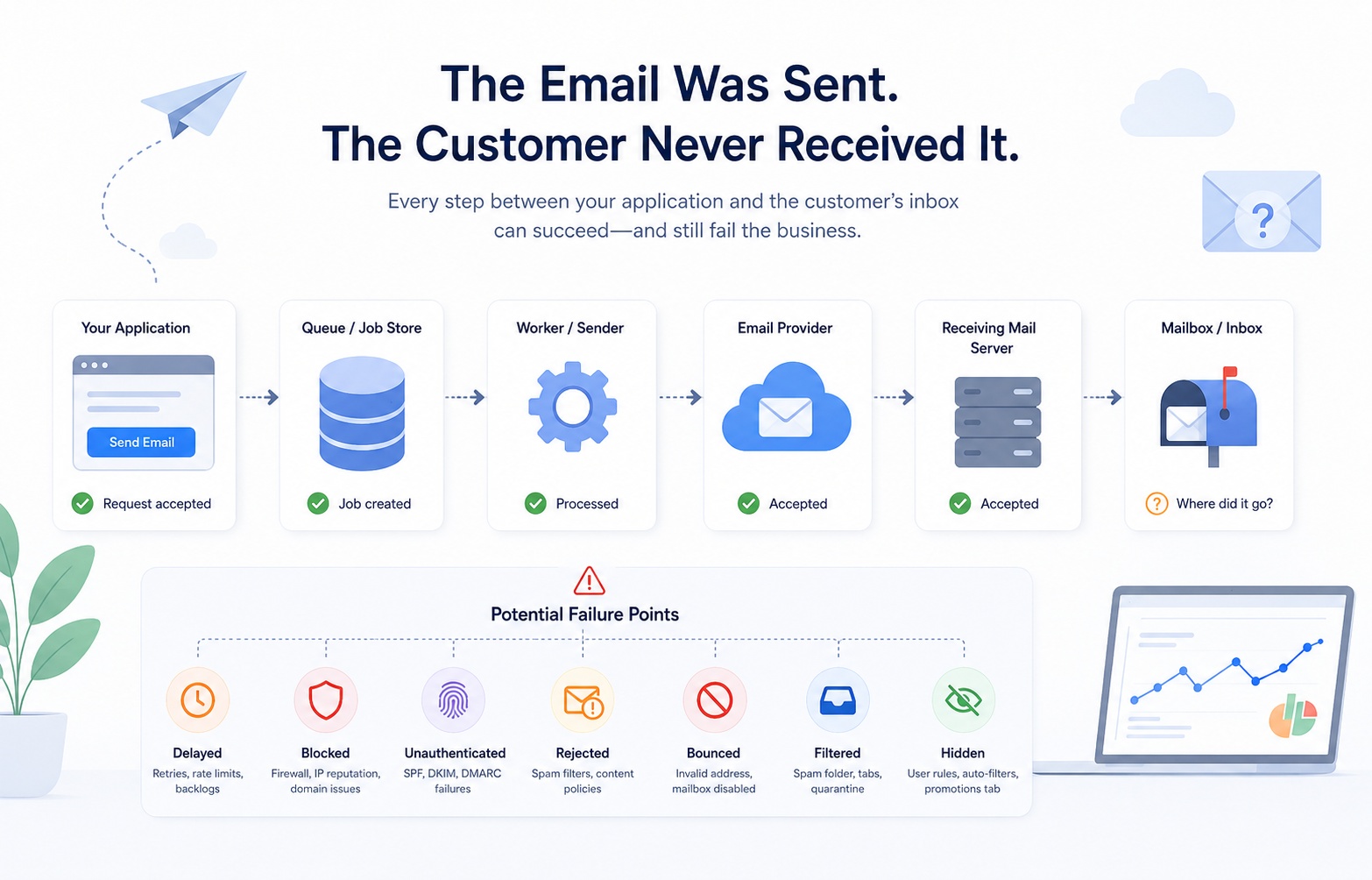
The application logged a successful send. The email provider returned a 2xx response and issued a message ID. No hard bounce was ever recorded against the address. The receiving mail server accepted the message during the SMTP session and did not reject it. And the customer, three days later, still says: "I never got it."
None of these statements contradicts any other. They are not describing the same event from different angles — they are describing five different systems, each reporting on the only thing it actually knows. The application knows that it handed a job to a queue. The provider knows that it accepted a well-formed request and attempted a connection. The receiving server knows that it did not refuse the SMTP transaction. Nobody in that chain claims to know whether a human being opened their inbox, saw the message, and could act on it — because nobody in that chain has visibility into that layer. A successful API response is proof that one system accepted responsibility for the next stage of a journey. It is not proof of the final, human-relevant outcome the business actually cares about.
This article is about that gap, and about the seven or eight systems that sit inside it. A send() call looks like a single operation. It is not. It is the first link in a chain of custody, where every participant — the application, the queue, the worker, the provider, the receiving infrastructure, the spam filter, the mailbox, and the human — takes responsibility for its own segment and then hands the message forward with no continuing obligation to prove what happens next. Each handoff has its own definition of success, its own failure modes, and its own evidence trail, or lack of one. Treating "the email was sent" as a single fact, rather than as a claim that needs to specify which system is making it, is one of the most common and most expensive blind spots in backend engineering.
The thesis that follows is simple to state and unusually difficult to build for: email delivery is not an API call, it is a distributed workflow with multiple independent authorities, asynchronous state transitions, and failure modes that live outside the application's control. A second, related idea will surface throughout: the only definition of "success" worth designing around is the one tied to the product outcome. For a password reset, success is not "the provider returned 200." Success is that a specific human being, within a window of time that still matters to them, receives a working link and completes the reset. Everything in between is instrumentation in service of that one fact.
A Message Has Many Owners
Picture the physical path of one transactional email, not as a diagram of boxes and arrows but as a sequence of custody transfers, the way a package changes hands between a warehouse, a courier, a regional depot, and a doorstep. At each transfer, the party taking custody makes a narrow promise about their own leg of the journey and nothing more.
Business Event
      │
      ▼
Notification Intent
      │
      ▼
Durable Queue
      │
      ▼
Worker
      │
      ▼
Email Provider API
      │
      ▼
Receiving Mail Server (SMTP)
      │
      ▼
Spam / Reputation / Policy Filtering
      │
      ▼
Mailbox (Inbox / Promotions / Junk / Quarantine)
      │
      ▼
Human Attention
      │
      ▼
Business Action Completed
At every one of those nine handoffs, three questions are worth asking, because the answers change completely as the message moves down the chain:
- Who currently controls the message? At the top, your application controls it completely — you can inspect it, retry it, cancel it. By the sixth box, a spam-classification system you have never seen and cannot query controls it. By the eighth box, the recipient's own mailbox rules and attention control it.
- What does "success" mean at this layer? For the queue, success means the job was persisted and will not be lost even if the process crashes. For the provider API, success means the request was authenticated and well-formed. For the receiving server, success means it did not refuse the SMTP transaction. None of these is the same claim.
- What evidence exists that the message actually progressed to the next layer? Sometimes there's a webhook. Sometimes there's a message ID. Sometimes — especially past the mailbox boundary — there is no evidence at all, and the application has to reason under uncertainty.
The rest of this article walks that chain from top to bottom, treating each handoff as its own engineering problem, because it is. The unifying idea is that application truth, provider truth, mailbox-provider truth, and user-visible truth are four different bodies of knowledge, and a mature system knows exactly where the boundary between what it can prove and what it can only hope sits.
The First Handoff: From Business Logic to Notification Intent
Most transactional messages start their life attached to a business action: an account is created, a password reset is requested, an invoice is generated, an MFA code is issued, a subscription changes state. The naive implementation calls the email provider synchronously, inline with that business action, and treats a provider error as a reason to fail the whole request.
That coupling is rarely what the product actually wants. Consider registration: a user submits a signup form, the account row is written, and then the application calls the email API to send a verification message. If the provider is briefly unavailable — a timeout, a transient 5xx, a expired credential — should account creation fail? In most products, no. The account is the durable, valuable artifact; the verification email is a follow-up action that can be retried independently. Coupling the two means a five-second provider outage becomes a signup outage, which is a strictly worse failure mode than "verification email arrives ninety seconds late."
The healthier shape separates the business event from the act of sending:
Application
   │  (writes business state + notification intent
   │   in the same database transaction)
   ▼
Notification Intent (durable row)
   │
   ▼
Queue (durable, retryable)
   │
   ▼
Worker (calls the provider, records the outcome)
The business action commits synchronously. The intent to notify is recorded as a durable fact — typically a row in the same database, in the same transaction as the business change — and a background worker picks it up, calls the provider, and records what happened. This buys three things: the business action no longer depends on an external system's uptime; a failed send can be retried without re-running the business logic; and there is now a queryable record of "we meant to send this" that exists independently of whether the send ever succeeded.
This is not a universal rule. Some flows genuinely want synchronous failure — if a payment provider is required to complete a checkout, failing the checkout when it's unreachable is correct, because the checkout has no meaning without it. The judgment call is specific to each notification: does the business outcome require the email to have been attempted before the response returns, or is the email a downstream consequence that can lag by seconds without harming the user? Password reset and MFA codes tend to want fast, visible failure if the send path is broken, because the user is sitting there waiting. Invoice emails and digest notifications tend to want durable, asynchronous delivery, because nobody is watching a spinner for them.
Writing to Two Systems at Once
The moment a notification intent has to be recorded in a database and eventually acted on by an external system, a specific distributed-systems problem appears, and it is worth naming precisely rather than hand-waving past it.
Suppose the implementation is:
1. Create invoice row.
2. Commit the database transaction.
3. Call the email provider to send the invoice email.
If the process crashes between steps 2 and 3 — a deploy lands mid-request, the pod is evicted, the worker throws an unhandled exception — the invoice exists, fully committed, and the email was never sent. There is no natural retry mechanism, because nothing recorded that a send was ever owed. The invoice looks complete from the database's point of view; the customer simply never hears about it.
Reverse the order and a different failure appears:
1. Call the email provider to send the invoice email.
2. Create invoice row.
3. Commit the database transaction.
If step 3 fails — a constraint violation, a downstream service rejecting the write — the customer has now received an email describing a financial event that never became authoritative in the system of record. That is a worse failure than a missing email, because it is actively wrong information sent to a customer about their money.
The underlying issue is that a database transaction and a call to an external HTTP API cannot participate in one atomic operation. There is no two-phase commit spanning your Postgres instance and your email provider's infrastructure. Two established patterns manage this without pretending atomicity is achievable:
The transactional outbox pattern. The notification intent is written as a row in the same database transaction as the business change. A separate process — a polling worker, or a change-data-capture pipeline reading the database's write-ahead log — picks up unsent outbox rows and forwards them to the provider, marking them sent (or failed, for retry) afterward. Because the outbox row and the business row commit together or not at all, there is no window where the invoice exists but no send was ever recorded as owed. The email might still be sent twice if the worker crashes after calling the provider but before marking the row sent — which is a real and different problem, addressed below — but it can no longer be silently never sent.
Event publication with at-least-once delivery. The business logic publishes a durable event ("invoice.created") to a broker, and a consumer service is responsible for turning that event into an email. This decouples notification logic from the originating service entirely, at the cost of needing careful idempotent consumption on the far end.
Both patterns share an important property: they replace "exactly-once" — which is not achievable across independent systems without extraordinary and usually not-worth-it engineering — with "durably recorded, at-least-once, and idempotent on replay." That combination is honest about what distributed systems can actually guarantee, and it pushes the remaining risk toward duplicate sends rather than lost ones, which is almost always the safer place for the risk to sit.
Sent Is Not a State, It's a Word
A surprising number of production schemas represent the entire life of a notification with a single boolean: sent = true. That field answers exactly one question — did our code call something? — and it cannot distinguish between a message that reached an inbox, a message that bounced, a message the provider silently suppressed, or a message still sitting in a retry queue.
A more honest model treats the notification as moving through a small state machine. The exact vocabulary differs by system and by provider, and no single naming scheme is universal — the point is not to standardize on the states below, but to demonstrate that more than one boolean is needed to answer real operational questions.
CREATED
   │   (notification intent recorded)
   ▼
QUEUED
   │   (durable job persisted)
   ▼
PROCESSING
   │   (worker picked it up)
   ▼
SUBMITTED
   │   (request sent to provider)
   ▼
PROVIDER_ACCEPTED ──► DEFERRED ──► (retry, eventually accepted or bounced)
   │
   ▼
DELIVERY_PENDING
   │
   ├──► DELIVERED (receiving server accepted it)
   ├──► BOUNCED (hard or soft, per provider taxonomy)
   ├──► SUPPRESSED (provider declined to attempt delivery at all)
   └──► FAILED (provider-side error, no attempt made)
The value of this granularity is not aesthetic. It answers concrete questions that sent = true cannot: when a customer calls support saying they never got a password reset, was the notification even created? Did it sit in the queue for eleven minutes because a worker pool was starved? Did the provider accept it and then bounce it four minutes later? Was it suppressed before an attempt was ever made? Each of those is a different root cause, owned by a different part of the stack, and each produces a different remediation. A single boolean collapses all of them into the same undiagnosable "yes."
The richer state machine also becomes the backbone for retries (which states are safe to retry from, and which risk duplication), for analytics (funnel drop-off between states reveals where the system is losing messages, not just that it is), and for support tooling, discussed later, that lets a human answer "where is my email" without guessing.
The Retry Dilemma
Durable queues and worker retries solve the lost-message problem and introduce a duplicate-message problem in its place. If a worker calls the provider, the provider accepts the message, and then the worker crashes before it can record that success — a deploy rolling mid-request, an out-of-memory kill, a network partition on the response path — the queue will see an unacknowledged job and retry it. The provider gets called a second time. Depending on how idempotency is handled, the customer now has two password reset emails, two verification codes, or two identical invoices in their inbox.
Not retrying is not a safe alternative — a transient provider hiccup that isn't retried can mean a password reset that never leaves the building. The dilemma is real: retrying protects against lost messages and risks duplicates; not retrying protects against duplicates and risks loss. The resolution is not to pick a side, but to make retries idempotent, so the system can retry aggressively without the duplication cost.
Idempotency has to be reasoned about at several levels, because a retry can happen at any one of them:
- Business event level: did the underlying event (password reset requested) genuinely happen twice, or is this the same event being reprocessed?
- Notification intent level: has this specific intent already been converted into a queued job?
- Queue job level: has this job already been picked up and completed by another worker, or is this a legitimate re-delivery of an unacknowledged message?
- Provider request level: did the provider already accept this exact request, even if the acknowledgment never made it back to the worker?
The common tool across all four is an idempotency key — a stable identifier attached to the notification intent (not regenerated on every retry) that lets each layer answer "have I already handled this one?" before doing real work. Many providers expose their own mechanism for deduplicating requests bearing the same key, but the exact contract — how long the key is honored, what counts as a duplicate, whether it deduplicates the send or just the API response — is provider-specific and should be checked against current documentation rather than assumed to work uniformly.
The deeper design question worth asking explicitly is: how does the system distinguish a retry of the same notification from a genuinely new notification of the same type? A user who requests a password reset twice in ten seconds — once because the page felt slow, once because they doubted the first click worked — has generated two legitimate business events that both deserve an email. A worker that retries the same job after a crash has generated one business event and must not turn it into two emails. Those two situations look identical at the HTTP-call level and must be distinguished at the intent level, which is exactly why the notification intent, not the individual provider call, is the right place to anchor idempotency.
What the Provider Actually Accepted
An email provider's API returning success is a narrower claim than it sounds. Depending on the provider and the specific endpoint, a 2xx response typically confirms some combination of: the request was authenticated, the payload was syntactically valid, a referenced template existed, and the message was accepted into the provider's own internal queue for processing. It is not, by itself, confirmation that the provider has attempted delivery to the recipient's mail server, that the recipient's mail server has accepted it, or that any human will ever see it.
This is worth stating carefully rather than generically, because provider semantics genuinely differ and change over time — what a given vendor's "accepted" response guarantees should always be checked against that vendor's current documentation rather than assumed by analogy to another provider. What is safe to generalize is the shape of the gap: acceptance by the API is always a smaller claim than delivery, and delivery by the provider is always a smaller claim than mailbox placement, and mailbox placement is always a smaller claim than human visibility. Four claims, four different pieces of evidence, four different systems that would each have to be queried to assemble the full picture:
- API acceptance — known immediately, owned by your integration code.
- Provider delivery attempt — known slightly later, owned by the provider's outbound infrastructure.
- Remote mail server acceptance — known only if the provider surfaces it, typically via a webhook.
- Mailbox placement — rarely known with certainty at all, and only approximated through techniques like seed-list monitoring, discussed later.
- Human visibility — essentially never known directly, only inferred through downstream product signals.
Treating the first claim as though it were the last is the single most common mistake in how teams report on "email delivery," and it usually shows up as a delivery dashboard that only ever measures the top of this list.
Names for the Same Message
A single business event can generate a surprising number of identifiers as it moves through the chain, and a system that does not correlate them cannot answer basic support and debugging questions. A reasonably complete set includes: a business event ID (the password-reset-request itself), a notification ID (the internal row representing the intent to send), a queue job ID (the specific unit of work a worker picked up), a provider message ID (returned once the provider accepts the request), the template version rendered, and often a broader correlation ID threading all of the above together across logs.
These identifiers exist to answer a specific sequence of diagnostic questions, in order: Did we create the notification at all? Was it enqueued, and how long did it wait? Which worker instance processed it, and did that instance crash mid-processing? Did the provider accept it, and under what message ID? Which webhook events, if any, correspond to that message ID? Was this job retried, and if so, did the retry produce a second provider-accepted message? What template version was actually rendered into the message the customer received?
None of this requires — and should actively avoid — logging the sensitive content of the message itself. A reset token, an OTP code, or the full rendered HTML body should never appear in logs or traces; the correlation IDs above are sufficient to reconstruct the message's journey without ever storing what a compromised logging system could use to impersonate the user. Traceability and data minimization are not in tension here — a well-designed identifier scheme gives you full observability using only opaque IDs.
SMTP Only Promises the Next Hop
It's worth being precise about what SMTP itself actually is, without turning this into a protocol tutorial: a store-and-forward relay mechanism, not an end-to-end guarantee. Internet Message Format is standardized separately from the transport (RFC 5322 defines the message format; RFC 5321 defines the Simple Mail Transfer Protocol used to move it), and the transport's job is narrow — accept a message from one hop and either accept responsibility for forwarding it, or explicitly refuse it.
At each hop, the receiving server's response falls broadly into two families: a temporary failure that signals "I can't accept this right now, try again later," and a permanent failure that signals "do not retry this, it will never succeed." The specific numeric codes and their exact meanings are defined in the SMTP status code conventions and vary in their fine-grained interpretation between providers — a system that needs to branch behavior on specific codes should validate against current provider documentation rather than hard-code assumptions about what a given code universally means.
The practically important point is this: a temporary failure at any hop does not mean the message is dead. Providers typically implement their own retry policies for temporary failures — attempting redelivery over some window before finally giving up — and the exact windows, backoff schedules, and give-up thresholds are provider-specific implementation details, not protocol guarantees, and change without much public notice. An application should not assume a specific retry window; it should instead treat "the provider is still attempting delivery" as a distinct, valid state (the DEFERRED state described earlier) rather than collapsing it into either success or failure prematurely.
Acceptance Is Not Admission
This is the section that most directly earns the article's title. A receiving mail server accepting a message during the SMTP transaction is a statement about transport, not about outcome. Once a message has been accepted, it typically passes through a second, entirely separate layer of processing before it becomes visible to anyone: spam and reputation classification, malware and content scanning, organizational policy filtering (a corporate mail gateway silently dropping attachments of a certain type, for instance), and finally routing into a specific mailbox location — a general inbox, a promotions or categorized tab, a spam or junk folder, or in some cases a quarantine that requires explicit end-user or administrator action to release.
None of these downstream systems talk back to the sender in real time. The SMTP session that accepted the message has already closed by the time spam classification runs. This is precisely why "the receiving server said yes" and "the customer got the email" are different claims that can diverge without either one being false — the server told the truth about accepting the message, and spam classification made an independent decision afterward that the sender has no visibility into unless the mailbox provider chooses to expose it, which most do not, for any individual message.
It's tempting to make confident, specific claims here about exactly how a given mailbox provider's spam filtering works — but that information is neither public nor stable, and any article asserting precise mechanics for a named provider's spam engine should be treated skeptically. What is safe and useful to say is structural: this layer exists, it is opaque from the outside, it operates independently of transport acceptance, and it is influenced by sender reputation and authentication signals discussed later in this piece — without those signals being a deterministic formula anyone outside the mailbox provider actually has access to.
Delivered, Seen, and the Gap Between Them
Even setting aside spam classification, there is a further gap between a message being placed in an inbox and a human actually reading it, and open tracking — the classic mechanism for trying to measure that gap — is a weaker signal than it's often treated as. Open tracking typically works by embedding a small, uniquely-URLed image in the message and recording a "open" event when that image is fetched. That fetch can be triggered by a human opening the message, but it can also be triggered by image pre-fetching in the mail client, by corporate or consumer security scanners that pre-visit links and images in a message before it reaches the user, by bots, or it can simply never fire because a client blocks remote images by default until the user explicitly allows them, or because a privacy-preserving image-proxying feature fetches the image on the provider's own infrastructure regardless of whether the human ever looks at the message. An "open" event, in other words, is neither necessary nor sufficient evidence that a human read the email — it should be treated as a coarse engagement signal, useful in aggregate for marketing analytics, and largely unsuitable as proof of anything for a single critical transactional message.
For workflows where the business genuinely needs to know whether the intended action happened, a stronger signal exists and it isn't email telemetry at all — it's the product's own state transitions. Compare:
password_reset_requested
        │
        ▼
reset_email_submitted        (we handed it to the provider)
        │
        ▼
reset_link_used               (someone clicked the link — application-observed)
        │
        ▼
password_reset_completed      (the actual business outcome)
reset_link_used and password_reset_completed are facts your own application observes directly, with no dependency on image loading, client rendering behavior, or a mailbox provider's privacy features. They are strictly better evidence of the business outcome than any open-tracking pixel could ever be, precisely because they are downstream of the human actually having and using the email, rather than downstream of a client silently fetching an image.
Bounces Are Not One Thing
"Bounce" is a category, not a single failure mode, and the exact taxonomy differs meaningfully by provider — which is itself an operational hazard, because code written against one provider's bounce vocabulary can silently misclassify events from another. Amazon SES, for instance, models bounces with a bounceType of Undetermined, Permanent, or Transient, each carrying its own subtype (a mailbox-full condition is a Transient/MailboxFull bounce; a nonexistent address is typically Permanent). SendGrid's event model instead distinguishes a bounce — described as a permanent delivery denial — from a block, a temporary delivery denial, with deferred events sitting further upstream as the provider's own retry-in-progress signal before either resolves. Neither vocabulary is wrong; they are simply different provider-specific abstractions over the same underlying SMTP reality, and a suppression or retry policy hard-coded against one provider's terms will not automatically translate to another.
The engineering implication is that "hard versus soft" is a useful mental model but not a portable data contract — the application layer should normalize whatever categories a given provider emits into its own internal vocabulary (something like BOUNCED_PERMANENT and BOUNCED_TRANSIENT in the state machine shown earlier), rather than storing and branching on provider-native bounce codes throughout the codebase.
It also matters that not every notification type should respond to a bounce identically. A permanent bounce on a marketing address should suppress future sends immediately. A permanent bounce on the address tied to an active password-reset flow is a more urgent, support-relevant event — the user is actively locked out and the one channel available to unlock them just failed permanently — and probably deserves a different, faster escalation path than "quietly add to suppression list and move on." Billing and security-notification bounces carry their own urgency profile too: a payment-related bounce might need finance or support visibility, while a security-alert bounce (a new-device login notice, for instance) failing silently is a genuine risk the product should not treat the same way as a stale marketing subscriber falling off a list.
Whatever a bounce reveals, customer-facing diagnostics need to stay conservative about how much detail they expose. Confirming to an anonymous requester that "this address doesn't exist in our system" via a specific, address-differentiated bounce message can enable account enumeration — an attacker probing which email addresses have accounts by watching how the system's response differs. Detailed bounce reasoning belongs in internal tooling, not in the user-facing error surface.
The Suppression List Nobody Told You About
There is a particularly disorienting failure state that sits upstream of everything discussed so far: an address can be suppressed by the provider before any delivery attempt is even made. Suppression typically results from a prior hard bounce, a prior spam complaint, an explicit unsubscribe, or the provider's own internal policy enforcement — and once an address lands on a suppression list, a subsequent send to that address may never generate a delivery attempt at all, regardless of how correctly the application called the API.
From the application's point of view, this produces a uniquely confusing state: the notification was created, the provider integration was called successfully, the API likely returned a normal-looking success response — and yet no meaningful delivery attempt occurred, because the provider silently declined to try. This is functionally invisible unless the application specifically checks for and surfaces a suppression signal, and it is exactly the kind of failure that produces the maddening support case where every internal log says "sent successfully" and the customer insists, correctly, that nothing arrived.
Detecting this state requires that suppression be treated as a first-class outcome in the notification state machine — not folded silently into SUBMITTED or DELIVERED — and that support tooling (covered later) can surface "this address is currently on the provider's suppression list" as a distinct, human-readable diagnosis rather than a mystery.
It's also worth keeping the transactional-versus-marketing distinction sharp here, since suppression logic is one of the places the two most often get conflated in code, even though the products they serve are different. A user who unsubscribes from a marketing newsletter has not necessarily opted out of receiving a receipt for a purchase they just made, and a naive suppression check that treats all outbound mail identically can silently swallow transactional messages the business is legally and functionally obligated to deliver. This piece is not the place for legal guidance on consent regimes, which vary by jurisdiction and should be reviewed with counsel — but from a pure software-architecture standpoint, the fix is the same either way: notification intent should carry an explicit classification (transactional versus marketing, and ideally a more granular category than that) all the way through the pipeline, so that suppression, rate limiting, and infrastructure choices can be applied differently to each.
Proving Who You Are: SPF, DKIM, and DMARC
Sender authentication is the mechanism by which a receiving mail server decides whether a message claiming to be from your domain is actually authorized to be. It is foundational to deliverability, and as of 2026 it has moved from best practice to hard requirement for a meaningful share of the email a typical product sends.
SPF (Sender Policy Framework) is a DNS TXT record that lists the servers and services authorized to send mail on behalf of a domain. A receiving server checks the connecting IP address against the domain's published SPF record. SPF proves that a message came from an IP address the domain owner authorized — it says nothing about the content of the message and nothing about whether the visible From: address matches the domain that was actually checked, which is a distinct concern DMARC addresses. Operationally, SPF records fail in familiar ways: a new email service provider gets added to the sending stack but never added to the SPF record; legacy infrastructure from a decommissioned system lingers in the record after it stopped sending; the record exceeds SPF's ten-DNS-lookup ceiling because too many third-party include: mechanisms have accumulated, silently invalidating the entire record rather than just the excess entries.
DKIM (DomainKeys Identified Mail) cryptographically signs outgoing messages using a private key, with the corresponding public key published in DNS under a specific selector. The receiving server verifies the signature against the published key, which proves both that the message genuinely originated from a party holding the private key and that specified parts of the message were not altered in transit. Misconfiguration typically shows up as key rotation gone wrong (a new key is deployed to the sending infrastructure before the corresponding DNS record propagates, breaking every message signed in that window), selector mismatches between what the sending system signs with and what's published, or simply DKIM never having been enabled on a sending domain that assumed SPF alone was sufficient.
DMARC (Domain-based Message Authentication, Reporting, and Conformance) sits on top of both: it requires that a message pass SPF or DKIM (or both), and that the authenticating domain be aligned with the domain visible in the message's From: header, and it tells receiving servers what to do — none, quarantine, or reject — with messages that fail this check. DMARC's most important property is often misunderstood: it materially improves anti-spoofing posture and gives domain owners visibility (via aggregate reports) into who is sending mail claiming to be from their domain — but it does not, by itself, guarantee inbox placement. A message can pass DMARC cleanly and still be filtered to spam on reputation or content grounds; DMARC governs authenticity, not desirability.
The DMARC specification itself changed meaningfully and recently. Since its original publication as RFC 7489 in 2015 — an Informational document, never on the IETF's formal Standards Track — DMARC has now been superseded: in May 2026 the IETF published RFC 9989 as the core protocol specification, with RFC 9990 covering aggregate reporting and RFC 9991 covering failure reporting, together promoting DMARC to Proposed Standard status for the first time. The practical changes are evolutionary rather than disruptive — existing v=DMARC1 records continue to function, and no domain owner is required to rewrite a working record to stay compliant — but several details are worth knowing: the old Public Suffix List mechanism for determining an "organizational domain" is replaced by a DNS Tree Walk algorithm; a handful of policy tags (pct, rf, ri) are deprecated while a few new ones (np, psd, t) are introduced; and the updated specification more explicitly discourages a strict p=reject policy for domains whose users participate in mailing lists, since indirect mail flows through forwarders and mailing lists remain a structurally unresolved problem that a strict reject policy can make worse rather than better. Teams maintaining DMARC records should treat this as confirmation their existing setup keeps working, plus an opportunity to audit for the newly deprecated tags, rather than as an urgent migration.
As of 2026, the three largest consumer mailbox operators have converged on broadly similar, though not identical, authentication requirements for higher-volume senders. Google's current published guidance requires, for any sender, SPF or DKIM at minimum, and for domains sending roughly 5,000 or more messages per day to personal Gmail and Googlemail addresses, SPF and DKIM and a published DMARC record (a policy of p=none satisfies the minimum bar), with the From: domain aligned to either the SPF or DKIM domain, alongside infrastructure requirements — valid forward and reverse DNS (PTR) records, a TLS connection for transmission, spam complaint rates kept under Google's published ceiling, and one-click unsubscribe support (via the List-Unsubscribe and List-Unsubscribe-Post headers specified in RFC 2369 and RFC 8058) for marketing and subscribed mail specifically. Google's own guidance recommends staying meaningfully below the hard 0.30% spam-rate ceiling as an operating target, since sustained proximity to the ceiling degrades deliverability even before it's breached. Yahoo's published sender requirements closely mirror Google's — SPF, DKIM, and DMARC for bulk senders, alignment, and one-click unsubscribe — enforced through Yahoo's own Sender Hub rather than Google's Postmaster Tools, and covering the AOL and Yahoo-managed telecom domains it now routes mail for. Microsoft extended equivalent requirements to its consumer domains (Outlook.com, Hotmail.com, Live.com) starting May 2025, using the same 5,000-per-day threshold and the same SPF/DKIM/DMARC baseline, and unlike the phased, junk-folder-first rollout Google and Yahoo initially used, Microsoft moved directly to outright SMTP-level rejection (a 550 5.7.15 error) for non-compliant bulk mail.
Two structural details change how a team should scope its own compliance work. First, all three providers define their thresholds by sending volume to that specific provider's domains, not overall volume — a sender well under any single provider's bulk threshold in isolation can still be a "bulk sender" in aggregate, and a bulk sender to Gmail is not automatically one to Yahoo or Microsoft. Second, Google's enforcement targets personal @gmail.com and @googlemail.com recipients specifically; mail to Google Workspace-hosted business domains falls under a related but distinct abuse policy. A product sending primarily B2B mail should verify which regime actually applies to its traffic. None of the specific thresholds or dates above should be treated as permanently fixed — all three providers have changed enforcement posture more than once in the past two years, and current requirements are worth verifying against official documentation before infrastructure decisions rest on them.
The Infrastructure Underneath the Code
A backend can be functionally flawless — correct business logic, well-tested code paths, a clean state machine for notifications — and still stop reliably reaching users because something changed in DNS, sender authentication, or provider-side reputation, none of which live in the application's own repository or deploy pipeline.
DNS as part of the product. SPF, DKIM, and DMARC records, PTR records, and MX configuration are all DNS state, typically managed outside the application's version control, often by a different team or a domain registrar's web console. A DNS change made for an unrelated reason — a migration, a registrar switch, a cleanup of "unused" TXT records — can silently break authentication for a sending domain with no application-level error to surface the problem. Treating this infrastructure with the same rigor as application code — DNS-as-code where feasible, change review for anything touching mail-related records, and automated monitoring that periodically re-checks SPF/DKIM/DMARC validity rather than assuming a one-time setup stays correct forever — closes a gap that pure application testing cannot reach.
Domain and IP reputation. Mailbox providers form an ongoing assessment of a sending domain and sending IP based on signals accumulated over time: complaint rates, bounce patterns, authentication consistency, and sending behavior. The exact weighting of these signals inside any provider's filtering system is not public and should not be asserted with false precision — what's safe to say is that reputation is cumulative, slow to build, and comparatively fast to damage, which is why a sudden change in sending pattern (a burst of volume, a spike in bounce rate) is treated with more suspicion than the same volume sent gradually.
Shared versus dedicated IP infrastructure is a genuine tradeoff, not a case where one option is categorically better. A shared IP inherits the sending reputation — good or bad — of every other sender using it, which is a real risk if the pool includes poorly-behaved senders, but it also benefits from the aggregate sending volume and history the pool has already built, which can be an advantage for a newer or lower-volume sender that would otherwise be starting from zero reputation on a dedicated IP nobody has ever heard from. A dedicated IP puts a sender fully in control of — and fully exposed to — its own reputation, which matters more as sending volume grows and the sender has enough consistent traffic to build a track record worth protecting.
Warm-up and sudden volume changes. New sending infrastructure — a new domain, a new dedicated IP, a newly migrated provider — that immediately begins sending at full production volume looks anomalous to receiving systems that have no sending history to compare it against, and anomalous patterns are treated with more scrutiny. The precise mechanics and schedules some providers or vendors recommend for gradually increasing volume are not something this piece will prescribe, since specific numeric ramp schedules are provider- and situation-dependent and easily go stale — but the underlying principle, confirmed in Google's own current guidance, is durable: increase volume gradually, monitor delivery signals as you go, and treat any change to sending infrastructure or message format as its own volume ramp rather than assuming existing reputation transfers automatically.
Rate limits and backpressure. Rate limits exist at every layer of the path — the provider's API, the SMTP submission path, the application's own outbound queue, and the receiving mailbox provider's acceptance rate for a given sender. When downstream capacity cannot absorb current demand, the question that matters is what happens to the notifications that can't be sent immediately: are they held durably and retried as capacity frees up, or silently dropped because a queue overflowed or a worker gave up? A system under backpressure should degrade toward slower delivery of everything, not toward silently discarding a subset of critical messages — which means queue depth, oldest-unprocessed-job age, and worker throughput deserve their own monitoring, independent of whether individual sends are succeeding or failing.
When Arriving Late Is the Same as Not Arriving
A message can pass every check described so far — accepted by the provider, accepted by the receiving server, placed in the primary inbox — and still fail the product, because it arrived too late to be useful. This is a distinct failure mode from everything discussed until now: nothing was lost, nothing bounced, and the outcome is still a failure.
Password reset is the cleanest illustration, because the failure window is short and the stakes are immediate. A user requests a reset, gets distracted, and by the time the email arrives — ninety seconds later, say, well within what most systems would consider acceptable delivery latency — they've either given up on the flow entirely or requested a second reset out of impatience, at which point a genuine distributed-systems problem appears: out-of-order delivery. If the second request's email happens to traverse a faster path through the provider's infrastructure than the first, message B can reach the inbox before message A. If the reset flow only accepts the newest token as valid — a common and reasonable security choice, since it prevents an attacker from reusing an intercepted older link — the user may click the first email that arrives (message B, correctly, since it's newer) and succeed, or they may click whichever email they see first regardless of order and hit a "this link has expired" error on message A, with no way to know from the email itself that a newer, valid one exists. This should be tested deliberately as a chronological-inversion scenario, not dismissed as a UX nuance, because it is a real consequence of independent, asynchronous delivery paths rather than a UI copy problem.
This connects directly to a design decision that is easy to make independently of email infrastructure but shouldn't be: token expiration windows cannot be chosen in isolation from realistic delivery latency. If a reset or verification link is designed to expire in a window shorter than delivery can realistically take under real-world conditions — a provider retry cycle, a receiving-server deferral, ordinary queueing delay — the system is generating messages that are technically correct and operationally useless by the time they're read. This isn't an argument for arbitrarily long-lived tokens, which carry their own security cost; it's an argument that authentication design and email-delivery reliability have to be reasoned about together, not handed to two different teams who each assume the other's numbers are conservative.
Email verification carries a related but distinct testing surface: what happens on a resend, a duplicate click, or a click on an old link after the account has since been verified through a newer one. The desired behavior is usually convergence — regardless of which valid-at-the-time link the user clicks, or how many times they click it, the account should end up in one correct, idempotent final state, not in a state that depends on click order.
Email-delivered OTP and MFA codes compress this timing problem to its most acute form: code expiration is typically measured in minutes, so delivery latency that would be a minor annoyance for a password reset can make an OTP flow entirely nonfunctional. Multiple-code issuance (a user requesting a new code before the first one arrives) and out-of-order delivery are the same structural problems as the reset-token case, just with a shorter fuse — and it's worth noting plainly, without overselling the point, that email is among the weaker channels for time-sensitive OTP delivery precisely because of everything this article has described: it has more independent hops, more asynchronous retry behavior, and less delivery-latency predictability than a push notification or even SMS. That's a reliability observation, not a security recommendation, and the actual channel choice for MFA is a separate product decision with its own tradeoffs.
A Message That Describes a State That No Longer Exists
Invoices, receipts, and other financially-sensitive transactional messages introduce a failure mode specific to their content rather than their delivery: the email can be delivered perfectly and still be wrong, because the data it describes changed after the message was generated but before — or even after — it was sent.
Consider a queued email job that renders "payment: pending" into an invoice email at creation time. If the payment settles four minutes later, and the email sits in a retry queue during that window due to an unrelated transient provider issue, the customer may receive a message describing a payment state that was already stale by the time it left the building. This is not a delivery-chain failure in the sense the rest of this article has focused on — the message arrived, intact, exactly as generated — the failure is upstream, in the decision to render financial state into a message before that state was final, combined with a delivery delay that happened to outlast the state's validity window.
The general principle this points to is that a notification should be rendered from the system of record as close as practically possible to the moment it's actually transmitted, not frozen at the moment the intent to notify was created — particularly for any content describing a mutable, business-critical value like payment status, account balance, or order state. Where that isn't fully achievable (a template rendered once and queued for asynchronous sending, for instance), the render step itself should re-fetch current state rather than trusting whatever was captured when the notification intent was first written, especially if there's any chance meaningful time will pass between intent creation and actual transmission.
Templates Are Software, Not Copy
An email template is executable presentation logic with real failure modes, not static marketing collateral, and testing it as though it were a finished asset — a final screenshot review before shipping — misses most of the ways it actually breaks in production: a missing variable rendering as a literal undefined or an empty string where a name or amount belongs; a null value reaching a conditional that assumed it would always be populated; a broken conditional branch that renders the wrong tier of content for a given account type; an environment-specific URL (a staging hostname, a local development link) baked into a production template because an environment variable wasn't swapped; unsupported CSS silently dropped or misrendered by a specific mail client; a missing plain-text alternative in a multipart message; incorrect tenant branding rendered for a multi-tenant product (discussed further below); or a template being rendered under a stale version after a newer one has already been deployed, discussed next.
HTML email is not a webpage, and this deserves to be internalized rather than rediscovered per incident. Email rendering environments have historically lagged, and continue to lag, behind general web-browser CSS and layout support by a wide margin, and — critically — rendering behavior is inconsistent across clients in ways that don't map cleanly onto browser-engine families the way web development does. Inline styling is frequently necessary rather than optional; responsive layout techniques that are trivial on the web require workarounds in email; dark-mode handling varies unpredictably, sometimes inverting brand colors in ways no designer intended; and image handling, as discussed earlier, is often blocked by default. Building a comprehensive client-compatibility matrix for every possible client is usually not worth the effort — better to identify, from actual product analytics, which clients the real audience uses, and test rendering specifically against that representative set rather than a generic industry-wide list.
The plain-text part of a multipart message matters for reasons beyond simple accessibility: some clients and some filtering systems weight the presence and quality of a plain-text alternative as a signal of message legitimacy, and its complete absence, or its being nothing more than "please view this email in HTML," is a minor but real deliverability signal in the wrong direction. It is not, on its own, a fix for deliverability problems that have other root causes — it's one input among many.
Links are part of the transaction, not just the message. Every link in a transactional email deserves the same scrutiny as an API endpoint, because functionally it is one: correct host and scheme (a staging link leaking into a production email is a classic, embarrassing, and entirely preventable configuration failure), correct token encoding, correct handling of expiration, and correct behavior under redirect chains. One subtlety worth designing around deliberately: email security scanners deployed by corporate mail gateways and some consumer providers automatically visit links inside incoming messages as part of threat scanning, before the human recipient ever clicks anything. A link that triggers an irreversible action — completing an unsubscribe, confirming a destructive account change, consuming a single-use token — purely because an automated scanner issued a GET request to it, is a design flaw with real consequences: the human recipient can find their password-reset token already consumed, or their one-click unsubscribe already actioned, without ever having clicked anything themselves. The defensive pattern is straightforward: state-changing actions triggered from an email link should require an explicit, human-driven confirmation step (typically a second request, like a POST from a rendered confirmation page) rather than executing directly on the GET request that loads the link.
Attachments, where used, carry their own testing surface distinct from the message body: sending the wrong file entirely due to a mapping bug, a missing attachment where one was expected, a zero-byte file from a failed generation step that wasn't checked before attaching, incorrect MIME type causing a client to mishandle the file, filename encoding issues with non-ASCII characters, and — a more serious category — a sensitive document (an invoice, a statement, a legal notice) attached and sent to the wrong recipient due to an upstream identity-resolution bug. This last case deserves the same seriousness as a wrong-recipient failure elsewhere in the system, discussed later, because an attachment often carries more sensitive content than the message body itself.
Localization introduces its own template-level testing surface: deterministic language selection (what determines which locale a given notification renders in, and is that determination made consistently across all notification types for the same user), correct fallback behavior when a translation is missing or incomplete, and correct handling of dates, currency, and number formatting per locale — including the length variance that different languages introduce into subject lines and layout, which can silently break a template designed and tested only against English-length strings.
Whose Name Is On the Envelope
The visible sender identity of a message — the From: header, the Reply-To: header, and the underlying envelope sender or Return-Path — is worth testing at the product level, not just the protocol level, because it's one of the few pieces of the delivery chain a recipient actually sees and judges the sender by directly.
Concretely: does replying to a transactional email go where the product actually intends — a monitored support address, or a noreply sink that silently discards genuine customer replies to a message that invited a reply? Does the sender identity visibly and consistently match the product the customer believes they're interacting with, rather than an internal service name or a vendor's default sending domain leaking through? For a multi-tenant product specifically, does a message sent on behalf of one tenant correctly display that tenant's name, branding, and reply-to address, rather than a hard-coded platform default or — critically — another tenant's identity entirely.
That last case is worth calling out as its own category of risk rather than a subset of general template correctness, because the failure mode is qualitatively different from a rendering bug: a tenant-isolation failure in email is a data-exposure incident, not a cosmetic one. A misconfigured template variable that causes Tenant A's branding, reply-to address, or — worse — actual customer data to appear in a message sent to Tenant B's customer is the kind of bug that a purely visual QA pass (does the email look right?) will not reliably catch, because the visual layout can be perfectly correct while the data populating it comes from the wrong tenant's context. Testing transactional email in a multi-tenant system should explicitly include cross-tenant isolation checks — generating notifications across multiple tenants concurrently and verifying that no tenant's message ever contains another tenant's identity or data — rather than treating tenancy as a concern that lives entirely in the application's data layer and stops mattering once content reaches the notification system.
The Provider's Side of the Conversation
Once a message has been accepted by the provider, webhooks become the primary channel through which the provider tells the application anything further about what happened — and because that channel is asynchronous, provider-defined, and delivered over an untrusted network, it deserves the same engineering rigor as any other external event source, not the "just update a status field" treatment it often gets.
Provider event vocabularies differ, and building against one provider's exact event names without an internal translation layer creates the same portability problem bounce-taxonomy differences created earlier. SendGrid's Event Webhook, for instance, distinguishes processed (the message was received by the provider and queued for delivery), dropped (the provider declined to attempt delivery, with a reason), deferred (a temporary rejection by the receiving server, which the provider will continue retrying for a defined window before giving up), delivered (the receiving server accepted the message — explicitly not a guarantee of inbox placement), bounce, open, click, and separate events for spam reports and unsubscribes. A representative payload for a single delivery event looks roughly like this — illustrative rather than a literal reproduction of any provider's exact schema, since field names and structure should always be checked against current documentation before being relied on in code:
{
  "event": "delivered",
  "email": "user@example.com",
  "timestamp": 1750000000,
  "sg_message_id": "abc123.filterdrecv-xyz",
  "smtp-id": "<original-smtp-message-id@sendinghost>",
  "response": "250 2.0.0 OK",
  "category": ["password-reset"]
}
A handful of engineering concerns apply to this channel regardless of which provider is sending the events:
Signature verification. A webhook endpoint accepting unauthenticated POST requests is trivially spoofable — anything reachable at that URL could claim a message was delivered, bounced, or complained-about, corrupting the application's own state. Providers that support webhooks generally offer a signing mechanism (commonly an HMAC or public-key signature over the payload); verifying it should be treated as a hard requirement for any webhook handler that feeds business logic, not an optional hardening step.
Idempotent processing. Webhook delivery, like most asynchronous event systems, is typically at-least-once — the same event can arrive more than once due to retries on the provider's side after a timeout or transient error on the receiving end. A delivered event processed twice should not fire whatever downstream business logic depends on delivery twice; a bounce event processed twice should not trigger suppression-list writes or customer-facing alerts twice. This means every webhook handler needs its own idempotency check, typically keyed on the provider's own event ID where one is provided.
Out-of-order arrival. Nothing guarantees that webhook events arrive in the same order the underlying events actually occurred. A delivered event can be processed by the application before an earlier processed event for the same message, due to nothing more sinister than network timing and retry jitter on the provider's side. A naive handler that blindly overwrites a notification's status field with whatever the most recently received event says can move a message's recorded state backward — from delivered back to an earlier state — if an older event happens to arrive late. The fix is to make state transitions monotonic where the underlying lifecycle genuinely is (using each event's own timestamp, not arrival order, to decide whether it should update current state), while recognizing that not every provider's event lifecycle is a strictly linear sequence, so this logic needs to be built against the actual lifecycle the provider documents rather than an assumed universal one.
Schema evolution. Providers add fields, add new event types, and occasionally change existing ones. A webhook handler that fails hard on an unrecognized event type or an unexpected field, rather than logging and ignoring what it doesn't understand, turns a provider's routine addition of a new feature into an outage in the receiving system.
The broader architectural point these four concerns point toward is that an application's internal notification state is, in a very real sense, a projection built from external events it does not control the timing, ordering, or delivery guarantees of — which makes it structurally similar to any other eventually-consistent system built on top of an external event source, and worth engineering with the same discipline that implies.
What "Delivered" Actually Means
It's worth pausing specifically on this word, because it is the single most overloaded term in the entire chain, and different systems attach genuinely different meanings to it. A provider's delivered webhook event typically means the receiving mail server accepted the message during the SMTP transaction — a transport-layer claim, made the moment the handoff completed, with no visibility into anything that happens afterward. It is a materially different claim from "the message reached the inbox," which is itself a different claim from "the message reached the primary inbox rather than a spam folder, a promotions tab, or a quarantine," which is a different claim still from "a human being saw it."
Any provider-specific documentation that defines its own Delivered state should be read carefully and specifically, rather than assumed to generalize — one provider's "delivered" might correspond to SMTP acceptance, while another vendor might use the same word to describe something slightly different in its own pipeline. Generalizing from one vendor's definition to describe "what delivered means" industry-wide is exactly the kind of unsupported claim this piece has tried to avoid throughout, and it's worth naming explicitly as a trap, because the word feels so unambiguous in everyday use that it's easy to stop questioning it once a dashboard displays it in green.
Measuring inbox placement specifically — as distinct from transport-level delivery — is inherently harder, precisely because it requires visibility into a layer the sender does not control and the recipient mailbox provider does not expose per-message. The closest practical approximation is controlled seed-account monitoring: maintaining a panel of real or realistic mailboxes across the major mailbox providers a sender's audience actually uses, sending representative mail into that panel, and observing where it lands. This is a genuinely useful signal, and it's also a limited one worth stating plainly: a handful of seed accounts, however well maintained, are not a statistically representative sample of a sender's entire real recipient base, whose individual mailbox histories, engagement patterns, and filtering configurations differ from any seed account's in ways that materially affect where mail lands for them specifically.
Which leads to a point worth making bluntly, because it's one of the most common and most avoidable mistakes in how teams reason about their own email: a message landing correctly in one engineer's personal Gmail inbox during manual testing is not evidence of general deliverability. That one mailbox has its own history, its own engagement pattern with the sending domain (likely artificially high, since the engineer testing it is also the one who set up the sending infrastructure and has probably interacted with test messages from it repeatedly), and its own provider-specific filtering state — none of which transfers to the actual, heterogeneous population of real recipients across dozens of mailbox providers, each running independent and opaque filtering logic. "It worked in my inbox" answers a narrower question than it appears to.
Three Axes of Email Quality
The preceding sections describe a lot of individually true but scattered failure modes. It's useful to compress them into a small reasoning framework — offered here as this article's own model for organizing the problem, not as an established industry standard — that separates three genuinely independent dimensions along which a single email can succeed or fail:
Message correctness — is the content itself right? Correct recipient, correct data populated into the template, correct amount and currency on an invoice, correct localization, correct working links, correct sender identity for the tenant in question.
Delivery correctness — did the message actually move successfully through the technical chain described in this article's first half? Was it accepted by the provider, accepted by the receiving server, not suppressed, not bounced, delivered within the state machine's terms.
Business outcome correctness — could the intended recipient actually accomplish the thing the message existed to enable? Did the password reset get completed, was the invoice payment reconciled, did the MFA code arrive in time to be used.
The value of separating these explicitly is that a message can fail on exactly one axis while succeeding on the other two, and each combination points to a completely different root cause and a completely different owner. A message that is perfectly correct and perfectly delivered but arrives after a token expired fails only on the third axis — no amount of deliverability engineering fixes that; it needs a token-lifetime or delivery-latency conversation instead. A message that is delivered flawlessly and arrives in time but contains the wrong tenant's branding fails only on the first axis — a template or data-binding bug, with delivery infrastructure entirely blameless. Treating "email is broken" as one undifferentiated complaint, rather than diagnosing which of the three axes actually failed, is how teams end up fixing SPF records to solve a problem that was actually a stale token-expiration setting, and vice versa.
Testing the Boundaries, Not the Function Call
The natural QA instinct is to test that send() returns success — to mock the provider, assert a 200, and move on. That verifies the application's own code executed correctly, and it verifies essentially nothing about whether the system actually gets business-critical messages to humans, because everything interesting in this article happens after that call returns.
A more useful testing architecture organizes itself around the boundaries between systems — the handoffs described at the very start of this piece — because each boundary is where a distinct class of failure actually lives, and testing a boundary means deliberately exercising what happens when the handoff itself goes wrong, not just when it goes right.
Business Event → Notification Intent. Does the correct business event reliably produce the correct notification intent, exactly once per genuine event, with no path where the event fires and no intent is recorded (the dual-write problem from earlier)?
Notification Intent → Durable Job. Can a process failure between intent creation and job persistence lose the notification silently? Is the intent itself durable enough — same transaction as the business write — that a crash at this boundary cannot produce a business change with no corresponding notification?
Job → Provider. Are retries idempotent under worker crash, network timeout, and provider-side 5xx? Does a retry after an unacknowledged success produce a duplicate customer-visible message, or does the idempotency key correctly deduplicate it?
Provider → Receiving System. Are webhook events interpreted correctly, including out-of-order arrival and duplicate delivery? Does a deferred event get correctly distinguished from a bounce, and does neither get silently dropped by an overly narrow event-type allowlist in the webhook handler?
Receiving State → Mailbox Evidence. For flows where it matters enough to justify the cost, can controlled end-to-end testing (seed accounts, dedicated test mailboxes) actually verify arrival and placement, rather than trusting the provider's own self-reported delivery event as the final word?
Email → Business Action. Does the link, token, invoice reference, or embedded action inside the email actually function correctly when exercised — not just render correctly when screenshotted?
This structure is offered as a deliberate replacement for a generic unit/integration/end-to-end testing pyramid applied uncritically to email, because a pyramid organized by test size doesn't naturally surface the boundary-specific failure modes above — a suite can have excellent unit and integration coverage of the application's own send logic and still have zero coverage of, say, out-of-order webhook handling, simply because that boundary was never identified as its own testable surface.
A useful companion to the six boundaries is a concrete failure matrix — not exhaustive, but representative of the kind of table worth maintaining and extending for a specific system:
| Boundary | Failure | Evidence Available | User Impact | Test Method |
|---|---|---|---|---|
| Application → Queue | Process crash between DB commit and job enqueue | None, unless outbox pattern used | Silent message loss | Kill the process mid-transaction; assert outbox row still yields a job |
| Queue → Worker | Worker crashes after provider accepts, before marking job complete | Provider-side message ID exists; internal state says "processing" | Duplicate message | Inject a crash after the provider call, before the ack; assert retry is deduplicated |
| Worker → Provider | Provider returns transient 5xx | HTTP error logged | Delayed send if retried, lost send if not | Fault-inject provider timeouts and 5xx responses; assert retry with backoff |
| Provider → Receiving Server | Receiving server defers (temporary rejection) | Webhook deferred event |
Delayed delivery, invisible without webhook handling | Assert deferred events transition state correctly and do not trigger premature failure handling |
| Receiving Server → Mailbox | Message placed in spam/junk | Rarely available directly | Silent business-outcome failure | Seed-account monitoring across representative mailbox providers |
| Mailbox → User Action | Token expired before user acted | Application-observed (link-used timestamp vs. token expiry) | User perceives total failure | Simulate realistic delivery latency against token lifetime in test |
Mocks can lie, and it's worth being specific about which lies they tell. A provider mock that always returns success is genuinely useful for testing the application's own logic in isolation, fast and deterministic, for the majority of test cases that aren't actually about the provider integration itself. What it cannot validate is the real integration: authentication against the live API, a referenced template ID actually existing on the provider's side, the real shape of webhook payloads (which a hand-written mock can easily drift from as a provider evolves its schema), or genuine error responses under real failure conditions. A healthy strategy reserves a smaller number of tests that hit real provider infrastructure — typically a staging or sandboxed account — specifically for what only real infrastructure can confirm.
True end-to-end testing, for flows critical enough to justify it, means triggering the actual application event, observing the notification move through its real job lifecycle, retrieving the message from a real controlled mailbox (via IMAP or a provider-specific test-inbox API, never production credentials embedded in test code), and following the embedded action link through to confirm it produces the correct resulting application state. This is expensive relative to a mocked test, but for password reset, account verification, and MFA — where the whole product depends on the chain working end to end — it earns its cost.
Fault injection deliberately, rather than accidentally, exercises the failure conditions described throughout this article: simulated provider timeouts, worker crashes at specific points in the send lifecycle, duplicate and delayed webhook delivery, queue-level outages. The single most valuable scenario to build a dedicated test around is the worker crashing after the provider has already accepted the message but before that success was recorded: the provider now believes it owns a message it will attempt to deliver, internal state still shows the job unacknowledged, and the queue will retry it. Does the retry get deduplicated by an idempotency key that survived the crash, or does it produce a second, fully independent message the provider has no way to know is a duplicate? This scenario, tested deliberately, tends to surface more real bugs than almost any other fault-injection case in this domain. No amount of careful engineering achieves perfect exactly-once semantics across this boundary; the achievable goal is a retry path that is provably idempotent, so duplicates, when they occur, are rare rather than routine.
Reconciliation and the Metrics That Matter
A structurally useful, and structurally underused, reliability technique is reconciliation: periodically comparing the notifications the application believes it intended to send against the messages the provider's own records show it actually processed, and against the webhook events received for those messages — three independent records of the same underlying activity that should, if the system is healthy, agree with each other.
Discrepancies between these three records are diagnostic gold, because each specific mismatch pattern points to a different failure class: an internal notification marked SUBMITTED with no corresponding provider message ID suggests the provider call itself failed silently, or the response was lost before the ID could be recorded. A provider-side message with no corresponding internal notification record suggests either an out-of-band send bypassing the normal pipeline, or a correlation-ID bug losing the mapping between the two systems. A notification that reached SUBMITTED with no webhook ever received afterward, past whatever window webhooks normally arrive within, suggests either a webhook-delivery infrastructure problem on the receiving end, or a provider-side issue worth escalating. An "impossible" lifecycle transition — a bounce event received for a message the internal state already shows as cleanly delivered — suggests either the out-of-order-event problem discussed earlier, or a genuine data-integrity bug in how state transitions are applied.
Running this reconciliation as a routine, scheduled process — not just as an ad hoc debugging step reached for after a customer complaint — turns silent, individually invisible failures into an aggregate signal that surfaces before they accumulate into a support crisis.
Support tooling deserves to be a first-class consumer of everything this article has described, not an afterthought bolted onto engineering's own dashboards. When a customer says "I never got the email," a useful answer requires more than a resend button — a support-facing view, gated by role-based access, surfacing the notification's type and creation time, its current lifecycle state, the provider-assigned message ID if one exists, the most recent delivery-relevant event, a bounce category if applicable, and whether the address is currently suppressed. A masked recipient address and these structural facts are enough for an agent to diagnose, rather than guess at, what happened — considerably more useful than "we show it as sent on our end."
Metrics deserve the same scrutiny as any other measurement with a denominator problem hiding in it. The most common analytical mistake is calculating a "delivery rate" using only provider-submitted messages as the denominator, which silently excludes every notification lost before it ever reached the provider — a dual-write failure, a worker crash, a dropped queue job — making the number look healthier than the system actually is. A more honest metric anchors its denominator at the business event — every password reset requested, not every password reset email the provider happened to receive — and tracks the full funnel from there: intent-creation success, queue-to-worker latency, provider submission success, bounce and deferral rates, suppression hits, delivery-to-webhook latency, and business-action completion where observable. A drop at any specific stage points precisely at the failure class responsible, in a way one aggregate number cannot.
Aggregate numbers also hide localized failure, which is worth calling out separately from the denominator problem above. A domain-wide delivery rate that looks perfectly healthy in aggregate can be masking a specific recipient-domain segment (one particular mailbox provider, say) with materially worse placement than the rest of traffic — invisible until the metrics are segmented by recipient provider or domain, sender identity, message type, region, or template. This piece won't invent target percentages for any of these segments, since healthy baselines are genuinely specific to a sender's own traffic mix and history — the point is structural: segment before concluding health, not after.
Service-level thinking for critical transactional email is worth adopting deliberately rather than borrowing wholesale from general infrastructure SLOs, because the dimensions that matter are specific to this domain: notification-intent persistence (did we ever durably record the intent to send), submission success rate to the provider, delivery latency at defined percentiles, and — the dimension purely infrastructure metrics miss entirely — business-action completion rate. What's an acceptable target for each dimension is not universal: an OTP flow and a monthly billing statement have completely different latency tolerances and completely different consequences for a missed delivery, and setting one SLO to govern both would be a category error.
Everything That Can Go Wrong Outside the Application
A cluster of failure modes worth grouping together share a common trait: none of them are bugs in business logic, and all of them can take down email reliability without a single line of application code changing.
Provider failure — an outright API outage, elevated timeout rates, a credential that silently expired, or a general provider degradation — raises a specific set of questions worth having pre-answered rather than discovered live: does the application retain the notification durably through the outage, or does a failed provider call get treated as a terminal failure and discarded? When the provider recovers, does the retry safely resume without duplicating anything already in flight? Can support see, in real time, that a batch of notifications is currently pending rather than failed, so they can set accurate customer expectations during an active incident? Does the queue itself degrade gracefully — continuing to accept and hold new notification intents — rather than backing up in a way that starts affecting unrelated parts of the system?
Multi-provider failover is a real resilience option, and the cost is easy to underestimate. The upside is genuine: resilience against a single provider's outage, plus operational flexibility. The cost is not just "integrate a second API" — it's a second authentication and DNS setup, a second event-normalization layer since webhook vocabularies differ, template compatibility work since providers don't render identically, and a second full testing burden. The failure mode specific to this architecture: a backup provider that has never actually carried real traffic or had its webhook handling genuinely tested provides false confidence rather than real resilience — the moment it's actually needed, during a live primary-provider outage, is a uniquely bad time to discover its integration has quietly drifted out of correctness.
Provider abstraction inside the application — a sendTransactionalEmail() interface the rest of the codebase calls without knowing which provider handles it — is a genuine tradeoff, not an obvious win. It simplifies switching and supports failover, but by construction it can only expose the lowest common denominator across every provider behind it, so provider-specific features either get excluded or need an escape hatch that partially defeats the abstraction. Which is right depends on how much the product needs provider-specific capability versus portability.
Configuration failures are, in practice, one of the most common root causes of "email stopped working" incidents, and they characteristically originate entirely outside application source code: an invalid or expired API key, an incorrect sender domain set in the provider dashboard rather than in code, a DNS record that changed or expired, a wrong template ID after a provider-side template was edited, sandbox credentials accidentally deployed to production, or a misset environment variable. None of these show up in a code diff, so they need their own detection mechanism — configuration validation at deploy time, plus ongoing monitoring that periodically re-verifies the configuration currently in effect rather than trusting it stays correct indefinitely.
Environment safety cuts in two directions that are in some tension with each other. Staging and development environments genuinely should not be able to email real customers — accidental cross-environment sends are a well-known category of embarrassing and sometimes serious incident, and defenses like recipient-address rewriting, strict allowlists, dedicated sandbox provider accounts, and synthetic test accounts are all reasonable mitigations. At the same time, making a staging environment's email path too artificial — mocking the provider entirely, for instance, rather than using a real sandboxed provider account — means staging stops being able to catch the production-only problems this entire article has been about: real authentication failures, real webhook payload shapes, real provider-side template issues. The practical resolution is usually a real provider integration in staging, pointed at a genuinely isolated sandbox or restricted domain, rather than either a fully mocked provider or an unrestricted production-equivalent one.
Recipient Correctness Is Not Optional
A wrong recipient is a more serious failure than no message at all, and it deserves to be treated with a different level of urgency than a missed delivery, because the two failures have completely different risk profiles: a missing email is an inconvenience with a retry path; a misdirected email is a data-exposure incident with no undo. For every transactional email a system sends, three questions are worth being able to answer with certainty rather than assumption: who should receive this, why are they authorized to receive it, and which data is actually safe to include in a message that might, through some bug, reach someone else.
Common root causes include a straightforward recipient-mapping bug, a stale cached address that no longer matches the account's current one, tenant mix-up in a multi-tenant system (covered earlier), a race condition between concurrent processes each resolving the recipient independently, an accidentally-included wrong address in a bulk recipient list, or test data leaking into a production recipient field. To, Cc, and Bcc handling deserves specific scrutiny in any multi-recipient scenario: a Cc or Bcc field populated with the wrong internal distribution list, or a bug that exposes recipient addresses to each other when Bcc was intended, are both real and recurring failure patterns worth explicit test coverage rather than assumed-safe defaults.
Email address handling at the input and normalization layer introduces its own subtle bug surface: whitespace not stripped before storage or comparison, validation that's either too permissive (accepting malformed addresses that only fail later, at send time) or too strict (rejecting valid internationalized addresses — non-ASCII addresses are valid under current standards, and an ASCII-only validator rejects legitimate users), inconsistent case handling despite the local part technically being case-sensitive, and plus-addressing (user+tag@domain.com) either stripped when a product wants to preserve it, or not recognized as the same mailbox when deduplication assumes it should be. The general guidance is to normalize conservatively — validate against actual address standards rather than a simplified regex, and avoid transformations aggressive enough to silently change which mailbox a message reaches.
Resend as a business operation, not a network retry, is worth making explicit in product design, not just implementation. A user clicking "resend" is not, semantically, retrying a failed HTTP call — it's closer to a new business event, and deserves its own explicit decisions: should a resend generate a fresh token or reuse the original? Should the original token stay valid alongside the new one, or be invalidated the moment a resend is issued? Should resend bypass a suppression that would otherwise block the address? Each of these is a product decision that should be made and tested deliberately, not left to whatever the underlying send function happens to do when called a second time.
Recipient resolution timing raises a specific race condition: if a user changes their email address while an earlier notification for that account is still queued, should the message go to the address current at intent-creation time, or whatever's current when the worker processes it? Neither answer is universal — a security alert about an unrecognized login should probably go to the address associated with the account when the event occurred, since a brand-new unverified address defeats the alert's purpose, while a general product update probably wants the current address. Recipient resolution needs to be a deliberate, documented decision per notification type, not an accident of whichever field the worker happens to read.
Template versioning raises a related question about time: if a notification is queued while template version 7 is live and version 8 deploys before a worker processes that job, should it render using the version live at creation, or at send time? A copy fix probably wants uniform rollout to everything in flight; a legally significant content change may need to preserve exactly what was true at intent-creation time for auditability. What matters is that the choice is explicit and the system can reproduce, after the fact, exactly what a historical message contained — which requires the template version to be one of the correlation identifiers captured per notification, not left implicit.
The Evidence Ladder
It's useful, near the end of this piece, to compress the whole chain into a single ordered framework — again, offered as this article's own reasoning tool rather than an external standard — describing the increasing strength of evidence a system can have that a given message actually accomplished something:
- The application attempted the notification. Weakest evidence: a job was created. Nothing external has confirmed anything yet.
- The provider accepted it. A request was authenticated and well-formed; the provider took custody.
- The provider attempted remote delivery. The provider's own infrastructure made contact with the receiving server.
- The destination system accepted it. The receiving mail server completed the SMTP transaction without refusing.
- A controlled mailbox observed it. Seed-account or synthetic monitoring confirms placement somewhere real, ideally in a primary inbox rather than a spam folder.
- The intended user completed the underlying action. The strongest possible evidence: not that the message existed anywhere, but that the human it was meant for used it for what it was for.
Not every message type needs, or can practically obtain, evidence at every level — a monthly digest email genuinely doesn't need level-six proof the way a password reset does, and demanding it would be disproportionate engineering effort for a low-stakes notification type. The discipline this ladder is meant to encourage isn't "always reach level six," it's "know, deliberately, which level your system can actually prove for each notification type, rather than assuming a green checkmark on a dashboard represents a stronger claim than it does."
A short set of architecture-review questions, worth working through explicitly for any notification type a team considers business-critical, follows naturally from everything above: What event creates this email, and is that event's notification intent durable? What happens, specifically, when the provider is unavailable at send time? Can a retry duplicate this message, and if so, is that duplication actually prevented or merely assumed to be rare? When is the recipient address resolved, and does that timing match the notification's actual security or product requirements? What does "sent" mean in this specific system's schema, concretely, in terms of the state machine described earlier? Are provider message IDs stored, and can they be correlated back to the originating business event? Are webhook handlers idempotent and resilient to out-of-order delivery? How is suppression modeled, and can support actually detect it? How is a bounce detected and classified, and does that classification differ appropriately by notification type? Has actual mailbox arrival ever been tested, or only provider-reported delivery? What delivery latency would make this specific message operationally useless, and is the token or content lifetime designed with that latency in mind? Could a DNS or sender-authentication change break this silently, and would monitoring catch it before a customer does? Can a support agent trace one specific message, end to end, using only the correlation IDs available to them? Does a worker crash at any point in this pipeline risk losing or duplicating the notification? And, if a failover provider exists, has it actually been exercised with real production-equivalent traffic, or only configured and left untested?
The Email Was Sent
Return, finally, to the sentence in this article's title, and notice how much it leaves unspecified. Sent by whom — the application, the queue, the worker, or the provider? Accepted by whom — the provider's API, or the recipient's mail server? Delivered where — a primary inbox, a spam folder, a quarantine an administrator has to manually release? Observed how — a webhook event, a seed-account check, or nothing at all? And useful for what — did it arrive in time to matter, to the person who actually needed it, for the specific action it existed to enable?
A system that has internalized the distinctions in this article stops saying "the email was sent" as though that sentence resolves anything, and starts being able to say something considerably more precise instead: the notification intent was created and durably persisted; the job was picked up and submitted to the provider under a specific idempotency key; the provider accepted it and later reported successful transport-layer delivery via webhook; no bounce or suppression was observed; a controlled mailbox check, where one exists for this notification type, confirmed placement; and the user completed the action the message existed to enable. Not every product can produce every one of those six statements for every notification type it sends — and that's fine, as long as the gap is a known, deliberate engineering tradeoff rather than an unexamined assumption. What matters is that the system knows, specifically, which of those statements it can actually make, and which ones it is silently hoping are true without any evidence behind them.
A provider can truthfully report "delivered." A customer can, at the very same moment, truthfully report "I never received it." Both statements can be accurate, because they describe different layers of a system that only looks like one operation from the outside. The engineering work this article has been describing isn't about making that contradiction impossible — parts of it, past the mailbox boundary, are structurally outside any sender's control, and no amount of engineering discipline erases that. The work is about deciding, deliberately, which layer of that chain actually matters to the product, and building the evidence trail that lets the system know, honestly, whether the message survived every boundary between the application and the person who actually needed it — rather than mistaking the first handoff in that chain for the last one.
Sources and Further Reading
- Google Workspace Admin Help — Email sender guidelines and Email sender guidelines FAQ
- Yahoo Sender Hub — Sender requirements and best practices
- Microsoft Tech Community — Strengthening Email Ecosystem: Outlook's New Requirements for High-Volume Senders
- IETF Datatracker — RFC 9989: Domain-based Message Authentication, Reporting, and Conformance (DMARC), RFC 9990: DMARC Aggregate Reporting, RFC 9991: DMARC Failure Reporting
- dmarc.org — IETF Publishes Updated DMARC Specification
- IETF — RFC 5321 (Simple Mail Transfer Protocol) and RFC 5322 (Internet Message Format)
- IETF — RFC 8058 (Signaling One-Click Functionality for List Email Headers) and RFC 2369 (List-Unsubscribe header)
- Twilio SendGrid Docs — Event Webhook Reference and Event Webhook Overview
- AWS Documentation — Amazon SES: Understanding email deliverability and Amazon SNS notification contents for Amazon SES