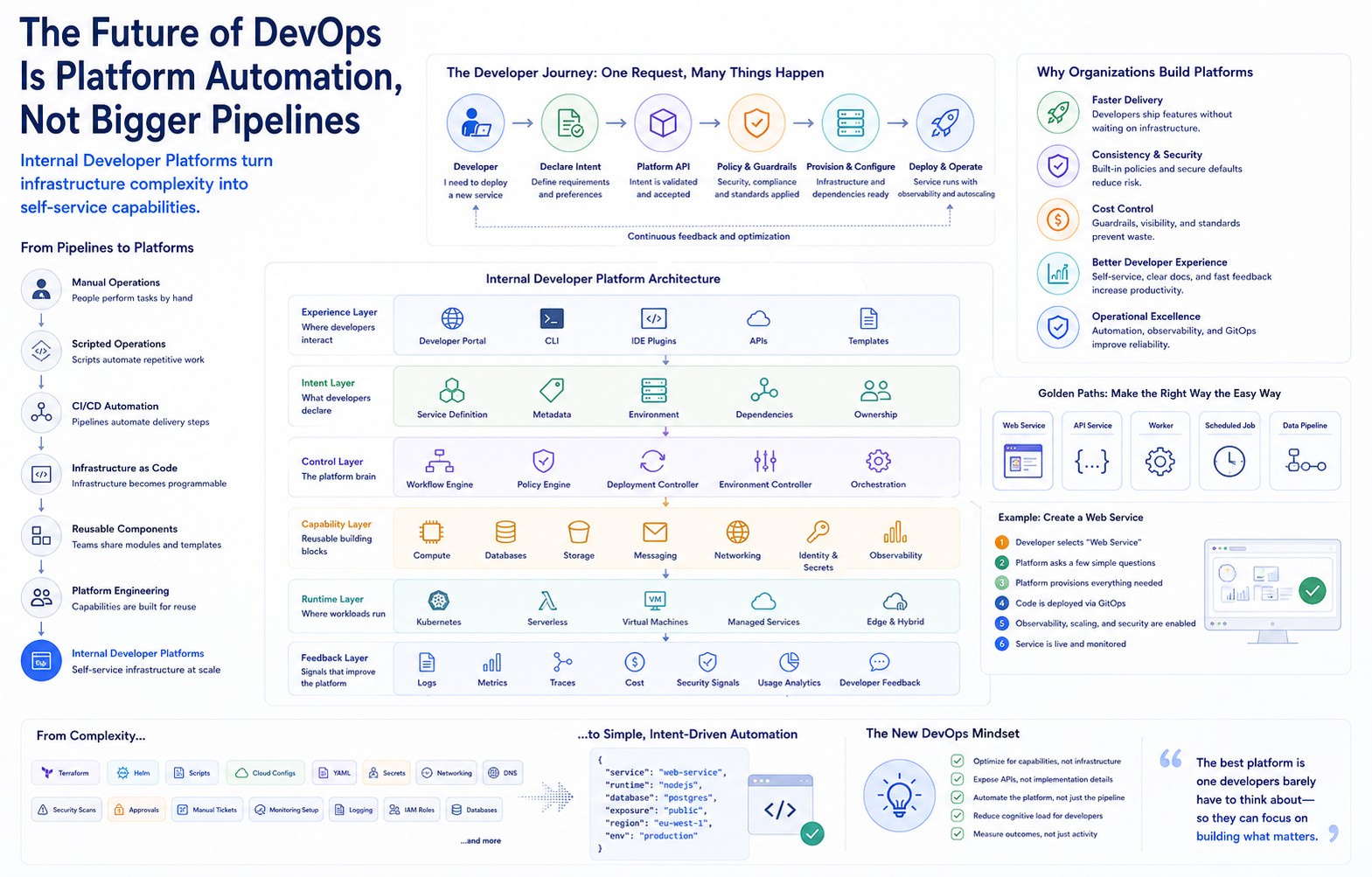
The Request That Looks Simple
Take a single, narrow, unglamorous object and follow it: a request to run a new service in production.
The request is easy to state. A team has finished a service. It builds. Its tests pass locally. It listens on a port, reads a configuration file, connects to a database, emits some logs. The team wants it running in production, reachable, monitored, and safe.
Between "I have a deployable application" and "this workload is running safely in production", the following things must be true — not aspirationally, but literally, as configuration that exists somewhere in some system:
- The repository is configured with the correct branch protections, required checks, and ownership metadata.
- A build definition exists that produces a deterministic artifact from source.
- Dependencies resolve from an approved registry, with a lockfile and a provenance record.
- A container image is produced from an approved base image, with a non-root user and a minimal surface.
- The image is signed, scanned, and stored in a registry the runtime is allowed to pull from.
- Environments exist — at minimum production, usually staging, often per-branch — with distinct configuration and distinct blast radii.
- Compute capacity is provisioned: a namespace, a node pool, a serverless function concurrency limit, a VM autoscaling group.
- Network configuration exists: VPC or VNet placement, subnets, security groups, service mesh membership, egress rules.
- DNS records point at something, and the something is stable across deployments.
- TLS certificates are issued, mounted, and renewed before expiry without human involvement.
- Secrets exist, are stored encrypted, are injected at runtime rather than baked into images, and are rotatable.
- A workload identity exists, distinct from a human identity, scoped to exactly the resources this service needs.
- Permissions bind that identity to a database, a queue, an object store, a third-party API.
- The database itself exists, with a schema, a migration path, a backup policy, and a retention window.
- Service discovery works, so callers can find this service without hardcoding addresses.
- A deployment strategy is chosen — rolling, blue/green, canary — and implemented with actual traffic-shifting mechanics.
- Health checks distinguish "process started" from "ready to serve" from "still alive."
- Autoscaling rules exist, with sane floors and ceilings and a metric that actually correlates with load.
- Structured logs are collected, indexed, and retained for a defined period.
- Metrics are emitted, scraped, stored, and attached to dashboards someone will look at.
- Traces propagate context across service boundaries.
- Security scanning runs against source, dependencies, image, and running configuration.
- Policy validation confirms the resulting configuration satisfies organizational rules.
- Rollback is possible, quickly, without reconstructing state from memory.
- Cost controls exist: resource requests, quotas, instance class restrictions, an expiry policy for non-production copies.
- Someone with authority approves the production change, or a system does on their behalf under defined conditions.
- An audit record captures who changed what, when, with which approval, against which artifact.
Depending on how you count, that is between thirty and eighty distinct decisions, most of which have a correct answer that is identical for nearly every service in the organization, and a small number of which genuinely depend on what this particular service does.
The important observation is not that this list is long. Everyone building production systems knows it is long. The important observation is that the list does not shrink when you automate it. CI/CD does not remove these concerns; it relocates them. Terraform does not remove them; it makes them textual. A developer portal does not remove them; it puts a button in front of them.
The complexity is conserved. Someone — or some system — must coordinate it.
The central architectural question of the next decade of delivery engineering is therefore not how do we automate more steps. It is: where should that coordination live, who owns it, and what interface does it present to the people who need its output?
For roughly fifteen years, the default answer was: the pipeline. That answer produced real, enormous gains. It is also, at sufficient scale, running out of room. What follows is an argument about why, what replaces it, and — importantly — when it is a mistake to replace anything at all.
When Pipelines Stop Being Automation and Become Software Systems
A pipeline begins as a shell script with ambitions. Build, test, publish. Three stages, maybe forty lines, understood entirely by the person who wrote it and readable in one sitting.
Then reality arrives, and it arrives incrementally. Each addition is individually justified and individually small:
Someone needs a different deployment target for staging, so a conditional appears. Someone needs a manual gate before production, so an approval step appears. Security wants dependency scanning, so a stage appears — and then an allowlist for the false positives, and then a bypass mechanism for the team with the vendored C library. Someone needs database migrations to run before the new version starts, but only if migrations changed, and only in environments where the schema is not shared. Infrastructure needs provisioning before the first deploy but not on subsequent ones, so a bootstrap branch appears. A team on a different cloud needs different credentials, so a matrix appears. A compliance requirement demands evidence, so an artifact upload appears. A flaky integration test needs retries, so retry logic appears. Notifications appear. Rollback logic appears. Release tagging appears. Version bumping appears. A cache appears, then a cache invalidation heuristic, then a workaround for the cache invalidation heuristic.
Nothing in that sequence is unreasonable. Each step is a locally optimal response to a real requirement. Yet at the end of it the organization is running a distributed program, written in a configuration language that was never designed for programming, executing on infrastructure with no local development story, with no type system, no dependency graph the authors can inspect, no test suite, and no clear owner.
Pipeline entropy is a structural condition, not a volume problem
The common diagnosis is "too much YAML." That framing is comforting because it suggests a cosmetic fix: better formatting, more comments, a linter. The actual problem is structural, and it has recognizable components.
Duplicated logic. The same twelve-line block that assumes a role, fetches a secret, and templates a Helm chart exists in eighty-three repositories in eleven slightly different variants. Nobody knows which variant is correct, because all of them work.
Hidden coupling. A pipeline reads an environment variable set by a different pipeline, or depends on the side effect of a previous job having written to a shared bucket, or assumes a runner image contains a CLI that was installed for an unrelated reason. These couplings are invisible in the pipeline definition and only become visible when they break.
Configuration drift. Two services deployed by the "same" process behave differently, because one was created before a template change and never re-adopted it. There is no reconciliation mechanism for pipelines. A pipeline describes what happens when it runs, not what should be true, so a service that has not deployed in six months carries six-month-old delivery semantics.
Repository-specific exceptions. Every large organization accumulates repositories where the standard process was bent: the monolith that needs a ninety-minute build, the mobile backend with its own signing requirements, the acquired team's stack. Exceptions are fine. Undocumented exceptions embedded in pipeline conditionals are not.
Implicit dependencies. Pipelines depend on runner OS versions, preinstalled tooling, network egress paths, base image tags, and credential shapes. None of this is declared. Upgrading a runner fleet becomes a change with an unknowable blast radius.
Version fragmentation. Shared workflows are pinned across a spread of versions, from @main to a two-year-old SHA. The distribution of pins is usually unknown until someone tries to make a breaking change.
Difficult upgrades. Because pipeline logic is copied rather than referenced, and because the copies have diverged, a security fix to the delivery process is not a deploy — it is a migration project with an unbounded long tail.
Ownership ambiguity. The platform team owns the shared template. The application team owns the repository. Nobody owns the interaction between them. When a deploy fails at 02:00, the first ten minutes are spent determining which of those two groups should be awake.
Poor discoverability. A developer asking "how do I add a Redis cache to my service" has no authoritative answer. They ask a colleague, find a repository that looks similar, and copy. Copying is the primary distribution mechanism for infrastructure knowledge in most organizations, which is why entropy compounds.
Inconsistent security controls. Scanning runs in most pipelines. Not all. Enforcement is advisory in some, blocking in others. The gap between "we have a control" and "the control is applied to every production workload" is exactly the gap auditors find.
Divergent deployment behavior. Two teams both say they do canary deploys. One shifts traffic by weight over ten minutes with automated metric analysis. The other deploys to one replica and waits for a human to look at a dashboard. Both call it the same thing in the same pipeline template.
Why shared templates help but do not resolve the architecture
The industry's response to pipeline entropy was correct as far as it went: factor the duplication out. Jenkins shared libraries, GitLab CI include and component templates, reusable GitHub Actions workflows, Tekton catalog tasks, Azure DevOps templates, central CI repositories with versioned modules.
This genuinely works. It reduces duplication, creates a place to make a change once, and gives a security team a chokepoint. Any organization that has not done this should do it before considering anything else in this article.
But it does not resolve the underlying architectural mismatch, for four reasons.
First, templates are still invoked, not enforced. A shared workflow is a library. Adopting it is a per-repository decision. Version pinning is a per-repository decision. Passing correct inputs is a per-repository decision. The template author has responsibility without authority, which is a reliable formula for burnout and for controls that exist on paper.
Second, the interface is a bag of strings. Pipeline templates accept inputs as untyped parameters with weak or no validation, defaulting silently, failing at runtime deep inside an execution, in an environment that cannot be reproduced locally. A platform interface should reject an invalid request in milliseconds with a comprehensible error. A pipeline template rejects it in minute nine of a fourteen-minute run, if at all.
Third, pipelines are event-triggered, not state-reconciling. A pipeline is a function invoked by a push. It has no opinion about the world between invocations. If someone changes a security group by hand, if a certificate expires, if a policy changes, if a required label is added to the standard — nothing happens until the next push. The mechanism has no way to express "this should be true continuously," only "do this now."
Fourth, and most fundamentally, the pipeline has no model of the organization. It knows about a repository and a run. It does not know that this service is owned by the payments team, that payments handles cardholder data, that cardholder data may not leave a specific region, that this team's budget for non-production environments is exhausted, that the service it calls is in the middle of an incident, or that the database it wants was deprecated last quarter. Every time an organization wants delivery to respect one of these facts, it teaches the pipeline about it — with an API call, a script, a lookup against a spreadsheet, a hardcoded map.
That accumulation is the mechanism by which a pipeline becomes something it was not designed to be.
The Pipeline Ceiling
There is a point at which additional pipeline sophistication stops producing proportional returns and starts producing maintenance load. Call it the pipeline ceiling. It is worth defining precisely, because "our CI is messy" is not the same problem and has a different fix.
The pipeline ceiling is reached when the delivery system is expected to make decisions that require knowledge of organizational state, rather than merely execute a sequence of known actions against a known artifact.
A pipeline is an orchestrator of ordered operations with an execution trigger, a working directory, and a termination condition. It is genuinely excellent at that. Give it an artifact and a sequence — compile, test, scan, publish, apply — and it will perform the sequence reliably, in parallel where possible, with logs and retries and caching.
The ceiling appears when the organization begins to expect the pipeline to know things:
- Organizational policy. Which workloads may be publicly exposed. Which data classifications may be stored in which regions. Which base images are approved this quarter.
- Infrastructure topology. Which cluster, which account, which VPC, which subnet tier, which mesh, which ingress class — as a function of the service's properties rather than a hardcoded string.
- Developer identity. Not "does this token work," but "is this human permitted to promote a change to this service in this environment, given their role and the current change freeze."
- Service ownership. Who is accountable, who is on call, who approves, who receives the cost, who gets paged when the deployment degrades an SLO.
- Environment state. Is staging currently held by another team's soak test? Is the target cluster draining? Was the last deploy rolled back, and if so, is redeploying the same SHA sensible?
- Dependency relationships. This service's consumers, its providers, the contract versions in play, and whether this release breaks any of them.
- Production risk. A configuration-only change and a change to the payment authorization path are not the same event, and should not receive the same gate.
- Security posture. Existing exceptions, accepted risks with expiry dates, current vulnerability status of the runtime dependencies at deploy time rather than at build time.
- Cost constraints. Remaining budget, quota utilization, the cost delta implied by this change's resource requests.
- Operational standards. Whether required telemetry exists, whether runbooks are linked, whether SLOs are defined.
- Service metadata. Lifecycle stage, tier, criticality, compliance scope, data classification.
Every one of those is a legitimate organizational requirement. None of them is a pipeline concern. When you implement them in CI anyway, you get a set of predictable structural problems.
State in a stateless place. Pipelines are ephemeral by design. Organizational facts are durable. Storing durable facts in ephemeral executions produces the familiar pattern of scripts that query five APIs at the start of every run to reconstruct a world model, slowly, with rate limits, and with no cache invalidation strategy.
No transactional semantics. A pipeline that provisions a database, creates an identity, writes a DNS record, and applies a manifest has four side effects and no rollback. When step three fails, the system is in a state that no code path describes. Cleanup is manual, or worse, is an on_failure block that has itself never been tested.
Authorization by proxy. The pipeline runs with credentials powerful enough to do anything any pipeline might need to do. Fine-grained authorization is then simulated inside the pipeline, in code, using identity information that the pipeline itself asserts. This is a control plane with the security model of a shell script.
Blast radius through a single template. Once shared templates carry policy, an error in a template is an error in every service. The organization has centralized risk without centralizing the engineering rigor that centralized risk requires — no versioned rollout, no canary of the delivery system itself, no SLO.
Debuggability collapse. A failure is reported as a non-zero exit code from a step whose logic lives across three repositories, two template versions, and an inline script. Mean time to understanding rises steadily, and the burden falls on application developers who did not choose this architecture.
Operations versus capabilities
The distinction that resolves this is between an operation and a capability.
"Deploy this container image to this cluster with this manifest" is an operation. It is imperative, bounded, and complete in itself. It has a beginning and an end. It is exactly what a pipeline should do.
"Provide a production-ready environment for an internet-facing API owned by the payments team, handling confidential data, in the EU, with high availability" is a capability request. It is declarative. It implies dozens of operations, but it does not specify them. It has no end — the resulting environment must continue to satisfy those properties as policies change, as certificates expire, as the platform's notion of "production-ready" evolves.
Operations compose into workflows. Capabilities compose into platforms. The two are not competitors; a platform executes operations constantly. But an interface designed for operations makes a poor interface for capabilities, in the same way that a function call makes a poor interface for a database.
Three practical consequences follow.
A capability must be idempotent and re-entrant in a way workflows rarely are. Requesting the same capability twice should converge, not duplicate. Requesting it after a partial failure should complete, not compound the damage.
A capability must have a lifecycle beyond the request. Something must keep the promise true after the request returns. This is why reconciliation loops, rather than job runners, are the natural implementation substrate.
A capability must have a contract, meaning a schema, a defined set of guarantees, a version, and a deprecation policy. A pipeline stage has none of these; it has a name and whatever arguments the last person to edit it happened to add.
Once you see the distinction, most of the frustration senior engineers feel toward large CI systems becomes legible. They are not annoyed by YAML. They are annoyed that the organization has built a control plane out of a task runner and is surprised that it behaves like a task runner.
Infrastructure as Code Was Necessary and Insufficient
It would be a mistake to read the previous section as an argument against Infrastructure as Code. IaC is one of the most consequential ideas in the history of operations, and every platform described in this article is built on top of it. It deserves a fair accounting before its limits are discussed.
Terraform and its successor fork OpenTofu, Pulumi, CloudFormation and CDK, Kubernetes manifests, Helm, Kustomize, and the earlier generation of configuration management tools — Puppet, Chef, Ansible, Salt — solved a set of problems that were genuinely unsolved:
Repeatability. The same definition applied twice produces the same infrastructure. Environments stop being artisanal.
Version control. Infrastructure changes acquire history, authorship, and diffs. "Why does production have this firewall rule?" becomes an answerable question.
Reviewability. A change to a subnet becomes a pull request, subject to the same review culture as application code.
Automation. Infrastructure becomes machine-applicable, which is the precondition for everything else.
Reproducibility. A disaster recovery plan becomes code rather than a document describing a click sequence in a console that has since been redesigned.
Definition. Perhaps most importantly, infrastructure acquires a canonical written form. Before IaC, the authoritative description of production was production.
Those gains are permanent and not up for renegotiation. The question is what IaC did not do, and here the record is more mixed.
IaC did not make infrastructure usable. A Terraform module is an interface for someone who already understands the domain it abstracts. aws_db_instance requires you to know about parameter groups, subnet groups, maintenance windows, storage autoscaling, multi-AZ semantics, and the difference between a snapshot and a backup. A well-written module hides some of that. It does not hide the need to know what a VPC is.
IaC did not produce standardization. It made non-standard infrastructure easy to write down. Ten teams with Terraform produce ten architectures, faster than ten teams with a console would have. Code is a medium, not an opinion.
IaC did not establish ownership. A state file does not know who is on call for what it created. The relationship between "this resource" and "this team" is an organizational fact that most IaC setups encode, if at all, in tags applied inconsistently.
IaC did not make self-service safe. Giving developers terraform apply against production is a permissions decision, and the tool provides no meaningful gradations. You either can create an RDS instance or you cannot. "Can create an RDS instance of an approved class, in an approved region, with encryption on, under a team budget, with backups configured" is not expressible in the tool; it is expressible only in policy layered on top.
IaC did not solve discoverability. The knowledge of which module to use, which version, with which inputs, in which repository, lives in the heads of the people who wrote it.
IaC did not deliver policy consistency. terraform plan will happily plan a public S3 bucket. Preventing that is a separate system.
IaC did not create reuse across teams. Modules are reusable in principle. In practice, a module written for one team's assumptions is forked by the second team, and the fork is where divergence begins.
IaC did not address lifecycle. Creation is well handled. Update is adequately handled. Deletion, migration between major provider versions, drift remediation, and the graceful retirement of an entire class of resource are handled poorly and mostly manually.
The distinction worth carrying forward is compact: Infrastructure as Code makes infrastructure programmable. It does not make infrastructure a product. Programmability is a property of the tool. Usability, guarantees, support, and evolution are properties of a thing someone has decided to own on behalf of others.
What happens when everyone gets the modules
The intuitive next step after building a module library is to publish it and let every team consume it. This is a reasonable experiment and it fails in reasonably predictable ways.
Module sprawl. The registry accumulates modules whose names differ by a hyphen, whose purposes overlap by eighty percent, and whose maintainers left the company. New teams cannot tell which is canonical, so they write a new one, which becomes the twelfth.
Version divergence. Consumers pin. Pins age. A breaking change in a provider forces an upgrade that the module maintainer performs, but the consumers do not adopt for eighteen months, during which the maintainer supports every version simultaneously.
Expertise requirements. Even excellent modules leak. A developer who wants a queue must still reason about visibility timeouts, dead letter queues, and IAM trust relationships when something misbehaves. The abstraction saves typing, not understanding.
Security mistakes. Modules expose inputs. Inputs include publicly_accessible. Someone will set it true, in a hurry, on a Friday, with a plausible reason.
Architecture inconsistency. Because modules are composable primitives rather than opinionated capabilities, each team composes them differently. The organization ends up with fourteen valid ways to run a stateless HTTP service, all of which must be supported during incidents.
Maintenance burden concentrated in the wrong place. The module library becomes a product without a product team — no roadmap, no SLO, no deprecation policy, and a support channel staffed by whoever feels guilty.
None of this argues for taking modules away. It argues that a module registry is a component of a platform, not a platform.
From Modules to Capabilities
The shift from module thinking to capability thinking is the conceptual hinge of platform engineering. It is worth stating carefully, because it is easy to mistake for "we renamed our modules."
A module is a parameterized description of infrastructure resources. Its contract is "give me these inputs and I will create these resources." Its abstraction boundary follows the shape of the cloud provider's API.
A capability is a description of something the organization is able to offer a team. Its contract is "tell me what you need to accomplish and I will provide something that satisfies our standards for that need, and keep it satisfying them." Its abstraction boundary follows the shape of the organization's needs.
The difference shows up most clearly in what the requester is required to know.
Consider a plausible capability catalog:
| Capability | What the developer states | What the platform decides |
|---|---|---|
| Create Service | name, runtime, exposure, tier | cluster, namespace, quotas, mesh, ingress class, base image, probes |
| Create Worker | queue binding, concurrency | scaling policy, retry semantics, DLQ, isolation |
| Create Scheduled Job | schedule, timeout | executor, concurrency policy, failure alerting, time zone handling |
| Create Database | engine, size class, criticality | version, HA topology, backup and retention, encryption, network placement, credential rotation |
| Create Queue | ordering and delivery needs | technology, partitioning, DLQ, retention, access policy |
| Create Object Store | data classification, access pattern | bucket policy, encryption keys, lifecycle rules, replication, public-access blocks |
| Create Preview Environment | pull request reference | namespace, TTL, seeded data, DNS, certificates, teardown |
| Expose Public API | hostname preference, auth model | WAF, rate limits, TLS policy, DDoS posture, certificate lifecycle |
| Enable Observability | service identity | pipeline configuration, retention, dashboards, alert routing, sampling |
| Request Secret | logical name, consumers | storage backend, encryption, rotation schedule, injection mechanism, audit |
| Configure Autoscaling | expected load shape | metric selection, thresholds, cooldowns, floors and ceilings |
| Create Development Environment | intended workflow | resource footprint, cost class, expiry, data masking |
Take one row seriously. Create Database is the canonical example because it looks trivial and is not.
Underneath a request that says "I need a Postgres database for a tier-2 service handling confidential customer data in the EU" there are at minimum the following decisions: engine and minor version, and a policy about when minor versions are upgraded and by whom; instance class, drawn from an approved list, with a mapping from the requester's size language to concrete resources; storage type, initial size, and autoscaling behavior; whether the deployment is single-AZ, multi-AZ, or multi-region, and what the failover semantics are; network placement in a private subnet with security groups permitting only the requesting service's identity; an authentication model, ideally IAM or workload-identity based rather than static passwords, and if static, a rotation schedule and injection mechanism; encryption at rest with a key from the correct key hierarchy, and encryption in transit enforced rather than available; a backup schedule, a retention period, a tested restore procedure, and a point-in-time recovery window consistent with the service's tier; monitoring of connections, replication lag, storage headroom, and long-running queries, with alerts routed to the owning team; a cost classification and tags that let finance attribute spend; deletion protection and a defined process for the day the service is retired; and a lifecycle position — is this database in the supported set, or the deprecated set that will be migrated next year.
Roughly twenty decisions. In most organizations, perhaps three of them genuinely depend on what the service does. The rest have an organizationally correct answer that is the same for every tier-2 EU service handling confidential data.
A capability is the encoding of that asymmetry. It asks for the three decisions that require the requester's knowledge and supplies the other seventeen from institutional knowledge, encoded once, maintained by people who understand them, and updated centrally when the correct answer changes.
This is also where the argument about developer cognitive load becomes precise rather than sentimental. The objection "developers should understand their infrastructure" is not wrong, but it is imprecise. There is a difference between understanding that your database has a fifteen-minute recovery point objective and being the person who configures the backup schedule that produces it. Capabilities preserve the first and remove the second.
What an Internal Developer Platform Actually Is
An Internal Developer Platform is not a portal, not a product category, and not a Kubernetes distribution. Defining it by its artifacts produces shallow implementations, which is why so many IDP initiatives ship a service catalog and stall.
A more useful definition: an IDP is the internal abstraction and automation layer through which an organization's software delivery, infrastructure, security, governance, and operational standards are exposed to developers as usable capabilities.
Three parts of that definition carry weight.
It is an abstraction layer, meaning it deliberately hides implementation. If every underlying detail remains visible and required, it is a wrapper, not a platform.
It is an automation layer, meaning requests are satisfied by machines rather than by humans reading tickets. A catalog of forms that generate work items for an infrastructure team is a workflow tool.
It connects concerns that are otherwise organizationally separate. Security policy, cost governance, infrastructure provisioning, delivery, and operational standards are usually owned by different groups with different tooling and different review processes. The platform's distinctive contribution is that it makes their combined output available through one coherent interface, so that satisfying all of them simultaneously is the default outcome of the normal path rather than a coordination exercise.
The components, and why the list is not a shopping list
A reasonably complete platform tends to include most of the following. The point of enumerating them is not to imply you need all of them, or that each is a separate product — it is to identify the responsibilities that exist whether or not you have named them.
A developer portal or equivalent surface provides discovery: what capabilities exist, what services exist, who owns them, what state they are in. Backstage is the best-known open implementation; the responsibility exists with or without it, and is frequently met by a CLI plus good documentation.
A service catalog is the system of record for services and their metadata: owner, tier, lifecycle stage, dependencies, compliance scope, on-call rotation. This is the single most under-appreciated component, because almost every interesting platform decision is a function of service metadata. Without it, policy has nothing to reason over.
Software templates scaffold new components with the organization's conventions already in place — repository structure, CI wiring, telemetry instrumentation, ownership files, security defaults.
The platform API is the programmable interface through which capabilities are requested. Its importance is large enough that it gets its own section below.
A workflow engine executes long-running, multi-step operations with retries, timeouts, and durable state. Argo Workflows, Temporal, Tekton, or a cloud step-function service all occupy this role. Provisioning is rarely a single atomic call, and pretending otherwise produces the partial-failure problems described earlier.
An infrastructure orchestrator turns declared intent into actual cloud resources. Terraform or OpenTofu executed by an automation layer, Pulumi, Crossplane compositions, or cloud-native control planes all fit. The distinguishing question is whether it reconciles continuously or applies on demand.
CI/CD integration remains essential. Platform automation does not eliminate pipelines; it demotes them from control plane to execution engine, which is the role they are good at.
A policy engine evaluates whether a requested or existing configuration is permitted. Open Policy Agent and Kyverno are the common choices, one general-purpose and one Kubernetes-native. Policy needs to run at multiple points — request admission, resource admission, and continuous audit — and often the same rule must be expressible at all three.
Identity and access management for both humans and workloads, ideally with short-lived credentials and workload identity federation rather than long-lived keys.
Secrets management with a defined injection path, rotation, and audit. Vault, cloud secret managers, or an operator that syncs into the runtime.
Observability integration that attaches telemetry, dashboards, and alert routing to a service as a consequence of its existence rather than as a follow-up task.
Cost management that attributes spend to services and teams and surfaces it where decisions are made.
Environment management that treats environments as first-class objects with lifecycles, owners, and expiry rather than as long-lived pets named staging-2.
A deployment controller that reconciles desired application state into runtime state. Argo CD and Flux are the dominant GitOps implementations of this responsibility.
A metadata catalog connecting services, resources, ownership, dependencies, and telemetry — the graph that makes questions like "what does this database serve, and who do I wake up" answerable.
No organization should build all of these from scratch, and most should build very few. The list is a map of responsibilities, and the correct implementation of most of them is "a system we already run, integrated properly." The failure mode is not choosing the wrong tool; it is leaving a responsibility unassigned and discovering during an incident that nobody owns it.
The Platform API Is the Durable Interface
If one component of a platform outlives all the others, it will be the API. Portals get redesigned. Pipeline vendors get replaced. Kubernetes distributions get migrated. Cloud providers get added. The contract between a development team and the organization's infrastructure capabilities is the thing worth designing to last a decade.
Intent, not implementation
The core move is to accept a declaration of what a service needs, not a description of how to build it.
apiVersion: platform.internal/v1
kind: Service
metadata:
  name: payments-authorization
  owner: team-payments
spec:
  type: api
  runtime: node
  exposure: public
  availability: high
  region: eu
  dataClassification: confidential
  dependencies:
    - kind: Database
      engine: postgres
      sizeClass: medium
    - kind: Queue
      name: authorization-events
      delivery: at-least-once
  scaling:
    minReplicas: 3
    targetConcurrency: 40
Nothing in that document names a cluster, an account, a subnet, a certificate issuer, a log pipeline, an IAM role, a WAF rule set, or a backup schedule. Every one of those is derivable from the declared properties plus organizational policy. exposure: public combined with dataClassification: confidential determines a specific set of network controls. availability: high combined with region: eu determines a topology. owner: team-payments determines cost attribution, alert routing, and approval authority.
The flow from that document to a running workload has a consistent shape:
        Developer Intent
              |
              v
        Platform API  ──────────┐  schema validation, defaulting,
              |                 │  authentication, admission
              v                 │
       Policy Evaluation  <─────┘  is this permitted, for this
              |                    identity, on this service,
              v                    under current constraints?
      Capability Selection         which implementation satisfies
              |                    the declared properties?
              v
   Infrastructure Provisioning     orchestrator + workflow engine,
              |                    idempotent, retryable
              v
    Deployment Configuration       manifests, traffic policy,
              |                    progressive delivery config
              v
       Security Controls           identity, secrets, network
              |                    policy, image constraints
              v
        Observability              telemetry, dashboards,
              |                    alerts, ownership metadata
              v
           Runtime
              |
              └──────> status, drift, cost, and health reported
                       back against the original intent
The reverse arrow matters as much as the forward ones. An intent-based API that cannot tell you the current status of your declaration is a submission form.
Designing the contract
Platform API design is product API design, and the disciplines transfer directly.
Schemas and validation. Every field typed, constrained, and documented. Enumerations rather than free strings wherever the set of valid values is knowable. Validation at submission, with errors that name the field, state the constraint, and suggest the fix. The difference between a platform developers tolerate and one they like is frequently just the error messages.
Defaults that encode judgment. The overwhelming majority of fields should be optional. A default is not a convenience; it is the platform team's accumulated opinion, applied automatically. Every required field is a decision you have pushed onto someone with less context than you.
Versioning and backward compatibility. Version from day one, even at v1alpha1. Additive changes only within a version. When breaking changes are needed, run versions in parallel, provide conversion, publish a deprecation timeline measured in quarters, and — critically — measure adoption so you know who you are about to break. Kubernetes' own API deprecation practice is a reasonable model.
Idempotency. The same declaration submitted repeatedly converges to one outcome. This is what makes retries safe, which is what makes automation on top of the platform possible.
Asynchronous operations with observable status. Provisioning a database takes minutes. The API should accept the intent, return immediately, and expose progress through a status subresource with conditions: Accepted, PolicyEvaluated, Provisioning, Ready, Degraded, Failed, each with a reason, a timestamp, and a human-readable message.
Failure semantics. Distinguish clearly between rejected (invalid input, correct response is to fix the declaration), denied (valid but not permitted, correct response is to request an exception), failed (transient, will retry), and stuck (needs intervention, here is who to contact). Collapsing these into "error" is the single most common cause of platform support load.
Ownership as a first-class field. Every object the platform creates should trace to a team. This is what makes cost attribution, alert routing, deprecation campaigns, and incident response tractable.
A resource model, not an RPC dump. Resist the accumulation of verbs — createServiceWithDatabase, createServiceWithDatabaseAndQueue. Model nouns with relationships and let composition happen through references.
Whether this API is literally an HTTP service, a set of Kubernetes Custom Resource Definitions served by the API server, a Crossplane composition, or a Git repository of typed manifests processed by a controller, is an implementation decision with real trade-offs but no universal answer. What matters is that a contract exists, is versioned, is validated, and is the same contract whether reached from a portal, a CLI, a pipeline, or another program.
Golden Paths Without Golden Cages
A Golden Path is a supported, opinionated, well-documented route through a common engineering task, for which the platform team accepts responsibility. Creating a service. Deploying an API. Adding a database. Publishing an event. Instrumenting telemetry. Running a background worker. Spinning up an ephemeral environment.
The word "supported" is the load-bearing one. A Golden Path is not a recommendation, a wiki page, or a reference implementation. It is a commitment: if you stay on this path, it will work, it will satisfy security and compliance requirements without further effort on your part, it will be maintained through upgrades, and when it breaks, it is our problem.
Consider the two failure modes it sits between.
No standardization. Every team chooses its own runtime, deployment mechanism, observability stack, secret handling, and infrastructure patterns. Local optimization is high; teams move fast initially and each choice is defensible. The costs appear later and are borne collectively: security controls must be implemented and verified N times, incident response requires N mental models, cross-team mobility is expensive, cloud spend is unoptimizable because no two workloads are comparable, and any organization-wide change — a CVE in a base image, a region migration, a compliance requirement — becomes an N-team negotiation.
Total standardization. One way to do everything, enforced, with exceptions requiring architectural review. Consistency is high. The costs are subtler: legitimate technical requirements get denied because the platform does not support them; teams route around the platform through side channels that are less safe than the exception would have been; the platform team becomes a scheduling bottleneck and is perceived as an obstacle; and — the deepest cost — the organization stops learning, because the mechanism by which new patterns proved themselves has been closed.
The operating principle that resolves this is not "find the middle." It is directional:
Make the safe path the easy path, and make leaving it possible but visible.
Notice what this rules out. It rules out safety that depends on developers choosing correctly under time pressure. It rules out enforcement so rigid that circumvention is the rational choice. And it rules out the pretense that the platform team can anticipate every legitimate need.
Escape hatches, done seriously
Escape hatches are where platform design either matures or fails. Three questions determine which.
When may a team leave the path? The answer should be "when they have a requirement the path does not serve, and they accept the consequences" — not "when they get approval from an architecture board." The gate should be on evidence and acceptance of ownership, not on permission.
What changes when they do? This is the crux. Leaving a Golden Path should transfer operational burden, not remove guardrails. A team that runs its own database is responsible for its backups, its upgrades, its monitoring, and its on-call. A team that runs its own ingress is responsible for certificate rotation. But no escape hatch permits unencrypted storage of confidential data, or unattributed spend, or workloads without ownership metadata. The distinction is between defaults, which are negotiable, and invariants, which are not. Platforms that fail to distinguish these either become rigid — treating every default as an invariant — or unsafe, treating every invariant as a default.
How is the exception recorded? In a durable, queryable, expiring record. Exceptions should have an owner, a rationale, a review date, and a mechanism that surfaces them during audits and incidents. An exception with no expiry is a permanent divergence with a paper trail.
The most valuable property of a well-run escape hatch system is that it is the platform's research pipeline. When three independent teams leave the path for the same reason, that is not three exceptions; it is a signal that a capability is missing. The correct response is to build it, migrate the three teams, and close their exceptions. A platform team without a steady flow of exceptions being promoted into capabilities has usually stopped listening — or has made escape so difficult that teams have started lying.
Self-Service Is a Governance Model, Not an Absence of Governance
The most persistent misunderstanding about developer self-service is that it means removing controls. Security teams hear "self-service" and imagine developers provisioning public databases at will. Developers hear "governance" and imagine tickets. Both are reacting to a version of self-service that responsible platforms do not implement.
Controlled self-service means: a developer can obtain, without human intervention, any capability that policy already permits them to obtain. The control does not disappear. It moves from a human review performed after the request to a machine evaluation performed during the request. The judgment that a reviewer would have applied is encoded in advance, applied consistently, and recorded automatically.
The mechanisms are well established individually; the platform's contribution is composing them.
Identity-aware authorization. Every request carries an authenticated identity — a human via SSO, a pipeline via workload identity federation, an agent via a scoped credential. Nothing is anonymous, and nothing runs as a shared super-user.
Role-based access handles the coarse cases: who may deploy to production, who may create infrastructure, who may approve exceptions.
Attribute-based access handles what roles cannot express, which is most interesting decisions. Whether this request is permitted depends on the requester's team, the service's tier, its data classification, the target region, the current change freeze status, and remaining budget. These are attributes of the request and its subject, not properties of a role.
Policy as code makes those rules testable artifacts under version control, with their own review process and their own test suite. A policy that has never been tested against a denial case is a policy of unknown behavior.
Quotas and budget controls bound the aggregate rather than the individual request. Any single non-production environment is cheap; four hundred of them are not. Quotas are how you permit generosity at the request level while capping exposure at the organizational level.
Approved service classes reduce the decision space to a curated set with known cost, known operational characteristics, and known support.
Region and residency restrictions enforce data sovereignty at the point of provisioning rather than discovering violations in an audit.
Auditability captures the decision, the inputs, the policy version, and the outcome — for approvals and denials alike.
The composed flow:
  Developer Request
        |
        v
     Identity            authenticated principal, team membership,
        |                current roles and delegations
        v
  Intent Validation      schema, referential integrity, quota
        |                headroom, dependency existence
        v
  Policy Evaluation      permitted for this principal, on this
        |                service, with these attributes, now?
        v
 Approved Capability     concrete implementation selected from
        |                the permitted set
        v
Automated Provisioning   workflow execution, idempotent, with
        |                durable state and compensation
        v
Continuous Enforcement   reconciliation, drift detection, policy
        |                re-evaluation as rules change
        v
       Audit             immutable record of decision and outcome
The counterintuitive result is that this configuration is usually more governed than the ticket-based process it replaces, not less. A human reviewer approving a Terraform plan at the end of a long week applies inconsistent scrutiny, has incomplete context, and produces an audit record consisting of a username and a timestamp. A policy engine applies the same rule to every request, has all available context by construction, and produces a record that includes the exact rule version that permitted the change.
There is a real caveat. Policy encodes the organization's understanding at the time it was written. A reviewer can notice that something is technically compliant and obviously wrong. Automated governance loses that, and the loss is not recoverable by writing more rules. The mitigation is not to reintroduce human gates on the common path — that destroys the value — but to invest in detection: anomaly detection on provisioning patterns, periodic review of what policy has been permitting, and low-friction paths for anyone to escalate something that looks wrong. Automated governance is fast and consistent. It is not wise. Wisdom has to be reinserted deliberately, at review time rather than request time.
Platform Engineering Does Not Replace DevOps
The claim that platform engineering supersedes DevOps is a category error, and it obscures a more interesting relationship.
DevOps, in its original formulation, is a set of cultural and operational commitments: that the people who build software should be involved in operating it; that automation should replace handoffs; that feedback loops should be short; that development and operations share goals rather than negotiate across a wall; that delivery should be continuous and low-risk.
Platform engineering is a discipline: the application of product management and software engineering practice to the internal infrastructure that developers consume. It has techniques — API design, abstraction, versioning, user research, SLOs for internal services — and deliverables.
One is a set of goals. The other is a means. They cannot replace each other any more than "customer focus" can be replaced by "product management."
The sharper point is that platform engineering is how DevOps principles survive scale. The original DevOps model, in which every team owns its full stack end to end, works beautifully at ten teams. At two hundred, "you build it, you run it" without a platform means two hundred teams independently learning Kubernetes networking, two hundred implementations of secret rotation, and two hundred on-call rotations of wildly varying quality. The principle does not fail; its naive implementation does. A platform preserves ownership — teams still own their services, still get paged, still make architectural decisions — while removing the requirement that every team independently solve problems that have one correct organizational answer.
How responsibilities redistribute
There is no universally correct org chart here, and any article claiming otherwise is selling something. What is reasonably stable is the shape of the redistribution.
Application developers retain ownership of their service's behavior, its dependencies, its SLOs, its on-call, and its architecture. They gain the ability to obtain infrastructure without waiting. They lose the requirement to know cloud primitives in depth — which some experience as relief and some as a loss of control, and both reactions are legitimate.
DevOps engineers embedded in product teams shift from executing infrastructure work to being the team's expert consumers of the platform: designing the service's topology, tuning its resource profile, handling the parts of delivery that remain genuinely service-specific, and acting as the feedback channel to the platform team. In organizations with a strong platform, this role tends to blend into either senior application engineering or platform engineering, depending on the individual's interests.
Platform engineers build and operate the capabilities. This is software engineering with an internal user base and a production dependency on the output. It requires skills that traditional operations roles did not emphasize: API design, backward compatibility, user research, documentation, and the discipline to say no to one-off requests that would fragment the platform.
SREs work at the intersection. Where SRE exists as a distinct function, it typically owns reliability engineering for critical services and increasingly for the platform itself — which, once it sits on the critical path of every deployment, is among the most critical services in the organization.
Security engineers move from reviewing changes to encoding controls. The highest-leverage security work in a platform organization is building the secure default, not auditing the insecure one. This is a genuine role change and not every security organization makes it successfully; it requires engineers who can write policy as code and reason about developer workflows rather than compliance checklists.
Cloud infrastructure teams own the substrate: accounts, networks, identity federation, the Kubernetes clusters or serverless foundations, and the relationship with providers. They become the platform's supplier rather than the developer's.
The boundaries between these blur constantly, and the blurring is fine. What is not fine is the arrangement where a platform team is created but the underlying accountability model is unchanged — where the platform team is expected to build capabilities and handle every ticket and operate the clusters and review every team's Terraform. That team will not build anything durable, because interrupt load and product work do not coexist in the same people without explicit protection.
Infrastructure as a Product, With Caveats
If developers are consumers of the platform, then the practices of product management apply: understand who your users are, what they are trying to accomplish, where they get stuck, what they work around, and what they would use if it existed.
In practice this means platform teams doing things that operations teams historically did not: shadowing developers through their first deployment and timing it; reading the support channel as a research corpus rather than a queue; instrumenting the platform to see where requests fail, where users abandon, and which capabilities are used once and never again; running actual interviews; maintaining a roadmap that is public inside the company; and writing documentation as a deliverable with an owner rather than as a byproduct.
Each platform capability should have the properties of a supported product:
An owner — a named team, not a rotating volunteer. A contract — a versioned schema and defined behavior. Service expectations — availability and latency targets for the capability's control operations, and defined support hours. Documentation — including a quickstart that a new engineer can complete unaided, and reference material that survives the quickstart. Usage telemetry — because you cannot deprecate what you cannot measure. Feedback mechanisms with visible responses, so that reporting a problem is worth the effort. A roadmap. And a deprecation strategy established before the first user, not after the first migration crisis.
Where the customer metaphor breaks
The metaphor is useful and dangerous in roughly equal measure, and the danger deserves explicit attention.
Developers are not customers. Customers can leave, do not share your goals, and are always right in the relevant sense. Internal developers cannot easily leave, share the organization's goals, and are frequently wrong about infrastructure in the same way that any user is wrong about the internals of a system they do not operate.
Taken too literally, the metaphor produces a platform that optimizes for developer satisfaction scores at the expense of things developers do not experience directly: security posture, cost, operability, compliance, and the long-run maintainability of the platform itself. Every one of these is a cost paid by someone else, later, and a satisfaction-optimizing platform team will systematically underweight them.
A better framing: the platform team's users are developers, but its stakeholder is the organization. The job is to make the organizationally correct path the most pleasant one — not to make the most pleasant path available regardless of whether it is correct. When a developer asks for public database access because it would make their debugging easier, the product-minded response is neither "no, file a ticket" nor "certainly, here you are." It is to understand the underlying need — debugging production data — and build a capability that serves it safely, such as a bastion-free, audited, time-limited, read-only query interface with masking for sensitive columns.
That reframing also protects platform teams from a real failure mode: becoming an internal service organization that measures itself by requests fulfilled. Fulfilling requests feels productive and generates gratitude. It also produces no leverage, and a platform team that spends its capacity there will be indistinguishable from the operations team it replaced within eighteen months.
Developer Experience Is an Architectural Property
Developer Experience is frequently treated as a presentation concern — a portal, a design system, a nicer CLI. This confuses the symptom with the cause. DX is overwhelmingly determined by architecture, and no interface can compensate for an architecture that produces bad experiences.
Consider where friction actually originates.
Slow feedback is an architectural property. A twenty-two minute pipeline is slow because of dependency resolution strategy, test isolation, image layer design, and the absence of caching — not because of how the results are displayed. A developer who learns that their configuration is invalid twenty-two minutes after committing it is experiencing an architecture that validates late.
Too many dependencies to coordinate is architectural. If shipping a change requires a database migration approved by one team, a firewall rule from another, and a certificate from a third, the experience is bad regardless of how those requests are submitted.
Unclear ownership is a metadata architecture problem. If a developer cannot determine who owns the service they need to call, no interface improvement helps.
Manual approvals in the common path are a policy architecture problem. Every approval that a machine could grant under stated conditions is a queue with a human in it.
Environment inconsistency — the code works in staging and fails in production — comes from environments being separately constructed rather than generated from a common definition.
Fragmented tooling means context switching between eight systems to answer one question, which is an integration architecture problem.
Hidden infrastructure knowledge — the fact that the correct answer lives in someone's head or in a Slack thread from 2023 — is a discoverability architecture problem.
Unreliable automation trains developers to distrust the system, which is the most expensive DX failure of all. Once developers believe a retry is the standard response to failure, they stop reading errors, and every genuine error costs an order of magnitude more to diagnose.
Excessive configuration — a new service requiring three hundred lines of YAML across five files — is an interface design problem, but the interface in question is the platform's contract, not its UI.
Good DX emerges from the inverse set of architectural properties: predictable interfaces that behave the same way in every context; sensible defaults so the common case requires almost no input; fast feedback through validation at the earliest possible point, ideally in the editor; clear errors that name the problem, the location, and the remedy; self-service so waiting is not part of the workflow; discoverability so the answer is findable without asking; stable abstractions that do not require relearning every quarter; reliable automation that does what it says; and documentation treated as part of the product.
The practical implication is uncomfortable for organizations looking for a fast win. Installing a developer portal over fragmented infrastructure does not improve DX. It improves discovery of fragmentation. Developers will find the portal, click the button, and land in the same ticket queue, having now been given a reason to expect otherwise. The portal will be blamed. The architecture was the problem.
The Portal Is Not the Platform
This distinction deserves to be stated bluntly because so many initiatives fail on it.
A portal is an interface — a web application that renders capabilities, catalogs, and status for human consumption.
A platform is the system of capabilities that the portal renders. It exists whether or not a portal does.
The anti-pattern is a portal built first, over nothing:
        Beautiful Portal
              |
           Buttons
              |
        Manual Tickets
              |
      Disconnected Scripts
              |
     Infrastructure Teams
This is a ticket system with better typography. The developer's experience improves marginally — the form is nicer — while the actual wait time, the actual coordination burden, and the actual inconsistency remain untouched. Worse, it consumes the political capital and the attention that a real platform effort requires, and it is often declared a success on the basis of usage metrics that measure clicks rather than outcomes.
The inverted structure:
   Developer Portal   /   CLI   /   API   /   IDE
              \           |         /        /
               \          |        /        /
                v         v       v        v
                  Platform Contracts
                  (typed, versioned, validated)
                          |
                          v
                 Automation and Policy
              (workflows, controllers, rules)
                          |
                          v
              Infrastructure Capabilities
          (compute, data, messaging, identity)
                          |
                          v
        Cloud  /  Kubernetes  /  Managed Services
Every surface at the top is a client of the same contract. This has a specific, testable implication: the platform must be fully usable without the portal. If a capability can only be invoked by a human clicking, it cannot be scripted, cannot be composed, cannot be used by a pipeline, and cannot be used by an agent. It also cannot be tested properly, because its interface is a rendering.
The design rule that follows is worth adopting literally: build the API first, the CLI second, the portal third. Teams that do this find the portal easy to build, because it is a client. Teams that do the reverse find themselves extracting an API from a web application, which is among the least pleasant projects in software engineering.
A Reference Architecture, Layer by Layer
Reference architectures are useful for locating responsibilities, not for prescribing implementations. The following six layers describe what any reasonably complete platform must handle, regardless of which products fill each role. Many organizations will implement several layers inside one system; that is fine as long as the boundaries remain conceptually distinct.
Experience layer
Developer portal, CLI, IDE integrations, project templates, and the API surface as consumed by humans. Its responsibility is discovery, invocation, and status presentation. Its architectural constraint is that it must hold no logic — anything it computes is unavailable to every other client.
Intent layer
Service definitions, the platform API schemas, metadata, and ownership. This is where a request becomes a durable, typed, versioned object. It is the layer that must survive the longest, because every other layer's implementation is replaceable behind it. Its architectural constraint is compatibility discipline: this layer changes slowly and additively, or the platform's value evaporates.
Control layer
The workflow engine, policy engine, deployment controller, environment controller, and infrastructure orchestrator. This is where intent becomes action. Its architectural constraints are durability — no in-memory state that cannot survive a restart — and idempotency, because everything here will be retried.
Capability layer
Compute, databases, messaging, storage, networking, secrets, identity, and observability, expressed as organizational capabilities rather than vendor primitives. This is the layer that translates "a Postgres database, medium, high availability, EU, confidential" into a specific implementation. Its architectural constraint is substitutability: the implementation behind a capability should be replaceable without changing the intent schema.
Runtime layer
Kubernetes clusters, VM fleets, serverless platforms, managed cloud services, edge infrastructure. Where workloads execute. Its architectural constraint is that it should be knowable but not required knowledge — inspectable by anyone who needs to debug, unnecessary for anyone shipping a standard service.
Feedback layer
Logs, metrics, traces, deployment status, cost data, security signals, reliability signals. Its responsibility is closing the loop, and it is the layer most often underbuilt. A platform that provisions but does not report is a one-way system, and one-way systems are the ones developers stop trusting.
How the layers communicate
Two properties determine whether this architecture works in practice.
Synchronous where fast, asynchronous where slow. Validation, policy evaluation, and authorization should be synchronous and fast — a developer should learn within a second that their declaration is invalid. Provisioning, deployment, and certificate issuance are asynchronous by nature. Blocking a request for eleven minutes while an RDS instance spins up produces timeouts, retries, and duplicate resources. The API should accept, acknowledge, and report.
Reconciliation rather than execution. This is the deepest architectural difference between a pipeline-centric and a platform-centric system, and it is worth dwelling on.
An imperative workflow executes a sequence and terminates. Its guarantee is "these steps ran." If the world changes afterward — someone edits a security group, a controller crashes, a policy tightens — the workflow has no opinion, because it is not running.
A reconciliation loop continuously compares desired state to observed state and acts to close the gap. Its guarantee is "this remains true." This is the model Kubernetes controllers use, that Argo CD and Flux use for application state, that Crossplane uses for cloud resources, and that any durable platform will use for its own objects.
The practical consequences are significant. Drift is corrected automatically rather than discovered during an incident. Policy changes propagate to existing resources rather than only to new ones — when the organization decides that all databases must have deletion protection, reconciliation applies it to the four hundred that already exist. Partial failures self-heal on the next loop rather than requiring manual cleanup. And the system's behavior becomes describable as a set of invariants rather than a set of procedures.
The trade-offs are real. Reconciliation loops can fight with humans and with each other, producing oscillation. They make "just let me change this one thing temporarily" surprisingly hard, which is correct behavior that feels obstructive during incidents — hence the need for a documented, audited, expiring pause mechanism. They consume resources continuously. And they require every operation to be expressible as a convergence toward a state, which some operations genuinely are not.
Which is why the honest architecture is hybrid: desired-state reconciliation for anything that should remain true, imperative workflows for anything that happens once. A database's configuration should be reconciled. A schema migration should not be — it is a one-time, ordered, non-idempotent operation with dependencies, and modeling it as a desired state produces bizarre systems. Mature platforms use a workflow engine to execute imperative sequences and controllers to hold invariants, with the workflow engine typically responsible for the initial creation choreography and the controllers responsible for everything afterward.
Where GitOps Fits, and Where It Strains
GitOps is a specific and valuable implementation of the reconciliation idea: the desired state of a system is stored declaratively in Git, and an agent running near the runtime continuously pulls that state and reconciles the environment to match.
Its strengths are substantial and worth stating without hedging.
The change record is the source of truth. Every change to production has a commit, an author, a review, and a timestamp, in a system engineers already know how to use.
Reconciliation is continuous. Manual changes to the cluster are reverted or flagged. Drift becomes an event rather than a discovery.
The credential direction is inverted. A pull-based agent inside the cluster needs no inbound access from CI, which means the delivery system does not hold cluster admin credentials. This is a meaningful reduction in the value of compromising a CI system.
Rollback is a revert. The recovery procedure is a Git operation with known semantics.
Auditability is largely free. For a substantial class of compliance requirements, "show me every change to production and who approved it" is answered by repository history.
The strains appear at the edges, and they are worth naming because GitOps advocacy often skips them.
Not all state belongs in Git. Secrets require encryption schemes or external references. Anything with a genuinely dynamic value — a generated password, a cloud-assigned identifier, an autoscaled replica count — either does not belong in the repository or requires careful exclusion, and the exclusion rules accumulate.
Ordered, stateful operations fit poorly. Schema migrations, data backfills, and multi-step cutovers are sequences with dependencies and failure semantics. Expressing them as desired state produces hook systems, sync waves, and ordering annotations, which is a workflow engine reimplemented inside a reconciler.
Repository structure becomes an architectural decision with real consequences. Monorepo versus repo-per-team versus repo-per-environment affects blast radius, review load, and reconciliation performance. Organizations frequently restructure two or three times before finding a fit.
Generated manifests need somewhere to live. Committing rendered output creates enormous diffs and repository bloat; rendering at reconciliation time reduces the repository's value as a record of what is actually deployed. Both approaches are used and both have unhappy days.
Git is not a great user interface for high-frequency operations. A developer who wants an ephemeral environment for a pull request should not be opening a pull request against an infrastructure repository to get one. The commit-review-merge cycle is appropriate for durable changes and heavy for transient ones.
Scale has costs. Thousands of applications reconciling continuously against a Git provider produces real load, and the failure modes — API rate limits, slow reconciliation, sync storms after a mass change — are operational problems requiring their own engineering.
The productive framing is compositional rather than competitive. GitOps is an excellent implementation mechanism for the control layer, particularly for application deployment and for infrastructure whose desired state changes deliberately. A platform API is the interface layer through which intent is expressed. These are not alternatives; in many well-built platforms the API is what writes to Git.
That combination is worth describing concretely. A developer declares intent through the platform API. The platform validates it, evaluates policy, and renders concrete manifests and infrastructure definitions. It commits those to a repository the developer never touches. A GitOps agent reconciles them into the runtime. Status flows back and is presented against the original intent, not against the generated artifacts. The developer gets a simple interface; the organization gets a complete, reviewable, auditable record of everything actually applied; and the reconciliation guarantees hold. The generated repository becomes an implementation detail and an audit surface rather than a user interface — which is precisely the right role for it.
Some platform operations will sit outside this path entirely: a one-time migration executed by a workflow engine, a break-glass action taken during an incident, a bulk credential rotation. Insisting that everything flow through Git produces contortions. The useful rule is that Git holds the desired state of things that should persist, and the workflow engine handles transitions that happen once — with both producing audit records into the same system.
Kubernetes Is Infrastructure, Not a Developer Platform
Kubernetes is an extraordinarily good control plane for container orchestration and an extensible substrate for building higher-level systems. It is not, and was never intended to be, an interface for application developers. The confusion between these two claims has cost the industry a great deal.
Consider what a developer must understand to run a single production HTTP service directly on Kubernetes, without abstraction:
Deployment semantics: replicas, update strategy, maxSurge and maxUnavailable, and why a rollout can appear complete while no healthy pod is serving. Service types and the difference between ClusterIP, NodePort, and LoadBalancer, plus selector semantics and the failure mode where a typo in a label produces no error and no endpoints. Ingress or Gateway API resources, controller-specific annotations, path matching semantics, and TLS configuration. ConfigMaps and their update propagation behavior — that a mounted ConfigMap updates eventually but an environment variable does not update at all. Secrets, including the fact that base64 is not encryption and that access control is the actual mechanism. Resource requests and limits, the distinction between them, the scheduling implications of requests, the throttling behavior of CPU limits, and the OOM-kill behavior of memory limits. Probes — liveness, readiness, and startup — and the standard outage caused by a liveness probe that checks a dependency, turning a downstream slowdown into a restart loop. NetworkPolicies, which are default-allow until one exists and then default-deny for the selected pods. RBAC, service accounts, and workload identity federation. HorizontalPodAutoscaler configuration and metric selection. PersistentVolumeClaims, storage classes, access modes, and reclaim policies. Scheduling: node selectors, affinity and anti-affinity, taints and tolerations, topology spread constraints, and PodDisruptionBudgets — the absence of which means a routine node drain can take an entire service down.
This is a legitimate and valuable body of knowledge. Someone in the organization must have it. The design question is whether everyone shipping an ordinary service must have it, and the answer for most organizations is no — not because developers are incapable, but because the marginal value of the four hundredth engineer knowing PodDisruptionBudget semantics is far below the value of what they would otherwise be doing.
Building domain abstractions on top
Kubernetes' most underused property is that it is a platform for building platforms. Custom Resource Definitions extend the API server with organization-specific types, and controllers implement their semantics using the same reconciliation machinery Kubernetes uses for its own resources.
An organizational abstraction might look like:
apiVersion: platform.internal/v1
kind: WebService
metadata:
  name: catalog-api
  namespace: team-catalog
spec:
  image: registry.internal/catalog-api:2.14.0
  port: 8080
  exposure: internal
  tier: 2
  scaling:
    min: 3
    max: 30
    targetConcurrency: 50
  dependencies:
    - database: catalog-primary
    - queue: catalog-events
Twelve meaningful lines. A controller watching this resource creates and maintains a Deployment with the organization's standard security context and topology spread constraints; a Service; an appropriate ingress or mesh route with TLS from the internal issuer; a NetworkPolicy permitting exactly the declared dependencies and denying everything else; a ServiceAccount bound to a workload identity with least-privilege access to the named database and queue; an HPA with metrics chosen for the declared scaling behavior; a PodDisruptionBudget consistent with tier 2; probe configuration derived from the runtime's conventions; telemetry collection with the correct resource attributes; a set of dashboards and default alerts; and cost allocation labels. Plausibly two hundred to four hundred lines of Kubernetes and cloud resources, generated and — crucially — maintained from twelve.
The maintenance property is what distinguishes this from templating. When the organization decides that all tier-2 services need a topology spread constraint across three zones, the controller is updated and every WebService converges. With a Helm chart, you have a version bump that four hundred repositories must adopt individually.
The risks of abstraction, stated honestly
Abstractions leak, and the leaks concentrate in the worst moments.
Debugging crosses the boundary. When a WebService is stuck, the developer sees a custom resource with a status condition. Diagnosis requires understanding the generated Deployment, the events on the ReplicaSet, and possibly the CNI. The abstraction saved them from learning this on a good day and requires it on a bad one. Mitigations exist — surfacing underlying events into the custom resource's status, providing a CLI that traces from abstraction to primitives, writing runbooks for the common failure modes — but the fundamental asymmetry remains and should be acknowledged rather than denied.
Abstractions accrete. Every legitimate request adds a field. Two years later the WebService CRD has ninety fields, most defaulted, and the abstraction has become a slightly reorganized Deployment with extra steps. The defense is discipline about what belongs in the abstraction versus what belongs in an escape hatch, and periodic willingness to remove fields.
Expressiveness ceilings arrive suddenly. A team needs a sidecar the abstraction does not support, or a scheduling constraint it does not model. Without an escape hatch, they either wait for the platform team or abandon the abstraction entirely. The common resolution — a raw podTemplateOverrides field — is pragmatic and corrosive: it works, and it makes the abstraction's guarantees unenforceable for anyone who uses it.
Controller correctness is now your problem. A bug in the controller affects every service it manages. Reconciliation logic is genuinely difficult to write correctly: level-triggered rather than edge-triggered, idempotent, tolerant of partial state, careful about ownership references and finalizers, and resistant to the thundering-herd behavior of a mass resync. This is not a weekend project, and organizations that treat it as one produce platforms that fail in ways nobody on the team can explain.
The reasonable posture is that abstractions above Kubernetes are usually worth building, that the threshold for building them is higher than enthusiasm suggests, and that the escape hatch and the debugging story must be designed at the same time as the abstraction — not added after the first incident.
Platform Automation Beyond Kubernetes
An article about platform engineering that treats Kubernetes as the whole substrate would misrepresent most real organizations. Kubernetes is one runtime among several, and in many companies it is not even the dominant one.
A platform's capability catalog must span:
Managed cloud services — the databases, caches, search clusters, and analytics services that constitute the majority of infrastructure spend and complexity in most organizations. These have no Kubernetes representation unless you install one.
Serverless compute — functions, container-based serverless runtimes, and edge execution, which have entirely different deployment, scaling, observability, and cost models from long-running containers.
Data infrastructure — warehouses, streaming platforms, ETL orchestration, and the governance layer over them, which is often the most compliance-sensitive part of the estate.
Content delivery and edge — CDN configuration, edge functions, WAF rules, and DNS, which are frequently managed by hand through a provider console because "it's just a few settings," and which therefore constitute a meaningful share of production incidents.
Identity providers — the creation of applications, scopes, client credentials, and group mappings, which is a bottleneck in almost every organization and an excellent early platform capability.
Messaging — managed queues and event buses with their own provisioning, access control, and retention semantics.
Object storage — with lifecycle policies, encryption key hierarchies, replication, and the public-access misconfigurations that produce breach headlines.
SaaS dependencies — monitoring tools, feature flag services, error tracking, and payment providers, each of which requires per-service configuration that is currently done by hand.
Legacy systems — mainframes, on-premises databases, virtual machine estates, and appliances that will not be modernized on any timeline worth planning around, but whose access must still be provisioned and governed.
The architectural implication is that the platform's model must be organizational, not runtime-derived. If your abstraction is kind: Deployment with extra fields, you have modeled Kubernetes. If it is kind: Service with a runtime property whose values include kubernetes, serverless, and managed-vm, you have modeled your organization, and the runtime becomes an implementation choice that can change without breaking the contract.
This is the point where Crossplane and similar control-plane projects become interesting: they extend the Kubernetes resource model and reconciliation machinery to cloud resources that live entirely outside Kubernetes, letting a single control plane manage a heterogeneous estate. Terraform or OpenTofu executed by an automation layer with drift detection achieves a comparable outcome by a different route. Cloud-native service catalogs and internal control planes built as ordinary services are also legitimate. The choice depends on existing skills, the shape of the estate, and how much operational load the organization can absorb. What is not optional is deciding where the desired state lives for non-Kubernetes resources, because the default answer — "in a Terraform repository that someone applies manually when they remember" — reintroduces every problem this architecture exists to solve.
The Control Plane Model
The clearest architectural lens for platform automation is the control plane / data plane distinction that networking and Kubernetes both use.
The data plane is where work happens: application processes serving requests, databases executing queries, queues moving messages, functions responding to events. Its properties are throughput, latency, and availability under load.
The control plane is where decisions about the data plane are made and enforced: what should exist, how it should be configured, who may change it, whether it complies with policy, and what its current state is. Its properties are consistency, correctness, and auditability.
A platform is a control plane for an organization's software delivery and infrastructure. It manages desired configuration, policy, ownership, provisioning, lifecycle, metadata, deployment, and compliance — while the workloads it manages run in data planes it does not sit inside.
The separation has substantial benefits. Scalability, because the control plane's load scales with change rate, not with traffic; a platform managing ten thousand workloads handles perhaps thousands of changes per day, which is a modest system. Independent evolution, because the control plane can be upgraded without touching running workloads. Uniformity, because one control plane can manage heterogeneous data planes across clouds and runtimes. And operational clarity, because "is this a platform problem or a workload problem" becomes a question with a structural answer.
The risks are equally structural, and platform teams underestimate them consistently.
Control-plane outage. If the platform API is down, nobody deploys. This is survivable for an hour and organizationally serious for a day. The mitigation is not merely high availability but graceful degradation: existing workloads must continue running with no dependency on the control plane, and there must be a documented, tested break-glass path for emergency deployment that bypasses the platform entirely. The break-glass path must be exercised regularly, because an untested emergency procedure is a plan, not a capability.
Central dependency risk. Every team now depends on one system operated by one team. This is a real transfer of risk and should be acknowledged rather than papered over. It is justified only if the platform team operates at a reliability standard commensurate with the dependency — which many newly formed platform teams do not initially do.
Incorrect global policy. A policy change that denies a common pattern blocks every team at once. Policy deserves the same rollout discipline as code: dry-run mode first, then warn, then enforce, with the ability to see exactly what would be denied before it is.
Platform blast radius. A controller bug that generates an incorrect NetworkPolicy applies it everywhere. The severity of a platform defect is proportional to adoption, which means the platform's success increases the cost of its mistakes. This is the central tension of platform engineering and it does not have a clever resolution — only engineering rigor.
Reconciliation storms. A change to a widely used template or base composition triggers simultaneous reconciliation of thousands of resources, saturating cloud APIs and hitting rate limits. Rate limiting, jitter, and staged rollout of platform-wide changes are not optional at scale.
Platform Reliability Is Production Reliability
Once a platform sits on the delivery path of every team, it is production infrastructure, and the arguments platform teams sometimes make — that it is "internal," that a brief outage merely inconveniences developers — stop being true. A platform outage during an incident prevents the fix from shipping.
It is worth enumerating the failure modes explicitly, because designing for them is what separates a platform from a collection of automation.
The platform API is unavailable. No new services, no configuration changes, no infrastructure requests. Deployments may or may not be blocked depending on whether the deployment path traverses the API. This is the argument for the deployment path having the fewest possible dependencies — a GitOps agent reconciling from a repository will keep working even if the control plane that writes to that repository is down.
Deployment orchestration fails midway. Half the replicas run the new version. The rollout controller is not making progress. Is the service healthy? Should it roll back? Does anyone know? Progressive delivery mechanisms need explicit, tested timeout and abort behavior, not just success paths.
Policy evaluation is unavailable. This is a design decision with no comfortable answer. Fail-closed means a policy engine outage stops all deployments, converting a component failure into a total delivery outage. Fail-open means an outage silently disables governance. The defensible resolution is usually differentiated: fail-closed for a small set of security-critical invariants, fail-open with loud alerting and a compensating audit sweep for the rest. What is not defensible is not having decided.
The service catalog is unavailable. If ownership, routing, and policy attributes are resolved from the catalog at request time, its unavailability degrades everything. Aggressive caching with stale-serving is usually correct here — stale ownership data is far better than no ownership data.
Provisioning partially completes. The database exists, the identity does not, the DNS record was created, the secret was not. This is the most common and most damaging failure mode. It demands durable workflow state, compensating actions, and a reconciliation loop that can resume from any point. It also demands that the platform report the partial state clearly rather than presenting a generic failure, because the developer's next action — retry or escalate — depends on knowing which.
A platform upgrade introduces a defect. A new controller version generates subtly wrong configuration for a class of services. Because reconciliation is continuous, the defect propagates automatically and quickly. This argues for canarying platform components against a subset of managed resources, for controllers that fail closed on unexpected states rather than generating best-effort output, and for the ability to pause reconciliation globally.
The engineering practices that address these are the ordinary practices of reliability engineering, applied to a system many organizations do not think of as needing them:
Availability targets that are explicit and published. A platform API at 99.5% is down for three and a half hours a month, which is either acceptable or not — but the conversation must happen before the outage.
Graceful degradation designed deliberately: read paths surviving write-path failures, cached policy decisions when the engine is unreachable, and existing workloads never depending on control-plane availability.
Transaction boundaries made explicit. Where atomicity is impossible across a database, an identity provider, and a DNS zone, the system must define what partial success means and how it resolves.
Retry semantics with exponential backoff, jitter, idempotency keys, and dead-letter handling for operations that cannot succeed.
Rollback for platform changes, including the ability to revert a controller version without reverting the resources it created.
Disaster recovery that has been tested. If the platform's own state store is lost, can the platform be reconstructed? Can workloads be redeployed? The answer is discoverable only by trying.
Observability of the platform itself: request rates and latencies per capability, policy decision outcomes, reconciliation lag, provisioning success rates, workflow queue depth, and error budgets. A platform team without a dashboard of its own reliability is operating on anecdote.
SLOs with error budgets, because they convert reliability from an aspiration into a resource-allocation mechanism and give the platform team a defensible basis for slowing feature work.
Security as a Default, Not a Gate
The strongest security argument for platform automation is arithmetic rather than philosophical.
If one hundred teams each implement TLS termination, network segmentation, secret injection, image provenance verification, and least-privilege identity, the organization has one hundred implementations, one hundred maintenance obligations, one hundred opportunities for a subtle error, and one hundred separate migrations every time a standard changes. Verification requires auditing one hundred configurations, and the audit is stale on completion.
If the platform provides these correctly as properties of the standard path, the organization has one implementation, one place to fix, one place to verify, and a change mechanism that propagates.
The capabilities that benefit most:
Base images — curated, patched, minimal, non-root, with a rebuild pipeline that produces new digests on upstream CVE fixes and a mechanism that surfaces which running workloads are on stale bases.
Workload identity — short-lived, federated credentials scoped per service, eliminating static keys. This single capability removes an entire class of breach vector, and almost no team implements it well independently.
Secrets — centrally stored, injected at runtime, rotatable, audited, never in images or repositories. The platform's job is to make the correct path require less effort than the incorrect one, which for secrets means the injection mechanism must be genuinely frictionless.
Network policy — default-deny with declared dependencies opening specific paths, derived from the service's declared dependencies rather than written by hand.
TLS everywhere — internal and external, with automated issuance and renewal, so that certificate expiry stops being a recurring incident category.
Dependency and container scanning — in the build path, with policy on severity thresholds and a defined exception process with expiry.
Artifact provenance — signed images and attestations, with runtime admission verifying that what is running was built by the organization's pipeline from the organization's source. This closes a supply chain gap that scanning alone does not.
Admission and runtime policy enforcement — so that constraints hold regardless of how a resource was created, including by someone bypassing the platform.
Access controls and audit logs — for both the platform and the resources it manages, correlated so that "who changed this" is answerable across layers.
The failure mode deserves equal attention. Centralized security is centralized risk. A vulnerability in the base image affects everything. A misconfigured default policy grants excess permission everywhere. A flawed secret injection mechanism exposes every secret. A compromise of the platform's credentials is a compromise of the entire estate — which makes the platform itself the highest-value target in the organization.
This argues for treating platform security components with the rigor applied to external-facing systems: threat modeling, independent review of the control plane's own permissions, strict separation between the platform's identity and the identities it provisions, defense in depth so that a single platform failure does not produce unrestricted access, and monitoring specifically designed to detect misuse of platform capabilities. It also argues for humility about the argument itself: centralization improves the expected security posture while increasing the variance. Organizations should adopt it knowingly.
Compliance as an Output of Normal Operation
Compliance work in most engineering organizations is an evidence-collection exercise performed retroactively. An auditor asks how changes are approved. Engineers assemble screenshots, export ticket histories, and write narratives describing a process that partially resembles what happens. The exercise consumes weeks of senior engineering time per cycle and produces documents that describe intent more than practice.
Platform automation offers a structurally different arrangement, because the control plane is already recording what auditors ask about.
Audit trails exist because every capability request passes through an authenticated, logged API. Deployment records exist because deployments are mediated. Approval evidence exists because approvals are policy decisions with recorded inputs, outputs, and rule versions. Artifact provenance exists because signing and attestation are part of the build path. Configuration history exists because desired state is versioned. Access history exists because credentials are issued by the platform rather than held by individuals. Policy decisions are recorded as data, including denials — which are frequently more interesting to an auditor than approvals.
The change in posture is meaningful: from "we believe our process works this way and here is documentation asserting it" to "here is the complete record of every production change in the period, with the policy version applied to each and the identity that requested it."
Two honest caveats. First, this is not a legal guarantee of anything. Regulatory frameworks impose obligations that are organizational and procedural as well as technical; automated evidence supports compliance work substantially but does not constitute it, and the mapping from platform records to control objectives requires specialist judgment. Anyone claiming a platform makes an organization SOC 2 or PCI compliant is overselling. Second, automated evidence is only as good as its coverage. If forty percent of production changes bypass the platform through legacy paths, the beautiful audit record covers sixty percent of reality, and the gap is exactly where problems concentrate. Coverage, not sophistication, is the metric that matters for compliance value.
Observability Should Not Be Reinvented Per Service
Every production workload needs telemetry. Almost no development team should be designing its own approach to producing it.
The costs of per-service observability decisions are cumulative and mostly invisible until an incident. Log formats differ, so cross-service queries require per-service parsing. Metric names and label conventions differ, so no dashboard generalizes. Trace context propagation is implemented in some services and not others, so distributed traces terminate at arbitrary boundaries. Retention differs, so the data you need is the data that expired. Alert routing is configured per team, so during an incident nobody can determine who owns the failing dependency.
A platform can provide, as a property of existing rather than as a task:
Structured logging with a consistent schema and automatically attached resource attributes — service, version, environment, owning team, deployment identifier, trace correlation. Metrics with consistent naming and the standard signals for the workload's type, so that every HTTP service has comparable latency, error, and saturation metrics without anyone configuring them. Distributed tracing with context propagation configured by the runtime's instrumentation, sampling policy set centrally, and the trace ID present in logs. Service metadata flowing from the catalog into telemetry, so that every signal carries ownership. Dashboards generated per service from the same templates, so that an engineer looking at an unfamiliar service sees a familiar layout. Alerts for the standard failure modes, routed by ownership metadata, with the team free to add service-specific rules. Deployment annotations overlaid on graphs, which answers the single most common incident question — "did something change?" — without investigation.
OpenTelemetry matters here specifically because it decouples instrumentation from backend. Applications instrument once against a vendor-neutral API; the platform controls collection, processing, sampling, enrichment, and routing through the collector. That separation is what makes it possible to change observability vendors, route different signal types to different backends, apply organization-wide sampling policy, or enrich all telemetry with ownership data — without touching application code. For a platform team, the collector is a control point of unusual leverage: policy about telemetry becomes a configuration change rather than a fleet-wide code migration.
The standardization argument is ultimately about incident response. During an incident, the constraint is human working memory. If every service reports differently, responders spend their scarce attention on translation. If every service reports identically, they spend it on the problem. This benefit is invisible in normal operation and decisive in the moments that matter most.
Cost Is a Platform Capability
Self-service infrastructure without cost feedback produces waste with mathematical reliability. Not through carelessness, but through the ordinary asymmetry of incentives: a developer choosing between a small instance and a large one, with no visibility into the difference and no accountability for it, will reasonably choose the one less likely to cause a problem. Multiply by every resource decision in the organization.
The platform is the correct place to address this, because it is the point at which resources come into existence.
Resource defaults should be right-sized for the declared workload class rather than copied from whatever the last team used. Most over-provisioning originates in a copied manifest, and the platform is what breaks the copying chain.
Quotas bound aggregate consumption per team and environment, converting an unbounded risk into a bounded one.
Autoscaling configured by default means capacity tracks demand rather than peak estimates.
Environment expiration is possibly the single highest-return cost capability. Ephemeral environments that persist indefinitely are the most common source of untracked spend in cloud-native organizations. Default TTLs with explicit, logged extension convert this from a recurring cleanup project into a non-issue.
Cost attribution through consistent labelling applied at provisioning time — not through a quarterly tagging project that never finishes.
Approved instance and service classes limit the decision space to options with known cost characteristics.
Storage lifecycle policies applied by default, so that log and artifact retention does not silently accumulate.
The failure mode in the other direction is equally real and less discussed. A platform that requires finance approval for any resource above a small threshold, that denies expensive-but-correct choices, or that makes developers justify every megabyte, imposes costs that do not appear in a cloud bill: delayed launches, engineers waiting, workarounds involving under-provisioned production systems, and the erosion of trust that makes teams route around the platform. Engineering time is generally more expensive than compute, and a platform that saves fifteen thousand dollars a year in cloud spend by consuming an hour a week from forty engineers has made the organization poorer.
The productive framing is feedback before enforcement. Show cost at the point of decision — the estimated monthly cost of a declaration, shown in the pull request that proposes it. Show it in context — this service costs more per request than comparable services. Route it to the people who can act on it. Enforce hard limits only where the downside is genuinely severe: unbounded autoscaling ceilings, expensive resource classes, and environments without expiry. Most engineers respond to visible cost information without being compelled to.
Ephemeral Environments as a Test of Platform Maturity
Ephemeral environments — full, isolated, temporary environments created per pull request and destroyed on merge — are a useful diagnostic because they exercise nearly every platform capability simultaneously. An organization that can provide them reliably has, by construction, solved most of the hard problems. An organization that cannot usually discovers exactly which capability is missing.
Walk through what the request implies:
Pull Request opened
      |
      v
Environment Request        derived from PR metadata: repository,
      |                    branch, author, target service
      v
Policy Evaluation          is this author permitted? does the team
      |                    have quota? what TTL applies? which
      |                    data may this environment access?
      v
Infrastructure             namespace or account, network placement,
      |                    database instance or logical schema,
      |                    queues, object storage, cache
      v
Application Deployment     this service at the PR's commit, plus
      |                    dependencies at a coherent version set
      v
Test Data                  seeded, masked or synthetic, sufficient
      |                    for meaningful testing, never production
      |                    data for confidential classifications
      v
DNS                        a predictable, unique hostname
      |
      v
TLS                        a valid certificate, automatically issued
      |
      v
Observability              telemetry flowing, with shorter retention
      |                    and no production alert routing
      v
Automated Testing          integration and end-to-end suites run
      |                    against the live environment
      v
Review                     the URL posted to the pull request, with
      |                    status, cost estimate, and expiry
      v
Automatic Destruction      on merge, on close, or at TTL, with
                           verified cleanup of every resource
Every stage is a capability that must exist independently. Policy evaluation requires a policy engine and service metadata. Infrastructure provisioning requires an orchestrator that can create and destroy reliably, at high frequency, without leaking resources. The dependency version question requires a service catalog that knows what this service talks to. Test data requires a masking or synthesis capability, which is frequently the missing piece and the reason ephemeral environment projects stall. DNS and TLS require automation that most organizations only have for production. Cleanup requires reliable deletion, including of resources created as side effects — the orphaned load balancer, the retained volume, the DNS record whose deletion failed silently.
That last item deserves emphasis, because it is where ephemeral environment systems most often fail expensively. Creation is exercised constantly and therefore works. Deletion is exercised equally often but its failures are silent — nothing breaks when a resource fails to delete; it simply persists and bills. Reliable teardown requires the same engineering rigor as provisioning, plus a reconciliation sweep that finds and removes orphans by comparing what exists against what should exist.
The reason ephemeral environments are more than a pipeline stage is that they require state management across time. A pipeline runs and finishes. An environment exists, has an owner, has an expiry, accrues cost, must be findable, must be extendable, and must eventually be destroyed. That is a lifecycle, and lifecycles need controllers.
Testing the Platform Itself
Platform automation is leverage, and leverage magnifies engineering quality in both directions. A well-built Golden Path improves delivery for every team simultaneously. A broken one breaks delivery for every team simultaneously. This asymmetry is why platform teams need testing practices that are stricter than what most application teams use, and why "we'll test it in production because it's internal" is a genuinely dangerous position.
Contract testing verifies that the platform API's schema, validation, defaulting, and error behavior remain stable across versions. Every field's constraint should have a test, and every defaulting rule should be pinned — silent default changes are among the most confusing failures a platform can produce, because nothing in the user's declaration changed.
Infrastructure testing verifies that modules and compositions produce the intended resources. Plan-level assertions catch structural errors cheaply. Ephemeral apply-and-verify tests in a sandbox account catch what plans cannot — provider behavior, dependency ordering, and the resources that only materialize at creation time.
Policy testing is non-negotiable and frequently neglected. Every rule needs both permitted and denied cases. A policy that has only been tested against compliant input has unknown behavior against non-compliant input, which is the only behavior that matters. Policy test suites should also include the cases the organization has explicitly decided to allow, so that a future tightening does not silently break a legitimate pattern.
Template testing ensures scaffolded projects actually build, deploy, and pass their own tests. A broken template is discovered by every new service simultaneously, at the moment when the team's impression of the platform is being formed.
Integration testing exercises the full path from API request through policy, provisioning, deployment, and observability, in an environment resembling production. This is expensive and slow and there is no substitute for it.
Deployment testing validates rollout mechanics: does a canary actually shift traffic proportionally, does an automated rollback trigger on the metric it claims to watch, does a failed deployment leave the previous version serving.
Security testing of the platform's own posture — its credentials, its admission logic, the permissions it grants — treating the control plane as the high-value target it is.
Resilience testing — fault injection against the platform's dependencies. What happens to deployments when the policy engine is unreachable, the registry is slow, the cloud API is rate-limited, or the state store is degraded? These behaviors should be known before they are observed.
Upgrade testing for the platform's own components, including the reconciliation behavior of existing resources under a new controller version. The question "what will this controller do to the four hundred resources it already manages when it starts" must be answered before deployment, ideally by running the new version in a read-only mode that reports intended changes without applying them.
The organizing principle is that the platform's blast radius is its adoption rate, and every increase in adoption should be accompanied by an increase in engineering rigor. A platform used by three volunteer teams can iterate loosely. The same platform used by every team is production infrastructure whose defects are organizational outages.
The Platform Team as Organizational Leverage
The economic argument for a platform team is about the shape of the work, not the volume.
A traditional operations team receives requests and fulfills them. Its output scales linearly with headcount and its knowledge accumulates in individuals. When it is good, it is fast and helpful and the organization becomes dependent on a small number of people. When it is overloaded, it becomes a queue, and the organization's delivery rate becomes a function of that queue's depth.
A platform team receives the same requests and treats each as a specification for a capability. Its output is reusable, and its knowledge accumulates in systems.
The progression is worth tracing, because each step is a real increase in reuse and a real increase in obligation:
  Ticket    →  Script  →  Module  →  Template  →  API  →  Product Capability
   one          one        many       many        many       many teams,
   request      person     users      users       clients    supported,
   fulfilled    reuses     copy       adopt       call       versioned,
                                                             evolved
Ticket. Someone asks; someone does. Zero reuse. Perfectly appropriate for genuinely novel work.
Script. The doer automates their own repetition. Reuse is limited to the author, and the script encodes assumptions nobody else can see.
Module. The script becomes parameterized and shareable. Reuse increases. So does obligation: other people's production now depends on your code, and you have acquired users without acquiring a support model.
Template. The module is packaged with conventions and scaffolding. Adoption becomes easy. Divergence begins immediately, because templates are copied at a point in time and evolve separately.
API. Consumers call rather than copy. Divergence stops, because there is one implementation. Obligation increases sharply: you now owe availability, backward compatibility, error semantics, and status reporting.
Product capability. The API is versioned, documented, monitored, supported, roadmapped, and eventually deprecated on a published schedule. Obligation is at its maximum, and so is leverage.
The failure mode is climbing this ladder without acknowledging what each rung costs. A team that publishes an API with the operational model of a script has created a dependency it cannot honor. The right question before each step is not "would this be more reusable?" — it always would — but "are we prepared to own it at this level for the next three years?"
When Not to Build a Platform
The most useful thing a platform engineering article can do is name the conditions under which none of it applies.
Platform engineering is a response to repetition at scale. Where repetition or scale is absent, its costs exceed its benefits, and those costs are substantial: a team of engineers not building product, an abstraction layer that must be maintained indefinitely, a new critical dependency, and a body of internal knowledge that new hires must acquire in addition to their industry knowledge.
Reasonable indicators that a formal platform is premature:
Small engineering organizations. Below roughly twenty to thirty engineers, coordination happens through conversation. Standardization is achieved by the four people who make all the decisions agreeing. Building an abstraction layer for four teams that talk daily is overhead in search of a problem.
Simple or homogeneous infrastructure. If everything is a managed container service with a managed database in one region, the cloud provider has already built your platform. Wrapping it adds a layer without removing complexity.
Few services. With a dozen services, the per-service cost of bespoke configuration is manageable and the amortization base for a platform is too small.
Low deployment frequency. If the organization deploys weekly, delivery friction is not the constraint on its throughput and effort is better spent elsewhere.
Minimal compliance scope. Much of the platform's value in regulated environments comes from automated evidence and enforced controls. Without those requirements, that value is absent.
Limited operational complexity. If workloads are stateless, traffic is predictable, and outages are tolerable, sophisticated deployment and reliability machinery is disproportionate.
No available capacity. A platform built by people who also carry the on-call pager and the ticket queue will be started, half-finished, and abandoned — leaving behind an abstraction nobody maintains, which is worse than nothing because it now sits between teams and their infrastructure.
The premature platform has recognizable symptoms. Abstractions get built for use cases that have occurred once. The platform team's roadmap is driven by architectural aesthetics rather than observed friction. Developers route around it because it does not do what they need. Its adoption is mandated rather than chosen. And the total complexity of the organization has increased, because teams must now understand both the platform and the underlying infrastructure it imperfectly hides.
The threshold question is diagnostic rather than aspirational: is the organization repeatedly solving the same infrastructure problem, or is it anticipating problems it does not yet have? Evidence for the former is concrete and countable — the same request appearing in the support channel weekly, the same configuration copied across repositories, the same mistake found in successive reviews, the same three-day wait before every new service ships. If those observations cannot be produced, the platform is being built on speculation.
A pragmatic sequencing: solve repetition with shared modules and templates first, because that is cheap and reversible. Add a platform API when template divergence becomes the binding constraint. Add a portal when discovery becomes the binding constraint. Each step should be forced by evidence, not by a reference architecture.
Build, Buy, and the Hybrid Reality
The build-versus-buy framing is somewhat false, since virtually every real platform is assembled from purchased, open-source, and internally built components. The genuine question is which layers to build.
Building offers exact organizational fit — the abstractions match how your teams actually work; full control over evolution and priorities; and unconstrained integration with the systems you already run, including the legacy ones no vendor will ever support.
Building costs engineering capacity indefinitely, not just at construction. It requires expertise in control-plane engineering, API design, and reconciliation semantics that is genuinely scarce. It creates an ownership obligation measured in years, and it produces a system whose knowledge concentrates in a few people whose departure is an organizational risk.
Buying offers speed — capabilities available in weeks rather than quarters; the accumulated product experience of a vendor who has watched hundreds of organizations attempt this; a support relationship; and a roadmap someone else funds.
Buying costs flexibility. Vendor abstractions embed assumptions that may not match yours. Integration with unusual internal systems ranges from awkward to impossible. Pricing frequently scales with the dimension you most want to grow. And your platform roadmap becomes partly a function of a company whose priorities are not yours.
The layer-by-layer heuristic that tends to hold: buy or adopt open source for the layers where your requirements are ordinary; build only where your organizational specifics are the point.
Nearly every organization should adopt rather than build its policy engine, secrets manager, observability stack, CI execution engine, GitOps reconciler, and workflow engine. These are deep, well-solved problems with mature open-source and commercial options, and an internally built version will be worse in every dimension.
The layers most often worth building are the intent schema — because it encodes your service taxonomy, tiers, and data classifications, which no vendor knows — and the capability compositions that translate that intent into your specific cloud accounts, networks, and standards. These are thin layers of genuinely organization-specific logic sitting on top of substantial purchased machinery, which is the correct ratio.
The portal is the most commonly over-built component. Backstage and its commercial derivatives exist; the marginal value of a bespoke portal is almost always lower than the cost, and the effort is better spent on the capabilities the portal would display.
Two anti-patterns are worth flagging. The first is buying a platform product and treating the purchase as the project — installing it, connecting nothing, and discovering that the capabilities it renders must still be built. The second is building everything from first principles because existing options are imperfect, which produces a system that is also imperfect but is now your responsibility forever.
Internal Platforms Create Their Own Lock-In
Discussions of lock-in focus on cloud providers. The lock-in an internal platform creates receives far less attention and is often more binding, because it is invisible and because nobody is selling anything.
If four hundred services declare themselves as kind: WebService in a proprietary internal schema, deploy through a proprietary control plane, obtain credentials through a proprietary identity flow, and emit telemetry through a proprietary enrichment layer, then those services are not portable. They are portable to nothing — not to a different platform, not to a different company after an acquisition, and not to the organization that inherits them when the platform team is reorganized.
The consequences arrive at predictable moments. During an acquisition or merger, when two platforms must be reconciled. During a strategic infrastructure change, when the platform's assumptions do not survive it. When the platform team is disbanded and the abstraction is left running without maintainers — the most common and most damaging case. And in hiring, when new engineers must learn a system that transfers nowhere.
Several practices reduce the binding without giving up the abstraction.
Build on open standards where they exist. OCI images, OpenTelemetry, Kubernetes resources, and standard cloud APIs mean that what the platform produces is portable even if the interface is not. A workload deployed as a standard container emitting standard telemetry can be run elsewhere; a workload that only functions inside a proprietary runtime cannot.
Keep the workload contract portable. The requirements the platform places on an application — how it receives configuration, how it exposes health, how it emits logs — should be conventions that work outside the platform. Environment variables, standard HTTP health endpoints, and stdout logging are portable. A proprietary SDK that applications must import is not, and every function call into that SDK is a strand of the rope.
Maintain a clean abstraction boundary. Business logic should never contain platform-specific code. If removing the platform requires editing application source in four hundred repositories, the boundary was never real.
Version the platform API properly. Consumers pinned to a versioned contract can migrate. Consumers coupled to whatever the platform did last Tuesday cannot.
Preserve data portability. Databases should be standard engines with standard dump and restore. Telemetry should be exportable. Configuration should be extractable in a form another system can consume.
Document the escape path explicitly. For each capability, there should be a written answer to "what would we do if the platform stopped existing?" Writing that document is clarifying, because the capabilities with no plausible answer are the ones with the most dangerous coupling.
The honest trade-off is that abstraction and portability trade against each other. The most useful platform is the one that hides the most, and the most portable platform is the one that hides the least. There is no configuration that maximizes both. The reasonable position is to make the trade deliberately, keep the outputs standard even when the interface is not, and revisit the question when the organization's circumstances change.
Measuring a Platform Without Measuring the Wrong Things
Platform teams under pressure to demonstrate value reach for metrics that are easy to collect and nearly meaningless: portal registered users, number of pipelines, number of deployments, number of platform features shipped, catalog entries created. Each measures activity. None measures whether the organization ships software better.
The distinction is not academic. A platform can double its user count while delivery gets slower, if adoption was mandated and the platform is worse than what it replaced. Better metrics fall into four categories that answer different questions.
Flow metrics — is delivery actually faster?
Time to First Deployment. From "a new service is proposed" to "it is serving traffic in production." This is the single most revealing platform metric, because it exercises every capability in sequence and cannot be gamed by optimizing one stage. Organizations that measure it honestly are frequently surprised: the elapsed time is dominated by waiting, not by work.
Time to Provision an Environment. From request to usable. Distinguish the automated portion from queue time; the gap between them is the manual coordination the platform has not yet absorbed.
Developer Waiting Time. The aggregate time developers spend blocked on something they cannot self-serve. Harder to instrument than the others and worth approximating, because it is the quantity a platform most directly attacks.
Deployment Lead Time. Commit to production. The standard delivery measure, meaningful primarily as a trend within one organization rather than as a cross-industry comparison.
Reliability metrics — is delivery safer?
Change Failure Rate. The proportion of changes causing degradation. A platform that increases velocity while increasing this figure is trading one problem for another.
Rollback Time. How long from "this is bad" to "the previous version is serving." Frequently the difference between an incident and a non-event.
Infrastructure Provisioning Success Rate. The proportion of capability requests that complete without intervention. Anything below the high nineties means developers are learning to expect failure, and that expectation is expensive to reverse.
Platform Availability. Measured per capability rather than as a single aggregate, because the deployment path and the catalog have very different criticality.
Policy Compliance Rate. The proportion of production workloads satisfying required controls — measured continuously against reality, not against intent.
Adoption and experience metrics — is the platform actually good?
Golden Path Adoption. The proportion of services using supported paths. Critically, this should be measured for voluntary adoption where possible. Mandated adoption tells you about policy enforcement, not about platform quality.
Self-Service Completion Rate. The proportion of requests fulfilled entirely without human involvement. The inverse is the remaining manual surface.
Manual Ticket Elimination. The trend in infrastructure request tickets. A platform succeeding at its central purpose shows a declining curve here even as the organization grows.
Platform API Success Rate. Requests succeeding versus rejected versus failed. High rejection rates indicate that the interface does not match how developers think, which is a design finding rather than a user error.
Platform Capability Reuse. How many distinct teams use each capability. Capabilities with one consumer are either too early or misconceived.
Developer Cognitive Load. Not directly measurable; approximable through structured survey, through the number of systems a developer must touch to complete a standard task, and through time-to-productivity for new hires. Imperfect proxies for something real.
Economic metrics — is it worth it?
Cost per Workload and its trend, which reveals whether defaults and rightsizing are working.
Cost of the platform itself, honestly accounted, including the engineering headcount. A platform team of eight is a substantial investment and should be evaluated as one.
Infrastructure cost efficiency — utilization against provisioned capacity, the proportion of spend that is attributable, and the trend in untagged resources.
Two cautions. First, distinguish activity metrics (features shipped, users registered) from operational metrics (availability, success rates) from experience metrics (adoption, waiting time) from business outcomes (delivery speed, incident rate, cost). Only the last three justify the investment; the first is for the platform team's own planning.
Second, every metric becomes a target and every target distorts. Time to First Deployment can be improved by degrading the checks that make deployment safe. Golden Path adoption can be improved by prohibiting alternatives. The mitigation is to always pair a velocity metric with a safety metric and to review both together, which is the same discipline that makes error budgets useful.
Migrating From Pipeline-Centric Delivery
The instinct to announce a platform initiative, form a team, and build for two quarters before exposing anything is understandable and reliably produces platforms nobody wants. The alternative is unglamorous and works better: find friction that already exists, remove it, repeat.
A sequencing that reflects how successful efforts tend to unfold:
Observe recurring requests. Read six months of infrastructure tickets and support channel history. Categorize. The top five categories usually account for the majority of volume, and they are your first capabilities. This is research, not planning, and it should produce counts rather than opinions.
Identify repeated patterns. Read the CI configuration and infrastructure code across many repositories. Find the blocks that appear everywhere with minor variation. Those variations are either meaningful — in which case they are parameters — or accidental, in which case they are the standardization opportunity.
Standardize the most common patterns first. Not the most interesting ones. The most frequent ones. The first capability should be the one that eliminates the largest share of repetition, which is usually something mundane like provisioning a standard service with a database.
Create reusable modules and templates. This is cheap, reversible, and immediately valuable. It also generates the knowledge required for everything after it — you cannot design a good abstraction for something you have not implemented several times.
Define stable contracts. Once patterns are clear, define the interface: what a team declares, what the platform guarantees. Write the schema before writing the implementation, and validate it against real services rather than hypothetical ones.
Automate lifecycle, not just creation. Update, drift correction, and deletion. This is the step most often skipped, and skipping it means the platform accumulates resources it created and cannot manage.
Expose capabilities through an API. Move from copied templates to called interfaces. This is the architectural transition that makes everything after it possible.
Build Golden Paths. Package capabilities into supported end-to-end routes for the most common tasks, with documentation and a support commitment.
Add self-service interfaces. CLI first, portal second. The CLI is faster to build, easier to test, and more useful to the developers who will be your early adopters.
Move policy into the platform. Shift controls from review-time to request-time and enforcement-time. Start in dry-run, measure what would be denied, fix the legitimate cases, then enforce.
Measure adoption and friction continuously. Instrument where requests fail, where users abandon, and what people ask about. This is your roadmap.
Expand based on demand rather than architecture. Build the next capability when three teams need it, not when the reference diagram has an empty box.
Several principles make this work in practice.
Do not rebuild what functions. Existing pipelines that work should continue working. New services adopt the platform; existing services migrate when there is a reason. A platform that requires a big-bang migration will not get one.
Earn adoption before mandating it. Voluntary adoption is the only honest quality signal you will get. Mandate after the platform is demonstrably better, and even then expect exceptions.
Ship something in weeks. A single capability that removes a real, frequent, painful step builds more credibility than a comprehensive architecture document. It also produces the operational learning that the architecture document cannot.
Run the platform team with product discipline — a small number of concurrent capabilities, explicit prioritization, and protection from interrupt work. Platform teams that also serve as the infrastructure help desk build nothing durable.
Expect the second system to be better and plan for it. The first version of the intent schema will be wrong in ways that only become apparent under use. Versioning from the start is what makes that survivable.
What Changes in the Repository
A concrete comparison illustrates where complexity moves.
Before, an application repository in a mature pipeline-centric organization commonly contains: application source and tests; a CI configuration of several hundred lines spanning build, test, scan, and deploy across environments; a Terraform directory with the service's infrastructure and its own state configuration; a Helm chart or Kustomize overlays with per-environment values; deployment shell scripts; security configuration including scanner exclusions and policy exemptions; monitoring configuration with dashboards and alert rules; environment-specific configuration files for three or four environments; and cloud-specific logic for credentials and region handling.
Depending on the organization, this can be several thousand lines of non-application content, most of which is a variant of what exists in every other repository, and nearly all of which the application team is nominally responsible for while lacking the context to maintain.
After, the same repository might contain application source and tests; a service metadata file declaring ownership, tier, lifecycle stage, and dependencies; and a platform declaration of a few dozen lines expressing intent — runtime, exposure, scaling shape, required capabilities. The infrastructure definitions, deployment mechanics, security configuration, telemetry setup, and environment handling live in the platform, versioned and maintained once.
The trade-offs deserve honest treatment rather than celebration.
What genuinely improves. The repository becomes readable. Onboarding to a service means reading its code rather than archaeology across its configuration. Organization-wide changes become platform changes rather than four-hundred-repository migrations. Consistency becomes structural. And the application team's attention returns to the application.
What genuinely gets worse. Debugging now spans repositories the developer does not own and may not be able to read. "Why is my service configured this way?" requires understanding platform logic rather than reading a local file. Local reproduction of the full environment becomes harder, sometimes considerably. The application team loses the ability to make a quick unilateral change to their deployment configuration — which is exactly the point, and is experienced as loss regardless. And a class of problems becomes unfixable by the team experiencing them, which is a real cost that platform advocates tend to under-weight.
What determines whether the trade is worthwhile. Chiefly the quality of the platform's transparency. If a developer can ask "show me the actual configuration generated for my service" and get a complete, readable answer in seconds, most of the downside evaporates. If the platform is opaque, the downside dominates and teams will resent it correctly. Rendering the generated configuration, surfacing underlying resource status, and providing a diff of what a declaration change would produce are not nice-to-haves; they are what makes the abstraction acceptable.
It is also worth saying that the "after" state is not universally achievable or desirable. Services with genuinely unusual requirements will retain more local configuration, and that is correct. The goal is that ordinary services carry ordinary configuration, not that every service be reduced to the same twenty lines.
What Happens to DevOps Engineers
The anxiety is understandable and mostly misplaced, but it deserves a precise answer rather than reassurance.
Work that diminishes:
Executing infrastructure requests. Creating databases, provisioning access, setting up namespaces, configuring DNS on request. This work is repetitive, interrupt-driven, and exactly what automation absorbs first.
Maintaining repository-specific pipelines. The per-team pipeline babysitting that consumes so much of the role today.
Copying deployment configuration between services and environments.
Manual environment setup and teardown.
Being the human router between developers and infrastructure teams.
Work that grows:
Building reusable capabilities, which is software engineering with infrastructure as the domain.
Designing platform APIs, which requires thinking about contracts, versioning, and the people who will use them for years.
Operating control planes, which is production engineering for systems with unusual reliability requirements.
Building automation, including reconciliation controllers and workflow orchestration.
Creating secure defaults, in collaboration with security rather than in response to it.
Improving observability as an engineered capability rather than a per-service task.
Reliability engineering for the platform and for critical services.
Cloud economics, which is increasingly a distinct specialty with meaningful financial impact.
Developer experience engineering — research, measurement, and design of the interfaces engineers use.
The consistent direction is upward in abstraction and toward software engineering. The person who previously wrote a script to provision a database now writes a controller that maintains a fleet of them. The skills that transfer well: systems understanding, operational judgment, familiarity with failure modes, and knowledge of how the organization actually works. The skills that need development: API design, software engineering discipline including testing and versioning, product thinking, and the ability to say no to individual requests in service of a coherent whole.
Two honest observations. First, not everyone wants this transition. Some engineers chose operations precisely because they prefer varied, concrete, immediately impactful work over building abstractions for other people. That preference is legitimate and there continues to be substantial work of that kind — incident response, capacity engineering, security operations, and the deep infrastructure work beneath the platform. Second, the transition is real and organizations should support it deliberately with training and time rather than assuming it happens by reassignment. A team told on Monday that it is now a platform team, with no change to its interrupt load and no investment in new skills, will produce a platform that reflects those conditions.
Platform APIs as the Interface for Software Agents
AI-assisted development is changing which parts of the delivery path are bottlenecks, and it is worth examining the implications for platform design specifically rather than in general.
An agent operating in a software delivery context might plausibly request an environment for testing a change, inspect the health of a deployment it initiated, analyze telemetry to characterize a regression, propose a scaling adjustment based on observed load, diagnose a failed rollout by correlating deployment events with error rates, or draft an infrastructure change for human review. None of these require novel capabilities. All of them require machine-consumable interfaces with clear semantics.
This is where platform architecture and agent capability intersect in a way that should influence design decisions today.
An organization whose infrastructure is operated through several thousand undocumented shell scripts, tribal knowledge, and console clicks presents an agent with the same problem it presents a new hire — except worse, because the agent cannot ask a colleague and cannot infer intent from a hallway conversation. Scripts have no schema, no error taxonomy, no idempotency guarantees, and no way to determine what they will do before running them.
An organization with a typed, versioned, documented platform API presents a tractable interface. An agent can discover available capabilities from a schema. It can validate a proposed change before submitting it. It can distinguish "invalid," "denied by policy," "transient failure," and "requires human intervention" — a distinction that determines whether the correct next action is to fix, escalate, retry, or stop. It can observe status through defined conditions rather than by parsing log output. And it operates within the same policy engine that governs humans, which means its actions are constrained by rules that already exist and are already audited.
The governance implications are where care is required, and they are not solved by enthusiasm.
Identity. Agents need their own identities, distinct from the humans who invoke them and from the services they manage. An action taken by an agent on behalf of an engineer should be attributable to both, and the audit record should reflect that composite.
Authorization scope. Agent permissions should be narrower than human permissions by default, and should be granted per task rather than standing. An agent authorized to inspect telemetry does not need authorization to modify production configuration, and the temptation to grant broad permissions for convenience should be resisted with the same rigor applied to service accounts.
Rate and blast radius limits. An agent operating in a loop can generate operations far faster than a human, which means a logic error becomes a fleet-wide event in seconds rather than a single mistake. Aggregate limits, anomaly detection on operation rates, and circuit breakers on the platform side are prudent regardless of how well-behaved the agent is expected to be.
Approval boundaries. Some classes of change — production data modification, security policy changes, resource deletion, anything affecting a tier-1 service — should require human approval regardless of the actor's confidence. Defining these boundaries explicitly, in policy, is straightforward when a policy engine already exists and nearly impossible when it does not.
Auditability. Every agent action recorded with its inputs, its reasoning where available, the policy decisions applied, and the outcome. This matters for debugging as much as for governance.
The design conclusion is modest and worth stating plainly: the platform interface characteristics that make a system pleasant for humans — clear schemas, meaningful errors, idempotency, observable status, explicit policy — are the same characteristics that make it usable by software. An organization that invests in a well-designed platform API is not making a bet on any particular development in AI tooling. It is building the interface it needs regardless, which will happen to be the interface agents require. The reverse strategy — building agent-specific integrations over an unstructured infrastructure estate — produces a second undocumented layer over the first.
Operations Does Not Disappear
The "NoOps" framing was always a category error, and it is worth rejecting explicitly because it recurs with every generation of automation.
Infrastructure complexity is not destroyed by automation. It is relocated, concentrated, and given an interface. The organization that runs four hundred services on a mature platform has not eliminated the work of running four hundred services; it has moved that work from four hundred teams into a smaller number of systems and the people who build and operate them.
The work that remains is substantial and is not going anywhere.
Infrastructure design. Someone decides the network topology, the failure domains, the multi-region strategy, and the data architecture. These are judgment-intensive decisions with long consequences.
Platform operation. The control plane needs on-call, capacity planning, upgrades, and incident response.
Failure management. Production still fails. Automation changes the failure modes rather than removing them, and platform-mediated failures are frequently harder to diagnose because they cross abstraction boundaries.
Trade-off evaluation. Cost against reliability, velocity against safety, standardization against flexibility. These are irreducibly human decisions requiring organizational context.
Security. Threat models evolve. Controls need design, verification, and adaptation.
Cost management. Cloud economics require continuous attention; a platform makes the levers available and does not pull them.
Architectural evolution. The platform's abstractions must change as the organization does, and deciding how is engineering judgment.
The accurate description of what automation does is that it changes the ratio of novel to repetitive work. Before automation, an operations engineer spends most of their time on the fifteenth instance of a task they have done fourteen times. After, they spend most of it on problems that have not been solved yet — which is more interesting, more valuable, and considerably more demanding.
It also concentrates consequence. When operations work is distributed, mistakes are local. When it is concentrated in a platform, mistakes are global. This is a trade the industry has generally decided is worth making, because the reduction in total error rate exceeds the increase in error severity — but it is a trade, and it means the remaining operational work carries more weight per decision than the work it replaced.
The Same Request, Two Architectures
Return to the object this began with: a team with a deployable application that needs to run in production.
In a pipeline-centric architecture, the path looks like this:
Developer
   → configure repository (branch protection, checks, ownership)
   → author or copy CI configuration (build, test, scan, publish)
   → author or copy deployment configuration (charts, values, overlays)
   → write or adapt infrastructure code (compute, database, network, DNS)
   → request or configure secrets and identity
   → configure security controls (policies, scanning thresholds, exemptions)
   → configure observability (log shipping, metrics, dashboards, alerts)
   → configure deployment strategy and rollback
   → obtain approvals from security, infrastructure, and finance
   → apply infrastructure, then deploy
   → Cloud Infrastructure
Ten to fifteen steps, most requiring specialized knowledge, several requiring another team's calendar, and the entire sequence repeated per service with variations that will diverge over time. The elapsed time is measured in weeks and is dominated by waiting rather than by work.
In a platform-centric architecture, the path looks like this:
Developer
   → declare intent (type, runtime, exposure, availability,
                     region, data classification, dependencies)
   → platform capability (validate, evaluate policy, select
                          implementation, provision, deploy)
   → Production
        with infrastructure, identity, security controls,
        telemetry, cost attribution, and audit records
        established as properties of the standard path
The second diagram is shorter. It is essential to understand precisely why.
Every item in the first diagram still happens. The branch protections are still configured. The container is still built, scanned, and signed. The network policy still exists. The certificate is still issued and will still be renewed. The backup schedule is still set. The IAM role is still scoped. The dashboards are still created. The audit record is still written. Nothing on the original enumeration — the thirty-odd things that must be true between a deployable application and a safely running production workload — has been eliminated.
What has changed is who decides and who maintains. The decisions with one organizationally correct answer have been made once, by people with the context to make them well, encoded in a system that applies them consistently and updates them centrally. The decisions that genuinely depend on what this service does remain with the team that knows: what it is, who owns it, what data it handles, where it must run, how available it must be, what it depends on.
The second diagram looks simpler because the complexity has been encapsulated behind an interface with a contract and an owner. It has not been reduced. Anyone who claims otherwise has either not built one of these systems or is not being straight about it.
The Measure of a Mature Delivery Organization
The most valuable automation an engineering organization builds is not the automation that executes the most steps. Pipelines that run four hundred stages, infrastructure code that provisions entire regions, orchestration that coordinates dozens of systems — these are impressive and frequently necessary, and none of them is the point.
The valuable automation is the automation that removes unnecessary decisions from application teams while preserving the decisions that genuinely require their knowledge.
That formulation has two halves and both are load-bearing. Removing unnecessary decisions is what platform automation does well: the backup schedule, the network policy shape, the log pipeline configuration, the certificate issuer, the base image, the resource labels. A team shipping an ordinary service should not be making these choices, because their choice adds no information and their maintenance of it adds no value.
Preserving the decisions that matter is the half that platforms fail more often. A team must retain authority over its service's architecture, its dependencies, its availability targets, its data model, its resource profile under real load, and its response to failure. A platform that absorbs these has not reduced cognitive load; it has removed agency, and the teams affected will correctly experience it as an obstacle rather than a service.
The same balance applies to knowledge. A good platform reduces the infrastructure knowledge required to safely ship ordinary software, without reducing the knowledge available to engineers who want or need it. The abstraction should be inspectable. The generated configuration should be readable. The escape hatch should exist, be documented, and be usable without a negotiation. An engineer who wants to understand exactly what the platform did on their behalf should be able to find out in minutes, because the day they need to know is the day something is broken and the abstraction has stopped helping.
There is a useful diagnostic buried in all of this. For years, delivery sophistication has been judged by the elaborateness of an organization's pipelines — the stages, the parallelism, the coverage of its checks, the density of its YAML. That measure rewards accumulated machinery, which is why organizations that follow it accumulate machinery.
A better measure runs the other direction: how little delivery complexity does an ordinary developer need to coordinate personally in order to put ordinary software into production safely? Count the decisions they must make that do not depend on what their service does. Count the systems they must touch. Count the people they must wait for. Count the days between "this works" and "this is live." Those numbers describe the actual state of a delivery organization far more honestly than any diagram of its build system.
The organizations that get this right will not be the ones with the most sophisticated automation. They will be the ones where the sophistication is somewhere the average engineer never has to look.
Closing Takeaway
Platform automation is not an escalation of CI/CD — it is a relocation of coordination. The thirty-odd concerns standing between a deployable application and a safe production workload do not disappear when a platform absorbs them; they get an owner, a contract, and a version. Build toward that only where repetition and scale make it pay, buy the layers where your needs are ordinary, keep the outputs standard so you can leave, and judge the result by how few infrastructure decisions an ordinary developer has to make rather than by how much machinery you have built.