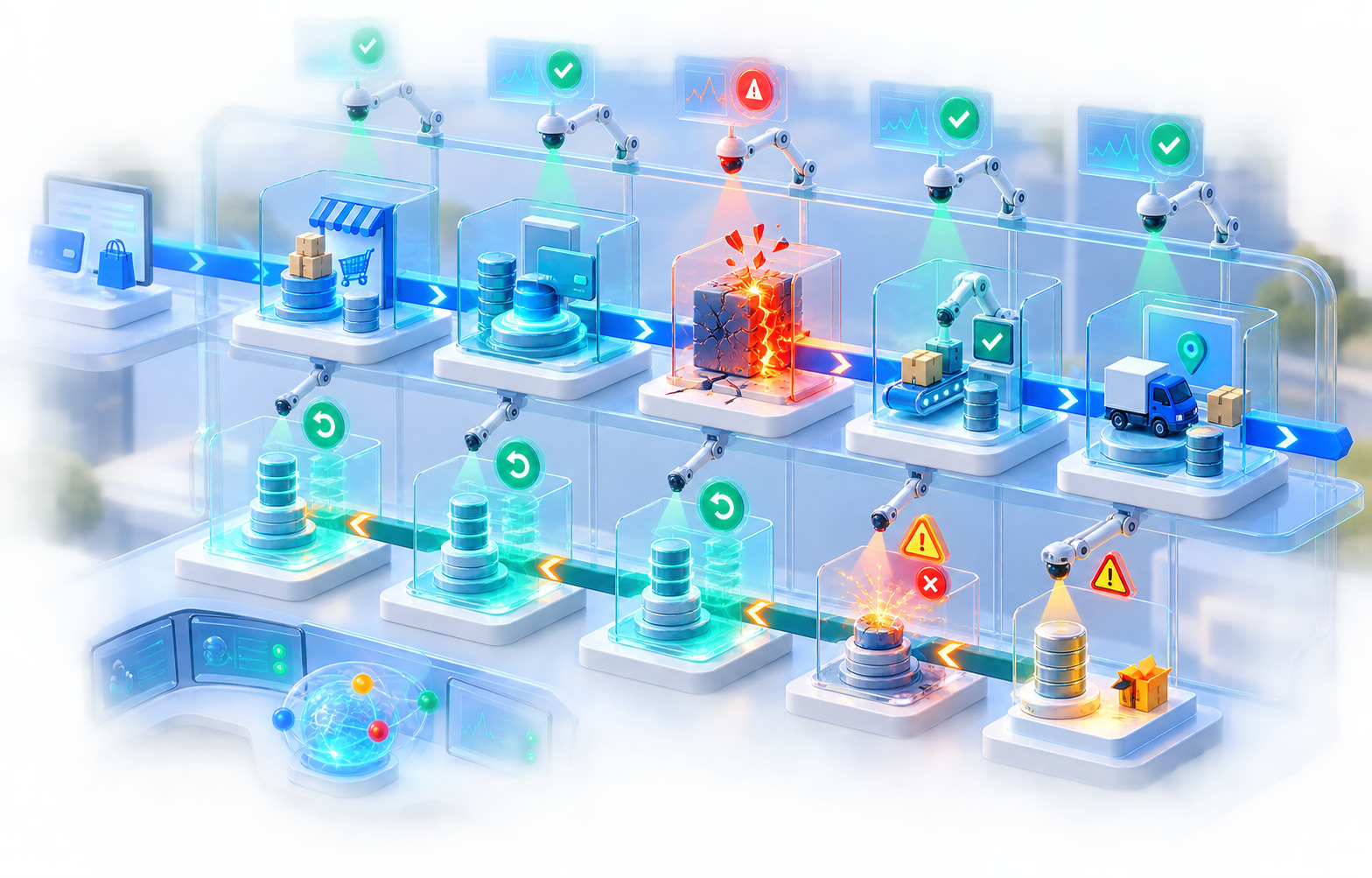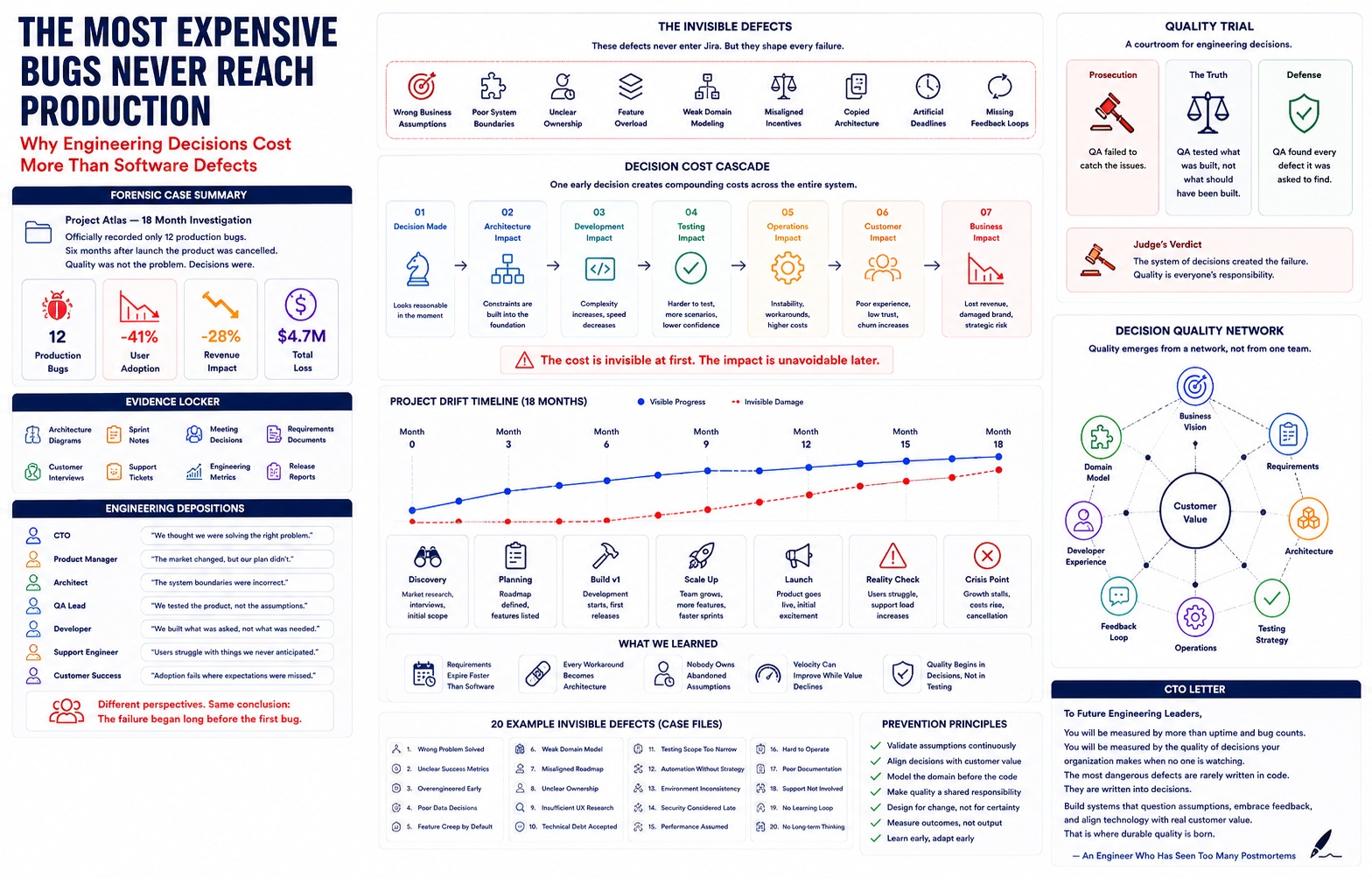
FORENSIC INTRODUCTION: THE PROJECT THAT PASSED EVERY TEST
The first exhibit in this file is a defect log.
It is unremarkable. It is also, in its way, one of the most damning documents in modern enterprise software.
Project Meridian — an eighteen-month platform rebuild at a mid-market financial services company — went live on a Thursday. Over the following ninety days, the support organization logged twelve production bugs. Two were severity-two. None were severity-one. The mean time to resolution was under nine hours. No customer data was lost. No outage exceeded four minutes. The release burned down cleanly.
The VP of Engineering circulated a slide with a single number on it: 99.94% defect-free deployment integrity. The QA organization was commended in the quarterly all-hands. Someone ordered a cake with a green checkmark on it. The screenshot of that cake is Exhibit 4 in the evidence locker, and it is genuinely difficult to look at now.
Six months later, Meridian was cancelled.
Not deprecated. Not sunset with a migration path. Cancelled — a word that appears exactly twice in the eighteen months of project documentation, both times in the final week, both times in a calendar invite title.
Here is what the forensic record shows in the interval between the cake and the cancellation:
- Revenue attributed to the platform declined 31% against the prior system it replaced.
- Customer adoption stalled at 22% of the migrated account base, against a business case that assumed 80% within two quarters.
- Development velocity fell by roughly half — not because of instability, but because every new feature required negotiation across four teams that each owned a fragment of the same workflow.
- Two of the three most senior engineers resigned within the cancellation quarter, and their exit interviews are among the most useful documents in this investigation.
- Support ticket volume rose 240% while the defect count stayed flat — a divergence that should have been the loudest alarm in the building, and was instead filed as a staffing problem.
That last line deserves to be read twice. Ticket volume more than tripled while software defects remained near zero. The system was doing exactly what it had been built to do, correctly, reliably, at scale — and customers were contacting the company in unprecedented numbers to ask for help escaping it.
The engineering organization at this company was not weak. The test pyramid was real. Coverage sat above 80% on the domains that mattered. Contract tests guarded the service boundaries. The CI pipeline was fast, the deployment automation was mature, observability was better than at most of the company's competitors. By every conventional measure of quality assurance and quality engineering, this was a healthy team shipping healthy software.
And the product failed anyway.
The temptation, in cases like this, is to blame the market, the sales organization, the timing, the economy — the comfortable externalities that let an engineering group hold its practices unchanged. This investigation rejects that explanation. The evidence does not support it.
What the evidence supports is uglier and more useful:
The failure of Meridian was fully determined before the first line of production code was written. The decisions that killed it were made in months one through five. They were made by competent people, in well-run meetings, with reasonable justifications, and they were recorded in documents that no testing strategy on earth was designed to inspect.
The defects were real. The defects were expensive. The defects were never bugs.
This report is an attempt to make that class of failure visible — to name it, catalogue it, trace its cost, and argue that engineering leadership, not QA strategy, is where the fate of a product is actually decided.
Twelve bugs. One cancelled product. That is the shape of the problem.
EVIDENCE LOCKER
The following materials were recovered during the investigation. Individually, none of them looks dangerous. Several look like good practice. That is precisely the point: invisible engineering defects do not announce themselves at the moment of commission. They are visible only in aggregate, and only in retrospect.
Reviewers are asked to read each exhibit twice — once as it would have been read at the time, and once knowing the outcome.
EXHIBIT 1 — Architecture diagram, "Target State," Month 3
A clean diagram. Eleven boxes. Service names drawn from the domain: AccountService, LedgerService, NotificationService, OnboardingService. Arrows are mostly unidirectional. There is a legend. Someone put real effort into this.
Reading it at the time: a well-decomposed microservice architecture with clear separation of concerns.
Reading it now: the eleven boxes correspond one-to-one with the eleven teams that existed in the organization in Month 3. Not with eleven business capabilities. With eleven reporting lines. The system design is an org chart with rounded corners, and when the org chart changed in Month 9, the architecture could not follow it.
EXHIBIT 2 — Sprint 4 planning notes
"Decision: defer customer-facing search until after MVP. Search is a read-path concern, low risk, easy to add later. Team agreed."
Three sentences. Under a minute of discussion, by the timestamps.
Reading it now: "easy to add later" was an assumption about data modeling, not about scope. The data model chosen in Sprint 5 normalized aggressively across six service boundaries, on the correct assumption that writes needed consistency. Nobody re-examined it when search arrived in Month 11, because by then the decision was no longer a decision — it was the schema. Search shipped as a nightly-batch denormalization job with a four-hour staleness window. Customers described it, repeatedly, as broken. It was never broken. It worked exactly as designed.
EXHIBIT 3 — Meeting minutes, Steering Committee, Month 2
"Agreed: platform must support the existing three product lines plus anticipated future lines. Configurability over hard-coding."
Reading it at the time: forward-thinking, avoids rework.
Reading it now: "anticipated future lines" were never specified, never validated with a customer, and never arrived. The configurability requirement added an abstraction layer to every domain object, roughly doubled the branching logic in the onboarding flow, and made the codebase hostile to new hires. The cost of a feature that did not exist was paid in full, monthly, for eighteen months. This is technical debt taken out against an imaginary future.
EXHIBIT 4 — Photograph, celebration cake, Month 18
Green checkmark. "12 BUGS!" in icing.
Retained as evidence of the measurement culture, not as ridicule. The team celebrated the metric it had been given. The metric was the defect. Any organization that rewards software defects trending to zero, without a paired measure of customer outcome, will eventually build something flawless that nobody wants.
EXHIBIT 5 — Requirements document v1.4, Month 4 (excerpt)
Two hundred and eleven pages. Four hundred and six numbered requirements. Every one testable. Every one traceable. It is, as a piece of requirements engineering, better than most.
The forensic finding is not about what it contains. It is about what it does not: the document states what the system must do in exhaustive detail and never once states what problem the customer is trying to solve. The word "customer" appears 340 times. The phrase "so that" appears eleven times. Requirements were captured. Intent was not.
Version 1.4 is dated Month 4. There is no version 2.0. The document was frozen for traceability. The business it described was not.
EXHIBIT 6 — Customer interview transcripts, Month 15 (three of nine)
"It does everything the old one did. It just takes longer to do it."
"I have to know which screen the information lives on before I can start. The old system, I just typed."
"My team went back to the spreadsheet for the monthly close. We use your system to enter it afterwards."
That third quote is the entire investigation compressed to one sentence. The customer had constructed a shadow workflow, done the real work outside the product, and used the platform as a system of record for decisions it had no part in making. Adoption metrics counted those entries as usage. The dashboards were green.
EXHIBIT 7 — Support ticket taxonomy, Months 12–18
Categorized volume:
| Category | Share | Logged as defect? |
|---|---|---|
| "How do I…" | 44% | No |
| "Why did the system…" | 19% | No |
| "Can it do X" (it could, elsewhere) | 14% | No |
| Access / permissions confusion | 11% | No |
| Performance perception | 7% | Occasionally |
| Actual software defects | 5% | Yes |
Ninety-five percent of the support load was generated by a system operating to specification. In defect terms, this platform was excellent. In customer experience terms, it was a maze.
EXHIBIT 8 — Engineering metrics dashboard, Month 14
Deployment frequency: up. Lead time for change: down. Change failure rate: 3.1%. Test suite: 14,200 assertions, 92% pass-first-time. Cycle time improving quarter over quarter.
Every DORA-adjacent indicator moving in the right direction, on a product losing revenue. Velocity is a measurement of motion, not of direction. A team can accelerate perfectly into a wall.
EXHIBIT 9 — Slack thread, Month 6, #arch-decisions (17 messages)
An engineer asks whether the onboarding service should own identity verification or merely call it. Two people answer. One says it depends. The thread ends with a 👍 and no decision. Identity verification was subsequently implemented in three services, each with a slightly different definition of "verified."
Forensic note: the most expensive artifact in this locker is a thread that ends in an emoji. Unresolved ownership is not a neutral state — it is a decision to duplicate.
EXHIBIT 10 — Exit interview, Principal Engineer, Month 19 (excerpt)
"I raised the boundary problem in Month 6. I was told it was a good point and we'd revisit it after the release. There were four releases. I stopped raising it after the second one, which is the part I'd change."
The organization did not suppress dissent. It deferred it — repeatedly, politely, with every intention of returning. Deferral is the most common mechanism by which good engineering judgment is neutralized. No one has to be wrong. No one has to be overruled. The calendar does the work.
Ten exhibits. Not one of them is a bug report. Together they are a complete account of a product's death.
THE INVISIBLE DEFECTS
We need a name for this class of failure, because the absence of a name is part of why it persists. An organization cannot triage what it cannot label.
An Invisible Engineering Defect is a decision that produces the same downstream consequences as a software defect — cost, rework, customer harm, degraded velocity — but that never enters a defect tracking system, because at the moment of commission it was not wrong.
That last clause matters. These are not mistakes in the ordinary sense. Most were defensible, several were locally optimal, and a few were genuinely the best available choice given what was known. They become defects the way a load-bearing assumption becomes a crack: slowly, under weight, in a place nobody is looking.
Here is the working taxonomy developed during this investigation. Each is presented as it would appear if such things could be filed as tickets — because the argument of this report is that they should be.
IED-01 — Wrong business assumption
Reported by: Nobody. Severity: Catastrophic. Reproducible: Yes, every single day, in every feature built on top of it.
The system correctly implements a belief about the customer that is false. All subsequent work — architecture, software delivery, testing, support — is executed flawlessly in service of that falsehood. Testing cannot catch this because testing validates the system against the assumption; it does not validate the assumption against the world. This is the parent defect of most cancelled products.
IED-02 — Poor system boundaries
Symptom: every meaningful feature requires three teams. Root cause: the seams were cut along nouns instead of along change.
Boundaries drawn by data entity (Customer, Order, Product) rather than by rate and reason of change guarantee that business capabilities cut across services. The technical architecture looks decomposed and behaves like a monolith with network latency. Every integration test passes. Every feature takes six weeks.
IED-03 — Incorrect ownership
Symptom: a critical component has three contributors and no owner.
Ownership is not a name in a CODEOWNERS file. Ownership is the presence of a person or team who feels the consequences of the component's decay. Where consequence and authority are separated, quality erodes by default — not through negligence, but through the ordinary arithmetic of competing priorities.
IED-04 — Feature overload
Symptom: the roadmap is full and the product is unclear.
Each feature was individually justified. The composite is incoherent. Feature overload degrades quality through interaction complexity: n features do not produce n behaviors, they produce a combinatorial surface that exceeds any realistic QA strategy. The most under-appreciated form of product quality is the discipline of subtraction.
IED-05 — Misaligned incentives
Symptom: everyone hit their targets and the product lost.
Engineering measured on throughput, product measured on shipped scope, QA measured on escaped defects, support measured on handle time. Four rational actors, four green dashboards, one dying product. Nobody's incentive contained the customer's outcome. When measurement systems disagree about success, the organization will optimize the metric that is easiest to move.
IED-06 — Unclear responsibilities
Symptom: "I assumed the other team was handling that."
Distinct from ownership: this is the ambiguity of the decision, not the asset. Who is allowed to say no to a requirement? Who signs off that a domain model is correct? In most organizations, both questions have empty answers, and empty answers are filled by whoever is most confident in the room.
IED-07 — Weak domain modeling
Symptom: the same word means different things in different services.
Three definitions of "active customer." Two definitions of "settled." Reports that disagree and are both correct. Weak domain modeling produces a system that cannot be reasoned about, which produces a software development lifecycle in which every change requires archaeology. This is the defect that most reliably converts a two-day task into a two-week one, forever.
IED-08 — Premature optimization
Symptom: a caching layer, a sharding strategy, and an event bus, all serving 400 daily users.
Built for a scale that did not arrive, at the cost of the iteration speed needed to find out what would. Premature optimization is rarely about performance; it is about certainty — the desire to make an unknowable future safe by pre-paying for it.
IED-09 — Architecture copied from another product
Symptom: "This is how we did it at my last company."
Architecture is a response to constraints: team topology, traffic shape, regulatory posture, change rate, failure cost. Transplanting a solution imports the answer without the question. The most dangerous version is copying a good architecture from a company operating at 1,000x your scale — inheriting all the operational complexity and none of the load that justified it.
IED-10 — Artificial deadlines
Symptom: a date chosen for a conference, a board meeting, or a fiscal quarter.
Artificial deadlines are not a scheduling problem. They are a quality problem, because they systematically convert reversible decisions into irreversible ones. Under date pressure, teams do not build worse code — they make faster decisions, with less validation, and then build excellent code on top of them.
Ten defect classes. Notice what they have in common:
- None of them can be detected by executing the software.
- All of them increase in cost the longer they remain unaddressed.
- All of them are legible in documents, conversations, and org structures — artifacts that no quality process routinely inspects.
And so we arrive, for the first time, at the central question.
If every production bug in Meridian had disappeared the day before launch — would the product have succeeded?
Every bug did, effectively, disappear. There were twelve of them across ninety days, in a platform serving a regulated financial workflow. The answer is in the record: revenue down 31%, adoption at 22%, cancelled inside two quarters.
Zero defects is not a success condition. It is not even evidence of one.
ENGINEERING DEPOSITIONS
Eight people were interviewed. Each was asked the same opening question, in the same words, with no context provided about the other answers.
"When did the project actually begin to fail?"
The transcripts are edited for length. The divergence is not.
DEPOSITION 1 — Chief Technology Officer
Q: When did the project actually begin to fail?
A: Month 14, when we saw the adoption numbers. That's when it became clear this wasn't a rollout problem.
Q: Was there an earlier point?
A: (pause) Look — if you want me to say something happened in Month 2, I understand the theory. But in Month 2 we had a business case, an approved budget, an architecture review that passed, and a team that was excited. What was I supposed to have seen?
Q: The steering committee agreed the platform would support three product lines plus anticipated future ones. Where did "anticipated future lines" come from?
A: From me. It's the kind of thing you say in a steering committee. You're not trying to add scope, you're trying to avoid building something we outgrow in a year.
Q: Was that requirement ever revisited?
A: … No. That's fair. That's a fair finding. I said it once, in a meeting, and eleven months later it was in the type system.
Forensic note: the CTO's answer is the most common form of executive engineering decisions damage — not a directive, but an aside, absorbed by an organization trained to treat executive speculation as constraint. Casual words from senior people acquire structural weight. Nobody in the room heard a hypothesis. Everyone heard a requirement.
DEPOSITION 2 — Product Manager
Q: When did the project actually begin to fail?
A: Month 4. The requirements freeze.
Q: You signed off on the freeze.
A: I did. I signed off because engineering needed stability to estimate, and the alternative on offer was another six weeks of discovery, and we didn't have six weeks. So I traded learning for predictability. That was the trade. I'd like to say I didn't understand it at the time, but I did.
Q: What did you learn after Month 4 that would have changed the product?
A: By Month 7 I knew the monthly close workflow was the actual job. Not account management — close. That's where their pain was, that's where the money was, that's what they'd have paid for. It didn't fit the requirements document, and the requirements document was the contract, so it went in the backlog under "Phase 2."
Q: Did Phase 2 happen?
A: Phase 2 is where products go to die.
DEPOSITION 3 — Software Architect
Q: When did the project actually begin to fail?
A: Month 3. The service decomposition.
Q: The architecture review passed.
A: The architecture review checked whether the design was internally consistent, scalable, and secure. It was all three. Nobody asked whether the boundaries matched how the business changes, because there was no forum for that question. We reviewed the solution. We never reviewed the problem statement.
Q: You drew the eleven services.
A: I drew eleven services because there were eleven teams and I needed each team to have something to own on the Monday. I want to be precise about this: that was a staffing decision that I encoded as an architecture decision, and once it was in the diagram it stopped looking like staffing. Eighteen months later, three teams had merged and one had disbanded, and the architecture didn't move, because architecture is expensive and org charts are free.
Forensic note: this is the clearest articulation in the entire investigation of how software architecture absorbs organizational conditions and then outlives them. Conway's observation is usually cited as a warning about communication structures. The sharper version is temporal: your architecture inherits the org chart of the moment it was drawn and holds it long after the organization has moved on.
DEPOSITION 4 — QA Lead
Q: When did the project actually begin to fail?
A: I want to answer that honestly, and honestly, I don't know that I ever saw it fail. I saw it pass.
Q: Expand on that.
A: We built the test strategy off the requirements document, which is what you do. Four hundred and six requirements, full traceability, automated regression across all critical paths, contract tests at every service boundary. When we shipped, we had covered every stated behavior. Twelve escapes in ninety days on a system that size — I'll defend that number in any room.
Q: Did you have concerns that weren't expressible as test cases?
A: (long pause) Yes. I ran the exploratory sessions myself in Month 16. It took me eleven clicks to complete what the old system did in three. I wrote it up.
Q: Where did it go?
A: It wasn't a defect. There's no field for "this is technically correct and functionally exhausting." I filed it as a UX enhancement request. It was prioritized against features. It lost.
Q: Should QA have escalated?
A: With what authority? My mandate was escaped defects. I was measured on escaped defects. I hit my number. I want to be careful here, because I'm not hiding behind that — I'm telling you the system worked exactly as designed and produced a bad outcome, which I think is the thing you're actually investigating.
DEPOSITION 5 — Senior Developer
Q: When did the project actually begin to fail?
A: Depends what you mean by fail. The code's good. Go read it. It's some of the cleanest work this team has ever done.
Q: Nobody disputes that.
A: Then Month 6, I guess. The identity verification thing. There was a thread — someone asked who owns verification, nobody answered, and I needed to ship onboarding that sprint. So I implemented it locally. Correct implementation, tested, reviewed, merged. Two other teams did the same thing within about five weeks.
Q: Did you know they would?
A: I knew someone would. That's what happens when a question doesn't get answered — everybody answers it privately. The thread died with a thumbs up. A thumbs up is not an answer, but it closes the conversation, and closing the conversation is what people want at 4pm on a Thursday.
Q: What would have changed the outcome?
A: Someone with authority saying "stop, this is a boundary question, we're deciding it Tuesday." Fifteen minutes of somebody's time in Month 6. I've since done the arithmetic on what that fifteen minutes cost us and I'd rather not say it out loud.
DEPOSITION 6 — UX Designer
Q: When did the project actually begin to fail?
A: Month 5, when the information architecture was locked to the service architecture.
Q: Meaning?
A: The navigation has eleven top-level areas. There are eleven services. That is not a coincidence, it's a causation, and I lost that argument in a meeting where I was the only designer and there were six engineers. The screens were organized around where the data lives instead of around what the user is trying to do. Users don't have an AccountService in their head. They have a Tuesday.
Q: Was this ever raised as a quality concern?
A: It was raised as a design preference. That's the whole problem in one phrase. When engineering says the boundary is wrong, it's an architecture concern. When design says the boundary is wrong, it's a preference. Same defect. Different standing.
DEPOSITION 7 — Customer Success Manager
Q: When did the project actually begin to fail?
A: Month 15, in a room in Leeds, when a client's operations lead showed me her spreadsheet.
Q: Describe it.
A: She'd rebuilt the monthly close in Excel. Formulas, tabs, the lot. She did the actual work there, then keyed the results into our platform because compliance required it. She wasn't complaining. She'd solved her problem. She thought she was being helpful by telling me.
Q: How was that recorded internally?
A: As a training gap. I want to be clear that I'm the one who recorded it that way, and it was wrong. But "customer has built a shadow system because ours doesn't do the job" is not a category that exists in any CRM I've ever used. "Needs additional training" is a category. So that's the box it went in.
Forensic note: the shadow spreadsheet is the highest-value signal in this entire case, and it was destroyed by the taxonomy of the tool that captured it. Organizations cannot learn from evidence for which they have no category.
DEPOSITION 8 — Support Engineer
Q: When did the project actually begin to fail?
A: I could tell you the week. Month 12, week 3. Ticket volume jumped and none of it was breakage.
Q: What was it?
A: Confusion. "Why can't I see this account." "Where did the approval go." "Is it saved." Hundreds of "is it saved." The system saved everything, instantly, correctly — it just never said so. So people would fill in a form, get no confirmation, and call us to ask whether their work still existed.
Q: Was a defect ever raised for that?
A: I raised one. It came back "working as designed." Which was true! It was working as designed! That's not a rejection I can appeal, because the person closing it wasn't wrong.
Q: What would you have needed?
A: A place to file the sentence "this is working as designed and the design is the problem." That's it. That's the whole thing I needed.
DEPOSITION SUMMARY
| Role | Failure point identified | Month |
|---|---|---|
| Customer Success | Shadow workflow discovered | 15 |
| CTO | Adoption metrics | 14 |
| Support Engineer | Ticket volume divergence | 12 |
| Developer | Unresolved ownership question | 6 |
| UX Designer | Navigation locked to services | 5 |
| Product Manager | Requirements freeze | 4 |
| Architect | Service decomposition | 3 |
| QA Lead | Never observed failure | — |
Read the table from the bottom up and a structure appears.
The closer a role sits to the original decision, the earlier it dates the failure. The closer a role sits to the customer, the later it detects it.
The gap between Month 3 and Month 15 — twelve months — is not a detection lag. It is the incubation period of an invisible engineering defect, and it is roughly the same length in every case file reviewed for this report. By the time the customer-facing roles have evidence, the architecture-facing roles have already built four releases on top of the cause.
Note also the last row. The function formally accountable for quality is the only one that never saw a failure — because it was, correctly and diligently, looking somewhere else.
DECISION AUTOPSY
A defect autopsy asks: what broke, and why? A decision autopsy asks something harder: what was decided, why was it reasonable, and how did reasonable become fatal?
Three decisions are reconstructed here in full. The method matters as much as the findings — this procedure can be run on any organization's history, and generally should be.
AUTOPSY I — "Defer search to Phase 2"
ORIGINAL CONTEXT. Sprint 4. The team is nine weeks in, tracking behind an already-tight date. Search is a large piece of work. The MVP scope needs cutting. Search is the obvious candidate: it is a read-path feature, no other feature depends on it, and the customer's current system has search that is, by their own account, "fine."
WHY IT LOOKED CORRECT. It was correct, under three assumptions, all of which were held implicitly and none of which were written down:
- Search is additive — it reads what already exists.
- The data model will not be shaped by search's absence.
- "Later" is a real point in time with capacity attached.
Assumption 1 is true in a monolith with a single database. It is false in a distributed system, and the architecture had been distributed in Month 3.
HIDDEN ASSUMPTIONS. The decisive one: that a deferred feature imposes no cost while deferred. In fact, deferral silently grants permission to every subsequent decision to ignore that feature's constraints. Over the next seven sprints, the team normalized the data model across six services — each choice locally correct, jointly making cross-entity query impossible without either a distributed join or a materialized read model. Nobody chose against search. Search simply had no advocate in the room during the twenty or so schema decisions that foreclosed it.
HOW IT PROPAGATED.
- Sprint 5–9: normalization decisions taken without a query-side constraint.
- Sprint 10: first report request; solved with a bespoke join service.
- Sprint 14: second report request; the bespoke service is extended.
- Month 11: search arrives in scope. The only affordable path is a nightly denormalization batch.
- Month 12: four-hour staleness ships. Customers call it broken.
- Month 13: an incremental sync is proposed. It is estimated at eleven weeks — roughly nine times the original Sprint 4 estimate.
- Month 14: not funded.
DOWNSTREAM PROBLEMS. A permanently stale search surface; a bespoke join service with one contributor and no owner (see IED-03); a customer-visible inconsistency between what the UI shows and what search returns, which generated 6% of all support volume and was closed as "working as designed" nineteen separate times.
WHY NOBODY CHALLENGED IT. Because it was not presented as an architecture decision. It was presented as scope management, in a sprint planning meeting, attended by the delivery team and not by the architect. The forum determined the frame. In a sprint planning meeting, every decision looks like a scheduling decision.
Finding: Scope decisions and architecture decisions are the same decisions viewed from different chairs. An organization that separates the two forums will make architecture in the cheaper room.
AUTOPSY II — "One service per team"
ORIGINAL CONTEXT. Month 3. Eleven teams exist, having been assembled from two prior programs. The architect needs a decomposition that lets all eleven start work in parallel within the fortnight, because eleven idle teams is a visible, career-relevant problem, and a suboptimal boundary is not.
WHY IT LOOKED CORRECT. Team autonomy is a well-supported principle. Independent deployability is a well-supported goal. Aligning service ownership with team ownership is standard product engineering practice, recommended by every reputable source on the topic. This decision has more literature behind it than almost anything else in the project.
HIDDEN ASSUMPTIONS. Three:
- That the current team structure reflects the domain. (It reflected the previous two programs' staffing.)
- That team count and domain-boundary count would coincide. (They coincided at eleven only by accident.)
- That the org chart would remain stable long enough for the architecture to amortize. (It survived six months.)
HOW IT PROPAGATED. By Month 9, a reorganization merged three teams and dissolved another. The services did not merge. Four services now had part-time custodians. By Month 12, two of them had no regular contributors and were maintained on an incident-driven basis. By Month 15, one had a known memory issue that was restarted on a cron schedule rather than fixed, because the fix required domain knowledge that had left the company.
DOWNSTREAM PROBLEMS. Cross-team coordination cost on 80% of features; a feature lead time that grew from eleven days to thirty-four while individual team velocity improved; the emergence of the "coordination tax" as a normalized, unbudgeted line item in every estimate.
WHY NOBODY CHALLENGED IT. Because challenging it required saying "some teams should wait." No one is promoted for proposing that eleven teams should idle for three weeks while the domain is properly modeled. The incentive structure made the correct decision unspeakable, which is a more serious organizational condition than the decision itself.
Finding: When the right architectural answer requires visible short-term idleness, most organizations will select the wrong answer and call it pragmatism.
AUTOPSY III — "Configurability over hard-coding"
ORIGINAL CONTEXT. Month 2 steering committee. A CTO aside, recorded as an agreement.
WHY IT LOOKED CORRECT. The company had, three years earlier, been burned by a hard-coded product-line assumption that cost six months to unwind. This decision was a direct, rational response to a real prior failure. It is the most sympathetic decision in this file.
HIDDEN ASSUMPTION. That flexibility is cheap when unused. It is not. Every configuration point is a branch, a test matrix multiplier, a documentation obligation, and a comprehension cost paid by every engineer who reads the code for the next decade. The team built a rules engine for product-line variation. It ended up serving three configurations — the three product lines that already existed.
HOW IT PROPAGATED. The onboarding flow's cyclomatic complexity roughly tripled. New-hire ramp time went from three weeks to seven. The test matrix expanded to cover configuration combinations that no customer had, which is where a meaningful share of those 14,200 assertions went — validating the behavior of hypothetical products.
DOWNSTREAM PROBLEMS. The most severe was second-order: because the codebase was hard to change, the team began routing urgent business requests around the rules engine with targeted special-cases. By Month 16 there were nineteen of these. The abstraction built to prevent hard-coding had produced nineteen instances of hard-coding, each one hidden behind a flag.
WHY NOBODY CHALLENGED IT. It was a defense against a remembered wound. Organizations over-correct against their most recent visible failure and under-correct against their most recent invisible one — which is the structural reason invisible defects persist across generations of leadership. The last fire teaches; the last slow decay does not.
Finding: Every architecture is partly a monument to the last disaster. Ask what an organization is defending against, and you will predict what it is currently building too much of.
THE QUALITY TRIAL
The following is a storytelling device. No such proceeding occurred. The arguments, however, are drawn verbatim in substance from the depositions above.
THE COURT: This tribunal is convened to determine responsibility for the failure of the Meridian platform. The charge before us is professional negligence in the assurance of software quality. The named defendant is the Quality Assurance function. Prosecution may open.
PROSECUTION: Thank you. The facts are not in dispute, and I will not waste the court's time pretending otherwise.
A platform was built. It was tested. It was certified fit for release. Within eighteen months it was withdrawn, having lost thirty-one percent of the revenue of the system it replaced.
Quality Assurance signed the release.
The defense will say the software worked. It did. The defense will say twelve defects in ninety days is exemplary. It is. The prosecution's case is not that QA did its job badly. The prosecution's case is that QA defined its job in a way that guaranteed it could not fail while the product did.
QA measured escaped defects. It hit its number. It measured nothing that the customer experienced. And when its own lead ran an exploratory session in Month 16 and found an eleven-click workflow that should have been three, she filed it as an enhancement request — because her own function had no mechanism for recording that a system was correct and unusable.
A quality function that certifies a product it knows to be unusable has not assured quality. It has assured compliance with a specification. Those are different professions, and the industry has spent thirty years allowing them to share a name.
DEFENSE: My client found every defect it was asked to find.
I want the court to sit with that sentence, because the prosecution has just built its case on it without noticing.
QA was given a requirements document containing four hundred and six requirements. It achieved full traceability. It automated regression across every critical path. It built contract tests at every service boundary. Twelve escapes in ninety days on a regulated financial platform is not merely adequate — it is, on the evidence before this court, the single best-executed function in the entire programme.
The prosecution asks why QA did not challenge the eleven-click workflow. I ask: with what authority? The QA Lead does not set the roadmap. She raised it. It was prioritized against features by people with the standing to prioritize. It lost. That is not negligence; that is the organization functioning exactly as it was designed to function.
The prosecution asks why QA did not detect the wrong business assumption. I ask my learned friend to describe the test. Genuinely — describe the assertion that fails when a correct implementation serves a false belief about the customer. There is no such assertion. There cannot be. Testing compares a system against a specification. It has no instrument that compares a specification against reality. To convict my client for failing to run a test that cannot exist is to convict a thermometer for the weather.
One further point, and it is the one that matters most. The prosecution's own evidence shows that the failure was determined by Month 5. QA was engaged in Month 7. My client is charged with negligence in preventing a fire that was set before it was hired.
The defense rests.
THE COURT: The court will give its finding.
The defense is correct on the facts and correct on the law of its own function. QA discharged its mandate to an unusually high standard. No verdict against the Quality Assurance function is available on this evidence, and none is entered.
But the prosecution has established something the defense's success makes unavoidable, and the court will name it directly.
The defense's strongest argument is that QA had no authority, no instrument, and no forum in which to raise the concerns it in fact held. The QA Lead held them. The Support Engineer held them. The UX Designer held them. The Principal Engineer held them from Month 6 and stopped raising them after the second deferral. Four people identified the failure while it was still cheap to correct, and the organization possessed no mechanism by which their knowledge could become a decision.
That is not a failure of a function. It is a failure of the system in which the functions sit.
This court therefore finds responsibility to lie with the engineering system itself — the composite of forums, incentives, taxonomies, mandates, and escalation paths through which an organization converts what it knows into what it does. Specifically:
- Architecture decisions were made in scope forums, where they were framed as scheduling and escaped architectural scrutiny.
- Ownership questions were permitted to close without resolution, which is not neutrality but an implicit decision to duplicate.
- The measurement system contained no metric that could turn red while every function was green, which is the defining signature of misaligned incentives.
- The taxonomies of the tools — Jira, the CRM, the support desk — could not represent the actual failure mode, and so systematically destroyed the evidence of it.
- Deferral operated as an unlimited and unaudited resource. No one was ever required to account for the cumulative cost of "we'll revisit that after the release."
The court notes for the record that no individual before it acted unreasonably, and that this is the most serious finding available. A system in which every participant behaves reasonably and the outcome is still catastrophic is not repaired by replacing the participants.
The defendant is discharged. The system is remanded for redesign.
THE DESIGN LAB
The trial named a mechanism. This section examines a category of defect that the mechanism reliably destroys: failures of design that are, in strict engineering terms, entirely correct.
The proposition under examination is uncomfortable for most engineering organizations:
A product that is correct, fast, secure, and available can still be defective.
Six specimens from the Meridian teardown.
SPECIMEN A — Navigation organized by system, not by task
Eleven top-level areas mirroring eleven services. Every route resolves. Every page loads under 200ms.
The defect: users do not arrive with a service in mind. They arrive with a job — "close the month," "onboard this client," "find out why this payment failed." Each of those jobs traverses four to six of the eleven areas. The user is required to hold the system's decomposition in their head as a precondition of using it.
Why it is a quality failure: the cost of the wrong boundary was not absorbed by the architecture. It was exported to the customer, who now performs the integration work the system declined to do. There is no line item for this, which is why it is invisible.
SPECIMEN B — Onboarding that teaches the system instead of the job
A nine-step guided tour explaining what each module does. Completion rate: 71%. Considered a success.
The defect: at the end of the tour the user knows the product's structure and still cannot complete their first real task. Measured properly — first successful independent task completion — the number was 34%.
Why it is a quality failure: the metric measured attention, not capability. Any onboarding measured by completion rather than by first productive use will optimize itself toward being easy to finish and useless to have finished.
SPECIMEN C — Workflows that encode the approval hierarchy
The approval chain in the software mirrored the customer's formal org chart: four sequential approvals, each with an email notification.
The defect: the customer's real process had two approvals and a phone call. The formal chart described accountability, not workflow. The software automated a fiction and thereby made it mandatory.
Why it is a quality failure: software converts documented process into enforced process. Every requirement gathered from a policy document rather than from observation carries this risk. Median time-to-approval went from four hours to two days, and the customer's response was, predictably, to begin pre-approving in advance to work around the system they had bought to manage approvals.
SPECIMEN D — Terminology inherited from the database
The UI used Entity, Instrument, and Position because the domain model used them. The customer's staff used "client," "product," and "holding."
The defect: every user, forever, performs a translation on every screen. Training decks existed purely to map the product's words onto the customer's words. Three of the nine customer interviews independently mentioned vocabulary before mentioning anything else.
Why it is a quality failure: weak domain modeling (IED-07) is usually discussed as a code-comprehension problem. Its more expensive manifestation is user-comprehension. The ubiquitous language was ubiquitous only inside the building.
SPECIMEN E — Approvals with no visible state
Submit an approval and the screen returns to the list. The record is saved. No confirmation, no status indicator, no audit trail visible to the submitter.
The defect: the user cannot distinguish "submitted successfully" from "the click did not register." So they resubmit, or they call support. Recall Deposition 8: hundreds of tickets asking whether work had been saved.
Why it is a quality failure: the system's internal state was correct and its observable state was absent. From the user's position these are indistinguishable from a bug — and the user's position is the only one that generates revenue. Feedback is not decoration. It is the mechanism by which a user forms a correct model of the system, and without it every subsequent action is taken under uncertainty.
SPECIMEN F — Error messages that describe the system's problem
Validation failed: constraint LEDGER_PERIOD_LOCK violated.
Accurate. Precise. Actionable by exactly the four engineers who wrote the constraint.
Why it is a quality failure: an error message is the product's most-read documentation, encountered at the moment of maximum user frustration. This one tells the user that something is wrong, nothing about what they did, and nothing about what to do next. The information required to write a useful version existed in the system at the moment of failure. It was simply not considered part of the deliverable.
LAB CONCLUSION. Every specimen above passed testing, because in each case the software did what it was built to do. What they share is that the definition of "correct" was drawn from the system's perspective rather than the user's — and once that frame is set, no amount of testing rigor can escape it, because testing inherits the frame from the specification.
This is the second angle on our central question. If every bug vanished, Specimens A through F would all remain, untouched, in full force. The bugs were never what was standing between this product and its customers.
THE COST CHAIN: THE DECISION COST CASCADE
Cost models in software are usually drawn as pyramids or curves — the familiar claim that a defect found in production costs some multiple of one found in design. That model is not wrong, but it is the wrong instrument here, because it measures the cost of finding a defect. Invisible engineering defects are never found. They are absorbed.
This investigation proposes a different structure: the Decision Cost Cascade.
A cascade has three properties a pyramid does not. It is directional — cost flows one way, downhill, and never returns to the point of origin. It is amplifying — each layer adds cost rather than merely transmitting it. And it is silent at the source — the layer that created the cost is the only layer that never pays it.
That last property is the entire problem. The decision-maker is structurally insulated from the consequence. Not through malice — through org design.
Trace a single decision through the ten layers.
THE DECISION: Month 3. Eleven services aligned to eleven teams (Autopsy II).
LAYER 1 — ARCHITECTURE. Cost: apparently zero. The diagram is coherent. The review passes. This layer produces the cost and records none of it. Every unit of cost in the nine layers below originates here, and none of it is visible here.
LAYER 2 — DEVELOPMENT. Cost: coordination. Features cross four boundaries. Each crossing requires a contract negotiation, a version, a deployment order. Individual team velocity is unaffected — it may even improve, since each team's slice is small and well-defined. Feature lead time triples while every team's burndown improves. This is the first appearance of the signature pattern: local metrics green, systemic outcome degrading.
LAYER 3 — TESTING. Cost: combinatorial. Any behavior spanning four services requires integration coverage across four deployment states. The test suite grows to 14,200 assertions. Runtime grows. Flakiness appears at boundaries, is attributed to test quality, and consumes an estimated 400 engineer-hours across the programme. The testing organization is now paying, in full, for an architecture decision it did not attend the meeting for.
LAYER 4 — OPERATIONS. Cost: surface area. Eleven deploy pipelines, eleven runbooks, eleven on-call surfaces, eleven sets of dashboards. When the org contracts to eight teams, the operational surface does not contract. Four services enter custodial maintenance. One acquires a cron-restart in place of a fix.
LAYER 5 — SUPPORT. Cost: fragmented truth. A customer question about a single workflow requires the support engineer to consult three systems with three definitions of "active." Handle time rises. Support is measured on handle time, so support is now failing its own metric because of a decision made in Month 3 by people it has never met.
LAYER 6 — CUSTOMERS. Cost: cognitive and operational. The architecture surfaces as navigation (Specimen A). The customer performs the integration the system declined to. Eventually — see the Leeds spreadsheet — they build a shadow system, and the moment a customer builds a shadow system, you are no longer their platform; you are their compliance obligation.
LAYER 7 — BUSINESS. Cost: revenue and strategy. Adoption stalls at 22%. Renewal conversations become price conversations. The roadmap is consumed by remediation, so the differentiating features that justified the investment are never built. The opportunity cost exceeds the direct cost by a wide margin and appears in no ledger.
LAYER 8 — REPUTATION. Cost: durable and asymmetric. Two reference customers decline to be references. In a mid-market vertical of perhaps three hundred realistic buyers, that is not a marketing problem; it is a permanent reduction in addressable market. Reputation decays fast and recovers slowly — the asymmetry is the cost.
LAYER 9 — ENGINEERING MORALE. Cost: talent. The people who see the cascade most clearly are the senior engineers who predicted it. They raised it, were deferred, and then spent eighteen months building on top of a decision they had argued against. Two resigned. Morale is not a soft consequence; it is the mechanism by which an organization loses precisely the people capable of preventing the next occurrence.
LAYER 10 — TECHNICAL DEBT. Cost: compounding, permanent. Nineteen special-case flags. A bespoke join service with no owner. A stale search index. A cron-restarted memory leak. None of this is debt in the classical sense — nobody borrowed deliberately. It is sediment: the accumulated residue of decisions that were never revisited. Sediment does not have an interest rate. It has a depth.
The three compounding effects
1. Amplification. Each layer multiplies rather than adds. A three-week architectural inefficiency becomes a permanent 20% coordination tax on every feature; over eighteen months that is not three weeks, it is several thousand engineer-hours.
2. Inversion of visibility. Cost visibility is inversely proportional to proximity to cause. Layer 1 sees nothing. Layer 10 sees everything and can explain nothing. The organization therefore experiences its own root causes as unexplained symptoms, and directs its remediation budget at Layers 8, 9, and 10 — where the pain is loudest and the leverage is nil.
3. Irreversibility gradient. At Layer 1 the decision costs a fortnight to reverse. At Layer 3 it costs a quarter. By Layer 6 it is not reversible at all in any practical sense, because customers have built workflows on it. The window during which a decision can be cheaply corrected closes long before the evidence that it needs correcting arrives. This is the central tragedy of the cascade, and the reason detection-based quality strategies cannot address it.
The Invisible Defect Index
If invisible defects are to be managed, they must be measured. This investigation proposes a composite indicator — deliberately crude, because a crude measure that exists beats a precise one that does not.
IDI = (Coordination Load × Assumption Age) ÷ (Decision Ownership × Feedback Velocity)
- Coordination Load — mean number of teams required to ship a customer-visible change. Meridian: 3.8.
- Assumption Age — median months since the core business assumptions were last tested against a customer. Meridian: 14.
- Decision Ownership — proportion of significant decisions with a named owner and a recorded revisit date. Meridian: ~0.15.
- Feedback Velocity — mean weeks from customer behavior to a change in engineering priority. Meridian: 26.
Meridian's index: (3.8 × 14) ÷ (0.15 × 26) ≈ 13.6.
A healthy organization sits below 2. The absolute number is not the point — the trend is, and so is the diagnostic structure. Everything in the numerator grows on its own. Everything in the denominator requires deliberate leadership effort to maintain. Left alone, the index of every software organization rises. That is the default state of the world, and it is why engineering excellence is a maintenance activity rather than an achievement.
PROJECT TIMELINE: EIGHTEEN MONTHS OF VISIBLE WORK AND INVISIBLE DAMAGE
The same programme, walked forward in time. Left column: what a status report would say. Right column: what the forensic record shows was actually accumulating.
MONTH 1 — Mobilization
Visible: Team assembled. Business case approved. Kickoff held. Energy high.
Invisible: The business case contains a growth assumption — 80% adoption in two quarters — derived from the incumbent system's usage, not from any customer stated intent to migrate. The programme's definition of success is established before anyone has asked a customer what would make them switch. Requirement Entropy begins at zero and starts climbing immediately.
MONTH 2 — Discovery and Governance
Visible: Stakeholder workshops. Steering committee established. Scope agreed.
Invisible: The configurability aside (Autopsy III) enters the record as an agreement. A hypothesis has been promoted to a constraint by the seniority of the person who voiced it, with no one in the room aware a promotion occurred.
MONTH 3 — Architecture
Visible: Target architecture published. Review passed. Eleven teams have workstreams.
Invisible: The decisive act of the entire programme. Boundaries are cut along the org chart (Autopsy II). Drift begins here — and, critically, this is the last month in which the failure could have been prevented at low cost. Everything after this is remediation of increasing expense. It is also the month in which the programme feels healthiest, which is the cruelty of the pattern: maximum confidence coincides exactly with maximum unrecognized risk.
MONTH 4 — Requirements Freeze
Visible: v1.4 signed off. 406 requirements. Full traceability. Estimation confidence high.
Invisible: Learning is formally decoupled from delivery. From this point the programme's knowledge of the customer is fixed while the customer continues to change. Requirement entropy is now accumulating at a constant rate, and the mechanism that would have detected it has been switched off in exchange for estimation confidence.
MONTH 5 — Design and IA
Visible: UI patterns established. Design system started. Navigation approved.
Invisible: Information architecture is bolted to service architecture (Deposition 6). The Month 3 decision has now been laminated onto the customer-facing surface, where it will be experienced daily by every user for the life of the product. The distance between an internal decision and a customer's Tuesday is two months.
MONTH 6 — First Increment
Visible: Onboarding flow demoed. Stakeholders pleased. Velocity established.
Invisible: The identity verification thread dies with a thumbs up (Exhibit 9). Three implementations of "verified" begin. The Principal Engineer raises the boundary problem for the first time and is deferred for the first time. The organization's immune response fires correctly and is switched off by the calendar.
MONTH 7 — QA Engagement
Visible: Test strategy approved. Automation framework selected. Traceability matrix built.
Invisible: QA's mandate is scoped to the frozen requirements document, which means the quality function is formally instructed to inherit every assumption made in Months 1 through 5 and to test nothing above that line. This is the moment the trial's verdict becomes inevitable.
MONTH 8 — Velocity
Visible: Best sprint yet. Burndown ideal. Confidence peaks.
Invisible: Coordination load reaches 2.9 teams per feature and is absorbed into estimates as normal. Once a tax is inside the estimate, it stops being a problem and becomes a fact of nature.
MONTH 9 — Reorganization
Visible: Three teams merged, one dissolved. Presented as efficiency.
Invisible: The architecture's founding premise is now false and nobody notices, because architectures are not re-reviewed on org changes. Four services enter custodial ownership. The gap between the org chart and the architecture — Architecture Confidence — begins its terminal decline.
MONTH 10 — Integration
Visible: End-to-end flows working. Contract tests green. Demo well received.
Invisible: Boundary flakiness appears and is diagnosed as a test-quality problem. A symptom of the Month 3 decision is now being actively misdiagnosed and separately funded, which is worse than ignoring it: budget is now flowing to the wrong layer.
MONTH 11 — Scope Reckoning
Visible: Search re-enters scope. Batch approach selected. Date held.
Invisible: The Sprint 4 deferral (Autopsy I) collects. The eleven-week correct fix is unaffordable because the date is fixed, so the four-hour staleness is accepted as temporary. "Temporary" is the most load-bearing word in enterprise software. It shipped and stayed.
MONTH 12 — Launch
Visible: Go-live. Twelve defects over the following ninety days. Cake.
Invisible: Support ticket volume begins its 240% climb, composed almost entirely of confusion. The divergence between defect count and support load — the single most diagnostic signal available anywhere in this case — opens here and is read as a staffing problem for six consecutive months.
MONTH 13–14 — Adoption Stall
Visible: Adoption 22%. Remediation programme launched. Training investment increased.
Invisible: Remediation targets Layers 8–10 of the cascade: more training, more documentation, more support headcount, a UI polish sprint. Every remediation pound is spent downstream of the cause. The Product Assumption Matrix — had anyone maintained one — would have shown that the founding adoption assumption had never been validated in fourteen months.
MONTH 15 — The Spreadsheet
Visible: Customer visit. Feedback described as "constructive." Training gap logged.
Invisible: The single highest-value piece of evidence in the programme is captured and immediately destroyed by the taxonomy of the CRM (Deposition 7). The organization now possesses proof that it solved the wrong problem, in a field labeled "needs additional training."
MONTH 16 — Exploratory Findings
Visible: QA exploratory session. Eleven-click workflow documented. Enhancement request raised.
Invisible: The request is prioritized against features and loses. The quality function's most valuable output of the entire programme is defeated by a backlog ranking process, because there is no category in which "correct and unusable" outranks "new capability."
MONTH 17 — Attrition
Visible: Two senior resignations. Backfill approved. Knowledge transfer sessions scheduled.
Invisible: The two departures take with them the only complete mental model of why the system is shaped as it is. From here the codebase transitions from designed to inherited. Every subsequent change will be made by someone reconstructing intent from artifacts. Product archaeology begins while the product is still alive.
MONTH 18 — Cancellation
Visible: Programme cancelled. Post-mortem scheduled. Lessons-learned document produced.
Invisible: The post-mortem examines Months 12–18, because that is where the visible failure lives. The causes are all in Months 1–6, and they will therefore survive the post-mortem intact and be re-committed on the next programme — by the same capable people, with the same good intentions, in a new well-run meeting.
The drift
Plotted as a curve — call it the Engineering Drift Curve — customer value delivered per unit of engineering effort declines monotonically from roughly Month 3 onward, while every observable indicator of engineering health improves through Month 12.
The two lines cross somewhere around Month 8. Nobody was watching, because no dashboard in the organization plotted them on the same axis.
That is the whole failure, stated in one sentence.
THE ENGINEERING ARGUMENT
Recorded at the Month 18 post-mortem. Four people, forty minutes, no resolution. Reproduced because the absence of resolution is the finding.
DEVELOPER: I'll start, because I think someone has to say it plainly. We delivered exactly what was specified. Every requirement, traced, tested, shipped. If the specification was wrong, that's not a delivery failure. I'm not going to accept that engineering failed here.
PRODUCT: Nobody's saying you failed at delivery. I'm saying the specification solved the wrong problem. Their pain was the monthly close. We built account management. Beautifully. Reliably. For the wrong job.
DEVELOPER: Then why did we build account management for eleven months?
PRODUCT: Because that's what the requirements said in Month 4, and I knew it was wrong by Month 7, and the freeze meant the only route was Phase 2.
DEVELOPER: So unfreeze it.
PRODUCT: With what? You'd have thrown away four sprints of work. You'd have missed the date. The date was board-committed. Tell me which of those you'd have signed for.
ARCHITECT: Can I reframe? Both of you are describing symptoms of the same thing. The reason you couldn't unfreeze in Month 7 is that the system had become too complex to change cheaply. That's mine. I own that. Eleven services, four-team features — by Month 7 a scope change wasn't a scope change, it was a coordination event across four teams and three contracts. I didn't just build an architecture, I built a cost of changing our mind, and I set that cost too high.
PRODUCT: That's the most useful thing anyone's said in six months.
QA LEAD: Then I'll add the uncomfortable one. There were no test failures. Not one, in the entire class of problems we're discussing. Everything we're describing was invisible to the only instrument the organization pointed at quality. My reports were green for eighteen months and I was not lying in any of them.
DEVELOPER: So who's actually wrong here?
ARCHITECT: Wrong question.
DEVELOPER: It's the only question anyone actually cares about.
ARCHITECT: I know. That's why we'll do it again.
FORENSIC ANALYSIS. Each participant is correct within their frame, and each frame is too small to contain the failure.
- The developer is correct that delivery was faithful — and faithful delivery of a wrong specification is the most efficient possible way to fail.
- The product manager is correct that the specification was wrong — and the mechanism that made it unfixable was not product's to control.
- The architect is correct, and is the only participant who identifies the actual causal chain: he set the organization's cost of changing its mind, and that single variable determined whether product's Month 7 insight could be acted on. Everything else follows.
- The QA lead is correct that no test failed — and in stating it, provides the definitive evidence that the organization's quality instrumentation was aimed at the wrong target.
The developer's closing question — who's actually wrong? — is the trap. It presumes failure is allocable to a person. Invisible engineering defects are properties of systems, and the demand to personalize them is the specific reflex that prevents systems from being examined.
The architect's last line is the finding of this section. An organization that leaves a post-mortem still asking who was wrong has learned nothing, and will re-run the same programme with the same structure and different faces.
Correct answer to "who is right?": all four, and the composite of four correct positions produced a cancelled product. That is the definition of a system-level defect.
THE DECISION ATLAS
If decisions are the primary defect surface, they require the same treatment code receives: classification, review standards, ownership, and a mechanism for revisiting them.
The atlas below maps ten categories. For each: the decision's characteristic form, its latency (how long before consequences surface), its reversibility, and the mechanism by which it damages product quality.
Business Decisions
Form: who the customer is, what problem is worth solving, what success means. Latency: 12–24 months. Reversibility: theoretically high, practically nil once architecture has been built to serve them.
Every other decision in the atlas is downstream of these, and they are the least formally reviewed decisions in most organizations. A wrong service boundary produces a coordination tax. A wrong customer assumption produces a cancelled product. Business decisions receive the least engineering scrutiny and carry the most engineering consequence — the single largest scrutiny/impact mismatch in enterprise software.
Architecture Decisions
Form: boundaries, coupling, data ownership, synchronicity, change cost. Latency: 6–12 months. Reversibility: falls off a cliff at first production traffic.
Architecture's real output is not structure — it is the price of future decisions. A good architecture makes changing your mind cheap; a bad one makes it expensive; and the organization will make exactly as many good decisions as it can afford. Judge an architecture by the cost of the change you have not thought of yet.
Process Decisions
Form: cadence, forums, sign-off gates, definition of done, estimation practice. Latency: 1–3 months. Reversibility: high — and therefore chronically neglected, because reversible problems never become urgent.
Process determines which decisions get made in which room, and Autopsy I demonstrated that the room determines the frame. Process is not overhead; it is the routing table for judgment.
Platform Decisions
Form: language, runtime, cloud, framework, build, managed vs. self-operated. Latency: 3–18 months. Reversibility: low, and declining with hiring.
The under-considered dimension is not capability but labor market and comprehension: a platform choice is a hiring strategy and an on-call strategy. The most common failure is selecting for peak capability instead of median-day operability.
UX Decisions
Form: information architecture, workflow, terminology, feedback, error handling. Latency: immediate on contact with users; 6+ months to be believed internally. Reversibility: moderate — until users build workarounds, at which point changing the UI breaks their process.
The Design Lab established the mechanism: UX decisions are where architecture becomes visible to the customer. Every unresolved internal boundary eventually appears on a screen.
Data Decisions
Form: schema, ownership, identity, consistency model, retention, lineage. Latency: 6–24 months. Reversibility: the lowest of any category, without exception.
Code can be rewritten in a quarter. Data outlives the code, the team, and often the company. A wrong identity model — two definitions of "customer" — will still be generating reconciliation work a decade later. Data decisions should receive the review intensity currently reserved for security.
Security Decisions
Form: trust boundaries, authn/authz model, secret handling, tenancy isolation. Latency: 0 to infinity — nothing, then everything. Reversibility: low.
Security is the one category where organizations reliably over-invest in review and under-invest in ergonomics. A control that is hard to comply with generates workarounds, and a workaround is a security decision made by whoever was in a hurry.
Testing Decisions
Form: what is tested, at what level, against what oracle, and — critically — what is treated as ground truth. Latency: 3–9 months. Reversibility: moderate.
The consequential decision is never the pyramid shape. It is the choice of oracle. Testing against the specification validates implementation; testing against intent validates the product. Meridian did the first with excellence. The most important line in any test strategy is the one that names what the tests are allowed to assume.
Automation Decisions
Form: what is automated, what is deliberately left manual, what is standardized. Latency: 2–8 months. Reversibility: high but sticky.
Automation encodes a process, and thereby votes for that process's permanence. Automating a broken approval chain does not fix it — it industrializes it (Specimen C). Automate only what you would defend in a design review.
Deployment Decisions
Form: frequency, granularity, rollback, feature flags, environment topology. Latency: 1–6 months. Reversibility: high.
The most under-rated category, because it directly sets the reversibility of everything else. Frequent, small, reversible deployment lowers the cost of being wrong across the entire atlas. It is the only category that improves the others.
The atlas finding
Sort the categories by latency and a pattern emerges that explains almost everything in this report:
Decisions are reviewed in inverse proportion to their latency. Deployment decisions (latency: weeks) get automated gates, staged rollouts, and change advisory boards. Business assumptions (latency: two years) get a slide and a nod.
We have built rigorous machinery for the decisions whose consequences we can see, and left the rest to intuition — because feedback trains attention, and slow feedback trains none.
PRODUCT ARCHAEOLOGY
The Meridian codebase was acquired in the cancellation and maintained for a further four years by a team that had not built it. What follows is a dig report from Year 3 — five artifacts encountered by engineers who had no access to the reasoning behind them.
Every strange implementation has a story. The stories are almost never in the comments.
ARTIFACT 1 — LEGACY_MODE
A boolean flag threaded through forty-two files. Default true. No documentation. Removing it breaks nine tests in ways that are not obviously related.
Recovered story: set in Month 6 to preserve compatibility with a reporting integration for one customer during migration. That customer churned in Month 14. The flag remained true because nobody could prove it was safe to remove, and the effort to prove it always exceeded the effort to leave it. The flag outlived its reason by four years and its beneficiary by three.
Constraint imposed today: every change to the affected paths must be tested twice.
ARTIFACT 2 — The 4:00 a.m. cron restart
A scheduled restart on one service. Ticket reference in the crontab comment points to a system decommissioned two years earlier.
Recovered story: the memory issue in a custodial service from Autopsy II. The engineer who could have fixed it left in Month 17. Restarting cost eight minutes to implement; fixing was estimated at three weeks nobody had.
Constraint imposed today: nothing in that service may hold state across 4:00 a.m. This rule is known to the team and written nowhere. It is enforced by folklore.
ARTIFACT 3 — Three "verified" fields
is_verified, verification_status, and kyc_complete, across three services, agreeing 94% of the time.
Recovered story: Exhibit 9. A thread that ended with an emoji in Month 6.
Constraint imposed today: every report touching verification requires a reconciliation step, and reconciliation logic has itself become a maintained artifact with its own bugs. A single unanswered question in a chat channel became a permanent line item in the operating cost of the business.
ARTIFACT 4 — The TempFix package
Nineteen classes. Namespace created Month 16. All nineteen still in production in Year 3, several extended by engineers who assumed the name was ironic.
Recovered story: the special-cases routed around the configurability rules engine (Autopsy III). The abstraction built to avoid hard-coding accumulated nineteen hard-codings in a package that announced its own impermanence and achieved the opposite.
Constraint imposed today: new engineers cannot determine which nineteen behaviors are intentional product rules and which are expedients. Naming something temporary is how organizations avoid deciding whether it should exist.
ARTIFACT 5 — A column named notes_2
Free text. Populated on 71% of rows. Contains, on inspection, structured data: dates, reference codes, and a recurring token RECON-OK.
Recovered story: when the requirements freeze (Month 4) blocked a field the operations team needed, a support engineer told customers to put it in the notes field. The convention spread. By Year 3 an internal reporting process parsed this column with a regular expression. A frozen requirements document produced a shadow schema inside a text field, and that shadow schema became load-bearing.
Constraint imposed today: notes_2 cannot be migrated or normalized without breaking a finance process nobody has documented.
The archaeological finding
Every artifact above shares a structure: a reasonable response to a real constraint, whose reason expired while the artifact did not.
This is the general law of legacy systems, and it is far more useful than the usual account of legacy as accumulated carelessness. Legacy is not bad code. Legacy is decisions that have outlived their context — and since context lives in people and people leave, every system is continuously converting design into archaeology.
The practical consequence: an engineering organization's documentation should record why and under what conditions this stops being true far more urgently than what. The what is recoverable from the code. The why is recoverable from nobody, and after eighteen months it is recoverable from no one at all.
EXECUTIVE NOTEBOOK
Loose observations, undated, in the hand of an engineering leader who has run this investigation more than once.
Every workaround becomes architecture. Not eventually — immediately. The moment a second person depends on it, it has the same status as anything you designed, and none of the review.
Nobody owns abandoned assumptions. Assumptions are made by groups and inherited by nobody. Assign every significant assumption a name and an expiry date, or it will be load-bearing and anonymous within a year.
Requirements expire faster than software. We build systems that last a decade from documents that were accurate for a quarter, then blame the systems.
Every shortcut eventually acquires users. The demo becomes the workflow. The internal tool becomes the product. The temporary endpoint appears in a customer's integration. Ship nothing you would be embarrassed to support for five years, because the shortcut chooses its own lifespan.
Documentation preserves decisions, not understanding. I can read what we decided in Month 3. I cannot read what we were afraid of. The fear is the useful part.
Velocity is a measurement of motion, not of direction. No team has ever been saved by a faster wrong turn.
The cost of a decision is set by how expensive it is to reverse, not by how wrong it is. Cheap reversibility makes bad decisions survivable. Expensive reversibility makes good ones brittle.
Deferral is a decision with no author. "Let's revisit after the release" has never once been logged as a choice, and it is the most frequently exercised choice in this industry.
The org chart is a draft of your architecture. You will publish it whether or not you meant to.
When a customer builds a spreadsheet, they have written a specification and paid for it themselves. Go and read it. It is the most honest requirements document you will ever be given.
A metric that cannot go red is not a metric. It is a decoration. If every function can hit its numbers while the product dies, you have not built a measurement system. You have built an alibi.
Seniority converts speculation into constraint. Say "I wonder whether" and the room hears "build it." The more senior you are, the more carefully you must mark the difference — out loud, in the meeting, every time.
You cannot inspect quality into a product, and you cannot decide it in afterwards either. Both are the same error at different ends of the pipeline.
The best engineers leave before the failure is visible. They are not fleeing the wreck. They saw the trajectory eighteen months ago, said so twice, and made a rational judgment about their remaining influence. Attrition among your most senior people is not a retention problem. It is a feedback system that has already failed, reporting its own failure in the only channel left.
FIELD REPORTS
Five organizations, five industries, five sets of genuinely capable engineers. Different invisible defects, identical structure.
FIELD REPORT A — Series B startup, developer tooling, 34 engineers
Presenting condition: shipping fast, churn rising, roadmap increasingly reactive.
Invisible defects found: IED-04 (feature overload), IED-01 (wrong business assumption).
The startup's advantage — shipping anything a design partner asked for within a fortnight — became its pathology at scale. Eleven design partners produced eleven partial products in one codebase. Each feature was validated individually and none was validated against the composite. Onboarding for new customers required a human, always, because there was no coherent default path through a product assembled from eleven people's preferences.
Signature finding: no defect data anywhere; churn concentrated entirely in self-serve customers, who were the only cohort that had ever tried to use the product without a guide. Their evaluation was quantitative evidence of a design failure, filed under sales conversion.
FIELD REPORT B — Tier-2 bank, payments modernization, 210 engineers
Presenting condition: three years in, 40% delivered, defect rate excellent, business sponsors losing patience.
Invisible defects found: IED-02 (poor system boundaries), IED-06 (unclear responsibilities), IED-10 (artificial deadlines).
The programme was governed by a quarterly regulatory milestone calendar. Every milestone was met. Each was met by scoping the increment to what could be delivered within the boundary structure inherited from the mainframe it was replacing — meaning the new system reproduced the old system's decomposition faithfully, including a distinction between two account types that had been a storage optimization in 1987 and had no business meaning whatsoever.
Signature finding: an architecture decision made by a person who had retired before most of the current team was born, still generating cost, still unexamined, because nobody in a bank of that size is empowered to ask why an account type exists.
FIELD REPORT C — Healthcare provider network, clinical scheduling, 90 engineers
Presenting condition: flawless compliance record, near-zero defects, clinician satisfaction the lowest of any system in the estate.
Invisible defects found: IED-05 (misaligned incentives), IED-07 (weak domain modeling), plus the full Design Lab set.
Everything was measured on compliance and uptime, both excellent. The domain model encoded "appointment" as a fixed-duration slot because that is how billing works. Clinical reality is variable-duration and frequently concurrent. Clinicians therefore booked adjacent phantom slots to buy time — a workaround that corrupted every capacity forecast the organization produced.
Signature finding: the capacity planning team knew their data was wrong and had built correction factors. Two departments had independently adapted to a domain modeling defect, at cost, without either of them ever raising it as a system problem — because from inside each department it was not one.
FIELD REPORT D — Retail platform, 400 engineers, replatform
Presenting condition: successful migration, stable peak trading, innovation stalled.
Invisible defects found: IED-08 (premature optimization), IED-09 (copied architecture).
The architecture was modeled explicitly on a published reference from a company operating at roughly two hundred times the traffic. Event sourcing throughout, CQRS everywhere, eventual consistency by default. It handled peak trading without incident. It also meant a merchandiser changing a price waited forty seconds to see it reflected, and that a simple catalogue feature required reasoning about event replay.
Signature finding: the organization had imported an architecture designed to solve a scale problem it did not have, and paid for it in the currency it actually needed — speed of change. Their competitors shipped features in days. They shipped in weeks, flawlessly.
FIELD REPORT E — AI SaaS, 60 engineers, enterprise workflow product
Presenting condition: strong demos, high pilot conversion, catastrophic pilot-to-production conversion (9%).
Invisible defects found: IED-01 (wrong business assumption), IED-03 (incorrect ownership), plus a category not yet named in this report.
The product's core capability was probabilistic. The surrounding product — permissions, audit, review, correction, escalation — was built on the assumption that outputs would be either correct or obviously wrong. In production, outputs were frequently plausible and wrong, a state the workflow had no representation for. There was no owner of "what happens when the model is confidently mistaken," because it fell between the ML team (owned model quality) and the product team (owned workflow).
Signature finding: every evaluation metric was green. Model accuracy exceeded target. The gap was between accuracy and trust, which nobody owned, nobody measured, and no test could express. This is the invisible defect class most likely to define the next decade of enterprise software failures, and it is a direct descendant of everything in this report: a correct system, correctly built, resting on an unexamined assumption about how humans would use it.
Cross-field observation
Five organizations. Different domains, sizes, regulatory environments, and technical stacks. In all five:
- Engineering execution quality was above industry norm.
- Defect metrics were excellent.
- The failure originated in a decision made before implementation began.
- Someone in the organization had identified the problem and lacked the standing, forum, or vocabulary to convert it into a decision.
- The organization was actively investing in remediation downstream of the cause.
Point 4 recurs with a consistency that this investigation did not anticipate. In no case reviewed was the failure genuinely unknown to the organization. It was known — by a support engineer, a designer, a principal engineer, a capacity planner — and there was no route from that knowledge to a decision.
Invisible engineering defects are rarely invisible to everyone. They are invisible to the people with the authority to act on them. That distinction is the difference between a detection problem and a leadership problem, and this report is arguing that it has always been the latter.
FAILURE COLLECTION: CASE FILES
Twenty-two case files drawn from the reviewed initiatives. Format is deliberately uniform, so that the pattern rather than the story is what carries.
Each file records: Symptom (what the organization saw) · Hidden Decision (what actually caused it) · Business Effect · Why QA Couldn't Detect It · Prevention.
CASE 01 — THE ELEVEN-CLICK CLOSE Symptom: users complete core workflow slower than in the replaced system. Hidden decision: navigation aligned to service boundaries (Month 5). Effect: adoption stalls at 22%; shadow spreadsheet emerges. Why QA missed it: no requirement specified a click budget; every step passed. Prevention: task-completion time as an acceptance criterion, benchmarked against the incumbent, from the first increment.
CASE 02 — THE FOUR-HOUR TRUTH Symptom: search results contradict the UI; reported as data corruption. Hidden decision: search deferred at Sprint 4 without a query-side constraint on the data model. Effect: 6% of support volume; permanent trust deficit. Why QA missed it: batch behaved exactly as specified. Prevention: record deferred features as active architectural constraints, not absent scope.
CASE 03 — THREE KINDS OF VERIFIED Symptom: reconciliation discrepancies in compliance reporting. Hidden decision: an ownership question closed with an emoji. Effect: permanent reconciliation cost; a regulatory near-miss. Why QA missed it: each service was correct in isolation; contract tests validated shape, not semantics. Prevention: unanswered boundary questions escalate automatically after 48 hours.
CASE 04 — THE PHANTOM PRODUCT LINE Symptom: onboarding code incomprehensible to new hires; ramp time doubles. Hidden decision: configurability for product lines that never existed. Effect: ~7 engineer-years of comprehension and test overhead. Why QA missed it: the abstraction worked; tests covered configurations no customer had. Prevention: flexibility requires a named future customer and a review date, or it is scope.
CASE 05 — THE SILENT SAVE Symptom: hundreds of "is it saved?" tickets; duplicate submissions. Hidden decision: confirmation feedback treated as visual polish and cut in Month 10. Effect: support cost, data duplication, eroded confidence. Why QA missed it: persistence was verified; perception was not in scope. Prevention: treat system-state visibility as functional, not cosmetic.
CASE 06 — THE 1987 ACCOUNT TYPE Symptom: every new feature requires branching on an account type nobody can explain. Hidden decision: a 1980s storage optimization inherited as a domain concept. Effect: ~15% overhead on all payments delivery, indefinitely. Why QA missed it: the distinction was faithfully implemented and faithfully tested. Prevention: domain concepts require a business owner who can state their purpose, or they are deleted.
CASE 07 — THE COMPLIANT MAZE Symptom: perfect audit results, lowest clinician satisfaction in the estate. Hidden decision: success defined as compliance and uptime only. Effect: systematic workaround behavior corrupting capacity data. Why QA missed it: every compliance assertion passed; no assertion represented a clinician. Prevention: every quality model needs at least one metric owned by the person who uses the system daily.
CASE 08 — THE PHANTOM SLOT Symptom: capacity forecasts consistently wrong; correction factors applied by a second team. Hidden decision: "appointment" modeled as a billing construct. Effect: chronic under-utilization, mis-staffing, invisible cost across two departments. Why QA missed it: the model was internally consistent; the defect was in its correspondence to reality. Prevention: domain models validated by observation of practice, not by policy documents.
CASE 09 — THE FORTY-SECOND PRICE CHANGE Symptom: merchandisers stop using the admin tool; prices set via engineering tickets. Hidden decision: eventual consistency adopted by default from a copied architecture. Effect: engineering time consumed by manual operations; pricing agility lost. Why QA missed it: eventual consistency worked correctly; latency was within spec. Prevention: consistency requirements derived per workflow from human tolerance, not adopted platform-wide.
CASE 10 — THE CONFIDENT MISTAKE Symptom: pilots convert at 9% despite accuracy above target. Hidden decision: workflow assumed model outputs are either right or visibly wrong. Effect: enterprise sales cycle collapses at production review. Why QA missed it: accuracy evaluation passed; the failure was in the human review path, which nobody owned. Prevention: explicit ownership for "what happens when the system is confidently wrong."
CASE 11 — THE LOAD-BEARING NOTE FIELD Symptom: migration blocked by a free-text column parsed by finance. Hidden decision: requirements freeze blocked a needed field; support invented a convention. Effect: permanent migration constraint; undocumented business process dependency. Why QA missed it: the column worked perfectly as free text. Prevention: a fast lane for field-level requirement changes; treat frozen scope as a risk register entry, not a control.
CASE 12 — THE COORDINATION TAX Symptom: feature lead time triples while every team's velocity improves. Hidden decision: services aligned to teams, not to change patterns. Effect: roadmap capacity halved; differentiating features never built. Why QA missed it: nothing failed; delivery merely became expensive. Prevention: measure lead time per customer-visible outcome, never per team.
CASE 13 — THE DEFERRED PRINCIPAL Symptom: the organization's best architect stops raising concerns in Month 12. Hidden decision: four consecutive polite deferrals of the same structural issue. Effect: loss of the primary internal detection mechanism; resignation in Month 17. Why QA missed it: not a QA surface at all — the failure was in the escalation path. Prevention: deferrals get an owner and a date; a third deferral of the same item requires an executive decision to accept the risk in writing.
CASE 14 — THE TRAINING GAP THAT WASN'T Symptom: a customer's shadow spreadsheet logged as a training issue. Hidden decision: a CRM taxonomy with no category for "solved the wrong problem." Effect: six months of remediation aimed at the wrong layer of the cascade. Why QA missed it: the signal never entered any engineering system. Prevention: a standing category for product-fit evidence with a route directly to the roadmap.
CASE 15 — THE NINETEEN TEMPORARY FIXES Symptom: a TempFix package still growing three years on. Hidden decision: an abstraction so costly to extend that bypassing it was rational. Effect: nineteen undocumented business rules; comprehension collapse. Why QA missed it: each fix was correct and tested. Prevention: recurring bypass of an abstraction is an architecture defect report, not a code smell.
CASE 16 — THE AUTOMATED FICTION Symptom: approval times increase 12x after automation. Hidden decision: the workflow was gathered from a policy document rather than observed practice. Effect: customer invents pre-approvals; the system becomes a record of a process that happens elsewhere. Why QA missed it: the chain executed exactly as documented. Prevention: never automate a process you have not watched a human perform end to end.
CASE 17 — THE GREEN DASHBOARD Symptom: every function hits target for four consecutive quarters on a dying product. Hidden decision: four functional metric sets with no shared outcome metric. Effect: eighteen months of unchallenged decline. Why QA missed it: QA's metric was one of the four that were green. Prevention: one metric, jointly owned, capable of turning red while all functional metrics are green.
CASE 18 — THE ELEVEN-TEAM MONDAY Symptom: architecture finalized in nine days. Hidden decision: the real constraint was idle teams, not domain complexity. Effect: boundaries wrong for the life of the system. Why QA missed it: precedes the software development lifecycle entirely. Prevention: explicitly budget domain modeling time before team mobilization; staff ramp-up is cheaper than boundary rework by roughly two orders of magnitude.
CASE 19 — THE VELOCITY MIRAGE Symptom: story points rise 30% year over year; customer-reported value falls. Hidden decision: estimation normalized to include the coordination tax. Effect: the organization loses the ability to perceive its own degradation. Why QA missed it: out of scope — but this is what made every other case unfixable. Prevention: never normalize a tax into an estimate without recording it separately.
CASE 20 — THE UNREVIEWED ASIDE Symptom: a costly platform capability with no traceable owner. Hidden decision: an executive speculation absorbed as a requirement. Effect: eighteen months of overbuild. Why QA missed it: it was in the requirements; QA verified it correctly. Prevention: senior speculation is marked as such in writing, or it becomes constraint by default.
CASE 21 — THE ORPHANED SERVICE Symptom: a production service maintained by cron restart. Hidden decision: a reorganization that changed team count without revisiting the architecture premised on it. Effect: an unresolvable defect, an operational ritual, and a folklore constraint. Why QA missed it: the restart made the symptom disappear before any test could observe it. Prevention: treat every org change as an architecture review trigger.
CASE 22 — THE POST-MORTEM THAT LOOKED FORWARD SIX MONTHS Symptom: a thorough lessons-learned exercise producing no behavioral change. Hidden decision: scoping the review to the period in which the failure was visible. Effect: every causal decision survives intact into the next programme. Why QA missed it: by this point there is nothing left to detect. Prevention: post-mortems begin at the business case, not at the incident. If your review does not reach the first architecture decision, you are studying the smoke.
What the twenty-two cases have in common
- Not one is a code defect.
- Twenty of twenty-two were correct implementations.
- In eighteen of twenty-two, at least one person had identified the problem before the cost was incurred.
- In every case, the prevention is a change to how decisions are made, owned, or revisited — never a change to testing.
THE ENGINEERING MAP: THE DECISION QUALITY NETWORK
Maturity models arrange practices in a hierarchy and imply progress upward. That framing is wrong for this problem, because invisible defects are not caused by immaturity. They are caused by weak connections between mature functions.
So the model proposed here is a network, not a ladder. Nine nodes. Quality is a property of the edges.
THE NODES
- Business Vision — who the customer is and what problem is worth solving.
- Requirements — the translation of vision into intent.
- Architecture — the structure that sets the cost of future change.
- Domain Model — the shared language between business reality and code.
- Developer Experience — the friction of turning intent into working software.
- Testing Strategy — the instrument that determines what "correct" means.
- Operations — the system's behavior under real conditions.
- Customer Feedback — evidence of what is actually happening.
- Learning Loop — the mechanism that converts evidence into changed decisions.
Every node in Meridian was individually competent. Seven of the twelve edges were broken.
WHAT HAPPENS WHEN A NODE WEAKENS
Business Vision weakens → Requirements become internally consistent and externally arbitrary; Architecture optimizes for the wrong change patterns; Testing certifies a correct solution to an unasked question. A weak vision node makes every downstream node's excellence irrelevant. This is Meridian.
Requirements weakens → the Domain Model absorbs the ambiguity and encodes it permanently (Case 06, Case 08). Requirements defects are the ones most likely to become data defects, which are the least reversible of all.
Architecture weakens → Developer Experience degrades, which slows the Learning Loop, which is the mechanism that would have detected the architecture problem. This is the network's most dangerous feedback path: the failure disables its own detector.
Domain Model weakens → language fragments; Testing validates each fragment separately; the customer meets three vocabularies and a reconciliation report (Case 03).
Developer Experience weakens → the cost of experiment rises; teams stop testing hypotheses and start executing plans. The organization loses the capacity to be surprised.
Testing Strategy weakens — or rather, aims at implementation instead of intent → the organization gains false confidence, which is strictly worse than no confidence, because it terminates inquiry.
Operations weakens → symptoms are absorbed by ritual rather than escalated (Case 21). Every cron-restart is a suppressed signal.
Customer Feedback weakens → the network's only external input is lost, and every remaining node begins validating against other nodes rather than against the world. A network with no external input converges on internal consistency, which is the technical description of a confident, well-run, failing organization.
Learning Loop weakens → nothing above matters, because no finding changes a decision. Meridian's loop broke in Month 6 with the first deferral and never recovered.
THE THREE STRUCTURAL FINDINGS
- Quality lives on the edges. Nine excellent nodes and broken edges produce Meridian. Seven adequate nodes with intact edges produce a successful product. Every organization in this study invested in nodes and neglected edges.
- The Learning Loop is the only node that can repair the others. It is also the first to be sacrificed under date pressure, because it produces no visible output. Protecting the loop is the highest-leverage act available to an engineering leader, and the one with the least legible short-term justification.
- The Customer Feedback → Requirements edge is the load-bearing one. In every failed case, that edge was broken by a taxonomy, a freeze, or a forum — never by a lack of data. The data was there in all five field reports. It could not travel.
THE REVIEW ROOM
Extracted comments from external engineering reviews conducted across the reviewed organizations. Reproduced without softening, as written.
"The backlog reflects features, not outcomes. I cannot find a single item in ninety that states what would change for a customer if it shipped."
"Architecture mirrors organizational boundaries. Your services are a photograph of a reporting structure that no longer exists."
"Nobody owns product assumptions. Four people described the target customer differently in the same afternoon, and all four were confident."
"Velocity improved while customer value declined. Both trends are in your own data. They have never appeared on the same page."
"Testing validates implementation rather than intent. Your suite proves the system does what the specification says. Nothing in your organization examines the specification."
"Your definition of done contains eleven items. None concerns whether a user can complete a task."
"The term 'temporary' appears in forty-one places in this codebase. The median age of a temporary item is 2.4 years."
"Every incident review reaches a technical cause and stops. Not one reaches a decision."
"Support holds the most accurate model of your product's failure in the building, and has no route to the roadmap."
"You have a change advisory board for deployments, which are reversible in minutes, and no review at all for schema changes, which are permanent."
"Three of your five most senior engineers described the same structural risk to me, unprompted, in the same words. None of them believes raising it again would change anything. That is your finding, not mine."
"You are measuring the quality of your software. Nobody is measuring the quality of your decisions."