Take an honest inventory of where QA hours actually go in a mature engineering organization:
- writing regression tests
- maintaining selectors and locators
- creating and refreshing test data
- executing repetitive scenarios across builds
- comparing screenshots between releases
- reading logs after a failed pipeline
- reproducing defects reported by support
- checking API responses against a contract
- updating suites after a UI refactor
- classifying failures as real, flaky, or environmental
- exploring edge cases nobody wrote down
- challenging requirements that don't quite make sense
- evaluating which product risks deserve attention
- investigating behavior that is strange but not obviously wrong
- deciding whether a release is safe enough to ship
Now sort that list into three buckets.
Bucket one — work machines are becoming genuinely good at. Selector maintenance. Test data generation. Screenshot diffing. First-pass log triage. Failure clustering. Scaffolding a Playwright spec from a described flow. Pattern-heavy, high-volume, low-ambiguity tasks with abundant training signal and cheap verification.
Bucket two — work machines can assist with but should not own. Reproducing defects. Classifying failures. Generating regression coverage for a new feature. Deciding which tests to run for a given change. A model can propose all of these competently and be wrong in ways that are expensive precisely because the output looks correct.
Bucket three — work where human judgment remains disproportionately valuable. Deciding what deserves testing at all. Recognizing that a requirement is internally contradictory. Knowing that a two-second delay is irrelevant in one workflow and a compliance problem in another. Noticing that the system satisfies its specification and still fails the user.
The consequence is arithmetic, not philosophical. If bucket one collapses in cost by an order of magnitude, an organization does not simply get cheaper QA — it gets released capacity, and has to decide where that capacity goes. Reinvest it in buckets two and three and quality signal improves. Reinvest it in producing more of bucket one and you get a larger, noisier, more expensive test estate and roughly the same understanding of your own risk. That decision, more than any tool selection, determines whether autonomous QA improves anything.
The Economics of Test Execution Are Changing
Traditional QA organizations were shaped by scarcity, and the shape persists even where the scarcity has eased.
Regression testing was expensive, so teams built tiered suites: smoke, sanity, nightly, full. Writing automation required engineering effort, so coverage decisions were rationed and effectively permanent — a suite written in 2019 still runs because deleting it would waste the investment. Maintenance cost more than authoring, which is why so many organizations quietly carry suites nobody trusts and nobody removes. Large suites took hours to run and longer to investigate, making failure triage a standing bottleneck. Nearly every structural feature of conventional QA — the test pyramid, risk-based selection, the smoke/regression split, the discipline of test maintenance itself — is a response to execution and authoring being costly.
Several capabilities are eroding those costs, at different rates and with different reliability:
- LLM-based test generation from acceptance criteria or existing code — reliable for scaffolding, uneven wherever domain knowledge is required. Code-aware generation, reading the diff rather than a prose description, performs materially better.
- Self-healing automation, re-resolving locators via DOM heuristics, visual anchors, or accessibility trees. Effective against structural churn; dangerous when it silently repairs a locator that broke because the element was intentionally removed.
- Test data generation with referential integrity and realistic distributions — mature enough to be a default.
- Visual regression with perceptual, layout-aware diffing, well past naive pixel matching.
- Failure clustering and log analysis, collapsing thousands of pipeline failures into a few root-cause candidates. One of the highest-value capabilities available today, and the least glamorous.
- Test impact analysis, mapping a commit to the tests plausibly affected. Established in some ecosystems, immature in heterogeneous stacks.
- Autonomous browser exploration — agents crawling an application, building a state model, proposing flows. Promising, currently noisy, heavily dependent on the product context supplied.
- Automatic defect reproduction from telemetry, session replay, or stack traces, arguably the most underrated near-term capability, since reproduction cost is what leaves production defects unresolved.
All of these reduce the cost of doing testing activity, which is not the same thing as improving quality. Conflating the two is the most common analytical error in this space. Cheaper execution improves quality only when the tests being run are the right ones, the failures are interpreted correctly, and the resulting information changes a decision somebody was going to make. A suite that runs in four minutes instead of forty has improved feedback latency, which enables quality improvement if the team uses the faster loop to ask better questions. Automation reduces the cost of an answer. It does not, on its own, improve the question.
A Machine Can Generate 10,000 Tests. Should It?
Almost certainly not, and the reasons are worth being precise about.
Generation at scale produces predictable pathologies. Suite inflation arrives first: coverage grows faster than the team's ability to reason about it, and within two quarters nobody can say what a given test protects. Duplication follows, because a model asked to cover a checkout flow ten times produces ten superficially different tests exercising the same path. Low-value assertions proliferate — that a button exists, that a title matches, that a response returned 200 — passing consistently and detecting nothing.
More insidiously, generated tests tend to encode implementation rather than behavior. A model reading source code will assert on what the code does, including its accidents, producing suites that break during safe refactors and stay green through behavioral regressions — precisely inverted from what a regression suite is for. Tests derived from requirements fail differently: they verify that the system does what the specification says and never ask whether the specification was right. An organization can achieve total requirements traceability and ship a feature that is coherently, comprehensively wrong.
Then there is the maintenance economy. Every generated test carries recurring cost in execution time, CI capacity, flake investigation, and triage attention. Generated tests are often more timing-fragile than hand-written ones, because the model has no representation of the application's asynchronous behavior — only of the code's surface. A 2% flake rate across 10,000 tests produces 200 spurious failures per run, enough to train an entire engineering organization to ignore red pipelines.
The underlying shift: the scarce resource stops being test creation and becomes test judgment. When authoring cost approaches zero, the binding constraint becomes deciding what should exist, what should be deleted, and what a passing result licenses you to believe. Coverage measures what code was executed, not whether the ways that code can fail were considered — a system can hold 90% line coverage and have no test at all for two services disagreeing about the state of the same record, because that failure lives between components while coverage instruments components.
Decomposing QA: Seven Kinds of Testing Intelligence
Treating "the tester" as a single role obscures what is changing. Testing work is a bundle of distinct capabilities, and AI is absorbing them at very different rates.
Execution Intelligence
Can the system perform known checks reliably and repeatably?
Machines are strongest here. Selenium, Cypress, and Playwright already made deterministic execution cheap; AI mainly reduces the authoring and maintenance overhead around it. Human judgment survives in one narrow place: deciding what "reliably" means. A test that passes 97% of the time is not a passing test, it is an unresolved question about the system. Delegate this layer entirely and you risk a suite maintained into permanent greenness, self-healing quietly repairing tests that should have failed — an execution layer that is technically healthy and epistemically empty.
Exploration Intelligence
Can unexpected behaviors and interactions be discovered?
Agentic crawlers can traverse an application, build state models, and surface anomalies: broken flows, unreachable states, console errors, layout collapse at unusual viewports. This is real and improving. What agents lack is a notion of surprise. Exploration works because a skilled tester carries an implicit model of how this kind of product should behave and reacts when reality diverges — a currency symbol that changes mid-flow, a confirmation that arrives before the operation completes, a permission that persists after a role change. Agents detect deviation only where expectation was encoded, so fully delegated exploration produces broad shallow crawls that find rendering bugs and miss semantic ones.
Risk Intelligence
Can the organization identify where failure matters most?
AI contributes well here, through data no human processes at scale: change frequency, defect density by module, incident clustering, dependency fan-out, churn in files with thin coverage. A risk engine ranking modules by empirical fragility beats static prioritization. But risk is a business quantity, not a code quantity. A model can tell you which module changes most; it cannot tell you that a defect in billing reconciliation triggers a regulatory reporting obligation. Code-derived signals alone optimize for where bugs are likely rather than where they are costly — frequently different places.
Product Intelligence
Does the observed behavior actually serve the user?
The weakest area for automation, and likely to remain so. A model can confirm a flow completes; it has no independent access to whether the flow should exist in that form, whether the error message is comprehensible to a stressed user, or whether a "successful" state is the one the user wanted. Generated tests inherit the assumptions of whoever wrote the requirement. Delegate this and you build a quality system structurally incapable of noticing that the team built the wrong thing correctly.
System Intelligence
Can dependencies, states, integrations, and failure propagation be understood?
Distributed systems fail at the seams: retry storms, partial writes, cache and database divergence, ordering violations in event streams, timeout cascades. AI helps considerably by correlating traces, mapping dependencies, and detecting propagation patterns nobody could assemble manually from logs. Humans remain essential in reasoning about failure modes rather than failure instances — recognizing that an at-least-once delivery guarantee combined with a non-idempotent handler is a latent duplicate-charge defect that has not happened yet and therefore appears in no dataset.
Evidence Intelligence
Can teams distinguish useful signals from testing noise?
Pipelines produce enormous evidence volume, and AI is well-suited to reducing it: clustering, deduplication, ranking, summarizing. The human role shifts to calibration — deciding what the reduction is allowed to discard. An evidence layer that suppresses low-frequency anomalies as noise suppresses exactly the class of defect that matters most, the rare and severe and non-reproducible. Automated triage optimizes for signal that recurs, which is a bias against novelty.
Quality Strategy
Can testing effort be allocated according to business and engineering risk?
Strategy is the allocation function over everything above: unit versus integration versus end-to-end, production observability versus pre-release verification, where to accept uncertainty deliberately. AI can inform it with data but cannot own it, because strategy trades quality against delivery speed, cost, and organizational priorities — a negotiation, not a computation.
Autonomous QA Is a System, Not a Bot
The prevailing mental image of autonomous testing — an agent that clicks through an application and reports what it finds — describes a component, not an architecture. An agent with browser control and no context is an expensive monkey tester.
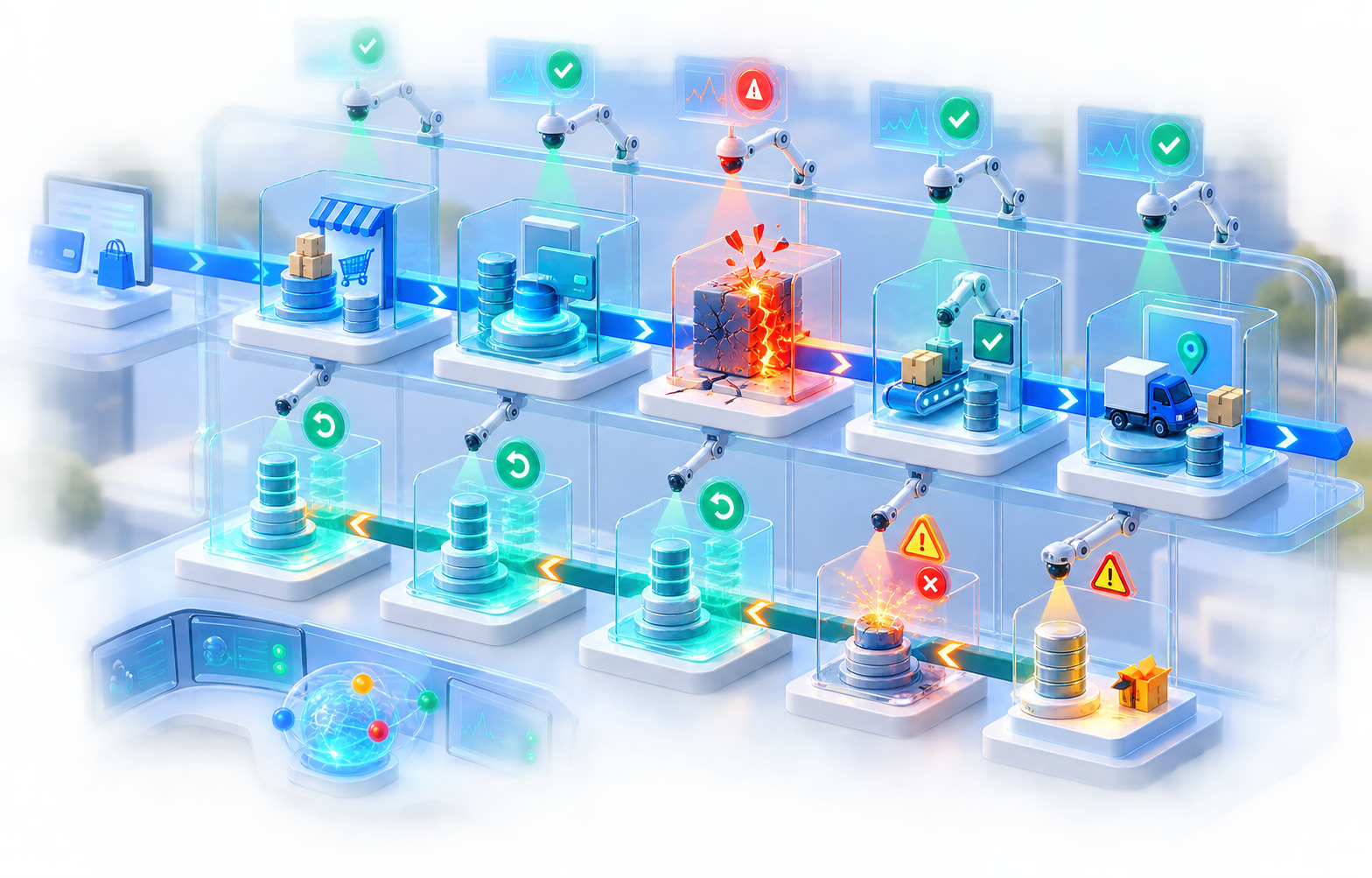
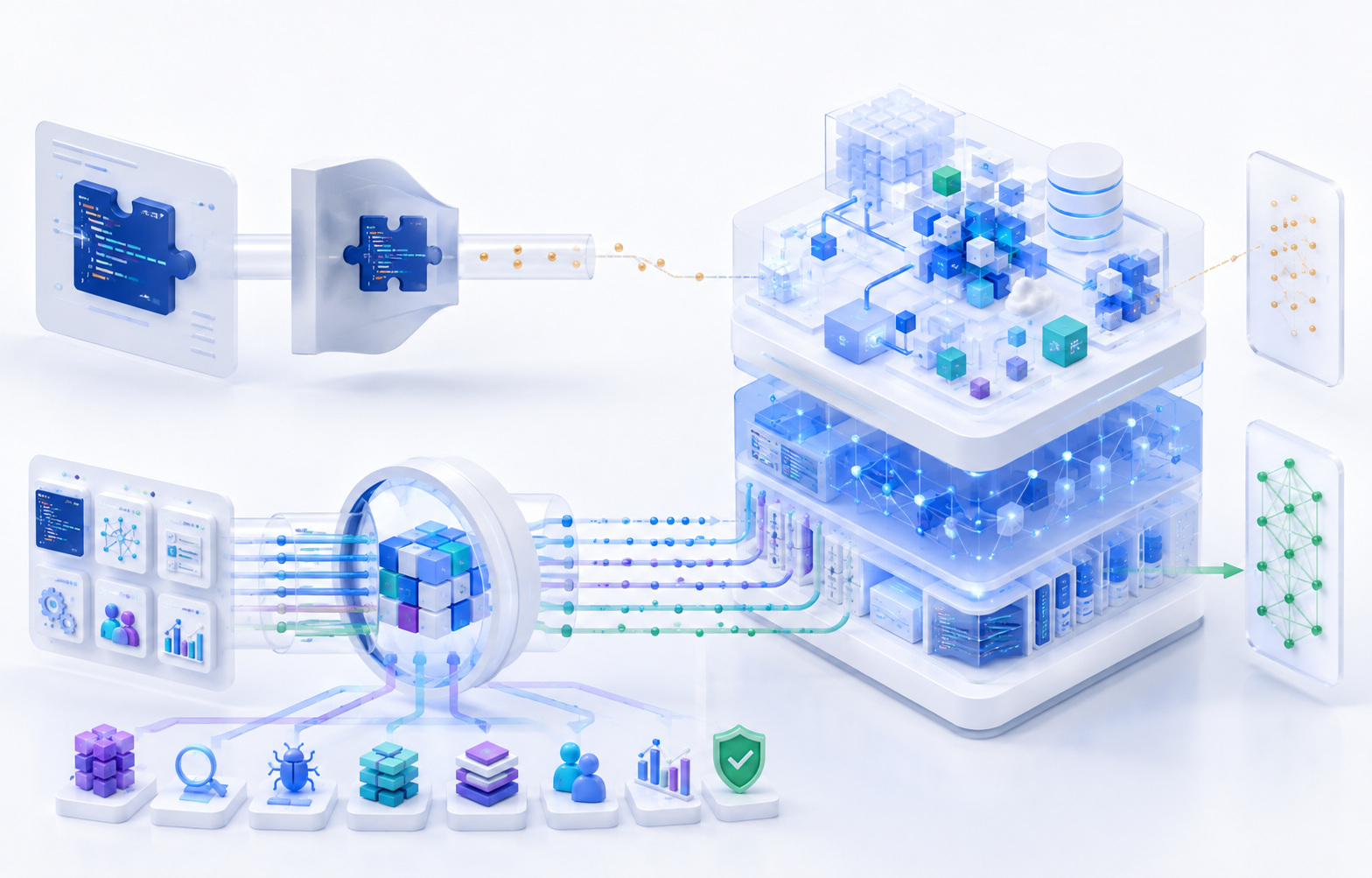
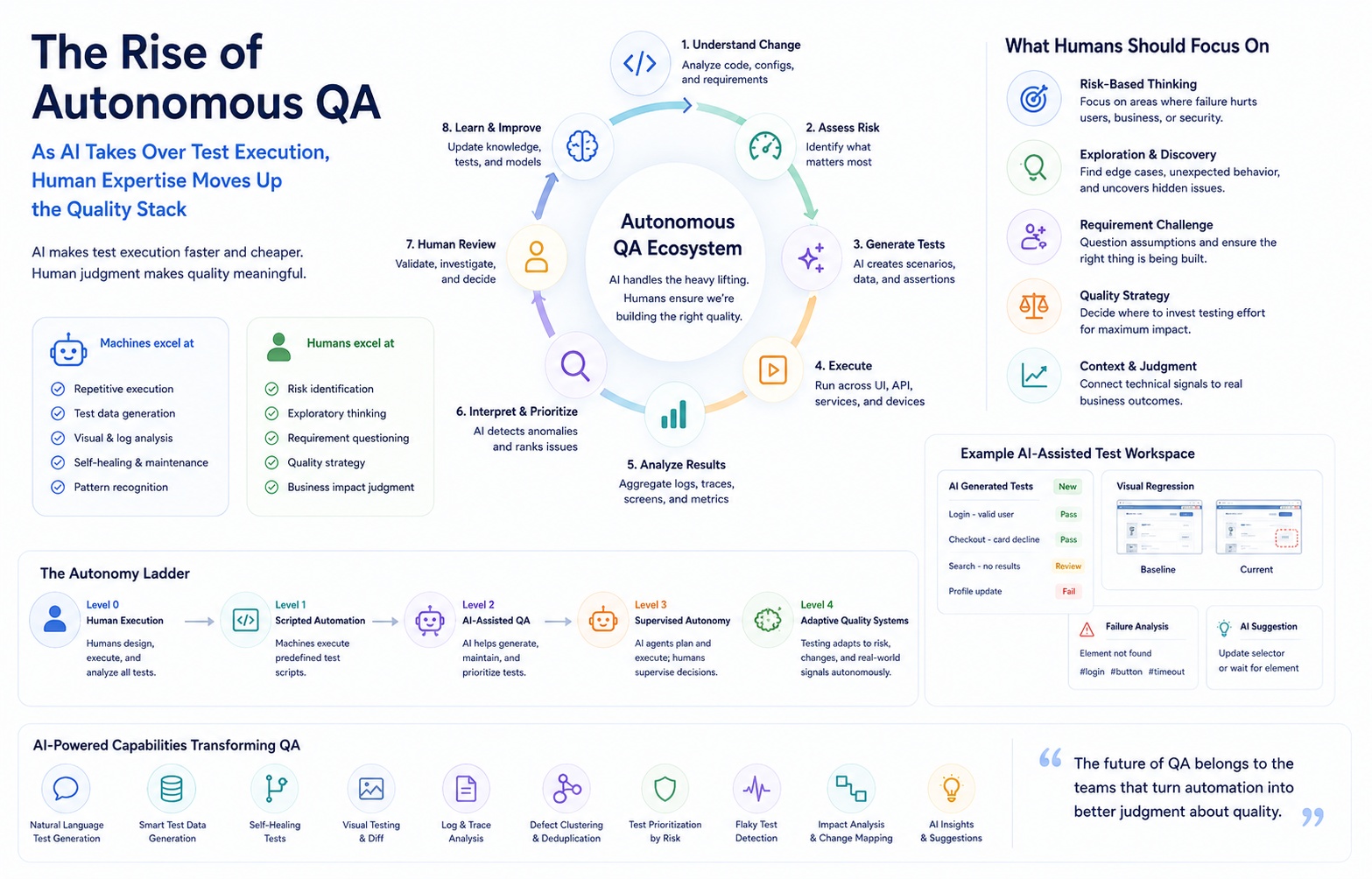
A realistic autonomous QA system is a loop: application under test → telemetry and runtime state (what it does in production, not only in staging) → requirements and product context (what it should do, including the ambiguities) → change intelligence (what moved, what is affected, how wide the blast radius is) → test knowledge (what was tested before, what failed historically) → an AI planner deciding what to verify → execution agents at browser, API, service, and mobile levels → result interpretation and anomaly detection → evidence collection → human review and escalation for anything ambiguous or high-stakes → back into a quality knowledge base that improves subsequent decisions.
Autonomy is a function of context, not agent capability. An agent that drives a browser flawlessly still needs to know what changed and what that change could affect; what matters in business terms rather than code terms; what expected behavior means where the specification is silent; which failures have occurred before and what they indicated; which environments produce trustworthy results; when its own confidence is insufficient to conclude anything; and when a human must be involved.
Nearly all of that is context engineering rather than model capability. Organizations that treat autonomous QA as a procurement decision tend to buy a capable agent and starve it of exactly the information that would make it useful.
The Autonomy Ladder
A staged model clarifies what changes as autonomy increases, and it is more useful for diagnosis than aspiration.
Level 0 — Human Execution. Humans design, execute, investigate, interpret. Signal is high-fidelity and does not scale.
Level 1 — Scripted Automation. Machines execute predefined checks; every decision remains human. Most organizations describing themselves as mature automation shops are here.
Level 2 — AI-Assisted QA. AI generates, maintains, prioritizes, or analyzes testing artifacts, with a human approving each artifact before it enters the system. Where most credible tooling sits today.
Level 3 — Supervised Autonomous Testing. Agents plan and execute meaningful testing activity — choosing what to test for a change, generating and running it, interpreting results — with humans validating consequential decisions rather than individual artifacts. Feasible now in bounded domains with good context.
Level 4 — Adaptive Quality Systems. Testing responds dynamically to code changes, production telemetry, evolving risk models, and observed behavior. Coverage stops being a fixed asset and becomes a continuously recomputed allocation. Directionally where tooling is heading; treating it as available today is a mistake.
The human contribution moves from doing to deciding to governing. Each step up must be matched by a step up in observability, auditability, evaluation, confidence thresholds, and escalation design. A Level 3 system that cannot explain why it tested what it tested is not more mature than a Level 1 system — it is less accountable. Autonomy without visibility is regression disguised as progress.
What Humans Should Stop Spending So Much Time On
Directionally, these activities are moving out of human hands, though unevenly:
- Routine regression execution — solved, and has been for years.
- Basic test scaffolding — page objects, fixtures, setup and teardown boilerplate.
- Repetitive test data creation, including synthetic datasets with valid relationships.
- Standard API validation — schema conformance, status codes, contract adherence.
- Simple cross-browser and cross-viewport checks, well-served by grids and visual tooling.
- First-pass log classification, assigning failures to probable categories before a human looks.
- Routine visual comparison, where perceptual diffing is mature.
- Basic test documentation, which models handle adequately when they can read the test.
- Initial failure clustering, collapsing hundreds of failures into candidate root causes.
- Predictable test maintenance — locator repair after DOM churn, with the caveat that silent healing can suppress real signal.
Two qualifications. "Suitable for automation" is not "requires no oversight": several of these degrade quietly, and degradation in a maintenance layer is invisible by construction. And the gap between what is reliable today and what is plausible in a few years is significant, with vendors incentivized to blur it. Log classification and data generation are production-ready. Autonomous exploration and adaptive test selection across heterogeneous stacks are not, yet.
What Human Testers Should Be Doing More Of
This is where released capacity should go.
Exploratory testing. Not a fallback for missing automation, but the primary mechanism for finding what nobody thought to specify. Humans notice inconsistencies that resist encoding as expected outputs: a state that is technically valid and practically absurd, an interaction that works but feels like the system is guessing. Exploration is where product and technical understanding meet, which is why it finds defects neither discipline finds alone.
Risk modeling. Determining which failures matter economically, operationally, legally, or reputationally — and by how much. Mapping workflows to revenue, identifying irreversible operations, separating failures support can recover from those it cannot. Most organizations have never done this explicitly, which is why their testing effort is distributed according to how easy things are to test.
Requirement interrogation. Asking whether the requested behavior makes sense before it is built. Defect cost is a function of when the defect was introduced, and specification defects are introduced earliest. Generation raises the stakes: a system that automatically produces comprehensive coverage of a flawed requirement makes the flaw more permanent, not less.
Quality strategy. Deciding where testing investment produces the greatest reduction in uncertainty — a different objective from maximizing coverage. Some risks are better addressed through observability and fast rollback than through pre-release testing; some through architecture.
System-level thinking. Reasoning about interactions between services, data stores, infrastructure, integrations, users, and business processes. Most severe incidents are integration or state-consistency failures, and neither lives inside a component boundary where component-level testing can see them.
Failure imagination. Constructing scenarios historical data cannot suggest: clock skew, partial network partition, the customer with three accounts who merges two, the retry that arrives after the compensating transaction. Models trained on what has happened are structurally weak at what has not.
AI test evaluation. Auditing generated tests for relevance, redundancy, blind spots, and misleading confidence — asking not only whether a test passes but whether it would fail for the right reason, whether it asserts on behavior or implementation, and whether its existence implies coverage that does not exist.
Production quality analysis. Connecting telemetry, incidents, support tickets, and customer behavior back into testing decisions. Production is the most honest environment available and the most underused source of quality intelligence; every escaped defect is information about a gap in the risk model, and most organizations discard it once the post-mortem is filed.
Quality advocacy and testability design. Influencing architecture and deployment practice so the system is observable and testable by construction: feature flags with clean kill switches, idempotent operations, structured events at decision points, deterministic time handling. Testability makes every downstream layer, human or automated, more effective.
Each of these appreciates as automation increases, because each governs the automation.
Test Coverage vs Risk Coverage
A typical quality dashboard reports something like: 90% of regression automated, 85% code coverage, 15,000 tests, 98% passing. None of those numbers answers the question an executive is actually asking, which is how much of the risk that matters is understood.
Risk coverage is a different frame. Rather than what proportion of code was executed, it asks what proportion of consequential failure modes have been deliberately considered and addressed — through testing, monitoring, architecture, or accepted exposure. Its dimensions are business dimensions: business-critical workflows weighted by usage and revenue; financial exposure, particularly money movement and pricing; security-sensitive behavior such as authentication, authorization, and data access boundaries; high-change areas where defect probability is empirically elevated; complex integrations and third-party dependencies; historically unstable components; customer-impacting functionality where failure is externally visible; irreversible actions like deletions and transfers; cross-service data integrity; and compliance-sensitive processes carrying audit obligations.
Two properties follow. Risk coverage can be high with modest test counts if the tests are well-targeted, and low with enormous test counts if coverage accumulated wherever testing was convenient.
This is where AI contributes something humans cannot do manually: continuously maintaining the mapping between code changes and risk dimensions. Given commit history, dependency graphs, incident records, and annotated critical paths, a system can flag when a change lands in a high-exposure area with thin coverage — on every pull request rather than during quarterly planning. The mapping is machine work. Defining the dimensions and their weights is not.
Testers as Quality Investigators
There is an older description of this work that has become newly accurate.
An investigator does not execute a checklist. They form a hypothesis about what might be wrong, gather evidence that would distinguish it from the alternatives, and revise. They treat a weak signal — a slightly elevated error rate, a support ticket that doesn't fit a known category, a test that fails once a fortnight — as a thread rather than noise. They look for contradictions: two systems reporting different totals, a log claiming success against a customer reporting failure. They test boundaries deliberately, because boundaries expose assumptions. And they ask why the system behaves as it does rather than only whether it behaves as specified, because correct behavior reached through an incorrect mechanism is a defect waiting for conditions to change.
AI alters the economics here in one specific way: it makes evidence abundant. Traces that would have taken a day to correlate arrive pre-correlated. Failure patterns invisible across 40,000 pipeline runs become visible. Reproduction, historically the most expensive step, becomes cheap for a growing class of defects.
Abundant evidence raises the value of knowing which evidence matters. The investigator's contribution was never collection; it was judgment about which threads to pull, and that judgment becomes scarcer as the pile grows.
When Should Humans Override the AI?
"Humans should stay in control" is a slogan. The useful version specifies where intervention earns its cost, because every escalation consumes attention, and a system that escalates constantly is neither autonomous nor trusted.
Escalation is warranted when:
- Expected behavior is ambiguous. The specification is silent and the model cannot classify what happened as correct or incorrect. The most common legitimate escalation — and a system that resolves ambiguity by guessing is worse than one that stops.
- The operation is financially sensitive. Payments, pricing, refunds, ledger state, where an incorrect pass has direct monetary consequences.
- Security or privacy boundaries are involved. The cost of a false negative is unbounded and often legal.
- There are regulatory consequences. Where a decision must be defensible externally, an unexplainable automated judgment is unusable regardless of accuracy.
- The behavior is novel. New functionality has no historical baseline, so anomaly detection has nothing to compare against.
- Evidence is contradictory. Telemetry and test results disagreeing is precisely the signal that something is understood incorrectly.
- The blast radius is large. Shared infrastructure, core data models, authentication.
- Model confidence is low — which presupposes the system produces calibrated confidence at all, an engineering requirement rather than a UI feature.
- A release decision is being made. Go/no-go is an organizational risk acceptance, not a test result.
Operationalizing this means explicit thresholds: what confidence permits an autonomous conclusion, which risk tiers require review regardless, and who holds the decision. It also means measuring escalation quality — a system escalating 40% of findings has not been tuned; one escalating 0.5% may be over-trusted.
The New QA Toolchain
Which AI testing tool to buy is a less interesting question than what architecture the tools have to fit into. A coherent stack has distinguishable layers:
Change intelligence — commits, pull requests, dependency graphs, and the mapping from a diff to affected functionality. Everything downstream depends on this being accurate.
Risk engine — change intelligence combined with business-weighted risk dimensions, estimating what this change deserves.
Test knowledge — historical defects, existing scenarios, production incidents, requirements, documented expected behavior. Most organizations lack this layer entirely, which is why their generated tests are context-free.
Generation layer — creating or modifying tests informed by the layers above rather than by a prompt alone.
Execution layer — UI, API, service, and mobile surfaces, in environments of known trustworthiness.
Observation layer — traces, logs, screenshots, metrics, network behavior, and application state, captured by default rather than on demand.
Evaluation layer — is this failure real, is this pass informative, is this test still relevant.
Human review layer — structured escalation of ambiguous and high-risk findings, with enough context attached that a human can decide quickly.
Learning layer — confirmed outcomes fed back so future risk estimates, generation, and evaluation improve.
Evaluation and learning are where current implementations are thinnest, and they are what separates an automation stack from an autonomous one. A system that generates and executes but never learns whether its choices were correct will produce confidently wrong decisions indefinitely.
Metrics for an AI-Assisted QA Organization
Test counts, automation percentage, and pass rates measure activity. These measure whether the activity works:
- Escaped defect severity — of what reached production, how bad was it? Whether the system catches what matters, independent of volume.
- Risk coverage — what share of high-consequence failure modes has deliberate treatment? Whether effort follows importance.
- Defect detection lead time — how far upstream defects are caught, and therefore how cheap they are.
- Regression signal-to-noise ratio — share of failures that are real defects. Predicts whether engineers will start ignoring the pipeline.
- AI test acceptance rate — share of generated tests kept after review. A low rate means the generation layer lacks context, not that generation fails.
- Generated test redundancy — whether the suite is inflating.
- False positive rate — what triage is costing.
- Failure investigation time — whether the observation and evaluation layers work.
- Human escalation rate — how often autonomy defers; miscalibration shows in both directions.
- Change-to-test mapping accuracy — when a change breaks something, was that area flagged? Whether the risk engine is real or decorative.
- Critical journey coverage — are the workflows the business depends on verified end to end? The question executives are actually asking.
- Flaky test rate — how much of the suite produces noise rather than information.
- Production learning reuse — what share of incidents produced a durable change to testing? Whether the organization learns.
- Time from risk identification to validation — the practical meaning of quality velocity.
Skills That Become More Valuable
QA career progression has been organized around tooling depth: frameworks, grids, pipelines. That knowledge does not become worthless, but its scarcity value declines as generation absorbs boilerplate.
Appreciating instead: systems thinking and architecture literacy; domain expertise in the business the software serves; risk analysis; exploratory testing as rigorous practice rather than unstructured clicking; APIs and distributed failure modes; observability and instrumentation design; data literacy sufficient to interrogate a model's output; AI evaluation; context and prompt design for testing agents, which is really the skill of encoding organizational knowledge in machine-usable form; security awareness; critical thinking; communication, since findings that change no decision are worthless; and testability design.
The distinction worth internalizing: the senior QA engineer of the next decade is not the person who knows the most automation frameworks. They are the person who can construct a defensible, evidence-backed argument about whether a complex system deserves the confidence someone is about to place in it — and who can say what additional evidence would change that judgment.
A Practical Autonomy Check
Questions worth asking internally, whatever tooling is in the stack:
- What percentage of QA capacity goes to repeating checks whose outcome is already known?
- Which of our testing activities genuinely require human judgment, and can we name them specifically?
- Can our AI-generated tests explain why they exist — what risk each one addresses?
- Can every automated test be connected to a meaningful failure mode?
- How do we detect redundancy among generated tests, and what do we do about it?
- Who validates the assumptions embedded in generated tests, and how often?
- Does our testing system learn from production incidents, or do post-mortems end at the document?
- Can it prioritize testing based on a specific code change, and how accurate is that prioritization?
- Can an agent recognize when expected behavior is ambiguous rather than guessing?
- Under what specific conditions must autonomous testing escalate, and are those written down?
- Can we audit why the system made a particular testing decision three months after it made it?
- When self-healing repairs a locator, do we ever review whether it should have failed instead?
- What proportion of our regression failures are real defects?
- If our suite doubled in size tomorrow, would our confidence in a release change at all?
- Are we automating testing activity, or improving justified confidence?
The last question is the one the others serve.
Where This Leads
For thirty years the central engineering problem in QA was making verification scale: frameworks, grids, parallelization, containerized environments, CI/CD integration — enormous ingenuity spent on running more checks, faster, more often. That problem is being solved, unevenly but decisively.
What emerges is not an industry with less need for quality expertise, but one where expertise has nowhere to hide behind execution. When running a test costs nothing, having run it proves nothing. Value migrates to the decisions around it: which risks deserve attention, which assumptions deserve challenge, which evidence deserves weight, and when confidence is warranted rather than merely comfortable.
Abundant testing makes the quality of testing decisions the only thing separating one organization from another. The teams that win will not be the ones running the most tests — they will be the ones who can say, precisely and with evidence, why they believe their system works.
Final Takeaway
AI is making test execution abundant, which devalues execution and revalues judgment. The work that appreciates is deciding what deserves testing, interrogating requirements, modeling business risk, auditing whether generated tests mean anything, and feeding production reality back into testing decisions. Autonomous QA is an architecture — change intelligence, risk estimation, test knowledge, generation, execution, observation, evaluation, escalation, learning — not a bot with browser access. Measure it by escaped defect severity, risk coverage, and signal-to-noise, not by test count.