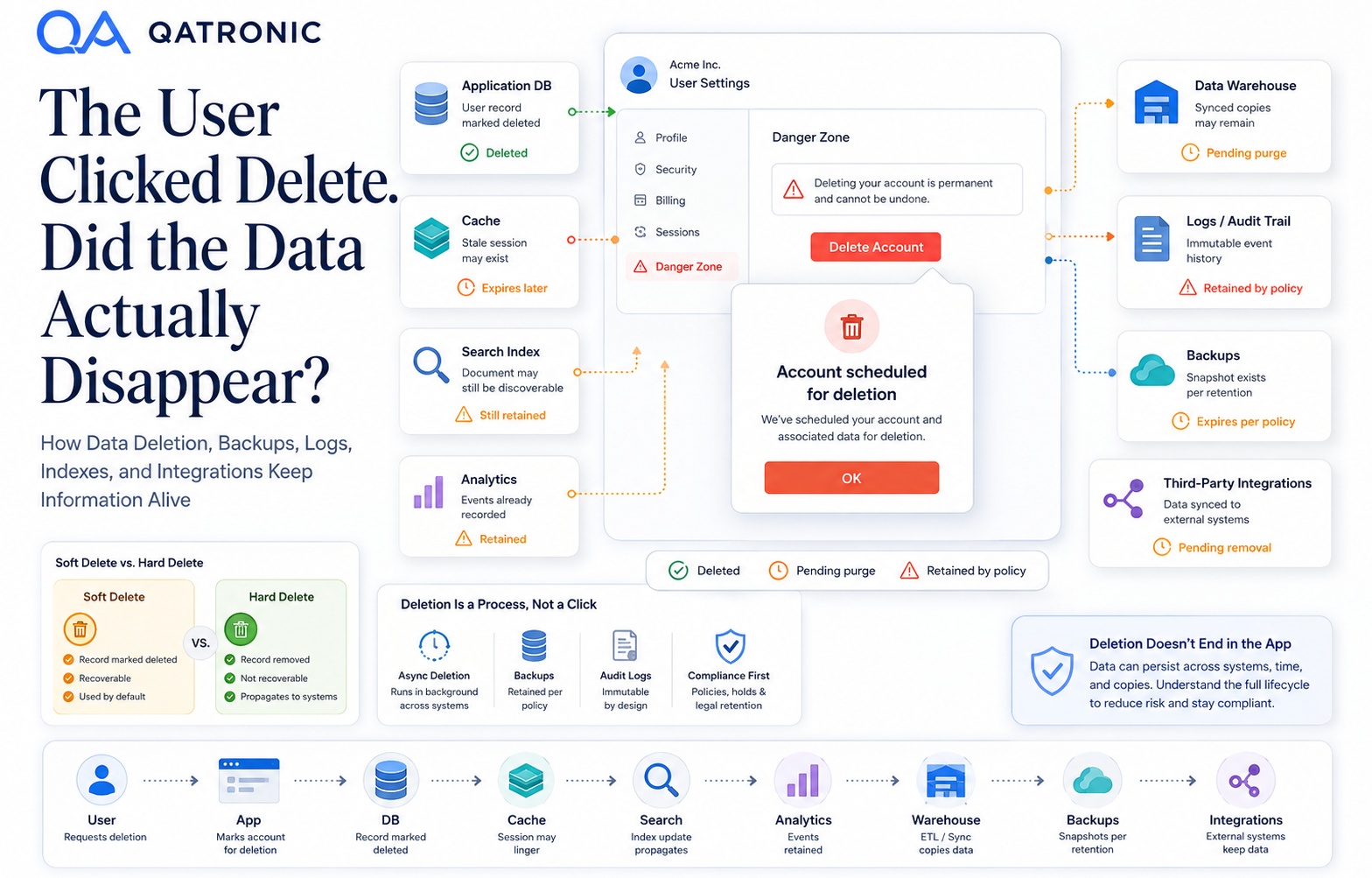
How Data Deletion, Backups, Logs, Indexes, and Integrations Keep Information Alive
A product can display the message "Your account has been deleted" while its infrastructure still truthfully contains an invoice tied to that account, a set of immutable security logs referencing it, a handful of analytics events carrying its identifiers, an encrypted backup snapshot from two nights ago, an email address sitting in a suppression list, and a queue entry waiting for a worker to finish the job asynchronously. None of these facts make the message false. They make it incomplete.
This is not a story about a company lying to its users. Most engineering teams that build a "Delete Account" button genuinely intend for the account to go away, and in the sense that matters most immediately to the user — they can no longer log in, their profile no longer renders, their data no longer appears in the product — it does go away. The harder question sits underneath that experience: what, precisely, did the word "deleted" promise? Did it promise that a row was removed from a table? That every derivative of that row, across every system that ever touched it, has also been removed? That removal has already happened, or that removal has merely been scheduled? Almost no product answers this question explicitly, which means almost no product can prove, when asked, that it kept its promise.
Treat deletion as what it actually is: a distributed systems problem, not a database statement. Most architecture discussions describe how data moves outward from a user into an application, a database, a cache, a search index, an analytics pipeline, a warehouse, and a set of third-party integrations. This article follows that same map in reverse. It starts where a deletion request begins and asks, system by system, what has to happen — and what usually does not happen — before a piece of information is genuinely gone. Creating data is synchronous, visible, and immediate. Destroying every meaningful representation of that data is asynchronous, distributed, policy-dependent, and very hard to prove. That asymmetry is the engineering problem this article is about.
Delete Is a Lifecycle, Not a State
The mental model most engineers start with is binary: a record exists, or it does not. That model works for a whiteboard sketch and fails almost immediately in a production system with more than one datastore. A mature deletion architecture usually needs to represent several distinct states, not two: active, disabled, soft-deleted, scheduled for deletion, deletion in progress, anonymized, archived, retained under obligation, and purged. A record can be simultaneously "gone" from the customer's point of view and "in progress" from the system's point of view, and those two views need to coexist without contradicting each other.
Treating deletion as a state machine rather than a single boolean flag changes what the system can do. A reasonable progression looks like this:
ACTIVE
  → DELETION_REQUESTED
  → ACCESS_REVOKED
  → PURGE_PENDING
  → PROPAGATING
  → DELETED
with branches such as RETENTION_REQUIRED, LEGAL_HOLD, and DELETION_FAILED available at almost every step. A user who submits a deletion request while a fraud investigation is open should land in RETENTION_REQUIRED, not silently vanish and not silently stay ACTIVE. A worker that cannot reach a downstream service should land in DELETION_FAILED with a retry policy, not swallow the exception and mark the row deleted anyway.
Explicit lifecycle states pay for themselves in ways a single deleted_at column cannot. They give support engineers a real answer when a customer asks "what's happening with my account," they give observability tooling a set of transitions to alert on, they give QA a finite set of states to assert against instead of an open-ended set of side effects, and they give auditors a trail that shows not just that data was removed but when, by what process, and under what authorization. A system that only knows deleted = true has thrown away the information needed to answer any question except the last one.
Soft Delete: The Data That Pretends to Be Gone
Soft deletion — marking a row with deleted_at, is_deleted, or a status enum instead of removing it — exists for good reasons. It supports undo after an accidental deletion, it preserves referential integrity for rows that other tables still point to, it keeps a business history that finance or support teams may need later, and it gives customer support a way to recover an account without restoring from backup. None of that is controversial.
What is easy to miss is how many code paths have to remember to respect that flag. A query like
SELECT * FROM users WHERE deleted_at IS NULL;only excludes deleted users if every query written against that table includes the same filter. In practice, that discipline erodes. An admin dashboard built by a different team queries the table directly and shows the "deleted" user in a list. A background job that recalculates usage statistics joins against users without the filter and counts a deleted account toward billing. A search-indexing job ingests the row before a nightly batch removes it, so the deleted user's name is still searchable. A CSV export written for an internal reporting need six months ago never got updated when the soft-delete convention was introduced, and it happily exports rows the product otherwise treats as gone.
ORMs that support soft delete as a first-class feature — adding a global scope that filters deleted_at IS NULL automatically — solve this for the ORM's own query builder, not for raw SQL, not for the reporting tool connected directly to the read replica, and not for the third-party BI tool with its own connection string. A soft-delete convention is only as strong as the weakest access path to the table, and most systems have more access paths to a given table than any single engineer can enumerate from memory. This is one of the more common causes of a "deleted" account visibly reappearing somewhere in the product, and it is rarely caused by a single dramatic bug. It is caused by one query, written months apart from the others, that never learned the rule.
Hard Delete Isn't Necessarily the End
A DELETE FROM users WHERE id = ... statement removes the row from that table. It says nothing about every other table that ever copied, denormalized, or referenced information from that row. Foreign-key relationships, materialized views, audit tables, event-log tables, and read replicas can all retain a shadow of the deleted record long after the primary row is gone.
ON DELETE CASCADE is the mechanism most relational databases offer to keep child rows in sync with a parent deletion: when a referenced row is deleted, PostgreSQL and similar systems automatically delete every row in a dependent table that points to it. Configured correctly, cascades keep a schema internally consistent without a developer having to hand-write cleanup logic for every table. Configured carelessly, they turn a single DELETE into a much larger blast radius than anyone intended — deleting a workspace can cascade through memberships, projects, comments, and uploaded files that other people also depend on, none of which the person who issued the delete necessarily anticipated.
The opposite failure is just as common. A schema that never wired up cascades, and relies instead on application code to clean up related rows, will accumulate orphaned data every time a developer adds a new table and forgets the corresponding deletion logic. Neither cascading everything nor cascading nothing is correct in general; the right answer depends on whether a given piece of related data has independent business meaning once its parent is gone. An explicit deletion service that owns the full dependency graph for a given entity — rather than relying purely on database-level cascade rules — gives a team more control over exactly this kind of judgment call, at the cost of having to maintain that graph by hand as the schema evolves.
Materialized views and denormalized tables complicate the picture further, because neither one is guaranteed to react to a delete at all. A materialized view is a snapshot, refreshed on its own schedule; a DELETE against the base table does not touch it until the next REFRESH MATERIALIZED VIEW runs, so a deleted row can keep appearing in anything reading from the view for however long the refresh interval allows. Denormalized columns — a user_display_name copied onto an orders table for query convenience, say — are worse, because there is often no foreign key at all connecting them back to the source, which means no cascade, no constraint violation, and no obvious signal that the copy exists in the first place. Auditing a schema for hard-delete completeness means auditing for these implicit, unconstrained copies as much as for the explicit, constrained ones.
A User Is Not One Row
Most conversations about "deleting a user" implicitly assume the user is one row in one table. In any system beyond a toy example, a user is a coordinate that touches dozens of tables: users, profiles, organizations, memberships, sessions, api_keys, notifications, preferences, uploads, messages, comments, orders, invoices, support_tickets, and analytics_events, to name an ordinary set.
The harder question underneath that list is not "which tables mention this user" but which of those rows are the user's personal data, and which are business records that happen to reference the person. An invoice references the user but belongs to the business's financial history; deleting it on request would corrupt the company's own accounting. A comment a former employee wrote on an internal document was authored by that person, but the document and its thread belong to the organization that employed them. Deleting the account should not necessarily delete the comment — it might instead need to anonymize the author field while leaving the comment's content and position in the thread intact.
This distinction — personal data belonging to the individual versus business records that merely reference the individual — has to be made deliberately, table by table, because no framework or database engine makes it automatically. Getting it wrong in one direction destroys business records the company is contractually or legally obligated to keep. Getting it wrong in the other direction leaves personal data in the system under the fiction that it is "just a business record." Neither mistake is visible from the UI, which only shows whether the account still logs in.
Caches Remember What Databases Forget
A cache is a second, faster copy of the truth, deliberately built to be stale for some bounded period in exchange for speed. That tradeoff is invisible until the moment a piece of data is supposed to disappear and the cache has not been told.
Redis and comparable in-memory stores expire keys through two mechanisms working together: a lazy check performed when a client touches a key — the store checks whether it has expired before returning it — and an active background process that periodically samples keys and removes the ones whose TTL has passed. Neither mechanism guarantees the key disappears the instant its TTL elapses; an active-expiration cycle runs on an interval and only reclaims a fraction of expired keys per pass, so a key can outlive its nominal TTL by a measurable amount before it is actually swept, particularly under load. That is an acceptable property for a cache whose only contract is "eventually stale data goes away." It is a much weaker property when the cache is standing in for a deletion guarantee.
The gap between "invalidated" and "expired" matters in three practical places. A profile object served from a cache-aside layer can keep returning a deleted user's name and avatar to other users' clients for as long as the TTL allows, unless the deletion path explicitly issues a cache invalidation rather than relying on the timer. A permissions cache that has not been told a membership was revoked can keep granting access to a resource the underlying authorization check would now deny. A CDN edge cache, further from the origin and slower to invalidate, can keep serving a cached API response containing information the origin no longer has.
QA coverage for this boundary needs more than one test. "Delete, then immediately read from the same service" only proves the primary path was invalidated. A more complete check reads through every service that fronts a cache for the same data, waits out the TTL rather than assuming an explicit invalidation fired, and separately checks whether a session or permissions cache is still honoring credentials for an account that database-level checks would now reject. Six hours of eventual disappearance by TTL might be an entirely reasonable answer for a low-sensitivity cache — but it is a decision that should be made on purpose, against the product's actual deletion contract, not discovered by accident during an audit.
Session Deletion Is Not Account Deletion
Authentication state deserves its own accounting, separate from the account record itself. When an account is deleted, a browser session, a mobile app's stored refresh token, an issued API key, an OAuth grant given to a third-party integration, and a "remembered device" cookie are all independent artifacts that may or may not be revoked by the same code path that deletes the account row.
Signed, stateless tokens make this sharper. A JWT that encodes a user ID and an expiry is, by design, valid on its own terms until that expiry passes — nothing about deleting the underlying account changes the token's signature or its embedded claims. A service that trusts the token without also checking current account state will keep honoring it for the remainder of its lifetime, deleted account or not. Mitigations exist at the architecture level: shorter token lifetimes reduce the exposure window, a server-side session or token-denylist store lets a service check revocation explicitly, and key rotation invalidates every token signed with a retired key. None of these is mandatory in every context, and the right combination depends on how sensitive the capabilities behind that token are.
The invariant worth holding onto, independent of implementation choice, is simple to state and easy to violate silently: a deleted account should not retain any capability solely because a previously issued credential still technically verifies. If a token check and an account-existence check can disagree, the token check should not win.
Search Is Another Database
Elasticsearch, OpenSearch, and similar systems are not a view over the primary database — they are a separate datastore, populated asynchronously, usually through an event or a change-data-capture pipeline: primary database change, event emitted, indexing worker consumes it, search index updated. Deletion has to travel the same path in reverse, and every asynchronous hop is a place where the two systems can disagree.
The underlying storage engine makes this concrete. Apache Lucene, which powers both Elasticsearch and OpenSearch, does not remove a deleted document's bytes immediately. It marks a bit in a per-segment bitset recording that the document is deleted, and all subsequent searches simply skip anything flagged that way; the space is not actually reclaimed until the segments involved are merged, which happens on Lucene's own schedule or on an explicit force-merge call. That is an internal storage detail with an externally visible consequence: a "deleted" document can sit inside a segment, invisible to normal search, for an indefinite period before the underlying content is physically gone — which matters if the concern is disk-level data remanence rather than search visibility, and matters even more if the deletion event never made it to the index at all.
The more common failure is simpler than storage internals: the delete event gets lost, delayed, or retried into a dead-letter queue, and the search document for a resource that no longer exists in the primary database keeps showing up in results — or worse, its text snippet keeps surfacing content someone specifically asked to have removed. Rebuilding an index from the primary database resolves this, since a full rebuild only contains what currently exists at the source; incremental indexing does not resolve it by itself, since incremental jobs typically only know how to apply changes forward and have no independent mechanism to notice that something is now absent. A search index is a reflection of a source of truth, not the source of truth, and it needs its own tombstone-and-reconciliation strategy rather than an assumption that indexing events always arrive.
Event Streams Do Not Work Like Tables
Append-only systems complicate deletion in a way relational tables do not, because the entire design point of an event stream or an event-sourced audit log is that history is not supposed to change. A sequence of events like UserCreated, UserUpdated, UserDeleted records what happened; it does not, by default, remove what happened before.
Kafka's answer to this tension, for topics configured with a compacting cleanup policy, is the tombstone: a message published with the deletion target's key and a null value. During compaction, Kafka retains only the most recent record per key, and a null-value record signals that the key's prior history should eventually be dropped entirely, tombstone included, once a configured retention window passes. This gives compacted topics a genuine deletion primitive — but it only applies to compacted topics. A plain, retention-based topic with cleanup.policy=delete has no equivalent; data there disappears only when its retention window expires, on a schedule the topic owner set for storage reasons, not for privacy reasons.
The deeper architectural point is that privacy requirements need to shape event design before data ever reaches the stream, not after. An event payload that embeds a user's email address, name, and IP address directly is much harder to make disappear than one that carries an opaque identifier and leaves the identifier-to-attribute mapping in a separate, mutable store. Deleting the mapping — a technique sometimes called crypto-shredding when the mapping is a decryption key rather than a lookup table — can render the immutable event payload practically unreadable without needing to touch the immutable log itself. This is a useful pattern, not a universal one: it depends on nothing else being able to re-derive the same information from the remaining fields, and it should be evaluated case by case rather than assumed to satisfy any particular legal obligation automatically. The general principle holds regardless of the specific technique: minimizing what identifying information ever enters an immutable log is a design decision made once, at schema time, and it is far cheaper than any remediation applied after the fact.
Analytics Never Received a Delete Button
Product analytics tools are usually wired up by a different team, on a different timeline, than the primary application database, and they tend to accumulate their own notion of "the user" independent of the application's account model. A typical instrumentation sends events like signup_completed, project_created, and feature_used, often carrying a payload that includes a user ID, an email address, an organization name, a device fingerprint, and a plan tier.
Because the analytics platform maintains its own user profile — built from identify calls, accumulated event history, and computed user properties — deleting the account in the primary application has no automatic effect on that separate profile. Whether and how the analytics vendor supports deletion, suppression, or anonymization of a specific user's history is a question that needs to be answered against that vendor's current documentation rather than assumed, since capabilities and APIs in this space change; a claim that was accurate a year ago may no longer be.
The more durable lesson is architectural rather than vendor-specific: the easiest copy of a piece of data to delete is the one that was never created. An analytics event that never included a raw email address in its payload — sending a hashed or internal identifier instead, and joining to identity only inside a system that already has deletion machinery — removes an entire category of downstream deletion work before it exists. Data minimization at the point of instrumentation is not a compliance nicety bolted on afterward; it is a direct reduction in the size of the deletion graph a team will eventually have to maintain.
Data Warehouses Create Copies of Copies
Modern analytics architecture typically moves data through several more hops before anyone queries it: production database, change-data-capture stream, object storage, an ETL or ELT transformation layer, a warehouse, one or more transformed models, and finally a BI dashboard. Deletion, to be meaningful, has to propagate through every one of those layers — raw landing tables, staging tables, transformed tables, and any materialized aggregates built on top of them.
Incremental transformation pipelines, common in dbt-style workflows against warehouses such as Snowflake, BigQuery, or Redshift, are built to apply new and changed rows efficiently. They are not automatically built to notice that a row present in a previous run is now absent from the source. Without an explicit delete or tombstone signal flowing through the CDC pipeline, an incrementally materialized warehouse table can keep a deleted user's data indefinitely, simply because nothing ever told the transformation that the row should be removed rather than left alone. Verifying that a specific deletion event actually reaches every downstream table it touches — raw, staged, and aggregated — is its own category of test, distinct from verifying that the primary database deletion succeeded, and it is one of the places deletion architecture most commonly breaks down silently, because a warehouse discrepancy rarely produces an error; it just produces a report that is quietly wrong.
The Derived Data Problem
Beyond direct copies, systems routinely compute new information from a person's data and keep the derivative long after — or even after removing — the source. A deleted email address might have already produced a country code, a customer segment label, a fraud score, a recommendation embedding, or a contribution to an aggregate statistic like "average session length for this cohort."
Whether that derived artifact should still be treated as connected to the original person is a classification question, not a database question, and it depends on how easily the derivative can be traced back to an individual. A fraud score keyed to an internal account ID that no longer resolves to anything is functionally anonymous. An embedding vector computed from a small number of distinguishing features about one specific person, stored alongside enough context to re-identify them, is not. The categories worth distinguishing — direct identifiers, indirect identifiers that only identify someone in combination with other data, aggregated statistics, and genuinely anonymous information — describe an engineering spectrum, and where a specific piece of derived data falls on it depends on context, on what other data exists alongside it, and often on jurisdiction. That determination is a legal and privacy judgment as much as a technical one, and it should be made with input from people qualified to make it rather than assumed from a generic rule of thumb. What engineering can control is visibility: knowing which systems compute derivatives from personal data, and treating that as part of the same inventory used to plan deletion, rather than treating derived data as automatically exempt because it "isn't the original record."
Logs: The Record Engineers Need But Users May Want Gone
Application and infrastructure logs exist because engineers need them during incidents, audits, and fraud investigations — request logs, authentication history, error traces, and database logs are often the only evidence available when something goes wrong at 3 a.m. six weeks from now. That value is real and does not disappear just because a user asks for their data to be deleted.
The trouble is usually not that logs exist; it is what ends up inside them. A line like logger.info("Password reset requested: " + JSON.stringify(request)) that serializes an entire request object will faithfully capture whatever the client sent, including personal fields nobody intended to log — and once that line has shipped to a centralized logging platform, it inherits that platform's retention window regardless of what the product's own deletion policy says. The fix is structural, not reactive: log the fields actually needed for debugging and nothing else, treat log statements that serialize whole objects as a code-review flag rather than a convenience, and separate debugging logs — short-lived, rotated, access-controlled — from deliberate audit records, which are a different thing built for a different purpose and covered in the next section. A log line that never captured an email address in the first place never needs to be found and redacted later.
Audit Trails May Be Designed Not to Disappear
Some records are supposed to survive a deletion request, by design, because they exist to prove that something happened rather than to describe the person it happened to. Financial systems, security tooling, and enterprise SaaS platforms with administrative action logs all have a legitimate need to retain evidence — "account 9f23... was deleted by admin 4a1b... at this timestamp" is a fact the business may need to keep even after the account itself, and most of its associated profile data, are gone.
The engineering resolution to this tension is usually to separate the fact of an event from the personal detail attached to it: keep the audit record, expressed in terms of internal identifiers and the action taken, and strip or replace the personal fields that aren't load-bearing for the audit's purpose. That is a defensible pattern in the abstract, but it is not automatically sufficient for any specific regulatory regime — whether a given retained field is permissible under GDPR, CCPA, or another framework depends on the legal basis for keeping it, and that determination belongs with qualified counsel, not with an assumption baked into the schema.
Backups Break the Immediate-Deletion Mental Model
Nothing in this article does more damage to the "delete means immediately gone" mental model than backups, and it is worth spending real time on why.
A production database is typically protected by some combination of full backups, incremental backups, storage-level snapshots, and continuous point-in-time recovery. PostgreSQL's continuous-archiving approach is a useful concrete example: the database continuously writes a write-ahead log, that log is shipped to archival storage alongside periodic base backups, and recovery works by restoring a base backup and replaying archived log segments up to any chosen point in time. The entire feature exists so that an organization can recover to a specific moment after a failure — which means, by construction, a backup taken last week necessarily contains whatever existed in the database last week, deleted-since-then or not.
Selectively removing one person's data from every historical backup, every incremental snapshot, and every WAL segment an organization has ever taken is, in most architectures, operationally impractical and sometimes actively counterproductive — rewriting or partially decrypting an immutable backup to strip one record can compromise the integrity guarantee that makes the backup trustworthy for disaster recovery in the first place. Regulators examining this problem have converged on a similar practical answer without pretending the tension disappears. The UK's ICO has described the standard as putting backup data "beyond use" even where it cannot be immediately and surgically erased — meaning the data is not accessible for any operational purpose and is not restored into a live system without deletion being reapplied — while the organization's own retention schedule eventually ages the backup out entirely. A February 2026 European Data Protection Board report on a coordinated audit of more than 750 controllers found this exact area to be one of the most common sources of compliance failure: many organizations had no defined procedure for backups at all, and some that claimed to have solved the problem had actually only pseudonymized the data — replacing identifiers with reversible tokens while keeping the mapping — which the EDPB was explicit does not qualify as erasure, since pseudonymized data remains personal data as long as re-identification remains possible.
The architectural pattern that reconciles "backups are immutable and shouldn't be selectively rewritten" with "deleted data shouldn't come back" is a deletion tombstone or ledger that survives independently of any single backup or restore operation. The mechanism matters more than the label: a durable record, kept separately from the data it describes, stating that a given subject's data was deleted as of a given time — so that any later restoration, from any backup, has something authoritative to reconcile against before that data is allowed to become live again.
Restore Testing: The Deleted User Comes Back
Most disaster-recovery testing asks one question: can this database actually be restored from backup. Privacy-aware testing has to ask a second, less comfortable question: after a successful restore, what should not have come back — and did it stay gone?
A complete restoration test walks through more than "restore the snapshot and confirm the row count." After the database snapshot lands, the deletion ledger described above needs to be reapplied against the restored state, re-purging anything that was deleted after the snapshot was taken; downstream search indexes need to be rebuilt or reconciled against the now-current state rather than the state as of the backup; caches need to be treated as untrusted until repopulated from the corrected source; and any analytics or warehouse pipeline that resynchronizes from the restored primary needs to inherit the same corrected state rather than reintroducing what the restore brought back. A restore that is technically successful — the database is up, queries return results, the application works — can still be a governance failure if a data subject who exercised a deletion right six months ago finds their record live again because nobody reapplied the deletion history. Disaster recovery drills that stop at "the system came back up" are testing half of the requirement.
Third-Party Integrations Never Got the Memo
Most SaaS products send data outward to a CRM, an email provider, a support desk, a billing processor, an analytics platform, a customer-success tool, marketing automation, or cloud storage — through direct API calls, webhooks, scheduled ETL jobs, or occasionally a one-off CSV export someone ran two years ago and forgot about. Deleting a record inside the primary product does nothing, by default, to retract any of that.
The starting point for getting this right is not a deletion mechanism at all — it is an inventory. A team needs to know what leaves the platform, which system receives it, why it was sent there in the first place, which identifier links the external copy back to the internal record, and whether the receiving vendor exposes any mechanism to delete or suppress that data on request. Not every vendor supports programmatic deletion, and where one does, that deletion call needs the same retry-and-verify discipline as any other unreliable network operation — a webhook that fires once and is never checked for success is not meaningfully different from never having sent it.
Webhooks and Asynchronous Deletion
A DELETE /account request that tries to synchronously perform every downstream deletion — revoke sessions, purge search, notify the CRM, update the warehouse, and confirm all of it — inside a single blocking HTTP call is not a realistic design for anything beyond a toy system. The more common and more honest shape accepts the request, disables access immediately, creates a deletion workflow, and lets asynchronous workers propagate that workflow outward over however long it actually takes: queues, retries, dead-letter handling for the calls that fail repeatedly, and timeouts for the ones that never respond.
That means an HTTP 200 in response to a deletion request usually means "the request was accepted and access has been revoked," not "every downstream copy has already been permanently removed." Whether the API should expose that distinction explicitly — through a status field, a separate endpoint for checking workflow completion, or something else — is a design decision to make deliberately rather than a status code to pick dogmatically. What matters more than the specific convention is that the distinction exists somewhere the product, support, and the customer can all see it, instead of being implied and never stated.
Deletion Must Converge Toward Absence
Idempotency is not a nice-to-have for destructive workflows; it is close to a prerequisite. Calling a deletion operation once should have the same observable end state as calling it ten times — no errors that corrupt the workflow, no duplicate side effects, and no surprising behavior triggered purely by a retry.
The practical consequence is that "already deleted," "record not found," and "the external service has no record of this identifier" need to be treated as successful convergence, not as failures. A search document that is missing when a deletion worker tries to delete it has, in fact, achieved exactly the state the worker was trying to reach; a webhook target returning 404 for an already-purged external record is confirming success, not reporting an error. Deletion workflows should be built around this idea explicitly: the goal state is absence, and any path that reaches absence — whether on the first attempt or the fifth retry after a partial failure — counts as done.
Ordering Problems Can Resurrect Data
Asynchronous, distributed systems do not guarantee that events arrive in the order they were produced, and deletion is one of the few operations where getting that ordering wrong actively brings deleted data back rather than merely delaying its removal. A UserUpdated event generated moments before a UserDeleted event can, because of retry queues, network delays, or partition rebalancing, arrive at a downstream consumer after the deletion event rather than before it — and a consumer that naively applies whatever it receives, in receipt order, will recreate the record the deletion event just removed.
Guarding against this requires treating deletion as a stronger, terminal state rather than just another event in a stream: attaching timestamps, monotonically increasing version numbers, or sequence numbers to events so a consumer can recognize a stale update and discard it rather than apply it; and keeping a tombstone in place after deletion specifically so a late-arriving update has something to be rejected against, rather than an absence that looks like "this record has simply never existed" and therefore gets happily recreated.
Multi-Tenancy Complicates Deletion
A single human being can belong to several workspaces or organizations inside the same SaaS product, and "delete my account" is genuinely ambiguous until the system defines what scope it applies to. Removing someone from one workspace is a different operation than disabling their global login, which is different again from permanently deleting their identity, which is different again from deleting an entire organization and everything inside it.
The trickiest version of this problem is ownership of shared content. If the person who deletes their account happens to be the sole owner of a workspace other people actively use, the system needs an answer that doesn't simply orphan that workspace — transfer of ownership, a grace period with notification to co-members, or an explicit block on self-deletion until ownership is resolved are all reasonable answers, and QA needs to verify that whichever one the product chose is actually enforced at the correct scope, not just at the scope that happened to be easiest to test.
Delete Account vs Delete Organization
Deleting an entire tenant — every user, project, file, billing record, integration, API key, and log line associated with an organization — is a substantially larger workflow than deleting one person's account, and it typically has to respect a dependency order rather than fire everything in parallel: disable access first, stop any jobs currently running on behalf of the tenant, revoke credentials, remove active application data, purge search indexes, clear object storage, notify any integrations that were receiving data from this tenant, process warehouse-side deletion, and only then let backup retention run its normal course. Represented as a graph rather than prose, it looks roughly like this:
disable access
  → stop incoming jobs
  → revoke credentials
  → remove active application data
     ├── purge indexed data
     ├── purge object storage
     └── notify integrations
  → process warehouse deletion
  → allow backup retention lifecycle to proceed
Treating tenant deletion as a single function call rather than a directed graph of ordered and partially parallel steps is the most common reason large deletions either time out, half-complete, or leave an organization in an inconsistent state that nobody notices until someone goes looking for data that should be gone.
Files and Object Storage
Records that reference an uploaded image, a generated document, a video, an export, or an attachment usually store only metadata — a filename, an object key, a size — in the primary database, with the actual bytes living in object storage. Deleting the metadata row does not delete the underlying object, and forgetting this is one of the more common causes of orphaned binary data lingering long after the record that referenced it is gone.
Object storage adds its own wrinkle when versioning is enabled. Amazon S3, for a versioned bucket, does not remove an object on a simple DELETE call; it inserts a delete marker, which becomes the object's current version, while every prior version remains stored, billed, and fully retrievable by anyone who knows to look for it by version ID. A plain GET against the key returns a 404, which looks identical to genuine deletion from the outside — but the object is still there. Permanently removing it requires a version-specific delete call naming the exact version ID, and any lifecycle policy meant to eventually clean up old versions has to be configured explicitly; it does not happen by default. Anything derived from the original object — a thumbnail, a transcoded video, a CDN-cached copy — is a separate artifact with its own lifecycle, and none of it disappears automatically just because the source object's metadata row was deleted.
Email Creates an Interesting Paradox
Deleting a user's data creates an odd tension around communications preferences specifically. A person who asks to be deleted very likely also wants to never be emailed again — but honoring that second, implicit request requires the system to retain something: an email address, or at minimum a hash of one, on a suppression list, so that future sends can be checked against it and blocked.
Deleting absolutely everything, taken literally, would remove the very information needed to keep respecting an opt-out, which is a genuinely paradoxical outcome from the person's own point of view. The architectural resolution generally involves retaining the smallest possible identifier needed to serve the suppression purpose — a hashed or scoped address rather than a full marketing profile — while removing everything else. Whether that minimal retention is itself permissible, and under what legal basis, is again a determination for qualified privacy counsel rather than an engineering assumption; the point worth internalizing at the architecture level is that "delete everything" and "never contact this person again" are not automatically compatible goals, and a system needs to decide, deliberately, which one wins where they conflict.
Machine Learning and AI Systems
Once personal information enters a training set, an evaluation set, a vector database, or a prompt log, deletion gets meaningfully harder, because the information has been transformed rather than merely copied. Removing a source document is a different operation than removing the vector embeddings derived from it, which is different again from removing retrieval metadata, conversation logs, or — hardest of all — whatever influence that information had on a model that has already finished training.
Vector databases used for retrieval-augmented generation are, mechanically, tractable: most support deleting stored vectors by ID or by a metadata filter, and Pinecone's API, for example, exposes a delete operation that removes specified vectors, or an entire namespace, on request. That solves the retrieval-store half of the problem. It does not touch a model that has already been trained on the underlying text. Genuinely removing a specific data point's influence from a trained model — what the machine unlearning research community distinguishes as "exact" unlearning — generally requires retraining, which for a model of any meaningful size is often prohibitively expensive; the faster "approximate" unlearning techniques that have been proposed as an alternative reduce a data point's influence without the same guarantee that it has been fully removed, and a 2025 peer-reviewed study found that several published approximate-unlearning methods failed to reliably remove targeted information under evaluation. Nothing about this article should be read as claiming that deleting a source document trivially removes what a previously trained model learned from it — that remains an open, actively researched problem. What is tractable today, and worth building deliberately, is deletion coverage for the systems around the model: source datasets, RAG stores, embedding indexes, and prompt or conversation logs, each treated as its own datastore with its own explicit deletion path rather than assumed to be covered by "we deleted the account."
Privacy Law Without Turning This Into Legal Advice
This article is a piece of software engineering and testing writing, not legal advice, and nothing in it should be read as a substitute for qualified counsel evaluating a specific product against a specific jurisdiction. It is nonetheless worth grounding the engineering discussion in what the major frameworks actually say, at a level of generality that holds up.
The GDPR's Article 17 gives individuals a right to obtain erasure of their personal data "without undue delay" once specific grounds apply — for instance, that the data is no longer necessary for the purpose it was collected for, or that consent has been withdrawn with no other legal basis remaining — and it is explicitly not an unconditional right: Article 17(3) carves out exceptions where processing remains necessary, including compliance with a separate legal obligation, the exercise or defense of legal claims, and archiving in the public interest under appropriate safeguards. California's framework — the CCPA as amended by the CPRA, enforced by the California Privacy Protection Agency — grants a comparable right to delete, subject to its own set of statutory exceptions, and the state has continued to expand the regime since: the Delete Act, for instance, created a centralized Delete Request and Opt-Out Platform intended to let a consumer request deletion across registered data brokers through a single request rather than contacting each broker individually.
Two points from recent regulatory activity are worth engineering teams internalizing directly, because they cut against common shortcuts. First, a February 2026 EDPB report on a coordinated enforcement action — thirty-two data protection authorities auditing more than 750 controllers — found that a meaningful share of organizations that believed they had resolved the backup problem had actually only pseudonymized affected records, replacing identifiers with a reversible token while retaining the mapping; the EDPB was explicit that pseudonymization of this kind does not constitute erasure, because the data remains personal data as long as re-identification stays technically possible for the controller or anyone with access to the mapping. Second, the same enforcement action found that many organizations simply had no defined procedure at all for handling erasure inside backup systems — the mechanism this article has already spent considerable time on. Neither finding is a reason to conclude any particular retention period or technical shortcut is compliant; both are reasons a product's actual deletion architecture, not its privacy policy's prose, is what regulators are increasingly examining. Organizations should confirm applicable requirements — including retention periods, permissible exceptions, and what counts as sufficient anonymization in their specific context — with qualified privacy and legal professionals rather than inferring them from this or any other engineering-focused source.
Data Inventory Before the Delete Button
Teams cannot reliably delete data they cannot locate, and building a deletion feature is frequently the first moment anyone is forced to produce a complete map of where a given piece of information actually lives. A practical inventory tracks, for each category of data, which system holds it, where it originated, what purpose it serves, how long it should be retained, what mechanism removes it, who owns that mechanism, and how its removal can be verified:
| Data type | System | Source | Deletion trigger | Expected behavior | Verification |
|---|---|---|---|---|---|
| Email address | Primary DB | User signup | Account deletion request | Row removed | Direct query returns none |
| Email address | Marketing platform | Signup sync | Deletion webhook | Suppressed or removed | Vendor API confirms status |
| Profile text | Search index | CDC pipeline | Delete event | Document removed | Search returns no match |
| Session token | Auth service | Login | Account deletion | Token revoked | Token rejected on use |
| Uploaded files | Object storage | User upload | Metadata deletion | Object deleted or marked | HEAD request returns 404 |
Building this table is rarely a purely technical exercise. It routinely surfaces the fact that nobody currently knows how many places hold a customer's email address — not because anyone was careless, but because each system was added at a different time, by a different team, for a reason that made sense in isolation. That gap is an architecture observability problem before it is a compliance problem, and closing it tends to matter for reasons well beyond any single deletion request.
Once that map exists, it is worth pairing it with an explicit definition of what each user-facing action actually means: removing someone from a workspace, deactivating an account, deleting a profile, deleting an account outright, deleting an organization, and erasing personal information under a regulatory request are six different operations with six different scopes, and a product's own copy should describe each one accurately rather than promising "all data permanently deleted immediately" for an operation that is, underneath, asynchronous and subject to retention windows. Getting that language right is a collaboration between engineering, product, security, privacy counsel, and QA — not a paragraph any one of those groups should write in isolation.
Consider two versions of the same confirmation screen. One says: "Your account and all associated data have been permanently deleted." The other says: "Your account has been deactivated and is no longer accessible. Your data will be permanently removed from our active systems within a defined period, and from backups according to our backup retention schedule." The second version is less satisfying to read and considerably more defensible, because it describes what the architecture actually does rather than what would be pleasant to promise. A support engineer who has to answer a follow-up question — "so is my data really gone right now or not" — can only give an accurate answer if the product copy they're working from was accurate in the first place. Vague, reassuring language at the UI layer does not make the underlying system faster; it just moves the gap between promise and reality from engineering's problem to support's problem, at the exact moment a user is most likely to be upset about it.
Testing Deletion as Evidence of Absence
The most useful reframe for QA is to stop treating deletion as a button to click and start treating it as a claim that needs evidence. The question worth asking at every layer is the same one: what observable evidence proves the promised deletion state has actually been reached, as opposed to merely being unobserved.
Applied layer by layer, that question produces a genuinely different test suite than a simple checklist. At the access layer: does a deleted user's session still authenticate, are their tokens actually rejected rather than merely expired-eventually, does a password reset flow accidentally work for an account that should no longer exist. At the primary-state layer: does a direct lookup by ID still return the record, do relationships that pointed to it get updated correctly rather than left dangling. At the authorization layer: does a cached permission grant still let someone in after the underlying membership was revoked. At the search layer: does the deleted resource still appear in results, autocomplete, or a cached snippet. At the file layer: are attachments and every generated variant of them — thumbnails, transcodes — actually handled, not just the metadata row. At the analytics and warehouse layers: does the required deletion or anonymization workflow actually propagate all the way through, or does it stop at the first hop. At the integration layer: do external systems that are supposed to receive deletion requests actually receive and confirm them. At the backup and restore layer: is retention behavior documented, testable, and does a restored deleted user actually stay deleted once the deletion ledger is reapplied.
A concrete version of this discipline is worth spelling out. Rather than a single assertion like "the user record is gone," a layered check looks closer to a short sequence run against different systems after the same deletion request: a direct-ID lookup against the primary database returning nothing, an authenticated request with the account's last-known token returning a 401 rather than a 200, a search query for a term unique to that account's profile returning zero hits, a HEAD request against every object key the account owned returning 404, and a status check against the deletion workflow itself confirming a completed state rather than merely the absence of an error. None of these five checks substitutes for any of the others; a deletion that passes the first and silently fails the third is exactly the kind of partial success a single end-to-end assertion would miss.
Because most of this work happens asynchronously, testing has to account for time honestly rather than pretending everything is synchronous. Delete, then read immediately proves almost nothing about eventual consistency; a more complete test polls workflow status, checks for a completion marker, or waits for the deletion event to surface in a downstream event log, and distinguishes a system that is still converging within its documented window from one that has genuinely failed. That window should come from an internal service-level objective the product and legal teams actually defined — deletion request accepted, downstream completion expected within a specific internal target — not from a number a QA engineer invented because the ticket needed one.
Fault Injection and Observability for Deletion
Deletion needs to be tested under failure, not just under the happy path, because production failure is exactly where a deletion workflow's design gets exercised for real. Worth deliberately injecting: a database that is briefly unavailable mid-workflow, a queue that is down, a third-party API that times out, a search cluster that is unreachable, a worker that crashes after completing three of eight downstream steps, a duplicate event delivered twice, an event that arrives late, and a network partition during a multi-step operation. The question that matters is what happens when deletion succeeds in seven systems and fails in the eighth — whether the workflow can retry safely, whether its status is visible to an operator, whether a failure is reported rather than silently swallowed, and whether partial progress is safe to leave in place rather than something that needs a rollback. For a genuinely destructive workflow, rollback is often not even the right instinct; a forward-only process that keeps retrying toward the same convergent, empty state is usually safer than trying to reverse a partially completed deletion.
None of that is testable, or operable, without observability built for exactly this shape of problem. "Deletion requested" logged once is not enough; an operator troubleshooting a stuck workflow needs to see per-system status — primary database complete, sessions complete, search complete, object storage complete, analytics pending, CRM retrying, warehouse complete, backup lifecycle retained under policy — tied together by a correlation or workflow ID rather than the subject's own identifiers, since deletion logging is exactly the wrong place to accumulate more personal data than necessary. Useful metrics here are the ordinary ones for any asynchronous workflow — completion latency, failed job count, retry count, count of workflows pending past their expected window, and downstream-specific failure rates — without inventing a specific benchmark number in the absence of a documented target.
The Deletion Ledger
An architecture pattern worth naming explicitly, because it resolves several of the problems already described: a durable record, kept independently of the entity it describes, stating that a given subject was deleted, when, and under what workflow — sometimes needed most acutely at exactly the moment the entity itself is gone.
This sounds paradoxical only until the use cases are made concrete. It protects against resurrection after a backup restore, described earlier. It gives a late-arriving stale update something authoritative to be rejected against, rather than an absence indistinguishable from "never existed." It gives a downstream system that ingests the same source twice — through a retried job, or a duplicate delivery — a way to recognize that the second copy should also be treated as deleted, rather than accidentally recreated.
A deletion ledger entry should carry the minimum needed to do that job: a subject reference — ideally an internal identifier rather than the personal data itself — a deletion timestamp, the workflow's completion state, and whatever policy metadata explains why the deletion happened. It should not become a second copy of the deleted account's profile under a different name; the entire point is that it survives specifically because it does not carry the personal fields it was created to help remove.
The Resurrection Bug
Give this failure mode a name, because naming it makes it easier to test for deliberately rather than discover by accident: a resurrection bug is any case where data that correctly disappeared later comes back. The causes are varied and mostly already described in this article individually — a backup restore that didn't reapply the deletion ledger, a stale event that arrived out of order, a re-import from an external source that still has the old data, a CRM sync running in the wrong direction, a cache write that raced with the deletion, a search index rebuild sourced from an outdated snapshot, a warehouse pipeline syncing in reverse, or a retried job that replays an old, pre-deletion state.
What ties them together is that a standard deletion test — delete, then query, confirm not found — never catches any of them, because they only manifest after some subsequent system event, sometimes much later. A test suite that actually covers this needs a second phase built around exactly that pattern: delete, then deliberately trigger the kinds of downstream events that could plausibly reintroduce the data — a retry, a resync, a rebuild, a restore — and confirm the record is still absent afterward, not just immediately after the original delete call. This is one of the highest-value additions a QA team can make to an existing deletion test suite, precisely because it is the category of bug that standard testing structurally cannot catch.
Deletion Across Migrations, Microservices, and Monoliths
Schema changes are a recurring, underappreciated source of deletion failure. A company that changes how it represents user IDs, restructures account data, switches identity providers, or reshapes an analytics schema often updates its deletion logic to understand the new tables and quietly leaves it unaware of the old ones — archive tables from a previous migration, deprecated columns nobody removed, temporary backup tables created during the migration itself, and one-off export files generated along the way. None of these show up in a deletion audit that only checks current, actively used tables. Including deletion coverage explicitly in migration acceptance criteria — not as an afterthought, but as a checked item before a migration ships — is one of the more effective ways to prevent this category of drift.
Service architecture changes who owns the question rather than how hard the question is. In a microservices architecture split across an identity service, a billing service, a workspace service, a search service, and an analytics service, someone has to own the delete command, and there are two broad shapes for that ownership: a central orchestrator that issues and tracks each downstream step, trading some coupling for clear visibility into overall completion, or event-driven choreography where each service reacts independently to a deletion event, trading that visibility for looser coupling. Neither is universally correct; what matters is that ownership of "is this deletion actually complete" is assigned explicitly to someone, in either model, rather than assumed to be nobody's job because it's everybody's job.
It is worth being explicit that none of this is specific to microservices. A monolith with a single application codebase can still depend on Redis, Elasticsearch, S3, an analytics vendor, a data warehouse, and an email provider — the same distributed data topology, wearing a different application architecture. Deletion complexity tracks how many places data actually lives, not how many services the application is split into.
What a Good Deletion Workflow Looks Like
A deletion API built around the realities described in this article behaves less like a synchronous command and more like a job submission: it accepts a deletion request, returns a workflow identifier rather than a completion guarantee, and exposes a way to check that workflow's status rather than forcing the caller to assume success from a 200 response.
// Request accepted
{
  "deletion_request_id": "del_8f2a1c",
  "status": "processing"
}

// Later, on a status check
{
  "deletion_request_id": "del_8f2a1c",
  "status": "completed"
}
The exact endpoint shape is not the point, and nothing here should be read as prescribing one universal convention; what matters is that retries against this API are safe by design, and that deleting a tenant — one of the more privileged, destructive operations a system can expose — is gated behind authorization controls appropriate to that level of privilege, verified independently of the deletion logic itself.
Before a QA engineer writes a single test case against a deletion feature, a short list of architectural questions is worth working through explicitly, because the answers determine what "correct" even means for this feature: What does "delete" mean here, precisely? What is its scope — one account, one membership, one organization? Which systems actually hold this data? Which copies update synchronously, and which asynchronously? Which systems cannot be purged immediately, and why? What must legitimately remain, and under what basis? What must be anonymized rather than removed outright? What is the defined condition for "complete"? What happens to this data after a restore? How are failures retried, and by whom? How is completion actually proven? Who owns this workflow end to end? A test suite built without first answering these questions tends to verify that a button was clicked, not that the thing the button promised actually happened.
Deletion Invariants
Individual test cases are useful but fragile; invariants — properties that should hold true across the entire system, regardless of which specific path a request took — are more durable and worth stating explicitly rather than leaving implicit. A reasonable starting set: a deleted identity cannot authenticate. An account marked permanently deleted cannot return through ordinary synchronization from any source. A stale update event cannot override a newer deletion state. A deletion workflow, given enough time and retries, eventually converges across every required downstream system. Restoring an old backup must never silently resurrect a subject who was deleted after that backup was taken. Retrying a deletion must never produce a new, invalid side effect. Resources owned by a deleted user remain valid and correctly owned afterward, rather than orphaned. Search must never expose a resource the system has otherwise declared inaccessible. Any record intentionally retained after deletion follows the specific minimization and access policy defined for that category of record — not just whatever fields happened to be convenient to keep.
Invariants like these are more powerful than any individual UI test because they hold across every code path that could violate them, including ones nobody has written a specific test for yet — a new integration added next quarter, or a migration nobody has planned. They are the kind of property worth asserting continuously, in production, rather than only at test time.
Automation, Test Data, and Production Verification
Not every layer of a deletion workflow is equally suited to automation, and it is worth being deliberate about which is which. API-level deletion tests, database-level assertions, search-index assertions, session and token tests, event-consumer tests, and integration contract tests are all reasonable candidates for a normal CI pipeline. Full restore-and-verify scenarios are usually too expensive to run on every commit, but that makes them more valuable, not less — they belong in a periodic, deliberately scheduled suite precisely because they catch the class of bug ordinary tests cannot.
Realistic test data matters more here than almost anywhere else in a test suite, because deletion bugs mostly live in the connections between records, not in any single record. A brand-new, empty test account with nothing attached to it will pass almost any deletion test trivially and prove almost nothing. A useful fixture has projects, messages, uploads, active sessions, issued API keys, billing history, a connected third-party integration, recorded analytics activity, and membership in more than one organization — the full shape a real account actually takes — so that deletion tests exercise the dependency graph a real deletion has to walk. It is also worth distinguishing sharply between test cleanup and testing the actual feature: a test harness that deletes rows directly from the database after a test run is convenient hygiene, but it proves nothing whatsoever about whether the application's own deletion workflow functions correctly, since it never went through that workflow at all.
In production, verification has to work without touching real customer data unnecessarily — synthetic accounts built specifically for this purpose, internal test tenants, workflow-level metrics, and scheduled reconciliation jobs are the usual tools. This matters on an ongoing basis, not just at launch, because the deletion graph keeps growing after a product ships: a new analytics tool, a new search engine, a new warehouse, a new CRM integration each expand the set of places data can live, and each one is a candidate to be silently missed by deletion logic that was correct when it was written and has not been revisited since. Deletion QA is architectural change management as much as it is a test suite.
Deletion Debt and Data Minimization
New destinations for data get added continuously — a new analytics tool this quarter, a new integration next quarter — while deletion propagation to each new destination is routinely deferred: "we'll wire up warehouse deletion later," "that integration doesn't support deletion yet, we'll deal with it eventually," "the old analytics platform is getting retired soon anyway." Individually, each of these deferrals is a reasonable, defensible engineering tradeoff under time pressure. Collectively, over a few years, they accumulate into a system that has become far better at creating copies of data than at removing them — a pattern worth naming as deletion debt, by direct analogy to technical debt, because it behaves the same way: invisible day to day, and expensive all at once when someone finally has to pay it down, whether that's during an audit, a security review, or a specific deletion request that turns out to need work nobody budgeted for.
The most durable defense against deletion debt is not better cleanup discipline after the fact — it is minimization at the point data first gets copied anywhere. Every additional attribute sent to a new system is additional storage, additional access-control surface, additional exposure if that system is ever breached, additional migration burden, and additional deletion burden, permanently, for as long as that copy exists. Does the analytics platform actually need a raw email address, or would an internal identifier serve the same analytical purpose? Does the search index need the full profile, or only the fields users actually search by? Does every log line need the entire request body, or the two or three fields relevant to debugging? Does the warehouse need raw personal fields at all, or only what the downstream reporting actually consumes? Framed this way, data minimization is not purely a privacy principle imposed from outside engineering — it is a direct simplification of the deletion graph a team will eventually be responsible for maintaining, which makes it as much an engineering optimization as a compliance one.
The Architecture Review Exercise
A useful, concrete exercise for an engineering organization that has never mapped its own deletion graph: pick a single, simple attribute — an email address is a good starting point — and trace it by hand through the entire system. Where does it first enter? Where is it stored? Where does it get logged, even incidentally? Where is it indexed for search? Where does it get exported, whether through a scheduled job or a one-off script someone ran once? Where is it transformed into something else — a hash, a segment label, a derived score? Where is it backed up? Which third parties ever receive a copy of it, and through what mechanism?
Repeating this exercise for a name, a phone number, a billing identity, an uploaded file, or a message body almost always turns up at least one data path nobody currently on the team remembers setting up, and often turns up several. That discovery is the exercise's actual value — a functioning "Delete Account" button, at the end of all this, is not really a UI feature. It is a diagnostic for whether an organization actually understands its own data ownership, its service boundaries, its storage systems, its third-party dependencies, its backup policies, its event flows, and its ability to recover without silently undoing its own privacy commitments. A team that cannot explain, with any confidence, what happens after someone clicks that button has a problem considerably larger than the button.
When Is Deletion Actually Complete?
The article's central technical investigation ends on a question that resists a clean answer: what does "complete" actually mean for a deletion workflow, given everything described above? It cannot mean, in any strict sense, that zero bits of information exist anywhere in the universe — some information may legitimately and lawfully remain, under a retention obligation, a fraud-prevention need, or an active legal hold, and pretending otherwise doesn't make the system more compliant, only more likely to make a false promise somewhere in its own product copy.
A more honest definition of completion is one a team writes down deliberately, before it needs to defend it: the system has reached the specific, previously defined deletion state for every relevant category of data, where "relevant category" and "defined state" were both decided on purpose, in advance, by the people responsible for the product's data, rather than inferred after the fact from whatever the code happened to do. That definition has to exist before it can be tested, audited, or explained to a customer who asks a straightforward question and deserves a straightforward answer.
Closing
Software, left to its own defaults, is optimized for copying data outward. A database replicates it to a standby. A cache duplicates it for speed. A search index transforms it into something queryable. An analytics platform ingests it into its own profile. A warehouse aggregates it into reports nobody will trace back to a single row. A backup preserves it, deliberately, against the day something goes wrong. Every one of these systems exists because copying data outward makes a product faster, more resilient, or more useful — creation spreads information outward almost by default, because that is what most of these systems are built to do well.
Deletion has to travel that same topology in reverse, against every one of those defaults, and nothing about the systems involved makes that direction easy. A delete button is genuinely simple to build. Proving, with actual evidence rather than assumption, what happened to every meaningful copy of that data after someone clicked it — that is the real engineering problem, and it is one worth taking exactly as seriously as the systems that made all those copies in the first place.
Sources and Further Reading
- Article 17 GDPR — Right to erasure ('right to be forgotten')
- ICO — Right to erasure guidance
- California Privacy Protection Agency — FAQs
- California Consumer Privacy Act statute text (CPPA)
- PostgreSQL Documentation — Constraints and referential actions (ON DELETE CASCADE)
- PostgreSQL Documentation — Continuous Archiving and Point-in-Time Recovery (PITR)
- Redis Documentation — EXPIRE command
- Redis Documentation — Key eviction policies
- Confluent / Apache Kafka Documentation — Log Compaction and tombstones
- Elastic Blog — Lucene's Handling of Deleted Documents
- Elasticsearch API Documentation — Force merge
- AWS Documentation — Working with delete markers (Amazon S3)
- AWS Documentation — Deleting object versions from a versioning-enabled bucket
- Pinecone API Reference — Delete operation
- EDPB — Report on the 2025 Coordinated Enforcement Framework action on the right to erasure, coverage via ReedSmith legal analysis
- EDPB — One-Stop-Shop case digest on the right to object and right to erasure
- "Machine Unlearning Fails to Remove Data Poisoning Attacks," ICLR 2025
- "Rethinking machine unlearning for large language models," Nature Machine Intelligence, 2025
This article addresses software architecture, engineering, and quality assurance practice. It is not legal advice. Organizations should confirm applicable retention obligations, permissible exceptions, and anonymization standards with qualified privacy and legal professionals for their specific jurisdiction and circumstances.