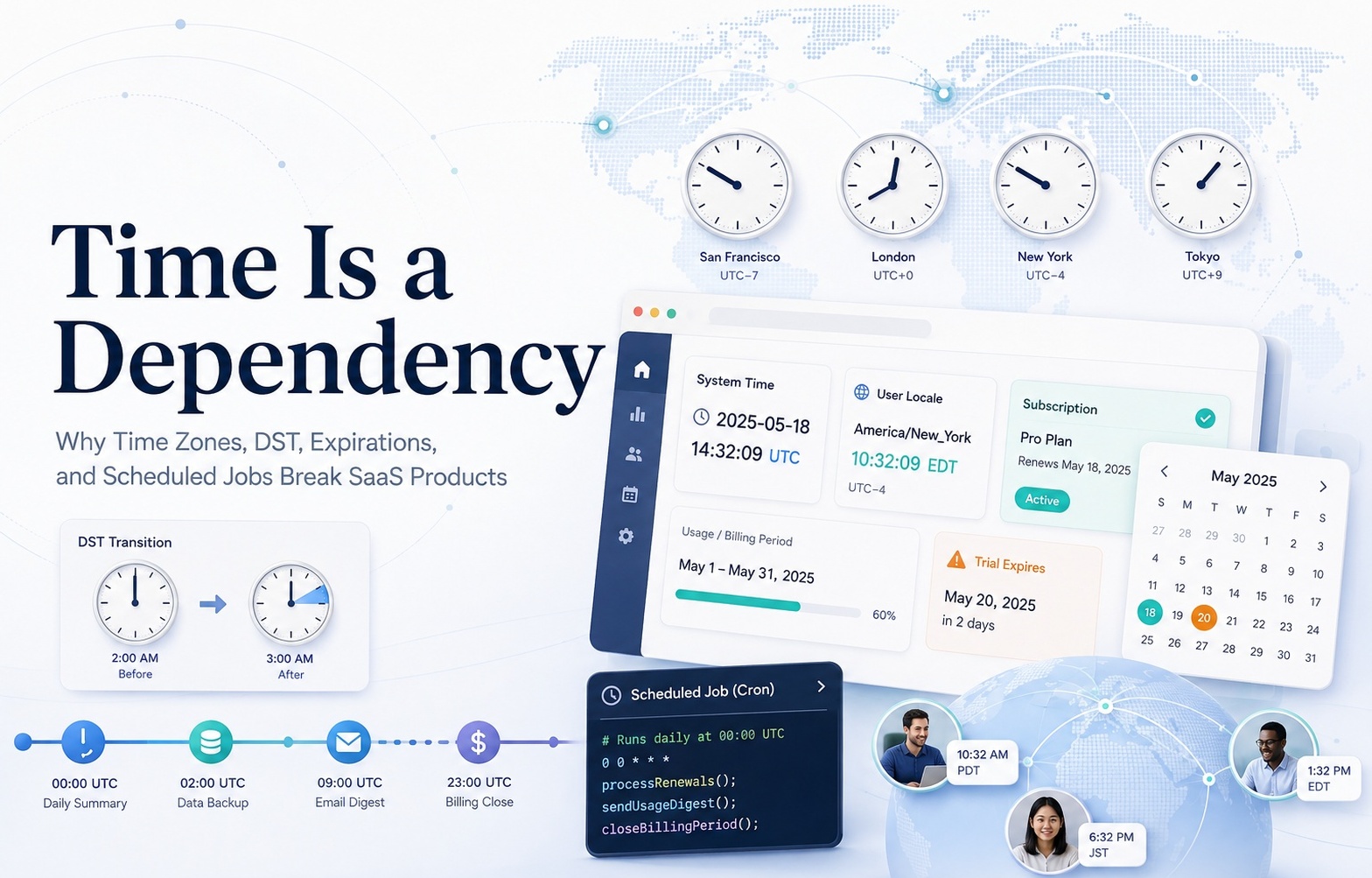
The dependency that never makes it onto the architecture diagram
Draw the architecture of almost any SaaS product and a familiar set of boxes appears. A database. A queue. An identity provider. A payment gateway. Object storage. A cache layer. Arrows connect them, each arrow representing a call that can fail, a contract that can be violated, a version that can drift out of sync with its caller. Engineering teams review these diagrams, argue about them, and build resilience around the boxes they contain.
Time is rarely one of the boxes.
It should be. Every one of those services agrees, implicitly, on what time it is. Every timestamp written to the database, every token expiration checked by the identity provider, every scheduled charge sent to the payment gateway, every object lifecycle rule applied in storage, depends on a shared understanding of "now," of "today," and of "when this period ends." That shared understanding is not guaranteed by the platform. It is assembled, mostly informally, out of system clocks, library defaults, database column types, and a handful of assumptions nobody wrote down.
Compare this to how a team treats its database. Nobody assumes a database "just works" without thinking about consistency, replication lag, or failure modes. Nobody assumes a payment gateway "just works" without idempotency keys and retry logic. Yet a striking number of systems assume that time "just works" — that now() is unambiguous, that a date printed on a screen matches the date the business means, that a job scheduled for a particular hour will run at that hour forever, regardless of where its users live or what the calendar does around it.
This is the wrong mental model, and it fails in a specific and recognizable way. Time doesn't behave like a primitive value. It behaves like an external dependency: something with its own rules, its own versioning, its own failure modes, and its own need for testing and observability. Most of what an engineer calls "a timestamp" is a compressed representation of several different pieces of information, and the compression is lossy. Most of what a product manager calls "a date" hides an unstated timezone, an unstated rounding rule, and an unstated answer to the question of what happens at the boundary.
This article is about that gap — between how software typically models time and what SaaS products actually need from it — and about how engineering and quality teams can close it deliberately rather than discovering it in production.
From "what time is it" to the questions software actually needs answered
Ask a person what time it is and they will give you a single number, understood in context: their own clock, their own timezone, right now. Software rarely gets to ask that simple a question, because software rarely has a single "now" that matters. What it actually needs to answer is a small set of much sharper questions, and conflating them is where a large share of temporal bugs originate.
What instant did this event occur? This is a physical fact, independent of any observer: a single point on the universal timeline, expressible unambiguously in UTC or as a Unix epoch value. A payment was captured. A login occurred. A row was written. These facts do not depend on where anyone was standing when they happened.
What date does this user consider it to be? This is not a physical fact. It's a social one, dependent on the observer's timezone and the calendar rules that govern it. The instant 2026-08-19T23:30:00Z is still August 19 in London and already August 20 in Kyiv. Neither is wrong. They are different, correct answers to a question that only makes sense once you specify whose day you're asking about.
When does this entitlement end? This is a business rule wearing the costume of a timestamp. A trial that "ends in 14 days" could mean 14×24 hours from signup, or it could mean the calendar date fourteen days later at local midnight for the customer, or at midnight in the timezone where the company's billing system runs. Each interpretation produces a different exact instant, and only one of them matches what the product actually promised.
Which billing period owns this transaction? Financial systems partition time into periods — a calendar month, a rolling thirty-day cycle, a billing anniversary — and every transaction must be assigned to exactly one of them. Get the boundary wrong by a few seconds and a charge lands in the wrong invoice, a usage unit gets double-counted or dropped, and reconciliation becomes a support ticket instead of an automatic process.
When should this recurring operation execute next? A cron expression evaluated against a particular clock produces one answer. The same expression evaluated against the intent — "every weekday morning for this customer's working hours" — can produce a different one, especially across a daylight saving transition or a timezone rule change.
These are five distinct engineering questions, each with a distinct correct answer, and each answer can require different data: a raw instant for the first, a timezone-qualified calendar date for the second, a duration-versus-calendar decision for the third, an explicit period boundary for the fourth, a recurrence rule paired with a timezone identifier for the fifth. A codebase that stores one generic timestamp field and expects it to answer all five questions will get some of them right by accident and the rest wrong in ways that surface only under specific, hard-to-reproduce conditions — which is exactly the profile of the bugs this article is concerned with.
None of this requires daylight saving time to be interesting yet. The distinction between "an instant" and "a business definition of when something ends" already accounts for a meaningful share of production incidents attributed, after the fact, to "a time zone bug." The clock transitions make the problem sharper. They do not create it.
One event, several truths
Consider a single value: 2026-08-19T10:00. On its own, this string is not wrong, but it is incomplete, and the ways it can be completed produce meaningfully different systems.
If it is 2026-08-19T10:00:00Z, it names an instant: exactly 10:00 UTC on that date, a single point that every clock on Earth agrees to call by different local names. If it is 2026-08-19T10:00:00+03:00, it also names an instant — the same instant is 07:00Z — but it additionally records the offset in effect for whoever generated it. If it is simply 2026-08-19T10:00:00, with no zone or offset attached, it names nothing precise at all. It is what specifications call a timezone-naive value: a string that looks like a moment in time but is actually a local wall-clock reading detached from the place and rule set that would let anyone convert it to an instant.
This distinction — naive versus aware — is where a large share of temporal defects are seeded, often years before they're discovered. A naive datetime column populated by application servers running in different regions, or migrated from a system that never recorded timezone context, is not simply "missing a field." It is missing the only information that would let a future engineer correctly interpret the data it already contains. You cannot safely infer the original timezone from the value itself, and guessing wrong doesn't throw an error — it silently produces a plausible-looking, incorrect instant, which tends to be worse than a query that fails outright.
It's worth separating several concepts that get flattened into "timestamp" in casual conversation:
An instant is a point on the universal timeline, independent of representation — the same physical moment no matter which clock or calendar describes it.
A local time (sometimes called wall-clock time, or a "plain" or "naive" datetime) is what a clock on a wall would read in a particular place, with no attached information about which place that is or which rules govern it.
A UTC offset is a fixed difference from Coordinated Universal Time at a specific moment — +03:00, -05:00 — sufficient to convert one specific local time to one specific instant, and nothing more.
A timezone identifier — Europe/Kyiv, America/New_York — is not an offset. It's a reference to a named rule set, maintained by a database, that tells you what offset applies at any instant, including future instants, accounting for daylight saving transitions and any legislated changes to the rules themselves. This distinction is important enough that the next section is dedicated to it.
A calendar date is a day on a calendar — 2026-08-19 — with no time-of-day component at all, and, depending on context, potentially no timezone either. A birth date, a public holiday, and a subscription renewal date are often calendar dates by nature, not instants that happen to fall at midnight.
A duration is a fixed length of elapsed time — 90 seconds, 24 hours, 30 days expressed as 720 hours — measured in physical units that do not vary with the calendar.
An interval, in the calendar sense used by many date libraries, is a difference expressed in calendar units — "1 month," "3 days" — whose actual length in elapsed time depends on which specific dates it's applied to. Adding "1 month" to January 31 is a well-defined calendar operation with an ambiguous numeric answer, discussed later in this article, while adding "744 hours" is a well-defined arithmetic operation with an unambiguous but calendar-blind result.
Software that fails to keep these concepts separate tends to fail in a specific way: it works during development and QA, when everyone testing it happens to sit in the same timezone as the servers, and it fails once real users in other regions, or automated processes running near a boundary, exercise the parts of the system where the distinction actually mattered.
The incomplete promise of "just store everything in UTC"
"Store everything in UTC" is common advice, and it solves a real problem: it gives every instant in a system a single, unambiguous, sortable representation, and it removes an entire category of bugs caused by naive local timestamps written by servers in different regions. For any value that represents when something happened — a login, a webhook delivery, a row's creation timestamp — storing the instant in UTC, or as an epoch value, is close to the correct default, and deviating from it usually needs a specific justification.
The advice becomes incomplete, and occasionally actively wrong, the moment a business rule is defined in terms of a local calendar rather than a physical duration. A subscription that renews "at midnight in the customer's timezone" cannot be correctly evaluated by a job that runs once at UTC midnight; a customer nine hours behind UTC would be charged nine hours before their day even ends, and a customer nine hours ahead would be charged well into their new day. A daily report described as "generated according to the account's business day" needs the account's timezone at generation time, not the timezone of whichever region happens to host the reporting service. A promotional price ending "at local midnight" is, by definition, a statement about wall-clock time in a specific place, not a UTC instant that can be computed once, in advance, and forgotten.
Recurring calendar events show the same tension at a smaller scale. A meeting scheduled for "9:00 AM every Tuesday" is, in the mind of the person who created it, an appointment with the wall clock in their own timezone, not a raw duration from the first occurrence. If a system naively stores the first occurrence as a UTC instant and repeats it by adding a fixed number of seconds, the appointment silently shifts by an hour the moment a daylight saving transition occurs between two calculated occurrences — a bug invisible in every test run performed outside the transition window and immediately obvious to every user who experiences it.
The correct model, in each of these cases, is not "avoid UTC." It's "know which kind of fact you are recording." Facts about when a physical event occurred belong in UTC. Facts about what a business rule means to a specific person in a specific place need to preserve enough context — typically a timezone identifier, sometimes an explicit local date or local time — to be recomputed correctly as circumstances, and occasionally the rules themselves, change in the future. Systems that store only a UTC instant for the second category of fact haven't simplified the problem; they've discarded the information required to solve it correctly and replaced it with an implicit assumption nobody wrote down.
An offset is not a timezone
Engineers who have internalized "always use UTC" sometimes take a further, subtler shortcut: recording a customer's local time as a fixed offset from UTC — UTC-5, UTC+3 — rather than a named timezone. It looks equivalent to storing America/New_York or Europe/Kyiv, and for a single instant in the present, the arithmetic comes out the same. The equivalence breaks the moment the value needs to be projected into the future, because an offset is a snapshot and a timezone identifier is a rule.
America/New_York is UTC-5 for part of the year and UTC-4 for the rest, because the United States observes daylight saving time under rules that specify which Sunday in March clocks move forward and which Sunday in November they move back. Europe/Kyiv is UTC+2 or UTC+3 under a similar seasonal pattern, subject to European Union transition rules. A system that stores "this user is at UTC-5" has recorded a true fact about one moment and a false one about most others; it has no way to know, six months later, whether the correct offset for that same user is still -5.
The IANA Time Zone Database — commonly called tzdb or the "Olson database," after its original maintainer — exists precisely to encode this distinction. Rather than storing offsets, it stores named zones such as America/New_York, Europe/London, Europe/Kyiv, Asia/Tokyo, and Australia/Sydney, each backed by a historical and, where legislated, future-dated table of transition rules: when daylight saving starts and ends, when a region has changed which offset it observes, and when a government has abolished or reinstated the practice entirely. Software that stores a timezone identifier rather than an offset can ask, correctly, "what offset applies to this identifier on this future date?" — software that stores only an offset cannot, because the offset was never the fact that mattered. The identifier was.
This is not a theoretical distinction. Timezone rules change because governments change them, and they change with a frequency that surprises engineers who assume the map was finalized decades ago. The tzdb project ships multiple releases most years specifically to capture these changes. In 2026 alone, the database recorded that Alberta, Canada made its spring daylight saving transition permanent and stopped observing the twice-yearly change altogether, adopting a fixed offset going forward; that Morocco and Western Sahara were scheduled to move to a permanent UTC standard time, ending their prior practice of suspending daylight saving during Ramadan; and that the long-standing alias Europe/Kiev was retired in favor of Europe/Kyiv, reflecting the transliteration change adopted after Ukraine's own spelling reform. None of these were bugs in the software that implements timezones. They were legislative and administrative facts that any system claiming to model "what time it is in this region, going forward" needed to absorb.
A system that had encoded any of these regions as a fixed offset rather than a named zone would have continued producing wrong future timestamps indefinitely, with no mechanism for correcting itself short of a manual data patch — because the bug wasn't in the code, it was in a design decision that discarded the one piece of information the code needed. A system that referenced the correct tzdb identifier absorbs the change automatically the next time its underlying tzdb version is updated, precisely because the identifier was always a pointer to a rule set rather than a snapshot of one value from that rule set.
The engineering implication runs through every layer that touches time. Databases that support a genuine timezone type, rather than a bare offset, should be configured to use it for values where the distinction matters, and the application layer should pass identifiers, not offsets, into those columns. APIs that accept a user's timezone as part of an account or profile should accept and store an IANA identifier — not a UTC offset, not a country name, not a city name that isn't also a valid identifier — because only the identifier lets the backend recompute future behavior correctly as rules evolve. Mobile apps and browser clients should read the device's configured timezone identifier through platform APIs rather than deriving an offset from the current instant and treating that offset as if it were durable. Scheduling systems that compute "the next run of this recurring job" need to re-derive the applicable offset at each computation, from the identifier, rather than caching an offset computed once and reused indefinitely. In every one of these cases, the fix is not exotic. It's the discipline of storing the rule rather than one of its outputs.
When a day isn't 24 hours
Daylight saving time is often treated, in engineering conversations, as a minor seasonal inconvenience — something that shifts a display by an hour twice a year and then goes away. This framing understates what actually happens to the local calendar during a transition, and understating it is exactly how DST-related defects survive code review, staging environments, and most manual QA cycles undetected.
A spring-forward transition removes an hour of local wall-clock time from existence. In many regions that observe U.S.-style rules, clocks move from 01:59:59 directly to 03:00:00, and every local time between 02:00:00 and 02:59:59 simply does not occur on that date, in that zone, that year. This is not a display quirk. It is a genuine gap in the local calendar. A system that schedules an operation for "02:30 local time" has, on that specific date, scheduled it for a moment that does not exist. Well-behaved date and time libraries will refuse to construct such a value, throwing an explicit error; poorly-behaved ones will silently normalize it to some nearby valid instant — often 03:30, sometimes 01:30 — and the choice is rarely documented, rarely tested, and rarely what anyone intended.
A fall-back transition does the opposite: it repeats an hour. Clocks move from 01:59:59 back to 01:00:00, and every local time between 01:00:00 and 01:59:59 occurs twice on that date, in that zone, that year, corresponding to two genuinely different instants an hour apart. A value such as "01:30 local time, November 1" is, on a fall-back date, ambiguous by construction — it names two distinct moments, and a naive local timestamp has no way to indicate which one it means, because it discarded the offset information at the point of storage.
These are not edge cases confined to a single calendar date per year, either. Where a recurring operation is scheduled repeatedly against local time — a nightly batch job, a recurring reminder, a weekly report — the transition dates are simply two specific occurrences of that recurrence, no more exotic than any other, and they arrive on a predictable annual schedule that testing can and should target deliberately rather than treat as an unlikely accident.
The interesting engineering question is not "how do we detect a nonexistent or ambiguous local time." Most competent date libraries can detect both conditions if timezone-aware types are used consistently. The interesting question is what the system should do once it detects one, and that answer is a product decision, not a library default, because different reasonable interpretations produce meaningfully different behavior:
A job scheduled for a nonexistent local time could be skipped entirely for that day, treated as if the trigger simply didn't fire — appropriate for something like a discretionary reminder where missing one occurrence is harmless. It could instead run at the next valid local instant, effectively shifting forward by the length of the gap — appropriate where the job must run exactly once per calendar day regardless of clock quirks, such as a daily reconciliation task. Or it could be defined, from the outset, against a fixed UTC instant rather than a local wall-clock time, sidestepping the ambiguity entirely at the cost of the job appearing to run at a different local hour on either side of the transition — appropriate where consistency of elapsed interval matters more than a fixed local appearance, such as a security token rotation.
A job scheduled for an ambiguous, repeated local time faces a parallel set of choices. Should it run at the first occurrence of that wall-clock time, the second, both, or exactly once regardless of which instant is chosen? A billing job that runs twice because a local hour repeated is not a display bug; it is a financial defect, capable of charging a customer twice for the same period. A notification job that runs twice may only be an annoyance. The correct behavior depends entirely on what the operation means, which is precisely why this decision belongs in the requirement, not in whatever a particular scheduler library happens to default to.
[Suggested diagram: a timeline showing a spring-forward transition (a gap where 02:00–02:59 do not occur) and a fall-back transition (an overlap where 01:00–01:59 occurs twice), each annotated with how a naive scheduler versus a DST-aware scheduler would behave.]
None of this is solved by "switching to UTC internally," a recommendation that resurfaces reliably in any discussion of DST bugs. Internal UTC storage is necessary and correct for recording the instant a scheduled run actually executed. It does not answer the scheduling question, which is inherently a question about local wall-clock time whenever the requirement is phrased in local wall-clock terms — "run every morning," "remind the user at 9 AM," "close the books at end of business day." Converting that requirement into UTC prematurely, before deciding how it should behave across a transition, bakes an unstated and untested assumption into the system that will only be discovered on the two days a year it actually matters.
"Every 24 hours" and "every day" are different product requirements
Once nonexistent and ambiguous local times are on the table, a related distinction becomes unavoidable: duration-based scheduling and calendar-based scheduling are different mechanisms, and a requirement that doesn't specify which one it means is not yet a specification at all.
"Run every 24 hours" is a duration-based requirement. It says nothing about the wall-clock time of any particular run; it says that the interval between consecutive runs, measured as elapsed time, should be exactly 86,400 seconds. A job implemented this way will drift, in local-time terms, across a DST transition — a job that first ran at 09:00 local time will run at 08:00 or 10:00 local time the day after a transition, because 24 real hours after 09:00 pre-transition is not 09:00 post-transition. For some operations this drift is not just tolerable but correct: a security credential that must be rotated at a fixed physical interval, a rate-limit window that must reset after a fixed elapsed duration, a cache entry with a genuine time-to-live, are all naturally duration-based, and forcing them into calendar semantics would be the actual bug.
"Run every day at 9:00 AM local time" is a calendar-based requirement. It says the wall-clock appearance of each run should stay fixed, and it deliberately accepts that the elapsed interval between runs will occasionally be 23 or 25 hours instead of 24, to preserve that appearance. A daily usage report, a morning email digest, a reminder tied to a person's typical working hours, are naturally calendar-based: users experience them as "the thing that happens every morning," and a report that quietly arrived at 8 AM one day because of a DST transition would be read as a bug even though the elapsed-time math is perfectly defensible.
Medication reminder applications make the distinction unusually visible, because both interpretations have plausible medical justifications and they diverge sharply during a transition. "Take this medication every 24 hours" is frequently a pharmacological requirement — some medications are dosed by elapsed interval to maintain a steady concentration in the bloodstream, and a reminder that silently became calendar-based would shift the actual dosing interval without anyone deciding that it should. "Take this medication every morning with breakfast" is a calendar-based requirement expressed in the same casual language, and forcing it into strict 24-hour arithmetic would eventually produce a reminder in the middle of the night. The two requirements sound almost identical in a product specification and produce different, defensible, and mutually exclusive scheduling implementations.
The same tension recurs, with lower stakes but equal frequency, in ordinary SaaS operations: billing runs, scheduled data exports, maintenance windows, digest emails, quota resets. None of these should be implemented by an engineer guessing which semantics the product owner intended. The requirement itself needs to say "every 24 hours, as an elapsed duration" or "every day at a specific local time, tolerating 23- or 25-hour intervals around DST transitions," and QA should treat both interpretations as independently testable claims rather than assuming the implementation matches whichever one seems more common. A test suite that only ever runs outside a DST transition window will pass regardless of which semantics were actually implemented, which is precisely why this class of bug so reliably survives to production.
Whose midnight?
"End of day" is one of the most casually used phrases in a product specification and one of the least well-defined. The question it leaves unanswered — end of whose day, measured against whose clock — has several plausible, non-equivalent answers inside a typical SaaS stack: the timezone the application server happens to run in, the timezone the database session defaults to, the timezone configured for a particular account, the timezone of the specific user viewing a report, and the timezone in which the billing system does its own accounting. These do not need to be the same, and in a distributed system built by different teams at different times, they frequently are not.
The failure mode this produces is most visible in analytics and reporting, where daily aggregation is a core operation. If an event pipeline groups events into calendar days using the UTC date of each event's timestamp, and a customer's dashboard is presented as if those groupings represented their own local calendar days, the two will disagree by up to the size of the customer's UTC offset. An event recorded at 2026-08-19T23:30:00-04:00 — 7:30 PM local time for a customer in New York — is 2026-08-20T03:30:00Z in UTC, and a UTC-date aggregation will file it under August 20th, a date that, for that customer, hasn't started yet. The customer sees an activity spike attributed to the wrong day, a "yesterday" total that looks understated, and a "today" total that looks inflated before their actual day has meaningfully begun. None of the underlying data is wrong. The grouping key is measuring a different day than the one the dashboard claims to represent.
The same mismatch propagates into anything built on daily boundaries: usage-based limits that are supposed to reset once per customer day, SLA calculations measured against a customer's business hours, quota systems that cap a resource "per day," and revenue reports that need to match a finance team's own calendar for reconciliation purposes. Each of these has an implicit answer to "whose day," and the implicit answer is not always the one a customer, or a finance team, or a compliance auditor, would choose if asked directly.
There is no universally correct choice here — UTC-based daily boundaries are entirely appropriate for internal engineering metrics, infrastructure dashboards, and anything where consistency across regions matters more than matching any individual observer's calendar. Account-local or user-local boundaries are appropriate wherever the boundary is customer-facing and the customer has a reasonable expectation that "today" means their own today. The engineering mistake is not choosing UTC boundaries; it's choosing them implicitly, by default, in a code path whose output is later presented to a customer as if it reflected their own calendar, without anyone deciding — or documenting — that the two were meant to match.
Expiration is a state transition, not a displayed date
Expiration logic touches an unusually large share of a SaaS product's trust boundary: authentication tokens, refresh tokens, sessions, password reset links, invitations, trial periods, subscriptions, promotional offers, API keys, temporary elevated permissions, signed URLs granting time-limited access to private resources. In every one of these, "expiration" is not primarily a value displayed to a user. It's a state transition that a system enforces at the exact instant a comparison is evaluated, and the correctness of that enforcement depends on details that a UI screenshot will never reveal.
The comparison itself hides a boundary decision that's easy to leave unexamined: is an item still valid when expires_at == now, or has it already expired at that instant? expires_at < now treats the expiration instant itself as still valid, expiring the item only once now has strictly passed it. expires_at <= now treats the expiration instant itself as already expired. Both are defensible, and a system that mixes the two operators across different services — one microservice checking access with a strict inequality, another checking it with a non-strict one — will disagree with itself for a window as narrow as a single clock tick, but real requests do land in narrow windows, and a disagreement at the boundary of a paid entitlement is exactly the kind of defect that turns into a support escalation or a billing dispute.
Boundary conditions widen further once request duration is taken into account. A request that begins its execution while a token is still valid, but that takes long enough to complete that the token's expiration instant passes during processing, raises a genuine design question that "check expiration once, at the start of the request" quietly answers in one particular way — usually the more permissive one — without anyone deciding that permissiveness was the intended behavior. Systems that need stricter guarantees re-validate expiration at the point where an action becomes irreversible, not only at the point where a request was accepted, precisely because those two instants are not the same instant.
Clock disagreement between services compounds the problem in the same way it compounds every other time-sensitive comparison in a distributed system. If the service issuing a token and the service validating it run on clocks that differ by even a few hundred milliseconds — an entirely normal amount of drift in the absence of tightly managed time synchronization — a token can appear valid to one service and expired to the other for a brief window around its nominal boundary. Most systems tolerate this by design, accepting a small clock-skew allowance in token validation logic; systems that don't account for it at all will occasionally reject valid requests or accept invalid ones in a way that is nearly impossible to reproduce outside production, because reproducing it requires reproducing the clock disagreement, not just the token's timestamp.
A related and frequently overlooked failure mode involves caching. Authorization data — a cached permission set, a cached "is this subscription active" flag, a cached feature-flag evaluation — often has its own effective lifetime, set for performance reasons, independent of the lifetime of the underlying entitlement it represents. When a subscription is canceled or a permission is revoked, the source-of-truth record updates immediately, but a cached copy can continue asserting the old, now-incorrect state for as long as its own cache TTL allows. From the perspective of the user experience, the entitlement "expired" the moment the subscription was canceled; from the perspective of the system actually enforcing access, it expired only once the cache entry itself timed out, and the gap between those two instants is a window of incorrect access that a UI check for a subscription_status field will never catch, because the UI is reading the same stale cache.
Testing expiration correctly, then, requires more than confirming that a UI displays the right date. It requires exercising the actual comparison at the actual boundary: requesting access one second before an expiration instant and confirming it succeeds, requesting it one second after and confirming it fails, requesting it at the exact instant and confirming the system's chosen inequality is applied consistently across every service that performs the check, and confirming that cached authorization state cannot outlive the entitlement it's meant to represent by more than an explicitly acceptable margin. This is a boundary-testing discipline, not a display-verification one, and it's covered in more structural detail later in this article.
Thirty days is not a month
Calendar arithmetic looks simple until it is asked to cross a month boundary, and SaaS products ask it to do exactly that constantly, in trial periods, subscription renewals, and promotional windows. "Thirty days," "one month," and "until the same day next month" are three different operations, and they only produce the same result by coincidence, for specific starting dates, in specific months.
Thirty days is a fixed duration. Adding it to any starting instant produces a predictable, unambiguous result: exactly 30×86,400 seconds later, regardless of which months that interval happens to cross. It is trivial to implement correctly and it is also, frequently, not what a business actually intends when it says "one month," because a calendar month is not a fixed duration — it ranges from 28 to 31 days depending on which month and whether the current year is a leap year.
"One month," interpreted as a calendar operation, means advancing to the same day-of-month in the following month, and this is where the arithmetic stops being unambiguous. Adding one calendar month to January 31 has no single correct numeric answer, because February does not have a 31st day, and different libraries and different business rules resolve the conflict differently: some clamp to the last valid day of the target month, producing February 28 (or February 29 in a leap year); others roll the excess days forward into March, producing March 3 or March 2 depending on the year; a smaller number raise an explicit error and require the caller to decide. All three behaviors are internally consistent. None of them is "the" correct behavior in the abstract, and a codebase that relies on whatever a particular date library happens to default to, without the product ever having decided which behavior it wants, has quietly delegated a business decision to a library changelog.
The practical stakes show up clearly in subscription billing. A monthly plan that begins on January 31 and renews "one month later" will, under the clamping interpretation, renew on February 28 — and then face the same question again the following month: does March's renewal fall on the 28th, matching the previous renewal, or does it roll back to the 31st, matching the original anchor date? Both are defensible product decisions with different implications for how many billing cycles a customer experiences across a year, and a system that hasn't chosen one explicitly will tend to drift unpredictably depending on which specific dates happen to be involved, a pattern that is difficult to diagnose from a single customer's ticket because it depends on their particular signup date.
Leap years introduce a narrower but sharper version of the same problem. A subscription anchored to February 29 has an anniversary date that, by construction, does not exist in three years out of four. Whatever rule resolves ambiguous month-end arithmetic for January 31 needs to also resolve this case, and it needs to be tested specifically against it, because February 29 occurs rarely enough that ordinary regression testing will not exercise it by accident — it has to be deliberately included in a temporal test plan, a topic returned to later in this article.
None of this is solved by picking a "better" date library. Every mature date and time library documents its month-arithmetic behavior clearly, and most offer configurable options; the failure is not technical, it's the absence of an explicit product decision that engineering can implement consistently. The fix is a specification that says, in words a product manager and an engineer would both sign off on, exactly what "one month later" means at a month boundary — and a test suite that asserts that meaning specifically at January 31, at February 29 in a leap year, and at the last day of every 30-day month, rather than only at the safely unambiguous 15th.
Billing systems turn time bugs into money bugs
Every category of temporal ambiguity discussed so far becomes materially more consequential once it touches a billing system, because billing is one of the few subsystems in a typical SaaS product where a boundary error doesn't just produce an incorrect number on a screen — it produces an incorrect charge, an incorrect invoice, or an incorrect entitlement, each of which carries a direct financial and trust cost and each of which is disproportionately expensive to correct after the fact compared to preventing it.
Trial-to-paid conversion is the first place ambiguity tends to surface. "Fourteen-day trial" needs an explicit answer to whether the fourteen days are a fixed duration from signup or a calendar-day count in the customer's local timezone, and the two produce different exact expiration instants — sometimes by close to a full day, depending on the customer's offset and the time of day they signed up. A customer who reasonably believes their trial "ends Friday" experiences a materially different product if the system silently expires it at UTC midnight Thursday in their local reckoning, and the resulting support conversation ("you charged me before my trial ended") is difficult to resolve gracefully because, from the customer's perspective, they are simply correct.
Renewal timing raises the same question at recurring intervals rather than once. A subscription renewal that's supposed to occur "on the billing anniversary" inherits every month-arithmetic ambiguity from the previous section, plus a timezone question about which clock defines the anniversary boundary. Grace periods compound this further: a common pattern extends access for a defined window after a failed payment before actually suspending the account, and that grace period needs its own explicit start and end semantics — measured from the failed charge attempt or from the original renewal date, evaluated against which timezone, inclusive or exclusive at each end — because a grace period computed inconsistently between the system enforcing access and the system generating invoices produces exactly the contradiction customers notice fastest: the product says access is active while the invoice says the account is past due, or the reverse.
Proration is where calendar-arithmetic ambiguity and timezone ambiguity combine most visibly. Upgrading or downgrading a plan mid-cycle typically requires calculating a partial-period credit or charge based on the number of days remaining in the current billing period, and "number of days remaining" depends on exactly the boundary questions raised earlier: is the day of the change itself counted, is the period boundary measured in the customer's timezone or the billing system's, and does a mid-cycle change that occurs near a DST transition inherit a 23- or 25-hour day in the calculation without anyone having decided that it should. None of these questions has a universally correct answer; each needs to be decided once, applied consistently, and reflected identically in both the number shown to the customer and the number the payment processor is instructed to charge.
Metered billing — usage-based pricing where a customer is charged based on consumption during a period — depends entirely on assigning every usage event to exactly one billing period, and this is precisely the daily- and monthly-aggregation problem from earlier sections, now with a dollar amount attached. A usage event that lands within a few seconds of a period boundary, evaluated inconsistently by the metering pipeline and the invoicing pipeline, either disappears from both periods or appears in both, and either outcome produces an invoice a customer can point to as demonstrably wrong, not merely debatable.
The deepest source of billing-related temporal defects, though, is architectural rather than purely definitional: many SaaS products compose several systems that each maintain their own opinion about time — a product backend tracking entitlement state, a dedicated billing or subscription-management service, an external payment processor, an analytics pipeline computing usage, and a customer-facing UI rendering all of it — and these systems are frequently built by different teams, sometimes acquired through different vendors entirely, with no shared, enforced definition of period boundaries, timezone handling, or rounding rules between them. The failure this produces is not any single wrong calculation. It's disagreement: the application says a subscription is active while the billing system has already marked it expired; usage recorded by the product is attributed to a different period than the same usage recorded by the invoicing system; a refund calculated against one system's period boundary doesn't match a proration calculated against another's. Reconciling these disagreements after the fact is expensive, manual, and erodes exactly the kind of customer trust that a billing system exists to protect — which is why the boundary definitions belong in a shared, explicit contract between systems rather than in each system's independently chosen defaults, and why temporal boundary tests belong specifically in the integration surface between billing, product, and payment systems, not only within each system in isolation.
Scheduled jobs are where time assumptions become automated
Everything discussed so far describes a moment where a human or a request briefly touches an ambiguous temporal boundary. Scheduled jobs remove the human from that interaction entirely and repeat it, unattended, on a fixed cadence, which means any unexamined assumption about time embedded in a scheduler configuration is not tested once — it's executed, silently, every day, until something downstream notices the result is wrong.
The first assumption worth interrogating is which timezone actually governs a scheduled job's trigger time. Traditional cron, container schedulers, managed cloud scheduling services, and serverless scheduled functions each have their own default — commonly UTC, but sometimes the host system's local timezone, sometimes an explicitly configurable identifier — and a team that doesn't confirm which default applies to a given platform is trusting an assumption it never actually verified. A job intended to "run at 9 AM Eastern" that's configured against a scheduler defaulting silently to UTC will run at 9 AM UTC — 4 or 5 AM Eastern, depending on the season — and will keep doing so until a customer or an on-call engineer notices the output arriving at the wrong local hour. Kubernetes CronJobs, for a widely used concrete example, historically evaluate their schedule expressions against the timezone of the kube-controller-manager process rather than any per-job configuration, and while newer Kubernetes versions have added an explicit per-job timezone field, teams running on the platform still need to confirm which behavior their specific cluster version actually implements rather than assuming a particular default.
The reliability questions layered on top of timezone correctness are, if anything, more consequential, because they determine what happens when execution doesn't go exactly as planned — and at scale, it never goes exactly as planned indefinitely. A job can be missed entirely if the scheduler itself was unavailable at the trigger instant. A job can execute more than once if a retry mechanism fires without confirming the original attempt actually failed, or if a scheduler and a worker disagree about whether a run already started. A job can be delayed well past its intended trigger time under load, and by the time it does execute, the boundary condition it was meant to evaluate — end of a billing day, expiration of a batch of trials — may have already shifted forward. A job's own recovery logic can compound the problem further: a naive "catch-up" mechanism that reruns every missed interval after an outage can generate a burst of duplicate side effects — duplicate emails, duplicate charges, duplicate report generations — precisely at the moment the system is already recovering from a failure and least equipped to absorb an unexpected surge.
None of these failure modes are really about cron syntax, and treating them as syntax problems is a common category error. They are reliability properties that the operation being scheduled needs to be designed to withstand, independent of which specific scheduler triggers it. Two properties matter more than any other for scheduled operations in a distributed SaaS system. The first is idempotency: an operation that runs twice for the same intended trigger — the same billing period, the same report date, the same reminder window — should produce the same observable outcome as running it once, typically by having the operation check, at execution time, whether its intended effect has already been recorded, rather than trusting the scheduler to guarantee exactly-once delivery, a guarantee almost no distributed scheduler actually provides without deliberate additional engineering. The second is observability at the level of intended executions rather than merely process starts: a monitoring system needs to be able to answer "did the 9 AM Tuesday run for this account actually complete, and did it complete exactly once," not merely "did the scheduler process start," because the two questions diverge exactly in the failure scenarios that matter — a process that starts and crashes mid-execution, a process that starts twice due to a scheduler race condition, a process that never starts because an upstream dependency was unavailable at trigger time.
Retry-safety follows from the same discipline. A scheduled operation that's safe to retry blindly, because it's naturally idempotent, can be retried aggressively without introducing new risk; a scheduled operation that has side effects that aren't naturally idempotent — sending an email, charging a card, incrementing a counter — needs an explicit deduplication mechanism, typically a persisted record of "this specific trigger, for this specific account, has already been fulfilled," checked before the side effect executes rather than after. Building this discipline into the operation itself, rather than trusting the scheduler's delivery guarantees, is what actually protects a SaaS product from the compounding failure mode where a scheduling hiccup — itself often caused by exactly the kind of timezone or DST-transition ambiguity discussed earlier in this article — turns into a customer-visible incident involving duplicate charges or duplicate notifications.
No two clocks fully agree
A distributed SaaS system — an application tier, a database, a queue, a handful of background workers, a browser, and one or more external providers — does not share a single clock. It shares several clocks, running on different machines, each synchronized independently against a time source, typically via the Network Time Protocol, and each carrying its own small, constantly fluctuating amount of drift relative to true UTC and relative to every other clock in the system. NTP synchronization keeps this drift small under normal conditions, generally within milliseconds on well-configured infrastructure, but "small" is not "zero," and a system that implicitly assumes every timestamp it compares originated from clocks in perfect agreement is making an assumption that is approximately true almost all the time and precisely false at the boundaries that matter most — the same expiration checks, billing-period assignments, and deduplication windows discussed throughout this article.
The consequence engineers encounter most often is that timestamps recorded by different services cannot be trusted as a perfectly reliable global ordering of events. If service A records an event at T and service B, milliseconds later in real time, records a causally dependent event at a timestamp that happens to be numerically earlier than T — because B's clock is running fractionally behind A's — any logic that sorts events purely by their recorded timestamp will order them incorrectly, and the error will be intermittent, small in magnitude, and extremely difficult to reproduce on demand, because it depends on the transient state of NTP synchronization at the exact moment each event was recorded. Systems that need a guaranteed causal ordering across services generally can't rely on wall-clock timestamps alone to provide it; they need an explicit ordering mechanism — a monotonically increasing sequence number, a logical clock, or a coordination layer that establishes ordering independent of wall-clock agreement — precisely because wall-clock timestamps were never designed to serve as a distributed ordering primitive, only as a record of approximately when something happened.
A closely related but conceptually distinct issue is the difference between wall-clock time and monotonic time, and conflating the two is a common source of a specific, nasty class of bug: elapsed-time calculations that briefly go negative or wildly wrong. Wall-clock time answers "what instant is it right now, in a form comparable across the whole system" — exactly the value needed for timestamps, expiration comparisons, and scheduling. It is also a value that can jump: an NTP correction, a manual clock adjustment, a virtual machine resuming from a suspended state, or a leap-second adjustment can all cause the wall clock to move backward or forward by more than the actual elapsed time that passed. Monotonic time answers a narrower but more reliable question — "how much time has elapsed since some reference point on this machine" — and it is guaranteed, by construction, never to move backward, making it the correct primitive for measuring durations: request latency, timeout countdowns, rate-limiter windows, retry backoff calculations. Code that measures elapsed time by subtracting two wall-clock readings is vulnerable to exactly the failure mode monotonic clocks exist to prevent — an underlying clock correction between the two readings can produce a negative duration, an unexpectedly enormous duration, or a timeout that fires early or never fires at all, none of which are reproducible through ordinary testing because they depend on a clock adjustment happening to occur during the measured interval.
The practical guidance that follows from both issues is narrower than "be careful with timestamps" and more specific: use wall-clock, timezone-aware instants for anything that represents when something happened or when something should happen, because those are inherently statements about a shared point on the calendar; use monotonic clocks for anything that measures how long something took or how much time remains before a purely internal deadline, because those are statements about elapsed duration on a single machine, unaffected by what the wall clock says. Most modern language runtimes expose both explicitly — a wall-clock "now" and a separate monotonic timer — and the discipline is simply choosing the correct one for each specific measurement rather than defaulting to whichever function happens to be more familiar or more convenient to call.
What databases think time means
Relational databases model time with more precision than most application code takes advantage of, and understanding what a column type actually guarantees — as opposed to what its name suggests — prevents a specific, common category of defect: data that looks correct in every row until it's queried from a session configured with a different assumed timezone than the one that wrote it.
PostgreSQL, a widely used concrete example, offers both a timestamp with time zone type and a timestamp without time zone type, and the naming is somewhat misleading in the same way "timezone-aware" and "naive" are misleading in application code: timestamp with time zone does not actually store a timezone identifier alongside the value. It stores the instant, normalized internally to UTC, and converts it to and from the session's configured timezone setting on input and output — which means the same stored value can display differently to two clients with different session timezone settings, and that behavior is correct and intentional, not a bug, as long as every caller understands that the type represents an instant rather than a wall-clock reading tied to a specific place. timestamp without time zone stores exactly the local values it's given — no conversion, no normalization, no timezone attached — which makes it the correct type for genuine calendar-local facts, such as a recurring event's nominal wall-clock time before it's resolved against any specific timezone, and the incorrect type for anything meant to represent a comparable, orderable instant across a system with users or servers in more than one timezone. A date type, distinct from either, stores a calendar day with no time-of-day component at all, and is the correct choice for values that are conceptually calendar dates — a birth date, a subscription renewal date defined in calendar terms — rather than instants that merely happen to fall at midnight of some particular timezone's day.
The failure this taxonomy prevents is subtle and easy to introduce without noticing: writing a naive local time into a timestamp without time zone column from application servers that run in more than one region, or that have their session timezone configured inconsistently, produces a column full of values that look uniform — a column of plausible-looking datetimes — but that actually represent different physical instants depending on which server, timezone, or session wrote each row. There is no query that can recover the original intended instant from such a column after the fact, because the information required to do so — which timezone applied when each specific row was written — was never captured. This is, structurally, the same naive-timestamp problem introduced earlier in this article, now expressed as a schema design decision rather than an application-code one, and it is considerably more expensive to fix once years of production data have accumulated in the ambiguous form.
Column naming is a second, quieter source of confusion, because a data type alone doesn't communicate the semantic category a value belongs to, and teams frequently store several conceptually different kinds of temporal fact using the identical underlying type. created_at and starts_at typically represent instants — facts about when something happened or will happen, appropriately stored as timestamp with time zone. billing_date, by contrast, is often better modeled as a calendar date paired with an explicit timezone reference, because "the billing date" is a business concept anchored to a specific place's calendar, not merely an instant that happens to fall at a particular moment. local_start_time for a recurring event is frequently better modeled as a wall-clock time value plus a timezone identifier, stored and resolved separately, precisely because the correct future instant it corresponds to needs to be recomputed against the timezone's current rules rather than frozen as of whenever the row was created — the exact scenario, described earlier, in which storing only a resolved offset silently produces the wrong result once the rules change. Using the same generic timestamp type for all of these because "it's all just a date" discards the semantic distinction the schema was supposed to encode, and the loss isn't visible until a migration, a report, or a rule change needs to recover a distinction the schema never captured.
This is also why changing a database's temporal model after years of production data is materially harder than getting it right initially. A migration that reinterprets an ambiguous naive-timestamp column as UTC, or as a specific fixed offset, is not a neutral technical operation — it's a claim about the historical meaning of every row in that column, and if the original data was ever written inconsistently, across regions or across a period when the application's own timezone handling changed, that claim will be wrong for some subset of historical rows in a way that's essentially undetectable after the fact. Teams facing this situation are better served treating it as a data-provenance investigation — identifying which code paths wrote which rows, under which configuration, during which periods — than as a straightforward reformatting task, a topic returned to later in the discussion of legacy systems.
APIs destroy time information before the database ever sees it
A well-designed database schema can still be fed corrupted temporal semantics if the API layer sitting in front of it fails to preserve the distinctions the schema depends on — and API contracts are, in practice, one of the most common places those distinctions get silently discarded, because request and response bodies are typically serialized as strings, and a string representation of a temporal value can look complete while omitting exactly the context that made it unambiguous.
RFC 3339 and ISO 8601 are the two standards most commonly invoked for representing dates and times as text, and while RFC 3339 is best understood as a stricter, internet-oriented profile of the broader ISO 8601 standard rather than a wholly separate format, the practical API-design guidance is the same regardless of which is cited: an API contract needs to specify, explicitly, which of several superficially similar string shapes it expects, because each shape encodes a different amount of information. 2026-08-19 is a calendar date with no time component and no timezone — correct for a birth date, a holiday, or a billing anchor date, and actively wrong for anything that needs to represent a specific instant. 2026-08-19T10:30:00 is a naive local datetime, timezone-unspecified — the same ambiguity problem discussed throughout this article, now embedded directly in an API payload. 2026-08-19T10:30:00Z is an unambiguous instant expressed in UTC, the "Z" suffix denoting a zero UTC offset. 2026-08-19T10:30:00+03:00 is also an unambiguous instant, expressed with an explicit non-zero offset rather than being pre-converted to UTC. An API that accepts or returns any of these interchangeably, without a documented and enforced contract for which shape is expected in which field, is delegating the interpretation of that ambiguity to whichever client or server happens to parse the value first — and different clients, in different languages, with different default parsing behavior, will not necessarily resolve the ambiguity the same way.
The date-versus-instant distinction deserves particular emphasis because the most common way it goes wrong is procedural rather than conceptual: an engineer who understands the difference perfectly well still writes code that takes a genuine calendar date — a birth date, a deadline, a billing anchor day — and, somewhere in a serialization or transformation step, converts it to a UTC instant at midnight, because the underlying date library or ORM defaults to representing all temporal values as instants internally. The conversion silently attaches a timezone assumption, typically UTC, to a value that was never supposed to have one, and the classic, immediately visible symptom is a date that displays as one calendar day earlier or later once it's rendered back to a user in a different timezone than the one implicitly assumed during the conversion: a birth date entered as "August 19" reappearing as "August 18" for a user west of UTC, because midnight UTC on August 19 is still August 18 in their local timezone. The fix is not a timezone-conversion fix. It's recognizing, upstream, that the value was never an instant, storing and transmitting it as a bare calendar date throughout the entire pipeline, and never allowing any layer to force a timezone assumption onto a value that doesn't carry one by nature.
API validation should treat these distinctions as first-class contract requirements rather than incidental formatting details: reject a payload that supplies a naive datetime where the contract requires an unambiguous instant, rather than silently guessing a timezone; reject an instant where the contract expects a calendar date, rather than silently truncating it and discarding whatever timezone context it happened to carry; and document, for every temporal field in a public or internal API, not just its format but its semantic category — is this an instant, a calendar date, a local wall-clock time paired with a timezone identifier, a duration — because the format alone, as the examples above demonstrate, is not sufficient to communicate that.
The frontend does more than format
It's tempting to treat client-side time handling as a purely cosmetic concern — formatting an instant for display, choosing 12-hour or 24-hour notation, deciding whether a week starts on Sunday or Monday — and delegate the underlying correctness entirely to the backend. The temptation is understandable and the conclusion is wrong, because browsers and mobile clients are not merely formatting engines. They are independent sources of temporal input: a device's configured timezone, a locale's calendar conventions, and a date picker's parsed output all originate on the client, get transmitted to the backend as data, and can silently encode a different interpretation of "when" than the one the backend assumes it's receiving.
JavaScript's built-in Date object has been a long-standing source of exactly this kind of silent disagreement. It represents a single instant internally, always displays in the browser's local timezone by default, has no native concept of a separate, explicit timezone identifier distinct from "whatever this device is currently configured to," and its parsing behavior for date-only strings has historically differed from its parsing behavior for full datetime strings in ways that have surprised experienced engineers — a bare date string like "2026-08-19" has traditionally been parsed as UTC midnight, while a full datetime string without an explicit offset has traditionally been parsed as local time, meaning two superficially similar inputs silently produce different underlying instants depending on which format the string happened to take.
This is precisely the gap the Temporal API, standardized within JavaScript's ECMAScript 2026 specification after reaching TC39 Stage 4 in March 2026, was designed to close. Temporal introduces separate, explicit types for the distinctions this article has emphasized throughout — an Instant for an unambiguous point on the timeline, a PlainDate for a calendar date with no time or zone attached, a PlainTime for a wall-clock time with no date or zone attached, a ZonedDateTime that pairs a wall-clock reading with an explicit IANA timezone identifier, and a Duration type distinct from calendar-based interval arithmetic — along with immutable objects that eliminate an entire class of bugs caused by code silently mutating a shared Date instance. As of mid-2026, Temporal ships natively and unflagged in current versions of Firefox and Chromium-based browsers including Chrome and Edge, and in current Node.js releases; Safari's support remains partial, available in Technology Preview builds rather than shipped stable releases, which means teams building for a broad, unpredictable range of client browsers still need either a polyfill or careful feature detection rather than assuming native availability everywhere. The relevant engineering takeaway is not "adopt Temporal immediately everywhere" — for any team still supporting older browser versions, that isn't yet realistic — but "model these distinctions explicitly regardless of which library enforces them," because the underlying conceptual separation between an instant, a calendar date, and a zoned wall-clock reading was correct before Temporal existed and remains correct for teams using a mature third-party date library instead.
Beyond the choice of date library, frontend and backend can disagree about a value's meaning in ways formatting alone won't reveal. A date picker component that returns a JavaScript Date object set to local midnight for the selected day, subsequently serialized to an ISO string and sent to the backend, transmits a value that looks like an instant but was only ever meant to represent a calendar date — and a backend that stores and later compares it as a genuine instant, rather than recognizing it as a calendar date wrapped in an instant's clothing, will exhibit exactly the off-by-one-day symptom described in the API section above the moment a user's timezone differs from whatever the picker's implicit assumption happened to be. Locale and timezone are also genuinely separate concerns that interact rather than one containing the other: a user's locale governs how a date is formatted — the ordering of day, month, and year, the choice between a 12-hour and 24-hour clock, which day a calendar week is considered to start on — while their timezone governs which instant a given wall-clock reading actually corresponds to; a user can have a French-formatted date display while operating in a U.S. timezone, or vice versa, and conflating the two settings, treating locale as if it implied a specific timezone, is a subtler and more product-specific mistake than the raw parsing bugs discussed above, but one that surfaces just as reliably once a product has users whose locale and physical location don't happen to match.
Mobile clients raise the same category of question in a different form: whether an app should use the device's configured timezone, an explicit timezone the user has selected within the app itself, or the timezone associated with their account on the backend, and whether those three should always agree — a traveling user, for instance, may reasonably want scheduled reminders to continue firing according to their home timezone rather than silently shifting every time their device's system timezone updates based on physical location. None of these questions has a universal answer. All of them need to be decided explicitly, as product requirements, rather than left to whatever a particular client platform's default happens to do.
Recurring events are harder than single timestamps
A single scheduled operation needs to resolve one instant correctly. A recurring one needs to resolve an unbounded sequence of future instants correctly, against timezone rules that may themselves change before every occurrence in that sequence has happened — which is why recurring events deserve treatment as a materially harder problem than a collection of independent single timestamps, not a simple repetition of the same logic.
"Every Tuesday at 10:00," "the first business day of each month," "the last day of the month," "every 90 days," "every weekday at 08:30," "the second Monday of every month" are all common recurrence patterns in SaaS products — meeting scheduling, recurring reports, subscription billing cycles, recurring reminders, recurring data exports — and each one names a rule, not a list of instants. The critical architectural decision is whether a system stores that rule, evaluated fresh each time the next occurrence is needed, or instead pre-computes and stores a fixed sequence of specific instants derived from the rule at creation time. The two approaches diverge the moment anything about the underlying timezone context changes between the rule's creation and one of its future occurrences.
Storing only "the next timestamp," computed once by adding a fixed duration to the previous occurrence, is the same drift-prone shortcut discussed in the DST section earlier, now expressed as a persistence strategy rather than a scheduling one: a "every Tuesday at 10:00 local time" event whose next occurrence is computed by adding exactly 7×86,400 seconds to the previous stored instant will silently shift to 9:00 or 11:00 local time the first time a DST transition falls between two computed occurrences, because the fixed-duration addition has no awareness that the wall-clock target was supposed to stay fixed while the elapsed interval flexed. Storing the recurrence rule together with the governing timezone identifier, and recomputing the next occurrence from that rule fresh each time it's needed — rather than from the previous occurrence's raw instant — avoids the drift entirely, because each occurrence is derived independently from the stated intent ("10:00, in this timezone, on this weekday") rather than incrementally from an already-resolved prior instant.
This distinction compounds further for events far enough in the future that the governing timezone's own rules might change before the occurrence arrives — a concern covered in more detail in the next section, but worth flagging here specifically because recurring events are exactly the artifact most exposed to it: a recurring reminder set to continue for years will, at some point, likely span a legislative change to the DST rules of at least one relevant jurisdiction, and a system that resolved every future occurrence to a fixed UTC instant at creation time has no mechanism for correcting itself when that happens, while a system that stored the rule and the timezone identifier, and resolved occurrences on demand, absorbs the correction automatically the next time its underlying timezone database is updated.
Calendar applications, meeting schedulers, recurring exports, and subscription billing cycles all face a version of this same architectural choice, and the practical guidance is consistent across all of them: treat a recurrence as a rule plus a timezone context, evaluated lazily and close to the point of use, rather than as a pre-flattened list of instants computed once and trusted indefinitely. The upfront cost is a small amount of additional computation at read time. The alternative cost, paid later, is a slow, silent drift that a customer eventually notices and reports as "my reminders keep arriving at the wrong time," with no obvious single root cause because the drift only manifests around specific transition dates that may be months apart from when the recurrence was originally configured.
Timezone rules change
A quieter operational risk sits underneath everything discussed so far: the rules a timezone identifier encodes are not fixed. They are periodically revised, by the IANA Time Zone Database maintainers, in direct response to legislative and administrative decisions made by governments — and a long-lived SaaS system needs a plan for consuming those revisions, because the alternative is running against an increasingly outdated picture of what a given identifier actually means for future dates.
The tzdb project ships new releases whenever a jurisdiction changes how it observes time, and the pace of change is higher than intuition suggests. Several releases in 2026 alone illustrate the range of changes a production system needs to absorb: Alberta, Canada made its March 2026 spring-forward transition its last, moving permanently to a fixed standard-time offset rather than continuing the twice-yearly change, with the tzdb maintainers noting that neighboring Northwest Territories was expected to follow a similar path once its own legislative process concluded. Morocco and Western Sahara were recorded as moving to a permanent UTC standard time in September 2026, discontinuing their prior practice of suspending daylight saving observance during Ramadan. And the long-used alias Europe/Kiev was retired in the tzdb in favor of Europe/Kyiv, reflecting Ukraine's own transliteration reform — a change that primarily affects identifier naming rather than offset arithmetic, but one that still requires any system with a hardcoded reference to the old identifier to be updated to avoid depending on a deprecated alias.
None of these were software defects. They were real-world decisions, made by legislatures and administrative bodies, that the tzdb exists specifically to track and that every downstream consumer of tzdb data — operating systems, container base images, language runtimes, database engines, mobile device firmware — needs to periodically absorb through an update. This is where the operational risk lives: two components in the same distributed system, if they happen to bundle different tzdb versions, can compute genuinely different future instants from the identical timezone identifier and the identical recurrence rule, for any date affected by a rule change one component has absorbed and the other hasn't yet. A backend service running a container image with a stale tzdb bundled at build time, alongside a managed database service that receives tzdb updates automatically and promptly, can silently diverge on exactly the kind of future-dated recurring billing or scheduling calculation discussed throughout this article — and the divergence is essentially invisible until it produces a customer-visible discrepancy on the specific date the rule change actually takes effect.
The practical response is not exotic, but it does require treating the timezone database as a genuine, versioned dependency rather than an invisible part of the platform. Operating system and container base image updates typically include tzdb updates, which is one argument, among several, for keeping base images current rather than pinning them indefinitely. Language runtimes vary in how they source timezone data — some bundle their own copy, refreshed only on a language version upgrade, while others read from the operating system's copy at runtime — and knowing which model a given production stack uses determines whether an OS-level update alone is sufficient or whether a runtime or dependency upgrade is separately required. Database engines and managed cloud services generally publish their own update cadence for the timezone data they use internally, and teams operating close to the boundary of a known upcoming rule change — a government's already-announced but not-yet-effective transition, of the kind the tzdb release notes routinely capture months in advance — have a legitimate reason to verify, deliberately, that every component touching the affected identifier has absorbed the update before the change actually takes effect, rather than discovering the gap on the day itself.
Testing time requires owning the clock
Every failure mode described so far shares a common testing obstacle: the conditions that trigger it — a DST transition, a token expiration boundary, a monthly renewal, a leap year — occur naturally on a schedule measured in months or years, and a test suite that waits for real time to pass in order to exercise them is not a test suite. It's an incident report with a very long lead time.
The prerequisite for testing any of this deliberately is a system whose notion of "now" can be controlled by the test rather than sourced, unavoidably, from the actual system clock. This sounds like a small architectural requirement and turns out to be a surprisingly consequential one, because it's violated by exactly the pattern that feels most natural to write: calling the platform's current-time function — new Date(), datetime.now(), time.Now(), or their equivalents — directly, inline, scattered throughout business logic, wherever a piece of code happens to need to know the current instant. Code written this way has no seam a test can use to substitute a different "now." Testing an expiration check written this way for the exact boundary instant requires either waiting for that instant to actually arrive, or manipulating the entire operating system's clock for the duration of the test — both impractical, and the latter actively dangerous in any environment shared with other processes.
The standard remedy is a Clock abstraction, or an equivalent explicit dependency: a small interface — often nothing more than a single function or object with a "current instant" method — that production code depends on for every time-sensitive operation, injected at construction or call time rather than invoked as a bare global function. In production, the injected implementation simply returns the real system time. In a test, it's replaced with a controllable implementation — a fixed instant, an instant that advances on command, or an instant that can be set to any arbitrary point, including a DST transition boundary, a leap day, or a moment a millisecond before a token's expiration. The abstraction itself is deliberately unremarkable; its value lies entirely in making time an explicit, substitutable dependency rather than an implicit global one, which is precisely the reframing this article has argued for from its opening section onward.
This discipline needs to operate at every level of the test pyramid, not only in unit tests, because each level catches a different class of temporal defect. Unit tests, with a fully controlled fake clock, are the right place to verify boundary logic in isolation — the exact expiration comparison, the exact DST-transition scheduling decision, the exact month-arithmetic rule — cheaply and deterministically, without any dependency on real elapsed time. Integration tests, where a fake or controllable clock is threaded through multiple real components working together — an application service, a real database, a real cache — verify that the boundary logic holds up once actual persistence and actual serialization are involved, catching the class of defect where a value is handled correctly in memory but loses its timezone context the moment it's written to or read from a datastore. API-level and end-to-end tests, run against a test environment whose clock can be advanced or set independently of the environment's actual wall-clock time, verify that the boundary behavior holds across full request/response cycles, including whatever client-side date handling sits in front of the backend logic. Production validation, distinct from all of the above, cannot rely on a fake clock at all — it depends instead on deliberately exercising real boundaries as they naturally occur and confirming, through monitoring and reconciliation, that the system behaved as specified when a genuine DST transition, month-end, or expiration boundary actually passed, closing the loop on assumptions that pre-production testing can approximate but never fully replace.
A temporal boundary test matrix
Boundary testing is the discipline this entire discussion has been building toward, and it deserves an explicit, structured framework rather than an ad hoc list of "things to remember to check," because the value of the framework is precisely that it can be applied consistently across features, reviewed in a test plan, and audited for coverage gaps the way any other structured test design can be.
A useful way to organize temporal boundary tests is to separate mechanical boundaries — properties of the calendar and clock themselves, independent of any specific business rule — from business boundaries, which are specific instants a particular feature has defined as meaningful. Both categories need coverage, and they interact: a business boundary that happens to fall near a mechanical one is exactly where the highest-value, least-often-tested defects live.
Mechanical boundaries worth testing systematically include: the instant immediately before and immediately after a token, session, or entitlement's expiration, along with the exact expiration instant itself, to confirm the chosen inequality (strict or non-strict) is applied consistently; a UTC calendar-date boundary, to confirm date-grouping logic behaves correctly for events recorded in the last and first few seconds of a UTC day; an account- or user-local calendar-date boundary, tested independently of the UTC one, for exactly the reason the "whose midnight" section above described; the last day of a short month (28-day February, 30-day months) and the transition into the following month, to exercise month-arithmetic rules; February 29 specifically, in a year confirmed to actually be a leap year, along with the anniversary of that date one year later in a non-leap year; the last day of a calendar year and the transition into the next, for any logic that resets or aggregates on an annual boundary; the exact instant of a DST spring-forward transition, including a deliberately constructed nonexistent local time within the gap; the exact instant of a DST fall-back transition, including a deliberately constructed local time that falls within the ambiguous, repeated hour; a timezone that observes no daylight saving time at all, to confirm logic doesn't implicitly assume every timezone has a transition; and both a large positive and a large negative UTC offset, to surface any logic that implicitly assumes a small, North American- or European-scale offset.
Business boundaries worth testing systematically, for a typical SaaS product, include: the exact instant of subscription renewal, tested from both the perspective of the entitlement being extended correctly and the perspective of the charge being assigned to the correct billing period; the exact instant of trial expiration, tested for both premature loss of access before the promised expiration and unintended continued access after it; an invoice cutoff boundary, tested for usage events recorded within seconds of the cutoff on either side; a quota or usage-limit reset boundary, tested for both a request arriving just before the reset that should still count against the old period and one arriving just after that should count against the new one; a scheduled report's generation boundary, tested for whether data from the boundary instant itself is included or excluded consistently with the report's stated coverage; an invitation or password-reset link's expiration boundary, tested with the same before/at/after rigor as authentication tokens generally; and a promotion or discount's start and end boundaries, tested for whether a purchase initiated before the boundary but completed after it receives the promotional price or not, consistently with whatever the business intends.
[Suggested diagram: a matrix with mechanical boundaries as rows and business boundaries as columns, marking cells where the two intersect — for example, "subscription renewal" crossed with "DST fall-back transition" — as the highest-priority combinations for dedicated test cases.]
The framework's real value is not the individual test cases, most of which an experienced QA engineer would eventually think to write. It's the discipline of treating this as a matrix to be deliberately populated for each new feature that touches time, rather than trusting that ordinary functional testing — which overwhelmingly exercises the comfortable middle of a value range rather than its edges — will happen to cover these instants by accident. It rarely does, which is precisely why temporal defects have a track record of surviving all the way to production.
Testing the edges: representative timezones, and the nonexistent and the ambiguous
The IANA database currently lists several hundred timezone identifiers, and running an entire regression suite against every one of them is neither practical nor useful — most of them differ from each other only in offset and DST rule, and testing against all of them adds execution time without adding meaningfully different coverage. A risk-based, representative selection of timezones covers the space of genuinely distinct behaviors far more efficiently, and choosing that set deliberately is itself a piece of test design worth documenting rather than reinventing informally for each feature.
A representative set should include, at minimum: UTC itself, as the baseline with no offset and no DST; a North American DST-observing timezone such as America/New_York, exercising the U.S.-style spring-forward and fall-back pattern; a European DST-observing timezone such as Europe/Berlin or Europe/Kyiv, exercising the EU's own transition dates, which don't always coincide with the U.S. dates in a given year; a timezone that observes no daylight saving time at all, such as most of Asia, to confirm logic doesn't implicitly assume every zone has a transition to handle; a timezone with a non-hour-aligned offset, such as Asia/Kolkata at UTC+5:30, to surface any code that implicitly assumes offsets are always whole hours; a timezone with an unusual 45-minute offset, such as Asia/Kathmandu at UTC+5:45 or Pacific/Chatham at a 45-minute-aligned offset, to surface the same class of assumption at an even less common granularity; and both a large positive offset, such as Pacific/Auckland or Pacific/Kiritimati, and a large negative one, such as Pacific/Midway or America/Adak, to exercise date-boundary logic where a single UTC instant can fall on entirely different calendar dates depending on which side of the International Date Line the observer sits.
Unusual offsets deserve specific emphasis because they're disproportionately effective at catching a category of bug that whole-hour-offset testing systematically misses: any code path that formats, rounds, or truncates a timezone offset assuming it divides evenly into hours will produce a subtly wrong result for a 30- or 45-minute-offset zone without raising any error at all, simply displaying or calculating with a value that's a fraction of an hour off — exactly the kind of defect that's cheap to catch with one deliberately chosen test case and expensive to diagnose from a scattered set of user reports once it's already shipped.
Testing the nonexistent and the ambiguous requires constructing specific, deliberate local times rather than waiting for a transition date to occur naturally in a test's execution window. For a spring-forward case, a test should attempt to construct or schedule something for a local time known, from the relevant timezone's published rules, to fall within that year's gap — and assert on the system's chosen, documented behavior: an explicit rejection, a shift to the next valid instant, or resolution against a fixed UTC equivalent, whichever the requirement specifies, rather than accepting whatever a library happens to do by default. For a fall-back case, a test should construct two specific, genuinely distinct instants that both correspond to the identical displayed local time — one from before the clock change and one from after — and assert that the system distinguishes them correctly wherever that distinction matters: in persistence, where both instants need to be stored and later retrieved as the two different moments they actually are; in scheduling, where a recurring job needs a documented, tested answer for whether it runs once, twice, or according to some other explicit rule during the ambiguous hour; and in any user-facing display or communication, where showing a customer an ambiguous local time without additional context — a UTC offset, an explicit "first occurrence" or "second occurrence" marker — leaves them unable to tell which of the two moments they're actually looking at.
This category of test is not exotic engineering. It requires only that the timezone library in use expose the nonexistent and ambiguous conditions explicitly, rather than silently normalizing them, and that the test suite deliberately construct dates known, from tzdb data, to fall on transition boundaries rather than assuming any date at all will do. Most mature timezone libraries support exactly this; the gap is almost always in test design, not in tooling capability.
Time travel belongs in continuous integration
Boundary tests are only as useful as the environment's ability to actually reach the boundary being tested, and for anything dated months or years in the future — a subscription's second annual renewal, a leap year three cycles out, a DST transition on a date not yet reached by the calendar — reaching it through the passage of real time is not a viable strategy for a CI pipeline that needs to run in minutes. The system's controllable-clock capability, established as a prerequisite earlier in this discussion, needs to extend from unit-level fake clocks all the way into full test environments capable of running an application, with its real dependencies, against an artificially advanced or fixed point in time.
The practical shape of this varies by architecture, but the underlying requirement is consistent: a test environment needs a deliberate, deterministic way to set "now" to a specific target — tomorrow, next month, a specific future DST transition date, a specific year-end boundary, a specific subscription's second renewal date — and have every component in that environment observe the same artificial "now" consistently, rather than some components respecting it and others silently reading the real system clock underneath. This consistency requirement is where time-travel testing most often breaks down in practice: an application server whose clock has been overridden for a test, running alongside a database that still reports its own real system time for functions like a native now() call, will produce exactly the kind of cross-service disagreement described earlier in the discussion of distributed clocks — except now it's an artifact of the test environment's own inconsistency rather than a genuine production condition being tested.
Deciding what should and should not be mocked is the central design judgment in building this capability well. Application-level time sources — anything reading through the Clock abstraction discussed earlier — should uniformly observe the artificial time. Anything genuinely external to the system under test — a third-party payment processor's own internal clock, an external API's rate-limit window, a real certificate's actual validity period — generally cannot be time-traveled at all, because it exists outside the boundary of what the test controls, and pretending otherwise produces a test that appears to pass while validating behavior against a scenario that could never occur in production, where the external dependency's real clock would never actually agree with the artificially advanced internal one. The honest response to this limit is not to force external dependencies into the illusion but to isolate them behind a boundary — typically a mock or stub with an explicitly documented, artificial expectation of what the external system will report — while keeping the test's assertions about internal behavior fully time-traveled and precise.
Test isolation deserves specific attention in this context because time-travel tests are unusually prone to a particular kind of cross-test contamination: a global or process-wide clock override that isn't correctly reset between test cases will leak an artificial "now" from one test into the next, producing intermittent, order-dependent test failures that are notoriously difficult to diagnose because the actual root cause — a stale clock override — is invisible in the failing test's own code and only present in whichever test happened to run before it. Scoping clock overrides tightly, resetting them explicitly at the start or end of every test rather than trusting an implicit teardown, and preferring per-instance or per-request clock injection over a single mutable global wherever the architecture allows it, are the practical safeguards against this failure mode.
Observability needs temporal context
Debugging a production incident that turns out to be time-related is disproportionately painful compared to most other categories of defect, for a specific, structural reason: the log line that would explain what happened often looks, on its face, exactly like the log line that would have been produced if everything had gone correctly, because both simply show a plausible-looking date and time with no indication of which of the several distinct meanings — instant, local date, business-period boundary — actually applied, or which timezone or offset was in effect when the value was recorded.
A log line reading only 2026-08-19 10:00 and reporting, say, a rejected access attempt, tells an on-call engineer almost nothing useful about a temporal defect, because it's missing every piece of information that would actually distinguish a correct rejection from an incorrect one: was this instant expressed in UTC or some local zone, and which one; what was the actual entitlement's expiration instant being compared against; which service performed the comparison, and what was that service's own clock reading at the time, independent of the value being compared; and which business period — billing cycle, trial window, promotional period — the comparison was meant to evaluate against. Reconstructing these details after the fact, from a bare local-looking timestamp and whatever can be inferred from surrounding log lines, turns a boundary-condition bug into a multi-hour investigation that a slightly more deliberate logging discipline would have made a five-minute one.
The practical remedy is to log temporal context explicitly and consistently, as a matter of established convention rather than ad hoc judgment at each call site: the UTC instant, unambiguously, for every recorded event; the specific timezone identifier relevant to the operation, where one applies, rather than an offset alone, for exactly the reasons discussed in the earlier section on offsets versus identifiers; the business period the operation was evaluated against, named explicitly rather than left implicit; for scheduled operations specifically, both the expected execution time according to the schedule and the actual execution time the system observed, logged as two distinct values rather than collapsed into one, because the gap between them is itself a meaningful signal of scheduling reliability; and the creation time of an event alongside its processing time, wherever the two can meaningfully differ, because a delay between them is often exactly the detail that explains a boundary-adjacent discrepancy.
This same context, aggregated rather than inspected one log line at a time, is what makes scheduled-operation reliability observable at the system level rather than only debuggable after a specific complaint arrives. Dashboards and alerts built around expected-versus-completed run counts for scheduled jobs, the count of runs delayed beyond an acceptable threshold, any detected duplicate executions for the same intended trigger, the accumulated processing lag between a job's scheduled and actual execution time, and — specifically around the two dates each year when they're relevant — any errors or unexpected behavior clustered around a DST transition, together turn "did our scheduled operations behave correctly" from a question answered only when a customer complains into one a team can monitor continuously. None of these metrics need a universal threshold prescribed in the abstract; the appropriate alerting sensitivity depends on the specific operation's tolerance for delay or duplication, which is itself a product decision rather than a purely technical one, consistent with the theme running through this entire discussion: temporal correctness is defined by the business rule, and engineering's job is to implement, test, and observe that rule precisely, not to substitute a convenient technical default for a decision nobody has actually made.
Giving requirements a language for time
A meaningful share of the defects catalogued throughout this article did not originate as engineering mistakes at all. They originated as an underspecified requirement, written in ordinary language that felt complete to whoever wrote it and that concealed, without anyone intending to conceal anything, exactly the ambiguities this article has spent its length unpacking. Improving requirements language is, for this class of problem, at least as valuable as improving engineering technique, because a precisely implemented but ambiguously specified requirement is still a defect waiting to happen — it has simply moved the ambiguity from the code into the product decision that produced it.
Consider a handful of requirement statements that would pass review, unremarked, in most product specifications: "Trial lasts one month." "Send the report every morning." "Reset the quota daily." "Offer expires Friday." "Subscription ends on May 31." "Notify users 24 hours before expiration." Each one sounds complete. Each one leaves at least three of the following unanswered: which timezone governs the boundary; whether the boundary is inclusive or exclusive of the stated instant itself; whether the interval is a calendar duration or an exact elapsed one; how the requirement should behave across a DST transition that happens to fall within its window; whether it's the account's timezone, the user's, or the system's that applies where more than one party's timezone could plausibly be meant; and what should happen on retry or delay if the operation implementing the requirement doesn't execute exactly on schedule.
Rewriting these into precise requirements doesn't require inventing a formal specification language, and doing so would likely make the requirements less readable to the product managers and stakeholders who need to review them, not more useful to engineering. It requires answering the specific unanswered questions directly, in the same plain language, as part of the requirement itself. "Trial lasts one month" becomes something closer to: the trial ends at local midnight, in the customer's account timezone, on the calendar date one month after signup, with month-end dates clamped to the last valid day of the target month; access is revoked at that instant, not merely flagged, and the customer retains access through the entirety of the last valid day. "Send the report every morning" becomes: the report is generated and delivered once per calendar day, at a fixed local wall-clock hour in the account's configured timezone, tolerating a 23- or 25-hour interval around DST transitions rather than a strict 24-hour cadence, and delivery is skipped rather than doubled if the previous day's report generation was delayed into the following morning's window. "Offer expires Friday" becomes: the offer is valid through 23:59:59 in the timezone specified at the offer's creation, and a purchase initiated before that instant but completed after it, due to payment processing delay, still receives the offer's price.
None of these rewritten versions is exhaustive, and no single template will cover every requirement a SaaS product will ever need to write. The value is in the habit: treating "which timezone," "inclusive or exclusive," "calendar duration or exact duration," "DST behavior," "whose timezone," and "retry and delay behavior" as a standing checklist that any time-sensitive requirement should be run through before it's considered ready for engineering, in the same way a security-sensitive requirement is routinely run through a checklist of authentication and authorization questions before implementation begins. A requirement that has genuinely answered these questions is not just easier to implement correctly; it's also directly testable against the boundary matrix described earlier, because the requirement itself now names the boundaries a test needs to exercise, rather than leaving the test designer to guess at intentions the requirement never actually stated.
Architectural patterns that reduce temporal risk
Everything discussed so far implies a set of design principles, and it's worth stating them explicitly, together, as architectural guidance rather than leaving them scattered across the sections that motivated each one individually.
Represent instants and local calendar values as distinct types, wherever the language or framework in use allows it, rather than relying on a single generic datetime type for both. This is the same distinction Temporal's Instant and PlainDate types formalize at the language level, and the underlying discipline is worth adopting even in languages or codebases where no equivalent type-level separation is available — through naming conventions, through schema comments, through code review norms — because the cost of conflating the two categories compounds every time new code is written against the ambiguous field.
Preserve timezone identifiers, not offsets, wherever a business rule depends on local wall-clock behavior that needs to remain correct as timezone rules evolve. This was the central argument of the earlier section on offsets and timezones, and it applies as much to schema design and API contracts as it does to in-memory application state.
Centralize time acquisition behind a single, explicit interface — the Clock abstraction discussed in the testing section — rather than allowing "get the current time" calls to scatter throughout business logic. The testing benefit is the most visible payoff, but the same centralization also makes it far easier to audit, in one place, every code path that depends on the current instant, which becomes valuable well beyond testing whenever a team needs to reason about temporal behavior during an incident or an architecture review.
Separate elapsed-time measurement from wall-clock time measurement explicitly, using monotonic clocks for the former, as discussed in the section on distributed clocks — a distinction that's easy to state and easy to violate accidentally, because most languages make both kinds of "now" available through similarly named functions with no structural guardrail preventing the wrong one from being used in the wrong context.
Define business time boundaries explicitly, as first-class, named concepts in both requirements and code, rather than letting them emerge implicitly from wherever a particular query or comparison happens to be written. A billing period boundary, a trial expiration boundary, a quota reset boundary, each deserve to be represented by an explicit, singular piece of logic that every part of the system consults, rather than independently reimplemented — and potentially inconsistently reimplemented — everywhere the boundary happens to matter.
Make scheduled operations idempotent and retry-safe by construction, as discussed in the section on scheduled jobs, treating exactly-once delivery as a property the operation itself needs to guarantee through deduplication rather than a property the scheduling infrastructure can be trusted to provide unassisted.
Track timezone-database and date-library versions as genuine dependencies, subject to the same update discipline, changelog review, and testing applied to any other third-party dependency, rather than treating them as an invisible part of the underlying platform that updates itself without engineering attention.
Avoid scattered, ad hoc timezone conversions performed independently at multiple points in a request's lifecycle — converting to local time for display, then apparently reconverting for a comparison, then converting again for storage — in favor of a disciplined convention: convert once, at a well-defined boundary, typically at the edge where a value crosses from external input into internal representation, or from internal representation into external output, and keep the internal representation in a single canonical form throughout.
None of these are individually complicated, and none require an unusual technology choice or a large upfront investment to adopt on a new codebase. Their value compounds specifically because temporal defects are disproportionately expensive to fix once they've accumulated in years of production data and years of ad hoc conversions scattered through a codebase — which is precisely the subject of the next section.
When the time model is already wrong
Not every team gets to design a temporal model from a clean starting point, and the more common situation — a database containing years of accumulated timestamps, some of them naive, written under different application versions, by servers that may have run in different regions or under different configuration at different points in the system's history — deserves treatment as its own distinct, realistic scenario rather than an afterthought to the architectural guidance above.
The first step in addressing an already-ambiguous temporal model is investigation, not correction. Before any data is modified, the actual semantics of the existing values need to be understood: which specific columns are naive, and which are already timezone-aware; which application code paths, across the system's history, actually wrote to each of those columns, and what timezone assumption, if any, was in effect in each version of that code; whether server configuration — the operating system's configured timezone, the database session's default timezone — changed at any point during the period the data was written, since a configuration change midway through a system's history can mean that even a single column, written by a single consistent code path, contains values with two genuinely different implicit timezones depending on when each row was created; and, having mapped all of that, which subset of the historical data can be confidently reinterpreted with a specific, correct timezone assumption, and which subset cannot be recovered with confidence at all.
That last category — genuinely unrecoverable ambiguity — deserves honest acknowledgment rather than a forced correction. A migration that reinterprets an ambiguous historical column under a single assumed timezone, applied uniformly across data that was actually written under inconsistent real-world conditions, doesn't remove the ambiguity. It converts a known unknown into an unknown wrong answer, which is a worse state, because the resulting data now looks precise and trustworthy while silently misrepresenting some portion of it. Where genuine ambiguity can't be resolved with confidence, the more defensible response is to record that ambiguity explicitly — flagging affected rows, documenting the affected date range and the reason for the uncertainty — rather than quietly overwriting it with a plausible-looking but unverifiable correction.
Going forward from that investigation, migrations should be scoped narrowly and reversibly: introduce the corrected, timezone-aware representation as a new field or column first, populate it from the historical data using the specific, investigated assumption that applies to each identified period, and cut application logic over to the new field only once its population has been verified against known reference points — a customer's own confirmed signup date, an invoice with an independently known issue date — rather than assuming the migration's output is correct simply because it ran without error. This is slower and more conservative than a direct in-place correction, and that caution is appropriate specifically because temporal data errors, once propagated into billing calculations or entitlement decisions downstream of the migration, are exactly the kind of defect this article has argued are disproportionately expensive to discover and correct after the fact.
A failure taxonomy for temporal bugs
The defects described throughout this article, despite their variety, cluster into a small number of recurring categories, and naming those categories explicitly gives an engineering or QA team a shared vocabulary for classifying a new defect quickly, recognizing which category of test coverage would have caught it, and identifying which architectural pattern from the section above most directly addresses it.
Representation failures occur when a system stores or transmits a temporal value without enough information to interpret it unambiguously — a naive local datetime with no timezone attached, an offset stored where a timezone identifier was needed, a calendar date silently coerced into an instant. These escape testing because the value looks complete and plausible in every test run performed within a single timezone context; they're detected by explicit cross-timezone test coverage and by schema or API review that asks, for every temporal field, "what category of fact is this, and does its type actually preserve that category."
Conversion failures occur when a value is correctly represented but incorrectly transformed between representations — an offset applied instead of a timezone's current rule, a month-arithmetic operation resolved inconsistently at a month-end boundary, a date-only value accidentally treated as an instant during serialization. These escape testing because most test inputs don't happen to fall on the specific boundary where the conversion diverges from the intended one; they're detected by the boundary test matrix described earlier, deliberately targeting month-ends, leap days, and DST transitions rather than arbitrary mid-range dates.
Boundary failures occur at the specific instant a comparison or transition is evaluated — an inconsistent choice of inclusive versus exclusive inequality for an expiration check, a request that spans an expiration instant during its own execution, a scheduled job triggered exactly at a nonexistent or ambiguous local time. These are, definitionally, invisible to any test that doesn't specifically target the exact boundary instant, which is why they survive ordinary functional testing so reliably.
Scheduling failures occur in the reliability of automated, recurring execution rather than in the correctness of a single evaluated instant — a missed run, a duplicated run, a run delayed past the point where its underlying comparison is still valid, a recurring rule that drifts because it was implemented as fixed-duration addition rather than rule-based recomputation. These escape testing because most test environments run a scheduled job exactly once, under ideal conditions, and never simulate the failure, retry, or delay scenarios that production infrastructure actually produces over time.
Duration failures occur when a calendar-based and a duration-based interpretation of the same casual requirement language are conflated — "every 24 hours" implemented where "every day" was intended, or the reverse. These escape testing because both interpretations produce identical behavior outside the narrow window of a DST transition, making the wrong choice invisible for months at a time.
Synchronization failures occur when timestamps generated by different clocks are compared or ordered as if those clocks agreed perfectly — an event ordering that inverts under normal, small NTP drift, a wall-clock elapsed-time measurement that goes negative across a clock correction. These escape testing because single-machine, single-process test environments rarely exhibit meaningful clock disagreement at all, making the underlying assumption look safe until it's exercised across genuinely independent machines under real network and synchronization conditions.
Persistence failures occur at the database or storage layer — a naive timestamp written without a preserved timezone context, a column type that discards information the application layer still needs, historical data whose original semantics can no longer be reconstructed. These escape testing because a single-environment test suite typically writes and reads data under one consistent, coincidentally correct timezone configuration, never exercising the multi-region or historically-inconsistent conditions that actually produce the ambiguity.
Presentation failures occur when a correctly stored and correctly computed instant is displayed incorrectly to a user — the wrong calendar day shown because of an unstated UTC-versus-local grouping choice, an ambiguous fall-back-hour local time displayed with no distinguishing context. These are the most customer-visible category and, not coincidentally, the category most likely to generate a support ticket rather than being caught internally first.
Business-rule failures occur when the underlying requirement itself was ambiguous or incomplete — the "whose timezone," "inclusive or exclusive," "calendar or exact duration" questions raised in the section on requirements language — and every layer of the implementation faithfully implements an ambiguity nobody actually resolved. These are, in a strict sense, not implementation defects at all, and no amount of additional testing or architectural rigor fully compensates for a requirement that never specified what correct behavior should be.
Temporal risk as a release signal
Not every release carries the same amount of temporal risk, and treating every deployment to an identical, generic regression suite wastes testing effort on low-risk changes while under-investing in the specific releases where a temporal defect is most likely to be introduced. A more efficient allocation of QA attention starts by recognizing which categories of change reliably raise temporal risk and prioritizing boundary testing specifically around those.
Changes to billing logic — pricing, proration, renewal timing, invoice generation — carry elevated risk by nature, given the direct financial consequences discussed in the earlier section on billing. Changes to scheduler configuration or scheduling infrastructure, including a migration from one scheduling platform to another or a change in how a scheduler's timezone is configured, carry risk because they can silently alter every recurring operation's behavior at once, rather than affecting a single isolated code path. Upgrades to a timezone library, a date-and-time framework, or the underlying tzdb version bundled in a runtime or base image carry risk precisely because their entire purpose is to change how temporal calculations resolve, and a version bump that fixes one edge case can just as easily introduce a behavioral change in another that a team hasn't specifically tested for. Changes touching calendar or recurring-event functionality, authentication or session expiration logic, reporting or analytics aggregation boundaries, subscription lifecycle logic, or any data migration that reinterprets historical timestamps, each carry an elevated version of the same risk for reasons this article has already covered in detail. International expansion into a new region — onboarding customers in a timezone, or a set of timezones, the product has not previously needed to support correctly — deserves particular attention, because it's exactly the kind of change that can reveal an implicit assumption ("all our customers are within a few hours of UTC," "all our supported timezones observe DST the same way the U.S. does") that has been silently true, and silently untested, for the entire life of the product up to that point.
The organizing concept worth adopting explicitly is a temporal risk review, conducted as a lightweight step in release planning rather than a heavyweight formal gate: for any change falling into one of the categories above, a specific, deliberate question — "does this change interact with any of the boundary categories in our test matrix, and if so, which specific boundary tests need to run before this ships" — replacing the default assumption that the standard regression suite already covers it. QA teams operating with limited time and limited ability to exhaustively test every release benefit disproportionately from this kind of risk-based prioritization, because temporal defects, as this article has argued throughout, cluster predictably around a knowable, enumerable set of boundaries rather than being randomly distributed across the codebase — which means the right response to limited testing time is not broader, shallower coverage, but a more deliberate identification of exactly which releases warrant the deep, boundary-specific testing this article has described.
Questions engineering leaders should be asking
A handful of direct questions, asked by a CTO, VP of Engineering, or QA lead in a planning or architecture review, tend to reveal an organization's actual level of temporal maturity more reliably than a survey of its documentation or its stated best practices, because the answers require someone in the room to have actually thought through the specific mechanics this article has covered, rather than gesturing at a general awareness that "time zones can be tricky."
Do we know which business operations in our product actually depend on local wall-clock time, as distinct from operations that depend only on elapsed duration — and is that distinction documented anywhere a new engineer could find it, or does it live only in the memory of whoever originally built each feature? Can our automated tests move the application's clock deterministically, at every level from unit tests through full environment-level end-to-end tests, or does verifying DST and boundary behavior still require waiting for the relevant date to arrive naturally? Do our recurring jobs and scheduled operations have an explicitly defined and tested answer for their behavior across a DST transition, or has that behavior simply never been exercised because the team's own testing has never happened to run during one? Do we preserve timezone identifiers, not merely offsets, everywhere a future-dated calculation depends on them — and would our stored data continue producing correct future instants if a relevant government changed its DST rules tomorrow? Can our monitoring actually detect when a scheduled job silently fails to execute, as distinct from detecting only that the scheduler process itself started successfully? Are our expiration boundaries — for sessions, tokens, trials, and subscriptions — tested at the exact boundary instant, with an explicit, consistently-applied answer for whether that instant itself counts as expired or not, or has that specific question simply never been asked? Do our billing and product systems share a single, enforced definition of period boundaries, or does each system maintain its own independent logic that happens, most of the time, to agree with the others? And when did we last verify which tzdb version each of our production components — application runtimes, container base images, managed database services — is actually running, and do we have a defined process for absorbing an announced future timezone rule change before it takes effect, rather than after a customer notices the discrepancy?
These questions are valuable specifically because none of them can be answered convincingly with a general assurance that "we handle time zones correctly." Each one requires a specific, verifiable fact — a test that actually exists, a monitoring dashboard that actually exists, a documented decision that actually exists — and an organization's ability to answer them concretely, rather than reassuringly, is a reasonably direct proxy for how much of this article's guidance has actually been implemented rather than merely agreed with in principle.
A practical temporal reliability model
The gap between an organization that treats time casually and one that treats it as a first-class dependency is wide enough, and crossed gradually enough, that it's useful to describe as a maturity progression — not as a formal certification to pursue for its own sake, but as a diagnostic a team can use to locate itself honestly and identify the single next investment likely to reduce its temporal risk the most.
Implicit time. Time handling is scattered throughout the codebase with no consistent convention. Some values are naive, some are timezone-aware, and which is which depends on which engineer wrote each specific piece of code and when. now() and equivalent calls are invoked directly, inline, wherever needed, with no central abstraction. Timezone identifiers and raw offsets are used interchangeably, without anyone having distinguished them as different kinds of information. Most organizations that haven't deliberately addressed temporal handling as a distinct concern sit here by default, often without realizing it, because the gaps only become visible at the specific boundaries this article has spent its length describing.
Normalized time. UTC storage and standard serialization formats — RFC 3339 or an equivalent — are used consistently for instants, and naive local timestamps have been largely eliminated from new code, even if legacy data still contains them. This is a genuine, meaningful improvement over implicit time, and it's also where a team can develop a false sense of completeness, because UTC normalization solves the representation-failure category cleanly while leaving boundary failures, duration failures, and business-rule failures almost entirely unaddressed — the "just store everything in UTC" trap discussed early in this article.
Explicit semantics. Instants, local calendar dates, timezone-qualified wall-clock values, durations, and calendar intervals are modeled as genuinely distinct concepts, in schema design, in API contracts, and in application code, rather than compressed into a single generic datetime representation. Business-period boundaries — billing cycles, trial windows, quota resets — are defined once, explicitly, and referenced consistently rather than reimplemented ad hoc wherever they're needed. Teams at this level have generally internalized the distinctions this article opened with and applied them systematically rather than case by case.
Testable time. The system's notion of "now" can be controlled deterministically at every level of testing, from unit tests through full environment-level time travel, and a structured boundary test matrix — of the kind described earlier — is actively maintained and exercised for features that touch time-sensitive logic. Representative timezone selection, deliberate testing of nonexistent and ambiguous local times, and DST-transition-specific test cases are a routine part of the test suite rather than an occasional, manually-remembered addition.
Observable temporal systems. Scheduled execution, expiration transitions, billing-period boundaries, and the downstream effects of timezone-database updates are actively monitored in production, with alerting built around expected-versus-actual execution rather than only process-level health checks. A temporal risk review is a routine part of release planning for changes in the categories described above. The organization has a defined process for absorbing an announced future tzdb rule change before it takes effect, rather than reacting to it afterward.
Most organizations, honestly assessed, will find themselves distributed unevenly across these levels — normalized in some subsystems, still implicit in others, observable in billing but merely testable in scheduling — and that unevenness is itself useful diagnostic information: it points directly at which specific subsystem represents the largest remaining source of temporal risk, and therefore the most valuable next investment, rather than treating "improve our time handling" as a single, undifferentiated initiative.
Time as a first-class dependency
Return to the comparison this article opened with. A database, a queue, an identity provider, a payment gateway: each earns its place on an architecture diagram because a team has learned, usually the hard way, that treating it casually produces outages, data loss, or security incidents. Time has never received the same treatment, not because it's less consequential, but because its failures tend to be quieter, more intermittent, and easier to attribute to something else — a "flaky test," a "weird edge case," a "one-off billing discrepancy" — right up until the pattern becomes undeniable.
The reframing this article has argued for is not complicated to state, even though implementing it thoroughly touches nearly every layer of a system. An instant is not a calendar date, and neither should be allowed to silently substitute for the other. UTC is a sound foundation for representing when something happened; it is not a complete model for what a business rule means to a specific person in a specific place, and treating it as one discards exactly the information that rule needs to remain correct as time passes and rules change. An offset is a snapshot, not a rule, and only a timezone identifier carries the rule forward correctly into the future. Every recurring operation needs an explicit, tested answer for its own semantics — calendar-based or duration-based, and its specific behavior across a DST transition — because the two interpretations are indistinguishable until the one date a year they diverge. Expiration boundaries, precisely because they sit at the intersection of security, trust, and revenue, deserve first-class, boundary-specific tests rather than a glance at a displayed date. Scheduled jobs require observability at the level of intended executions, not merely process starts, because the gap between the two is exactly where duplicate charges and missed notifications live. Elapsed time and wall-clock time are different concepts, measured with different tools, for good reason. And every one of these distinctions needs to be visible where decisions actually get made — in architecture diagrams, in database schemas, in API contracts, and in the plain language of product requirements — rather than left as an implicit assumption that a handful of engineers happen to carry in their heads until they leave the team.
None of this requires exotic tooling or a large dedicated team. It requires the same discipline already applied, as a matter of course, to every other dependency a SaaS product actually depends on: know what you're depending on, model it explicitly, test its edges deliberately, and watch it in production once it's live. Time has been treated as an exception to that discipline for long enough that the exception itself has become the risk. It doesn't need to stay that way.
Sources
- IANA Time Zone Database, release announcements and NEWS file — iana.org/time-zones, tz-announce mailing list archive at lists.iana.org/hyperkitty/list/tz-announce@iana.org
- RFC 3339, Date and Time on the Internet: Timestamps — IETF
- ISO 8601, Date and time — Representations for information interchange — ISO
- PostgreSQL official documentation, Date/Time Types — postgresql.org/docs/current/datatype-datetime.html
- MDN Web Docs, JavaScript
Dateobject and Temporal API reference — developer.mozilla.org - TC39, Temporal proposal repository and specification — github.com/tc39/proposal-temporal
- Python official documentation,
datetimeandzoneinfomodules — docs.python.org - Kubernetes documentation, CronJob — kubernetes.io/docs/concepts/workloads/controllers/cron-jobs