Usage-Based Billing Testing: Metering Accuracy as a Continuous Quality Problem
A mid-sized API platform closes out a quarter with usage revenue up 34% year over year. The board deck looks good. Three weeks later, finance reconciles the metering database against the invoicing system for the first time since the migration to a new pricing engine, and finds that the two systems disagree on total billable events for the quarter by just under 2%. Nobody can say, without a multi-day investigation, whether that 2% is money the company failed to collect, money it collected twice, or some combination of both spread unevenly across a few hundred accounts. The engineering team never wrote a test for this scenario, because nobody had framed metering accuracy as something engineering was responsible for testing. It had always been "a billing thing," which in practice meant it was nobody's thing until the invoice was already sent.
This is not a hypothetical edge case confined to companies with sloppy engineering practices. It is close to the default outcome of how usage-based pricing gets built. A pricing model gets approved by finance and product, a metering pipeline gets built by whichever engineering team owns the relevant service, a billing platform gets wired up to consume that metering data, and the two halves of the system are validated independently, if they are validated at all. Nobody owns the seam between them. The seam is where the money leaks.
Usage-based billing testing has to be treated as a distinct discipline, not a subset of general QA or a line item in a finance close checklist, because the failure modes are specific, recurring, and expensive in both directions: undercharging bleeds revenue silently for months, and overcharging becomes a support ticket, a churn event, or a public incident almost immediately. Both are quality defects. Neither shows up reliably in a typical test suite built around functional correctness and feature access control.
This article makes the case that billing accuracy under usage-based pricing is a live property of a distributed system, not a static configuration verified once at launch, and it lays out a concrete framework for testing it that way — with real industry data on how fast this pricing shift is happening, two recent, publicly documented billing failures at companies operating at enormous scale, and a testing architecture built specifically around where metering-to-invoice pipelines actually break.
The Pricing Shift That Finance Approved Before Engineering Was Ready
The move away from flat, seat-based subscription pricing has been underway for several years, but it has accelerated sharply as AI-native products have forced a rethink of what "usage" even means. A January 2025 survey of 100 SaaS companies conducted by Metronome and Greyhound Capital — spanning application, vertical, and infrastructure software across a wide range of company sizes, from under $20 million to over $100 million in annual recurring revenue — found that 85% of surveyed software companies had adopted some form of usage-based pricing, and 77% of the largest companies in the sample incorporated usage-based pricing at some level. Adoption has also been recent: 78% of companies with usage-based pricing adopted it within the last five years, and nearly half of all adopters implemented it within the last two years. The same report noted that Metronome's own platform processed an eightfold year-over-year increase in usage-based billing volume during 2024, which is a vendor-reported operational metric rather than an independently audited industry figure, but it is directionally consistent with everything else in the survey data.
Separately, Maxio's 2025 SaaS Pricing Trends Report found that companies using hybrid pricing — a subscription base combined with usage-based components — posted a median growth rate of 21%, outperforming both pure subscription and pure usage-based models in their sample. The same report found that 73% of SaaS companies running usage-based models actively forecast variable revenue as a distinct financial planning exercise, which is itself a tell: predicting usage-based revenue has become important enough to warrant its own forecasting discipline, precisely because it is not fixed and predictable the way seat-based ARR is.
Two things follow from this data that matter more to engineering and QA leaders than the topline adoption numbers.
First, the shift is not confined to a narrow category of infrastructure or API companies. It spans application software, vertical SaaS, and infrastructure tooling, and it is happening at companies of every size, from early-stage startups to organizations well past $100 million in ARR. Any assumption that "billing complexity is a problem for infrastructure companies with huge transaction volumes" does not hold. A vertical SaaS company charging per processed claim, per verified transaction, or per completed workflow run faces the identical class of metering risk as an API platform charging per request, just at a smaller scale that makes the risk easier to overlook.
Second, hybrid models — not pure usage-based pricing — are becoming the practical default, and hybrid models are harder to get right than either pure model in isolation. A pure subscription only has to answer "did the customer pay for the tier they're on." A pure usage-based model only has to answer "did we correctly count and price what they consumed." A hybrid model has to correctly answer both questions simultaneously, and then correctly resolve the interaction between them: what happens to metered usage when a customer upgrades mid-cycle, what happens to an included usage allowance when a subscription tier changes, how usage that exceeds an included quota gets rated differently from usage under a pure consumption model. Every one of those interactions is a distinct code path, and every one of those code paths is a place a defect can live undetected until it produces a wrong invoice.
Under flat subscription pricing, billing correctness was substantially a configuration problem: does this customer's account correctly map to this plan's price and feature set, checked at signup and at renewal. It was testable with a manageable, finite set of scenarios, most of which stayed true for the lifetime of the subscription unless a human changed something. Under usage-based and hybrid pricing, correctness depends on the accurate capture, transmission, aggregation, and rating of a continuous stream of events generated by production systems under real operating conditions — network failures, retries, partial outages, clock skew, and traffic spikes included. The correctness of the bill is now downstream of the reliability of the entire system that generates the events being billed. That is a fundamentally different testing problem, and it needs a fundamentally different testing strategy.
Why Metering Is a Distributed-Systems Problem Wearing an Accounting Costume
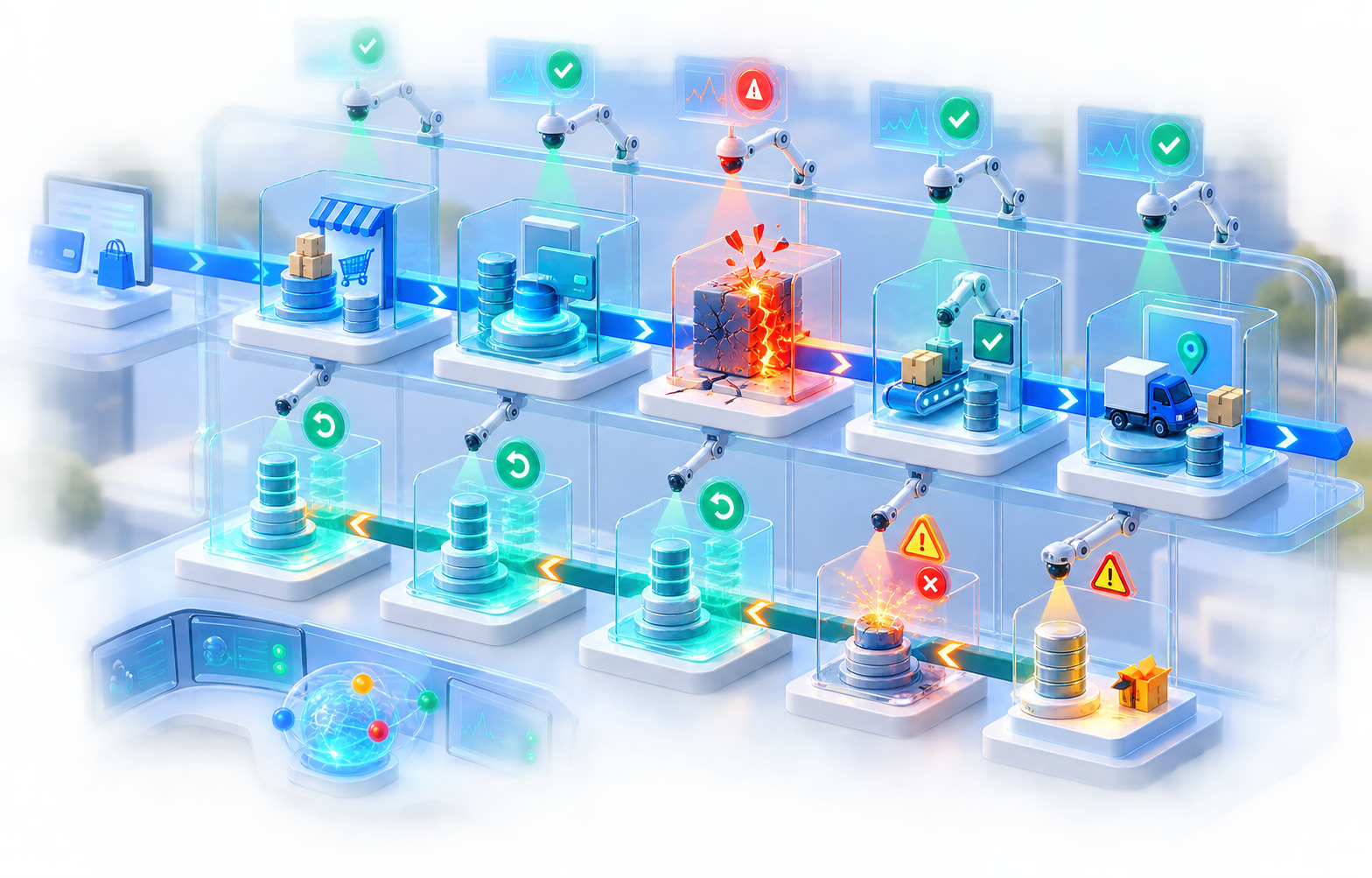
Every usage-based billing pipeline, regardless of vendor or in-house architecture, has roughly the same shape: an application emits an event when a billable action occurs, that event travels through some combination of a queue, a stream, or a direct API call to a metering service, the metering service aggregates events over a billing period according to a pricing metric, a rating engine applies the price schedule to the aggregated usage, and a billing engine turns the rated usage into an invoice or ledger entry. Each of those five stages is a place where the number the customer eventually sees can diverge from the number that actually reflects what they did.
flowchart LR
    A["Application event\n(API call, token,\nworkflow run, GB processed)"] --> B["Event capture\n(SDK / gateway)"]
    B --> C["Usage event queue\nor stream"]
    C --> D["Metering service\naggregation + dedup"]
    D --> E["Rating engine\nprice application"]
    E --> F["Billing engine\nproration + invoicing"]
    F --> G["Invoice / ledger"]
    D -.duplicate or dropped\nevents.-> D
    E -.plan change mid-cycle,\ncredit/allowance logic.-> E
    F -.currency, rounding,\ntax, dunning retries.-> F
    G -.reconciliation gap\nvs. raw events.-> C
Each arrow in that diagram represents a network hop, a queue, or a service boundary, and each one inherits the standard failure modes of distributed systems: messages can be delivered more than once, messages can be lost, messages can arrive out of order, and two services can disagree about the current state of the world for a period of time. In most application contexts, teams have learned to treat these as normal operating conditions to be handled defensively. In a billing pipeline, the same failure modes translate directly into dollars, and the defensive handling has to be provably correct, not just probably fine.
Event capture and delivery. The first place accuracy can fail is at the point an event is generated. If a client SDK retries a request after a timeout without knowing whether the original request actually succeeded on the server, and the metering event is fired independently by the server on successful processing rather than by the client on send, a retried-but-actually-successful request can generate two billable events for one customer action. Stripe's billing meter event API addresses this directly by supporting an optional identifier field on each meter event and enforcing uniqueness on that identifier within a rolling window of at least 24 hours — explicitly designed, according to Stripe's own documentation, to address "issues arising from accidental retries or other problems occurring within extremely brief time intervals." The existence of that field is itself evidence of how common the failure is: a major billing infrastructure provider built deduplication into the primary write path because without it, retries reliably produce duplicate billing.
The corresponding failure in the other direction is event loss. If the service responsible for emitting a usage event crashes, is killed during a deployment, or hits a resource limit before the event is durably written to a queue, the event may never be recorded, and the customer's action goes unbilled with no error surfaced anywhere, because from the application's point of view, the customer's request succeeded normally. There is no exception to catch. The only symptom is a metering total that is quietly lower than actual usage, which nobody sees unless they compare metering output against an independent measure of actual system activity.
Aggregation windows and late-arriving data. Usage has to be aggregated over a billing period, and aggregation requires a clear answer to what happens when an event arrives late — after the window it belongs to has already been closed and, in some cases, after an invoice has already been issued for that period. Systems that use pre-aggregated counters (increment a running total as events arrive) have to decide whether to reopen a closed period, apply the late event to the current period instead, or drop it. Any of those choices can be defensible, but only if it is a deliberate, tested decision rather than whatever the code happens to do by accident.
This is precisely the design problem that led Orb, a usage-based billing platform, to build its architecture around what it calls query-based billing rather than real-time counter mutation. According to Orb's own architecture documentation, usage events are stored immutably in a columnar data store, and invoices are computed by querying the raw event data against current pricing and metric definitions rather than reading from pre-aggregated running totals. The stated benefit is that "late-arriving events don't corrupt existing state" — the system simply re-queries the full historical dataset, and any invoice fragments affected by the newly arrived event are automatically recalculated through a dependency graph that tracks relationships between invoices, usage, and pricing configuration. Orb's documentation also states that backfilling historical events is safe under this model precisely because invoices are derived from immutable source data rather than mutated counters, which removes the double-counting risk that comes with correcting a running total after the fact.
This is not a claim that one architecture is universally correct. Real-time counter-based systems have lower latency for usage alerting and threshold-based notifications, which matters for use cases like hard spend caps or real-time consumption dashboards — which is exactly why Orb, per its own documentation, runs a separate stream-based pipeline specifically for alerting alongside its query-based billing pipeline, rather than trying to serve both requirements from one architecture. The point for a QA or engineering leader is narrower and more actionable: whichever architecture you build or buy, "what happens when an event arrives after its billing period has closed" is a question that must have an explicit, tested answer, not an implicit one determined by whatever the aggregation code does when nobody was thinking about that case.
Clock skew and time-zone boundaries. Billing periods are defined in terms of time, and distributed systems are notoriously bad at agreeing on time. An event timestamped by a client with a skewed clock, or generated near a billing-period boundary and timestamped by a server in a different time zone than the one the billing period is defined in, can land in the wrong period. Stripe's meter event API explicitly bounds how far in the past or future a timestamp can be — within the past 35 calendar days or up to 5 minutes in the future — which is a defensive measure against exactly this class of problem, but the bound doesn't eliminate the risk of an event landing one period earlier or later than intended near a boundary; it only prevents wildly incorrect timestamps from being accepted at all.
Where Billing Accuracy Actually Breaks: A Failure Framework
Treating "test the billing system" as a single task produces shallow coverage, because the failure modes are structurally different from each other and require different test techniques. The following framework separates them by mechanism, not by which team happens to own the affected component.
| Failure category | Mechanism | Typical detection point (if detected at all) | Business consequence |
|---|---|---|---|
| Duplicate or dropped metering events | Retries without idempotency keys threaded through the metering path; crashes or resource limits before an event is durably queued; missing dead-letter handling | Customer support ticket (duplicates) or finance margin review months later (drops) | Overcharge and trust damage, or silent revenue leakage |
| Mid-cycle proration and plan-change errors | Usage counters not correctly re-baselined when a plan changes; included-allowance logic double-counting or losing usage across the transition | Customer complaint after an upgrade or downgrade | Overcharge on the transition invoice, or lost overage revenue |
| Currency and rounding drift | Per-unit prices with many decimal places multiplied across millions of units; inconsistent rounding rules between metering, rating, and invoicing systems; multi-currency conversion timing | Rarely detected without a dedicated reconciliation check | Small per-invoice discrepancies that compound into material aggregate leakage or overcharge |
| Reconciliation gaps between metering and invoicing systems | Metering system and billing system independently deployed, independently evolved, and never automatically cross-checked against each other | Manual finance reconciliation, typically monthly or quarterly, well after invoices are sent | Delayed discovery of any of the above, larger blast radius by the time it's found |
| Late-arriving or backfilled events | Network delays, offline mobile clients, or upstream system outages causing events to arrive after their billing period has closed | Only visible if the system has explicit logic (and tests) for this case | Under- or over-stated invoices depending on how the late event is handled |
| Free-tier, credit, and overage boundary errors | Off-by-one or boundary-condition errors in the logic that decides when included usage is exhausted and paid usage begins | Customer notices they were charged for usage that should have been covered by a credit or allowance | Immediate trust damage, disproportionate to the dollar amount involved |
Every row in this table is testable with standard QA techniques — synthetic event generation, fault injection, boundary-value analysis, contract testing between services — but only if someone has decided that testing them is in scope. The reason so many organizations don't test these paths isn't that the techniques are exotic. It's that nobody assigned ownership of the seam between "the system that knows what happened" and "the system that turns that into a dollar amount," so the testing never gets planned in the first place.
A Worked Example: How a Retry Storm Turns Into Real Money
Abstract failure categories are easy to acknowledge and easy to underestimate. The following example is entirely hypothetical — illustrative arithmetic, not a real company, benchmark, or QAtronic client — but the mechanism it describes (a retry generating a duplicate metering event during a network incident) is exactly the failure mode Stripe's meter-event idempotency identifier and Orb's immutable-event architecture were both built to prevent, which is a strong signal that it happens in production systems often enough to justify infrastructure investment from two separate billing vendors.
Assume a hypothetical developer-tools company, "API Company X," bills customers $0.004 per API call, or $4 per 1,000 calls. A large enterprise customer typically makes 40 million calls per month, generating a $160,000 usage line item.
During a 45-minute regional network incident, this customer's client library — following a common defensive pattern — retries any call for which it doesn't receive an acknowledgment within 2 seconds. Suppose 900,000 calls occur during the incident window, and 18% of them are retried exactly once, not because the original request failed, but because the acknowledgment was delayed past the 2-second timeout while the underlying request had already succeeded and been processed server-side.
If the metering pipeline logs a billable event at the point of server-side request completion, without a deduplication key that is honored specifically in the metering path (as distinct from the API's own request-idempotency handling, which may correctly prevent the request from being processed twice, while the metering event is still emitted twice by mistake), the retried acknowledgments generate duplicate billable events:
- 900,000 calls × 18% retried = 162,000 duplicate events
- 162,000 duplicate events × $0.004 = $648 overcharge from a single 45-minute incident on one enterprise account
On its own, $648 looks trivial, and if this happened once, it would be. But if this company runs 30 enterprise customers of comparable scale on the same shared API gateway path, and a regional network incident of this kind occurs on average four times per quarter — a conservative assumption for any service with a multi-region footprint — the aggregate quarterly impact is:
- 30 accounts × 4 incidents per quarter × $648 = $77,760 in quarterly overcharges across those accounts alone
That is a large enough figure to force at least one invoice restatement, generate a support escalation from a customer who reconciles their own API logs against their bill (increasingly common among sophisticated usage-based buyers), and consume real engineering and finance hours tracing the discrepancy back to a single missing deduplication check — a check that would have taken a fraction of that time to write as an automated test before launch. The arithmetic scales in the other direction just as easily: the same missing safeguard, applied to a scenario where events are dropped instead of duplicated, produces silent undercharging of comparable magnitude, except nobody complains about being undercharged, so it can persist indefinitely until someone specifically goes looking for it.
This Is Not Theoretical: Two Recent, Verified Billing Failures
Skepticism that this class of defect matters at scale is reasonable until you look at what has actually happened at companies operating some of the largest billing systems in the industry.
In July 2026, Amazon Web Services experienced a widely reported billing display incident in which customers across a range of account sizes saw estimated cost figures inflated by orders of magnitude — accounts that normally accrued a few dollars per month showed estimated charges in the billions, and in the most extreme cases, into the trillions of dollars. According to reporting from TechCrunch and The Register, this was a bug in AWS's estimated-billing computation subsystem — not a fault in the actual invoicing pipeline — and AWS stated explicitly that the inflated figures "do not reflect actual usage and charges," meaning no customer was actually billed the displayed amounts. AWS attributed the issue to a recent change in its billing computation subsystem consistent with a unit-conversion error (industry commentary pointed to a plausible per-byte-versus-per-gigabyte type of miscalculation, though AWS did not confirm the specific root cause publicly), and an initial rollback attempt on the first morning of the incident failed to resolve it, extending the disruption. The incident is a useful case regardless of the precise root cause, because it demonstrates two things at once: first, that unit and computation errors in billing pipelines happen even at organizations with some of the deepest engineering resources in the industry, and second, that the reputational cost of a billing-accuracy failure is not proportional to whether money actually changed hands. No customer was overcharged, and it was still a widely covered incident that visibly shook customer confidence, because a bill that displays a wrong number is itself the product failure, independent of whether the number is later corrected before settlement.
In the same month, Anthropic confirmed a separate billing error in which a free-tier developer in South Korea, with no payment method on file and no meaningful API usage, received phantom invoices escalating from roughly $1.67 million to $16.6 million within 24 hours. According to reporting corroborated by multiple outlets including Yahoo Finance and IBTimes UK, the charge attempts were declined by the user's bank due to transaction limits, no money was actually collected, and Anthropic subsequently attributed the error to an incorrect automatic credit-reload configuration, which it disabled as a precaution, without publicly explaining how the reload value reached that magnitude. The user reported spending four days and roughly 18 support emails obtaining written confirmation that the invoices were void. Separately, and reported around the same period, an audit firm operating under the name Vaudit stated it had reviewed AI service invoices from Anthropic and OpenAI and found billing discrepancies in a portion of the invoices it examined, amounting to approximately $1.7 million in claimed overcharges across roughly 60 enterprise accounts, attributed in that firm's reporting to causes including charges tied to failed requests, incorrect model-tier pricing, and repeated "retry storm" behavior. That figure should be read as a vendor-reported claim from an audit-services company with a direct commercial interest in identifying billing errors — it is not an independently adjudicated or company-confirmed figure in the way the free-tier phantom-invoice incident was — but it is directionally consistent with the mechanism this article has described throughout: retries and failed-request handling that leak into the billing path.
Neither of these incidents is being cited to single out any particular company as unusually careless. They are cited because they happened recently, at organizations operating billing infrastructure at a scale and level of engineering investment that most companies reading this article do not have, and they still failed in exactly the categories this framework describes: a computation error in the billing pipeline, and a configuration error in an automated billing mechanism (credit reload) that had no apparent upper bound or sanity check. If organizations with that level of resourcing produce public billing-accuracy incidents, the assumption that a smaller company's ad hoc, untested metering pipeline is "probably fine" does not survive contact with the evidence.
The Asymmetry Between Undercharging and Overcharging
Every billing defect resolves in one of two directions, and the two directions behave completely differently as business risks, which is why they need to be discussed separately rather than lumped together as "billing bugs."
Undercharging is silent and compounds. A dropped metering event, a proration bug that under-bills a plan change, or a rating error that applies a lower price tier than the customer's actual usage warrants — all of these reduce revenue without producing any customer-visible symptom. Nobody complains about being undercharged. The defect persists until someone specifically audits metering output against an independent source of truth, which, per the failure framework above, usually only happens during a periodic finance reconciliation, if it happens at all. The financial exposure compounds with time and with usage growth: a 2% undercount on a small usage base is a rounding error; the same 2% undercount on a usage base that has grown tenfold since the defect was introduced is a material and retroactively unrecoverable loss, because most companies have neither the contractual right nor the practical ability to go back and invoice customers for historically under-billed usage discovered a year later.
Overcharging is loud and immediate. A duplicate event, a rounding error that compounds upward, or a proration bug that double-bills a plan transition produces a wrong number on an invoice that a customer sees directly. Sophisticated usage-based buyers — the same buyers usage-based pricing is often designed to attract, because they value paying only for what they use — are disproportionately likely to reconcile vendor invoices against their own usage logs, precisely because usage-based pricing invites that scrutiny in a way flat subscription pricing does not. An overcharge discovered this way does not stay quiet. It becomes a support escalation, a trust conversation with a champion inside the customer's organization, and in aggregate, a contributor to churn that is difficult to attribute back to a billing defect in a churn analysis, because the stated reason for churn is rarely "your invoice was wrong once," even when that is the underlying cause.
The organizational failure mode this asymmetry produces is predictable: companies that lack systematic billing testing tend to discover overcharging quickly, because customers report it, and tend to discover undercharging slowly or never, because nobody reports free money. This creates a false sense of security. A company that has "never had a billing complaint" may simply be undercharging in ways nobody has caught, rather than actually charging correctly. Billing accuracy has to be measured against ground truth — actual system activity — not against the absence of customer complaints, which is a biased and incomplete signal that systematically under-detects one entire category of the problem.
Revenue Recognition, Audit Controls, and Why Finance Has a Direct Stake in Engineering's Test Coverage
Billing defects under usage-based pricing are not purely an engineering or customer-experience concern. They intersect directly with how a company recognizes revenue and, for public companies or companies preparing for an audit, with internal control obligations that carry legal weight.
Under ASC 606, the revenue recognition standard used in U.S. GAAP reporting, revenue from usage-based contracts is generally recognized as the customer consumes the service, which means the amount of revenue a company reports in a given period is directly tied to the accuracy of its usage measurement for that period. A metering defect that undercounts usage doesn't just mean a smaller invoice; it means the company's reported revenue for that period is understated relative to the service actually delivered, which can create a mismatch that auditors are specifically trained to look for during revenue testing procedures. A defect that overcounts usage creates the mirror-image problem: revenue recognized in a period that doesn't match what was contractually earned, which can require later reversal or restatement if discovered after financial statements have already been issued. Neither of these is a hypothetical audit concern; usage-based and consumption pricing models are widely flagged in accounting literature and audit guidance as higher-risk areas for revenue recognition testing precisely because the amount owed depends on operational data generated outside the finance function's direct control, rather than a fixed contractual amount finance can verify against a signed agreement alone.
For companies subject to Sarbanes-Oxley internal control requirements, or companies in the process of preparing for that level of rigor ahead of a future public offering or acquisition, the metering-to-invoice pipeline is a de facto part of the financial reporting control environment, whether or not it has ever been formally documented as one. A control environment that has no automated reconciliation between metering and invoicing, no change-management process for pricing logic, and no test coverage for plan-transition billing scenarios is, in substance, an unmitigated control gap over a material revenue stream. This is a case where the interests of QA, engineering, and finance are not in tension; they are the same interest, described in different vocabulary. An engineering team that builds continuous reconciliation and transition testing because it wants a reliable product is, without necessarily framing it this way, also building the control evidence a future audit will eventually require. Building it early, as an engineering discipline, is materially cheaper than reconstructing it retroactively under audit pressure, when a company has to explain, after the fact, why a period of revenue cannot be independently substantiated.
This does not mean every engineering team needs to become fluent in revenue recognition accounting. It means the reconciliation and testing work described throughout this article should be visible to finance and, where applicable, to the audit function, framed explicitly as the control evidence it functionally is, rather than treated as an internal engineering practice with no connection to the company's financial reporting obligations.
Two More Illustrative Scenarios (Hypothetical)
The retry-storm example above shows how duplicate events create overcharges. The following two scenarios — both explicitly hypothetical and not based on any real QAtronic client or any specific company — illustrate two other failure categories from the framework table: mid-cycle proration errors and silent event loss.
Hypothetical scenario: the workflow-automation platform's mid-cycle upgrade. A hypothetical SaaS company sells a workflow-automation product priced per completed workflow run, with tiers that each include a monthly allowance of runs before overage pricing kicks in — Team tier includes 10,000 runs per month at a base fee, Enterprise tier includes 50,000 runs at a higher base fee. A Team-tier customer, having already consumed 8,500 of their 10,000 included runs partway through the billing cycle, upgrades to Enterprise mid-cycle to unlock a higher allowance before hitting overage charges.
The hidden assumption in the billing engine is that a plan change resets the usage counter cleanly against the new plan's allowance from the moment of upgrade. In this hypothetical case, the proration logic correctly credits the unused portion of the Team-tier subscription fee, but the usage-counter re-baselining logic — a separate code path, built by a different engineer, at a different time — does not reset which allowance the already-consumed 8,500 runs count against. The result: the invoice both credits the customer for unused Team-tier subscription value and continues to count the pre-upgrade 8,500 runs against the new Enterprise allowance, effectively double-penalizing the customer's early-cycle usage relative to what either plan's terms actually promised. The customer ends up paying overage charges despite having upgraded specifically to avoid them, and does not immediately understand why, because the subscription-fee proration line item looks correct in isolation. The technical cause was straightforward in retrospect: two independent code paths (subscription proration and usage-counter re-baselining) that were never tested together as a single integrated scenario, because they were built and reviewed separately by different owners.
Hypothetical scenario: the AI inference API's silent margin compression. A hypothetical AI company charges customers per token processed through an inference API and pays a comparable per-token cost to its own model infrastructure provider, making its usage-based revenue and its cost of goods sold two sides of the same metering pipeline. The usage-event emitter runs as a set of serverless functions that occasionally hit out-of-memory conditions during traffic spikes, and when that happens, the function is killed by the runtime before it finishes writing its usage event to the queue — with no dead-letter queue or crash-recovery mechanism in place to catch the lost event. This drops approximately 2% of usage events during high-traffic periods, silently and without triggering any error, because from the customer's perspective their inference request completed successfully; only the internal accounting of that request was lost.
Because the missing 2% is spread thinly across thousands of customers and millions of requests, no single customer's bill looks obviously wrong, and no support ticket is ever filed. The defect is only discovered three months later, during a routine margin review, when finance notices that the company's actual infrastructure cost (which is metered independently by the infrastructure provider and is not subject to the same event-loss bug) is growing measurably faster than the usage-based revenue line that is supposed to track it proportionally. The investigation that follows — comparing infrastructure-side token counts against internally metered token counts — takes two weeks and ultimately traces back to the same out-of-memory crash pattern that had already been flagged, and dismissed as low-priority, in an unrelated infrastructure reliability review months earlier, because nobody had connected "occasional function crashes during traffic spikes" to "we are silently failing to bill for a measurable share of a major AI product's revenue."
A Third Illustrative Scenario: The Marketplace Take-Rate Problem (Hypothetical)
The two scenarios above involve a company billing its own direct customers. A related but distinct pattern shows up in marketplace and platform businesses that charge a usage-based take rate — a percentage fee on transactions processed through the platform — rather than a flat per-unit price. This hypothetical scenario, again not based on any real company, illustrates how the same class of defect behaves differently when the pricing unit is a percentage of a variable transaction value rather than a fixed price per event.
A hypothetical e-commerce marketplace platform charges sellers a 2.9% take rate on the gross value of each transaction processed through its checkout system, calculated and deducted at the moment of settlement. The platform's checkout service and its settlement service are separate systems, connected by an asynchronous event: checkout emits a "transaction completed" event containing the transaction's gross value, and settlement consumes that event to calculate and apply the take rate before disbursing the net amount to the seller. During a promotional period with unusually high transaction volume, a subset of transactions include post-purchase discounts and partial refunds applied within seconds of the original transaction completing — a common pattern during flash sales, where a customer applies a coupon code that triggers a small adjustment immediately after checkout confirms.
The hidden assumption in the settlement service is that the gross value in the "transaction completed" event always reflects the final, settled value of the transaction. In this hypothetical case, roughly 3% of transactions during the promotional period have their gross value adjusted by a discount-application event that fires after the original checkout event, but the settlement service has already calculated and applied the take rate against the original, pre-discount gross value by the time the adjustment arrives, and has no mechanism to recalculate the fee once a transaction has been settled. The result is that the marketplace collects a take rate calculated against a higher gross value than the seller actually received, on roughly 3% of transactions during the promotional window — a systematic overcharge that is small on any individual transaction (often well under a dollar) but affects thousands of sellers simultaneously during a single high-volume promotional event, the exact combination of high transaction volume and disproportionate visibility that makes this category of defect likely to surface as a mass support event rather than an isolated complaint. The technical fix — holding fee calculation until a short settlement-finalization window has passed, or supporting fee recalculation on late-arriving adjustment events — is a variation of the same late-arriving-event handling problem discussed earlier in this article, applied to percentage-based rather than fixed-unit pricing.
Building a Testing Framework for Usage-Based Billing
Testing a metering-to-invoice pipeline effectively requires treating it as what it is: a distributed system whose correctness has direct financial consequences, tested with the same rigor applied to any other business-critical distributed system, plus a set of financially specific checks that generic distributed-systems testing does not naturally cover.
Test dimensions that need explicit, owned coverage
- Event capture correctness. Does every billable action reliably produce exactly one usage event, under normal conditions and under failure conditions (timeouts, retries, partial network failures, client crashes mid-request)?
- Deduplication and idempotency in the metering path specifically. Not just at the API request level — a request can be correctly idempotent at the application layer while still emitting a duplicate metering event, if the two concerns are handled by different code with different assumptions.
- Event durability and loss handling. What happens when the metering service, queue, or downstream consumer is unavailable at the moment an event is generated? Is there a dead-letter queue, a retry-with-backoff mechanism, and alerting on sustained delivery failure?
- Aggregation window boundaries. Events generated in the final seconds of a billing period, and events that arrive after a period has closed, need explicit, tested handling — not default behavior nobody chose deliberately.
- Proration and plan-change transitions. Every upgrade, downgrade, and mid-cycle plan change is a distinct scenario requiring its own test case, particularly where usage-allowance re-baselining and subscription-fee proration are handled by separate logic.
- Currency, rounding, and tax interaction. Rounding rules need to be consistent across metering, rating, and invoicing, and tested specifically at high-volume, low-per-unit-price scenarios where rounding differences compound most visibly.
- Free-tier, credit, and overage boundaries. The exact transition point where included usage becomes billable usage is a classic off-by-one risk and deserves dedicated boundary-value tests, not incidental coverage from broader functional tests.
- Reconciliation between metering output and invoiced amounts. An automated, continuous comparison — not a manual, periodic one — between what the metering system recorded and what the billing system actually invoiced.
A responsibility map for the metering-to-invoice pipeline
Ambiguous ownership is itself a root cause in this domain, so making ownership explicit is a testing prerequisite, not an afterthought.
| Pipeline stage | Primary owner | QA responsibility | Finance/RevOps responsibility |
|---|---|---|---|
| Event emission (application code) | Engineering team owning the billable feature | Test event generation under retry, timeout, and crash conditions | Define which actions are billable events in the first place |
| Event transport and deduplication | Platform/infrastructure engineering | Fault-inject the queue/stream; verify dedup logic with synthetic duplicate events | Set acceptable variance thresholds for detected duplication |
| Metering aggregation | Billing platform team (or vendor) | Verify aggregation window boundaries and late-event handling | Confirm aggregation logic matches contractual usage definitions |
| Rating and pricing application | Billing platform team + product/pricing | Test every price-tier boundary and plan-change transition | Own and version the price schedule itself |
| Invoice generation | Billing platform team | Reconcile generated invoices against raw metering data automatically | Sample-audit invoices against contracts pre-send for high-value accounts |
| Post-invoice reconciliation | Shared: engineering + finance | Build and maintain the automated reconciliation pipeline | Investigate and resolve flagged discrepancies |
A step-by-step testing playbook
- Instrument before you optimize. Before writing a single billing test, ensure every billable event carries a unique, stable identifier generated as close to the point of the underlying user action as possible — not regenerated at each hop through the pipeline, which is what allows retries to masquerade as new events.
- Build a synthetic usage generator. Create a tool that can generate realistic usage event streams at controllable volume and rate, including deliberately malformed, duplicated, delayed, and out-of-order events. This becomes the primary tool for every subsequent test in this list.
- Fault-inject the event pipeline. Using the synthetic generator, deliberately kill the event-emitting service mid-write, introduce network partitions between the application and the metering queue, and verify that the system either successfully delivers the event exactly once or fails loudly (alerting, not silent loss) rather than failing silently.
- Test every plan-change transition as an integrated scenario, not two isolated ones. Enumerate every combination of upgrade, downgrade, mid-cycle timing, and usage state (under allowance, at allowance, over allowance) and verify the resulting invoice against a manually calculated expected value for each combination.
- Build boundary-value tests for every rate limit, allowance, and tier threshold. Test at exactly the boundary, one unit below it, and one unit above it, for every price tier and included-usage allowance in the pricing model.
- Run rounding tests at production-representative volume, not toy numbers. A rounding error of $0.0001 per unit is invisible in a 10-unit test case and material at 50 million units; test cases need to reflect realistic customer usage volume, not convenient small numbers.
- Build an automated reconciliation pipeline as a release gate, not a monthly finance task. Compare aggregate metering totals against aggregate invoiced totals continuously (daily, at minimum, ideally closer to real time), and alert on any variance beyond a defined threshold.
- Run a shadow-billing period before any pricing engine migration or major pipeline change. Compute invoices under both the old and new systems in parallel for at least one full billing cycle before cutting over, and diff every invoice line item between the two.
- Test late-arriving and backfilled events explicitly. Simulate an event arriving after its billing period has closed and verify the system's actual behavior matches its documented, intended behavior — reopening the period, applying to the current period, or explicitly rejecting the event with an audit trail.
- Include billing-path scenarios in incident response drills. When your team runs a game day or chaos exercise for the broader system, include "what happens to billing accuracy during this failure" as an explicit question, not an assumed non-issue.
- Sample-audit real invoices against contracts before they are sent, for high-value accounts. Automated testing reduces but does not eliminate the value of a human, contract-aware review for your largest customers, where an error has the highest financial and relationship cost.
Currency, Rounding, and the Arithmetic That Hides in Plain Sight
Multi-currency usage-based billing introduces a failure category that is easy to dismiss as trivial and expensive to discover otherwise. Per-unit prices in usage-based models are frequently fractions of a cent — a token, an API call, or a processed record priced at $0.0002 or similar — and small rounding decisions, applied consistently within one currency but inconsistently across currency conversions or across the boundary between metering and invoicing systems, compound in ways that are invisible at low volume and material at production scale.
Consider a hypothetical illustrative case, not based on any real company: a company prices an API at $0.00013 per call and serves a customer making 200 million calls in a month, generating a base charge of $26,000. If the metering system stores and sums usage at four decimal places of precision per unit, but the invoicing system that consumes the aggregated total rounds the final line-item price to two decimal places using standard rounding rather than the same rounding convention applied during aggregation, the two systems can produce invoices that differ by amounts ranging from a few cents to several dollars per invoice, depending on exactly where in the calculation the rounding is applied and how many intermediate aggregation steps occur before the final invoice line is generated. A few dollars per invoice looks immaterial in isolation. Across ten thousand invoices in a billing cycle, inconsistent rounding conventions applied unevenly (rounding up more often in aggregate for some accounts, rounding down for others, depending on where their usage values happen to fall relative to a rounding boundary) can produce a company-wide discrepancy in the tens of thousands of dollars that shows up only in an aggregate reconciliation check, never in any single customer's invoice review, because no individual invoice looks obviously wrong.
The practical fix is not complicated, but it requires a deliberate decision rather than an accident of implementation: define one rounding convention (typically, round only once, at the final invoice line-item stage, using full precision throughout every intermediate aggregation step) and test that convention specifically at production-representative volumes and at the specific per-unit price points your actual pricing model uses, not at round numbers chosen for test-case convenience. A test suite that only ever bills 100 units at $1.00 per unit will never catch a rounding defect that only manifests at 200 million units priced at $0.00013.
Multi-currency conversion adds a second dimension to the same category of risk: at what point in the pipeline does currency conversion happen, using what exchange rate source and what rate-lock timing, and is that conversion applied consistently between the metering system's internal accounting (often denominated in a single base currency for simplicity) and the customer-facing invoice (denominated in the customer's contracted currency)? A conversion applied at the moment of invoice generation using a same-day rate will produce a different, equally defensible number than a conversion applied using a rate locked at the start of the billing period, and a testing strategy needs to verify that whichever choice was made is applied consistently, every cycle, rather than drifting based on whichever exchange rate happened to be cached at the time a particular invoice run occurred.
The Testing Toolchain: What to Actually Build or Buy
None of the testing techniques described in this framework require exotic tooling, but they do require assembling a small set of capabilities that most standard QA toolchains don't include out of the box, because most QA toolchains were built around functional correctness rather than financial-arithmetic correctness at scale.
A synthetic usage-event generator is the foundation everything else depends on. This is typically a purpose-built internal tool, not an off-the-shelf product, because it needs to generate events that match your specific metering schema, at controllable volume and rate, with deliberate injection of duplicates, out-of-order delivery, and malformed payloads. Building this early, even in a simple form, pays for itself many times over across every subsequent test in the playbook, because every fault-injection and boundary-value test described above depends on being able to generate realistic event traffic on demand rather than waiting for production traffic to accidentally exercise the same conditions.
Contract tests between the metering service and the billing/rating engine verify that the interface between these two systems — which are frequently owned by different teams or are entirely different vendor products — continues to honor the assumptions each side makes about the other, particularly around field formats, timestamp precision, and how partial or malformed data is handled. This is the same contract-testing discipline applied to any other pair of services with an internal API boundary, applied specifically to the boundary where a defect has direct financial consequence.
Fault-injection or chaos-engineering practices, already common in reliability engineering for general system availability, extend naturally to the metering pipeline specifically: deliberately killing the event-emission service mid-write, introducing latency and packet loss between the application and the metering queue, and verifying that the system's behavior under those conditions matches its documented, intended behavior (loud, alertable failure, rather than silent data loss).
Invoice-diffing tooling — a mechanism to compare two versions of an invoice, whether across a shadow-billing migration, a pricing-engine change, or a reconciliation check against raw metering data — turns what would otherwise be a manual, error-prone comparison into an automated check that can run on every relevant code change or deployment, the same way a visual-regression or snapshot-testing tool works for UI changes, applied instead to financial output.
None of this requires abandoning a third-party billing or metering platform in favor of building everything in-house. Vendor platforms like the ones referenced earlier in this article handle a meaningful share of the underlying deduplication and reconciliation mechanics. What a vendor platform cannot do is verify that your specific pricing model's edge cases, your specific plan-transition logic, and your specific event-emission code are correct, because those are business logic decisions unique to your product, sitting on top of whatever platform you choose.
Reconciliation as a Continuous Control, Not a Monthly Finance Chore
The single highest-leverage change most organizations can make is moving reconciliation from a periodic, manual finance activity to a continuous, automated engineering control. The difference is not just frequency; it changes who is accountable and how fast a discrepancy is caught relative to how much money and how many customer accounts it has already touched by the time it's found.
A useful mental model is to track three metrics continuously, rather than treating reconciliation as a pass/fail check performed once a month:
- Event-to-invoice variance rate. The percentage difference between total metered usage and total invoiced usage, calculated at the aggregate level and, where feasible, broken out per customer for high-value accounts. A variance rate that is consistently near zero and suddenly moves is a leading indicator of a new defect, often before any customer notices.
- Event loss rate. The percentage of expected events (estimated from an independent signal, such as raw application logs or infrastructure request counts) that never arrive at the metering system at all. This metric specifically targets the undercharging failure mode that customer complaints will never surface.
- Duplicate event rate. The percentage of received events that match an existing event's identifier within the deduplication window, tracked as a rate rather than dismissed once deduplication successfully catches them — a rising duplicate rate is evidence of an upstream reliability problem even if the billing system is correctly absorbing it.
None of these require exotic tooling. They require treating the metering and billing systems as two independent sources of truth that should agree, and building the comparison between them as a first-class, monitored system component rather than a spreadsheet exercise performed by finance after the fact.
The architectural choice between real-time aggregated counters and event-sourced, query-based recomputation (discussed earlier in the context of Orb's documented approach) has direct implications for how reconciliation gets built, and it's worth making the trade-off explicit rather than treating it as a vendor feature checklist item.
| Architecture pattern | Reconciliation implication | Best fit |
|---|---|---|
| Real-time aggregated counters (increment running totals as events arrive) | Fast to query for live dashboards and spend alerts, but correcting a past error requires carefully un-incrementing and re-incrementing state, which is itself error-prone | Use cases where real-time spend visibility or hard caps matter more than perfect historical correction |
| Event-sourced / query-based (store immutable raw events, compute invoices by querying) | Naturally supports safe backfills and late-event correction, since invoices are always recomputed from source data, but requires more compute at invoicing time and a separate fast path for real-time alerting | Use cases where invoice correctness and auditability matter more than sub-second usage visibility |
Most mature usage-based billing platforms, including the one described in Orb's own architecture documentation, resolve this trade-off by running both patterns in parallel for different purposes rather than picking one — a stream-based path for real-time alerting, and an event-sourced path for actual invoicing. Whether you build this in-house or buy it from a metering and billing platform, the underlying question for a testing strategy is the same: can this system prove, with an auditable trail, exactly which raw events produced a given invoice line item, and can it safely recompute that line item if new information arrives after the fact?
How the Right Level of Investment Changes With Company Stage
The testing framework above is not a checklist every company should implement in full on day one. The appropriate depth of investment depends heavily on scale, and treating it otherwise wastes engineering effort at one end of the spectrum or leaves material risk untested at the other.
Early-stage startups running usage-based pricing at modest volume typically face lower absolute dollar exposure per defect, but often have the least mature metering infrastructure — frequently a bespoke pipeline built quickly to ship a pricing model, without dedicated ownership. The highest-leverage investment at this stage is usually the cheapest: a unique event identifier threaded through the entire pipeline from the start (retrofitting this later is materially harder), and a basic automated reconciliation check comparing metering totals to invoiced totals, even if it runs weekly rather than continuously. Full chaos-engineering-style fault injection is likely premature; the value-to-effort ratio favors getting the fundamentals in place first.
Scale-ups with growing usage volume and an expanding customer base face the steepest part of the risk curve, because usage volume has grown enough that even small variance rates translate into real money, while the pipeline is often still the same one built during the early stage, now under significantly more load and often more organizational complexity (more teams touching more parts of the pipeline). This is the stage where the full testing playbook above earns its cost: synthetic usage generation, systematic plan-change transition testing, and continuous reconciliation monitoring with defined alert thresholds all become justified by the dollar volume at stake.
Enterprises running usage-based billing at large scale, often across multiple product lines and pricing models simultaneously, face the compounding problem of pipeline complexity: multiple metering sources, multiple currencies, contractual custom pricing terms layered on top of standard tiers, and often legacy billing infrastructure that predates the usage-based pricing initiative and was never designed for it. At this stage, the reconciliation pipeline itself needs to be treated as a product with its own reliability requirements, shadow-billing before any pricing-engine change becomes close to mandatory rather than optional, and sample-audit of high-value invoices before they're sent is worth the manual overhead given the financial and relationship stakes of getting a large account's bill wrong.
Where This Overlaps — and Doesn't — With Adjacent QA Disciplines
Billing accuracy testing sits near several other testing disciplines without being identical to any of them, and the boundaries are worth stating explicitly because the terminology overlaps in ways that invite confusion.
Idempotent request handling is a general distributed-systems technique — ensuring that processing the same request twice produces the same result as processing it once — and it is a necessary but not sufficient condition for billing correctness. A request can be correctly idempotent at the application layer (the underlying action only happens once) while the metering event tied to that request is still emitted twice, if the two concerns are implemented in different code with different assumptions about what "the same request" means. Feature entitlement testing verifies that a customer can only access the features and capacity their plan permits; it answers "can they do this," not "did we correctly charge for what they did." SLA-credit testing verifies that uptime commitments are correctly honored with credits when reliability targets are missed; it is a compensation mechanism triggered by service failure, structurally different from metering a customer's own consumption of a working service. None of these disciplines substitute for dedicated metering and billing reconciliation testing, though a mature organization will find that the same fault-injection and synthetic-event techniques used for one often transfer directly to the others.
A Maturity Model for Billing Accuracy as a QA Discipline
Organizations tend to sit at one of four recognizable stages in how they treat metering and billing accuracy, and recognizing which stage you're actually at — as opposed to which stage you assume you're at because nobody has complained recently — is the first useful diagnostic step before investing further.
Stage one: reactive. Billing accuracy is verified only when a customer complains or finance notices a discrepancy during an unrelated review. There is no dedicated reconciliation process, no unique event identifier threaded through the metering pipeline, and no test coverage specifically targeting plan-change transitions or duplicate-event handling. Most early-stage companies that adopted usage-based pricing quickly, without dedicated engineering investment in the billing pipeline itself, sit here by default, often without anyone having consciously decided to accept this level of risk.
Stage two: periodic. A manual or semi-automated reconciliation process exists, typically run monthly by finance as part of the close process, comparing aggregate metering totals to aggregate invoiced amounts. Discrepancies are caught, but weeks or months after the invoices in question were already sent, which limits the practical options for resolution to writing off the loss, awkwardly correcting an already-sent invoice, or absorbing the reputational cost of a late correction. Ownership of the underlying pipeline defects, once found, is often unclear, because the reconciliation process identifies that a discrepancy exists without necessarily identifying which team's code produced it.
Stage three: proactive. Automated, frequent reconciliation runs as a monitored system component, with defined variance thresholds and alerting that reaches both engineering and finance. Plan-change transitions and duplicate-event handling have explicit, tested code paths rather than incidental behavior. Fault injection is applied to the metering pipeline as part of normal reliability testing practice, not as a one-off exercise. Most organizations that have consciously decided billing accuracy deserves engineering investment, and have had at least one meaningful incident or near-miss to justify that investment, land here.
Stage four: engineered as a release gate. Billing-accuracy checks — reconciliation variance, event-loss rate, duplicate-event rate — are treated with the same release-gating rigor as other critical quality metrics like error rate or latency, meaning a deployment that measurably degrades billing accuracy is blocked or flagged the same way a deployment that measurably degrades uptime would be. Shadow billing before any pricing-engine or plan-structure change is standard practice, not an exceptional precaution reserved for major migrations. Finance, engineering, and audit functions share visibility into the same reconciliation data, framed explicitly as both a product-quality metric and a financial control. This stage is achievable at meaningful usage volume without requiring enterprise-scale headcount; it requires deliberate design decisions made early, which is precisely why retrofitting it after years of stage-one or stage-two operation is materially more expensive than building it in from the pipeline's inception.
Most organizations reading this can locate themselves on this model within a few minutes of honest reflection, and the useful next question is not "how do we reach stage four immediately" but "what is the single highest-leverage step to move one stage forward" — for a stage-one organization, that is almost always introducing a unique event identifier and a basic weekly reconciliation check; for a stage-two organization, it is almost always automating and accelerating the reconciliation cadence and assigning clear ownership for the defects it surfaces.
A Diagnostic Checklist for Leaders
Before assuming your organization's usage-based billing is adequately tested, a small set of direct questions tends to surface the gap quickly:
- Can we state, right now, the variance rate between total metered usage and total invoiced usage for the last completed billing period — not an estimate, an actual measured number?
- Does our metering pipeline have a unique event identifier that is generated once, close to the source action, and honored for deduplication all the way through to invoicing — or does deduplication only happen at the API-request layer, leaving the metering path unprotected?
- Do we have an automated test suite that exercises every combination of mid-cycle plan upgrade, downgrade, and usage state against a manually verified expected invoice?
- If a service in our metering pipeline crashed mid-write right now, would we know, and would we know how much billable usage was lost in the window before it was detected?
- When was the last time anyone deliberately tried to break our billing pipeline with duplicate, delayed, or malformed events, in the same way we would deliberately fault-inject any other production-critical system?
- Do we sample-audit our largest customers' invoices against their actual contracts before sending, or only after they complain?
An honest "no" to more than one or two of these is a reliable signal that billing-accuracy risk is currently being carried, untested, on production infrastructure.
Frequently Asked Questions
Is usage-based billing testing the same as testing feature entitlements or plan access control? No. Entitlement testing verifies that a customer can only use the features and capacity their plan allows — access control. Billing testing verifies that what they actually did was correctly counted, priced, and invoiced — financial accuracy. A system can have flawless entitlement enforcement and still bill incorrectly for the usage it correctly permitted.
How often should metering-to-invoice reconciliation run? As close to continuous as your infrastructure allows. Daily automated reconciliation is a reasonable minimum for most organizations; near-real-time is achievable and valuable at higher usage volumes, where a defect can accumulate significant financial exposure within a single day. Monthly, manual, finance-led reconciliation is the pattern this article argues against, precisely because of how much exposure can accumulate before it's caught.
What is an acceptable variance threshold between metered usage and invoiced amounts? There is no universal industry-standard number, and any organization or vendor claiming one should be treated skeptically. The right approach is to establish your own baseline variance rate under known-correct conditions, then alert on meaningful deviations from that baseline rather than an arbitrary fixed percentage borrowed from elsewhere.
Does this require a dedicated billing QA specialist, or can existing QA teams own it? Most organizations do not need a permanent, dedicated billing QA role at smaller scale, but they do need explicit ownership assigned to someone who treats it as a distinct discipline rather than an incidental part of broader functional testing, and the synthetic-usage-generation and fault-injection skills involved are extensions of general distributed-systems QA competence, not a separate specialty.
Does AI and token-based pricing change any of this? The mechanisms are identical, but AI pricing tends to compress the timeline in which errors compound, because token volumes and per-unit costs both scale quickly, and because AI product usage often has a tighter, more directly comparable relationship between a company's own infrastructure cost and its usage-based revenue — meaning a metering defect distorts gross margin visibility faster than it would in a business where usage-based revenue and underlying cost aren't so closely coupled.
Should we build metering and billing in-house or use a dedicated platform? That decision depends on scale, engineering capacity, and how central pricing flexibility is to the product strategy, and it is outside the scope of this article. What doesn't change based on that decision is the testing obligation: a bought platform still requires you to verify that your own event emission is correct and that the platform's behavior matches your specific pricing model's edge cases, because the platform vendor cannot test your business logic for you.
Who should be alerted when the reconciliation variance rate crosses its threshold? Both engineering and finance, on the same alert, at the same time. Routing the alert only to engineering treats it as a reliability issue and risks under-communicating the financial exposure; routing it only to finance treats it as an accounting issue and risks a slow response to what is often a fast-moving, actively compounding technical defect. A shared alert with a documented, joint response process closes the ownership gap that allows most billing defects to persist as long as they do.
Does shadow billing before a migration actually catch problems that unit tests miss? Yes, and for a specific reason: unit tests verify that individual pricing rules produce the expected output for a given input, but they rarely exercise the full diversity of real historical usage patterns, real plan-change timing, and real edge-case account configurations that exist across an entire customer base. Running old and new billing logic in parallel against genuine historical usage data for a full cycle surfaces discrepancies that only emerge from the intersection of multiple rules interacting with real-world data, which is exactly the class of defect that isolated unit tests are structurally unable to find.
The Distinction That Matters
Usage-based pricing was adopted, broadly and quickly, because it aligns what customers pay with the value they actually receive, and the data on hybrid and consumption pricing's growth advantage over flat subscription models suggests that alignment is working commercially. But the same mechanism that makes the pricing fair — a continuous, granular measurement of real usage — is what turns billing correctness from a static fact, verified once, into a live property of a running distributed system, subject to every failure mode that distributed systems are known to produce.
The organizations that will avoid a public billing incident, or the quieter but equally real cost of months of undetected revenue leakage, are not the ones with the cleverest pricing model. They are the ones that decided, deliberately and early, that metering accuracy is an engineering and QA responsibility with a named owner and a continuous test suite, not a finance reconciliation task performed after the damage is already done. The question worth taking back to your own team is not whether your billing has ever produced a customer complaint. It's whether you can currently prove — with a number, not an assumption — that what you invoiced last month matches what actually happened in your system, and whether you would find out within a day if that stopped being true.
Metering and billing pipelines carry the same financial-consequence weight as payment processing, yet rarely receive the same testing rigor. QAtronic works with engineering teams to build the fault-injection, reconciliation, and transition-testing coverage that usage-based and hybrid pricing models require — treating billing accuracy as a release-gated quality property rather than a post-launch finance concern.