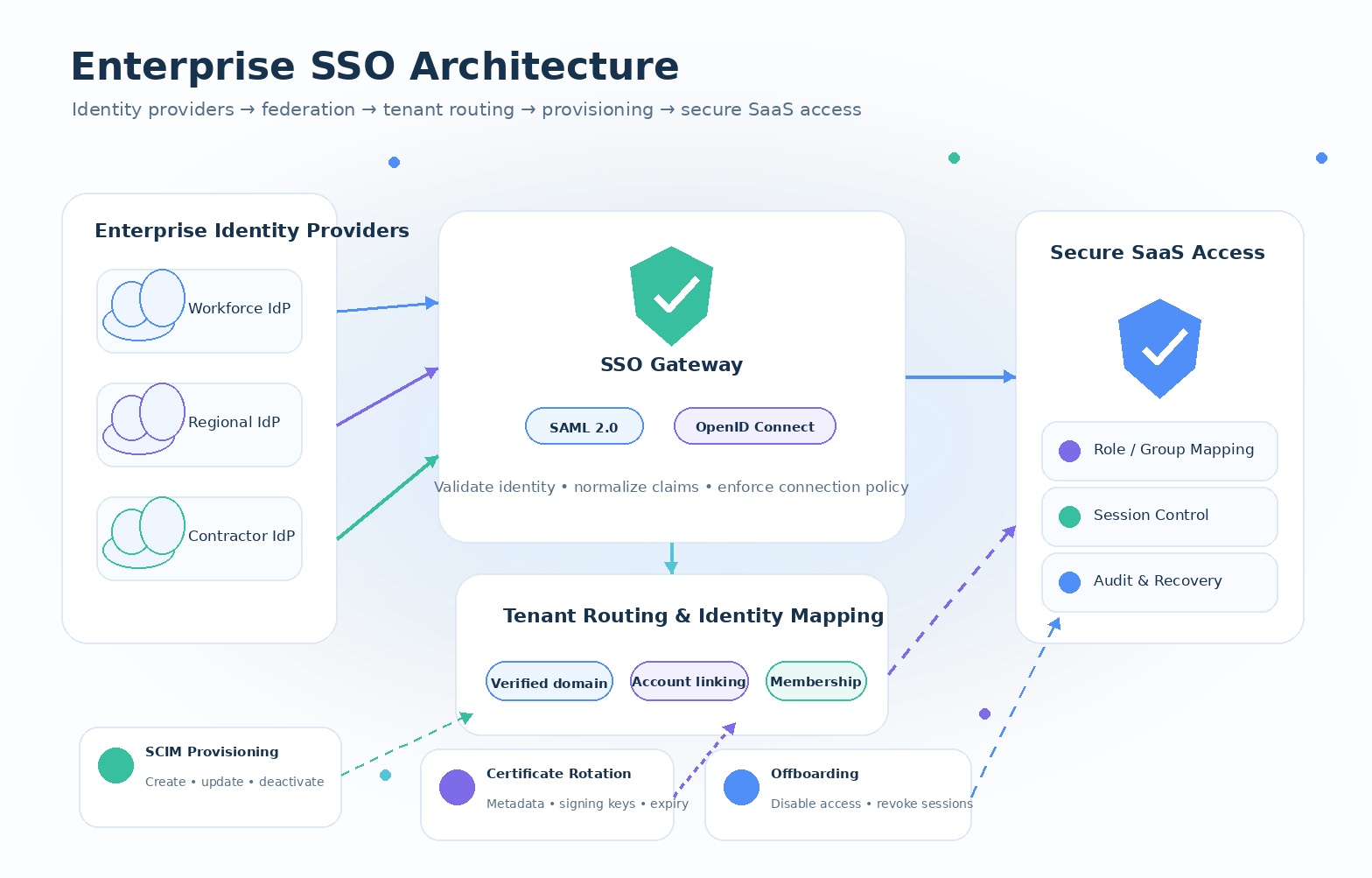
Enterprise buyers ask a short question during procurement: does the product support SSO? The vendor answers yes, sometimes accurately, sometimes optimistically, and the conversation moves on to pricing. Four words settle it. Nothing about those four words reveals what actually has to be true underneath them for the answer to hold up once four thousand employees, a directory the vendor has never seen, and an IT administrator with strict deadlines are involved.
"We support SSO" sounds like a binary fact, comparable to "we support dark mode" or "we support CSV export." It reads as a checkbox, and in a security questionnaire it often is one. But single sign-on is not a feature in the way a UI preference is a feature. It is a boundary between two systems that were never designed together: an external identity authority that a customer controls, and an internal identity and authorization model that the SaaS product controls. Everything difficult about enterprise SSO comes from keeping that boundary honest as both sides change independently, over years, across hundreds of customer configurations.
This article is organized around a series of assumptions that all have to remain true simultaneously for "we support SSO" to mean what a buyer thinks it means. None of them are exotic. Each one, on its own, sounds manageable. The difficulty is that they interact, and a team that has only tested the login button has usually tested one narrow path through a much larger space of legitimate enterprise behavior.
SSO Is a Compatibility Surface, Not a Feature Flag
A team that gets one SAML connection working with one identity provider, in one browser, with one test account, has proven that the protocol implementation is functionally correct under controlled conditions. That is a meaningful milestone. It is not the same claim as "our product supports enterprise SSO," even though the two statements often get compressed into the same sentence during a sales call.
The gap between them is compatibility across several independent axes at once:
- Protocols. SAML 2.0 and OpenID Connect are both federated identity standards, but they are not interchangeable implementations of the same idea, and a product that only handles one has made a real scoping decision, whether or not anyone said so out loud.
- Identity providers. Standards compliance narrows behavioral variation; it does not eliminate it. Metadata formats, default claim names, group export behavior, and certificate rotation habits differ across providers and even across configurations of the same provider.
- Tenants. A single connection has to resolve to exactly one customer organization, every time, including when the customer has multiple domains, subsidiaries, or a consulting firm sending users on their behalf.
- User states. New user, existing password user, disabled user, deprovisioned user, and user with a duplicate identity under a different login method are all different code paths, not variations on the same one.
- Organizational policy. Some customers make SSO optional. Some make it mandatory for all users. Some make it mandatory except for a short list of break-glass administrators. Some are mid-migration.
- Provisioning model. Some customers want every user created automatically on first login. Others want to control membership through a directory sync process and reject anyone who was not pre-provisioned.
- Access-control model. Authentication tells the product who someone claims to be. It does not, by itself, tell the product what that person may do once inside.
- Operational failure states. Certificates expire. Metadata goes stale. Configuration is entered incorrectly by a customer's IT administrator who has never seen the product before and will likely never see it again after setup.
None of these axes is unusual or specific to a demanding customer. They are the ordinary shape of enterprise identity. A product that has only exercised one path through this surface has an SSO capability that is real but narrow, and the distance between "narrow but real" and "production-ready for the next fifty enterprise customers" is where a large share of unplanned engineering work tends to live.
[Figure: Enterprise IdP → SSO boundary → SaaS internal identity → product authorization]
Authentication Ends Before Authorization Begins
The most consequential design decision in an SSO implementation is usually invisible in a demo: what does a successful login actually grant.
Authentication answers one question: is this person who they claim to be, according to an identity authority the customer trusts. Authorization answers a completely different question: what is this specific, now-identified person allowed to do inside this specific product. A valid SAML assertion or a valid OIDC token is evidence for the first question. It is not, by itself, an answer to the second.
This distinction sounds obvious stated plainly, and most engineers would agree with it immediately if asked directly. The problem is that it is easy to violate implicitly, without anyone deciding to violate it. A common failure shape looks like this: the first version of SSO support is built quickly, a successful assertion creates or updates a user record, that user record is granted membership in whatever tenant the code could infer, and the membership defaults to a permissive role because nobody wrote an explicit deny path and the happy path had to work for the demo. Nothing in that description looks like a security decision. It is a sequence of small, reasonable-looking shortcuts that add up to authorization being derived implicitly from authentication, which is precisely the coupling that later needs to be undone, usually under time pressure, usually after a customer notices.
Concrete cases where the two must be kept separate:
A verified employee of the customer organization authenticates successfully. That does not mean they should become an administrator of the product. Product administrator status is an authorization decision the application should make deliberately, not an artifact of "the assertion was valid."
A user is removed from a workspace inside the product by another admin. Their identity still exists in the enterprise directory, and they can still authenticate against it. Authentication succeeding again should not silently restore access that was deliberately revoked inside the product's own authorization model, unless that is an explicit design decision the team made and can defend.
A contractor authenticates through the same enterprise IdP as full-time employees, because the customer's directory does not distinguish contractor accounts at the identity layer. The product's authorization model, not the IdP, is where the distinction between contractor-level access and employee-level access has to live, if it needs to exist at all.
The practical implication is architectural: identity resolution (who is this, and which tenant are they logging into) and authorization resolution (what can they now do) should be separable steps, ideally implemented as separable code paths, so that a bug or a misconfiguration in one does not silently become a privilege decision in the other.
| Layer | Question it answers | Typical inputs | Owned by |
|---|---|---|---|
| Authentication | Is this person who they claim to be? | SAML assertion / OIDC token, signature, issuer | Identity provider + protocol handler |
| Tenant resolution | Which organization is this login for? | Domain, connection ID, RelayState, subdomain | Application routing layer |
| Provisioning | Does an internal account exist, and should one be created? | JIT rules, SCIM state, invitation state | Application identity service |
| Authorization | What may this identity do inside this tenant? | Roles, group mappings, entitlements, resource ownership | Application authorization model |
[Internal link opportunity: access control testing]
Protocols Solve Overlapping but Different Problems
SAML 2.0 and OpenID Connect both provide federated identity. Neither is a strictly superior successor to the other, despite OIDC being newer, and a mature enterprise product typically ends up supporting both because different segments of the customer base standardize on different stacks.
SAML is XML-based. Identity is expressed as a signed assertion, exchanged through browser redirects and POST bindings, described by metadata documents that specify entity IDs, endpoints, and signing certificates. It has deep roots in enterprise identity infrastructure, and large organizations with long-established directory investments frequently have SAML-based tooling and administrative habits already in place. Its browser-redirect and POST-binding mechanics mean the client is usually a full browser session, which shapes how it behaves in mobile and native app contexts.
OpenID Connect is built on top of OAuth 2.0 and expresses identity as a JSON Web Token. It fits more naturally into modern web and mobile authentication flows, including cases where an application needs to combine authentication with delegated API access. Claims are simpler to work with programmatically than XML assertions, and the OAuth foundation gives it a more flexible set of grant types for different client types.
Neither protocol is "the secure one" or "the modern one" in a way that should drive an architectural decision by itself. Security depends on correct signature validation, correct audience and issuer checks, and correct handling of the specific bindings a product implements, not on which specification the mechanism happens to come from. The practical reason enterprise products support both over time is customer distribution: large regulated enterprises and government-adjacent organizations skew toward SAML-based identity infrastructure, while newer, cloud-native organizations more often standardize on OIDC-based providers. A product targeting a broad enterprise market eventually needs both, not because one is deficient, but because customer directories are heterogeneous.
| Dimension | SAML 2.0 | OpenID Connect |
|---|---|---|
| Data format | XML assertions | JSON Web Tokens |
| Foundation | Purpose-built federation standard | Built on OAuth 2.0 |
| Typical transport | Browser redirect / POST binding | Redirect with authorization code, or implicit/hybrid flows |
| Common enterprise fit | Established enterprise directories, long-standing IT tooling | Cloud-native organizations, mobile and API-integrated apps |
| Metadata | XML metadata documents | Discovery document (well-known configuration) |
| Typical integration effort | Certificate and metadata management | Token validation and claim mapping |
The Tenant Is Part of the Login
In a single-tenant product, "who is logging in" is the entire question. In multi-tenant SaaS, a second question arrives at exactly the same moment: which organization is this login for. Treating tenant resolution as an afterthought to authentication is one of the more common sources of subtle, hard-to-reproduce bugs in enterprise identity systems.
Tenant resolution strategies each carry different assumptions:
Email domain matching infers the organization from the domain portion of an email address returned in the assertion or token. It is simple and works well for the common case of one organization per domain, and it breaks down the moment a domain is shared or ambiguous.
Organization slug or explicit tenant selection asks the user, or the URL, to state the tenant directly, which removes ambiguity but adds friction, particularly for IdP-initiated flows where there is no product-controlled starting page to put the selector on.
Customer-specific login URLs bind a distinct entry point to a distinct tenant, which resolves ambiguity cleanly for SP-initiated flows but requires the customer's users to know or bookmark the correct URL rather than typing the product's general domain.
Invitation-link-based resolution ties the first login to a specific pending invitation record, which works well for onboarding a known user but does not generalize to ongoing directory-driven access.
The ambiguity is not a hypothetical edge case. Consider a user with the address someone@consulting-firm.com who has been engaged by five different client organizations, each of which has configured SSO with the same corporate IdP that consulting-firm.com uses internally. Domain alone cannot determine which of the five client tenants this particular login attempt is for, because the domain is the consultant's employer, not any of the five customers. The same structural ambiguity shows up with subsidiaries that share a parent company's directory, with organizations mid-merger that have not yet consolidated domains, and with managed service providers whose staff authenticate through one IdP to service many client accounts.
None of these situations is unusual for a product that sells into mid-market or enterprise accounts for more than a year or two. They are the ordinary consequence of how organizations actually structure themselves, and a tenant resolution strategy that only handles the one-domain-per-customer case will eventually collide with one of them.
[Figure: Tenant routing with multiple IdPs and overlapping domains]
Domain Discovery Looks Simple Until It Isn't
Domain-based tenant discovery deserves its own scrutiny because the underlying assumption, email domain equals organizational ownership, is weaker than it appears.
Verified domains solve part of the problem: a customer proves control of a domain (commonly through a DNS TXT record or a similar mechanism) before the product treats logins from that domain as belonging to that tenant. Domain verification is table stakes for any product that lets an organization claim a domain for SSO purposes, because without it, anyone controlling an email address on a shared domain could otherwise attempt to associate themselves with an organization they do not belong to.
Beyond simple verification, several structural cases complicate the picture: multiple verified domains for one organization, which is common after a rebrand or a product line acquisition; subdomains that may or may not be intended to inherit the parent domain's tenant association; alias domains registered defensively by IT but not actually used for employee email; consumer email domains that a small business may still be using for some of its staff; contractors whose email domain belongs to their employer, not the customer; and domain ownership that changes entirely after a merger, acquisition, or divestiture, sometimes leaving a domain pointed at a different organization than the one that originally verified it.
The design implication is that domain-to-tenant mapping should be treated as data the product owns and can update, not as an assumption baked into authentication logic. Verification status, not domain string matching, should gate trust, and the product should have deliberate behavior for the case where a domain that is not currently verified appears in a login attempt, rather than falling back to guesswork.
SP-Initiated and IdP-Initiated Flows
Enterprise customers reasonably expect login to work from two different starting points. SP-initiated flow begins at the SaaS application: a user visits the product, indicates their organization, and is redirected to the IdP to authenticate before being sent back. IdP-initiated flow begins at the enterprise identity portal: a user clicks the product's tile inside their company's app launcher and arrives at the product already carrying an assertion or token, without ever visiting the product's own login page first.
Both are legitimate and both get requested, often by the same customer, because different users have different habits and because some IT departments standardize on portal-based access as their default employee experience.
IdP-initiated flow introduces routing questions that SP-initiated flow does not have to answer, because there is no product-controlled starting page to carry state. RelayState, when supported, can specify a destination inside the application, but it has to be handled carefully since it originates from outside the product's own session. Deep links, meaning a request to land the user on a specific resource after login rather than a generic dashboard, are harder to support cleanly from an IdP-initiated start. And if a single IdP is associated with multiple tenants, or if the specific connection used does not unambiguously map to one tenant, the routing decision has to be made using only what arrived in the unsolicited assertion, without the benefit of anything the product itself set up beforehand.
A product that only tests SP-initiated flow, because it is easier to trigger deliberately during QA, will frequently discover that IdP-initiated behavior needs separate handling once a customer's IT team configures the product as a portal tile and employees start clicking it.
| Flow | Starting point | Tenant context available before authentication | Typical complication |
|---|---|---|---|
| SP-initiated | The SaaS application | Yes, established before redirect | Ensuring the redirect carries enough state to return correctly |
| IdP-initiated | The enterprise identity portal | No, arrives only with the assertion/token | Resolving tenant and destination without prior context |
Claims Are a Data Contract, Not a Guarantee
Every SAML assertion or OIDC token carries a set of claims or attributes: typically some form of email, a name, possibly group membership, possibly a department, possibly an internal employee identifier, and possibly a tenant-specific identifier the customer's IT team has added deliberately. Treating this payload as a fixed, self-describing structure is a common early mistake, because in practice it behaves as a negotiated data contract that varies per customer and per IdP.
The attribute that a product's own logic assumes will always be "email" may arrive under a different name depending on the customer's configuration: mail, email, emailAddress, upn, or preferred_username are all plausible names for functionally the same value, and different identity providers, and different administrators configuring the same identity provider, make different choices. Required claims that the product genuinely cannot function without need to be distinguished from optional claims that enrich the experience but should not block login if absent. Case sensitivity in claim names and claim values is inconsistent across providers. Multi-valued attributes, most commonly group membership, need to be handled as collections rather than assumed to be a single string.
The only durable solution is configurable claim mapping: a mechanism, ideally with a validation and testing step, that lets each tenant's SSO configuration specify which incoming claim corresponds to which internal field, rather than hardcoding claim names into the protocol handler. This is not a statement that any particular mapping is universal or correct by default; different customers will genuinely require different mappings, and a product that ships with only one hardcoded assumption about claim names has effectively decided, without deciding on purpose, that it only supports the subset of IdP configurations that happen to match its assumption.
[Figure: Claims as a configurable data contract between IdP and application]
Email Is a Convenient Identifier Until It Changes
Email address is the most human-legible identifier available in most SSO exchanges, which makes it tempting to use as the primary key linking an external identity to an internal account. It is also mutable in ways that make it a fragile long-term anchor.
Alternative candidates for the internal identity key each have tradeoffs. The IdP's subject identifier, sometimes surfaced as NameID in SAML or sub in OIDC, is typically stable for a given IdP connection but is opaque, meaningless outside that specific connection, and not portable if the customer changes identity providers. An enterprise employee ID, when available as a claim, can be more stable than email but is not guaranteed to be present, is not standardized across IdPs, and requires the customer to have configured its export deliberately. A purely internal user ID, generated and owned by the application itself, is stable by construction but has to be linked to an external identity through some other mechanism, which just relocates the problem rather than solving it.
Email changes for reasons that have nothing to do with the SaaS product and everything to do with the customer's own operations: an employee's name changes and their email is regenerated to match, a company rebrands and issues new addresses on a new domain, an employee transfers between subsidiaries that use different domains, or an organization simply issues an email alias without retiring the original address. If the product's internal identity is keyed entirely on email, any of these ordinary events can produce what looks, from inside the application, like an entirely new person, disconnected from the history, permissions, and content the original account had accumulated.
| Identifier | Stability | Portability across IdP changes | Human-readable | Typical availability |
|---|---|---|---|---|
| Email address | Low to moderate | Depends on domain stability | Yes | Almost always present |
| IdP subject identifier (NameID / sub) | High within one connection | None | No | Always present |
| Enterprise employee ID | Moderate to high | High if consistently exported | Somewhat | Often optional, customer-dependent |
| Internal application user ID | High by construction | Full | No | Always present, but needs a linking mechanism |
Account Linking Is High Risk
Account linking is the process of connecting a newly arriving SSO identity to an existing internal account, and it is one of the places in an SSO implementation where a permissive default can create an actual security vulnerability rather than just an inconvenience.
The scenario that makes this concrete: a user already has a password-based account in the product, created before the customer enabled SSO. The customer then turns on SSO. The same user authenticates through the IdP for the first time. Should the product automatically link this new SSO identity to the pre-existing password account, silently inheriting its history, permissions, and content? The intuitive answer is often yes, because it is the same human being, and forcing them to start over with a fresh account feels unnecessary. But the question the product actually has to answer is narrower and more adversarial: what evidence, exactly, establishes that the SSO identity and the password account belong to the same person, and is that evidence strong enough to justify an automatic grant of access to everything the password account could already do.
If the matching signal is simply "the email addresses are the same string," and email addresses are not verified at account creation time in the product's own signup flow, then an attacker who knows a target's email address could, in principle, have created a password account under that address earlier, and would then inherit access when the real user's IdP-backed identity links to it, or the reverse could occur depending on which side is trusted more. The specifics vary by implementation, but the general shape of the risk is the same: automatic linking based on a weak signal converts an identity coincidence into an authorization grant.
Approaches products use, each with different security and friction tradeoffs, include: automatic linking gated on a verified email match, where "verified" means the product itself confirmed ownership of that address at some point, not merely that the string matches; administrator-approved linking, where a customer admin explicitly confirms the association, which is safer but adds operational overhead; and structured migration flows, where the customer or the product runs a one-time reconciliation process rather than relying on linking logic firing organically as users log in over time.
There is no single universally correct policy here, and the article does not prescribe one. What is consistent across implementations is that the risk scales with how much an attacker could gain from a false positive, and that "match on email string" without a verification step behind it is the version of this decision most likely to produce a takeover path.
Just-in-Time Provisioning
Just-in-time, or JIT, provisioning creates or updates an internal account automatically at the moment a user successfully authenticates through SSO, rather than requiring the account to already exist. It is popular because it removes friction: a new employee's first login can also be their account creation event, with no separate onboarding step inside the product.
The convenience comes with a set of questions that a naive implementation tends to skip, because the happy path, a brand-new user logging in for the first time at a customer with plenty of available seats, does not surface them:
Which tenant does this new account belong to, if tenant resolution itself is ambiguous. Which role should the account receive by default, and is that default safe if group-based mapping is not configured or fails to resolve. Which permissions follow from that role. Which product plan or entitlement tier governs what this new account can access, if the customer has a mixed-tier arrangement. What happens if a user with this identity already exists, whether through a prior password account, a prior SSO login through a different connection, or a SCIM-provisioned record that has not yet been logged into. What happens if the customer has a limited number of purchased seats and this login would exceed it. And, perhaps most importantly for security-conscious customers, what happens if the customer's actual intent is that only pre-approved users should ever gain access, meaning JIT provisioning itself is the wrong provisioning model for them and should be disabled or gated behind an allowlist.
That last point matters because it is easy to treat "successful authentication" and "permission to provision an account" as the same event by default, when many enterprise customers explicitly do not want that coupling. A customer running a tightly controlled joiner-mover-leaver process through their directory may want accounts created only through SCIM, with JIT disabled entirely, so that authentication never has the side effect of granting product access to someone the directory technically allows to authenticate but has not yet been formally granted product access.
SCIM Changes the Identity Lifecycle
SSO and SCIM solve different problems that are frequently requested together and easy to conflate. SSO is about authentication: verifying who someone is at the moment they try to log in. SCIM, the System for Cross-domain Identity Management, is about provisioning: keeping the set of accounts that exist inside the product synchronized with the set of people who should have them, independent of whether or when any individual person actually logs in.
The operations a SCIM integration typically needs to support include creating a user record when the customer's directory adds someone, updating attributes when the directory changes them, deactivating a user when they leave or lose access, and reflecting group membership changes so that role and permission mappings can respond without waiting for the person's next login.
The reason enterprise customers often request both SSO and SCIM together is that SSO alone leaves a gap: an employee who never logs in still technically has a dormant account, and an employee who is removed from the directory but never attempts to log in again still has an account that was never explicitly deprovisioned, because deprovisioning-by-absence is not a real mechanism. SCIM closes that gap by making the account lifecycle directory-driven rather than login-driven, which matters a great deal for the offboarding case discussed in the next section.
[Figure: SCIM lifecycle flow — create, update, deactivate, group sync]
| Capability | SSO alone | SSO + SCIM |
|---|---|---|
| Verifies identity at login | Yes | Yes |
| Creates accounts before first login | No | Yes |
| Removes access when directory removes a user, even if they never log in again | No | Yes, if deactivation is implemented |
| Reflects group/role changes without waiting for next login | No | Yes |
| Requires customer to run a separate sync process | N/A | Yes, typically automated by the IdP |
Offboarding Is Where Identity Becomes a Security Control
Everything discussed so far concerns getting people in. Getting people out, correctly and completely, is where an SSO implementation is judged as a security control rather than as a login convenience, and it is a section worth being precise about because partial answers are common and can look complete from the outside.
When an employee leaves an organization, several mechanisms might contribute to removing their access, and they are not equivalent to each other. The IdP can be configured to deny future authentication attempts, which stops new logins but says nothing about sessions that are already active. A SCIM integration can deactivate the corresponding account inside the product, which is a stronger signal but depends on the customer's directory actually triggering the deactivation promptly and on the product actually implementing SCIM deactivation rather than only creation. The product's own session handling can expire an existing session after some interval, which limits the exposure window but does not close it immediately unless the product specifically checks for revocation on every request. And an administrator inside the product can manually remove the person's membership, which works but depends on someone remembering to do it and having the access to do it.
The gap that is easy to underestimate is that blocking future SSO login addresses only the authentication front door. It says nothing about several other forms of standing access that may have been issued earlier and remain independently valid: an existing browser session that has not expired, a refresh token that continues to mint new access tokens without requiring a fresh login, a personal access token the user generated for API use, a mobile app session that persists across app restarts, or service credentials tied to an integration the user set up personally. None of these necessarily check back in with the identity provider before continuing to function.
A defensible offboarding design treats identity lifecycle synchronization as covering more than the login screen: it defines what happens to each category of standing access when a deactivation signal arrives, whether that means immediate session termination, requiring reauthentication on next request, revoking issued tokens, or some documented combination. This is not a claim that every product must revoke every session instantly the moment a SCIM deactivation event fires; that is a product and risk-tolerance decision, and different customers may have different expectations. What matters is that the policy is explicit, documented, and testable, rather than an assumption that "SSO handles offboarding" because login now fails.
[Figure: Offboarding event and the standing access it does, and does not, immediately affect]
Session State Outlives the Login Event
A related and distinct point: session state in most products is designed to be long-lived on purpose, for the sake of user convenience, and that design goal is in some tension with identity revocation.
Application sessions, refresh tokens, "remember me" mechanisms, and separately maintained mobile sessions are all forms of state that were created at some past login event and are intended to keep working without requiring the user to authenticate again for a period of time, sometimes a long one. This is good user experience under normal conditions and a liability the moment the underlying identity needs to be cut off quickly.
The gap to be explicit about: an IdP account can be disabled while an application session generated from an earlier, valid login remains fully functional, because nothing in a typical session implementation checks back with the IdP on every request. Whether that gap is acceptable depends entirely on the product's risk posture and the customer's expectations, which is why reauthentication policy, meaning how often and under what conditions a session is forced to re-verify against the IdP, and session revocation, meaning the product's ability to actively invalidate a session before its natural expiry, are both design decisions that need to be made deliberately rather than left as accidental consequences of how the session store happens to work.
Single Logout Is Not as Simple as Single Sign-On
Users reasonably expect that logging out means logging out everywhere. The mechanics rarely deliver on that expectation as cleanly as the mechanics of logging in deliver on single sign-on, and the asymmetry is worth naming directly because it is a frequent source of user confusion and support tickets.
Several distinct things can happen when a user clicks "log out," and they are not the same event: logout from the application itself, which typically just ends the local application session; logout from the local browser session more broadly, which may or may not be scoped the same way as the application session; logout from the IdP's own session, which, if it happens at all, requires the application to actively participate in a single logout exchange with the IdP rather than just clearing its own state; and logout across the customer's broader enterprise session, which might span many applications the IdP has issued sessions for and is generally outside any individual SaaS product's control entirely.
SAML and OIDC each define mechanisms for propagating logout back to the identity provider, but implementation and support for these mechanisms varies across providers, and a product that only clears its own local session, without initiating any logout exchange with the IdP, has implemented "log out of this application" correctly while leaving the user's belief that they have "logged out everywhere" unaddressed. This is not necessarily a defect; many products make a deliberate, reasonable choice to keep logout scoped locally. The risk is in the gap between what the product actually does and what a security-conscious customer assumes it does, which is worth resolving through explicit documentation rather than silence.
Group Mapping
Enterprise directories commonly organize employees into groups, and a natural pattern is to use those groups to drive product roles: members of an "Engineering" group become "Developer" role holders inside the product, members of "Finance" become "Billing Viewer," members of an "Admins" group become "Workspace Admin."
The pattern is useful and widely requested, and it introduces its own set of configuration hazards. Group naming is customer-specific and not standardized, so the mapping has to be configured per tenant rather than assumed. Directories frequently use nested groups, where membership in a parent group implies membership in a child group without that child membership being explicitly listed in the claim the product receives, which can cause a product that only reads flat group lists to miss intended memberships. Groups get renamed by IT administrators without necessarily updating every downstream system that references the old name. Groups get deleted and recreated for organizational reasons unrelated to the SaaS product. Users commonly belong to multiple groups simultaneously, and when those groups map to conflicting product roles, the product needs an explicit priority or combination rule rather than undefined behavior.
None of this implies that any particular customer's directory structure is unusual or that enterprise directories should export groups identically; they do not, and a product's group mapping configuration has to be built with that variation as the expected condition rather than the exception.
[Figure: Group and role mapping, including conflicting and nested memberships]
Role Mapping Can Create Privilege Escalation
Group and role mapping deserves separate treatment from a security angle, because a misconfiguration here does not merely produce an inconvenient bug; it can grant a user access they should not have, silently, with no error message to alert anyone.
If a mapping rule is written broadly, for example treating any unrecognized group as qualifying for a default role that turns out to be more permissive than intended, or if a mapping evaluates multiple matching groups by taking the most permissive result without that being an explicit, reviewed design decision, the result is a user acquiring elevated access as a side effect of directory structure the product's engineering team never examined.
The general defensive posture, without prescribing exploitation-relevant specifics, involves a small number of consistent principles: default to the least privileged role when a mapping is ambiguous or a group is unrecognized, rather than defaulting to a permissive one; make every mapping rule explicit and visible to the customer's administrator rather than implicit in code; make elevated role assignments, especially anything close to product-administrator level, subject to review or at least clear audit visibility rather than silent automatic grant; and ensure that mapping configuration changes are themselves logged, so that an unexpected privilege change can be traced back to the directory or configuration event that caused it.
Multiple IdPs Per Customer
A single customer organization does not always mean a single identity provider. Larger or more complex customers may need a primary workforce identity provider for full-time employees, plus a separate provider for a recently acquired company that has not yet been consolidated into the parent directory, plus a distinct mechanism for contractors who were never issued accounts in the main directory at all, plus, in some cases, a regional identity provider serving a subsidiary with independent IT infrastructure, plus a sandbox or test identity provider used purely for validating configuration before rollout.
This raises a modeling question that is easy to answer implicitly and wrong: does an SSO connection belong to the tenant as a whole, to a specific domain within the tenant, or to a specific workspace inside the tenant. Each choice has consequences. If connections are modeled strictly one-per-tenant, a customer needing two providers cannot be served without either forcing an artificial merge of two directories or splitting into two separate tenant records that then have to somehow share billing, branding, and other tenant-level configuration. If connections are modeled per-domain or per-workspace instead, the product needs tenant routing logic sophisticated enough to route a login to the correct connection based on more than just "which tenant is this," and admin tooling has to expose multiple connections per tenant clearly, rather than assuming a one-to-one relationship that the data model may not actually enforce, and that customer growth will eventually violate anyway.
One IdP Can Serve Multiple Tenants
The reverse relationship is equally real and equally easy to miss if the data model assumes a one-to-one mapping between an identity provider connection and a customer tenant. Consulting firms, holding companies, and managed service providers commonly operate a single corporate directory that their staff use to authenticate into many different client organizations' instances of a product. A parent company with several subsidiaries that each purchased the product independently might likewise share one central directory across what the SaaS vendor considers several distinct customer accounts.
The architectural implication is that "IdP connection" and "tenant" should not be treated as synonyms in the data model or in the routing logic, even though the simplest possible implementation, and often the first one built, quietly assumes they are. A single connection identity, meaning the specific configured integration with a specific IdP, needs to be able to resolve to different tenants depending on additional context, such as which application instance the user started from, which group they belong to, or which tenant-specific parameter accompanied the login request, rather than the connection itself uniquely determining the tenant.
Certificates Turn SSO Into an Operational Dependency
Everything discussed so far is largely a design-time concern. Certificate management is where SSO becomes an ongoing operational responsibility that persists long after the initial integration ships, and it is one of the more common sources of production incidents in mature SSO implementations, not because it is technically difficult, but because it is easy to forget once the initial setup succeeds.
In SAML specifically, signing certificates are used to verify that assertions genuinely originated from the claimed identity provider, and certificates have expiration dates by design. The customer's IdP has a certificate the product must trust; the product may also present its own certificate that the customer's IdP must trust, depending on the binding and configuration used. Either side rotating its certificate without the other side being updated in lockstep produces authentication failures for every user at that tenant simultaneously, typically without warning, because certificate expiry does not announce itself to whichever side is not tracking it.
The common operational failure pattern takes one of two symmetric shapes: the customer rotates their signing certificate as part of their own internal security hygiene, and the product continues trusting only the old certificate because nothing prompted an update to stored metadata; or the product rotates its own certificate, and the customer's IT administrator, who configured the integration once during onboarding and has not touched it since, never updates their side, because they were never notified that an update was needed.
Mitigations that reduce this operational risk include supporting multiple simultaneously trusted certificates during a rotation window, so that old and new certificates both validate until the transition is complete; consuming and periodically refreshing metadata automatically where the IdP supports a metadata URL rather than a one-time upload; building expiry visibility directly into administrator-facing tooling, so a customer's IT team can see an approaching expiration date without being told about it by a support ticket after the fact; and generating proactive alerts, to both the customer's administrators and, where feasible, internal operations, ahead of expiry rather than at the moment of failure.
[Figure: Certificate rotation with an overlapping trust window]
Metadata Is Configuration, Not Magic
SAML metadata is often treated, especially by less experienced implementers, as something that gets uploaded once during setup and then simply works indefinitely. It is better understood as configuration data with the same lifecycle risks as any other configuration: it can go stale, it can be entered incorrectly, and updates on one side do not automatically propagate to the other.
A metadata document typically describes the entity ID that uniquely identifies the IdP or the service provider, the SSO URL the browser is redirected to for authentication, the signing certificate or certificates in use, and the specific bindings supported for the exchange. Some products support automatic metadata refresh, where the product periodically re-fetches the customer's metadata from a URL the customer's IdP publishes, keeping certificate rotations and endpoint changes in sync without manual intervention. Others rely on a one-time manual upload, which is simpler to implement but places the burden of noticing and re-uploading updated metadata entirely on the customer's IT team, who have no particular reason to remember that this product depends on it.
Stale metadata is a quiet failure mode: nothing about an outdated metadata document looks broken until an authentication attempt actually fails against it, which means the gap between "metadata went stale" and "someone notices" can be arbitrarily long, and the eventual failure often looks, from the customer's side, like the product simply stopped working for no reason.
Redirect URIs and Callbacks Are Environment-Specific
Every SSO integration involves a callback: an endpoint the identity provider redirects back to, or POSTs an assertion to, after authentication completes. That endpoint is inherently environment-specific, and a product with production, staging, QA, and development environments, plus potentially a customer-specific sandbox, has as many distinct callback configurations as it has environments that need to exercise SSO.
Enterprise IdP administrators frequently need to register the SaaS application separately for each environment they intend to test against, with separate credentials, separate redirect URIs, and, particularly for OIDC, separate client IDs and secrets per environment. This is not an inconvenience the product can design away entirely; it is a structural consequence of the fact that "works in the engineering team's dev environment," where callback URLs point to local infrastructure, provides limited assurance that the customer's actual production configuration, pointed at the product's production callback URL, will behave the same way, since the two are, from the identity provider's perspective, genuinely different registered applications.
Test Environments Are Part of the Enterprise Product
This deserves treatment as a first-class product capability rather than an internal engineering convenience, because enterprise customers need it for their own rollout process, not just because the vendor's QA team finds it useful.
A customer preparing to enable SSO for several thousand employees does not want their first real test to be flipping the switch for the entire workforce simultaneously. They want a way to validate that their configuration, their specific metadata, their specific claim mapping, their specific group export, actually works correctly before anyone's daily login depends on it. That requires the product to support something like a sandbox identity provider connection, a small set of designated test users who can exercise the full login flow without affecting real accounts, a configuration validation step that checks structural correctness (valid metadata, reachable endpoints, matching entity IDs) before anything goes live, and ideally a dry-run login capability that reports what would have happened, including which tenant, which role, and which claims were received, without actually granting a session.
The absence of this capability does not make SSO fail to work; it makes enterprise rollout riskier and slower, because the customer's only way to validate configuration is to attempt it against production and hope, which is precisely the situation careful IT administrators try to avoid, and precisely the situation that produces the lockout scenario discussed next.
The Lockout Problem
A specific and severe failure mode deserves direct attention: a customer administrator enables mandatory SSO, the configuration turns out to be wrong in some way, either through their own error or a mismatch with the product's expectations, and now nobody, including the administrator who made the change, can log in to fix it, because password login has been disabled and SSO is broken.
This is not a hypothetical edge case; it is a predictable consequence of combining "SSO is the only login path" with "SSO configuration can be entered incorrectly," and any product that supports enforced SSO needs a deliberate answer to it. Common approaches, at a conceptual level, include maintaining an emergency administrator authentication path that bypasses the tenant's SSO enforcement under tightly controlled and heavily audited conditions; requiring at least one secondary verified administrator who retains an alternate authentication method specifically to prevent single points of failure; providing a support-assisted recovery process, where the vendor's own support team can verify the requester's identity through an out-of-band process and restore access; or offering a temporary, time-limited bypass mechanism that is itself gated behind strong verification and produces a clear audit trail.
Whichever mechanism a product chooses, the two properties that matter most are auditability, so that any use of an emergency path is visible and reviewable after the fact, and strong verification, so that the emergency path does not become a more convenient attack surface than the SSO configuration it exists to work around. This article deliberately does not describe bypass mechanics in exploitable detail; the point is that a deliberate, secure, audited recovery path needs to exist, not what its exact implementation should be for any given product.
Enforced SSO vs Optional SSO
Products generally need to support more than one enforcement posture, because customers arrive at different points on this spectrum and often move along it over time. SSO can be entirely optional, available to users who want it but not required. It can be required for some subset of users, commonly a customer's administrators or a specific security-sensitive group, while remaining optional for others. It can be required for all members of a tenant. And, in the most disruptive configuration, password login can be disabled entirely following a completed migration, so that SSO becomes the only path.
Each transition between these states has to account for populations that a simple toggle switch does not: existing users who have password accounts and have never logged in through SSO before enforcement begins; brand-new users who join after enforcement is already active and never had a password account to begin with; administrators, who need special handling given the lockout risk described above; and service or automation accounts, discussed next, which frequently cannot use human SSO flows at all and need an explicit exemption or an entirely separate mechanism.
The migration period between "SSO available" and "SSO enforced" is where most of the actual complexity lives, because it requires the product to correctly handle a mixed population of authentication methods simultaneously, potentially for an extended period, rather than assuming a clean cutover happens at a single moment in time.
Service Accounts Do Not Fit Human SSO Cleanly
Enterprise customers commonly need programmatic access to the product: API integrations, automation scripts, bots, and other machine identities that need to authenticate without a human present to complete an interactive login flow. SSO protocols, particularly the browser-redirect-based flows common to both SAML and OIDC, are designed around an assumption of an interactive human user in a browser, and forcing that model onto a non-human identity tends to produce awkward workarounds rather than a clean fit.
The practical implication is that service accounts generally need a separate authentication mechanism from human SSO, conceptually distinct even if the underlying credential management shares infrastructure with the human identity system. What matters for this article's purposes is recognizing that "we support SSO" is a statement about human interactive login, and a customer who also needs machine-to-machine access should not be led to assume that enforcing SSO for their organization automatically defines or secures how their API integrations authenticate; that is a related but separate capability that needs its own explicit design.
Guest Users and External Collaborators
Many B2B products are explicitly designed to support collaboration that extends beyond a single customer's own workforce: agency partners, vendors, external auditors, outside counsel, or the customer's own clients might all need some form of access to a shared workspace inside the product.
A customer that requires SSO for its own employees has, by definition, not necessarily made any statement about how it wants these external parties handled, and a product needs a deliberate policy rather than an assumption. Options include allowing guest access through a separate, non-SSO authentication path that coexists with enforced SSO for the primary tenant; requiring guests to authenticate through their own organization's identity provider if they have one, effectively treating the collaboration as a federation across two separate identity boundaries; or restricting guest access entirely for security-sensitive tenants that have opted into strict enforcement.
This article does not argue for one universal model, because the correct answer depends heavily on the product's actual collaboration use case and the customer's risk tolerance. What matters architecturally is that the decision be explicit and configurable per tenant, rather than an accidental consequence of how enforcement logic happens to be written.
Mergers and Domain Changes
Corporate structure changes over the lifetime of a long-running enterprise customer relationship, and identity systems have to survive those changes without losing the internal history that the product has accumulated. A company changes its domain following a rebrand. A company acquires another company and eventually wants to consolidate directories. Two previously separate directories get merged into one. Users move from one identity provider to an entirely different one as part of a broader IT consolidation.
In each of these cases, the goal from the product's perspective should be preserving application-internal identity, meaning the specific internal user record with its history, roles, workspace memberships, resource ownership, and audit trail, across a change in the external identity that authenticates it. External identity changing should not, by itself, mean that internal identity has to be recreated from scratch, provided the product has a defensible way to establish that the same internal identity continues to correspond to the same underlying person or account, which typically depends on the internal identifier design discussed earlier remaining decoupled from the external identifier that happens to be in use at any given moment.
User Renames and Email Changes
A narrower, more concrete version of the same problem deserves its own treatment because it happens routinely, not just during major corporate events. An employee named Alice Smith gets married and changes her name; her email address changes from alice.smith@company.com to alice.jones@company.com as part of the same event. Separately, and unrelated to any individual's life event, a company's domain changes from company.com to newcompany.com as part of a rebrand, affecting every employee's address simultaneously.
If application identity is keyed on email, both of these ordinary, entirely legitimate events look identical to the product as "a new user showed up." The desirable behavior, from both a user experience and a data-integrity perspective, is that the existing internal identity's history, permissions, and content remain associated with the person, and that the change is recognized as an update to an existing record rather than the creation of a new one. Achieving that in general requires either a stable identifier that survives the email change, most reliably the IdP's own subject identifier if the IdP connection itself remains constant, or an explicit reconciliation step, whether automated through SCIM update events or manually performed by an administrator, when the identifier that does change is the one the system happens to be relying on.
Duplicate Users
Duplicate identities inside a product's internal user model are a predictable byproduct of supporting multiple authentication methods for what is, from the real world's perspective, a single human being. A user might have a legacy password account created before SSO was configured, a SAML-based account created after SSO was enabled and first used, a separate OIDC-based account if the customer later added a second identity provider, and a SCIM-provisioned record created by the directory sync process independently of any of the user's own login attempts. Left unreconciled, these can exist as four distinct internal records for one person.
Detecting duplication generally requires looking at signals beyond a single field, since the whole reason duplicates arise is that no single field reliably ties the records together across every account-creation path. Remediation is genuinely difficult once duplicates have diverged, because the harder version of the problem is not detection but data ownership: if two duplicate accounts have each independently created documents, comments, or other content inside the product before anyone notices the duplication, merging the accounts means merging that content's ownership as well, which is a data migration problem layered on top of an identity problem, and one that benefits from being designed for proactively rather than solved reactively after a customer discovers the issue themselves.
Deprovisioning Should Not Destroy Business Data
A distinction worth stating plainly because it is easy to conflate in implementation: disabling a user's access and deleting that user's data are different operations with different consequences, and an offboarding flow that treats them as the same event risks destroying business records the customer never intended to lose.
When an employee leaves an organization, the customer generally wants their future access blocked immediately. The customer does not generally want the documents that employee authored, the support tickets they were assigned, the projects they contributed to, the comments they left, or the approvals they issued to vanish along with their access, because that content typically belongs to the organization, not to the departing individual, and other people inside the organization frequently depend on it continuing to exist and remain attributable.
A well-designed deprovisioning flow separates access revocation, which should generally happen promptly, from data lifecycle decisions, which typically require a resource ownership transfer step, whether automatic (reassigning ownership to a manager or a team default) or manual (requiring an administrator to make an explicit reassignment decision) rather than an implicit deletion cascade triggered by the same event that disabled the account.
Audit Logging
Enterprise administrators and the vendor's own support team both need a reliable record of what happened to identity configuration and identity events over time, not just the ability to observe the current state. Events worth capturing typically include SSO configuration being created or modified, a signing certificate being updated, a domain being verified, SSO enforcement being turned on or off, a role or group mapping rule being changed, a SCIM token being issued or rotated, a user being provisioned or deactivated, an account link being established, and any use of an emergency or break-glass login path.
The reason this matters beyond generic "logging is good practice" advice is specific to identity: when something goes wrong with access, whether a user has unexpected permissions, a user who should have lost access still has it, or a configuration change coincided with an authentication outage, the audit log is frequently the only artifact that can establish what changed and when, which is foundational both to resolving the immediate issue and to satisfying an enterprise customer's own security review process.
[Internal link opportunity: enterprise software testing]
Admin UX Is Part of SSO Reliability
A meaningful share of production SSO failures originate not in the product's code but in a customer administrator's configuration, entered once, under time pressure, by someone who has likely never configured this specific product before and will likely not need to touch the configuration again for a long time afterward. Admin experience is therefore not a cosmetic concern layered on top of a working identity implementation; it is a direct contributor to whether the implementation actually works in practice for the customers who have to configure it.
Useful product behavior in this area includes clear, unambiguous field naming that matches the terminology the administrator's own IdP console uses rather than the product's internal jargon; support for metadata import via URL rather than requiring manual field-by-field entry, which both reduces transcription errors and enables the ongoing refresh behavior discussed earlier; structural configuration validation that catches obviously malformed input, such as a metadata document that does not parse or an entity ID that does not match expectations, before the administrator finishes setup rather than only surfacing an error on the first real login attempt; visible certificate expiry dates surfaced directly in the admin interface rather than buried in raw metadata; a test-connection capability that lets the administrator confirm the configuration works before enforcing it for their whole organization, tying back to the sandbox and dry-run concepts discussed earlier; and diagnostic error messages, covered in more depth in the next section, that tell the administrator specifically what is wrong rather than only that something is wrong.
Error Messages Need to Identify the Failed Contract
A generic message reading "SSO failed" is close to useless for both the end user experiencing it and the administrator or support engineer trying to resolve it, because it collapses a large number of structurally distinct failure categories into a single undifferentiated signal.
Meaningful categories worth distinguishing internally, even if not all of them are shown verbatim to every audience, include an unknown or unresolvable tenant, an invalid or unrecognized issuer, an audience mismatch between what the assertion or token specifies and what the product expects, an expired signing certificate, a missing required claim, a user who authenticated successfully but has no corresponding provisioned account, a user whose account exists but has been disabled, a role mapping that failed to resolve to any valid role, and a connection that is temporarily unavailable due to an IdP-side outage or misconfiguration.
What can safely be surfaced differs by audience. An end user generally needs enough information to know whether the problem is something they can act on (contact your IT administrator) versus something the vendor needs to fix, without exposing internal system details or specifics that could aid an attacker probing for information about the tenant's configuration. An administrator, authenticated into the product's own admin console, can reasonably see more detail, including which specific validation step failed. Support and engineering, working from internal diagnostics, need the most detail of all, which is the subject of the next two sections.
Support Needs Identity Diagnostics
When a customer reports "SSO doesn't work," a support team without adequate diagnostic tooling is left guessing, which produces slow resolution times and a poor experience for a customer who is, by definition, currently unable to log in.
Useful diagnostic surface area for support to inspect, without needing engineering escalation for routine cases, includes which tenant the failed attempt was associated with, which specific connection or IdP configuration was involved, which protocol was in use, a precise timestamp, a request correlation ID that can be used to locate the corresponding server-side log entries, which IdP the request claimed to originate from, whatever user identifier was present in the failed attempt, which validation stage the request failed at, and a categorized failure reason drawn from the same categories discussed above.
What support diagnostics should explicitly avoid is exposing full sensitive tokens, complete raw assertions, or unnecessary personal information in a form accessible to a broad support team, which is the subject of the following section on logging discipline.
Logging Without Leaking Credentials
Diagnostic logging for identity systems has to walk a specific line: detailed enough to actually diagnose problems, restrained enough not to become a security liability in its own right. The sensitive values at stake include full SAML assertions, OIDC tokens (both ID tokens and any access or refresh tokens involved), and SCIM bearer tokens used to authenticate the provisioning integration itself.
Logging these values in full, in systems accessible to a broad internal audience, effectively creates a secondary credential store with weaker access controls than the identity system it is meant to help diagnose. The general pattern that avoids this is structured, redacted logging: capturing the metadata needed for diagnosis (timestamps, correlation IDs, failure categories, non-sensitive claim names) while truncating, hashing, or omitting the actual sensitive payload values, and treating any logging path that does need to capture more detail, for genuinely hard-to-reproduce issues, as a deliberately scoped, time-limited, access-controlled exception rather than a standing default.
Observability
Beyond diagnosing individual failed logins, a mature identity implementation needs aggregate visibility into how the system is behaving over time, so that problems can be caught before a customer reports them rather than only after. Questions a team should be able to answer without ad hoc investigation include: how many SSO logins are failing, broken down by tenant, so that a problem affecting one customer does not get lost in an aggregate success rate; which failure categories have increased recently, which can surface a systemic issue such as a widely used IdP changing behavior; which certificates are approaching expiry across the customer base, tying back to the operational risk discussed earlier; which SCIM synchronization jobs are failing, and for which tenants; which tenants have incomplete or stalled provisioning; which connections have not had a successful authentication recently, which can indicate a silently broken integration nobody has noticed yet because the affected users simply stopped trying; how long authentication is taking end to end, since latency regressions in this path directly affect every login for a tenant; and how many users end up locked out following a configuration change, which can serve as an early warning signal for exactly the lockout risk discussed earlier.
This is not a call to build an arbitrarily large dashboard of vanity metrics; it is a short, specific list of questions that a team supporting enterprise SSO at any meaningful scale needs to be able to answer quickly when something goes wrong, because the alternative is discovering the answer reactively, from a customer, after the fact.
SSO Configuration Is Versioned State
Configuration for a given tenant's SSO setup, spanning issuer, certificates, claim mappings, verified domains, role mappings, and enforcement status, changes over time, sometimes deliberately by the customer, sometimes as a side effect of a certificate rotation or a directory reorganization. Treating this configuration as a single mutable record, overwritten in place with no history, makes a common recovery scenario much harder than it needs to be: something breaks shortly after a configuration change, and nobody can say with confidence what the configuration looked like immediately before the change, or which specific field changed.
Retaining history, whether through a full versioning system or a more modest change log, supports two specific and valuable operations: comparing the current configuration against a prior known-good version to identify exactly what changed, and restoring a previous configuration, or a specific previous mapping, when a recent change turns out to be the cause of a failure. This is not an argument for a heavyweight full event-sourcing architecture as a universal requirement; a reasonably complete audit trail of configuration changes, retained long enough to be useful, accomplishes the same practical goal for most teams.
Identity Providers Are Not Perfectly Interchangeable
Standards compliance narrows the space of behavioral variation across identity providers considerably, but it does not eliminate it, and treating "we implement SAML" or "we implement OIDC" as equivalent to "we work identically with every provider" tends to be an optimistic overstatement discovered the hard way during a specific customer's onboarding.
Real differences show up in claim naming defaults, which vary by provider and by administrator configuration; group export behavior, including whether nested groups are flattened, how group names are formatted, and whether groups are included by default or require explicit configuration; metadata management practices, including whether metadata is published at a stable URL that supports automatic refresh or must be manually exported and re-uploaded; certificate rotation habits and lead times, which differ across providers' own operational practices; choices around which identifier is used as the primary subject identifier; and administrator workflow differences that affect how easily a given provider's IT staff can complete the configuration steps a product requires.
None of these differences reflects a deficiency in any particular provider; they reflect genuine implementation variation within a standard that leaves meaningful room for it. The practical consequence is that a product's SSO implementation benefits from being validated against more than one real provider before being described as broadly enterprise-ready, rather than assuming that compatibility with one implies compatibility with all.
"Works With Okta" Is Not the Same as "Supports SAML"
This distinction is worth stating explicitly because it is a common source of overconfidence. A product team that has built and thoroughly tested one specific SAML integration against one specific identity provider, using one specific tested configuration, has validated that combination. That validation does not automatically extend to a different customer's SAML implementation on a different provider, or even to a different configuration of the same provider, because any of several specific variables can differ: NameID format, which can be configured to use several different formats depending on the provider and the administrator's choice; certificate rotation process, discussed at length above; claim naming and structure; and tenant routing requirements that differ based on how that specific customer's domains and organizational structure are set up.
A compatibility matrix, tracking which specific provider and configuration combinations have actually been tested, is a more honest and more useful internal artifact than a single unqualified claim of "we support SAML" or "we support OIDC," because it makes explicit exactly what has been validated and what remains an untested assumption the next enterprise customer's onboarding might expose.
Enterprise SSO Needs Contract Testing
Framing the testing strategy in terms of contracts, rather than in terms of a generic feature test plan, follows naturally from everything above: each of the sections in this article describes an assumption that has to remain true, and testing exists to verify that those assumptions actually hold, including under conditions where they are deliberately violated.
At the protocol level, this means validating SAML assertion structure and signature correctness, OIDC claim structure and token signature correctness, metadata correctness, issuer and audience validation, and, where applicable to the specific flow in use, correct handling of state and nonce parameters designed to prevent replay and injection. The posture throughout should be defensive: testing exists to confirm the product correctly rejects malformed, expired, or fraudulent input, not to develop or document exploitation techniques.
Test Matrix
A useful test matrix for enterprise SSO spans several independent dimensions, and the goal is not to generate every possible combination of every dimension, which produces an unmanageable and largely redundant test suite, but to select combinations deliberately based on where realistic risk concentrates.
| Dimension | Representative values |
|---|---|
| Protocol | SAML, OIDC |
| Flow | SP-initiated, IdP-initiated |
| User state | New, existing (password), existing (prior SSO), disabled, duplicate |
| Tenant state | Single IdP, multiple IdPs, SSO optional, SSO enforced |
| Provisioning | JIT, SCIM, pre-created / invitation-based |
| Role mapping | None configured, valid mapping, conflicting/multiple groups, unrecognized group |
| Certificate state | Valid, recently rotated (overlap window), expired |
Risk-based selection means prioritizing combinations most likely to represent real customer conditions and highest-impact failure modes, such as SP-initiated SAML login for an existing user during a certificate rotation overlap window, or IdP-initiated OIDC login for a brand-new user at a tenant with multiple configured IdPs, rather than exhaustively testing every mathematically possible combination regardless of whether it reflects a plausible real configuration.
Negative Testing
Alongside confirming that legitimate logins succeed, a defensible test suite confirms that the product correctly rejects illegitimate ones, and does so in ways that fail safely rather than failing open. Scenarios worth covering, described here at the level of expected product behavior rather than exploitation technique, include an assertion or token with an invalid issuer, a token with an audience that does not match the expected value, an expired assertion or token, an assertion missing a claim the product requires, an attempt to authenticate as a user whose account is disabled, an attempt associated with an unknown or unresolvable tenant, an attempt originating from a domain that has not been verified, a role mapping that resolves ambiguously or conflictingly, an attempt that would create a duplicate account under weak matching conditions, and an attempt against a connection whose configuration has been revoked or disabled.
For each of these, the correct product behavior is rejection with an appropriately categorized, non-leaking error, not a silent fallback to a permissive default.
Clocks Matter
Time-based validation is a specific, easy-to-underweight testing area. Token and assertion expiration, the validity windows within which an assertion is considered fresh, and certificate validity periods are all time-dependent, and clock skew between the identity provider's infrastructure and the product's own infrastructure can cause a technically valid assertion to be rejected as expired, or, in the opposite and more concerning direction, cause validity window checks to be looser than intended. Testing should specifically exercise behavior near these boundaries, including deliberately introduced clock skew, rather than only testing with clocks perfectly synchronized, since perfect synchronization is the easy case and not the one production infrastructure reliably guarantees.
Certificate Rotation Testing
Given how frequently certificate rotation causes real production incidents, it deserves dedicated test scenarios rather than being treated as a one-time setup concern. Worth covering explicitly: authentication using only the old certificate, authentication using only the new certificate, authentication during a deliberate overlap period where both are configured as trusted simultaneously, a rotation that happens well ahead of the old certificate's expiry as a matter of good practice, and, importantly, an unexpected early rotation that has not been coordinated in advance, since real customers do sometimes rotate certificates for reasons unrelated to any planned schedule the vendor was aware of. Verifying that a supported overlap mechanism actually prevents downtime during rotation, rather than just assuming the mechanism works because it exists in the configuration schema, is the specific thing worth testing here.
SCIM Testing
SCIM integrations warrant their own test coverage distinct from SSO login testing, because they exercise a different code path with different failure modes. Worth covering: basic create, update, and disable operations functioning correctly; behavior when a create request arrives for a user who already exists, which should generally be idempotent rather than producing a duplicate or an error; behavior under retry, since directory sync systems commonly retry failed or timed-out requests, and a non-idempotent create operation combined with retries is a specific, well-known source of duplicate accounts; behavior when updates arrive out of order relative to when the underlying directory changes actually occurred; behavior under partial failure, where some records in a batch succeed and others fail; and behavior under rate limiting, since a large directory sync can generate a substantial burst of requests that the product's own API needs to handle gracefully rather than dropping silently.
Offboarding Tests
Given the earlier discussion of offboarding as a security control rather than a convenience feature, it deserves explicit, comprehensive test coverage of its own, checking each relevant category of standing access independently rather than assuming that one mechanism covers all of them. Concretely, this means separately verifying what happens to an active browser session, an issued API token, an active mobile session, and any resources the user owned, following each of: the user being disabled directly in the IdP, and the user being deactivated through SCIM. The important discipline here is not assuming that any one of these tests standing in for the others is sufficient; the earlier section's core point, that blocking future login is not the same as revoking standing access, is exactly what this test category exists to verify empirically, and the product's actual, explicit policy, not an assumption about what "should" happen, is what the test should be checked against.
Account Linking Tests
Given the security stakes discussed earlier, account linking deserves deliberately adversarial test coverage. Worth covering: an existing password account followed by a first SSO login under the same email, checked against whatever linking policy the product has actually implemented; a user's email changing between logins; two users with genuinely similar but distinct identities, to confirm they are not incorrectly merged; a single user who legitimately belongs to multiple tenants, to confirm no cross-tenant bleed occurs during linking; and the same email address appearing across different connection types, such as a password account and a SAML account and an OIDC account, all nominally for the same address. The verification goal throughout is confirming that no unauthorized account takeover path exists as a byproduct of the linking logic, under conditions specifically designed to stress the linking policy's actual boundaries rather than only its intended happy path.
Role Mapping Tests
Following from the privilege escalation discussion earlier, role mapping tests should specifically probe the ambiguous and adversarial cases rather than only confirming that a clean, unambiguous mapping produces the expected role. Worth covering: a user with no group present at all in the assertion or token; a user belonging to multiple groups that map to different roles; a group that has been renamed on the IdP side after the mapping was configured; a group that has been deleted; conflicting mapping rules configured by an administrator; and confirmation that the default role applied in ambiguous cases is genuinely the least privileged option available, not merely a role that happens to be convenient.
Tenant Isolation Testing
This is arguably the most security-critical test category in the entire suite, and deserves to be treated as such rather than as one item among many. The property being verified is that an identity presented by Tenant A's IdP can never be accepted as valid for Tenant B, under any circumstance, unless the product has an explicit, deliberate, reviewed mechanism authorizing exactly that cross-tenant relationship.
Specific conditions worth testing include two tenants with similar or easily confusable domains, two tenants that happen to share the same underlying identity provider (which, as discussed earlier, is a legitimate and common real-world configuration, not just a test artifact), a single user who genuinely has valid access to multiple tenants, and the consultant scenario described earlier, where a user's own employer domain differs from every client tenant they need access to. Every one of these represents a case where the tenant boundary has to hold correctly despite a signal, whether domain similarity or shared IdP infrastructure, that could plausibly cause a less careful implementation to blur it.
Configuration Migration Testing
Customers change their SSO configuration over the life of the relationship in ways that go beyond routine certificate rotation: migrating from SAML to OIDC, replacing an old certificate outside of a routine rotation schedule, moving from a single IdP to a multi-IdP setup as the organization grows more complex, or transitioning from optional to enforced SSO. Each of these transitions deserves its own test coverage focused specifically on the transition period, not just the before and after states in isolation, since a staged rollout, where old and new configurations may need to coexist temporarily, and a rollback path, in case the new configuration proves problematic after partial rollout, are both real operational needs that a "big bang" test approach, only verifying the fully-migrated end state, will not catch problems in.
Deployment Compatibility
Backend changes made by the vendor's own engineering team, entirely independent of anything a customer does, can also affect identity behavior, and deserve their own compatibility discipline. Changes to assertion parsing logic, claim mapping behavior, tenant lookup logic, SCIM payload handling, or session behavior all have the potential to alter how existing customer configurations are interpreted, even though from the customer's perspective, nothing about their own setup changed.
The important discipline here is backward compatibility with configurations that already exist in production: enterprise customers do not reconfigure their identity provider integration every time the SaaS vendor ships a deployment, and a vendor-side change that silently alters how an existing, previously-working configuration is interpreted can produce a production authentication failure that the customer had no way to anticipate or prevent, because from their side, nothing changed.
API Versioning and Identity Configuration
Where a product exposes identity configuration through APIs, whether SCIM endpoints, admin configuration APIs, or automation scripts customers have built against either, schema evolution needs the same versioning discipline applied to any other public API surface, tied specifically to the identity context rather than treated as a generic API concern. A customer who has built internal automation against a specific SCIM payload shape or a specific admin API response structure is depending on that structure remaining stable, or on breaking changes being versioned and communicated clearly, in exactly the same way they depend on their SSO configuration itself remaining stable between deployments.
Failure Patterns
The following are structural failure patterns worth designing and testing against. They are presented as general engineering patterns, not as descriptions of any specific incident that has occurred at any specific QAtronic customer.
- Valid SAML response arrives but tenant cannot be resolved. Underlying cause: tenant resolution logic depends on a signal, commonly domain, that is ambiguous or absent for this particular login. Detection: monitoring for successful signature validation paired with failed tenant resolution as a distinct, trackable category.
- Customer rotates their signing certificate and authentication stops for their entire tenant. Underlying cause: the product cached or stored a single trusted certificate with no automatic refresh and no overlap window. Prevention: metadata auto-refresh where supported, and proactive expiry alerting.
- A user authenticates successfully but receives the wrong role. Underlying cause: ambiguous or stale group mapping, commonly following a group rename on the IdP side that was never reflected in the product's mapping configuration.
- SCIM deactivates a user, but their existing application session remains fully valid. Underlying cause: deprovisioning was implemented as blocking future authentication only, without a corresponding session revocation mechanism tied to the deactivation event.
- An existing password account becomes duplicated after the user's first SSO login. Underlying cause: linking logic failed to match the new SSO identity to the existing account, commonly due to an email mismatch or an overly strict matching rule.
- Domain-based routing sends a consultant to the wrong tenant. Underlying cause: tenant resolution assumed one organization per domain, which does not hold for the consultant's own employer domain relative to the client tenants they access.
- A role mapping rule references a group name the customer has since renamed. Underlying cause: mapping configuration stored a literal group name rather than a stable group identifier, and no validation caught the rename.
- Enforcing SSO locks out the tenant's own administrators. Underlying cause: no emergency access path existed, or the path that did exist was itself dependent on the same SSO configuration being enforced.
- Test and production environments use mismatched callback configuration. Underlying cause: environment-specific redirect URIs were not clearly separated during setup, causing a configuration validated in one environment to fail in another.
- A single IdP connection serves two subsidiaries, and users land in the wrong organization. Underlying cause: the data model assumed a one-to-one relationship between IdP connection and tenant, which did not hold for this customer's actual directory structure.
- A user's email changes, and the application creates a second identity rather than updating the existing one. Underlying cause: internal identity was keyed on email rather than on a stable identifier that survives the change.
- A SCIM retry creates a duplicate membership record. Underlying cause: the create operation was not implemented idempotently, so a retried request following a timeout produced a second record rather than recognizing the first.
- An employee is disabled in the IdP, but their personal API token remains active. Underlying cause: deprovisioning covered the interactive login path but not independently issued long-lived credentials.
- Metadata is stale following a certificate rotation on the customer's side. Underlying cause: the product relied on a one-time metadata upload with no refresh mechanism, and the customer had no reason to know a re-upload was required.
- A user belongs to multiple IdP groups that map to conflicting application roles. Underlying cause: the mapping logic had no defined priority or combination rule for the conflicting case, producing behavior that depended on incidental ordering rather than a deliberate decision.
Reviewing a Representative Enterprise Request
Consider a requirement stated the way it typically arrives from a sales or customer success context: a customer wants mandatory SSO with Microsoft Entra ID for four thousand employees, automatic provisioning, group-based roles, and contractor access.
Read as a checklist, this looks like four items. Read as an engineering scope, it raises a specific, answerable set of questions drawn directly from the material above, and working through them is more useful than treating the requirement as a single unit of work to be estimated in the abstract.
Which protocol will actually be used for this integration, and has that specific combination, this protocol against this specific identity provider, been validated before, or only assumed compatible based on general standards support. Will the login flow need to support SP-initiated access, IdP-initiated access from the customer's own application portal, or both, since a workforce this size will likely include users who expect to start from a corporate portal tile rather than visiting the product directly. How will the tenant be identified for this customer specifically, and is domain-based resolution sufficient, or does this customer have multiple domains, subsidiaries, or shared directory infrastructure that requires something more explicit. Which domains need to be verified before logins from them are trusted. How will contractor access be handled, given that contractors were explicitly mentioned and may not exist in the same directory segment as full-time employees, or may not exist in the directory at all. How will existing accounts, if any employees already have password-based accounts in the product today, be linked to their new SSO identities, and what evidence will be considered sufficient to link them safely. Will provisioning be just-in-time, SCIM-driven, or some combination, and if SCIM, what is the expected cadence and error-handling behavior for a directory sync covering four thousand users. What happens when an employee leaves the organization, specifically covering session revocation, API token revocation, and data ownership transfer, not just future login denial. Which of the customer's directory groups map to which product roles, and what happens for a user belonging to several groups that would otherwise map to conflicting roles. How will SSO enforcement be rolled out without risking a lockout of the customer's own administrators during the transition. How will certificate rotation, on either side, be handled operationally once this integration is live and no longer receiving active attention. What does the testing and validation path look like before this configuration goes live for the full four thousand users, and does the product actually offer a sandbox or dry-run capability suitable for validating a rollout at this scale. How service or API accounts tied to this customer's own internal automation will be authenticated, given that they were not explicitly mentioned but are highly likely to exist at this size of deployment. What support and engineering teams will actually be able to see when this customer reports a login failure, given the diagnostic and logging discipline discussed earlier. What happens to active sessions immediately following a deprovisioning event, and whether that behavior matches this customer's own security expectations, which the answer to a checkbox in a security questionnaire will not have surfaced. How a configuration change can be rolled back if a mid-rollout adjustment turns out to be wrong. What gets logged, for both security review and later troubleshooting. And what gets specifically tested, at what scale, before this deployment is treated as production-ready for the full workforce.
| Requirement area | Key open question | Risk if unanswered |
|---|---|---|
| Protocol and flow | Is this specific IdP and flow combination actually validated, not just standards-compliant in theory | Integration fails on first real customer configuration |
| Tenant resolution | Does domain-based routing hold for this customer's actual structure | Users routed to the wrong organization |
| Contractor access | Do contractors authenticate through the same directory, a different one, or neither | Contractors locked out or given unintended access |
| Account linking | What evidence links existing accounts to new SSO identities | Account takeover risk or duplicated identities |
| Provisioning model | JIT, SCIM, or both, and how do they interact | Orphaned or duplicate accounts at scale |
| Offboarding | What happens to sessions, tokens, and data ownership on departure | Standing access surviving termination |
| Role mapping | How are group conflicts and renames handled | Silent privilege escalation or access denial |
| Enforcement rollout | Is there a safe path that avoids admin lockout | Customer-wide login outage during rollout |
| Operational continuity | Who owns certificate rotation and metadata freshness going forward | Authentication outage months after go-live |
| Testing and validation | Can the configuration be validated before full production rollout | Errors discovered by four thousand simultaneous users instead of a test group |
What "SSO Ready" Should Mean
A common, understandably simplistic completion criterion for an SSO project is "SAML login works," verified by one successful test login with one test account against one configured identity provider. Everything in this article argues that this criterion, while a real and necessary milestone, is not the same claim as production readiness for a broad enterprise customer base.
A more complete readiness definition has explicit, deliberate, tested behavior across each of the areas this article has covered: protocol validation correctness, tenant routing under ambiguous conditions, account identity and linking policy, provisioning behavior for both new and existing users, deprovisioning that addresses more than the login front door, role and group mapping with defined behavior for conflicting or missing data, session behavior across the login and logout lifecycle, a certificate rotation process that does not depend on nobody forgetting, a defined approach to domain changes and multi-IdP scenarios, a secure emergency access path for administrators, audit logging sufficient for both customer security review and internal incident response, support diagnostics that identify specific failure categories, aggregate observability across the customer base, and a testing approach that deliberately exercises negative and adversarial cases rather than only the happy path.
Build vs Buy
Identity platforms and libraries, whether commercial identity-as-a-service products or well-maintained open-source SAML and OIDC libraries, meaningfully reduce the amount of protocol-level implementation work required, and for most teams represent a reasonable default starting point rather than building raw protocol handling from scratch. What they do not eliminate, regardless of how mature the underlying platform is, is the set of product-specific decisions this article has focused on: tenant-specific routing and authorization rules that reflect this particular product's data model, entitlement and role mapping logic specific to this product's permission system, account linking policy specific to this product's risk tolerance, support workflows tailored to this product's own diagnostic needs, data ownership decisions specific to this product's content model, and the testing coverage needed to validate all of the above.
Neither "always buy identity infrastructure" nor "always build it in-house" holds up as a universal rule, and the more useful framing is a boundary decision: which layer, roughly, protocol handling, versus which layer, roughly, product-specific identity and authorization logic, is the platform or library actually taking responsibility for, and which layer remains the product team's responsibility regardless of what infrastructure sits underneath it.
Managed Identity Brokers
A related architectural option is a managed identity broker or aggregation layer sitting between the product and the range of enterprise identity providers it needs to support, normalizing multiple providers behind a more consistent interface. Potential benefits include centralized protocol handling across both SAML and OIDC, connection and metadata management, some degree of automated certificate operations, and broader provider compatibility maintained by a specialized vendor rather than the product team itself.
What such a layer does not remove is the application-specific identity and authorization logic this article has focused on throughout: tenant resolution rules specific to the product's own multi-tenant model, role and entitlement mapping specific to the product's own permission system, account linking policy, and the product-specific testing needed to validate all of it. A broker can meaningfully reduce protocol-layer maintenance burden; it does not substitute for the architectural decisions a product team still has to make about its own identity and authorization boundary.
Security
Several security properties recur throughout the sections above and are worth restating together, precisely, without walking through exploitation techniques for any of them. Signature validation confirms an assertion or token genuinely originated from the claimed identity provider and has not been tampered with. Issuer validation confirms the assertion or token actually came from the expected identity provider for this specific tenant, not merely from some valid, trusted identity provider in general. Audience validation confirms the assertion or token was actually intended for this specific application, preventing a token issued for one relying party from being replayed against another. State and nonce parameters, where the specific flow in use supports them, protect against replay and certain injection attacks. Redirect URI control ensures that authentication responses are only ever delivered to registered, expected destinations. Secure certificate handling covers storage, rotation, and the trust boundary discussed at length earlier. Token protection covers how access, ID, and refresh tokens are stored and transmitted once issued. Tenant isolation, discussed as a dedicated testing category above, is the guarantee that no identity from one tenant can be accepted as valid for another. Account-linking safety, also discussed above, prevents identity coincidence from becoming an unintended authorization grant. Least privilege in role mapping ensures ambiguous or unrecognized directory data does not default to elevated access. And SCIM token security covers protecting the credential that authenticates the provisioning integration itself, which, if compromised, could be used to create or modify accounts directly.
For deeper technical reference on these properties, the OASIS SAML specifications, the OpenID Foundation's OIDC specifications, and OWASP's guidance on authentication and session management are the more authoritative primary sources than general SEO-oriented content on the topic.
[Internal link opportunity: security testing]
Compliance Without Turning This Into Compliance Marketing
Enterprise buyers frequently care about SSO for reasons connected to their own compliance and governance obligations: centralized access control, auditability of who accessed what and when, a defensible offboarding process, and centralized identity management that reduces the number of independent credential stores an organization has to secure and monitor.
It is worth being precise about what SSO support does and does not establish on its own. Supporting SSO does not, by itself, make a product compliant with SOC 2, ISO 27001, HIPAA, GDPR, or any other specific framework; compliance depends on a much broader set of controls, documentation, and processes than an authentication mechanism alone. SSO support is frequently a necessary component of satisfying certain specific controls within those frameworks, particularly around access management and auditability, but it is one component among many, not a substitute for the broader compliance program a framework actually requires.
The Commercial Effect
Enterprise SSO tends to appear in security questionnaires and procurement checklists as a single line item, answered with a checkbox. That framing is not wrong from a sales and procurement perspective; it reflects genuinely how the buying process treats the requirement at that stage of the relationship. It is, however, a significantly compressed representation of what the requirement actually involves once a contract is signed and real onboarding begins.
Sales sees a checkbox. Engineering, if the scoping has been done honestly, sees a long-lived integration boundary that has to remain correct across protocol variation, customer-specific configuration, ongoing certificate and metadata operations, identity lifecycle events that occur on the customer's own schedule rather than the vendor's, and the eventual arrival of edge cases, multiple domains, multiple IdPs, mergers, contractors, that a single tested happy-path connection never exercised. Estimating enterprise SSO support as a one-time login feature, scoped and staffed the way a UI feature might be, is a common and understandable underestimation given how the requirement is typically communicated during the sales process, and it is a frequent source of delivery risk precisely because the gap between "SSO checkbox is checked" and "SSO is reliably supported across the actual enterprise customer base" tends to surface gradually, customer by customer, well after the initial commitment was made.
Identity workflows are strong candidates for risk-based quality engineering precisely because failures concentrate at boundaries: between an external identity provider and the product's internal model, between authentication and authorization, between tenant configuration and routing logic, and between a user's directory lifecycle and the product's own session and data lifecycle. Coverage that stops at the happy-path login misses most of where the actual risk lives.
[Internal link opportunity: API testing] [Internal link opportunity: test automation]
QAtronic helps SaaS teams test enterprise authentication, integrations, APIs, access-control flows, and other high-risk product workflows across manual and automated testing. For SSO specifically, meaningful coverage extends well beyond the happy-path login and into provisioning, role mapping, configuration changes, offboarding, and failure recovery, the areas where enterprise identity actually tends to break.
[Internal link opportunity: SaaS QA strategy]
Frequently Asked Questions
What does enterprise SSO actually require in a SaaS product, beyond a working login button? A working login against one identity provider under controlled conditions demonstrates protocol correctness for that specific case. Production-grade enterprise support additionally requires reliable tenant resolution, account linking and provisioning policy, deprovisioning that covers standing access beyond future login attempts, defined role and group mapping behavior, certificate and metadata operations, administrator recovery paths, audit logging, and testing that specifically covers negative and adversarial conditions.
What is the practical difference between SAML and OIDC for enterprise SSO? Both provide federated authentication. SAML is XML-based, has deep roots in established enterprise identity infrastructure, and communicates through browser redirects and POST bindings. OIDC is JSON Web Token-based, built on OAuth 2.0, and fits more naturally into modern web and mobile authentication patterns. Neither is universally superior; enterprise products commonly support both because customer directories are heterogeneous.
Does enabling SSO automatically provision user accounts? Not by itself. Just-in-time provisioning can create accounts automatically at first successful login if a product implements it, but successful authentication and permission to provision an account are separate decisions. Some enterprise customers explicitly prefer SCIM-driven provisioning over JIT, so that account creation is controlled by their directory rather than triggered by an individual login attempt.
What is the difference between SSO and SCIM? SSO handles authentication: verifying who someone is at the moment they attempt to log in. SCIM handles provisioning: keeping the set of accounts inside the product synchronized with the set of people who should have them, independent of whether or when any individual person logs in. Many enterprise customers expect both, because SSO alone leaves accounts that were never explicitly deprovisioned if the affected person simply never attempts to log in again.
How should SaaS applications handle SSO certificate rotation? By supporting an overlap window where both an old and new certificate are trusted simultaneously, consuming metadata automatically from a stable URL where the identity provider supports it rather than relying solely on one-time manual uploads, surfacing certificate expiry dates directly in administrator tooling, and generating proactive alerts ahead of expiry rather than only after an authentication outage has already occurred.
Should SaaS products use email address as the primary SSO user identifier? Email is convenient because it is human-readable, but it is mutable: name changes, domain rebrands, and employee transfers can all change a person's email address without changing who they are. A more durable approach keys internal identity on a stable identifier, such as the identity provider's own subject identifier or an internal application-generated ID, and treats email as an attribute that can change rather than as the permanent key.
How should role mapping work with SSO-based group data? Role mapping should be explicit and configurable per tenant rather than hardcoded, should default to the least privileged role when a directory group is unrecognized or a mapping is ambiguous, and should have a defined, deliberate rule for users belonging to multiple groups that would otherwise map to conflicting roles, rather than undefined or incidental behavior.
What should happen when an employee is deactivated in the identity provider? Blocking future login is necessary but not sufficient. A complete offboarding policy also addresses existing browser sessions, refresh tokens, personal API tokens, and mobile sessions that were issued before deactivation and do not automatically check back with the identity provider. It should also separate access revocation, which should generally happen promptly, from decisions about the departing user's business data, such as documents and tickets, which typically needs to remain accessible to the organization.
How should multi-tenant SaaS products route users to the correct organization during login? Common strategies include email domain matching, explicit tenant or organization selection, customer-specific login URLs, and invitation-linked resolution. None is universally sufficient on its own; domain matching in particular breaks down for consultants, shared corporate directories, subsidiaries, and organizations with multiple verified domains, which is why many products combine more than one resolution strategy.
How should enterprise SSO be tested before it is considered production-ready? Testing should go beyond a single successful login and cover multiple protocols and flows, multiple user and tenant states, provisioning and deprovisioning behavior, role mapping under ambiguous and conflicting conditions, certificate rotation scenarios including overlap windows, and deliberately adversarial cases such as tenant isolation and account-linking edge cases, selected using risk-based prioritization rather than exhaustive combinatorial coverage.
Closing
"We support SSO" is a true statement the moment one working connection exists. Whether it remains true depends on a much larger set of assumptions holding simultaneously across every customer, every identity provider, every certificate rotation, and every employee's departure, for as long as the product keeps selling into the enterprise segment. External identity, tenant membership, internal identity, authorization, provisioning, session state, and administrative policy all have to keep agreeing with each other, continuously, not just at the moment a demo succeeds.
The hardest SSO bugs rarely come from the existence of the login button. They appear when identity, tenant, role, session, or lifecycle state no longer agree about who the user is and what access they should have.