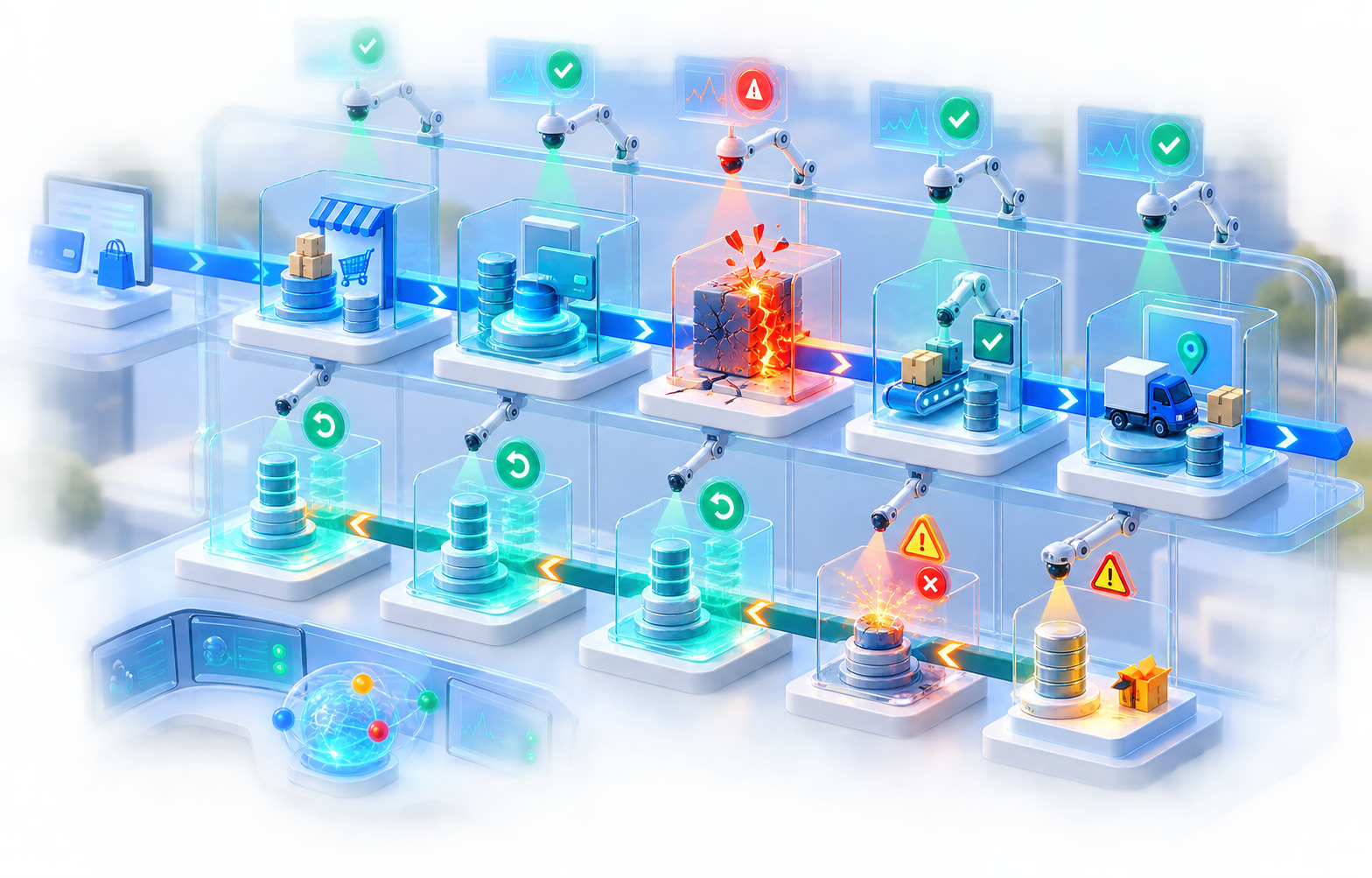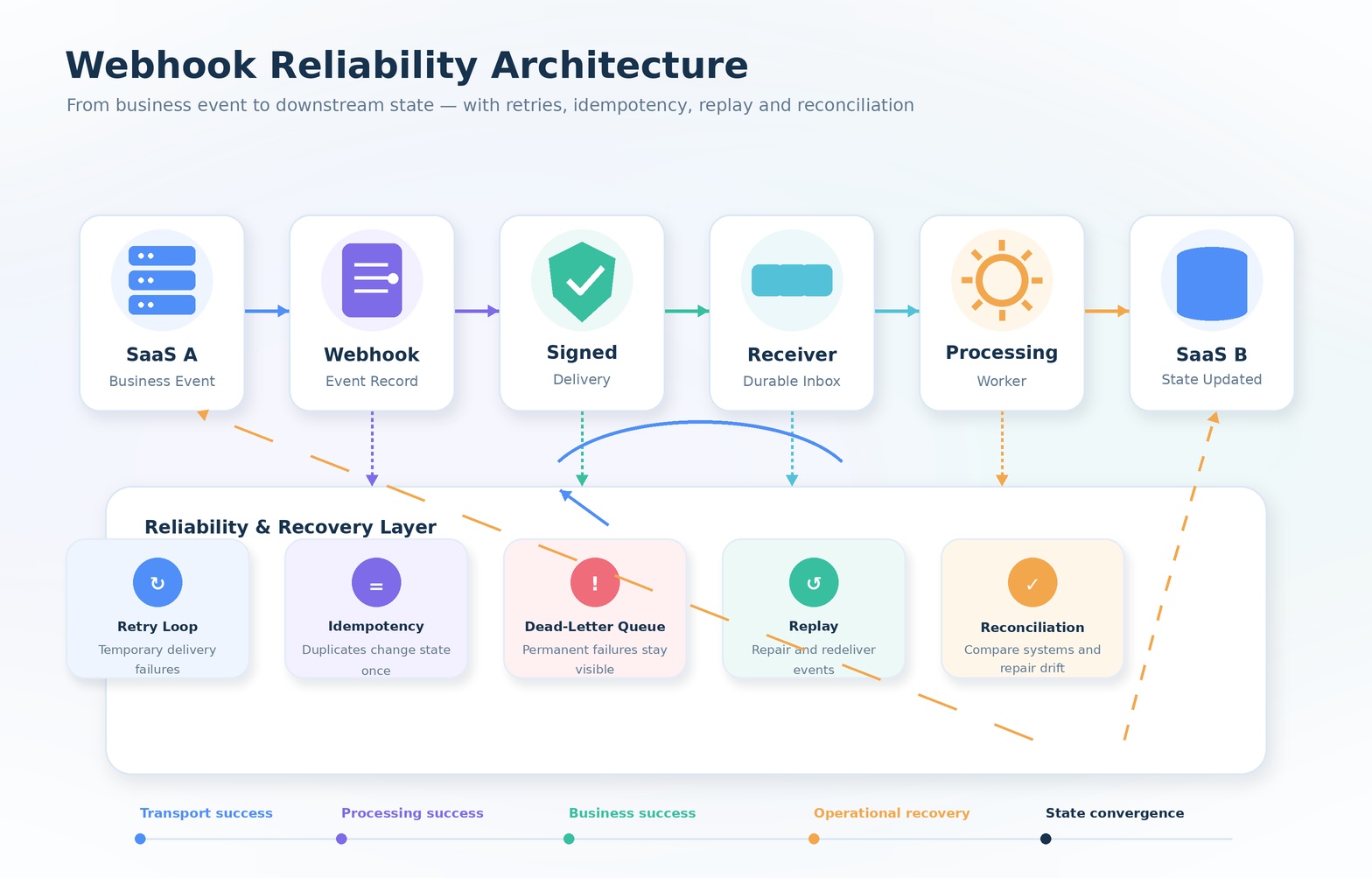
Transport Success, Processing Success, Business Success
Three different claims get collapsed into one word — "success" — in most webhook conversations, and separating them is the foundation for everything that follows.
Transport success means bytes moved from sender to receiver and the receiver returned a response the sender's retry logic interprets as final. This is the layer HTTP client libraries, load balancers, and API gateways can observe. A 200 response is transport success. Nothing more.
Processing success means the receiving system's internal machinery — parsing, validation, queueing, business logic execution — ran to completion without an unhandled error. A worker that pulls a job off a queue, updates a database row, and exits cleanly represents processing success. This can happen well after transport success, on a different machine, in a different process, sometimes minutes or hours later.
Business success means the intended real-world state is now correct: the entitlement is active, the invoice is marked paid in every system that needs to know, the shipment record reflects delivery, the customer record in the CRM matches the customer record in the billing system. This is the only one of the three that actually matters to the business, and it is the only one that most systems don't directly measure.
The reason webhooks fail quietly is that transport success is cheap to achieve and easy to monitor, so it becomes a proxy for the other two. A team that instruments "webhook delivery rate: 99.97%" is measuring transport. It says nothing about whether the 99.97% of delivered requests resulted in correct downstream state, and it says nothing about the events that never made it to transport in the first place because they were never created, never queued, or dropped before a request was ever attempted.
| Layer | What succeeded | What can still be wrong | Who can observe it |
|---|---|---|---|
| Transport success | HTTP request reached the endpoint and got a terminal response | Request body never persisted; queue publish failed after response was sent | Sender's delivery log, receiver's access log |
| Processing success | Receiver's internal logic ran without throwing | Business rule applied incorrectly; side effect partially completed; wrong tenant matched | Receiver's application logs, worker logs |
| Business success | The real-world state the event was supposed to produce is now correct everywhere it needs to be | Nothing — this is the target state | Reconciliation against source of truth; often nobody, by default |
Treating these as one thing is not a minor simplification. It is the specific place where reliability engineering for webhooks usually stops short, because "the webhook worked" is answered affirmatively by the first layer while the second and third remain unverified.
[Figure: Transport success vs. processing success vs. business success, shown as three overlapping but distinct outcome states along the same event timeline]
The rest of this article follows the life of a single event through each stage where one of these three kinds of success can be confused for another, and describes what has to be true — architecturally, operationally, and in test coverage — for a team to be able to say, with evidence rather than assumption, that a webhook actually worked.
The Business Event Happened — But Did a Webhook Record Exist?
Every webhook story starts before the webhook. Something happens inside a system: a payment settles, an invoice moves to paid, a user account is created, a document gets a final signature, a build finishes, a shipment reaches its destination. That event is, at the moment it occurs, purely internal. Nothing outside the system knows about it yet.
The gap that matters here is the one between "the business transaction committed" and "a durable record exists that this transaction should produce an outbound event." These sound like they should be the same step. In most real systems they are two separate writes, sometimes to two separate stores, sometimes performed by two separate pieces of code that were not written with each other in mind.
Consider a straightforward version: a payment service commits a database transaction marking an invoice as paid. As a next step — in the same request handler, a few lines later — it constructs a webhook event object and hands it to a delivery library or publishes it to a queue. If the process crashes, is restarted, hits an unhandled exception, or the delivery library throws before that publish call completes, the invoice is paid and the webhook event does not exist. Not "failed to send" — never created. There is nothing in a delivery log to retry, because nothing was ever registered as needing delivery.
From the customer's perspective, and from any dashboard that only tracks delivery attempts, this failure mode is invisible. The delivery success rate stays high, because the metric only counts events that made it into the delivery pipeline. The invoice is paid. The webhook simply never existed.
This is the argument for tying event creation to the same durable transaction as the business state change, rather than treating "update the record" and "queue the notification" as two independent operations performed by application code after the fact. The common pattern for this is usually described as a transactional outbox: instead of publishing an event to an external queue as a side effect of a business transaction, the application writes an outbox row — event type, payload, target — inside the same database transaction that updates the business record. A separate process then reads unpublished outbox rows and delivers them, retrying that separate process independently of the original request. Because the outbox write and the business state write are part of one atomic transaction, there is no window where one commits and the other doesn't.
BEGIN TRANSACTION
  UPDATE invoices SET status = 'paid', paid_at = now() WHERE id = :invoice_id
  INSERT INTO outbox_events (event_type, payload, status, created_at)
    VALUES ('invoice.paid', :payload, 'pending', now())
COMMIT
The delivery worker that reads from outbox_events and performs the actual HTTP call is a separate concern, with its own retry and failure handling, but it is reading from a durable, transactionally-consistent source rather than racing the original request handler.
This is not a claim that every application must implement an outbox table. A system built entirely on a durable, transactional event stream — where "business event" and "event log entry" are the same write by construction — solves the same problem differently. What matters is the underlying guarantee: the moment a business state change is considered committed, a record that a corresponding notification must eventually go out should also be considered committed, in the same atomic operation, with no dependency on a subsequent network call, external queue publish, or synchronous downstream side effect succeeding.
[Figure: Business transaction commit and event record write shown as a single atomic operation, versus the same two writes performed as separate, non-atomic steps]
Failure modes worth naming here explicitly:
- The business transaction commits, then the process crashes before an in-memory event object is published anywhere.
- The business transaction commits, the event publish call is attempted, but the message broker is unavailable and the exception is silently swallowed by a broad try/catch.
- The business transaction is later rolled back for an unrelated reason (a subsequent validation step fails), but an event was already published based on the tentative state.
- Two application instances both believe they are responsible for creating the event and both do, or neither does, due to a race in a poorly-synchronized cron-style trigger.
None of these produce an error a customer sees. None of them show up as a failed delivery, because delivery was never attempted. They show up, if at all, as a support ticket three weeks later: "we were charged, but our account was never activated."
The Event Exists — But Has It Left the Building?
Assume the event record now exists durably. It survived the transaction. It is sitting in an outbox table, a queue, or an event log with status "pending" or equivalent. The next question is whether anything is actually going to pick it up and attempt delivery.
This sounds like it should be automatic, and in a healthy system it is. But "event persisted" and "event delivered" are genuinely separate states with their own independent failure surface, and treating persistence as equivalent to delivery hides an entire category of stuck events.
A delivery worker can crash after claiming an event but before sending it, leaving the event marked "in progress" indefinitely if there is no timeout or reclaim logic. A queue itself can experience an outage — a managed message broker having a bad day, a self-hosted queue running out of disk, a Redis instance evicting keys under memory pressure. A scheduler responsible for polling the outbox table on an interval can have a bug that silently stops firing, or can be misconfigured after a deployment and simply not run. A retry timestamp calculation can produce a value far in the future due to a unit conversion bug (seconds treated as milliseconds is a classic version of this), effectively parking an event that looks, to a human scanning a database, like it's scheduled correctly. A specific tenant's webhook configuration can be disabled — intentionally or by a configuration bug — silently excluding all their events from the delivery pipeline while every other tenant continues normally.
What all of these share is that they leave events in a state that is neither "delivered" nor obviously "failed." They are stuck, and stuck is a state that most systems don't alert on, because most alerting is built around explicit failure signals — a 5xx response, an exception stack trace — not the absence of an attempt that should have happened.
This is one of the strongest arguments for durable, inspectable queues over fire-and-forget delivery mechanisms, and for building explicit visibility into event age. A queue where every unpublished item has a created_at timestamp and a first_delivery_attempt_at field that can be null lets you ask a direct, answerable question: are there pending events older than N minutes with no delivery attempt at all? That query catches worker crashes, scheduler bugs, and disabled tenant configurations in one shot, because all three produce the same observable symptom — old, untouched, pending events — even though their root causes are unrelated.
| Delivery pipeline state | What it means | Common causes when stuck |
|---|---|---|
| Created, unpublished | Event exists, not yet handed to delivery mechanism | Missing outbox worker, worker crash, scheduler failure |
| Published, no attempt yet | Delivery mechanism has claimed the event but hasn't sent a request | Queue outage, consumer lag, misrouted queue message |
| Attempt in progress | A delivery request is currently outstanding | Normal transient state; stuck here indicates a lost response or worker crash mid-request |
| Attempt failed, retry scheduled | A delivery attempt received a retryable response or transport error | Normal; problem only if retry timestamp logic is broken |
| Delivered | Receiver returned a terminal success response | This is where most delivery dashboards stop counting |
| Permanently failed | Retry budget exhausted | Should route to a monitored dead-letter path, not disappear |
[Figure: Event lifecycle states from creation through delivery, showing where "stuck" states are invisible to naive delivery-rate metrics]
The practical takeaway is not "use a specific queue technology." It's that the state machine an event moves through needs enough granularity that "not yet delivered" can be distinguished from "never even attempted," because those two situations have completely different root causes and completely different urgency.
An Attempt Is Not a Delivery
Once a delivery worker actually sends a request, a new layer of ambiguity opens up, because "the request failed" is not one failure mode — it's a category containing several failure modes with different meanings and different correct responses.
DNS resolution can fail before a connection is even attempted, usually indicating a misconfigured or recently-changed endpoint URL. A TCP connection can time out, which is different from a connection being actively refused — the former often means a firewall or security group silently dropping traffic, the latter usually means nothing is listening on the port at all. TLS negotiation can fail, commonly due to an expired certificate on the receiver's side or a client that doesn't support a required TLS version. An HTTP-level timeout can occur after a connection succeeds but no response arrives within the sender's patience window — this is genuinely ambiguous, because the receiver may have processed the request and simply been slow to respond, or may never have received it at all. A 5xx response indicates the receiver acknowledged the connection but its own processing failed. A 429 indicates the receiver is intentionally throttling. A 4xx other than 429 usually indicates a client-side problem from the receiver's point of view — bad authentication, malformed payload — that a naive retry will not fix no matter how many times it's attempted.
Collapsing all of these into "the webhook failed" throws away information that should drive different sender behavior. A DNS failure and a TLS certificate expiry both mean "this endpoint URL is currently unreachable in a way retries won't fix," and both deserve to eventually surface as an actionable configuration problem rather than silent retries that will never succeed. A timeout is genuinely ambiguous and should be retried, but the receiver needs to be built assuming the request might have actually been processed — this is the seed of the duplicate-delivery problem covered later. A 5xx is the clearest signal to retry with standard backoff. A 429 should be retried, but ideally respecting whatever backoff signal the receiver provided rather than the sender's default schedule. A 400 or 401 is a signal that retrying without changing anything is pointless — the problem is in the request itself, not in the current state of the network.
| Failure type | What it tells the sender | Retry behavior that makes sense |
|---|---|---|
| DNS resolution failure | Endpoint is not currently resolvable | Retry a few times; if persistent, flag configuration issue |
| Connection refused | Nothing is listening on the target port | Retry with backoff; flag if persistent |
| TLS handshake failure | Certificate or protocol mismatch | Retry briefly; flag immediately as likely configuration issue |
| Timeout, no response | Ambiguous — request may or may not have been processed | Retry, but design receiver to tolerate a duplicate |
| 5xx | Receiver acknowledged connection, its processing failed | Retry with standard backoff |
| 429 | Receiver is intentionally throttling | Retry, respecting any provided backoff hint |
| 4xx (excluding 429) | Problem with the request itself | Do not blindly retry unchanged; surface for investigation |
A production delivery system that treats all of these identically ends up either retrying things that will never succeed (wasting delivery capacity and creating log noise that obscures real problems) or giving up too early on things that were genuinely transient. The distinction matters operationally, not just academically.
An HTTP 200 Is Only an Acknowledgment
This is the point where a large fraction of webhook reliability problems actually live, and it deserves to be examined slowly.
Picture a common receiver implementation. A request arrives at a webhook endpoint. The handler verifies the signature. It queues a job for asynchronous processing. It returns HTTP 200. Later — could be milliseconds, could be minutes if the queue is backed up — a worker picks up that job and attempts to apply it: parse the payload, look up the relevant business record, update it, trigger any downstream side effects. That worker's database update fails. Maybe a constraint violation, maybe a timeout talking to a downstream service, maybe an unhandled exception in business logic that nobody tested for this particular payload shape.
From the sender's point of view, this event delivered successfully. The delivery log says 200, the retry logic considers this event closed, and nothing about the interaction looked wrong.
From the receiver's point of view, business processing failed, silently, after the point where anyone was watching.
The instinct some teams have when they encounter this is to conclude that returning 200 before processing completes is the mistake — that the fix is to do everything synchronously inside the request handler and only return success once the business logic has actually run. This instinct is understandable but usually wrong in production, because synchronous processing inside a webhook handler creates its own serious problems: slow business logic makes the endpoint slow, slow endpoints get retried by the sender (because the sender's own timeout fires while your handler is still working), and now you have both the original request and a well-intentioned retry both trying to process the same event concurrently, which is a much worse problem than the one you started with.
The actual issue isn't when 200 gets returned. It's what condition is true at the moment 200 gets returned. Returning 200 immediately after signature verification and durable persistence into a processing queue is entirely correct — as long as that persistence is genuinely durable, and as long as everything downstream of that point has its own retry and failure-handling logic that doesn't depend on the sender ever finding out. The problem in the scenario above isn't the early 200. It's that the worker's failure had nowhere to go. There was no retry on the worker side, no dead-letter path, no alert. The event was durably queued, the queue did its job, and then the actual processing logic failed with no safety net behind it.
This is the concept worth naming explicitly: an acknowledgment boundary — the precise point in the pipeline past which the receiver is claiming full responsibility for eventually getting the event to a correct final state, using its own internal mechanisms, independent of whether the original sender ever calls again. Before that boundary, if something goes wrong, the sender's retry is the safety net. After that boundary, the sender's retry is no longer coming (the sender considers this delivered), so the receiver's own internal retry, dead-letter handling, and alerting have to be the safety net instead.
A receiver that returns 200 needs to know, precisely, what condition that 200 is vouching for. "I received bytes" is a much weaker claim than "I have durably queued this for processing with retry logic behind it," which is weaker still than "I have fully applied this event's business effects." Different architectures land in different places on this spectrum, and that's fine — what's not fine is being unclear about which claim is actually being made, because that ambiguity is exactly where events get lost without anyone noticing.
| Acknowledgment claim | What it guarantees | What can still go wrong after this point | Appropriate for |
|---|---|---|---|
| "I received bytes" | Connection succeeded | Everything — no durability at all | Never, as a sole strategy |
| "I validated the request" | Signature and schema checked | No persistence yet; a crash loses the event | Rarely sufficient alone |
| "I persisted the event" | Event is durably stored, unprocessed | Processing logic may still fail with no retry | Reasonable if processing has its own robust retry |
| "I queued it durably for processing" | A durable queue with retry semantics now owns it | Business logic bugs, poison events without DLQ handling | Common, solid baseline |
| "I completed all business processing" | The business state change actually happened | Very little — but risks slow endpoints and retry collisions | Appropriate only when processing is fast and safe synchronously |
[Figure: The acknowledgment boundary shown as a line across the receiver's pipeline, with everything before it covered by the sender's retry and everything after it requiring the receiver's own retry and dead-letter handling]
The design decision that actually matters is making this boundary explicit, documenting it, and building the retry and alerting machinery on the correct side of it. A team that can answer "what exactly does our 200 mean" in one sentence has almost certainly already thought this through. A team that answers with "well, it means we got the request" has probably not.
Webhooks Are Asynchronous Even When the HTTP Call Is Synchronous
It's worth stating directly: the HTTP request-response cycle is usually one stage in a longer asynchronous process, even in architectures where the response is returned quickly and nothing about the transaction looks asynchronous on the surface. Delivery, processing, and the eventual convergence of both systems' state into agreement are three separate phases that happen on three different timelines.
Delivery is the network-level exchange — fast, usually sub-second, and the only part most monitoring actually watches. Processing is whatever the receiver does with the event after accepting it — this can be immediate or can be queued behind other work, rate limits, or dependent external calls, and its duration is often unbounded from the sender's perspective. State convergence is the point at which both systems agree on the current business fact — and this is genuinely eventual, meaning there is, by design, a window during which the two systems disagree and that disagreement is expected, not a bug.
A payment provider's system considers an invoice paid the instant its own database transaction commits. A SaaS customer's system, receiving that fact via webhook, will lag behind by however long delivery and processing take — a gap that is normally small but is not zero, and under load, backlog, or partial outage can stretch to minutes or hours. Treating this gap as an error condition rather than a normal, bounded characteristic of the architecture leads to brittle expectations. Treating it as unbounded and untracked leads to silent staleness that nobody notices until a customer does.
The useful mental model separates "did the request succeed" from "has the state converged yet," and instruments both. The first is answerable from delivery logs in milliseconds after the fact. The second requires either an explicit record of when business processing actually completed, or a reconciliation process that periodically checks whether the two systems still agree — a topic this article returns to in depth later, because it ends up being the actual backstop for everything discussed up to this point.
Retries Are Normal, Not Exceptional
It's worth resetting expectations here: a webhook provider retrying a delivery is not a sign that something is broken. It is the expected behavior of any reasonably designed sender, because from the sender's side, the set of things that can go wrong between "I sent a request" and "I got confirmation it worked" is large, and many of those things are transient by nature.
A sender retries because a timeout occurred and the outcome is genuinely unknown — the receiver may have processed the request and the response was simply lost in transit. A sender retries because it received a 5xx, which by convention indicates a server-side problem the receiver itself might resolve on its own within seconds. A sender retries because of a brief network interruption between the two systems that has nothing to do with either application's code. A sender retries because the receiver was temporarily overloaded and shed load with a 429 or a fast-failing 503, expecting the request to succeed shortly after.
None of these represent an unusual or degraded operating condition for a distributed system communicating over an unreliable network. They represent Tuesday.
Retry policies vary and there is no single universally correct schedule. Fixed-delay retry — attempt again after a constant interval — is simple to reason about but performs poorly under sustained outages, because every failed receiver gets hit with retries at the same cadence, which can produce synchronized bursts of traffic the moment the receiver recovers. Exponential backoff — doubling (or otherwise growing) the delay between successive retries — spreads load out over time and reduces the odds of overwhelming a recovering system, at the cost of longer worst-case delivery latency for events that fail early and succeed only much later. Jitter — adding randomness to the backoff interval — exists specifically to prevent many different senders' retry schedules from synchronizing into simultaneous bursts, which becomes especially relevant with multi-tenant senders retrying against a single receiver endpoint after a shared outage.
What matters more than which specific policy a sender chooses is that a receiver is built assuming retries will happen, under normal operating conditions, as a routine and expected part of the traffic pattern — not an edge case reserved for testing.
Retries Create Duplicates, by Design
Follow one concrete sequence closely. A receiver gets a request, processes it completely and correctly, updates its database, and begins writing the HTTP response. Before that response finishes transmitting — a network blip, a load balancer timing something out, a process restart mid-response — the connection drops. The sender, from its vantage point, sees a failed request: no response received, or a connection reset. Its retry logic, working exactly as designed, schedules another attempt. That attempt arrives at the receiver a few seconds later, carrying the same event.
Nothing in this sequence is a bug. The sender behaved correctly by retrying an ambiguous outcome. The receiver behaved correctly the first time. The network did what unreliable networks do. And the result is that the receiver now sees the same logical event twice, with no way to distinguish "this is a genuine duplicate the sender doesn't know about" from "this is the first attempt" just by looking at the second request in isolation.
This is the core reason webhook consumers need to treat duplicate delivery as a certainty rather than a possibility, unless a specific provider has made an explicit, documented guarantee otherwise (and even then, treating that guarantee as absolute rather than as a strong reduction in likelihood is usually a mistake — provider guarantees describe intended behavior, not a proof against every possible failure mode in a distributed system). A receiver that assumes "each event ID will arrive exactly once" is building on an assumption the network itself does not honor.
[Figure: A successful processing run followed by a lost response, sender-side timeout, and resulting duplicate delivery — shown as a sequence diagram]
Exactly-Once Delivery Is Usually the Wrong Mental Model
A natural response to the duplicate problem is to ask whether the sender could just guarantee exactly-once delivery and remove the need for the receiver to handle duplicates at all. It's worth being precise about why this doesn't actually solve the problem in practice, without overstating the theoretical case.
The issue isn't a mathematical impossibility proof — it's that guaranteeing exactly-once delivery across an unreliable network, where the sender cannot always distinguish "the receiver processed this and the confirmation was lost" from "the receiver never received this," would require the sender and receiver to share enough coordinated state that the distinction disappears — effectively making delivery and processing a single atomic cross-system operation. That's an enormous amount of coordination to build for every webhook interaction, and most systems don't build it, including the vast majority of commercial webhook providers.
What is realistic, and what most reliable systems actually implement, is at-least-once delivery combined with idempotent processing on the receiver side — sometimes described as achieving "effectively-once" business outcomes even though the underlying delivery mechanism makes no such guarantee. The sender's job is to keep trying until it gets a terminal success response, accepting that this might occasionally mean sending the same event more than once. The receiver's job is to make sure that processing the same event twice produces the same final state as processing it once — not by preventing duplicates from arriving, but by making duplicates harmless when they do.
This reframing matters because it moves the reliability burden to the place where it can actually be discharged. A sender cannot fully guarantee non-duplication across an unreliable network without extraordinary coordination. A receiver can guarantee idempotent processing entirely within its own system, using tools it already controls — database constraints, deduplication tables, careful handler design. That's a solvable problem, and it's the one worth solving.
| Delivery model | What it guarantees | What it requires |
|---|---|---|
| At-most-once | Never delivered more than once | Accepts silent loss under failure; rarely appropriate for business-critical events |
| At-least-once | Always eventually delivered, possibly more than once | Receiver must handle duplicates |
| Effectively-once (business outcome) | Final business state is correct regardless of delivery count | At-least-once delivery + idempotent processing on the receiver |
Idempotency: Making Duplicates Harmless
An invoice.paid event arrives twice. What should happen is that the receiving system ends up in exactly the same final state as if it had arrived once: one invoice marked paid, one entitlement activated, one confirmation email sent. What should not happen — and does happen in naive implementations — is two credits applied to an account, two provisioning actions executed against an external system, or two emails sent to a customer who now has a reasonable question about why they were billed twice.
The distinction worth drawing precisely is between event-level deduplication and business-operation idempotency, because they solve different problems and neither one alone is sufficient in every case.
Event-level deduplication means recognizing "I have already seen this exact event ID" and skipping reprocessing. This is straightforward to implement — a table or key-value store recording processed event IDs, checked before any processing logic runs — and it correctly catches the retry scenario described above, where the sender resends the literal same event after a lost response.
Business-operation idempotency is a stronger and more subtle property: ensuring that applying a given business operation produces the same result no matter how many times it's applied, even if it arrives via events that don't share the same event ID. This matters because event ID equality is not always the same thing as "this represents the same business action." Some providers, under certain internal retry or reprocessing conditions, can generate a new event ID for what is, from a business standpoint, a repeat of the same underlying fact. Relying purely on event-ID deduplication in that situation lets the duplicate through, because the IDs genuinely differ.
A more robust pattern anchors idempotency to the business object and operation, not just the event envelope. For a payment-provisioning use case, this might mean: before applying a credit, check whether a credit has already been recorded for this specific invoice ID and this specific payment amount, using a unique database constraint that makes a second attempt fail at the database layer rather than relying on application logic remembering correctly. For a provisioning action against an external API, it might mean passing an idempotency key derived from the business object's identity, if the external API supports one, so that even a duplicate outbound call from your own system doesn't create a duplicate resource on the far end.
-- A unique constraint that makes duplicate credit application
-- fail at the database layer regardless of application logic
CREATE UNIQUE INDEX idx_credit_per_invoice
  ON account_credits (invoice_id, credit_type);
function handleInvoicePaid(event):
if processedEvents.contains(event.id):
return # already handled this exact event
existingCredit = credits.findByInvoiceId(event.invoiceId)
if existingCredit is not null:
processedEvents.markProcessed(event.id)
return # business operation already applied under a different event
applyCreditWithConstraint(event.invoiceId, event.amount)
processedEvents.markProcessed(event.id)Neither layer alone is complete. Event-ID deduplication alone misses the case where the provider's underlying event ID changes across what is functionally the same fact. Business-operation idempotency alone, without any event tracking, can be more expensive to check on every single event and doesn't give you a clean audit trail of what was received when. Using both — a fast dedup check for the common case, backed by a database-level uniqueness guarantee on the actual business effect — covers the practical space well.
| Idempotency strategy | Catches | Misses if used alone |
|---|---|---|
| Provider event ID dedup table | Exact retries of the same event | Business-equivalent events arriving under different IDs |
| Business object version/state check | Semantic duplicates regardless of event ID | Race conditions between concurrent requests without a database constraint |
| Unique database constraint on the effect | Concurrent duplicate writes, at the storage layer | Anything upstream of the write — doesn't prevent redundant external API calls |
| Idempotency key passed to external APIs | Duplicate side effects on systems you call, not just your own database | Only works if the external API actually supports and honors idempotency keys |
Deduplication Storage Has a Lifespan
A processed-event table needs, at minimum, the event ID, the provider it came from, the tenant it belongs to, a processing status, and timestamps for when it was first seen and last seen (useful when the same event is retried multiple times before finally succeeding). What it also needs, and what's easy to overlook, is a retention policy that's actually been thought through rather than defaulted to "keep forever" or, worse, aggressively pruned to save storage without considering the consequence.
If deduplication records are deleted too soon, an old event that gets legitimately replayed — during a provider-side incident recovery, a customer-initiated resend, or a manual operational replay after fixing a downstream bug — will no longer match anything in the dedup table, and will be reprocessed as if new, repeating whatever side effects it originally triggered. This is a subtle failure because it only manifests when replay actually happens, which might be rare enough that a too-short retention window goes unnoticed for a long time before it causes a real incident.
There's no single correct retention period to prescribe here — it depends on how long a given provider or internal system might plausibly attempt a legitimate resend, how expensive a false reprocessing would be (crediting an account twice is expensive; re-logging an already-logged analytics event usually isn't), and what storage cost the team is willing to carry for older dedup records. What matters is that the retention decision is made deliberately, with the replay use case specifically in mind, rather than being an incidental consequence of a general data-retention policy that wasn't written with webhook processing in mind.
Order Is Not Guaranteed by Arrival
Consider three events in a subscription lifecycle: subscription.created, subscription.updated, subscription.canceled. They were generated by the sending system in that order, reflecting the real order in which those things happened. There is no guarantee they arrive at the receiver in that order, and there are several entirely normal reasons why they might not.
If the first delivery attempt for subscription.created hits a transient failure and gets retried with backoff, while subscription.updated succeeds on its first attempt, the update can arrive before the creation event, simply because one of them took the scenic route through the retry queue and the other didn't. If a receiver processes events with multiple parallel workers pulling from a shared queue, there's no guarantee two workers pick up strictly sequential events in the order they were enqueued — workers can pick up whichever available message comes next, and processing time for one message can exceed processing time for a later one, resulting in the later one finishing first. Even without retries or parallelism, network-level reordering of otherwise sequential requests is possible, if unusual.
Trusting arrival order as if it reflects actual event order is a quiet way to corrupt state. A receiver that blindly applies whatever event arrives, overwriting the current record with whatever fields the event describes, can end up with a canceled subscription becoming "updated" again by a stale subscription.updated event that was in flight before the cancellation but arrives after it — silently reactivating something that should have stayed canceled, with no error anywhere in the pipeline to indicate anything went wrong.
[Figure: Three events generated in sequence, with retry-induced reordering causing arrival order to differ from creation order]
Event Order and Business Version Are Different Concepts
The fix for ordering problems isn't simply "process events in the order they arrive" (which, as established, doesn't reflect true order) or naively "process events in the order of their creation timestamp" — timestamps have their own set of limitations that make them an incomplete solution on their own.
Clock precision is coarser than it looks. Two events genuinely created a few milliseconds apart by the same system might carry timestamps with second-level precision, making them indistinguishable by timestamp alone even though one genuinely preceded the other. Distributed systems generating events across multiple servers can have modest clock skew between machines, meaning timestamp comparison across servers isn't as reliable as comparing timestamps generated by a single process. And some providers document their timestamp semantics loosely enough — "approximately when this occurred" rather than a strict, monotonically increasing sequence guarantee — that treating the field as an authoritative ordering key is relying on more precision than was promised.
A more robust anchor is an explicit version, revision number, or sequence identifier on the business object itself, when the provider exposes one — something that increments deterministically with each state change to that specific resource, independent of delivery timing. A receiver holding a subscription.updated event with version: 4 for a subscription it currently has recorded at version: 5 can safely conclude this event is stale and discard or ignore it, regardless of when either event arrived or was generated.
Where no such version field exists, some architectures choose a different strategy entirely: treating the webhook as a notification that something changed, rather than as the authoritative description of what changed, and fetching current state directly from the provider's API upon receipt. That approach is significant enough to examine on its own.
Applying the Event vs. Fetching Current State
There are two broadly different models for how a receiver can respond to an incoming webhook, and the choice between them has real architectural consequences that are worth laying out plainly rather than picking a default and moving on.
Model A — apply the event. Treat the webhook payload itself as the description of the state transition. The receiver reads the fields in the payload and applies them directly: this subscription's status is now active, this invoice's amount is now $450. This preserves a full history of what happened and when, is fast (no additional network call required), and works well when a version or sequence field is available to guard against out-of-order application. Its weakness is exactly the ordering problem above — without a reliable ordering signal, applying payloads directly can leave the receiver's state reflecting a stale event rather than current reality.
Model B — fetch current state. Treat the webhook as a notification that "something about this resource changed, go check," and respond by making an authoritative API call back to the provider to retrieve the current state of that resource, then apply that. This sidesteps the ordering problem almost entirely — no matter what order three notifications arrive in, each one triggers a fetch of the resource's actual current state, and the receiver converges on the right answer even if a notification is skipped or arrives late, because the fetch reflects "true now," not "true as of whenever this event was generated." The cost is a new dependency: every webhook now implies an outbound API call, which introduces additional latency, consumes API rate limit budget, and creates a new failure mode — the provider's API being temporarily unavailable exactly when a fetch is attempted, which the receiver now also has to handle with its own retry logic.
Neither model is universally superior. Fetching current state trades ordering complexity for an additional runtime dependency and cost; applying events directly trades that dependency away in exchange for needing solid version or sequence handling to stay correct under reordering. Some systems use a hybrid: apply the event directly for fast-path updates, but periodically or opportunistically reconcile by fetching authoritative state to catch drift — an idea that connects directly to the reconciliation discussion later in this article.
| Model | Ordering robustness | Latency | New dependency | Best suited for |
|---|---|---|---|---|
| Apply the event payload | Requires version/sequence field to be safe | Low — no extra call | None | High-volume events where a reliable version field exists |
| Fetch current state | High — always reflects latest truth | Higher — extra API round trip | Provider API availability and rate limits | Lower-volume, higher-stakes events without reliable versioning |
[Figure: Apply-the-event model versus fetch-current-state model, shown as two different receiver processing paths responding to the same incoming notification]
Concurrency: When Two Events for the Same Resource Race
A payment update, a refund, and a subscription change for the same customer can, in principle, be delivered close enough together that two receiver workers process them at essentially the same time, on separate threads or separate machines, both reading and writing to the same underlying record. Without explicit protection, this is a race condition — whichever write happens to commit last wins, regardless of which event was actually supposed to take precedence, and it's entirely possible for the "losing" write to silently overwrite a more important state change.
Several mechanisms address this, and they aren't mutually exclusive. Per-resource locking ensures only one worker at a time can process events for a given resource ID, serializing what would otherwise be concurrent operations — at the cost of some processing throughput if a single resource generates a high volume of events. Optimistic concurrency control checks, at write time, whether the record's version has changed since it was read, and rejects (or retries) the write if it has, rather than blindly overwriting. Serialization keys — routing all events for the same resource to the same queue partition or worker — achieve ordering and race protection together, by construction, at the queueing layer rather than the database layer. Database-level constraints and conditional updates (an UPDATE ... WHERE version = :expected_version pattern) can enforce correctness even if application-level coordination is imperfect, functioning as a last line of defense.
Which mechanism fits depends on event volume per resource, how the receiver's infrastructure is already organized around queues or workers, and how expensive a lock is relative to the processing being protected. What doesn't vary is the need for some explicit mechanism — assuming concurrent processing of the same resource "probably won't happen often enough to matter" is a bet that tends to lose exactly when traffic is highest and the cost of getting it wrong is greatest.
Signature Validation Is Not Optional Ceremony
A webhook endpoint is, by its nature, a public or semi-public URL that accepts POST requests and, on receipt, takes some action. Without verifying that a given request actually originated from the system it claims to have come from, that endpoint is an open door — anyone who discovers the URL can send arbitrary payloads and trigger whatever business logic the handler executes.
Verification schemes generally fall into a few families. A shared-secret HMAC scheme has the sender compute a cryptographic hash of the request body (or a canonical representation of it) using a secret known to both parties, include that hash in a request header, and have the receiver independently compute the same hash and compare. Public-key signature schemes have the sender sign the payload with a private key, allowing the receiver to verify using a corresponding public key without either party needing to share a secret directly — useful when a provider signs for many receivers and doesn't want to manage a unique shared secret per integration. Timestamped signature schemes incorporate the current time into what gets signed, so a receiver can reject requests where the timestamp is too far in the past or future, limiting the window during which a captured, valid request could be resent by an attacker.
The most common implementation mistake, and one worth calling out specifically because it's so easy to introduce accidentally, is verifying the signature against the parsed and re-serialized payload rather than the exact raw bytes the sender signed. Web frameworks often parse incoming JSON automatically before a request handler ever sees it, and if that parsed object is later re-serialized (even with semantically identical content) to compute a signature for comparison, the resulting bytes can differ from the original — different key ordering, different whitespace, different number formatting — causing a legitimate, correctly-signed request to fail verification. The fix is architectural: signature verification needs access to the exact raw request body as it was received, before any framework middleware has touched it, which sometimes requires explicitly configuring a framework to preserve raw body access for webhook routes specifically.
Other implementation mistakes worth naming: using the wrong encoding when converting the secret or payload to bytes before hashing (a secret stored as a UTF-8 string versus expected as base64-decoded bytes will silently produce a different HMAC), comparing signatures using a standard string equality check rather than a constant-time comparison (opening a timing side channel, however marginal), applying clock tolerances that are too loose to actually limit replay risk or too tight to tolerate normal clock drift between systems, and incorrect canonicalization when a scheme requires assembling multiple fields (timestamp, method, path, body) into a specific signed string format — getting the delimiter, field order, or encoding of any one of those wrong produces a signature that will never validate even though every individual piece of data is correct.
Where a specific provider's exact signing scheme is being implemented, verifying the details against that provider's official documentation rather than a general pattern is worth the extra step, since implementations do vary in header names, hashing algorithms, and canonicalization details.
Raw Body Handling Deserves Its Own Attention
The point above about raw bytes is significant enough to expand on directly, because it's one of the more common causes of "our signature verification works in testing but fails intermittently in production" reports.
Many web frameworks, by default, eagerly parse an incoming request body based on its Content-Type header before a route handler gets a chance to inspect it, exposing a convenient parsed object (a dictionary, a deserialized class instance) rather than the raw bytes that were actually transmitted. This is a reasonable default for most application logic, but it's actively hostile to signature schemes that sign the exact bytes of the original request, because re-serializing a parsed object rarely reproduces those bytes exactly — key order in JSON objects isn't guaranteed to be preserved through a parse-then-stringify round trip in every language and library, floating point numbers can be reformatted, and any incidental whitespace in the original payload is typically lost entirely during parsing.
The practical fix is to configure webhook-receiving routes specifically to capture and preserve the raw request body — often via middleware configuration that stores the unparsed bytes on the request object before any JSON parsing occurs — and to perform signature verification against that preserved raw body, only parsing the payload into a usable object afterward, once verification has passed. This is provider- and scheme-dependent behavior; schemes that sign a normalized or explicitly-constructed string (rather than the literal request body) don't have this exact problem but may have their own canonicalization sensitivities.
Replay: An Attack and a Recovery Mechanism, Not the Same Thing
The word "replay" carries two very different meanings in webhook systems, and conflating them leads to either overly permissive security (allowing genuine replay attacks) or overly restrictive operations (blocking legitimate recovery).
A security replay is an attacker capturing a previously valid, correctly-signed request — perhaps via a compromised logging system, a man-in-the-middle position, or an exposed request log — and resending it later, hoping the receiver will process it again as if new. Timestamp validation as part of the signature scheme, combined with event-level deduplication, is the standard defense: a request whose signed timestamp is far outside an acceptable window gets rejected outright regardless of signature validity, and even a request within that window that duplicates an already-processed event ID gets caught by dedup logic rather than reprocessed.
An operational replay is the opposite situation: an authorized party — the provider itself, or the receiving system's own operators — deliberately resending a past, legitimate event, usually as a recovery mechanism after discovering that the original delivery failed, was lost, or needs to be reprocessed following a bug fix. This is a desired capability, not a threat, and a system that can't distinguish it from a security replay ends up either exposing itself to attack (if it accepts any resend uncritically) or unable to recover from real incidents (if it treats every duplicate as suspicious and refuses to reprocess it).
The resolution is that these two concerns are handled by different mechanisms operating together rather than in conflict: timestamp validation defends against unauthorized replay of captured requests, while an explicit, authenticated replay mechanism — distinct from the normal delivery path, often initiated through an authenticated API call or admin action rather than mimicking an original webhook request — handles authorized recovery, and idempotent processing (already necessary for ordinary duplicate handling) makes that authorized replay safe to execute without repeating side effects.
Payload Versioning and Schema Drift
Providers change their webhook payload schemas over time — a new field gets added, an existing field gets renamed, a new possible value appears in what used to be a small fixed set, a previously flat structure gets nested. A receiver built against the schema as it existed on the day of integration will, sooner or later, encounter a payload that doesn't quite match what it expected, and how the receiver responds to that mismatch determines whether a schema change is a non-event or an outage.
Robustness here follows a few general principles worth stating plainly rather than as a formal named methodology. Unknown fields that the receiver doesn't currently use should generally be ignored rather than treated as an error — a strict schema validator that rejects any payload containing a field it doesn't recognize will break the moment the provider adds anything new, even something entirely irrelevant to the receiver's own logic. Fields the receiver actually depends on should be explicitly validated as present and correctly typed, with a clear, loud failure (routed to a dead-letter path for investigation, not silently ignored) if a required field is missing or malformed, rather than letting a null value propagate silently into business logic that assumes it will always be there. Where a provider offers explicit schema versioning — either via a version field in the payload or a versioned API/webhook endpoint — pinning to a known version and deliberately opting into newer versions after testing, rather than automatically receiving whatever the provider currently considers current, gives the receiving team control over when a schema change actually takes effect on their side. Contract tests — automated tests that validate real or representative sample payloads from the provider against the receiver's parsing logic, run regularly rather than only at initial integration time — catch drift before it reaches production traffic.
None of this means every possible future change should be silently tolerated. There's a meaningful difference between "ignore fields I don't use" (safe) and "silently accept any value in a field whose meaning is critical to a business decision" (not safe), which is worth its own discussion.
Enums Are a Compatibility Risk Hiding in Plain Sight
A status field with a small, apparently stable set of values — pending, paid, failed — feels safe to build strict logic around: a switch statement, an exhaustive match expression, a set of conditional branches that assumes those three values are the entire universe of possibilities. Then a provider adds a fourth value, processing, to better represent an intermediate state their own system has started distinguishing. Every receiver that assumed the original three values were exhaustive now has a payload it wasn't built to handle.
What happens next depends entirely on how that unhandled case was written. Code that throws an unhandled exception on an unrecognized enum value turns a provider-side schema addition — something the provider almost certainly considers a minor, backward-compatible change on their end — into a receiver-side outage. Code that silently falls through to a default branch without any record that something unexpected happened can produce quietly wrong business behavior: an invoice sitting in processing might get treated identically to pending by a default branch, when the two states may need genuinely different handling.
The forward-compatible middle ground is deliberate: treat an unrecognized enum value as a distinct, explicitly-handled case — not a crash, but not silent business-as-usual either. Log it, route the associated event somewhere reviewable, and apply a clearly-defined safe default only where a safe default genuinely exists for that specific field's business meaning. This is different from broadly "accepting unknown values without validation" — the receiver is still validating that the value is being tracked and handled deliberately, just not treating "not previously seen" as equivalent to "invalid."
Optional Fields Become Required by Accident
Provider documentation frequently marks a field as optional — present in most cases, but not guaranteed — and receiver code frequently, without any explicit decision to do so, ends up depending on that field always being present anyway. This happens gradually: a field is optional in the schema, but in practice, for the specific event types and account configurations the integration was originally tested against, it was always populated, so nobody wrote a null check, and the code works fine until a new event type, a different account tier, or a partial webhook expansion produces a payload where that field is genuinely absent.
Related patterns worth watching for specifically: conditional fields that only appear under certain circumstances documented by the provider but easy to miss during initial implementation, object expansion features where a provider returns either a full nested object or just an identifier depending on API configuration, and fields that can be explicitly null (present but empty) versus fields that are entirely absent from the payload — two different states that naive parsing code sometimes treats identically and sometimes doesn't, inconsistently, depending on the specific parsing library's defaults.
Contract testing against representative sample payloads — including edge cases the provider's documentation explicitly calls out as possible, not just the happy-path payload from initial integration testing — is the practical defense here, catching an over-reliance on fields the schema never actually promised would always be there.
Delivery Endpoint Versioning
An application's own webhook receiver endpoint evolves too, and deployments that change what a receiver expects can break in-flight or delayed deliveries just as easily as a provider-side schema change can. A deployment that changes the expected payload shape, removes a field the old handler relied on, or renames a required field can leave an endpoint unable to correctly process events that were generated by the provider under the old assumptions but arrive — delayed by a retry, a backlog, or simple network latency — after the new code is already live.
Strategies that mitigate this include maintaining explicitly versioned webhook endpoints (accepting that older event formats might still need to be handled by dedicated logic for some transition period), building schema adapters that normalize multiple incoming payload shapes into one internal representation before business logic ever sees them, and writing backward-compatible handlers that can accept either an old or new field name or structure during a defined migration window rather than cutting over instantaneously. The relevant risk window is usually shortest right around a deployment — any event generated moments before a deploy, then delayed in delivery until moments after, is exactly the case worth explicitly testing.
Webhook Handlers Should Usually Be Small
There's a practical design principle that falls out of everything discussed so far: the HTTP handler that directly receives a webhook request should generally do a small, well-defined set of things — authenticate the request via signature verification, validate the basic envelope (is this recognizable as a webhook event at all, does it have the fields needed to route it), persist it durably, enqueue it for asynchronous processing, and return an acknowledgment. Heavier business logic — the actual application of the event's effects — belongs in a separate worker process consuming from that queue, not inline in the request handler.
This isn't an absolute rule; some workflows genuinely need synchronous validation before responding (a receiver that needs to reject a webhook outright based on business rules that can be checked instantly, for instance). But as a general default, keeping the handler thin brings concrete benefits: lower and more predictable request latency, since the handler isn't waiting on potentially slow downstream operations; isolation, since a bug or slowdown in business logic doesn't directly threaten the availability of the HTTP endpoint itself; cleaner retry semantics, since the queue consuming from persisted events can have its own independent retry and backoff policy without needing to coordinate with the sender's retry behavior at all; and better observability, since a persisted, queued event is a concrete, inspectable record that exists independently of whether processing later succeeds or fails.
A Dead-Letter Queue Is Not a Graveyard
Every retry policy eventually needs an exit condition — a point at which continuing to retry an event that keeps failing stops being useful and starts being harmful, consuming processing capacity that could go toward events that are likely to succeed. That exit condition is usually a dead-letter queue: a place events go once they've exhausted whatever retry budget the system allows.
The mistake worth naming directly is treating the dead-letter queue as the end of the story rather than the beginning of an operational process. An event that lands in a DLQ with nobody watching it, no alerting tied to its arrival, and no defined workflow for what happens next is not meaningfully different from an event that was silently dropped — it's just been dropped into slightly better-organized storage. The business fact that event was supposed to produce still hasn't happened, and now there's no active retry mechanism working toward eventually making it happen either.
A dead-letter queue that's actually functioning as a recovery mechanism, rather than a graveyard, needs a few operational capabilities built around it, not just the storage itself: the ability to inspect a dead-lettered event's payload and full failure history (what was attempted, what error occurred each time); the ability to classify why it failed, distinguishing "this is a transient issue we should retry after fixing something" from "this event is fundamentally unprocessable and needs different handling"; the ability to repair whatever configuration or code issue caused the failure and then replay the event through normal processing; and the ability to explicitly mark an event as resolved-without-reprocessing, for cases where investigation concludes the event genuinely shouldn't be applied (a duplicate that slipped through some other check, for instance), so that it stops showing as an outstanding unresolved item without pretending it was successfully processed when it wasn't.
Without alerting tied to DLQ volume and age, none of this happens, because nobody knows there's something to look at.
Poison Events
A distinct and more troubling case within the dead-letter discussion is the poison event — one that will fail every single time it's processed, no matter how many retries are attempted, because the failure isn't transient. Common causes include a payload that's genuinely incompatible with the current schema-parsing logic, data that violates a business invariant the handler enforces, a bug in the handler itself that any event of a particular shape will trigger, or a reference to a resource (a customer record, an account) that's since been deleted and no longer exists to be updated.
A retry policy without a hard ceiling — one that keeps attempting a failing event indefinitely, perhaps with growing backoff intervals but no eventual stop — will retry a poison event forever, and depending on how the retry mechanism is implemented, this can consume meaningful processing capacity, clutter logs with the same repeated error, and in some architectures block or slow down processing of unrelated events stuck behind it in the same queue or partition.
The defense is a firm retry limit specifically designed to route poison events out of the active processing path and into dead-letter handling promptly, combined with isolation so that one poison event's repeated failures can't degrade throughput for everything else in the pipeline — commonly achieved by ensuring a single event's retries don't block a shared queue's forward progress, whether through per-event retry scheduling that doesn't hold up the main queue or through routing to a separate retry queue after the first failure.
Retry Storms
Consider a receiver that goes down for a period — a deployment issue, an infrastructure problem, a database outage on the receiving side. During that window, every webhook the provider attempts to deliver fails, and the provider's retry logic, working exactly as designed, schedules each of those failed deliveries for a later retry attempt. The receiver recovers. Now, in a compressed window, every one of those queued retries arrives at once — potentially alongside newly generated events that were created during the outage and are being delivered for the first time, plus events created after recovery that are part of normal ongoing traffic.
This recovery traffic spike can be large enough to overwhelm the receiver a second time, immediately after it comes back up, effectively re-triggering the outage it just recovered from — a retry storm compounding on top of the original failure.
The mitigation strategies on the receiver side largely mirror general load-management practices, applied specifically to this recovery scenario: backoff signals communicated back to the sender (via 429 responses or documented retry-after headers, where the sender respects them) that explicitly ask for slower delivery during a recovery period rather than accepting a burst at full speed; rate limiting at the receiver's ingress layer, deliberately shedding or delaying excess load rather than letting every request through and overwhelming downstream processing; queue buffering, where the receiver accepts requests quickly (persisting them durably) even under a traffic spike, decoupling the rate of acceptance from the rate of actual processing so that a burst gets smoothed out over the following minutes rather than overwhelming processing capacity instantaneously; and controlled concurrency limits on the workers actually doing business logic processing, so that a sudden backlog gets worked through at a sustainable rate rather than every worker trying to process everything simultaneously and starving shared resources like database connections.
[Figure: A receiver outage followed by a retry storm on recovery, with and without backpressure controls, shown as two contrasting traffic patterns]
Backpressure and Processing Lag
Even without a discrete outage event, a receiver's processing capacity and a sender's event generation rate aren't guaranteed to match, and a sustained mismatch — the sender consistently producing events faster than the receiver's workers can process them — results in a growing backlog even when nothing is technically "failing." Every individual delivery attempt might return 200. Every individual event might eventually process successfully. But the queue depth keeps growing, and the time between an event being created and its business effects actually landing keeps stretching.
This matters because that lag is itself a reliability dimension, not just a performance detail. It determines how stale the receiving system's view of reality is at any given moment, and whether that staleness is acceptable depends entirely on what the events represent.
Time Is a Reliability Dimension, Not Just a Performance Metric
A webhook that eventually delivers and eventually processes correctly, but does so 30 minutes after the originating event occurred, has technically succeeded by every transport and processing metric while potentially failing the actual business requirement it exists to serve.
The acceptable lag varies enormously by use case, and treating "eventually correct" as sufficient without asking "correct by when" misses something real. A fraud-detection response that needs to block a transaction has a lag tolerance measured in seconds, not minutes — a correct decision arriving five minutes late may be operationally useless, because the transaction it was meant to inform has already gone through. An inventory update feeding a storefront's available-stock display has a moderate tolerance; a few minutes of staleness is usually acceptable, a few hours is not, because it risks overselling. A deployment notification triggering a downstream automated action has a tolerance defined by whatever process is waiting on it — sometimes seconds matter, sometimes the notification just needs to arrive before a human checks in the next morning. A billing entitlement change — a customer upgrading a plan and expecting immediate access to a new feature — has a customer-perceptible tolerance; delays here don't just risk incorrect internal state, they generate support tickets from customers who paid and are staring at a still-locked feature.
The practical implication is that lag tolerance should be an explicit, use-case-specific requirement defined during design, not an incidental outcome of whatever the queueing and processing architecture happens to produce under normal load — and it should be something the system can actually report on, so that "we're currently averaging 40 seconds of lag, with a p99 of 4 minutes" is an answerable question rather than a guess.
Multi-Tenant Webhooks and Isolation
A SaaS platform serving many customers, each of whom may configure their own webhook endpoint, secret, and set of subscribed event types, introduces a tenant-isolation dimension on top of everything already discussed. The architecture generally needs to resolve which tenant a given inbound or outbound event belongs to, apply that tenant's specific configuration (their endpoint URL, their signing secret, their event type subscriptions), and — critically — guarantee that an event or configuration mistake involving one tenant can never leak into or mutate another tenant's data.
This shows up concretely in a few places worth naming. Tenant-to-provider-account mapping needs to be unambiguous; if a webhook receiver is processing inbound events from an upstream provider on behalf of multiple downstream tenants, correctly identifying which tenant a given inbound event belongs to — often via an account or organization identifier embedded in the payload, cross-referenced against a mapping table the receiver maintains — is a prerequisite for every subsequent processing step, and a bug in that mapping logic (a stale cache, a race condition during tenant onboarding, a fallback default that's supposed to be unreachable but isn't) can route an event to the wrong tenant's data entirely. Secret isolation matters both for security (one tenant's compromised secret shouldn't expose others) and for correctness (using the wrong secret to verify a signature will simply fail verification, but a bug that applies tenant A's secret when validating what's actually tenant B's traffic is a subtler and more dangerous failure mode). And straightforward data-access discipline — every query and mutation triggered by webhook processing explicitly scoped to the resolved tenant, with no code path that could accidentally operate across tenant boundaries — is the last line of defense if an earlier stage's tenant resolution goes wrong.
Endpoint Configuration Is Production State
It's easy to think of a webhook endpoint's configuration — the URL it delivers to, its signing secret, which event types it's subscribed to, which API version it expects, which environment (sandbox or production) it's associated with — as static setup performed once during integration. In an actively used system, this configuration changes over time: URLs get updated when infrastructure moves, secrets get rotated, event subscriptions get expanded as new features are built, and any of these changes can be made incorrectly.
Because this configuration directly determines what happens to real business events, it deserves the same operational rigor as any other piece of production state: changes should be auditable (who changed what, when), validated before taking effect (a URL that fails a basic reachability or format check shouldn't be silently accepted), and reversible (a bad configuration change should be quickly identifiable and revertible, rather than requiring investigation to even notice something changed). Treating endpoint configuration as an afterthought — editable through an unaudited admin panel with no validation and no history — is a common source of failures that look, from the outside, exactly like a delivery or processing bug, when the actual root cause was a configuration change nobody tracked.
Secret Rotation Without Downtime
A webhook signing secret sometimes needs to be rotated — as routine security hygiene, in response to a suspected compromise, or as part of a broader credential rotation policy. The operational challenge is that rotation isn't instantaneous from a distributed-systems perspective: the sender needs to switch to signing with the new secret, and the receiver needs to be validating against the new secret, and there is almost always some window where in-flight or delayed events might be signed with the old secret while the receiver has already switched, or vice versa.
The pattern that avoids downtime during this transition is supporting a window where the receiver accepts signatures verified against either the old or the new secret simultaneously, giving both systems time to fully transition before the old secret is retired. Whether this is available for a given integration depends on whether the provider's signing scheme and configuration options actually support dual-secret verification during a transition period — not all provider implementations do, and assuming this capability exists without confirming it against the specific provider's documentation risks a rotation that briefly breaks signature validation for legitimately in-flight events.
Environment Separation
Development, staging, production, and a provider's own sandbox environment are, ideally, cleanly separated — but the points of leakage between them are numerous enough to be worth listing explicitly. A sandbox event, generated by a provider's test mode, accidentally delivered to (or configured against) a production endpoint can create fake business records in a real system. A production secret, copied into a staging environment's configuration for convenience during debugging, can leave staging able to validate and therefore act on genuine production traffic if a staging endpoint URL is ever mistakenly used. Shared queues or shared databases between environments — sometimes introduced unintentionally through copied configuration or infrastructure-as-code templates that weren't fully parameterized per environment — can let test data and production data collide.
The discipline here is largely about ensuring environment boundaries are enforced structurally rather than by convention: separate credentials per environment that are actually incapable of being valid across environments, separate infrastructure (queues, databases, endpoints) rather than shared infrastructure gated by application-level flags, and configuration management that makes it hard to accidentally point a production system at a sandbox endpoint or vice versa.
Test Events Are Not Production Events
Most webhook providers offer some version of a "send a test event" feature, letting an integrator trigger a sample payload without performing the real underlying action. This is useful for basic connectivity and signature verification checks, and it is not, on its own, a substitute for testing against real event traffic, because test events are typically simplified in ways that hide exactly the failure modes this article has spent most of its length describing.
A test event usually doesn't reproduce true ordering behavior, since it's a single isolated event rather than part of a sequence generated by a real multi-step business process. It typically doesn't exercise the full business lifecycle a resource actually goes through — a test subscription.updated event doesn't necessarily reflect a subscription that's actually been through creation, trial, upgrade, and whatever other states real subscriptions pass through, and any logic that depends on prior state won't be meaningfully tested. And it doesn't create real provider-side state, meaning any follow-up action the receiver might take that involves calling back to the provider's API (the fetch-current-state model discussed earlier, for instance) has nothing real to fetch.
Full integration testing — exercising a genuine, complete business lifecycle in a sandbox or staging environment, generating real sequences of events through real actions rather than isolated test triggers — is what actually validates the scenarios this article treats as central: ordering, duplicates, versioning, and the full acknowledgment-through-processing pipeline.
Local Development Realities
Tools that tunnel a public URL to a developer's local machine, or forward webhook traffic from a provider's dashboard directly to local development, are genuinely useful for early integration work and quick iteration, without needing to name any specific vendor's tool. What's worth being clear-eyed about is how much of the production path they don't exercise. A local tunnel typically bypasses the load balancers, API gateways, and network infrastructure that sit in front of a real production endpoint, meaning any behavior specific to that infrastructure — timeout configuration, connection limits, TLS termination specifics — isn't represented in local testing. It usually bypasses the actual queueing infrastructure a production system uses, since local development often just calls handler code directly or with a lightweight local substitute rather than the real durable queue. Secrets in local development are frequently different from production secrets, which is appropriate for security but means signature verification issues specific to a particular secret's format or encoding might not surface locally. And concurrency behavior — multiple events processing in parallel, the exact scenario that motivates the concurrency-control discussion earlier in this article — is rarely reproduced by a single developer manually triggering test events one at a time.
None of this is an argument against local development tooling, which remains valuable for rapid early iteration. It's an argument for treating it as one stage in a testing strategy rather than sufficient validation on its own.
Observability: The Questions a Team Should Be Able to Answer
A team with genuinely solid webhook reliability isn't distinguished by having zero failures — failures at various layers are, as this article has argued throughout, a normal and expected part of the system. What distinguishes solid reliability is the ability to answer specific, concrete questions about the current state of the pipeline at any moment, rather than discovering problems only when a customer reports one.
How many events were created in a given period, and does that match expectations based on known business activity? How many delivery attempts occurred, and how does that compare to the number of events (a ratio far above 1:1 across the board might indicate a systemic delivery or endpoint problem rather than normal occasional retries)? How many events remain pending, with no attempt yet made? How many were accepted (crossed the acknowledgment boundary) but haven't finished processing? How many failed permanently and are sitting in a dead-letter path? What is the age of the single oldest unprocessed event right now — a number that, tracked continuously, catches stuck pipelines faster than almost any other single metric? What is the delivery lag distribution — not just an average, which can hide a bad tail, but percentiles, since a p50 of 2 seconds alongside a p99 of 20 minutes describes a very different operational reality than a tight distribution around 2 seconds? Are there specific tenants experiencing elevated failure rates relative to others, which might indicate a tenant-specific configuration problem rather than a systemic one? Which event types fail most often, which can point at a specific parsing or business-logic bug tied to that event type's payload shape? How many duplicate deliveries have occurred, tracked as its own signal rather than folded silently into overall delivery counts? How many events have been manually replayed, and why — a growing replay count over time can indicate an underlying processing bug that keeps needing manual recovery rather than being fixed at the source?
None of this needs to be organized into a named framework or scored against an arbitrary target. What it needs is to actually be measured, queryable, and visible to the team responsible for the pipeline, rather than inferred after the fact from a support ticket.
[Figure: A webhook observability dashboard concept, showing pending count, oldest unprocessed event age, delivery lag percentiles, and per-tenant failure rates as connected panels]
| Signal | What it reveals |
|---|---|
| Event creation rate vs. expected business activity | Whether events are being generated at all, at the source |
| Delivery attempts per event | Whether retries are occurring at a normal or abnormal rate |
| Oldest unprocessed event age | Stuck pipelines, worker crashes, disabled configurations |
| Delivery lag percentiles (not just average) | Whether the tail of the distribution meets business latency needs |
| Per-tenant failure rate | Tenant-specific configuration or mapping problems |
| Per-event-type failure rate | Payload-specific parsing or logic bugs |
| Duplicate delivery count | Whether idempotency handling is actually being exercised and working |
| Manual replay count over time | Whether an underlying bug keeps requiring manual recovery |
Correlation IDs Turn "It Didn't Work" Into a Diagnosable Problem
"The webhook didn't work" is not, by itself, a diagnosable statement — it could mean the event was never created, never left the delivery queue, was delivered but never accepted, was accepted but never processed, or was processed but produced the wrong result. Turning that vague report into an actual diagnosis requires being able to trace one specific business event across every stage it passed through: the original business event, the resulting webhook event ID, each individual delivery attempt (with its own outcome), the specific HTTP request and response involved, the queue message that resulted from acceptance, the specific worker job that processed it, and the specific database mutation (or lack thereof) that resulted.
A single correlation identifier — generated at the earliest point (ideally at event creation) and threaded through every subsequent log line, queue message, and database record touched by that event's processing — makes this traceable. Without it, diagnosing a specific customer's specific missing update often means manually cross-referencing timestamps across several unrelated logging systems, hoping nothing else happened close enough in time to create ambiguity.
[Internal link opportunity: distributed systems testing]
Event History as an Operational Timeline
Beyond aggregate metrics, being able to pull up the specific sequence of things that happened to one event — created, first delivery attempt at time X (timed out), second delivery attempt at time X+30s (202 accepted), worker started at X+31s, worker failed with a specific error at X+33s, retry scheduled, retry succeeded at X+90s — turns an abstract reliability discussion into something concrete enough for three different audiences to use directly. Engineering can use it to debug a specific failure without reconstructing the sequence from scattered logs. Support can use it to answer a customer's question about a specific transaction with actual evidence rather than a guess. Customer success can use it, in aggregate, to identify a pattern across a specific account that might indicate a configuration issue worth proactively addressing before it generates more tickets.
This kind of timeline isn't a separate system to build from scratch — it's largely the natural output of good correlation-ID discipline and enough retained history at each processing stage, presented in one place rather than left scattered across separate logs.
A Webhook Delivery Dashboard as Internal Tooling
Beyond raw metrics and log correlation, a dedicated internal tool for browsing webhook activity — filterable by tenant, event type, delivery status, date range, and target endpoint — turns investigation from a query-writing exercise into something an engineer or support agent can do directly. Useful capabilities include inspecting a sanitized version of the payload for a specific event (sanitized meaning sensitive fields are appropriately redacted for whoever's viewing it), seeing the full attempt history with response codes for each attempt, seeing current processing state (accepted, processing, completed, failed, dead-lettered), and triggering a manual replay directly from the tool for an authorized operator, rather than requiring a database script.
What such a tool should not do is expose raw signing secrets or other sensitive credentials through its interface, even to internal users — the same operational security discipline that applies to any admin tooling touching production credentials applies here.
Customer-Facing Webhook Logs
For a SaaS product that emits webhooks to its own customers — rather than only consuming them from upstream providers — the same visibility problem exists on the other side of the relationship, and customers benefit from a version of the same tooling scoped to their own account. Useful details to expose typically include the event type, timestamp, current delivery status, attempt count so far, the response code received on the most recent attempt, when the next retry (if any) is scheduled, and the event's unique ID for cross-referencing with their own logs.
Payload visibility here deserves care — showing a customer the full payload their own endpoint should have received is useful for their own debugging, but only if it doesn't inadvertently expose data that shouldn't cross whatever boundary exists between what that specific user is authorized to see and what the full underlying event actually contains.
Replay, in Depth
Replay capability — deliberately resending a past event through the delivery and processing pipeline — needs to support several different scopes, because the appropriate scope depends heavily on what's being recovered from. A single delivery attempt replay resends one specific attempt, useful when a receiver was known to be briefly unavailable for one specific request and the event otherwise processed fine. A single event replay resends one complete event from the beginning of the pipeline, useful when the entire original delivery and processing sequence needs to be redone. A date-range replay resends every event within a specific window, useful after discovering a systemic issue that affected all events during a known outage period. A failed-events replay specifically targets events currently sitting in a dead-letter or failed state, useful after fixing whatever bug caused the original failures. A full resource-history replay resends every event ever generated for a specific resource, useful in more extreme recovery scenarios — rebuilding a downstream system's understanding of one specific customer's history from scratch, for instance.
Each of these carries real risk that needs to be weighed before executing it. Repeating side effects is the central risk this entire article has built toward, and it's exactly why idempotent processing isn't optional groundwork for a system that intends to support replay — without it, replay is actively dangerous rather than helpful. Old schema versions can be a risk specifically for older events being replayed through current processing logic that's evolved since those events were originally generated, if the receiver's schema-compatibility handling (discussed earlier) isn't actually robust to genuinely old payload shapes. Old business assumptions can be a subtler risk — a replayed event might have been correct under business rules that applied at the time it originally occurred but aren't correct under current rules, a distinction pure technical replay logic has no way to know about on its own. And large-scale replay load — resending a large volume of historical events at once — can itself create a retry-storm-like burden on both the sending and receiving infrastructure if not deliberately rate-limited during execution.
Replay should generally default to relying on the same idempotent processing paths normal delivery uses, rather than a separate, less-tested code path — a replay mechanism that bypasses the normal processing pipeline "for speed" or "for simplicity" undermines the exact safety properties that make replay trustworthy in the first place.
[Figure: Replay scopes shown as concentric options — single attempt, single event, date range, failed events, full resource history — each with increasing blast radius]
Replay as a Migration Tool, Not Just a Recovery Tool
Beyond incident recovery, replay capability has a second, less obvious use: supporting migrations and rebuilds. A team that fixes a bug in how a particular event type has been processed for months may want to replay every historical event of that type to correct downstream state that's been wrong the whole time, not just going forward. A team building a new internal projection or read-optimized view of data derived from webhook events may want to replay the full historical event stream to populate that new view from scratch, rather than starting it empty and only capturing new events from that point forward. A team rebuilding a downstream service entirely may similarly want to reconstruct its state by replaying the full available event history against the new service's logic.
This use case has direct implications for event retention policy — a system that only retains recent event history for operational dead-letter recovery purposes may not retain enough history to support this kind of full historical replay, which is a legitimate reason to extend retention beyond what pure incident recovery alone would require. It's worth being precise, though, that this doesn't mean every webhook system needs to become a full event-sourcing architecture, with an event log serving as the single source of truth for all system state — that's a much larger architectural commitment, with its own tradeoffs, than simply retaining enough webhook history to support occasional migration-driven replay.
Reconciliation: The Backstop Everything Else Depends On
Every mechanism discussed so far — durable event creation, reliable queueing, retries, idempotency, ordering protection, schema robustness, dead-letter handling — reduces the probability of drift between the sending system's true state and the receiving system's recorded state. None of them reduces that probability to exactly zero, and a team that operates as though it does is one unusual, unanticipated failure mode away from a silent, undetected discrepancy that persists indefinitely.
This is the argument for reconciliation as a distinct, deliberately-built safety net, independent of and layered on top of the webhook pipeline itself, rather than a nice-to-have addendum. Consider a straightforward example: a payment provider's own records show 10,000 paid invoices for a given period. A periodic reconciliation query against the receiving system's local database shows 9,998 marked paid for the same period. Two invoices are inconsistent — somewhere in the chain examined throughout this article, an event failed to produce its intended effect, and nothing in the delivery or processing pipeline itself surfaced that failure as an alert, because from a pure transport-and-processing standpoint, nothing necessarily went visibly wrong. An event might have been silently lost before ever reaching the delivery pipeline (the very first failure mode this article covered). A worker might have processed an event and hit a subtle logic bug that didn't throw an exception but produced an incorrect result. A dead-lettered event might be sitting, unresolved, in a queue nobody's actively monitoring.
Reconciliation — a scheduled process that periodically queries the provider's authoritative API for current state and compares it against local records, flagging discrepancies for investigation — doesn't prevent any of these failures from occurring. What it does is guarantee that they don't stay invisible indefinitely. This is worth stating as one of the clearer conclusions available in this whole subject: webhooks are a low-latency change-notification mechanism; reconciliation is the correctness safety net. They serve genuinely different purposes, and a reliable system needs both — webhooks for fast, event-driven updates under normal conditions, reconciliation for catching whatever normal conditions don't cover.
[Figure: A reconciliation loop shown as a periodic comparison between provider-authoritative state and locally recorded state, feeding discrepancies into an investigation and repair workflow]
Webhooks and Polling Are Complements, Not Competitors
A common simplification worth challenging directly is the idea that webhooks exist to replace polling — that once a system has webhook-based notifications in place, periodic polling becomes redundant overhead that can be eliminated. This holds up only if the webhook pipeline is assumed to be perfectly reliable, an assumption this entire article has been building the case against.
Mature systems more often use webhooks for what they're genuinely good at — fast, low-latency notification of change under normal operating conditions — while retaining some form of periodic polling or scheduled reconciliation specifically as a recovery mechanism for whatever the webhook pipeline misses. This isn't necessarily continuous, high-frequency polling running in parallel with webhooks at all times, which would largely defeat the latency and efficiency benefits webhooks provide in the first place. It's typically a lower-frequency, deliberately scheduled reconciliation pass — hourly, daily, or whatever cadence matches the acceptable staleness window for a given use case — that exists specifically to catch drift, not to serve as the primary update mechanism.
The cost and rate-limit tradeoffs here are real and worth weighing deliberately rather than defaulting to either extreme: polling too frequently defeats much of the purpose of having webhooks at all and can strain a provider's API rate limits; polling too infrequently, or not at all, leaves silent drift undetected for longer than a business might be comfortable with. The right cadence is use-case-specific, mirroring the discussion of acceptable lag earlier in this article.
State Convergence as the Actual Goal
Pulling several threads together: the goal of a webhook system was never "deliver every request successfully." The goal is that two systems, which are allowed to temporarily disagree — this is not a flaw, it's a structural characteristic of any system using asynchronous notification rather than synchronous, transactional cross-system updates — reliably converge back to agreement within an acceptable time window, and that when they don't converge on their own, there's a mechanism (reconciliation, replay, dead-letter recovery) that repairs the disagreement rather than leaving it permanent.
Eventual consistency isn't a compromise a team settles for reluctantly. It's the honest description of what any system connected by asynchronous notification over an unreliable network actually offers, and building explicit repair mechanisms around that reality produces a more robust system than pretending, through hope or unexamined assumption, that consistency is instantaneous and guaranteed.
Side Effects Complicate Everything Downstream of Processing
Webhook processing frequently triggers side effects beyond a simple database update — sending an email, updating a billing system, provisioning access to an external service, mutating inventory records, emitting an analytics event, or making a call to yet another external API. Each of these complicates retry logic in its own specific way, because each one may have its own independent idempotency boundary that doesn't automatically inherit from the idempotency protection applied to the primary database update.
A handler that correctly uses a database constraint to prevent applying the same credit twice, but then unconditionally sends a confirmation email as a separate step after that database write, hasn't actually solved the duplicate problem for the email — a retry of the whole handler that hits the database constraint (correctly preventing a duplicate credit) but still reaches the email-sending code before erroring out, or that's structured so the email send happens before the constraint check, can still produce a duplicate email even though the money side of things is protected. Each side effect genuinely needs to be considered for its own idempotency, not assumed to be covered by whatever protection exists around the primary state mutation.
Email as an Illustrative Case, Not a Special One
Consider one specific, intuitive version of this: a database update succeeds, an email gets sent as the next step, and then the worker crashes for an unrelated reason before finishing whatever bookkeeping marks the event as fully complete. A subsequent retry of the event reruns the handler, and if there's no independent tracking of "was the email already sent for this specific event," the retry sends the email again — a customer receiving two identical confirmation emails minutes apart, from a system where every individual database operation was, in isolation, correctly idempotent.
The general fix mirrors the outbox pattern discussed early in this article, applied to side effects rather than just outbound events: rather than performing a side effect directly and unconditionally as an in-line step of the handler, record the intent to perform it (as part of the same transaction as the primary state update) and have a separate, idempotency-aware process actually execute it, tracking completion independently so a retry of the primary handler doesn't blindly re-trigger every side effect from scratch. This is worth understanding as one instance of a general pattern — durable side-effect orchestration — rather than an email-specific fix; the same reasoning applies to provisioning calls, external notifications, or any other action a webhook handler triggers beyond its own primary database write.
Webhook Chains Across Multiple Systems
Some architectures involve genuine chains: system A generates a webhook that system B consumes and processes, and as part of that processing, system B itself generates a webhook that system C consumes. Every reliability concern discussed throughout this article now compounds across each hop rather than existing once.
A successful, correctly-processed event at the A-to-B boundary can still fail at the B-to-C boundary, and from A's perspective — which has no visibility into what happens after B accepts its webhook — everything looks fine. Tracing a problem that originates at the B-to-C hop back to its actual root cause, when the visible symptom shows up as "system C never received the expected update," requires correlation identifiers that survive being passed across organizational and system boundaries, not just within a single system's internal logging — a meaningfully harder problem than the single-hop tracing discussed earlier, since it depends on cooperation and shared identifiers across systems that may be operated by entirely separate teams or companies.
[Figure: A three-system webhook chain, showing how a single point of failure at the second hop is invisible to the first system while producing a visible symptom only at the third]
Cascading Retries Across a Chain
If every system in a chain independently retries failures using its own default policy, without any coordination or awareness of the systems upstream and downstream of it, a single sustained failure somewhere in the middle of the chain can produce amplified retry traffic at every hop simultaneously — each system dutifully retrying according to its own schedule, with no single system positioned to see or control the aggregate effect across the whole chain.
Rate control and monitoring specifically at each hop — rather than assuming a chain's overall reliability will simply be the product of each individual link behaving reasonably in isolation — is the practical mitigation. There's no universal amplification factor worth quoting here; the actual magnitude depends entirely on chain length, each system's specific retry policy, and how long the underlying failure persists, and any specific number offered without that context would be a fabrication rather than a useful figure.
Webhooks as an External API Contract
If a SaaS product emits webhooks that its own customers build integrations against, those webhook payloads are, functionally, a public API — deserving the same discipline typically reserved for a REST or GraphQL API surface, even though the direction of the call is reversed. This means documentation that's kept genuinely current rather than aspirational, explicit versioning so schema changes can be introduced without breaking every existing customer integration simultaneously, a defined deprecation process that gives customers real time to adapt to breaking changes rather than encountering them unannounced, clearly documented delivery guarantees (at-least-once, retry behavior, timeout expectations) so customer-side integrators know what assumptions are safe to build on, clearly documented retry behavior specifically, and a clearly documented signature scheme with enough detail that a competent integrator can implement correct verification without guesswork.
Changing a webhook payload shape casually — adding a field without announcement is usually safe if consumers follow the schema-robustness practices discussed earlier, but renaming a field, changing a field's type, or removing a field a customer might reasonably depend on is a breaking change with exactly the same weight as a breaking change to any other public API, deserving the same advance notice and migration path.
[Internal link opportunity: API testing]
Consumer Diversity Deserves Design Consideration
Customers implementing webhook receivers do so in a genuinely wide range of environments — modern backend frameworks in whatever language their stack uses, serverless functions with their own constraints around execution time and cold starts, no-code or low-code automation platforms with limited customization of request handling, and legacy enterprise middleware that may have been built or configured years before the integration was ever imagined. A provider's webhook design should generally avoid assumptions specific to any one of these environments — assuming a receiver can hold a connection open for an unusually long time before timing out, for instance, or assuming a receiver has sophisticated queueing infrastructure available to it, when a customer implementing a receiver in a simple serverless function may have neither.
Designing toward the more constrained end of this spectrum — reasonable timeout expectations, tolerance for receivers that can only do simple synchronous processing within a request handler, clear guidance for less sophisticated integrators — produces a webhook contract that's actually usable across the real diversity of systems customers build, rather than one that implicitly assumes every customer has engineering resources comparable to the provider's own team.
Choosing a Delivery Timeout Policy
A sender has to decide how long to wait for a response before considering a delivery attempt a timeout and triggering retry logic. Too short a timeout risks classifying legitimate, if somewhat slow, receivers as failures, retrying against endpoints that were actually about to succeed — generating unnecessary duplicate load and, depending on how idempotency is (or isn't) handled downstream, unnecessary duplicate processing on the receiver's side. Too long a timeout risks holding delivery-worker capacity open against a genuinely unresponsive endpoint for longer than useful, reducing the sender's overall throughput and delaying the point at which a truly failed delivery gets scheduled for retry.
There's no single correct number to offer here without it being an arbitrary example rather than a grounded recommendation — the appropriate value depends on the specific system's processing characteristics and the acceptable-lag requirements discussed earlier, and any specific provider's documented timeout behavior for their own webhook delivery system should be treated as the authoritative reference for that provider, rather than assuming it matches some general convention.
Status Code Semantics Aren't Perfectly Universal
The general classification covered earlier in this article — 2xx as success, 5xx and 429 as retryable, other 4xx as generally not retryable without a change to the request — is a reasonable and common default, but it's worth being precise that not every provider's sender-side retry logic treats every status code identically, and assuming universal semantics without checking a specific provider's documented behavior can lead to incorrect assumptions about what will or won't get retried. A permanent configuration failure at a receiver (an endpoint that's been deleted, for instance) and a temporary server-side failure (a receiver mid-deployment, briefly returning 503) both might return response codes in the same broad category from a naive classification standpoint, but a well-designed sender ideally distinguishes them differently over time — recognizing a persistently failing endpoint as a different situation from an intermittently failing one, even if a single individual failed attempt looks identical in isolation.
Disabled Endpoint Behavior as Product Policy
When a receiver's endpoint fails persistently — every delivery attempt over an extended period returning an error or timing out — a sender generally has to decide what to do about that endpoint going forward, and this decision is genuinely a product and policy question as much as a technical one, not something with a single objectively correct answer.
Options include automatically disabling the endpoint after a defined threshold of consecutive failures, preventing further delivery attempts (and further wasted retry capacity) until a human re-enables it; notifying the customer or account owner that their endpoint appears to be failing, giving them the opportunity to investigate and fix it on their end; continuing to retry indefinitely regardless of failure history, accepting the ongoing cost in exchange for never requiring manual intervention to resume delivery once the underlying issue resolves itself; or requiring explicit manual reactivation after a disablement, treating a persistently failing endpoint as something that shouldn't silently resume without a human confirming the problem's actually been addressed.
Which of these fits best depends on the specific product's relationship with its customers and the criticality of the events involved — there's no technically superior default among them, only tradeoffs between operational cost, customer experience, and the risk of either wasted retry effort or unnoticed prolonged outages.
Testing the Sender
A sender-side testing strategy needs to cover meaningfully more ground than confirming that a JSON payload serializes correctly, which is necessary but far from sufficient. Coverage should include event generation (does the correct event get created, with correct data, at the correct point in the business transaction), queueing (does the event actually get durably enqueued for delivery, surviving a simulated crash immediately after creation), delivery (does an actual HTTP request get correctly constructed and sent), retry (does a simulated transient failure correctly trigger a retry with the intended backoff behavior), signature generation (is the signature computed correctly and verifiable against the documented scheme, ideally verified against an independent implementation rather than only the sender's own verification logic, to catch a bug that's symmetric on both sides), timeout handling (does the sender correctly classify and respond to a slow or unresponsive receiver), response classification (are different status codes correctly routed to retry versus non-retry logic), and endpoint disabling behavior (if the sender implements automatic disablement after persistent failure, does that logic actually trigger correctly under a simulated sustained-failure scenario).
Testing the Receiver
Receiver-side testing needs corresponding breadth: signature verification (correctly accepting valid signatures and correctly rejecting invalid ones, including the specific raw-body handling issues discussed earlier), duplicate delivery (sending the same event more than once and confirming the resulting business state matches what a single delivery would produce), out-of-order events (delivering events for the same resource in a scrambled order and confirming the resulting state is correct, or that stale events are correctly identified and ignored), invalid schema (payloads missing required fields, containing unexpected types, or otherwise malformed, confirming these fail safely rather than corrupting state or crashing unrecoverably), unknown event type (an event type the receiver wasn't specifically built to handle, confirming it's ignored gracefully rather than causing an error), timeout behavior (confirming the receiver's own response time stays within whatever the sender's timeout tolerance is, under realistic load), queue failure (simulating the receiver's internal queue being briefly unavailable at the moment of accepting a request, and confirming this fails safely rather than silently losing the event), database failure (simulating a downstream database being unavailable during processing, and confirming the resulting failure is retried rather than silently swallowed), worker retry (confirming a worker that fails partway through processing correctly retries rather than leaving the event in a permanently stuck or ambiguous state), and side-effect duplication (specifically confirming that a retried or duplicated event doesn't produce duplicate emails, duplicate external API calls, or other duplicate side effects, beyond just the primary database state).
Testing the Acknowledgment Boundary Specifically
This deserves its own explicit test scenario, separate from general receiver testing, because it's testing a boundary condition rather than a normal-path behavior. Construct a scenario where a request arrives, the event gets persisted successfully, but the subsequent queue publish — handing the persisted event off for asynchronous processing — fails. The question the test needs to answer is: what does the endpoint do in this exact circumstance? Does it return success anyway, effectively losing the event despite it having been technically persisted, because nothing will ever pick it up for processing? Does it return failure, correctly triggering the sender's retry logic, giving the event a second chance at successfully making it through the full pipeline?
The correct answer depends on the receiver's specific architecture — a system where persisted-but-unpublished events are periodically swept and republished by a separate background process might reasonably return success even in this scenario, since the event isn't actually lost, just delayed. A system without such a sweep mechanism should almost certainly return failure here, since success would misrepresent what actually happened. What matters is that this exact boundary condition is deliberately tested, with an explicit, understood expected behavior, rather than left as untested territory where the actual behavior — whatever it happens to be based on how the code was incidentally written — was never a deliberate decision.
Duplicate Delivery Tests, Explicitly
Beyond the general receiver-testing coverage mentioned above, duplicate delivery deserves dedicated test scenarios covering several distinct timing patterns, because each exercises different code paths and can surface different bugs. Sending the same event twice in quick sequence tests the straightforward dedup path. Sending the same event twice concurrently — near-simultaneously, testing whether a race condition between two in-flight processing attempts for the same event can slip past dedup logic that assumes sequential arrival — tests something meaningfully different and often catches bugs the sequential test misses. Sending a duplicate after a simulated worker restart tests whether in-memory or transient dedup state survives a process restart, or whether it needs to be durable to actually work under this realistic failure scenario. And sending a duplicate after a long delay tests whether dedup records have been retained long enough to still catch it, directly exercising the retention-policy discussion from earlier in this article.
In every case, the assertion that matters is on final business state, not just on whether the second request was technically detected as a duplicate — a system might correctly identify a duplicate and still, due to a separate bug, apply some partial side effect anyway, and only checking for detection rather than actual outcome would miss that.
Ordering Tests, Explicitly
Given three events A, B, and C for the same resource that have a genuine correct order, testing should explicitly deliver them in every meaningfully different sequence — the original order, and permutations like B-then-A-then-C, C-then-B-then-A, and A-then-C-then-B — and verify, for each permutation, that the resulting final state is either correct (if the receiver's version or sequence handling is designed to tolerate reordering) or that genuinely invalid or unsafe sequences are detected and handled safely rather than silently corrupting state. This is one of the more labor-intensive categories of test to build but also one of the categories most likely to catch a real production bug before it happens, precisely because ordering assumptions are easy to introduce accidentally and easy to miss in normal happy-path testing that only ever exercises events in their originally-intended order.
Retry Tests, Explicitly
Simulating each of the transport-failure categories discussed earlier — timeout, 500, 429, and connection failure — against a test receiver, and verifying, for each, that a retry actually gets scheduled, that the retry count increments correctly and respects whatever maximum is configured, that the backoff interval between attempts matches the intended policy, that no duplicate side effects result from the eventual successful retry, and that the event ultimately reaches a resolved state (successfully processed or correctly dead-lettered) rather than being left in limbo, gives concrete coverage of the retry machinery specifically, separate from the general delivery and processing tests covered elsewhere.
Dead-Letter Tests, Explicitly
Deliberately forcing a permanent processing failure — a payload engineered to fail every retry attempt — and verifying that the resulting event correctly exits the active retry path after the configured limit, correctly appears in whatever diagnostic or dead-letter tooling exists, remains inspectable (payload and failure history both available for investigation), and can successfully be replayed through normal processing after the underlying cause is fixed, closes the loop on the dead-letter discussion earlier in this article with concrete, testable assertions rather than leaving it as an architectural aspiration.
Signature Tests, Explicitly
Signature verification deserves defensive, explicit test coverage: a genuinely valid signature is accepted, an invalid signature is rejected, a signature computed with the wrong secret is rejected, a payload that's been modified after signing (with the original signature left unchanged) is rejected, a timestamp outside the acceptable window is rejected where the scheme incorporates time, and a signature computed with a since-rotated key is handled correctly according to whatever rotation-window policy is in place. None of this coverage requires or should include exploit-style techniques for bypassing signature checks — the goal is confirming the defensive logic works correctly under both legitimate and illegitimate inputs, not documenting attack methods.
Schema Compatibility Tests, Explicitly
Testing should explicitly include payloads containing unrecognized extra fields (confirming they're ignored rather than causing rejection), payloads missing optional fields (confirming the receiver handles their absence gracefully), payloads missing genuinely required fields (confirming this fails safely and visibly, rather than either crashing unrecoverably or silently proceeding with incorrect assumptions), payloads containing enum values the receiver wasn't originally built to recognize, payloads containing explicit nulls where a value might normally be expected, and older, previous-version payload shapes if the receiver is meant to maintain backward compatibility with them. Each of these directly exercises one of the schema-drift failure modes discussed earlier, with a concrete pass/fail assertion rather than relying on hoping current production traffic happens to never exercise these edge cases.
Performance and Burst Testing
Beyond correctness under individual scenarios, the pipeline needs testing under realistic and unrealistic load: normal expected traffic, deliberately generated burst traffic simulating a spike, backlog recovery time after a deliberately-induced processing pause (how long does it actually take the system to work through an accumulated queue once processing resumes), behavior with many tenants generating traffic simultaneously (surfacing any tenant-isolation or fairness issues that only appear under concurrent multi-tenant load), unusually large individual payloads, and deliberately slow-responding simulated consumers (relevant for provider-side testing of sender behavior against a receiver that's technically responding but doing so unusually slowly). Queue lag under each of these conditions, and the time required to recover back to baseline lag after a load spike subsides, are the concrete measurements worth capturing.
Chaos and Failure Injection
In deliberately controlled, non-production test environments, injecting specific failures — making the queue temporarily unavailable, making the database temporarily unavailable, forcing a worker process to crash mid-processing, introducing artificial slowness into a downstream dependency, or simulating a network timeout at a specific point in the pipeline — and observing what actually happens, rather than what's assumed to happen based on reading the code, tests the invariants this entire article has been building toward directly: does a crash mid-processing leave an event stuck rather than lost, does a database outage during processing correctly trigger a retry rather than a silent failure, does a slow dependency correctly get isolated rather than blocking unrelated processing.
This is meaningfully different from, and should not be confused with, advocating for uncontrolled experimentation directly against production systems — the value here comes specifically from controlled, deliberate, observable failure injection in an environment built for it, not from testing resilience by allowing real, unplanned production incidents to serve as the test.
Business Invariants as the Actual Test Target
Underneath all of the specific test scenarios above, what a QA-focused approach to webhook reliability is really trying to establish is a set of business invariants that should hold true regardless of the specific sequence of technical events that occurred. Every paid invoice should eventually produce exactly one active entitlement, regardless of how many delivery attempts or retries were involved in getting there. Every completed shipment should eventually reach a delivered state in every downstream system that needs to reflect it, regardless of the order in which related events arrived. No duplicate webhook delivery should ever result in a duplicate credit, email, or provisioning action, regardless of how the duplication occurred. No event genuinely belonging to one tenant should ever be able to mutate another tenant's data, regardless of any mapping or isolation bug elsewhere in the pipeline. And every permanently failed event should remain discoverable and inspectable indefinitely (or for whatever defined retention period applies), rather than silently disappearing.
Testing directly against invariants like these, rather than only against specific individual scenarios, is what actually catches the failure modes this article has spent most of its length describing — because the specific scenario that eventually breaks an invariant in production is very often one nobody anticipated writing a specific test case for, but a well-chosen invariant, verified under a wide enough variety of injected conditions, catches it anyway.
A Non-Prescriptive Reliable Architecture
Pulling the pieces discussed throughout this article into one coherent shape, without prescribing a specific technology stack or claiming this is the only correct arrangement: a business transaction commits, and as part of that same atomic operation, an event or outbox record is created. A delivery queue picks up that record and a sender worker attempts delivery to the external endpoint. On the receiving end, a durable inbox accepts the incoming request, validates and persists it, and hands it to a processing queue. A business handler consumes from that queue, performs the actual state mutation, and records that processing has completed. Surrounding this entire path: retry logic at both the delivery and processing stages, a dead-letter path for events that exhaust their retry budget, a replay mechanism for authorized recovery, a reconciliation process running independently on its own schedule as a backstop, and metrics and correlation tracking throughout every stage.
None of this implies a microservices architecture is required — a modular monolith, with the same conceptual boundaries implemented as distinct modules, database tables, and internal queues rather than as separately deployed services, can implement exactly the same guarantees. What matters is the presence of these conceptual boundaries and the guarantees they provide, not the specific deployment topology chosen to implement them.
[Figure: A complete conceptual pipeline from business transaction through outbox, delivery, receiver inbox, processing, and reconciliation, with retry and dead-letter paths shown branching off at each relevant stage]
Inbox and Outbox Patterns, Tied Directly Back to Webhooks
The outbox pattern, introduced earlier in this article in the context of durably tying event creation to business transaction commits, exists to solve one specific problem: reliably producing an outbound notification as an atomic consequence of a business state change, without a race between the two. The inbox pattern is its receiving-side counterpart: reliably accepting an incoming event, durably recording that it's been received (before any business logic acts on it), and deduplicating against previously seen events — functioning, in practice, as the concrete implementation underlying the "durable acceptance" acknowledgment claim discussed in the earlier section on acknowledgment boundaries.
Neither pattern is a general database tutorial topic in this context; both exist here specifically because they're the mechanisms that make the guarantees this article has argued for — durable event creation on one side, durable and deduplicated acceptance on the other — actually implementable rather than aspirational.
Eighteen Compact Failure Patterns
The following patterns are presented as illustrative engineering scenarios — the kind of thing that happens across systems built this way in general — not as specific incidents involving any QAtronic client or engagement.
1. Payment commits but the webhook event is never created. Condition: business transaction and event creation aren't atomic. Observed behavior: correct business state, no corresponding notification anywhere. Why it happens: process crash or unhandled exception between the two writes. Prevention/detection: transactional outbox pattern; reconciliation against provider state.
2. Event exists but the delivery job disappears. Condition: event persisted, delivery worker or scheduler fails silently. Observed behavior: event sits indefinitely in a pending state. Why it happens: worker crash without reclaim logic, scheduler bug, disabled tenant configuration. Prevention/detection: alerting on event age; explicit "oldest unprocessed event" metric.
3. Receiver processes successfully but the response times out; a duplicate arrives. Condition: network interruption after successful processing but before response delivery. Observed behavior: correct state, followed by a redundant retry. Why it happens: normal distributed-systems behavior, not a bug. Prevention/detection: idempotent processing makes this harmless by design.
4. Receiver returns 200 before durable persistence; the process crashes. Condition: acknowledgment boundary set too early relative to actual durability. Observed behavior: sender believes delivery succeeded; event is lost. Why it happens: unclear or undocumented acknowledgment semantics. Prevention/detection: explicit acknowledgment-boundary testing.
5. Two duplicate deliveries create two credits. Condition: processing logic isn't idempotent at the business-operation level. Observed behavior: customer account credited twice for one event. Why it happens: dedup checks only at the event-ID layer, no database-level uniqueness constraint on the effect. Prevention/detection: unique constraint on the business operation itself.
6. A newer event processes before an older event. Condition: no version or sequence check on write. Observed behavior: stale data overwrites current, correct data. Why it happens: retry-induced reordering combined with naive "last write wins" logic. Prevention/detection: version or sequence field checked before applying any update.
7. A new enum value crashes the consumer. Condition: receiver logic assumes an exhaustive, fixed set of possible values. Observed behavior: unhandled exception on an entirely valid, provider-compatible payload. Why it happens: strict matching without a default case. Prevention/detection: explicit handling for unrecognized values, logged rather than crashing.
8. Signature verification uses the parsed body instead of the raw body. Condition: framework middleware parses JSON before the raw body is captured. Observed behavior: legitimate, correctly-signed requests intermittently fail verification. Why it happens: re-serialization doesn't reproduce original byte-for-byte content. Prevention/detection: explicit raw-body preservation for webhook routes.
9. Consumer is offline; retries accumulate into a recovery storm. Condition: no rate limiting or backpressure on recovery traffic. Observed behavior: receiver crashes again immediately after recovering. Why it happens: burst of queued retries plus new traffic arriving simultaneously. Prevention/detection: durable ingress queueing that decouples acceptance rate from processing rate.
10. An event reaches the dead-letter queue but nobody monitors it. Condition: DLQ exists without alerting or an operational process. Observed behavior: permanent, silent data loss with better storage than an outright drop. Why it happens: DLQ treated as a terminal state rather than a recovery starting point. Prevention/detection: alerting tied directly to DLQ volume and age.
11. A replay sends duplicate emails. Condition: email side effect isn't independently idempotent from the primary state mutation. Observed behavior: customer receives the same notification twice after a legitimate operational replay. Why it happens: side effects assumed to be covered by primary-record idempotency protection when they aren't. Prevention/detection: durable side-effect orchestration with its own completion tracking.
12. Tenant mapping routes an event to the wrong organization. Condition: tenant resolution logic has a bug, stale cache entry, or unsafe fallback. Observed behavior: one tenant's data mutated by another tenant's event. Why it happens: insufficiently strict tenant-scoping in the mapping or query layer. Prevention/detection: mandatory tenant scoping enforced at every query and mutation, tested explicitly for cross-tenant isolation.
13. Provider state and local state drift for days with no reconciliation in place. Condition: no periodic comparison against provider-authoritative state exists. Observed behavior: silent, growing inconsistency discovered only by accident or customer complaint. Why it happens: webhook pipeline treated as sufficient on its own. Prevention/detection: scheduled reconciliation process.
14. A webhook secret rotates and old consumer configuration stops validating. Condition: rotation performed without an overlap window. Observed behavior: legitimate in-flight events fail signature verification during the transition. Why it happens: sender and receiver switch to the new secret at slightly different times. Prevention/detection: dual-secret acceptance window during rotation, where supported.
15. Receiver database succeeds but a downstream external API call fails. Condition: a multi-step processing handler has no per-step idempotency or retry granularity. Observed behavior: partial completion — local state correct, external system never updated. Why it happens: entire handler treated as one atomic unit when it isn't. Prevention/detection: per-side-effect tracking and independent retry for the external call.
16. An event is marked processed before all side effects complete. Condition: completion status recorded too early relative to actual work done. Observed behavior: a subsequent retry (triggered by an unrelated failure) skips a side effect that was never actually performed, because the event is already marked done. Why it happens: "processed" flag set at the start of a multi-step handler rather than after every step succeeds. Prevention/detection: granular, per-step completion tracking rather than one coarse flag.
17. A customer endpoint returns 200 for every request even when its internal queue is full. Condition: receiver's acknowledgment doesn't actually reflect durable acceptance. Observed behavior: sender believes delivery is succeeding while the receiver silently drops load. Why it happens: acknowledgment boundary set at "received bytes" rather than "durably queued." Prevention/detection: acknowledgment-boundary testing under induced backpressure specifically.
18. An old webhook version gets replayed after the consumer removed backward-compatibility code. Condition: schema-version support window doesn't match actual replay/retention expectations. Observed behavior: a legitimate operational replay of an old event fails against current parsing logic. Why it happens: backward-compatibility code removed without accounting for replay of historical events. Prevention/detection: explicit policy tying schema-compatibility support duration to event retention duration.
Reviewing One Realistic Requirement
Take a single sentence, the kind that shows up in a product requirements document without much elaboration: "Send a webhook whenever an invoice is paid." Everything discussed in this article expands out of that sentence.
When, exactly, is "paid" true — the moment a payment processor confirms the charge, or the moment the invoice's internal status field is updated to reflect it, if those two things aren't the same atomic operation? Can an invoice return to a non-paid state later — a refund, a chargeback, a payment reversal — and if so, does the webhook design account for that, or does it implicitly assume "paid" is a one-way, permanent transition? What event ID gets used, and is it guaranteed unique and stable, or could the same underlying payment generate more than one event ID under some internal retry condition? What payload version is being sent, and what's the plan for changing it later? What exactly gets signed — the raw body, a canonicalized string, something else — and is that documented precisely enough for a receiver to implement correctly? How is secret rotation handled for this specific webhook type? How long does delivery get retried before giving up, and which specific status codes are treated as retryable? Can events for the same invoice arrive out of order — a paid event and a subsequent refund event, for instance — and if so, what protects against applying them in the wrong sequence? What happens if a receiver's endpoint times out — is that distinguishable from an explicit failure, and does the sender's retry logic treat it appropriately? How are duplicate deliveries handled on the receiving end? Can a customer manually replay a missed event, and through what mechanism? How long are events retained, both for dedup purposes and for potential replay? What appears in whatever delivery log or dashboard exists for this event type, for both internal engineering and, if applicable, the customer? Under what conditions does an endpoint get disabled after persistent failures, and is that automatic or does it require a human decision? How does support diagnose a specific customer's report that a payment succeeded but their downstream system wasn't updated? How does the system reconcile invoice state later, independent of whether every individual webhook succeeded? How does the team test behavior under burst traffic — a batch of many invoices marked paid in quick succession? And what happens, specifically, if the event-producing process crashes immediately after the invoice's paid state commits but before the corresponding webhook event is created?
That single-sentence requirement, taken seriously, is genuinely most of this article. A compact review of it might look like this:
| Concern | Question to answer before shipping |
|---|---|
| Event creation | Is event creation atomic with the business state transition? |
| Reversibility | Can "paid" transition back to another state, and is that handled? |
| Identity | Is the event ID stable and guaranteed unique per logical occurrence? |
| Signing | What exact bytes are signed, and is that documented precisely? |
| Rotation | Is there a no-downtime path for rotating the signing secret? |
| Retry policy | Which status codes are retryable, and for how long? |
| Ordering | Can related events for the same resource arrive out of order? |
| Timeout handling | Is a timeout distinguished from an explicit failure? |
| Duplicates | Is receiver-side processing idempotent at the business-operation level? |
| Replay | Can a customer or operator manually replay a missed event? |
| Retention | How long are events and dedup records retained? |
| Visibility | What does internal and customer-facing delivery logging show? |
| Endpoint health | What happens after persistent delivery failure to one endpoint? |
| Diagnostics | Can support trace one customer's specific report to a root cause? |
| Reconciliation | Is there a scheduled process comparing local and provider-authoritative state? |
| Load behavior | Has burst traffic (many invoices paid at once) been tested? |
| Crash resilience | Does the pipeline survive a crash between commit and event creation? |
What "Done" Actually Means
"Webhook endpoint implemented" is a completion criterion that, on its own, says almost nothing about reliability. A production-ready webhook capability, judged against everything this article has covered, has explicit, deliberate behavior — not merely incidental behavior that happens to be whatever the code does by default — for event creation and its durability guarantee, delivery and the retry policy behind it, authentication and signature verification, the specific acknowledgment boundary and what condition it actually represents, retry behavior on both the sending and receiving sides, duplicate handling and the idempotency strategy behind it, event ordering and how out-of-order arrival is handled, schema versioning and forward compatibility, dead-letter handling and the operational process around it, replay capability and its safety guarantees, observability sufficient to answer the questions listed earlier without guesswork, tenant isolation where multi-tenancy applies, secret rotation without a downtime window, support diagnostics sufficient to trace a specific customer report to a root cause, reconciliation as an independent correctness backstop, and test coverage across each of these dimensions specifically, not just general happy-path integration testing.
That's a long list, and it's not offered as a marketing checklist to be rubber-stamped — it's offered as an honest description of what "done" actually requires if the goal is a webhook capability that behaves correctly under the real conditions distributed systems eventually encounter, rather than one that happens to work during a demo and under light, well-behaved test traffic.
Provider and Consumer Responsibility
Some of what's been discussed throughout this article sits more naturally on the sending side, some on the receiving side, and some genuinely overlaps — worth laying out directly rather than leaving implicit.
A webhook provider generally owns event creation and its durability guarantee, the delivery mechanism and retry policy, request signing, delivery history and logging on their own side, and payload schema versioning and its associated compatibility commitments. A webhook consumer generally owns request validation (including signature verification), durable acceptance (the inbox side of the pattern discussed earlier), idempotent processing, internal retry and dead-letter handling for their own processing pipeline, and reconciliation against the provider's authoritative state as their own correctness backstop.
These aren't rigid, universal boundaries that apply identically to every integration — a provider offering a fully managed webhook delivery platform, for instance, might take on more of what would otherwise be consumer-side observability tooling, and a consumer integrating with a provider that offers weaker delivery guarantees might need to build more defensive infrastructure on their own side to compensate. What matters is that both parties in a specific integration have an explicit, shared understanding of where the line actually falls for that integration, rather than each side silently assuming the other has covered a given concern.
| Concern | Typically provider-owned | Typically consumer-owned |
|---|---|---|
| Event creation and durability | Yes | — |
| Delivery mechanism and retry policy | Yes | — |
| Request signing | Yes | — |
| Signature verification | — | Yes |
| Durable acceptance (inbox) | — | Yes |
| Idempotent processing | — | Yes |
| Internal processing retry and DLQ | — | Yes |
| Payload schema versioning | Yes | Partially — must adapt to changes |
| Reconciliation against authoritative state | — | Yes |
| Delivery history and logging | Yes | Partially — own processing history |
Managed Webhook Platforms Solve Part of the Problem
Managed webhook infrastructure — third-party platforms that handle delivery, retry, signing, observability, and customer endpoint management on behalf of a provider — genuinely does solve real parts of what's been discussed throughout this article, particularly on the sending side: reliable delivery mechanics, well-tested retry and backoff logic, standardized signing, and delivery dashboards that would otherwise need to be built in-house.
What such platforms don't automatically solve, because these concerns live specifically at the receiving side and in the business logic layer, are business idempotency (the receiving system's own responsibility to handle duplicates at the business-operation level), business-level ordering (how the receiving system's own logic responds to out-of-order events for a given resource), domain reconciliation (comparing the receiving system's own state against the provider's authoritative source), and internal state correctness generally, which depends entirely on how the receiving application's own code processes whatever it's handed. A managed delivery platform can guarantee an event was delivered; it cannot guarantee the receiving application processed it correctly, because that logic lives entirely outside the platform's scope.
Security, Stated Plainly
Several security-relevant concerns have been threaded throughout this article already and are worth summarizing directly rather than treating as an afterthought. TLS should be required for webhook endpoints, without exception, given that payloads frequently contain sensitive business data. Signature verification, discussed at length earlier, is the primary defense against forged requests and should never be treated as optional or skippable "for now." Secrets need protection appropriate to any other sensitive credential — not logged in plaintext, not exposed in error messages, not stored insecurely. Timestamp validation, where a signing scheme supports it, limits the window during which a captured request could be replayed. Tenant isolation, covered earlier, prevents one tenant's traffic from ever being able to affect another's data. Payload validation defends against malformed or unexpectedly-structured input causing unintended behavior. Rate limiting at the receiving endpoint protects against both malicious traffic and unintentional overload. Least-privilege access for whatever internal systems and credentials a webhook handler touches limits the blast radius if something does go wrong. And replay protection, distinguishing legitimate operational replay from unauthorized resending of captured requests as covered earlier, closes the loop between security and operational recovery needs.
For provider-specific implementation details on any of these, official documentation from the specific provider or relevant standards body — OWASP's API security guidance and the relevant IETF RFCs governing HTTP semantics among them — is the authoritative reference rather than general convention.
[Internal link opportunity: security testing]
Business Impact, Without Exaggeration
The consequences of the failure modes covered throughout this article are concrete and directly tied to specific business processes, without needing invented statistics to make the point. Incorrect entitlements mean customers who paid don't have the access they're owed, or in the opposite direction, customers retain access they shouldn't after cancellation. Stale CRM data means sales and support teams working from an outdated picture of a customer relationship. Incorrect fulfillment state means orders that appear undelivered when they've shipped, or the reverse. Missed notifications mean customers or internal teams not learning about something that mattered, until they discover it some other way. Billing discrepancies mean revenue that's either uncollected or incorrectly charged. Support confusion means longer resolution times and more escalations, specifically because the underlying system state doesn't match what actually happened, making the problem hard to even diagnose correctly without the observability tooling discussed earlier.
None of these require a fabricated dollar figure or percentage to establish that they matter — they're direct, traceable consequences of the specific technical failure modes this article has described in detail.
[Internal link opportunity: SaaS QA strategy]
Webhook reliability is a strong candidate for risk-based quality engineering specifically because failures tend to occur at the boundaries between transport, asynchronous processing, business state, and recovery mechanisms — the exact places where individual-system monitoring has the least visibility. QAtronic works with engineering teams to test APIs, event-driven integrations, failure recovery paths, and end-to-end system behavior under both normal and degraded conditions, rather than treating delivery success as a proxy for correctness.
Frequently Asked Questions
Why do webhooks get delivered more than once? Because senders retry on ambiguous outcomes — a timeout doesn't tell the sender whether the receiver actually processed the request, only that no confirmation arrived in time. A dropped connection after successful processing produces the same ambiguity. Retrying under uncertainty is correct sender behavior, not a bug, which is why receivers need to treat duplicate delivery as a normal, expected condition rather than an edge case.
Should a webhook endpoint return 200 before processing finishes? It can, as long as the 200 is returned only once the event has reached a genuinely durable state — persisted and handed off to a processing mechanism with its own retry and failure handling. The problem isn't returning 200 early; it's returning 200 before responsibility for the event has actually become durable, at which point the sender stops retrying and any failure after that point has no safety net unless the receiver has built one internally.
How should duplicate webhook events be handled? Through idempotent processing — designing the receiving logic so that applying the same event twice produces the same final result as applying it once. This typically combines fast event-ID deduplication with a stronger, database-level uniqueness guarantee on the actual business effect, since event-ID matching alone doesn't cover every case where the same business fact might arrive under a different event ID.
Are webhooks guaranteed to arrive in order? Generally, no — retries, parallel processing, and ordinary network variability can all cause events to arrive in a different order than they were generated. Relying on arrival order to determine correctness is risky; a version, sequence number, or revision field checked before applying an update is a more reliable guard than trusting delivery order.
How should webhook retries work? With a defined backoff policy — commonly exponential backoff with jitter — that spreads retry attempts out over time rather than hammering a struggling receiver at a fixed interval, combined with a firm retry limit that eventually routes persistently failing events to a dead-letter path rather than retrying forever.
What is webhook idempotency? The property that processing a given event, or a given business operation, more than once produces the same final state as processing it exactly once — achieved through a combination of event-level deduplication and business-operation-level safeguards like unique database constraints, rather than assuming any single mechanism alone is sufficient.
What is a dead-letter queue for webhooks? A destination for events that have exhausted their retry budget without successfully processing. On its own, a dead-letter queue only preserves the failure — it needs active monitoring, alerting, and an operational process for inspecting, classifying, repairing, and replaying dead-lettered events to actually function as a recovery mechanism rather than a place events silently accumulate.
How do you test webhook reliability? Beyond confirming a request succeeds, by explicitly testing duplicate delivery, out-of-order arrival, the exact acknowledgment boundary under partial-failure conditions, retry behavior under various failure types, dead-letter and replay paths, signature verification under both valid and invalid conditions, and schema-compatibility handling for missing, unexpected, or unrecognized payload content — ideally organized around business invariants that should hold regardless of the specific sequence of technical events involved.
Should webhook systems also use reconciliation or polling? Generally yes, as a complement rather than a replacement. Webhooks provide fast, low-latency notification under normal conditions; a periodic reconciliation process comparing local state against the provider's authoritative source catches whatever the webhook pipeline missed, which — given the range of failure modes covered throughout this article — is a realistic possibility in any sufficiently long-running system, not a hypothetical edge case.
How should webhook signatures be verified? Against the exact raw request body (or precisely canonicalized string, depending on the specific signing scheme), using the correct secret, correct encoding, and a constant-time comparison — verified before any framework-level JSON parsing has altered the original bytes, since re-serialized content frequently doesn't match what was originally signed. Provider-specific implementation details should be checked against that provider's official documentation rather than assumed from a general pattern.
Conclusion
Every stage examined in this article — event creation, delivery, acknowledgment, retry, deduplication, ordering, schema handling, dead-letter management, replay, and reconciliation — exists because delivery success and business success are different claims, verified by different mechanisms, and one does not imply the other. A reliable webhook architecture is, in the end, a system that preserves enough state at each stage to answer specific questions with evidence: what happened in the originating system, what was sent, what was accepted, what was processed, what failed, what was retried, and what — right now, even in a well-built system — still disagrees between the two sides.
The most dangerous webhook failure is not the one that returns an error. It's the one that returns 200, logs a clean delivery, and leaves both systems quietly convinced they agree, while the specific state they were supposed to share has already drifted apart.