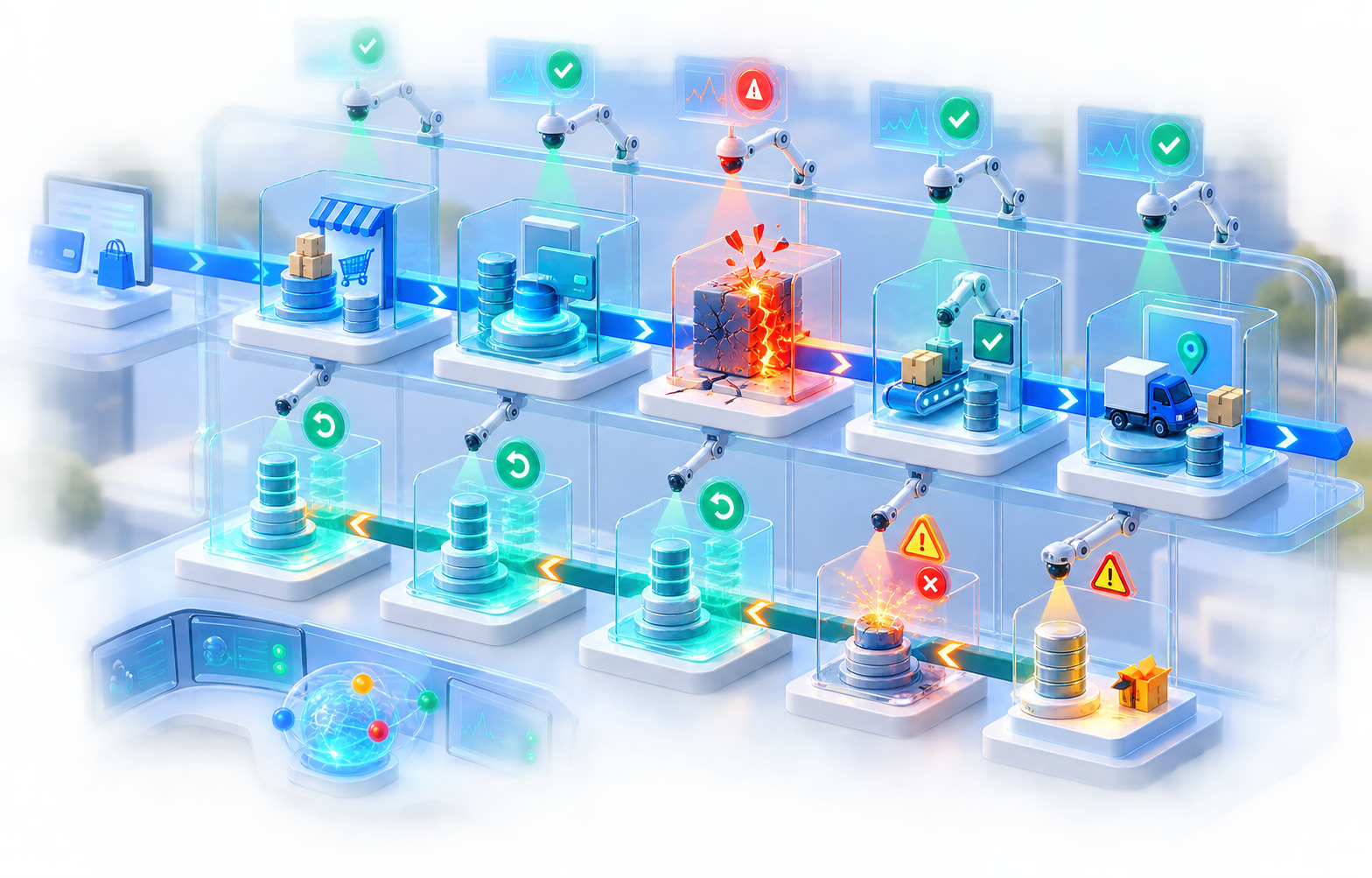
Best Buy's website went down on Black Friday in 2014, widely reported at the time by outlets including TechCrunch and Fox News, at the exact moment the retailer's biggest single day of the year depended on it staying up. It was not the last time this happened to a major retailer, and it was not the last time it will happen. Retail Dive has reported on Macy's and Lowe's both experiencing Black Friday technical glitches in more recent years, and Fast Company has documented a running list of retail sites reporting outages or degraded performance during Black Friday and Cyber Monday. These are large, well-resourced organizations with mature engineering teams, and the pattern repeats because the underlying problem is not a lack of engineering competence — it's a mismatch between what gets tested and what actually happens on the day.
Most organizations preparing for a known peak event run a load test: a script that fires a fixed number of concurrent requests against key endpoints and confirms the servers respond within an acceptable time. This is a real and useful exercise. It is also a narrow one, and it validates a much smaller slice of what a peak event actually demands than most teams realize. A load test confirms the server can accept and respond to traffic. It says very little about whether the checkout funnel completes correctly when payment gateways slow down under their own peak load, whether inventory reservation logic holds up when thousands of customers are simultaneously trying to buy the last units of the same discounted item, or whether a queueing or retry mechanism designed for occasional failures behaves sanely when failures become the norm for a sustained period rather than the exception.
QAtronic works with e-commerce and SaaS engineering teams on exactly this readiness question, heading into the specific, dated events — a seasonal sale, a product launch, a marketing campaign tied to a broadcast moment — where failure is public, immediate, and expensive in a way that a steady-state reliability problem rarely is. This article breaks down what peak-traffic engineering actually requires beyond a standard load test, why the gap persists even at sophisticated organizations, and how to build a
The Load Test That Passes and the Launch That Fails
There is a specific and recurring shape to peak-traffic incidents that is worth naming directly, because it explains why "we did load testing" and "we were ready" are not the same claim, even when the team making the first claim is being completely honest.
A team runs a load test in the weeks before a known peak event. The test simulates a target number of concurrent users hitting the homepage, the product listing page, and the checkout endpoint, ramped up over a fixed period. The application handles the load. Response times stay within an acceptable range. The test passes, a report goes out, and the engineering team reasonably tells leadership the platform is ready.
On the actual day, the traffic pattern that arrives is not the traffic pattern that was tested. Real peak-event traffic is bursty in ways a smoothly ramped synthetic load rarely captures — a flash sale announcement goes out on social media and traffic quadruples in under a minute rather than ramping over ten. Real users don't complete a single clean transaction the way a load-testing script's user journey usually models; they open five tabs, compare the same product across two browser windows, add items to a cart and abandon it to check a competitor's price, then come back and try again — behavior that multiplies the actual load on session, cart, and inventory systems well beyond what a "concurrent user" count alone would suggest. Real payment processing depends on a payment gateway that is simultaneously handling peak load from every other retailer running a sale on the same calendar day, which means the gateway's own latency and error rate during the event is worse than it was during the load test, conducted on an ordinary Tuesday when the gateway had no comparable load of its own. And real failures compound: a slow database query that adds a barely noticeable delay under normal load can, under peak contention, hold locks long enough to cascade into connection pool exhaustion — a failure mode a load test run against isolated components, one at a time, often never surfaces, because it only appears when every system is under simultaneous, sustained peak pressure at once.
None of this means the load test was worthless. It means a load test answers a narrower question — can the server handle N concurrent requests — than the question that actually determines whether Black Friday goes well: can the entire system, including its dependencies, its data-contention points, and its failure-handling logic, survive a specific, bursty, unpredictable, multi-hour peak without the compounding failures that turn a slow page into a public outage.
A Vocabulary Problem: Load, Stress, Spike, and Soak Are Not Interchangeable
Part of why peak-readiness testing is inconsistently done is that the underlying performance-testing vocabulary is used loosely, and different testing types answer genuinely different questions — running only one of them and calling the work "load testing" leaves specific, predictable gaps.
Load testing, in the strict sense, verifies system behavior under an expected, realistic level of concurrent usage — validating that the system meets its performance targets (response time, throughput) at the traffic level it's actually expected to handle. This is the most commonly run test and the one most teams mean when they say "we load tested it."
Stress testing pushes load beyond expected levels, deliberately, to find the system's actual breaking point and to observe how it fails — whether it degrades gracefully (slower responses, but still functioning) or fails catastrophically (crashes, data corruption, cascading errors across dependent systems). This is the test that answers "what happens when the peak exceeds our estimate," which for an event like a flash sale or a viral marketing moment is not a hypothetical edge case — it's a realistic scenario that deserves its own deliberate test, not an assumption that the system will fail "gracefully" because no one ever verified that it does.
Spike testing examines behavior under a sudden, sharp increase in load rather than a gradual ramp — testing specifically how the system responds when traffic jumps dramatically in a short window, which is a much closer approximation of a flash-sale announcement or a viral social post than the smoothly ramped traffic pattern most standard load tests use. Systems that handle gradually ramped load well can still fail under a spike specifically because auto-scaling infrastructure, connection pool warm-up, and cache-priming all take time that a gradual ramp provides and a spike does not.
Soak testing (also called endurance testing) runs a sustained, moderate load over an extended period — hours, not minutes — to catch failure modes that only appear over time: memory leaks, gradually exhausted connection pools, log files filling available disk space, or a scheduled batch job that collides badly with sustained peak traffic because it was only ever tested in isolation. A peak sales event is not a five-minute spike; it is frequently a multi-hour or multi-day sustained elevated-load period, and a team that has only ever spike-tested or load-tested in short bursts has no evidence about how the system behaves eight hours into a sustained peak, which is exactly when soak-testing-catchable failure modes tend to surface.
A genuinely thorough peak-readiness program runs some version of all four, because each answers a distinct question that the others do not, and a team that has run only a standard load test has meaningfully tested only one of the four failure surfaces a real peak event will actually exercise.
What Synthetic Load Scripts Get Wrong About Real Peak Traffic
Beyond the taxonomy above, there's a more specific and commonly underappreciated gap: even a well-designed load, stress, spike, and soak testing program is only as realistic as the traffic pattern and user behavior it simulates, and most synthetic load scripts simplify real user behavior in ways that systematically understate real-world load on specific system components.
Read-heavy assumptions undercount write contention. A typical load-testing script models a user journey as mostly reads — browsing, searching, viewing product pages — with a smaller proportion of writes (adding to cart, checking out). Real peak-event behavior skews more write-heavy than typical traffic, because peak events specifically motivate cart activity: more users adding items, more users applying and removing promotional codes, more users updating quantities as they compare options against a countdown timer. Systems tuned and tested primarily against read-heavy load patterns can have write-path bottlenecks — a database table lock, a cache invalidation storm triggered by frequent price or inventory updates — that a read-dominant load test simply never exercises with enough intensity to surface.
Session and cart abandonment inflate real load beyond "concurrent user" counts. A load-testing tool typically models a fixed number of virtual users completing a defined journey and then either repeating it or exiting cleanly. Real shoppers during a peak event abandon carts, return, abandon again, open multiple tabs for the same product, and leave sessions open in idle browser tabs far longer than a scripted virtual user would — all of which keeps session state, cart records, and often held inventory reservations alive and consuming resources for far longer, and in far greater volume, than a raw concurrent-user count would predict.
Bot and scraper traffic is part of real peak load and is absent from most synthetic tests. Price-monitoring bots, deal-aggregator scrapers, and, for high-demand limited-inventory items, purchase bots attempting to automate checkout all generate real load against the same endpoints legitimate shoppers use, disproportionately concentrated on exactly the high-value pages (limited-stock product pages, checkout endpoints) where load matters most. A load test that only models legitimate, human-shaped traffic patterns has no data on how the system behaves under this additional, adversarial load layer, which for high-profile product drops or steep limited-time discounts can be a substantial share of total peak traffic.
Geographic and device distribution shifts under promotional traffic. A peak sales event, especially one driven by a broad marketing push, often draws a different device and geographic mix than typical traffic — a higher proportion of mobile users arriving from a social media link, for instance, with different latency characteristics and different client-side performance constraints than the desktop-heavy traffic a load test's default user-agent and network-condition assumptions might reflect. Testing exclusively against a single, typical network and device profile can miss performance problems that disproportionately affect the actual peak-event audience.
What to test, specifically: build load test scenarios using actual historical peak-event traffic logs where available — the previous year's Black Friday access logs are a far more accurate behavioral model than a generic e-commerce load-testing template — paying specific attention to the write-to-read ratio, the session duration and abandonment rate, and the device and geographic mix actually observed during past peaks; include a deliberately adversarial load component (simulated scraping or rapid repeated requests against high-value endpoints) rather than assuming only well-behaved traffic; and validate mobile performance under peak conditions specifically, using the network conditions and device profiles that actually characterize your peak-event audience rather than your average-day audience.
The Checkout Funnel: Where Load Testing Usually Stops and Failure Usually Starts
Checkout is disproportionately likely to be the point of failure during a peak event, and disproportionately likely to be under-tested relative to that risk, for a structural reason: checkout is the point in the user journey with the most external dependencies (payment gateways, fraud-detection services, tax calculation, inventory finalization, sometimes third-party financing or buy-now-pay-later providers), the most write operations against shared, contended data (inventory decrement, order creation, payment records), and the most business logic (promotional code validation, shipping calculation, currency conversion) — all concentrated into a single, time-pressured user flow where a shopper who hits a friction point during a limited-time sale is far more likely to abandon than a shopper browsing casually on an ordinary day.
Standard load testing frequently treats checkout as just another endpoint to include in the test script, hit at the same proportional rate as other pages, without accounting for the fact that checkout's actual failure behavior under load is qualitatively different from a product page's. A slow product page under load is a bad experience. A checkout flow that partially completes under load — charging a customer's card but failing to create the order record, or reserving inventory but timing out before payment confirmation — is a data-integrity incident with financial, customer-trust, and sometimes regulatory consequences that a slow-but-eventually-successful product page simply does not carry.
The specific checkout failure modes worth testing deliberately, beyond generic response-time thresholds, include: whether a payment that succeeds at the gateway but times out on the response back to the application correctly reconciles into a completed order rather than either double-charging on retry or leaving an order in permanent limbo; whether promotional code validation, if it depends on a shared counter (a "first 500 customers" style promotion), correctly enforces that limit under concurrent access rather than allowing more redemptions than intended due to a race condition; whether tax and shipping calculation services, which are frequently third-party dependencies with their own rate limits, degrade the checkout experience gracefully (a slightly stale but reasonable estimate) or block checkout entirely when they're slow to respond under their own peak load; and whether the checkout flow's timeout and retry behavior, from the customer's perspective, gives clear feedback rather than leaving the customer staring at a spinner with no indication of whether the action can be safely retried — a UX failure that, under peak-event pressure, reliably produces exactly the duplicate-submission problem the backend retry logic then has to handle correctly.
Inventory and Reservation Logic Under Contention
Peak sales events routinely involve limited-quantity, high-demand items — a specific discounted product, a doorbuster deal, a limited product drop — where the entire point of the promotion is that demand exceeds supply, which means the inventory system is guaranteed to face genuine contention: many customers simultaneously attempting to claim the same finite pool of units. This is a fundamentally different testing problem than general checkout load, because it's specifically about correctness under contention, not just throughput under volume.
The core failure mode is overselling: multiple concurrent purchase attempts each read the same "units remaining" value before any of them commits a decrement, and each proceeds believing sufficient inventory exists, resulting in more confirmed orders than actual available stock. This is a classic race condition, well understood in database and distributed-systems theory, but it remains a common real-world failure specifically because it is invisible under normal, low-contention traffic and only manifests when concurrent access to the same inventory record actually happens at meaningful scale — exactly the condition a standard load test, spreading simulated traffic evenly across a large product catalog rather than concentrating it on a single hot item, is unlikely to reproduce.
A related and less obvious failure mode is the opposite problem: an overly conservative reservation system that holds inventory for every customer who reaches checkout, even if they never complete the purchase, can make available inventory appear exhausted to genuine buyers while a large share of the "reserved" stock is actually held by abandoned carts that will never convert — a defect that manifests as apparent stockouts on inventory that technically still exists, and that specifically requires testing the interaction between reservation timeout duration and realistic abandonment behavior under peak conditions, not just the reservation logic in isolation.
What to test, specifically: deliberately construct a concentrated-contention test scenario — many simulated concurrent purchase attempts against a single, low-stock item — rather than relying on a generally distributed load test to reproduce this by chance; verify the specific concurrency-control mechanism in place (database-level locking, an atomic decrement operation, a distributed lock, or an eventually-consistent reservation queue) actually prevents overselling under the concentrated-contention scenario, rather than assuming the general architecture handles it correctly; and test reservation timeout behavior specifically against realistic peak-event abandonment rates, since the "right" timeout duration is a trade-off between protecting genuine buyers from a false stockout and holding inventory hostage from abandoned carts, and that trade-off can only be evaluated with realistic abandonment data, not a generic default value.
Payment Gateways: The Dependency You Can't Load Test in Isolation
Every e-commerce checkout flow depends on at least one payment gateway or processor, and this dependency introduces a testing constraint most internal load tests handle poorly: you generally cannot load-test a third-party payment gateway's actual production infrastructure at realistic peak-event volume, because doing so would itself generate a disruptive load spike against a shared service you don't control and likely don't have permission to stress-test directly.
Most payment providers offer a sandbox or test environment for functional testing, but these environments are typically not provisioned or intended to validate performance under realistic peak load — a sandbox environment behaving fine under a load test provides limited assurance about how the production gateway will behave when your traffic peak coincides with every other merchant's traffic peak on the same shopping-event calendar day, which is precisely when the gateway itself is under its own, unrelated peak load and may exhibit elevated latency or error rates that have nothing to do with your application at all.
The practical response to this constraint is not to give up on testing payment behavior under load; it's to shift the testing focus from "can we generate enough load against the real gateway" (usually not feasible or advisable) to "does our application handle gateway slowness and intermittent failure correctly," which is a testable property independent of generating real load against the gateway itself. This means deliberately simulating gateway latency and error responses — using a test double, a service virtualization tool, or the gateway's own documented simulation capabilities where available — and verifying the application's behavior under degraded gateway conditions: does a slow gateway response correctly show the customer an appropriate waiting state rather than allowing a duplicate submission; does a gateway timeout get retried safely (without risking a double charge) or does it fail cleanly with clear customer messaging; and does a gateway outage, however brief, get detected quickly enough by the application's own monitoring to trigger a fallback path (a secondary payment provider, if one exists, or at minimum a clear, honest status message to customers) rather than customers discovering the outage through repeated failed attempts with no explanation.
What to test, specifically: simulate payment gateway latency and failure conditions directly, independent of the gateway's real production infrastructure, using service virtualization or the gateway's own sandbox failure-simulation features where available; verify idempotency of payment submission specifically — that a retried request, whether retried by the customer clicking twice or by the application's own retry logic, cannot result in a duplicate charge; and confirm the application has a monitored, tested path for detecting a gateway degradation quickly during the actual event, since the cost of an undetected gateway problem compounds for every minute it goes unnoticed during a high-volume window.
The Retry Storm: How Good Failure Handling Becomes a Second Outage
Retry logic — automatically re-attempting a failed request rather than immediately surfacing an error — is a standard and generally sound resilience pattern. Under peak-event conditions specifically, naively implemented retry logic can become the mechanism that turns a brief, contained slowdown into a sustained, self-inflicted outage, a failure pattern well documented in distributed-systems literature as a retry storm or thundering herd.
The mechanism is straightforward once named: if a dependency (a database, a payment gateway, an inventory service) becomes briefly slow under peak load, requests to it start timing out. If every client retries immediately upon timeout, without any backoff or jitter, the retries arrive as an additional burst of load on top of whatever caused the initial slowdown — precisely when the dependent system is least able to absorb additional load, since it's already struggling. This can extend a slowdown that would have resolved in seconds into an outage lasting many minutes, entirely because well-intentioned retry logic amplified the problem it was meant to route around, rather than mitigating it.
This failure mode is specifically dangerous during peak events because peak conditions are exactly when transient slowness is most likely to occur in the first place (systems operating near capacity are more likely to experience brief slow periods than systems with comfortable headroom), and because peak events involve the highest number of concurrent clients capable of generating a retry storm simultaneously — the same scale that makes the event valuable is what makes a synchronized retry storm capable of doing real damage.
Well-designed retry logic uses exponential backoff (increasing the delay between successive retry attempts) combined with jitter (randomizing the exact delay slightly across clients, so that retries from different clients don't all land in the same instant and recreate the synchronized burst the backoff was meant to prevent) and a circuit breaker pattern (temporarily stopping retry attempts entirely against a dependency that has failed repeatedly, giving it time to recover, rather than continuing to hammer it with retries that are very unlikely to succeed).
What to test, specifically: deliberately induce a slowdown or failure in a downstream dependency during a load or stress test and observe whether the resulting retry pattern from calling services amplifies load on the already-struggling dependency or backs off appropriately; verify that backoff includes jitter, not just an increasing fixed delay, since backoff without jitter still allows synchronized retry bursts across many clients; and confirm that a circuit breaker or equivalent mechanism exists for the dependencies most likely to experience transient peak-event slowness (payment gateways, tax and shipping calculation services, inventory systems), and that its trip and reset thresholds have actually been tested under realistic failure conditions rather than left at an untested default.
A Realistic Failure Scenario, Walked Through Step by Step
The following scenario is a hypothetical composite, constructed to illustrate how the failure modes described above interact in practice — it does not describe any specific QAtronic client or real incident, though it closely mirrors the publicly reported pattern behind several real retail outages referenced earlier in this article.
The initial situation. A mid-sized e-commerce company runs a well-attended, well-marketed 24-hour flash sale on a popular product category, having completed a standard load test two weeks prior that confirmed the platform could handle three times average daily traffic — a comfortable margin over the marketing team's traffic forecast.
The hidden assumption. The load test modeled traffic as a smooth ramp to peak concurrency over thirty minutes, based on how the previous year's more modest promotional traffic had actually arrived. The marketing team's social media push for this year's sale, however, includes a scheduled, coordinated post across several channels at the exact moment the sale opens, driving traffic that spikes to peak within roughly ninety seconds rather than ramping over half an hour — a pattern the load test never modeled because it wasn't the pattern the team had reason to expect based on history.
The technical cause. The application's auto-scaling infrastructure is configured to add capacity based on sustained load over a multi-minute observation window, a sensible configuration for gradually ramping traffic that assumes new capacity has time to come online before load fully materializes. Against a ninety-second spike, the scaling response lags meaningfully behind the actual traffic, and the fixed capacity in place at the moment of the spike is overwhelmed. Database connection pools, sized for three times average load spread across the scaled fleet, saturate quickly as the undersized initial fleet holds connections open longer than usual due to the elevated load. Checkout requests, competing for the same saturated connection pool as browsing traffic, begin timing out.
The consequence. Client-side retry logic, implemented without backoff specifically for checkout submission (added by a well-intentioned engineer months earlier specifically to reduce customer-visible checkout failures on ordinary days, where transient failures are rare and immediate retry is a reasonable and low-risk choice), begins resubmitting failed checkout attempts immediately. This retry traffic adds directly to the already-saturated connection pool, extending the saturation well past the point where auto-scaling capacity would otherwise have caught up. What should have been a two-to-three-minute capacity-catch-up window, based on the auto-scaling configuration's own response time, becomes a twenty-minute period of checkout failures, during which a meaningful share of the day's most motivated, highest-intent traffic — customers who came specifically for the flash sale, at the moment it opened — experiences repeated checkout failures.
The decision that needs to be made. In the aftermath, the engineering team faces a choice familiar to many organizations after a peak-event incident: treat this as a one-off traffic anomaly not worth deep structural investment, since the sale still generated meaningful revenue despite the twenty-minute disruption, or treat it as evidence of a genuine gap between the testing performed and the traffic patterns the business's own marketing activity can produce, worth addressing before the next comparable event.
The better approach. Retroactively, the fix is threefold and directly maps to the failure modes described earlier in this article: reconfigure auto-scaling to respond to shorter observation windows or, more robustly, pre-provision capacity ahead of any marketing-driven event with a known, coordinated launch moment rather than relying on reactive scaling alone; add backoff and jitter to the checkout retry logic, accepting a marginally worse experience for the rare ordinary-day transient failure in exchange for removing the retry-storm risk during genuine peak contention; and, critically, establish a standing practice of sharing the marketing team's planned promotional mechanics — specifically, whether a launch is a coordinated, synchronized announcement versus organic, gradually building traffic — with engineering ahead of any load-testing exercise, so the test's traffic-arrival pattern actually reflects how the specific event is designed to unfold, rather than a generic or historically-based assumption that this year's coordinated push invalidated without anyone on the engineering side realizing it had.
Capacity Planning as a Distinct Discipline From Load Testing
Load testing answers whether a specific, already-built system handles a specific, defined level of traffic. Capacity planning is a broader, ongoing discipline that answers a different question: how much infrastructure, at what cost, is needed to handle an anticipated range of future demand, and it needs to happen on a different timeline and with different inputs than a pre-event load test.
Capacity planning for a known peak event should start from a demand forecast — informed by prior years' actual peak traffic where available, current marketing spend and expected reach, and any known changes (a larger customer base than last year, a bigger promotional push, new geographic markets) that would make historical data an unreliable baseline on its own — rather than working backward from whatever infrastructure happens to already be provisioned. This ordering matters because the common alternative, testing against current infrastructure and declaring success if it handles some multiple of average traffic, implicitly treats current capacity as the right target rather than deriving the target independently from actual expected demand, which can silently understate what's needed if the business has grown or the promotional push is larger than in prior comparable periods.
Cost is a legitimate and necessary part of this conversation, not a compromise of engineering rigor: over-provisioning capacity that sits idle for 364 days a year to handle a single peak day has a real, ongoing infrastructure cost, and the capacity planning conversation should explicitly weigh the cost of that headroom against the cost of a peak-day outage, using whatever concrete revenue and reputational data the organization has available, rather than defaulting to either extreme — under-provisioning to save cost, or over-provisioning "to be safe" without examining whether the specific safety margin chosen is actually proportionate to the specific risk. Cloud infrastructure's elasticity has made this trade-off more manageable than it once was, since capacity can, in principle, be provisioned specifically for the peak window and released afterward — but this elasticity only pays off if the auto-scaling and pre-provisioning strategy is itself tested against the realistic arrival pattern of peak traffic, as the scenario above illustrates, rather than assumed to work correctly simply because the infrastructure is technically capable of scaling.
Third-Party Dependencies: Testing What You Don't Control
Beyond the payment gateway dependency discussed earlier, a modern e-commerce stack typically depends on a range of third-party services during checkout and browsing — tax calculation, shipping rate calculation and carrier integration, fraud detection and risk scoring, content delivery networks, search and recommendation services, and marketing/analytics tags that, while not functionally critical, can degrade page performance if they load synchronously and slow down under their own peak load.
Each of these dependencies has its own capacity, its own peak-event exposure (a shipping rate API, for instance, faces elevated load from every e-commerce customer running a promotion on the same calendar day, for the same reason your payment gateway does), and its own service-level commitments that may or may not have been reviewed with peak-event traffic specifically in mind. A dependency's general-purpose SLA, negotiated for typical usage patterns, does not automatically guarantee performance under the specific, correlated peak-demand conditions that a major shopping event creates across that vendor's entire customer base simultaneously — which is a meaningfully different load profile than an individual customer's own usage growth, and worth a direct conversation with vendor account teams ahead of a known major event rather than an assumption that existing service levels will hold.
What to test, specifically: inventory every third-party dependency in the critical checkout and browsing path and classify each by whether a failure or slowdown is functionally blocking (checkout cannot complete without it) or degradable (the experience is worse without it but can still function, like a personalized recommendation widget); for blocking dependencies, confirm with the vendor directly what their own peak-event capacity and support posture looks like for your specific event window, rather than assuming their general SLA covers correlated peak demand across their full customer base; and for degradable dependencies, verify that the application actually degrades rather than blocks when the dependency is slow or unavailable — a recommendation widget that hangs and blocks the surrounding page from rendering has effectively been miscategorized as blocking in practice, regardless of how it was intended to behave.
Graceful Degradation: Deciding in Advance What Gets Sacrificed
A mature peak-readiness posture accepts, explicitly, that at some traffic level beyond what capacity planning targets, the system will not be able to serve every request at full functionality — and treats deciding what gets sacrificed first as a deliberate design and business decision made in advance, rather than an emergent, ad hoc outcome decided under pressure during the event itself by whichever engineer is on call.
Graceful degradation means defining, ahead of time, a priority order for functionality under extreme load: personalized recommendations might be the first thing disabled, falling back to generic best-sellers, since personalization is compute-intensive and non-essential to completing a purchase; real-time inventory counts might fall back to a cached, slightly stale value rather than a live database query, accepting a small risk of overselling in exchange for removing a expensive, contended read path from the critical checkout flow; and, in the most extreme case, a virtual waiting room — a deliberately imposed queue that admits customers to checkout at a controlled rate — might be activated to protect the core transaction path entirely, at the cost of a worse but honest experience (a visible queue with a wait estimate) rather than the alternative of an uncontrolled, unpredictable failure that gives customers no information at all.
The reason this needs to be decided in advance rather than during the event is that decisions made under live incident pressure, by an on-call engineer without full business context, tend to be worse than decisions made calmly ahead of time with input from both engineering and the business stakeholders who understand the relative cost of each type of degraded experience. A pre-agreed degradation plan, tested in advance (ideally exercised as part of the stress-testing process described earlier, deliberately triggering each degradation path to confirm it activates and behaves as intended, rather than trusting untested code to work correctly the first time it's actually needed, under the worst possible conditions), converts an emergency decision into an executed plan.
A Peak-Readiness Framework
The following framework consolidates the testing dimensions covered above into a structured readiness assessment, organized around the questions that actually determine peak-event outcomes rather than a generic pre-launch checklist.
| Readiness dimension | Key question | Primary testing approach |
|---|---|---|
| Baseline capacity | Can the system handle the forecasted peak concurrency at steady, ramped load? | Standard load testing against a demand-forecast-derived target, not an arbitrary multiple of current traffic |
| Breaking point | What happens when actual traffic exceeds the forecast, and does it fail gracefully? | Stress testing to find and characterize the actual breaking point |
| Burst response | Does the system handle a sudden, coordinated traffic spike, not just a gradual ramp? | Spike testing modeled on the actual planned marketing mechanics for the event |
| Sustained endurance | Does the system remain stable across the full multi-hour or multi-day duration of the event? | Soak testing at sustained elevated load for a duration matching the real event window |
| Checkout integrity | Does checkout complete correctly, without duplicate charges or lost orders, under load and under partial failure? | Targeted checkout-flow testing including induced gateway latency and timeout scenarios |
| Inventory correctness | Does concentrated demand on limited-stock items avoid overselling and avoid false stockouts? | Concentrated-contention testing against specific hot inventory items |
| Dependency resilience | Do third-party dependency slowdowns get absorbed gracefully rather than amplified? | Induced-failure testing against simulated dependency latency, with retry and circuit-breaker verification |
| Degradation readiness | Is there a tested, pre-agreed plan for what gets sacrificed under extreme, above-forecast load? | Deliberate exercise of the degradation plan itself, not just a document describing it |
| Observability | Can the team detect and diagnose a problem in real time during the event, not just after? | Dashboard and alert validation specifically under simulated peak conditions, ahead of the real event |
A team that can honestly check each row of this table, backed by an actual test rather than an assumption, has a materially stronger claim to being "ready" than a team that can only point to a passed load test against dimension one.
Observability During the Event Itself
Testing before the event and monitoring during the event are related but distinct concerns, and a gap in the second undermines even excellent preparation in the first, because a problem that isn't detected quickly during a live, time-boxed peak event has effectively the same business impact as a problem that wasn't prevented at all — the remediation window is simply too short for a slow detection process to matter.
The specific readiness question worth testing directly, not just assuming, is whether the team's dashboards and alerting actually surface the right signals at peak-event scale, in time to act. A dashboard built and tuned against ordinary-day traffic and alert thresholds calibrated to ordinary-day baselines can be either too noisy (firing constantly during expected, planned peak conditions, training the on-call team to ignore alerts right when they matter most) or too insensitive (calibrated with enough headroom for peak conditions that a genuine, event-specific problem doesn't cross the threshold until real damage has already accumulated). Both failure modes are testable in advance, by running the observability stack itself through the same load and stress tests described throughout this article and confirming that the right people would actually notice the right problem within an acceptable window — a check that is frequently skipped because observability is assumed to "just work" rather than treated as a system with its own testable failure modes.
What to test, specifically: validate alert thresholds against the load and stress test scenarios described earlier, confirming alerts fire at a stage early enough to allow intervention rather than only after the failure is already customer-visible; explicitly staff and rehearse the incident response process for the event window itself, including a clear, pre-agreed decision authority for triggering the degradation plan described earlier, since ambiguity about who can make that call during a live, time-pressured incident is itself a readiness gap; and confirm that on-call staffing during the actual event window matches the elevated risk of that window, rather than defaulting to standard on-call rotation coverage for what is, by design, the highest-stakes traffic period of the year.
Metrics That Mislead During a Peak Event
A team monitoring a peak event needs metrics that reveal problems while there's still time to act on them, and several of the most commonly displayed metrics are specifically prone to looking healthy while a real, customer-affecting problem is already underway — a distinction worth understanding before the event, not discovered live while trying to decide whether an alert is real.
Average response time hides the customers who are actually suffering. A dashboard showing average response time holding steady at an acceptable level can coexist with a meaningful share of requests experiencing severe latency, if the average is being pulled down by a larger volume of fast, cached, or simple requests. The customers most affected by a peak-event slowdown are often disproportionately concentrated in exactly the specific, expensive operations — checkout, payment confirmation, a specific high-demand product page — that an aggregate average across all traffic will dilute into invisibility. A p95 or p99 latency metric, tracked specifically for the checkout and payment path rather than blended across the whole site, surfaces the tail-latency problem an average conceals, and is the more actionable metric during an active event.
Overall uptime percentage says nothing about partial, functionally significant degradation. A system can report 100% uptime by the standard measure of "did the server respond" while checkout is silently failing at an elevated rate due to a downstream payment gateway issue, because uptime as conventionally measured checks whether an endpoint responds, not whether the response represents a successful business transaction. A peak-event dashboard needs a business-outcome metric — successful completed orders per minute, or checkout completion rate as a percentage of checkout attempts — displayed alongside infrastructure-level uptime, because the two can diverge sharply during exactly the kind of partial failure this article has focused on throughout.
Total request volume, without a comparison to expected volume, doesn't reveal a silent drop-off. A team watching total traffic volume climb through the day can miss that traffic is climbing more slowly than the marketing forecast predicted — a sign that customers are hitting friction early in the funnel (a slow-loading landing page, a broken link in a promotional email) and abandoning before they're even counted as an active session, a failure mode that a raw volume metric, without a forecast comparison line on the same chart, doesn't surface at all until well after the promotional traffic window has largely passed.
Queue depth and backlog trends often predict a problem before response time does. For systems using any form of request queueing, background job processing, or a virtual waiting room, queue depth that is steadily growing rather than stable is a leading indicator that the system is falling behind demand, and it typically becomes visible in this metric before it becomes visible in response time or error rate, because a growing queue initially manifests as increased latency for the customers at the back of it, which an average or even a p95 metric across the whole system may not yet reflect if the queue is still a relatively small proportion of total traffic. Watching the trend, not just the current value, is what makes this metric useful as an early warning rather than a lagging confirmation of a problem that's already fully materialized.
What to test, specifically: confirm that peak-event dashboards display p95 or p99 latency for the checkout and payment path specifically, not just an aggregate average across all traffic; add a business-outcome metric (completed orders, checkout completion rate) alongside infrastructure uptime, and verify during pre-event testing that this metric actually reflects a deliberately induced partial failure, since a business-outcome metric that doesn't move during a simulated checkout failure isn't wired correctly; overlay real-time traffic volume against the pre-event forecast on the same dashboard so a shortfall is visible as a gap rather than requiring a mental comparison against a number from a separate planning document; and track queue depth or backlog trend, where applicable, as a leading indicator, with an alert threshold tested against the stress and spike scenarios described earlier in this article rather than an untested default.
Mobile Apps and APIs Under Peak Load
E-commerce traffic during a major peak event skews heavily toward mobile, and mobile clients — whether a mobile web browser or a native app — introduce failure modes distinct from the desktop-web-centric scenarios discussed so far, because mobile clients interact with backend APIs differently than a browser rendering a server-driven page does.
Native app caching and background sync can mask or amplify backend problems unpredictably. Native mobile apps commonly cache API responses aggressively and use background sync and prefetching to improve perceived performance — behavior that, under normal conditions, is a legitimate and effective optimization. Under peak-event conditions, this same behavior can mean a meaningful share of users are viewing stale inventory or pricing data because the app is serving a cached response rather than hitting a struggling backend, which can produce a specific and confusing failure pattern: a customer sees an item as available and proceeds through several screens before checkout, at which point a fresh, non-cached call finally reveals the item is out of stock — a worse experience than an honest, immediately visible stockout, because it wastes the customer's time and reads as a bait-and-switch even though no one designed it that way.
Backend API rate limiting, tuned for normal usage, can throttle legitimate peak-event traffic. Rate limiting is a standard and important protection against abuse, but rate limits calibrated against typical daily API call volume can trigger against legitimate mobile app traffic during a peak event, when background sync, retry logic, and simply a much larger number of concurrent app sessions all combine to push per-client or aggregate call volume well above what the rate limit was tuned to allow — a failure mode that, from a monitoring dashboard, can look identical to a backend capacity problem (elevated error rates) while actually being a self-inflicted throttling issue with an entirely different fix.
Push notification systems face their own peak-load and timing considerations. A promotional push notification sent to a large user base at the exact moment a sale opens is itself a traffic-generating event, and the app's own backend needs to be prepared for the resulting surge of near-simultaneous app opens and API calls that follow a mass notification send — a surge that arrives with the sharp, coordinated timing characteristic of the spike-testing scenario described earlier in this article, driven by the company's own marketing action rather than organic, gradually building demand.
API versioning and backward compatibility matter more during a peak event than teams often realize, because a meaningful share of a mobile user base during any given period is running an older app version that hasn't yet updated, and a backend change deployed shortly before a major event — even one intended purely as a performance or capacity improvement — carries real risk if it isn't verified against the older API contract that a portion of the peak-event user base is still actually using; this is a specific reason many mature organizations enforce a deployment freeze on backend API changes in the days immediately preceding a known major peak event, reserving that window strictly for monitoring and incident response rather than active development.
What to test, specifically: verify mobile app caching behavior specifically for inventory and pricing data under peak conditions, confirming that a cached "available" state gets revalidated before the customer reaches a point of no return in the checkout flow rather than only at the final payment step; review and, if necessary, temporarily adjust API rate limits ahead of a known peak event to reflect realistic elevated legitimate traffic, distinguishing this adjustment clearly from a separate, still-necessary defense against genuinely abusive traffic; load-test the backend specifically against the traffic pattern a mass push notification produces, if the promotional plan includes one, rather than assuming this traffic is adequately represented by the general spike-testing scenario; and confirm, ahead of the event, that the current and at least the immediately prior mobile app version both function correctly against the backend as it will exist during the event window, treating a pre-event deployment freeze on backend API changes as a deliberate risk-reduction decision rather than an arbitrary process constraint.
Startups, Scale-Ups, and Enterprises: Different Peak-Readiness Postures
Early-stage e-commerce companies running their first major promotional event typically have the least historical data to forecast against and the least infrastructure sophistication to build a full framework described above. The proportionate response at this stage is to focus disproportionately on the checkout-integrity and inventory-correctness dimensions specifically — because a data-integrity failure (a lost order, an oversold item) causes disproportionate customer-trust damage relative to a slow page — while accepting a simpler, less elastic capacity strategy, potentially including deliberate over-provisioning for the specific event window rather than a sophisticated dynamic scaling and degradation strategy that the team doesn't yet have the operational maturity to build and test reliably.
Scale-up companies with one or more prior peak events behind them are the segment most likely to have real historical traffic data available and the segment where the gap between "we load tested" and genuine peak readiness, as this article defines it, tends to be largest — because they've typically outgrown the simple over-provisioning approach on cost grounds, have started building more sophisticated auto-scaling and dependency architectures, but have not yet built the corresponding testing discipline (stress, spike, and soak testing beyond a standard load test) to validate that the more sophisticated architecture actually behaves correctly under real peak conditions. This is the segment for which the framework in this article has the highest immediate return, because the historical data needed to build a realistic test scenario already exists.
Enterprise-scale e-commerce and SaaS organizations generally have dedicated performance engineering functions and should be operating close to the full framework described above, including a tested degradation plan and dependency-level resilience testing — for this segment, the gap that persists is more often organizational than technical: a degradation plan that exists as a document but has never been exercised, or a peak-readiness testing program that has become a compliance exercise (a checklist completed for governance purposes) rather than a genuinely adversarial exercise aimed at finding real gaps, which is a subtler but equally consequential failure mode than simply not testing at all.
When Extensive Peak-Load Investment Isn't Justified
Not every business faces peak-traffic risk proportionate to the full framework described in this article, and it's worth naming the exceptions honestly.
A B2B SaaS product with steady, predictable usage patterns and no marketing-driven promotional events has fundamentally different traffic characteristics than a consumer e-commerce platform running a scheduled flash sale, and applying the full peak-event framework described here to a product that never actually experiences this kind of event is effort spent on a risk that doesn't exist in your specific business model — the framework in this article is specifically about event-driven, forecastable, bursty peak demand, not general scalability, which is a related but distinct concern with its own, more incremental testing approach.
A company running a modest, low-stakes promotional event — a small discount with no specific inventory constraint, no coordinated single-moment marketing push, and no historical pattern of dramatic traffic multiplication — can reasonably scope its testing to a standard load test at a conservatively estimated multiple of average traffic, without necessarily building the full stress, spike, and soak testing program, provided that scoping decision is made deliberately by comparing the actual expected traffic pattern against the risk factors described throughout this article, rather than skipped by default.
Very early-stage companies without the traffic volume to make a "peak" meaningfully different from ordinary variance in day-to-day traffic should generally prioritize building general reliability and monitoring practices over investing in a peak-specific framework that presumes a scale of event this stage of company doesn't yet have — the framework in this article becomes progressively more valuable as the gap between typical and peak traffic grows, and for a company where that gap is currently small, the marginal return on this specific investment is correspondingly small.
The Post-Event Review: The Step Most Teams Skip
Regardless of how the event goes, a structured post-event review is one of the highest-leverage and most commonly skipped steps in the entire peak-readiness cycle, because once the event is over, the immediate pressure that motivated the preparation work disappears, and attention naturally shifts back to ongoing feature work.
A genuinely useful post-event review captures the actual traffic pattern observed (arrival rate, burst timing, device and geographic mix, and how closely or poorly it matched the pre-event forecast), compares it explicitly against what was tested, catalogs every incident or near-miss regardless of whether it was customer-visible (a near-miss that the team caught and mitigated in real time is exactly as valuable a data point for next year's testing as an incident that wasn't caught, and is far more likely to be forgotten if it isn't deliberately documented while memory is fresh), and produces specific, dated action items — not general resolutions to "test more thoroughly next time," but concrete changes to the testing scenarios, the capacity plan, or the degradation plan that will be implemented and, ideally, verified well before the next comparable event rather than revisited for the first time during next year's pre-event preparation, under the same time pressure that constrained this year's effort.
The review is also the correct venue for the conversation raised in the hypothetical scenario earlier in this article: distinguishing between an incident that reflects a genuine, addressable gap in the testing and readiness process, versus one that reflects a truly unusual, low-probability circumstance not worth significant structural investment to prevent — a judgment call that deserves an honest, specific conversation rather than a default assumption in either direction.
The review is also the right moment to look outward briefly, not just inward. Public post-incident reporting from other companies' peak-event outages — including the widely reported retail incidents referenced at the start of this article — is a legitimate and underused input into your own review, not because any two companies' architectures are the same, but because the recurring, cross-industry pattern in these public reports (a traffic pattern that exceeded the tested assumption, a payment or inventory system that behaved correctly in isolation but not under real contention, a retry mechanism that amplified rather than absorbed a slowdown) is worth checking your own findings against, specifically to notice whether your organization is at risk of the same category of gap even if your own event went smoothly this time. A near-miss that didn't become a public incident this year, for reasons that were more luck than design, deserves exactly the same scrutiny in the review as an incident that did.
Questions Executives Should Ask Before the Event
A short set of direct questions in a pre-event readiness review tends to distinguish genuine confidence from optimism: Has our load testing modeled the actual traffic arrival pattern our marketing team is planning — a coordinated spike versus a gradual ramp — or a generic historical assumption that may no longer match this year's promotional mechanics? Have we specifically tested checkout behavior under induced payment-gateway slowness, not just under generic server load? Have we tested inventory correctness under concentrated demand on our actual limited-stock promotional items, not just general checkout throughput? Do we have a tested, specific, pre-agreed plan for what functionality gets sacrificed if traffic exceeds our forecast, and has anyone actually exercised that plan rather than just written it down? Who has the authority to activate that degradation plan during the live event, and have they rehearsed making that call? And if this year's actual traffic pattern turns out to differ meaningfully from the forecast we tested against — in either direction — do we have a same-day process for recognizing that gap and adjusting, or will we only find out how the mismatch mattered during next year's post-event review?
FAQ
How far in advance should peak-event load testing start? This depends heavily on the scale of the event and the extent of any needed remediation, but a useful rule of thumb is to start early enough that findings from stress and spike testing — which frequently surface architectural issues, not just configuration tweaks — can actually be addressed before the event, rather than discovered too late to fix. For a major, high-stakes event, this often means beginning capacity planning and initial testing several months out, with final validation testing in the final weeks serving as confirmation rather than initial discovery.
Is it possible to fully load test a checkout flow that depends on a live payment gateway? Not against the gateway's real production infrastructure at full realistic peak volume, for the reasons discussed in this article — most gateways don't support or permit this kind of test against production. The practical approach is to test your application's behavior under simulated gateway latency and failure conditions, which validates the resilience patterns (retries, timeouts, idempotency) that actually determine whether a real gateway slowdown becomes a contained inconvenience or a compounding failure.
What's the single highest-leverage test most teams are skipping? Spike testing modeled on the actual planned marketing mechanics for the event, as opposed to a generic gradually-ramped load test. The scenario walked through in this article is a common, realistic failure pattern precisely because marketing-driven traffic spikes are often faster and sharper than teams assume when they build a load test based on general historical patterns rather than the specific mechanics of the specific event being planned.
Does cloud auto-scaling eliminate the need for this kind of testing? No. Auto-scaling changes what capacity planning looks like, but it doesn't eliminate the need to test whether the scaling response is fast enough for the actual traffic arrival pattern, whether the application behaves correctly during the window before new capacity comes online, or whether the failure modes described in this article — retry storms, inventory contention, dependency slowdowns — occur regardless of how much raw compute capacity is available, since several of the most damaging failure modes are about correctness and coordination under contention, not raw capacity.
How does this relate to general SLA and reliability commitments? General reliability engineering and SLA commitments address the question of steady-state uptime and performance. Peak-event readiness is a distinct, additional discipline specifically because peak events involve deliberately elevated, forecastable, often marketing-driven demand with its own timing, correlation with other companies' peak demand on the same day, and business stakes — a system can have excellent general reliability and still be unprepared for the specific dynamics of a coordinated flash-sale spike, because the two failure surfaces are different.
Should we freeze all deployments before a major peak event? Most mature organizations freeze non-essential changes, particularly to backend systems in the critical checkout and payment path, for a defined window immediately before and during a known major event, reserving that window for monitoring and incident response rather than active feature development. This is a risk-management decision rather than an absolute rule — some organizations carve out exceptions for critical fixes discovered during final testing — but the default should be a deliberate freeze decision, not an assumption that normal deployment cadence is safe to continue right up to the event.
How do we know if our degradation plan actually works, short of triggering it during a real event? The degradation plan should be exercised deliberately during stress testing, in the same way the rest of the failure modes in this article are tested: deliberately push load past the threshold where the plan is supposed to activate, and confirm it activates correctly, degrades the intended functionality, and preserves the intended core functionality (typically checkout), rather than trusting untested code to behave correctly the first time it's actually invoked under real, live pressure.
What's the relationship between peak-readiness testing and general chaos engineering practices? They overlap in spirit but differ in scope and timing. Chaos engineering, broadly, is the ongoing practice of deliberately injecting failure into a system to build confidence in its resilience under a wide range of conditions, typically as a continuous program rather than a one-time pre-event effort. Peak-event readiness testing borrows the same underlying philosophy — deliberately inducing failure conditions (a slow gateway, a traffic spike, a saturated connection pool) to see how the system responds — but applies it specifically to the failure modes and timing relevant to a known, dated event, with the goal of validating readiness for that specific occasion rather than building general-purpose resilience over an open-ended timeframe. An organization with a mature, ongoing chaos engineering practice has a considerable head start on peak-event readiness, because much of the underlying failure-injection tooling and organizational comfort with deliberately breaking things in a controlled way already exists; it still needs the event-specific traffic modeling and business-context testing (checkout integrity, inventory contention, the specific promotional mechanics) that this article has focused on, which general chaos engineering practice doesn't automatically cover.
Conclusion: Readiness Is a Decision, Not a Hope
The recurring pattern behind public retail outages during major shopping events is rarely a lack of engineering effort. It's a mismatch between what got tested — a smoothly ramped load against isolated components — and what actually happened: a bursty, contentious, dependency-heavy, multi-hour event where checkout, inventory, and third-party services all faced simultaneous peak pressure at once, in combinations a standard load test was never designed to reproduce.
The distinction worth carrying forward is that "we ran a load test" and "we are ready for this specific event" are different claims, and the gap between them is exactly the set of failure modes this article has walked through: the traffic pattern a load test assumes versus the one your own marketing team is about to create, the checkout integrity questions a generic load test never asks, the inventory contention that only appears when demand actually concentrates on a specific item, and the retry logic that quietly turns a brief slowdown into a sustained outage.
Readiness, treated seriously, is a decision an organization makes deliberately — to model the actual planned event, to test the specific failure modes that matter for this business, and to rehearse the degradation plan before it's needed under pressure — rather than a hope that a passed load test, run against a generic traffic assumption, will hold up against whatever the actual day brings.
None of this requires predicting the future perfectly. The marketing team's coordinated push, the exact item that sells out first, the specific moment a payment gateway slows down under its own unrelated peak load — none of it needs to be known in advance for this framework to work, because the point is not to predict the exact failure but to have already tested how the system behaves under the categories of pressure a peak event reliably produces, so that whatever specific form the pressure takes on the day, the response has already been rehearsed rather than improvised.
QAtronic helps e-commerce and SaaS engineering teams build peak-readiness testing programs that go beyond a standard load test — covering checkout integrity, inventory contention, dependency resilience, and rehearsed degradation plans — scoped to the actual scale and mechanics of the specific event ahead, rather than a generic template. If a major sales event or product launch is on your calendar this year, the questions in this article are worth working through now, while there's still time to act on what they surface.