Models Understand Language. Businesses Run on Relationships.
The most valuable information in an enterprise is not written down anywhere. It exists in the space between the things that are written down.
A contract is a document. The fact that this contract governs seventeen active service commitments, inherits indemnity terms from a master agreement signed by a legal entity that was acquired two years ago, and constrains the deprecation schedule of an API that three internal teams depend on — none of that is in the contract. It is around the contract. It is distributed across procurement systems, org charts, service catalogs, ticket histories, and the working memory of four people who have never met.
Large Language Models are extraordinary at the first part of that problem. Give an LLM the contract and it will summarize, extract, classify, translate, and reason about the language inside it with something close to expert fluency. What it cannot do — what no amount of parameter scaling will make it do — is know what that document is connected to. Language comprehension and organizational comprehension are different problems, and the industry has spent three years conflating them.
Enterprises are not document repositories that happen to have some structure. They are networks that happen to emit documents. Customers connect to contracts, which connect to entitlements, which connect to products, which connect to release trains, which connect to engineering teams, which connect to on-call rotations, which connect back to the same customers through incident history. Products connect to bills of materials, which connect to suppliers, which connect to geographies, which connect to regulatory exposure. Employees connect to roles, which connect to approval authority, which connects to spend limits, which connects to vendors, which connects back to suppliers. Every meaningful question an executive asks traverses at least three of those edges.
This is why the return on investment in Enterprise AI has been so uneven. The systems that work spectacularly are the ones where the answer lives inside a single document — policy lookup, code explanation, summarization, drafting. The systems that quietly underperform are the ones where the answer requires assembling a picture from fragments that were never assembled before. Those are the questions that matter most, and they are precisely the questions that similarity search is structurally unable to answer.
The competitive frontier is shifting accordingly. It is not moving toward larger models. Frontier capability is becoming a commodity input, purchased by the token, available to every competitor simultaneously. What is not commoditized is the structure of an organization's own knowledge — the degree to which its entities are resolved, its relationships are explicit, and its context is machine-traversable. Two companies running identical models on identical infrastructure will produce dramatically different AI systems if one of them has a coherent knowledge layer and the other has a very large pile of embeddings.
Vector search retrieves information. Knowledge Graphs explain relationships. The interesting engineering question is no longer which one wins. It is how they compose.
Documents Are Flat. Businesses Are Networks.
Consider what a document actually is from a systems perspective: a serialization. It is a snapshot in which a multidimensional set of relationships has been flattened into linear text for human consumption, with most of the connective structure discarded because the human reader was expected to supply it from memory.
A quarterly business review deck encodes revenue attribution, account ownership, product adoption, churn risk, and competitive positioning — but as prose and charts, with the underlying joins removed. An architecture decision record encodes a dependency, a constraint, a trade-off, and an owner, then stores all four as paragraphs. A change ticket encodes a causal chain across systems and compresses it into a free-text field. Every enterprise document is a lossy projection of a graph, and enterprise search has spent twenty-five years trying to invert that projection statistically.
Document storage optimizes for retrieval of the container. Graph thinking optimizes for traversal of the contents. The difference shows up immediately in the shape of the questions each can answer. A document store answers where is this stated. A graph answers what does this touch. Most operational decisions are the second kind of question wearing the clothing of the first.
The reason organizations map so cleanly onto graph structures is not aesthetic. It is that the fundamental primitives of a business are relational by construction:
Ownership is an edge, not a property. A system without a named owner is not a system with a missing field; it is a system with a severed relationship, and the consequences of that severance — unpatched dependencies, orphaned budgets, ambiguous escalation — are the consequences of a broken edge.
Dependency is transitive and directional. A team depends on a service, which depends on a datastore, which depends on a vendor contract, which depends on a renewal decision made by someone three org units away. Transitivity is the entire point, and transitivity is exactly what flat storage cannot express.
Approval is a path. Authority in an enterprise is a directed acyclic graph with conditional edges, and questions like who can actually sign this are shortest-path queries that most organizations answer by asking around.
Membership and hierarchy are trees embedded in a larger network. Teams roll into departments, products into portfolios, accounts into parent accounts, subsidiaries into legal entities. Hierarchy is not metadata decoration; it is the mechanism by which context propagates. A policy that applies at the portfolio level must be inheritable by everything beneath it, and inheritance requires structure.
Supply and delivery are chains whose value lies in their length. The reason supply chain risk is hard is that exposure lives four hops out, in a tier-three supplier nobody has a contract with.
None of these are analytics artifacts to be reconstructed at query time from unstructured text. They are the operating model itself. An Entity Relationship Network view of even a mid-sized enterprise reveals something uncomfortable: the majority of high-value edges are not recorded in any system of record. They exist implicitly, inferable from documents by a competent human with sufficient context, and invisible to every automated system in the building.
That invisibility is the actual bottleneck in Enterprise AI. Not context windows. Not hallucination rates. Not model capability. The bottleneck is that the relationships were never captured, so there is nothing to retrieve.
Where Retrieval Augmented Generation Reaches Its Natural Ceiling
Retrieval Augmented Generation earned its place. It solved the grounding problem convincingly, it deploys in days rather than quarters, and for a large class of workloads it remains the correct architecture. Criticizing RAG is not useful. Understanding its operating envelope is.
The envelope is defined by a single design assumption: that relevance can be approximated by proximity in embedding space, and that the answer to a question is contained within a small number of passages that are individually similar to that question. Where that assumption holds, RAG is excellent. Where it breaks, it breaks silently — which is the more dangerous failure mode.
Semantic ambiguity. Embeddings collapse meaning into geometry, and geometry has no mechanism for disambiguation. The token sequence "Apollo" occupies a single neighborhood whether it refers to a customer account, an internal platform, a supplier, or a discontinued product line. The vector database returns all four, ranked by cosine similarity to a question that presupposed exactly one. The model, given no signal that these are distinct entities, will happily synthesize across them and produce an answer that is fluent, confident, and a composite of four unrelated things.
Entity resolution failure. The same organization appears in the CRM as "Northwind Industrial," in the contract repository as "Northwind Industrial Holdings Ltd.," in the ticketing system as an account ID, and in the finance ledger as a tax registration number. Semantic Search treats these as four weakly-related strings. A knowledge layer treats them as one node with four identifiers. Every downstream reasoning task depends on which of those two models is in effect, and vector similarity alone will never converge on the second one, because the strings genuinely are different and no amount of embedding quality changes that.
Duplication and near-duplication. Enterprise corpora are pathologically redundant. The same policy exists in seven versions across three systems, each partially updated. Similarity search does not deduplicate — it amplifies, because near-identical passages cluster tightly and crowd the top-k window. The retrieved context ends up presenting one perspective seven times rather than seven perspectives once, and the model's confidence rises precisely when its evidence diversity collapses.
Cross-document reasoning. The structural limitation. A question whose answer requires combining a fact from document A with a fact from document C, where the connection between them is stated in document B — and where B is not lexically or semantically similar to the question — is unanswerable by top-k retrieval. The retriever has no notion of path. It cannot follow B because it cannot see that B is a bridge. Multi-hop questions are the natural language of enterprise decision-making, and they fall outside the envelope entirely.
Aggregation and completeness. "How many of our active contracts include this clause" is not a retrieval question. It is a set operation, and top-k retrieval is definitionally a sampling method. It returns a plausible subset and offers no signal about what it missed. The model then reports on the sample as though it were the population.
Negation and absence. "Which systems have no designated owner" requires knowing the full entity set and testing for a missing edge. Nothing in a similarity pipeline can establish absence. Absence is only visible against a complete structure.
The common thread is that similarity is a statement about resemblance, and enterprise questions demand statements about connection. Those are different relations. Two documents can be maximally similar and causally unrelated. Two documents can be lexically disjoint and tightly coupled by a business relationship that determines everything. Embedding space encodes the first property and is blind to the second.
Scaling the retriever does not help. Larger context windows do not help — feeding a hundred thousand tokens of undifferentiated passages to a model shifts the burden of relationship reconstruction to inference time, where it must be redone, imperfectly, on every single query. Reranking improves precision within the resemblance frame without escaping it.
The ceiling is not a performance ceiling. It is a representational one.
What a Knowledge Graph Actually Contributes
Skip the textbook definition. What matters operationally is the set of capabilities that become available once relationships are first-class, addressable objects rather than statistical artifacts.
Identity. A graph forces the question that unstructured retrieval permits you to avoid: what is this thing, and have we seen it before. Entity Resolution converts a population of mentions into a population of entities. This single transformation is the highest-leverage step in the entire pipeline, because every subsequent operation — aggregation, traversal, permissioning, freshness tracking — is meaningless without stable identity. Most Enterprise AI programs that stall have stalled here without diagnosing it.
Traversal. Once edges exist, multi-hop reasoning becomes a query rather than an inference. Which customers are exposed to a vulnerability in this library is a four-hop traversal — library to service to product to entitlement to account — executed in milliseconds with complete recall. Asking a language model to derive the same answer from retrieved text is asking it to reconstruct the join at inference time from partial evidence.
Typed semantics. An edge in a well-designed graph is not merely a connection; it carries a type, a direction, a temporal validity, and often a provenance record. "Supplies," "supersedes," "governs," "escalates to," "is a regulated instance of" are different relations with different reasoning rules. Vector similarity has exactly one relation — is near — and it is untyped, symmetric, and semantically empty.
Hierarchy and inheritance. Business context is layered. A control that applies to a legal entity applies to its subsidiaries; a standard that applies to a platform applies to services built on it. Graphs express inheritance natively, so context propagates without being restated in every document. This is where a Connected Business Knowledge Model pays for itself: policy stated once, resolved everywhere.
Causal and dependency chains. Incident analysis, impact assessment, and change risk are all traversals of a Semantic Dependency Graph. Determining what breaks if a service degrades is a reachability computation. It is not something to be approximated from prose.
Constraint and rule representation. Business rules — segregation of duties, data residency, approval thresholds, licensing restrictions — are statements about permissible configurations of the graph. They can be checked structurally. They cannot be checked against a document corpus in any reliable way.
Explainability by construction. A graph-derived answer arrives with its path attached. The system did not merely produce a conclusion; it produced the specific chain of typed edges that supports it. In regulated environments this is not a nice-to-have feature, it is the difference between a deployable system and a demonstration.
None of this displaces vector search. The two technologies are strong in exactly opposite regimes. Embeddings excel at the fuzzy, open-vocabulary, unstructured entry point — matching an imprecisely worded question to relevant material without requiring the user to know any schema. Graphs excel at precise, structured, complete traversal once the relevant entities are identified. Semantic Search finds the door. The Knowledge Graph knows the building.
The productive architecture uses each where it is strong: embeddings to enter the knowledge space, structure to move through it.
GraphRAG as an Architectural Evolution
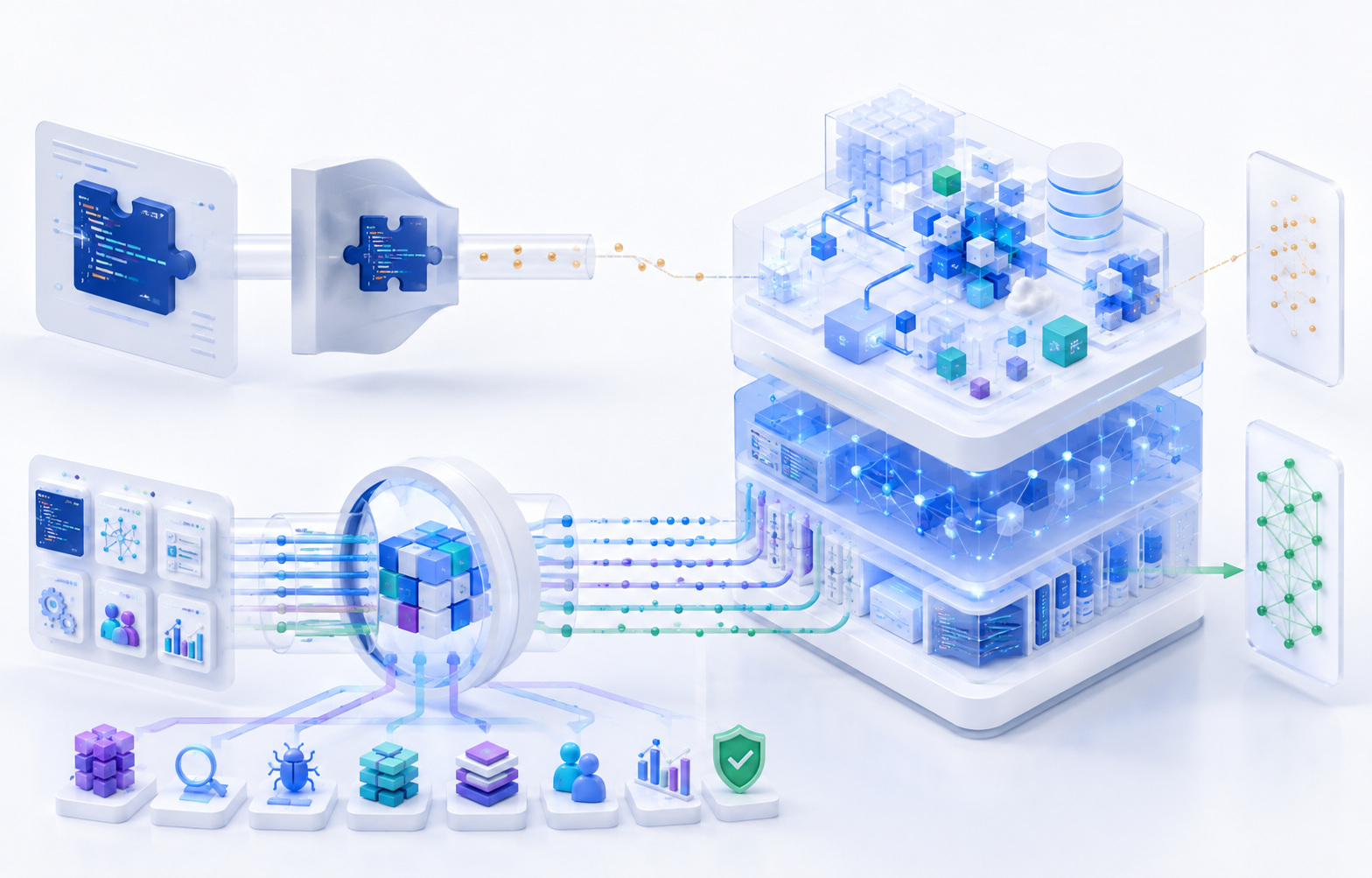
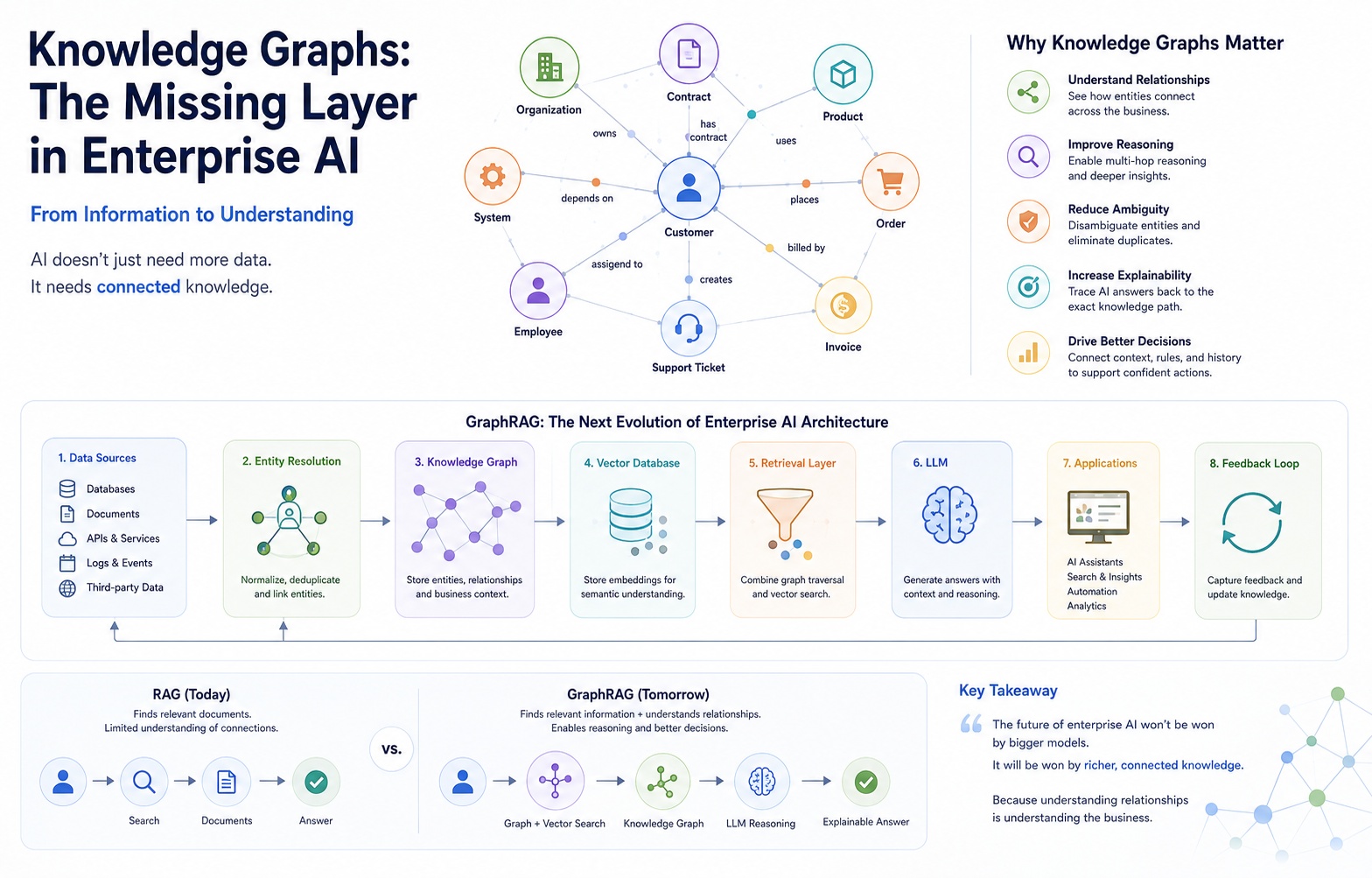
GraphRAG is best understood not as a product category but as a division of labor. In a conventional Retrieval Augmented Generation pipeline, a single component — the vector index — carries responsibility for identity, relevance, scope, and completeness simultaneously. It is competent at exactly one of those. Hybrid Retrieval decomposes the responsibility across specialized layers.
The knowledge graph holds structure and identity: canonical entities, typed relationships, hierarchies, ownership, temporal validity. It is the authoritative answer to what exists and how it connects, and it is queried deterministically. Its contribution is precision and completeness — when a graph traversal returns twelve dependent services, there are twelve, not approximately twelve.
The vector database holds meaning: the unstructured content, the language, the nuance that resists schematization. Its contribution is recall over open vocabulary. It is what allows a user to ask a question in their own words without knowing the ontology, and it is what surfaces relevant material that nobody thought to model.
Embeddings function as the bridging mechanism in both directions — mapping natural language to candidate entities, and mapping graph nodes into a space where semantic neighborhood can be computed. Increasingly they are applied to the graph itself, embedding subgraphs so that structural similarity becomes searchable.
Metadata and provenance cut across every layer: source system, extraction confidence, effective date, access classification, review status. In enterprise deployment this layer often determines whether the system is permitted to operate at all, because it is what makes row-level and edge-level authorization enforceable before generation rather than after.
Retrieval orchestration is where the architecture earns its complexity. This layer decomposes an incoming request into a retrieval plan: identify entities via semantic matching, resolve them against the graph, traverse to the relevant neighborhood, use that neighborhood to constrain and expand the vector query, assemble evidence with structural annotation. It decides when a question is a lookup, when it is a traversal, when it is an aggregation, and when it requires several passes. A GraphRAG Workflow diagram makes this legible: the flow is not linear but alternating, moving between structure and text several times before assembly.
The LLM does what it is genuinely best at — comprehension, synthesis, and articulation over assembled evidence. Critically, its role shrinks. It is no longer being asked to infer organizational structure from fragments. It is being handed structure and asked to explain it. Hallucination rates fall not because the model improved but because the task got easier and better specified.
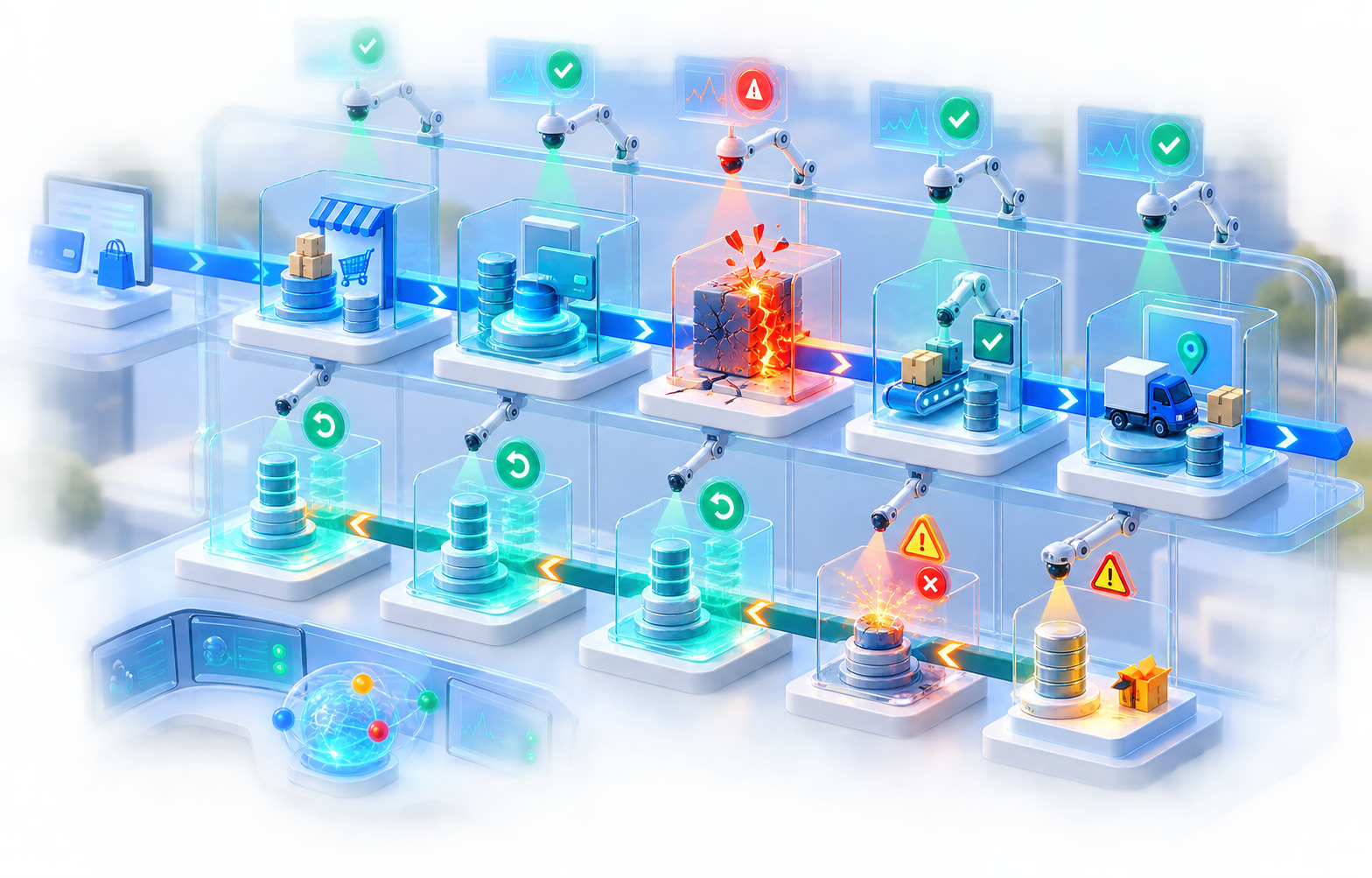
What changes in practice is the character of the failure modes. A pure vector pipeline fails by confidently answering the wrong question — plausible, fluent, and untraceable. A graph-augmented pipeline tends to fail by returning nothing, or by returning an incomplete traversal with the gap visible. That is an enormously better failure mode. It is inspectable, attributable to a specific missing edge, and fixable by improving data rather than by prompt archaeology.
There is a real cost. Ontology design is genuinely difficult and requires sustained domain engagement. Entity resolution at enterprise scale is a hard technical problem with no fully automatic solution. Graph maintenance is continuous rather than one-time. Anyone who presents GraphRAG as a straightforward upgrade path has not built one. The honest framing is that the difficulty moves from inference time — where it is invisible, unfixable, and repeated on every query — to design time, where it is expensive, explicit, and amortized.
Enterprise Knowledge Is Not Just Information
Treating "enterprise knowledge" as a single substance to be indexed is the category error underneath most failed deployments. It is several distinct kinds of knowledge with incompatible representational requirements, and only one of them is well served by a document corpus.
Organizational knowledge — who does what, who reports to whom, who owns which asset, which team is accountable for which outcome — is pure structure with almost no textual content. It lives in HR systems, org charts, service catalogs, and CMDBs, and it changes constantly. Serialized into documents it becomes stale within weeks and unqueryable immediately.
Business rules are conditional logic. Approval thresholds, discount authority, eligibility criteria, escalation triggers. These are executable statements that happen to be written in prose because prose was the only available medium. When a rule lives only as a paragraph, every system that needs to apply it must reinterpret it, and interpretations diverge. When it lives as a constraint over a graph, it is evaluated identically everywhere.
Operational dependencies are the runtime topology — what calls what, what fails when what degrades, which batch job blocks which report. This knowledge is inherently a directed graph and is typically distributed across runbooks, dashboards, tribal memory, and incident postmortems. Its value is entirely in traversal depth, which flat storage eliminates by construction.
Customer relationships are multi-entity and time-varying. An account is a hierarchy of legal entities, contacts, contracts, entitlements, usage, support history, and commercial commitments, evolving continuously. The CRM captures a slice. Contracts capture another. Support systems capture a third. No document contains the relationship; the relationship is the union of edges across systems.
System architecture is a graph that documentation approximates. Every architecture diagram is a lossy human-readable rendering of a structure that actually exists in configuration, code, and network topology. The diagram goes stale; the structure does not.
Regulatory context is fundamentally a mapping problem — obligations to controls to systems to data to jurisdictions to owners. The regulation itself is a document, and that document is the least useful part. What matters is the edge set connecting each obligation to everything it touches, which is precisely what nobody maintains and what auditors always request.
Historical decisions are the most systematically lost. Why an architecture was chosen, why a supplier was rejected, why a policy exception was granted, what constraints were binding at the time. These decisions constrain present options, and their rationale survives only as edges — decision to alternatives, to constraints, to owner, to affected systems, to expiry condition. Absent that structure, organizations relitigate settled questions indefinitely.
Only a minority of enterprise knowledge is genuinely document-shaped. The rest is structure that has been forced into documents because documents were the only container available. Knowledge Engineering, in this framing, is not the work of writing things down better. It is the work of extracting structure back out of the containers it was flattened into, and giving it a home where its shape is preserved.
Where Relationship Awareness Changes Outcomes
The domains where a knowledge layer produces immediate, measurable improvement share a diagnostic property: the correct answer depends on entity identity and relationship depth rather than on passage relevance.
Customer support stops being FAQ retrieval when the response depends on this customer's entitlement tier, their contract's specific exclusions, the known defects in their deployed version, and their open escalations. Every one of those is an edge from the account node. Resolution quality improves because the system is answering about a customer rather than about a topic.
Healthcare operates on a dense graph of patients, conditions, medications, interactions, protocols, providers, and coverage. Contraindication checking is edge traversal. Care pathway reasoning is subgraph matching. The consequence of an entity resolution error — two records for one patient, one record conflating two — is not a degraded answer but a clinical risk, which is why identity discipline is non-negotiable in this domain.
Banking and capital markets run on hierarchies that similarity search cannot see: legal entity structures, beneficial ownership, counterparty exposure, collateral chains. Aggregate exposure to a counterparty is a traversal across subsidiaries and instruments. Getting it approximately right is a regulatory finding.
Manufacturing lives in bills of materials — recursive, multi-level structures where a quality issue in a component propagates upward through every assembly containing it. Recall scoping, supplier substitution analysis, and cost roll-up are all graph operations that no text index can perform.
Telecommunications manages network inventory as an explicit topology of sites, circuits, equipment, and service dependencies. Fault correlation is the identification of a common ancestor across simultaneous alarms — a structural computation.
Legal depends on relationships between agreements: amendments to originals, subsidiaries to parents, defined terms to their scope, obligations to triggering conditions. A clause means nothing without knowing what it modifies and whether it is still in force. Retrieval that returns the clause without its position in the agreement graph returns something worse than nothing.
Insurance connects policies, insureds, coverages, exclusions, endorsements, claims, and reinsurance treaties. Coverage determination is a path query with conditional edges. Fraud detection is anomaly detection over the relationship structure itself — shared addresses, repeated adjusters, unusual clustering — which is invisible unless the relationships are materialized.
Cybersecurity is perhaps the clearest case. Attack path analysis, blast radius calculation, and vulnerability prioritization are all graph problems by nature. A CVE score in isolation is close to meaningless; the same vulnerability on an isolated development host and on an internet-facing service with a path to a crown-jewel datastore differ by orders of magnitude in actual risk, and the difference is entirely structural.
Enterprise search itself changes character. The question shifts from find documents about X to tell me about X, assembling from everything that touches it. The unit of retrieval becomes the entity neighborhood rather than the passage, and the result becomes a synthesized view rather than a ranked list.
The pattern across all of them: relationship awareness improves decision quality because the decisions in question were always relational. The AI system was previously answering a simpler question than the one being asked, and doing it fluently enough that the substitution was hard to detect.
Designing the Enterprise Knowledge Layer
A conceptual architecture, layer by layer, with the responsibility of each stated precisely. An Enterprise Knowledge Graph Architecture diagram renders this as a vertical stack; the important content is what each layer is accountable for and what it must refuse to do.
Data Sources. Systems of record, document repositories, operational databases, event streams, APIs, and the semi-structured exhaust of collaboration tools. The responsibility here is fidelity and provenance — capturing not just content but origin, timestamp, and authority. Sources are ranked, not merged blindly: when the CRM and the contract repository disagree about an account name, the resolution must be governed by declared precedence rather than by ingestion order.
Entity Resolution. The layer that determines whether the entire system functions. Its job is to convert mentions into canonical entities with stable identifiers, using deterministic matching where identifiers exist, probabilistic matching where they do not, and human adjudication for the residue. It must expose confidence rather than hiding it, and it must be reversible — merges will be wrong, and unmerging must not require rebuilding. This layer's output quality caps the quality of everything above it.
Knowledge Graph. The structural core. Canonical entities, typed and directed relationships, hierarchies, temporal validity, ownership, and business rules expressed as constraints. Its responsibility is to be authoritative about structure and to refuse to store what it cannot type. Ontology discipline lives here: a graph that accepts arbitrary edges degrades into a differently-shaped mess within two quarters.
Vector Database. Meaning at scale. Chunked unstructured content, embedded and indexed, with every chunk carrying a link back to the entities it mentions. That linkage is the critical design detail — an embedding index that does not know which graph nodes its chunks reference cannot participate in Hybrid Retrieval, only in parallel retrieval, which is a substantially weaker pattern.
Retrieval Layer. Query understanding, planning, and execution. It classifies intent, identifies entities, resolves them, chooses a strategy — lookup, traversal, aggregation, or hybrid — executes across both stores, and assembles evidence with structural annotation intact. It also enforces authorization, filtering at the entity and edge level before anything reaches generation. A Hybrid Retrieval Pipeline view exposes the alternation between structural and semantic steps that distinguishes this from conventional top-k retrieval.
LLM. Comprehension and articulation over assembled, structured evidence. Its remit narrows deliberately: it interprets and explains, it does not infer structure. Where it produces claims, it produces them attached to the evidence path that supports them.
Applications. Assistants, agents, search interfaces, analytical surfaces, embedded copilots. Their responsibility is to expose reasoning rather than conceal it — showing the path, not only the conclusion — and to capture interaction signal in a structured form.
Feedback Loop. The layer most often omitted and most responsible for long-term viability. Corrections, confirmations, rejections, and unanswered queries flow back as proposed graph mutations: missing entities, incorrect merges, absent edges, stale facts. A Knowledge Evolution Lifecycle view makes explicit that the graph is not built once but continuously curated, with the system's own usage as the primary signal about where its knowledge is thin.
The architectural discipline that matters most: each layer should be authoritative about exactly one thing and deferential about everything else. Graphs that start storing full document text, vector stores that start encoding relationships in metadata, retrieval layers that start applying business logic — these are the compromises that turn a knowledge layer into a second data swamp with better branding.
Measuring Knowledge Quality Rather Than Model Quality
Enterprise AI programs are typically instrumented with model metrics — latency, token cost, answer relevance, user satisfaction. These describe the symptom layer. When a system underperforms, model metrics tell you that it did, and almost never why. Knowledge metrics are diagnostic because they measure the substrate on which every answer depends. A Knowledge Quality Dashboard built on the following measures tends to predict system behavior more reliably than any evaluation harness aimed at the model.
| Metric | What it measures | Why it matters |
|---|---|---|
| Entity Coverage | Proportion of business-relevant entities present as resolved nodes | Anything absent from the graph is invisible to reasoning, regardless of how much text mentions it |
| Relationship Accuracy | Correctness of asserted edges against ground truth | A wrong edge is worse than a missing one — it produces confident, traceable, incorrect conclusions |
| Knowledge Freshness | Distribution of time since last verification, per entity class | Staleness is uneven; ownership and org structure decay far faster than product taxonomy |
| Graph Connectivity | Density, orphan rate, component fragmentation | Isolated nodes indicate ingestion that captured entities without capturing context |
| Reasoning Depth | Traversal hops actually used in production answers | A graph consistently queried at one hop is a directory, and the modeling investment is unrealized |
| Retrieval Precision | Share of assembled evidence that is genuinely relevant | Noise in context degrades generation quality faster than missing context does |
| Knowledge Reuse | Number of distinct applications consuming the same entities | Low reuse signals a point solution wearing a platform label |
| Context Completeness | Whether all necessary context was assembled before generation | The dominant cause of subtly wrong answers is partial context confidently completed by the model |
| Duplicate Entity Rate | Unresolved co-referent nodes remaining in the graph | Directly fragments aggregation, ownership, and permissioning; the single most corrosive defect |
| Business Rule Coverage | Share of operative rules represented as executable constraints | Rules that exist only as prose are reinterpreted by every consumer, and interpretations drift |
| Semantic Consistency | Uniformity of type and relationship usage across domains | Divergent modeling of the same concept prevents cross-domain traversal entirely |
| Knowledge Confidence | Calibrated certainty attached to facts and edges | Enables the system to hedge where the graph is weak instead of asserting uniformly |
The organizing insight is that these are supply-side metrics. Model metrics measure output. Knowledge metrics measure input, and input quality is the constraint that actually binds. A team optimizing prompts against a graph with a fifteen percent duplicate entity rate is tuning the wrong variable.
Engineering Principles
Relationships create meaning. An entity in isolation carries a name; an entity in context carries significance. Meaning is a property of position in a network, not of the record itself.
Context outlives documents. Documents are superseded, archived, and deleted. The relationships they described persist and continue to govern behavior long after the file that recorded them is gone.
Knowledge should be connected before it is searched. Structure imposed at ingestion is computed once and reused indefinitely. Structure inferred at query time is recomputed on every request, imperfectly, at cost.
Identity precedes intelligence. No reasoning operation is trustworthy until the system can reliably determine that two mentions refer to the same thing.
Structure multiplies intelligence. Model capability and knowledge structure compose multiplicatively. A superior model over unstructured knowledge loses to an adequate model over well-structured knowledge on any question requiring traversal.
Entities deserve ownership. Every canonical entity class needs a named human accountable for its definition, quality, and lifecycle. Unowned entities decay silently and predictably.
Knowledge ages continuously, not on a schedule. Freshness is a per-fact property with class-specific half-lives. Uniform refresh cycles over-invest in stable knowledge and under-invest in volatile knowledge.
Graphs must evolve with the business. A reorganization, an acquisition, or a product line change is a schema event. An ontology that cannot absorb structural change without a migration project will be routed around.
Retrieval should explain, not only find. An answer without a traversable path is an assertion. In any consequential domain, the path is a larger part of the deliverable than the conclusion.
Meaning lives between objects. The highest-value information in an enterprise is rarely inside any single record. It is in the edges, which is precisely why it is so consistently uncaptured.
Absence must be representable. A system that cannot distinguish no such relationship exists from no relationship was found cannot support risk, compliance, or completeness questions of any kind.
Ontologies should be minimal and enforced. A small type system applied rigorously outperforms a comprehensive one applied loosely. Permissiveness is how graphs become swamps.
Confidence belongs in the data, not the interface. Uncertainty attached to facts propagates through reasoning. Uncertainty added at the presentation layer is decoration.
The feedback loop is part of the architecture. A knowledge layer without a curation path from usage back to structure is a snapshot, and snapshots depreciate from the moment they are taken.
Governance is what distinguishes memory from accumulation. Without stewardship, deprecation, and conflict resolution, a growing graph is not institutional memory — it is an increasingly expensive record of everything anyone ever asserted.
Executive Self-Assessment
The following questions are diagnostic instruments rather than recommendations. Each isolates a specific structural capability, and each is answerable by test rather than by opinion. Where the answer is uncertain, the uncertainty is itself the finding.
On identity. Can your AI distinguish two entities that share a name? When the same customer appears across four systems under four identifiers, does your system recognize one entity or four? What is your measured duplicate entity rate, and does anyone own that number?
On structure. Can your system explain why two systems are connected, or only observe that they are mentioned together? How many business relationships are currently invisible to your AI — captured nowhere, inferable only by a human with context? Can it traverse from a regulation to every system that regulation constrains?
On reasoning. Can your retrieval layer answer a question whose evidence spans three departments and no single document? Can it trace a dependency chain to its origin and report where the trace became uncertain? Can it determine that something is absent, as distinct from not found?
On currency. How often is enterprise knowledge updated, and is that rate calibrated to how fast each class of knowledge actually changes? What is your oldest unverified assertion, and does anything currently depend on it?
On accountability. Can knowledge ownership be identified for any given entity class? When an answer is wrong, can you attribute the error to a specific missing or incorrect edge — or does diagnosis begin with prompt inspection?
On explanation. Can your AI produce the reasoning path alongside the conclusion? Would that path satisfy an auditor, a regulator, or an engineer who disagrees with the answer?
On leverage. How many applications consume the same resolved entities? If the answer is one, you have built a feature. If it is many, you have built a layer.
Closing Reflection
There is a quiet assumption running underneath most Enterprise AI strategy: that the systems are getting smarter, and that continued improvement will eventually dissolve the remaining difficulties. It is a comfortable assumption because it locates the solution outside the organization, in someone else's model release.
But the difficulties that persist are not difficulties of intelligence. They are difficulties of representation. A model cannot reason about a relationship it was never shown. It cannot aggregate over a population it cannot enumerate. It cannot explain a dependency that exists nowhere except in the working memory of someone who left. These are not gaps that capability closes; they are gaps that structure closes, and structure is built rather than purchased.
Which means the differentiating work is local, unglamorous, and unavoidable. Resolving entities. Naming relationships. Assigning ownership. Deciding what is authoritative. Curating what has gone stale. None of it produces a demonstration that impresses a board. All of it determines whether the demonstrations that do impress the board survive contact with production.
The organizations pulling ahead are not the ones with privileged access to better models. Everyone has the same models. They are the ones that have done the patient work of making their own knowledge legible — to their systems, and increasingly, to themselves. That work compounds. Every resolved entity makes the next relationship easier to establish. Every established relationship makes the next question answerable. Every answered question generates signal about what is still missing.
The next generation of Enterprise AI will not distinguish itself by remembering more documents. It will distinguish itself by understanding more relationships. And the organizations that connect their knowledge better will, in the end, build AI that reasons better — not because they bought something different, but because they understood earlier what they were actually building.