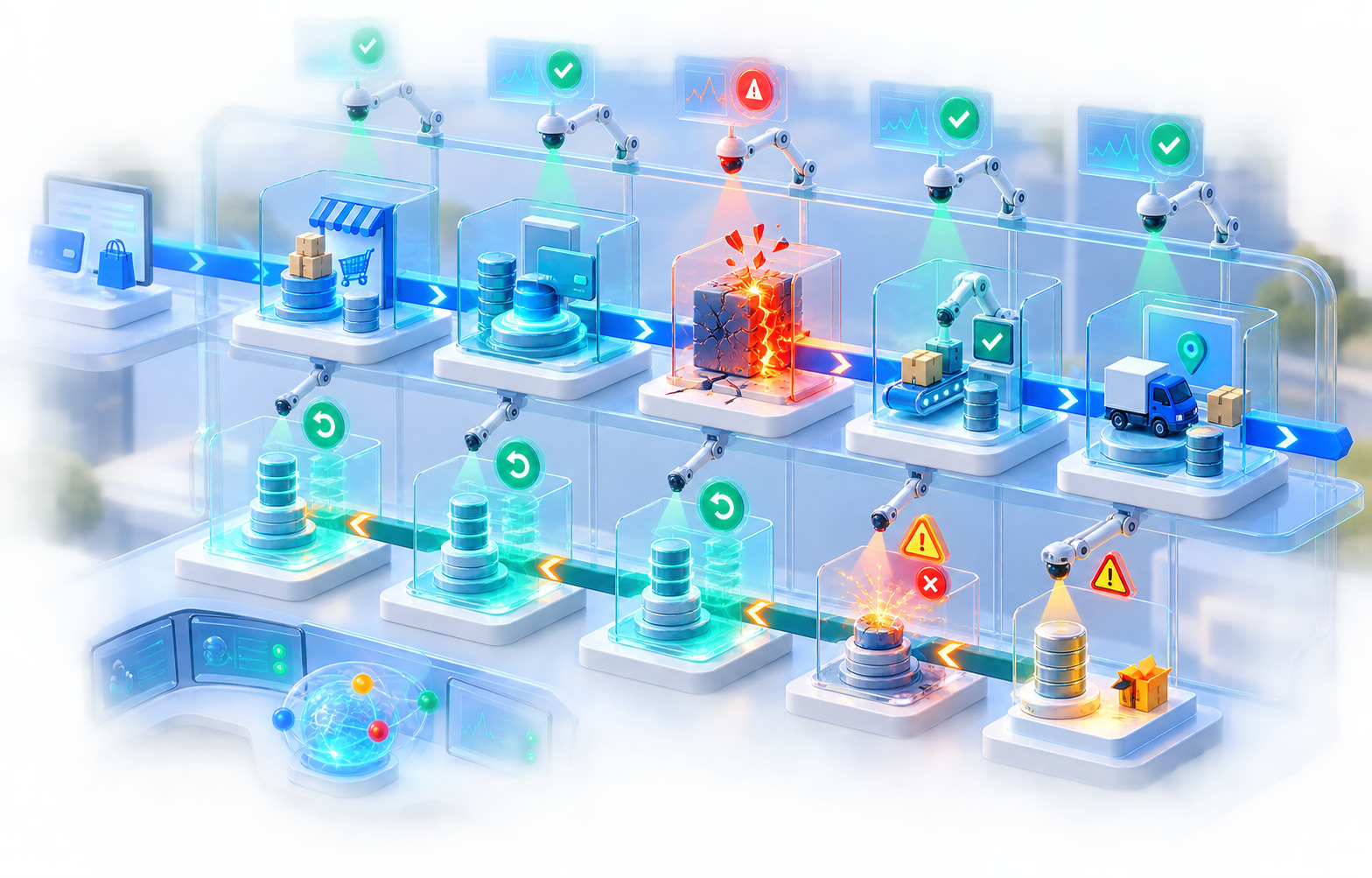
Opening Observation — Incidents Are Expensive. Forgotten Incidents Are Catastrophic.
An incident that repeats is not evidence of a bug that resisted fixing. It is evidence of a system that resisted changing.
This distinction sits at the center of nearly every failed postmortem practice, and it is almost never stated directly. Engineering organizations treat recurrence as a technical embarrassment — a patch that didn't hold, a test that wasn't written, a monitor that wasn't tuned. The technical explanation is usually true. It is also usually irrelevant, because the technical layer is the last place the failure originated and the first place the organization looks.
Incidents rarely repeat because engineers forgot them. Engineers, as a rule, remember outages with uncomfortable precision — the paging tone, the dashboard that wouldn't load, the customer ticket that arrived before the alert did. What organizations forget is not the incident. It is the decision that made the incident possible, and the systemic conditions that allowed that decision to go unchallenged.
A postmortem document gets written. A root cause gets identified. A fix gets shipped. And the engineering system — the architecture, the review process, the incentive structure, the ownership model — returns to exactly the shape it had before the incident occurred. The organization has removed a symptom. It has preserved the machine that generates symptoms.
This is the quiet failure mode of incident management at scale: postmortems that explain the past with forensic precision while leaving the future structurally unchanged. The result is not chaos. It is something more expensive — a steady, low-grade repetition of near-identical failures, each treated as a surprising new event, each consuming the same investigative effort, each producing the same category of remediation, none of them compounding into anything resembling institutional capability.
The following investigation does not offer a better incident response checklist. Checklists already exist in abundance, and abundance has not solved the problem. What follows is an examination of why postmortems fail to change systems, what an incident actually contains when treated as information rather than as damage, and what it would mean for an engineering organization to learn permanently rather than repeatedly.
Investigation One — The Difference Between Failure and Signal
Every incident is treated as an event. Very few are treated as a transmission.
This is the first conceptual error worth correcting. An outage, a rollback, a spike in error rate, a customer complaint about a missing feature that quietly stopped working — these are not isolated failures to be closed out and filed away. They are telemetry about the health of the engineering system itself, arriving in a form that is unusually honest because it was not designed for public consumption.
Consider the categories of signal most organizations already generate but rarely correlate:
Incidents — the acknowledged failures, formally declared, formally reviewed, and formally closed.
Near misses — the failures that were caught before impact, usually by luck, timing, or an individual's vigilance rather than by design. These are the richest and most wasted category of signal in most organizations, because nothing forces their documentation.
False alarms — alerts that fired without corresponding harm. Dismissed as noise, they frequently indicate a monitoring architecture that cannot distinguish between symptom and cause, which is itself information.
Customer complaints — the signal that arrives outside the incident process entirely, often describing degradation that internal monitoring never detected.
Deployment rollbacks — treated as routine safety mechanisms, rarely analyzed in aggregate for what they reveal about the fragility of the release pipeline that required them.
Performance degradation — the slow failures, the ones without a discrete start time, which resist the incident process because incident processes are built around discrete events.
Each of these categories contains information beyond the specific bug that triggered it. A single incident tells you what broke. A pattern across incidents, near misses, and rollbacks tells you what the organization has structurally normalized. The bug is the least interesting part of the signal. The conditions that made the bug survivable, undetectable, or inevitable are the actual message — and most postmortem processes are architected to discard exactly that part.
Treating failure as signal rather than as damage changes the unit of analysis. The question shifts from "how do we fix this" to "what does this tell us about everything we haven't looked at yet." That shift is small in language and enormous in consequence.
Investigation Two — The Invisible Layers Beneath Every Incident
Picture the incident the way a structural engineer pictures a building failure: the visible collapse is the least informative part of the event.
Visible layer — what the postmortem document typically covers in full:
- the bug
- the outage
- the failed deployment
- the customer complaint
Invisible layers — what the postmortem document typically omits, minimizes, or gestures at without examining:
- decision assumptions made months or years earlier
- architecture that constrained the available responses
- organizational incentives that rewarded speed over scrutiny
- knowledge gaps between the team that built the system and the team that operates it
- ownership ambiguity that delayed detection or response
- process design that made the correct action harder than the convenient one
- platform limitations that were known, accepted, and never revisited
Root causes almost never exist alone, yet the postmortem format — a single narrative, a single timeline, a single "root cause" field in a ticketing system — actively pressures teams toward a single explanation. The five-whys technique, used well, resists this. Used poorly, and it usually is, it terminates at the first layer that feels emotionally or organizationally satisfying: a missed test, a misconfigured flag, an engineer who "should have known."
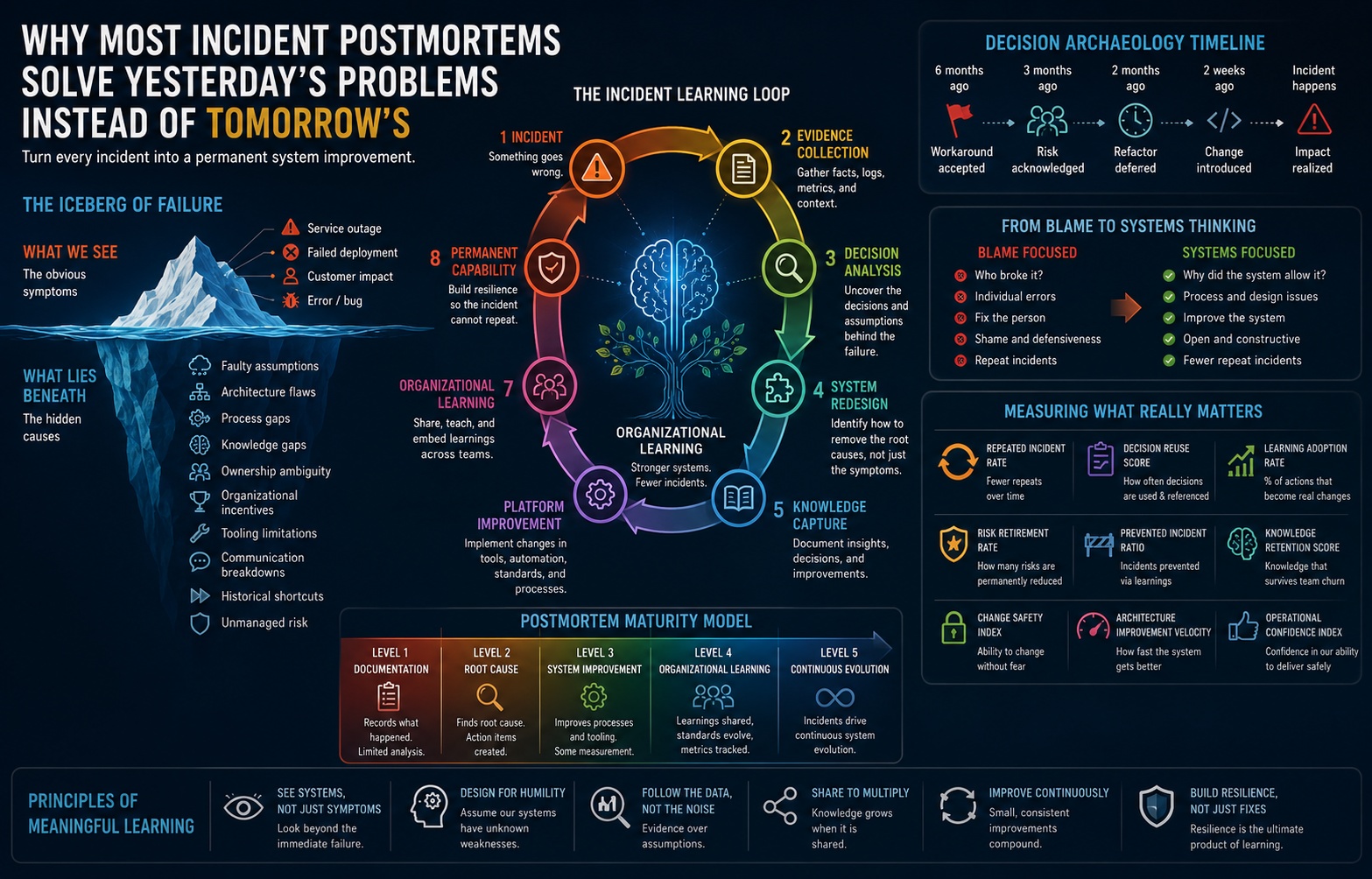
The iceberg metaphor is worn out in general business writing, but it survives here because it is structurally accurate rather than decorative. The visible failure is buoyant precisely because of what is submerged beneath it — years of accumulated decisions, trade-offs, and unexamined assumptions that never surface until something forces them to. A postmortem that stops at the waterline has performed an autopsy on the symptom and left the disease untouched.
Investigation Three — Decision Archaeology
There is a more precise question underneath the standard postmortem question, and most organizations never reach it.
The standard question is: what failed?
The precise question is: what engineering decisions quietly accumulated until failure became inevitable?
This is decision archaeology — the practice of excavating the layered, historical decisions that made an incident not just possible but eventually unavoidable. It differs from root cause analysis in a specific way: root cause analysis looks for the proximate technical trigger. Decision archaeology looks for the sequence of reasonable, defensible, individually-small decisions that, stacked over time, built the conditions for failure.
Every mature system carries this sediment:
- Historic compromises — the deliberate trade-off made under a deadline, documented nowhere, remembered by one person who may no longer be at the company.
- Deadline pressure — decisions made not because they were correct, but because they were available in the time allotted.
- Temporary workarounds — the fix that was explicitly labeled temporary and has since outlived three reorganizations.
- Accepted risks — risks that were formally acknowledged, informally deprioritized, and eventually forgotten as risks at all.
- Organizational memory — or its absence, when the people who understood the original trade-off have moved teams, moved companies, or simply moved on from remembering.
- Technical shortcuts — implementation choices made under the assumption that scale, load, or usage patterns would never reach the point where they mattered.
- Missing reviews — the architectural decision that shipped without the review process that would have caught it, because the review process was skipped under pressure, or didn't exist for that class of change.
- Hidden assumptions — the belief, never written down, that a dependency was reliable, a data format was stable, or a team would always own a service it has since abandoned.
Decision archaeology reframes the incident timeline. Instead of beginning at "the deployment that triggered the outage," it begins years earlier, at the decision that made that deployment dangerous in the first place. The postmortem that only reconstructs the final 48 hours has excavated the wrong stratum. It has found the artifact without finding the civilization that produced it.
This reframing is uncomfortable, because it implicates decisions that felt correct at the time, made by capable people, under real constraints. That discomfort is precisely why most organizations avoid it — and precisely why it produces the most durable learning when they don't.
Investigation Four — The Anatomy of a Weak Postmortem
Weak postmortems share a recognizable structure, regardless of industry, company size, or the sophistication of the tooling involved.
| Pattern | What It Looks Like | Why It Fails to Prevent Recurrence |
|---|---|---|
| Timeline obsession | Minute-by-minute reconstruction of the incident window | Explains sequence, not causation; treats the visible layer as the whole story |
| Five Whys without systems thinking | Linear chain terminating at a single human or component | Root causes are networks, not chains; linear analysis stops at the first convenient answer |
| Action items nobody owns | A list of "should do" items with no assigned owner or deadline | Diffuse responsibility guarantees the item is never completed |
| Blame disguised as analysis | Language that identifies individuals rather than conditions | Suppresses future honesty; the next incident gets reported later and with less detail |
| Too much technical detail | Extensive logs and stack traces, minimal organizational context | Technically accurate, systemically useless; unreadable to the people who could change the system |
| No architecture discussion | The postmortem never asks whether the architecture itself enabled the failure mode | Preserves the exact conditions that will reproduce the incident class |
| No organizational learning | The document is filed and never referenced again | Institutional memory resets to zero after every incident |
| No measurable follow-up | Success is "the postmortem was written," not "the system changed" | Confuses documentation with improvement |
The common thread across every row is a category error: weak postmortems measure completion of a process rather than change to a system. A postmortem can be thorough, well-attended, and professionally written, and still fail entirely at its actual purpose if nothing about the engineering organization is different afterward.
Investigation Five — Systems That Learn Faster Than They Fail
The alternative to a document-centric postmortem practice is not a better document. It is treating learning itself as infrastructure — something built, maintained, and monitored with the same rigor as the systems it studies.
This shows up as concrete engineering artifacts, not cultural aspirations:
ADR evolution. Architecture Decision Records that are revisited and amended as incidents reveal their assumptions to be wrong, rather than written once and left static.
Architecture governance. A standing mechanism, not a one-time review, that periodically re-examines whether the architecture still matches the risk profile of the system it supports.
Deployment policy. Rules that change in response to incident patterns — canary requirements, rollback thresholds, blast-radius limits — rather than policy that was set once at company founding and never revisited.
Testing evolution. Test suites that grow specifically in the directions incidents have exposed as blind spots, rather than growing uniformly or arbitrarily.
Platform improvements. Shared infrastructure that absorbs lessons on behalf of every team that depends on it, so that one team's incident becomes every team's protection.
Documentation refinement. Runbooks and operational guides that are edited immediately after an incident reveals them to be wrong, incomplete, or dangerously out of date.
Operational playbooks. Response procedures that incorporate the specific failure modes the organization has actually experienced, not generic industry templates.
Decision repositories. A searchable record of what was decided, why, and what alternatives were rejected — the connective tissue between today's architecture and yesterday's incidents.
None of these are postmortem artifacts in the traditional sense. They are the postmortem's downstream infrastructure — the mechanisms that convert a single incident's lessons into a permanent shift in how the organization operates. An organization that treats these as living systems, updated continuously, learns faster than it fails. An organization that treats them as static reference material eventually fails faster than it learns.
Investigation Six — The Memory Architecture of Engineering Organizations
Most companies store code. Few store decisions.
This asymmetry is worth sitting with, because it explains a great deal about why incidents recur years after the people who understood the original context have left. Version control preserves every line of code ever written, along with a commit message that frequently says little more than "fix bug" or "update config." It does not preserve the meeting where the trade-off was debated, the alternative that was seriously considered and rejected, or the constraint that made the eventual choice feel inevitable rather than arbitrary.
What a durable memory architecture actually requires:
- Design rationale — not just what was built, but why this approach and not another.
- Rejected alternatives — the options that were considered and set aside, along with the reasoning, so that future engineers don't rediscover and re-reject the same dead ends at the cost of real incidents.
- Trade-offs — the explicit acknowledgment of what was sacrificed for what was gained, so that the sacrifice is a known and monitored risk rather than a surprise.
- Production history — how a system has actually behaved under real load, real failure, and real operator error, as distinct from how it was designed to behave.
- Risk registers — living lists of known, accepted risks, reviewed on a cadence, rather than risks acknowledged once in a postmortem and never revisited.
- Architectural evolution — a traceable line from the system's original design through every incident-driven modification since.
Future engineers do not primarily need documentation. They need context. Documentation tells them what a system does. Context tells them why it does it that way, what was already tried, and what already failed — which is precisely the information that would prevent them from reintroducing a previously-fixed failure mode under a different name. An organization without this memory architecture is condemned to relearn its own history at the cost of repeated incidents, because the alternative — a new engineer independently deriving the same hard-won lessons — is slower and more expensive than remembering.
Investigation Seven — Measuring Organizational Learning
Mean time to resolution measures how quickly an organization recovers. It says nothing about whether the organization learned anything in the process. A team can have an excellent MTTR and a terrible learning rate simultaneously — fast at extinguishing fires, no better at preventing the next one.
A more honest measurement set looks at learning directly:
| Metric | What It Measures |
|---|---|
| Repeated Incident Rate | The proportion of incidents that share a root cause with a prior incident — the clearest available signal that learning failed to convert into change |
| Decision Reuse Score | How often past architectural decisions and rationale are referenced when making new ones, rather than being re-derived from scratch |
| Architecture Improvement Velocity | How quickly architectural changes are shipped in direct response to incident findings |
| Prevented Incident Ratio | The proportion of near misses and detected risks that are addressed before they become incidents, relative to those that are documented and left unaddressed |
| Learning Adoption Rate | How many postmortem action items are implemented, versus recorded and abandoned |
| Risk Retirement Rate | How quickly known, accepted risks are actually eliminated rather than perpetually re-accepted |
| Operational Confidence Index | A measure of how confidently on-call engineers can diagnose and respond to a given system, independent of whether an incident has recently occurred |
| Knowledge Retention Score | How much operational and architectural context survives employee turnover, team reorganization, or time |
| Governance Improvement Rate | How frequently architecture review and change-management processes are updated in response to what incidents reveal about their gaps |
| Change Safety Index | The relationship between the volume of change an organization ships and the incident rate that change produces, tracked over time to reveal whether safety is improving alongside velocity |
None of these metrics are difficult to instrument. What they require is organizational will to measure learning as rigorously as uptime is already measured — because an organization that only tracks recovery speed will optimize for recovery speed, and recovery speed, on its own, has no relationship to whether the same incident happens again next quarter.
Investigation Eight — The Incident Transformation Model
An incident that produces only a fix has traveled halfway through its useful life. The following model describes the full distance between an incident occurring and an organization becoming permanently better because of it.
Stage 1 — Incident. The event occurs. Detection may be automated, customer-reported, or discovered through routine operations.
Stage 2 — Evidence Collection. Logs, metrics, timelines, and firsthand accounts are gathered — the raw material, not yet interpreted.
Stage 3 — Decision Analysis. Decision archaeology begins here. The evidence is traced backward, past the proximate trigger, into the historic decisions and accepted risks that made the incident possible.
Stage 4 — System Redesign. The architecture, process, or ownership model implicated by the decision analysis is deliberately changed — not patched, redesigned, with the explicit goal of eliminating the incident class rather than the specific instance.
Stage 5 — Knowledge Capture. The rationale for the redesign, along with the rejected alternatives and the original decision archaeology, is written into the organization's memory architecture — not filed as a postmortem document, but integrated into ADRs, risk registers, and runbooks.
Stage 6 — Platform Improvement. Where the lesson generalizes beyond the specific team or service involved, it is absorbed into shared infrastructure, so that every team building on that platform inherits the protection without having to experience the incident themselves.
Stage 7 — Organizational Learning. The metrics from Investigation Seven are updated. Governance processes, testing standards, and deployment policy are revised where the incident revealed a gap in each.
Stage 8 — Permanent Capability. The organization is now structurally different than it was before the incident — not because a bug was fixed, but because the conditions that produced the bug have been identified, addressed, and encoded into how the organization operates going forward.
Most postmortem processes terminate at Stage 2 or Stage 3. A polished document is produced, a root cause is named, and the process stops just short of the work that would have made the incident actually valuable. The distance between Stage 3 and Stage 8 is the distance between an incident that cost the organization time and an incident that paid the organization back.
Engineering Reflection
- Every recurring incident is an architectural conversation postponed.
- The absence of incidents is not evidence of resilience. It may only be evidence of insufficient load.
- Fast recovery without learning becomes expensive repetition, dressed up as operational excellence.
- Organizations accumulate forgotten lessons faster than they accumulate technical debt, and forgotten lessons compound with more interest.
- The most valuable postmortem often prevents an incident that never happens, and therefore never gets counted.
- A postmortem that names an individual has already failed to find the system.
- Decisions do not expire when the person who made them leaves the company. Their consequences remain fully employed.
- A near miss that goes undocumented is a future incident that has already been rehearsed and forgotten.
- Architecture reviews that never reference past incidents are reviewing a system that doesn't exist.
- The gap between an action item and a completed action item is where organizational learning goes to die.
- Postmortems measured by attendance are measuring a meeting. Postmortems measured by system change are measuring an organization.
- A risk accepted without a retirement plan is not a managed risk. It is a scheduled incident with an unknown date.
- The engineer closest to an incident usually understands the least about the decisions that made it inevitable, because those decisions predate their tenure.
- Documentation answers what a system does. Only decision history answers why it still does it that way.
- An organization that cannot trace its architecture to its incidents has no memory — only records.
Organizational Self-Assessment
- Do we archive decisions, or only tickets?
- Can a new engineer understand why the architecture exists in its current form, or only what it currently does?
- Which incidents changed engineering standards, and which simply generated a document?
- Which incidents changed nothing, and how long have they been allowed to change nothing?
- How many postmortem action items became permanent platform improvements, versus how many were quietly closed without being completed?
- Which recurring incidents have become so familiar that they are no longer treated as incidents at all?
- Do we reward incident learning, or do we reward the appearance of incident avoidance?
- Can leadership trace today's architecture to yesterday's incidents, or has that connective history been lost to reorganizations and turnover?
- When a risk is accepted, does anyone own retiring it — or only accepting it?
- If the engineer who understood a system's history left tomorrow, would the understanding leave with them?
Closing Reflection
Organizations don't become resilient because they experience incidents. Every organization experiences incidents. Resilience is not a byproduct of exposure.
Organizations become resilient because incidents permanently reshape how the organization thinks — how it makes decisions, how it distributes ownership, how it remembers what it has already learned at real cost.
Every outage offers two outcomes. One fixes the software. The other improves the engineering system that produced the software, and will go on producing whatever comes after it.
The fix resolves an incident. The system change resolves a category of incidents that hasn't happened yet.
Only one of these compounds. The organizations that understand the difference are not the ones with the fewest incidents. They are the ones for whom every incident, eventually, stops being able to repeat itself.