What Is a Customer?
Ask a salesperson what a customer is, and the answer arrives quickly: a customer is whoever is about to sign, or has just signed, a contract. The customer is an opportunity that converted. In the sales worldview, a customer is fundamentally a decision — a yes that moves a deal from pipeline to revenue.
Ask finance the same question and the answer shifts. To finance, a customer is a billing entity: a legal name attached to an invoice, a payment method, a revenue recognition schedule, a set of terms about when money is owed and when it must be refunded. Finance does not particularly care how many humans use the product. It cares who is contractually obligated to pay for it.
Ask product, and the definition moves again. Product tends to think of a customer as a user with a job to be done — someone who opens the application, performs actions, encounters friction, and (ideally) experiences value. Product's customer is behavioral. It is defined by what someone does inside the system, not by what someone owes for the privilege of doing it.
Ask engineering, and something interesting happens. Engineering usually does not have a concept of "customer" at all. Engineering has accounts, tenants, organizations, users, roles, and permissions. If you ask an engineer to point to "the customer" in the data model, they will often pause, because the word does not map cleanly onto any single table. It might map onto three or four.
Ask support, and the customer becomes whoever is on the other end of the ticket — sometimes an end user, sometimes an administrator, sometimes someone who does not have an account at all but is affected by someone else's account, such as a guest invited to a shared workspace or a customer's customer, one layer removed.
Ask compliance, and the customer becomes a data subject with rights: someone whose personal information is being processed, stored, and potentially exposed, and to whom the organization owes specific legal obligations depending on jurisdiction.
Ask data or analytics, and the customer becomes a row — or, more precisely, a unit of aggregation, chosen so that metrics like retention, activation, and lifetime value can be computed consistently. Whether that unit is a person, an account, or a workspace is often decided quietly, by whoever built the first dashboard, and rarely revisited.
None of these answers is wrong. Each function is looking at a genuinely different slice of the same underlying reality, and each slice is legitimate for the purposes it serves. Sales is right that a signed contract matters. Finance is right that someone has to pay the invoice. Product is right that behavior inside the product is what creates or destroys value. Engineering is right that the data model has to represent something concrete enough to store, query, and enforce rules against.
The problem is not that these perspectives differ. Difference is normal, and in a healthy organization, difference is even productive — it means each function is doing its job well, seeing the part of the system that matters to its function. The problem begins at a specific, narrower point: the moment the software has to pick one interpretation, because a database table can only have one primary key structure, an authorization system can only enforce one hierarchy of permissions, and an API can only expose one shape of resource, while the organization, informally and often unconsciously, continues to operate with several.
At that moment, "customer" stops being a word people use loosely in conversation and becomes an architectural decision. Whoever builds the system first — a founding engineer moving quickly, a contractor working from a hurried specification, a product manager writing a ticket at 11 p.m. before a sprint planning meeting — makes that decision, usually without realizing it is being made at all. They pick a definition because the code has to compile, the schema has to be created, the form has to have fields. And once that definition is encoded, it becomes remarkably difficult to dislodge, not because anyone defends it explicitly, but because dozens of downstream decisions — authentication flows, billing logic, permission checks, support tooling, analytics pipelines — quietly assume it is correct.
This is the doorway into the argument this article wants to make.
Software is built from representations. Long before a line of code exists, people carry mental representations of the business: who the users are, what they are trying to accomplish, what the system must never allow, what "done" looks like for a given workflow. Those representations live in heads, in habits of speech, in unspoken assumptions about how the business works. Code is what happens when someone takes their version of that representation and makes it executable.
If the representations inside people's heads diverge — if the founder's version of "customer" is subtly different from the architect's version, which is subtly different from the version implicit in how QA writes test cases — the codebase eventually contains that divergence. Not as a single dramatic bug, but as a texture: inconsistent validation rules across different parts of the product, APIs that disagree with each other about what a resource means, edge cases nobody can quite explain, features that technically work but somehow never quite fit together the way anyone expected.
Many defects that look, on the surface, like implementation mistakes are actually downstream symptoms of upstream misunderstanding. The developer did not misread the ticket. The ticket accurately reflected what the product manager believed to be true. The product manager accurately reflected what they understood from a conversation with a founder. The founder was speaking casually, using a word — "customer," "account," "user" — that felt obvious in the moment, without realizing that four other people in the organization were quietly attaching different meanings to the same word.
The rest of this article is an attempt to take that observation seriously: not as a communication tip, but as an engineering discipline. It argues that the organizations that consistently build software that fits the business — software that does not need constant rework, does not accumulate a permanent layer of confusing exceptions, and does not surprise its own builders in production — are the organizations that treat shared understanding as something to be deliberately constructed, tested, and maintained, in the same way they treat architecture, testing, and deployment pipelines as things to be deliberately constructed, tested, and maintained.
Alignment, in this view, is not something that happens around engineering, in meetings and kickoffs and retrospectives, separate from the "real work" of writing code. Alignment is part of engineering. It is infrastructure, in the same sense that a message queue or an authentication service is infrastructure: mostly invisible when it works, and the direct cause of expensive, confusing failures when it does not.
The Invisible System That Exists Before the Software
Every software system has a predecessor. Before there is a codebase, there is a domain — a set of business concepts, relationships, constraints, workflows, and expectations that exist whether or not any software represents them. A logistics company has shipments, carriers, routes, and delays before it has a tracking application. A healthcare clinic has patients, appointments, providers, and no-shows before it has a scheduling system. A marketplace has buyers, sellers, listings, and disputes before it has a platform.
This predecessor is not written down anywhere in complete form. It exists as a distributed, informal model, spread across the minds of the people who work in and around the business: founders who understand why the business exists, salespeople who understand what objections customers raise, operations staff who understand what breaks in practice, support staff who understand what customers actually do rather than what they are supposed to do, and finance staff who understand where money actually flows.
This informal model includes things that are easy to represent and things that are hard to represent. It includes clean entities — a shipment, a patient, a listing — but it also includes relationships that are harder to pin down: ownership, delegation, escalation, exception-handling, trust. It includes states that things move through — an order that is placed, then confirmed, then fulfilled, then possibly returned — and it includes the far messier reality of what happens when a state transition goes wrong: an order that is partially fulfilled, a shipment that is lost and then found, an appointment that is rescheduled twice and then cancelled by someone who was never actually notified of the second reschedule.
It includes incentives: why a salesperson might be motivated to mark a deal as closed slightly before it is truly closed, why a support agent might be motivated to resolve a ticket quickly rather than correctly, why an engineer might be motivated to ship a feature that looks complete rather than one that handles every edge case. Incentives shape behavior, and behavior is part of the domain, whether or not anyone writes it down as a formal requirement.
Different disciplines within an organization perceive different slices of this invisible system, and it is worth being precise about which slice each one sees, because the differences are not accidental — they follow from what each discipline is actually responsible for.
Product tends to see user behavior: what people are trying to accomplish, what confuses them, what they abandon partway through, what makes them come back. Product's version of the domain model is built from user interviews, usage data, and support escalations, and it tends to be strong on intent and weak on edge cases that rarely surface in normal usage.
Engineering tends to see structures and dependencies: which parts of the system depend on which other parts, what happens if a given service goes down, what the actual shape of the data is once you account for every historical migration and legacy field. Engineering's version of the domain model is built from the codebase itself, and it tends to be strong on mechanism and weak on why the mechanism exists in the first place.
QA tends to see observable behavior and failure conditions: what the system actually does, as opposed to what it is supposed to do, and specifically what it does at the boundaries — the empty input, the concurrent request, the permission that was revoked mid-session. QA's version of the domain model is built from testing the gap between specification and reality, and it is often the most accurate picture of where the organization's shared understanding is thin, because ambiguity in requirements shows up directly as ambiguity in what "correct" behavior would even mean.
Security sees trust boundaries: who is allowed to do what, under which conditions, and what happens if that trust is violated, either through malice or through an honest mistake that happens to look like malice from the system's point of view. Security's version of the domain model is adversarial by design, and it is often the discipline most likely to notice that a supposedly simple entity — a "user," an "admin" — actually needs to support delegation, impersonation, or revocation in ways nobody else thought to specify.
Operations sees runtime behavior: what actually happens when real traffic, real data volumes, and real failure modes meet the system in production. Operations often has the most accurate model of what the system does under stress, because that is precisely when informal assumptions — "this will never happen more than a few times a day," "this list will always be short" — get tested against reality and frequently fail.
Finance sees transactions and liabilities: money that is owed, money that has been collected, money that must be returned, and the legal and accounting obligations attached to each of those states. Finance's version of the domain model is often the most rigorously defined of all of them, because accounting has external rules that must be followed regardless of what the software does — which is precisely why finance is so often surprised when engineering's model of a "transaction" does not match finance's model of the same word.
Support sees real-world exceptions: the customer who did something nobody anticipated, the workflow that broke in a way the design never considered, the gap between the documented behavior and what actually happened to a specific person on a specific day. Support's version of the domain model is built entirely from anomalies, which makes it invaluable for finding gaps and somewhat unreliable as a source of what "normal" looks like.
None of these views is complete. None of them is meant to be. The problem is not that product sees behavior while engineering sees structure — that division of perspective is healthy and, in fact, necessary, because no single discipline could hold the entire domain in working memory while also doing its job well. The problem is when these partial views never converge into something close enough to a shared representation that decisions made by one discipline remain coherent when they reach another. When they never converge, each discipline continues building its own version of the system, encoded into its own artifacts — product's roadmap, engineering's schema, QA's test suite, finance's reporting logic — and the artifacts drift apart in ways that are invisible until something forces them to interact.
How Misalignment Becomes Software
It is worth tracing, concretely, how an ambiguous concept turns into an expensive technical reality, because the path is more mechanical and less mysterious than it first appears.
It typically follows a recognizable sequence: an ambiguous concept exists in the organization's shared vocabulary; different people interpret that concept differently, usually without realizing anyone else holds a different interpretation; someone translates their interpretation into a requirement, because requirements have to be specific even when the underlying concept is not; an architect or senior engineer makes a structural decision based on that requirement, because architecture has to commit to a shape even when the requirement is ambiguous; the decision is implemented, because implementation has to produce working code even when the architecture rests on an unexamined assumption; QA writes test expectations based on the implementation, because tests need something concrete to assert against; and the system goes to production, where real usage eventually reveals that the original concept meant something different to at least one important part of the organization than it meant to whoever made the first structural decision.
By the time the mismatch becomes visible, it is buried under five or six layers of derived decisions, each of which seemed locally reasonable, and none of which was wrong given what came before it. That is what makes this kind of failure so different from an ordinary bug: there is no single point where someone made an obvious mistake. There is a long chain of correct local decisions built on top of one ambiguous starting point.
A few concrete examples make this easier to see.
SaaS permissions. A product team decides that "organizations can have multiple team members with different roles." Engineering interprets this as a straightforward many-to-many relationship between users and organizations, with a role attached to each membership. This is a reasonable interpretation, and it works for the first year. Then sales closes an enterprise deal where the customer wants a single person to belong to two different organizations with two different roles, and also wants a contractor who belongs to an organization only for the duration of a project, and also wants an administrator whose role should automatically downgrade if their employment status changes in an external HR system the customer uses. None of this was wrong in the original model, but the original model was implicitly scoped to a much narrower definition of "membership" than the business had actually intended, because nobody had made the definition explicit at the time the schema was designed. The fix is not simply adding fields; it often requires reworking the underlying relationship, because the original schema encoded an assumption — one user, one role, one organization at a time — that increasingly did not hold.
E-commerce inventory. "Available inventory" sounds like a single number. In practice, a retailer might mean, simultaneously: physical stock in a warehouse, stock minus items already reserved in open carts, stock minus items committed to unfulfilled orders, stock allocated to a specific sales channel versus shared across channels, and stock that exists but is held for quality inspection and therefore not truly sellable. If engineering builds "available inventory" as a single computed field before these distinctions are made explicit, the business eventually needs several of these numbers simultaneously — for the storefront, for the fulfillment team, for finance's revenue recognition — and the original single number has to be decomposed under pressure, usually while inventory is overselling or underselling in production.
Financial transaction states. A payments team might treat "paid" as a boolean. But a mature financial domain model usually needs to distinguish between authorized, captured, settled, and reconciled, because each of these represents a genuinely different state with different legal and operational consequences — an authorized charge can still fail to capture, a captured charge can still be disputed, a settled charge can still require reconciliation against a bank statement that arrives days later. A system built around a single "paid" flag will eventually need to bolt on additional flags and special-case logic to represent states the original model never anticipated, and that bolted-on logic is precisely the kind of exception-heavy code that becomes fragile over time.
Healthcare scheduling. "Appointment" seems self-evidently simple until you account for recurring appointments, appointments that involve multiple providers, appointments that are rescheduled versus cancelled and rebooked (which may have different billing and compliance implications), and appointments where the patient shows up but the provider does not, which is a state most scheduling systems never explicitly model because nobody thought to ask about it during requirements gathering.
Marketplace identity. A two-sided marketplace often needs to distinguish between the account that logs in, the entity that is legally responsible for a transaction, and the person physically present for a service — three things that are frequently the same person and occasionally are not, such as when a company account books a service on behalf of an employee, or when a guest is added to an existing account without ever creating credentials of their own.
Subscription billing. "Cancel" can mean immediate termination, termination at the end of the current billing period, a pause with a defined resumption date, or a downgrade to a free tier that technically continues the account. Each of these has different implications for revenue recognition, for what data the user retains access to, and for what messaging support should give the customer — and a system that encodes only one of these meanings under a single "cancel" action will eventually need to represent the others through some combination of new endpoints, new flags, and increasingly specific documentation explaining which "cancel" a given API call actually performs.
Telecom provisioning. "Activate a line" can mean creating a billing record, provisioning a SIM, updating a carrier-facing system, and enabling service on the network — four steps that are often owned by four different systems, and which can be partially complete in ways that are individually valid but collectively confusing, such as a line that is billed but not yet provisioning service, which from the customer's point of view simply looks like the product does not work.
In every one of these examples, the underlying problem was not incompetence. Someone made a reasonable interpretation of an ambiguous concept, under time pressure, with the information available at the time. The expensive part is not the original interpretation — it is how many downstream artifacts silently inherited that interpretation before anyone had a chance to notice it was incomplete.
The Economics of Misunderstanding
It is tempting to treat semantic disagreement as a soft problem — an annoyance for product managers to sort out in a meeting, unrelated to the harder, more "real" work of engineering. The economics do not support that framing. Ambiguity has a cost, and the cost is not fixed; it grows, often sharply, with how many artifacts have already been built on top of it.
An ambiguity that surfaces in a conversation is close to free to resolve. Two people disagree about what "active user" means, someone asks a clarifying question, and within a few minutes there is a shared definition. Nothing has been built yet, so nothing has to be unbuilt.
The same ambiguity, once it has been encoded into a database schema, is considerably more expensive, because now resolving it means a migration — a process that has to account for existing data, backward compatibility, and the risk of corrupting records that other parts of the system already depend on.
Encoded into an API contract, it becomes more expensive still, because now external consumers of that API — other internal teams, or in the worst case, external customers who built integrations against it — have taken a dependency on the ambiguous interpretation, and any change risks breaking their systems, not just yours.
Encoded into a test suite, it becomes expensive in a different way: the tests actively enforce the wrong (or merely narrow) interpretation, so any attempt to correct the underlying model will cause tests to fail, and the team has to determine, test by test, whether a failure represents a regression or a correction. This is precisely the situation where teams start to lose trust in their own test suite, because a red test no longer reliably means "something broke" — sometimes it means "we were testing the wrong thing all along."
Encoded into documentation, the ambiguity becomes expensive in a slower, quieter way: new engineers read the documentation, internalize the narrow interpretation as if it were the full picture, and make further decisions on top of it, widening the gap between the documented model and the model the business actually needs.
Encoded into analytics and reporting, it becomes expensive in a way that is often invisible until a specific, high-stakes moment — a board meeting, a due diligence process, a regulatory audit — when someone asks a seemingly simple question ("how many customers do we have?") and discovers that three different dashboards give three different answers, each technically correct according to its own quiet, undocumented definition.
Encoded into integrations with other systems, the ambiguity becomes expensive in the most difficult way of all, because now correcting it requires coordinating a change across organizational boundaries — with a partner, a vendor, or a customer's own engineering team — none of whom share your internal context about why the change is necessary.
And encoded into a customer's own workflow — because customers build habits and sometimes their own tooling around how your product actually behaves, regardless of what you intended — the ambiguity becomes, in practical terms, nearly permanent. Changing it now breaks something for someone outside your organization, and that kind of breakage tends to generate the most visible, most reputationally costly kind of failure.
This is worth naming directly: there is a misunderstanding multiplier at work. The same piece of ambiguity costs roughly the same amount to resolve, in engineering hours, no matter when you catch it — a short conversation, a small schema adjustment, a modest refactor. What changes dramatically is the number of downstream artifacts that have to be found, understood, and updated once the ambiguity has propagated. A concept that lives only in someone's head costs nothing extra to correct. A concept that has been encoded into a schema, an API, a test suite, a set of dashboards, and three partner integrations costs the sum of correcting all of those things, plus the coordination overhead of doing so without breaking anything currently depending on the old interpretation.
This helps explain a pattern many engineering leaders recognize but rarely articulate precisely: why some codebases seem to accumulate a permanent layer of confusing, exception-heavy logic that nobody feels able to remove, even though everyone agrees it is confusing. That layer is frequently not the result of bad engineers writing bad code. It is the visible residue of concepts that were ambiguous at the moment they were first implemented, later discovered to be incomplete, and patched — again and again — rather than restructured, because restructuring became progressively more expensive with each additional artifact built on top of the original assumption.
It is worth being honest about what this section is not claiming. It is not claiming that ambiguity can be eliminated, or that every concept needs to be perfectly specified before any code is written — that would trade one dysfunction (encoded ambiguity) for another (analysis paralysis). The claim is narrower and, hopefully, more useful: the cost of resolving an ambiguity rises with the number of artifacts that have already assumed an answer, which means the return on investment for clarifying a concept early — before it has been encoded into a schema, an API, or a test suite — is almost always higher than the return on clarifying it later. This is an argument for timing, not for perfectionism.
Shared Mental Models
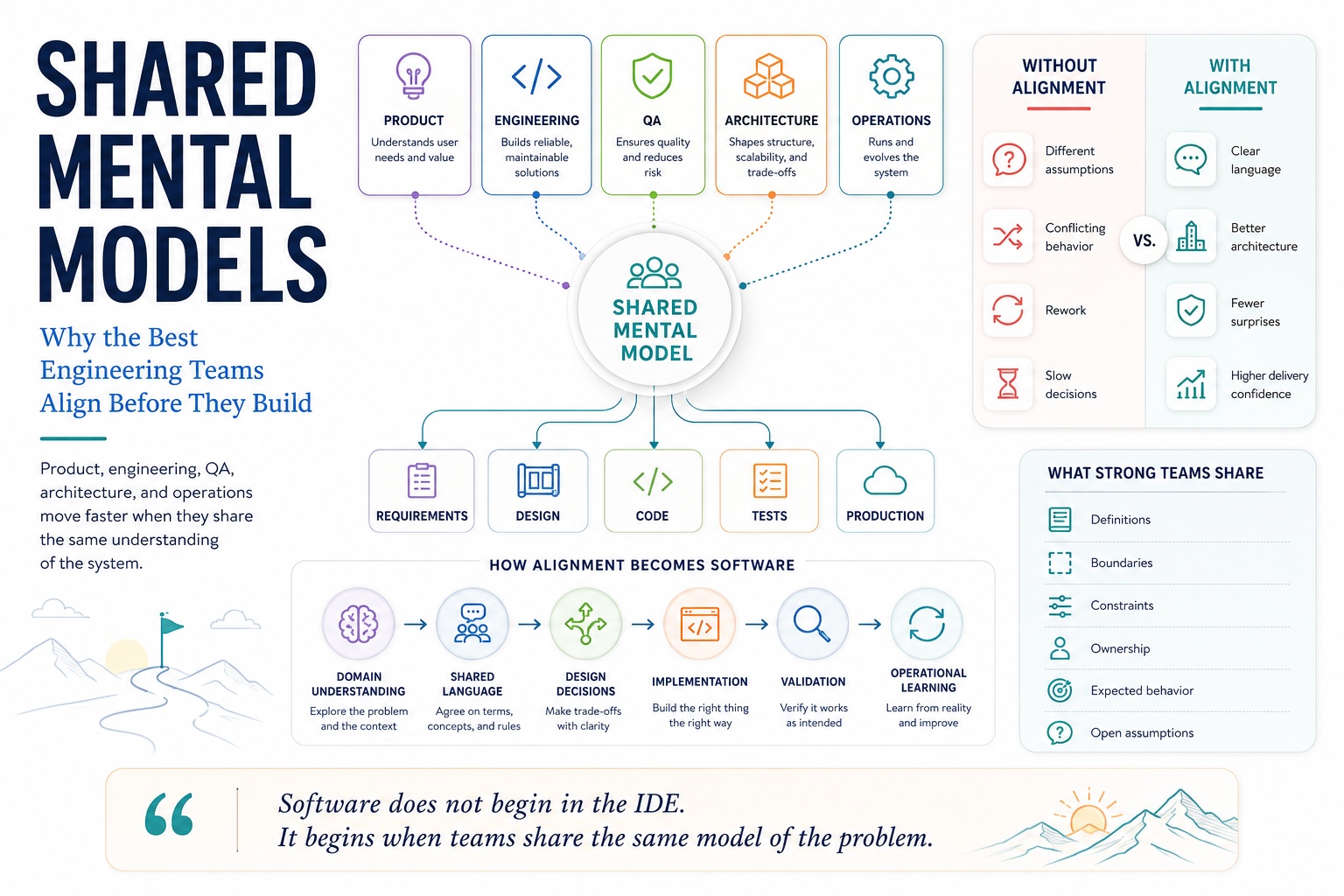
The term "shared mental model" comes originally from research on team cognition, where it describes the degree to which members of a team hold compatible representations of a task, their roles within it, and the environment they are operating in. Applied to software engineering, a shared mental model is the set of beliefs, held in common across a group of people, about what a system is for, how it is structured, what it must never do, and what the important words mean.
It is useful to be specific about what can actually be shared, because "alignment" is often invoked so vaguely that it becomes unfalsifiable — nobody can tell whether it exists or not. In an engineering context, there are several distinct kinds of models worth naming individually:
A domain model — shared understanding of the entities, relationships, and rules that describe the business itself, independent of any particular system.
A system model — shared understanding of how the software is actually structured: its major components, their responsibilities, and how they depend on one another.
A user model — shared understanding of who is using the system, what they are trying to accomplish, and what they expect from it.
A risk model — shared understanding of what could go wrong, how severe each failure mode would be, and which risks the organization has decided are acceptable to carry.
An operational model — shared understanding of how the system behaves in production: its failure modes, its scaling characteristics, its dependencies on external systems.
An architectural model — shared understanding of the major structural decisions that have been made, and, importantly, why they were made, which is often more valuable than the decisions themselves.
A decision model — shared understanding of how decisions get made in the organization: who has authority over what, which decisions are reversible, and which require broader consultation.
No organization achieves perfect synchronization across all of these, and none should try. Complete synchronization is neither possible nor necessary — it would require every person to hold an identical, complete copy of every model, which would be an enormous and pointless duplication of cognitive effort. The goal is narrower: sufficient alignment around the models that actually bear on decisions currently being made. A backend engineer working on an internal caching layer does not need a detailed shared model of the sales team's incentive structure. A product manager scoping a new billing feature does need a reasonably precise shared model of how the finance team defines a transaction, because that definition will directly shape what the feature can correctly do.
It is worth drawing a sharp distinction here, because it is one of the most common points of confusion in how organizations think about alignment: the difference between information sharing and model alignment.
A team can produce enormous volumes of documentation — wikis, specs, recorded meetings, detailed tickets — and still have deeply incompatible mental models. Information sharing means the relevant facts exist somewhere and are, in principle, accessible. Model alignment means the people who need those facts have actually internalized a compatible interpretation of them. These are not the same thing, and the gap between them is where a great deal of engineering dysfunction quietly lives.
It is entirely possible for a detailed specification document to exist, to be technically available to everyone on the team, and to be interpreted three different ways by three different readers — not because anyone failed to read it, but because natural language is genuinely ambiguous, and a document does not enforce a single interpretation the way a compiler enforces a single meaning for a line of code. Two engineers can both read a sentence like "the system should notify the account owner when a payment fails" and walk away with different assumptions about what "the account owner" means in an organization where accounts can have multiple administrators, or what "notify" means when the account owner has disabled email notifications but not in-app ones.
This is why organizations that measure their alignment by the volume of documentation they produce are often measuring the wrong thing. The relevant question is not "does the information exist," but "if you asked five people who depend on this concept to describe it independently, would their descriptions be compatible." That question is harder to answer, and it is also the one that actually predicts whether the resulting software will be coherent.
Domain Understanding Before Implementation
There is a common assumption that "requirements gathering" and "domain understanding" are the same activity, differing only in thoroughness. They are not. Requirements gathering, as it is usually practiced, produces a list of things the system should do. Domain understanding produces a model of the world the system operates in — and a good model generates correct requirements almost as a byproduct, while a list of requirements built without an underlying model tends to be internally inconsistent in ways that only surface later.
A useful way to see the difference: a requirements list might say "users can cancel their subscription" and "cancelled users should not be billed again." These sound complete. But a domain model would force a series of further questions before either statement can be implemented correctly: What are the valid states a subscription can be in, and does "cancelled" mean the same thing from every one of those states? Is there a distinction between a subscription that is cancelled and one that has simply lapsed due to a failed payment? What happens to a cancellation request made mid-billing-cycle — is it immediate, or does it take effect at the next renewal? Can a cancelled subscription be reinstated, and if so, does reinstatement create a new subscription record or resurrect the old one? Are there business rules — a minimum commitment period, an early-termination fee — that constrain when cancellation is actually permitted?
None of these questions are exotic. They are the ordinary texture of a real domain. But a requirements list, written as a flat list of desired behaviors, tends not to surface them, because a list format encourages thinking in terms of individual features rather than in terms of the underlying entities, their lifecycle states, and the rules governing transitions between those states.
This is closer to what domain modeling actually is: identifying the entities that matter to the business, the relationships between them, the invariants that must always hold true, the states each entity can be in, the legitimate transitions between those states, and the exceptions — the cases where the normal rules do not apply, and why.
Invariants deserve particular attention, because they are frequently the most valuable and the most neglected part of a domain model. An invariant is a rule that must always be true, regardless of how the system got into its current state — "an order's total can never be negative," "a seat cannot be assigned to two attendees simultaneously," "a refund can never exceed the original payment amount." Invariants are valuable because they are stable: business rules about workflow change often, but invariants tend to be closer to bedrock truths about the domain, and they are exactly the kind of fact that, if made explicit early, prevents an entire category of future bugs — the category where individual operations look correct in isolation but combine to produce an impossible state.
It is worth being clear that this discussion is not an attempt to smuggle in a full tutorial on domain-driven design, though the vocabulary of that discipline is genuinely useful here and worth borrowing without adopting it wholesale. Two concepts in particular are worth naming.
A bounded context is a recognition that a single word — "order," "account," "customer" — does not need to mean exactly the same thing everywhere in a large system, as long as each context in which it is used has an internally consistent, clearly scoped definition, and the boundaries between contexts are made explicit rather than left implicit. This sounds, at first, like a contradiction of everything argued earlier in this article about the cost of divergent definitions. It is not. The difference is that a bounded context makes divergence deliberate and visible, rather than accidental and hidden. Fulfillment's "order" (a physical thing to be picked, packed, and shipped) and billing's "order" (a financial commitment with a price, tax, and payment status) can legitimately be different models, as long as everyone agrees where the boundary between those two models sits, and as long as there is a clear, explicit translation at the boundary — rather than each team quietly assuming their version is the only version, and discovering the mismatch only when a cross-cutting feature, like a partial refund on a partially shipped order, requires both models to agree on what actually happened.
Ubiquitous language — the practice of using the same, precisely defined terms in conversation, in documentation, and in code, within a given bounded context — matters because it collapses a translation step that would otherwise happen, invisibly and imperfectly, every time someone moves between a conversation about the business and a conversation about the code. When the word used in a planning meeting is the same word used in the class name, the API field, and the test case, there is no opportunity for the meaning to drift during translation. When they diverge — when the business calls something a "waitlist" but the code calls it a "queue," and a separate internal tool calls it a "backlog" — every conversation that crosses between these contexts requires someone to silently translate, and translation is exactly where meaning gets lost.
The deeper point underlying both of these ideas is a claim about direction of influence: the domain model should shape the architecture, rather than the architecture forcing artificial concepts onto the domain. This happens more often than most engineering teams would like to admit. A relational database's normalization rules, a particular framework's preferred patterns, or simply the shape of the first version of a system, can all quietly become the model that later business decisions have to bend around, rather than the other way around. When engineering shapes the domain — when the business starts describing itself using words like "record," "flag," or "status code" because those are the terms embedded in the tool, rather than terms that reflect how the business actually thinks — that is usually a sign that the architecture has begun leading the domain model instead of following it, and it is worth noticing, because reversing that relationship later is considerably harder than establishing it correctly the first time.
Domain understanding, in this framing, is not a phase that happens before "real" engineering work begins. It is a form of engineering work in its own right — arguably one of the highest-leverage forms available, because a correct domain model, discovered early, prevents categories of defects that no amount of careful implementation could otherwise avoid, simply because the implementation would be faithfully executing an incorrect understanding.
Ubiquitous Language and the Cost of Synonyms
Some of the most expensive misunderstandings in software organizations are not disagreements about complex ideas. They are disagreements about ordinary words that everyone assumes they already understand, which is precisely what makes them dangerous — nobody thinks to check.
Consider a short list of words that appear in nearly every software organization: user, customer, account, organization, tenant, subscription, order, transaction, payment, authorization, approval, workspace. Each of these words looks simple. Each of them is, in practice, capable of holding several distinct, mutually incompatible meanings within a single company.
"Account" might mean a login credential, a billing relationship, an organizational entity that can contain multiple users, or — in a financial services context — a specific financial instrument, like a checking account, entirely unrelated to who is allowed to log in. A single sentence like "delete the account" can mean four different, non-overlapping operations depending on which meaning of "account" the speaker has in mind, and a system that conflates them risks a support agent deleting a customer's login credentials when the customer actually wanted their billing account closed — or worse, the reverse.
"Authorization" might mean permission to access a resource, or it might mean the specific step in a payment flow where a card issuer confirms funds are available — two concepts that share a word but have essentially nothing to do with each other, and yet, in a conversation between a security engineer and a payments engineer, the word "authorization" can be used by both without either realizing they mean something different.
"Workspace" might mean a top-level organizational container, a specific project within that container, or a personal, unshared area belonging to a single user — three meanings that a fast-growing product team can accumulate over successive feature launches, each of which introduced the word in a slightly different context, without anyone stepping back to notice that the same word was now doing three jobs.
Terminology fragmentation like this rarely announces itself. It shows up quietly, distributed across a dozen locations: in meeting transcripts, where two people use the same word to mean different things without either one realizing it; in support tickets, where a customer's description of "my account" does not match the internal team's mental model of what an account is; in API design, where one endpoint's "order" and another endpoint's "order" turn out, on close inspection, to represent different entities with different lifecycles; in database schemas, where a table named accounts accumulates columns that only make sense for one of several meanings of the word, producing a table that is technically queryable but conceptually incoherent; in test cases, where a test asserting something about "the user" is actually only valid for one specific kind of user relationship, and silently fails to cover the others; and in dashboards, where "active customers" is computed one way on the executive dashboard and a subtly different way on the product analytics dashboard, producing numbers that never quite reconcile and that nobody fully trusts as a result.
A shared vocabulary reduces this overhead by removing the translation step. When "order" means exactly one thing within a given bounded context, a conversation about orders does not require anyone to silently ask themselves, "which kind of order do they mean?" before responding. This sounds like a small saving, but it compounds across every meeting, every ticket, and every code review a team conducts, and its absence compounds in exactly the same way, in the opposite direction.
It is worth resisting a natural but mistaken conclusion here: that the answer is to freeze terminology permanently, treating a glossary as a fixed artifact that must never change. Vocabulary should evolve as understanding improves, and a rigid, outdated glossary can be just as damaging as no glossary at all, because it teaches people to distrust the documented terms rather than rely on them. The goal is not permanence. The goal is that, at any given point in time, the terms in active use are understood the same way by the people who need to use them together — and that when a term's meaning needs to change, that change is made deliberately and communicated, rather than happening silently as different parts of the organization drift in different directions.
Framed this way, a shared vocabulary is not bureaucracy. Bureaucracy is process for its own sake, disconnected from outcomes. A shared vocabulary is closer to a shared unit of measurement — the reason engineers across the world can collaborate on physical systems without constant confusion is that "meter" means the same thing regardless of who is using it. Software organizations rarely have that luxury by default, because their units of measurement are business concepts, not physical constants, and business concepts do not enforce their own consistency the way physics does. Someone has to do that work deliberately, and the return on doing it is proportional to how many decisions, across how many people, depend on getting it right.
Architecture as a Shared Model
Architecture is often discussed as if it were primarily a technical concern — a set of decisions about services, databases, and communication patterns, evaluated on criteria like performance, scalability, and maintainability. Those criteria matter, but they miss something architecture is doing at the same time, whether or not anyone names it explicitly: architecture is communication. It is one of the clearest expressions an engineering organization produces of who is responsible for what, what depends on what, what can change without warning, and what should be treated as stable.
A service boundary communicates ownership: this is the part of the system that one team is responsible for, and other teams should interact with it through its defined interface rather than reaching into its internals. A well-drawn boundary tells every other team, implicitly, "you do not need to understand how this works, only what it promises." A poorly drawn boundary — one that does not correspond to any real organizational or domain boundary — tends to generate exactly the kind of cross-team confusion this article has been describing throughout, because it forces teams to coordinate on details that a good boundary would have made unnecessary to coordinate on at all.
A dependency communicates trust and risk: if service A depends on service B, then A's reliability is capped by B's reliability, A's team needs to understand B's failure modes, and any change to B's behavior is potentially a breaking change for A. Making dependencies explicit — visible on a diagram, documented in an architecture decision, discoverable through tooling — allows people to reason about risk without having to reconstruct the dependency graph from memory or from reading source code line by line.
A contract — an API definition, an event schema — communicates a promise: this is what you can rely on, and this is what might change. A contract that is precise reduces the shared mental model burden on everyone who consumes it, because they do not need to understand the internal implementation; they only need to understand the promise. A contract that is vague — an API that returns whatever shape of data the current implementation happens to produce, with no explicit schema — pushes the burden of understanding back onto every consumer, each of whom now has to infer the actual contract by observation, and each of whom may infer it slightly differently.
This is why an architecture diagram that nobody interprets consistently is not, in any meaningful sense, alignment — even though it looks like alignment from a distance. A diagram is only as useful as the shared understanding it actually produces in the people who look at it. A box labeled "Payment Service" that one engineer reads as "handles all payment logic" and another reads as "handles only card authorization, with refunds owned elsewhere" is not communicating a shared model; it is providing a Rorschach test that different readers complete with different assumptions, and those assumptions will surface, expensively, the first time someone builds a feature that depends on the wrong interpretation.
Several kinds of artifacts are worth discussing individually, not as a generic list of "documentation tools," but because each clarifies a genuinely different kind of thinking, and choosing the right one for the question at hand matters.
Context diagrams are useful when the question is "what exists, and how does it relate to everything else at a high level." They are deliberately imprecise about internals, and that imprecision is the point — they are meant to give someone unfamiliar with a system a correct first mental model, not a complete one.
Dependency maps are useful when the question is "what breaks if this fails, and what does this rely on." They matter most during incident response, capacity planning, and any conversation about acceptable risk, because dependency is exactly the information that determines blast radius.
Sequence diagrams are useful when the question is about ordering and timing — what happens first, what waits for what, where race conditions or timing assumptions might live. They are particularly valuable for surfacing assumptions about synchronicity that are easy to get wrong when a system evolves from a single synchronous call into a more complex asynchronous flow.
State machines are useful whenever an entity has a lifecycle with meaningful transitions — precisely the situation, described earlier in the discussion of subscriptions and orders, where ambiguity about "what state is this thing actually in" tends to produce the most expensive bugs. Making the state machine explicit forces a team to enumerate every valid transition and, just as importantly, to notice the transitions nobody had considered.
Architecture decision records (ADRs) are useful not primarily as historical record-keeping, but because they capture something a diagram cannot: the reasoning behind a decision, the alternatives that were considered and rejected, and the constraints that were in force at the time. This turns out to matter enormously for future alignment, because a decision without its reasoning attached tends to be either treated as unchangeable dogma — "we've always done it this way" — or discarded without understanding what problem it originally solved, both of which are failures of shared understanding across time rather than across roles.
API contracts are useful because they are the most concrete, most enforceable representation of a shared model available to an engineering organization — a schema either matches or it does not, which makes it a form of shared understanding that can be automatically checked, rather than merely hoped for.
Event schemas, in systems built around asynchronous messaging, serve a similar role for a different kind of interaction: they define what a producer promises to emit and what a consumer can rely on receiving, and, like API contracts, they convert an informal understanding ("the order service publishes something when an order ships") into a checkable, versioned artifact.
The unifying idea across all of these is that a representation is only valuable to the extent that it produces the same understanding in every person who reads it. A representation that is technically accurate but ambiguous in the way it is presented — precise to its author, open to interpretation by everyone else — is not doing the job architecture is supposed to do. Producing genuinely shared representations is harder than producing technically correct ones, because it requires anticipating how a reader without the author's context will interpret what is on the page, and revising until that interpretation converges with reality.
The Role of QA in Building Shared Understanding
QA is frequently described, even by engineering organizations that value it highly, primarily as the function that finds bugs before customers do. That description is not wrong, but it is incomplete in a way that undersells what strong QA actually contributes, and undervaluing it has real consequences for how organizations invest in the function.
The more precise claim is this: strong QA challenges the mental model of the system, not merely its implementation. A skilled QA engineer, reading a requirement, does not primarily ask "does the code do what this says." They ask a prior, harder set of questions: What does this requirement actually mean? What happens in the states between the ones explicitly described? Which of several plausible interpretations is the correct one? What happens when the assumptions behind this requirement turn out to be false? Which behaviors are intentional design decisions, and which are simply whatever the current implementation happens to do, with nobody having decided one way or the other? What does the user actually observe, as distinct from what the internal system state technically is? And, underlying all of these — what would even constitute "correct" behavior here, given that the requirement, taken literally, does not fully specify it?
These are not implementation questions. They are questions about the underlying model, and asking them well requires QA to hold — and actively interrogate — a mental model of the domain that is at least as sophisticated as the one held by the people who wrote the requirement in the first place.
This is why test design functions as a mechanism for exposing conceptual gaps, independent of whether it also happens to catch defects. Writing a precise test case forces vague language toward observable, checkable behavior. A requirement that says "the system should handle concurrent edits gracefully" contains no information a test can act on until someone decides what "gracefully" means: does the second editor's change get rejected, silently overwritten, merged, or queued? Each of these is a legitimate design choice, but the requirement as written does not choose between them — and it is frequently the act of writing a test case that forces someone to notice the requirement never actually specified an answer.
Several specific QA practices are worth discussing individually as mechanisms for building shared understanding, not simply as testing techniques.
Exploratory testing — deliberately unscripted investigation of a system's behavior — is valuable for surfacing the gap between the documented model and the system's actual behavior, because it is not constrained by what anyone predicted in advance. An exploratory tester interacting with a system the way a real, unpredictable user might will frequently discover states the original design never considered, simply by doing things nobody thought to write a test case for.
Acceptance criteria, written well, function as an explicit, checkable statement of what "done" means for a given piece of work — converting a conversation that might otherwise remain informal ("we talked about it, I think we're aligned") into an artifact that can be checked against directly, and, crucially, that can be checked by someone other than the person who wrote it, which is exactly the property that catches divergent interpretations before they reach production.
Risk analysis — identifying which parts of a system carry the highest cost if they fail — forces an explicit conversation about the risk model discussed earlier in this article, surfacing disagreements about severity ("is a delayed notification a minor issue or a compliance risk?") that might otherwise remain unspoken until an actual incident forces the question.
Boundary analysis — systematically examining behavior at the edges of valid input, at the transitions between states, at the limits of what a system was designed to handle — is one of the most direct tools available for finding exactly the kind of ambiguity this article has focused on, because boundaries are where informal, "obviously correct" assumptions most often turn out to be incomplete.
State transition testing connects directly to the state machine modeling discussed in the previous section: by systematically testing every transition, including ones that should be prohibited, it verifies not just that the happy path works, but that the invariants of the domain model actually hold under every combination of events the system might encounter.
Contract testing — verifying that a service's actual behavior matches its documented API contract, and that consumers' assumptions about that contract match reality — is a direct, mechanized check on whether the shared model represented by an API specification is actually shared, or merely documented.
None of these practices are primarily about catching mistakes after the fact. Used well, they are mechanisms for surfacing, early and explicitly, exactly the kind of conceptual gaps this article has argued are the real source of most expensive software failures. This is also where a function like QAtronic's work tends to sit most naturally within an engineering organization — not bolted on at the end of a delivery process to catch what slipped through, but involved early enough that test design, acceptance criteria, and risk analysis can do the work of clarifying the underlying model before that model gets expensive to correct, rather than only verifying, after the fact, whether the implementation matches whatever model happened to get built.
Design Reviews as Model Collision
Design reviews are usually described as a checkpoint: a piece of work is proposed, relevant people look at it, and it either gets approved or sent back for revision. That description captures the administrative function of a review but misses what makes a good review actually valuable, which is something closer to controlled collision than approval.
A design review, done well, is the place where different mental models — product's view of user intent, engineering's view of feasibility and structure, QA's view of ambiguity and failure modes, security's view of trust assumptions, operations's view of runtime constraints, data's view of measurement implications — are brought into contact with each other early enough that disagreements are still cheap to resolve, before any of the artifacts described in the economics section above have been built.
Each participant's disagreement, in a well-run review, is not noise to be managed but information to be extracted. When product raises a concern that engineering had not considered, that is usually not a sign product does not understand the technical constraints; it is a sign that product's model of user intent contains information engineering's model of the system did not yet have. When QA asks what happens in a state the proposal does not address, that is not nitpicking; it is a direct test of whether the proposal's model is actually complete, surfaced before the cost of incompleteness has compounded. When security flags an assumption about trust that nobody else had made explicit, that is often the review doing exactly what it exists to do — making an implicit assumption visible before it becomes load-bearing.
The value of bringing this diversity of perspective into a single conversation depends entirely on whether disagreements are made explicit rather than smoothed over. A review where everyone nods, defers to whoever seems most senior or most confident, and approves the proposal without surfacing genuine uncertainty is not alignment — it is the appearance of alignment, which is arguably worse than visible disagreement, because it hides exactly the gaps that will later become expensive.
A handful of concrete techniques tend to separate reviews that genuinely produce shared understanding from reviews that merely produce a rubber stamp.
State assumptions explicitly, rather than leaving them implicit. If a proposal assumes that a given field will always be present, or that a certain operation will always be fast, saying so directly — even briefly — gives other participants something concrete to challenge, rather than requiring them to infer the assumption from what is missing.
Identify unresolved questions as a distinct category from decisions that have already been made, so that the group does not confuse "we discussed this" with "we resolved this." A review that ends with a clear list of open questions, explicitly owned by named individuals, has often done more useful work than a review that ends with vague, general approval and no acknowledgment of what remains uncertain.
Separate facts from decisions. A statement like "the current system processes about ten thousand requests per day" is a fact, checkable against data. A statement like "we should therefore not worry about scaling this for now" is a decision, built on that fact plus a judgment about risk. Conflating the two — presenting a decision with the same certainty as a fact — makes it harder for others to challenge the judgment without appearing to dispute the underlying data, which discourages exactly the kind of pushback a good review depends on.
Record rejected alternatives, and briefly, why they were rejected. This connects directly to the earlier discussion of architecture decision records: an alternative that was seriously considered and rejected for a specific reason is valuable institutional memory, because it prevents the same alternative from being re-proposed, re-debated, and re-rejected for the same reasons a year later, once everyone who was present for the original discussion has moved on or forgotten the details.
Expose dependencies explicitly, particularly dependencies on teams or systems not represented in the room. A design that quietly depends on another team's roadmap, another system's stability, or another organization's willingness to change an integration, needs that dependency named, so that it can be validated with the people who actually own it rather than assumed away.
Define ownership before the review concludes. A design that is approved without clarity about who is responsible for building it, who is responsible for maintaining it once built, and who is responsible for the parts of the system it depends on, has resolved the technical question while leaving an organizational question dangerously open — and organizational ambiguity tends to resurface, later, as exactly the kind of implementation drift this article has spent considerable time describing.
Design reviews conducted this way take somewhat more discipline than reviews conducted as a formality on the way to approval. They also tend to be shorter in the long run, in the aggregate, than the alternative — because the cost of a review that surfaces a real disagreement early is almost always lower than the cost of that same disagreement surfacing later, embedded in production code, discovered by an incident rather than by a colleague asking a pointed question in a meeting.
Documentation as Externalized Memory
It has become almost a reflex in engineering culture to say "documentation is important" and move on, as if the statement were self-evidently true and required no further analysis. It is more useful to ask why documentation matters, because the answer clarifies what kind of documentation actually matters and what kind is closer to wasted effort.
Human memory, as a substrate for organizational knowledge, has several properties that make it unreliable at scale. It is incomplete — nobody remembers every decision they were part of, particularly the reasoning behind decisions made months or years earlier. It is contextual — a memory that feels vivid and certain to the person who holds it is often, on closer examination, tangled up with assumptions and simplifications that were not true even at the time. It is temporary — people leave teams, leave companies, or simply move on to other projects and stop actively holding a piece of context in working memory, even if they technically still "know" it somewhere. And it is unevenly distributed — critical knowledge about why a system works the way it does frequently lives in one or two people's heads, invisible to everyone else until those people happen to be asked the right question, or until they leave and the knowledge leaves with them.
Software, as a discipline, tends to outlive individual contributors. A system built by a team of five people will, if it survives long enough to matter, eventually be maintained by people who were not present for any of its founding decisions. For that system to remain comprehensible — for new engineers to be able to reason correctly about why it behaves the way it does, rather than reverse-engineering intent from implementation — the important context has to exist somewhere other than in the original team's memory.
This is the actual function documentation serves: it is externalized memory, built specifically to survive the departure of the people who originally held the knowledge. Understood this way, documentation is not a courtesy extended to future readers; it is closer to a form of institutional continuity, without which an organization's accumulated understanding of its own system decays every time someone with tenure leaves.
It is useful to distinguish between different purposes documentation serves, because conflating them tends to produce documentation that serves none of its purposes well.
Reference documentation describes what a system currently does — its API surface, its configuration options, its expected inputs and outputs. Its value depends entirely on staying synchronized with reality; reference documentation that has drifted from actual behavior is worse than no documentation at all, because it actively misleads rather than simply leaving a gap.
Decision documentation — architecture decision records and their equivalents — captures why a particular choice was made, what alternatives were considered, and what constraints were in force at the time. Its value does not depend on the system remaining unchanged; a decision record remains useful even after the decision it describes has been superseded, because it explains the reasoning that led there, which is exactly the context a future team needs before deciding whether to change course.
Operational documentation describes how to run, monitor, and recover a system in production — runbooks, alerting thresholds, escalation paths. Its value is realized specifically during incidents, when the people responding are often not the people who built the system, and under exactly the kind of time pressure that makes reconstructing context from first principles most costly.
Domain documentation describes the business concepts a system represents — the entities, relationships, and rules discussed earlier in this article — independent of any particular implementation. Its value is that it gives new team members, and existing team members working outside their usual area, a way to build an accurate mental model of the domain without having to reverse-engineer it from code, which is a slow and error-prone process even for skilled engineers.
Behavior documentation describes what the system actually does in specific, often subtle situations — edge cases, exception handling, the kind of detail that acceptance criteria and test cases capture more precisely than prose usually can. Its value is closest to QA's function described earlier: converting ambiguous intent into checkable, specific statements.
It is worth stating directly something that is less often acknowledged: excessive documentation can damage shared understanding just as thoroughly as insufficient documentation, though through a different mechanism. A team that produces documentation for everything, regardless of whether it is likely to be needed again, tends to produce documentation that nobody reads carefully, because the volume exceeds what anyone has time to absorb. This has a corrosive effect beyond simple waste: once people learn that most of the documentation is unlikely to be current or worth reading, they stop trusting any of it, including the parts that are accurate and important, and knowledge quietly reverts to living primarily in people's heads regardless of how much has technically been written down.
This suggests a more useful guiding principle than "document everything" or "document important things," both of which are too vague to act on consistently: document what future reasoning would otherwise have to reconstruct. If a decision required weighing several real alternatives, and the reasoning behind the final choice is not obvious from the choice itself, that reasoning is worth capturing, because reconstructing it later — determining whether a design was intentional or accidental — is expensive and error-prone. If a piece of behavior is subtle enough that a new engineer could easily misunderstand it by reading the code alone, that behavior is worth documenting explicitly, because the alternative is that misunderstanding gets encoded into whatever that engineer builds next. Conversely, if something is obvious from the code itself, or if a decision genuinely had no meaningful alternative worth recording, documenting it in detail mostly adds volume without adding value, and volume is precisely what erodes trust in documentation as a whole.
Alignment Without Meeting Overload
An objection worth taking seriously, because it reflects a real and reasonable concern: does building shared mental models simply mean more meetings? Engineering organizations are, with good reason, protective of focused time, and a prescription that amounts to "talk to each other more" risks trading one dysfunction — misalignment — for another — an organization that spends so much time synchronizing that it never actually builds anything.
The answer is that meetings are one mechanism for building shared understanding, and often not the most efficient one, particularly for the kind of alignment this article has been describing — alignment around stable concepts, definitions, and structural decisions, as opposed to alignment on fast-moving day-to-day coordination, which genuinely does benefit from synchronous conversation.
A range of asynchronous mechanisms can build shared understanding without requiring everyone's simultaneous attention. Short, focused design documents — a page or two, not a lengthy specification — that lay out a proposal, its key assumptions, and open questions, allow reviewers to engage on their own schedule, with the added benefit that writing forces a clarity of thought that speaking often does not. Architecture decision records, discussed earlier, serve a similar function specifically for structural choices. Diagrams, when built to be genuinely self-explanatory rather than requiring live narration, allow someone unfamiliar with a system to build an accurate first model without needing anyone else's time. Recorded decisions — a simple, consistently maintained log of what was decided and why, distinct from a full ADR — give the organization a searchable record that reduces how often the same question needs to be asked and answered again. Structured review processes, of the kind described in the design review section, front-load disagreement into a bounded, well-prepared conversation rather than letting it surface unpredictably across dozens of smaller interactions. Executable tests, particularly acceptance tests written in close collaboration between product, engineering, and QA, are a form of shared understanding that does not require a meeting to consult — the test itself is the record of what "correct" was agreed to mean. API schemas and event schemas, similarly, are alignment that a machine can verify, which is a stronger and more durable form of alignment than a conversation anyone might misremember. Concrete examples — specific, worked-through scenarios illustrating how a rule applies — are often more effective at producing genuine shared understanding than abstract descriptions of the rule itself, because examples force ambiguity to the surface in a way abstractions can hide. And prototypes, even rough ones, let people react to something concrete rather than to a description of something that does not yet exist, which tends to surface disagreement faster than discussing the same idea in the abstract.
None of this means synchronous communication is unnecessary. There is a real category of ambiguity that resolves faster, and more reliably, through live conversation than through any asynchronous alternative — specifically, ambiguity where the underlying disagreement is not yet well understood by the people who hold it. Asynchronous mechanisms work well when the question is relatively well-defined and people mainly need to react to a proposal. They work less well when nobody yet knows what the actual disagreement is, because writing a document requires already having enough clarity to write something down, and that clarity is sometimes exactly what is missing. In that situation, a focused conversation — ideally a short one, with a clear question to resolve, rather than an open-ended discussion — tends to surface the actual disagreement faster than several rounds of asynchronous back-and-forth on a shared document, each round adding a comment thread that gets harder to follow than the conversation it was meant to replace.
The distinction that matters is not synchronous versus asynchronous as a matter of principle, but which mechanism actually resolves the specific uncertainty at hand. Mature teams tend to optimize for resolving uncertainty efficiently, choosing the lightest mechanism that will actually work, rather than optimizing for a fixed ratio of meetings to documents, or reflexively defaulting to whichever mechanism is culturally comfortable. A team that defaults to meetings for everything accumulates unnecessary synchronous overhead. A team that defaults to asynchronous documents for everything, including genuinely unresolved disagreements, accumulates long comment threads that never quite converge, and the underlying ambiguity survives, merely relocated into a document nobody feels confident interpreting.
When Teams Scale
Shared understanding is comparatively easy to maintain in a small team, not because small teams are more disciplined, but because they benefit from mechanisms that do not require deliberate design. A team of six people sitting near each other, working on one product, accumulates shared context almost as a side effect of proximity — overhearing conversations, sitting in the same standups, remembering the reasoning behind decisions because everyone was present when they were made. Shared history does a great deal of the work that, at scale, has to be done deliberately.
These mechanisms — proximity, informal communication, shared memory, shared history — stop scaling well past a certain size, and the transition is often more abrupt than gradual. There is a recognizable point at which an organization can no longer assume that everyone relevant to a decision was in the room when it was made, or even that everyone relevant to a decision is aware the decision exists.
Several forces accelerate this beyond simple headcount growth. Team boundaries multiply: work that used to be owned by one team is split across several, each with a narrower, more specialized view of the system, and each less likely to independently notice when their local decisions conflict with another team's assumptions. Platform teams emerge, building infrastructure consumed by other teams that may not deeply understand how that infrastructure works internally — a healthy specialization of labor, but one that requires the platform team's model of "how this should be used" to be made explicit, rather than assumed to be self-evident from the platform's design. Distributed and remote organizations lose the informal, physical-proximity channels that used to carry a great deal of context passively, without anyone deliberately deciding to share it. Multiple products multiply the number of domain models an organization has to maintain simultaneously, increasing the odds that a term meaningful in one product context is reused, with a different meaning, in another. Acquisitions bring in entire teams with their own, independently evolved vocabulary, architecture, and assumptions, none of which automatically reconciles with the acquiring company's existing models simply because the org chart has merged. Staff turnover removes people who were carrying context that was never externalized, and each departure risks silently degrading the organization's actual — as opposed to documented — shared understanding. Outsourcing and external engineering partners introduce people who, reasonably, do not share the tacit context an internal team has built up over years, and who need that context made explicit in order to build correctly, rather than filling gaps with their own reasonable-sounding assumptions.
In each of these situations, the underlying mechanism is the same: interfaces between teams become representations of mental models, whether or not anyone designs them that way deliberately. When Team A calls an API exposed by Team B, that API is not merely a technical contract — it is Team B's externalized model of what Team A is allowed to assume, and Team A's actual usage of that API reveals what Team A believes it is allowed to assume, and these two things can diverge quietly for a long time before anything visibly breaks.
This is why a poorly defined organizational interface — unclear ownership, ambiguous responsibility, no explicit agreement about what one team can rely on from another — eventually produces a poorly defined technical interface, and the causality runs in that direction more often than the reverse. An API that is confusing to use is frequently not a failure of API design in isolation; it is often a downstream symptom of an organizational relationship where responsibility, ownership, and mutual expectations were never made explicit between the teams on either side of it.
The practical implication is that organizational scaling and technical architecture are not separate concerns to be handled by different parts of the business — the org chart and the system architecture tend to converge over time, a pattern well known enough to have its own name in software engineering discourse, and the convergence runs in both directions. A system's architecture will tend to mirror the organization's communication structure, but the reverse is also true: deliberately designing clear technical boundaries — clear ownership, clear contracts, clear escalation paths for ambiguity — can help an organization maintain coherent communication structures even as it grows past the size where informal alignment mechanisms stop working on their own.
AI Changes the Problem, Not the Principle
It would be incomplete to write about shared mental models in software engineering today without addressing how AI-assisted development changes the picture, and it would be a mistake to let that discussion dominate an article whose central argument predates any particular technology. The honest claim is narrower than either extreme: AI changes the economics of implementation dramatically, and in doing so, it makes the underlying argument about shared understanding more urgent rather than less relevant.
Here is the paradox worth sitting with. AI coding assistants make implementation cheaper and faster — an engineer working with a capable assistant can generate a working feature, a test suite, or a data migration in a fraction of the time it used to take. This sounds like it should reduce the cost of misunderstanding, because everything downstream of a concept becomes faster to build and, presumably, faster to rebuild if it turns out to be wrong.
In practice, the opposite pressure tends to dominate. If an engineer can generate hundreds of lines of plausible, syntactically correct, apparently functional code in minutes, the quality of the underlying mental model that code is built on becomes more important, not less — because the bottleneck has shifted. It used to be implementation speed: even with a flawed understanding, the physical act of writing code was slow enough that misunderstandings had time to surface during the writing itself, as an engineer worked through the details and occasionally noticed something did not quite fit. When implementation is fast, that friction disappears, and a flawed model can be turned into a large amount of working, tested, seemingly complete code before anyone has the chance to notice the model itself was wrong.
This means the misunderstanding multiplier described earlier in this article — the idea that the cost of an ambiguity grows with the number of artifacts built on top of it — now compounds faster than it used to, because the artifacts themselves can be produced faster. An ambiguous concept that once might have taken a team a sprint to encode across a schema, an API, and a test suite can now be encoded across all of those in an afternoon, by a single engineer working with an AI assistant, all without ever surfacing the ambiguity, because the assistant, like the engineer, will happily generate a plausible, internally consistent implementation of whichever interpretation it is given, with no way of knowing that a different interpretation existed.
This dynamic extends beyond code generation itself. AI-generated tests can encode an incorrect model just as thoroughly as human-written tests can, and arguably with less friction to notice the error, because a generated test suite can look comprehensive — many test cases, good coverage numbers — while every test in it faithfully verifies the same underlying misunderstanding. AI-generated documentation carries a similar risk: documentation that reads fluently and appears thorough can nonetheless formalize an incorrect model, and fluent, confident prose is, if anything, more persuasive and therefore more dangerous than a rough, obviously incomplete human draft that invites scrutiny by virtue of visibly being unfinished. Autonomous agents, operating with some degree of independence across multi-step tasks, inherit whatever model they are given as context and will execute against it consistently and at scale — which is valuable when the model is correct and genuinely costly when it is not, because the agent will not spontaneously notice the model is wrong; it will simply build more on top of it, faithfully.
The underlying principle, stated plainly: AI can accelerate implementation. It cannot automatically guarantee organizational agreement about intent. No model, however capable, can resolve a disagreement that the organization itself has not resolved — if sales, product, and engineering hold three different definitions of "active customer," an AI assistant asked to build a feature involving active customers will simply pick one, based on whatever context and prior examples it has been given, and it will do so with the same fluent confidence whether the choice happens to be correct or not.
This is where the idea of context engineering becomes directly relevant to the argument this article has been making. AI systems, to produce output aligned with an organization's actual intent, need reliable access to correct domain context: the entities and relationships that matter, the constraints and invariants that must hold, the policies that govern who can do what, the architecture the new work needs to fit into, the terminology the organization actually uses, and concrete examples of correct and incorrect behavior. Every one of these is precisely the kind of shared mental model this article has argued needs to be deliberately constructed among humans in the first place. An organization that has never done the work of making its domain model explicit has nothing coherent to hand an AI system as context, and will predictably get output that reflects whatever plausible, generic assumptions the model falls back on in the absence of anything more specific — assumptions that may look reasonable and will frequently be wrong in exactly the ways this article has described.
Put differently: the organizations best positioned to use AI-assisted development well are, largely, the same organizations that were already good at building and maintaining shared mental models before AI was part of the picture. The skill of making implicit domain knowledge explicit — in glossaries, in domain models, in acceptance criteria, in architecture decision records — turns out to be exactly the skill that determines whether an AI system's output reflects the organization's actual intent or a plausible-sounding approximation of it. AI does not replace the need for shared understanding. It raises the cost of not having it, because it removes the natural friction that used to give misunderstanding time to surface before it became expensive to correct.
Measuring Whether a Team Actually Understands the System
Given how much of this article has argued that shared understanding is essential, it is worth addressing directly how an organization would actually know whether it has it — without resorting to a simplistic score or index that would create a false sense of precision around something inherently qualitative.
There is no single number that captures whether a team's mental models are sufficiently aligned, and any attempt to reduce it to one risks the same failure mode described earlier regarding documentation volume: optimizing the measurable proxy while leaving the underlying reality untouched. What is more useful is a set of observable signals — individually imperfect, collectively informative — that tend to correlate with the presence or absence of shared understanding.
A high frequency of requirement reinterpretation — features that get scoped, then rescoped mid-development because "that's not actually what we meant" — is one such signal, particularly when it happens repeatedly with the same people involved, suggesting the gap is not a one-off miscommunication but a recurring difference in how two roles model the same concept.
Architecture reversals — structural decisions that get undone shortly after being made, not because new information genuinely emerged, but because the original decision turns out to have been based on an incomplete or incorrect understanding of a constraint that was actually knowable at the time — are a similarly useful signal, especially when a team notices a pattern of reversals clustered around a particular part of the domain.
Contradictory terminology — genuinely observable by listening carefully across a handful of meetings and tickets, noticing when the same word is used to mean different things by different speakers without either party appearing to notice the difference — is a direct, low-cost signal, precisely because it does not require any special instrumentation, only attention.
Repeated clarification cycles — the same question being asked and answered multiple times, by different people, because the answer was never captured anywhere durable, or because the people asking did not know the question had already been resolved — indicate that the organization's information sharing has not translated into lasting model alignment, echoing the distinction drawn earlier.
Test expectation conflicts — situations where two tests, both apparently reasonable, assert incompatible things about the same behavior — are a fairly direct signal that the underlying model was ambiguous at the point where each test was written, and that the ambiguity was resolved differently, and independently, by whoever wrote each one.
Unplanned API contract changes — particularly ones driven by a consumer discovering the contract did not mean what they assumed, rather than by a genuine evolution of requirements — indicate a gap between the model the API's producer held and the model its consumers held.
Rework specifically attributable to misunderstood intent, as distinct from rework caused by changing requirements or discovered technical constraints, is worth tracking as its own category, because it is the most direct financial signature of the misunderstanding multiplier described earlier in this article.
Onboarding questions — the specific questions new engineers ask repeatedly during their first few months — are a surprisingly reliable signal, because new engineers have not yet absorbed the organization's unwritten assumptions, and the questions they ask tend to expose exactly the gaps between what is documented and what is actually true, or between what is assumed to be obvious and what is, in fact, not obvious at all without prior context.
Recurring production behavior surprises — situations where the system does something that surprises the very engineers who built it, not because of a code defect but because nobody had actually agreed on what the correct behavior should be in that situation — are perhaps the starkest signal of all, because they represent the underlying ambiguity finally surfacing in the most expensive possible place: live, in front of real users.
It is worth being explicit that all of these are indirect signals, not direct measurements. None of them proves the presence or absence of shared understanding on its own; each of them is a symptom that becomes meaningful mainly in combination with the others, and mainly when observed as a pattern over time rather than as an isolated incident, since isolated incidents happen even in well-aligned organizations.
Because of this, the most reliable way to actually assess alignment tends to be qualitative rather than metric-driven: architecture reviews that specifically probe for unstated assumptions rather than simply approving proposals; retrospectives that ask, directly, whether a recent piece of rework was caused by a technical mistake or by a misunderstanding that existed before any code was written, and that resist the temptation to file every retrospective item under "process" without asking what kind of gap actually produced it; design review observations, tracked informally over time, noting which topics repeatedly generate confusion rather than productive disagreement; onboarding feedback, gathered specifically and deliberately from new hires while they are still new enough to notice gaps that veterans have stopped seeing; and incident analysis that asks, as a standard part of any postmortem, not only what technically failed, but whether the people involved actually held a shared understanding of how the system was supposed to behave before the incident occurred.
A Practical Alignment Exercise
Much of this article has been analytical, tracing how misunderstanding propagates and what mechanisms help prevent it. It is worth closing the practical portion of the argument with something concrete enough to actually use, without turning it into another generic checklist.
The exercise is simple to describe and often uncomfortable to run, which is usually a sign it is working. Take a group of people who are all genuinely involved in the same system — perhaps a founder, a product manager, an architect, a lead engineer, a QA lead, and someone from operations or support — and ask each of them, independently and without conferring, to answer a small set of questions in writing.
What problem does this system actually solve?
Who is the primary user?
What is a customer, precisely, in this system?
What are the most important domain entities, and how would you describe the relationships between them?
Which rules must never be violated, under any circumstances?
Where are the boundaries of this system — what is inside its responsibility, and what is explicitly someone else's?
Which failures matter most, and why?
Which of the significant decisions already made about this system are reversible, and which are not?
Who owns each of the system's major capabilities?
What would we never allow this system to do, even if a customer or a business stakeholder asked for it?
Then, and only then, compare the answers.
The value of this exercise does not come from producing a single correct answer to each question, and it is worth being explicit about that, because the temptation to treat any disagreement as a failure to be immediately corrected can undermine the exercise's actual purpose. The differences between people's answers are not automatically failures of the organization or of any individual. They are a map — a genuinely useful, if occasionally uncomfortable, diagnostic — of where alignment work may actually be needed, as distinct from where people merely assume alignment exists because nobody has ever tested it directly.
Some divergence, discovered this way, will be trivial: a difference in emphasis or phrasing that does not actually reflect a difference in underlying model. Some divergence will be genuinely important: two people responsible for closely related parts of the system holding incompatible views of a core entity, a boundary, or an invariant, in a way that has likely already produced friction, even if nobody has previously traced that friction back to its source. And some divergence will be productive in the sense discussed throughout this article: legitimate, healthy disagreement about the right solution, layered on top of genuine agreement about what problem is being solved — which is exactly the distinction the next section addresses directly, because knowing which kind of divergence you are looking at determines what, if anything, needs to change.
Running this exercise once is useful. Running it periodically — particularly after significant organizational change, after a period of rapid hiring, or before a major architectural decision — is more useful still, because the answers to these questions are not fixed. A system's boundaries shift as the business grows. Ownership changes as teams reorganize. What counts as an acceptable risk today may not be acceptable next year. An exercise like this is not a one-time audit; it is closer to a diagnostic instrument that an organization can return to, deliberately, whenever it has reason to suspect its shared understanding may have quietly drifted.
The Productive Role of Disagreement
It is worth returning, directly and at length, to a distinction raised near the beginning of this article, because it is easy to read everything written so far as an argument for consensus, and that would be a misreading of the actual claim.
Shared mental models are not intellectual conformity. A healthy engineering organization can, and should, contain real disagreement while maintaining a shared representation of the problem, the terminology, the constraints, the boundaries, the assumptions, the goals, and the dependencies involved. What this article has argued against is not disagreement — it is unknowing disagreement, the kind where two people believe they agree, act on that belief, and only discover the gap once it has already been built into incompatible artifacts.
Teams should disagree about solutions. Given a well-understood problem, a genuine set of constraints, and a shared vocabulary for discussing trade-offs, two competent engineers can reasonably reach different conclusions about the best architecture, the best algorithm, or the best sequencing of work — and that disagreement, argued out explicitly, tends to produce better decisions than either engineer would have reached alone, because it forces assumptions to be stated, alternatives to be considered seriously, and weaknesses in a proposal to be found before they are built rather than after.
What teams should not do is unknowingly disagree about what problem they are solving. A disagreement about the best way to build a "waitlist" feature is healthy and productive. A disagreement where one engineer is building a first-come-first-served queue and another is building a priority-ranked list, each believing they are building the same feature because nobody made the underlying model explicit, is not a disagreement at all in any useful sense — it is two people independently guessing, unaware that their guesses differ, until the moment their work has to integrate and the difference becomes impossible to ignore.
The formula worth holding onto is this: shared facts, plus shared language, plus visible assumptions, plus different hypotheses, produces the kind of disagreement that improves decisions. Remove any one of the first three ingredients — accurate shared facts, a common vocabulary, assumptions that have been stated rather than left implicit — and disagreement stops being productive, because the people disagreeing are no longer actually arguing about the same thing, even though it may feel, from the inside, exactly like a normal disagreement.
This is the useful way to distinguish hidden disagreement from explicit disagreement, a distinction worth stating as plainly as possible: hidden disagreement becomes implementation divergence. Two people who never realize they disagree will each build according to their own version of the truth, and the divergence surfaces later, expensively, embedded in incompatible code, incompatible data, or incompatible expectations about what the system does. Explicit disagreement, by contrast, can become design improvement — precisely because it happens early enough, and visibly enough, that it can be resolved through discussion, prototyping, or a deliberate decision, rather than through the far more expensive process of reconciling two already-built, mutually incompatible interpretations after the fact.
The practical implication for engineering leaders is that suppressing disagreement — treating it as a sign of dysfunction, or as something to be minimized in the name of efficiency — is precisely the wrong instinct if the goal is genuinely coherent software. The goal is not less disagreement; it is disagreement that surfaces earlier, is grounded in the same underlying facts and vocabulary, and is resolved through explicit reasoning rather than through silent, independent assumption. A design review where everyone agrees quickly and without friction is not obviously a sign of good alignment — it may equally be a sign that genuine, unstated disagreements are present but nobody felt able, or inclined, to voice them, which is a considerably more dangerous situation than a review that runs long because real disagreement is being worked through in the room.
When Alignment Becomes Too Expensive
Everything argued so far could, taken to an extreme, be read as license for a kind of paralysis: if shared understanding is this valuable, and misunderstanding this costly, should an organization not seek to align on every concept, exhaustively, before building anything? The honest answer is no, and it is worth explaining why with the same rigor applied to the argument for alignment in the first place, because perfect alignment is not merely difficult — it is, in a meaningful sense, actively wasteful, and pursuing it indiscriminately would misapply everything argued above.
Perfect alignment on every concept before any code is written is impossible in practice and undesirable even as an aspiration, because achieving it would require a volume of upfront analysis that itself carries a cost, and that cost is not always justified by what is being decided. Not every ambiguity is equally consequential. Some decisions are genuinely small, genuinely reversible, and genuinely low-risk, and treating them with the same rigor this article has recommended for core domain concepts would be a misapplication of the underlying principle, not a faithful application of it.
The relevant variables to weigh are decision scope, reversibility, risk, blast radius, and uncertainty. A decision with narrow scope — affecting one small internal tool, used by a handful of people, easily changed later — does not need the same depth of shared understanding as a decision that touches the core domain model, is consumed by many other systems, and would be expensive or impossible to reverse once other decisions have been built on top of it. A decision that is genuinely reversible — one where, if it turns out to be wrong, correcting it costs roughly the same regardless of when the correction happens — carries much lower stakes than an irreversible one, where the cost of being wrong compounds with time in exactly the way the earlier discussion of the misunderstanding multiplier described. A decision with a small blast radius, affecting only the team that makes it, is different in kind from a decision that other teams will build on top of, where a misunderstanding will propagate outward in ways the original decision-makers may never directly observe.
This produces a useful, general principle, worth stating directly because it does the work that a rigid rule or checklist cannot: the required depth of shared understanding should increase with the cost of being wrong. A small, reversible, narrowly scoped decision can reasonably be made on the basis of one person's best judgment, documented briefly, and revisited if it turns out to be mistaken — the cost of that mistake is bounded and cheap to correct. A large, difficult-to-reverse, widely consumed decision — the kind that defines a core domain concept, establishes a system boundary that many other systems will depend on, or sets a precedent for how a category of future decisions will be made — warrants exactly the kind of deliberate, explicit, multi-perspective alignment work this article has spent considerable space describing, because the cost of getting it wrong, and of discovering the error only after it has propagated through many downstream artifacts, is proportionally much higher.
This principle also explains why organizations that apply uniform process to every decision tend to perform worse than organizations that calibrate their process to the stakes involved. An organization that requires a full design review, a formal ADR, and cross-functional sign-off for every decision, regardless of scope, will move slowly on trivial matters and, perversely, may produce review fatigue that causes people to disengage from the process precisely when it matters most — on the large, irreversible decisions where genuine engagement is actually needed. An organization that correctly identifies which decisions are small and reversible, and handles those quickly and informally, preserves the organizational appetite for rigor when a genuinely consequential decision arrives, because rigor has not been devalued through overuse on matters that did not warrant it.
Calibrating this well is, itself, a skill that depends on shared understanding — specifically, a shared model of which kinds of decisions in a given domain tend to be reversible and low-risk, and which tend to be foundational and hard to walk back. This is not a contradiction; it is simply an acknowledgment that the argument of this article applies recursively. Knowing when alignment work is worth the investment is itself something an organization benefits from aligning on, ideally early, rather than relitigating the question of "how much process does this deserve" separately for every individual decision.
What High-Performing Teams Actually Share
It is worth resisting, one more time, the pull toward a numbered checklist, and instead synthesizing what has been argued throughout this article into a small set of things that strong engineering organizations tend to hold in common — not as a list to be mechanically implemented, but as a description of what alignment actually looks like when it is present.
Strong teams usually have reasonably consistent answers, across roles and levels, to why the product exists — not a marketing slogan, but a genuine, shared understanding of the problem the business is solving and for whom, which is precisely what the practical exercise described earlier is designed to test directly rather than assume.
They have consistent answers about who the product serves, including the harder edge cases: not just the primary user, but the secondary users, the administrators, the people affected by the system without directly using it, and how those different populations relate to the core entities the system represents.
They have a shared vocabulary for the important words — not necessarily documented exhaustively, but consistent enough in practice that the same word means the same thing whether it appears in a planning conversation, a ticket, an API, or a test case, within whatever bounded context that word belongs to.
They have a shared, reasonably accurate understanding of where the major boundaries in their system actually sit — which team owns what, which service is responsible for which capability, and where the seams are that require explicit coordination rather than assumption.
They know which constraints are genuinely non-negotiable — legal requirements, safety-critical invariants, business rules that cannot be violated under any circumstances — and, just as importantly, they can distinguish these from constraints that are merely conventional or historical, and therefore open to reconsideration.
They can name, honestly, which assumptions remain uncertain, rather than papering over uncertainty with false confidence. An organization that can say "we genuinely do not know how this will behave at ten times our current scale" is, in a meaningful sense, better aligned than one that has a confident, unexamined answer nobody has actually tested.
They have a consistent, shared understanding of how their critical workflows actually behave — not merely the happy path, but the states in between, the exceptions, and what happens when something goes wrong, because this is precisely the area, as discussed throughout this article, where ambiguity tends to be most expensive.
They have clear ownership, understood consistently by the people inside and outside a given team, rather than ownership that is nominally assigned on an org chart but practically contested or unclear in day-to-day work.
They retain, in some accessible form, the reasoning behind their major decisions — not merely the decisions themselves — so that reasoning can be revisited, challenged, or built upon by people who were not present when the original decision was made.
And they have some shared, if imperfect, sense of how success and failure are recognized — what a good outcome actually looks like for a given piece of work, and what would constitute a clear failure, rather than leaving both open to retrospective, convenient interpretation.
What these teams do not necessarily share is agreement on every implementation choice. They disagree, often productively, about the best architecture, the best algorithm, the best sequencing of work, the best technology to use for a given problem. That distinction — alignment on what problem is being solved, disagreement on how best to solve it — is, as this article has argued throughout, not a contradiction. It is closer to the actual definition of a healthy engineering culture: a group of people who trust each other enough to disagree openly about solutions precisely because they are confident they are not secretly disagreeing about the problem.
Code Is the Last Representation
Return, for a moment, to the question this article opened with: what is a customer? It looked, at first, like a vocabulary question — a matter of definitions, the kind of thing that might be resolved by a brief conversation or a line in a glossary. By now, it should be clear that it was never only that.
It was an architecture question, because whichever definition gets encoded first shapes the schema, the relationships, and the boundaries the rest of the system has to work within. It was a data question, because whatever unit of aggregation is chosen for "customer" determines what every subsequent metric, dashboard, and business decision built on top of that metric will actually mean. It was a QA question, because testing correctness requires knowing, precisely, what correct behavior looks like for each of the entities a system claims to represent, and "customer" cannot be tested meaningfully until it has been defined precisely enough to test against. And, ultimately, it was a business question, because the definition of "customer" a company operates with, consciously or not, shapes how it prices its product, how it recognizes revenue, how it measures its own growth, and how it understands who it actually serves.
None of this was visible from the word itself. It became visible only by tracing the word through every function that touches it, and by noticing that the differences between those functions' definitions were not mistakes to be corrected, but legitimate perspectives that needed, at some specific point, to converge into a definition the software could actually be built around — not because the perspectives themselves needed to disappear, but because a piece of software, unlike a conversation, cannot hold five interpretations of the same word simultaneously without becoming exactly the kind of fragile, inconsistent, exception-laden system this article has described throughout.
This is the argument this article has tried to make, from as many angles as the subject warranted: software does not begin when an engineer opens an IDE, writes a ticket, or draws an architecture diagram. It begins earlier, in the far less visible work of an organization forming a sufficiently accurate, sufficiently shared representation of the problem it wants software to solve. That representation is built from domain understanding, tested through design review and QA, preserved through documentation, and stress-tested through disagreement that is made explicit rather than left to surface later as implementation divergence. It is not a phase that precedes engineering. It is a form of engineering, with its own discipline, its own techniques, and its own cost of getting it wrong.
Code is simply what happens when that representation becomes executable. It is the last step in a much longer process of understanding, not the first, whatever the timeline of a project might suggest. A team that writes excellent code on top of a poorly understood domain will produce a system that works, in a narrow sense, and quietly accumulates the cost of that misunderstanding in every artifact built afterward — in schemas that need migrating, APIs that need versioning, tests that need rewriting, and documentation that needs correcting, each one a little more expensive than the last, because each one inherits everything built before it.
A team that takes the time to build genuine shared understanding first — not perfect understanding, not exhaustive understanding, but understanding sufficient to the actual stakes of what it is building — tends to write code that fits the business it is meant to serve, code that does not need to be quietly reworked six months later once someone finally notices that two teams were building different versions of the same system the entire time.
This is, in the end, a claim about where engineering quality actually comes from. It is tempting to locate quality entirely inside the code itself — in clean architecture, thorough testing, careful review. All of that matters, and none of it is dispensable. But quality built on top of a fractured, unexamined understanding of the problem is quality with an expiration date, because the fracture does not disappear when the code is well written; it simply becomes harder to see, embedded a layer deeper, waiting for the moment two parts of the system that were built on different assumptions finally have to interact.
QAtronic works across quality assurance, automation, software engineering, and DevOps precisely because these disciplines meet at exactly this point — where an organization's expected behavior, its architecture, its testing, and its actual business intent either agree with each other closely enough to build reliable software, or diverge quietly enough that nobody notices until the cost has already compounded. Getting expected behavior and business intent to agree is, more often than not, as much of the work as writing the implementation itself.
Software is, in this sense, always a translation — from an organization's understanding of its own business into something a machine can execute precisely and without ambiguity. Translation is only as accurate as the thing being translated is well understood in the first place. An organization that invests in that understanding, deliberately and continuously, is not doing something adjacent to engineering. It is doing the part of engineering that determines whether everything built afterward actually holds together.