1. The Incident Nobody's Dashboard Caught
A mid-sized SaaS company serving corporate legal departments had, by every conventional measure, an exemplary quality program. Test coverage sat at 99.98%. The regression suite — several thousand Selenium and Cypress scripts — ran green on every build. API contract tests passed. Load tests cleared SLA thresholds. The QA team had a dashboard that would make any VP Engineering proud.
Then the company shipped an AI assistant that helped in-house counsel draft and review contract clauses.
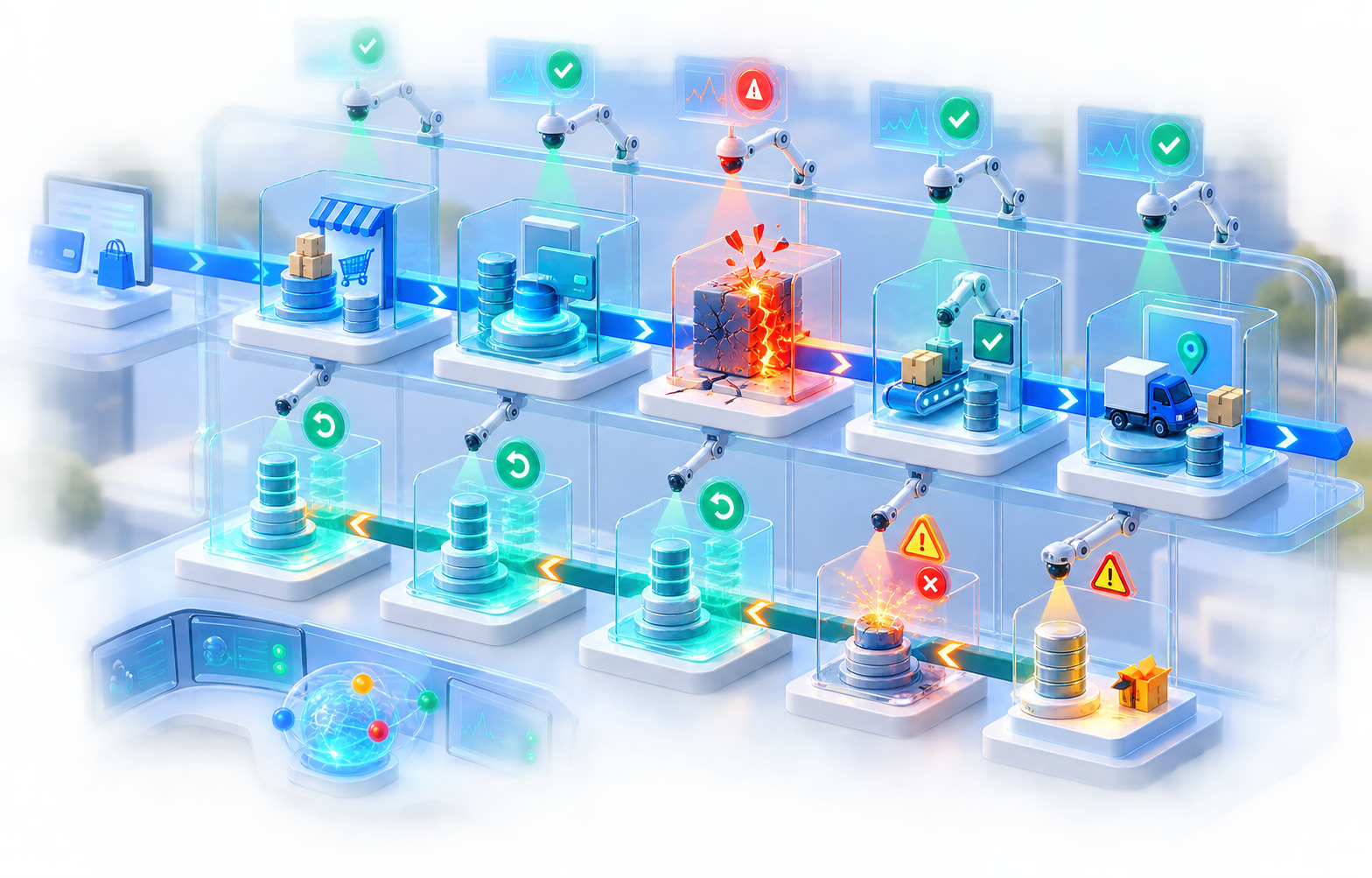
Within three weeks, the assistant had recommended indemnification language that shifted liability in the wrong direction on two enterprise contracts, cited a termination clause standard that didn't match the governing jurisdiction, and — in one case — invented a limitation-of-liability cap that didn't exist in any template the company owned. No exception was thrown. No request timed out. No test failed. The service returned a 200 on every call. From the perspective of the existing QA infrastructure, the system was working perfectly.
This is the story playing out, in some variation, across nearly every enterprise shipping generative AI in 2025 and 2026. It's not a story about sloppy engineering. It's a story about a category error: applying a testing discipline built to answer one question to a system that requires answering an entirely different one.
Traditional software QA answers: did the code execute correctly?
AI systems require answering: did the model make a good decision?
These are not the same question, they are not answered by the same tools, and conflating them is the single most consequential blind spot in enterprise AI programs today. This article is about what changes, why it changes, and what a rigorous, board-defensible AI testing discipline actually looks like.
2. Deterministic Systems vs. Probabilistic Systems
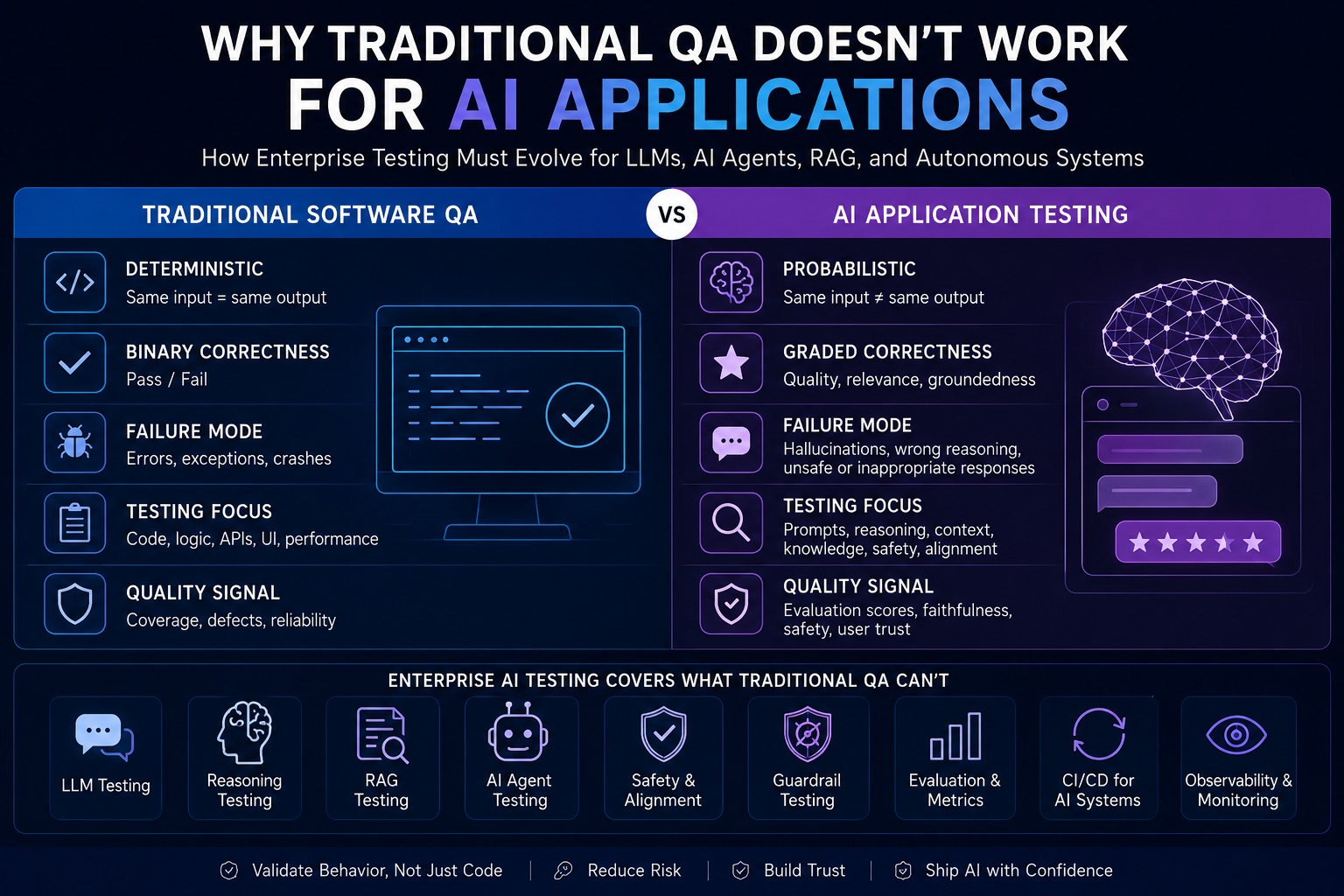
Traditional software is deterministic by design. Given the same input and the same code path, you get the same output, every time, forever — barring a bug. That property is what makes unit tests, regression suites, and CI/CD gates work at all: a test is a fixed assertion against a fixed expectation.
AI systems — particularly those built on large language models — are probabilistic. The same prompt, sent twice, can produce two different but individually reasonable responses. There is often no single "correct" output, only a distribution of acceptable ones, a distribution of borderline ones, and a distribution of unacceptable ones. Worse, "unacceptable" is frequently a judgment call that depends on domain, tone, legal exposure, or user context — not a boolean.
| Dimension | Traditional Software | AI Systems (LLMs, Agents, RAG) |
|---|---|---|
| Behavior model | Deterministic | Probabilistic / stochastic |
| Same input | Same output | Range of acceptable outputs |
| Correctness | Binary (pass/fail) | Graded (quality, groundedness, appropriateness) |
| Failure mode | Crash, exception, wrong value | Plausible-sounding wrong answer |
| Root cause | Traceable to a line of code | Distributed across prompt, model weights, retrieved context, and conversation history |
| Change trigger | Code deploy | Code deploy, model update, prompt change, knowledge base update, or nothing at all (model drift) |
| Testing unit | Function / endpoint | Conversation, decision, or task |
| Oracle (source of truth) | Specification | Judgment, policy, and grounded evidence |
| Regression definition | Output changed | Output changed and quality changed |
| "It works" means | Matches expected value | Is accurate, safe, grounded, and appropriate |
This table is the reason a passing regression suite told the legal-tech company nothing. Every test asserted that a function returned a string. None of them asserted that the string was correct legal reasoning. That assertion requires an entirely different kind of test — one that traditional QA was never built to write.
3. What Traditional Test Types Still Cover — and What They Miss
None of the classic testing disciplines become useless. They remain necessary for the parts of an AI system that are still conventional software: APIs, databases, authentication, infrastructure, UI rendering. But each one has a hard ceiling the moment model reasoning enters the picture.
| Test Type | Still Covers | Blind Spot for AI |
|---|---|---|
| Unit Testing | Individual functions, parsers, utility logic, guard clauses | Cannot assert whether a model's reasoning or generated content is correct |
| Integration Testing | Service-to-service contracts, data flow between components | Cannot detect that a retrieved document was irrelevant but the model used it anyway |
| Regression Testing | Confirms code changes don't break deterministic behavior | Cannot detect "silent" quality regression when a model or prompt update makes answers subtly worse |
| UI Testing | Rendering, layout, accessibility, click paths | Cannot evaluate whether the chat response displayed is factually correct |
| API Testing | Schema validation, status codes, latency | A well-formed JSON response can still contain a hallucinated fact |
| End-to-End Testing | Confirms the full pipeline runs without error | Confirms a answer was produced, not that it was the right answer |
| Smoke Testing | Confirms the service is up and responding | A "smoke test" for an LLM answering "hi" tells you nothing about its behavior on an ambiguous, high-stakes query |
| Performance Testing | Latency, throughput, resource usage | Doesn't measure reasoning degradation under load, truncated context, or token-limit compromises |
| Security Testing | Injection, auth bypass, OWASP Top 10 | Doesn't cover prompt injection, jailbreaks, data exfiltration through model outputs, or tool-calling abuse |
The pattern is consistent: traditional tests validate the pipe. AI testing must validate the water flowing through it.
4. The New AI Testing Layers
Enterprises that have matured past "we ran some prompts and it looked fine" organize testing around the following layers. Each is treated below with its purpose, typical failure modes, a real-world-style example, key metrics, automation potential, and an enterprise recommendation. After each layer, a short note describes how QAtronic would approach testing that specific layer in practice — not as a pitch, but as a concrete illustration of the engineering method behind the theory.
4.1 LLM Testing
Purpose: Validate the foundational behavior of the model itself — correctness, tone, refusal behavior, consistency — independent of any specific application logic. Typical failures: Inconsistent answers to logically identical questions; confident wrong answers; instability across model versions. Example: A model upgrade silently changes how the assistant handles ambiguous pricing questions, quoting different discount rules than the previous version, with no code change on the application side. Metrics: Task accuracy, answer consistency across paraphrased inputs, refusal appropriateness. Automation: Golden-set regression suites run against every model version, using frameworks like Promptfoo or DeepEval. Enterprise recommendation: Never upgrade a model version without re-running the full evaluation suite, even if "nothing else changed."
If QAtronic were testing this layer, we would maintain a paraphrase bank for every golden-set question — five to ten semantically identical rewordings per item — and score consistency across the bank, not just accuracy on the original phrasing. A model that's only been validated against one phrasing of each question hasn't really been validated at all.
4.2 Prompt Testing
Purpose: Verify that prompt templates and system instructions produce reliable, intended behavior across realistic input variation. Typical failures: A prompt that works for well-formed input breaks on typos, slang, non-English input, or adversarial phrasing. Example: A support-bot prompt instructing the model to "always recommend the premium plan when relevant" causes upselling in contexts where a customer explicitly states a budget constraint. Metrics: Instruction-adherence rate, prompt sensitivity (output variance for semantically equivalent inputs). Automation: Prompt diffing and A/B evaluation pipelines that score old vs. new prompt versions against the same test set. Enterprise recommendation: Treat prompts as versioned artifacts with code review, not as configuration you can edit in production.
If QAtronic were testing this layer, we would require every prompt change to ship with a diff report against the previous version, scored on the same golden set — the same discipline as a code diff with a regression run attached, because a one-line prompt edit can shift behavior as much as a significant code change.
4.3 Reasoning Testing
Purpose: Determine whether the model's multi-step reasoning is logically sound, not just whether its final answer looks right. Typical failures: Correct final answer reached through incorrect logic (right answer, wrong reason), which fails silently the next time inputs shift slightly. Example: A financial-advisory assistant correctly recommends against an early loan payoff, but its stated reasoning cites the wrong interest calculation — the right answer for the wrong reason, which breaks on the next similar case. Metrics: Reasoning consistency, chain-of-thought validity (where inspectable), logical-error rate. Automation: Step-by-step evaluators (LLM-as-judge with rubrics) scoring intermediate reasoning, not just final output. Enterprise recommendation: For high-stakes domains, require reasoning traces to be logged and periodically audited by domain experts, not just engineers.
If QAtronic were testing this layer, we would score the reasoning path and the final answer as two separate pass/fail dimensions. A right answer reached by wrong reasoning is scored as a defect, even though it would pass any traditional output-matching test — because the same flawed logic will eventually produce a wrong answer on a slightly different input.
4.4 AI Agent Testing
Purpose: Validate that autonomous agents make correct decisions across multi-step tasks involving planning, tool use, and sequential actions. Typical failures: Agent loops indefinitely; agent takes an irreversible action (e.g., sending an email, issuing a refund) based on a misread intermediate step. Example: A procurement agent tasked with "reorder if stock is low" repeatedly reorders because it misreads a decimal in an inventory API response. Metrics: Task success rate, step efficiency, unnecessary/irreversible action rate. Automation: Simulated environments (sandboxed tool APIs) that replay thousands of task variations and assert on final state, not just final message. Enterprise recommendation: Require a "dry run" mode for any agent with access to real-world side effects (payments, emails, data mutation) before production rollout.
If QAtronic were testing this layer, we would build the sandbox before writing a single test case. An agent that can take irreversible actions needs a mirrored environment where "send the email" and "issue the refund" produce a log entry instead of a real-world effect. Without that, every test either risks a real side effect or quietly skips the scenarios that matter most.
4.5 Memory Testing
Purpose: Verify that an agent's short-term and long-term memory retrieval is accurate, relevant, and doesn't leak across sessions or users. Typical failures: Cross-user memory leakage; stale facts persisting after correction; memory retrieval pulling irrelevant history into the current context. Example: A customer support agent references a prior user's shipping address because a memory store wasn't properly scoped by session/tenant. Metrics: Memory recall accuracy, memory isolation rate, stale-fact persistence rate. Automation: Multi-session test harnesses that plant facts, then probe for correct recall, incorrect recall, and cross-tenant leakage. Enterprise recommendation: Memory isolation testing should be treated as a security requirement, not just a quality one.
If QAtronic were testing this layer, we would run isolation testing as an adversarial exercise, not a functional one: deliberately plant conflicting facts across two concurrent sessions from different tenants and probe whether either one leaks into the other. This is closer to a penetration test than a feature test, and it's treated with that level of seriousness.
4.6 RAG (Retrieval-Augmented Generation) Testing
Purpose: Validate that retrieved context is relevant, sufficient, and correctly used by the model — and that the model doesn't override good context with its own (wrong) prior knowledge. Typical failures: Irrelevant chunks retrieved; correct chunks retrieved but ignored; outdated documents retrieved because the index wasn't refreshed. Example: A healthcare assistant retrieves an outdated dosage guideline because the vector index hadn't been re-synced after a policy update, and the model presents it confidently as current. Metrics: Context precision, context recall, groundedness (% of claims traceable to retrieved sources), citation accuracy. Automation: Frameworks like Ragas that automatically score retrieval quality and answer groundedness against a labeled corpus. Enterprise recommendation: Version your knowledge base the same way you version code, and re-run groundedness evaluations on every index update.
If QAtronic were testing this layer, we would start by deliberately breaking the index before the model — running the same 50 factual questions against three states of the knowledge base: fully current, partially stale, and missing entirely. The goal isn't to see if the model answers well when everything is in place; it's to see what it does when it isn't, since that's the condition real production systems eventually hit.
4.7 Tool-Calling Testing
Purpose: Confirm that a model correctly selects, formats, and interprets calls to external tools and APIs. Typical failures: Wrong tool selected for the task; malformed parameters; correct tool called but the model misinterprets the return value. Example: An agent calls a currency-conversion tool but passes the amount and currency code in the wrong order, and no downstream validation catches the resulting error. Metrics: Tool invocation accuracy, parameter correctness, result-interpretation accuracy. Automation: Contract tests against mocked tool APIs combined with adversarial parameter fuzzing. Enterprise recommendation: Log every tool call and its raw response; without this, tool-calling failures are nearly impossible to diagnose after the fact.
If QAtronic were testing this layer, we would fuzz parameter generation the same way a security team fuzzes an API — swapping argument order, injecting boundary values, and feeding malformed upstream data — then check not just whether the tool call fails, but whether the model correctly notices and recovers when it does.
4.8 Context Window Testing
Purpose: Verify system behavior as conversations or documents approach and exceed context limits. Typical failures: Silent truncation of critical instructions or earlier facts; degraded reasoning as context fills with irrelevant history. Example: A long customer support thread causes the system prompt (containing compliance instructions) to be truncated, and the model's later responses drop required disclaimers. Metrics: Instruction-retention rate under long context, quality degradation curve vs. context length. Automation: Synthetic long-conversation generators that progressively stress context length and assert on retained behavior. Enterprise recommendation: Never assume a system prompt is "safe" simply because it worked in a five-turn test conversation.
If QAtronic were testing this layer, we would generate synthetic conversations that grow one turn at a time, re-checking instruction adherence at every step, to find the exact point where retention starts to degrade — not just confirm it works at five turns and fails at fifty, but plot the actual curve in between.
4.9 Hallucination Testing
Purpose: Detect fabricated facts, invented citations, or confident statements not supported by any grounding source. Typical failures: Invented legal precedents, fabricated statistics, non-existent product features stated as fact. Example: A legal research assistant cites a court case that does not exist, formatted convincingly enough that it has led to real-world professional sanctions in reported cases where lawyers relied on such output without independent verification. Metrics: Hallucination rate, grounded-response percentage, citation accuracy. Automation: Automated fact-checking against a trusted corpus, combined with LLM-as-judge scoring for unsupported claims. Enterprise recommendation: Hallucination rate should be a release gate metric, tracked and reported the same way crash rate is for mobile apps.
If QAtronic were testing this layer, we would separate "wrong" from "unsupported" as two distinct failure categories, not one. A response can be factually correct but still ungrounded — right by luck rather than by evidence. We'd score both independently, because a system that's accidentally right today will eventually be wrong the same way it was accidentally right.
4.10 Safety Testing
Purpose: Verify the system doesn't produce harmful, dangerous, or policy-violating content under normal and adversarial use. Typical failures: Providing dangerous instructions when asked indirectly; failing to recognize distress signals; generating discriminatory content. Example: A generative chatbot, when repeatedly reframed by coordinated adversarial users, produces content wildly inconsistent with its intended persona and brand values — a dynamic broadly similar to what happened with Microsoft's Tay chatbot in 2016, where adversarial user input shifted the system's outputs within about a day. Metrics: Harmful-content rate, jailbreak resistance rate, false refusal rate (over-blocking safe requests). Automation: Red-teaming suites with adversarial prompt libraries, run on every model and prompt change. Enterprise recommendation: Red-teaming is not a one-time pre-launch activity; it should run continuously against production traffic patterns.
If QAtronic were testing this layer, we would run the same red-team scenarios not once, but as a persistent, sustained conversation — the same adversarial framing repeated, escalated, and revisited across many turns. Single-prompt red-teaming misses exactly the failure mode that matters most: gradual drift under sustained pressure.
4.11 Alignment Testing
Purpose: Confirm the system's outputs remain consistent with organizational values, brand voice, and intended purpose across edge cases. Typical failures: Model adopts a tone or takes a stance inconsistent with brand guidelines under adversarial framing. Example: A brand-voice assistant, when asked leading questions, begins expressing opinions on unrelated controversial topics, well outside its intended scope. Metrics: Persona-consistency score, off-topic response rate, values-alignment score (human-rated). Automation: Persona-adherence evaluators combined with periodic human review panels. Enterprise recommendation: Alignment testing requires domain and brand stakeholders in the loop — this cannot be fully delegated to engineering.
If QAtronic were testing this layer, we would bring brand and legal stakeholders into the rubric-writing process directly, not just the review process. A persona-consistency score is only as good as the definition of "consistent," and that definition belongs to the people who own the brand, not the engineers scoring against it.
4.12 Guardrail Testing
Purpose: Verify that input/output filters, content moderation layers, and policy enforcement mechanisms actually catch what they're designed to catch. Typical failures: Guardrails that catch obvious violations but miss paraphrased or obfuscated attempts; guardrails that over-trigger on benign content. Example: A content filter blocks a legitimate medical question about medication dosage while missing a rephrased request for the same information using slang. Metrics: Guardrail precision, guardrail recall, false-positive (over-block) rate. Automation: Adversarial paraphrase generation testing the same intent through dozens of phrasings. Enterprise recommendation: Track false refusal rate with the same rigor as hallucination rate — over-blocking erodes user trust just as much as under-blocking erodes safety.
If QAtronic were testing this layer, we would test every guardrail rule against a paraphrase bank of the intent it's meant to catch, not the literal phrasing it was written against — because a guardrail tuned to one wording is a guardrail that will be bypassed by the second person who tries.
4.13 Evaluation Testing (Evals)
Purpose: The overarching discipline of scoring model/system outputs against defined rubrics, at scale, continuously. Typical failures: Relying on a small, stale "golden set" that doesn't represent evolving real-world usage. Example: A company's eval set from launch no longer reflects the questions users actually ask six months later, so quality regressions in real usage go undetected. Metrics: Eval-set coverage, eval-to-production correlation, rubric inter-rater reliability. Automation: Continuous eval pipelines (LangSmith, DeepEval, OpenAI Evals) that sample production traffic and score it automatically. Enterprise recommendation: Refresh eval sets quarterly using real production queries (properly anonymized), not just launch-time hypotheticals.
If QAtronic were testing this layer, we would measure the eval set itself, not just what it measures — tracking what percentage of real production queries would actually be represented by an item in the golden set. An eval set that hasn't been checked against real traffic in six months is measuring a system that no longer exists.
4.14 Multi-Agent Testing
Purpose: Validate correct behavior when multiple AI agents collaborate, hand off tasks, or negotiate with each other. Typical failures: Agents stuck in circular delegation; conflicting decisions between agents; one agent's hallucination propagating to another as "fact." Example: A planning agent hands a flawed premise to an execution agent, which acts on it without questioning it, compounding a small reasoning error into an incorrect real-world action. Metrics: Handoff success rate, cross-agent consistency, error-propagation rate. Automation: Orchestration-level simulation testing with fault injection at each handoff point. Enterprise recommendation: Instrument every agent-to-agent handoff individually — debugging multi-agent failures without per-hop tracing is close to impossible.
If QAtronic were testing this layer, we would inject a plausible-but-wrong premise at the first agent in the chain and trace exactly where — or whether — a downstream agent catches it. Most multi-agent failures aren't a single agent being wrong; they're every agent being locally reasonable while trusting an upstream mistake.
4.15 Human-in-the-Loop Testing
Purpose: Verify that escalation points to human reviewers trigger correctly and that human overrides are properly captured and fed back into the system. Typical failures: Escalation thresholds set too high (harmful content slips through) or too low (humans drowned in unnecessary reviews). Example: An insurance claims assistant's escalation rule only triggers on explicit keywords, missing cases where fraud risk is implied but not stated directly. Metrics: Escalation precision/recall, human override rate, override-to-improvement feedback loop latency. Automation: Simulated escalation scenarios combined with audit sampling of real escalations. Enterprise recommendation: Human override rate should be tracked as a leading indicator of model quality, not just an operational cost.
If QAtronic were testing this layer, we would deliberately test the two failure directions separately — cases that should escalate but don't, and cases that shouldn't escalate but do — because tuning against only one of them tends to make the other one worse without anyone noticing.
4.16 Policy Testing
Purpose: Confirm the system enforces business, legal, and regulatory policies consistently. Typical failures: Policy correctly stated in documentation but not actually enforced in edge-case conversations. Example: A financial assistant correctly refuses to give investment advice in direct questions, but provides de facto advice when the same request is framed as a hypothetical. Metrics: Policy compliance rate, policy-bypass rate under reframing. Automation: Policy-specific adversarial test suites mapped directly to compliance requirements. Enterprise recommendation: Every regulatory policy should have a corresponding, named test suite that compliance and legal teams can review — not just engineering.
If QAtronic were testing this layer, we would write every policy test suite directly from the regulatory text, with a named test case per obligation, so compliance can review the mapping without needing to read the underlying code — the same way a financial audit traces a control back to the specific rule it satisfies.
4.17 Decision Testing
Purpose: Evaluate the quality of discrete decisions the system makes (approve/deny, recommend/don't recommend), independent of the language used to express them. Typical failures: Inconsistent decisions for materially identical cases; decisions that violate documented business rules. Example: An automated screening system scores functionally equivalent candidate profiles differently based on incidental formatting or phrasing differences — a failure category broadly consistent with issues reported around automated screening tools across the industry. Metrics: Decision consistency rate, decision-to-policy compliance rate, disparate-impact metrics across protected classes. Automation: Paired testing (near-identical inputs with only irrelevant attributes varied) run at scale. Enterprise recommendation: Fairness and consistency testing on decisions should be a release gate for any system influencing hiring, credit, insurance, or similar high-stakes outcomes.
If QAtronic were testing this layer, we would construct paired inputs that vary only a single, irrelevant attribute at a time, run them at scale, and treat any statistically meaningful gap in outcomes as a defect — not a discussion point, a defect, filed and tracked the same way a functional bug would be.
4.18 Recovery Testing
Purpose: Verify the system can detect its own errors mid-task and recover gracefully rather than compounding a mistake. Typical failures: Agent continues executing a multi-step plan after an early step clearly failed, rather than halting or re-planning. Example: A travel-booking agent proceeds to book a hotel after a flight-booking step silently failed, resulting in a stranded itinerary. Metrics: Error-detection rate, recovery success rate, mean steps-to-recovery. Automation: Fault-injection testing that deliberately breaks intermediate steps and measures recovery behavior. Enterprise recommendation: Require explicit "checkpoint" validation between irreversible steps in any agentic workflow.
If QAtronic were testing this layer, we would inject faults at every intermediate step of a multi-step task, one at a time, and measure not whether the task eventually fails, but how many additional steps happen after the failure before anything notices — that gap is where the real damage accumulates.
4.19 Fallback Testing
Purpose: Confirm graceful degradation when the model, a tool, or a retrieval system is unavailable or returns low-confidence output. Typical failures: System returns a confident-sounding answer instead of acknowledging uncertainty when a dependency fails. Example: A knowledge base outage causes the assistant to answer from ungrounded model knowledge instead of stating it cannot access current information — the exact opposite of the intended fallback behavior. Metrics: Fallback trigger accuracy, graceful-degradation rate, user-facing uncertainty disclosure rate. Automation: Dependency-failure simulation (killing the retrieval service, tool API, or model endpoint mid-test) with assertions on resulting behavior. Enterprise recommendation: Explicitly test "everything downstream is broken" scenarios before launch — this is the scenario most teams skip and most incidents originate from.
If QAtronic were testing this layer, we would deliberately kill every dependency the system has, one at a time and then in combination, before launch — not to see if the system stays up, but to see if it tells the truth about being degraded instead of quietly pretending everything is fine.
5. Traditional QA vs. AI QA: The Full Comparison
| Attribute | Traditional QA | AI QA |
|---|---|---|
| Goal | Verify code matches specification | Verify decisions are accurate, grounded, safe, and appropriate |
| Input | Structured, bounded | Unstructured, open-ended, adversarial-prone |
| Output | Deterministic value | Probabilistic distribution of acceptable responses |
| Coverage | Code paths, branches | Behavioral scenarios, reasoning paths, edge-case intents |
| Regression | Output changed vs. baseline | Output changed and quality/groundedness changed |
| Automation | Assertion-based (equality, schema) | Judgment-based (LLM-as-judge, rubric scoring, statistical sampling) |
| Expected results | Exact or pattern match | Graded quality bands, acceptable ranges |
| Failure detection | Exceptions, failed assertions, wrong values | Silent quality degradation, hallucination, policy violation |
| Debugging | Stack trace to a line of code | Trace across prompt, retrieved context, model version, and conversation history |
| Monitoring | Uptime, latency, error rate | The above, plus hallucination rate, groundedness, override rate, policy compliance |
| Ownership | QA engineers | QA engineers + ML engineers + domain experts + compliance |
| Test data | Fixed fixtures | Evolving, continuously refreshed real-world samples |
| "Definition of done" | All tests pass | All tests pass and eval scores clear thresholds and human review sign-off for high-stakes domains |
6. What Classical QA Would Never Have Caught: Real Production Failures
These cases are illustrative of documented, publicly reported categories of AI failure. They are described here based on general public reporting, not exact quotation, and are used to illustrate systemic patterns rather than to single out any company.
Airline chatbot providing incorrect policy information. A widely reported 2024 case involved an airline's customer-support chatbot giving a customer incorrect information about a bereavement fare policy, information the customer relied on. A tribunal later held the airline responsible for what its AI system had told the customer. No traditional test would have caught this: the chatbot responded fluently, quickly, and with a well-formed sentence. The failure was entirely in the content of the answer, not its structure.
Auto dealership chatbot manipulated into absurd commitments. In 2023, a dealership's AI chat widget was publicly shown being talked into agreeing to sell a vehicle for a token amount and affirming unrelated absurd statements, after users deliberately crafted adversarial prompts. This is a guardrail and safety-testing failure: the system had no tested boundary for prompt manipulation, only a happy-path conversation flow.
A conversational AI shifting dramatically under adversarial input. Microsoft's 2016 Tay chatbot is the canonical example: coordinated adversarial input caused the system's outputs to shift within about a day into content wildly inconsistent with its intended purpose. This illustrates why safety and alignment testing must include adversarial, coordinated, and sustained-interaction scenarios — not just single-turn spot checks.
Automated screening tools producing biased outcomes. Multiple reported cases across recruiting technology have shown automated candidate-screening systems producing systematically skewed outcomes for certain demographic groups, sometimes rooted in patterns learned from historical hiring data. Traditional QA validates that the scoring pipeline runs and returns a number; it does not validate that the distribution of those numbers is fair across protected groups. That requires dedicated decision testing and fairness metrics.
Generative assistants producing fabricated citations. Numerous reported incidents — including in legal practice — describe generative assistants producing citations to court cases or sources that do not exist, presented with full confidence and correct formatting. This is a hallucination and groundedness failure, invisible to any test that only checks that the API returned a syntactically valid response.
Healthcare and financial assistants requiring extreme grounding discipline. In regulated domains, an assistant that is 95% accurate is not "mostly working" — it is producing incorrect medical or financial guidance in roughly one out of twenty answers, at scale, with no traditional test flagging any of them, because every one of those answers is well-formed, well-punctuated, and confidently stated.
The common thread: every one of these systems was, from a conventional QA perspective, functioning correctly. The requests were parsed, the responses were generated, the APIs returned 200s. The failures were entirely in a dimension traditional testing was never built to measure — correctness, groundedness, and appropriateness of a decision, not the mechanics of producing an output.
7. The Cost of Poor AI Testing
Every one of the failures above has a price — it just isn't visible on a test-coverage dashboard, and it usually isn't visible until well after the decision that caused it.
Legal risk. An incorrect contract recommendation, a wrong compliance answer, or a misstated policy term can turn into a settlement or a tribunal finding — as it did in the airline case above — at a cost orders of magnitude higher than the testing that would have caught it before launch.
Customer loss. A customer who gets one wrong answer from an AI assistant rarely files a bug report. They simply stop trusting the system, and often the company, and leave without ever telling anyone why.
Financial errors. An agent that misreads a decimal, a currency code, or a discount rule can execute hundreds of incorrect transactions before anyone notices — because no traditional test asks whether a transaction was reasonable, only whether it completed.
Reputational risk. Unlike a code bug, an AI failure rarely shows up in a bug tracker first. It shows up in a screenshot. That's how a handful of adversarial prompts against a single dealership chatbot became a widely circulated public story in a matter of hours.
Regulatory exposure. In finance, healthcare, and insurance, an AI decision that can't be explained isn't just a technical gap — it's a legal one. The question a regulator asks after an incident is rarely "how does this work"; it's "why didn't you know this could happen."
Rising support costs. Every AI answer that's subtly wrong generates, at minimum, one support ticket — and often more than the automation was supposed to save, once hallucinations go untracked long enough to become a pattern rather than an anomaly.
None of these costs appear in a test-coverage report. That is precisely why boards are increasingly asking a different question than "how many of our tests pass" — the question is closer to "if the AI gets something wrong, will we be the first to know, or the last."
8. A Framework: The Enterprise AI Validation Framework (EAVF)
Rather than a single "AI testing pyramid," enterprise-grade AI validation is better modeled as four concentric layers, each depending on the ones inside it.
        ┌─────────────────────────────────────────┐
        │   Layer 4: Governance & Continuous       │
        │   Monitoring (production)                │
        │   ┌───────────────────────────────────┐   │
        │   │ Layer 3: System & Behavior         │   │
        │   │ Validation (agents, RAG, policy)   │   │
        │   │  ┌───────────────────────────────┐  │   │
        │   │  │ Layer 2: Model & Prompt       │  │   │
        │   │  │ Evaluation (LLM, reasoning)   │  │   │
        │   │  │  ┌─────────────────────────┐  │  │   │
        │   │  │  │ Layer 1: Traditional    │  │  │   │
        │   │  │  │ Software QA             │  │  │   │
        │   │  │  │ (unit, integration, API,│  │  │   │
        │   │  │  │  security, performance) │  │  │   │
        │   │  │  └─────────────────────────┘  │  │   │
        │   │  └───────────────────────────────┘   │
        │   └───────────────────────────────────┘   │
        └─────────────────────────────────────────┘
Layer 1 — Traditional Software QA: Everything covered in Section 3. Necessary but not sufficient; this layer validates the scaffolding around the model.
Layer 2 — Model & Prompt Evaluation: LLM testing, prompt testing, reasoning testing, hallucination testing. This layer validates the model's core behavior in isolation, before it's embedded in a larger system.
Layer 3 — System & Behavior Validation: RAG testing, agent testing, tool-calling testing, multi-agent testing, memory testing, policy and decision testing. This layer validates how the model behaves once it's wired into retrieval systems, tools, and multi-step workflows — where most real-world failures actually originate.
Layer 4 — Governance & Continuous Monitoring: Safety, alignment, guardrail testing, human-in-the-loop testing, and production observability. This layer never "completes" — it runs continuously against live traffic, because model behavior can drift even when no code has changed.
The critical insight of this framework: a system can pass Layers 1 and 2 perfectly and still fail catastrophically at Layer 3 or 4. This is precisely what happened in the opening story — a system with excellent Layer 1 coverage and no meaningful Layer 2, 3, or 4 testing at all.
9. AI Testing Reference Architecture
Where the EAVF framework describes what kind of testing exists at each layer, the reference architecture below shows where in the running system each of those tests actually attaches.
                              ┌─────────────┐
                              │    User     │
                              └──────┬──────┘
                                     │
                              ┌──────▼──────┐
                              │   Gateway    │  ← auth, rate limiting,
                              │              │    input sanitization,
                              └──────┬──────┘    prompt-injection screening
                                     │
                              ┌──────▼──────┐
                              │     RAG      │  ← retrieval, context
                              │  (Retrieval) │    assembly, source
                              └──────┬──────┘    versioning
                                     │            [Layer 3 testing]
                              ┌──────▼──────┐
                              │     LLM      │  ← reasoning, generation,
                              │              │    tool calling, memory
                              └──────┬──────┘    [Layer 2/3 testing]
                                     │
                              ┌──────▼──────┐
                              │  Evaluation  │  ← hallucination check,
                              │    Layer     │    groundedness scoring,
                              └──────┬──────┘    policy compliance
                                     │            [Layer 2/3/4 testing]
                              ┌──────▼──────┐
                              │  Guardrails  │  ← safety filter, alignment
                              │              │    check, false-refusal
                              └──────┬──────┘    balance
                                     │            [Layer 4 testing]
                              ┌──────▼──────┐
                              │Observability │  ← tracing, logging,
                              │              │    versioning, replay
                              └──────┬──────┘    [continuous, Layer 4]
                                     │
                    ┌────────────────┼────────────────┐
                    │                                 │
             ┌──────▼──────┐                  ┌───────▼──────┐
             │Human Review │  ← escalation,    │  Production  │
             │             │    override,      │   Response    │
             └──────┬──────┘    feedback loop  └───────┬──────┘
                    │                                  │
                    └──────────────┬───────────────────┘
                                   │
                          feedback into eval set,
                          golden set, and prompt/model
                          versioning (closes the loop)
Why the feedback loop matters more than the pipeline itself: most reference architectures for AI systems stop at "Production Response." The version that holds up under audit closes the loop — human overrides and escalation outcomes feed back into the evaluation set, which is what turns a static pipeline into a system that gets measurably better, or at least doesn't silently get worse, over time.
Where each testing layer maps onto this architecture:
| Architecture Stage | EAVF Layer | What Gets Tested Here |
|---|---|---|
| Gateway | Layer 1 + 4 | Input validation, auth, prompt-injection resistance |
| RAG | Layer 3 | Context precision/recall, groundedness, index freshness |
| LLM | Layer 2 + 3 | Reasoning consistency, tool-calling accuracy, memory isolation |
| Evaluation Layer | Layer 2 + 3 | Hallucination rate, citation accuracy, policy compliance |
| Guardrails | Layer 4 | Jailbreak resistance, false refusal rate, alignment |
| Observability | Layer 4 (continuous) | Trace completeness, version reproducibility, decision replay |
| Human Review | Layer 4 | Escalation precision/recall, override rate |
| Production → feedback loop | All layers | Eval-set drift, real-world correlation with pre-launch scores |
10. Metrics: Coverage Is No Longer Enough
Test coverage percentage, the traditional north star metric, tells you almost nothing about AI system quality. The following metrics form a more honest scorecard.
| Metric | What It Measures | Why It Matters |
|---|---|---|
| Hallucination Rate | % of responses containing unsupported or fabricated claims | Direct measure of trustworthiness |
| Grounded Response % | % of responses fully traceable to retrieved or verified sources | Core RAG health metric |
| Citation Accuracy | % of cited sources that actually support the stated claim | Prevents "correct-looking but wrong" citations |
| Task Success Rate | % of agent tasks completed correctly end-to-end | Core agent reliability metric |
| Reasoning Consistency | % of logically equivalent inputs producing logically equivalent conclusions | Detects fragile or superficial reasoning |
| Tool Invocation Accuracy | % of tool calls with correct tool, parameters, and interpretation of results | Prevents silent automation failures |
| Memory Recall Accuracy | % of correct recalls of prior session facts | Prevents both memory loss and cross-contamination |
| Context Precision | % of retrieved context that is actually relevant to the query | Reduces noise that degrades reasoning |
| Policy Compliance | % of responses adhering to defined business/regulatory policy | Direct compliance and legal risk indicator |
| Human Override Rate | % of AI decisions overridden by human reviewers | Leading indicator of quality erosion |
| False Refusal Rate | % of legitimate requests incorrectly blocked or refused | Balances safety against usability |
| Latency | Time to first token / full response | User experience and cost-tradeoff metric |
| Cost per Task | Total compute + API cost per completed task | Business viability metric, often ignored until it's a crisis |
None of these appear on a typical QA dashboard today. Enterprises that are ahead of the curve have replaced "percentage of tests passing" with a blended scorecard combining several of the metrics above, reviewed on the same cadence as uptime and error rate.
11. Observability: Why AI Systems Need a Different Kind of Visibility
Traditional application monitoring (uptime, latency, error rate, log aggregation) remains necessary but is insufficient for diagnosing AI failures, because the failure often isn't an error — it's a bad decision that looked like a successful one.
Enterprise AI observability requires:
- Tracing — capturing the full execution path of a request: the prompt sent, the context retrieved, the tools called, and the final response, as a single connected trace.
- Evaluation (continuous) — automatically scoring live or sampled production traffic against quality rubrics, not just pre-launch test sets.
- Logging (structured, not just text) — capturing model version, prompt version, retrieved document IDs, and confidence signals alongside every response.
- Prompt Versioning — treating every prompt template as a versioned, diffable artifact, the same way you version application code.
- Model Versioning — recording exactly which model (and often which specific checkpoint or API version) generated each response, since providers routinely update models behind the same API endpoint.
- Dataset Versioning — tracking exactly which version of a knowledge base or fine-tuning dataset was in effect for any given response, so failures can be reproduced.
- Evidence Collection — retaining the source documents and retrieval results behind any grounded claim, for audit and dispute resolution.
- Decision Replay — the ability to re-run a past decision with the exact same model version, prompt, and context to determine whether a failure is reproducible or was a one-off stochastic outlier.
- Conversation Replay — reconstructing an entire multi-turn conversation for root-cause analysis when a failure occurs several turns into a session.
Without this instrumentation, most AI incidents are simply undiagnosable after the fact. Teams are left saying "it happened once, we're not sure why," which is not an acceptable answer for a system making decisions that affect customers, contracts, or regulatory exposure.
12. Automation: The Emerging AI Testing Toolchain
A practical, layered toolchain has emerged across the industry. No single tool covers everything; enterprise teams typically combine several.
| Tool Category | Representative Tools | Primary Use |
|---|---|---|
| Prompt/LLM evaluation | Promptfoo, DeepEval, OpenAI Evals | Golden-set testing, regression scoring across prompt/model versions |
| RAG-specific evaluation | Ragas | Context precision/recall, groundedness scoring |
| Tracing & observability | LangSmith, Phoenix, LangFuse | End-to-end trace capture, conversation replay, live monitoring |
| Experiment tracking | Weights & Biases, MLflow | Model version tracking, evaluation run history, dataset versioning |
| Conventional test execution | Pytest, Playwright | Layer 1 traditional QA, and orchestrating AI eval scripts within CI |
| CI/CD orchestration | GitHub Actions (and equivalents) | Gating deploys on both traditional test results and AI eval thresholds |
The meaningful shift is architectural, not just tool selection: these tools need to sit inside the same CI/CD pipeline as traditional tests, with their own pass/fail gates, rather than existing as a separate, manually-run process that happens "sometime before launch."
13. AI-Aware CI/CD: What Runs, and When
| Trigger | What Should Run |
|---|---|
| Every commit | Unit tests, integration tests, prompt-template lint/schema checks |
| Every prompt change | Full prompt regression suite against the golden eval set; diff report against previous prompt version |
| Every model version update (including provider-side updates) | Full LLM evaluation suite, hallucination and groundedness checks, safety/red-team suite |
| Every knowledge base / index update | RAG-specific evaluation (context precision/recall, groundedness), citation accuracy checks |
| Every production deployment | Full regression suite (traditional + AI), canary rollout with live evaluation sampling, rollback triggers tied to quality metrics, not just error rate |
The key departure from conventional CI/CD: a deployment gate that only checks "did the build succeed and did the smoke test pass" is not sufficient. AI-aware pipelines add a second gate — "did quality metrics clear their thresholds on the latest eval run" — and that gate must be able to block a release even when every traditional test is green.
14. Case Study: An Insurance Carrier's AI Support Assistant
Background. A mid-size property and casualty insurer deployed a generative AI assistant to help policyholders understand coverage, file claims, and answer billing questions. It launched with a conventional QA process: unit tests, API tests, a 200-conversation manual UAT pass, and a go-live decision based on all tests passing.
Problems before AI testing was introduced.
- Hallucination rate (unsupported claims about coverage terms) estimated at roughly 6–8% of responses in early production sampling.
- No visibility into why specific bad responses occurred; incidents were diagnosed by manually re-reading chat transcripts.
- Two escalations to the compliance team within the first quarter over incorrect statements about claim eligibility.
- No systematic way to know whether a prompt tweak improved or degraded quality — teams shipped changes based on a handful of manual spot checks.
New testing strategy introduced.
- Layer 2/3 evaluation pipeline built around a 400-item golden set covering coverage questions, claims scenarios, and billing edge cases, scored automatically on every prompt and model change.
- RAG groundedness evaluation added, since most factual answers were meant to be sourced from the policy document corpus.
- Guardrail and policy-compliance suite built directly from compliance team requirements, with named test cases mapped to specific regulatory obligations.
- Full tracing added so every response could be reconstructed: prompt version, retrieved documents, model version, and final output.
- Human-in-the-loop escalation tuned and tested explicitly, with override data fed back into the eval set monthly.
Architecture (simplified):
User Query → Retrieval Layer (indexed policy docs)
           → Context Assembly + System Prompt (versioned)
           → LLM (versioned) → Response
           → Guardrail/Policy Check → Response to User
           ↘ Trace logged (prompt v, model v, docs, response)
           ↘ Sampled into continuous eval pipeline
           ↘ Escalation check → Human review queue if triggered
Metrics tracked post-implementation:
| Metric | Before | After (2 quarters later) |
|---|---|---|
| Hallucination rate | ~7% | ~1.2% |
| Compliance escalations | 2 in Q1 | 0 in the following two quarters |
| Mean time to diagnose an incident | Several days (manual transcript review) | Under 2 hours (trace replay) |
| Release cycle for prompt changes | ~2 weeks (manual review cycle) | 2–3 days (automated eval gate) |
| Customer satisfaction (support CSAT for AI-handled queries) | Below baseline for human agents | On par with human agents |
Business outcome. The carrier didn't just reduce incidents — it changed its relationship with the release process. Prompt and knowledge-base updates that previously required a multi-week manual review cycle, out of caution, could ship in days because the eval suite provided an objective, automated basis for confidence. The AI testing investment paid for itself primarily in velocity, not just risk reduction.
15. AI Testing ROI: What Changes When You Invest in It
| Dimension | Without AI Testing | With AI Testing |
|---|---|---|
| Incident rate | Discovered reactively — via customer complaints, screenshots, or legal escalation | Caught proactively via continuous evaluation, before reaching most users |
| Release confidence | "It passed our tests" means only that the code ran, not that the answers are good — releases are slow and cautious because nobody trusts the safety net | Releases are backed by objective quality scores; teams move faster precisely because they trust the gate |
| MTTR (mean time to resolve) | Days — root cause requires manually re-reading transcripts and guessing which prompt/model version was live | Hours — full trace replay shows exact prompt, model, and context behind any past response |
| Support costs | Every unnoticed bad answer generates a support ticket, or worse, silent churn with no ticket at all | Hallucination and error rates are tracked and driven down directly, reducing ticket volume at the source |
| Customer trust | Trust is discovered to be broken only after it's already gone — one bad public interaction can outweigh months of good ones | Trust is measurable and defensible: you can show, with evidence, what the system does and doesn't get wrong |
| Compliance risk | Exposure is unknown until a regulator, auditor, or plaintiff's attorney asks a question you can't answer | Every regulatory obligation maps to a named test suite; you can produce evidence on request instead of scrambling |
The honest caveat: these are directional outcomes, not guaranteed percentages — the actual magnitude depends on your domain, your current baseline, and how exposed you are to high-stakes decisions. What's consistent across organizations that make this investment is where the payoff shows up: not primarily in "fewer bad days," but in faster releases and shorter incident cycles, because a rigorous eval gate replaces slow, manual caution with fast, evidence-based confidence — the same shift shown in the case study above.
The framing worth keeping in front of a CTO isn't "AI testing prevents disasters." Disasters are rare and easy to dismiss as unlikely. The framing that holds up is: you are already paying the cost of not having this — in slower releases, longer incident cycles, and support tickets you can't trace to a root cause. AI testing doesn't add a cost. It makes a cost you're already carrying visible, and then reduces it.
16. Build vs. Buy: Should AI Testing Be Built In-House?
There's no universally correct answer here — but there is a clear set of factors that determines which answer is correct for a given organization. The mistake most teams make is treating this as a budget decision. It's actually a capability and timing decision.
What building in-house requires. Building a serious internal AI testing capability isn't just "add eval scripts to CI." It requires, concurrently: ML engineers who understand evaluation methodology (not just prompt engineering); domain experts with the bandwidth to define and maintain rubrics; infrastructure for tracing, versioning, and continuous evaluation running as a live system, not a one-time script; an eval set that gets refreshed against real production data indefinitely; and ownership that survives when the one engineer who understands it leaves. None of this is exotic, but all of it has to exist at once — a partial version, evals with no tracing, or tracing with no domain review, tends to produce a false sense of safety, which is arguably worse than knowing you have a gap.
| Factor | Favors Building In-House | Favors Bringing in Outside Expertise |
|---|---|---|
| Time to production | 6+ months before a high-stakes launch | Need a working evaluation and observability layer in weeks, not quarters |
| Domain stakes | Internal tools, low regulatory exposure | Legal, medical, financial, or other high-liability domains where the testing discipline itself must be defensible to auditors |
| Existing ML maturity | Already run MLOps, have eval infrastructure for other models | This is your first AI system in production, experience is primarily traditional software |
| Talent availability | Can hire or reassign ML engineers and get sustained time from domain experts | Best people are already stretched across the product roadmap |
| Rate of change | Models, prompts, and knowledge base change infrequently | Expect to iterate weekly and need the discipline to keep pace without becoming a bottleneck |
| Long-term ownership | Want this expertise as a durable, strategic capability | Need the gap closed now, can build internal capability in parallel rather than in sequence |
The honest middle ground. For most organizations, the real answer isn't "build" or "buy" — it's a staged approach: bring in outside expertise to stand up the evaluation framework, tracing infrastructure, and initial golden sets quickly, while training internal engineers and domain experts to own and extend it going forward. The expensive mistake isn't choosing build or buy — it's spending six months building the wrong thing internally because no one on the team has done this before, or outsourcing indefinitely and never developing the in-house judgment to know if the work being delivered is actually rigorous.
Three questions that settle it faster than any framework:
- If we launch without this and something goes wrong, what's the actual cost? (Section 7 is the honest starting point for this conversation.)
- Do we have anyone in-house who has actually built and maintained an evaluation pipeline before — not read about one, but operated one under production load?
- Is our bottleneck knowledge, or is it time? If it's knowledge, outside expertise closes the gap permanently once the team absorbs it. If it's only time, hiring or reallocating internally is usually the more durable answer.
17. AI Testing Maturity Model
Level 1 — Traditional QA
   Unit, integration, regression, UI, API, security testing.
   No AI-specific evaluation exists. AI outputs are tested
   the same way any other feature output is tested.
        │
        ▼
Level 2 — AI Awareness
   Teams recognize AI needs different testing, but practices
   are manual and ad hoc: someone spot-checks conversations,
   a handful of prompts are reviewed before launch. No
   automation, no consistent metrics, no ownership structure.
        │
        ▼
Level 3 — AI Validation
   Automated evaluation pipelines exist for core risks:
   golden-set regression testing, RAG groundedness checks,
   basic hallucination detection. Prompts and models are
   versioned. Metrics are tracked but reviewed periodically,
   not continuously.
        │
        ▼
Level 4 — Continuous AI Evaluation
   Evaluation runs continuously against production traffic,
   not just pre-launch test sets. Full tracing, decision and
   conversation replay, and AI-aware CI/CD gates are in place.
   Quality metrics (hallucination rate, override rate, etc.)
   are monitored and alerted on like uptime and latency.
        │
        ▼
Level 5 — AI Governance
   Cross-functional ownership spans engineering, ML, compliance,
   and domain experts. Every regulatory obligation maps to a
   named, auditable test suite. Incident response is formalized
   and AI-specific. Testing data informs the product and model
   roadmap, not just release gating. The organization can
   produce evidence, on request, for any past decision.
What distinguishes each level:
| Level | Automation | Ownership | Metrics Tracked | Can You Answer "Why Did It Do That"? |
|---|---|---|---|---|
| 1 — Traditional QA | None specific to AI | QA engineers only | Pass/fail on functional tests | No |
| 2 — AI Awareness | Manual spot checks | One or two individuals, informally | None consistent | Rarely, and slowly |
| 3 — AI Validation | Golden-set eval pipelines | QA + ML engineering | Hallucination rate, groundedness (periodic) | Sometimes, with effort |
| 4 — Continuous AI Evaluation | Continuous, production-sampled | QA + ML + observability tooling owner | Full metric suite (Section 10), alerted | Usually, within hours |
| 5 — AI Governance | Continuous + audited | Engineering + ML + compliance + domain experts | Full suite + fairness + policy compliance | Yes, with evidence on request |
How to use this model. Most organizations shipping generative AI today sit at Level 2 or the early edge of Level 3 — not a sign of falling behind, since the tooling and practices that make Level 4–5 possible have only matured over the last two years. The model is most useful not as a scorecard to feel good or bad about, but as a way to answer a narrower, more useful question: what is the one thing standing between us and the next level? For teams at Level 2, it's usually automation. For teams at Level 3, it's continuity — moving from periodic review to always-on evaluation. For teams at Level 4, it's governance — extending the same rigor to fairness, compliance, and cross-functional ownership.
18. Enterprise Checklist: 50 Questions Every CTO Should Ask Before Releasing AI
Model & Reasoning
- What is our current hallucination rate, measured against a real eval set — not anecdotally?
- What is our grounded-response percentage for factual claims?
- Do we re-run evaluations every time the underlying model version changes, even without our own code changes?
- Can we reproduce any given production response exactly, including model version and prompt version?
- Do we track reasoning consistency across paraphrased, logically equivalent inputs?
- Have we tested behavior at and beyond our context window limits?
- What happens when the model is asked the same high-stakes question ten times — do we get materially the same answer?
RAG & Knowledge 8. What is our context precision and recall for retrieval? 9. Do we version our knowledge base and re-run groundedness evaluation on every update? 10. Can we trace any factual claim back to a specific source document? 11. What happens when the knowledge base has no relevant document — does the system say so, or guess? 12. How do we detect and remove outdated documents from the retrieval index?
Agents & Tools 13. What is our task success rate for agentic workflows, measured end-to-end? 14. Do we have a dry-run/sandbox mode for any agent capable of irreversible actions? 15. What happens when a tool call fails mid-task — does the agent notice and recover? 16. Do we log every tool call and its raw response for later diagnosis? 17. Have we fuzz-tested tool parameter generation for malformed or adversarial inputs? 18. In multi-agent systems, do we trace every handoff individually?
Safety, Alignment, and Guardrails 19. What is our jailbreak resistance rate under active red-teaming? 20. What is our false refusal rate — are we over-blocking legitimate requests? 21. Do we run red-team testing continuously, or only once before launch? 22. Have we tested behavior under sustained, coordinated adversarial interaction, not just single prompts? 23. Do our guardrails catch paraphrased or obfuscated attempts at policy violations? 24. Does our system maintain brand voice and stated values under adversarial reframing?
Policy, Compliance, and Fairness 25. Does every regulatory obligation have a named, owned test suite? 26. Do we test for consistent decisions across near-identical inputs that differ only in protected characteristics? 27. Have we measured disparate impact for any AI system influencing hiring, credit, insurance, or similar decisions? 28. Can compliance and legal teams review our test suites directly, not just engineering summaries? 29. Do we have a documented process for what happens when a policy violation is discovered in production?
Human Oversight 30. What is our human override rate, and is it trending up or down? 31. Are escalation thresholds tuned and tested, not just assumed? 32. Do we feed human corrections back into our evaluation and training data? 33. Who is accountable when the AI, not a human, makes a wrong high-stakes decision?
Observability & Incident Response 34. Can we replay any past conversation exactly, for root-cause analysis? 35. Do we know which model version, prompt version, and knowledge base version were active for any given past response? 36. What is our mean time to diagnose an AI quality incident? 37. Do we have alerting on quality metrics (hallucination rate, override rate), not just uptime and latency? 38. Is there a rollback plan specifically for prompt or model regressions, distinct from a code rollback?
Process & Ownership 39. Who owns AI quality — is it solely QA, solely ML engineering, or a shared, explicitly defined function? 40. Do domain experts (legal, medical, financial, as applicable) review our eval rubrics? 41. Is our eval set refreshed regularly with real production data, or frozen at launch? 42. Do prompt changes go through the same review rigor as code changes? 43. What's our threshold for blocking a release based on eval scores, and who has authority to override it?
Cost & Sustainability 44. What is our cost per completed task, and how does it scale with usage? 45. Have we load-tested reasoning quality under high concurrency, not just latency? 46. What is our plan if a model provider deprecates or silently changes the model version we depend on?
Governance 47. Do we have an internal AI Testing Center of Excellence, or is this knowledge concentrated in one or two individuals? 48. Is there a documented AI incident response plan, distinct from our standard security incident plan? 49. Have we run a tabletop exercise simulating a public-facing AI failure? 50. If asked by a regulator or a court to explain why the AI produced a specific harmful output, could we actually answer — with evidence?
19. AI Testing Readiness Assessment
Score your organization. For each statement, score 0 (not true), 1 (partially true), or 2 (fully true).
Model & Reasoning
- We re-run evaluations every time the underlying model version changes, even without our own code changes.
- We track hallucination rate against a real eval set, not anecdotal spot checks.
- We can reproduce any past production response exactly (same model, prompt, and context).
- We test reasoning consistency across paraphrased, logically equivalent inputs.
RAG & Knowledge 5. Our knowledge base is versioned, and every update triggers a groundedness re-evaluation. 6. We measure context precision and recall, not just "does retrieval seem to work." 7. When there's no relevant document, our system says so instead of guessing.
Agents & Tools 8. Every agent with real-world side effects (payments, emails, data changes) has a dry-run/sandbox mode. 9. We log every tool call and its raw response. 10. Our agents can detect a failed step mid-task and recover instead of continuing blindly.
Safety, Alignment & Guardrails 11. We run red-team testing continuously, not just before launch. 12. We track false refusal rate, not only harmful-content rate. 13. Our guardrails have been tested against paraphrased and obfuscated attempts, not just obvious ones.
Policy, Compliance & Fairness 14. Every regulatory obligation has a named, owned test suite that compliance can review directly. 15. We test decision consistency across inputs that differ only in protected characteristics. 16. We have measured disparate impact for any AI system influencing hiring, credit, or similar decisions.
Human Oversight 17. We track human override rate as a quality signal, not just an operational cost. 18. Escalation thresholds have been tuned and tested, not just assumed to work.
Observability & Incident Response 19. We can replay any past conversation exactly for root-cause analysis. 20. We know which model version, prompt version, and knowledge base version were active for any past response. 21. We have alerting on quality metrics (hallucination rate, override rate), not just uptime and latency. 22. There is a rollback plan specifically for prompt or model regressions.
Process & Ownership 23. AI quality ownership is explicitly defined and shared across engineering, ML, and domain experts — not siloed in one team. 24. Our evaluation set is refreshed regularly with real production data, not frozen at launch. 25. Prompt changes go through the same review rigor as code changes.
Governance 26. We have a documented AI-specific incident response plan, distinct from our security incident plan. 27. We could explain, with evidence, why the AI produced a specific harmful output if asked by a regulator or court.
Your score: out of 54
| Score | Level | What It Means |
|---|---|---|
| 0–14 | Beginner | AI is being tested the same way traditional software is. This works until the first silent quality failure — which, by definition, none of your current tests will catch. |
| 15–28 | Emerging | Some AI-specific practices exist, likely ad hoc and concentrated in one or two people. Quality depends on who's paying attention that week. |
| 29–42 | Mature | Automated evaluation and observability are in place for the core risks. The gap is usually governance — extending this rigor to fairness, compliance, and continuous red-teaming. |
| 43–54 | Enterprise Ready | AI testing is a cross-functional discipline with defined ownership, continuous monitoring, and audit-ready evidence trails. This is the small group of organizations that can answer "why did it do that" with data, not guesswork. |
Most organizations shipping generative AI today score in the Beginner-to-Emerging range — not because they're behind, but because AI-specific testing is genuinely new territory, and the tooling and practices described in this article have only matured in the last two years.
20. Common Mistakes Enterprises Make
- Treating a passing regression suite as proof the AI system is working correctly.
- Testing only "happy path" conversations and skipping adversarial or ambiguous inputs.
- Never re-running evaluations after a silent, provider-side model update.
- Editing prompts directly in production without version control or review.
- Measuring only latency and uptime, with no quality metrics on a dashboard anywhere.
- Assuming a high accuracy percentage is acceptable without asking what "wrong" costs in that specific domain.
- Freezing the evaluation set at launch and never refreshing it with real usage data.
- Having no mechanism to reproduce a specific past bad response.
- Delegating AI quality entirely to engineering, with no compliance, legal, or domain-expert involvement.
- Not testing behavior when a downstream tool or retrieval system fails.
- Not testing multi-turn and long-context conversations, only short interactions.
- Assuming guardrails that catch obvious attacks also catch paraphrased or obfuscated ones.
- Running red-team testing once before launch and never again.
- Not distinguishing between "the system produced an answer" and "the system produced the correct answer."
- Ignoring false refusal rate and only optimizing for blocking harmful content.
- Not testing for consistency and fairness across demographically varied but otherwise equivalent inputs.
- Treating human override events as noise rather than as a primary quality signal.
- Having no incident response plan specific to AI failures.
- Allowing agentic systems with irreversible real-world actions to ship without a sandboxed dry-run mode.
- Not tracing agent-to-agent handoffs individually in multi-agent systems.
- Assuming vendor-provided "safety" features are sufficient without independent testing.
- Treating AI testing as a one-time pre-launch checklist rather than a continuous discipline.
- Underestimating how quickly small prompt or model changes can shift behavior across an entire eval set.
21. Conclusion
Traditional QA is not obsolete. Unit tests, integration tests, API tests, security testing, and performance testing remain necessary — they validate the scaffolding that every AI system still runs on. The mistake is believing they are sufficient.
They answer a narrower question than the one an AI system actually poses. "Did the code execute correctly" is a question about mechanics. "Did the model make a good decision" is a question about judgment — grounded in facts, consistent under variation, safe under adversarial pressure, and compliant with policy and law. Answering that second question requires a distinct discipline: evaluation frameworks, groundedness and hallucination metrics, agent and RAG-specific testing, continuous production monitoring, and cross-functional ownership that includes compliance and domain experts alongside engineers.
The organizations that will scale AI safely are not the ones with the most tests. They are the ones that understood, early, that AI systems need a different kind of test altogether — and built the discipline, the tooling, and the ownership model to match.
QAtronic helps SaaS companies and enterprise teams build reliable AI-powered applications through AI testing, quality engineering, and automation.