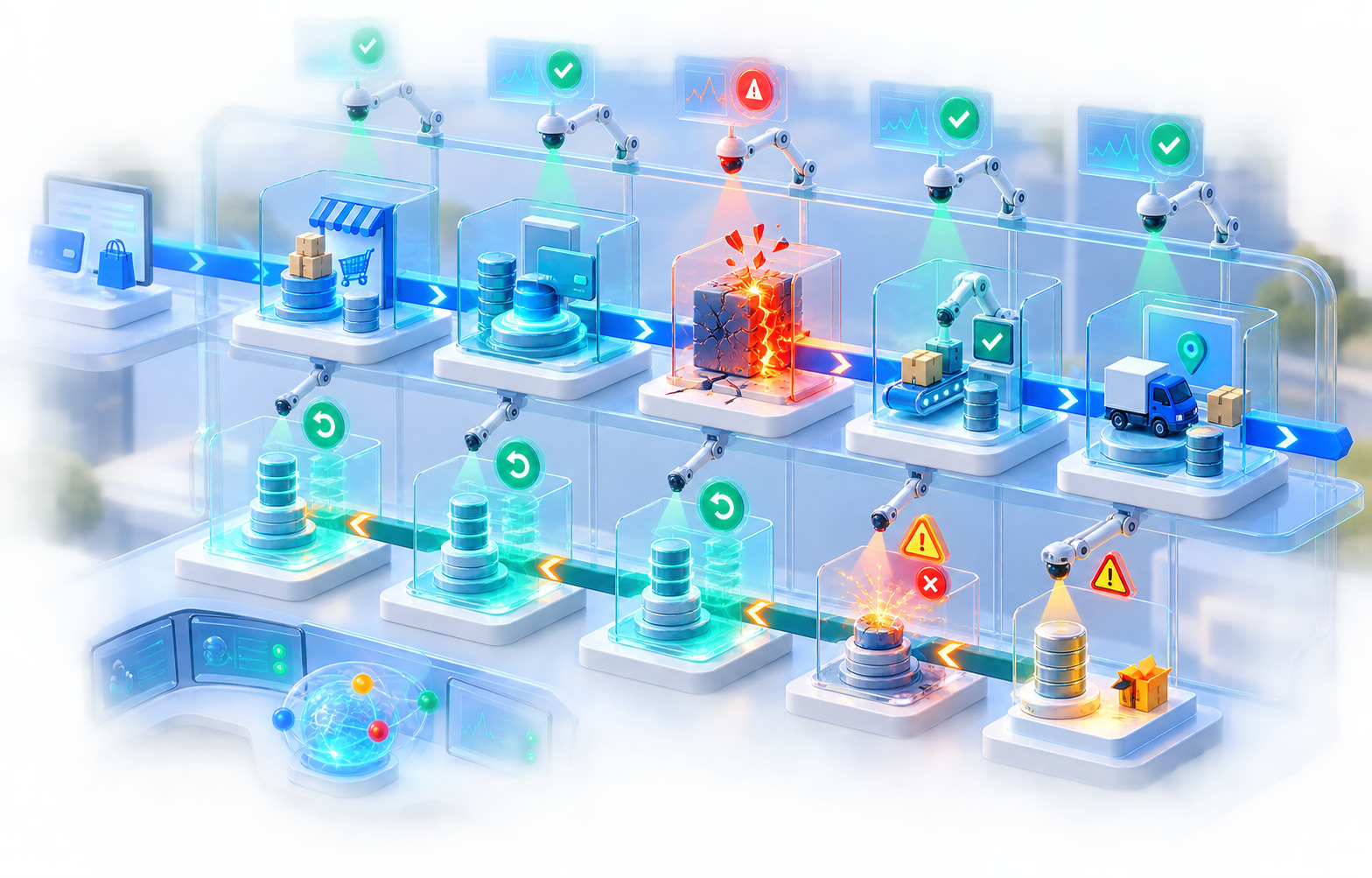
A platform engineering team completes a database access layer refactor on a Wednesday morning. The changes reduce the number of round trips a common query pattern makes by consolidating several small calls into a single larger one. Unit tests pass. Integration tests pass. Load tests in the staging environment show the expected performance improvement — actually better than expected, with the p95 latency for the affected endpoint dropping by roughly 35% under synthetic load. The team lead reviews the results, approves the merge, and the change deploys to production the following morning through the standard release process.
By mid-afternoon, the on-call engineer is investigating a production incident. The change did reduce round trips as designed. It also produced a specific query shape that, at production data volume, caused the database's query planner to choose a different execution strategy than it had chosen in staging — one that used a full table scan rather than an index-supported plan. The staging database had approximately 40,000 records in the affected table; production had approximately 12 million. Below some threshold in the tens or hundreds of thousands, the query planner had preferred the index; above it, the planner switched. The staging load test had exercised the new query pattern extensively, at staging's data volume, and the test result was accurate for that volume. The test result was not predictive for production's volume, and nothing in the release pipeline had marked that discrepancy as a risk factor.
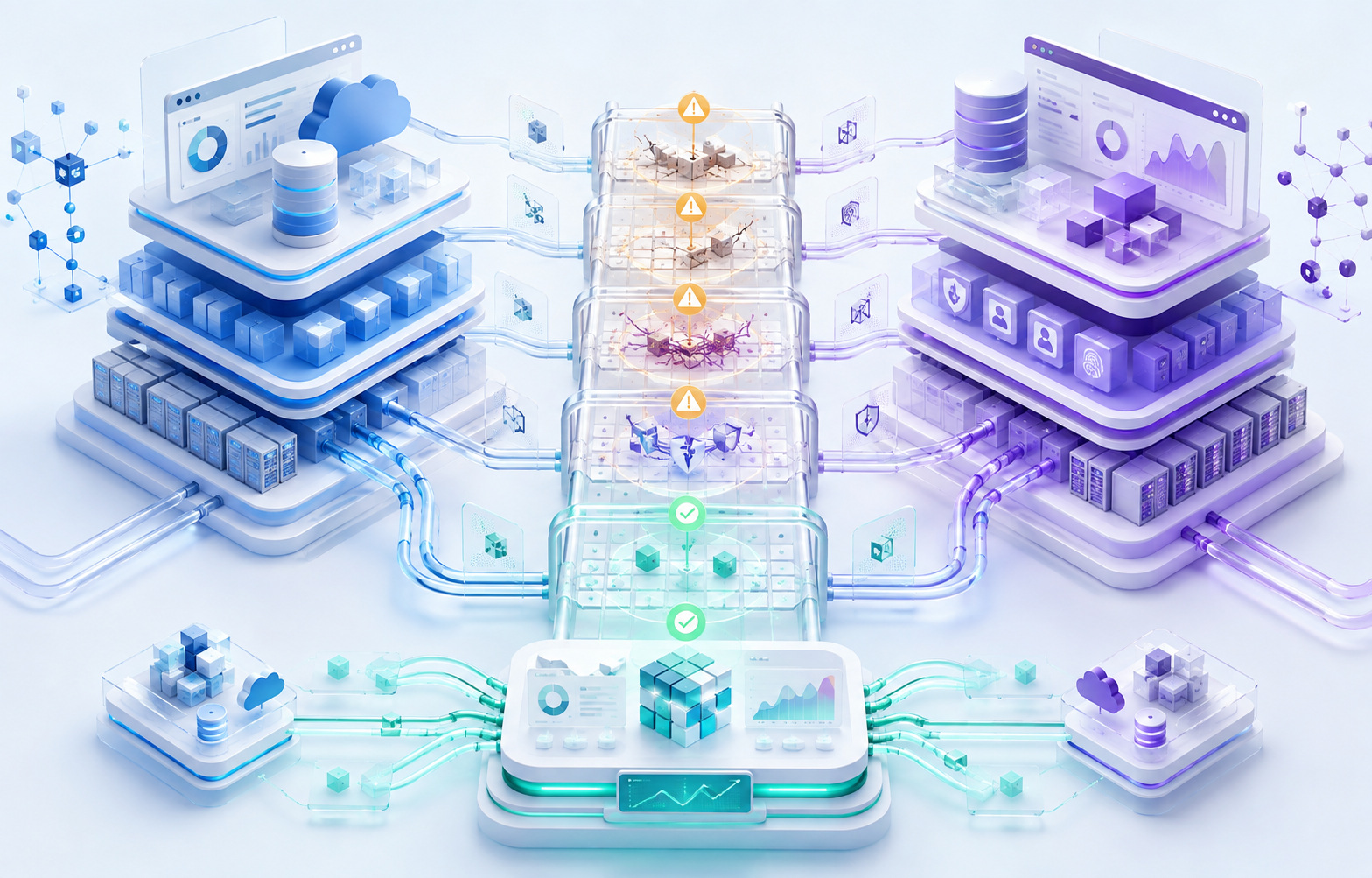
Nothing about this incident is unusual. Some version of it happens routinely across the industry — a change that passes every check available in a pre-production environment, ships to production, and behaves differently there for reasons rooted in specific differences between the two environments that the team either did not know about or knew about but did not weight properly. The specific difference is sometimes data volume, sometimes traffic composition, sometimes a hardware distinction, sometimes a configuration value, sometimes a version of a dependency, sometimes something subtler that only becomes visible under specific conditions. The generic name for all of it is test environment drift, and it is the single most consistent source of "we tested this and it worked and then it broke anyway" incidents in modern software delivery.
The industry's dominant response to environment drift has been the pursuit of parity. If production and staging behaved identically, the argument goes, staging results would be reliable. This is true and also unachievable — full parity is impossible in principle for any nontrivial production system, and the closer teams get to it, the more expensive each incremental step becomes and the less value each step delivers. The pursuit of parity has been the wrong response to a real problem. The right response is to accept that drift will always exist and to make it deliberate, catalogued, and priced against risk — a discipline of instrumented drift, not eliminated drift. This article lays out what that discipline looks like, why parity was the wrong target, and how a team can build a drift audit that actually informs release decisions.
Why Environment Parity Is the Wrong Goal
The intuition behind chasing production parity is straightforward: if the pre-production environment matches production exactly, then behavior observed pre-production predicts behavior in production, and release confidence is high. This intuition is correct in a limited sense — reducing specific differences that matter for specific tests does improve the predictive value of those tests. It is misleading in a broader sense because it implies that a fully parity-achieving environment is a coherent goal to pursue.
Full parity is impossible in principle for any production system that handles real customer data, real traffic, or real integrations. A parity-perfect staging environment would need production's data (which raises privacy, security, and cost issues), production's traffic (which by definition serves real customers), production's integrations with third parties (which cost real money to call), production's exact hardware and network topology (which duplicates infrastructure cost), and production's exact operational state (which includes decades of historical mutations no fresh environment can reproduce). Each of these is either technically infeasible, prohibitively expensive, ethically or legally problematic, or all of the above. The teams that have pursued this goal most aggressively have consistently produced environments that are much closer to production than a naïve staging setup — and still meaningfully different in ways they have simply learned to work around or, more often, forget about.
More importantly, chasing parity as a goal produces a specific pathology: the more effort a team puts into parity, the more implicit trust the staging environment accumulates in decision-making, precisely because so much effort has been visibly invested in making it "like production." This trust is often unjustified along specific dimensions that the parity work did not address, and the false confidence produces the specific class of incident described in the opening. A staging environment that everyone knows is a rough approximation is treated as a rough approximation. A staging environment that is claimed to be production-parity is treated as authoritative, and when it turns out to have drifted along an unaddressed dimension, the resulting incident is a surprise that a more honest environment would not have produced.
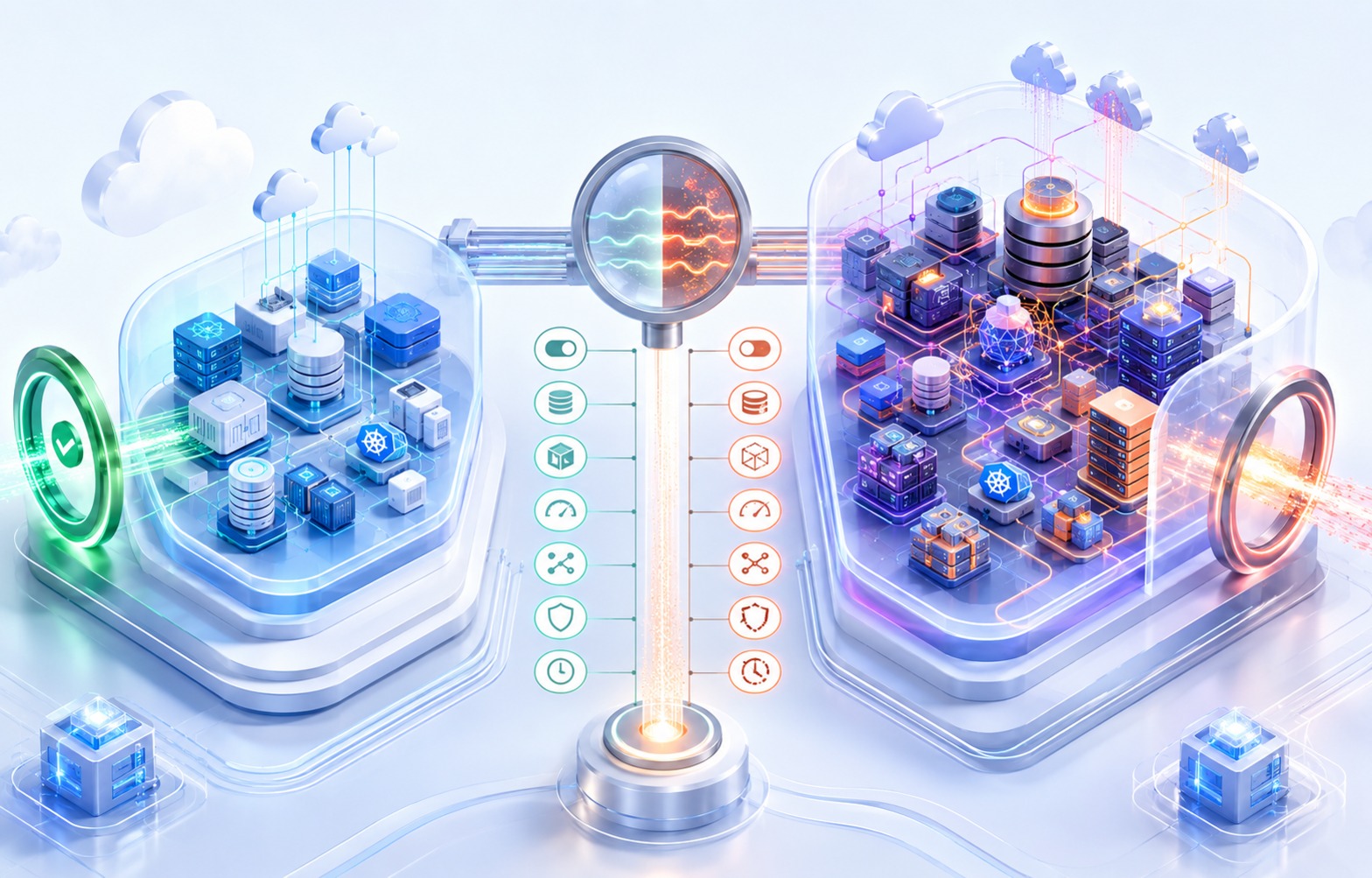
The productive frame is different. Assume the environments will differ. Know precisely along which dimensions, in which directions, by how much. Understand which of those differences matter for the specific test being run, and which do not. Use that understanding to decide whether the staging result is trustworthy for the release decision being made, or whether specific supplementary verification is needed. This is a discipline of instrumented drift, and it is achievable in a way that full parity is not. It also produces better release decisions, because it aligns the trust placed in staging results with the actual reliability of those results.
The Seven Dimensions Along Which Environments Drift
Not every difference between staging and production matters equally, and treating them as a single blob of "drift" makes the audit impossible. Seven specific dimensions capture most of the drift that matters for release quality, and each of them has different measurement approaches, different remediation costs, and different risk profiles.
Data drift is the difference in the actual data present in the environment. Staging typically has fewer records, less variety in the data, less accumulated historical complexity, and either synthetic data that follows patterns the test author anticipated or a sampled subset of production data that lacks the tail cases production actually contains. Data drift is the single most common source of "worked in staging, failed in production" incidents, because so much software behavior depends on properties of the specific data being processed. The opening scenario is a data drift story: a query planner made a different decision because the data volumes were different. Similar stories play out for search relevance, cache behavior, batch processing performance, and many others.
Configuration drift is the difference in the values of configuration parameters, feature flags, secrets, and environment-specific settings. Staging often has debug-friendly configuration (more verbose logging, longer timeouts, disabled rate limiting), which produces different behavior than production's tighter configuration under load or error conditions. Configuration drift is subtle because it is easy to overlook — configuration is by design supposed to differ between environments — and expensive because it can produce behavior that is not just quantitatively but qualitatively different from production.
Dependency drift is the difference in the versions of libraries, frameworks, operating system components, and third-party services that the environment uses. In theory, deployment automation keeps versions synchronized. In practice, environments accumulate divergence over time — staging is used to test an upgrade that never fully rolls out, production is patched for a security issue that is not backported to staging, transitive dependencies pull in different versions in different environments due to lockfile drift. Dependency drift is often small in isolation but compounds across many dependencies, and produces defects that are difficult to attribute because the code being tested has not changed — only its surroundings have.
Traffic drift is the difference between the load the environment is exposed to and the load production experiences. Staging typically has orders of magnitude less traffic than production; when it has any load at all, that load is usually synthetic and follows patterns designed by the test author rather than emerging from real user behavior. Traffic drift is what makes load testing in staging often unreliable — the load being tested is a proxy for production load, not production load itself, and proxies miss the specific interaction patterns that produce real production issues.
Integration drift is the difference in how the environment interacts with external systems. Staging typically uses sandbox versions of third-party services (a sandbox payment processor, a sandbox email provider, a sandbox authentication provider), and sandboxes have different rate limits, different error rates, different feature availability, and often different data formats than the production versions of the same services. Integration drift also includes internal service versioning — staging may be calling versions of internal services that have already been superseded in production, or vice versa.
Infrastructure drift is the difference in the underlying compute, network, and storage infrastructure. Staging often runs on smaller machines, in different regions, with different network topology, different disk types, different networking configurations, and different observability instrumentation. Infrastructure drift produces the specific class of behavior that only manifests at production scale — a query that runs fine on a smaller instance but exhausts memory on the larger production one, a network topology that hides latency in staging but exposes it in production, an observability configuration that captures different information in each environment.
State drift is the difference in the historical state of the environment — the sequence of past deployments, past migrations, past incidents, past configuration changes, past data imports. State drift is the dimension most often ignored because it is invisible to point-in-time comparison; two environments that look identical at a moment in time can behave differently because one has accumulated state from operations the other has not. State drift is what produces "the eighth time we ran this migration, it broke, because the previous seven times had left residue we did not know about."
Each of these dimensions has different measurement approaches and different costs to reduce. A useful drift audit categorizes the environment's current state along all seven, quantifies the delta from production on each, and produces a prioritized view of which deltas most affect release risk for the specific product being shipped. Absent that categorization, drift is a black box, and drift-related incidents are unpredictable in a specific way — every one is a surprise, and no organizational learning accumulates because the specific cause is different each time.
The seven dimensions summarized, with the detection technique and remediation cost for each — which together determine where audit effort is worth spending first:
| Dimension | What differs | How to detect it | Remediation cost | Matters most for |
|---|---|---|---|---|
| Data | Volume, variety, tail cases, synthetic vs. real | Side-by-side row counts, cardinality and temporal distributions | High | Search, analytics, financial calculation, anything query-plan sensitive |
| Configuration | Timeouts, flags, limits, secrets, debug settings | Normalized diff across env vars, files, flag service, secret store | Low | Products with large configuration surface or heavy feature flagging |
| Dependency | Library, framework, OS, and base-image versions | Lockfile and image manifest diff | Low | Anything touching DB drivers, HTTP clients, crypto, serialization |
| Traffic | Volume, shape, segment mix, geography | Access-log characterization in both environments | High | Rate limiting, caching, load balancing, autoscaling behavior |
| Integration | Sandbox vs. production limits, error rates, features | Documentation review plus empirical probing per vendor | Medium–High | Payments, messaging, auth, any third-party-critical flow |
| Infrastructure | Compute size, network topology, storage class, instrumentation | Deployed-resource manifest comparison | Variable | Performance-sensitive and resource-constrained products |
| State | Divergent deployment, migration, and operational history | Consolidated change-log diff across both environments | Low ongoing, high first pass | Long-lived environments that have never been reset |
The first-pass audit is usually uncomfortable because it reveals more drift than the team believed existed. That discomfort is the point — it is the difference between an assumed-small delta and a measured one.
Why the "Just Replicate Production" Answer Fails
Several patterns of attempted parity have become common in the industry, and it is worth examining why each of them fails to deliver the parity it promises.
The "copy production data to staging" pattern addresses data drift by, in some form, replicating production data into staging. In its naïve form, this creates immediate problems — real customer data in an environment that is less secured than production, testing accounts that see real customer information, compliance violations for regulated data. Various sanitization and anonymization schemes attempt to work around these problems, and each has its own failure modes: sanitization that is too aggressive removes the specific properties of the data that made the test meaningful, sanitization that is too permissive creates the same compliance problems the sanitization was meant to solve, sanitization that changes some fields but not others produces inconsistent internal state that behaves differently than either the original or a properly sanitized version would. Modern data-masking tooling has made some of this manageable, but the fundamental tension remains: real data is what makes the test predictive, and real data is what makes the environment a compliance liability.
The "shared production database with schema separation" pattern addresses data drift by pointing staging at a subset of the production database, isolated by schema or tenant boundary. This delivers some of the parity benefits but couples staging's operational health to production's — a heavy staging test can affect production performance, a staging bug can produce artifacts in production, an unwanted staging modification can persist in production storage. The isolation has to be very carefully designed to prevent these problems, and even carefully designed isolations sometimes leak.
The "ephemeral production-like environments" pattern addresses several dimensions by spinning up fresh environments on demand for each test or each pull request, provisioned from infrastructure-as-code definitions that are supposed to match production. This has real benefits — parallel environments do not conflict with each other, each test starts from a known state — but it does not address data drift (each environment starts with either empty or seeded data, neither of which is production), traffic drift (there is no real traffic to route to an ephemeral environment), or integration drift (the ephemeral environment still calls sandbox external services). And the infrastructure-as-code definition itself is a source of drift, because it is a specification of what the environment should look like rather than a guarantee that it does, and small differences between the specification and the actual production environment quietly accumulate.
The "test in production" pattern gives up on parity entirely and moves the testing into production itself, using techniques like feature flags for progressive rollout, shadow traffic to test new code against real traffic without user impact, and canary analysis to catch regressions in a subset of production users. This is arguably the most honest approach — it does not pretend to have parity because it is not trying to — but it is not a full replacement for pre-production testing, because it does not catch pre-shipping bugs that would harm production users if they reached even a canary, and because some kinds of testing (destructive tests, security tests, load tests at extreme volumes) genuinely cannot be safely done against real production traffic.
Each of these patterns is useful for specific things and none of them delivers what unqualified parity would deliver. The rest of this article proceeds from the assumption that no combination of these patterns will fully close the drift gap, and asks a different question: given that drift is permanent, how does a team make good release decisions in its presence.
The Drift Audit: A Practical Template
The core artifact of an instrumented-drift discipline is the drift audit — a documented, current inventory of how the staging environment differs from production along each of the seven dimensions, along with an assessment of which of those differences matter for which categories of change. A first-cut drift audit for a typical mid-sized SaaS platform can be produced in a few days of focused work, and a good one becomes a living document that is updated whenever either environment changes in ways that affect the delta.
The template that follows is a starting point; specific teams should adapt it based on the shape of their product and their staging environment.
Data drift audit. For each meaningful data store, record: staging record count vs. production, distribution of key attributes (data types, tenant count, geographic distribution, temporal distribution), presence or absence of tail cases (very old records, very large records, records in unusual states), and known synthetic-vs-real data ratios. Flag the specific stores where the delta is largest and where the properties most affect behavior of the code being tested. A team whose staging database has 1% of production's record count is going to have very different query planner behavior; a team whose staging authentication service has one hundred users versus production's several million is going to have very different session-related behavior. The audit does not need to specify all of this in exhaustive detail — it needs to be honest about the order of magnitude and about which specific properties matter.
Configuration drift audit. For each service, list the configuration values that differ between staging and production, and briefly note the reason for each divergence. This exercise almost always reveals divergences that no one intended and no one can justify — a timeout that was set to a debug value years ago and never reset, a feature flag that has different defaults in the two environments because the flag system was migrated at different times, a rate limit that was disabled during a specific investigation and never re-enabled. Each such divergence is a candidate for either alignment (make them match) or explicit annotation (record why they differ and what that means for interpreting test results).
Dependency drift audit. For each service, list the versions of key dependencies in staging versus production. Focus on the ones where a version delta could meaningfully affect behavior: database drivers, HTTP client libraries, cryptographic libraries, serialization libraries. Small version drift in a UI library that is not exercised by the test being run is low risk; small version drift in a database driver is high risk. This is one of the audits that has become cheaper to maintain with modern dependency management tooling, and there is little excuse for not having it current.
Traffic drift audit. Characterize the traffic staging actually experiences: what percentage is synthetic vs. real, what is the volume and composition, what patterns are represented and what patterns are absent. Note the specific traffic patterns that appear in production but not in staging — off-peak spikes, patterns from specific customer segments, patterns from specific geographic regions, patterns from specific integration types. The audit does not need to try to reproduce all of these in staging; it needs to acknowledge which ones are missing, so that a test result from staging is understood to be a result on a specific traffic distribution and not a general result.
Integration drift audit. For each external integration, list the sandbox vs. production differences that could affect behavior. Rate limits are commonly different. Error rates are commonly different. Feature availability is commonly different. Response timing is often different. Note the specific integrations most likely to be exercised by the code being tested, and be explicit about which sandbox behavior is a good proxy for production and which is not. A payment processor sandbox that returns synthetic success for every transaction is a poor proxy for production behavior around declines, fraud checks, and 3D-Secure flows; using it to verify a change to the payment processing logic and concluding "it works" is a false conclusion in a specific and knowable way.
Infrastructure drift audit. Note the differences in compute, network, and storage between staging and production. Not every difference matters — a smaller staging instance is fine for tests that are not resource-bound — but the ones that do matter should be explicit. This audit should also cover observability infrastructure: is the same instrumentation running in both environments, is the same alerting active, are the same logs being captured? Discrepancies here mean a test's outputs are being observed differently, which affects the meaningfulness of the test result.
State drift audit. This is the hardest of the seven to audit and the easiest to overlook. Note the divergent history: when was the last time staging was fully reset from scratch, what migrations have been run in one environment and not the other, what deployments have happened in one that were rolled back in the other, what one-off operational actions have been taken in each. State drift accumulates silently and is often the reason "the test suite has been passing for weeks and today it started failing"; something in the environment's history diverged and the specific past deployment or operation that caused it is invisible.
The output of a first-pass audit for most teams is uncomfortable, because it usually reveals more drift than the team believed existed. The remediation is not to attempt to eliminate all of it; the remediation is to know it exists and to weight test results accordingly.
Deployment-Time Drift Signals as Leading Indicators
A specific pattern that often catches drift-related issues earlier is watching for signals of drift at deployment time itself. If a change deploys and produces significantly different infrastructure resource usage, different traffic patterns, different error attribution, or different downstream call patterns than the pre-deployment version, that difference is a leading indicator that the environment is exercising the code in ways staging did not.
Concretely, a deployment where CPU usage jumps by 50% at the same traffic level, or memory allocation shifts noticeably, or the ratio of database calls per request changes, is a deployment where something is happening in production that did not happen in staging. Sometimes this is expected — the change was a performance optimization and the deployment signal confirms it worked. More often it is unexpected, and the unexpected version is exactly the drift-related surprise that the release process should have flagged but did not.
Making these signals actionable requires the same discipline discussed elsewhere in this article — defined baselines, defined tolerances, defined ownership. It also requires a specific willingness to treat drift-signal anomalies as release-blocking events rather than as monitoring curiosities. A team that watches the signal and does not act on it is worse off than a team that does not watch it at all, because the un-acted-on signal trains the observer to disregard future signals of the same type.
Ephemeral Environments and Their Specific Illusions
The move to ephemeral pre-production environments — spun up on demand for each pull request or each test run — has genuine benefits and specific limitations worth naming. The benefits include: parallel environments do not conflict with each other, each test starts from a known state, resource cost is controlled because environments only exist when needed, and the environment definition is under version control alongside the code it serves.
The specific limitations show up in ways that surprise teams who did not think through what an ephemeral environment can and cannot deliver.
An ephemeral environment has no data drift with production in the sense of "there is a difference between the data present" — because the ephemeral environment has no data at all, or has only data that a seed process creates. This is not parity; it is a different form of divergence. The ephemeral environment cannot show behavior that depends on data volume, data variety, or data tail properties, because none of those properties exist. Tests that would have caught the opening scenario's query planner issue cannot be run in an ephemeral environment at all, because the ephemeral environment does not have the data volume that produced the issue.
An ephemeral environment cannot experience real traffic and cannot be observed responding to real traffic patterns. Whatever load a test author generates is the load being tested, and that load is a proxy for production load with all the limitations proxies have.
An ephemeral environment's integration with external services still uses sandbox versions, with all the sandbox limitations discussed above. The ephemeral pattern does not solve integration drift; it may actually make it worse, because each ephemeral environment is a fresh sandbox with none of the accumulated state a longer-lived sandbox would have.
The ephemeral environment's infrastructure-as-code definition is a source of drift with production if production's infrastructure is defined separately, which is often the case. A change to production infrastructure that is not reflected in the ephemeral environment's definition creates a silent, growing drift that the ephemeral pattern's flexibility makes easier to introduce than a shared long-lived staging environment would.
None of these limitations argues against ephemeral environments; they are a valuable tool for specific test types, particularly for parallel isolated testing of independent changes. The argument is that ephemeral environments are not the answer to drift; they are a different structure that has its own drift profile, and that drift profile has to be audited the same way any environment's drift is audited.
Detection Techniques for Each Drift Dimension
Naming the seven dimensions is only half of the diagnostic work. Detecting drift along each dimension in practice requires specific techniques, and it is worth being concrete about each because the effort involved varies substantially, and a team can prioritize which dimensions to instrument based on which are most affordable to detect relative to the risk they represent.
For data drift, the most direct detection is straightforward query analysis: for each meaningful table or collection, compute row counts, cardinality distributions of key columns, temporal spread of records (age of oldest and newest, distribution across time), and the presence or absence of specific tail-case categories (very old records, records with unusually high update counts, records associated with unusually large aggregate volumes). Run the same queries against staging and production, side by side, and produce a delta report. This kind of analysis can be scripted once and run periodically. The output typically surprises teams — the delta is nearly always larger than expected, and specific categories of tail cases are frequently missing from staging entirely.
For configuration drift, the detection is a diff of the configuration surface between environments. This is easier said than done, because "the configuration" in a modern application spans environment variables, configuration files, feature flag services, secret stores, and runtime configuration APIs. A comprehensive diff requires pulling from each of these sources for each environment and normalizing them into a common representation, which is engineering work but is tractable. The output is a specific list of divergences, each of which is a candidate for either alignment, explicit documentation of why the divergence is intentional, or investigation of whether the divergence is accidental and should be removed.
For dependency drift, most modern language ecosystems have lockfile-based dependency management that produces exact version manifests per environment. Comparing manifests is a straightforward diff exercise. The complication is that a manifest is a snapshot of one part of the dependency surface; operating system libraries, kernel versions, and container base images are also dependencies and are often not managed by the application-level dependency tooling. A full dependency drift audit reaches into each of these layers, which is more work but often reveals the specific drift sources that produce subtle behavioral differences.
For traffic drift, the detection requires characterizing traffic in each environment along specific dimensions: volume, request-per-second distribution over time, request-shape distribution (which endpoints, which parameters, which user agents), user-segment distribution (if applicable), and geographic distribution. Production traffic characterization is usually already available from access logs or observability platforms. Staging traffic characterization requires the same instrumentation, which is often not deployed to staging on the assumption that staging does not have interesting traffic — an assumption that becomes untrue exactly when drift matters.
For integration drift, the detection is largely a documentation exercise: for each external integration, list the specific differences between the sandbox and production versions, drawing from vendor documentation and from empirical observation. Some differences are documented explicitly by the vendor; some emerge only from experience (a specific sandbox that returns success for a test scenario that production actually rejects, for instance). This documentation, once produced, needs to be maintained as vendors update their sandbox or production offerings.
For infrastructure drift, the detection requires comparing infrastructure-as-code definitions or, better, comparing the actual deployed infrastructure state. Modern infrastructure tooling produces detailed manifests of deployed resources; comparing them across environments produces a specific list of divergences at the compute, network, and storage layers. Some of these divergences are legitimate scale differences (staging runs smaller instances by design); others are accidental drift that has accumulated over time.
For state drift, the detection is a change-log comparison: for each environment, produce a chronological list of all deployments, migrations, configuration changes, and operational actions, and diff the two lists. This is often the hardest audit to produce because the change logs are frequently incomplete or spread across multiple systems (deployment tool, migration tool, incident management tool, manual change records). The effort of consolidating them is significant on the first pass and much smaller on subsequent passes, so investment in this dimension is often front-loaded.
Not every team needs to detect drift along all seven dimensions with equal rigor. A team whose product is highly data-dependent (search, analytics, financial calculation) should prioritize the data drift dimension. A team whose product is highly integration-dependent (payments, messaging, third-party workflows) should prioritize integration drift. A team whose product is highly performance-sensitive should prioritize infrastructure drift. The prioritization should match the product's specific risk profile.
A Hypothetical: The Configuration Divergence
The following scenario is hypothetical and illustrative. It does not describe an actual QAtronic client, engagement, or outcome.
Initial situation. A B2B SaaS company providing project management software to professional services firms deploys a change to how it handles user session expiration. The change reduces the session timeout from twelve hours to two hours in response to a security requirement from a large enterprise customer. The engineering team implements the change straightforwardly, updates the relevant tests, and verifies in staging that sessions expire at the new interval and that the expiration is handled gracefully (users are prompted to re-authenticate rather than seeing an error). Everything works. The change is approved and shipped.
The hidden divergence. The staging environment had, for reasons no one currently working on the team could explain, a specific configuration override that extended the session refresh window during active use. Users who were actively working in staging had their sessions refreshed if activity was detected; users who were inactive would see expiration at the configured interval. This override had been added years earlier during a specific investigation into a session-related bug and had never been removed. In production, no such override existed. The team's staging tests, all of which involved active user simulation, verified that active users experienced no disruption from the reduced timeout — which was true in staging.
The consequence. After the change deployed to production, active users started seeing session expiration prompts every two hours regardless of activity. The intended behavior — sessions refresh during active use — was correct for the staging environment where the tests ran, and incorrect for the production environment where the override that made that behavior possible did not exist. Support tickets started arriving within an hour of deployment. The immediate mitigation was a quick rollback, followed by a longer investigation to reproduce the correct refresh behavior in code (rather than in a staging-only configuration override) and re-deploy the change.
The organizational cause. The staging configuration override was not documented in any current knowledge base. It had been added by an engineer no longer at the company. It appeared in the staging environment's configuration files but was not flagged as a staging-only value, and no one running the tests knew it existed. The tests, correctly, verified behavior in the environment they ran against; that environment had a behavior production did not have, and the tests were correctly (and misleadingly) confirming the behavior of the wrong environment.
The decision that needs to be made. The team faces a broader question than "fix this specific bug." The specific override was not the only unexplained configuration divergence between staging and production; a quick inspection reveals several dozen values that differ between the two, with no documented reason for the difference. The question is whether to systematically audit all of them (which is a substantial effort), whether to accept the divergences as legitimate and add explicit documentation for each (which formalizes the drift), or whether to attempt some middle path — audit the highest-risk categories now and expand later.
The better approach. The team chooses a focused version of the audit: rather than trying to catalog every configuration difference, they identify the specific configuration surface areas most likely to affect user-visible behavior (session management, authentication, rate limiting, timeout handling, feature flag defaults) and audit those in detail. The audit reveals five more divergences of similar shape to the one that caused this incident — configuration values that made staging behave differently from production in ways nobody had documented. Each is either aligned with production or explicitly annotated with a reason for the divergence. The team also institutes a lightweight ongoing discipline: any new configuration override that is intentionally different in staging must be documented at the point of creation, with a specific reason and an owner. Six months later, no similar incidents have occurred, and the discipline has become part of how configuration changes are reviewed.
The generalizable lesson. The most damaging configuration drift is often not the divergences the team knows about — those are treated with appropriate skepticism. It is the divergences the team has forgotten about, or that predate anyone currently on the team, that produce the specific class of "tests confirmed the wrong environment" failure. The organizational intervention is not a one-time audit; it is a discipline that treats configuration divergence as needing explicit justification at the moment it is introduced, so that future audits are easier and future incidents are less likely.
The Organizational Factors That Produce Drift
Drift does not appear spontaneously. It is produced by specific patterns in how teams operate, and understanding those patterns is what makes preventive investment possible.
The first pattern is asymmetric maintenance investment. Production is maintained by people whose incentives are tied to production behavior — SRE teams, on-call rotations, incident response processes. Staging is maintained by people whose incentives are tied to whether staging is usable — which is a much lower bar than production parity. When a small drift creeps in, the person who notices it in production has strong incentive to fix it; the person who notices it in staging usually has no such incentive, because staging is "still working." Over time, this asymmetry produces exactly the pattern of "production got updated, staging didn't, no one noticed" that drift is made of.
The second pattern is temporary changes that become permanent. During an incident investigation, a debugging feature flag gets enabled in staging to help reproduce a bug. During a load test, a rate limit gets disabled to allow the test to proceed without artificial constraint. During a data migration, a specific schema change gets applied to staging before production for testing purposes. Each of these is a legitimate temporary change. Each one, absent explicit tracking, has a nontrivial chance of becoming permanent — the person who made it moves on, no one follows up to revert it, and the "temporary" divergence quietly persists for months or years.
The third pattern is versioning ambiguity. When staging and production run different versions of internal services (perhaps because staging is being used to test a new version of a service before rolling it to production), it is very easy to lose track of exactly what version is running where. If the release process is not disciplined about tracking which version is deployed to which environment at all times, staging can drift out of alignment with production in ways that are only apparent when a specific issue forces the discovery. Modern deployment tooling has largely solved the "what version is deployed" problem for the primary application code, but the same rigor often does not extend to configuration, feature flags, and database schema versions.
The fourth pattern is under-instrumentation of the staging environment itself. Production has extensive observability because production incidents are visible and expensive; staging has whatever observability someone thought to configure, which is often much less. This means drift signals that would be visible in production are invisible in staging, and drift accumulates faster in staging than in production because there is no signal that alerts anyone to it. The fix is symmetric instrumentation — the same observability infrastructure running in both environments — which allows drift to be detected in staging as it happens rather than discovered later when it causes an incident.
The fifth pattern is process gaps between teams. A platform team may own the staging environment infrastructure, an SRE team owns production, a QA team uses staging, and application developers write configuration that gets applied to both. When responsibility for staging-production alignment is distributed across multiple teams with no single owner, drift lives in the gaps between the teams — each team assuming another is handling it, none of them actually doing so systematically. The fix is explicit ownership of staging-production parity as a first-class responsibility of some specific team or role.
Each of these patterns is organizational rather than technical, and each has a corresponding organizational intervention. The technical work of remediating drift is often the smaller part of the effort; the larger part is the process discipline that prevents drift from re-accumulating after the initial cleanup.
The Operational Cost of Managing Environments
An underappreciated dimension of the environment discussion is the operational cost of running each environment — not just infrastructure spend, but the human cost of maintaining, updating, troubleshooting, and reasoning about it. A team's total environment count is directly correlated with total operational overhead, and each additional environment adds cost in ways that are individually small and collectively significant.
Each environment requires: someone to update it when infrastructure changes are made, someone to troubleshoot it when it breaks, someone to keep its dependencies current, someone to manage its access controls, someone to monitor its resource usage, and someone to reset it periodically. In small teams with few environments, this is absorbed by whoever happens to be closest to the work. In larger organizations with many environments (staging, integration, load-testing, security-testing, per-team development, per-pull-request ephemeral, and so on), the operational cost of environment management becomes a meaningful fraction of platform engineering capacity.
The specific implication for the drift discussion is that the cost of an environment is not just the cost of running it — it is also the cost of keeping it appropriately aligned with production, and that alignment cost scales roughly with the size and complexity of the environment and how much production has changed since the alignment was last verified. A staging environment that is very close to production is very expensive to keep aligned as production changes; a staging environment that is a rough approximation is much cheaper to maintain but delivers less predictive value from its tests.
The productive framing is that the number and shape of pre-production environments should be a deliberate design decision based on what specific test needs each environment serves, not an accretion of environments that grew up over time and never got rationalized. Some teams find, upon audit, that they have four or five pre-production environments serving purposes that could be met by two or three, with significant reduction in operational overhead and no reduction in test coverage. Other teams find they have one environment being asked to serve purposes that genuinely require two — an integration-testing environment and a load-testing environment cannot easily share, for instance — and the right investment is splitting the single environment rather than continuing to force it to do both jobs poorly.
The point is that the environment topology itself is a design decision that deserves periodic review. A team whose environment topology was designed three years ago for a product that has since substantially changed is often running a topology that no longer fits, and drift is one of the ways that mismatch shows up.
Cost Framing for Drift Remediation
For a team persuaded that drift is a problem and considering investment in reducing it, the honest framing is that the return varies dramatically by which specific drift dimension is being addressed and by how important that dimension is to the product's risk profile.
Data drift remediation has the highest cost and often the highest return. Sanitized production data pipelines, production-scale synthetic data generation, or shared-database staging patterns each require substantial upfront engineering investment and ongoing maintenance. The return is directly proportional to how much of the product's behavior is data-dependent. For a product where the core value depends on data (search, analytics, recommendation, financial calculation), the return is high; for a product where the core value is largely business logic operating on relatively simple state, the return is much lower.
Configuration drift remediation has moderate cost and moderate return. Configuration audits are cheap to run, alignment is cheap to enforce, and the specific incidents configuration drift produces (like the hypothetical above) are usually clearly attributable once they occur. The return depends on how much configuration surface the application has and how frequently it changes. Products with extensive feature flagging and configuration-driven behavior tend to have more configuration drift and higher return from remediation.
Dependency drift remediation has low cost given modern tooling and modest return. The cases where dependency drift causes production issues are relatively rare but often severe when they occur; the low remediation cost makes this a straightforward investment. The main effort is disciplining the deployment process to update dependencies in both environments together rather than one at a time.
Traffic drift remediation is expensive and has variable return. Reproducing production traffic patterns in staging requires either recording and replaying real traffic (which has legal and privacy issues) or generating synthetic traffic that matches production distributions (which requires substantial analytical work to build). The return is high for products whose behavior is heavily traffic-dependent (rate limiting, caching, load balancing behavior) and low for products where the behavior of interest is mostly determined by request contents rather than traffic patterns.
Integration drift remediation is moderate to expensive and has variable return. Some integrations offer richer sandbox environments than others, and the cost of exercising more of the sandbox surface varies by vendor. The return is highest when the product's failure modes concentrate around integration behavior (a payment product's decline handling, for instance).
Infrastructure drift remediation is highly variable in both cost and return. For teams using infrastructure-as-code with disciplined shared definitions, keeping staging infrastructure aligned with production is cheap. For teams whose environments diverged historically and have not been reconciled, alignment can be a major project. The return is highest for performance-sensitive products where infrastructure differences translate directly into behavioral differences.
State drift remediation is cheap in isolation (periodic environment resets, better change-log discipline) and modest in return, but accumulates: teams that let state drift compound for years often have to do more painful remediation than teams that maintain state hygiene continuously. This is one where preventive investment substantially outperforms reactive investment.
The overall implication is that drift remediation is not a single investment; it is a portfolio of investments with different cost-return profiles for each dimension. A team's investment plan should be tuned to which dimensions matter most for their specific product, not applied uniformly across all seven.
Consolidated into a portfolio view, since the return varies enough by dimension that uniform investment is nearly always the wrong allocation:
| Dimension | Remediation cost | Return | Highest return when |
|---|---|---|---|
| Data | High | High | Product behavior is genuinely data-dependent (search, analytics, pricing, risk) |
| Configuration | Low | Moderate | Large configuration surface; heavy feature flagging |
| Dependency | Low | Modest but cheap | Always worth doing — low cost makes it a straightforward call |
| Traffic | High | Variable | Behavior depends on traffic patterns (rate limits, caches, autoscaling) |
| Integration | Medium–High | Variable | Failure modes concentrate in third-party behavior (declines, retries, throttling) |
| Infrastructure | Variable | High for perf-sensitive | Performance characteristics translate directly from infra differences |
| State | Low ongoing | Modest, but compounds | Preventive hygiene strongly outperforms reactive cleanup |
The practical conclusion is that drift remediation is a portfolio of investments with different cost-return profiles, not a single project — and the allocation should follow the product's specific risk concentration.
What to Actually Do About It
The prescriptive part of this article is short, because most of the substance is in the diagnostic. Given a properly audited drift profile, the actual decisions become tractable.
For each category of change being tested, ask: which drift dimensions matter for this test? A change to a UI component may not be materially affected by data drift or traffic drift; a change to a database query is affected by both critically. Match the rigor of the pre-production testing to the drift dimensions that matter, and reserve additional verification effort for the changes that touch drift-sensitive areas.
For the specific drift dimensions that most affect the highest-risk changes, invest in reducing them where the cost is justified. Data drift on a heavily query-dependent product may justify sanitized production data, or at least dramatically larger synthetic datasets with production-like distributions. Integration drift on a payment-critical product may justify richer sandbox environments or contract testing that specifically exercises production-like behaviors. Infrastructure drift on a performance-sensitive product may justify production-parity load-testing environments that are more expensive but produce test results that predict production performance.
For the drift dimensions that cannot be reduced practically, invest in supplementary verification: canary deploys that catch what staging could not, shadow traffic that exercises new code against production patterns before user-visible deployment, feature flags that allow rollback of specific behavior without a full deployment. These techniques all live in the "test in production" space, and their value is exactly proportional to the amount of drift that pre-production testing cannot close.
For the state and configuration drift that accumulates over time, invest in periodic environment resets and configuration audits. A staging environment that has drifted for a year from any coherent starting point is producing test results whose meaning is difficult to interpret. Periodic resets and audits are a maintenance cost that pays off in test-result reliability.
The specific mix of these interventions depends on the product's specific risk profile and specific drift audit. There is no universally correct answer; there is a coherent framework for producing a specific answer for a specific team.
A Drift-Management Maturity Model
Placing a team accurately on a maturity spectrum helps distinguish "should we invest more" from "we have already invested past the point of return" — both of which are common misdiagnoses in the environment discussion. A five-level model, oriented specifically around drift management practices rather than general test environment sophistication, provides a useful reference point.
Level 1: Unmanaged. The staging environment exists but is essentially unmaintained. No one owns keeping it aligned with production. Drift is discovered reactively, when a specific incident forces investigation. When drift is found, it is often significant along multiple dimensions. Test results from staging are treated with informal skepticism ("staging is weird sometimes") but are still used as the primary release signal because there is no alternative. Teams at this level are shipping software largely on hope, and the incident rate around environment-related surprises is high.
Level 2: Aware. The team knows staging drifts from production and can identify at least the largest categories of drift. Some specific alignment work has been done — perhaps a project to synchronize configuration, or an infrastructure-as-code migration that brought some parity to the compute layer. Staging is more useful than at Level 1 but there is no systematic ongoing discipline; drift re-accumulates and periodic remediation projects are launched when it becomes painful. Incidents from environment-related surprises are less frequent than at Level 1 but still occur regularly.
Level 3: Instrumented. The team has produced a drift audit along most or all of the seven dimensions and updates it periodically. Specific dimensions where drift most affects the product's risk profile have been prioritized for reduction. Some form of drift detection is automated — configuration diffs, dependency version comparisons, data volume checks. Test results from staging are interpreted in the context of the known drift; releases involving code that touches drift-sensitive areas trigger additional verification. Environment-related incidents still occur but their causes are usually attributable to specific known drift dimensions rather than to unknown surprises.
Level 4: Aligned. The team runs continuous drift monitoring that catches new drift as it accumulates. Production-like data patterns, production-like traffic characterization, production-parity infrastructure definitions, and coordinated configuration management are all in place for the dimensions that matter most to the product's risk profile. Ephemeral or pre-production environments are provisioned from the same definitions as production. State drift is prevented through regular resets and disciplined change tracking. Environment-related incidents are rare and, when they occur, usually reveal a specific gap in the drift management framework that then gets closed.
Level 5: Deliberate. The team has moved past uniform investment in staging parity and has segmented its pre-production strategy: specific test needs use specific environments purpose-built for those needs, and the drift profile of each environment is well-understood and documented. Some testing has been moved into production techniques (canaries, shadow traffic, feature flags) where those approaches are more effective than any pre-production environment could be. The environment portfolio itself is periodically reviewed for whether it still fits the product's current risk profile. Environment-related incidents are essentially all caught by the framework before customer impact.
Most SaaS engineering organizations sit somewhere between Level 2 and Level 3, and the gap between them and Level 4 is more organizational than technical — the tools and techniques for Level 4 are well-established, but making the discipline stick requires the ownership and process work that most teams have not systematically addressed. Level 5 is the right target for a small subset of teams whose product's risk profile justifies the investment; most teams get most of the practical benefit from reaching a solid Level 4.
The levels compared on the dimensions that actually distinguish them:
| Level | Drift knowledge | Detection | Who owns parity | Environment-related incidents |
|---|---|---|---|---|
| 1 — Unmanaged | None; drift found during incidents | Reactive only | Nobody | Frequent, causes always novel |
| 2 — Aware | Largest categories known informally | Periodic remediation projects | Ambiguous, shared across teams | Regular, partially attributable |
| 3 — Instrumented | Audited across most dimensions, updated periodically | Some automated (config diffs, version checks) | A named team, best-effort | Occasional, usually attributable to a known dimension |
| 4 — Aligned | Continuous, with monitoring on new drift | Automated across priority dimensions | Explicit, first-class responsibility | Rare; each one closes a framework gap |
| 5 — Deliberate | Per-environment drift profile documented by purpose | Continuous, plus production techniques where pre-prod can't reach | Owned as a product with a roadmap | Essentially all caught before customer impact |
Most organizations sit between Level 2 and Level 3, and the gap to Level 4 is organizational rather than technical — the tooling for Level 4 is well-established; the ownership discipline is what is usually missing.
Communicating the Value of Drift Work to Leadership
A specific challenge in this domain is that drift remediation is difficult to justify to leadership using the framing they usually apply to engineering investment. The reason is that drift work produces no visible feature output, and its value is measured in the incidents that did not happen — a category that is inherently hard to attribute and easy to dismiss.
A leadership team asking "what did we get for our platform engineering investment this quarter" is asking a question drift work does not answer well. "We aligned configuration between staging and production" is factually true and rhetorically weak; it sounds like housekeeping rather than value creation. The more effective framing puts the value in terms leadership already cares about.
One useful framing is release confidence: after this drift work, what percentage of releases now ship without environment-related incidents, versus before? This turns the value into a metric ("release success rate") that has an obvious connection to business outcomes (customers unaffected, engineering time not spent on incidents, customer trust preserved).
Another useful framing is incident cost avoidance: for the specific environment-related incidents that occurred in the previous period, estimate the total cost (engineering time spent, customer impact, credit or refund cost, opportunity cost of engineers pulled from feature work). Extrapolate that cost forward for the current drift level, and project the reduction from the proposed remediation. This produces a specific dollar figure of avoided cost that competes for attention with other investment categories on their own terms.
A third useful framing is time-to-recovery: after this drift work, how much faster can the team diagnose and remediate a production incident, because staging now accurately reproduces the conditions that produced the incident? This connects to service-level objectives that leadership often cares about and that most engineering organizations track.
The point is not to game the presentation. It is that drift work has real business value that is invisible in the default engineering-reporting framing, and making the value visible in leadership-relevant terms is often what turns "yes but we have other priorities" into an actual investment decision. Without this framing, drift work is systematically underfunded because its value never becomes legible to the people making the funding decisions.
Frequently Asked Questions
Is there any way to have a truly production-identical staging environment? No, not for any nontrivial production system. Real data, real traffic, real integrations, and accumulated state are the specific things a staging environment cannot have without becoming a second production environment, which is a very different kind of thing. Anyone claiming to have full parity is either working on a system simple enough that parity is achievable (rare in production SaaS), or is defining "parity" more loosely than the word suggests.
Should we invest in reducing drift or in supplementing pre-production testing with production techniques? Both, weighted by risk. Reduce the drift that is cheap to reduce and matters most for high-risk changes. For everything else, invest in production techniques — canaries, shadow traffic, feature flags — that catch what pre-production cannot. The two approaches are complementary, not competitive; the mix depends on where the specific team's risk concentrates and where its drift is most costly.
How often should we rebuild staging from scratch? For most teams, quarterly is a reasonable cadence — often enough to prevent significant state drift accumulation, infrequent enough to be operationally manageable. Teams with high-throughput staging environments may need more frequent resets; teams with lightly-used staging environments may need less. The specific cadence matters less than having a specific cadence, so that state drift is not just accumulating indefinitely.
Can containerization solve this? Containers help with some drift dimensions (dependency drift, some configuration drift, some infrastructure drift for compute) and do nothing for others (data drift, traffic drift, integration drift, state drift within the container's mounted volumes). Containerization is useful for the dimensions it addresses and should not be mistaken for a general solution.
What about production data in staging — is it ever the right answer? Sometimes, for specific classes of test where the data volume and variety are the specific properties being tested, and where robust anonymization can be maintained. It is the right answer far less often than teams think it is, because the anonymization is harder to do correctly than it appears, the compliance implications are more serious than they appear, and the value of the anonymized data for many kinds of testing is lower than teams expect. The default should be strong synthetic data with production-like distributions; production data should be a specific investment for specific test needs.
How do we prioritize which drift to reduce? By the intersection of drift magnitude and business risk. A drift dimension where the delta is small does not need attention regardless of risk. A drift dimension where the delta is large but the affected code is low-stakes does not need attention regardless of magnitude. Attention concentrates where both are true: large drift affecting code that is high-stakes if it fails. The seven-dimension audit combined with a risk classification of the code being tested produces this intersection directly.
Does this apply to teams that deploy through CI/CD with no staging step? It applies differently. Teams that deploy directly from CI to production have collapsed the pre-production layer entirely, which is a viable strategy for products with the right characteristics (well-covered by tests, robust progressive rollout, fast rollback). Those teams still have drift issues — the CI environment is not production either — but the drift they care about is the drift between their test environment and production, and the mitigation is the same: audit it, understand which dimensions matter, invest in reducing what can be reduced and in production techniques for what cannot.
How does drift affect performance testing specifically? Performance testing is one of the areas most affected by drift, because performance behavior depends heavily on data volume, infrastructure scale, traffic composition, and dependency versions — four of the seven drift dimensions, often simultaneously. A performance test in staging measures the performance of the staging environment under the staging test's specific load; extrapolating that to production performance requires knowing which drift dimensions matter for the specific performance characteristic being measured. Teams that treat "staging performance test passed" as evidence that production will perform similarly are usually treating the signal as more general than it actually is, and performance regressions that reach production after passing staging tests are a common outcome. The productive approach is to be explicit about which specific performance properties the staging test can and cannot predict, and to reserve production-scale testing (via canary deployment or dedicated production-parity load environments) for the properties staging cannot honestly speak to.
Does the seven-dimension framework apply to teams using only production-like ephemeral environments per pull request? Yes, and with some emphasis differences. Ephemeral environments largely eliminate state drift (each environment starts fresh) and can reduce configuration drift (if the environment definition is consistent). They typically do not address data drift (fresh environments have no data), traffic drift (no real traffic), or integration drift (still using sandboxes). The framework in this article still applies; it just shifts which dimensions are the primary concerns for the specific team's setup. The general principle — know your drift explicitly rather than pretending it doesn't exist — is the same regardless of what specific pre-production topology a team runs.
Is there a business case for eliminating staging entirely and testing in production? Yes, and it is a serious position that some teams have adopted successfully. The case is that pre-production environments are always drift-affected proxies for production, and investment in making the proxy more faithful eventually costs more than investment in production-safe testing techniques (progressive rollout, feature flags, shadow traffic, canary analysis). Teams that have gone this direction usually retain some form of continuous integration testing (running unit and integration tests against ephemeral environments during the merge process) but eliminate the traditional long-lived staging environment. This works well for products with the right properties (well-covered by tests, capable of safe progressive rollout, low blast radius for individual releases) and does not work well for products where a single bad release can cause substantial customer impact before rollback. It is not a universal answer but is worth considering deliberately rather than assuming staging is required.
Conclusion: Making Drift Deliberate
The change in the opening scenario was a good change. It did what it was designed to do; it improved performance for the affected query pattern; the staging tests were correctly run and produced accurate results for the environment they were run in. What failed was not the change, and not the tests. What failed was the assumption that a staging result is a production prediction — the specific quiet assumption that everyone in the pipeline was making about how well staging represented production for that particular kind of test.
The alternative is not a better staging environment. It is a more accurate mental model of what staging is. Staging is a specific approximation of production, differing along known and measurable dimensions, with known and measurable implications for which tests are predictive and which are not. Held that way, a staging test result is a specific piece of evidence that can be weighted appropriately in a release decision. Held the way most teams currently hold it — as a general "it works" signal — a staging test result is treated as more reliable than it is, and the incidents that follow are not surprises so much as consequences of the trust being miscalibrated.
The concrete question worth taking back to an engineering meeting is not "how do we make staging more like production." It is more precise. For the last release that shipped, what did we know about the specific drift between staging and production, and how did that knowledge affect the decision to trust the staging result? If the honest answer is that no one had that knowledge, and the decision was based on a general "staging passed," the release process is running on an assumption that drift is small and stable — and drift is neither, unless someone specifically works to keep it so. A drift audit, updated when things change, is the specific artifact that turns the assumption into evidence. Most teams do not have one, and most drift-related incidents are a consequence of that absence.