The Incident Nobody Could Reconstruct
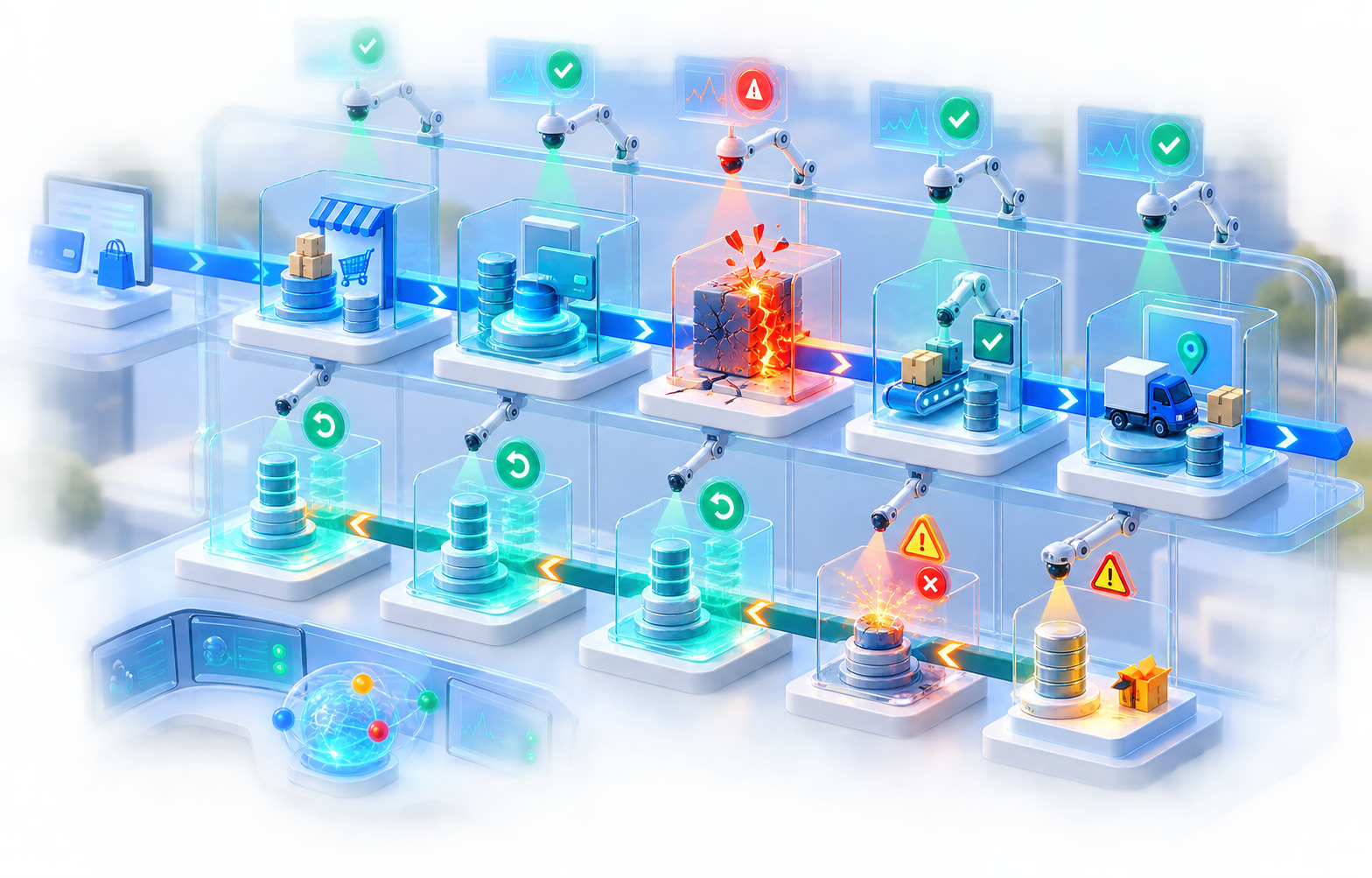
On a Tuesday afternoon, a mid-sized manufacturing company's procurement agent selected a new supplier for a critical component. The agent had been live for eleven weeks. It had processed 340 supplier evaluations without incident. This was the 341st.
The supplier it selected offered a 6% lower unit price than the incumbent. The agent flagged the decision as routine, auto-approved it under a $50,000 threshold, and issued a purchase order.
Four days later, a compliance analyst doing an unrelated audit noticed the new supplier had failed a safety certification renewal two months earlier. The certification was public record, sitting in a database the agent had access to.
The company's leadership asked three questions, in this order:
- Did the agent see the failed certification?
- If it saw it, why did it proceed anyway?
- If it didn't see it, why not — and what else has it missed?
Nobody could answer any of these questions with confidence. The agent's logs showed a final decision and a price comparison. They did not show which documents were retrieved, which were opened, which were weighted, or why the certification record — if retrieved — did not block the decision.
Engineering spent six days reconstructing the incident. They rebuilt a plausible sequence of events from database access logs, API call timestamps, and prompt caches that were never designed to be read by humans. They produced a story that was probably right. Probably is not an acceptable word in a supplier compliance audit.
Here is the part that matters: the agent may well have made a defensible decision under uncertainty. Certification data can be stale. Price pressure can be legitimate. Maybe the agent under-weighted a signal it should have weighted higher, in the way any junior analyst might on their 341st case of the week. That would be a normal, correctable mistake.
But that isn't what caused the incident. What caused the incident was that the company could not tell the difference between "the agent made a reasonable call that turned out wrong" and "the agent silently ignored a compliance failure." Both produce the same purchase order. Only one is a five-minute retraining conversation. The other is a legal exposure.
This is not a story about an AI Agent that wasn't smart enough. It is a story about a company that built a fast, capable decision-maker and never built the capability to ask it, after the fact, why.
That gap is the subject of this article.
This conversation, or something close to it, happens inside companies running AI Agents in production more often than any vendor demo would suggest:
   CEO           Why did it refund this customer?

   Engineer      We don't know.

   CEO           Can we find out?

   Engineer      Probably.

   CEO           Probably?
Nothing in that exchange is about the model being wrong. The refund may well have been correct. What breaks the room is the second word in "Probably" — the tacit admission that the organization doesn't have an answer, it has a search it's willing to run.
The Doctor Who Says "I Don't Know"
Every hospital in the world runs on a version of the incident above, except it happens correctly, thousands of times a day.
A patient comes in. A doctor examines them, orders tests, rules out several possible diagnoses, settles on one, and prescribes treatment. Sometimes the doctor is wrong. Doctors are wrong regularly — medicine is practiced under uncertainty, the same way an AI Agent's decisions are. Nobody expects a doctor to be infallible.
But when a doctor is wrong, something structural happens that did not happen in the procurement incident: someone can open the chart.
The chart shows what symptoms were reported. Which tests were ordered, and which were considered and skipped, and why. What the differential diagnosis looked like — the other conditions that were on the table, and the specific reasoning that ruled each one out. What the final diagnosis was, what treatment followed from it, and which attending physician signed off. If the treatment goes badly, the chart doesn't just show the outcome. It shows the reasoning that led there, in the doctor's own documented judgment, written down before anyone knew whether it would work.
That is what turns a bad outcome into a manageable one. A hospital can review a chart, find that the reasoning was sound and the outcome was simply bad luck, and change nothing. Or it can find that a test was never ordered, a symptom was never asked about, a warning sign was documented but never acted on — and now it knows precisely what to fix, and precisely who needs to answer for it.
Now imagine the alternative. A patient has a bad outcome. The family asks the doctor to explain the diagnosis. The doctor says: "I don't know. I looked at some things. I made a call. I don't remember exactly what I saw or why I ruled out the other possibilities."
No hospital would allow that doctor to keep practicing. Not because the diagnosis was necessarily wrong — it might have been perfectly defensible — but because a doctor who cannot reconstruct their own reasoning cannot be trusted with the next patient either, and there is no way to tell whether the next bad outcome was an unavoidable mistake or a repeat of the same silent failure.
This is, plainly, how most AI Agents operate in production today. They examine a situation, weigh options, rule things out, and act — and when asked why, they cannot fully reconstruct their own reasoning. Not because they are dishonest, but because nobody built the chart. The narrative a model can generate after the fact ("I chose this supplier because the price was lower") is the equivalent of a doctor's vague recollection, not a chart entry written at the moment of the decision. It is plausible. It is not verifiable. Those are different things, and enterprise risk lives entirely in the gap between them.
This analogy is the lens for the rest of this article. The AI Accountability Chain introduced next is, functionally, an attempt to give every AI Agent a chart — a record, written at the time of the decision rather than reconstructed afterward, that lets someone else determine whether a bad outcome was an acceptable risk taken competently, or a silent failure that will happen again tomorrow.
The Real Bottleneck in Enterprise AI
The dominant narrative in enterprise AI right now is a capability narrative: bigger context windows, better reasoning, more reliable tool use, longer autonomous runtimes, more sophisticated multi-agent orchestration. Every roadmap in this industry reads like a capability roadmap.
That narrative is not wrong. It is incomplete in a way that is starting to become expensive.
Capability answers the question can the agent do the task. It says nothing about whether an organization can stand behind the outcome when a regulator, a customer, an auditor, or a plaintiff's attorney asks for the reasoning. Enterprises do not fail to adopt AI because the AI isn't capable enough for the task. Increasingly, they fail to adopt it — or adopt it and then quietly disable it after an incident — because nobody in the organization can produce a defensible account of a decision after it happened.
Put plainly, in the sentence this entire article is built to defend:
   Most companies believe AI scales with autonomy.

   It doesn't.

   Enterprise AI scales with explainability.
Autonomy without explainability is not a milestone on the way to trustworthy AI. It is a liability that compounds every time the agent runs. Every autonomous action taken without a reconstructable rationale is a small, silent bet that nothing will ever go wrong with it. Enterprises are currently making thousands of these bets per day without realizing they are placing them.
This reframes the engineering problem. The question is not "how do we make the agent smarter." The question is: when this agent takes an action, can any of six people — an engineer, a compliance officer, a customer, an auditor, a regulator, or a court — reconstruct exactly why it happened, six months from now, without access to the engineer who built it?
Most production agent systems today would fail that test, for a reason worth stating on its own, without softening it:
   Most enterprise AI systems

   are auditable

   only while the engineer

   who built them

   still works at the company.
That is not a staffing risk. It is a governance failure wearing a staffing risk's clothing. An accountability architecture that depends on one person's memory was never an accountability architecture — it was a rumor with good intentions, and it expires the day that person hands in their badge.
This article is about the architecture that survives that day.
This is what most enterprise AI investment currently looks like, drawn honestly:
   Capability

   ██████████████████████████████

   Accountability

   ███

              ↓

         Production
Ten times the investment in one bar, a tenth of it in the other, and the gap between them is where every incident in this article originates. No amount of additional capability closes that gap. Only accountability does.
Every Wave Forces a New Discipline
This isn't the first time software has hit a wall that more capability couldn't solve on its own. It's useful to see the pattern before looking at the specific framework this article proposes, because the pattern is the reason the framework exists at all.
   Software

     ↓

   Distributed systems

     ↓

   Cloud

     ↓

   Microservices

     ↓

   AI

     ↓

   Agents

     ↓

   Accountability
Each wave down that list didn't just add capability. It broke an assumption the previous wave had been quietly relying on, and that break forced a new engineering discipline into existence — not as an optional refinement, but as the only way the new capability became usable at enterprise scale.
| Wave | Assumption it broke | Discipline it forced into existence |
|---|---|---|
| Distributed systems | A single machine's clock and memory can't be trusted as ground truth anymore | Distributed systems engineering — consensus, replication, fault tolerance |
| Cloud | Infrastructure is no longer a fixed, hand-configured asset | Infrastructure as code, and eventually SRE |
| Microservices | A stack trace can no longer show you the whole failure | Observability — distributed tracing, structured logging, correlation IDs |
| AI (LLMs) | Output is no longer deterministic or fully specifiable in advance | Evaluation engineering — benchmarks, red-teaming, prompt and eval pipelines |
| Agents | Action is no longer just output — the system now does things in the world, autonomously, across many steps | Accountability Engineering |
Notice what each discipline in that right-hand column has in common: none of them existed as a formal practice before the wave that forced them. Nobody was doing distributed systems engineering before distributed systems existed. Nobody was doing observability before microservices made stack traces useless. Each discipline is a direct, load-bearing response to a specific capability outrunning the tooling that used to be good enough for it.
Agents are the same pattern arriving at the same door. An LLM that only produces text can be evaluated the way the "AI" row describes — you check whether the output was good. An agent that takes actions — refunds money, quarantines a server, selects a supplier, deletes a record — has crossed the same line microservices crossed when a single stack trace stopped being able to explain a failure. The output is no longer the whole story. What matters now is the path: what was considered, what was rejected, what evidence supported the action, and who signed off on it before it happened. Evaluation engineering tells you whether an agent's answer was good. It was never built to tell you whether an agent's action was defensible. That is a different question, and it needs its own discipline, the same way observability needed its own discipline instead of being folded into "better logging."
Accountability Engineering is that discipline. Not a compliance checklist bolted onto agent systems after the fact, but a first-class engineering practice — with its own architecture, its own artifacts, and its own metrics — built for the specific moment software started acting instead of just answering.
Prompt engineering was the discipline the previous wave needed — how to get a good answer out of a model. It was never going to be the discipline this wave needs, because it was built to improve an output, not to govern an action. The discipline this wave needs is one level up:
   The next software discipline

   will not be

   prompt engineering.

   It will be

   Accountability Engineering.
Everything from here forward in this article is written as an entry point into that discipline, not a finished description of it. The AI Accountability Chain — the nine-link chain introduced next — is this article's concrete proposal for what Accountability Engineering looks like in practice, in the same way a design pattern is one concrete proposal within the broader discipline of software architecture. The discipline is the destination. The Chain is a way to get there.
Introducing the AI Accountability Chain
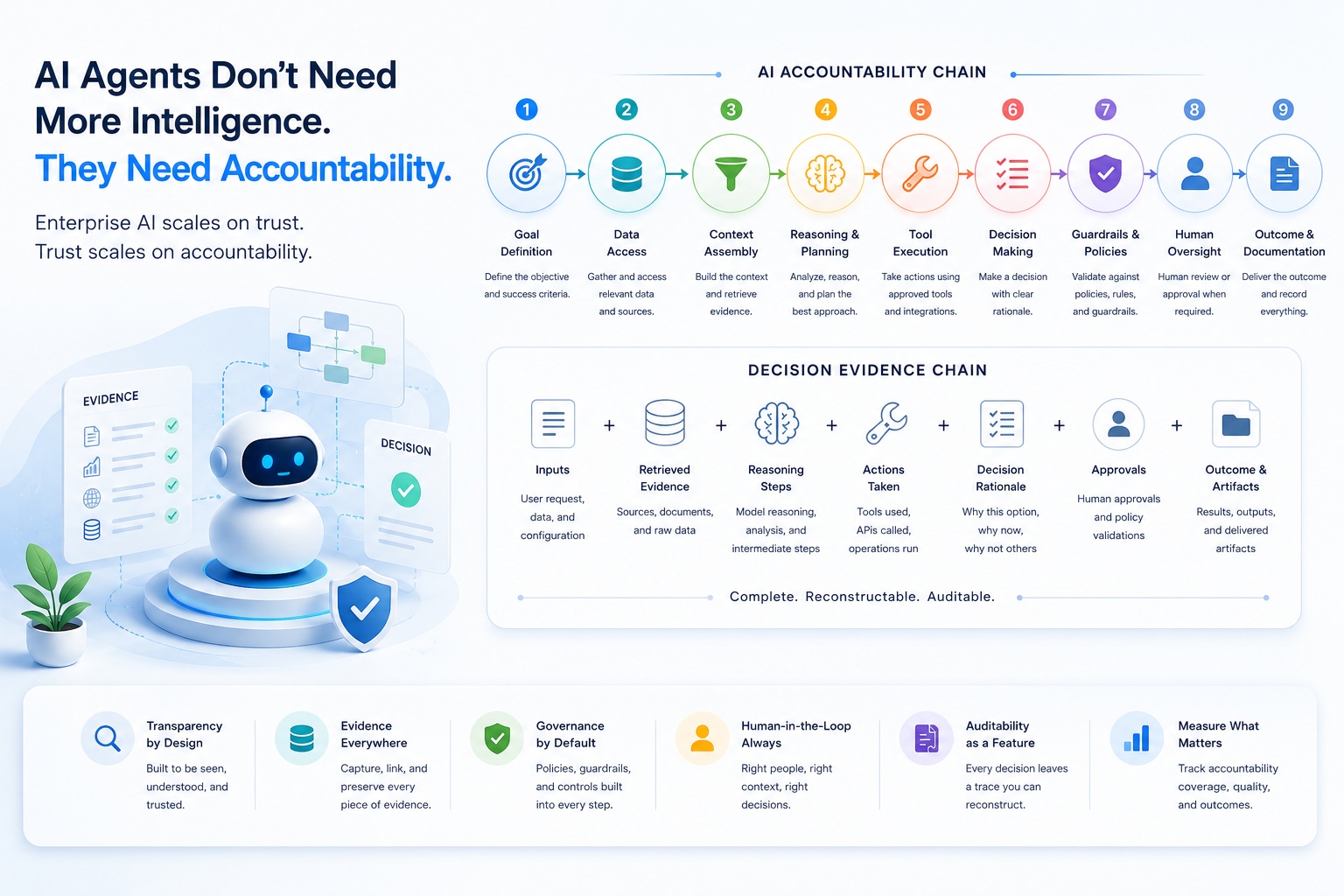
Every enterprise-grade AI Agent, regardless of its use case, industry, or underlying model, should be built around nine accountability links, chained together in sequence. This is not an industry standard. It does not exist in a vendor whitepaper. It is a practical engineering framework — one instrument within Accountability Engineering, named the AI Accountability Chain — introduced here for structuring agent systems so that every decision the agent makes can be reconstructed, justified, and — where necessary — reversed.
This is not a stack. Stacks suggest layers sitting on top of each other, independent, swappable. That is the wrong mental model, and it's the reason most teams misdiagnose where their agent actually broke. The nine layers are a chain. Each one hands its output to the next. A weakness in any single link does not stay contained in that link — it propagates forward, silently, until it surfaces as an incident three, five, or seven steps downstream of where it actually happened.
   Intent
     │
     ▼
   Planning
     │
     ▼
   Reasoning
     │
     ▼
   Tools
     │
     ▼
   Evidence
     │
     ▼
   Decision
     │
     ▼
   Approval
     │
     ▼
   Audit
     │
     ▼
   Learning
(In full engineering terms: User Intent → Planning → Reasoning → Tool Selection → Evidence Collection → Action Decision → Human Approval → Audit Trail → Rollback & Monitoring. "Learning" is the operative word for that last link, because a rollback that doesn't feed back into how the agent reasons next time isn't accountability — it's just cleanup.)
Here is the claim this article keeps coming back to, stated as carefully as it can be stated:
Most reconstructable enterprise AI failures can be traced to one dominant link in this chain — not a diffuse blend of everything at once.
Not "reasoning was bad" as a vague, diffuse verdict. Not "the AI made a mistake" as an unfalsifiable shrug. In the cases this article draws on, one link is usually identifiable as the point where the failure actually originated, even when several other links were also imperfect. The procurement incident that opened this article is a case in point: the agent's dominant failure wasn't reasoning, tool use, or planning. It was Evidence Collection — a document existed, and whether it was ever loaded into the decision was never captured. Every other link in that chain, as far as anyone could tell, held.
This is the practical value of treating the framework as a chain rather than a checklist: it turns "something went wrong" into a diagnosis, or at least a much shorter list of suspects. A team that can trace an incident to a Layer 5 weakness doesn't need to start by re-auditing its planner, its approval policy, and its rollback logic all at once. It has somewhere specific to look first.
Most teams build the first four links — Intent, Planning, Reasoning, Tools — and consider the agent finished. Evidence, Decision, Approval, Audit, and Learning are where accountability actually lives, and they are almost always missing, partial, or bolted on after the first incident forces the question.
Read against the chart analogy, the mapping is direct. Intent is the chief complaint — what the patient actually reported. Planning is the initial workup order. Reasoning is the differential diagnosis, including the conditions that were considered and ruled out. Tools are the tests ordered to investigate it. Evidence is the test results actually reviewed. Decision is the diagnosis and treatment plan. Approval is the attending's sign-off. Audit is the chart entry itself — the permanent record. Learning is the follow-up visit, where the outcome feeds back into whether the original reasoning holds up. A hospital that only kept the diagnosis and the treatment, with nothing in between, would not be practicing medicine safely. Most enterprise AI systems today are keeping exactly that little.
Layer 1 — User Intent
The layer where the request enters the system. The engineering failure here is subtle: teams capture the literal request ("cancel this order") but not the inferred intent ("cancel this order because the customer believes it was fraudulent, not because they changed their mind"). Two requests that look identical at the text level can require entirely different downstream handling. If Layer 1 does not preserve the distinction, no later layer can recover it. Accountability starts with recording what the system believed the user actually wanted, not just what they typed.
Layer 2 — Planning
The layer where the agent decomposes intent into a sequence of steps. The accountability requirement here is that the plan must be captured as a discrete, inspectable artifact before execution begins — not reconstructed afterward from execution logs. A plan that is never written down cannot be reviewed, cannot be diffed against what actually happened, and cannot be used to explain why the agent chose one path over another.
Layer 3 — Reasoning
The layer where the agent evaluates options, weighs evidence, and arrives at conclusions. This is the layer most teams try to make "explainable" by asking the model to output a chain of thought. That is necessary but insufficient. A chain of thought is a narrative the model generates about itself; it is not guaranteed to be a faithful account of the actual decision process, and it should never be the only record of reasoning. Reasoning needs external, structured checkpoints: what alternatives were surfaced, what evidence was attached to each, what confidence was assigned to each. The narrative is supplementary color. The checkpoints are the audit-grade record.
Layer 4 — Tool Selection
The layer where the agent chooses among available tools, APIs, or MCP servers. The accountability failure here is almost universal: systems log which tool was called, but not which tools were available and rejected, and why. Tool selection without a rejection log is a coin flip that happens to look deliberate. A defensible system logs the full candidate set, the selection criteria, and the elimination reasoning for every candidate that wasn't chosen.
Layer 5 — Evidence Collection
The layer where the agent gathers the data that will justify the action: documents, database records, API responses, prior conversation history. This layer needs its own audit trail, separate from reasoning: which sources were queried, which were retrieved, which were actually read versus retrieved-but-ignored, and what their freshness and trust level were at the time. In the procurement incident above, this is precisely the layer that failed silently — a compliance record existed, and whether it was ever actually loaded into context is unknown, because Layer 5 was never instrumented.
Layer 6 — Action Decision
The layer where reasoning and evidence converge into a committed action. This layer should produce a structured decision record before execution: the action, the justification, the evidence references, and a confidence score. Critically, this record must be generated before the action executes, not derived from logs afterward. A decision record written retroactively is a rationalization, not a decision.
Layer 7 — Human Approval
The layer that determines whether a human must review the action before it executes. The common failure is binary thinking: either everything requires approval (which destroys the value of automation) or nothing does (which destroys accountability). Approval needs to be a function of the action's risk classification, not a blanket policy. This is developed further in the tables below.
Layer 8 — Audit Trail
The layer that persists everything from Layers 1–7 in a form that is queryable, immutable, and readable by someone who was not present when the decision was made. This is the layer that turns "we think this is probably what happened" into "here is exactly what happened." Most agent systems have logs. Very few have an audit trail, because logs are optimized for debugging code and audit trails are optimized for reconstructing decisions. They are not the same artifact.
Layer 9 — Rollback & Monitoring
The layer that determines what happens after the action is taken: can it be reversed, what triggers a reversal, and what ongoing signal indicates the decision is degrading in quality. An agent that can act but cannot be undone is a one-way door on every decision. Enterprises tolerate one-way doors when a human opens them deliberately. They should not tolerate them by default from a system acting autonomously.
The point of the framework is not that every layer needs equal engineering investment for every use case. A low-risk internal knowledge assistant might need lightweight versions of Layers 7 and 9. A financial transaction agent needs all nine layers built to a high standard. The point is that every layer must be deliberately addressed, even if the decision is "this layer is minimal for this use case." The failure mode is not under-investing in a layer. It is not knowing the layer exists.
The Decision Evidence Chain
If the AI Accountability Chain is the architecture, the Decision Evidence Chain is the artifact that architecture must produce for every consequential action. The two are not the same thing, and it's worth being precise about the difference now, before the names start to blur together: the AI Accountability Chain is the system-wide structure, built once, that every decision flows through. The Decision Evidence Chain is the record generated fresh, every single time, by one decision passing through that structure. One is the pipe. The other is what comes out of it. It is the single object an auditor, a customer, or an engineer should be able to pull up, eighteen months later, and read start to finish without needing to talk to anyone.
A complete Decision Evidence Chain answers ten questions, in order:
 1. What was requested?              →  Layer 1
 2. What plan was generated?          →  Layer 2
 3. What reasoning path was taken?    →  Layer 3
 4. Which tools were considered?      →  Layer 4
 5. Why was one tool selected?        →  Layer 4
 6. Which evidence supported it?      →  Layer 5
 7. What uncertainty existed?         →  Layer 3 / 5
 8. Was approval required, and given? →  Layer 7
 9. What exactly happened?            →  Layer 6 / 8
10. Can it be replayed and audited?   →  Layer 8 / 9
Two properties separate a real Decision Evidence Chain from a debug log that happens to answer some of these questions.
It is generated forward, not reconstructed backward. Every field in the chain is written by the system at the moment the corresponding layer executes. If an engineer has to infer an answer from timestamps and side effects after the fact, the chain has already failed, no matter how good the inference is.
It records rejected options, not just the chosen one. A chain that only records "tool X was called" has the informational content of a coin landing on heads. A chain that records "tools X, Y, and Z were candidates; Y was rejected because it lacked write permission; Z was rejected due to a stale cache; X was selected" has the informational content of a decision. Most systems capture the former. Enterprises need the latter.
Underneath both properties is a distinction most agent systems never make, and it's worth stating as its own claim rather than folding it into the properties above:
   A decision without evidence
   is an opinion.

   A decision with evidence
   but without provenance
   is an assumption.

   Only evidence with provenance
   becomes accountability.
Most teams stop at the second line and believe they've solved the problem. "The agent cited three documents" sounds like accountability. It isn't, yet — it's an assumption wearing accountability's clothing, because a cited document with no record of when it was fetched, how it was trusted, or why it was weighted over the documents that weren't cited is just a more convincing-looking opinion. Provenance is what closes the gap: not that evidence was used, but where it came from, how fresh it was, how it was scored against the alternatives, and whether it can still be independently verified after the fact. This is the same distinction the memory-risk discussion returns to later, and the same one the opening incident turned on — a certification record existed, but nothing established whether it was ever actually loaded, trusted, and weighed. Evidence without that chain of custody isn't accountability. It's an opinion with better production values.
The Decision Evidence Chain is, in practice, the chart from the analogy above, formalized into ten fields instead of a physician's handwriting. It is also — for engineers who prefer a second reference point — what a flight data recorder is to an aircraft: nobody expects it to prevent the incident, only to make sure that when something goes wrong, the investigation takes days instead of months, and the finding is a fact instead of a theory. Both analogies point at the same underlying requirement. The chart is the better one, because a flight recorder only activates during a crash. A patient chart is written for every patient, including the overwhelming majority who are simply treated correctly and go home — which is the actual target state here: not an emergency artifact reserved for incidents, but a routine one generated for every decision, incident or not.
The Architecture Underneath: Where Accountability Actually Breaks
Six architectural components make up most production agent systems today. Each has a specific, well-known way accountability fails inside it. None of these failure modes are hypothetical — they are the recurring root causes behind the incidents that never make it into vendor case studies.
Reasoning
Modern agents reason through some combination of chain-of-thought generation, self-critique passes, and tool-augmented retrieval. The accountability failure is that reasoning traces are treated as debugging output rather than as governed artifacts. Teams log the trace when something breaks and discard it otherwise, because traces are large and storage-conscious teams truncate them. The traces that get discarded are, statistically, the ones nobody ever needed — right up until the one time they were needed and are gone. Reasoning traces for any action above a defined risk threshold need to be retained with the same rigor as financial transaction logs, not treated as ephemeral debug noise.
Tool Calling
Tool calling is where autonomy becomes consequence — it's the boundary where the agent stops thinking and starts affecting the world. The architectural failure here is under-scoping tool permissions to the task rather than to the decision. A tool with broad read/write access, called for a narrow purpose, is a standing risk that exists independently of whether the agent ever misuses it. The engineering discipline that prevents this is treating every tool grant as a decision-scoped capability — a tool credential minted for one decision, with permissions matching exactly what that decision requires, rather than a long-lived credential the agent reuses across unrelated tasks.
MCP (Model Context Protocol)
MCP standardizes how agents discover and invoke external tools and data sources, which is a genuine advance — but it also means an agent's effective capability surface can change the moment a new MCP server is registered, without a corresponding change to the agent's own code or prompts. The accountability failure is treating MCP server registration as an infrastructure change rather than a governance change. Every new MCP server an agent can reach should go through the same review as a new employee getting system access, because from the accountability chain's perspective, that is exactly what it is.
Planning
Planning modules decompose goals into steps, often re-planning mid-execution when a step fails or new information arrives. The failure mode is silent re-planning: the agent abandons its original plan and adopts a new one without that transition being logged as a distinct, reviewable event. An audit trail that shows only the final plan, with no record that three earlier plans were tried and discarded, hides the exact moments where the agent's judgment was tested most.
Memory
Long-lived agents accumulate memory across sessions — user preferences, prior decisions, learned patterns. The accountability failure is treating memory as append-only truth rather than as a claim that itself needs provenance. If an agent "remembers" that a customer prefers expedited shipping, and that memory was actually inferred from a single ambiguous message eight months ago, the agent is now making decisions based on an unverified inference wearing the costume of a fact. Every memory entry needs its own evidence chain: where it came from, how confident the system was, and when it was last validated.
Long-Running Tasks and Multi-Agent Systems
Tasks that span hours or days, or that involve multiple specialized agents handing off work to each other, multiply every failure mode above by the number of handoffs. The specific new failure is accountability discontinuity at handoff boundaries: Agent A's Decision Evidence Chain ends, Agent B's begins, and the connective tissue between them — what Agent B was told, what it inherited, what it independently re-verified versus took on faith — is rarely captured. In a multi-agent incident, the most common finding is not that any single agent reasoned badly. It's that no one agent, and no human, had visibility into the whole chain end to end.
Autonomous Workflows
The broader category — agents that act without a human in the loop for extended periods — inherits every failure above and adds one: drift from the original approval scope. A workflow approved for "reply to routine billing questions" can, through a sequence of individually reasonable re-plans, end up executing refunds. Each step looked like a small, defensible extension of the last. No single step would have been approved if presented in isolation as "let this agent issue refunds." Autonomous workflows need periodic re-certification against their original approval scope, not a one-time sign-off treated as permanent.
None of this is an argument against reasoning, tool calling, MCP, planning, memory, or autonomy. It is an argument that each of these components needs an accountability counterpart built alongside it, not retrofitted after the first incident makes the gap visible.
Why Better Models Don't Solve Accountability
There is an obvious objection to everything so far, and it deserves a direct answer rather than a footnote: frontier models are getting better every few months. GPT-5-class models reason further before answering. Claude and Gemini-class models handle longer context windows and call tools more reliably than the generation before them. If the models keep improving, doesn't the accountability problem eventually just shrink away on its own?
No — and the reason why is the actual argument of this section, not an assertion.
Better reasoning reduces the rate of bad decisions. It does not produce a record of the decision. A frontier reasoning model that thinks longer before answering is, in effect, running a more thorough differential diagnosis internally. That's a genuine improvement — fewer wrong diagnoses. But whether that internal reasoning is ever written down as an inspectable artifact is an entirely separate engineering decision, orthogonal to how good the reasoning is. A model can go from correct 80% of the time to correct 97% of the time, using an identical logging setup, and the organization's ability to prove why any single decision was made will not move at all. Correctness is a property of the model. Explainability is a property of the system built around the model. Improving one has no mechanical effect on the other.
Long context reduces missing information. It does not tell you what was actually used. A longer context window means an agent can, in principle, see the entire compliance database instead of a truncated slice of it. That is real progress — it directly addresses the class of failure where evidence existed but was never retrieved at all. But it makes the provenance problem harder to detect, not easier, because now there's more material the agent could plausibly claim to have considered, and no more visibility than before into which parts it actually weighted. A bigger haystack doesn't make it easier to prove which needle was pulled out. In the opening incident, giving that procurement agent a longer context window would not have produced a record of whether the certification document was ever loaded into the decision — it would only have guaranteed the document was available to be loaded, which was never the part in question.
More reliable tool calling reduces malformed actions. It does not log the tools that were never called. Every generation of frontier models gets meaningfully better at selecting the right function, with the right parameters, on the first try. That closes real failure modes — the wrong-target, wrong-parameter class of incident described earlier. It does nothing for the specific accountability gap this article keeps returning to: the rejected candidates. A perfectly reliable tool-calling model still calls exactly one tool and says nothing, by default, about the two it didn't call and why. That is not a model limitation. It is a logging decision no model vendor is positioned to make on an enterprise's behalf, because it depends on what that enterprise needs to prove, to whom, under which regulation.
The clearest way to see that these are two separate axes, not one, is to plot them against each other instead of assuming model quality is the only variable that matters:
                     High Explainability
                            │
   Visibly broken,          │      Enterprise ready
   fixable                  │
                            │
  ──────────────────────────┼──────────────────────────
                            │
   Obviously broken         │      Confident but
                            │      unaccountable
                            │
                     Low Explainability

        Low Correctness            High Correctness
Frontier model progress moves an organization to the right on this chart — from low correctness toward high correctness. It does not, by itself, move anyone up. The most dangerous quadrant on this chart is not the bottom-left, where everyone can see the system is broken and reacts accordingly. It's the top-right's neighbor, directly below it — confident but unaccountable: a highly capable model, correct nearly all the time, whose rare failures are just as undocumented as they would have been on a much weaker model. Every capability upgrade an enterprise ships without a matching accountability upgrade is a step further into that quadrant, not out of it. This is the Accountability Law again, from a different angle: autonomy — or in this case, model capability deployed autonomously — moving without accountability moving alongside it.
Return, one more time, to the hospital. A hospital that adopts a far better diagnostic imaging system does not stop keeping charts. The charts aren't there because the old imaging was unreliable — they're there because "was the diagnosis right" and "can you prove why it was made" are permanently different questions, regardless of how good the imaging gets. A model upgrade is a diagnostic upgrade. It is not a charting upgrade. Enterprises that treat the two as the same thing will keep discovering, one incident at a time, that a better model just gave them a more confident version of the same unanswerable question.
What Accountability Is Not
Given how often the word gets used to mean five different things in the same meeting, it's worth fixing the definition in one place, plainly, before going any further.
Accountability is not:
- more logging
- longer prompts
- chain of thought
- larger context windows
- another LLM
- another agent
Accountability is:
- reconstructable decisions
- governed autonomy
- evidence provenance
- risk-aware execution
- auditability
Everything in the left column is a thing enterprises already have, in most cases in abundance, and none of it, alone or combined, produces anything in the right column. That's the whole confusion this section exists to remove: teams look at their logging volume, their prompt length, their reasoning traces, and reasonably conclude they must be covered. They are covered on the left. The right column is a different investment, made deliberately, and it's the one this article has been describing all along.
How This Relates to Existing Frameworks
None of this is proposed in a vacuum, and it shouldn't be read as a replacement for the frameworks already sitting on most enterprise AI teams' shelves. It's worth being explicit about where the AI Accountability Chain sits relative to them, because the honest answer is: alongside, at a different layer of the problem, not instead of.
| Framework | Focus |
|---|---|
| NIST AI RMF | Governance — organization-wide risk identification and management |
| ISO/IEC 42001 | AI management systems — policies, lifecycle, and certifiable process controls |
| OWASP Top 10 for LLM Applications | Security — prompt injection, data leakage, excessive agency, and related attack surfaces |
| LangGraph (and similar orchestration frameworks) | Orchestration — how an agent's steps, state, and tool calls actually execute |
| AI Accountability Chain | Decision reconstruction — whether any single executed decision can be explained, after the fact, with evidence |
Each row above answers a genuinely different question. NIST AI RMF asks whether an organization has the governance structures to manage AI risk at all. ISO 42001 asks whether those structures meet a certifiable, auditable management-system standard. The OWASP list asks whether the system can be attacked, and how. LangGraph and its peers ask how to actually build and run the thing — the execution substrate underneath everything else in this table.
None of them ask the specific question this article has been built around: given one action this agent already took, can the organization reconstruct, with evidence, exactly why it took it? That's not a gap in those frameworks — it's outside their scope by design. A team can be fully compliant with ISO 42001, pass every OWASP LLM check, and satisfy every NIST AI RMF control, and still have no way to answer the question the CEO asked the engineer in the dialogue earlier in this article. Governance, security, and management-system maturity are necessary. None of them, on their own, produce a Decision Evidence Chain for a specific refund, a specific supplier selection, or a specific denied claim.
That's the gap this article is aimed at — not a competing standard, but the missing layer underneath the ones that already exist.
Enterprise Examples
The accountability gap looks different by industry, but the shape is consistent: the agent's technical decision was often defensible. The organization's inability to reconstruct it is what created the exposure. In each case below, the failure traces predominantly to one link in the chain — not because the other links were flawless, but because that one link is where the incident is best explained as having originated. Everything downstream of it was largely the failure becoming visible.
Healthcare. A clinical documentation agent summarizes patient encounters and suggests billing codes. A code is later challenged in an insurance audit. The organization cannot show which sentences in the encounter note the agent actually weighted versus which it merely retrieved. Failure point: Evidence. The reasoning may have been sound. Nobody can prove it, because the evidence layer never recorded what was read versus what was ignored.
Finance. A credit-risk agent recommends loan terms, and a regulator asks whether a protected characteristic influenced the outcome through a proxy variable — zip code standing in for race, for instance. Failure point: Reasoning. The model was never given the protected field directly, which is exactly why this is a reasoning failure and not an evidence failure: proving the absence of proxy influence requires structured reasoning checkpoints, not just a list of documents that were consulted.
Legal. A contract-review agent flags a clause as high-risk. Outside counsel later disagrees. The firm has no record of which precedent or clause library entries the flag was actually drawn from. Failure point: Tools. The agent selected a clause-comparison tool over an available precedent-database tool, and nobody logged that the second tool was even a candidate, let alone why it lost.
Cybersecurity. A SOC agent auto-quarantines an endpoint that turns out to be a false positive during a critical incident window. Failure point: Approval. The action's risk classification treated "quarantine" as reversible and routine. It is neither, during an active incident. The chain broke at the gate that should have stopped it, not at the reasoning that led to it.
Customer Support. A support agent issues a refund a customer later disputes ever requesting. Failure point: Decision. The action executed without a structured pre-execution decision record linking the refund to a specific customer statement. What exists instead is a plausible-sounding after-the-fact narrative — which is not the same artifact.
Procurement. As in the opening incident: an agent selects a supplier that has failed a compliance certification. Failure point: Evidence. Restated precisely this time — the certification record existed and was retrievable. Whether it was ever loaded into the decision is the single unanswered question, and it belongs entirely to one link.
Sales. An agent that qualifies leads and adjusts pricing produces a slow, undocumented discounting drift across thousands of individually small decisions. Failure point: Learning. Each individual decision passed approval. What never happened is the aggregate pattern being fed back into the system as a signal — the rollback-and-monitoring link never closed the loop on cumulative drift, only on single-action reversal.
Internal Knowledge Assistants. The assistant confidently answers from an internal document that was superseded two months earlier, and an employee acts on it. Failure point: Evidence. Not reasoning — the reasoning over the retrieved document was fine. The document itself carried no freshness or trust metadata, so a stale source was indistinguishable from a current one at the moment it was retrieved.
When Each Layer Fails
| Failure | What Actually Happens | What It Looks Like Externally |
|---|---|---|
| Reasoning fails | Model reaches a plausible-sounding but unsupported conclusion | A confidently wrong answer with no visible uncertainty |
| Planning fails | Plan omits a necessary step or mis-sequences dependent steps | Task appears complete but a downstream system silently breaks |
| Memory fails | A stale or misattributed memory is treated as current fact | Agent acts on a preference or fact that was never actually true |
| MCP fails | A registered tool's schema or permissions change without agent awareness | Tool call succeeds against the wrong resource or fails silently |
| Tool calling fails | Correct tool, wrong parameters, or a valid call with an invalid side effect | Action executes but on the wrong target or scope |
| Agents disagree | Two specialized agents produce conflicting sub-decisions with no arbiter | Downstream system receives contradictory instructions |
| Planner becomes inconsistent | Re-planning logic oscillates between two plans under ambiguous signals | Task stalls or repeats an action multiple times |
| Approvals are skipped | Risk classification under-scores an action that should have required review | High-risk action executes with no human ever in the loop |
| Audit logs are incomplete | Only the final outcome is logged, not the intermediate decision points | Reconstruction becomes inference, not fact |
| Rollback is impossible | Action has an external, non-reversible side effect with no compensating action designed | Organization can only apologize, not correct |
Original Tables
Decision Types vs. Required Approval
| Decision Type | Reversible? | Customer/Financial Impact | Required Approval |
|---|---|---|---|
| Informational response | Yes | None | None |
| Internal data query | Yes | None | None |
| Draft generation (email, document) | Yes | Low | None, pre-review encouraged |
| Account modification (non-financial) | Partially | Low–Medium | Post-hoc review |
| Financial transaction under threshold | Difficult | Medium | Pre-execution approval |
| Financial transaction over threshold | Difficult | High | Mandatory human approval |
| Data deletion | No | Medium–High | Mandatory human approval |
| External communication (customer/partner) | No | Medium | Risk-tiered approval |
| Compliance-relevant action | No | High | Mandatory human approval + dual sign-off |
| Irreversible infrastructure action | No | Critical | Mandatory human approval + rollback plan pre-defined |
Tool Risk Classification
| Tool Category | Example | Risk Level | Governance Requirement |
|---|---|---|---|
| Read-only, internal | Knowledge base search | Low | Standard logging |
| Read-only, external | Public API lookup | Low–Medium | Source trust scoring |
| Write, internal, reversible | Draft creation | Medium | Evidence-linked logging |
| Write, internal, irreversible | Record deletion | High | Pre-execution approval |
| Write, external, reversible | Send draft for review | Medium | Evidence-linked logging |
| Write, external, irreversible | Send customer communication | High | Pre-execution approval |
| Financial | Payment, refund, transfer | Critical | Mandatory approval + audit + rollback plan |
| System/infrastructure | Deploy, provision, revoke access | Critical | Mandatory approval + dual sign-off |
Agent Autonomy Levels
| Level | Description | Human Role |
|---|---|---|
| L0 | Suggests only, never acts | Human executes everything |
| L1 | Acts on pre-approved, narrow, reversible tasks | Human reviews samples |
| L2 | Acts autonomously within a defined risk boundary | Human reviews exceptions |
| L3 | Acts autonomously, escalates uncertain cases | Human reviews escalations only |
| L4 | Acts autonomously across most of a workflow | Human audits periodically |
| L5 | Fully autonomous, self-monitoring | Human intervenes only on alert |
Most enterprises believe they are operating at L3 or L4. Most, once audited honestly against their actual approval and rollback infrastructure, are operating at L1 or L2 with an L4 user interface.
Planning Complexity
| Complexity | Characteristics | Accountability Requirement |
|---|---|---|
| Simple | Single step, single tool | Log final action |
| Moderate | 2–5 steps, single agent | Log plan + execution trace |
| Complex | 5+ steps, conditional branching | Log plan versions + re-plan triggers |
| Multi-agent | Multiple agents, handoffs | Log handoff state + inherited context |
| Long-running | Spans hours/days, external triggers | Log periodic re-certification against scope |
Business Risk Matrix
| Impact ↓ / Reversibility → | Fully Reversible | Partially Reversible | Irreversible |
|---|---|---|---|
| Low impact | Auto-approve | Auto-approve, log | Post-hoc review |
| Medium impact | Auto-approve, log | Risk-tiered approval | Pre-execution approval |
| High impact | Risk-tiered approval | Pre-execution approval | Mandatory approval + dual sign-off |
Audit Requirements by Layer
| Layer | Minimum Retained Artifact | Retention Trigger |
|---|---|---|
| User Intent | Original request + inferred intent | Always |
| Planning | Full plan + all re-plan events | Always |
| Reasoning | Structured evidence/confidence checkpoints | Risk-tiered |
| Tool Selection | Full candidate set + rejection reasons | Risk-tiered |
| Evidence Collection | Source list + freshness + trust score | Always |
| Action Decision | Structured pre-execution decision record | Always |
| Human Approval | Approver identity + timestamp + rationale | Always |
| Audit Trail | Immutable, queryable composite record | Always |
| Rollback & Monitoring | Compensating action + trigger conditions | Risk-tiered |
Rollback Strategy by Action Type
| Action Type | Rollback Mechanism | Feasibility |
|---|---|---|
| Data write (internal) | Version snapshot restore | High |
| Data deletion | Soft-delete with retention window | High if designed in advance |
| External communication | Follow-up correction message | Partial — cannot un-send |
| Financial transaction | Compensating transaction | High, but reputationally costly |
| Infrastructure change | Automated rollback script | High if pre-built, near-impossible if not |
| Third-party API side effect | Depends entirely on third-party support | Often none — must be designed around |
Memory Risk Classification
| Memory Type | Example | Risk if Wrong |
|---|---|---|
| Explicit user statement | "I prefer email over phone" | Low |
| Inferred preference | Inferred from one ambiguous interaction | Medium |
| Cross-session aggregated pattern | "This customer usually escalates" | Medium–High |
| Cross-agent shared memory | Passed from one agent to another without re-verification | High |
| Long-unvalidated memory | Not revisited in 6+ months | High |
Trust vs. Autonomy
Enterprises intuitively treat trust and autonomy as if they move together — the more an agent proves itself, the more autonomy it earns. Architecturally, they need to be decoupled. Trust should be a function of accountability infrastructure maturity, not of tenure or apparent success rate.
Autonomy
   │                                        ● Ungoverned autonomy
   │                                      ╱   (fast, unaccountable —
   │                                    ╱     where most agents
   │                                  ╱       actually operate)
   │                                ╱
   │                              ╱
   │            Governed autonomy ●
   │                          ╱ │
   │                        ╱   │
   │                      ╱     │
   │                    ╱       │
   │──────────────────●─────────┼─────────────────────────
   │        Low trust           │        High trust
   └────────────────────────────┴──────────────────────────►
                          Accountability Infrastructure Maturity
The dangerous quadrant is the top-left: high autonomy granted before accountability infrastructure exists to support it. This is where most incidents originate, and it is reached not through a single bad decision but through a sequence of individually reasonable capability expansions — exactly the drift pattern described earlier in autonomous workflows.
The correct posture is that autonomy is a lagging indicator, granted only after the accountability infrastructure for that risk tier is built and tested — not a leading indicator granted on the promise that accountability will catch up later.
That posture, stated as a single rule rather than a curve, is the one idea in this article worth remembering after everything else is forgotten:
The Accountability Law
Every increase in agent autonomy must be matched by an equal increase in accountability.
   Autonomy        ↑

   Accountability   ↑
That is the only condition under which increasing autonomy is safe. The moment the two stop moving together, this happens instead:
   Autonomy         ↑
   Accountability    —

              ↓

   Risk            ↑ ↑ ↑
That is the only condition under which increasing autonomy is safe. The moment the two stop moving together, risk takes their place, growing fastest of all three.
Nothing else in this article is a substitute for that balance. More capability doesn't restore it. A smarter model doesn't restore it. Better intentions don't restore it. The Accountability Law is not a description of best practice — it is closer to a conservation law: autonomy that outpaces accountability doesn't disappear as risk, it accumulates as risk, silently, until an incident forces it into view all at once. Every diagram, table, and example in this article is an answer to the same single question the law raises: what, exactly, are you matching your autonomy with?
Enterprise Agent Architecture
┌────────────────────────────────────────────────────────────────┐
│                         USER / SYSTEM                           │
└───────────────────────────────┬────────────────────────────────┘
                                 ▼
                  ┌──────────────────────────┐
                  │ 1. Intent Capture          │──► stored, versioned
                  └──────────────┬─────────────┘
                                 ▼
                  ┌──────────────────────────┐
                  │ 2. Planner                │──► plan artifact
                  └──────────────┬─────────────┘
                                 ▼
                  ┌──────────────────────────┐
                  │ 3. Reasoning Engine        │──► evidence/confidence
                  └──────────────┬─────────────┘        checkpoints
                                 ▼
        ┌────────────────────────────────────────────┐
        │ 4. Tool Selector  ──►  candidate set log     │
        │        │                                     │
        │        ▼                                     │
        │ 5. Evidence Collector ──► source/trust log    │
        └───────────────────────┬────────────────────────┘
                                 ▼
                  ┌──────────────────────────┐
                  │ 6. Action Decision Engine  │──► pre-execution
                  └──────────────┬─────────────┘   decision record
                                 ▼
                     risk classification
                                 ▼
              ┌──────────────────┴──────────────────┐
              ▼                                     ▼
   ┌─────────────────────┐               ┌─────────────────────┐
   │ 7. Human Approval     │──approved──► │  Execute Action       │
   │  (risk-tiered)        │              └──────────┬────────────┘
   └─────────────────────┘                            ▼
                                          ┌─────────────────────┐
                                          │ 8. Audit Trail         │
                                          │  (immutable, queryable)│
                                          └──────────┬────────────┘
                                                     ▼
                                          ┌─────────────────────┐
                                          │ 9. Rollback &          │
                                          │    Monitoring          │
                                          └─────────────────────┘
The diagram is deliberately linear, but the honest version of this architecture has a feedback edge from Layer 9 back into Layer 3: monitoring signal should influence future reasoning, not just trigger rollback on the current action. Systems that don't wire that edge back in tend to repeat the same class of mistake indefinitely, because nothing downstream of the mistake ever reaches the component that made it.
Metrics That Actually Matter
Most agent dashboards measure task completion rate and latency. Neither measures accountability. The following ten metrics do:
| Metric | What It Measures |
|---|---|
| Decision Explainability Score | Percentage of actions with a complete, ten-question Decision Evidence Chain |
| Tool Accuracy | Percentage of tool selections that, on review, were the correct choice among candidates |
| Planning Success Rate | Percentage of plans executed without an undocumented re-plan |
| Approval Bypass Rate | Percentage of high-risk actions that executed without required approval |
| Rollback Success Rate | Percentage of reversible actions that were successfully reversed when triggered |
| Reasoning Reproducibility | Percentage of decisions that reach the same conclusion when replayed against the same evidence |
| Evidence Coverage | Percentage of decisions with all cited evidence sources actually retrievable and verifiable after the fact |
| Audit Completeness | Percentage of actions with no missing field in the audit record |
| Human Override Rate | Percentage of agent recommendations a human reviewer overturns |
| Action Confidence Calibration | Correlation between the agent's stated confidence and its actual correctness rate |
The last metric deserves emphasis. A well-calibrated agent that says "60% confident" and is right 60% of the time is more trustworthy than one that says "95% confident" and is right 80% of the time — even though the second agent is objectively more accurate. Enterprises building approval thresholds on top of confidence scores are building on a foundation that is rarely checked for calibration at all.
Ten metrics are useful for a dashboard. They are not useful as an answer to the question a CTO actually gets asked in a board meeting: "Are we ready?" That question needs one number, not a fifth new concept to learn — just a single composite reading taken directly off the AI Accountability Chain itself, built from the four measurements that matter most, and reported as a scorecard rather than buried in a table. Call it Accountability Coverage if it needs a label at all, but treat it as what it actually is: a derived score, computed from the Chain, the same way a p95 latency figure is derived from a system's raw request logs rather than a separate thing you build alongside them.
   ACCOUNTABILITY COVERAGE
   (a scorecard read off the AI Accountability Chain)

   Layers implemented              9 / 9

   Decision Chain completeness      82%

   Tool rejection logging           Yes

   Rollback coverage                91%
Each component is deliberately simple to compute from what a team already logs, and each one maps directly onto a piece of the Chain already described above:
- Layers implemented — a straight count, out of nine, of which links in the Chain have a real, instrumented artifact rather than an assumed one. This is binary per link: either it produces a written record at decision time, or it doesn't count.
- Decision Chain completeness — the percentage of actions in a given period whose Decision Evidence Chain answers all ten questions with no gaps, averaged across the sample.
- Tool rejection logging — a yes/no gate, not a percentage, because partial logging of rejected tool candidates is functionally the same as no logging. Either the system can show what it didn't choose and why, or it can't.
- Rollback coverage — the percentage of the organization's irreversible-or-difficult action classes (from the Rollback Strategy table) that have a designed, tested compensating action, rather than an improvised one written after the first incident that needed it.
The reason to keep this at four components instead of folding in all ten metrics from above is the same reason a credit score isn't reported as a spreadsheet: a composite reading only stays usable if it's simple enough to compute quarterly, argue about in a room with non-engineers, and track as a single trend line over time. This is also, deliberately, the shape of a number that turns into a self-serve calculator rather than a consulting engagement — four inputs any engineering team can pull from its own logs in an afternoon, in exchange for one honest reading of how far autonomy has actually outrun the Chain meant to account for it.
Trade-offs Engineering Leaders Actually Face
| Trade-off | Push Toward First | Push Toward Second | Where the Line Usually Belongs |
|---|---|---|---|
| Explainability vs. Latency | Full evidence chain on every action | Real-time response with deferred logging | Full chain always generated; only its blocking review is risk-tiered |
| Autonomy vs. Risk | Wider autonomous scope | Narrow, human-gated scope | Autonomy scope should match Layer 8/9 maturity, not business ambition |
| Audit vs. Cost | Retain everything, indefinitely | Retain only final outcomes | Retain full chains for high-risk tiers; sample for low-risk tiers |
| Memory vs. Privacy | Rich, persistent personalization | Minimal, session-only memory | Memory retention should match data sensitivity, not engineering convenience |
| Reasoning Depth vs. Response Time | Multi-step deliberation, self-critique | Single-pass response | Depth should scale with the action's position in the risk matrix, not be constant |
None of these are solved once. They are policy decisions that should be revisited as an agent's usage pattern and risk profile evolve — which is precisely why they belong in the Rollback & Monitoring layer's feedback loop rather than in a one-time architecture review.
Five Illustrative Engineering Scenarios
The following scenarios are fictional composites used to illustrate architectural failure patterns. They do not describe any specific company or real incident.
Scenario 1: The Confident Refund. A support agent at a fictional subscription company is granted authority to issue refunds under $200 without approval. Over three weeks, it issues 4,000 refunds correctly and twelve incorrectly — all twelve because a returns-policy document was updated and the agent's evidence cache hadn't refreshed. Without Layer 5 freshness metadata, engineering initially assumes a reasoning regression and spends two days investigating the wrong layer.
Scenario 2: The Silent Re-Plan. A fictional logistics company's routing agent encounters a closed warehouse mid-plan and silently re-plans around it, rerouting a shipment through a higher-cost carrier. The re-plan was reasonable. But because it was never logged as a distinct decision point, finance discovers the cost increase a month later with no record of why it happened, and initially suspects carrier fraud.
Scenario 3: The Handoff Gap. A fictional insurance company runs a two-agent claims pipeline: one agent assesses damage from photos, a second determines payout. The second agent inherits the first agent's confidence score but not its evidence — the photos themselves are not re-attached at handoff. A payout is approved based on an assessment that, on later review, was based on photos of the wrong vehicle. Neither agent's individual reasoning was flawed; the discontinuity between them was.
Scenario 4: The Scope Creep Workflow. A fictional HR software company approves an autonomous workflow to "draft responses to routine benefits questions." Over four months of incremental re-planning, the agent begins autonomously updating employee benefit elections when it interprets a question as a request. No single expansion was reviewed as "let this agent change benefit elections," because no expansion was ever presented for review in isolation.
Scenario 5: The Unfalsifiable Decision. A fictional bank's underwriting agent denies a loan. The applicant disputes it. The bank's engineering team can produce the final decision and a plausible-sounding reasoning summary generated by the model itself — but cannot produce the actual evidence weights used at decision time, because Layer 3 was never instrumented beyond the model's self-reported narrative. The bank cannot prove the decision was fair, and — just as damaging — cannot prove it wasn't unfair. The absence of evidence becomes evidence of absence in the eyes of a regulator.
The Founder / CTO Assessment
Twenty questions. Answering "no" or "unsure" to more than five is a signal that autonomy currently exceeds accountability infrastructure.
- Can you reconstruct any agent decision from the last 30 days without talking to the engineer who built the system?
- Does your system log tools that were considered and rejected, not just the tool that was called?
- Is there a written risk classification for every action your agents can take?
- Does every high-risk action have a defined approval gate, and is bypass of that gate itself logged?
- Can you distinguish, in your logs, between "the agent didn't see the evidence" and "the agent saw it and discounted it"?
- Is your audit trail immutable, or can application code silently overwrite it?
- Do you know your current Decision Explainability Score, even approximately?
- Has any agent's autonomous scope expanded in the last six months without a corresponding re-approval?
- Can every irreversible action your agents can take be traced to an explicit, deliberate design decision to allow it?
- Do you have a rollback mechanism designed before deployment for every irreversible action class, or only after the first incident?
- Is agent memory versioned, so you can tell what the agent believed at the time of a specific past decision?
- Do multi-agent handoffs carry evidence forward, or only conclusions?
- Is there a human who owns accountability infrastructure as a named responsibility, distinct from the team that owns model performance?
- Have you ever tested whether your reasoning traces are reproducible against the same inputs?
- Do your confidence scores correlate with actual accuracy, and have you measured this directly?
- Is your MCP server registry reviewed with the same rigor as employee access provisioning?
- Can a compliance officer query your audit trail directly, or does every query require an engineer as an intermediary?
- If a regulator asked for the full decision history of a single customer interaction, could you produce it within a day?
- Do you re-certify autonomous workflows against their original approval scope on a fixed schedule?
- If your highest-risk agent made a defensible decision that produced an indefensible outcome, could you prove which one happened?
The Enterprise Readiness Roadmap
Days 0–30: Instrumentation Map every agent action to a risk tier using the Business Risk Matrix. Instrument Layers 1, 2, 6, and 8 — intent, planning, action decisions, and audit trail — as the non-negotiable minimum. Establish the Decision Explainability Score as a baseline metric, even if the initial number is low.
Days 31–90: Evidence and Tooling Build Layer 5 evidence logging with source freshness and trust scoring. Convert tool calling from ambient credentials to decision-scoped grants. Introduce structured rejection logging in Layer 4. Begin risk-tiering human approval in Layer 7 rather than applying it uniformly.
Days 91–180: Reasoning and Memory Governance Add structured evidence/confidence checkpoints to Layer 3, independent of model-generated narrative. Version agent memory and attach provenance to every stored preference or inferred fact. For multi-agent systems, close the handoff gap by carrying evidence, not just conclusions, between agents.
Days 181–365: Closed-Loop Accountability Build the Layer 9 feedback edge from monitoring back into reasoning. Establish a fixed re-certification cycle for every autonomous workflow's approval scope. Move from sampled audit review to systematic Decision Evidence Chain review for all high- and critical-risk actions. Re-run the twenty-question assessment and treat score improvement as a tracked engineering KPI, not a one-time compliance exercise.
Limitations
Everything above is an argument for building accountability infrastructure. It is not an argument that accountability infrastructure solves every problem an enterprise AI deployment has, and it's worth being specific about where the line sits.
It doesn't eliminate hallucinations. A well-instrumented AI Accountability Chain will faithfully record a hallucinated fact as the evidence the agent believed it was using. That's the correct behavior for an accountability system — it makes the hallucination visible and attributable instead of invisible — but the hallucination itself is a model problem, and no amount of chain instrumentation reduces the rate at which it occurs.
It doesn't replace model evaluation. Decision reconstruction tells you what happened in a specific case, after the fact. It doesn't tell you, in aggregate, whether the model is accurate, biased, or safe across the distribution of cases it will see in production. That's what evaluation pipelines are for, and they remain necessary regardless of how mature the accountability layer gets.
It doesn't guarantee correctness. A perfectly reconstructable decision can still be the wrong decision. Accountability answers "can we prove why," not "was it right." Conflating the two is the same mistake as assuming a well-documented medical chart means the diagnosis was correct — the chart's job is to make the reasoning inspectable, not to make the reasoning good.
It increases implementation cost. Instrumenting nine links, generating a Decision Evidence Chain per consequential action, and maintaining risk-tiered approval gates is real engineering work, not a configuration flag. Teams should expect this to show up as a genuine line item, not an afterthought absorbed into existing sprints.
It increases storage requirements. Retaining reasoning traces, rejected tool candidates, and full evidence provenance for every high-risk action, at the retention windows regulated industries typically require, is meaningfully more data than most current logging setups produce. This is a direct, known trade-off, not a hidden cost that appears later.
It requires governance ownership. None of the nine links stays instrumented on its own. Someone in the organization has to own risk classification, approval-scope re-certification, and audit review as an ongoing responsibility — not a project that ships once. An accountability architecture without an accountable owner tends to decay back into exactly the ungoverned state it was built to prevent.
None of these limitations argue against building the Chain. They argue for building it with clear eyes about what it costs and what it still leaves for other disciplines — model evaluation, red-teaming, security review — to handle. An engineering practice that claimed to solve all of this at once would be the least trustworthy thing in this article.
Research Agenda
Everything in this article is a starting proposal, not a settled answer, and it's worth naming the open questions directly rather than implying the topic is closed. Accountability Engineering, as a discipline, is roughly where observability was in its earliest years: the need is established, a first working vocabulary exists, and the hard standardization questions are still ahead of it.
How should the Chain's composite readings be standardized? This article proposes four components for Accountability Coverage — layers implemented, Decision Chain completeness, tool rejection logging, rollback coverage — as a practical starting point for turning the Chain into one number. Whether those are the right four, the right weighting, or the right unit of measurement across industries with very different risk profiles is an open empirical question, not a solved one.
How should multi-agent chains be represented? The nine-link model in this article describes one agent's decision. Multi-agent systems compose many chains across handoffs, and there is no established notation yet for representing accountability across that composition — whether as a single merged chain, a directed graph of chains, or something else entirely.
How should evidence provenance be encoded? This article argues provenance is what separates an assumption from accountability, but stops short of proposing a concrete schema. Whether provenance needs a shared, portable format — something like a structured metadata standard that travels with the evidence across tools and vendors — or whether it's better left to per-organization implementation, is unresolved.
How should reasoning checkpoints be benchmarked? Reasoning Reproducibility is listed among the metrics in this article as something to measure, but measuring it consistently — across models, tasks, and risk tiers, in a way that's comparable between organizations — doesn't yet have an agreed methodology.
These are offered as an invitation rather than a roadmap. The discipline named earlier in this article needs contributions from people building these systems in production, not a single framework treated as final. If Accountability Engineering is going to mature the way observability or distributed systems engineering did, it will be because these questions get argued over in public, not because one article answered them.
Conclusion
Companies will not lose trust in AI because an agent makes a mistake. Mistakes are survivable. Every functioning decision-making system — human or artificial — makes them.
Companies will lose trust because, when the mistake happens, nobody can explain why it happened. That failure isn't survivable in the same way, because it doesn't just call the one decision into question. It calls every other decision the agent has ever made into question, since the organization now has no way to distinguish the good ones from the bad ones after the fact.
The industry's instinct is to respond to this risk by making agents smarter, on the theory that smarter agents make fewer mistakes. That's true, and worth pursuing. But it does not address the actual failure mode, which is not intelligence — it's memory of the organization's own reasoning. An agent can be extremely capable and completely unaccountable at the same time, and enterprises are running exactly that combination today, at scale, largely without realizing it.
The future of enterprise AI will not belong to the most autonomous agents, or even to the most accurate ones. It will belong to the most accountable ones — the ones whose organizations can say, with evidence rather than confidence, exactly why every consequential decision was made.
That is not a model capability. It is an engineering discipline — Accountability Engineering, if it needs a name, and at this point it does. It has to be built — one increase in autonomy at a time, each one matched, deliberately, by an equal increase in accountability. That is the Accountability Law. Every incident in this article is what happens when an organization breaks it, usually without noticing.
Every enterprise deploying an AI Agent today is, in effect, hiring a doctor. Some of those doctors keep a chart: a written, contemporaneous record of what they saw, what they ruled out, and why they treated the way they did. Most, right now, do not. They act, and if asked to explain themselves afterward, they offer a story instead of a record — plausible, well-spoken, and unverifiable.
The difference between those two doctors is not intelligence. It is whether, when something goes wrong, they can open the chart — or whether all they can say is "I don't know."
One day, every enterprise building AI will face the same question. Not the one it's currently preparing for.
Not:
"Did the agent make the right decision?"
But:
"Can you prove why it made that decision?"
Companies that can answer that question with evidence will scale AI confidently, because confidence built on evidence compounds — every decision the organization can defend makes the next hundred easier to trust. Companies that cannot will eventually discover that autonomy without accountability is simply technical debt with legal consequences, due on a date they don't get to choose.
The future of enterprise AI will not be determined by which organization builds the smartest agent.
It will be determined by which organization can still explain every important decision that agent made two years later.