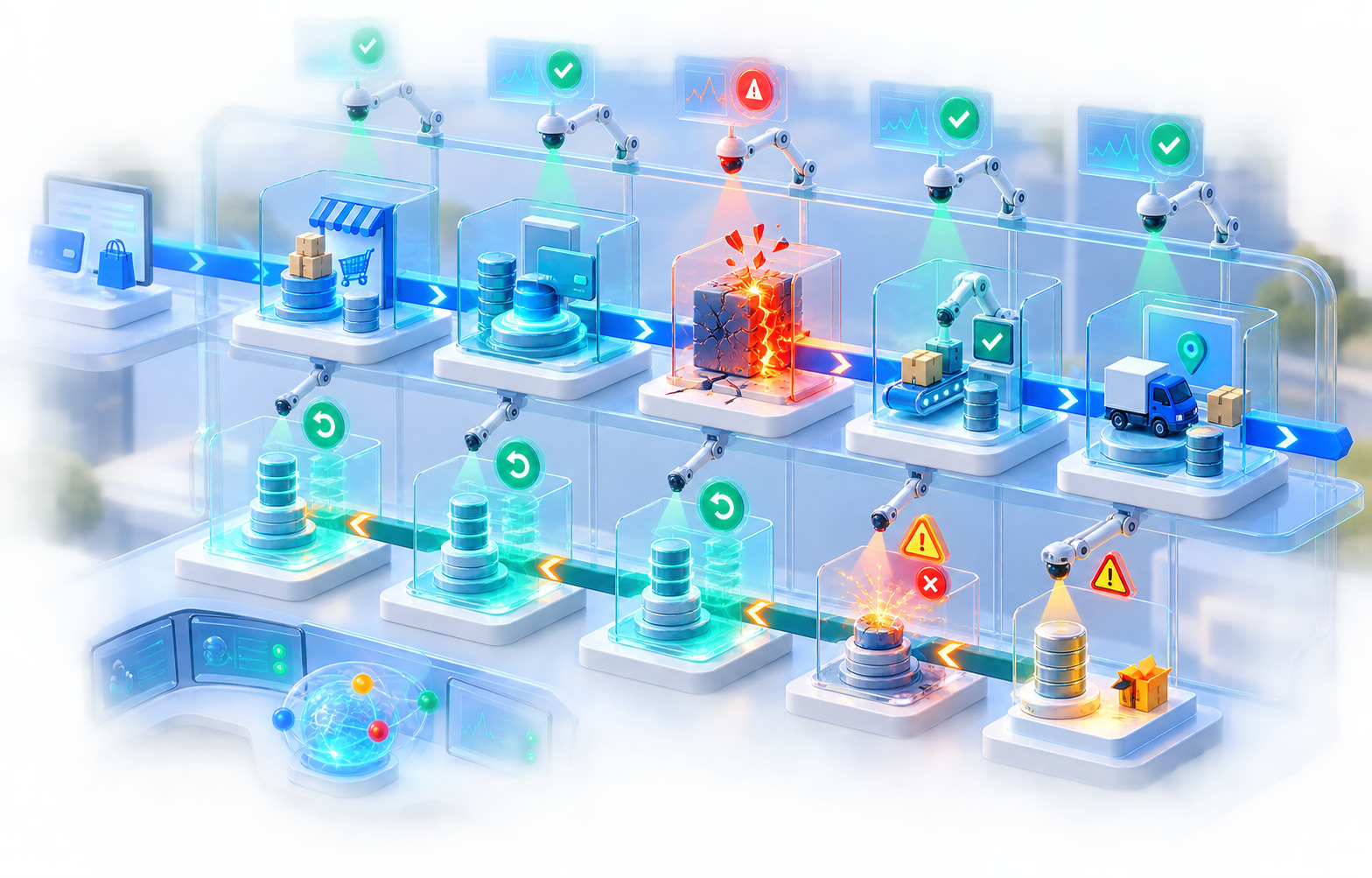
An engineering team renames a field in an API response — from customer_name to full_name — as part of a broader data model cleanup. The change goes through the same code review process as any other refactor: a pull request, a couple of approvals, a passing test suite. The test suite passes because it tests the API the way the team that owns it understands the API, and nobody on that team is currently building anything against the old field name, so nothing in the internal test suite exercises the old contract at all. The change ships.
Three days later, a partner integration that has been running unmodified for two years starts throwing null-reference errors in production, because it reads customer_name and has never heard of full_name. The partner's engineering team spends the better part of a day debugging their own system before finding the actual cause. The relationship survives, but the trust cost is real, and it was entirely avoidable — not because anyone wrote bad code, but because nobody treated the API's public contract as a thing that needed its own review, separate from the internal code review that happened.
This is the pattern this article addresses. Internal breaking changes get caught by internal tests, because the team writing the tests can see every internal consumer. Breaking changes to a public or partner-facing API get caught by production incidents, because the team shipping the change usually cannot see every external consumer, and the API's own test suite, written by the same team that owns the API, tends to test the API's current, intended behavior rather than the contract that past versions of the API actually promised and that real integrations are actually depending on. QAtronic works with engineering teams building and maintaining API-first products, and this piece lays out why this gap persists even at careful, well-resourced organizations, what a genuine API stability discipline looks like, and how to build one without freezing your API in place indefinitely.
Why Internal Code Review Doesn't Catch External Breaking Changes
The scenario in this article's opening is not a story about a careless team. It's a story about a structural blind spot that exists in almost every organization that has ever shipped a public or partner-facing API, and understanding why it exists is the first step to closing it.
Internal breaking changes are visible because the team making the change can, in principle, see every caller: the codebase is searchable, the internal consumers are other services owned by people in the same organization (or at least reachable through the same Slack), and a sufficiently thorough internal code review or a comprehensive internal test suite can catch a rename, a removed field, or a changed status code before it ships, because every internal consumer is, at least theoretically, enumerable.
External API consumers are not enumerable in the same way. A partner or third-party developer builds an integration against your API, and from that point forward, your team has no visibility into their code, no ability to grep their codebase for usages of a field you're about to rename, and often no reliable inventory of which specific fields, status codes, and edge-case behaviors any given consumer actually depends on — including behaviors your own team might consider incidental or unintentional, but that a consumer, having observed and built against the API's actual behavior rather than its documented behavior, now depends on regardless of what the documentation says was ever promised.
This asymmetry means the review process that reliably catches internal breaking changes — a knowledgeable reviewer looking at a diff and asking "does anything call this differently" — structurally cannot perform the same function for a public API, because the reviewer's knowledge of "anything that calls this" is necessarily incomplete for any consumer outside the organization. The gap isn't a process failure by the reviewer; it's a category error in applying an internal-consumer review process to an external-consumer surface, and it requires a genuinely different kind of testing and governance to close — which is the subject of the rest of this article.
What Actually Counts as a Breaking Change
Before building a process to prevent breaking changes, it's worth being precise about what actually qualifies, because the category is broader and less intuitive than "removed a field," and a surprising share of changes that ship without a second thought are breaking changes by any rigorous definition.
Unambiguously breaking: removing a field or endpoint; renaming a field (functionally equivalent to removal plus addition, from a consumer's perspective, since old code reading the old name gets nothing); changing a field's data type (a string becoming a number, or a single object becoming an array); changing a field's semantic meaning without changing its name or type (a status field that used to mean order status now meaning shipment status); adding a new required field to a request payload (any consumer not yet sending it now fails validation); changing an error response's status code or structure for an error condition consumers may be specifically handling; and changing default behavior when a parameter is omitted, since consumers who never specified the parameter were implicitly depending on the old default.
Commonly, incorrectly assumed to be safe: adding a new field to a response is usually safe for consumers using proper, defensive parsing, but is not safe for any consumer using strict schema validation that rejects unrecognized fields — a validation approach that is more common than API providers often assume, particularly among enterprise consumers with their own strict internal data-governance requirements. Reordering fields in a JSON response is safe for any consumer accessing fields by key, which is the overwhelming majority, but can break a consumer that, unusually but not impossibly, parses positionally. Changing the order of items in a returned list or array, when no explicit ordering was ever documented or guaranteed, is technically not a breaking change relative to any documented contract, but is very likely to break consumers who observed a stable order in practice and built logic that implicitly depends on it — which raises a point addressed later in this article: the actual contract a consumer depends on is not always the same as the contract you documented.
Changes that are breaking for some consumers and not others: tightening validation on an input field (rejecting a value that used to be silently accepted) breaks any consumer currently sending that now-rejected value, while having no effect on every other consumer — meaning the change can pass every internal test, appear completely safe in a staging environment using well-formed test data, and still break a meaningful share of real production traffic the moment it ships, precisely because staging test data rarely reproduces the full diversity of malformed or edge-case input that real, years-old integrations have been sending all along without anyone knowing it was technically invalid.
The practical takeaway: "is this a breaking change" is not reliably answerable by intuition or by asking whether the change feels large. It requires a specific, deliberate check against a documented understanding of the current contract — which is exactly the artifact most organizations don't have, and exactly the gap the rest of this article addresses.
Semantic Versioning and Its Limits for APIs
Semantic Versioning (SemVer) — the widely adopted convention of a MAJOR.MINOR.PATCH version number, where a MAJOR version increment signals a breaking change, MINOR signals backward-compatible new functionality, and PATCH signals a backward-compatible bug fix — provides a genuinely useful shared vocabulary for communicating the nature of a change. The specification's core discipline, in its own words, is that a MAJOR version bump is required whenever "any backward incompatible changes are introduced to the public API," which forces a team to explicitly classify each change rather than let it ship without a clear label.
Applied to package and library versioning, this convention works well, because a consumer chooses when to upgrade to a new major version, and can test that upgrade deliberately before adopting it. Applied naively to a web API, SemVer runs into a structural mismatch: unlike a library, where the consumer controls the exact moment of upgrade by changing a dependency version in their own build, a web API's provider often controls when a new version becomes the one actually being served, and many real-world API deployments do not cleanly separate "old major version" and "new major version" into two fully independent, indefinitely-supported code paths the way a library's versioned releases can — the underlying database schema, business logic, and infrastructure are frequently shared and evolving continuously underneath whatever version number is exposed at the interface layer, which makes maintaining multiple, fully faithful major versions simultaneously a genuinely difficult and expensive engineering commitment, not just a numbering convention.
This is not an argument against using SemVer-style major version numbers for an API — many well-run APIs do, and the discipline of explicitly classifying changes is valuable regardless of the specific numbering scheme — but it explains why some of the most mature, widely used APIs in the industry have moved toward a different model entirely, described in the next section, rather than a traditional major-version-per-breaking-change approach.
Date-Based Versioning: What Stripe's Approach Actually Solves
Stripe's publicly documented API versioning approach is a useful, real-world illustration of an alternative model built specifically to address the mismatch described above, and it's worth understanding on its own terms rather than as a universal prescription, because it solves a specific problem that not every organization has in the same form.
Stripe uses versions named by release date (for example, a version identified as 2017-05-24) rather than sequential major version numbers. According to Stripe's own public documentation and engineering blog, a merchant's account is automatically pinned to whatever the current version was at the time they made their first API request, which means new integrations never accidentally receive a breaking change simply because time passed — a real risk in any versioning scheme that has a single "current" version that changes underneath existing consumers without their explicit action. A consumer can choose to upgrade to a newer dated version deliberately, at a time of their choosing, by changing a version header or through Stripe's dashboard.
The mechanism underneath this model, as Stripe has publicly described it, is a stated commitment that "fields that were present before should stay present, and fields should always preserve their same type and name" — meaning the underlying data model doesn't fork into genuinely separate major versions; instead, each breaking change is captured as a small, isolated transformation that can be applied to translate a response from the current internal representation back into the shape a specific older dated version expects, applied sequentially as needed to satisfy whatever version a specific request is pinned to. This lets Stripe continue evolving its actual data model while still serving what is, from each consumer's perspective, a stable, unchanging contract for as long as they choose to remain on their pinned version.
Stripe's own stated philosophy, drawn from its public engineering writing, is instructive beyond the specific mechanism: the company frames its API as infrastructure, drawing an analogy to a power company that shouldn't change its voltage every two years, and explicitly states a preference for investing in getting API designs right before release rather than relying on versioning as a way to paper over design mistakes after the fact — treating versioning as a safety net for genuinely necessary evolution, not a routine tool for correcting avoidable design errors.
The broader lesson for organizations not operating at Stripe's specific scale is not necessarily "adopt date-based versioning" — building and maintaining the field-level transformation infrastructure this model requires is a real engineering investment that needs to be weighed against the size and stability requirements of your own consumer base — but rather the two underlying principles: default new integrations to an explicit, pinned contract rather than an ever-shifting "latest," and treat the up-front design review of a new API surface as the primary defense against needing a breaking change later, with versioning as the backstop for the cases that genuinely require it rather than the first-line tool for routine API evolution.
Consumer-Driven Contract Testing: Testing What You Can't See
The core technical problem this article has described — an API provider cannot enumerate every external consumer's actual dependencies — has a direct testing-methodology answer: consumer-driven contract testing, an approach built specifically around the insight that the contract an API needs to honor is best defined not by the provider's own understanding of its API, but by what actual consumers actually depend on.
The mechanism works, in its most common implementation (the open-source Pact framework is a widely used example, though it is one implementation of a broader pattern rather than the only one), as follows: each consumer of an API writes a lightweight test, from their own side of the integration, that specifies exactly what fields, structure, and behavior they actually depend on from a given API interaction — not everything the API returns, just the specific subset the consumer's own code actually uses. This test generates a "contract" — a machine-readable specification of the consumer's actual expectations — which is then published to a location the API provider can access. The provider, in turn, runs these consumer-generated contracts against their own API implementation as part of their own test suite and build pipeline, verifying that the current implementation still satisfies every published consumer contract before a change ships, not after.
This inverts the blind spot described at the start of this article. Instead of the provider trying to guess what external consumers might depend on, each consumer explicitly declares its actual dependencies, and the provider's CI pipeline fails the build — before deployment, not after a production incident — if a proposed change would violate any consumer's declared contract. The rename from customer_name to full_name in this article's opening scenario would, under this model, have failed the build the moment the partner's contract test (declaring a dependency on customer_name) ran against the proposed change, surfacing the conflict in a pull request rather than in the partner's production logs three days later.
The practical limitation of this approach, worth naming honestly, is that it requires participation from the consumer side: an external partner or public API consumer needs to actually write and maintain a contract test and make it available to the provider, which is a natural, low-friction expectation for a tightly coupled internal microservice architecture where every consumer is inside the same organization, and a much harder ask for a public API with an open, self-service developer ecosystem where most consumers will never write a formal contract test at all. For this reason, consumer-driven contract testing is most directly and completely applicable to internal service-to-service APIs and close, well-defined partner integrations, while public, open-registration APIs generally need to rely more heavily on the schema-based and staged-rollout techniques described later in this article, since there's no realistic way to collect a formal contract from every anonymous public API consumer.
The Expand-and-Contract Pattern for Safe Schema Evolution
For changes that genuinely require altering an existing field or endpoint's shape — as opposed to purely additive changes, which are usually, though not always, safe as discussed earlier — the expand-and-contract pattern (also called parallel change) provides a way to make the change without ever presenting consumers with a single, instantaneous breaking moment.
The pattern has three phases, each independently deployable and each leaving the system in a fully working state for all existing consumers throughout. In the expand phase, the new field, endpoint, or behavior is added alongside the old one, without removing or altering anything existing — for the field-rename scenario in this article's opening, this would mean adding the new full_name field to the response while continuing to populate customer_name exactly as before, so every existing consumer continues working entirely unaffected, and only new or updated consumers need to be aware the new field exists at all. In the migrate phase, consumers are actively, deliberately transitioned to the new field or behavior — through direct communication, documentation updates, and, where the relationship allows it, direct outreach to known consumers — while both old and new remain available, giving every consumer time to update on their own schedule rather than being forced to react to a sudden change. In the contract phase, once telemetry confirms (not assumes) that no meaningful traffic is still using the old field or behavior, the old version is finally removed — and this phase is where the deprecation process described in the next two sections becomes essential, because removing the old path prematurely, before consumers have actually migrated regardless of how much time has nominally been given, recreates exactly the breaking-change problem this pattern exists to avoid.
The discipline this pattern requires that many teams skip is the middle phase's reliance on actual usage telemetry rather than assumed migration completion. It is common for a team to complete the expand phase, announce the new field, wait what feels like a reasonable amount of time, and proceed to the contract phase based on the assumption that "surely everyone has migrated by now" — without ever actually instrumenting the old field's usage to confirm this. This assumption is wrong often enough, and the cost of being wrong (a repeat of this article's opening incident) is high enough, that usage telemetry on any field or endpoint slated for removal should be treated as a hard prerequisite for the contract phase, not an optional nicety.
Deprecation as a Managed Process, Not an Announcement
A deprecation notice in a changelog is not the same thing as a managed deprecation process, and the gap between the two is where most of the actual damage from API evolution occurs — not from the fact that something changed, but from the fact that the change happened faster, or with less warning, than affected consumers could reasonably act on.
A genuinely managed deprecation process has several components working together. It starts with explicit, machine-readable deprecation signaling, not just prose in a changelog that a developer has to be actively reading to notice. The IETF's RFC 8594 defines a standard Sunset HTTP response header specifically for this purpose, carrying a timestamp indicating when a resource is expected to become unavailable, along with a way to link to migration documentation — a mechanism designed to be programmatically detectable by API client tooling, rather than requiring a human to read and remember a blog post. A related, more recently developed Deprecation header addresses the earlier stage of the lifecycle — signaling that something is deprecated but not yet scheduled for removal — a distinction RFC 8594 itself draws explicitly, noting that the Sunset header is specifically for the decommissioning stage rather than the general "this is no longer recommended" stage. Using both, at the appropriate stage, gives consumers' own tooling a chance to surface the coming change automatically, rather than depending entirely on a human noticing a changelog entry.
Beyond signaling, a managed process requires usage-based notification rather than blanket announcement: identifying, wherever technically possible (authenticated API keys make this considerably easier than fully anonymous public endpoints), which specific consumers are still actively using a field or endpoint slated for removal, and reaching out to them directly and individually rather than relying solely on a general changelog post that most consumers, by any real-world measure, will never read until something breaks. A blanket changelog announcement is a necessary component of a good process, not a sufficient one.
It also requires a genuinely adequate notice period, calibrated to the realistic pace at which your specific consumer base can act, not to whatever timeline is most convenient for the team that wants the old code path removed. A well-resourced partner with a dedicated integration team might realistically act within weeks; a small business relying on an integration built years ago by a contractor who has since moved on might need months to even discover the need to act, let alone complete it — and a single fixed notice period applied uniformly across a diverse consumer base will, by construction, be adequate for some consumers and inadequate for others, which is why usage-based, individualized notification matters as much as the length of the notice period itself.
A Realistic Deprecation Scenario, Walked Through
The following is a hypothetical composite scenario, constructed to illustrate how a technically reasonable deprecation process can still produce real damage when the human and organizational dimensions are treated as secondary to the technical mechanics — it does not describe a specific QAtronic client or a real, identified incident.
The initial situation. A B2B SaaS company with a public API needs to remove a legacy authentication method, replacing it with a more secure, modern standard, for genuine and well-justified security reasons. The engineering team follows a reasonable-looking process: they announce the deprecation in the API changelog and via an email to all registered developer accounts, set a six-month notice period they consider generous, add a Sunset header to responses from the legacy authentication endpoint, and track it as a well-managed, textbook deprecation.
The hidden assumption. The six-month timeline was calibrated against the company's largest, most engaged, most technically sophisticated partners — the ones the team talks to regularly and who had, in informal conversation, indicated six months was comfortable for their own migration. The assumption, never explicitly examined, was that this timeline would be similarly comfortable for the company's long tail of smaller integrations: businesses that built an integration once, years earlier, often through a contractor or an employee no longer at the company, who have no dedicated engineering capacity actively monitoring the API changelog or reading unsolicited emails from a vendor about a technical change to an integration that, from their perspective, has been quietly working without any attention needed for years.
The technical and organizational cause. The deprecation email went to the technical contact on file at each account's registration — in many cases, for the smaller, older integrations, an email address belonging to someone who left the company long ago, or a shared inbox nobody actively monitors. The changelog announcement, while genuinely present, requires an active decision by someone to check it, which the sophisticated, actively engaged partners do routinely as part of their own vendor-management process, and which the long tail of smaller, "it just works" integrations essentially never does, because nothing in their own experience of the integration has ever required that kind of active monitoring before.
The consequence. On the day the legacy authentication method is actually removed, at the end of the six-month window, several dozen smaller integrations — invisible to the engineering team throughout the process because none of them had engaged with the changelog, the email, or any outreach — fail simultaneously. Support volume spikes sharply on the day of removal, disproportionately from small businesses without in-house technical staff, several of whom experience real, immediate business disruption (an order-processing integration that stops working, a payment reconciliation process that silently halts) before anyone on either side identifies the cause, because from the affected business's perspective, nothing about their own system changed — the failure appeared to come from nowhere.
The decision that needs to be made. The company faces a choice familiar to many organizations after this kind of incident: treat the affected accounts as having had adequate notice by any reasonable standard, since a genuine six-month notice period with multiple announcement channels was provided, and treat the resulting disruption as an unfortunate but not unreasonable consequence of consumers not monitoring their own vendor relationships adequately — or recognize that a notice process that technically satisfies a reasonable timeline can still functionally fail an entire segment of the consumer base, and that the responsibility for bridging that gap sits at least partly with the party that has better visibility into the change and better tooling to detect who's actually still affected.
The better approach. The more resilient version of this process, applied going forward, adds usage-based detection as a mandatory step before final removal: querying actual API traffic in the days immediately before the scheduled sunset date to identify accounts still actively using the deprecated authentication method, and triggering a final, individualized, higher-urgency outreach — potentially including a brief, one-time extension for accounts who can be shown to still be actively dependent — specifically for that remaining set, rather than treating the passage of the calendar deadline as sufficient justification for removal regardless of who's still measurably depending on it. This does not mean deprecations should never have a real deadline; it means the deadline should be enforced against actual, measured usage as the final gate, not against a calendar date alone, because the calendar date is a proxy for "consumers have had time to migrate," and proxies should be checked against the reality they're meant to represent before being acted on irreversibly.
What Belongs in the Contract and What Doesn't
A recurring source of disagreement in API breaking-change discussions is exactly what counts as "the contract" a provider is obligated to honor, and being explicit about this — ideally in written API design guidelines, not left to case-by-case debate — prevents both over-caution (treating every implementation detail as sacred) and under-caution (breaking things that were never formally documented but that consumers reasonably depended on anyway).
Explicitly documented behavior is unambiguously part of the contract, and any change to it is a breaking change by definition, regardless of how the change is justified internally. This is the easy case.
Consistently observed but undocumented behavior is a harder case, and the honest answer is that it is often part of the contract in practice, even though it was never part of the contract on paper. Consumers build against the API they can actually observe, not the API described in documentation that may be incomplete, outdated, or simply never read closely enough to notice a gap. A field's consistent ordering, a status code's consistent (if undocumented) meaning in a specific edge case, or a rate limit's actual observed threshold rather than its documented one, can all become de facto contract elements that real integrations depend on, whether or not the API provider ever intended to make that specific commitment. The practical response is not to treat every observed behavior as permanently frozen — that would make meaningful evolution impossible — but to explicitly evaluate, before changing undocumented-but-consistent behavior, whether it's likely enough to be depended on that it deserves the same expand-and-contract treatment as a documented field, rather than being changed without warning on the theory that "it was never promised."
Genuinely internal implementation details — response time characteristics not covered by an SLA, internal identifiers not exposed in any response, the specific technology stack behind the API — are not part of the contract, and treating them as if they were would make ordinary internal engineering work impossible. The distinction that matters is observability from the consumer's side: if a consumer can observe it by calling the API, it's a candidate for being part of the de facto contract; if it's purely internal and has no observable effect on any API response or behavior, it isn't.
Error messages and error response bodies occupy an ambiguous middle ground worth calling out specifically. Teams frequently treat error message text as a purely cosmetic detail, safe to reword freely, while some consumers — often more than a provider expects — parse specific substrings of error messages to drive their own error-handling logic, particularly for error conditions where no more structured error code was provided. This is a strong argument, independent of the breaking-change discussion, for always providing a stable, structured, documented error code alongside any human-readable error message, specifically so that the human-readable text remains free to improve without becoming an accidental part of the contract that a poorly designed error-handling scheme forced it into.
Internal APIs, Partner APIs, and Public APIs: Different Stability Bars
Not every API needs the same stability discipline, and treating an internal microservice interface with the same process overhead as a public, third-party-facing API is a real cost that isn't justified by a proportionate reduction in risk.
Internal service-to-service APIs, where every consumer is inside the same organization, can reasonably rely primarily on the visibility and coordination advantages described earlier in this article — a searchable codebase, direct communication with consuming teams, and consumer-driven contract testing, which is genuinely practical to implement at the internal scale where every consumer can realistically be asked to write a contract test. Breaking changes here are still real events that deserve coordination, but the tooling and process overhead of a full public-API governance model is usually disproportionate to the risk.
Partner and B2B integration APIs, where the number of consumers is large enough that direct, individual coordination for every change is impractical but small and identifiable enough that usage-based tracking and individualized deprecation outreach (as described in the scenario above) is genuinely feasible, sit in a middle zone that benefits most directly from the expand-and-contract pattern, structured deprecation signaling (the Sunset and Deprecation headers), and, where the relationship supports it, consumer-driven contract testing with the largest or most strategically important partners specifically, even if it isn't practical to extend to every partner.
Fully public, self-service, open-registration APIs — where consumers can sign up and start building without any direct relationship with the provider — carry the highest stability bar and the fewest tools for individualized coordination, because there's often no reliable way to reach every consumer directly, no formal contract-testing relationship to lean on, and a genuinely long tail of small, inactive-looking-but-still-live integrations that usage telemetry, not assumption, is the only reliable way to detect. This is the category where the Stripe-style approach of defaulting new consumers to a stable, pinned contract, combined with rigorous up-front design review to minimize the frequency of breaking changes in the first place, matters most, precisely because the individualized outreach options available to a partner-API provider are much weaker here.
Governance: Who Approves a Breaking Change
A technical process for detecting and managing breaking changes needs an organizational counterpart: an explicit answer to who has the authority to approve a breaking change to a public or partner API, because without one, the decision defaults to whoever happens to be reviewing the specific pull request that contains it — usually a peer engineer evaluating the change on its internal technical merits, without necessarily having visibility into, or explicit authority over, the external-consumer risk this article has focused on throughout.
A reasonable governance model designates a specific, accountable review step — a dedicated API design reviewer, a small API governance group, or, for smaller organizations, simply an explicit requirement that any change touching the public contract gets a second, specific sign-off focused exclusively on backward compatibility, separate from the general code review focused on internal code quality. The specific structure matters less than the existence of an explicit, non-bypassable checkpoint that isn't relying on the same reviewer who evaluates internal code quality to also independently think to evaluate external consumer impact, since those are genuinely different review skills and different areas of context, and expecting one reviewer to reliably do both, unprompted, on every change, is how the scenario at the start of this article happens even at organizations with genuinely rigorous internal code review standards.
This governance step should have real teeth — the authority to block a merge or a deployment, not just the authority to leave a comment that can be overridden under deadline pressure — because a breaking-change review process that can be bypassed whenever a release deadline is tight will, predictably, be bypassed most often exactly when the underlying change has had the least scrutiny, which is precisely the condition under which a breaking change is most likely to slip through.
Communicating Change to Consumers Who Don't Read Changelogs
A recurring theme through the deprecation scenario and the governance discussion above is that a technically correct communication ("we announced it") is not the same as an effective one ("the people who needed to know found out in time to act"), and this gap deserves direct attention because it's where good-faith, well-documented processes still produce real damage.
The realistic baseline assumption should be that most API consumers do not proactively monitor a changelog, do not reliably read vendor emails, and will first learn about a breaking change when something in their own system stops working — which means the entire communication strategy should be built around minimizing how many consumers reach that failure point, rather than around producing a defensible paper trail that a notice was technically given. This reframing has concrete implications: machine-readable signaling (the Sunset and Deprecation headers discussed earlier) matters more than prose announcements, because it can be detected automatically by client tooling regardless of whether a human ever reads anything; usage-based, individualized outreach matters more than a single blanket announcement, because it reaches specifically the accounts still at risk rather than assuming a general announcement reached everyone equally; and a final, active check against real usage data immediately before an irreversible removal — as illustrated in the walked-through scenario — is the last and most important safety net precisely because it catches the consumers who were never going to see any of the earlier communication regardless of how well it was executed.
Webhooks and Asynchronous Contracts: The Same Problem, Harder to See
Everything discussed so far has focused on request-response APIs, where a consumer actively calls an endpoint and can, at least in principle, be identified through authentication and API keys. Webhooks — where the provider pushes data to a consumer-specified endpoint asynchronously, in response to an event — carry the same breaking-change risks with an additional layer of difficulty: the provider often has even less visibility into how a consumer's webhook receiver actually processes the payload than it does into how a direct API caller processes a response, because a webhook payload is typically consumed by backend code with no interactive session and no immediate, visible error surfaced back to a human at the point of failure.
A breaking change to a webhook payload's structure — the same categories of change discussed earlier in this article: renamed fields, changed types, altered semantics — can silently fail at a consumer's webhook endpoint for an extended period before anyone notices, particularly if the consumer's own error handling for webhook processing is less rigorous than their error handling for direct, synchronous API calls, which is common, because webhook receivers are often built and tested less thoroughly than the primary, more visible integration surface. This makes the usage-telemetry discipline described throughout this article even more important for webhook contract changes specifically: monitoring webhook delivery success rates (not just delivery attempts) at a level of granularity that can detect a spike in receiver-side errors following a payload change, and treating a rise in webhook delivery failures following a deployment as a specific, monitored signal deserving immediate investigation, rather than an ambient, expected background rate that gets attention only if a consumer proactively complains.
Schema Diffing and Traffic Replay: Testing Beyond Declared Contracts
Consumer-driven contract testing, described earlier, is the strongest available tool when consumers can be identified and enlisted to declare their dependencies — but for the large, partly anonymous public API consumer base that many organizations serve, a meaningful share of actual usage will never be captured by a formal, consumer-authored contract. Two additional, complementary techniques help close that gap by working from the provider's side alone, without requiring consumer participation.
Schema diffing compares a proposed API change against the previously published schema — typically an OpenAPI or similar machine-readable specification — and automatically flags any change that falls into the breaking categories described earlier in this article: a removed field, a changed type, a newly required parameter, an altered enum value set. This can run automatically in a CI pipeline, failing a build or at minimum flagging a required manual review whenever a proposed change alters the published schema in a way that matches a known-breaking pattern, which converts the informal, intuition-based classification this article has argued against into an automated, consistent check that doesn't depend on the reviewing engineer happening to remember the full list of breaking-change categories on any given day. The limitation of schema diffing, worth naming honestly, is that it can only catch changes to what's actually captured in the schema — it won't catch a change to undocumented-but-relied-upon behavior, a change to field ordering where ordering was never formally specified, or a semantic meaning change that doesn't alter the schema's structure or types at all, which is why schema diffing is a strong first-line automated check but not a complete substitute for the human judgment the governance step described earlier in this article provides.
Traffic replay (sometimes implemented through a shadow-traffic or dark-launch pattern) takes a different, complementary approach: rather than analyzing the schema in the abstract, it captures a sample of real, live production requests and replays them against the proposed new version of the API in a non-production or shadow environment, comparing the actual responses produced by the old and new versions for the exact same real-world inputs. This has a distinct advantage over both contract testing and schema diffing: it exercises the API against the genuine diversity of real production traffic — including the malformed, edge-case, and unusual inputs discussed earlier in this article that a hand-built test suite is unlikely to include — rather than against a curated set of expected scenarios, which means it can surface exactly the kind of validation-tightening breaking change described earlier (a previously-accepted input value now being rejected) that would otherwise only be discovered when it actually breaks a real, active integration in production.
Traffic replay requires meaningful infrastructure investment — capturing and safely replaying real traffic without triggering unintended side effects (a replayed request that creates a duplicate order, for instance, would be a serious problem in its own right) requires careful design, typically limiting replay to read-only or clearly idempotent operations, or replaying against an isolated environment with side effects deliberately suppressed or redirected. This investment is generally justified for high-traffic, high-stakes public APIs where the cost of an undetected breaking change is high and the diversity of real traffic is large enough that no synthetic test suite could realistically approximate it; for a smaller API with a limited, known consumer base, the simpler and cheaper combination of schema diffing and direct partner communication described earlier in this article is usually sufficient, and building shadow-traffic replay infrastructure ahead of actually needing it is effort better spent elsewhere.
Measuring API Stability as an Ongoing Property
A stability practice that is never measured is a set of good intentions, not a verified discipline, and the difference matters because several of the mechanisms described in this article — governance sign-off, deprecation processes, contract testing — can exist on paper while quietly eroding in practice if nobody is tracking whether they're actually working.
Breaking-change incident rate, tracked as the number of production incidents specifically caused by an API contract change reaching a consumer without adequate warning, is the most direct measure of whether the overall practice is working, and it should be tracked as its own category rather than folded into general production incident metrics, precisely because folding it in obscures the specific pattern this article addresses and makes it harder to notice whether the rate is improving, worsening, or staying flat as the API and its consumer base grow.
Time from consumer-visible failure to root-cause identification — how long it took, in the incidents that do occur, to recognize that a provider-side API change was the actual cause, as opposed to the affected consumer initially (and often for some time) assuming the problem was in their own system — is a measure of whether the provider has adequate visibility into its own change history relative to consumer impact. A consistently long time-to-identification suggests the organization lacks an easy way to correlate a consumer's reported symptom with a specific recent API change, which is a fixable process and tooling gap distinct from the question of whether the change should have been made at all.
Deprecation completion rate at the originally scheduled removal date, tracked as the percentage of previously-identified active consumers who had actually migrated away from a deprecated field or endpoint by the time it was originally scheduled for removal, directly measures whether the notice periods and outreach efforts described earlier in this article are calibrated realistically. A consistently low completion rate at the scheduled date — requiring repeated extensions to avoid breaking a large remaining population — is a signal that the organization's assumed notice period is systematically too short for its actual consumer base, a finding that should feed back into recalibrating future deprecation timelines rather than being treated as a one-off surprise each time it recurs.
Contract test coverage relative to actual integration count, for organizations using consumer-driven contract testing, tracks what fraction of known active integrations actually have a corresponding contract test in the pipeline, as opposed to the number that exist in principle but have gone stale, been abandoned by a partner's own team turnover, or were never actually completed despite an initial commitment to do so. This number tends to decay over time without active maintenance, in the same way any test suite decays, and treating it as a tracked, reviewed metric rather than a one-time setup accomplishment keeps the actual protective coverage honest.
Webhook delivery failure rate, tracked continuously as a first-class operational metric rather than only investigated reactively when a consumer complains, catches the asynchronous contract breaks discussed earlier in this article — and is worth tracking with the same seriousness as any other core reliability metric, since, as established earlier, webhook failures are structurally more likely to go unnoticed for longer than a synchronous API failure would.
A Practical Testing and Governance Framework
The following framework consolidates the mechanisms discussed throughout this article into a structured practice, organized by when in the change lifecycle each mechanism applies.
| Stage | Mechanism | Purpose |
|---|---|---|
| Design | API design review with an explicit backward-compatibility checklist | Catch likely-breaking design choices before implementation begins, when they're cheapest to change |
| Pre-merge | Consumer-driven contract tests run in CI, for internal and key partner consumers | Fail the build automatically if a change violates a known consumer's declared dependencies |
| Pre-merge | Explicit breaking-change classification against the categories described earlier in this article | Force an active determination of whether a change is breaking, rather than leaving it to intuition |
| Pre-merge | Dedicated backward-compatibility sign-off, separate from general code review | Ensure external-consumer impact gets deliberate, accountable review, not incidental attention |
| Release | Expand-phase-only deployment for any change affecting an existing field or endpoint | Ensure no existing consumer is affected at the moment of deployment |
| Post-release | Usage telemetry on any field or endpoint marked for eventual removal | Replace assumption with evidence before proceeding to the contract phase |
| Deprecation | Sunset and Deprecation HTTP headers, plus individualized outreach to identifiable active users | Maximize the chance that affected consumers learn about the change before it affects them |
| Pre-removal | Final usage check against real traffic immediately before irreversible removal | Catch the long tail of consumers who never engaged with any earlier communication |
| Ongoing | Webhook delivery failure rate monitoring, tracked as a first-class signal | Detect asynchronous contract breaks that have no interactive failure surface |
Startups, Scale-Ups, and Enterprises: Proportionate Rigor
Early-stage companies building their first public or partner API, with a small number of known, direct-relationship consumers, should prioritize the up-front design review and direct communication channel over heavier tooling investments like consumer-driven contract testing infrastructure — at this stage, a genuine, proactive relationship with each of a small number of partners, including advance notice of upcoming changes as a matter of course, often achieves the same outcome as more formal tooling would, at a fraction of the setup cost, and building the heavier tooling before there's a consumer base large enough to need it is effort better spent elsewhere.
Scale-up companies with a growing partner ecosystem and the beginnings of a genuinely public, self-service API tier are the segment most likely to have outgrown the "we know all our partners personally" stage without having built the corresponding formal governance and tooling — this is the point at which explicit breaking-change classification, a dedicated backward-compatibility review step, and structured deprecation signaling (the Sunset and Deprecation headers) typically deliver the highest return relative to their implementation cost, because the consumer base has grown past the point where informal coordination reliably works but hasn't yet reached a scale that requires the most expensive tooling investments.
Enterprise organizations with a large, diverse, partly anonymous public API consumer base should generally be operating close to the full framework above, including genuine usage-telemetry-gated deprecation and, for the largest strategic partners, consumer-driven contract testing — at this scale, the cost of a breaking-change incident (in support volume, in partner trust, in the kind of reputational damage that shows up in developer community discussion of whether your API is safe to build on) reliably exceeds the cost of the governance investment, and the Stripe-style investment in preserving old contracts indefinitely through internal transformation logic becomes a genuinely justified engineering investment rather than overkill.
When Breaking Changes Are the Right Call
None of this article argues that an API should never change, or that stability should be pursued at any cost — a small number of honest exceptions are worth naming directly.
A security vulnerability that can only be fixed by changing behavior that some consumers depend on is a case where the breaking change is not just justified but obligatory, and the deprecation process should compress accordingly — shorter notice, more urgent individualized outreach, and a clear, direct explanation of why the normal timeline doesn't apply, rather than either skipping the process entirely (which still causes unnecessary consumer confusion even in a genuine emergency) or insisting on a normal-length notice period for a change that genuinely cannot wait.
A young API with a very small number of consumers, all in active, ongoing conversation with the provider, may reasonably decide that the overhead of formal versioning and deprecation tooling isn't justified yet, and that direct communication is sufficient — provided this is a deliberate, revisited decision as the consumer base grows, rather than a default that simply never gets revisited until an incident like the one in this article's opening forces the question.
And a genuinely poor early API design decision — a field name that turned out to be confusing, a data model that doesn't scale to a feature the product has since grown into needing — sometimes justifies a breaking change specifically because the ongoing cost of maintaining backward compatibility with a design everyone agrees was a mistake exceeds the one-time cost of a well-managed, appropriately communicated break. The point of this article is not that breaking changes are always wrong; it's that they should be a deliberate, reviewed, well-communicated decision rather than an unexamined side effect of a change that looked purely internal to the team that shipped it.
A useful test for distinguishing a justified breaking change from an avoidable one is to ask whether the same outcome could have been achieved through the expand-and-contract pattern described earlier, at the cost of some additional engineering time maintaining both the old and new paths temporarily. If it could, and the only reason to skip that path is convenience or schedule pressure rather than a genuine constraint like a security emergency or an external regulatory mandate, that's a signal the break isn't actually necessary — it's merely cheaper for the provider in the short term, with the cost shifted onto consumers who had no say in the trade-off.
Documentation as a Testable Artifact, Not Just a Reference
One underlying enabler of nearly every mechanism described in this article — schema diffing, contract testing, the explicit definition of what belongs in the contract — is having an accurate, machine-readable specification of the API in the first place, and it's worth addressing directly why this is harder to achieve and maintain than it sounds, and why treating documentation as a testable artifact rather than a static reference document changes the equation.
The common failure pattern is documentation drift: an OpenAPI specification or equivalent schema document is written when an endpoint is first built, accurately reflecting its behavior at that moment, and then gradually diverges from the actual implementation as the endpoint evolves, because updating the specification is a separate, easily-forgotten step from updating the code, with no automatic enforcement linking the two. Months or years later, the specification that schema-diffing tools and external documentation both rely on no longer accurately describes what the API actually does, which means schema diffing — however well implemented as a technique — is only as trustworthy as the specification it's comparing against, and a stale specification can either produce false confidence (failing to flag a real breaking change because the stale spec never captured the field being changed) or false alarms (flagging a change to something the spec describes incorrectly, when the actual behavior never matched the documented behavior in the first place).
The more durable solution treats the specification as generated from, or continuously validated against, the actual implementation, rather than maintained as a hand-written, parallel document. Several common approaches achieve this: generating the specification directly from code annotations or type definitions, so the specification is mechanically derived from the same source of truth as the implementation and cannot drift independently; or, where the specification is authored separately, running automated contract tests that validate live API responses against the published specification on every deployment, treating any mismatch as a build failure regardless of which side — the code or the spec — turns out to be wrong. Either approach converts documentation from a best-effort reference that quietly rots into a continuously validated artifact that the rest of the stability framework in this article can actually depend on.
Questions Executives Should Ask About Their API's Stability
A short set of direct questions tends to reveal whether an organization's API stability practice is real or aspirational: Do we have an explicit, written definition of what counts as a breaking change for our API, or does that determination happen case by case, informally, in code review? Who specifically has the authority to block a breaking change from shipping, and has that authority ever actually been exercised, or does it exist only on paper? When we last deprecated a field or endpoint, did we base the final removal decision on actual, measured usage data, or on the passage of a calendar deadline? Do we have any visibility at all into webhook delivery failure rates, or would a payload-breaking change to a webhook currently go undetected until a consumer complained? If a major partner integration broke tomorrow because of something we shipped, how long would it take us to even identify that our own change was the cause? And is our published API specification something we can trust as an accurate, current description of what the API actually does today, or would checking that require someone to manually compare it against the live behavior?
FAQ
Is it ever acceptable to skip a deprecation period entirely? Generally no, except in genuine security emergencies, and even then, some communication — however compressed — is better than none. A breaking change shipped with zero warning, for a non-emergency reason, reliably produces the worst version of the trust damage this article has described, because it signals to consumers that the provider either didn't consider their dependency at all or didn't consider it important enough to warn about.
How do we find out what undocumented behavior our consumers actually depend on? There's no complete solution, but usage telemetry on specific fields and endpoints, consumer-driven contract tests where you can get partners to participate, and treating any support ticket that reveals an undocumented dependency as a signal worth recording (not just resolving) all incrementally improve visibility. The honest position is that you will never have complete visibility into every consumer's actual dependencies, which is precisely why the expand-and-contract pattern and usage-based deprecation gating — designed to work even without complete visibility — matter more than trying to achieve complete visibility as a prerequisite.
Do these practices apply to internal APIs consumed only by mobile apps we control ourselves? Partially, and the distinction is worth drawing out because it's a common edge case. A mobile app is technically a consumer the provider "controls" in the sense of owning the code, but it behaves like an external, uncoordinated consumer in one crucial respect: you cannot force every installed copy of the app to update instantly the way you can redeploy a backend service, because users update client apps on their own schedule, and a meaningful population will be running an older version for weeks or months after a new one ships. This means a backend API serving a mobile client needs the same backward-compatibility discipline described throughout this article — expand-and-contract evolution, careful handling of older client versions — even though there's no external partner relationship involved at all, simply because of the update-lag mobile clients introduce.
Does GraphQL solve the breaking-change problem that REST APIs have? It changes the shape of the problem rather than eliminating it. GraphQL's field-level query model means consumers only receive the specific fields they request, which reduces the risk of an added field breaking a strict-schema consumer, and its introspection capabilities make usage telemetry on individual fields somewhat more natural to implement. It does not eliminate the risk of removing or changing the meaning of a field a consumer actively queries, and GraphQL schemas still require the same deliberate deprecation discipline (GraphQL has its own built-in @deprecated directive for exactly this purpose) rather than being inherently immune to the problem this article describes.
What's the single highest-leverage first step for an organization with no formal process today? Writing an explicit, internal definition of what counts as a breaking change for your specific API, using the categories in this article as a starting point, and requiring an explicit yes/no classification against that definition for any pull request touching the public contract. This is inexpensive to implement, requires no new tooling, and directly addresses the core problem described at the start of this article: a change that looked purely internal to the engineer making it, evaluated without ever explicitly asking the external-impact question at all.
How does API contract stability relate to internal microservice architecture decisions? They're related but distinct disciplines. Internal service boundaries can and often should evolve more fluidly than a public API contract, precisely because internal consumers are visible and coordinatable in a way external consumers are not, as discussed earlier in this article. Conflating the two — either applying public-API-level rigor to every internal service interface, or applying internal-service-level flexibility to a public API — produces either unnecessary process overhead in the first case or the exact risk this article addresses in the second.
Should our API documentation be generated from code, or is a well-maintained hand-written specification good enough? A well-maintained hand-written specification can work, but "well-maintained" is doing a lot of work in that sentence, and the discipline required to keep a hand-written specification continuously accurate, without any mechanical link to the actual implementation, is harder to sustain over time than teams initially expect — which is exactly the documentation-drift pattern described earlier in this article. Generating the specification directly from code, or validating it continuously through automated contract tests against live responses, removes the dependency on sustained manual discipline and is generally the more durable choice as an API and its team grow, though a small, stable API with a single dedicated owner can reasonably sustain a hand-written approach for longer than a larger, more actively evolving one.
How do we handle a breaking change that's required by a change in a regulation or a payment network rule, not our own product decision? This falls into the same emergency-adjacent category as a security fix: the change is not optional, but the deprecation process should still compress rather than disappear entirely. Direct, urgent, individualized communication explaining the external mandate driving the change, as much advance notice as the external deadline actually allows, and, where the mandate allows any flexibility at all, prioritizing the usage-based final check described earlier in this article for the specific consumers most likely to be affected, gives the affected consumer base the best realistic chance to adapt even under a compressed and non-negotiable timeline.
Conclusion: Ship the Feature, Keep the Promise
The rename from customer_name to full_name in this article's opening was not a bad engineering decision. It was a reasonable, ordinary piece of internal cleanup, reviewed by the process that reliably catches internal breaking changes and structurally cannot see external ones. The gap wasn't competence; it was a category error in applying an internal review model to an external-facing contract, and that category error is close to universal in organizations that haven't deliberately built a separate discipline for it.
The distinction worth carrying forward is that a public or partner API is a product commitment, not an implementation detail, and it deserves the same category of deliberate governance — explicit definitions, accountable sign-off, and evidence-based rather than calendar-based decisions — that a mature organization already applies to its other product commitments. The technical mechanisms described in this article — consumer-driven contract testing, expand-and-contract evolution, structured deprecation signaling, usage-gated removal — all serve one underlying goal: making the actual state of external dependency visible enough that a breaking change is a deliberate, reviewed decision rather than something that happens to a partner's production system before anyone on the provider's side even knows it occurred.
The question worth asking this quarter is not whether your API has ever had a breaking change — every API eventually does. It's whether your organization would find out about the next one from a passing contract test, or from a partner's support ticket.
Neither answer requires heroics to get right, and neither requires freezing your API in place indefinitely, which is the false choice this discussion sometimes collapses into. Every mechanism described in this article — expand-and-contract evolution, schema diffing, usage-gated deprecation, a dedicated backward-compatibility sign-off — exists specifically to let an API keep evolving, keep improving, and keep shedding genuine design mistakes, while converting the moment a change actually reaches an external consumer from an unmanaged surprise into a deliberate, visible, reviewed event. That distinction, more than any specific tool or technique in this article, is the actual discipline worth building.
QAtronic works with engineering teams to build API stability practices that scale with their consumer base — from breaking-change classification and consumer-driven contract testing to deprecation processes that check real usage before an irreversible removal — matched to whether you're managing a handful of direct partner relationships or a large, partly anonymous public developer ecosystem. If your organization's honest answer to "how would we find out" is "when someone complains," that gap is worth closing before it closes itself the hard way.